BlogGuide
Project Proposal Template: 8 One-Page Examples and How to Fill Yours In
A free one-page project proposal template, 8 real examples (campaign, business case, charter, grant, partnership) and the 7 parts a proposal needs.

By MakeOnepagers Team
Updated · 11 min read
A project proposal template gives you the parts a decision maker needs to approve a project: what you are asking for, why it matters now, the plan, what it costs and how long it takes, what it returns, the risks, and the decision you need by a date. Below is a free one-page version you can fill in, followed by eight real examples, each for a different kind of project, with what each one gets right.
One‑Pager examples
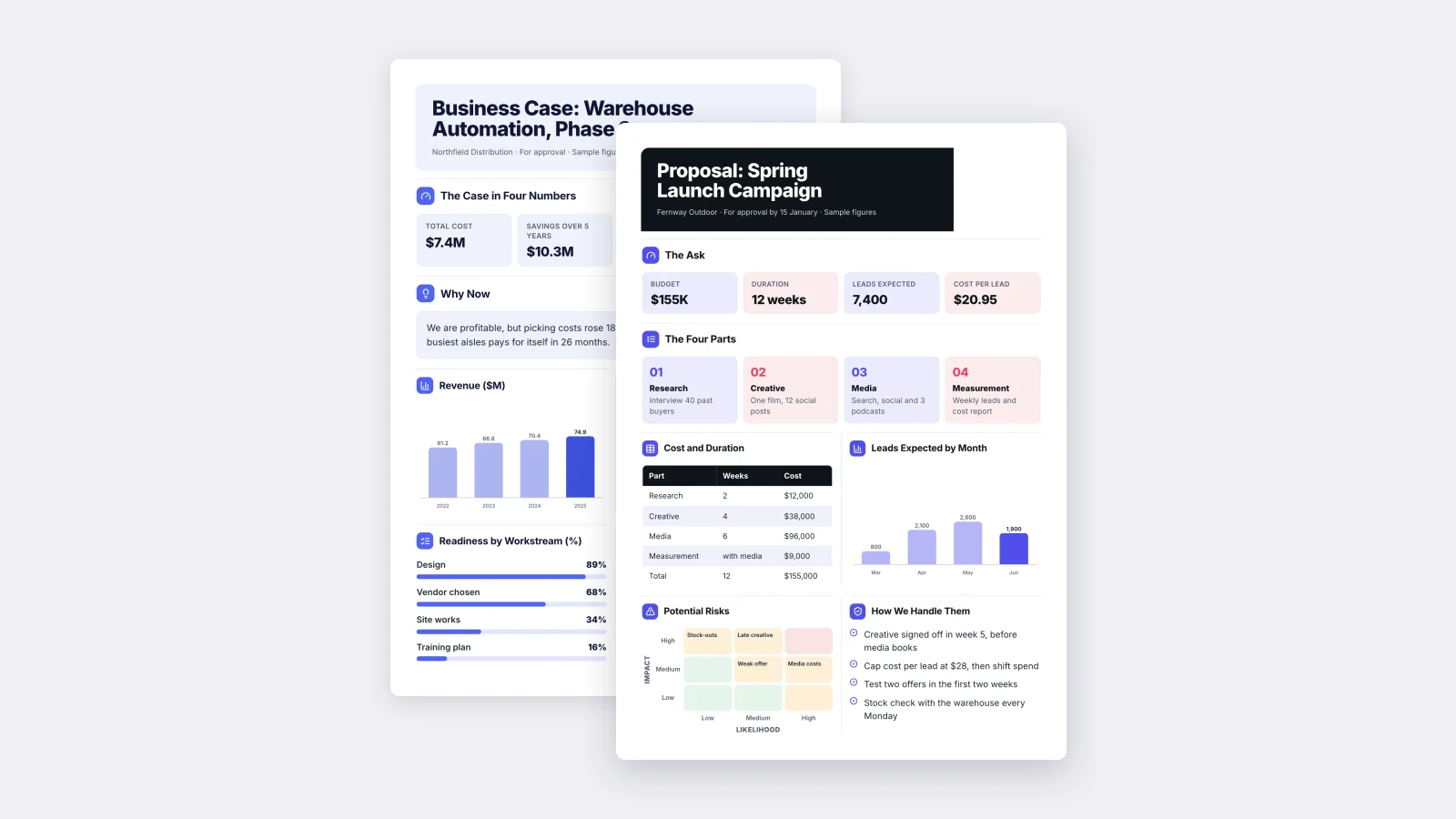
Six real One-Pagers made with MakeOnepagers. Open any one to edit it as your own.
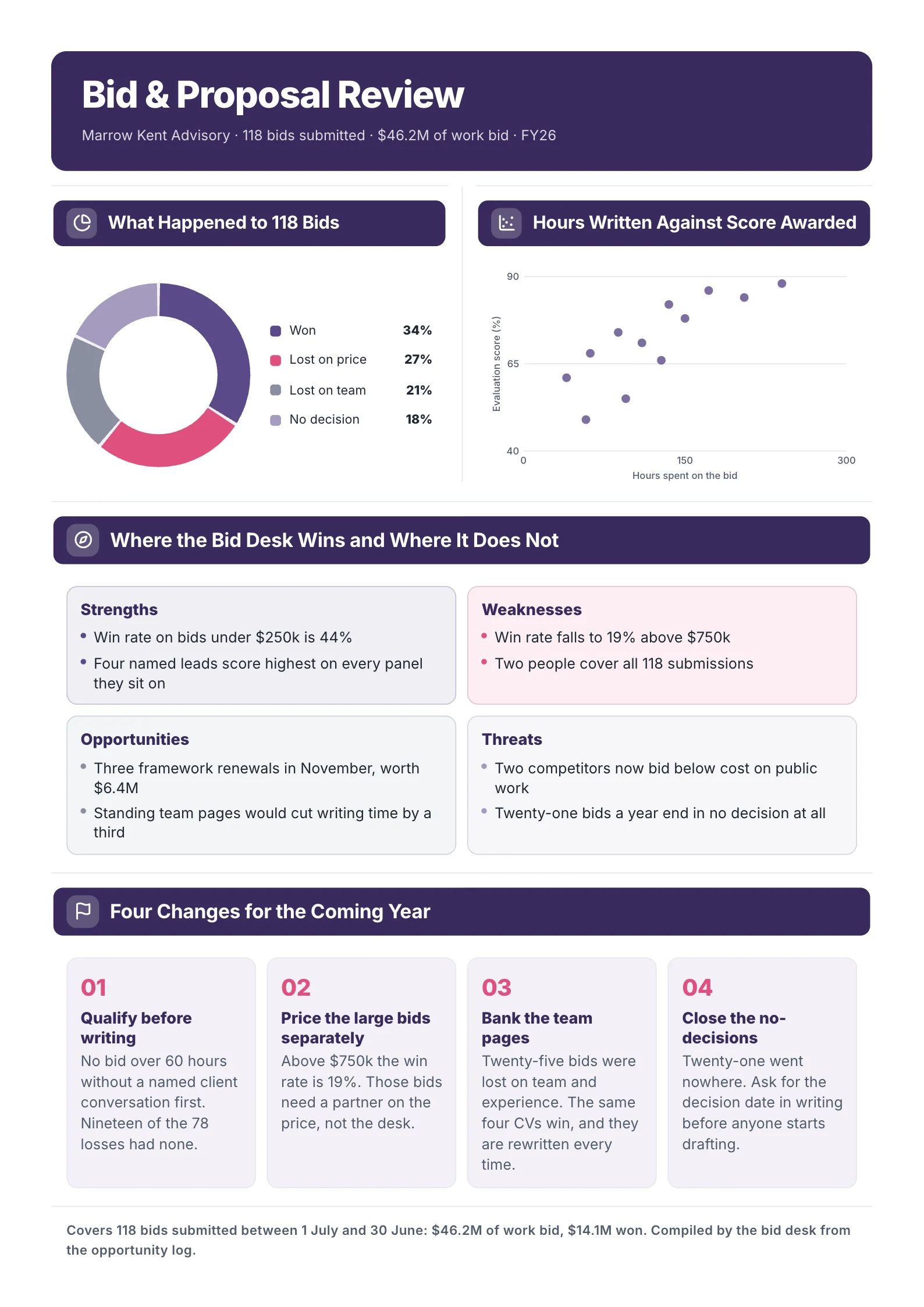
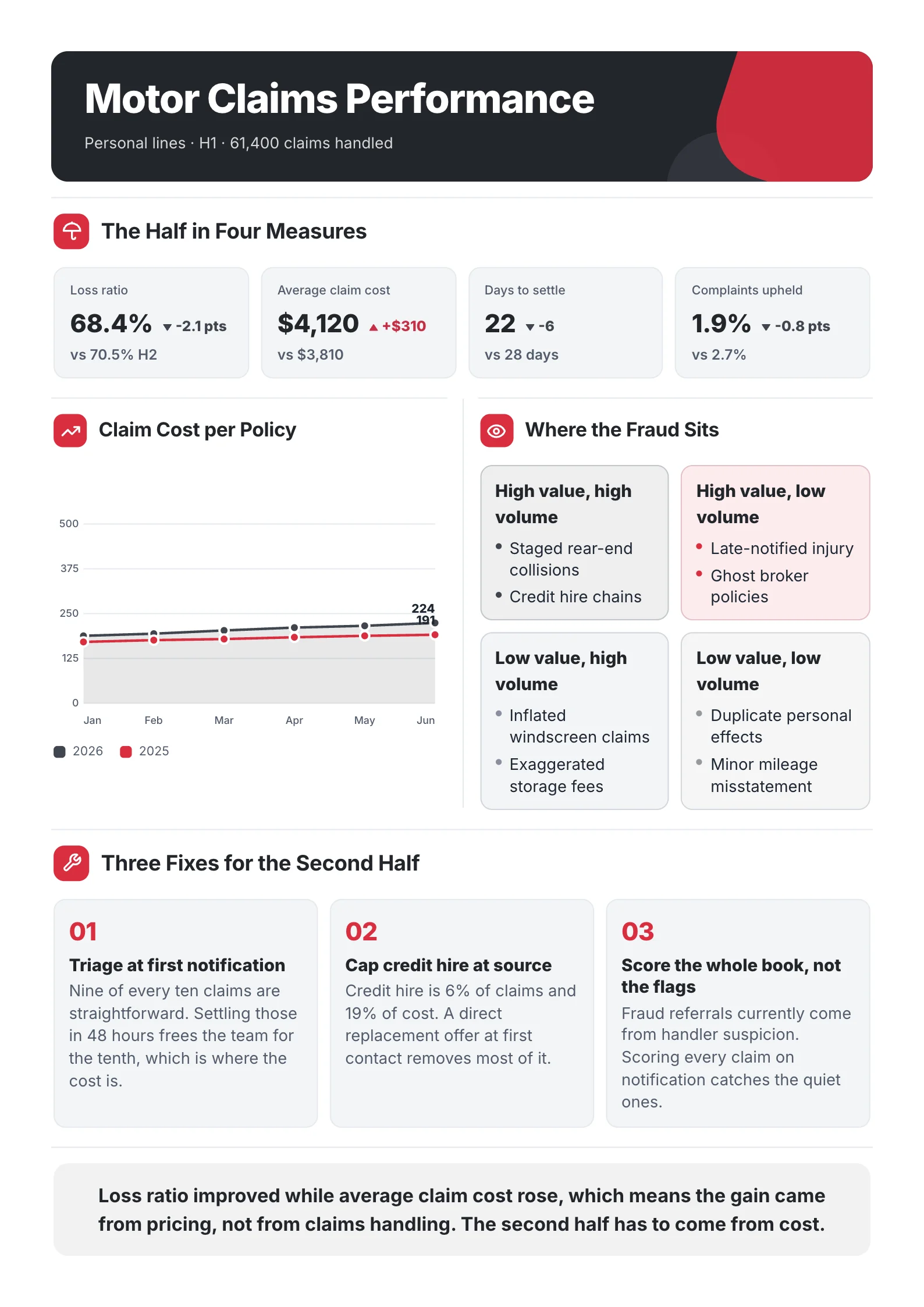
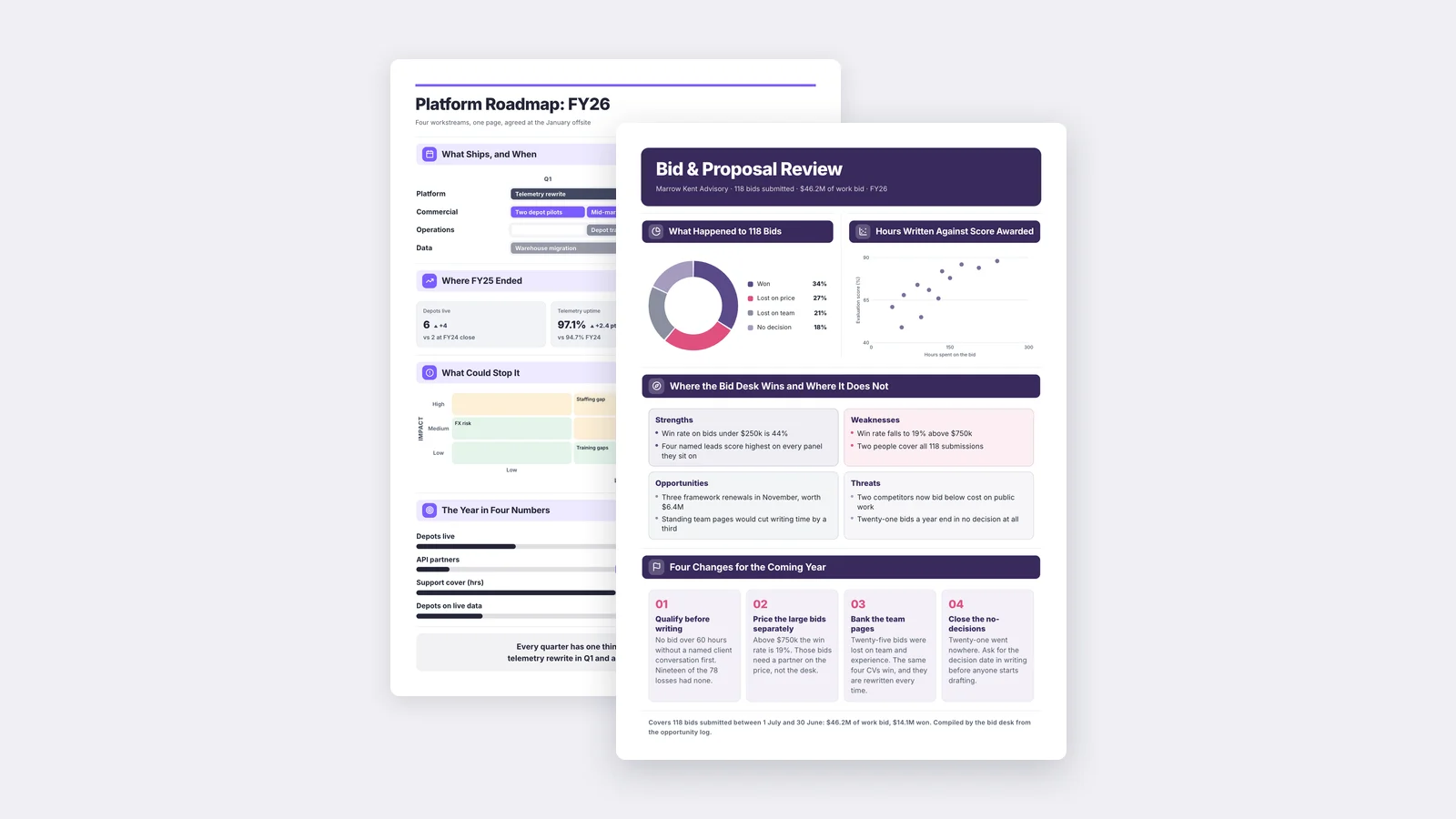
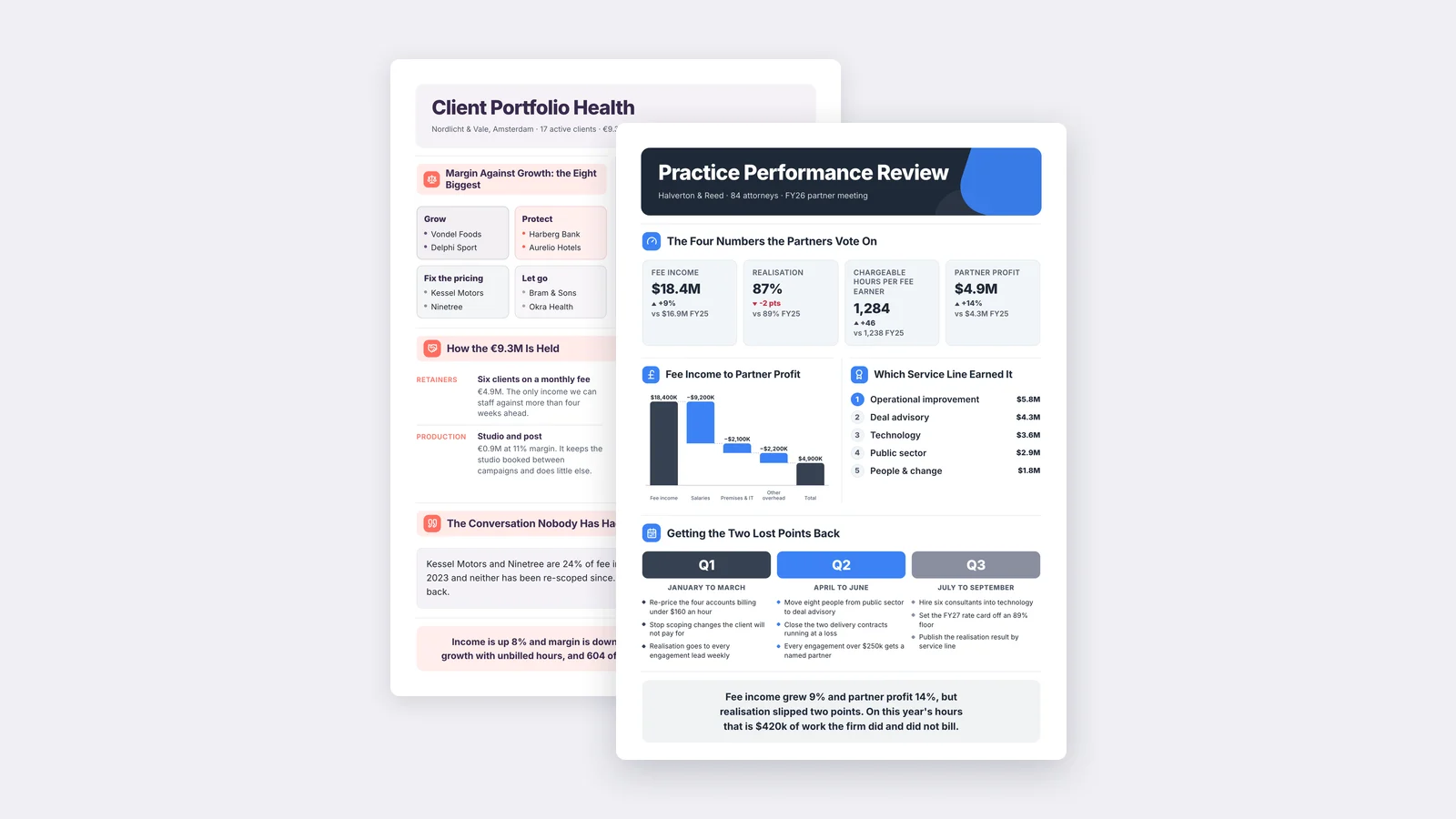
 Marketing Project ProposalOpen this One-Pager (opens in a new tab)
 Campaign ProposalOpen this One-Pager (opens in a new tab)
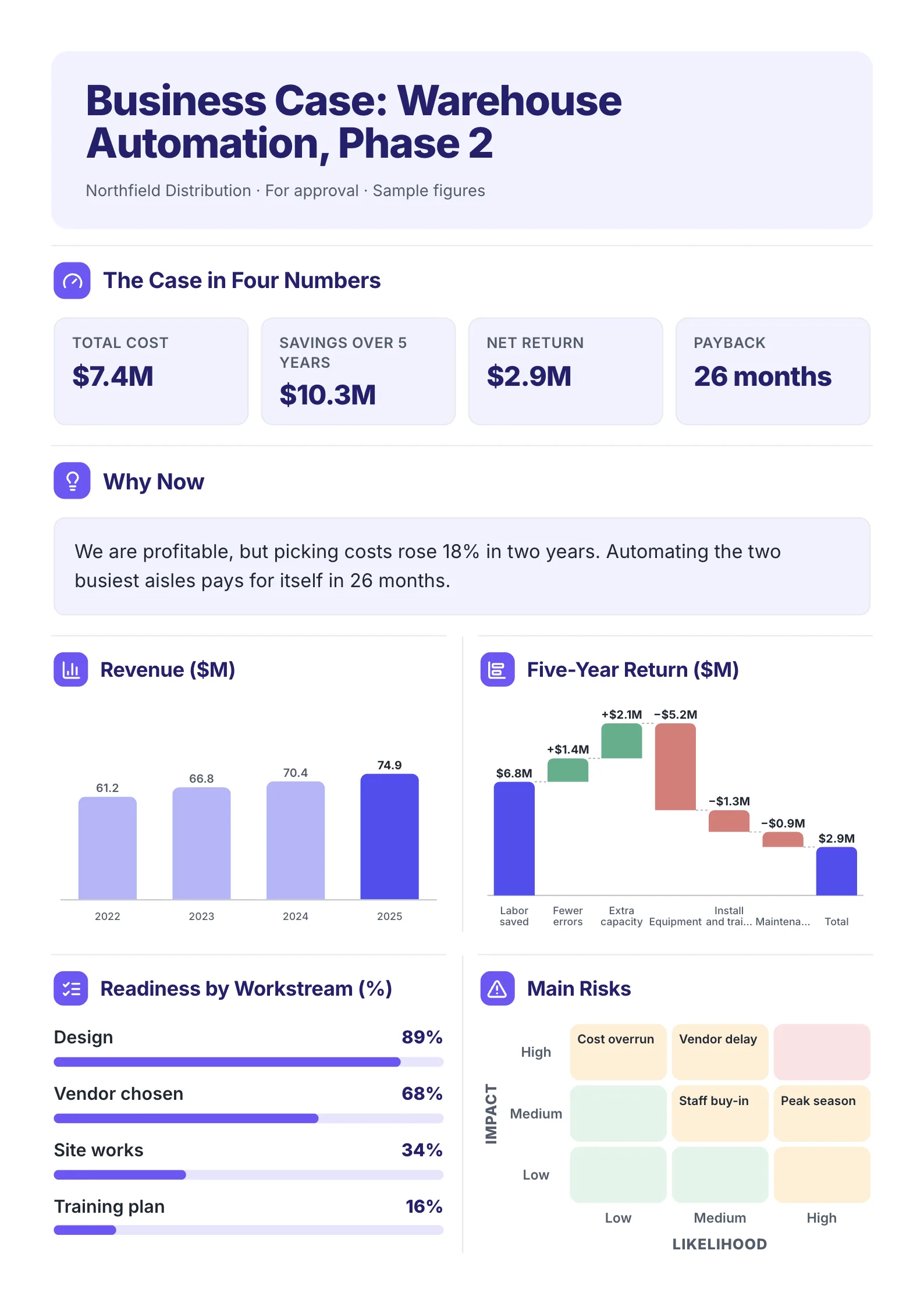 Project Business CaseOpen this One-Pager (opens in a new tab)
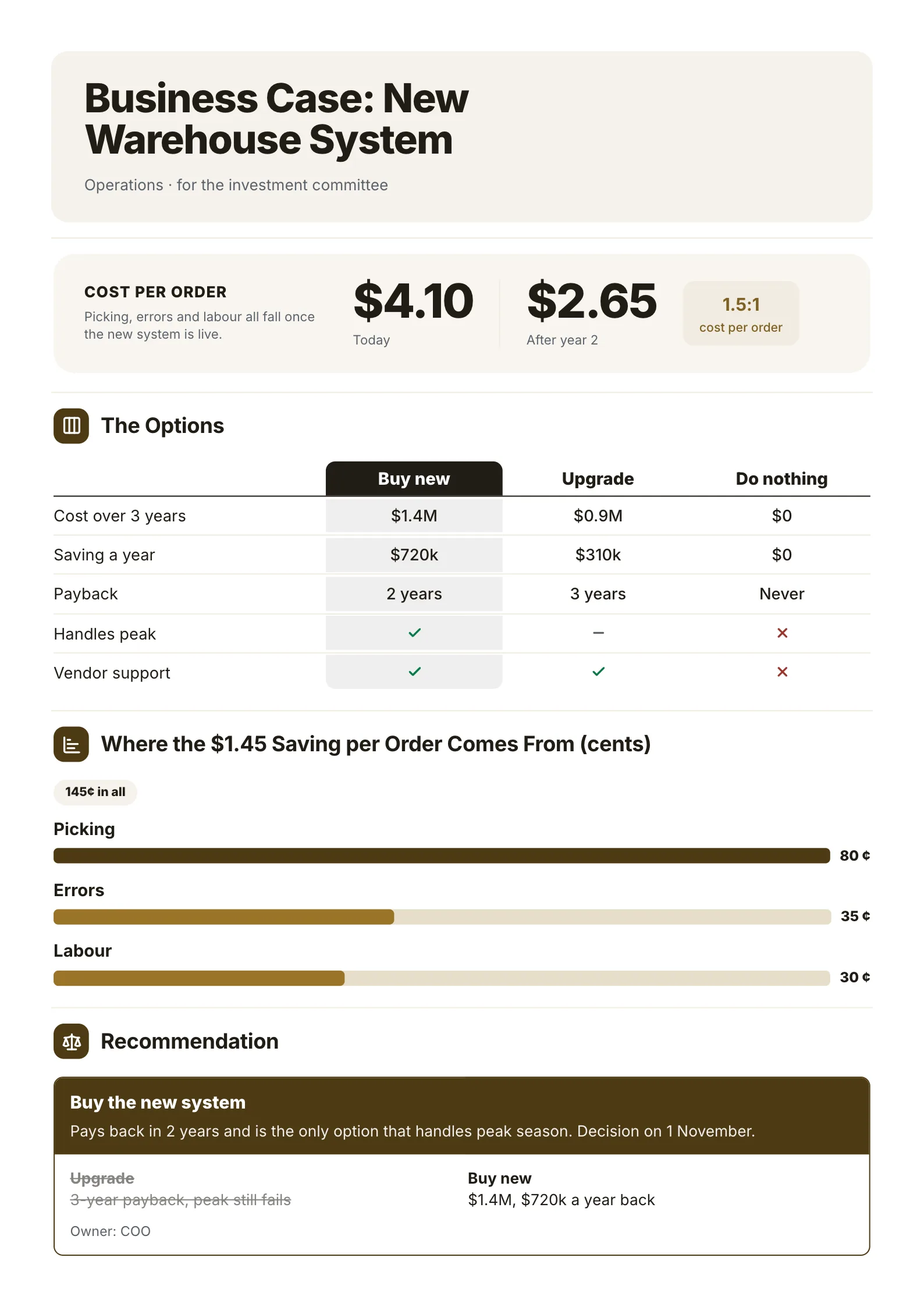 Business CaseOpen this One-Pager (opens in a new tab)
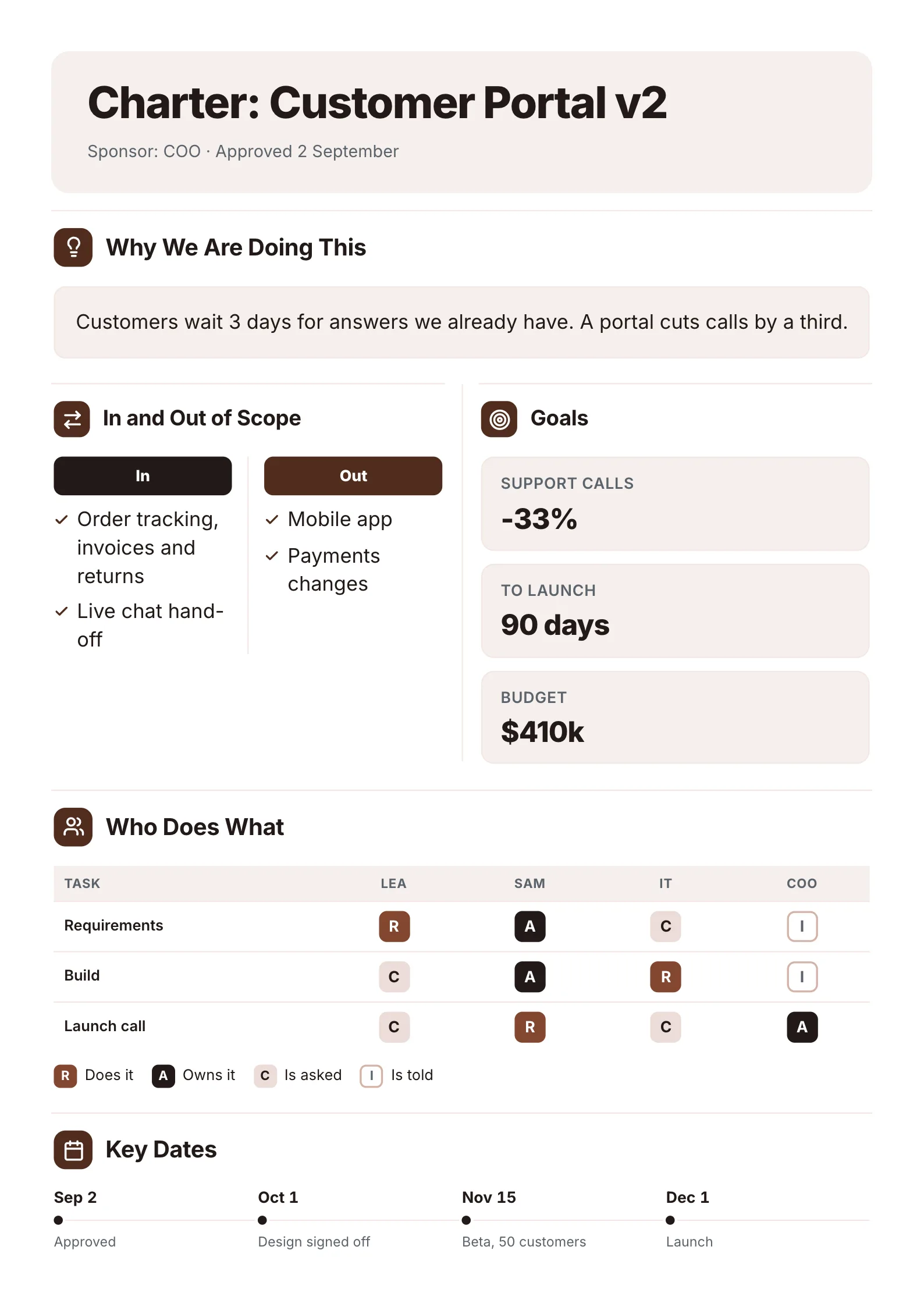 Project CharterOpen this One-Pager (opens in a new tab)
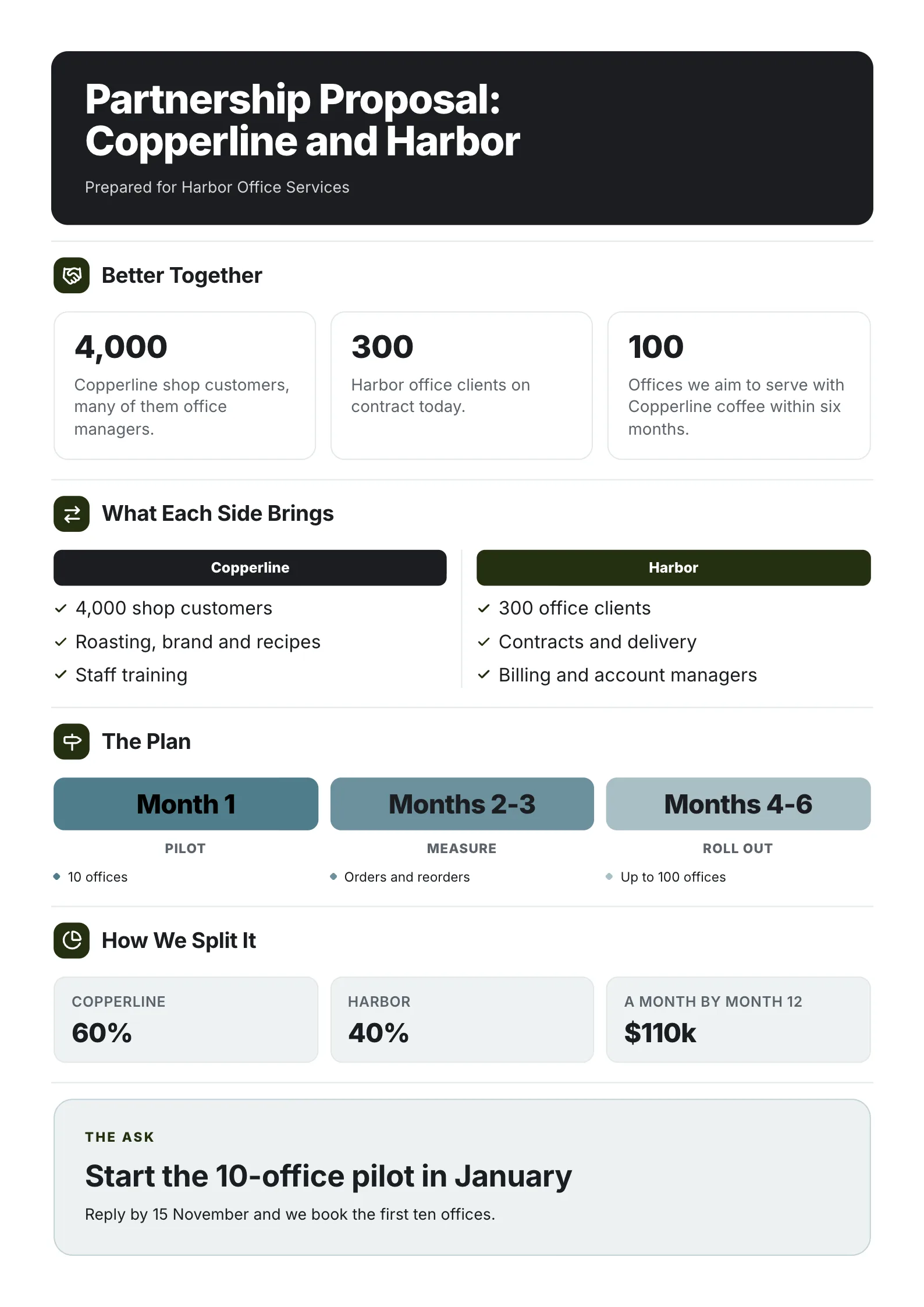 Partnership ProposalOpen this One-Pager (opens in a new tab)
Every example was made with MakeOnepagers. The companies and figures are samples, but the structure is the one approvers in each field expect, and each one opens as an editable template.
What goes in a project proposal: the 7 parts
Most project proposal guides list ten or more sections: cover page, introduction, background, methodology and so on. That is the format for a 20-page document. The person who signs off on the money reads one page of it. So put these seven parts on that page, in this order:
- The ask, in numbers. Budget, duration and the result you expect, in a row across the top. "$155K, 12 weeks, 7,400 leads" tells the reader what they are approving before they read a sentence.
- Why now. One or two lines on the problem and what waiting costs. "Picking costs rose 18% in two years" is a reason. "To improve efficiency" is not.
- The plan. Three to five phases or workstreams, each with one line on what happens in it.
- Cost and timeline. A small table: each part, how long it takes, what it costs, and the total. This is where most rejections happen, so make it easy to check.
- What it returns. The number the approver cares about: payback, savings, leads, people reached. Show it by month or year if you can.
- Risks and how you handle them. The two to four things most likely to go wrong, each with the step that limits it. Naming risks first is what makes the rest believable.
- The decision and the date. What you need, from whom, by when. "Approve the 10-office pilot by 15 November" gets an answer. "Let us know your thoughts" gets a meeting.
If your proposal is missing one of these, the approver has to go looking for it, or ask you in a meeting, which is the delay a proposal is meant to avoid.
A free one-page project proposal template
Copy this into your own document, or open one of the examples below and edit it.
| Section | What to write | Example |
|---|---|---|
| Title | The project and the ask, in one line | Proposal: Spring Launch Campaign |
| Subtitle | Who it is for and the decision date | Fernway Outdoor · For approval by 15 January |
| The ask | 3 or 4 numbers: budget, duration, expected result, unit cost | $155K · 12 weeks · 7,400 leads · $20.95 per lead |
| Why now | 1 or 2 lines: the problem and what waiting costs | Last spring's launch missed its lead target by 30% |
| The plan | 3 to 5 phases, one line each | Research, creative, media, measurement |
| Cost and timeline | A table: part, weeks, cost, total | Media: 6 weeks, $96,000 |
| What it returns | The result over time, ideally as a small chart | Leads by month, March to June |
| Risks | 2 to 4 risks, each with how you handle it | Weak offer: test two offers in the first two weeks |
| The decision | What you need, from whom, by when | Approve the budget by 15 January |
Keep every line to what fits on one sheet. Anything longer (the full methodology, vendor quotes, the research) goes in an appendix that the one page points to.
8 project proposal examples, by type
1. Marketing project proposal
 Edit this template
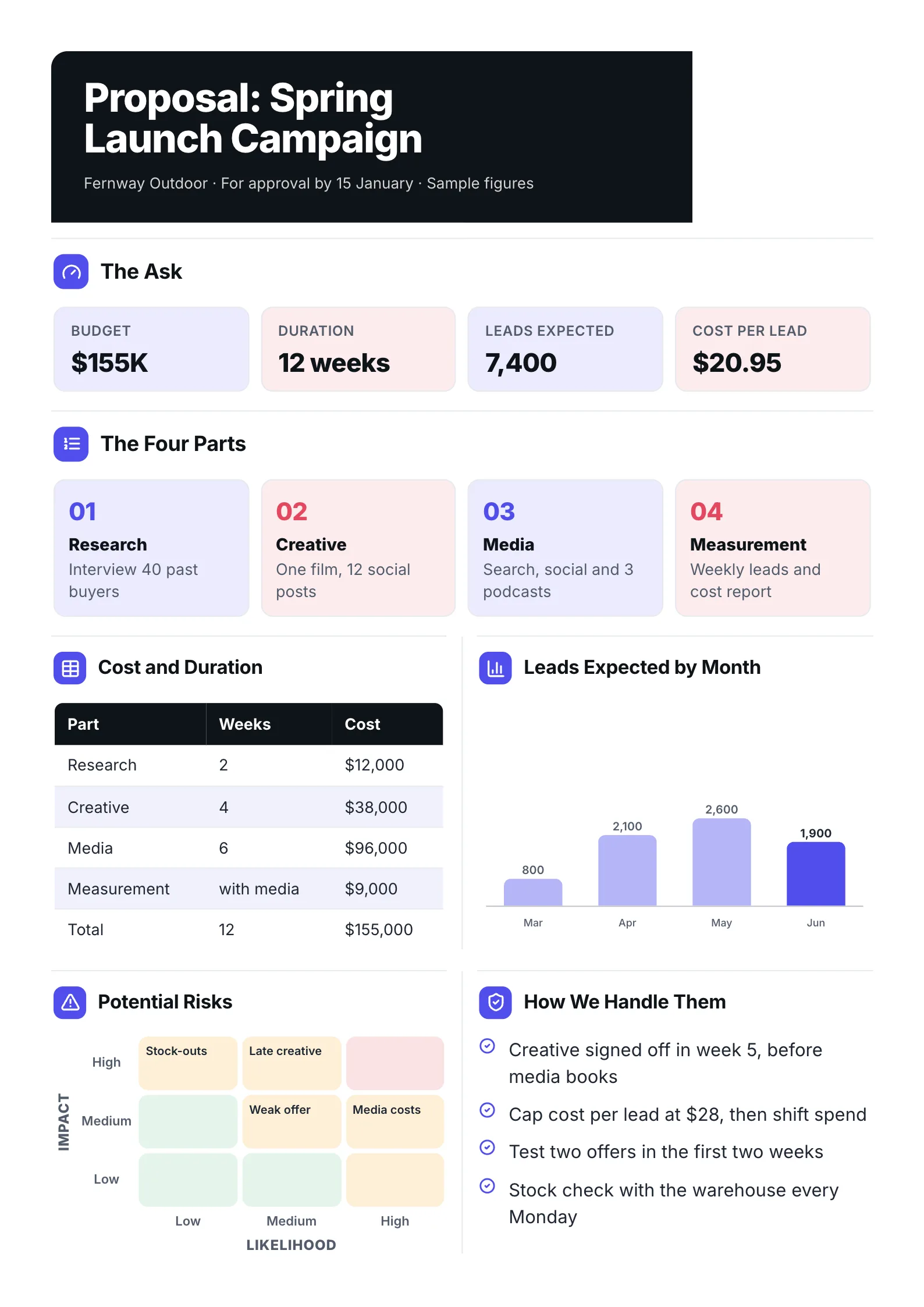
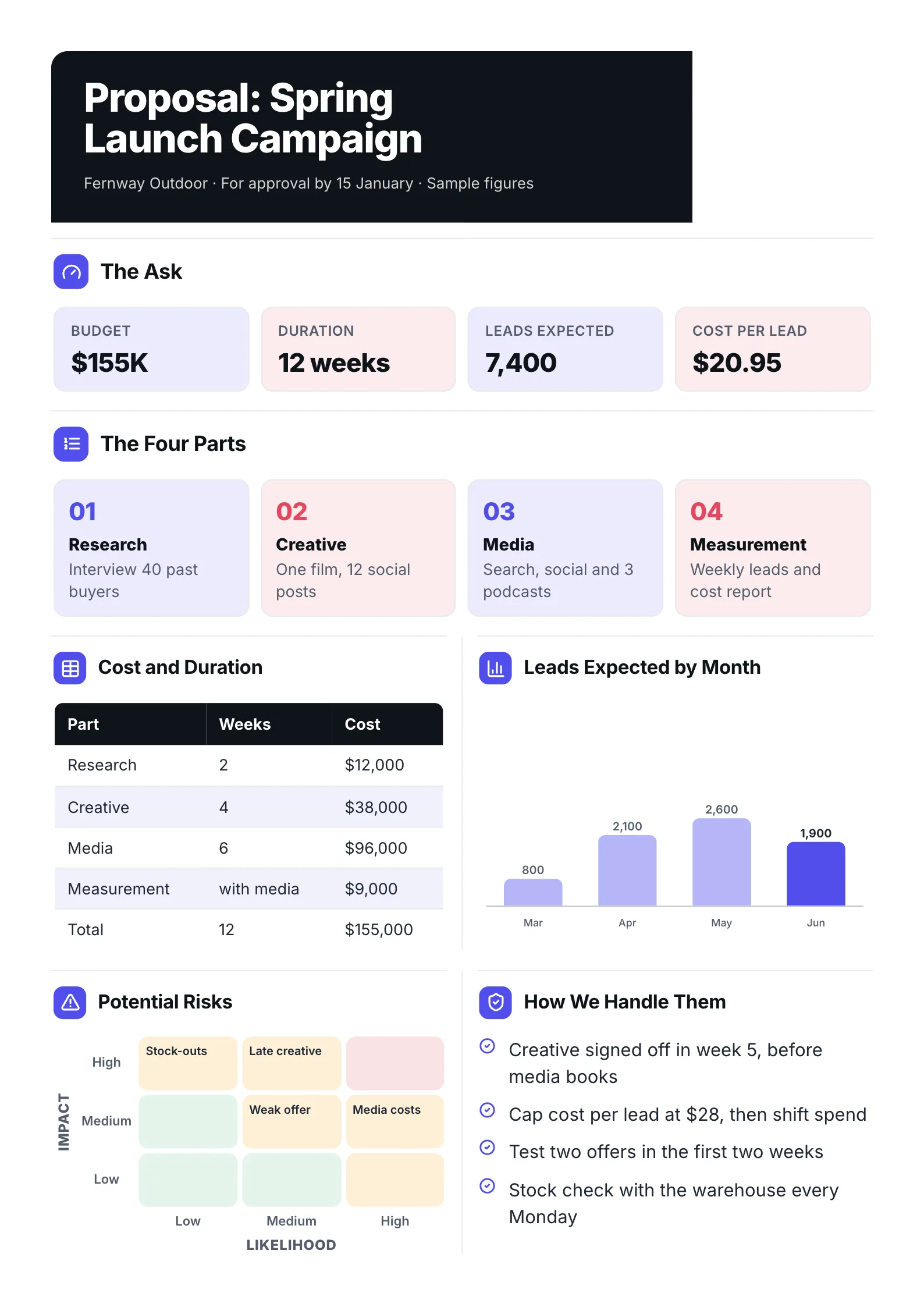
A sample marketing project proposal: the ask in four numbers, the plan in four parts, and every risk paired with a fix.
What to copy:
- Unit cost beside the total. $155K on its own sounds large. $20.95 per lead lets the approver compare it with last year's cost per lead in one glance.
- Risks with their answers. "Cap cost per lead at $28, then shift spend" turns a worry into a rule the team will follow.
- A decision date in the subtitle. "For approval by 15 January" is on the page before any number.
Open it: marketing project proposal template.
2. Campaign proposal
 Edit this template
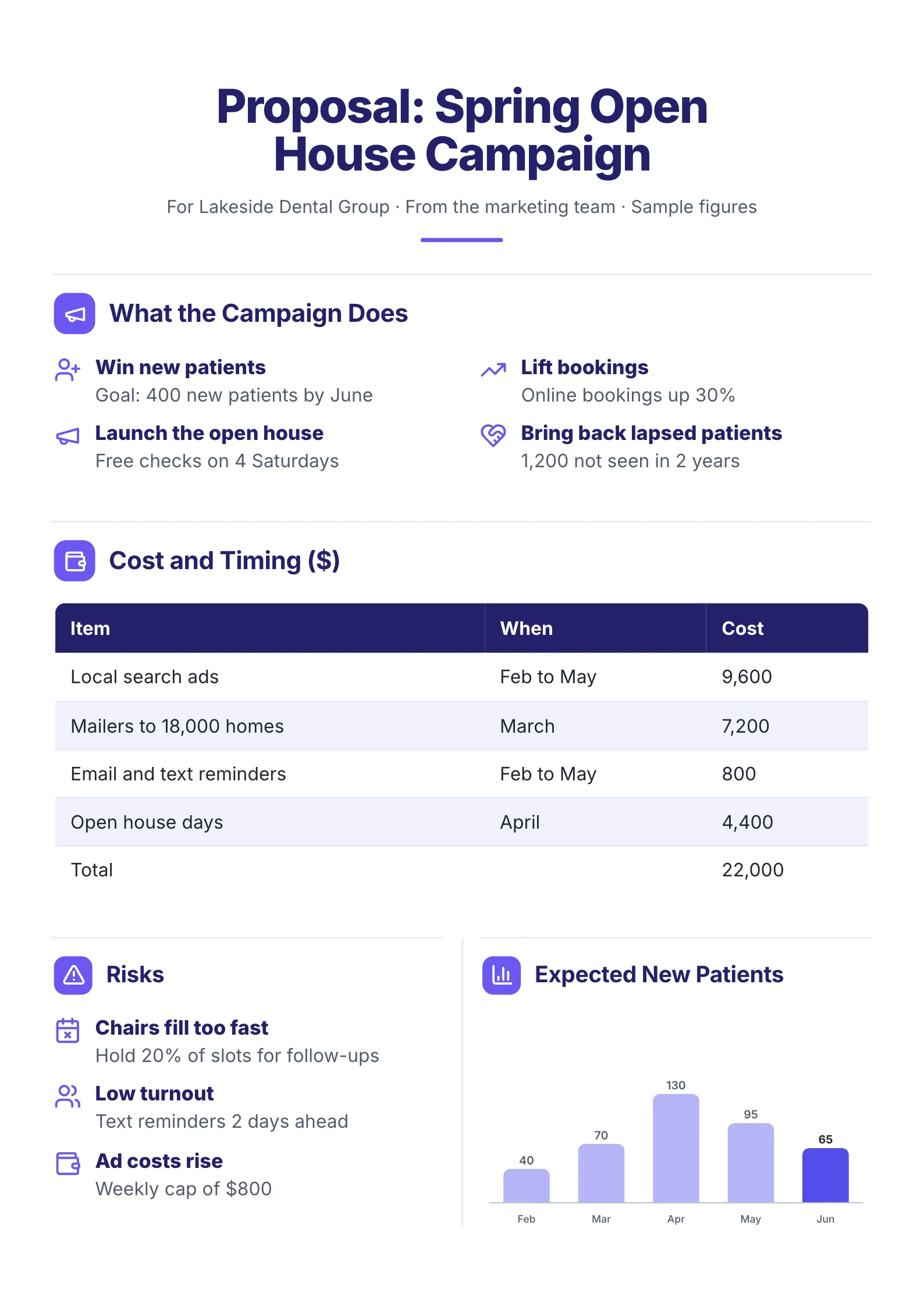
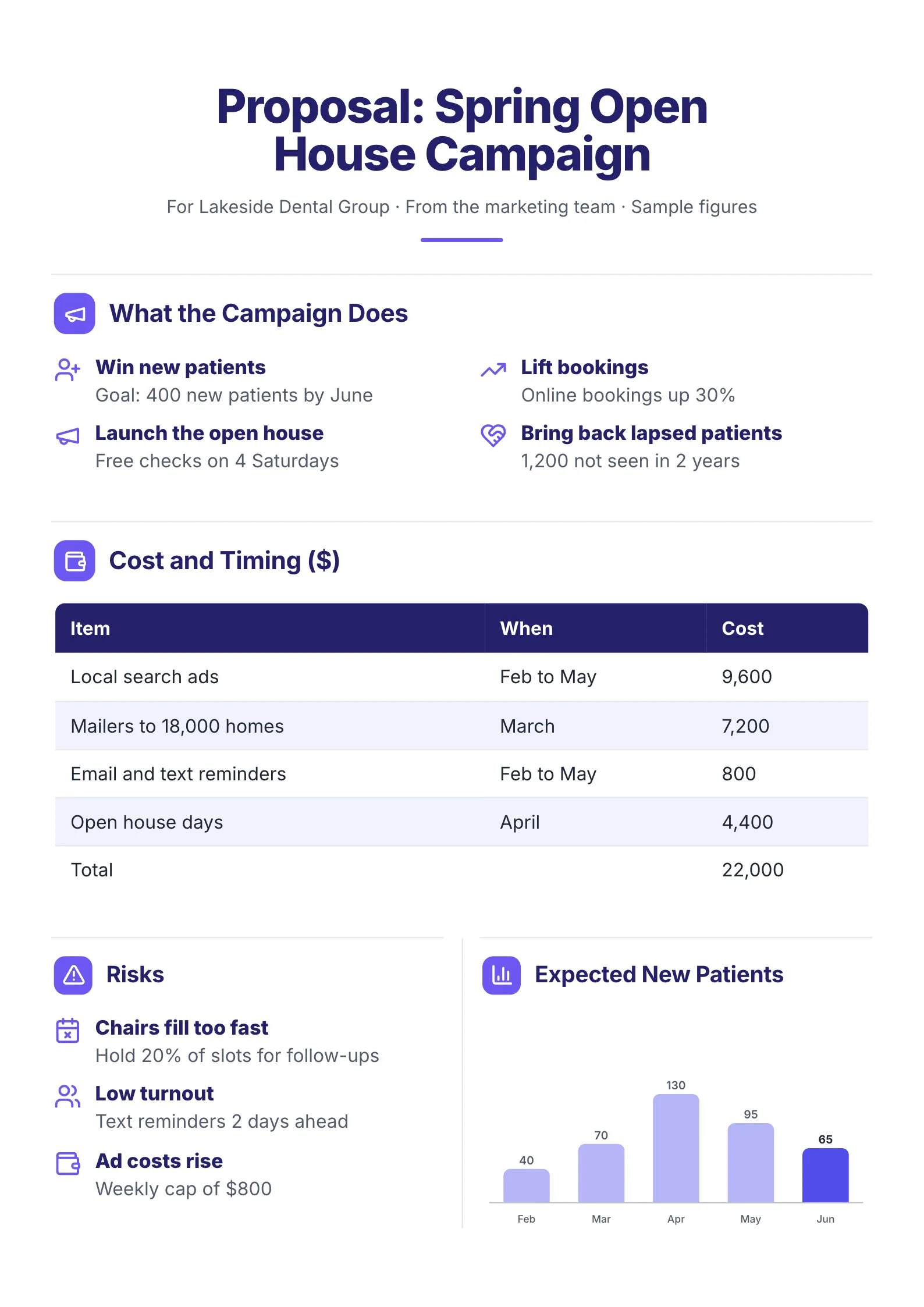
A sample campaign proposal for a dental group: goals with numbers, a $22,000 cost table and expected new patients by month.
What to copy:
- Goals written as numbers. "400 new patients by June" and "online bookings up 30%" can be checked later. "Raise awareness" cannot.
- A cost table a manager can add up. Four lines, a month for each, and the total at the bottom.
- The result as a chart. Expected new patients from February to June shows when the money pays off, not just whether it does.
Open it: campaign proposal template.
3. Project business case
 Edit this template
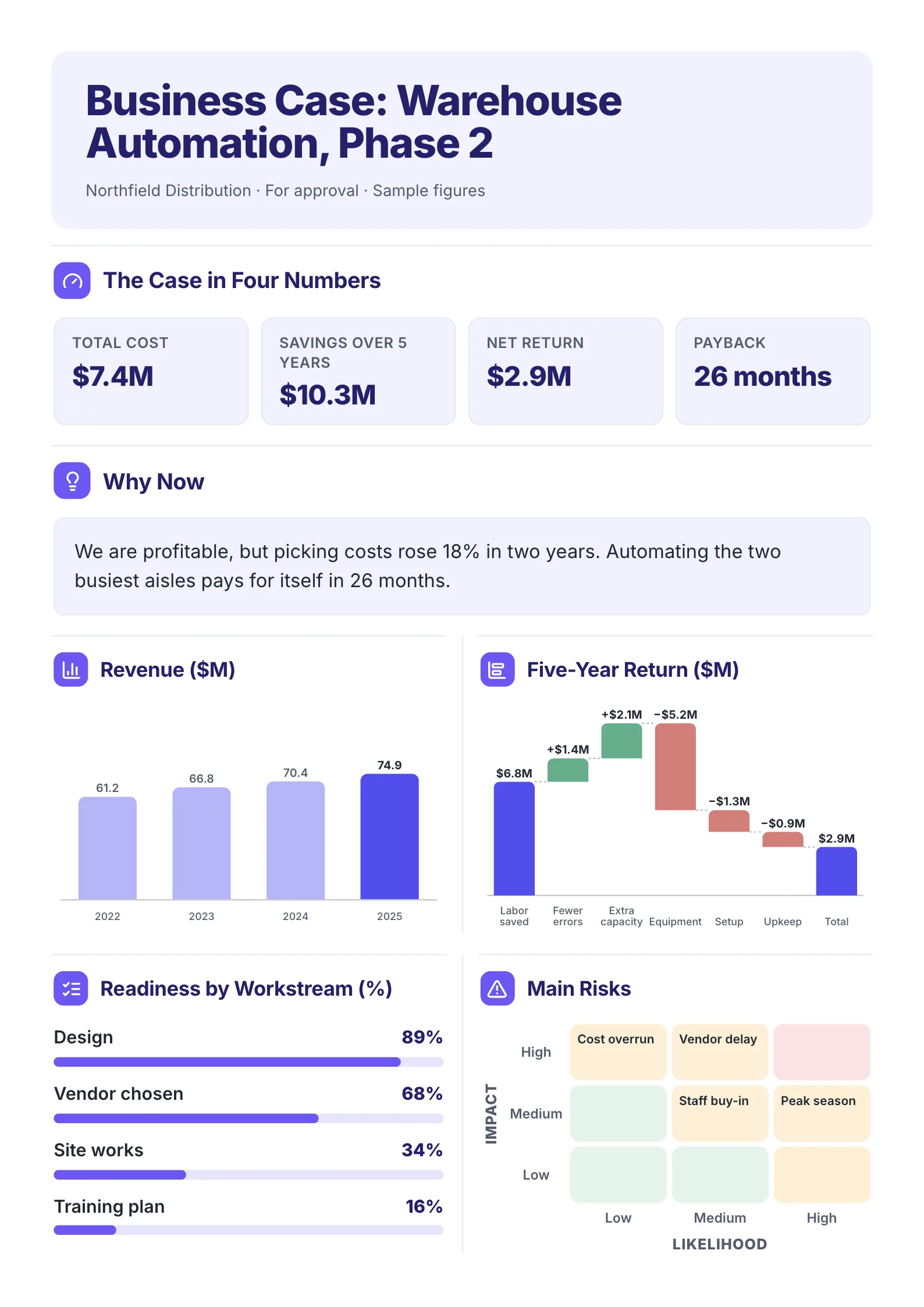
A sample project business case: the whole case in four numbers, then a waterfall showing where the return comes from.
What to copy:
- The case in four numbers. Cost, savings, net return and payback. A finance reader needs nothing else to decide whether to keep reading.
- A waterfall for the return. Labor saved, fewer errors and extra capacity go up; equipment, installation and maintenance come down. The $2.9M is not a claim, it is a sum the reader can follow.
- Readiness by workstream. Design at 89% and training at 16% shows honestly what is still to do.
Open it: project business case template.
4. Business case with options
 Edit this template
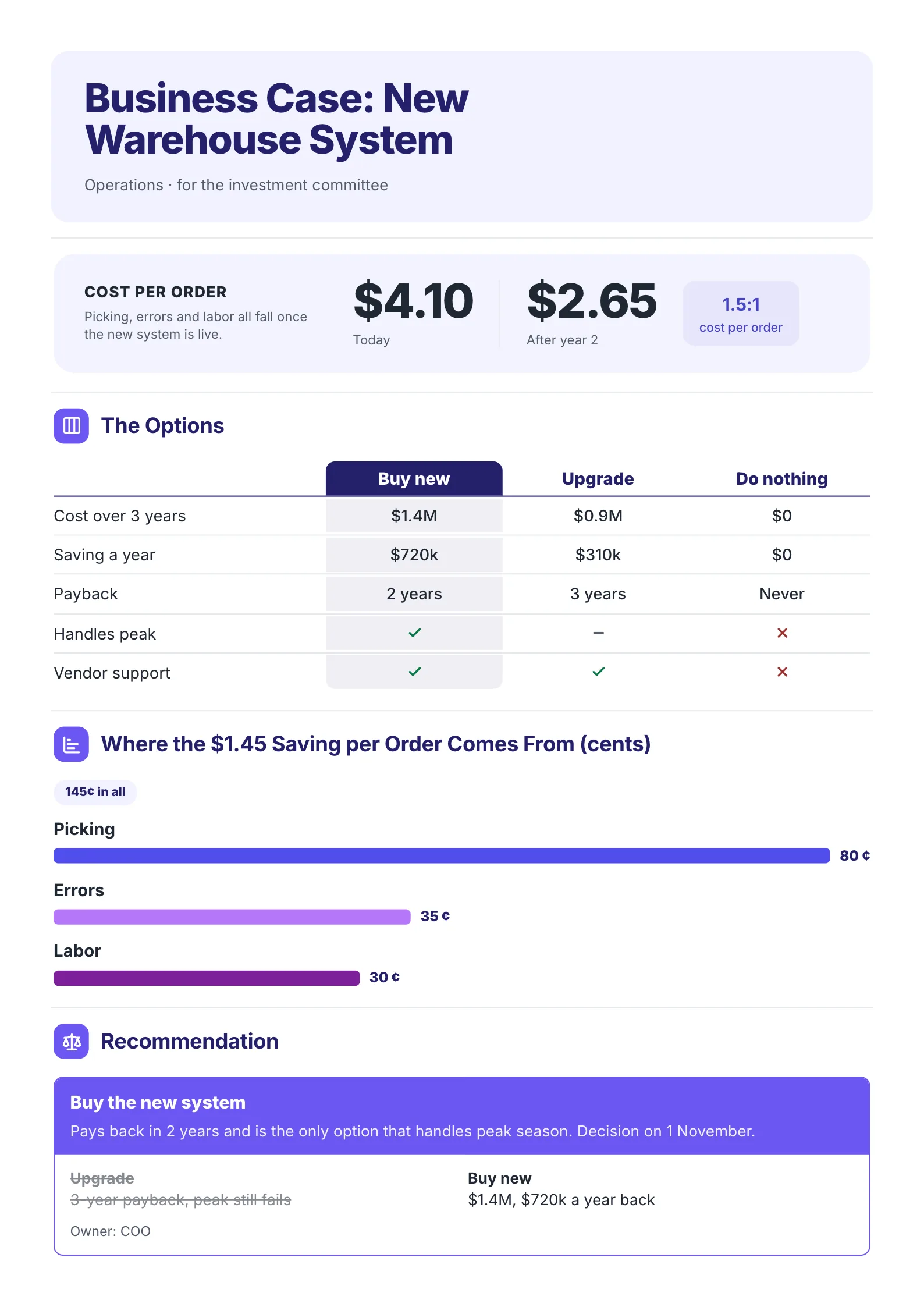
A sample options business case: buy new, upgrade or do nothing, side by side, with the recommended option highlighted.
What to copy:
- Do nothing as an option. Putting "Never" in its payback row shows the cost of saying no.
- The saving broken down. The $1.45 per order splits into picking, errors and labor, so a skeptic can challenge one part instead of the whole.
- One clear recommendation. "Buy the new system", with the losing option crossed out and the decision date: 1 November.
Open it: business case template.
5. Project charter (the approved proposal)
 Edit this template
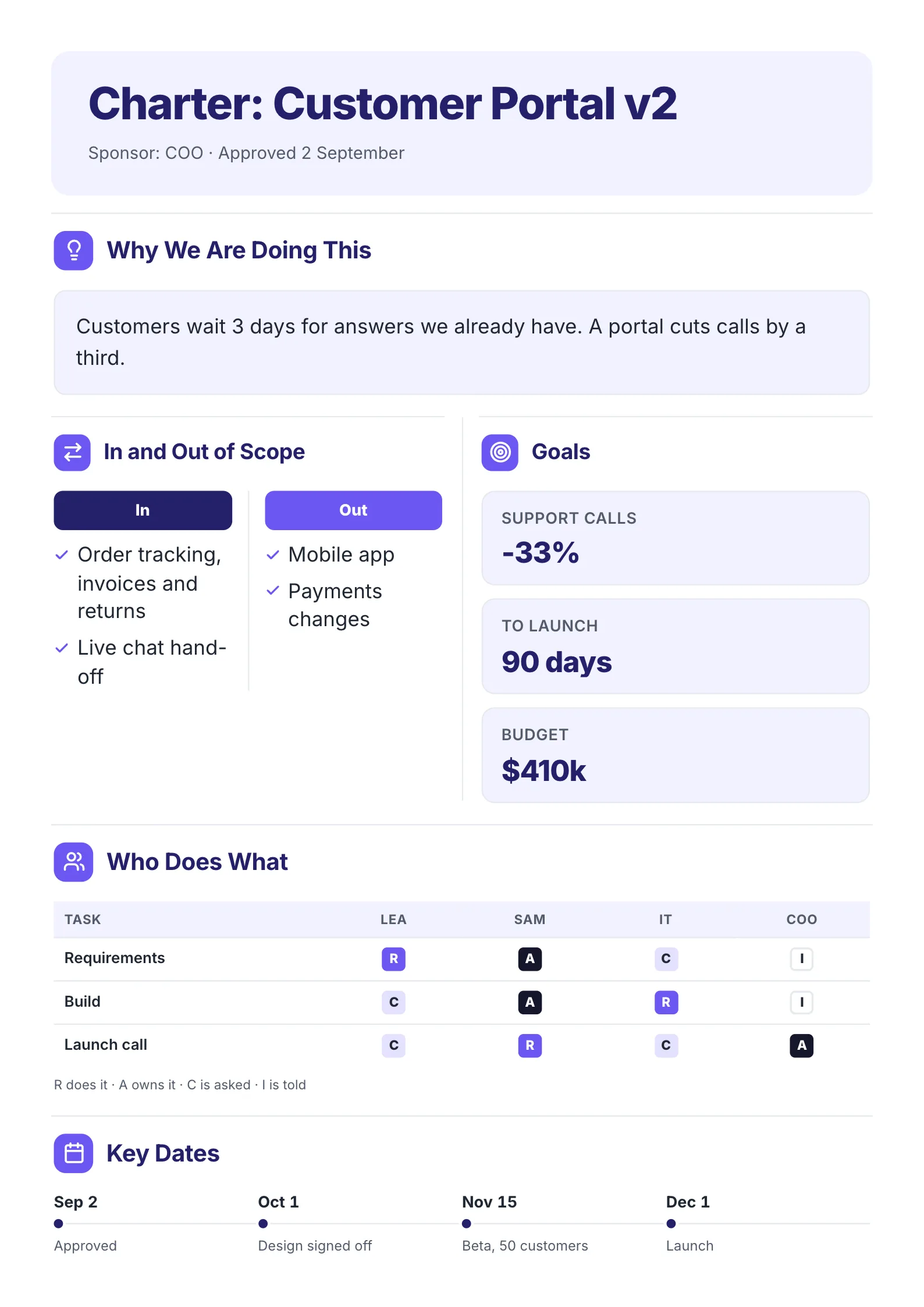
A sample project charter: once the proposal is approved, the same page becomes the charter, with scope and owners added.
What to copy:
- In and out of scope, side by side. "Mobile app: out" settles an argument before it starts.
- Who does what, as a grid. Does it, owns it, is asked, is told, for each task. One owner per row.
- Key dates as a line. Approved, design signed off, beta, launch. Four dates are enough.
Open it: project charter template.
6. Partnership proposal
 Edit this template
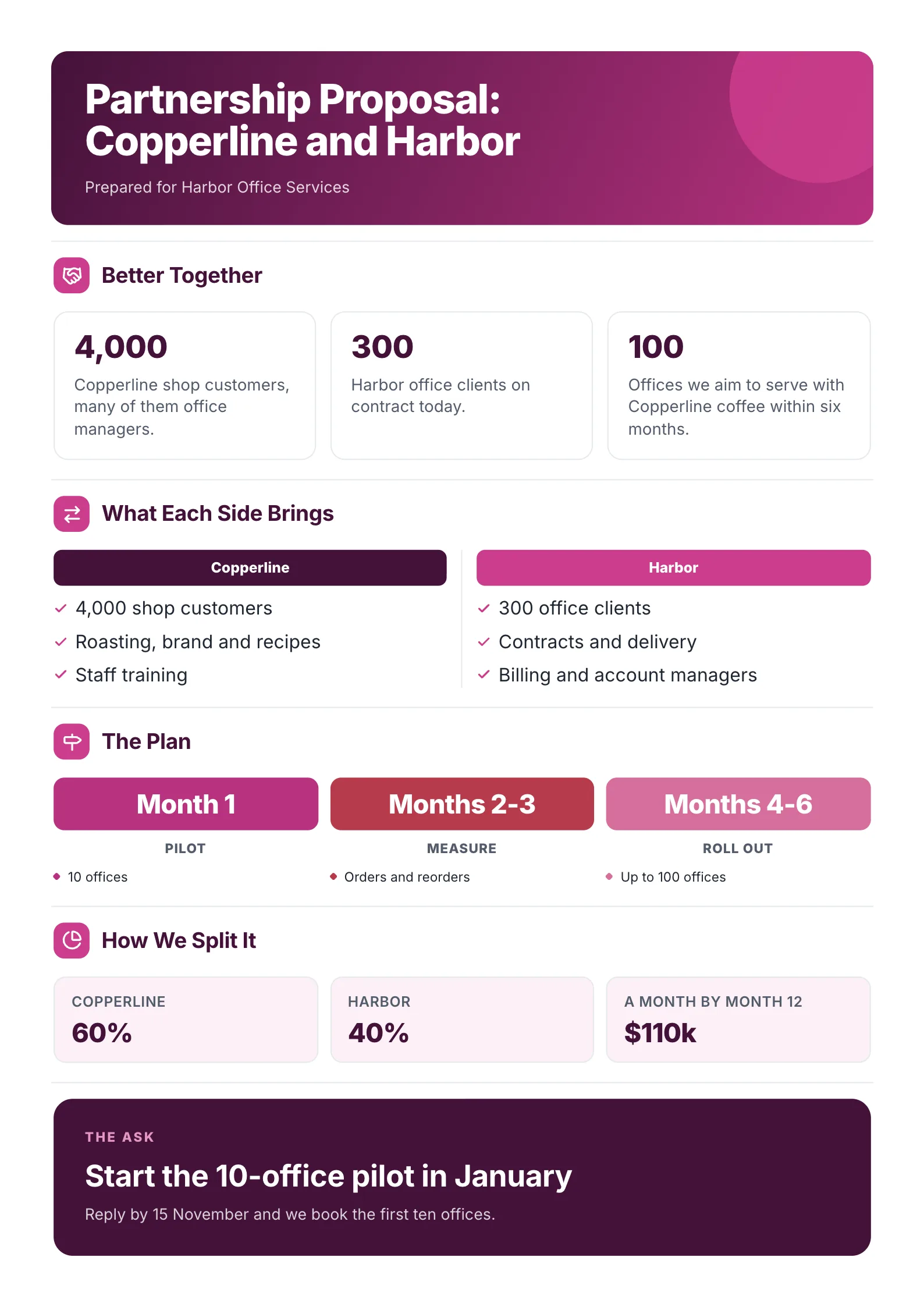
A sample partnership proposal: what each side brings in two columns, a three-stage plan and a small first step as the ask.
What to copy:
- What each side brings, in two columns. The other company sees its own strengths named, which is half the pitch.
- The split stated plainly. 60% and 40%, and what that is worth by month 12.
- A small first ask. A 10-office pilot is easy to say yes to. A full partnership is not.
Open it: partnership proposal template.
7. Grant request (nonprofit project proposal)
 Edit this template
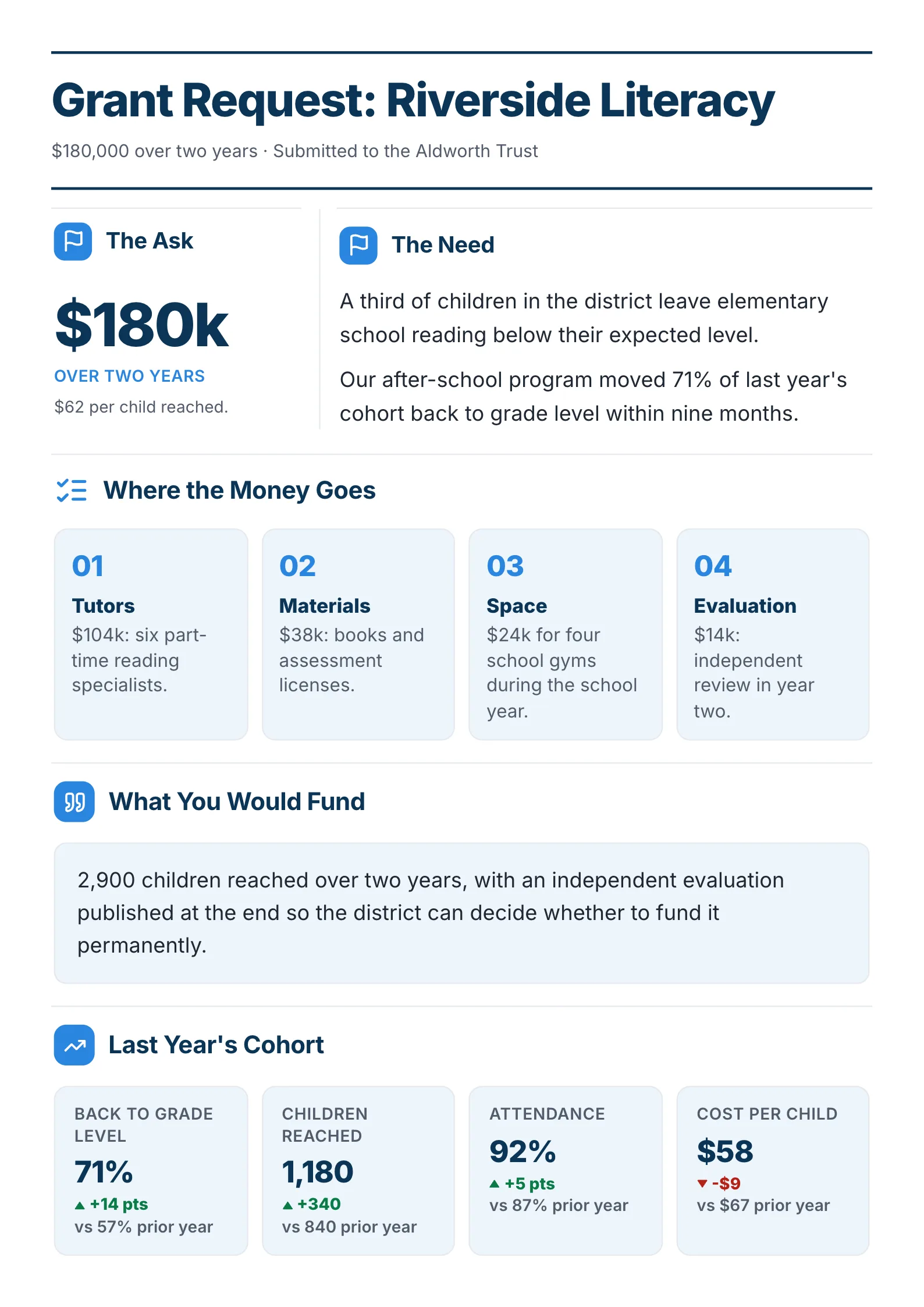
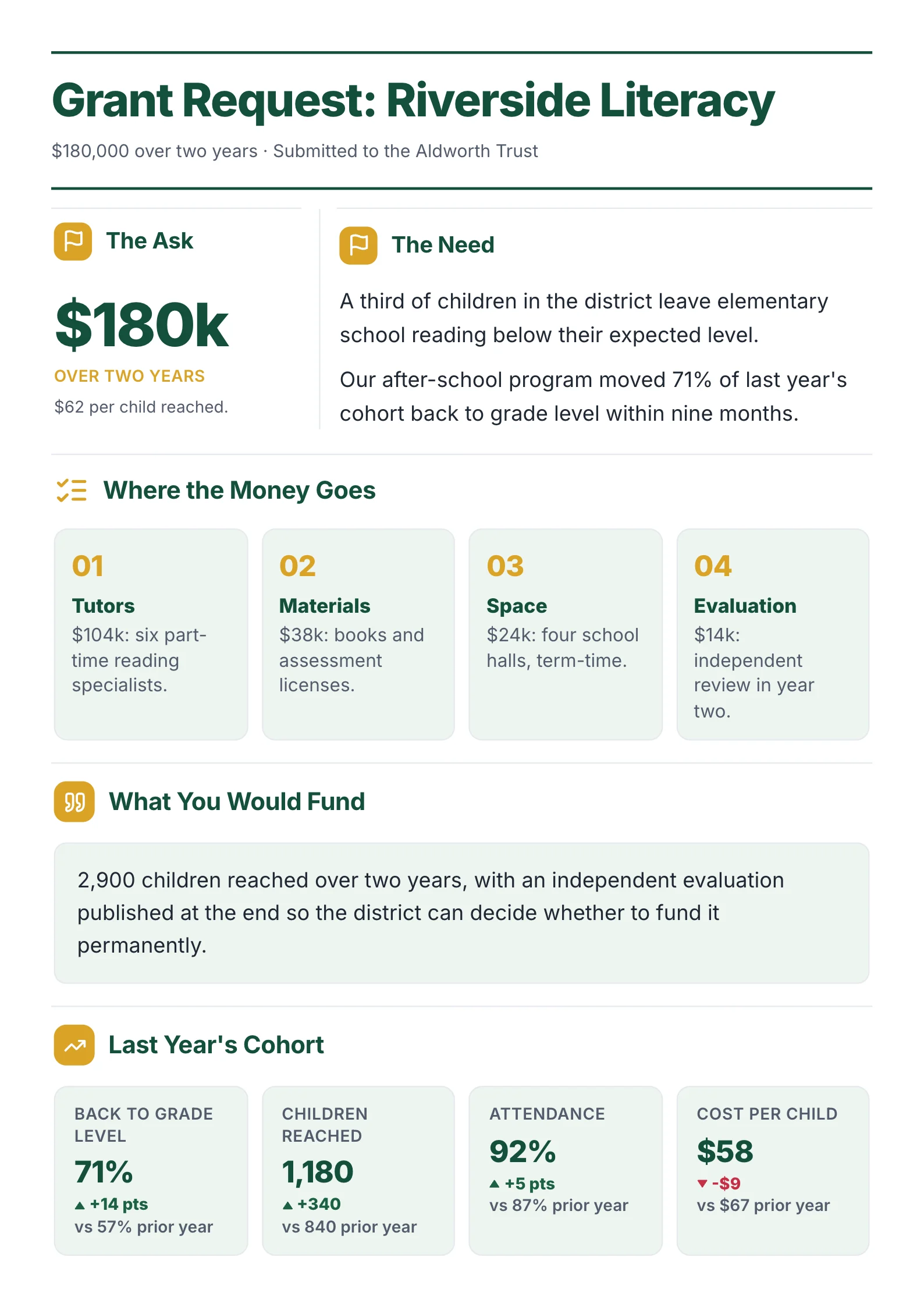
A sample grant request: the amount and cost per child first, then last year's results against the year before.
What to copy:
- Cost per person reached. $62 per child lets a funder compare you with every other request on the desk.
- Where every dollar goes. Tutors, materials, space and evaluation, each with its amount, adding up to the ask.
- Proof from last year. 71% of children back to grade level, up 14 points, shows the plan already works.
Open it: grant request template.
 Edit this template
8. Event sponsorship proposal
 Edit this template
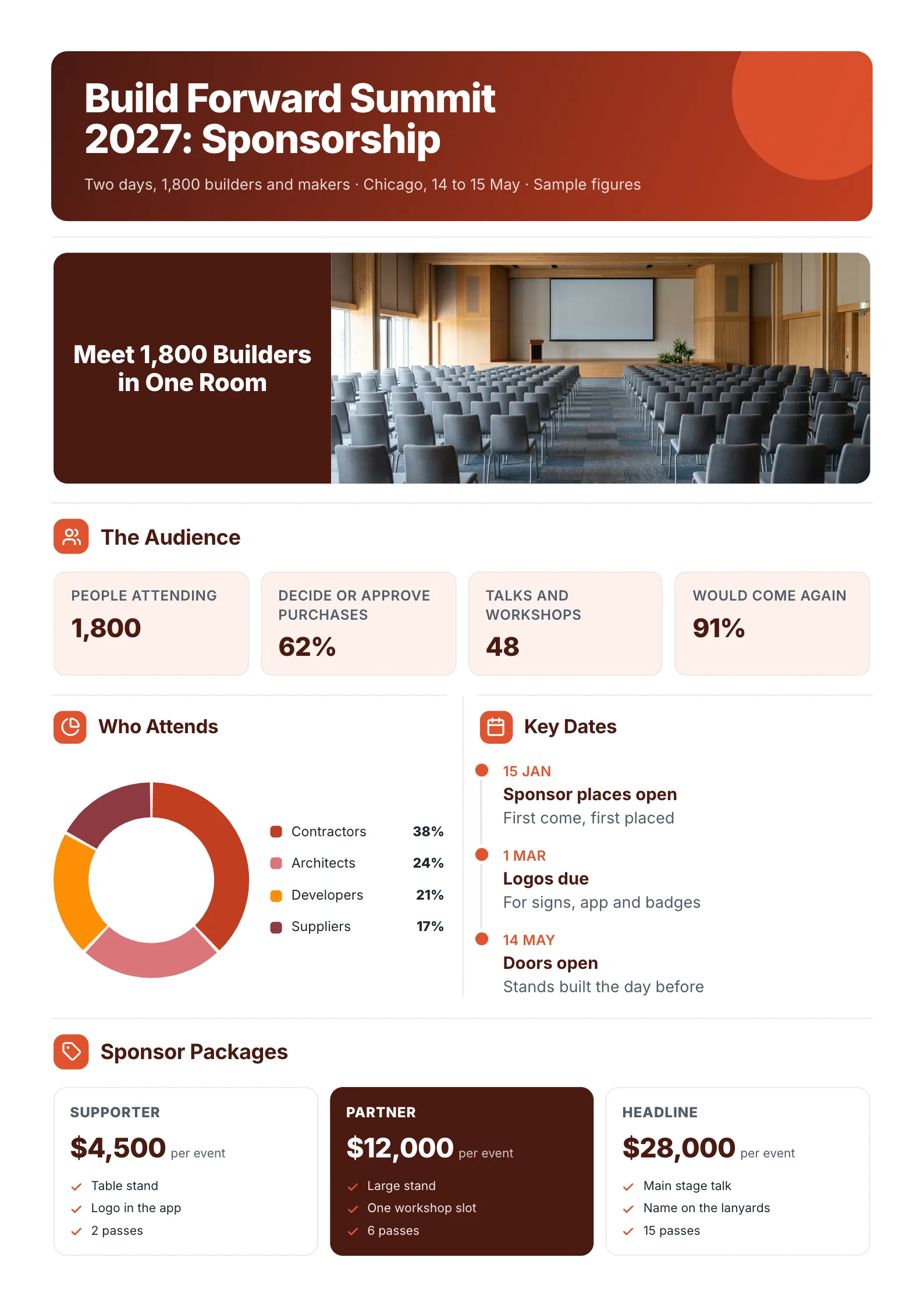
A sample sponsorship proposal: the audience in numbers, who attends, and three packages with a clear middle choice.
What to copy:
- The audience as the product. 1,800 attendees and 62% who approve purchases is what a sponsor is buying.
- Three packages, middle one highlighted. Highlighting one package points the sponsor to the one you most want to sell.
- Dates the sponsor must act on. Places open, logos due, doors open.
Open it: event sponsorship proposal template.
For more layouts like these, browse all One-Pager templates, or see how a project One-Pager keeps the same project on track after it is approved.
How to write a project proposal in 5 steps
- Write the decision first. Before anything else, finish this sentence: "I need [person] to approve [what] by [date]." Everything on the page exists to get that yes.
- Fill in the ask row. Budget, duration, expected result and one unit cost. If you cannot fill these four boxes, the project is not ready to propose.
- Build the cost table from the plan. One row per phase, so the total is the sum of parts the reader can see.
- Name the risks before the approver does. Two to four, each with the step that limits it.
- Cut to one page. Move methodology, research and quotes to an appendix. If a section does not help the approver decide, it goes.
For the general method behind any one-page document, read our step-by-step guide on how to make a One-Pager.
Mistakes that get a project proposal rejected
- No number in the first lines. If the budget and the result are not visible at a glance, the approver assumes the worst.
- A cost with no breakdown. "$155K" invites the question "for what?". A four-row table answers it before it is asked.
- No risks, or risks with no answers. A proposal with no risks reads as a proposal nobody has stress-tested.
- Benefits nobody can measure. "Better efficiency" and "more awareness" cannot be checked in six months. Leads, payback and people reached can.
- No deadline for the decision. Without a date, a proposal waits behind everything that has one.
Can ChatGPT write a project proposal?
Yes, it can draft the text, and that is a fair starting point. Two problems remain. It will invent figures it does not have, so every number has to be checked against your plan. And it gives you text, not a designed page an approver can read in a minute.
If you already have the material (a brief, a plan, a spreadsheet or a long proposal), MakeOnepagers turns it into a designed one-page proposal like the eight above, using only the figures in your file so you can check every one. You can start from any of these templates or drop in your document. It is free for 7 days with 3 One-Pagers included.
Frequently asked questions
What is the format for a project proposal?
A one-page project proposal follows this order: the ask in numbers, why now, the plan, cost and timeline, what it returns, risks and how you handle them, and the decision you need by a date. A long proposal adds a cover page, background, methodology and appendices behind that first page.
What are the 7 main parts of a project proposal?
The ask (budget, duration and expected result), the reason it matters now, the plan, the cost and timeline, the return, the risks with how you handle them, and the decision with a date. Those seven fit on one page.
How long should a project proposal be?
As long as the approver needs, and for most internal projects that is one page. Grant funders and public bodies often set their own page limits, so check those first. When a longer document is required, put a one-page summary at the front.
Is there a project proposal template in Word or Google Docs?
Yes. Microsoft Word and Google Docs both include proposal templates you can type into. If you want a designed one-page version with charts and a cost table, open any of the eight templates above in MakeOnepagers, edit it, and export a PDF that prints on one sheet.
Can I use ChatGPT to write a proposal?
You can use it to draft the wording, but check every figure, because it will fill gaps with numbers you never gave it. For a finished, designed one-page proposal built from your own documents, use a tool that works only from your file.