Board Report vs Annual Report: One Water District's Pair, Compared
Board report vs annual report, shown with one water district's 262-page board packet and 28-page annual report: who reads each, what each asks, and when.


A board report goes to the people in charge of an organization, and it asks them to decide something at the next meeting. An annual report goes to everyone else, and it tells them what the whole year delivered. That's the board report vs annual report difference in one line: one asks for a vote, the other gives an account. Start from a free one pager template.
One‑Pager examples
Real One-Pagers made with MakeOnepagers. Open any one to edit it as your own.
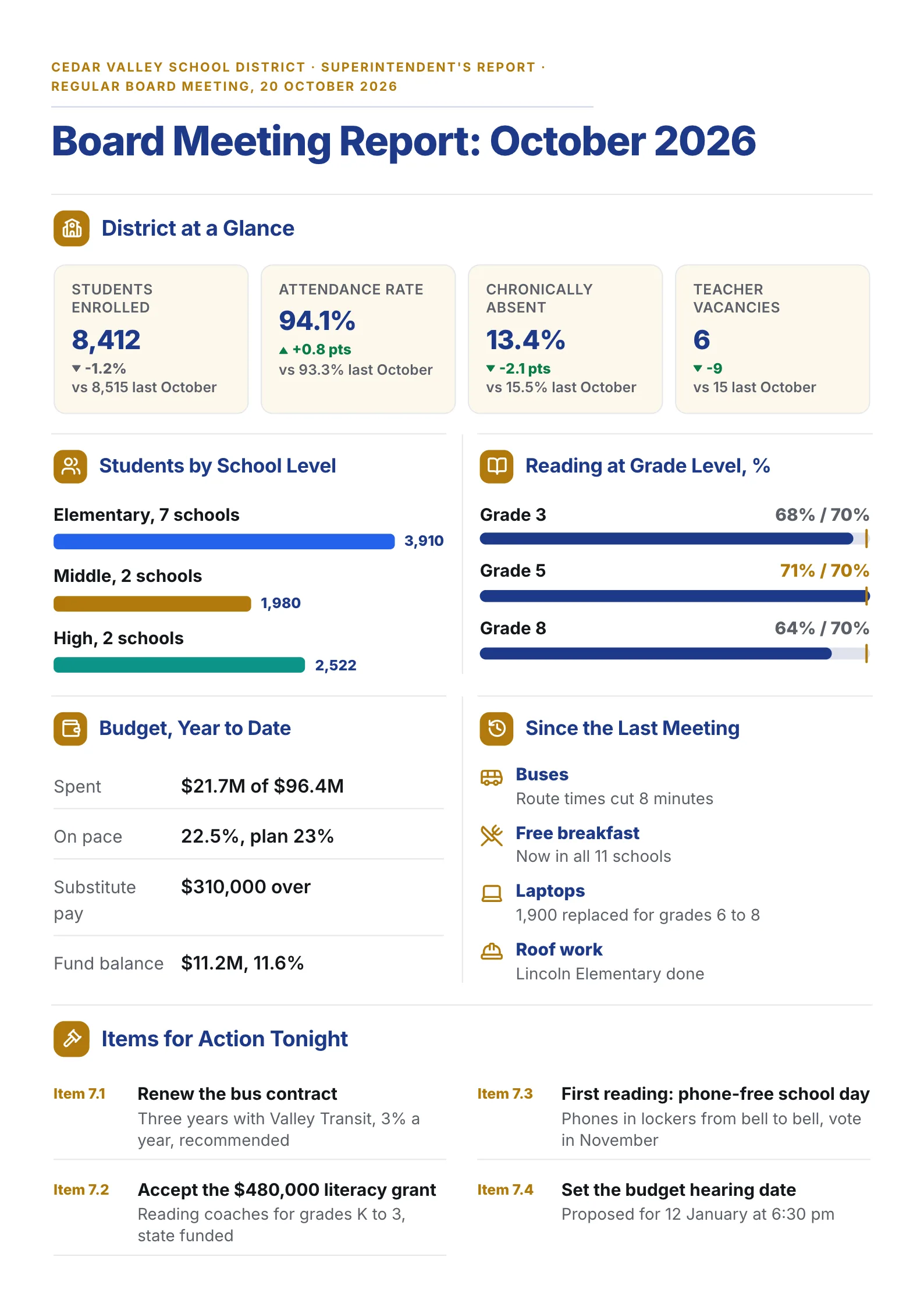 Board Meeting Report: School DistrictEdit for free(opens in a new tab)
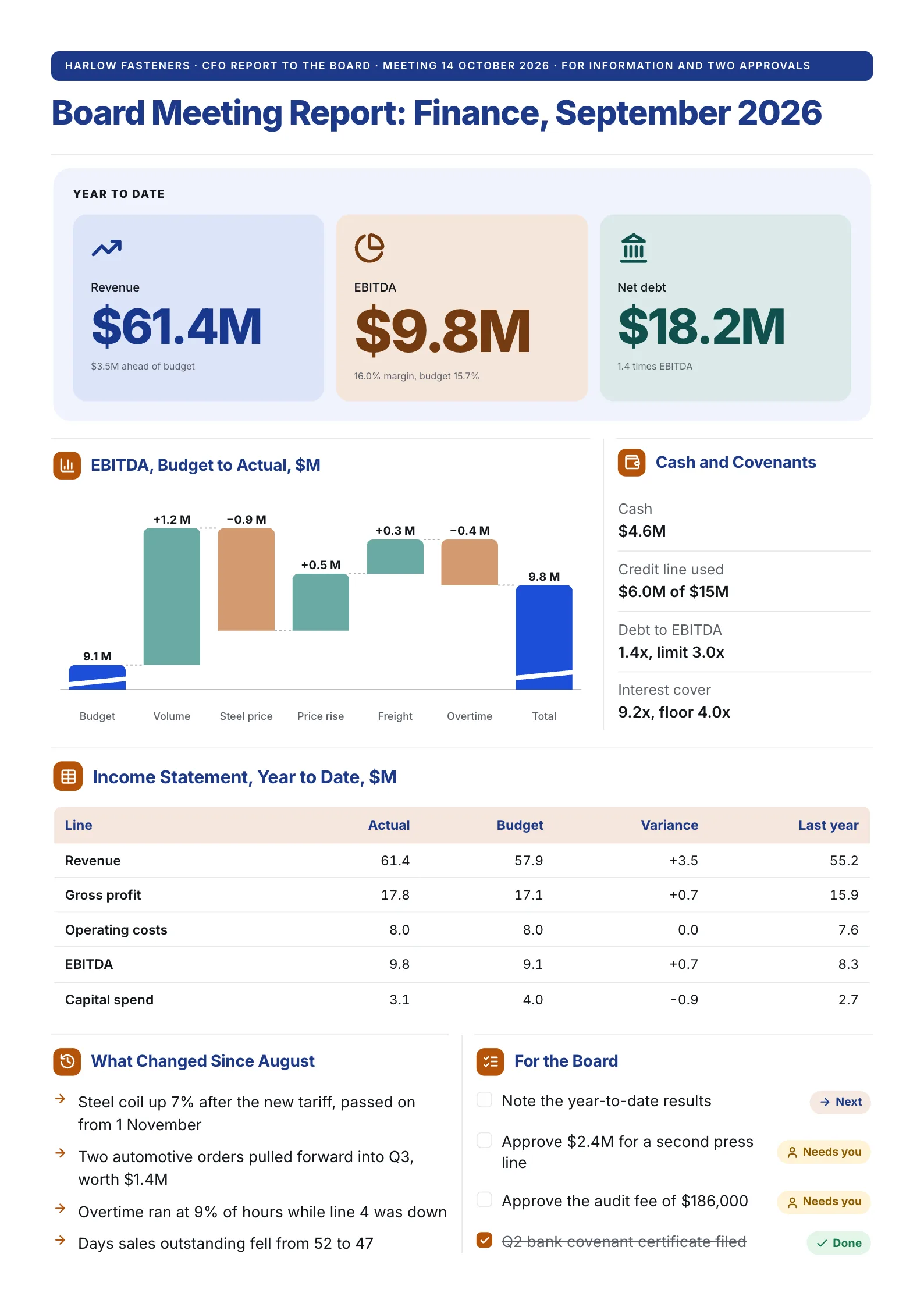 Board Meeting Report: CFO Finance, ManufacturerEdit for free(opens in a new tab)
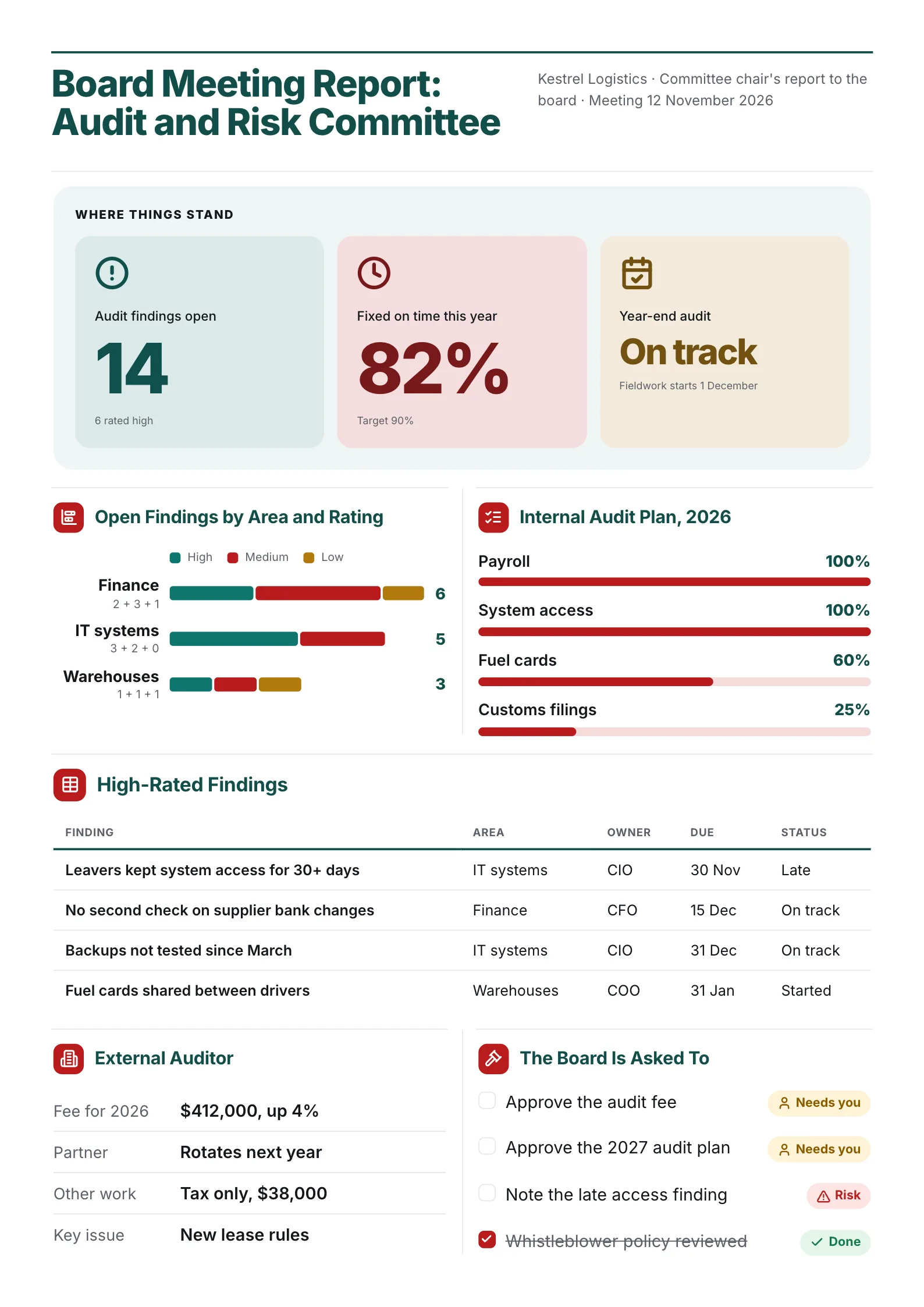 Board Meeting Report: Audit CommitteeEdit for free(opens in a new tab)
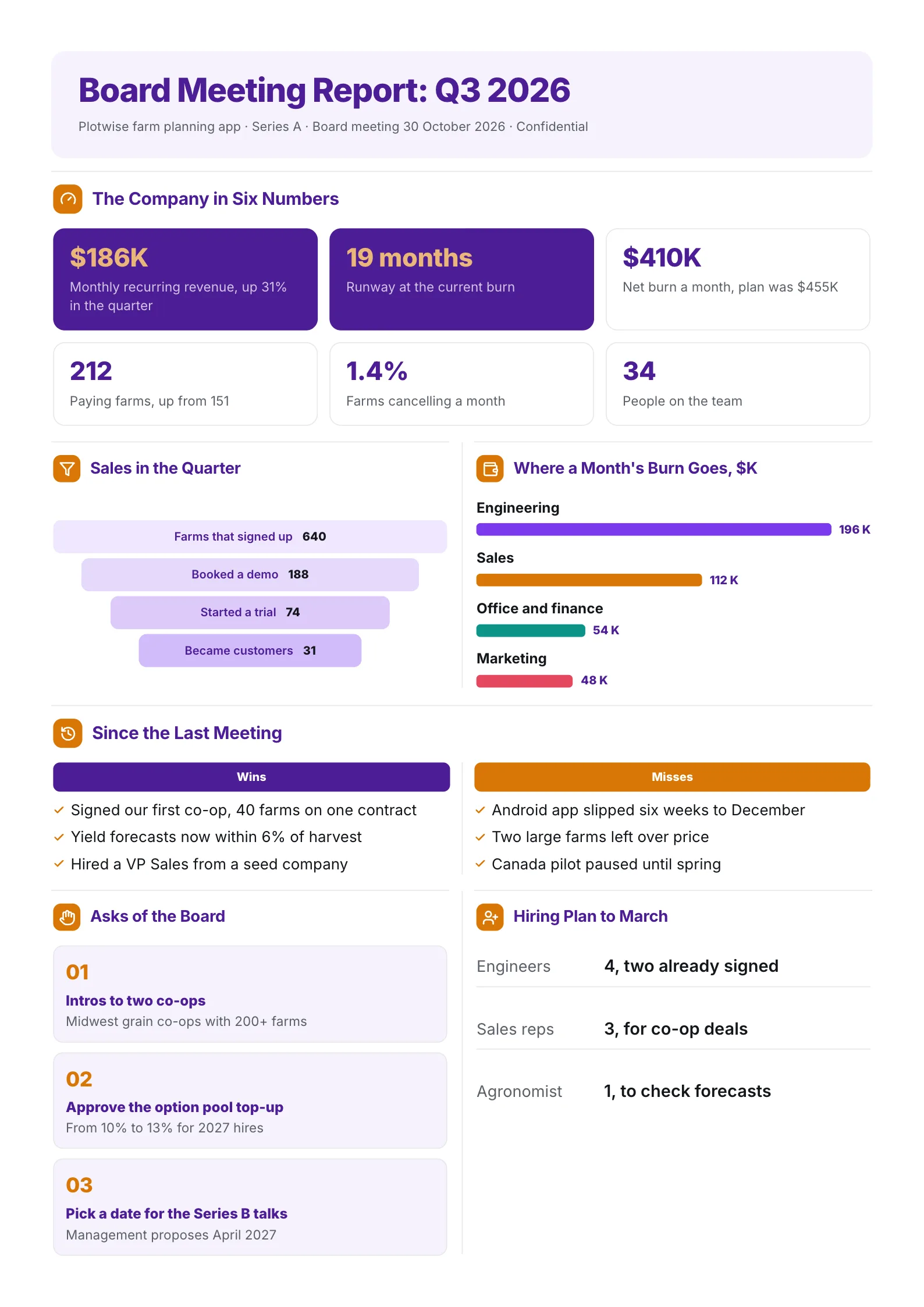 Board Meeting Report: Startup, Series AEdit for free(opens in a new tab)
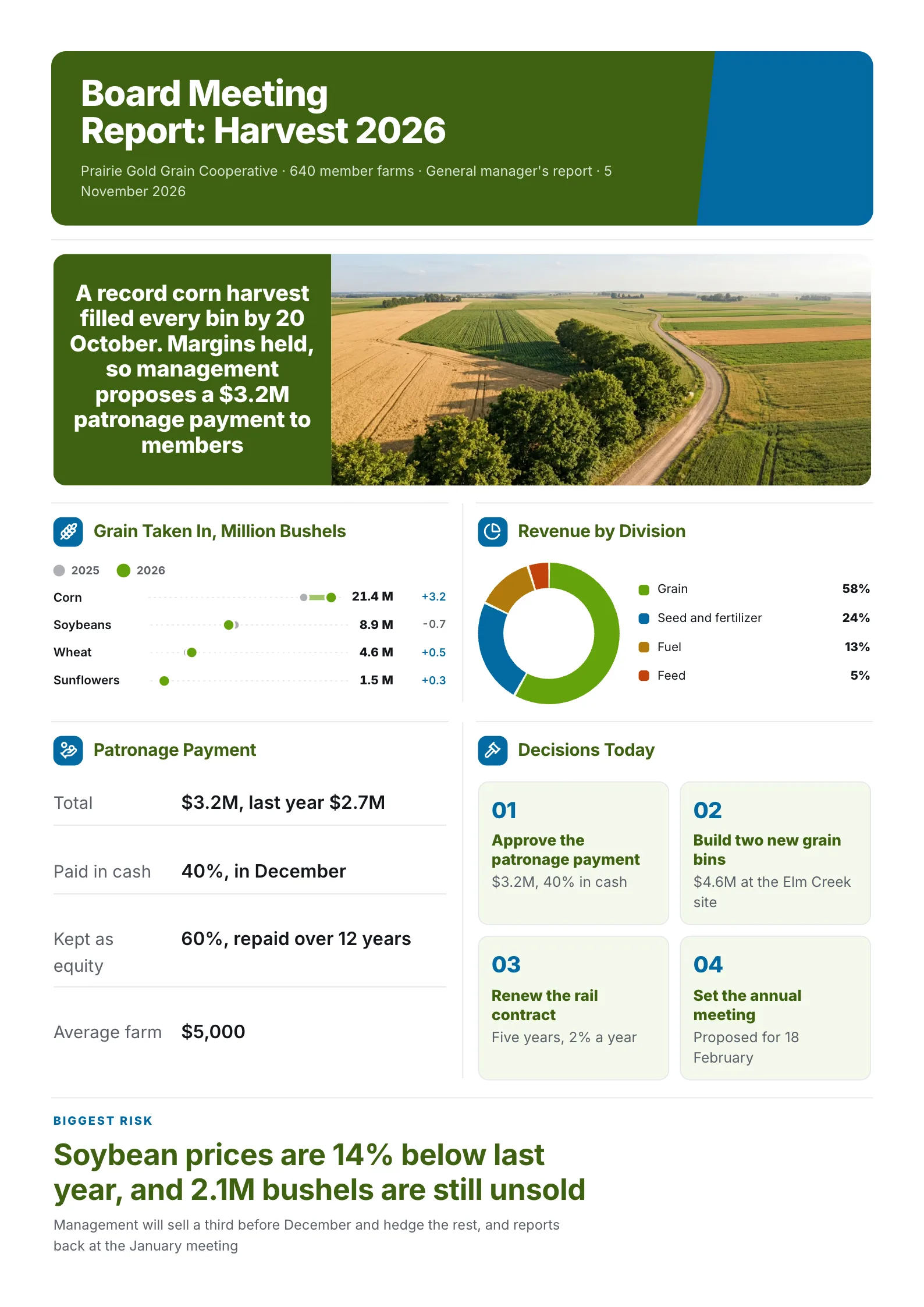 Board Meeting Report: Farm CooperativeEdit for free(opens in a new tab)
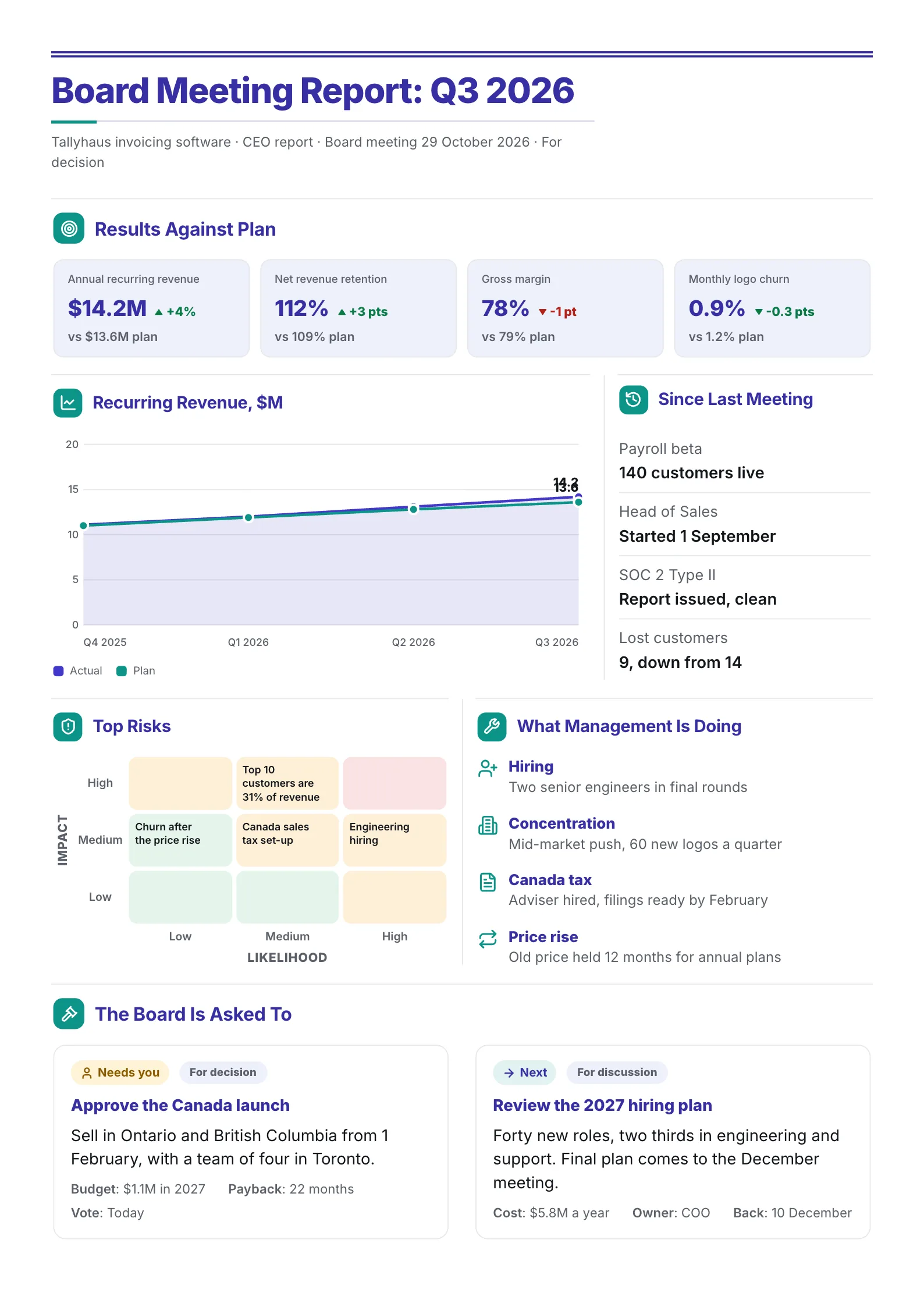 Board Meeting Report: CEO, Software CompanyEdit for free(opens in a new tab)
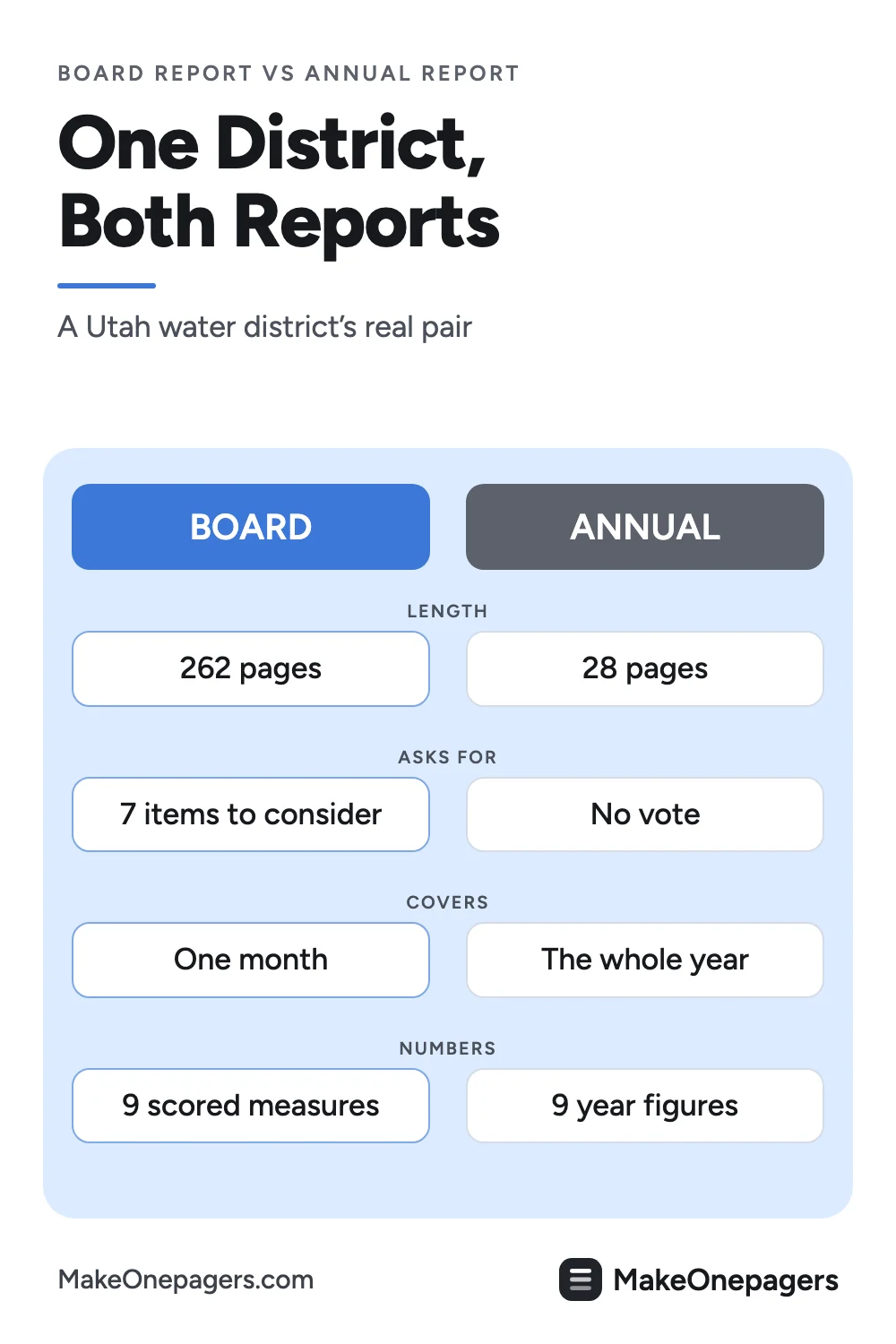
To show you the gap in real documents, we read both from one publisher. Utah's Jordan Valley Water Conservancy District posts its board packets and its annual report online. The packet for its October 14, 2026 meeting runs 262 pages, and its agenda lists 7 items that begin with the word "Consider." The FY 2025/26 annual report runs 28 pages and asks its reader to approve nothing.
| Board report | Annual report | |
|---|---|---|
| Who reads it | The board of trustees | Residents, member agencies, the public |
| How often | Every meeting, 12 a year here | Once a year |
| Period covered | The last month or quarter | The whole fiscal year |
| What it asks | A vote, a note or a discussion | Nothing, it reports |
| Length here | 262 pages, 42,868 words | 28 pages, 5,175 words |
| Bad news | Flagged in color with a reason | Told as a story, in its own section |
Inside the packet and the annual report
The board packet for October 14, 2026 holds everything the district's trustees needed that day. Its agenda has 19 numbered items. Item 2 is a public hearing on issuing "up to $120 million of water revenue bonds." Seven items begin with "Consider," from a well pump contract to two water purchase agreements with nearby cities. Behind each one sits a short staff memo, and behind those come contracts and reports. You aren't meant to read it front to back. Each trustee reads the memos and dips into the rest.
The FY 2025/26 annual report is built for a stranger. It opens with a letter from the general manager, then runs through 12 sections with titles like "Putting Our Resilience to the Test" and "Investing in Our People." It names the 9 trustees, but it doesn't ask them for anything. Its "At a Glance" page gives 9 numbers for the year, such as more than $79 million in capital improvements and 234 after-hours emergency callouts.
Both come from the same staff, about the same water system, in the same season. So the differences come from the reader each one serves.
A board report asks for a decision, in a few lines
Take one decision memo from the packet and you'll see the shape a board report takes. Item 11.a asks the trustees to buy a second vactor truck, a hydro-excavator truck the memo says will help crews respond "during pipeline breaks and emergencies." The memo opens with the budget, $750,000, and the share another agency will pay back, about $31,947. Then it gives the reason in one paragraph. The district runs a single 2018 truck, and recent repairs showed the risk of relying on it.
After that comes a table of 6 bids, 4 with prices and 2 marked "Non-responsive." The lowest is $638,947. The memo ends with a one-line recommendation and, in its own row, "Total Authorization Amount (Approval Requested): $638,947." The whole memo fits on one page of the packet, page 162, so a trustee sees the ask, the price and the other options at once.
That's the pattern you can copy in your own board report. Put the ask and the money first, give the reason in a few sentences, show the choices your team weighed, and end with the exact motion you want. Our guide on how to write a board meeting report walks through each of those parts.
The monthly scorecard: a board report you can read in a minute
The packet also carries a three-page "Monthly Performance Scorecard" for September 2026. It scores 9 measures, and each one sits on a colored band marked On Track, Needs Attention or Off Track. Where a measure slips, staff add a sentence that says why.
Employee turnover reads 10.4%, inside the Needs Attention band of 6.9% to 13.9%. The note says exit interviews point to "individual circumstances rather than a common organizational concern." Emergency response training reads 3.1 hours per employee, also in Needs Attention, and the note starts plainly: "We have struggled to implement our Emergency Response related training as intended."
Revenue reads 92% of what was planned so far, or $21.90 million. Staff explain it this way: "This performance measure remains in yellow as customers have responded to water conservation messaging to reduce demand during the drought."
Notice what the scorecard does for its reader. It doesn't decide anything by itself, but it tells the board where to spend its questions. For anyone reporting to a board, a one-page scorecard like this is the most useful thing you can add. Give each number a target band, and write one sentence wherever it misses.
An annual report tells the year as a story
The annual report covers some of the same ground, but it speaks to a different reader. Its tables put three fiscal years side by side, so a resident can see the trend. Total water supply in FY 2025/26 was 154,131 acre-feet, and the table shows the two years before it.
It also tells the drought as a story with a beginning and an end. The district set a 10% goal for cutting water use. The report says: "Water deliveries across Jordan Valley Water's service area dropped by 15% compared to the same time from the year before, surpassing the 10% reduction goal set at the outset of the drought response." Applications for its landscape incentive program rose from about 250 the year before to more than 600.
It doesn't hide the hard part either. A section headed "Not in the Clear Yet" warns that "conservation gains are fragile when they're driven by circumstance rather than habit." But you won't find the turnover rate or the training hours anywhere in it. Those belong to the board.
Same drought, two readers
Here's the clearest way to see the split. The annual report celebrates a 15% drop in water deliveries, beating the goal. The board scorecard, a few months later, shows what that drop cost: water sales below budget, with revenue in the yellow band. Both are true. Each one is the half of the story its reader needs.
A resident needs to know the region pulled together and the water kept flowing. A trustee needs to know revenue is running short, so they can decide what to do about rates, bonds or spending. Before writing either report, ask which half your reader is responsible for.
Which one do you need?
You need a board report when people with authority have to act. That might be a nonprofit board, a credit union's directors, a school board or the owners of a small company. Write one for every meeting, keep each ask on its own page, and send it a few days early so they can read before they vote.
You need an annual report when people outside the room deserve an account of the year. That might be donors, members, residents, lenders or staff. Write it once a year, compare this year with the last two, and include the hard parts in plain words.
Many groups need both, and the board report feeds the annual one. Keep a monthly scorecard and your annual report's "at a glance" page is half written by the end of the year. For a one-page version of the yearly report, see our guide to the annual report one pager. Writing mainly for donors? Weigh the annual report against an impact report in impact report vs annual report.
Turn your board reports into your annual report
You don't have to write the annual report from a blank page. With a board report from every meeting, most of your year is already on paper. Here's how to move it across.
Start with your scorecard. Pull each measure's year-end number and put it beside the year before, the way Jordan Valley's tables show three years at once. Pick the few numbers a stranger would care about for your "at a glance" page, and leave the rest with the board.
Next, read back through the decisions your board made. Each big vote is a line in your annual report. A truck bought, a contract signed or a rate set becomes "what we built this year." Write it as what changed for the people you serve, and skip the motion wording.
Then go back to the measures that slipped. You don't have to print every yellow band, but your reader should hear the hard part from you. Jordan Valley gave it a whole section, "Not in the Clear Yet." Give yours a paragraph at least.
Finally, swap the voice. Your board report says "the board is asked to." Your annual report says "this year, we." Catch yourself asking your reader to approve something? Move that line back to the board.
Five one-page board reports, and what each asks the board
These samples from MakeOnepagers are all board reports, with made-up names and numbers. Each one shows its board a few results and then asks for something specific, the way the district's memos do.
 Edit this template
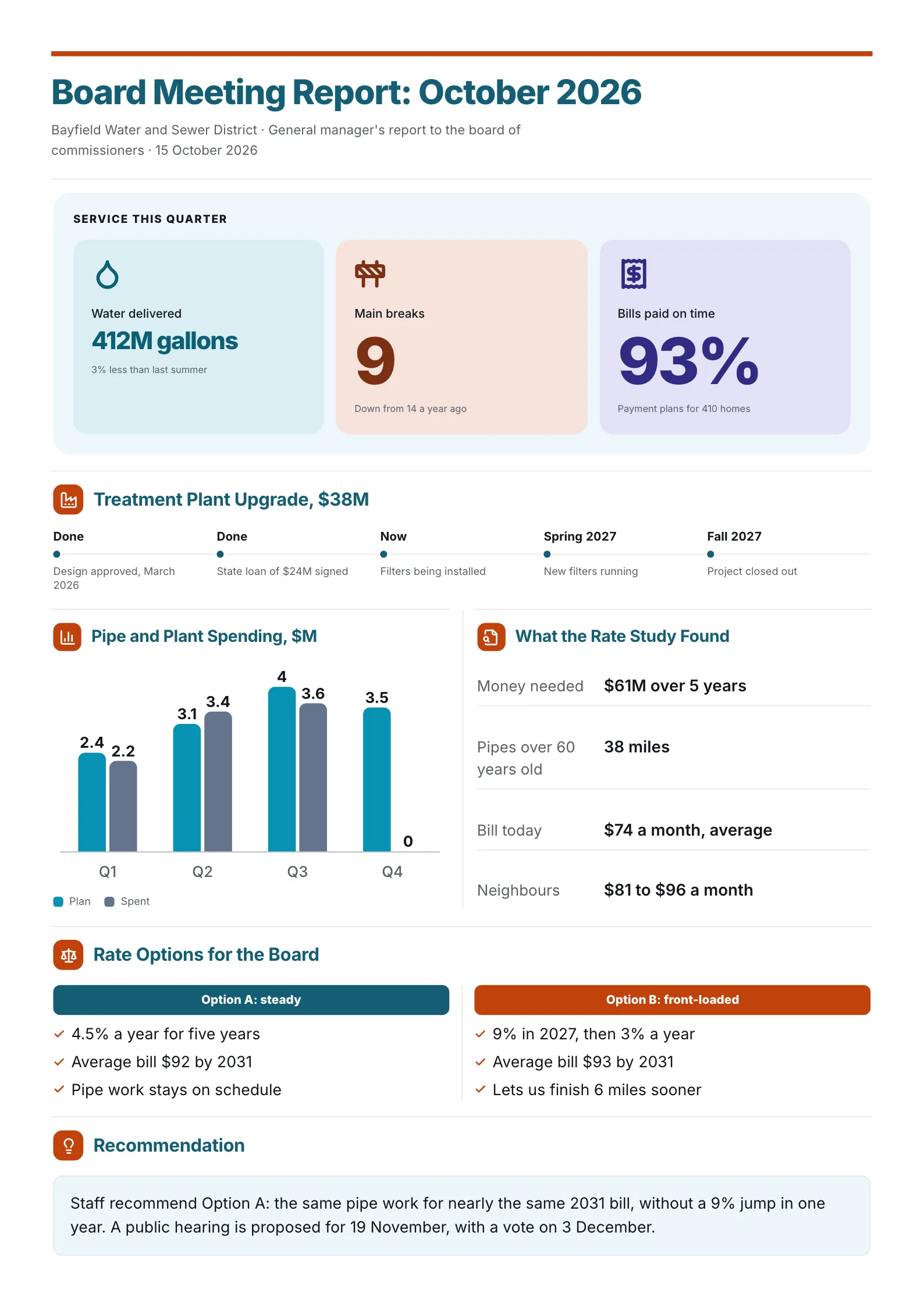
This water utility board meeting report comes nearest to Jordan Valley's packet. Utilities can start right here. It gives the board two rate options for a made-up district with a $74 average bill. Option A raises rates 4.5% a year to reach $92 by 2031. Option B starts with 9% in 2027 and reaches $91. Staff recommend A and name the hearing date, November 19, and the vote, December 3. You can check the sums yourself, and both bills land where the sheet says.
 Edit this template
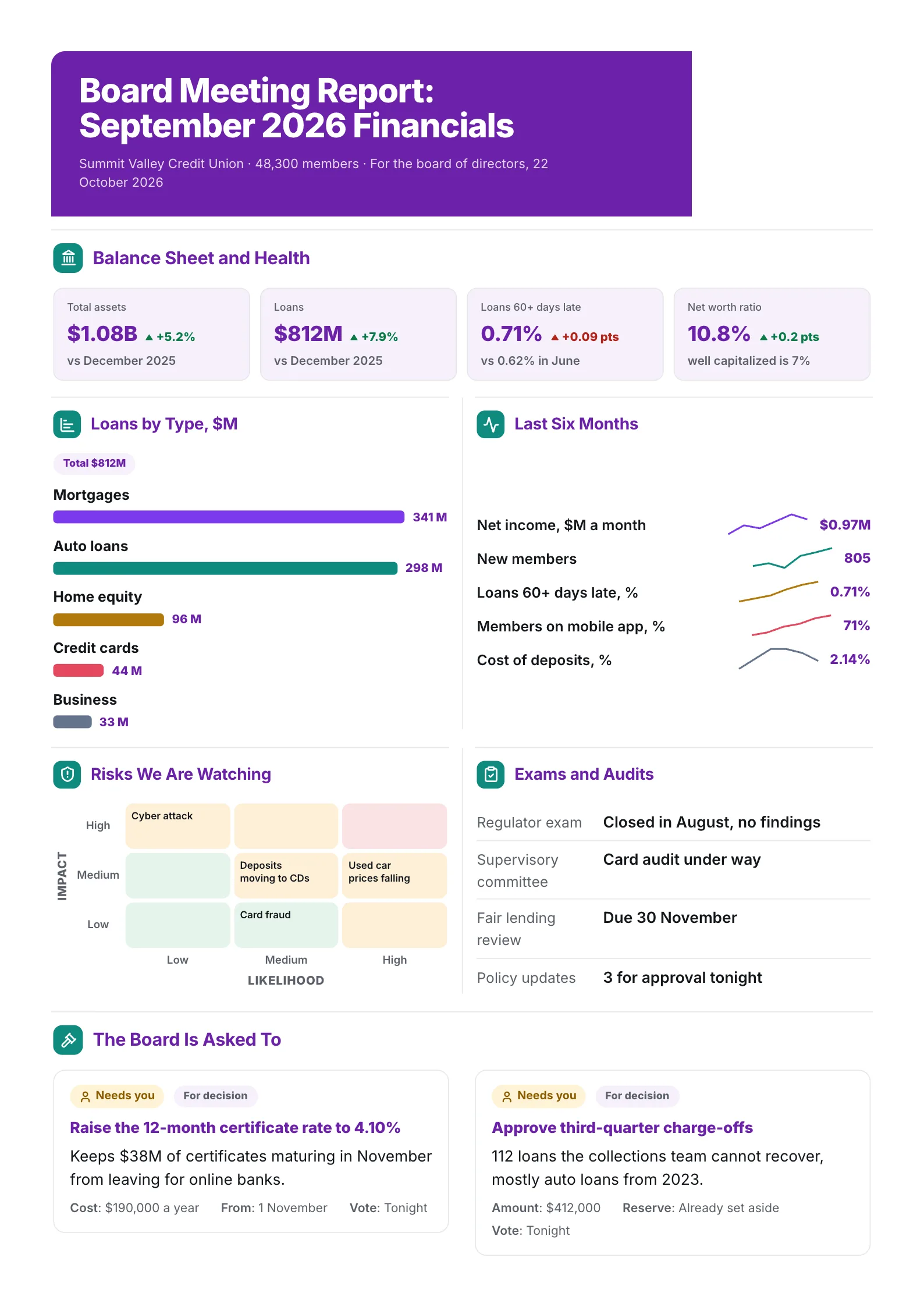
This credit union board meeting report leads with $1.08B in assets and a 10.8% net worth ratio, beside the 7% that counts as well capitalized. Then it asks for two votes that night. One raises the 12-month certificate rate to 4.10% to keep $38M from leaving, at a cost of $190,000 a year. The other approves $412,000 of charge-offs across 112 loans.
 Edit this template
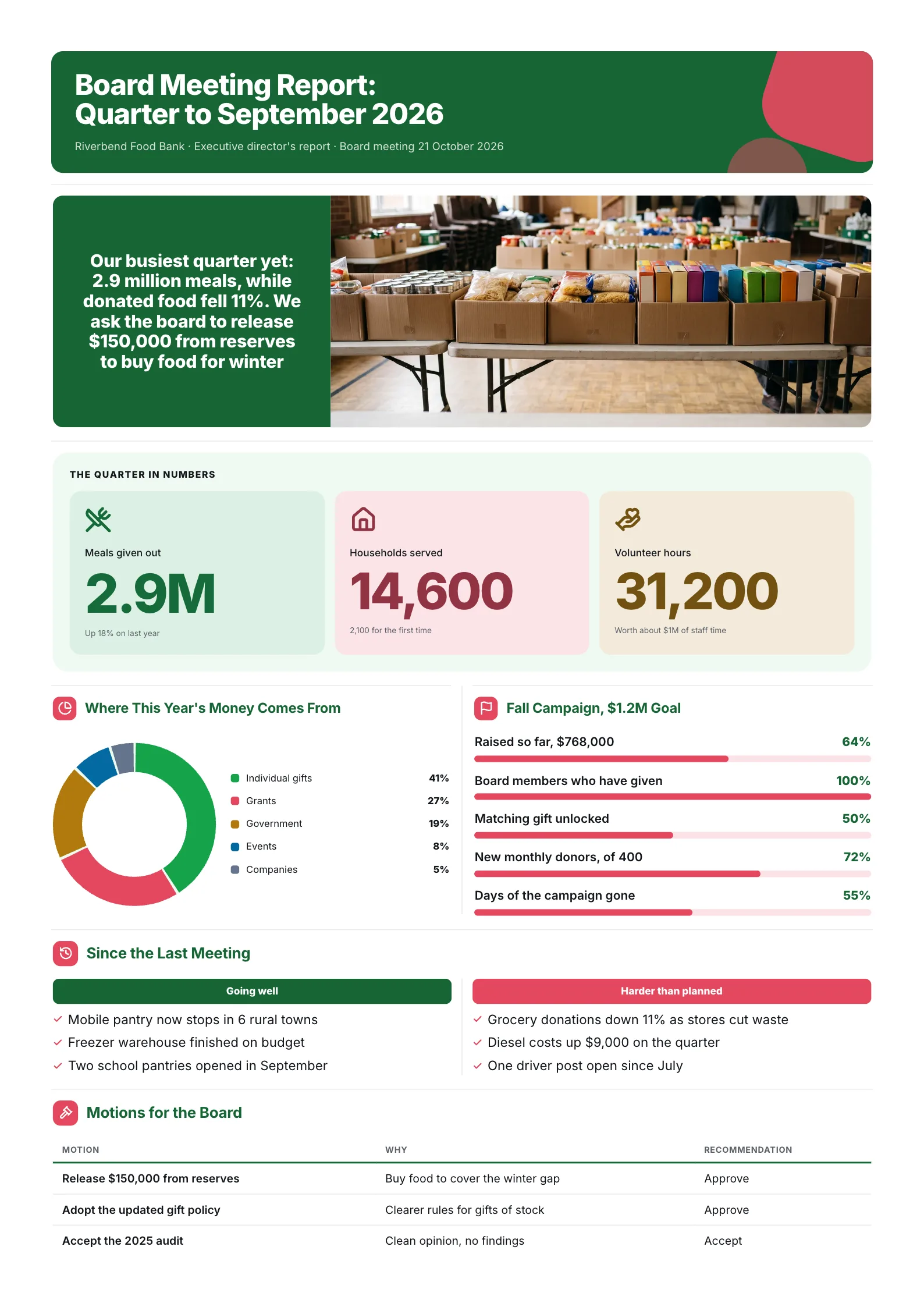
This nonprofit food bank board meeting report puts the tension in its first line. It gave out 2.9 million meals, up 18%, while donated food fell 11%. So it asks the board to release $150,000 from reserves. One of its three motions is "Accept the 2025 audit," which is where a board report and the yearly accounts meet.
 Edit this template
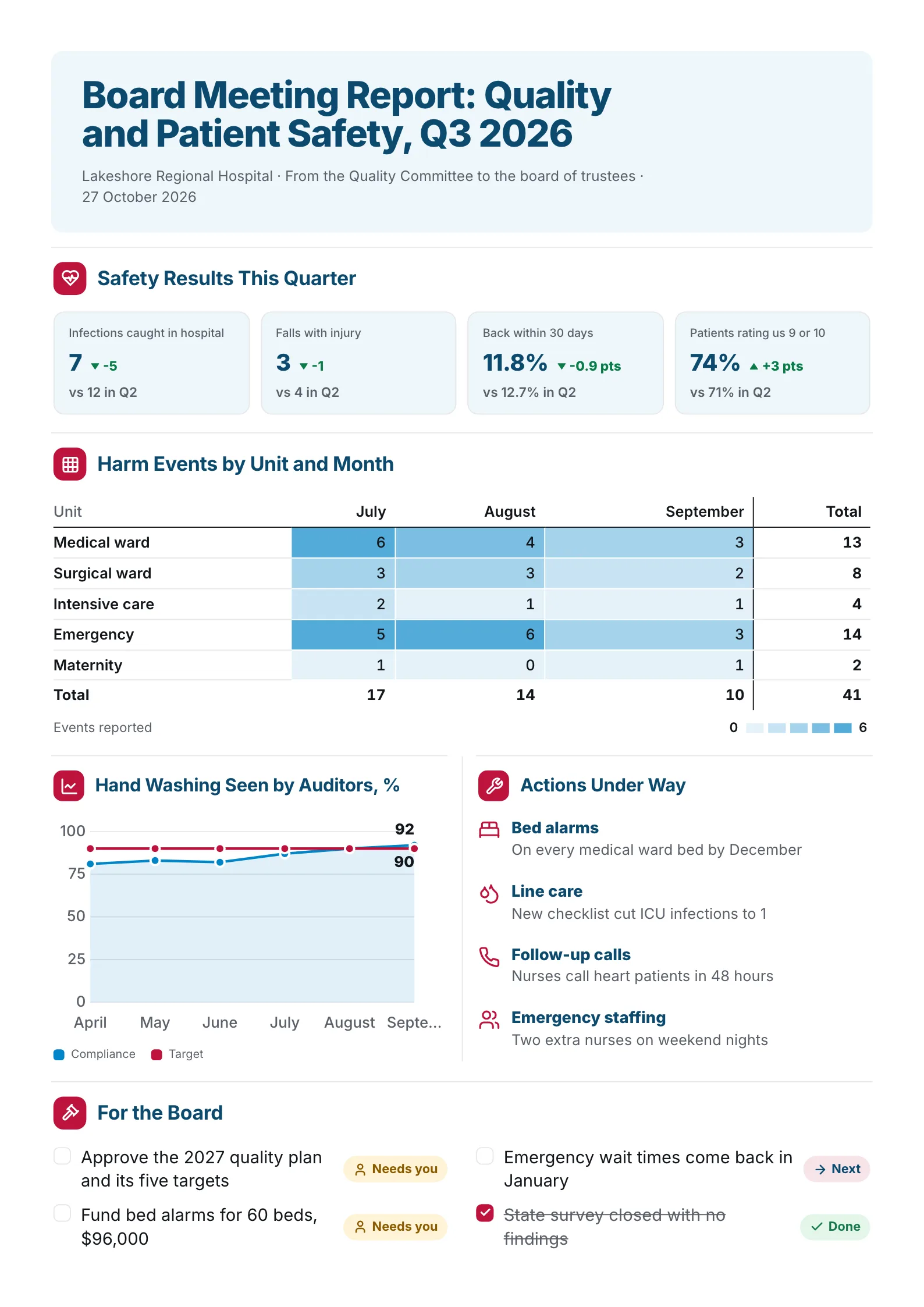
This hospital quality board meeting report comes from the hospital's Quality Committee. It shows infections caught in hospital falling from 12 to 7 and asks trustees to approve the 2027 quality plan and its five targets. It also asks them to fund bed alarms for 60 beds, at $96,000.
 Edit this template
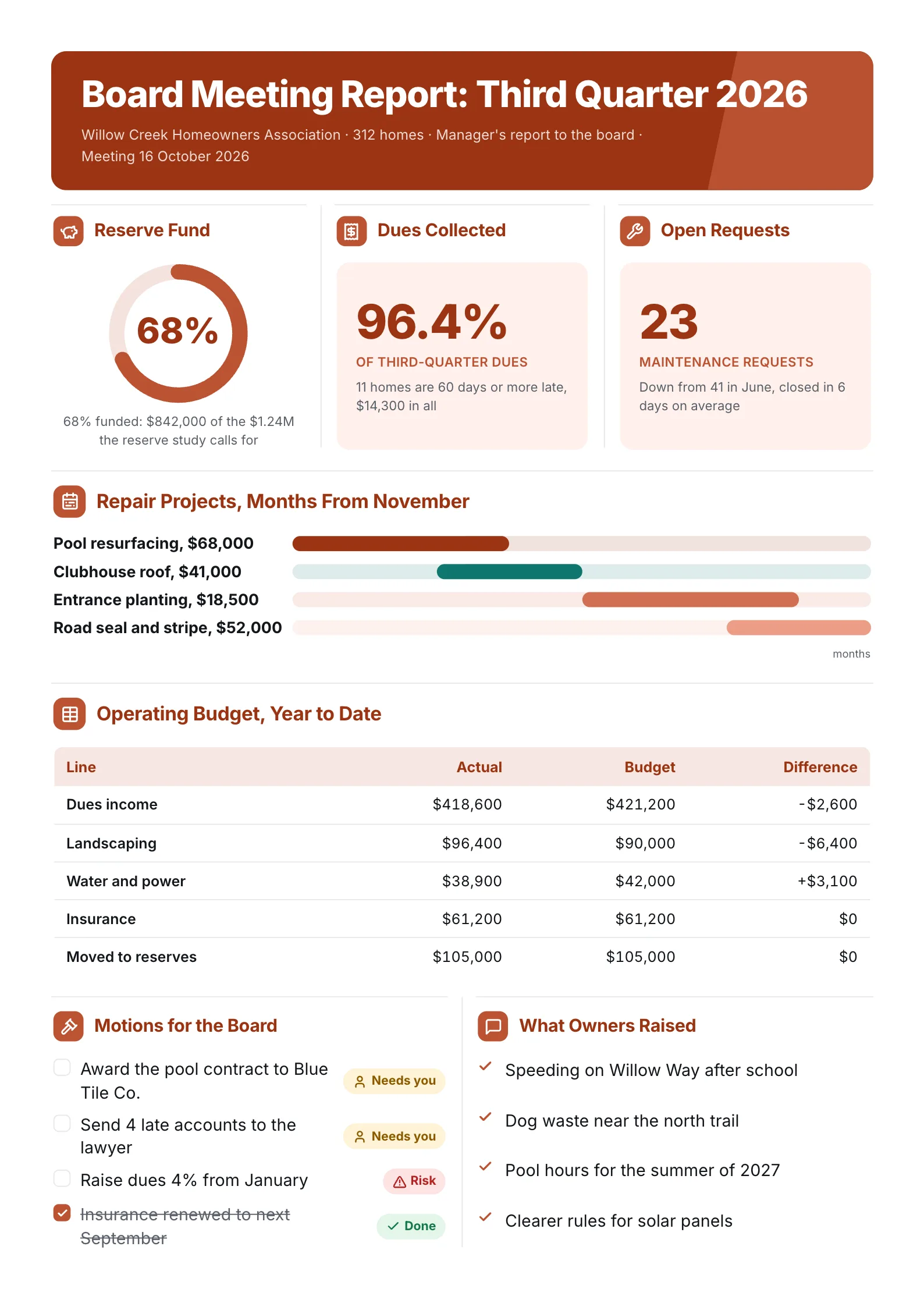
This HOA board meeting report is for the board of a 312-home community. Its reserve fund is 68% funded, $842,000 of the $1.24M the study calls for, and dues collection is 96.4%. The motions ask the board to award a pool contract, send 4 late accounts to the lawyer and raise dues 4% from January.
Make your board report
Open a MakeOnepagers board report made for a group like yours, then type in this month's numbers. Short on time? Paste this month's figures into the free AI One-Pager generator and tidy what comes back. Either way, put your ask at the top and your motion at the bottom, the way Jordan Valley's memos do.
Frequently asked questions
What is the main difference between a board report and an annual report?
The reader and the ask. A board report goes to directors before a meeting and asks them to vote, note or discuss. An annual report goes to the public once a year and accounts for what happened.
Is a board report public?
It depends on who you are. Public bodies, like Jordan Valley Water, post their board packets online. A private company's board reports usually stay with its directors.
How often should a board report be written?
Once for every board meeting. Jordan Valley's 2026 schedule lists 12 regular board meetings, and its scorecard is labeled monthly.
Does the board approve the annual report?
That depends on your bylaws and your funders. In our food bank sample, accepting last year's audit is one of the board's motions.
Can a board report be one page?
Yes, for each topic. Jordan Valley's truck memo fits the budget, the bids and the ask on one page, and its scorecard covers 9 measures in three pages.