Budget Checklist: The 50 Questions a Budget Award Asks, for Home or Work
A budget checklist built from the 50 questions GFOA's budget award scores, worth 200 points. Each check has a home version and a filled-in sample budget.


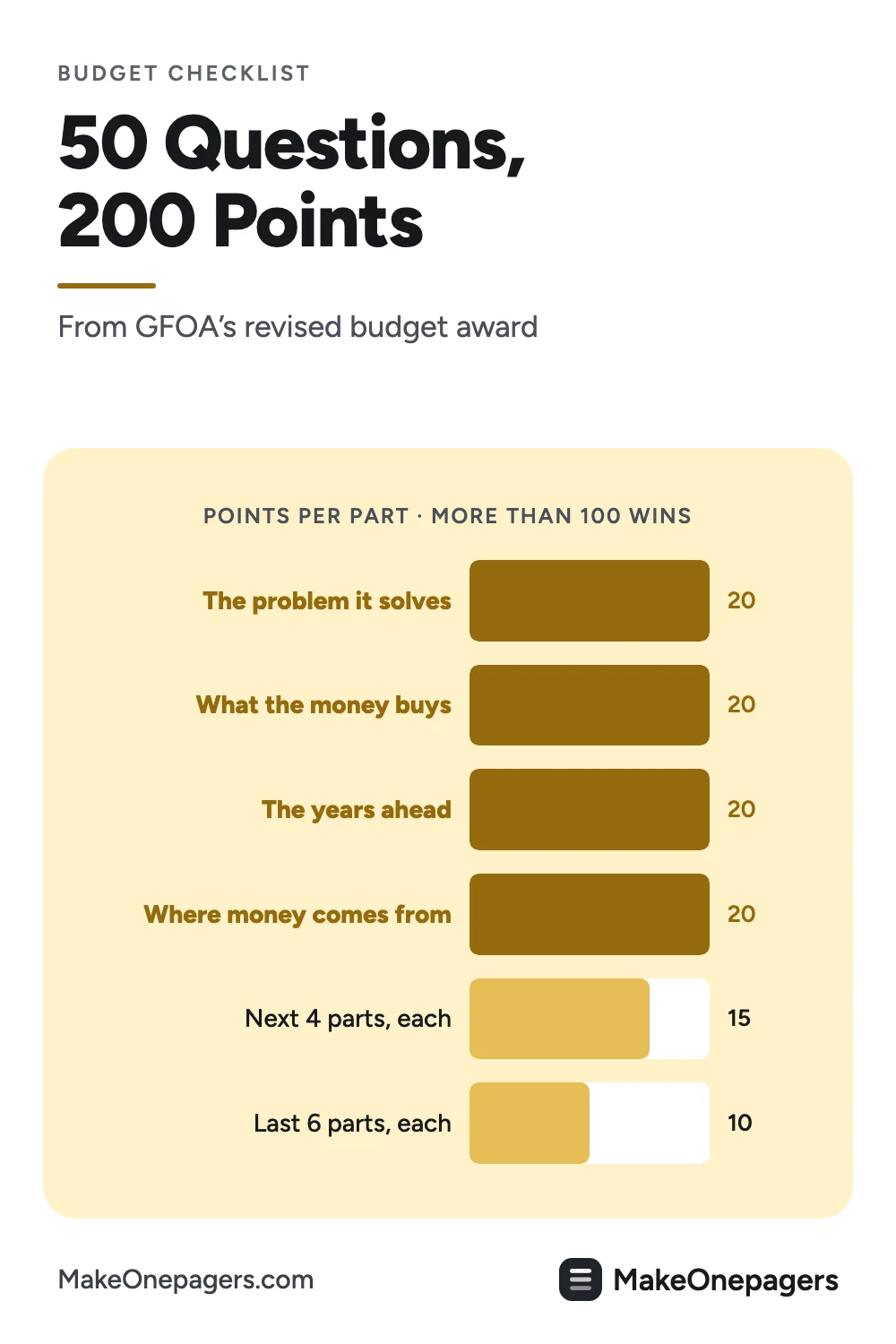
Every budget gets read by someone with questions, and a budget checklist makes sure yours answers each one before they ask. One group has already written those questions down for its judges. The Government Finance Officers Association of the United States and Canada (GFOA) runs a budget award for governments, and its revised criteria hold 50 questions in 14 parts, worth 200 points in all. A budget needs more than 100 points to win. Start from a free one pager template.
One‑Pager examples
Real One-Pagers made with MakeOnepagers. Open any one to edit it as your own.
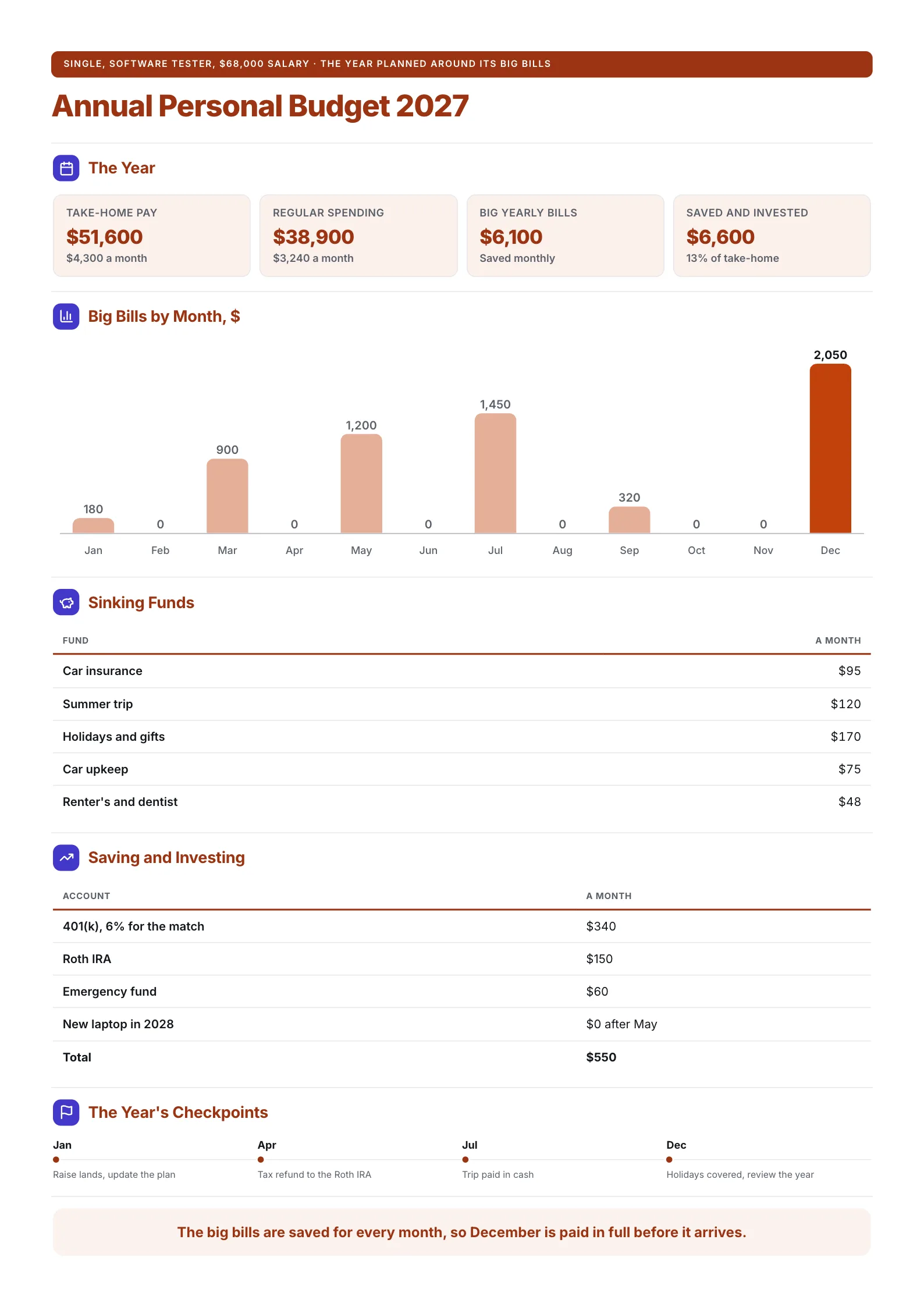 Personal Budget: Annual Plan with Sinking FundsEdit for free(opens in a new tab)
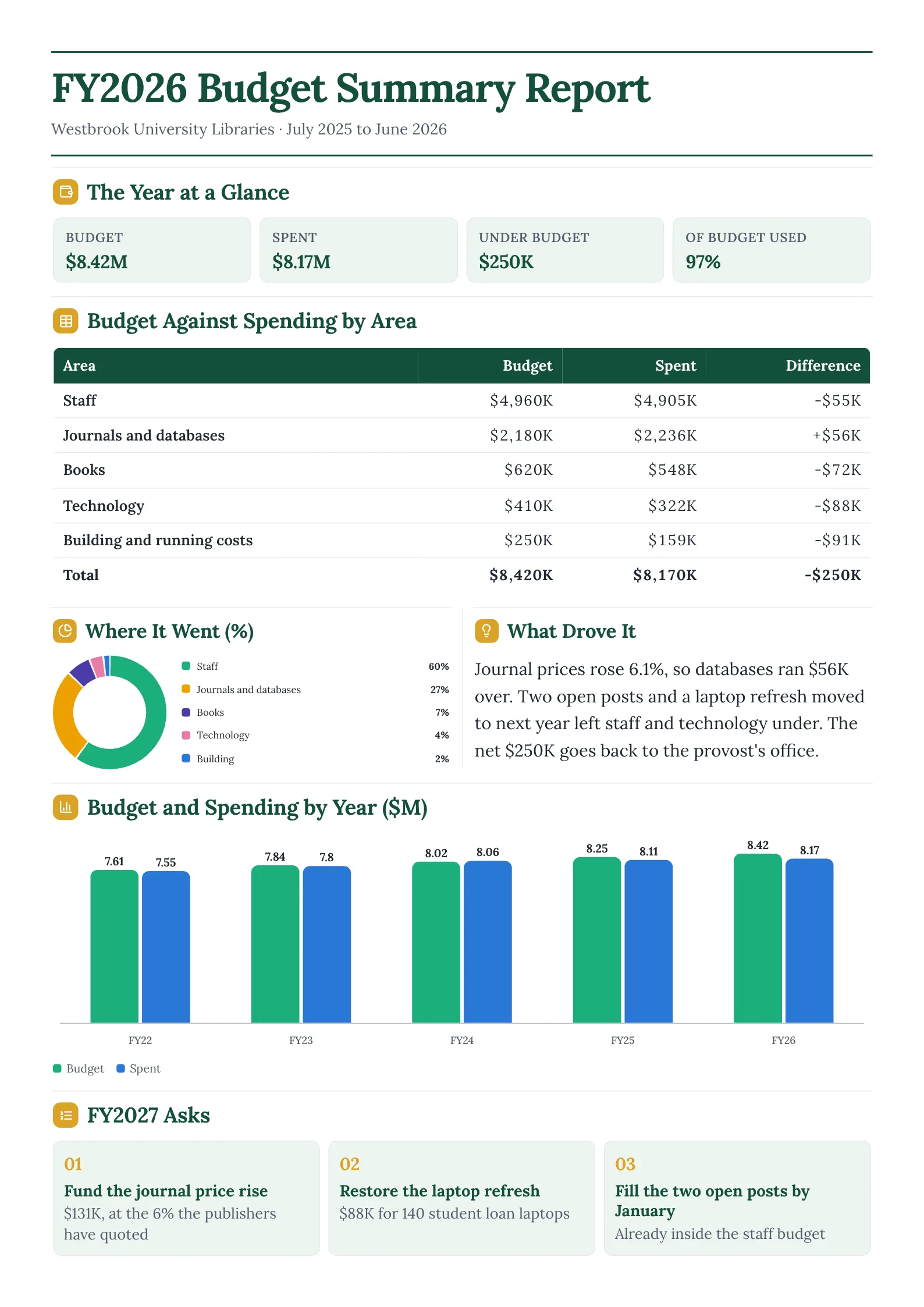 Budget Summary ReportEdit for free(opens in a new tab)
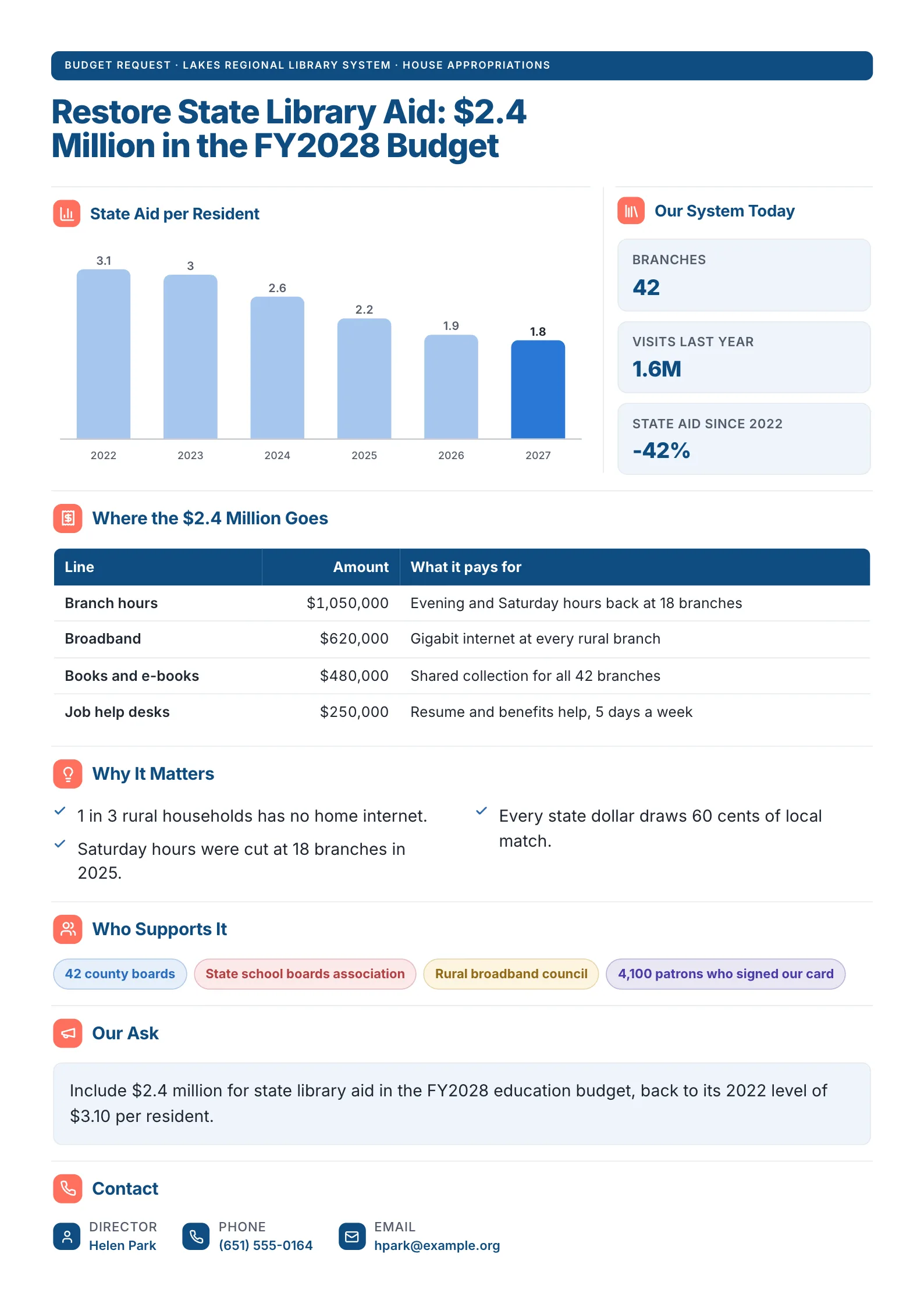 Legislative Brief: State Library Aid BudgetEdit for free(opens in a new tab)
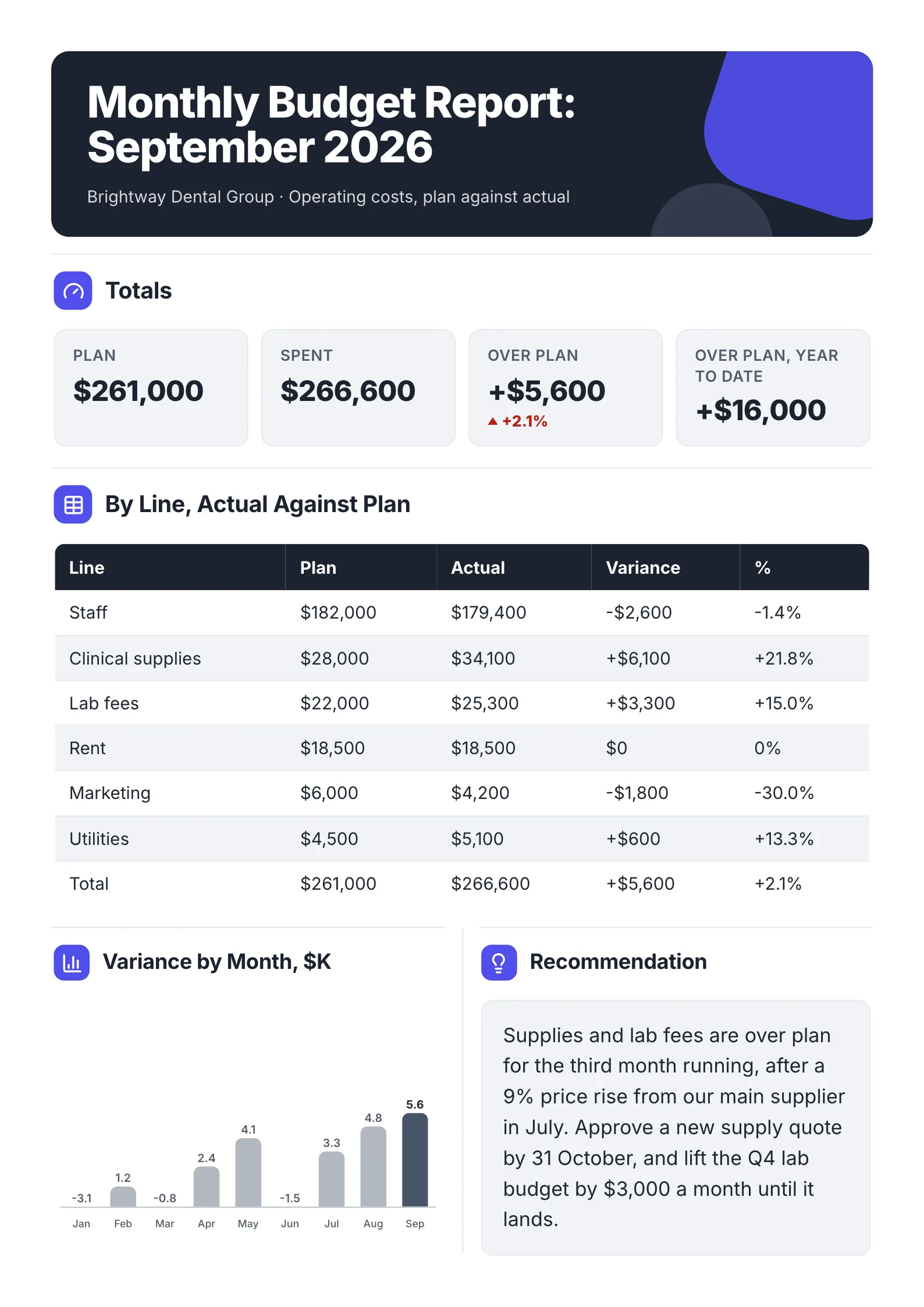 Monthly Budget ReportEdit for free(opens in a new tab)
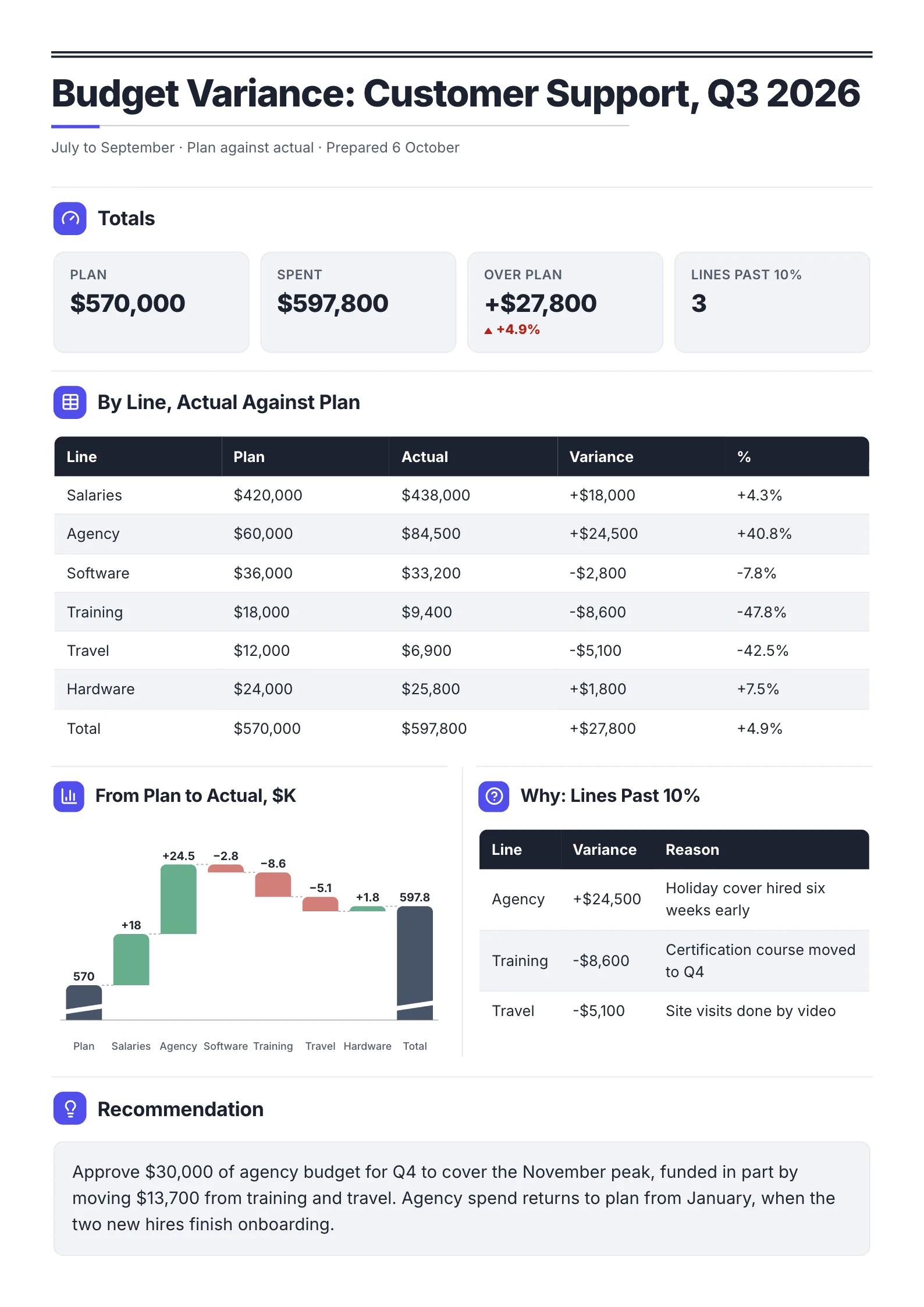 Department Budget Variance ReportEdit for free(opens in a new tab)
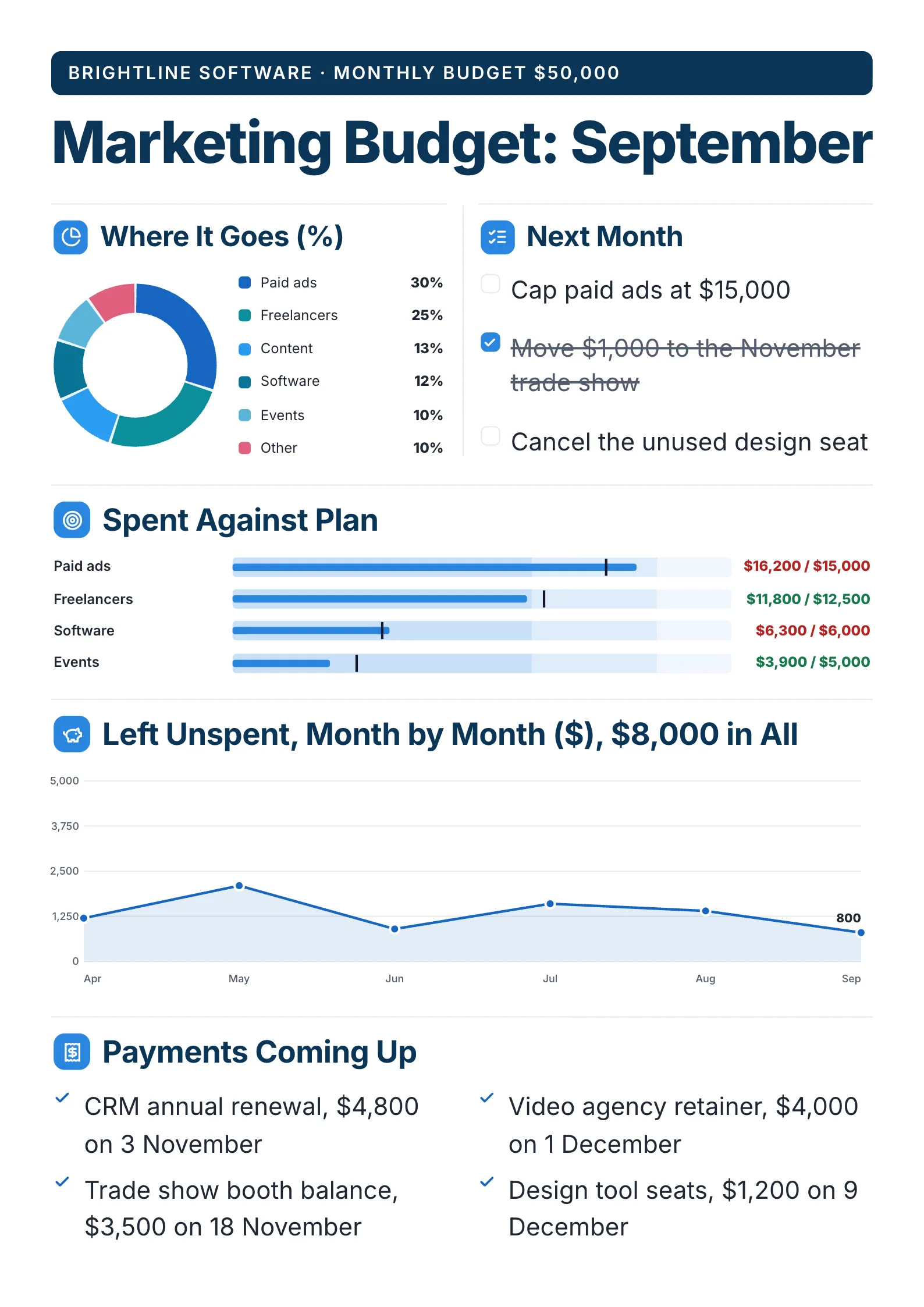 Team Budget SnapshotEdit for free(opens in a new tab)
The questions work just as well on a household or team budget as on a city's. Below you'll find all 14 parts and what each one is worth, then a home and a work version of every check. After that come 5 sample budgets from MakeOnepagers, each one matched to the parts it answers best.
The 14 parts, and what each is worth
GFOA splits the list in two. Nine parts score what your budget says, and five score how you share it with the people who read it.
| Part | Points | Questions |
|---|---|---|
| The challenges it takes on | 20 | 3 |
| Value: what you get, and the cost | 20 | 2 |
| The long-term outlook | 20 | 5 |
| Revenue | 20 | 4 |
| Staff | 15 | 3 |
| Departments | 15 | 4 |
| Programs and services | 15 | 4 |
| Capital (big purchases) | 15 | 5 |
| How the budget was made | 10 | 5 |
| The budget document | 10 | 3 |
| A budget in brief or newsletter | 10 | 4 |
| A budget website | 10 | 3 |
| Videos | 10 | 3 |
| Other tools | 10 | 2 |
| Total | 200 | 50 |
The first nine parts carry 150 of the 200 points and 35 of the 50 questions. The departments part and the programs part ask the same 4 questions, so 46 of the 50 are different.
The rules are changing, too. Governments can choose the new questions for 2027, and starting January 1, 2028, GFOA's program page says "all governments must submit using the new criteria." The same page drops the old must-have items, and says GFOA "will accept websites, budget-in-brief, presentations, videos, or other formats that clearly answer the budget questions." So no single part is required, and you score points for each one you answer.
The budget checklist
GFOA writes each question for a government. The home and work lines under each part are our own wording of the same check, so you can run it on the budget in front of you.
1. Name the problem this budget takes on (20 points)
GFOA asks three things. "What are the major challenges facing the organization and/or the community?" "How does this budget address those challenges?" And "Are results expected to improve within the budget period?"
- At home: write your biggest money problem at the top, like a card balance or a car near the end of its life. Then point to the line that deals with it.
- At work: name the problem, the line that pays to fix it, and the number you expect to move by year end.
2. Say what the money buys, and what it all costs (20 points)
The two questions are "What is the public getting from the government?" and "How much does the government cost?" Put plainly, what does the reader get, and for how much?
- At home: show the month's total in one number, then say what each big line gets you, like a rent that keeps you near work.
- At work: give the total and what it buys, such as hours of service or a target your team will hit.
3. Look past this year (20 points)
This part ties with capital and the budget process for the most questions, at 5 each. GFOA asks how today's decisions change the long-term outlook and "How does the current budget impact reserve levels?" It asks "Are any expenses deferred to future budgets (operating or capital)?" and "Does the budget create any long-term spending obligations?" Last, it asks what the trend from prior years means for the future.
- At home: say what this budget does to your emergency fund, then list any repair you're putting off and any new loan or contract you're signing.
- At work: flag anything that locks in a cost for later years, and set this year beside the last few.
4. Say where the money comes from (20 points)
GFOA asks how much revenue you expect, "Where does revenue come from?" and "How much control or discretion does the government have over revenue?" Its fourth question asks how the cost is shared across the community.
- At home: list each source of take-home pay, and mark the ones you can't count on, like overtime or tips. If two people share costs, write who pays what share.
- At work: list each source and say which ones you control and which you're guessing at.
5. Count the people (15 points)
GFOA asks "How many total staff are budgeted?" and "How have personnel costs changed from the prior year?" Then it asks what is driving that change.
- At work: give the headcount now and next year, the change in pay and benefits, and the reason, such as new hires or raises.
- At home: skip it, unless you pay for childcare or help in the house. In that case, give it a line of its own.
6. Break the total into parts, each with a goal (15 points, twice)
For departments and for programs, GFOA asks the same 4 questions: "What are the major programs or services?" "What are the costs?" "What are the goals?" "How much revenue does each generate?"
- At home: give each category a cost and one goal, like "groceries: $800, cook four nights a week."
- At work: give each team or project its cost and goal, and any income it brings in.
7. Treat big purchases on their own (15 points)
The capital part has 5 questions. GFOA starts with "How is capital spending defined?" and then asks how much you'll spend, "How are projects prioritized?" and "How is the capital budget funded?" Last, it asks you to name the major projects.
- At home: pick your own line, like any single cost over $500. Rank everything above it, and write how you'll pay for each one, from savings, a sinking fund or a loan.
- At work: do the same for equipment, buildings and software you'll pay for once and use for years.
8. Write down how the budget was made (10 points)
GFOA asks 5 questions here. "How is the budget developed?" "Who is involved?" "How are community priorities considered?" "When are decisions made?" "When can the public participate?"
- At home: note who sat down to make it, the day you'll decide, and when your partner or kids get a say.
- At work: list who built it, the approval date, and when others can still ask for changes.
Check how you share it (50 points)
The last five parts score how the budget reaches people, and each is worth 10 points.
- The document: "Is the document well-organized?" "Does it communicate key messages?" "Does it use graphics effectively?"
- The short version: "Does the budget in brief provide a concise overview?" "Is it free from unnecessary information?" "Was it distributed?" "Is it attractive?"
- The website, and any videos: the website is easy to reach, interactive and kept up to date. A video gets the main message across, explains the key ideas and reflects community priorities.
- Other tools: "What other tools were used?" "How is success measured?"
For most of us, that's one clear sheet. Make the summary short enough to read in a minute, add one chart, and send it to everyone who spends from the budget. GFOA asks "Was it distributed?" for a reason, since a budget nobody has seen can't guide anyone's spending.
Five sample budgets, and the parts each one answers
These samples are made with MakeOnepagers, with invented names and numbers. Each one shows you how to answer a different part of the checklist on a single One-Pager, so borrow the part your own budget is missing.
A CEO brief that names the problem first
 Edit this template
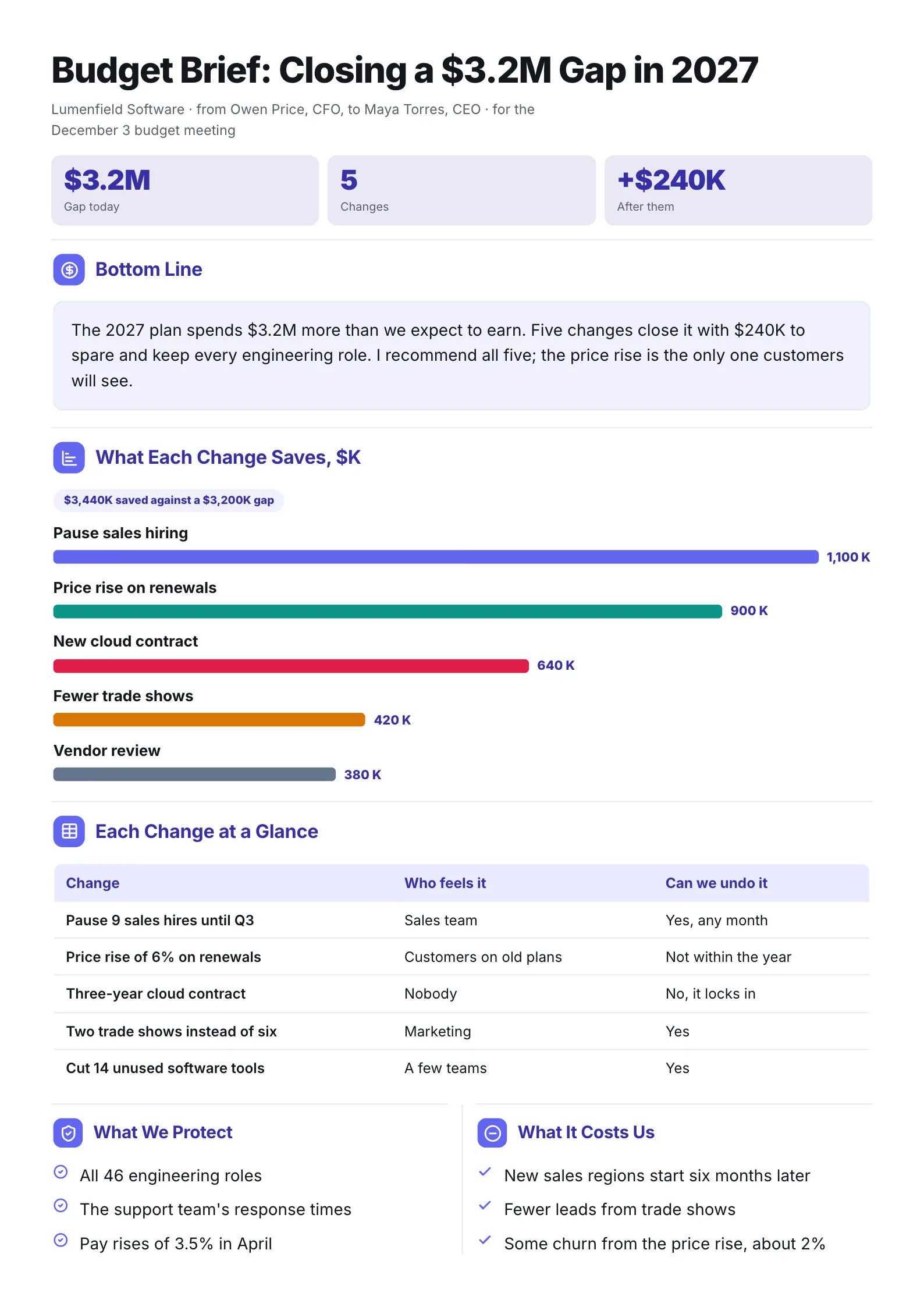
This budget brief for a CEO answers part 1 in its Bottom Line box, which names a $3.2M gap between what 2027 will cost and what the company will earn. Five changes save $3,440K, so the gap closes with $240K to spare. It covers part 3 as well. A column asks "Can we undo it" for each change, and the three-year cloud contract reads "No, it locks in." That's a long-term cost, written where the CEO can't miss it. If your budget signs you up for anything you can't undo, give it a column like this.
A school district summary that splits the total
 Edit this template
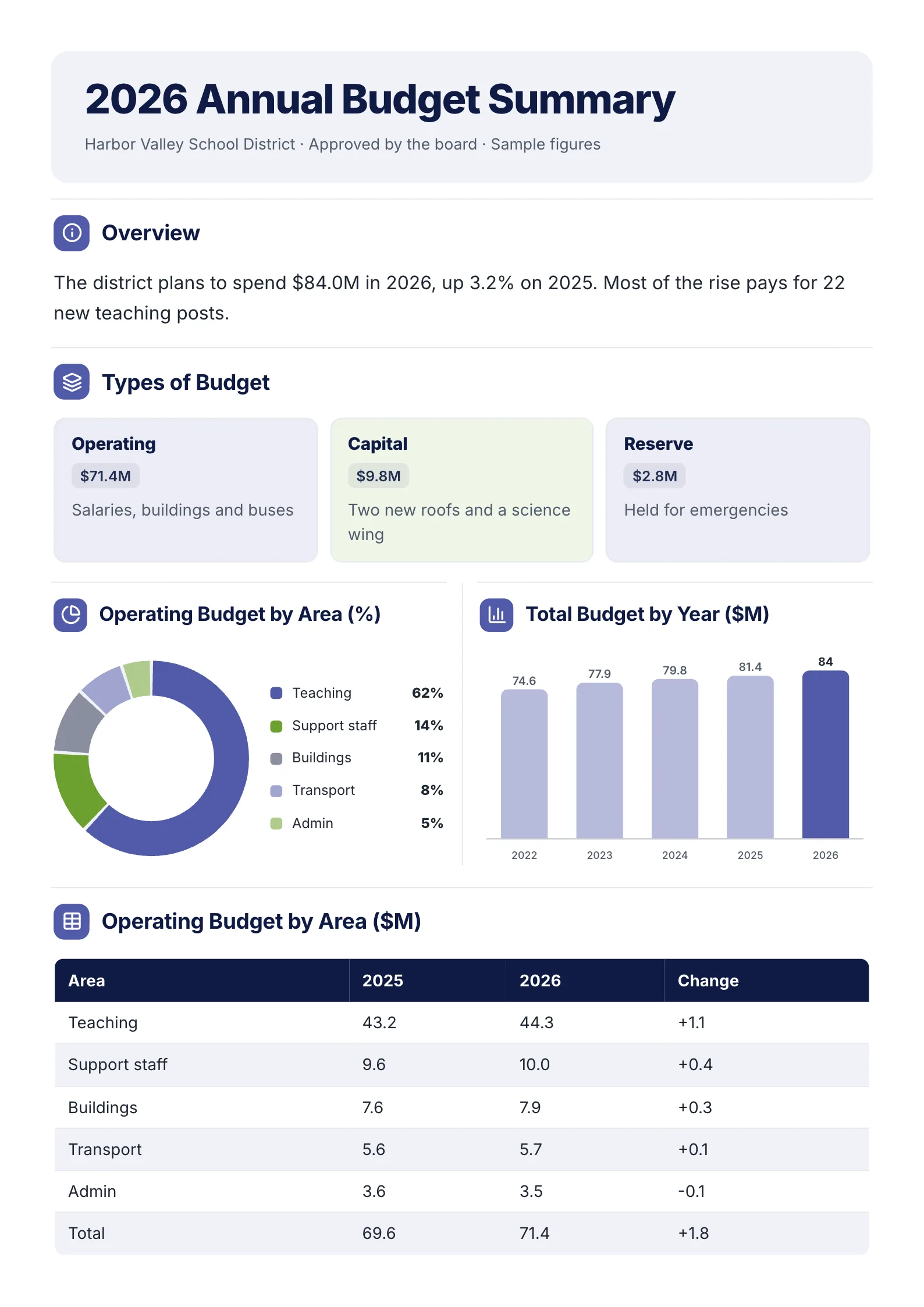
This annual budget summary gives part 2's total up top: $84.0M in 2026, up 3.2% on 2025. Then its tiles split that total. Operating gets $71.4M, capital gets $9.8M for two new roofs and a science wing, and the reserve gets $2.8M, held for emergencies. The three add to $84.0M, so you can check the split at a glance. Its overview names the staff driver too, since most of the rise pays for 22 new teaching posts.
A team proposal that counts its people
 Edit this template
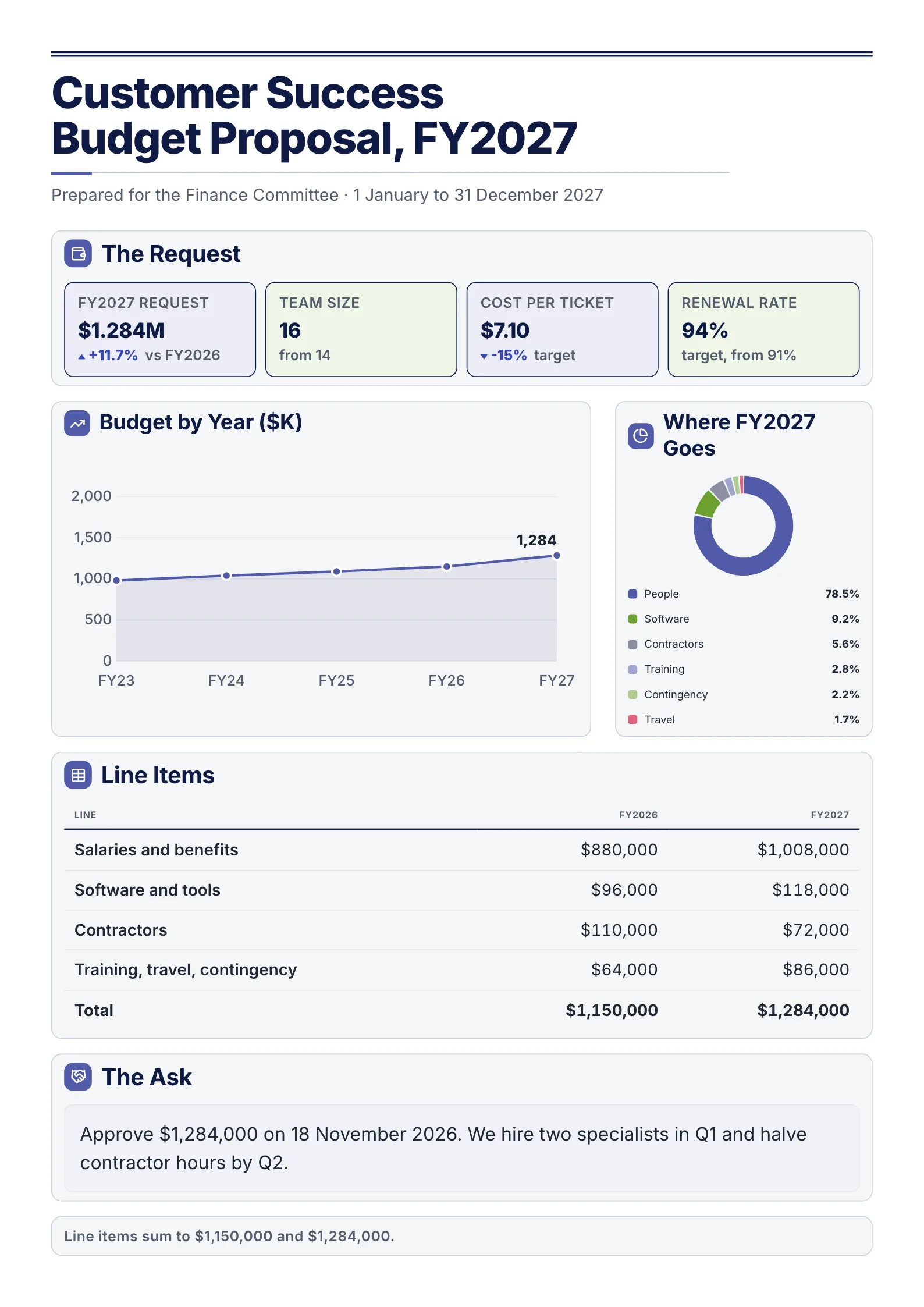
Part 5 is where this budget proposal shines. The team grows from 14 to 16. Salaries and benefits rise from $880,000 to $1,008,000, and the ask says why: two specialists hired in Q1, and contractor hours halved by Q2. Contractors drop from $110,000 to $72,000. For part 2, it sets targets of $7.10 a ticket and a 94% renewal rate, up from 91%. The line items add to $1,284,000. When your headcount changes, give the reason in the same sentence as the cost.
A meeting summary that records how it was decided
 Edit this template
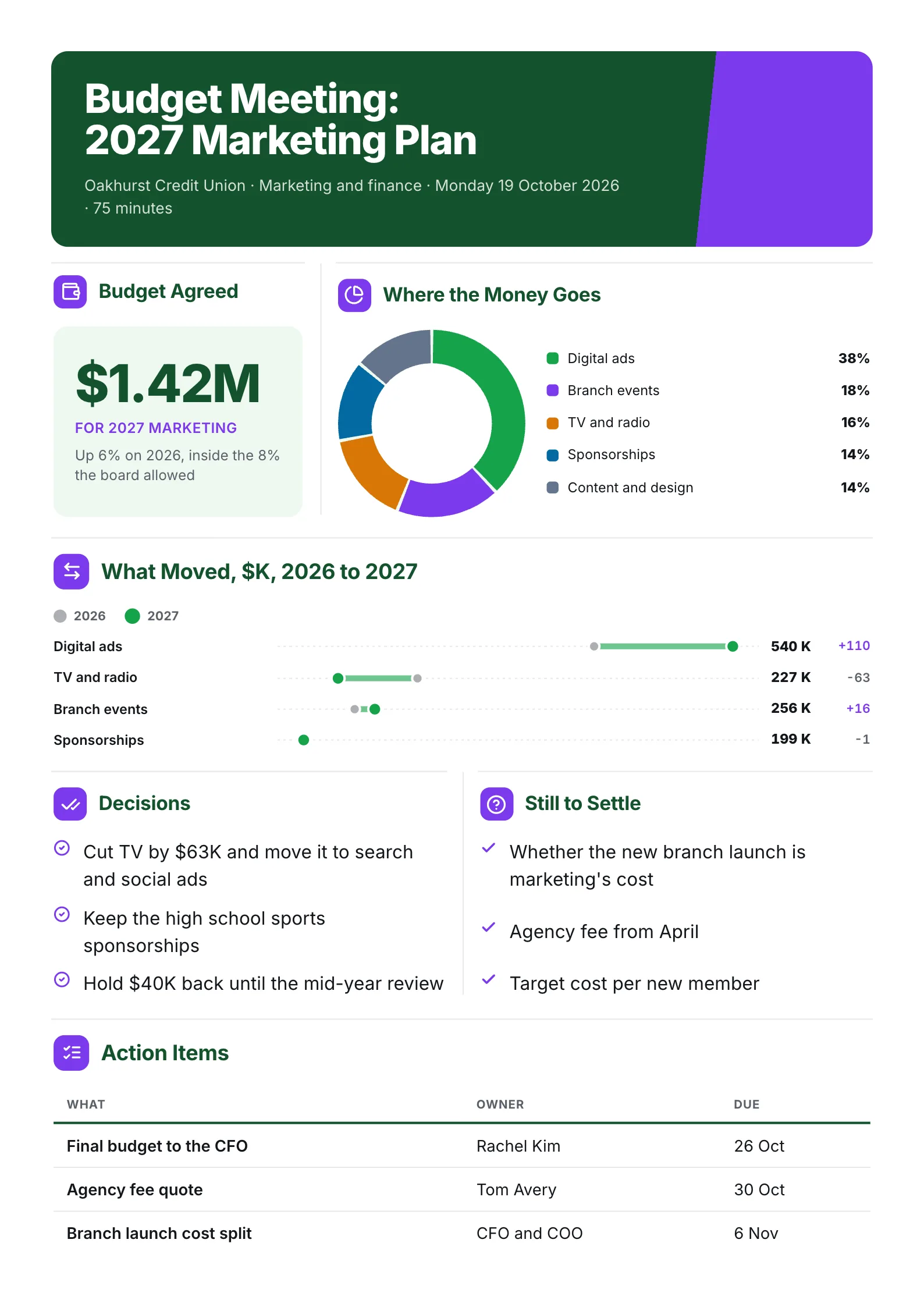
Part 8 asks who was involved and when decisions are made. This budget planning meeting summary answers both. Marketing and finance met on Monday, October 19, 2026, for 75 minutes. They agreed $1.42M for 2027 marketing, up 6% on 2026, "inside the 8% the board allowed." It lists three decisions, among them a $63K cut to TV, moved into search and social ads. Three items are still open, and each action item has an owner and a date. Copy that layout when you need a group to agree on your numbers.
A household budget that looks ahead
 Edit this template
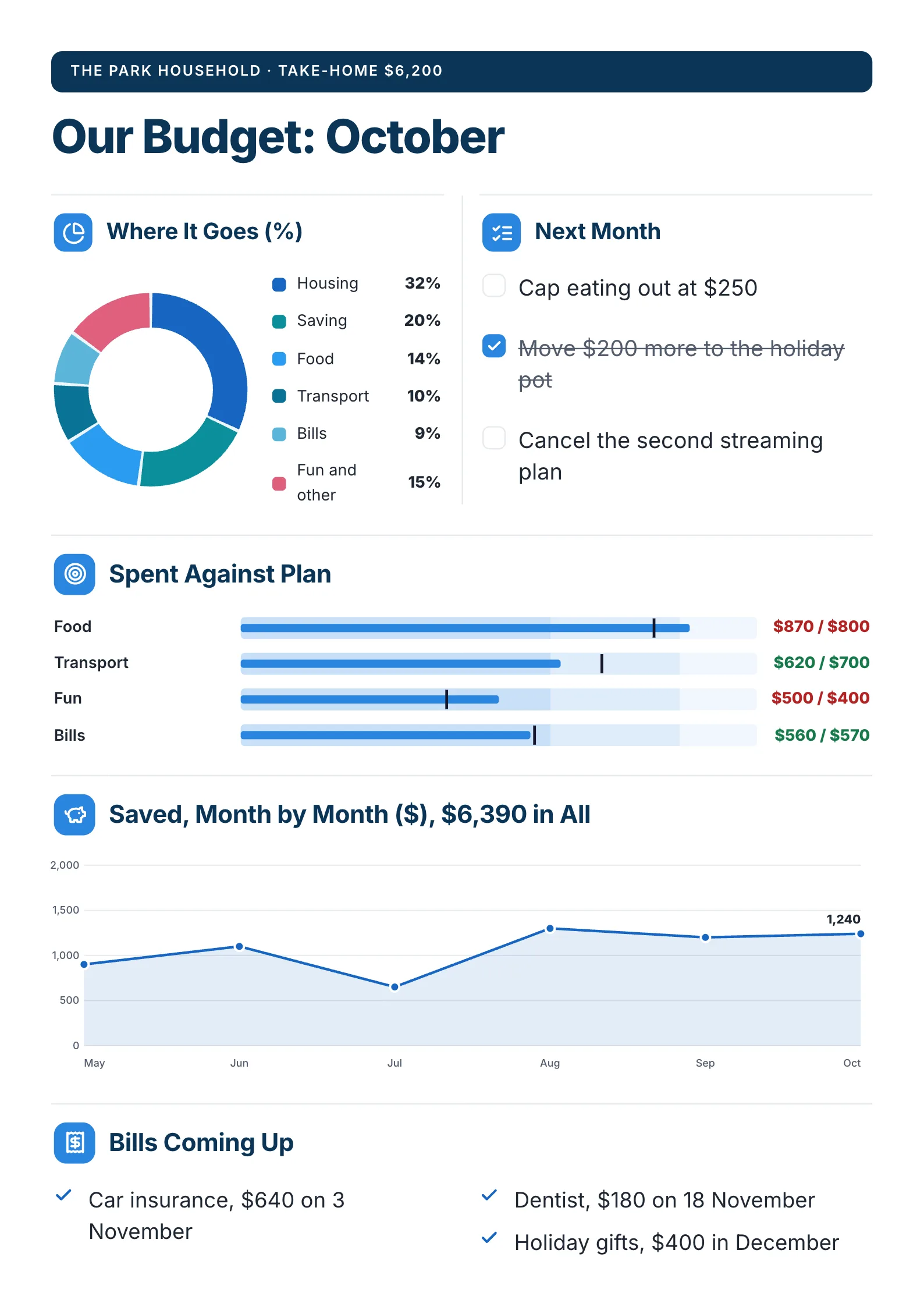
This personal budget runs the checklist at home. The Park household takes home $6,200. Food came in at $870 against an $800 plan, and fun at $500 against $400. So part 1's fix sits right beside it: cap eating out at $250 next month. Its bills box covers part 3, with car insurance of $640 on November 3, a $180 dentist bill on November 18 and $400 for gifts in December. That's $1,220 the family can see coming. List your own bills for the next three months the same way, and none of them will catch you short.
One budget, run through the checklist
Here's the Park household's budget from above, checked part by part. It's a good sheet, and it still leaves points on the table.
| Part | What the Park budget shows | What to add |
|---|---|---|
| The problem (20) | Food and fun over plan, with a cap on eating out next month | One line naming the main money goal for the year |
| Value (20) | $6,200 of take-home pay, and the share each area gets | Nothing; this part is done |
| The years ahead (20) | $6,390 saved since May, and $1,220 of bills due by December | How many months the emergency fund would cover |
| Revenue (20) | One take-home total | Each source of pay, marked steady or not |
| Parts with goals (15) | Plan and spending for food, transport, fun and bills | One goal beside each amount |
| Big purchases (15) | Nothing yet | Any cost over your line, with how you'll pay |
| How it was made (10) | Nothing yet | The day you review it, and who joins you |
Three of those fixes are a single line each. You can add the goal, the emergency fund and the review day in five minutes, and they answer the questions your partner is most likely to ask you.
Score your own budget
Give your budget the points for each part it answers in full, using the table above. GFOA's line is more than 100 of 200, and that makes a fair bar for your own.
A home budget won't have staff, separate programs, a website, videos or other tools. Leave those out, and 60 points come off the 200, which still leaves you 140 within reach. Start with the four 20-point parts, because that's where a weak budget loses the most. A budget that names its problem and shows its cost already has 40.
Put your budget on a One-Pager
Choose a MakeOnepagers budget that looks like yours and type in your own figures. Or describe your month to the free AI One-Pager generator and fix whatever it gets wrong. Run every check above on it once before you share it. If this is your first budget, start with our guide on how to write a budget, which shows you each step. For the short version you hand out, look at these budget in brief examples. And once spending starts, set your budget vs actual numbers side by side every month.
Frequently asked questions
What should a budget checklist include?
At least the four parts GFOA scores highest: the problem your budget takes on, what it buys and costs, what it does to future years, and where the money comes from. Each is worth 20 of the award's 200 points.
How many points does a budget need to win the GFOA award?
More than 100 of the 200 possible. GFOA's revised criteria say "applicants who accumulate more than 100 total points will be recognized" with its Distinguished Budget Presentation Award.
When do the new GFOA budget award criteria start?
They're optional for 2027 submissions. Starting January 1, 2028, all governments must use them. GFOA expects its fees to stay the same for 2027 and 2028.
Does a government budget have to be one long PDF?
No. GFOA's program page says a single PDF budget book isn't required. It accepts websites, a budget in brief, presentations and videos, as long as they clearly answer the questions.
Can I use a government budget checklist for a personal budget?
Yes, most of it. Reserves become your emergency fund, revenue becomes your take-home pay, and capital becomes any big purchase. Only the staff, separate programs, website, video and other tools parts rarely apply at home.