How to Write a Proposal: What 4 Official Guides Score
How to write a proposal that gets a yes, from what four official guides score: federal buying rules, a grant guide, a research fellowship guide and a letter guide.

Somebody will score your proposal, and most writers never find out how. So before you write a word, we read four official guides on how to write a proposal: the federal government's buying rules, a grant guide from Babson College, Yale's guide for student research proposals and a guide to proposal letters from the Zoom blog. They cover four kinds of reader, from a contracting officer to a client. Three of the four, the federal rules, Babson and Zoom, ask for a price or budget that holds up. None of them asks you to open with your company's history. Start from a free one pager template.
One‑Pager examples
Real One-Pagers made with MakeOnepagers. Open any one to edit it as your own.
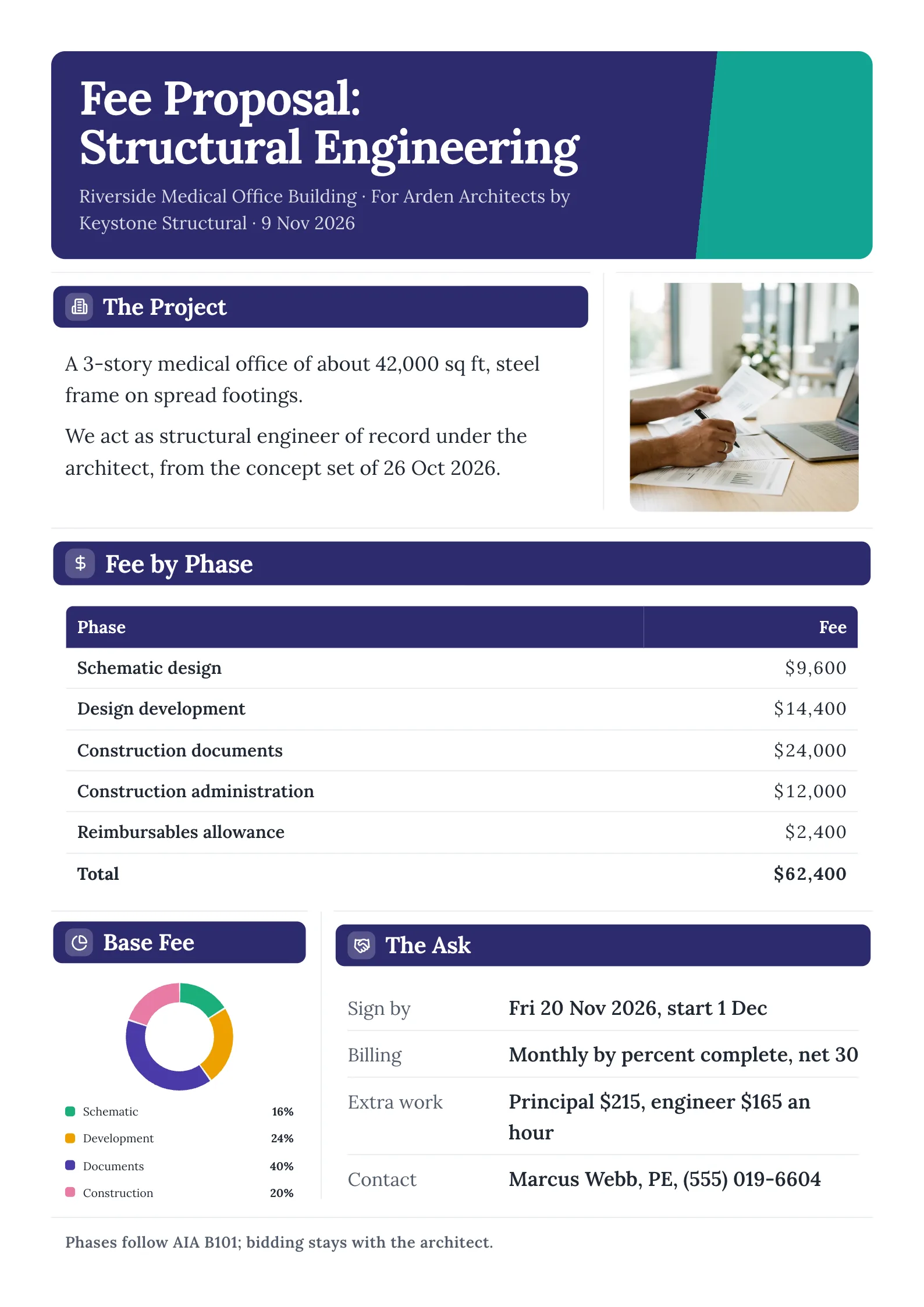 Fee ProposalEdit for free(opens in a new tab)
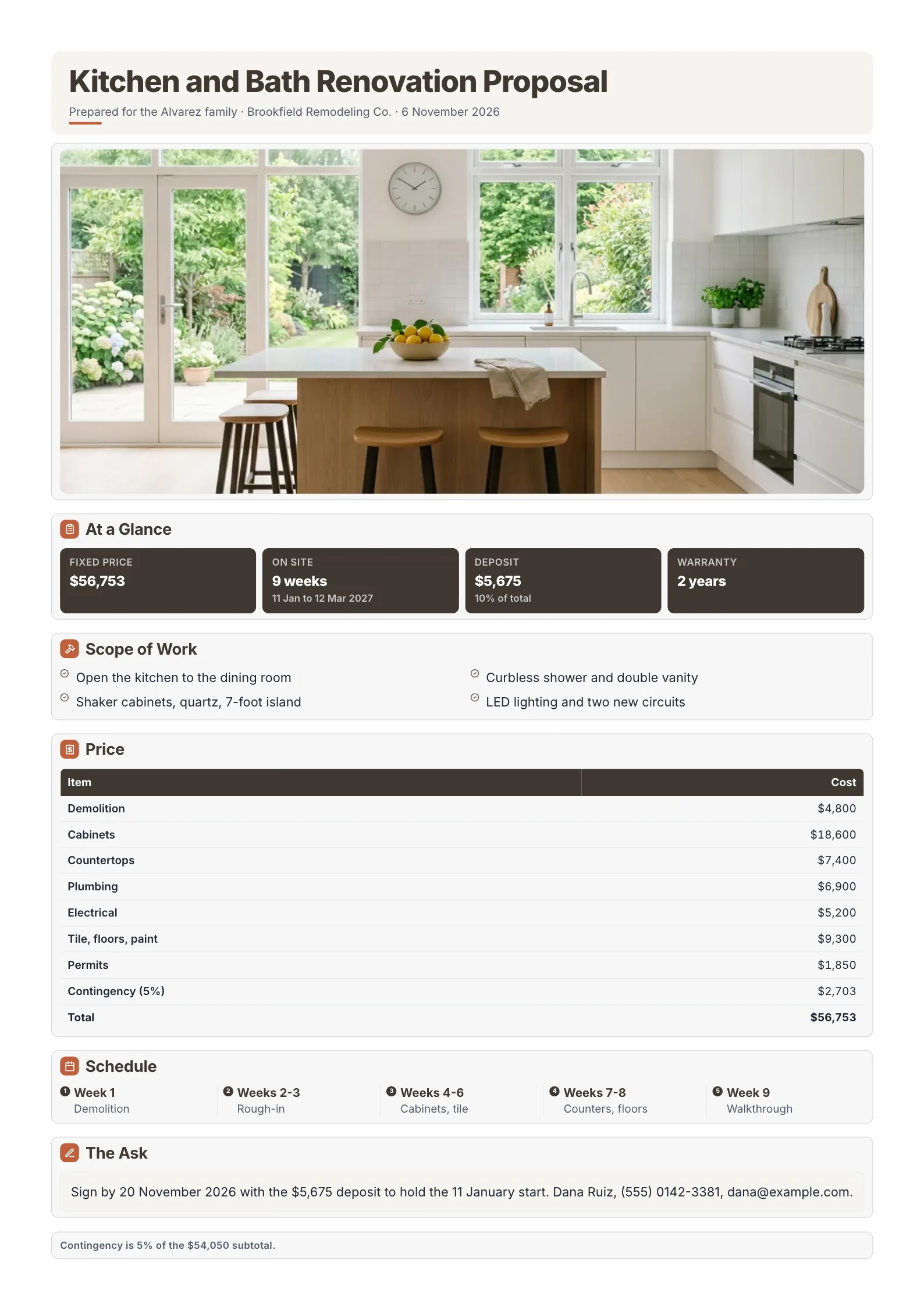 Renovation ProposalEdit for free(opens in a new tab)
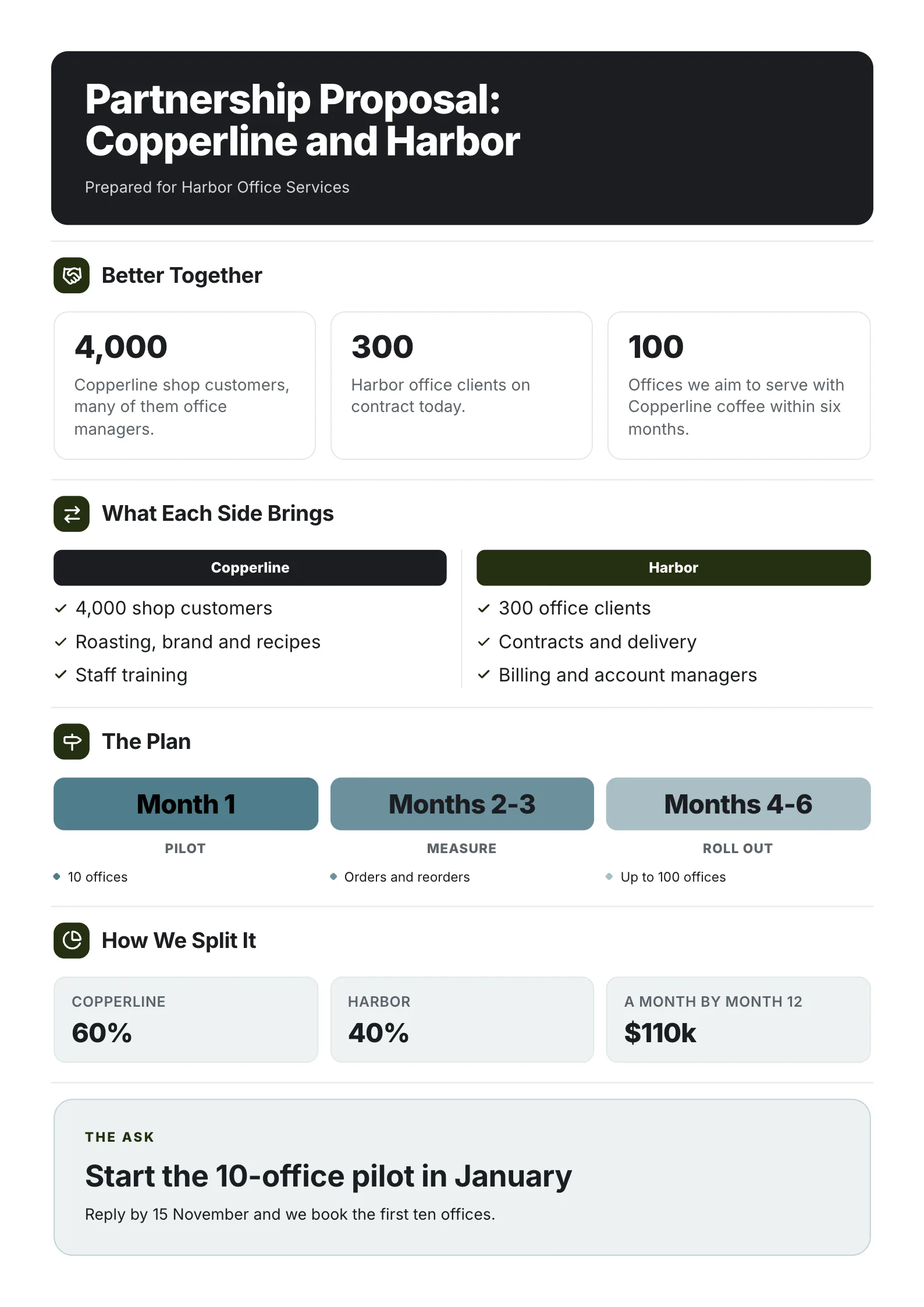 Partnership ProposalEdit for free(opens in a new tab)
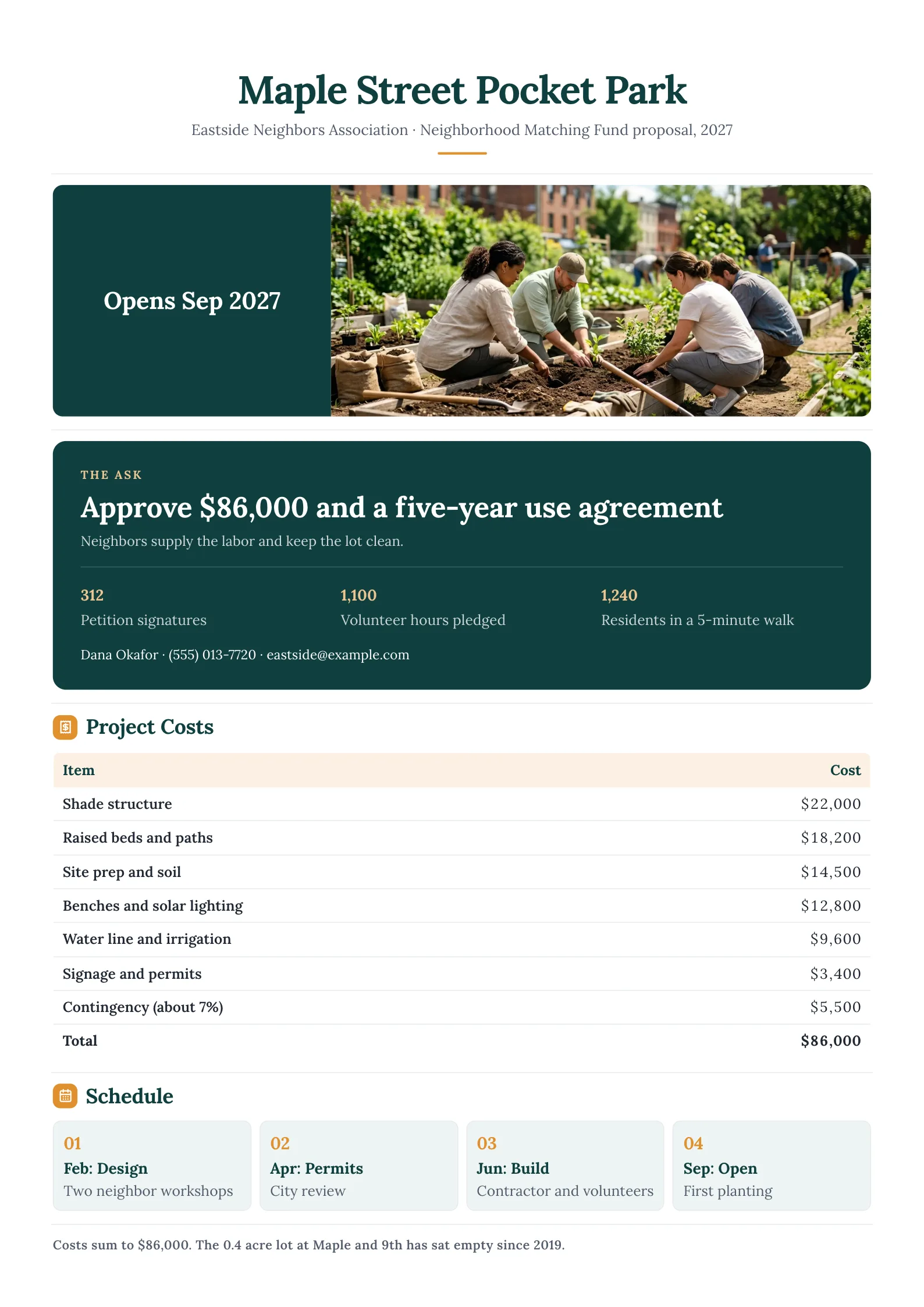 Community Improvement ProposalEdit for free(opens in a new tab)
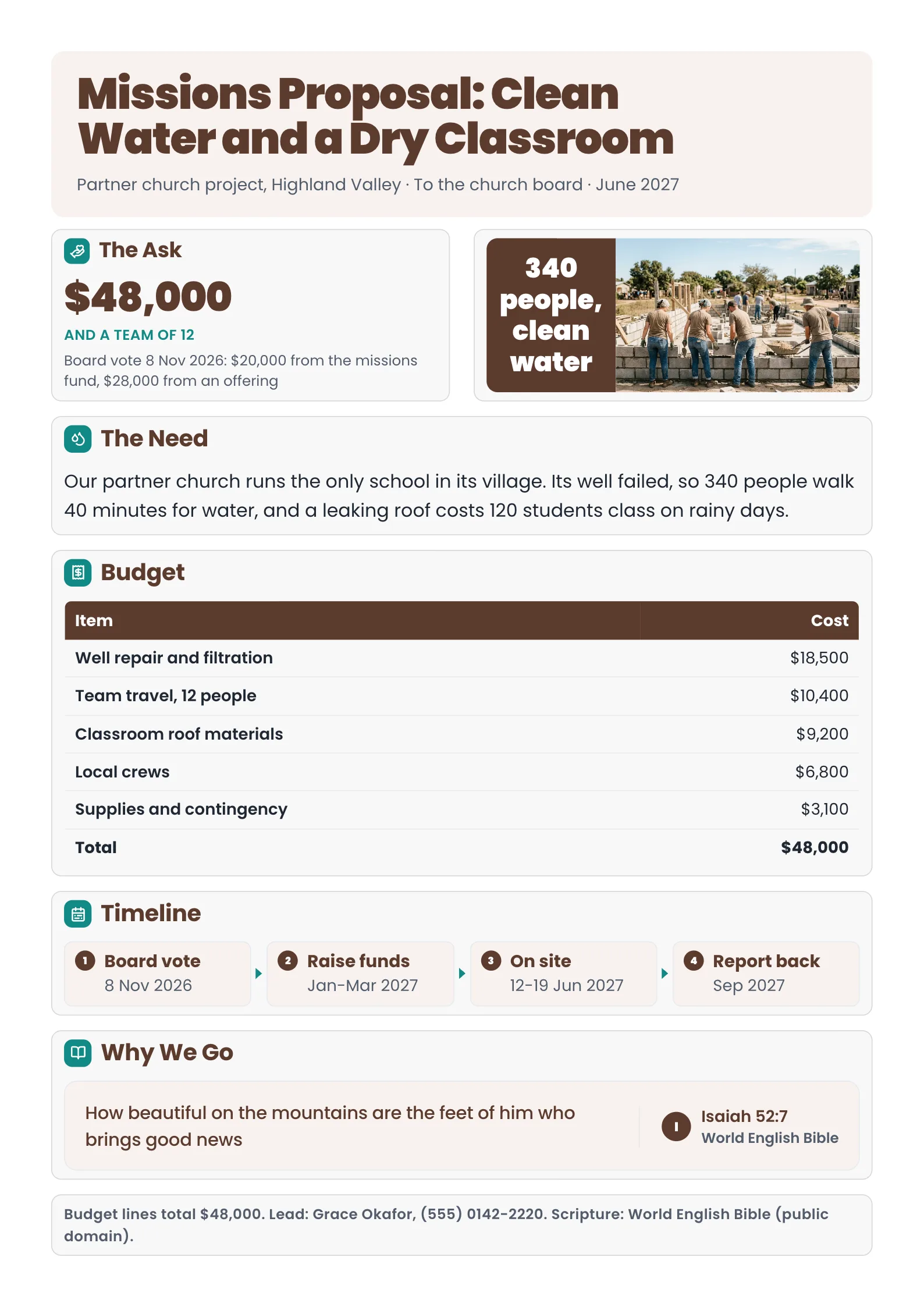 Church Missions ProposalEdit for free(opens in a new tab)
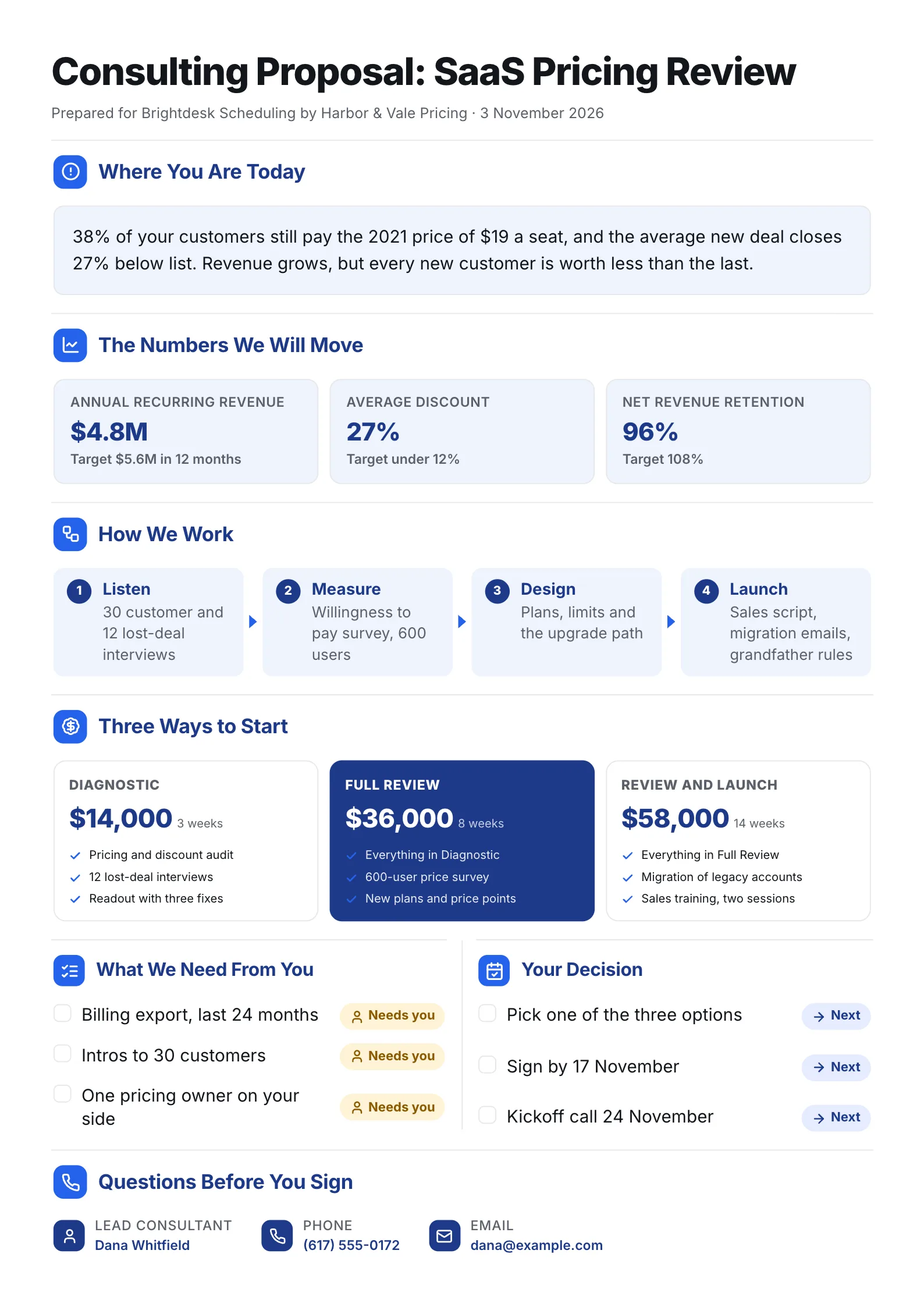 Consulting Proposal: SaaS Pricing ReviewEdit for free(opens in a new tab)
Next comes a table of what each reader scores, then seven steps in an order that suits all four, with 5 sample proposals for made-up organizations. Open the first one if you'd rather start now.
What 4 official guides tell you to include
| Part | Federal (FAR) | Grant (Babson) | Research (Yale) | Letter (Zoom) |
|---|---|---|---|---|
| A short summary at the top | Set by each request | Yes, 2 or 3 sentences | Yes, 250 words at most | Yes, an opening hook |
| The problem or need | Set by each request | Yes | Yes, as background | Yes |
| What you will do | Yes, against the statement of work | Yes, the work plan | Yes, two aims at most | Yes |
| Price or budget | Yes, in every award | Yes, a 1 or 2 page budget | Not on this page | Yes |
| Dates | Yes, delivery terms | Yes, if the project is long | Not on this page | Yes, a timeline |
| What could go wrong | Yes, risk is rated | Not asked | Yes, its own section | Not asked |
| How you'll measure success | Varies by request | Yes, outcomes and evaluation | Yes, the hypothesis | Not asked |
| One clear ask | Yes, the signed offer | Yes, the request amount | Not on this page | Yes, a call to action |
We read FAR 15.204-1, 15.304 and 15.305, Babson College, Writing a Successful Proposal, Yale College, How to Write a Proposal and Zoom, How to write a proposal letter, all on November 3, 2026. "Not on this page" only means that guide is silent on it; the program may still ask elsewhere.
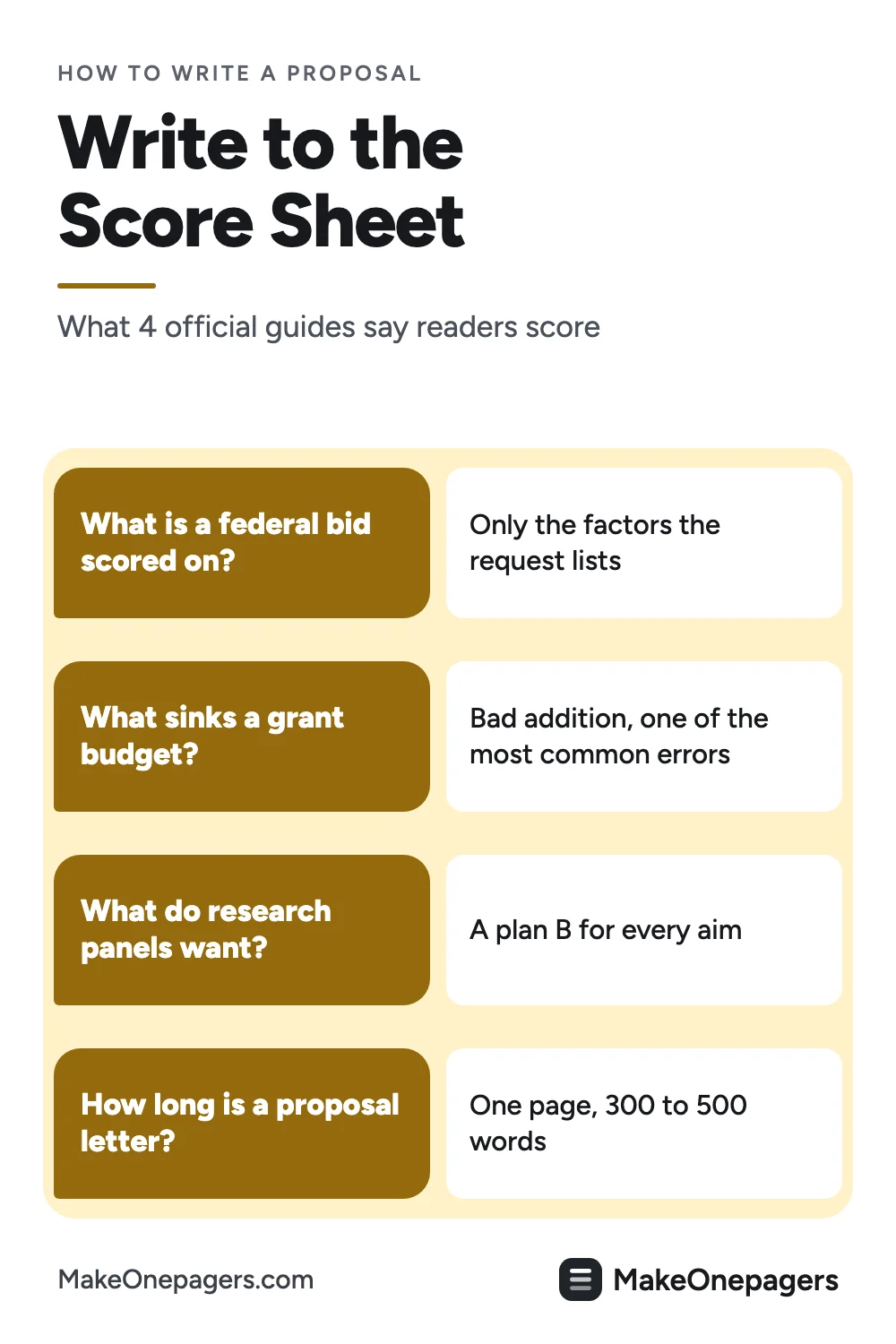
Three things stand out. Three of the four readers want to see the money. Two of the four want you to say what could go wrong. And the only one with a word count is the shortest: Zoom says a proposal letter should fit on one page, about 300 to 500 words.
Step 1: Find the score sheet before you write
The federal rules are the most blunt about this. Under FAR 15.305, an agency rates proposals "solely on the factors and subfactors specified in the solicitation." The request itself tells you what those are. In the standard federal format, Section L holds the instructions and Section M holds the evaluation factors for award.
Most readers outside government work the same way, even when nobody writes it down. A foundation has a list of what it funds. A fellowship panel has a rubric. A client has the three things they said on the call. Ask for the list, or write it down from what you heard, then use the reader's own headings in your proposal so each point is easy to find and tick.
If there's a page limit, a font size or a deadline, treat it as part of the score. Yale's guide, for example, sets an 8-page limit before references, in 12-point Times New Roman.
Step 2: Put the ask and the problem at the top
Babson tells grant writers to open with a summary of two or three sentences. Yale caps the research abstract at 250 words. Zoom wants an opening hook. They're all saying the same thing: your reader should know what you want and why in the first few lines.
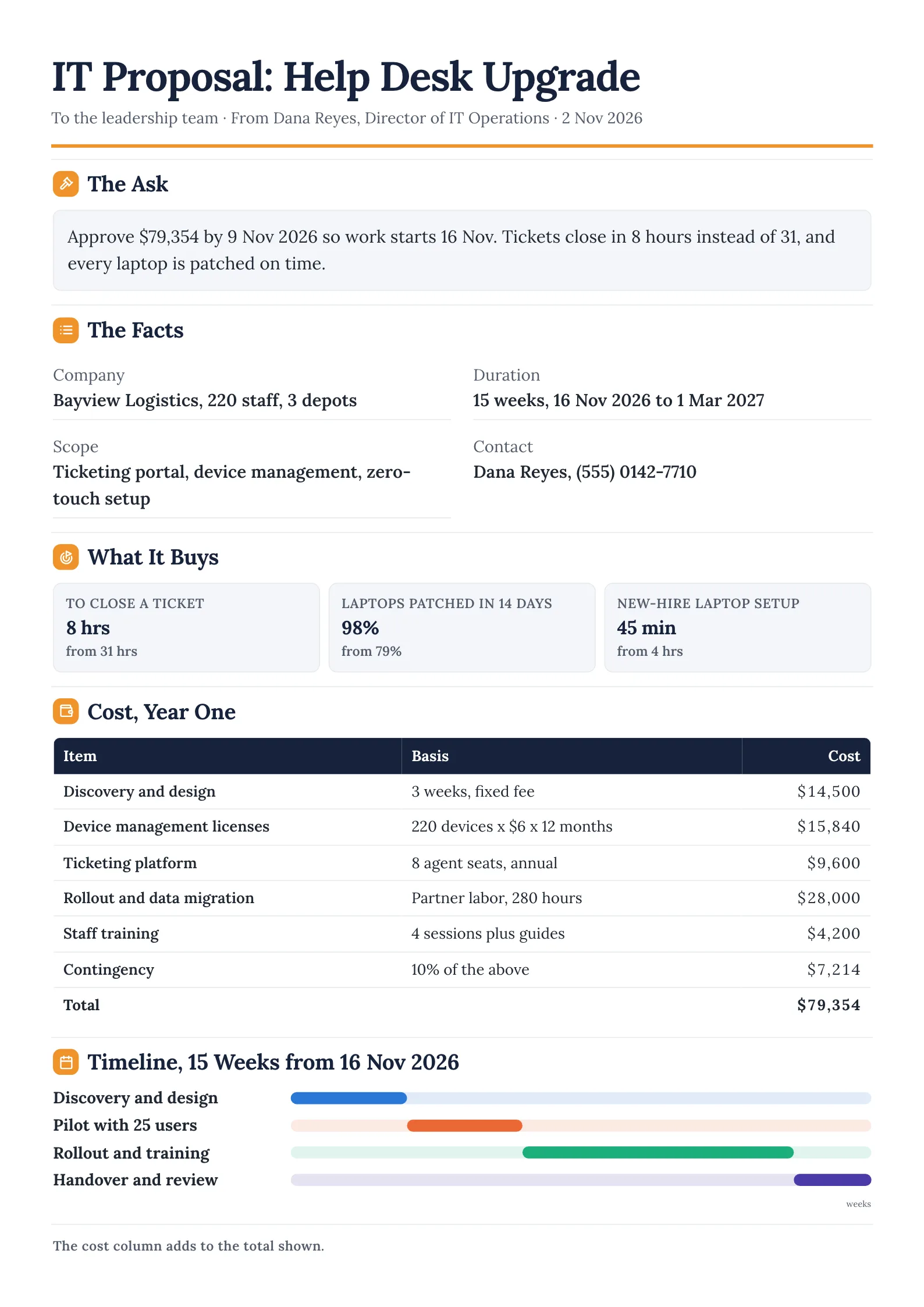
This IT proposal does exactly that. Its first box asks the leadership team to approve $79,354 by November 9, 2026, and says what changes: tickets close in 8 hours instead of 31.
 Edit this template
Below the facts come three numbers the reader already tracks: hours to close a ticket, laptops patched on time and the time it takes to set up a new hire's laptop. Each one shows today's figure beside the new one, so the change is clear at a glance.
Step 3: Describe the problem, not the missing project
Babson's guide has one line every proposal writer should pin above the desk: "Don't describe the problem as the absence of your project." Its own example is a shelter. Not having enough beds isn't the problem. More domestic violence is the problem, and more beds are one answer to it.
So check your opening sentence. "We don't have a dental wing" is about you. "Children on Medicaid wait 7 months for a first dental visit" is about the people you serve. Babson adds a second test: describe a problem about the same size as your solution, so you don't promise to fix the whole world with a small program.
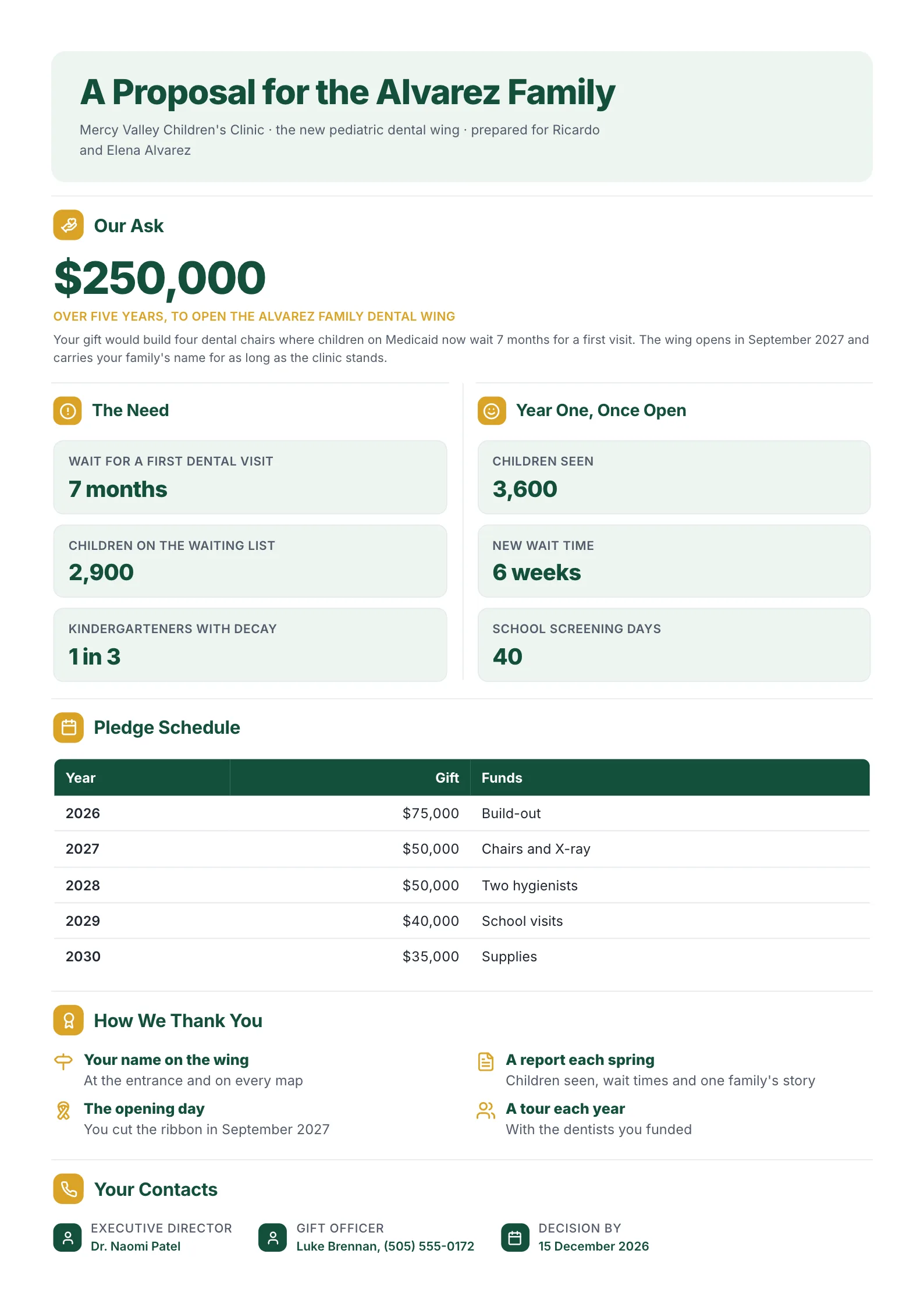
This gift proposal to one family gets both right. The need is three numbers: a 7-month wait, 2,900 children on the waiting list and 1 in 3 kindergarteners with decay. Then the same layout shows year one after the wing opens.
 Edit this template
Check the pledge schedule too. $75,000, $50,000, $50,000, $40,000 and $35,000 add up to the $250,000 asked, and each year says what that year's money buys.
Step 4: Lay out the plan, and keep it small
Yale gives student researchers a hard limit: "Don't propose more than two aims." Its reason is time. There's a smarter point underneath it, though. The two aims should be related but not depend on each other, so if the first one fails, the second still works.
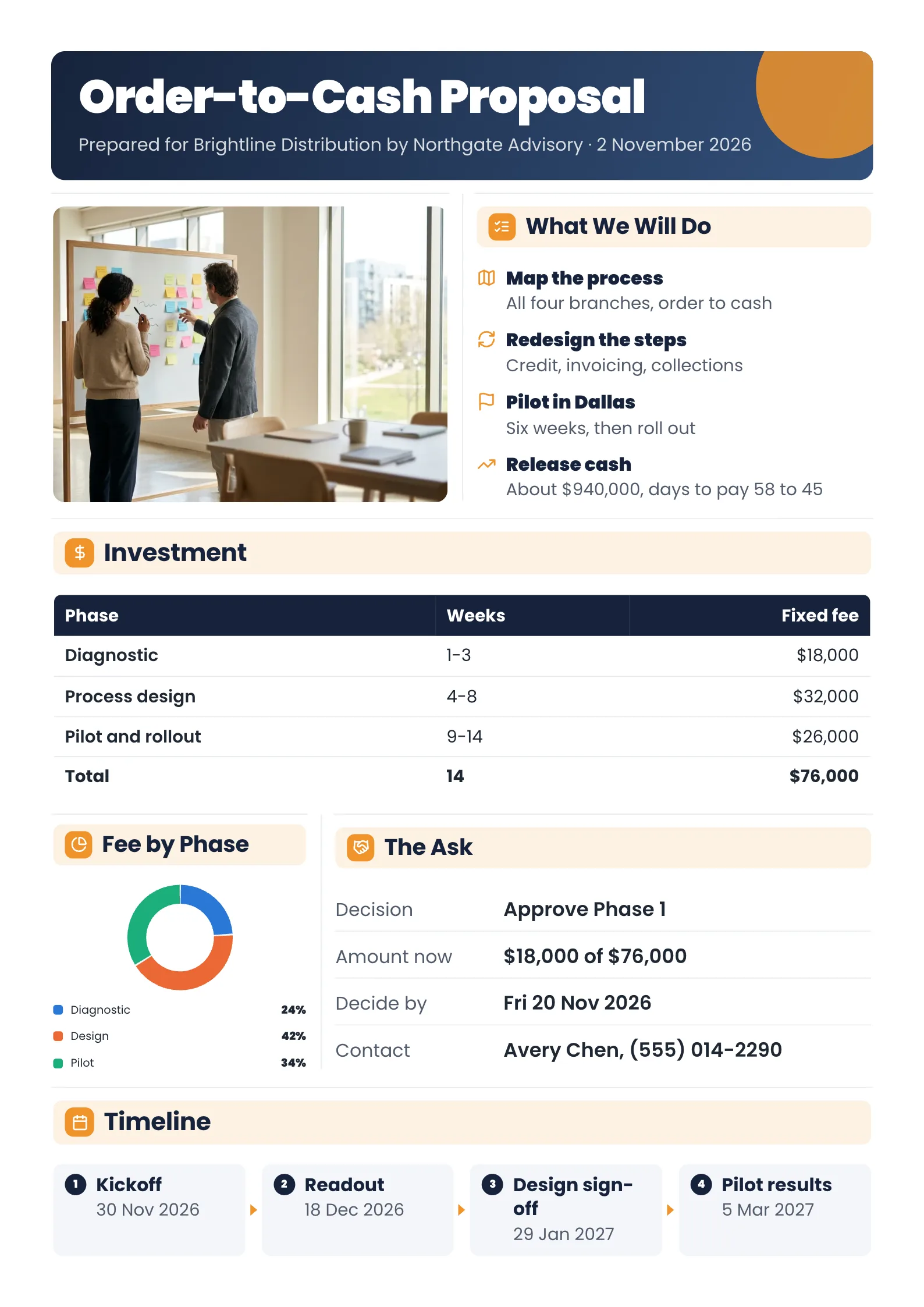
Business plans can follow the same idea. Split your work into phases, and give the reader a small first step to approve. This consulting proposal has three phases: a diagnostic, a process design, and a pilot and rollout. They run 14 weeks in total, but the ask is only Phase 1, $18,000 of the $76,000.
 Edit this template
A small first yes is easier to give. It also gives you a readout date, here December 18, 2026, when the client sees results before spending the rest.
Step 5: Make every number add up
Babson's warning is short: "Incorrect addition on budgets is one of the most common errors in a grant proposal." The federal rules leave no way around it either. Under FAR 15.304, price or cost must be evaluated in every source selection, with one narrow exception for some multiple-award contracts.
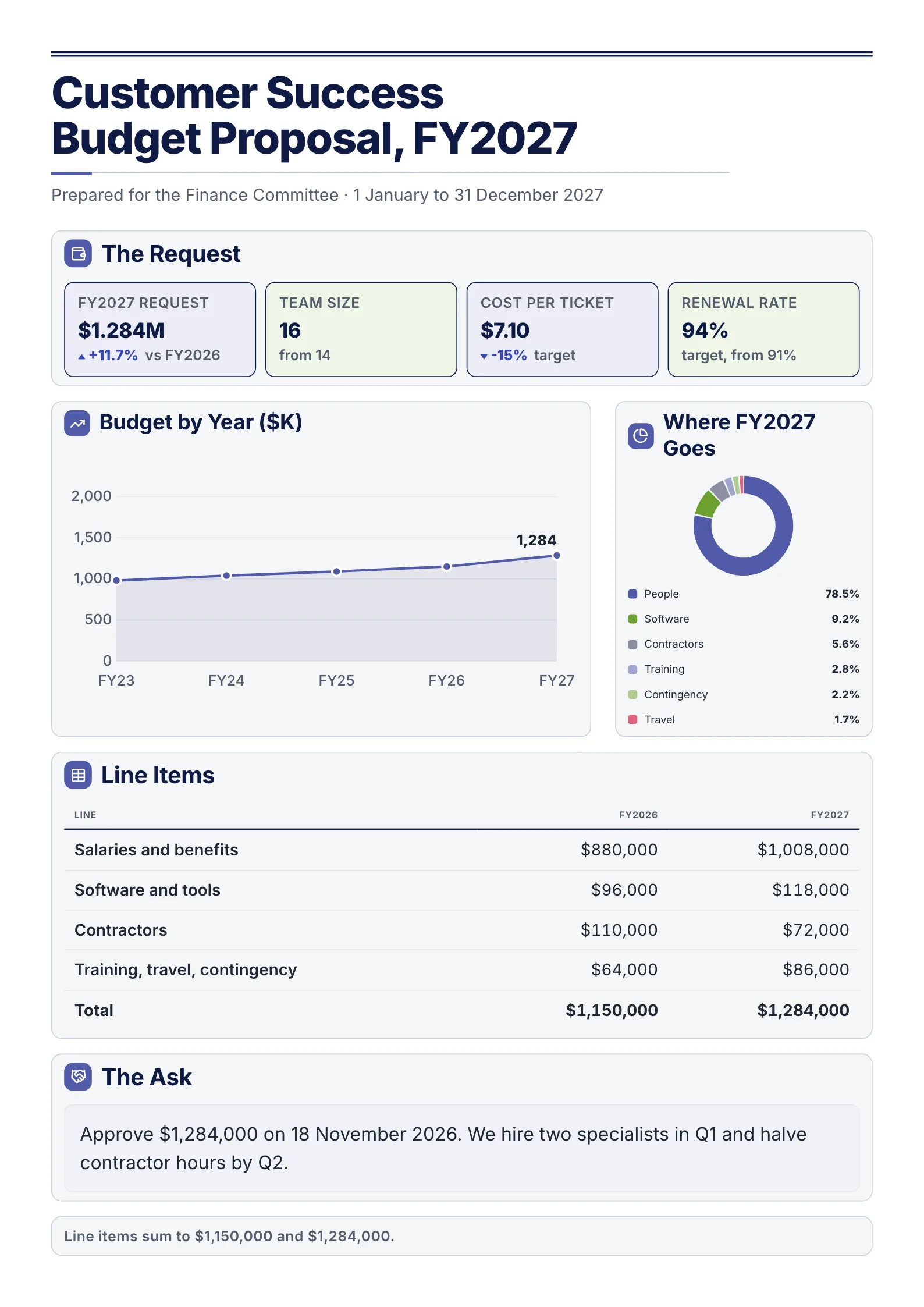
So total each column yourself, twice, before anything goes out. Then check that the same total appears everywhere it's mentioned: in the ask, in the table and in the summary. This budget proposal to a finance committee lists four lines for two years. They add up to $1,150,000 for this year and $1,284,000 for next, and the footer says so out loud.
 Edit this template
The 11.7% rise checks out too: $1,284,000 is 11.7% more than $1,150,000. A committee member will do that sum in their head. Do it first, so they don't catch you out.
If your reader is a foundation, Babson also asks you to show income, not only expenses. List what you've already raised or asked for from other funders, so the reader can see the whole budget balance.
Step 6: Say what could go wrong, and what you'll do
Yale calls this "a very important part of any proposal." Its guide says a reviewer who spots a weak point you didn't plan for won't fund the proposal. The federal rules take risk seriously too: FAR 15.305 has evaluators write down the strengths, weaknesses and risks of each proposal.
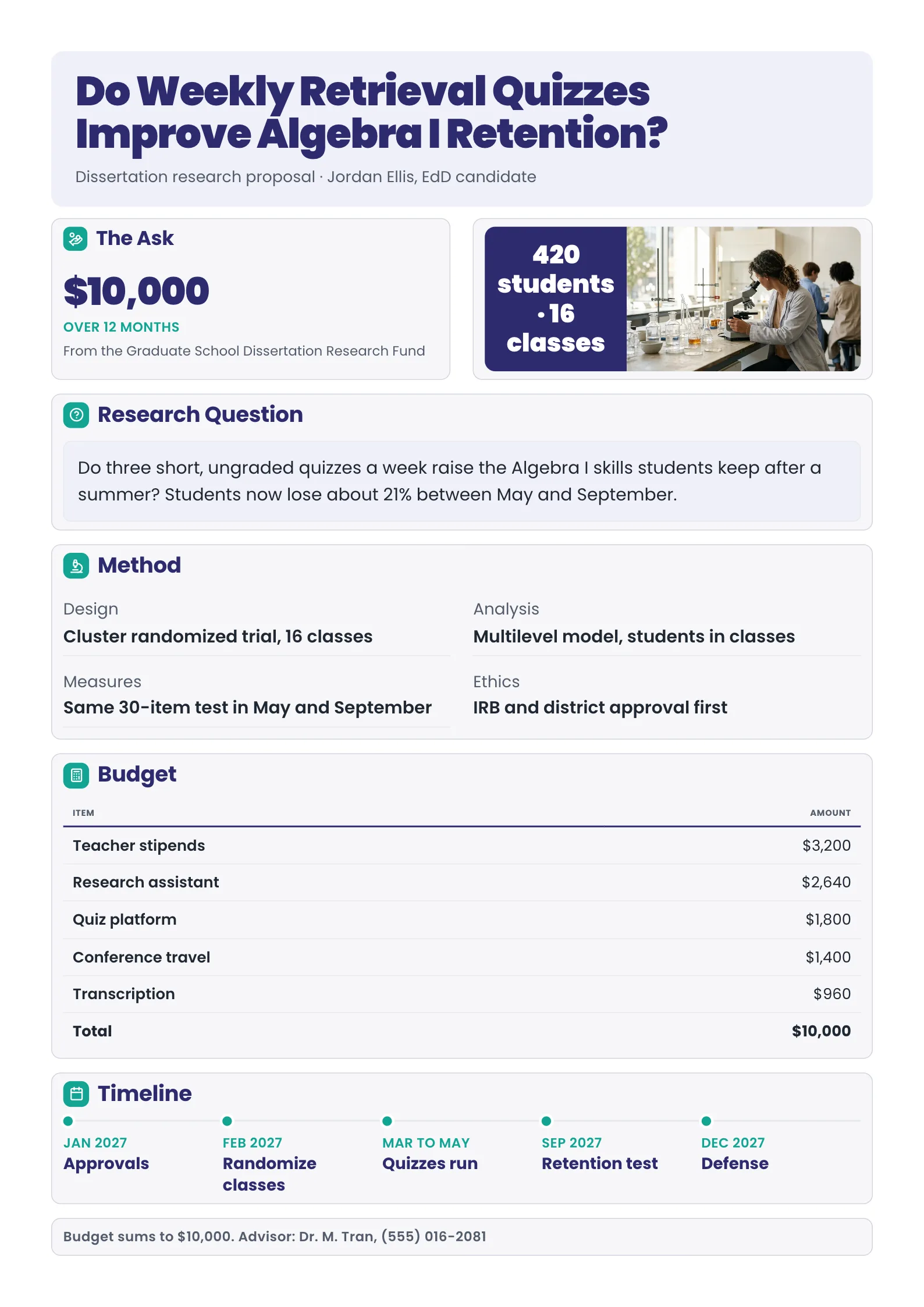
You don't need a long section. One line per risk is enough: what might fail, how you'd know, and your plan B. This research proposal has no risks box. Its method still answers the two questions a panel asks first. Approvals come first, in January 2027. Then classes are picked at random, with the same 30-item test in May and in September. Add one line for what you'll do if classes drop out.
 Edit this template
The budget here is small and exact: five lines from $3,200 for teacher stipends down to $960 for transcription, adding to exactly $10,000. A panel can see where every dollar goes.
Step 7: Close with a single request, a name and a date
Zoom's four-part letter closes with a call to action, and Babson puts the amount in its very first sentence. Make yours just as plain: who decides, how much, and by when. Four of the samples above name that date: the IT proposal asks for approval by November 9, the budget by November 18, the consulting phase by November 20, and the gift by December 15.
A date also tells you when to pick up the phone. If the day passes in silence, ring the person who decides and ask where things stand.
How long should a proposal be?
As long as your reader's rules allow, and not a page more. Yale caps its fellowship proposals at 8 pages before references. Zoom keeps a proposal letter to one page.
When nobody sets a limit, let the size of the decision set the size of the document. A price that one person can approve fits on a One-Pager. A large contract that needs legal review can run longer, but send a one-page summary with it as the part everyone reads. Babson's own format, for comparison, is meant for projects of $5,000 or more.
Common mistakes the guides warn about
- Opening with your history. None of the four guides puts your story first. Babson places organization information after the summary, and keeps it to two or three paragraphs.
- Describing the problem as the missing project. Describe the need in the reader's terms, at the size you can really fix.
- Sums that don't add up. Babson calls this one of the most common errors. Total each column twice.
- No plan B. Yale says a gap a reviewer spots, with no fix offered, can cost you the funding.
- Ignoring the format rules. A page limit or a required heading is part of how you're scored.
Proposal, quote or business case?
These three get mixed up, and the difference is what your reader has already decided.
| Document | Use it when | It has to show |
|---|---|---|
| Proposal | Your reader hasn't decided yet | The problem, your plan, the cost and one ask |
| Quote | Your reader already wants it | The items, the total and how long the price holds |
| Business case | Your own company is deciding whether to invest | The options, the costs and the return |
Selling to a client after a call? See our guide to the sales proposal template. Writing for a business client from scratch? Start with the business proposal template.
Write your first proposal
MakeOnepagers has every sample above ready to edit: pick the closest one, swap in your reader, your numbers and your dates, then download it as a PDF. Already have notes from a call or a request for proposal? Paste them into the AI One-Pager generator for a first draft built around your figures, then check every sum against Step 5. New here? The home page shows the editor in a minute.
Frequently asked questions
What are the main parts of a proposal?
A short summary with your ask, the problem, what you'll do, the cost, the dates, what could go wrong and one clear ask at the end. The four guides above all ask for most of these, and three of the four ask for the money.
How do you start a proposal?
Start with two or three sentences that say what you want, how much it costs and what changes. Babson asks for a summary that short, and its own example names the amount in the first sentence. Yale caps the research version at 250 words.
What is the format of a proposal?
If your reader gives you one, use it, with their headings in their order. Federal requests set the format in Section L. Otherwise, go summary, problem, plan, budget, dates, risks and ask.
How do you write a simple proposal?
Keep it to a One-Pager. Put the ask at the top, the problem in three numbers, your plan in three to five steps, a price table that adds up and a date for the decision.
How long does it take to write a proposal?
It depends on the reader's rules and how much research you need. A one-page client proposal can be done in an afternoon once your notes and numbers are ready. A grant or federal proposal often takes weeks, so start when the request comes out.




