Business Case One Pager: What 6 Government Forms Ask You to Prove
A business case one pager built from 5 government forms and guides and one approved council case: the options, what doing nothing costs and what to include.

A business case one pager asks for money on one sheet. It names the problem, what it costs to change nothing and the other options you weighed. Then it gives each option's cost over its whole life, the payback, the risks and the one you recommend. To see what approvers really look for, we read 6 business case documents from governments. Five are the forms and guides their staff fill in. The sixth is a full business case a UK council approved for new software. All 6 make you price the option of changing nothing, and that's where most first drafts go wrong. Start from a free one pager template.
One‑Pager examples
Real One-Pagers made with MakeOnepagers. Open any one to edit it as your own.
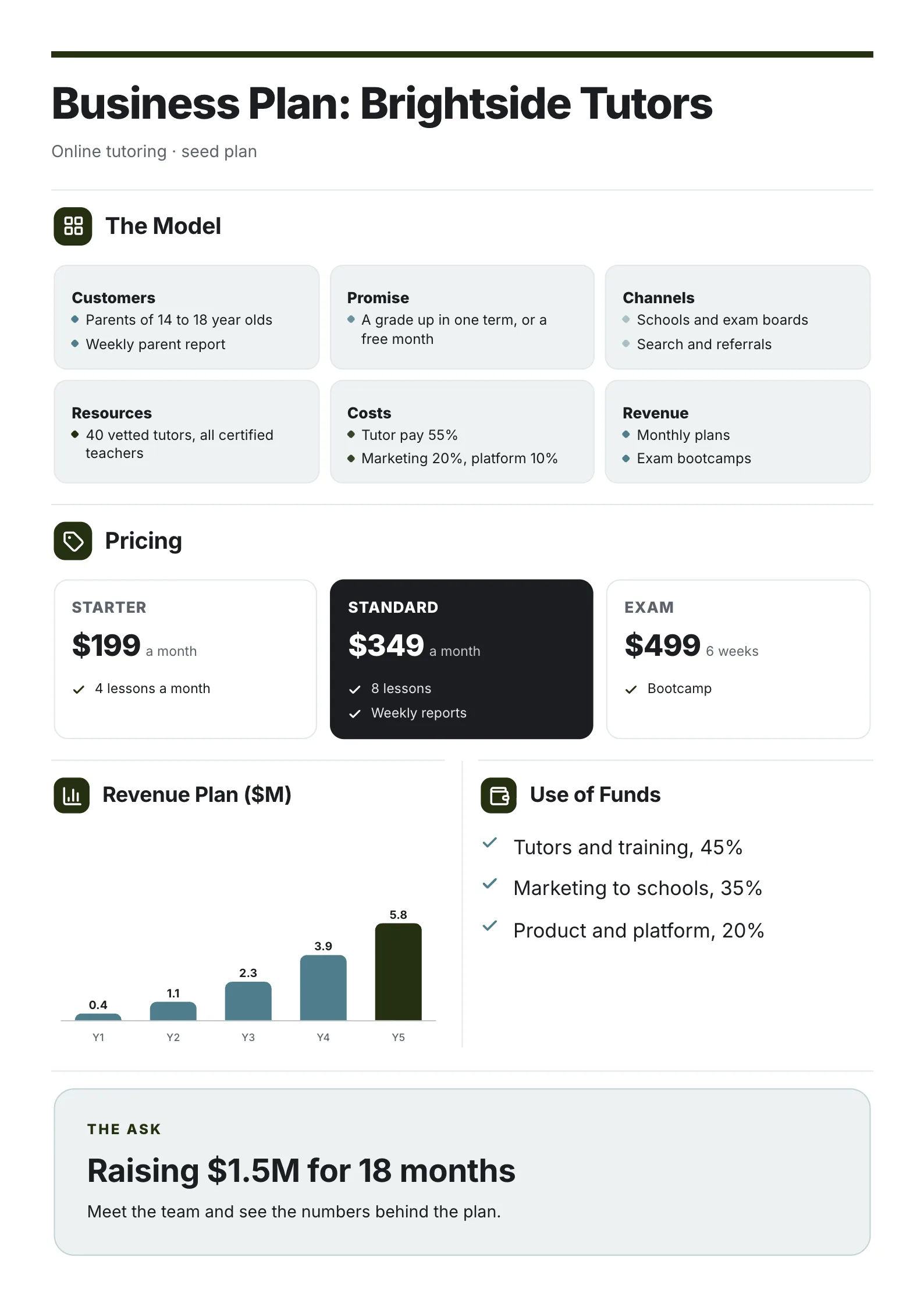 Business Plan SummaryEdit for free(opens in a new tab)
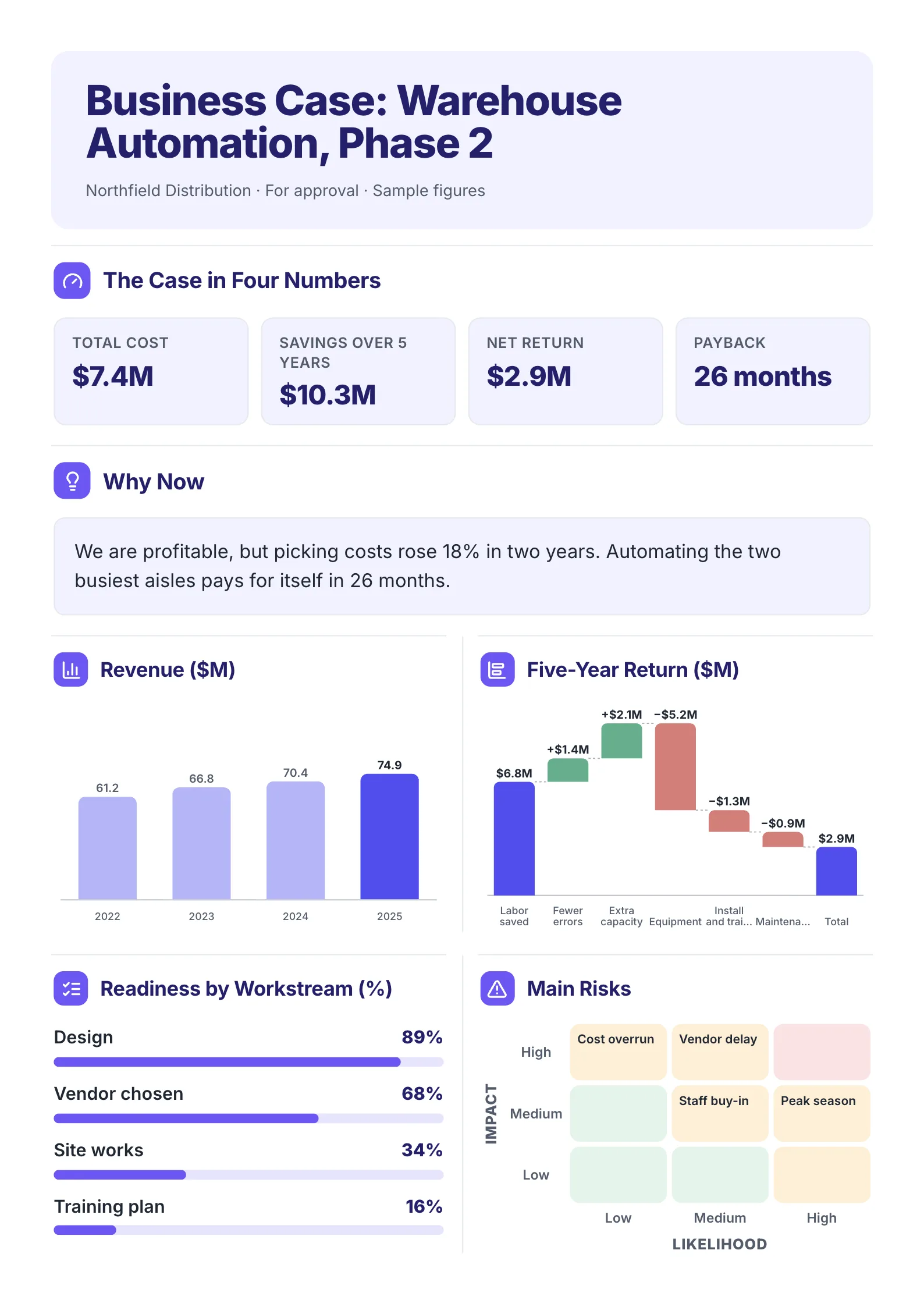 Project Business CaseEdit for free(opens in a new tab)
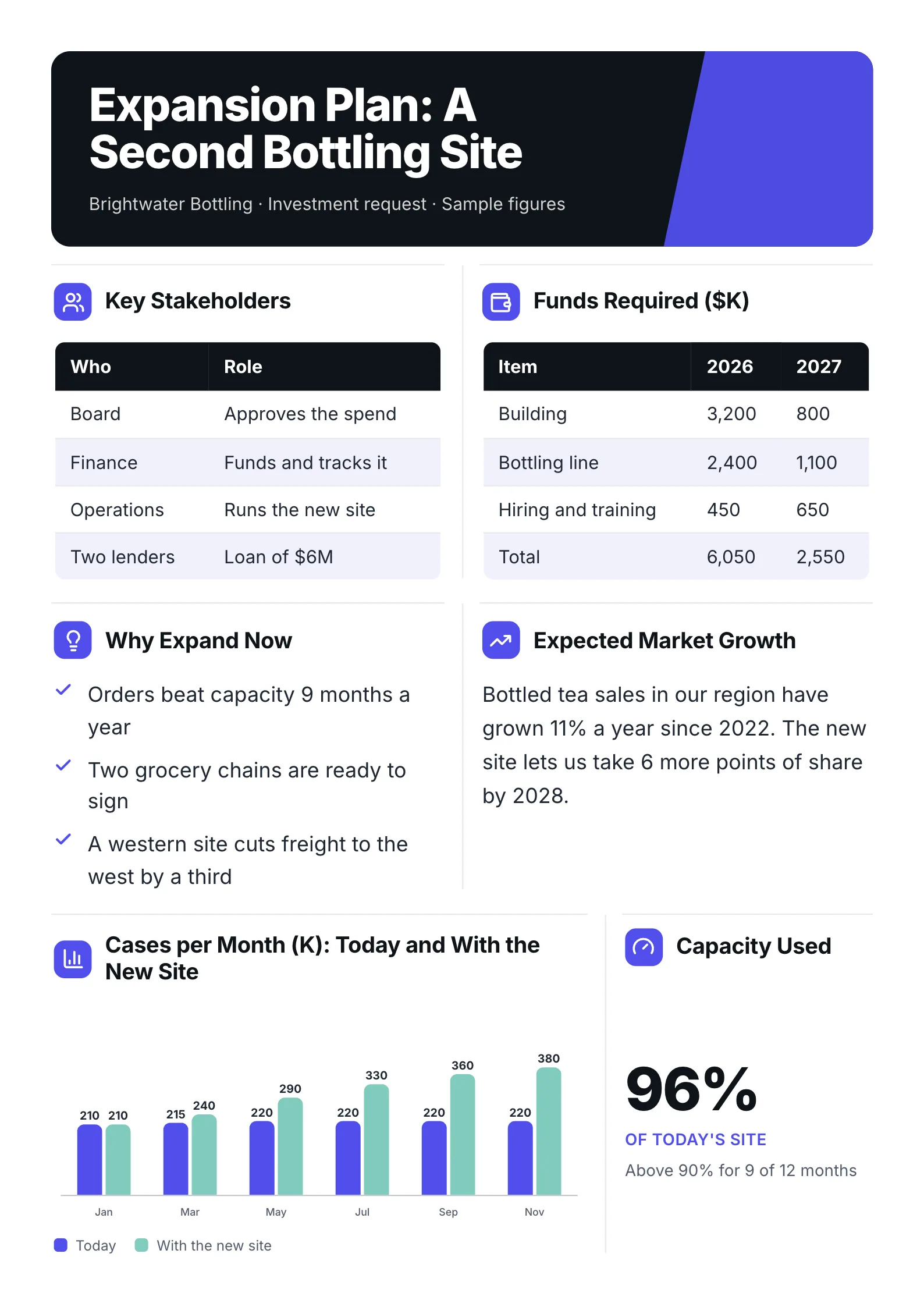 Business Expansion InvestmentEdit for free(opens in a new tab)
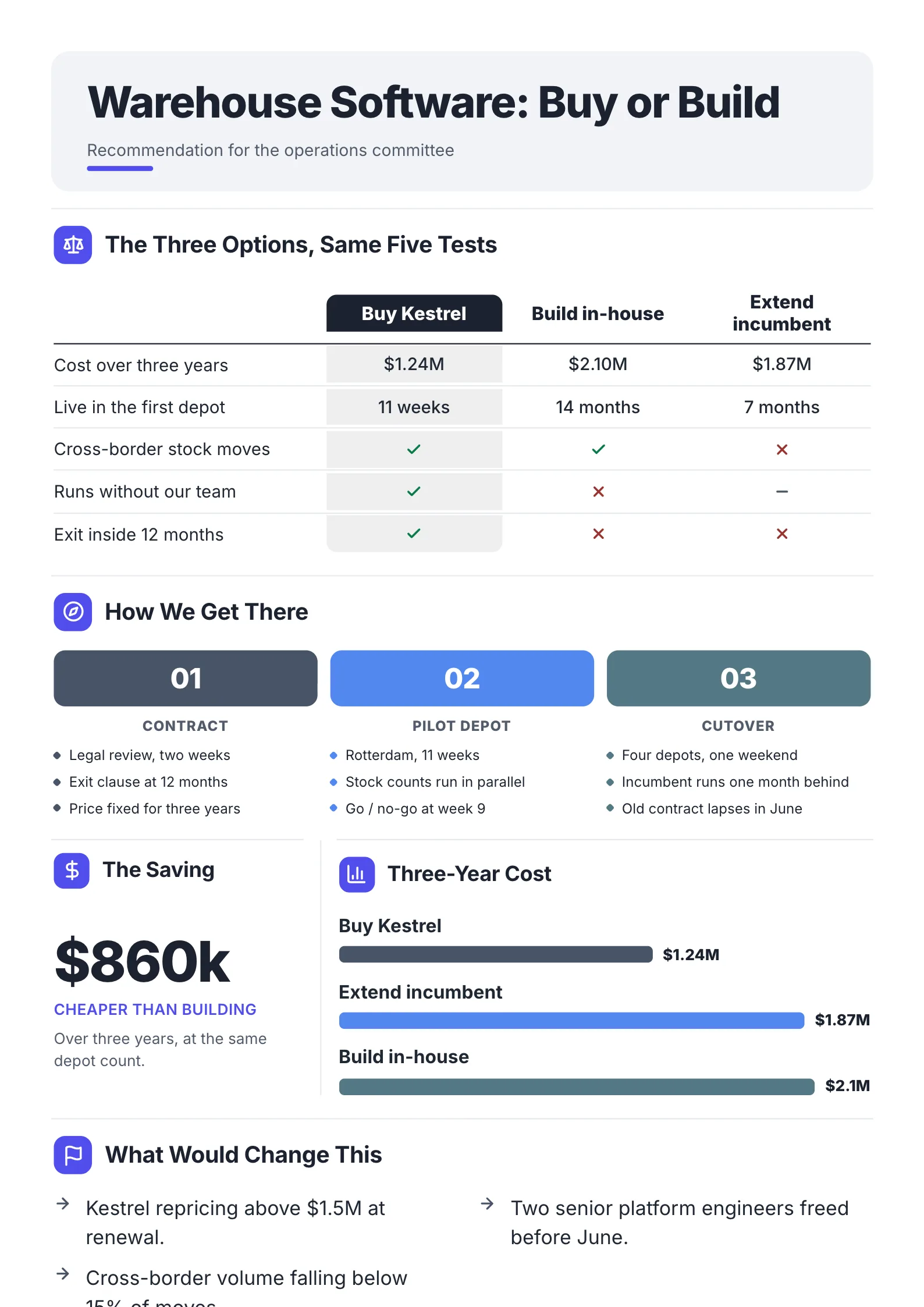 Buy vs Build DecisionEdit for free(opens in a new tab)
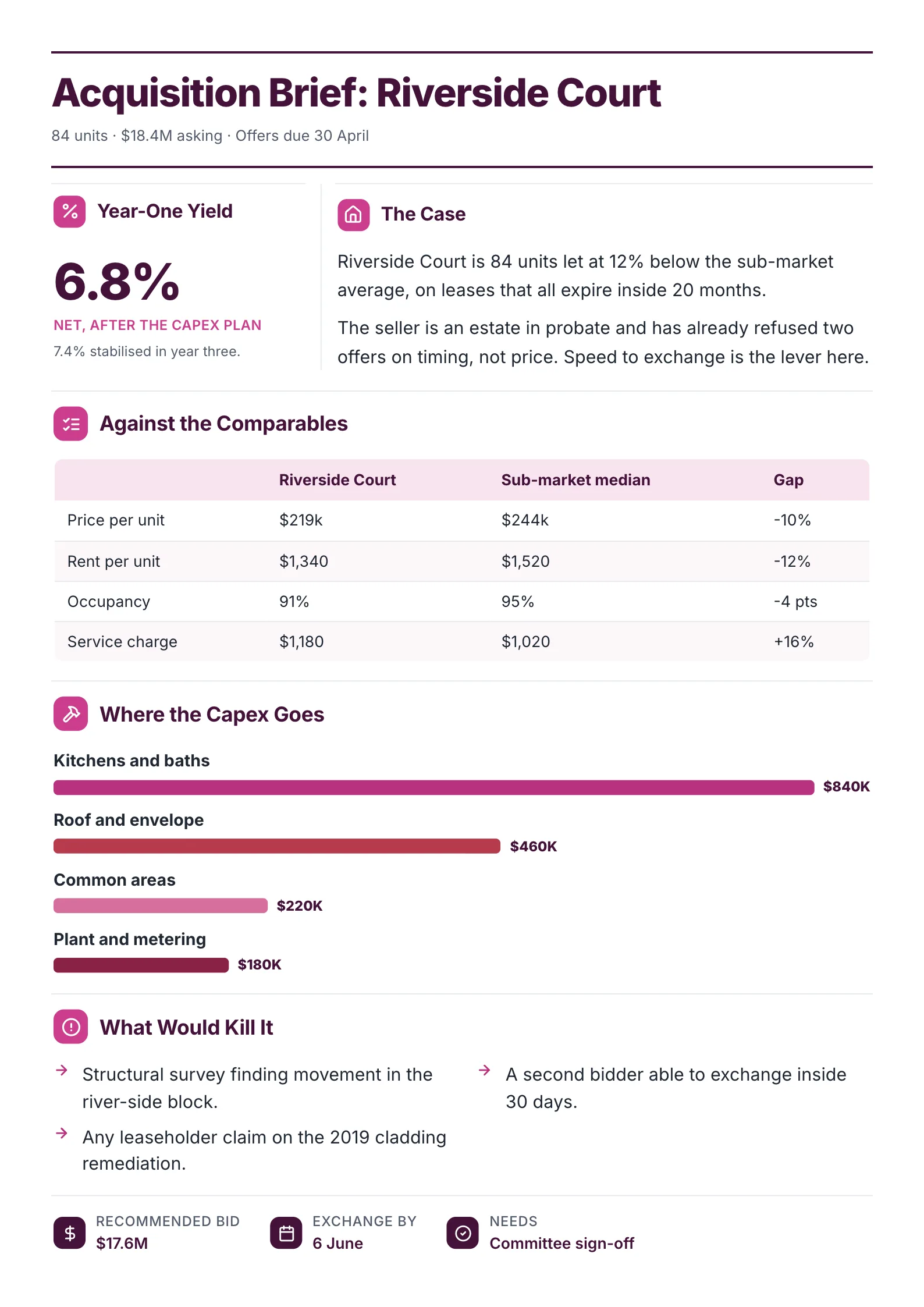 Property Acquisition BriefEdit for free(opens in a new tab)
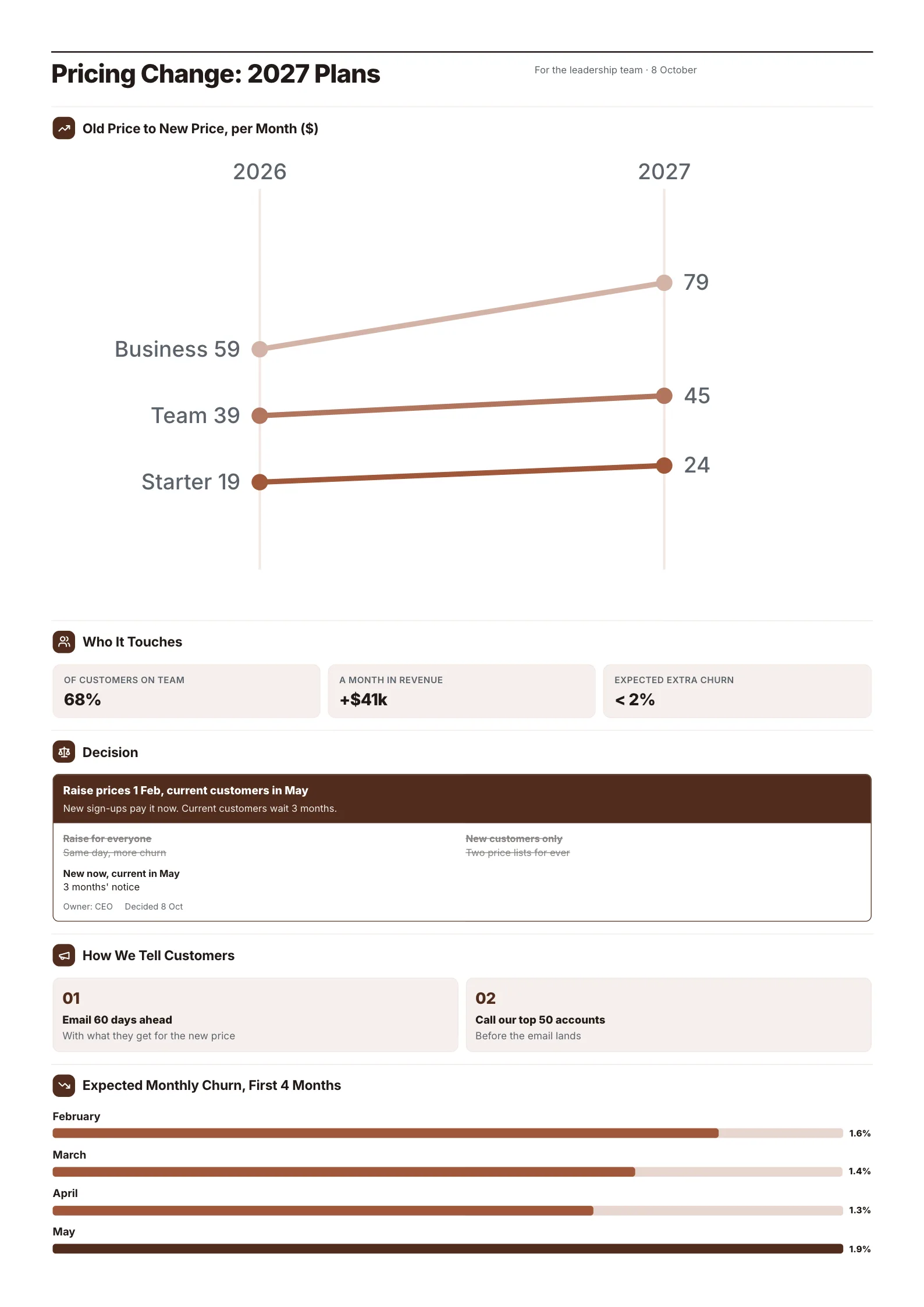 Pricing Change BriefEdit for free(opens in a new tab)
Below you'll find the six documents, what they all ask, how the council's case reads, how short a case can be, and a layout to copy.
The six documents we read
- The Business Case Workbook for IT Projects, from Mississippi's Department of Information Technology Services, August 2020. It runs 5 pages.
- The Georgia Technology Authority business case template, about 16 pages with its appendices.
- The Cost Benefit Analysis Directions, from the Virginia Information Technologies Agency. They explain the workbook that compares each option side by side.
- The low value business case template, shared by the Welsh Government, for buys up to £250,000. The whole form is under 800 words.
- The Guidance on Developing Business Cases, from HM Treasury, 2026. It runs 98 pages.
- The full business case for planning software, from Havant Borough Council in England, November 2023. It's 21 pages, filled in, and was posted by the Havant Civic Society.
We read each one ask by ask and marked which of 12 it makes. The table below counts them. Each link above opens the copy we read, so you can check any count.
What every form asks you to prove
| What the form asks for | Documents that ask |
|---|---|
| What happens if you change nothing | 6 of 6 |
| Other options, compared | 6 of 6 |
| The cost over the whole life | 6 of 6 |
| Measured benefits | 6 of 6 |
| The problem or business need | 5 of 6 |
| Payback or return | 5 of 6 |
| Where the money comes from | 5 of 6 |
| Risks | 5 of 6 |
| The recommended option and why | 5 of 6 |
| Where the numbers come from | 5 of 6 |
| The same yardstick for every option | 2 of 6 |
| A named approver with a signature box | 2 of 6 |
Source: MakeOnepagers.com read of 6 business case documents (Mississippi ITS 2020, Georgia Technology Authority, Virginia VITA, Welsh Government, HM Treasury 2026, Havant Borough Council 2023), October 26, 2026.
Virginia's sheet is a spreadsheet guide, so it skips the written parts. That's why you see 5 of 6 on several rows.
Doing nothing still costs money
Every one of the six treats "change nothing" as an option you have to price. Virginia names that column Do Nothing. Georgia calls it the Current State and says it outlines the cost of not making a change. Mississippi asks you for the impact if no action is taken.
HM Treasury goes a step further. Its guide says you shouldn't assume nothing happens if your proposal is turned down. Your team will still act, and that path has its own costs, benefits and risks. It calls this business as usual.
The council's case shows it in numbers. Its first option was to let the old software contracts run out. That still meant maintenance at £120,842 a year until September 2025, plus a service that kept struggling. So on your sheet, never write the do-nothing cost as zero. Put the real yearly cost of staying put next to your other options.
Compare every option the same way
Georgia asks you for at least three options, one of them the current state. It also says each option must use the same cost categories, with $0 or N/A where a category doesn't apply. Virginia sets one time span for every option: the years it takes to build, plus six years of running it. Do Nothing gets the same span.
That rule protects you from a common trick. A new system looks cheap over two years and costly over seven. When every option uses the same rows and the same years, your approver can compare them at a glance.
How the council's case reads
The council weighed three options, and its one-paragraph answers are worth copying into your own case.
- Do nothing. Ruled out, because extra costs would land on top of the yearly license fees.
- Build its own software. Ruled out, because the council didn't have the staff to build and support it.
- Buy a software package. Chosen, because suppliers already had the expertise.
The case puts £469,000 in licenses over the life of the contract. Against it, it lists £115,000 of income from one planning officer freed up for paid work and £105,000 of saved support staff time. Each rejected option gets one plain reason, and that's all your approver needs.
How short a business case can be
The six run from under 800 words to 98 pages. The Welsh form for buys up to £250,000 fits on a few sheets and still asks for the options, the recommended one, the cost for five years and the funding. Mississippi's 5-page workbook gives a payback rule you can use on any sheet. A $100,000 project that saves $20,000 a year pays for itself in five years.
So a one-sheet business case suits a small or mid-size spend on its own. For a large one, HM Treasury asks for a clear, concise executive summary in front of the full case. Your one-pager can be that summary.
A business case is easy to mix up with a case study, which shows a past customer's result as proof. Our guide to the best case study templates puts the two side by side, with the kind of decision each one supports.
A one-sheet business case layout you can copy
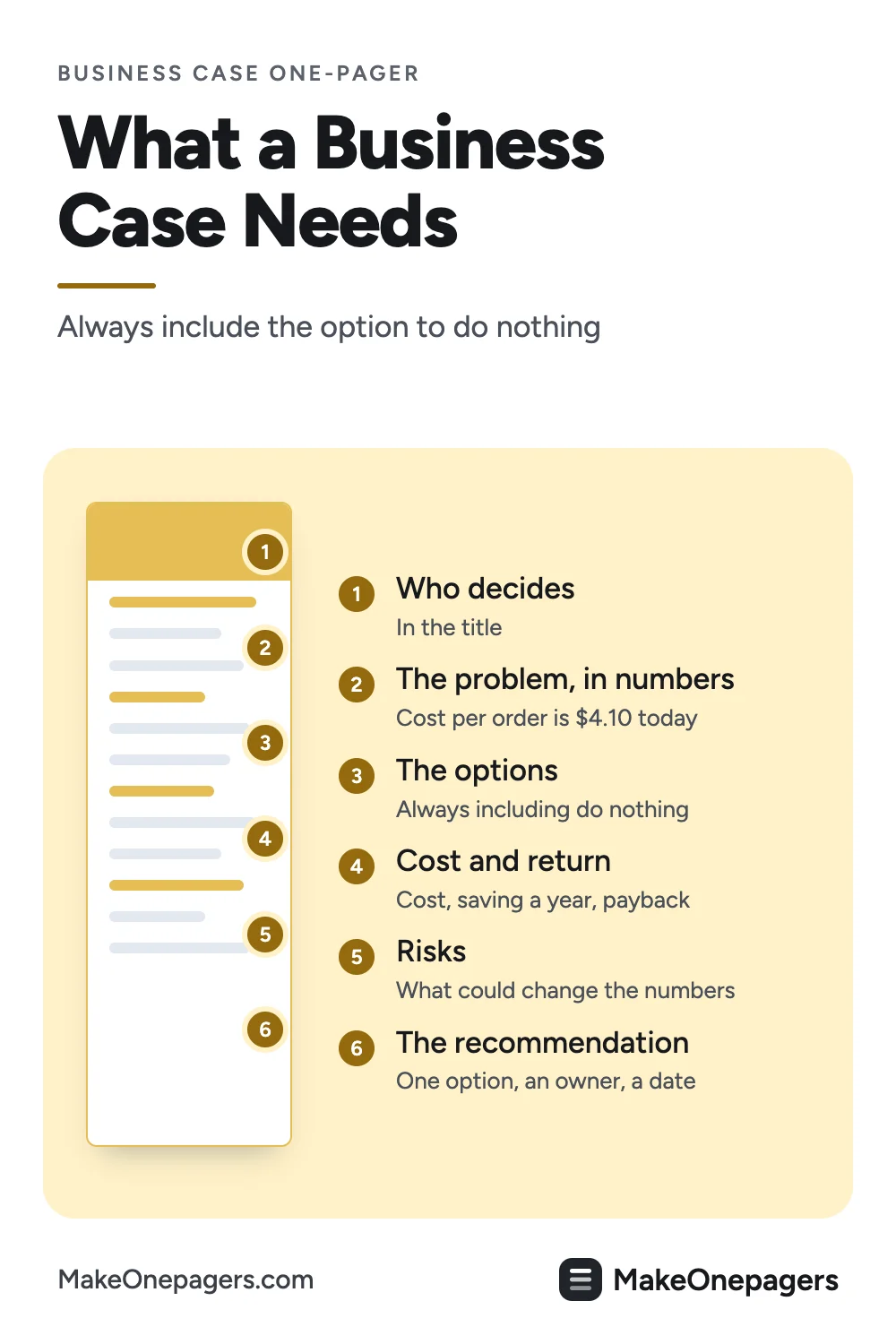
This layout covers the 12 asks, from top to bottom.
| Row | What to write |
|---|---|
| The ask | The amount, who decides and by when |
| The problem | One number that shows it today |
| Do nothing | The yearly cost of staying put, never zero |
| Options | Two or three more, each with one plain reason to choose or reject it |
| Cost over the whole life | Build years plus running years, the same span for every option |
| Benefits | Each with a number and when it starts |
| Payback | The year each option pays for itself |
| Funding | Where the money comes from |
| Risks | The top three for your recommended option |
| Recommendation and sources | The option you'd choose, why, and where your numbers came from |
Here's a finished sample. It makes the case for a new warehouse system, with three options side by side and a recommendation.
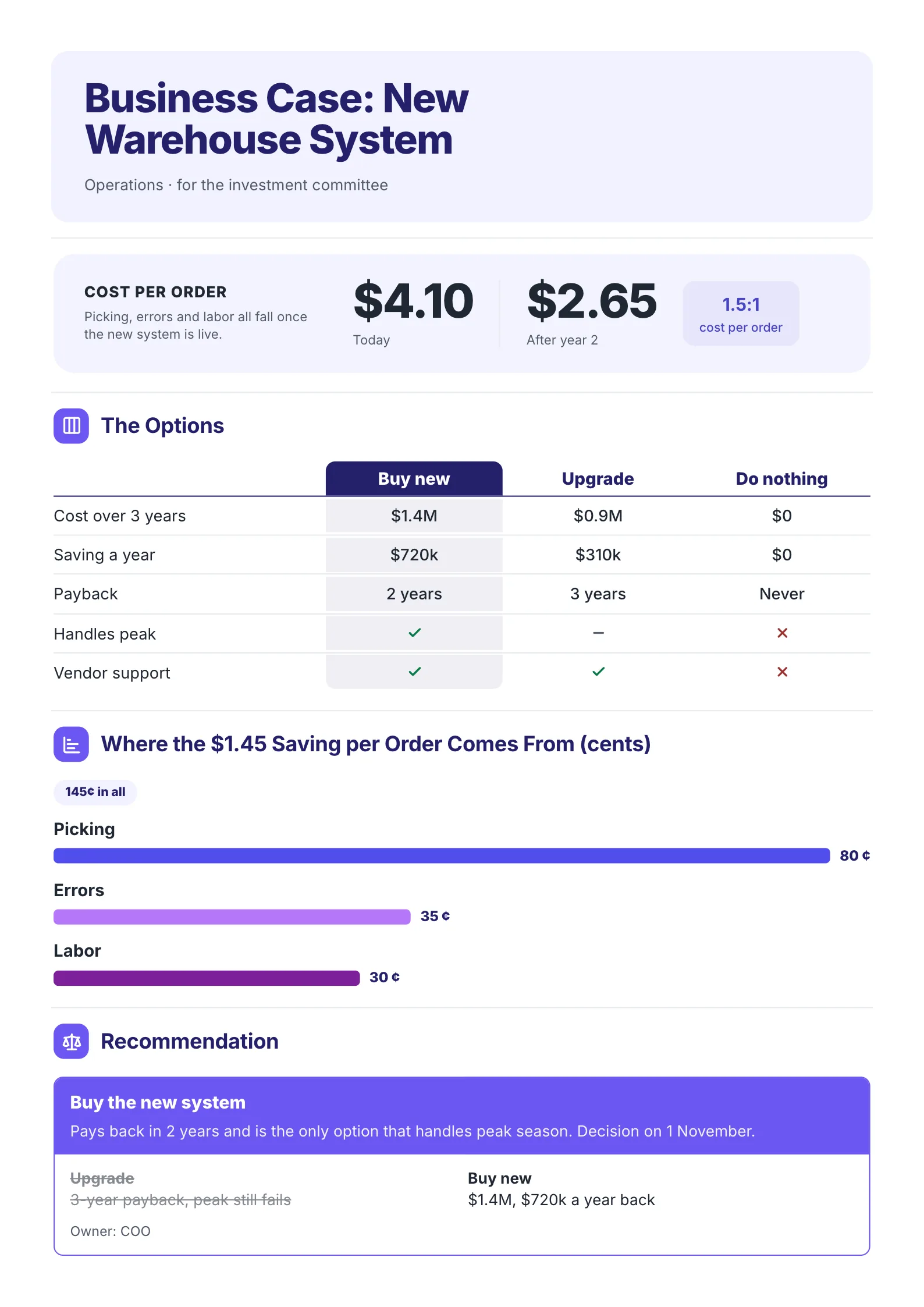 Edit this template
You can edit this business case template for free in MakeOnepagers. Put your own do-nothing cost in its row before anything else.
Questions people ask about business cases
What should a business case one pager include?
Start with the four asks all six documents share. That's the cost of changing nothing, other options to compare, the cost over the whole life and measured benefits. Then add the problem, the payback, the funding, the risks and your recommendation.
Is "do nothing" a real option in a business case?
Yes, and all six documents we read ask for it. Price it honestly, because staying put still has running costs and risks. HM Treasury calls it business as usual.
How many options should a business case compare?
Georgia asks for at least three, counting the current state. HM Treasury suggests a shortlist of around five for a large project. For a one-sheet case, three or four is plenty.
How do you work out payback?
Divide the total cost by the yearly saving. Mississippi's own example is a $100,000 project that saves $20,000 a year and pays for itself in five years.
Is there a free business case template?
Yes. Copy the ten-row layout above into any document. Or open the sample business case in MakeOnepagers and edit it by hand for free.
Price the option you'd rather skip
Open the business case sample in MakeOnepagers and fill in the do-nothing row first, with its real yearly cost. Then add your other options on the same years, and send the PDF to the person who decides.




