Company Profile One‑Pager: What to Include, With Examples
How to write a company profile one-pager: the 7 sections to include, how it changes for clients, investors and partners, and a template to copy.

A company profile one-pager is a single sheet that introduces your business to someone who has never heard of you. It says what you do and who you do it for. It shows the proof that you do it well and tells people how to get in touch. You attach it to a first email, hand it over at a trade show, or send it ahead of a meeting, so the other person arrives already knowing who you are. Start from a free one pager template.
One‑Pager examples
Real One-Pagers made with MakeOnepagers. Open any one to edit it as your own.
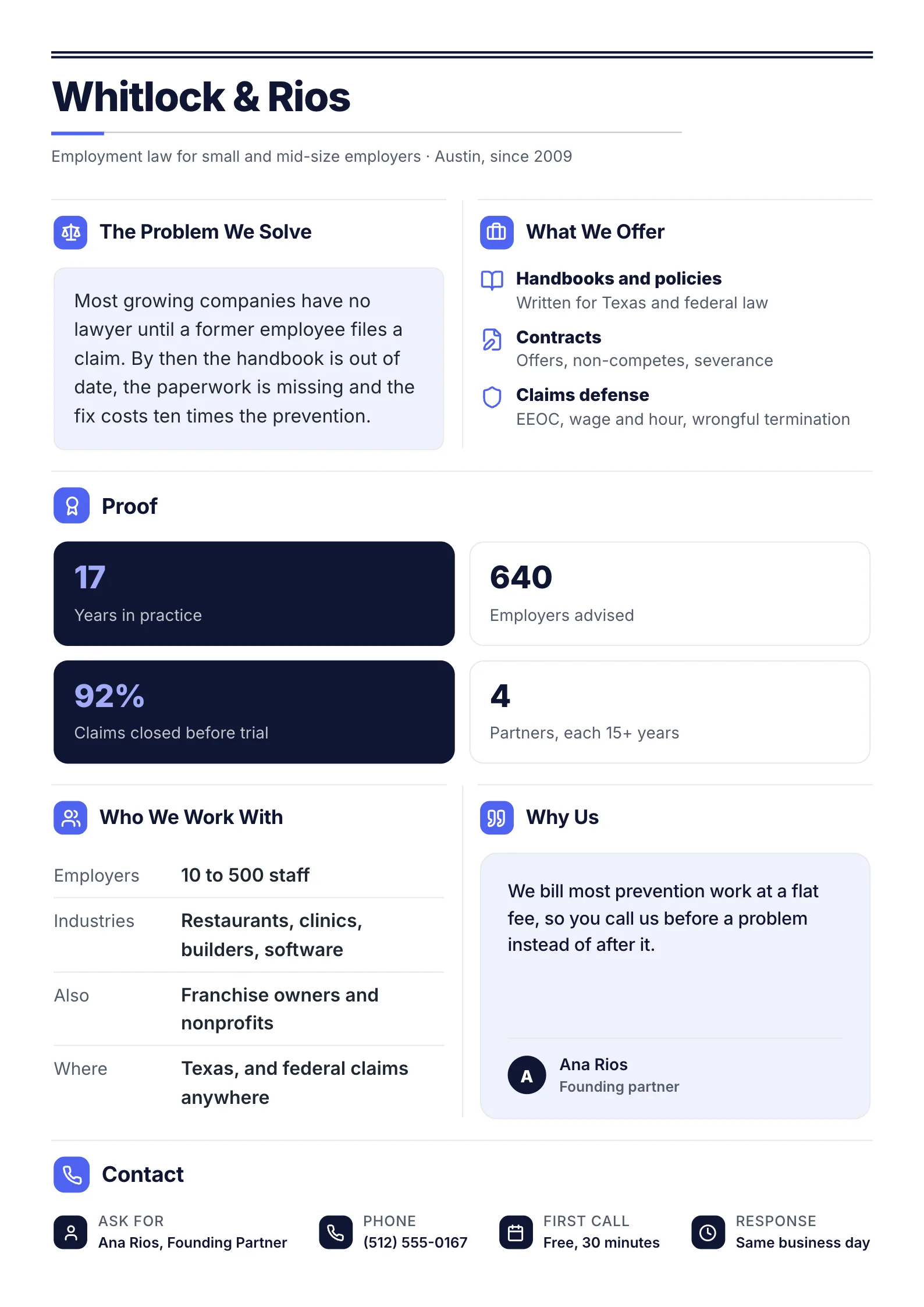 Law Firm ProfileEdit for free(opens in a new tab)
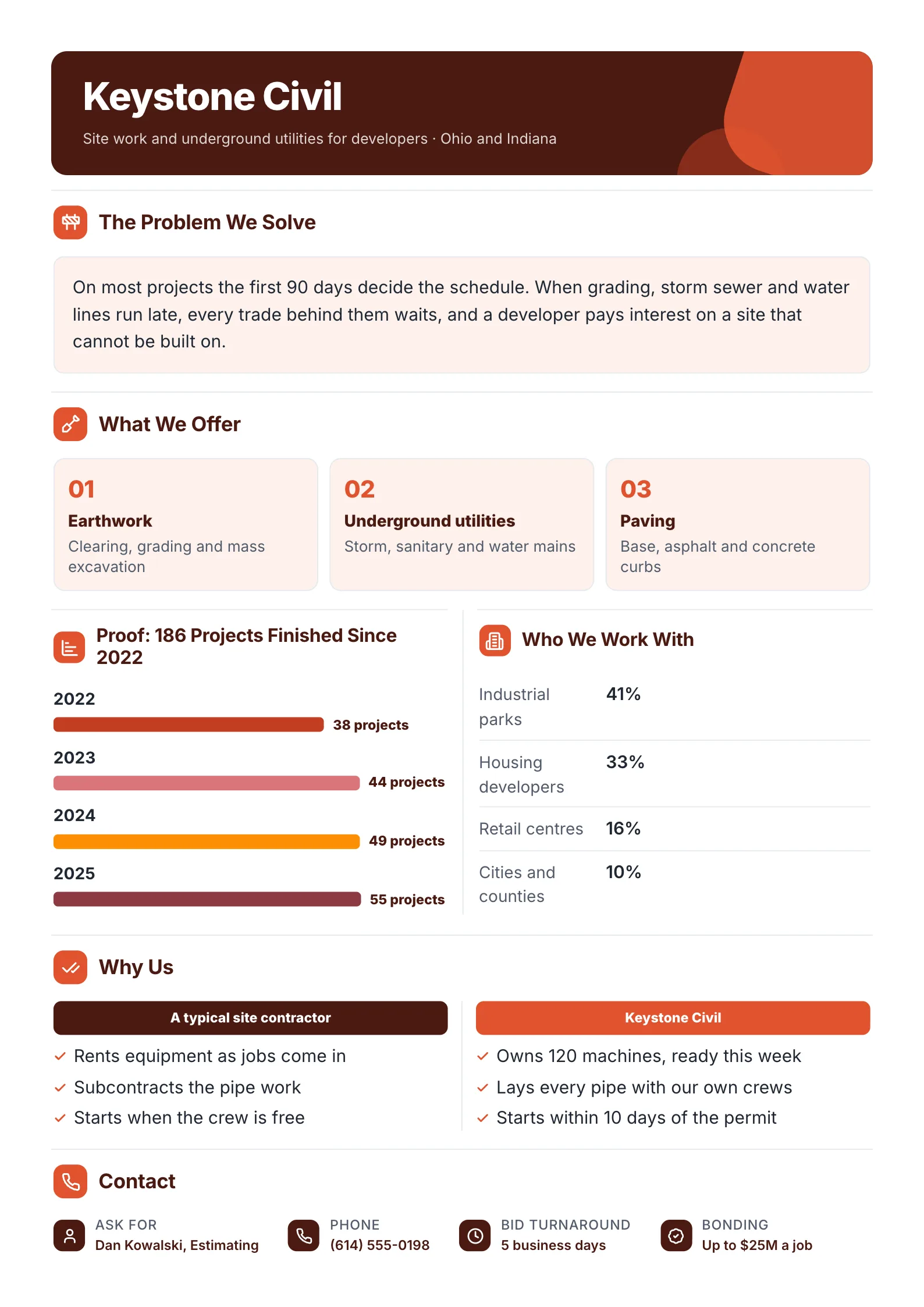 Site Contractor ProfileEdit for free(opens in a new tab)
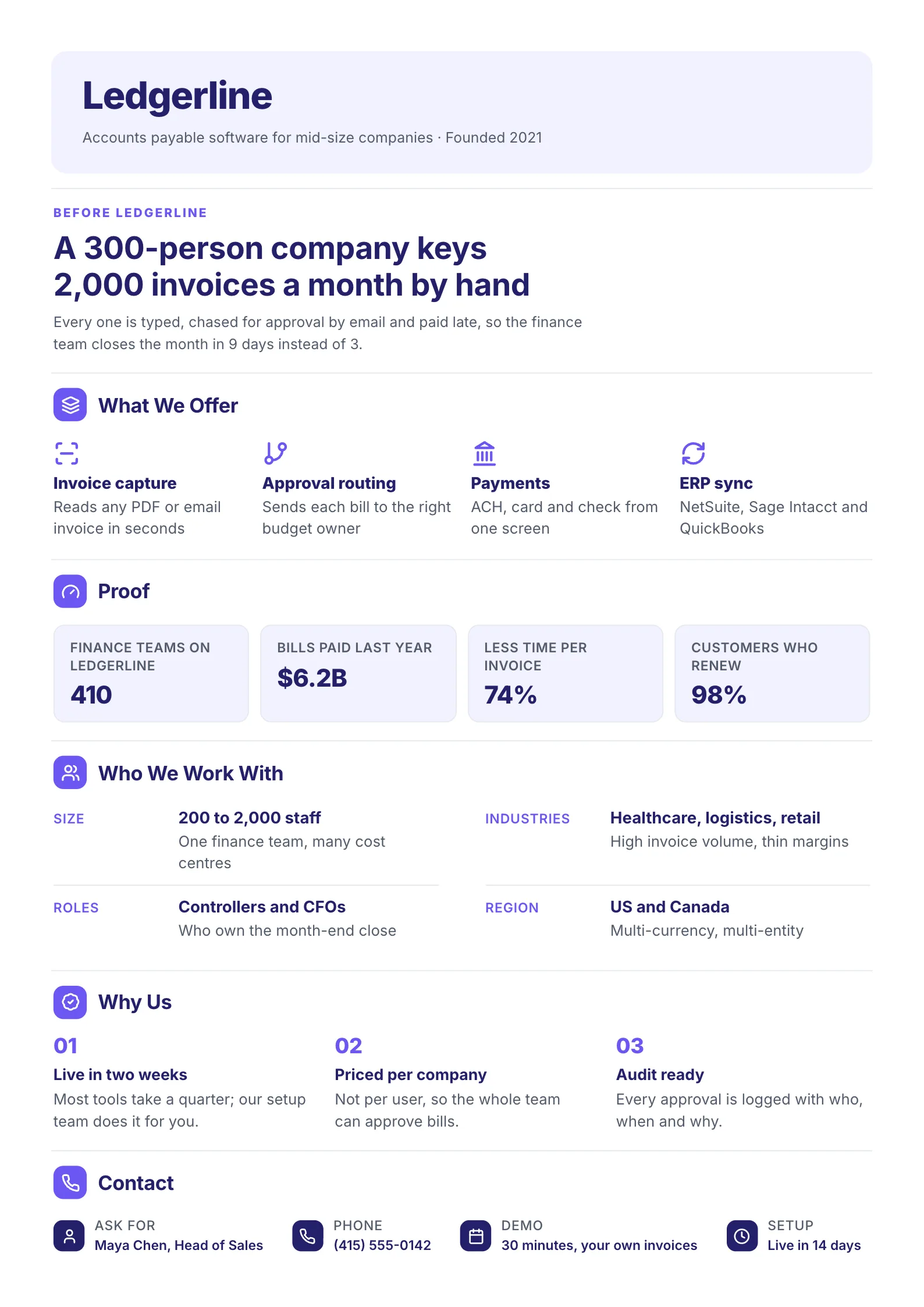 Software Company ProfileEdit for free(opens in a new tab)
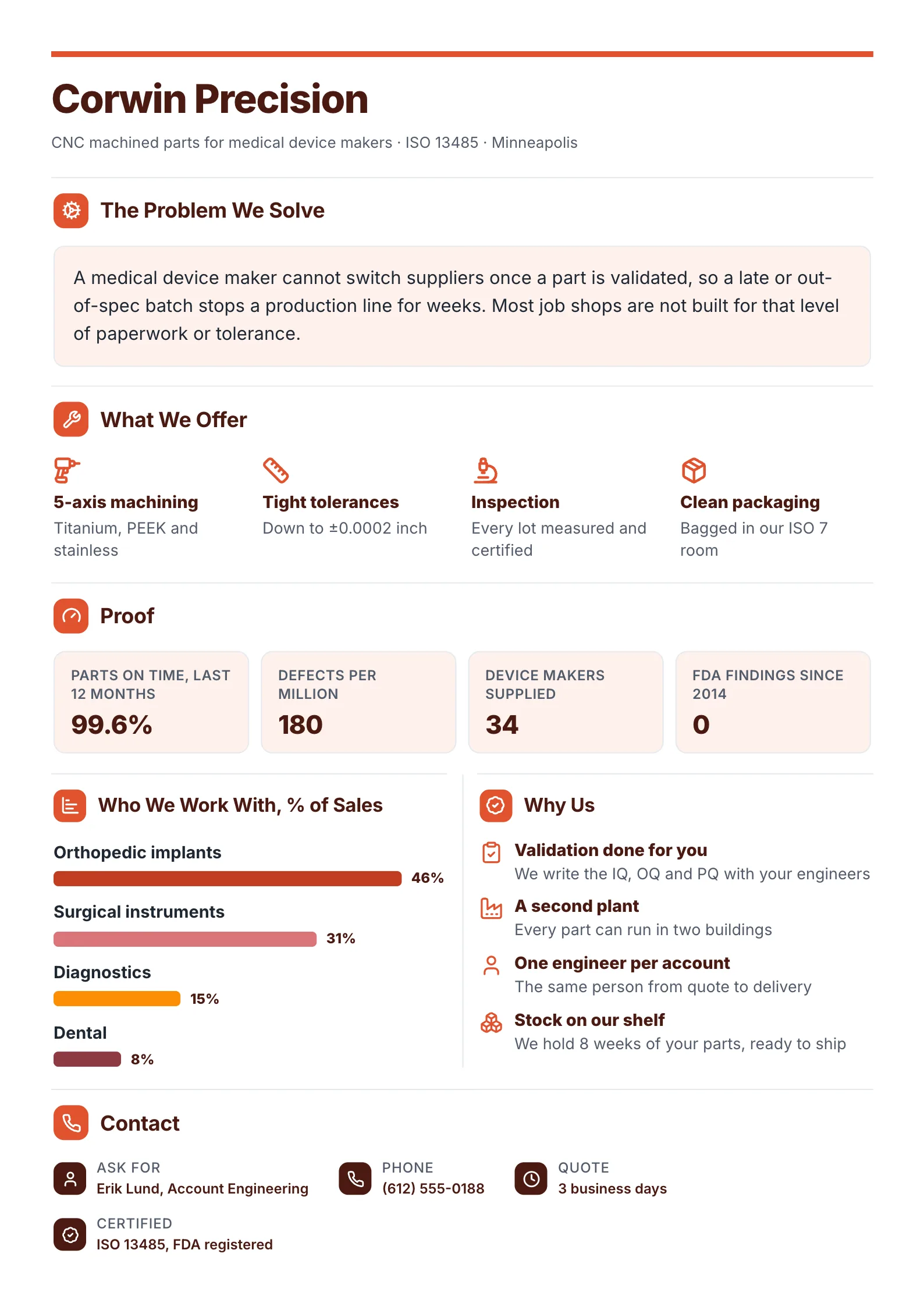 Manufacturer ProfileEdit for free(opens in a new tab)
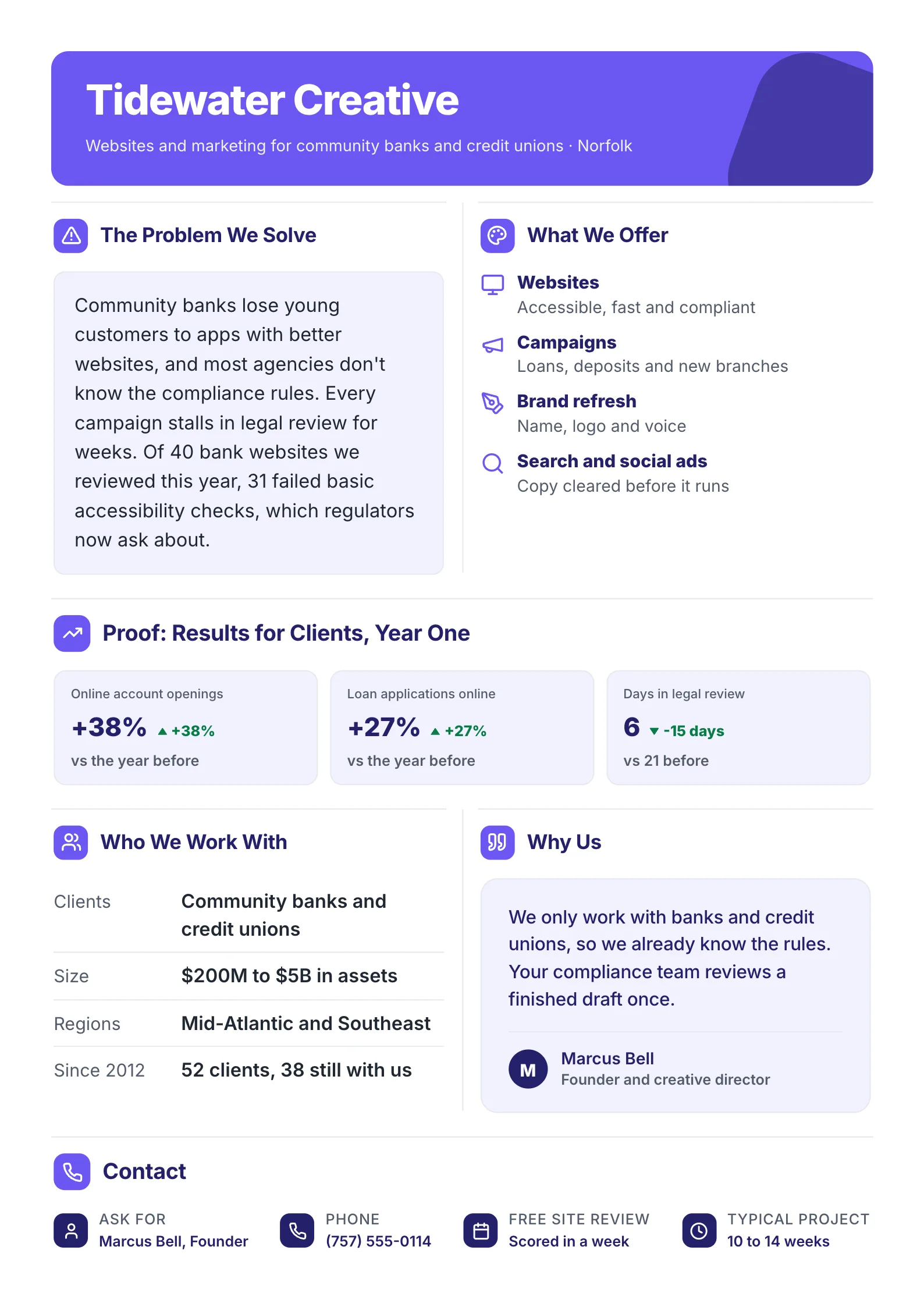 Marketing Agency ProfileEdit for free(opens in a new tab)
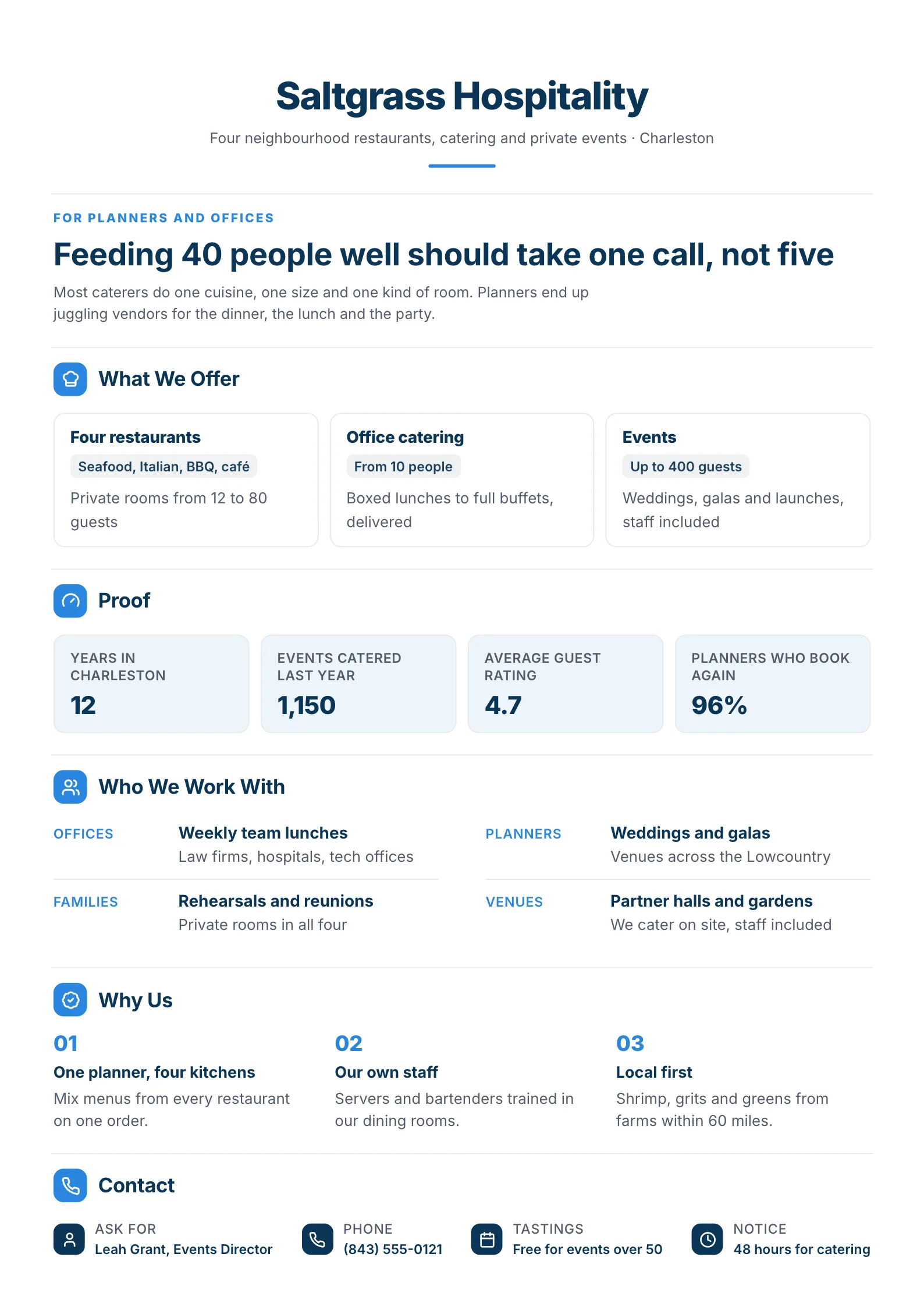 Restaurant Group ProfileEdit for free(opens in a new tab)
This guide covers the seven sections every company profile one-pager needs, how to change it for clients, investors and partners, the mistakes that make it read like a brochure, and a template outline you can copy. Writing for a lender or a buyer instead? The business one-pager guide covers those readers too.
The 7 sections of a company profile one-pager
- Name and one-line description. What you do, for whom, in one sentence a stranger understands. "Scheduling software for field service teams" beats "Empowering the future of work".
- The problem you solve. Two sentences on the pain your customers had before you.
- What you offer. Your products or services, in three to five short lines.
- Proof. Two to four figures: customers, years, results, growth. Each one specific and true.
- Who you work with. Customer types or named clients, with their permission.
- What makes you different. One or two sentences on why customers pick you over the alternatives.
- Contact. One named person, an email, a phone number if you take calls, and your website.
Founding story, values and team bios can go on your website. On a one-pager, every line should help a stranger decide to talk to you.
One company, three one-pagers
The facts stay the same; the order and the emphasis change with the reader.
| Reader | Lead with | Include | Leave out |
|---|---|---|---|
| A potential client | The problem you solve for them | Services, results for similar clients, how to start | Funding, valuation |
| An investor | The market problem and your traction | Revenue, growth, the raise and what it buys | Long service lists |
| A partner or supplier | Who you serve and how you work | Volume, locations, what a partnership needs | Pricing details |
A company one-pager, taken apart
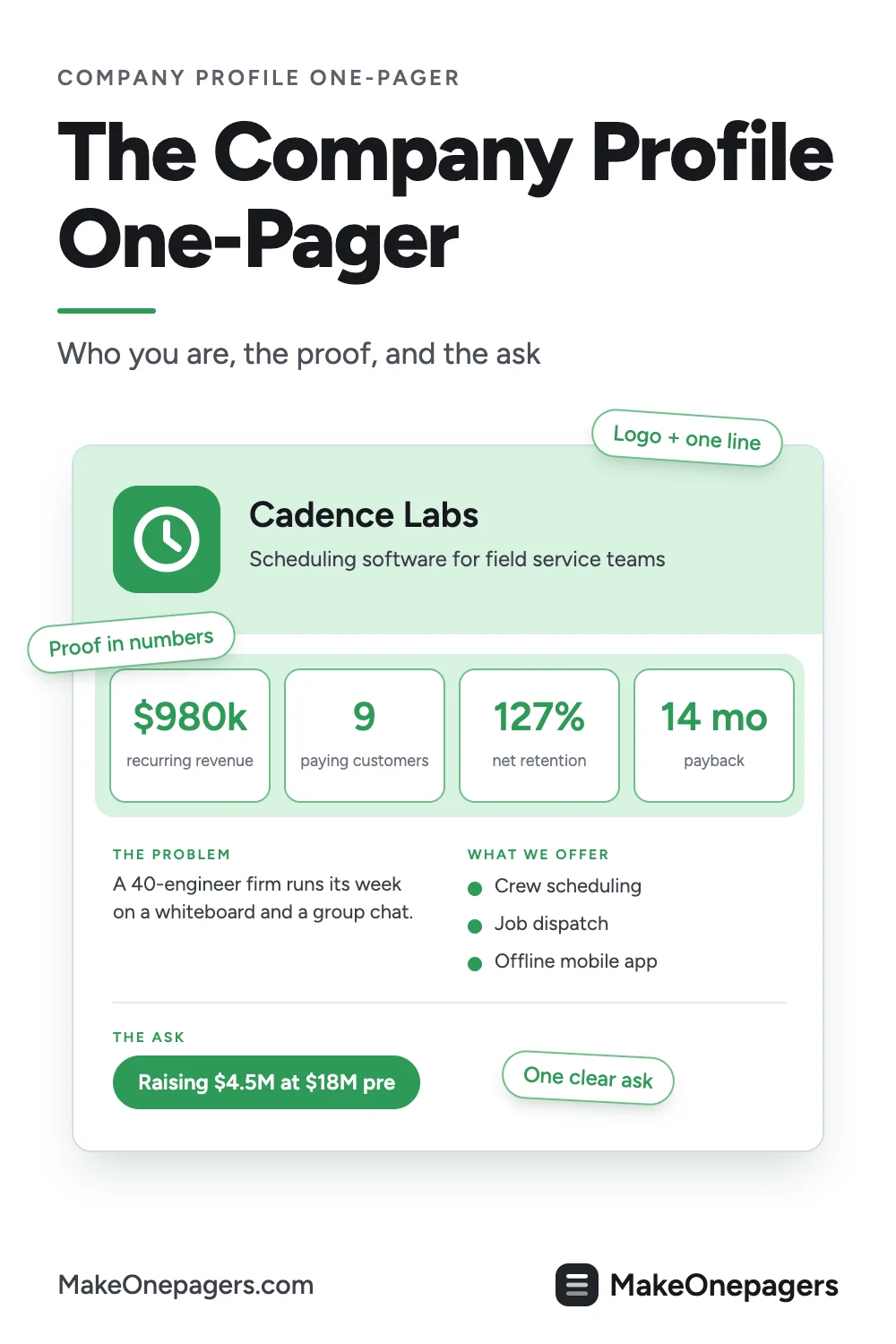
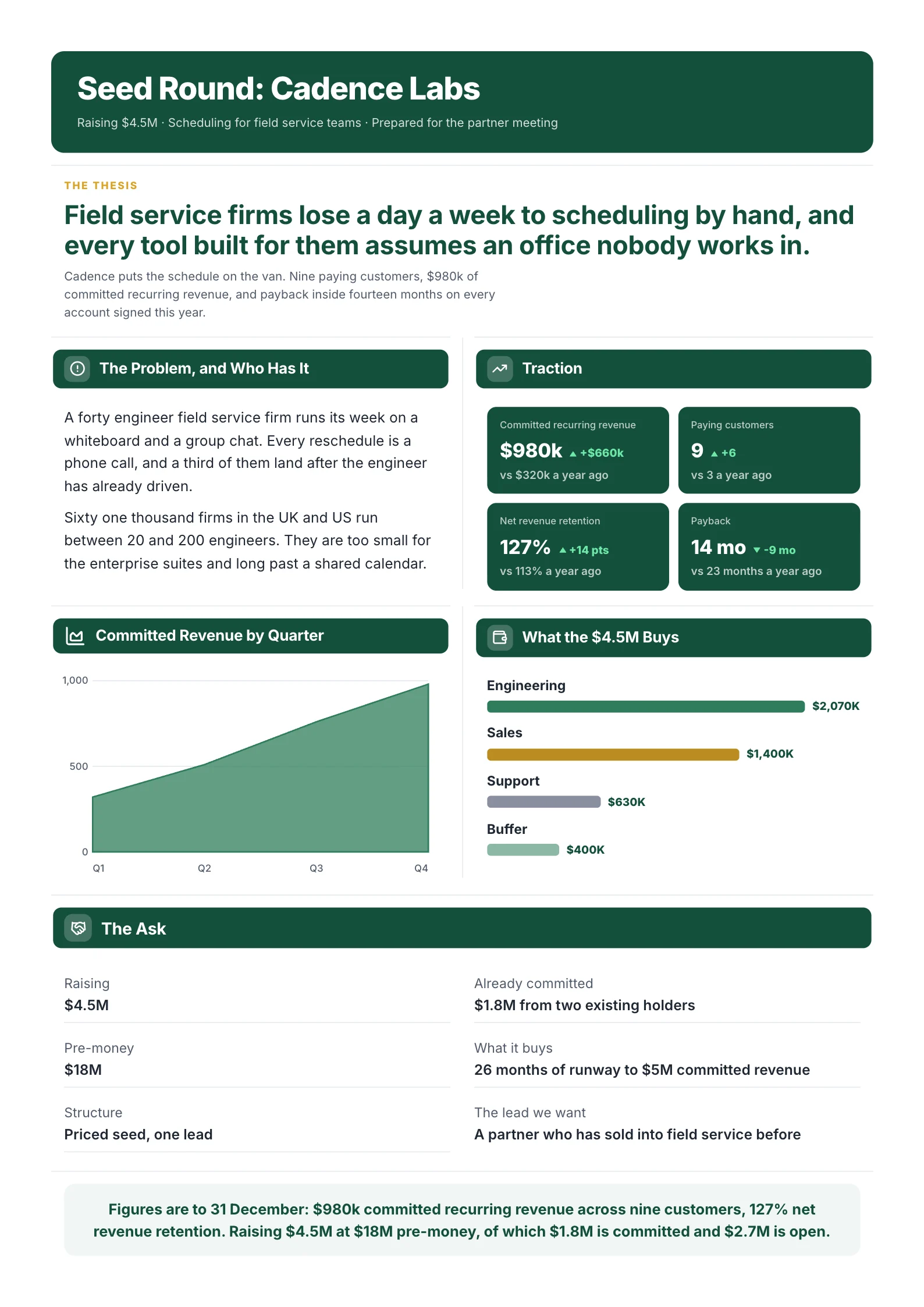
Here is a sample investor version made with MakeOnepagers from a longer pitch deck. The company is made up for this guide.
 Edit this template
In this sample investor version, the one-line thesis does the work a paragraph of company history would not.
- The one-liner is the thesis: field service firms lose a day a week to scheduling by hand, and the tools built for them assume an office nobody works in.
- The problem names who has it: a forty-engineer firm running its week on a whiteboard and a group chat.
- Proof is four figures, each against a year ago: $980k committed recurring revenue (up from $320k), 9 paying customers (up from 3), 127% net revenue retention, and payback of 14 months.
- What the money buys is four bars that add up to the $4.5M raise.
- The ask closes the sheet: raising $4.5M at $18M pre-money, with $1.8M already committed.
Open this layout as a pitch One-Pager template.
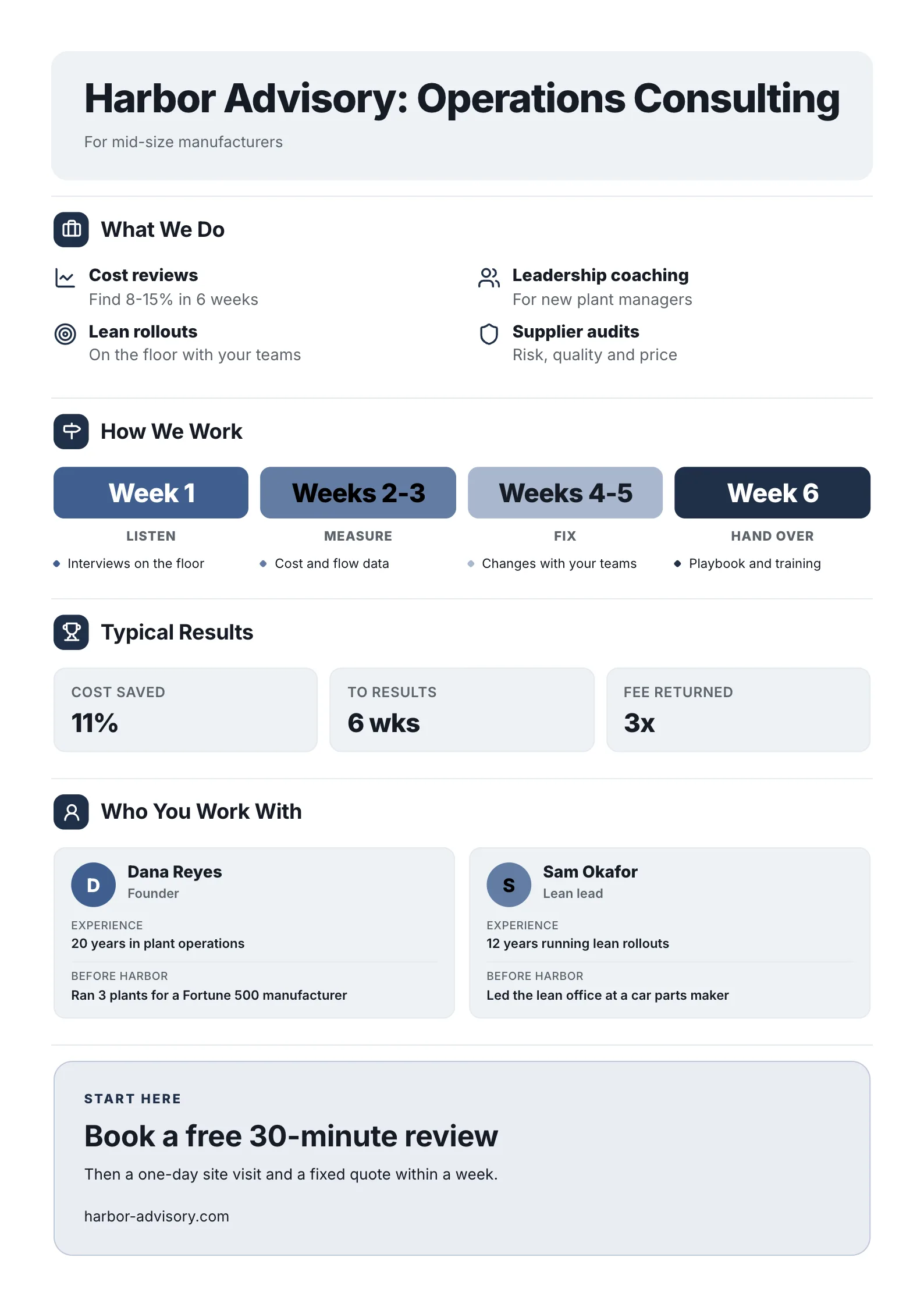
A client version of the same company would lead with the problem and the results for customers, and drop the raise. Here is what the client version looks like for a consulting firm:
 Edit this template
The client version shows the services and how the work runs week by week. It ends with typical results and the two people the client will actually meet.
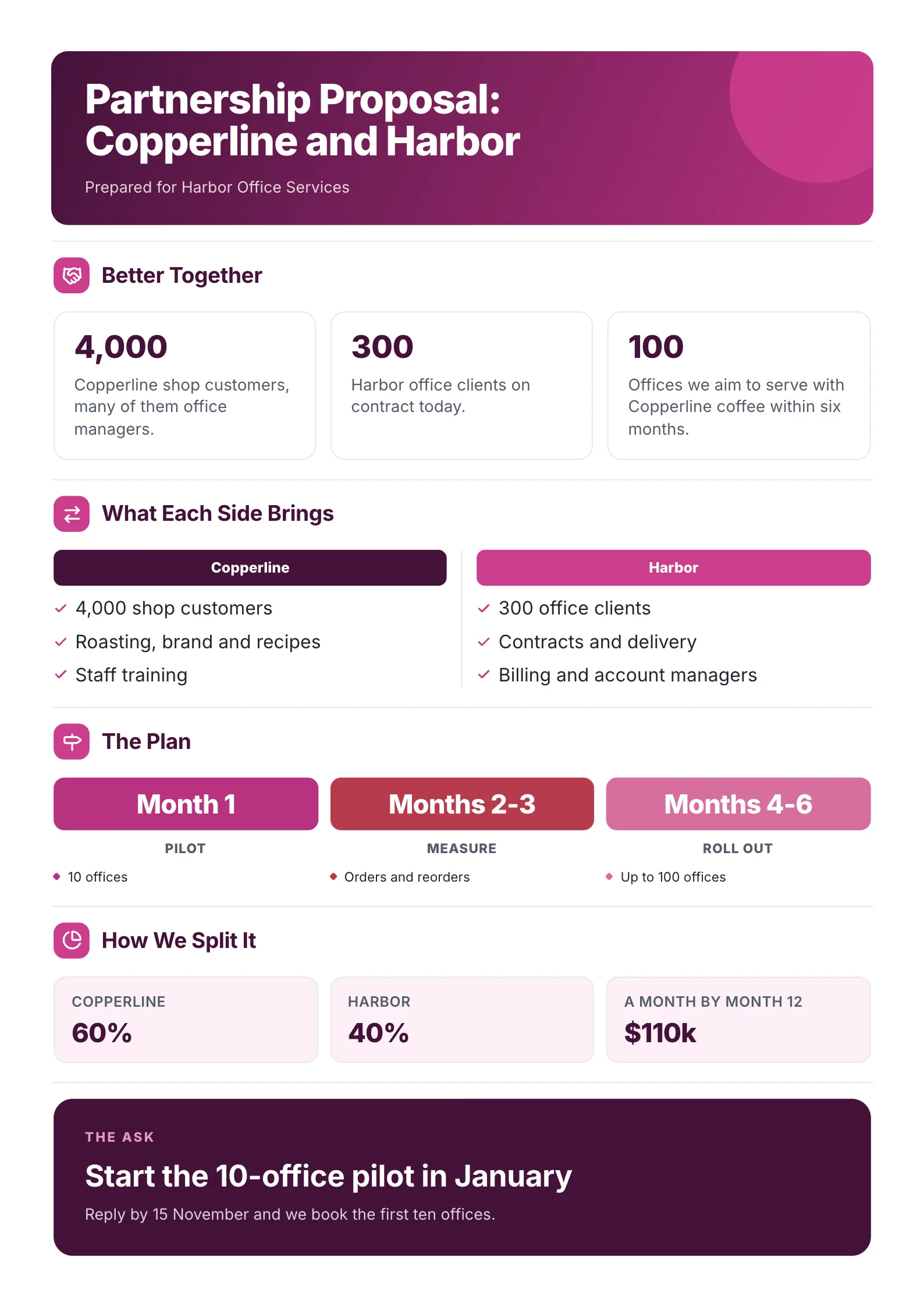
And the partner version, which leads with what each side brings:
 Edit this template
The partner version uses two columns for what each side brings. Then it shows the split in numbers and a pilot with a reply-by date.
The proof section: a success story and social proof
Proof is the section a stranger checks before they believe anything else on your company profile one-pager. It has two parts. The first is a short success story about one client. The second is social proof, the signals that other people already trust you.
A success story in four lines
- Who the client is: their type and size, and their name only if they agreed.
- The problem before, with a number.
- What you did, in one line.
- The result after, in the same unit as the before, plus one sentence from the client with their name and role.
The marketing agency profile template shows how much fits in a small space. Its proof is three before-and-after figures for clients in their first year: online account openings up 38%, online loan applications up 27%, and days in legal review down from 21 to 6. Each figure is something the client's own boss would care about. An agency metric like "campaigns launched" would mean little to them.
Social proof that fits on one sheet
| Kind of proof | How to show it |
|---|---|
| Figures | Customers, years, renewal rate: two to four, each specific |
| Client logos | Only with written permission; otherwise describe clients by type |
| A quote | One sentence, with the person's name, role and company |
| Ratings | The score, where it comes from and how many reviews |
| Certifications and awards | Only ones you hold, with the year |
Pick the two or three a stranger in your market trusts most. A software buyer checks renewal rates; a shopper checks ratings. The retail store profile template leads its proof with years in business, rewards club members and its review rating across three stores.
Company profile one-pager variants by business type
The seven sections stay the same for every business. What changes is which proof leads and what "what we offer" looks like.
E-commerce or early-stage startup: lead with traction
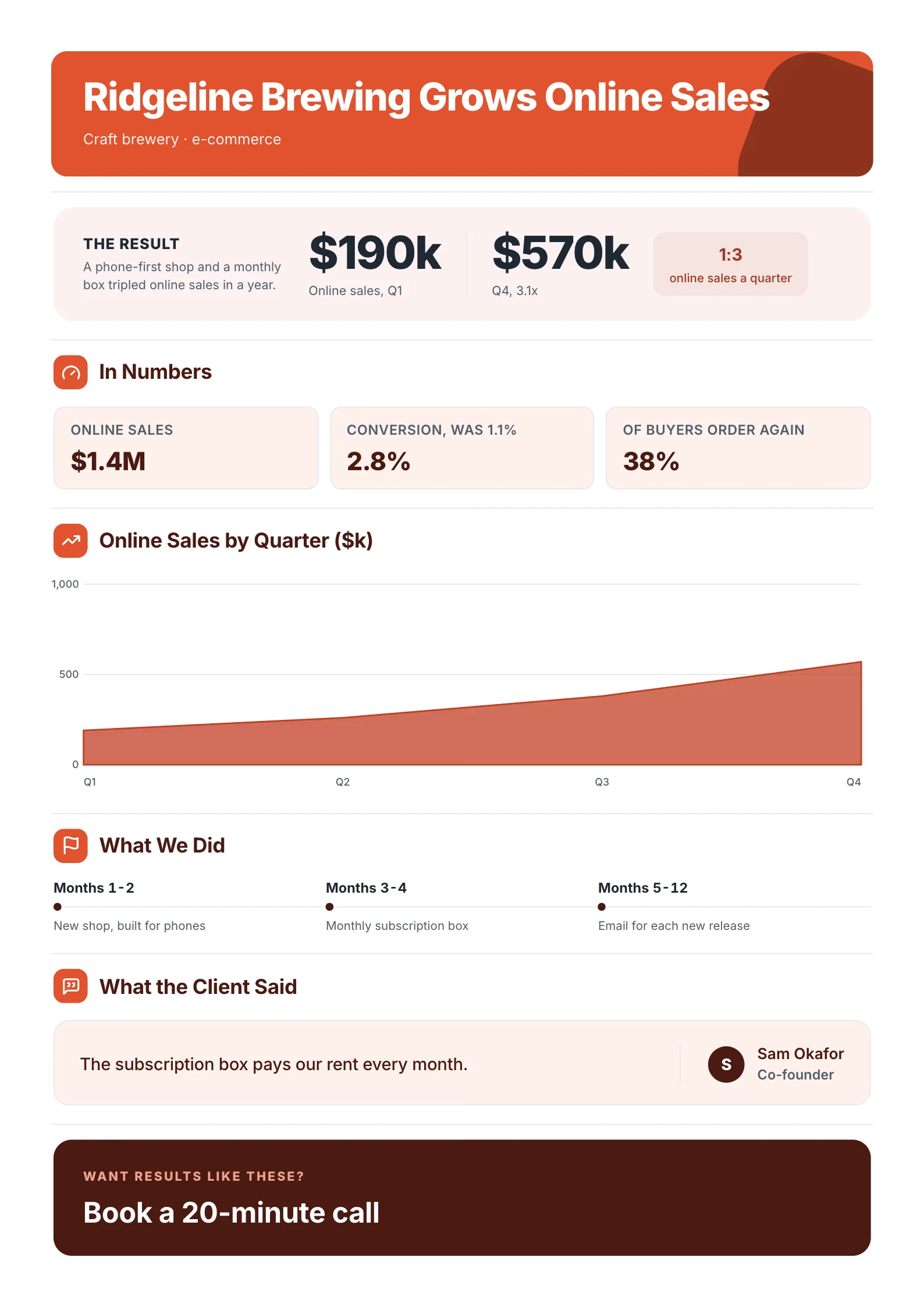
A young company has few clients and short history, so its strongest proof is growth. Show revenue by quarter, conversion and repeat buyers, and say what drove the change.
 Edit this template
A traction-first layout: the result as two quarters side by side, three figures, then what changed month by month.
You can edit this online sales case study template for free. Comparing tools first? Here are the best case study templates we found across seven sites.
Consulting, agency or professional services: lead with who you serve
A service firm sells people and a way of working. Name one narrow client type, the problem that type has, and the results you got for clients like them. Then show how the work runs and who the client will meet. The consulting services template and the law firm profile template both follow this order.
Case-study style: one client tells the story
When you have one strong result and few clients, let the whole one-pager be that client's story. Put the result in the headline, then show the before and after and the steps you took. Add the client's quote, and end with one line on who you are. The month-end close case study template is laid out this way.
Software company: lead with the cost of the old way
A software buyer already has a way of doing the job, usually a slow one. The software company profile template opens with that old way as a headline: a 300-person company keys 2,000 invoices a month by hand. What it offers follows as four short features, then proof as four figures, including 410 finance teams and a 98% renewal rate. "Why us" is three numbered reasons a buyer can check, such as going live in two weeks.
Other business types
| Business type: what leads the one-pager | Template |
|---|---|
| Manufacturer: capabilities and the quality record | Manufacturer |
| Logistics: the on-time record for the last 12 months | Logistics |
| Medical clinic: services, wait times, insurance taken | Clinic |
| Restaurant group: venues, catering and private events | Restaurants |
| Contractor: projects finished by type | Contractor |
| Nonprofit: the need before and after the program | Nonprofit |
Company profile one-pager vs executive summary vs full company profile
A company profile one-pager introduces your business to a stranger. An executive summary condenses one longer document, such as a business plan or a proposal, for a reader who must decide on it. A full company profile is the long reference version, often several pages, that a buyer or partner reads once they are already interested.
| Document: its job and its reader | Length |
|---|---|
| Company profile one-pager: get a stranger to talk to you | One sheet |
| Executive summary: help a decision-maker act on one plan or proposal | One to two pages |
| Full company profile: answer a serious buyer's or partner's detailed questions | Several pages |
Send the one-pager first. Send the full profile when someone asks for it, usually during supplier checks or a tender.
If you only have the full profile today, it already holds the one-pager. Keep the one-line description, your top three services, two to four figures, one client story and one contact. History, values, team bios and the full service list stay in the long version. Write an executive summary when there is a longer document behind it; our guide to the executive summary one-pager covers that version.
Mistakes that make it read like a brochure
| Mistake | Fix |
|---|---|
| "We are a leading provider of innovative solutions" | Say what you do and for whom, plainly |
| A paragraph of company history | One line: founded in [year], [number] customers |
| Every service you have ever offered | Your top three to five, the rest on your website |
| Claims with no numbers | Two to four specific figures |
| Logos of clients who didn't agree | Ask first, or describe them by type |
| No clear next step | End with one contact and one action |
How to make a company profile one-pager
If you already have a company deck, a capabilities document or a long profile, the content exists. Your job is cutting it to one sheet without losing the proof.
You can do that by hand in Word, Google Docs or Canva with the template below. Or upload your deck or profile to MakeOnepagers. It reads the whole document and picks out the description, the offer and the figures. Then it lays them out as a designed One-Pager you can edit line by line. Anything it can't tie to your document is left out, so it won't invent a client or a number.
Starting from a pitch deck? See how MakeOnepagers handles pitch decks and case studies, or read our guide to the startup One-Pager.
A company profile one-pager template
| Section | What to write |
|---|---|
| [Company name] | [One line: what you do, for whom] |
| The Problem We Solve | [Two sentences on what customers struggled with before] |
| What We Offer | [Product or service 1] · [Product or service 2] · [Product or service 3] |
| Proof | [Figure 1] · [Figure 2] · [Figure 3] |
| Who We Work With | [Customer types, or named clients with permission] |
| Why Us | [One or two sentences] |
| Contact | [Name, role] · [email] · [phone] · [website] |
For more layouts, browse our free One-Pager templates and One-Pager examples.
In Canva or Word you pick a template and rewrite your deck into it line by line. MakeOnepagers starts from the deck or report you already have. The free generator takes a PDF, Word or PowerPoint file up to 10 pages, and writes the profile for you to edit. Canva is still the better pick if you want to place every element yourself.
Turn your deck into a company One-Pager
Upload your company deck or profile and get a designed company One-Pager back in a minute or two, ready to edit and send. Make yours free with the AI One-Pager Generator. Make your One-Pager free.
Frequently asked questions
What should a company profile one-pager include?
Your name and a one-line description, the problem you solve, what you offer, two to four figures as proof, who you work with, what makes you different, and one contact. Keep history and values for your website.
What is the difference between a company profile and a one-pager?
A company profile can run several pages and cover history, team and every service. A company profile one-pager is the short version: only what a stranger needs to decide whether to talk to you.
How do I write a company one-pager for investors?
Lead with the problem and your traction, then the market, the raise and what the money buys. Our guide to the startup One-Pager covers what investors expect.
Can I make a company profile one-pager for free?
Yes. On MakeOnepagers you can edit the template above and download it as a PDF free. Drop your existing deck or profile into the free AI One-Pager generator and your One-Pager is written and laid out for you, free. You can also type it into Word or Google Docs if you'd rather design it yourself.
Should a company one-pager have a logo and photos?
A logo, yes. Photos only if they show something specific, such as your product in use. Stock photos take space from your proof.




