Business One‑Pager: What to Include, With 5 Examples
A business one-pager sums up your company on one sheet. See what to include for investors, clients, lenders and buyers, with 5 real examples to edit.

Your business one-pager is the single sheet that tells one reader what your company does, the numbers that prove it works and what you want from them next. You hand it to an investor before a call, leave it with a client after a meeting or send it to a buyer who wants a first look. Think of it as the slice of your business plan that one reader needs today. Start from a free one pager template.
One‑Pager examples
Real One-Pagers made with MakeOnepagers. Open any one to edit it as your own.
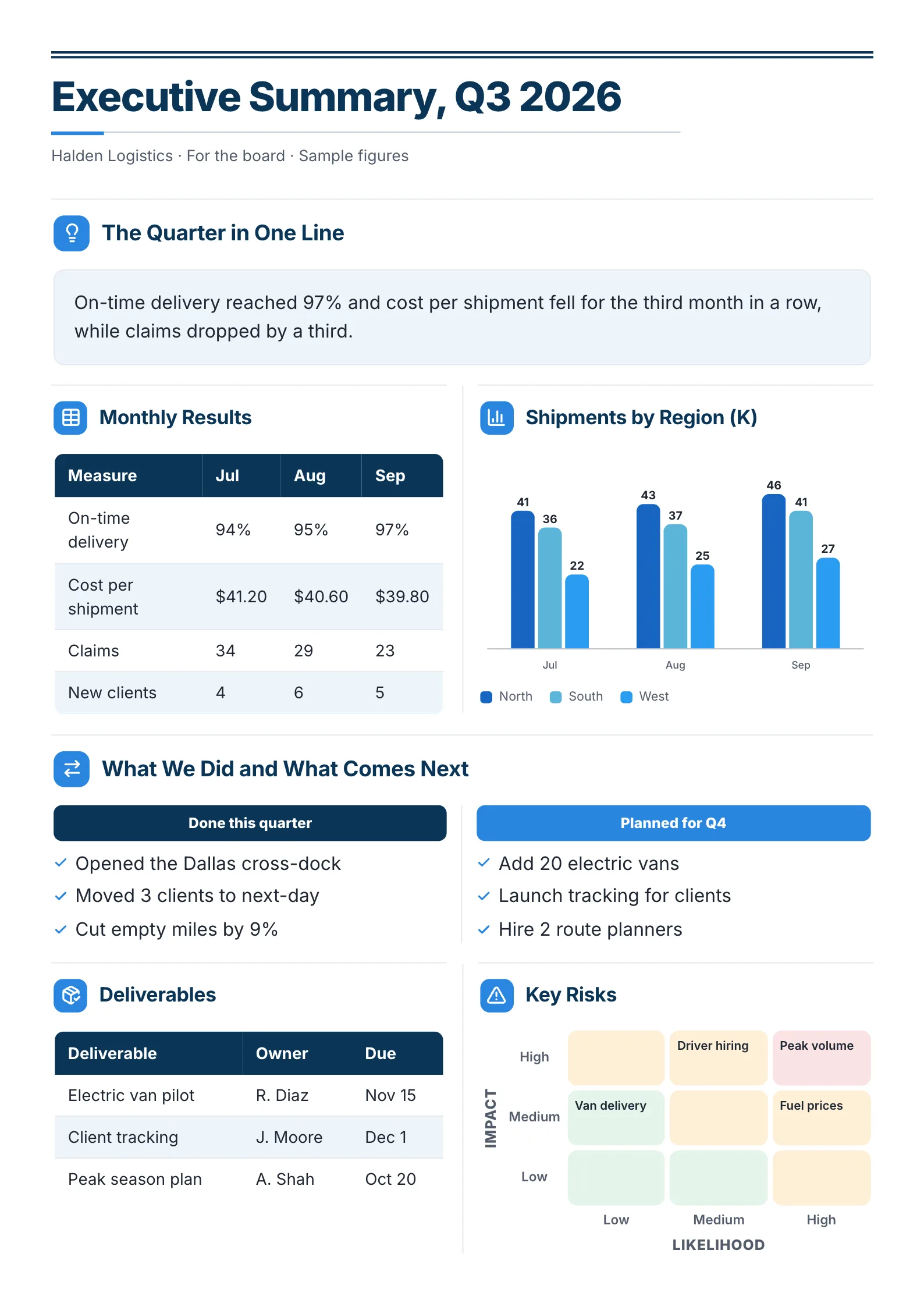 Business Executive SummaryEdit for free(opens in a new tab)
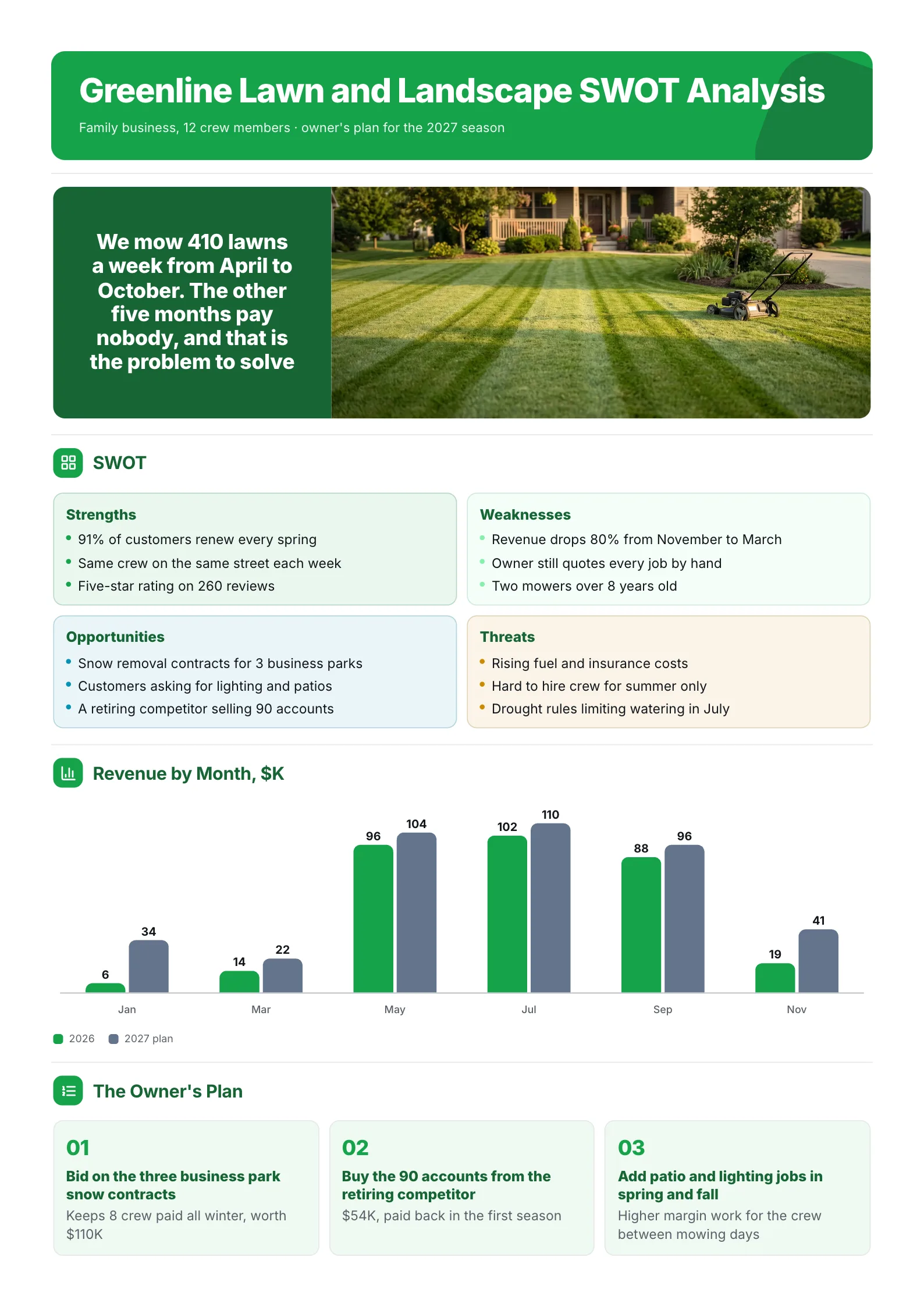 SWOT Analysis: Small BusinessEdit for free(opens in a new tab)
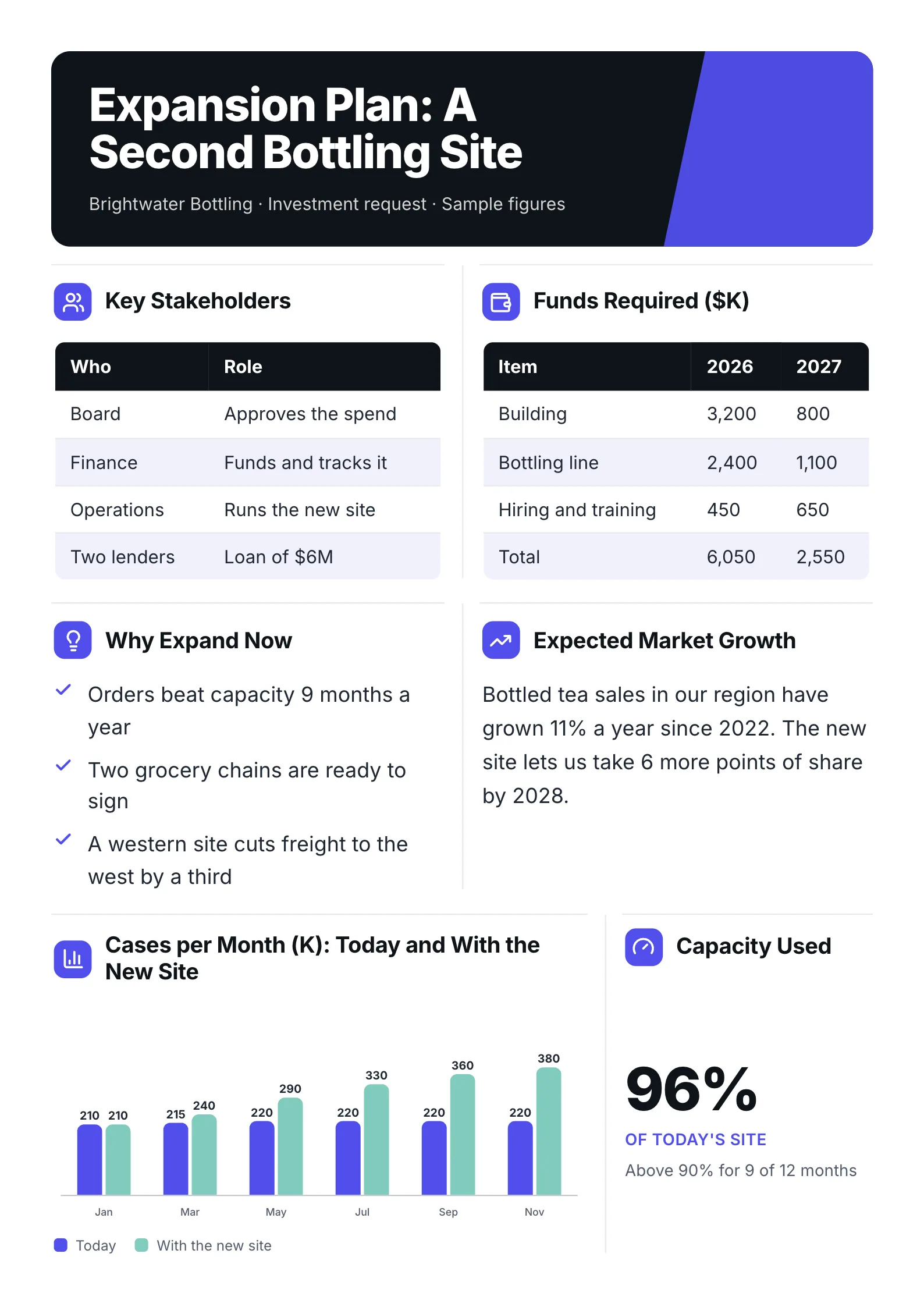 Business Expansion InvestmentEdit for free(opens in a new tab)
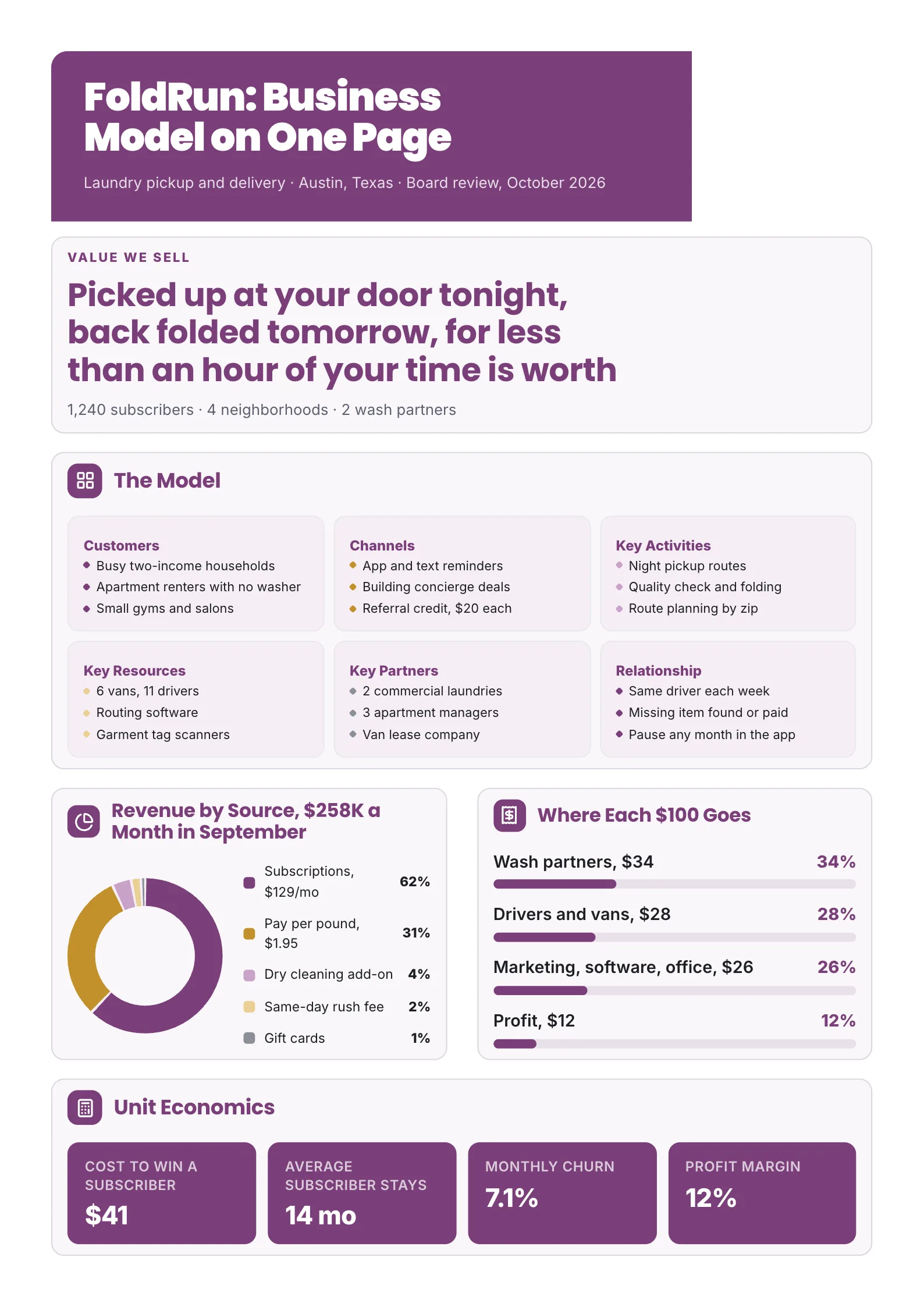 Business Model Canvas One-PagerEdit for free(opens in a new tab)
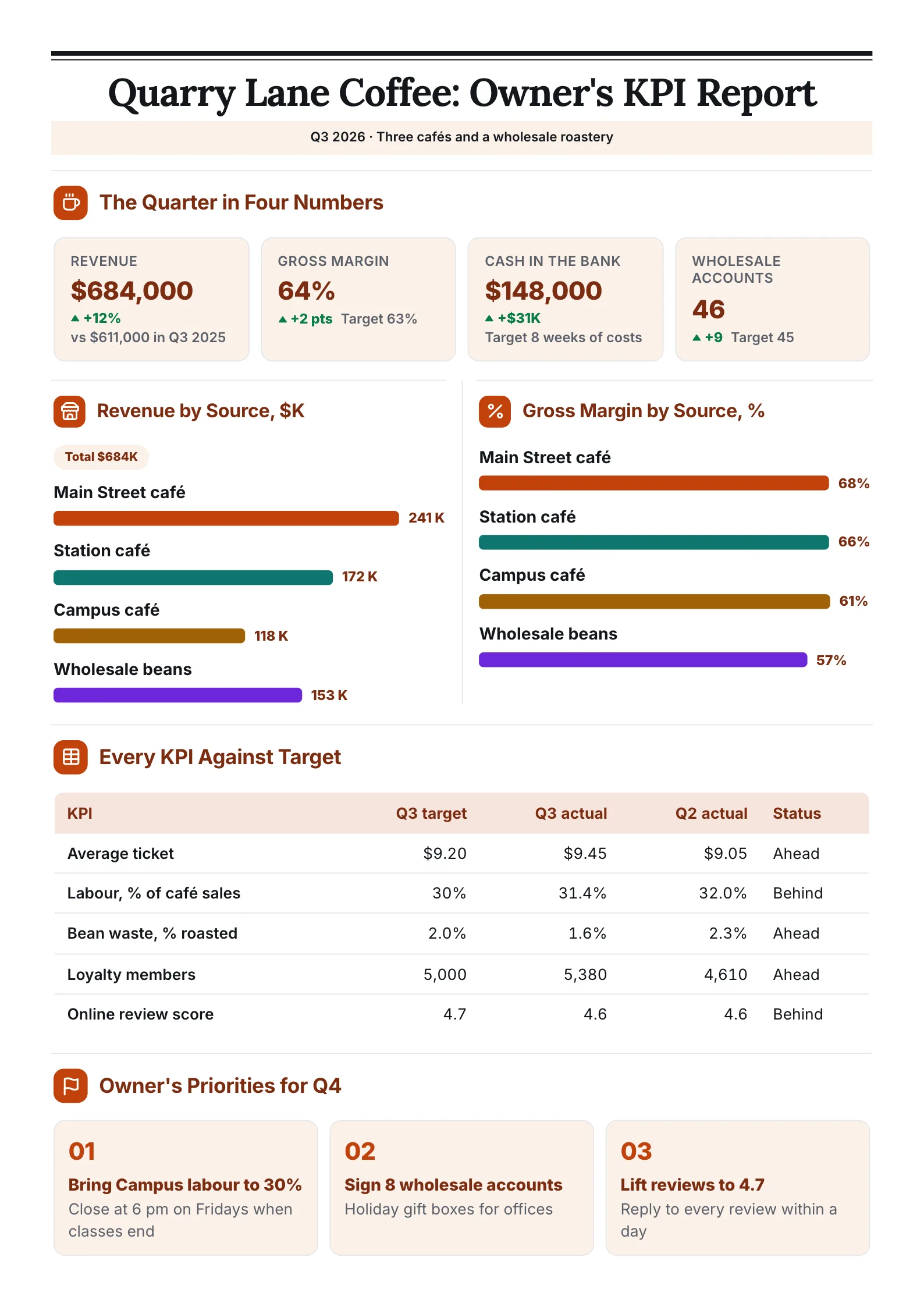 KPI Report: Small Business OwnerEdit for free(opens in a new tab)
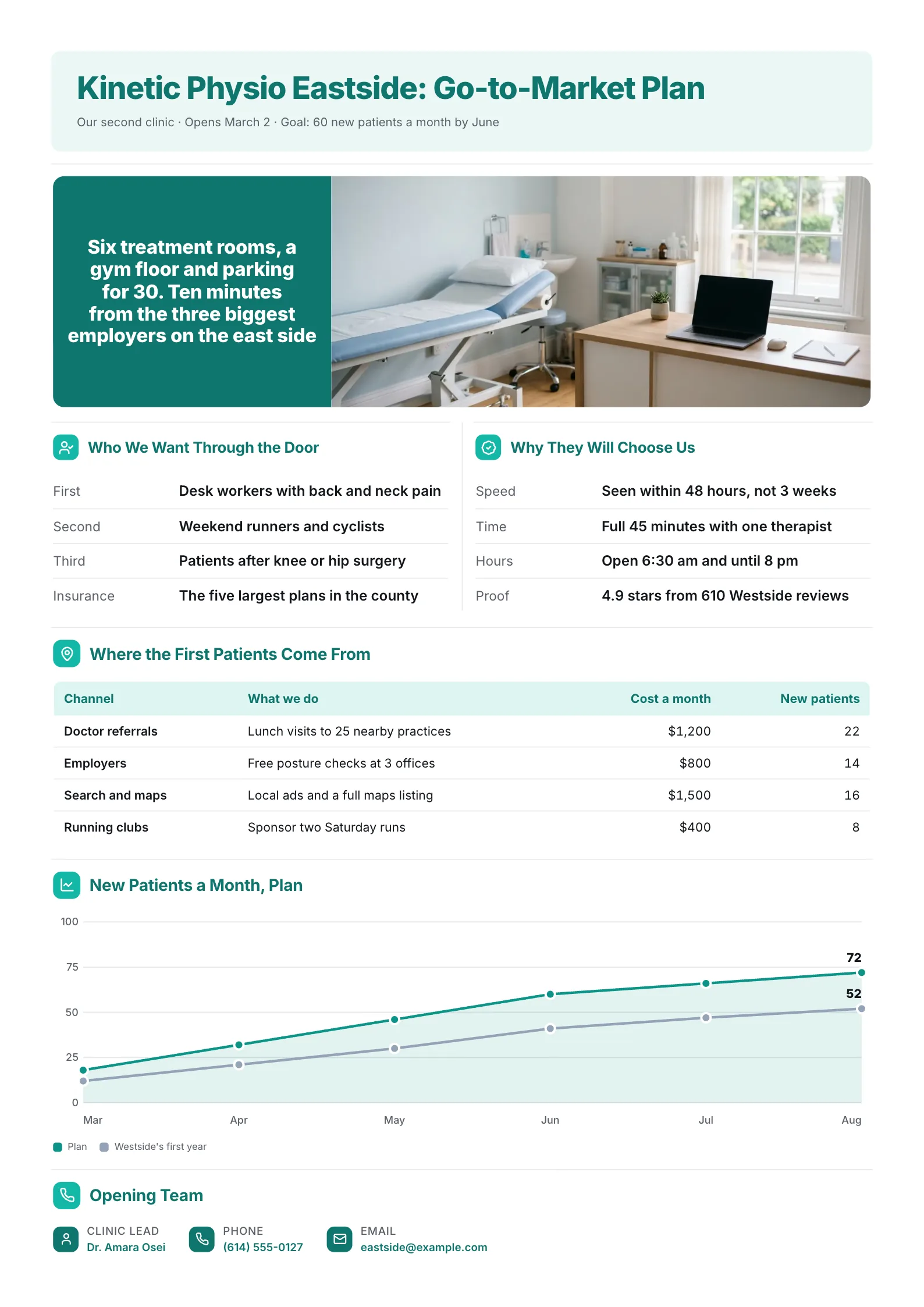 Go-to-Market Strategy: Local BusinessEdit for free(opens in a new tab)
The U.S. Small Business Administration agrees that a plan can fit on one sheet. In its guide to writing a business plan, it says a lean plan can "take as little as one hour to make" and is "typically only one page." We also counted the words on the 11 business One-Pagers in this post. They hold 119 to 206 words, with a median of 169. At 238 words a minute, the average silent reading speed for non-fiction in a 2019 review of 190 studies, that's 30 to 52 seconds to read one in full.
Below you'll find the parts every business one-pager shares, what four kinds of reader check first and 5 examples you can edit. Want to skip ahead? Open the fact sheet and edit it as you read.
What to include in a business one-pager
Most business one-pagers use the same eight parts. You won't always need all eight, but you'll use most of them.
- Your company in one line. Say what you do and who you do it for, in words a stranger would use. "We text a clinic's waitlist the moment a slot opens" beats "a patient engagement platform."
- The problem. Name the cost of the problem in your customer's terms: hours, dollars or missed sales.
- What you sell. Describe the product or service and how it fixes that problem, in two or three short lines.
- Who buys it. Be specific. The SBA's advice for a lean plan is to name your customer segments because "your business won't be for everybody."
- Proof. Give three or four figures that prove it works: customers, revenue, growth, a rating, a repeat rate.
- How you make money. Give your prices or revenue streams. A reader who can't see how money comes in will assume it doesn't.
- Who runs it. Name your founder or owner, your team size and where you're based, all on a single line.
- The ask. End with one next step and a name to contact: the amount you're raising, the meeting you want or the date offers are due.
The SBA's advice for the executive summary of a full plan covers much of the same ground. It asks for your mission, your product or service, who leads the company, how many people work there and where it is. Add financial information and growth plans "if you plan to ask for financing."
Same business, four readers: what each checks first
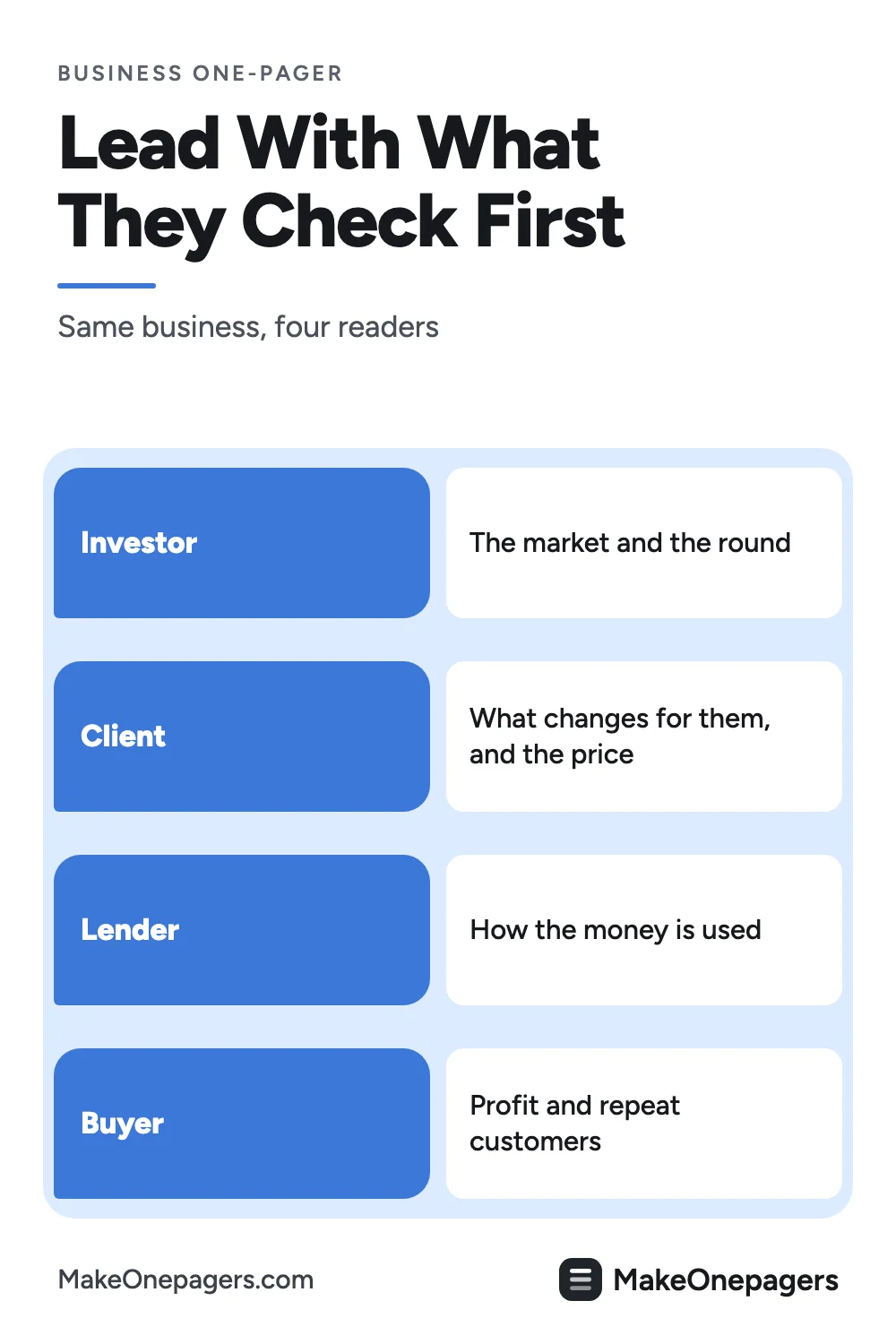
The eight parts stay the same. The order changes, because each reader opens the sheet looking for one thing. Put that thing at the top.
| Reader | What they check first | Lead with | Example below |
|---|---|---|---|
| An investor | Market size and traction | The problem, the market and monthly revenue | Business summary for investors |
| A client | What changes for them, and the price | Today against the way it will be with you | Business proposal |
| A lender or partner | How the business makes money and where the funds go | The model, the prices and the use of funds | Business plan summary |
| A buyer | Profit, staff and repeat customers | Revenue, cash profit and why the owner is selling | Business for sale teaser |
And when you don't know who will read it, at a trade show, on a website or in a press kit, a fact sheet with your key numbers works for everyone.
5 business one-pager examples
Each of these is a real One-Pager made with MakeOnepagers for a made-up company. Open any one and swap in your own name, numbers and dates.
1. Business fact sheet: for anyone who asks
 Edit this template
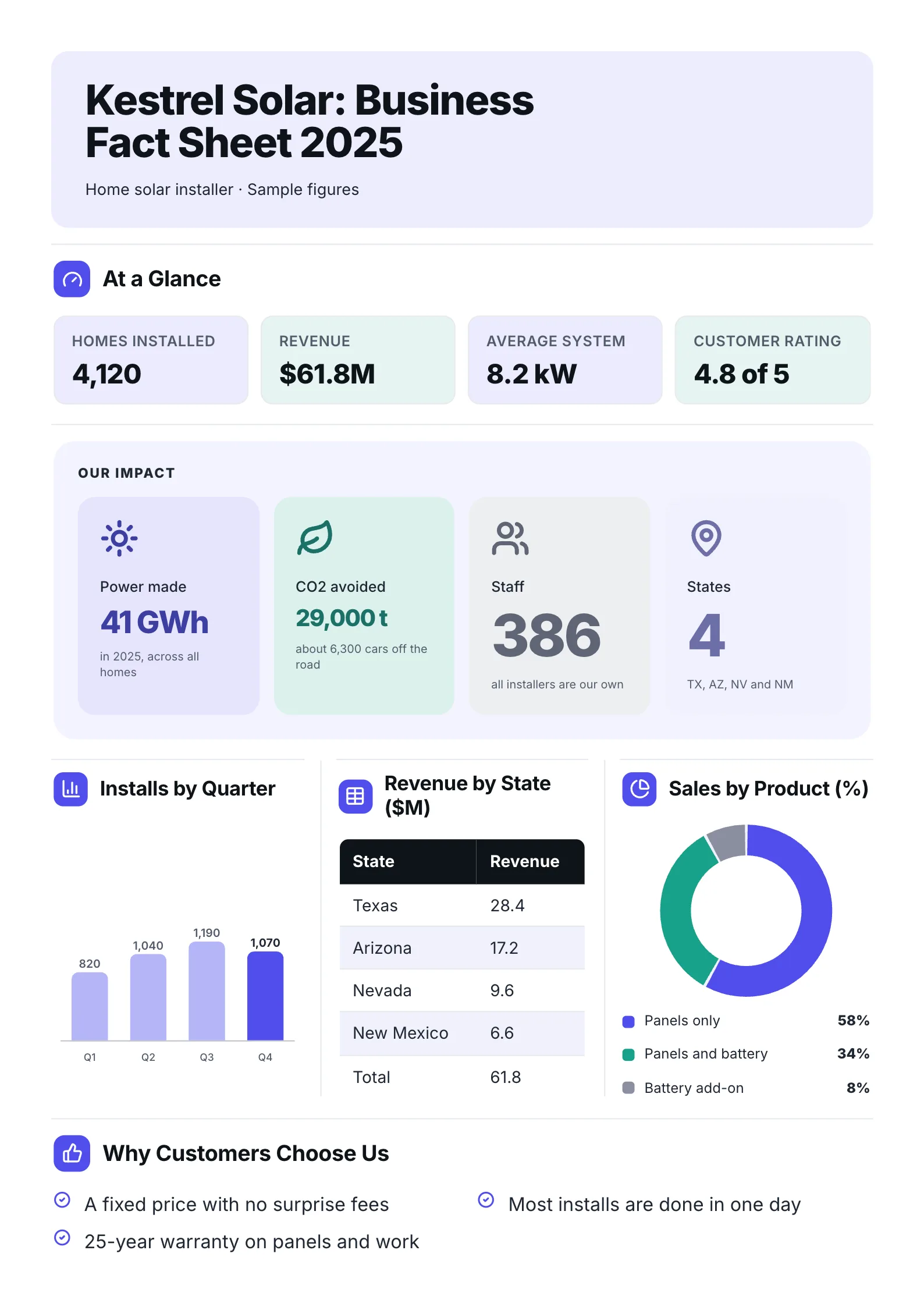
Kestrel Solar opens with four numbers anyone can understand: 4,120 homes installed, $61.8M in revenue, an 8.2 kW average system and a 4.8 out of 5 rating. Then it shows its impact, installs by quarter and revenue by state, and closes with three reasons customers pick it. There's no ask, because a fact sheet is for readers you haven't met yet. Hand it out at events or put it on your About page. Edit this business fact sheet.
2. Business summary: for an investor
 Edit this template
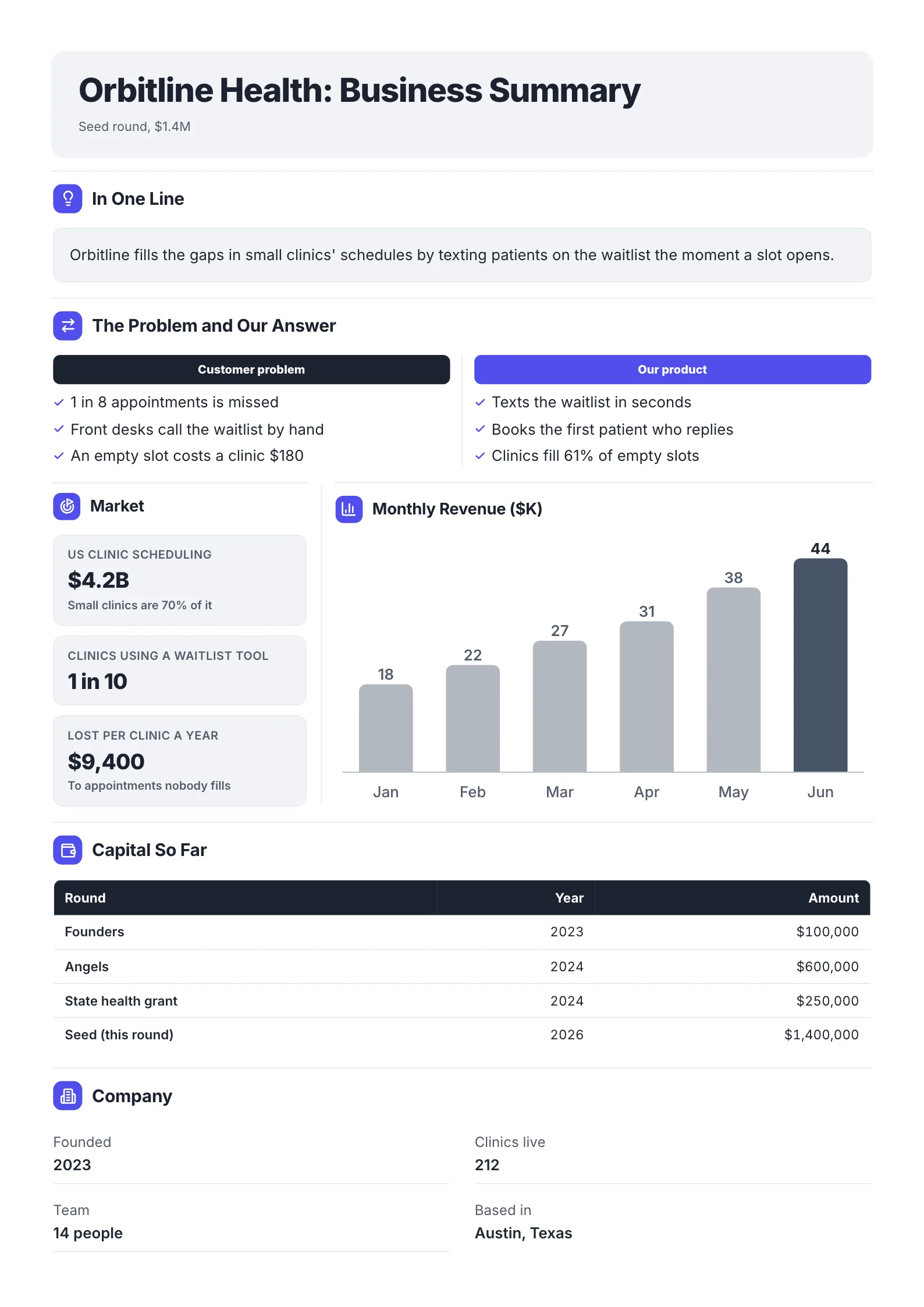
Orbitline Health is raising a $1.4M seed round, and the subtitle says so straight away. Its "In One Line" box explains the product in one sentence. Next come the customer's problem and the product side by side, its market and a revenue chart that climbs from $18K in January to $44K in June. The capital table shows every round so far, so the investor doesn't have to ask. Edit this business summary, or read more on this reader in our investor one-pager guide.
3. Business proposal: for a client
 Edit this template
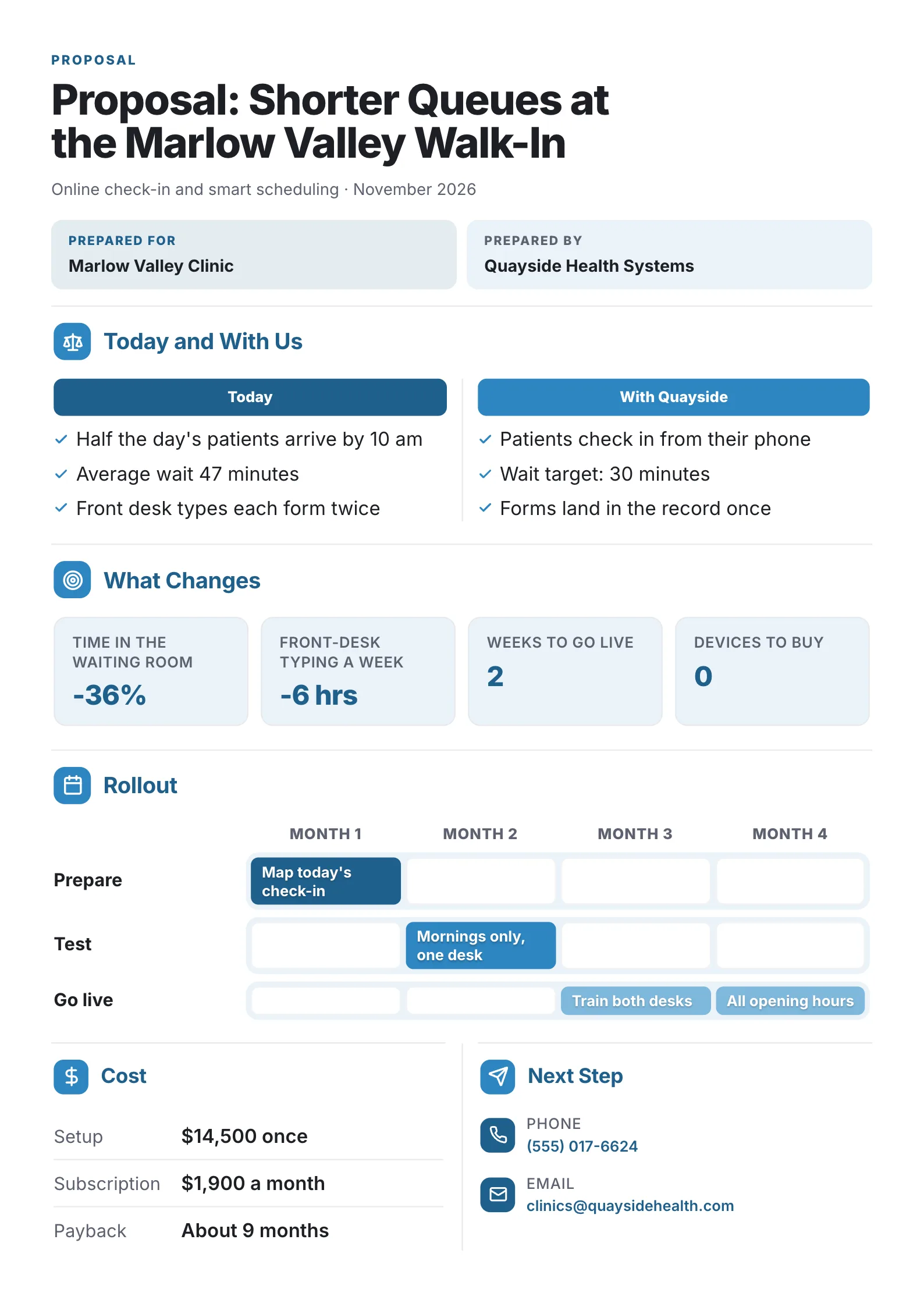
A client doesn't care about your funding. They care about their own problem. Quayside's proposal puts the clinic's day today beside the day with Quayside: a 47-minute wait now, a 30-minute target later. Then it lists four changes, a four-month rollout and the full cost: $14,500 to set up and $1,900 a month, $37,300 in year one. The last box lists a phone line and an email address, so the next step is easy. Edit this business proposal. For the full version, see our business proposal template guide.
4. Business plan summary: for a lender or partner
 Edit this template
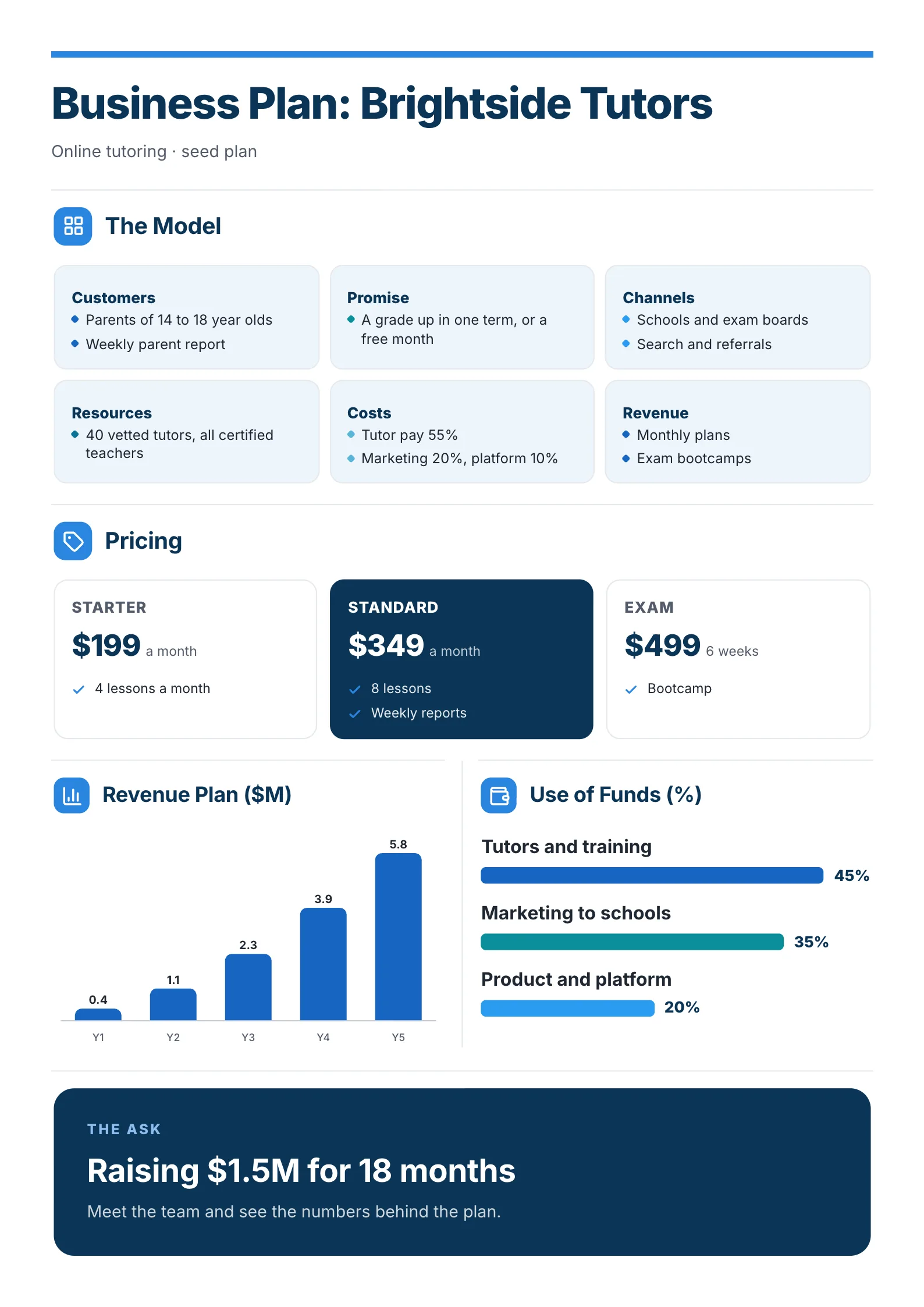
Brightside Tutors fits its business model into six boxes: customers, promise, channels, resources, costs and revenue. That's close to the SBA's lean plan, which lists nine parts, including customer segments, channels, cost structure and revenue streams. Below sit the three price plans, a five-year revenue plan and a use of funds bar for every dollar. The ask in the dark box at the foot is $1.5M for 18 months. Edit this business plan summary. The one-page business plan post goes deeper on this format.
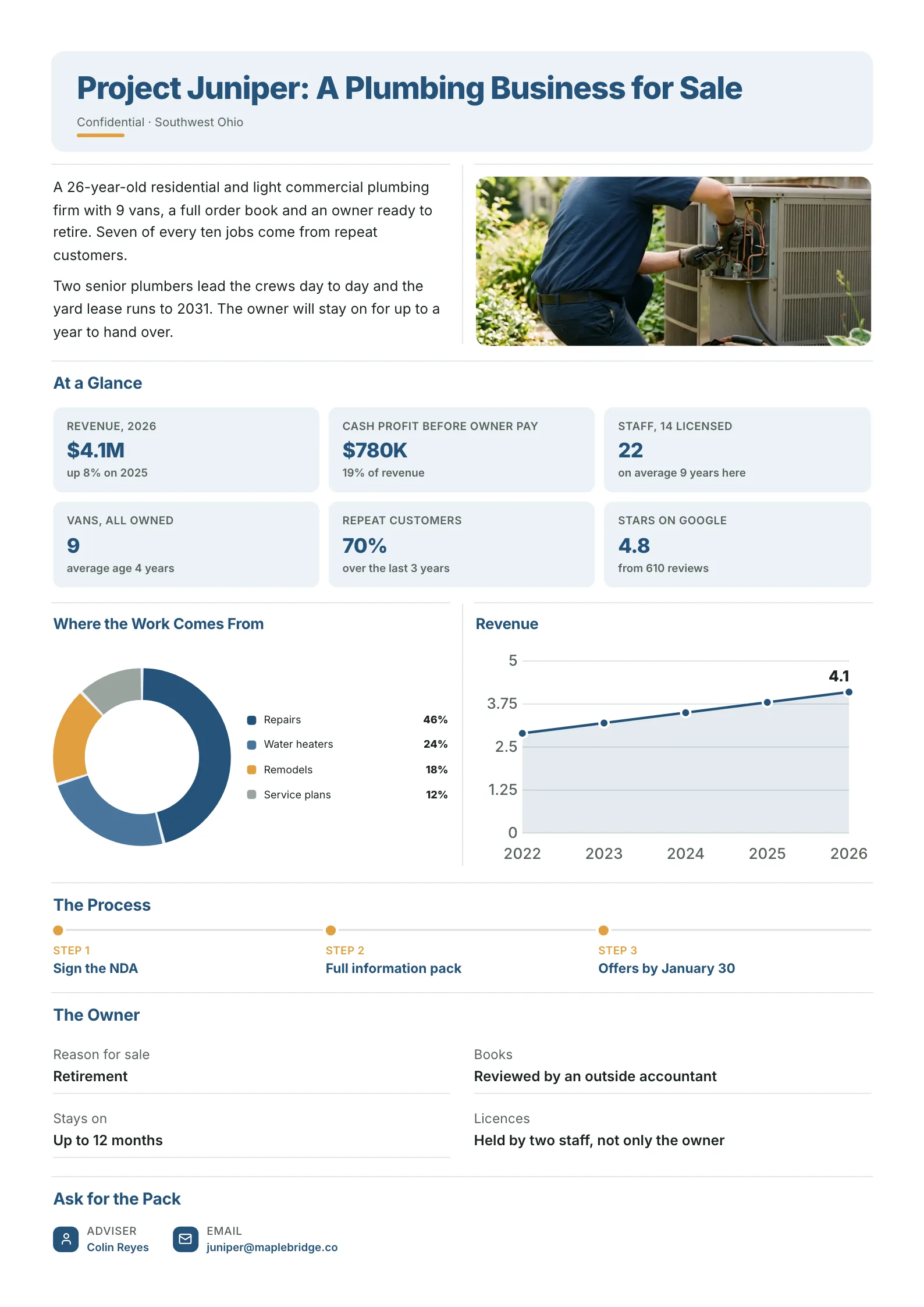
5. Business for sale teaser: for a buyer
 Edit this template
A buyer wants to know whether the profit will stay when the owner leaves. Project Juniper answers that before anyone asks. It shows $780K of cash profit and 22 staff, 14 of them licensed, on average 9 years in the job, so the licenses don't leave with the owner. The name is a code name, which keeps the business confidential until a buyer signs the NDA in step one. The owner's reason for selling is retirement, and the sheet says so plainly. Edit this business for sale teaser.
How to make a business one-pager in 6 steps
- Pick one reader. Write their name or role at the top of your notes. An investor and a client need different first lines.
- Write the one line. Say what you do and for whom in under 25 words. If you can't, the rest of the sheet won't fix it.
- Choose three or four numbers. Pick the ones your reader would ask for first, and give each one a short label that says what it counts.
- Add one picture of the trend. A small bar or line chart of revenue, customers or installs shows growth faster than a sentence.
- End with one ask. Give one action, one name and one date. "Book a 20-minute call by December 4" is better than "let's connect."
- Read it as the reader. Give it to someone outside the business and ask them to tell you what you do and what you want, in 30 seconds. If they can't, cut words until they can.
You can start from a blank page in Word or Google Docs. Or, to save the design time, open one of the examples above in MakeOnepagers and type over the names, figures and dates.
How long should a business one-pager be?
It should fit on one side of one US Letter or A4 page, at a type size your reader can read without zooming in. The examples in this post hold 119 to 206 words. A typed single-spaced page in 12 pt holds about 600 to 730 words, so a business one-pager carries about a quarter as many and leaves the rest to headings, numbers and charts. For the timing behind those figures, see how long it takes to read one page.
If yours runs much longer than these, you're probably writing for two readers at once. Split it into two sheets.
Business one-pager vs business plan vs pitch deck
| Business one-pager | Business plan | Pitch deck | |
|---|---|---|---|
| Length | 1 page | Can run dozens of pages for a traditional plan, says the SBA | A set of slides |
| When it's used | Before or after a meeting, by email or in print | When a lender or investor asks for detail | In the meeting itself |
| Reader | One reader with one question | Someone checking every assumption | A room you're talking to |
| Ask | One next step | Often a loan or investment | The round or the deal |
Most companies need all three in the end. The one-pager usually comes first, because it decides whether the reader asks for the other two. Read more in one-pager vs pitch deck.
Common mistakes
- Starting with your history. "Founded in 2014" tells a reader nothing about what you do for them. Put it last, in a short row of company facts.
- Numbers with no label. "$4.1M" alone means nothing. "$4.1M revenue, 2026, up 8%" tells the reader everything.
- No price. Clients and buyers look for cost first. If you hide it, they have to ask, and many won't.
- Two asks. "Invest, or partner with us, or try the product" means the reader does none of them.
- A wall of text. If a paragraph runs past four lines, turn it into a list or a number.
Make your business one-pager
MakeOnepagers keeps all five examples, plus the six in the grid below, open for editing. Choose the one written for your reader, swap in your company name, figures and ask, then download it as a PDF or share a link. Have a long business plan already? Paste it into the AI One-Pager generator and you'll get a first draft on one page, built from your own figures. New to One-Pagers? What is a one pager explains the basics.
Frequently asked questions
What should a business one-pager include?
A business one-pager should include what your company does in one line, the problem it solves, what you sell, who buys it, a few numbers that show it works, how you make money, who runs it and one next step that says whom to contact.
How do I create a one-pager for my business?
Pick one reader, write one line about what you do, pick the figures they will ask about and end with one ask. Then lay it out with short headings and a chart, and check it fits on one page. A template saves the design time.
Can ChatGPT make a one-pager?
A chatbot can draft the words and a rough layout, but it can't know your real numbers unless you type them in, and its layout still needs work before a client sees it. Check every figure it writes against your own records before anything goes out. The AI One-Pager generator turns your own notes into a designed One-Pager you can edit.
What are some good examples of one-pagers for a business?
A fact sheet for anyone who asks, a business summary for investors, a proposal for a client, a business plan summary for a lender or partner and a teaser for a buyer. All five are pictured above, and each one leads with what its reader checks first.
Is a business one-pager the same as a company profile?
They overlap. A company profile describes who you are for anyone, much like the fact sheet above. A business one-pager is usually written for one reader and ends with an ask. See our company profile one-pager guide for the profile version.




