Investor One Pager: Free Template and 12 Examples
A free investor one pager template, the 8 parts investors look for, 12 examples from a seed pitch to a down quarter update, and who you may send it to.

An investor one pager is a single sheet that tells an investor what your company does, the proof that it is working, how much you are raising and what the money will buy. You send it before the first meeting, so an investor can decide in two or three minutes whether to take the call. A second kind goes to people who have already invested: the investor update, sent every month or quarter. Below you'll find the 8 parts every investor one pager needs, a template you can copy, 12 worked examples of both kinds and the US rules on who you may send it to. Start from a free one pager template.
One‑Pager examples
Real One-Pagers made with MakeOnepagers. Open any one to edit it as your own.
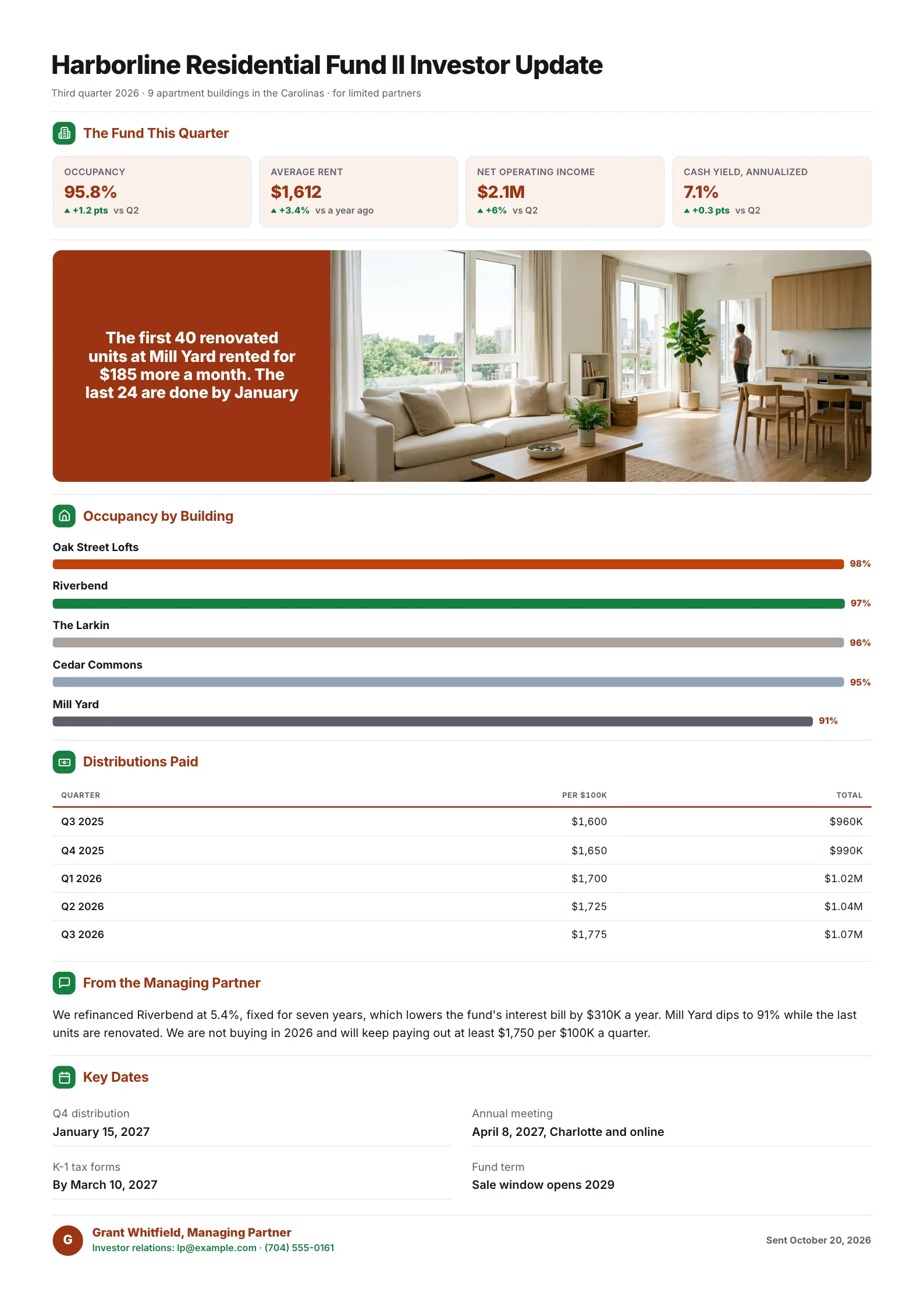 Investor Update: Real Estate FundEdit for free(opens in a new tab)
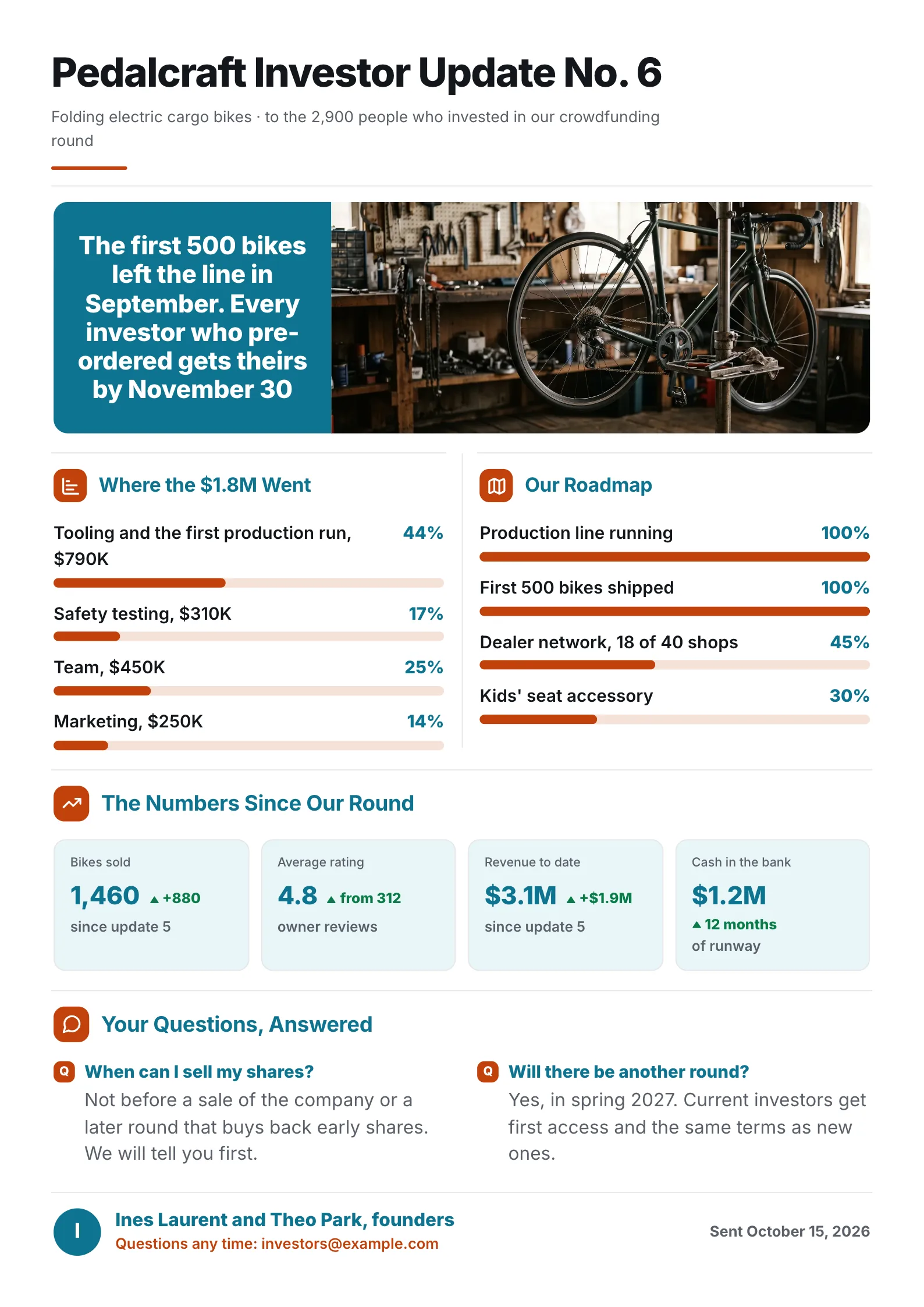 Investor Update: Crowdfunding InvestorsEdit for free(opens in a new tab)
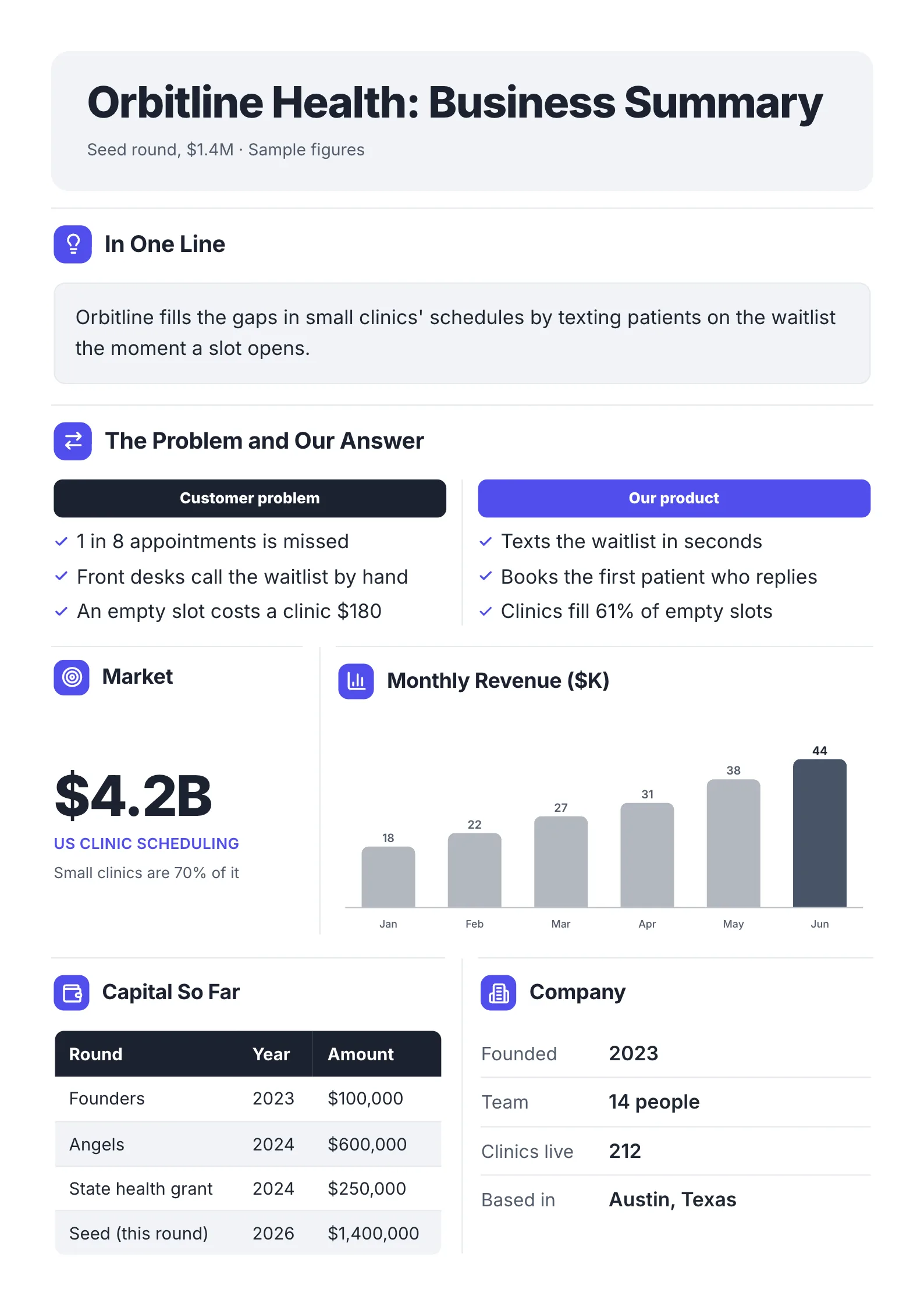 Business Summary for InvestorsEdit for free(opens in a new tab)
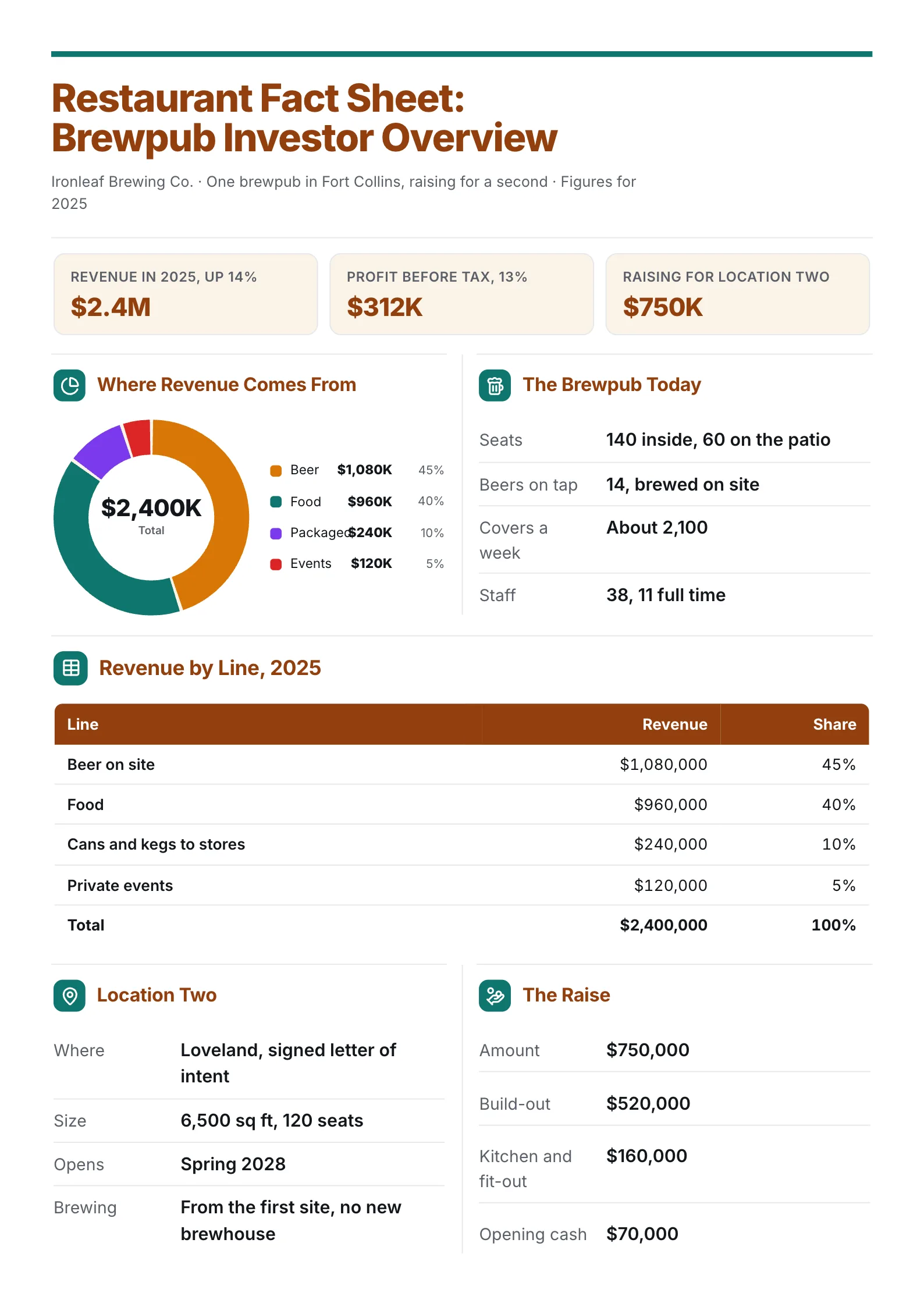 Restaurant Fact Sheet: Brewpub Investor OverviewEdit for free(opens in a new tab)
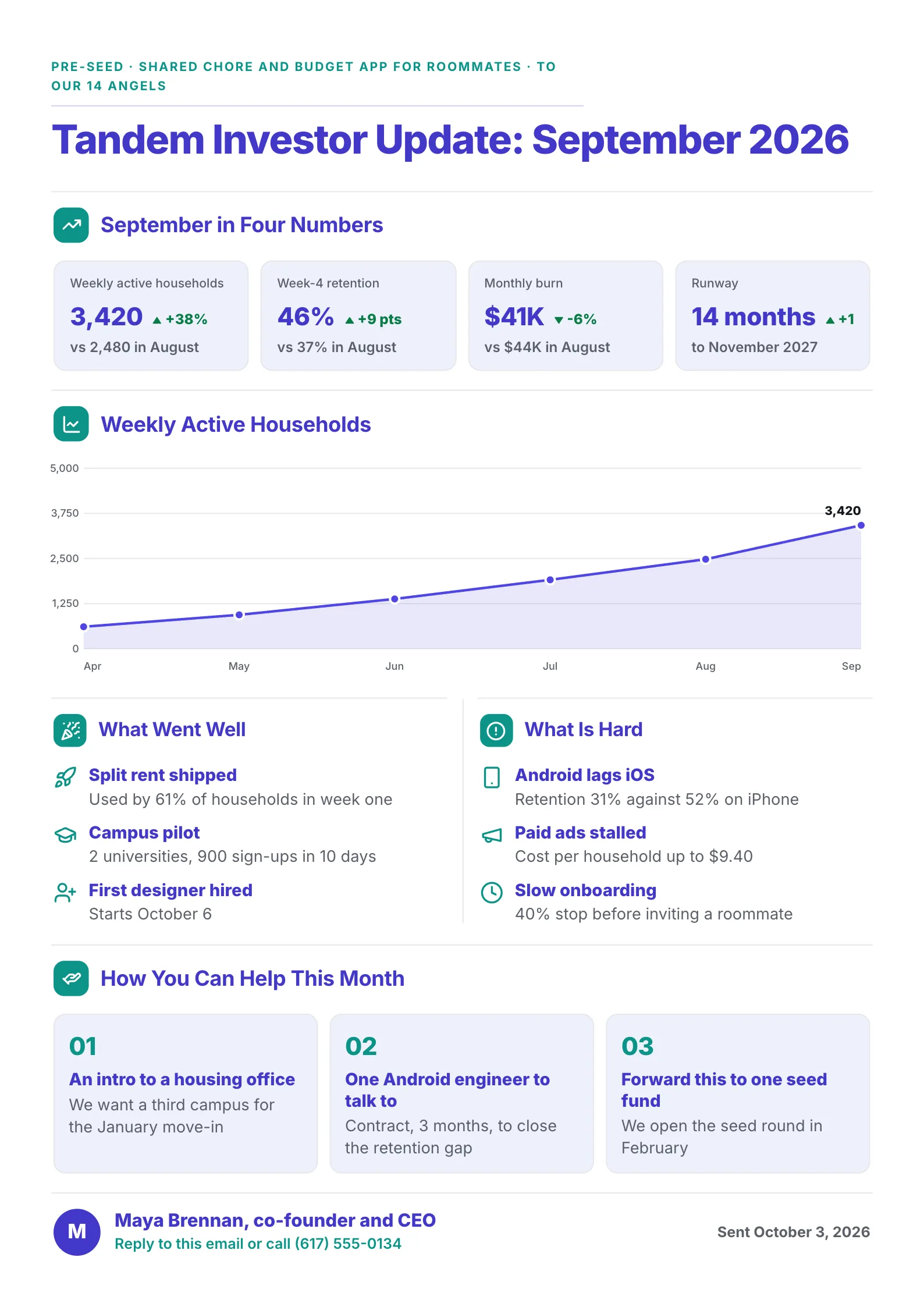 Investor Update: Pre-Seed MonthlyEdit for free(opens in a new tab)
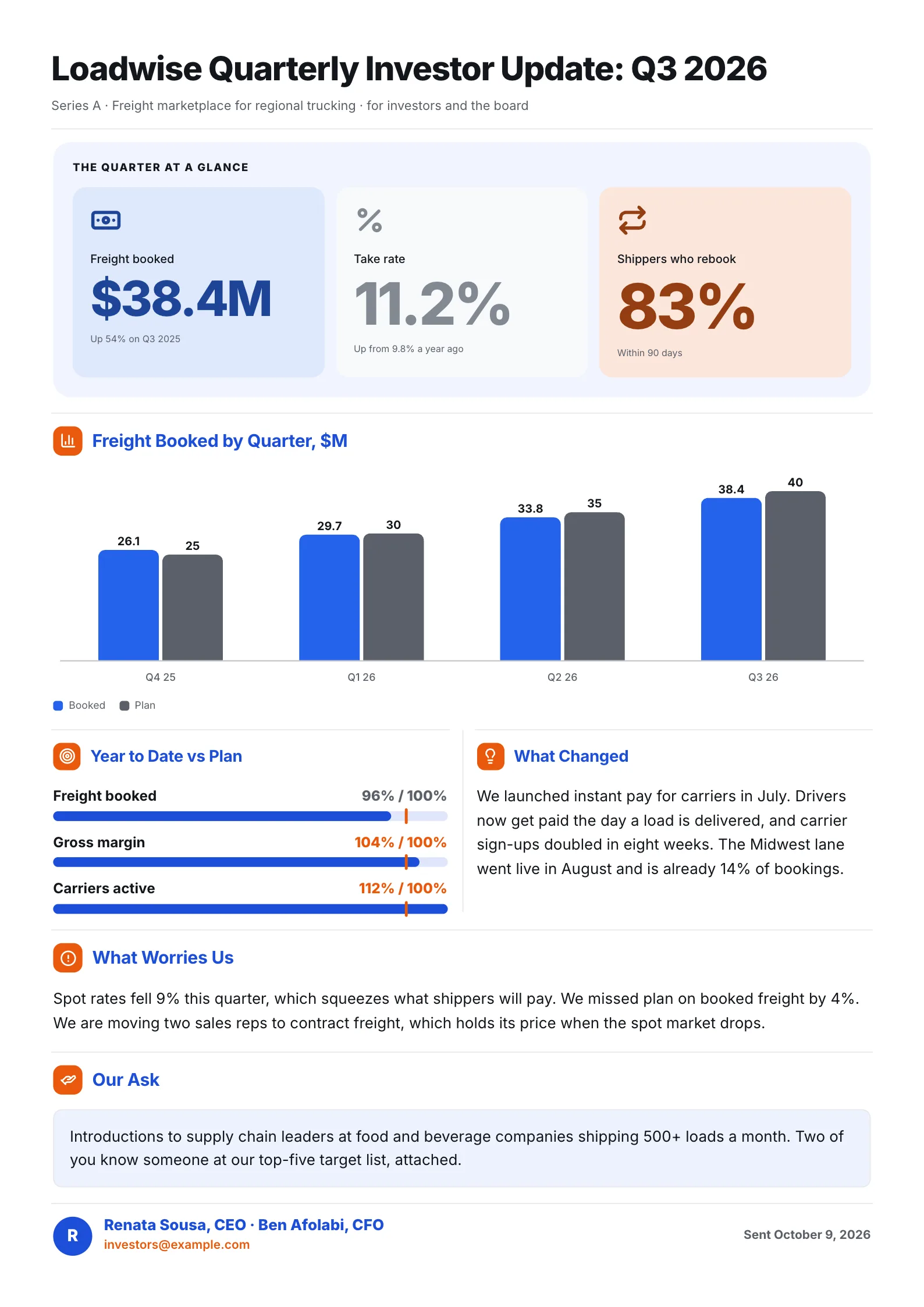 Investor Update: Series A QuarterlyEdit for free(opens in a new tab)
Every example was made with MakeOnepagers. Each one opens as a template you can edit for free, down to the last number.
What is an investor one pager?
An investor one pager is the shortest document in a raise. It sits before the pitch deck and the data room. An angel or a partner at a fund reads it, then either books a meeting or asks for the deck.
It is also called an investor one sheet, a teaser or a business summary for investors. The names differ and the job stays the same. You give a busy reader enough to say yes to the next step, and nothing they have to work out for themselves. It's one kind of business one-pager, the version that leads with the market and the round.
There are two kinds, and they answer different questions.
| Pitch one pager | Investor update | |
|---|---|---|
| Who reads it | People who have not invested yet | People who already own a share |
| When you send it | Before the first meeting | Every month or quarter |
| The question it answers | Should I take this meeting? | How is my money doing? |
| What leads | The idea and the raise | The numbers since last time |
| What it asks for | A call or a meeting | Introductions, hires, advice |
If you are writing for new investors, read on. If your readers already invested, skip to the update examples below or read our full investor update template guide. A pitch one pager is also not a short pitch deck. We compare the two side by side in one pager vs pitch deck.
What we measured on 20 investor One-Pagers
We read every investor One-Pager in our own library on 22 October 2026 and counted the words and the numbers on each page. Six are pitch One-Pagers and fourteen are investor updates.
| Pitch one pagers (6) | Investor updates (14) | |
|---|---|---|
| Words on the page | 154 to 226, median 194 | 155 to 284, median 224 |
| Numbers on the page | 10 to 31, median 15 | 18 to 57, median 27 |
| Raise stated in the top line | 6 of 6 | Not needed |
Three things stand out. A pitch one pager carries about 200 words, which fits in the time an investor gives a cold email. The raise sits at the top on every one, next to the name, so nobody has to hunt for it. And an update holds almost twice as many numbers as a pitch, because the people reading it want to see the business move.
If your draft runs past 300 words, cut the adjectives first. Then cut any paragraph that a number could replace.
The 8 parts of an investor one pager
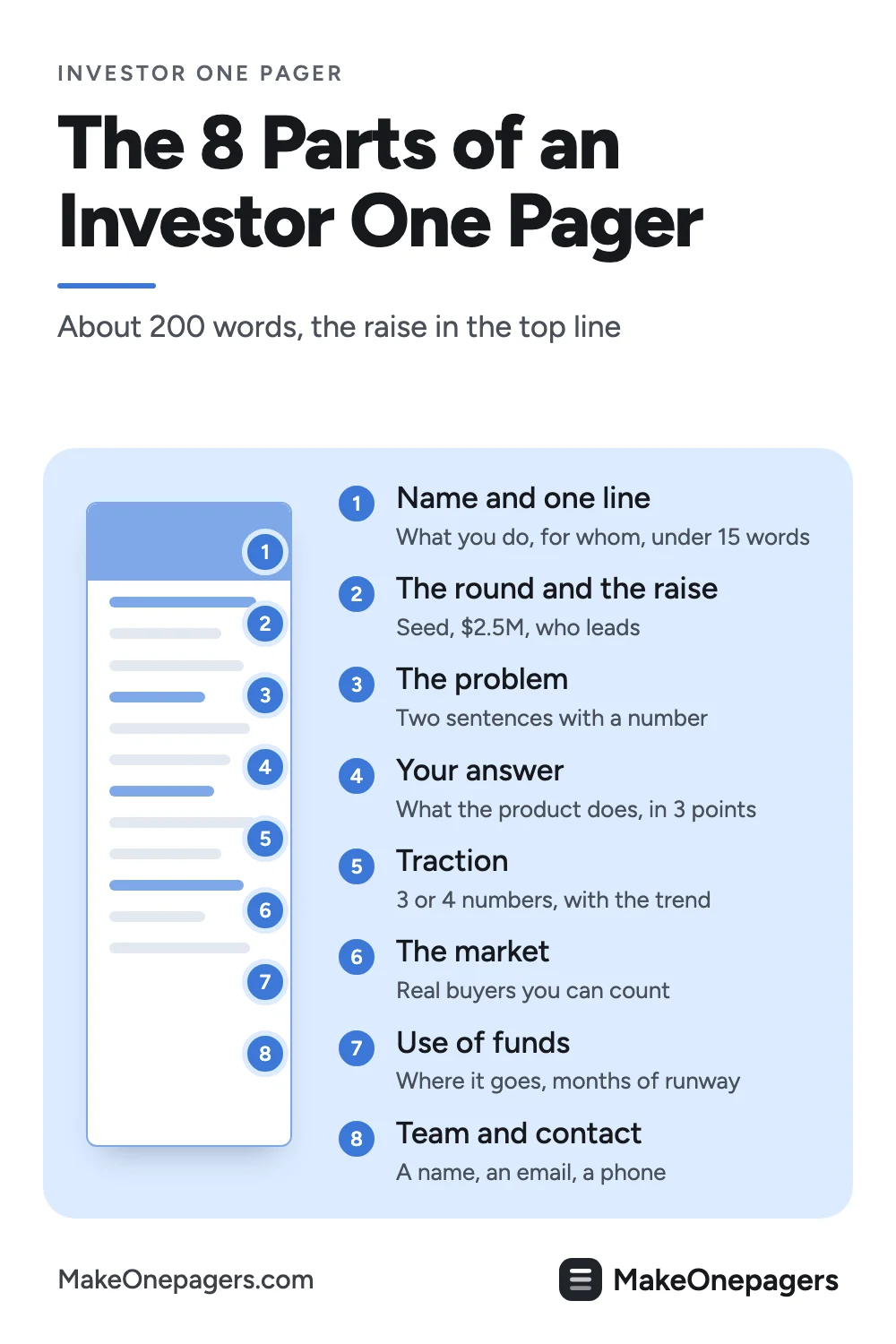
Most investor one pagers use the same eight parts, in roughly this order. Make the top three readable from across a desk.
- Company name and one line. What you do, for whom, in under 15 words. "Payroll and tip pooling for restaurants" works. "Reimagining the future of work" does not.
- The round and the raise. Pre-seed, seed or Series A, and the amount. Add what is already committed and who leads, if anyone.
- The problem. One or two sentences with a number in them. "Restaurants split tips by hand in spreadsheets every week" is clear and checkable.
- Your answer. What the product does, in the customer's words. Three short points beat one long paragraph.
- Traction. Revenue, growth rate, customers, retention or a signed pilot. Pick the three or four numbers your stage is judged on and show the trend.
- The market. Who buys and how many of them there are. Keep it honest; a bottom-up count of real buyers reads better than a huge top-down figure.
- Use of funds and the terms. Where the money goes, how many months of runway it buys and the milestone it reaches.
- Team and contact. The founders, one line on why they can win, an email address and a phone number.
Add a chart when it shows your trend, such as monthly revenue climbing. A logo wall helps only when the logos are real customers who agreed to be named.
A free investor one pager template
Copy this into any document, or open one of the examples below and edit it.
| Field | What to write, with an example |
|---|---|
| Company and one line | Fernleaf: payroll and tip pooling for restaurants |
| Round and raise | Raising a $2.5M seed, $1.1M committed |
| The problem | Managers lose 4 hours a week splitting tips by hand |
| What you do | Tips split by hours or role, paid out the same day |
| Traction | $46K monthly revenue, up 18% a month for 9 months, 3% churn |
| Chart | Monthly revenue for the last 6 to 12 months |
| Market | Number of real buyers and what each one pays a year |
| Use of funds | Engineering, sales, operations and a reserve, with rough shares |
| Runway and milestone | 24 months, to $150K monthly revenue by end of 2027 |
| Team | Founders with one line each |
| Contact | Name, email, phone, and "deck on request" |
Keep your fonts large and your margins wide. Investors often open the file on a phone first, so test it at phone size before you send it.
12 investor one pager examples
The first four are pitch One-Pagers for investors you have not met. The next two are updates for people who already invested. Six more sit in the gallery at the end of this post.
1. Seed pitch with use of funds
 Edit this template
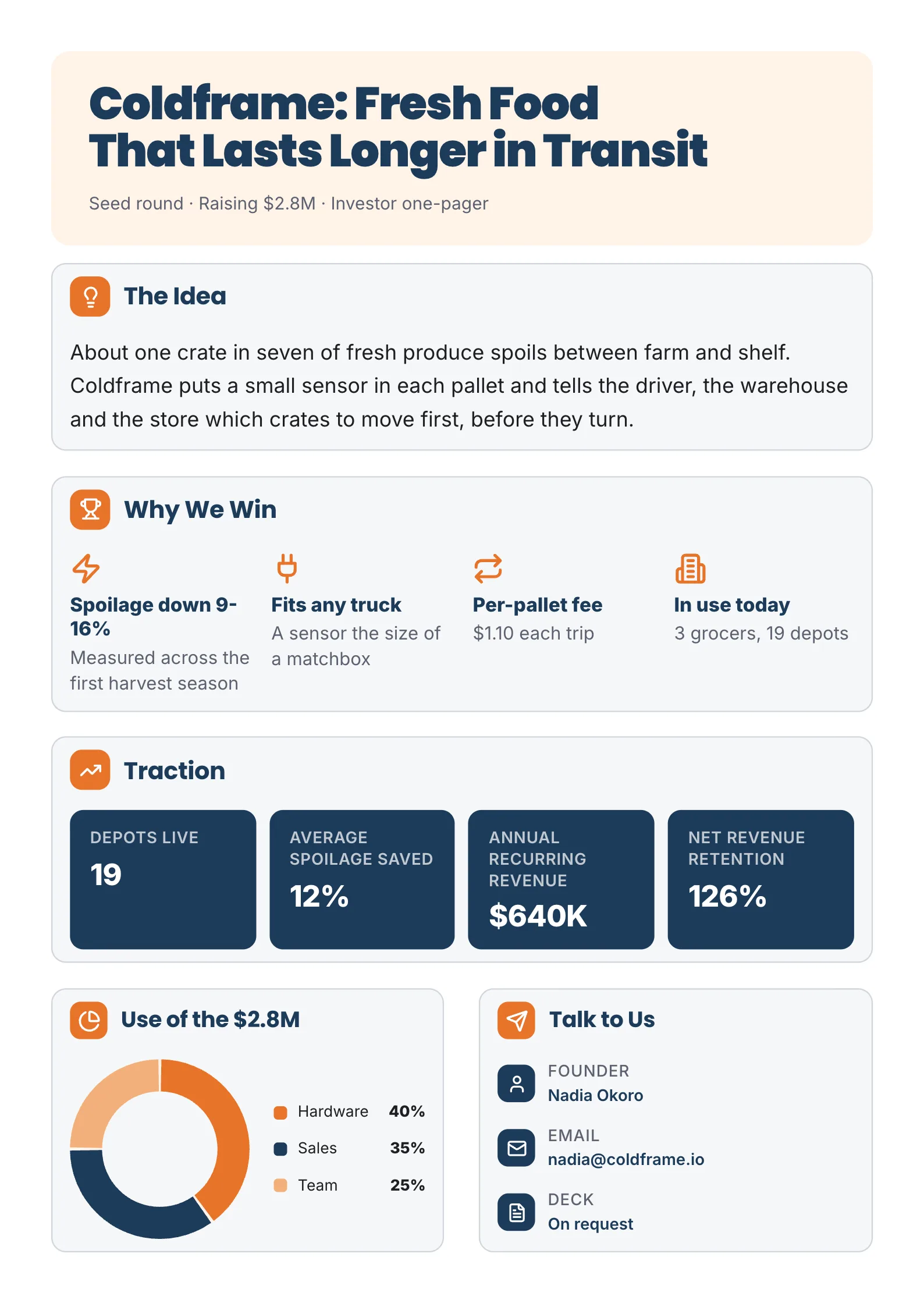
Coldframe opens with the raise, $2.8M, right under its name. The idea takes two sentences, and the second one names the three people the product helps: the driver, the warehouse and the store.
Look at how "Why We Win" works. Each reason is a number or a fact: spoilage down 9 to 16%, a sensor the size of a matchbox, $1.10 a trip. The donut chart answers the question every investor asks next, which is where the money goes.
You can edit this investor pitch one pager template for free.
2. Seed round summary with the terms
 Edit this template
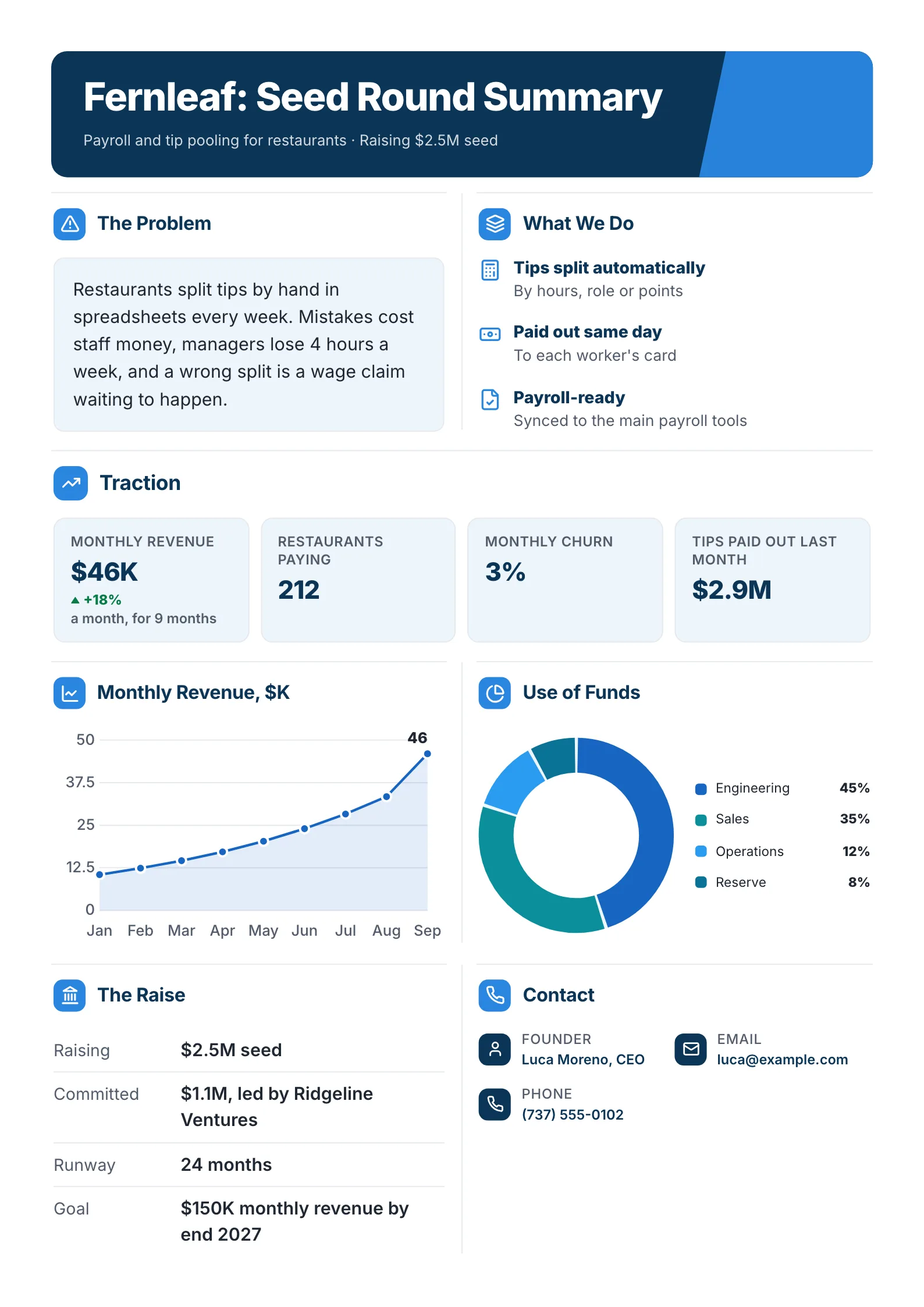
Fernleaf puts the terms in their own box: the amount, what is already committed and who leads, 24 months of runway and the goal the money reaches. That box is what a second investor reads first, because a lead investor makes the decision easier.
The problem ends with a line that raises the stakes: a wrong tip split is a wage claim waiting to happen. You can do the same with a cost, a fine or a lost customer.
You can edit this seed round investor one pager template for free.
3. Investor snapshot
 Edit this template
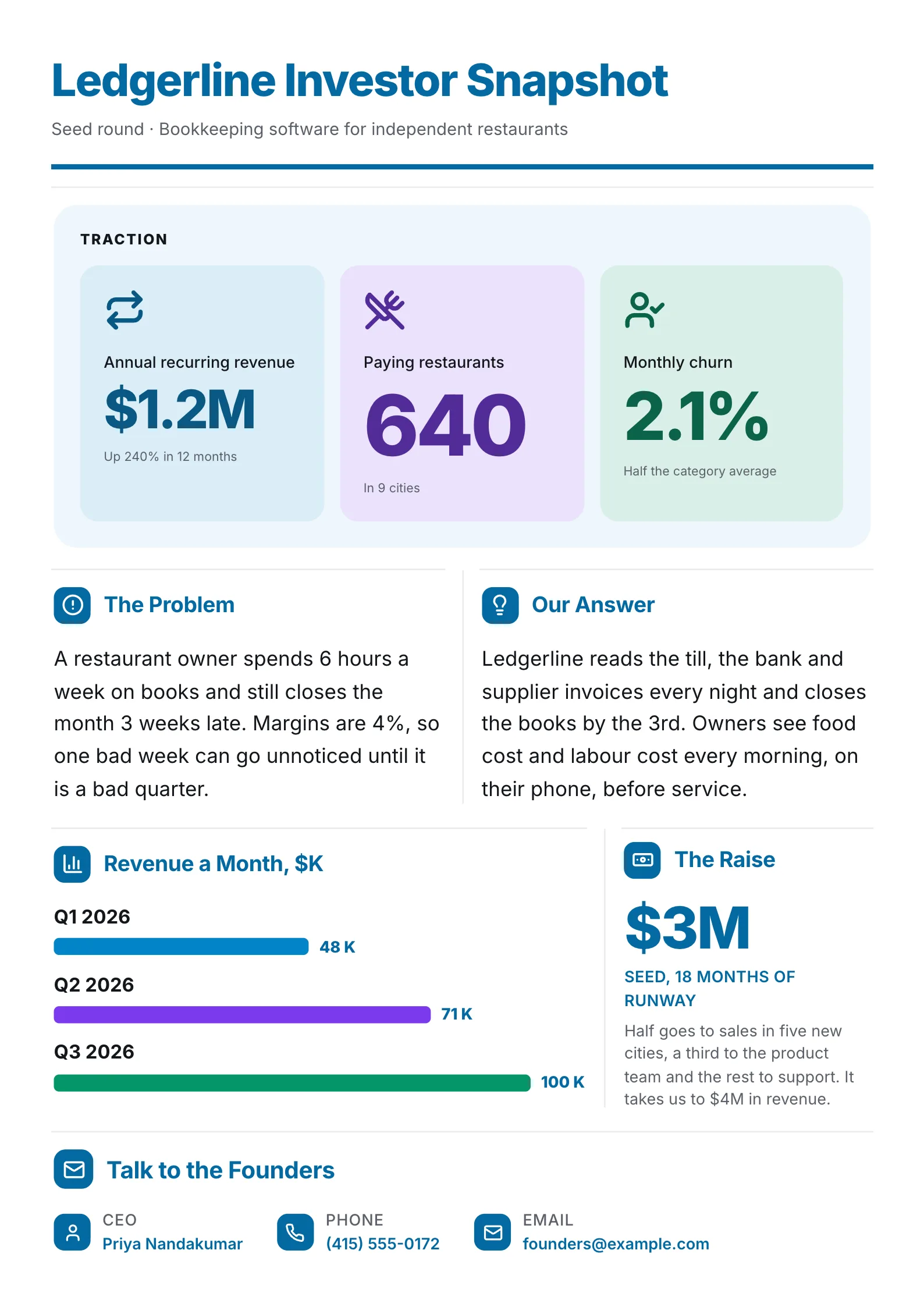
Ledgerline leads with traction instead of the idea. When your numbers are strong, this order works better: $1.2M in recurring revenue, up 240% in a year, with churn at half the category average.
The raise section says what each share of the $3M buys. Half goes to sales in five new cities and a third to the product team. Then it names the result: $4M in revenue.
You can edit this investor snapshot template for free.
4. Company overview for investors
 Edit this template
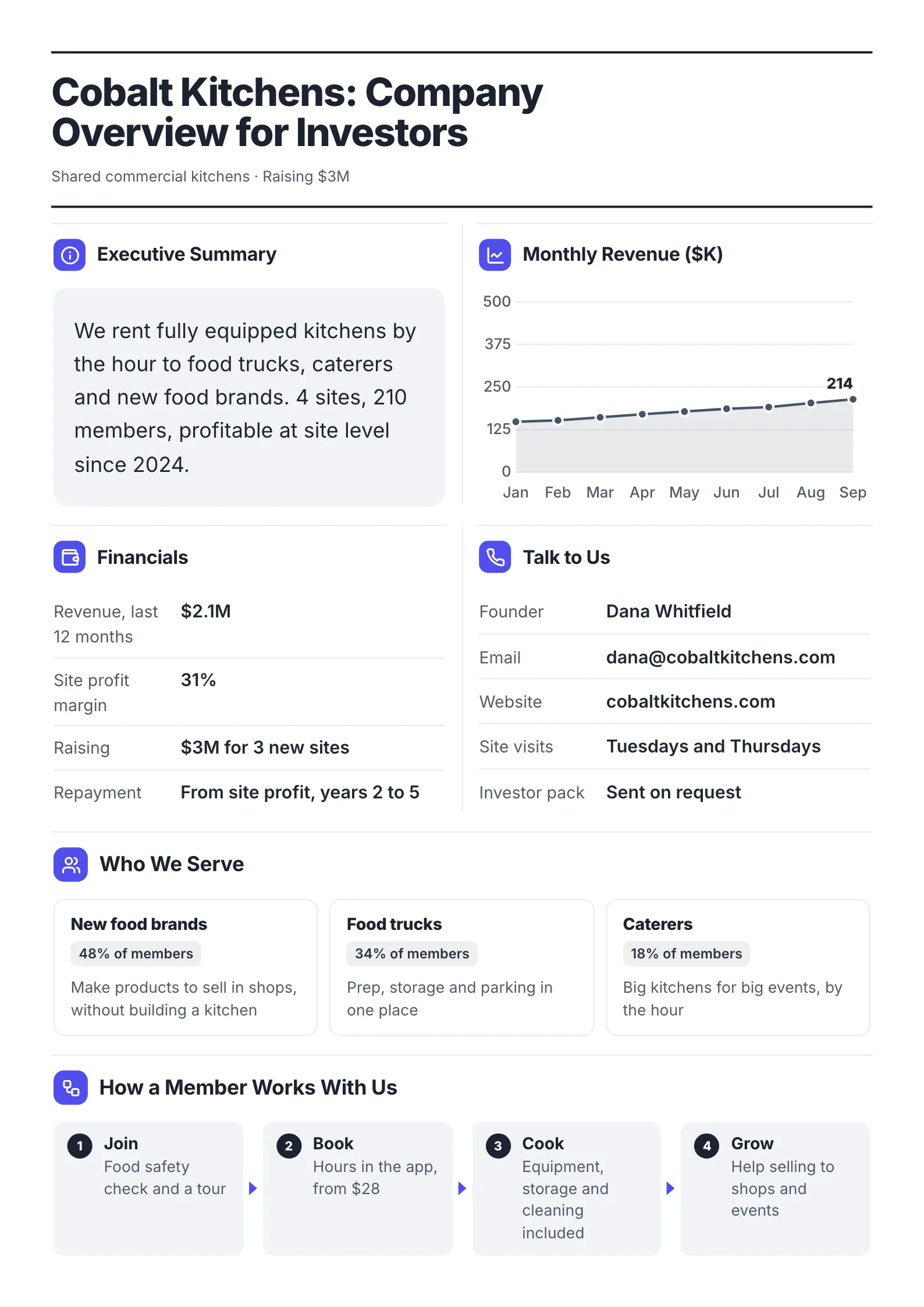
Cobalt Kitchens is a profitable business with sites, members and a margin, so its one pager reads more like a company profile with a raise on top. The "Who We Serve" row splits members into three groups with their share of the total.
This shape suits a real business raising from private investors, such as a restaurant group, a clinic or a property company. It even states how investors get paid back: from site profit, in years 2 to 5.
You can edit this company overview for investors template for free.
5. Quarterly investor update
 Edit this template
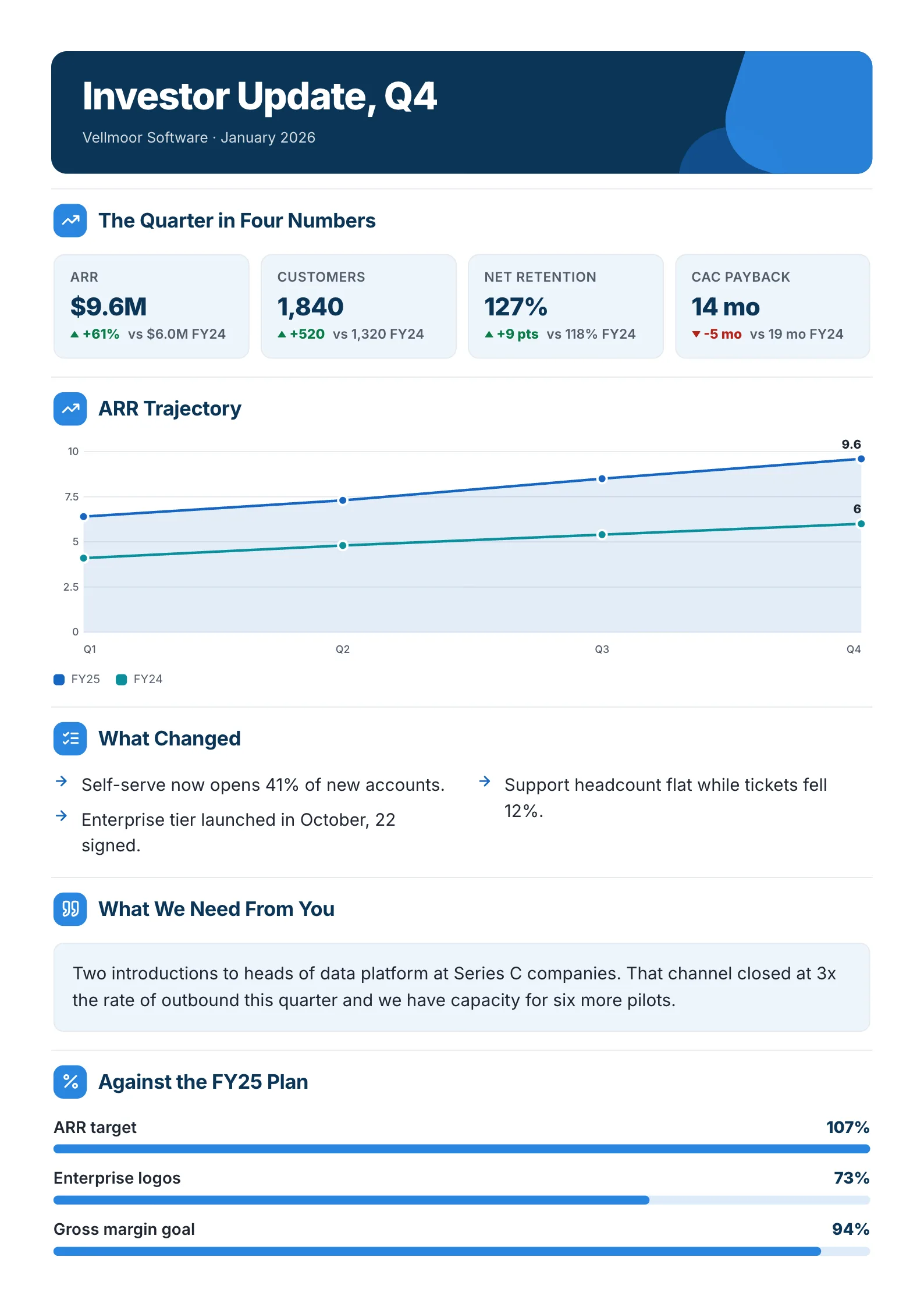
Once someone has invested, the one pager flips. Vellmoor opens with four numbers, each compared with the year before, so a reader sees the change without doing any maths.
The best part is "What We Need From You". It asks for two introductions to a named kind of buyer, and it says why: that channel closed at three times the rate of cold outreach. A specific ask gets a specific answer.
You can edit this investor update template for free.
6. Down quarter investor update
 Edit this template
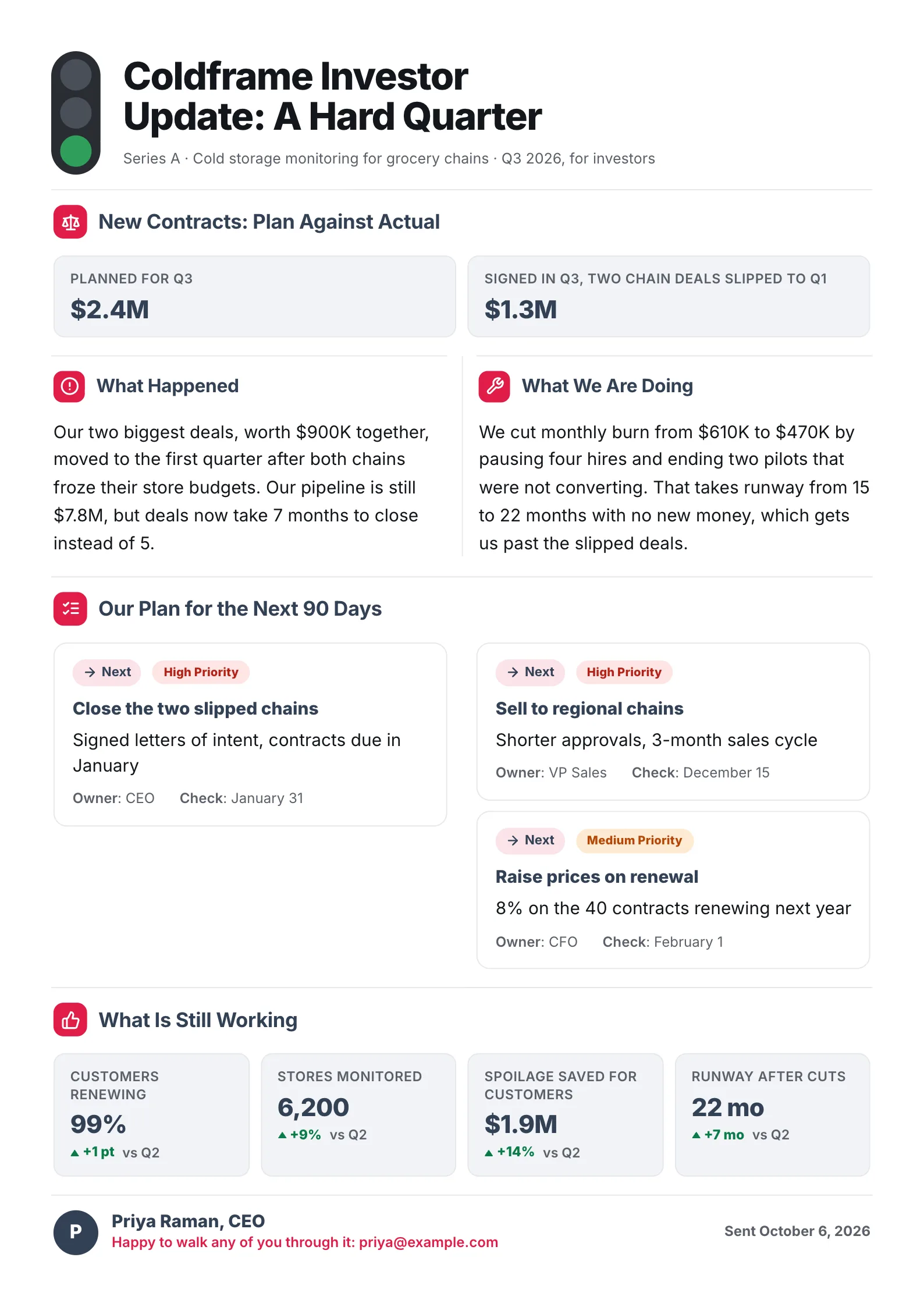
Every company has a bad quarter. This one says so in its title, then shows the plan next to the actual: $2.4M planned, $1.3M signed. It explains the two deals that slipped, what was cut and how long the money now lasts.
Investors forgive a miss far more easily than a surprise. A short, honest update like this one keeps your next raise easier.
You can edit this down quarter investor update template for free.
7 to 12. Six more in the gallery below
The gallery at the end of this post holds six more, each one ready to edit:
- Business summary for investors: Orbitline Health, a $1.4M seed, built around one line and a market box.
- Brewpub investor overview: a single brewpub raising $750K for a second site, with revenue split by beer, food and events.
- Pre-seed monthly update: a roommate app writing to its 14 angels, with weekly active households and runway.
- Series A quarterly update: a freight marketplace with freight booked, take rate and results against plan.
- Crowdfunding update: a bike maker showing 2,900 investors where their $1.8M went.
- Real estate fund update: occupancy, rent and cash yield for limited partners in an apartment fund.
Who you can send an investor one pager to (US rules)
In the US, a one pager that asks for investment is part of a securities offering, so the rules on who may see it apply to it. Most startup rounds rely on Rule 506 of Regulation D. We read the SEC's own pages on 22 October 2026, and this is general information, never legal advice.
| Rule 506(b) | Rule 506(c) | |
|---|---|---|
| Can you post it publicly or advertise? | No general solicitation or advertising | Yes |
| Who can invest | Unlimited accredited investors, plus up to 35 non-accredited in any 90 days | Accredited investors only |
| Your extra step | Non-accredited buyers must be financially sophisticated | Take reasonable steps to verify each buyer is accredited |
| Paperwork | Form D notice | Form D within 15 days of the first sale |
The SEC's accredited investor test for a person is a net worth over $1 million, not counting their main home, or income over $200,000 a year ($300,000 with a spouse or partner) in each of the last two years.
What this means for your one pager: under 506(b), send it only to people you already know or who reach you through someone you know. Don't post it on social media or a public page. Under 506(c) you can share it widely, but every buyer has to be checked. Ask a securities lawyer which one your round uses before the one pager leaves your inbox. Sources: SEC, Private placements, Rule 506(b), General solicitation, Rule 506(c) and Accredited investors.
How to write an investor one pager in 6 steps
- Start from your deck. Take its title, problem, product, traction, raise and team slides. That gives you six of the eight parts.
- Write the one line last. Once the rest is written, you'll know which 15 words matter most.
- Pick three or four numbers. Choose the ones investors judge at your stage. At pre-seed that might be a waitlist or pilots. At Series A it is revenue growth and retention.
- Add one chart. Monthly revenue, users or orders, drawn over 6 to 12 months.
- Put the raise near the top and the contact at the bottom. A reader should never scroll to find either.
- Read it on a phone. If a number is too small to read at phone size, make it bigger or cut something else.
Already have the deck, notes or a business plan? Drop them into the free AI One-Pager generator and get them back as a designed investor one pager to check and send.
Investor one pager mistakes
- No amount. "We are raising a seed round" leaves the investor guessing. Write the figure.
- A market slide in miniature. One giant number with no source tells a reader nothing. Count real buyers instead.
- Every metric you track. Fifteen numbers hide the three that matter.
- Adjectives in place of proof. "Fast-growing" means nothing beside "up 18% a month for 9 months".
- No contact. It sounds obvious, and it still happens. Put a name, an email and a phone number at the bottom.
- Posting it publicly during a 506(b) round. See the rules above.
Make your investor one pager
Open the free investor one pager template and swap in your own company, or drop your deck into the free AI One-Pager generator and get a finished investor one pager back. You can browse every design in MakeOnepagers too.
Frequently asked questions
What should an investor one pager include?
The company name and one line, the round and the amount you are raising, the problem, your product, three or four traction numbers, the market, the use of funds and runway, and the team with a contact.
How long should an investor one pager be?
One page, and usually about 200 words. The pitch One-Pagers we measured ran from 154 to 226 words. Numbers and short points do most of the work.
Is an investor one pager the same as an executive summary?
They overlap. An executive summary one pager can be written for any reader, such as a board or a buyer. An investor one pager is written for someone deciding whether to invest, so it always states the raise and the use of funds.
Should I send the one pager or the pitch deck first?
The one pager usually goes first, attached to the intro email. Offer the deck on request. That way you learn who is interested before you share the longer document.
What is the difference between a startup one pager and an investor one pager?
A startup one pager can be for anyone: customers, partners, new hires or investors. An investor one pager is the version written only for investors, with the raise, the terms and the numbers they judge.




