Guide
Startup One‑Pager: What to Include for Investors (Template and Example)
A startup one-pager tells an investor what you do, why now and what you are raising, on one sheet. The 9 sections to include, plus a template.
Updated · 6 min read
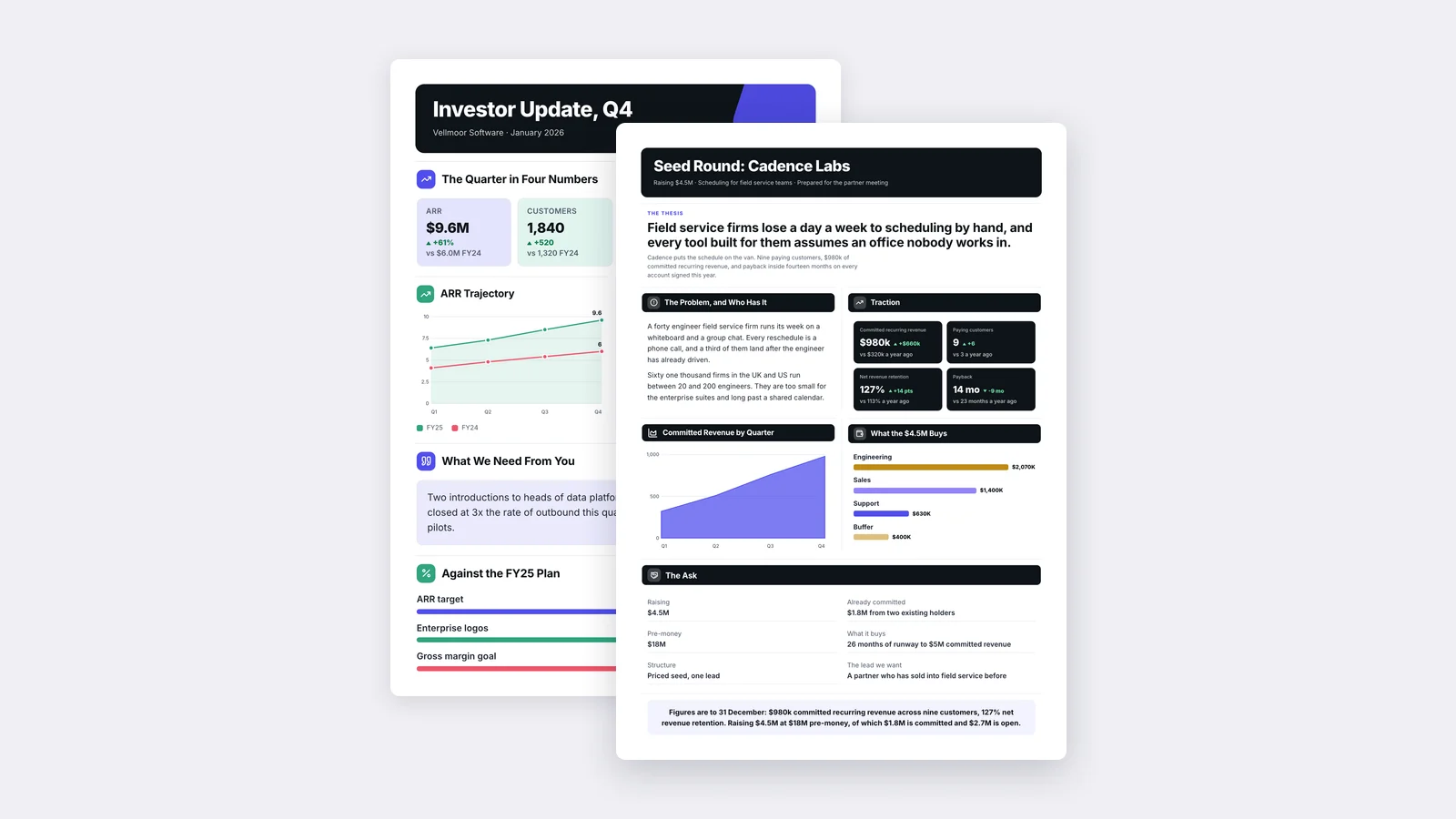
A startup one-pager is a single sheet that tells an investor what your company does, why it will win, and what you are raising, so they can decide whether to take a meeting. It usually covers nine things: the problem, your solution, the market, traction, the business model, the team, the competition, the raise, and how to reach you.
Its job is narrow. It does not close the round. It earns the next conversation. This guide covers what goes in each section, a fill-in template, a worked example, and the mistakes that get a startup One-Pager skipped.
When you need a startup One-Pager
Investors see far more companies than they can meet, so the first thing they read has to be quick. A startup One-Pager is the document you send when:
- Someone offers a warm introduction and asks for "something short to forward".
- You are emailing an investor cold and a 20-slide deck is too much to ask for.
- You meet someone at an event and want a leave-behind that prints cleanly.
- An accelerator or angel group asks for a summary before the application.
In each case the reader gives it a couple of minutes. If they want more, they will ask for the deck.
The 9 sections of a startup One-Pager
1. Company name and one-line description
Say what you do in one sentence a stranger understands. "We help small clinics fill cancelled appointments within the hour" beats "an AI-powered healthcare scheduling platform". Add your logo, website and stage (pre-seed, seed, Series A).
2. The problem
Who has the problem, how often, and what it costs them. Use a number when you have one, and say where it came from. A problem stated with a cost the investor can check is worth more than a big market claim.
3. Your solution
What you built and how it solves the problem, in two or three lines. Describe what the customer gets, not your technology stack.
4. Market
How many customers could buy this and what they would pay. Investors are used to seeing TAM, SAM and SOM. A bottom-up estimate (number of target customers times what each would pay you) is more believable than a top-down share of an industry report.
5. Traction
The strongest section if you have it. Revenue, growth rate, paying customers, pilots, retention, a waitlist. Give each number its comparison: "$42k monthly revenue, up from $18k six months ago" tells a story; "$42k monthly revenue" alone does not.
6. Business model
How you make money and roughly what one customer is worth. Pricing, average contract value, and gross margin if you know it.
7. Team
Founders and key people, each with the one fact that shows why they can build this: the relevant job, the previous company, the domain expertise. Notable advisors and investors go here too.
8. Competition
Who else solves this problem today, including spreadsheets and doing nothing, and why customers pick you. A short comparison table works well. Claiming "no competitors" makes an investor trust the rest of the sheet less.
9. The raise and contact
How much you are raising, the instrument if it is set (for example a SAFE or priced round), what the money buys in milestones, and how long it lasts. End with a name, email and phone number.
A startup One-Pager template
Copy this outline and fill it in. Each line is a prompt, not a heading to keep.
| Section | What to write | Length |
|---|---|---|
| Header | Name, logo, one-line description, website, stage | 1 line |
| Problem | Who, how often, what it costs them | 2 to 3 lines |
| Solution | What the customer gets | 2 to 3 lines |
| Market | Bottom-up estimate with its maths | 2 lines |
| Traction | 3 to 4 numbers, each with its comparison | 3 to 4 bullets |
| Business model | How you charge, average deal size, margin | 2 lines |
| Team | Each founder plus the fact that qualifies them | 1 line each |
| Competition | 2 to 4 alternatives and why customers pick you | small table |
| The raise | Amount, instrument, use of funds, runway | 2 to 3 lines |
| Contact | Name, email, phone | 1 line |
If you would rather start from a designed layout, our pitch One-Pager template is built around these sections.
An example, section by section
Here is how the sections read for an illustrative company. The company and its numbers are made up to show the shape.
- Header: Refill. Fills cancelled clinic appointments within the hour. Seed.
- Problem: Small clinics lose appointments to late cancellations every week, and each empty slot is revenue they cannot recover.
- Solution: When a patient cancels, Refill texts the waitlist and books the first person who replies.
- Traction: 140 clinics paying, up from 35 a year ago. Monthly revenue $61k. 4% monthly churn.
- Business model: $450 per clinic per month. 82% gross margin.
- Team: CEO ran operations for a 30-clinic group. CTO built scheduling at a large booking company.
- Competition: front-desk staff calling down a list, generic reminder tools. Refill is the only one that rebooks automatically.
- The raise: $3M seed to reach 600 clinics in 18 months.
Notice what is missing: the history of the founders' idea, a product roadmap, a long market essay. Those belong in the deck.
Startup One-Pager vs pitch deck
The One-Pager gets you the meeting; the deck runs it. A deck has room for the product demo, the go-to-market plan and detailed financials. The One-Pager has room for the conclusion of each. We compare the two in detail in One-Pager vs pitch deck.
If you already have a deck, do not write the One-Pager from scratch. Pull the strongest line from each section of the deck and cut the rest. With MakeOnepagers you can upload the deck itself and get a first draft of the One-Pager that keeps the deck's numbers, then edit it down. It is free for 7 days with 3 One-Pagers included.
Mistakes that get a startup One-Pager skipped
- Leading with the vision instead of the business. "Reinventing healthcare" tells the reader nothing. Say what you sell and to whom.
- Numbers without a comparison. Every metric needs its time frame or benchmark.
- A market size nobody can check. A huge top-down figure invites doubt. Show your maths.
- No ask. If the sheet does not say how much you are raising, the reader does not know what you want.
- Shrinking the font to fit. If it does not fit at a readable size, you have too much on it. Cut.
- Sending it as an editable file. Send a PDF or a link so it looks the same on every screen.
One‑Pager examples
Six real One-Pagers made with MakeOnepagers. Open any one to edit it as your own.
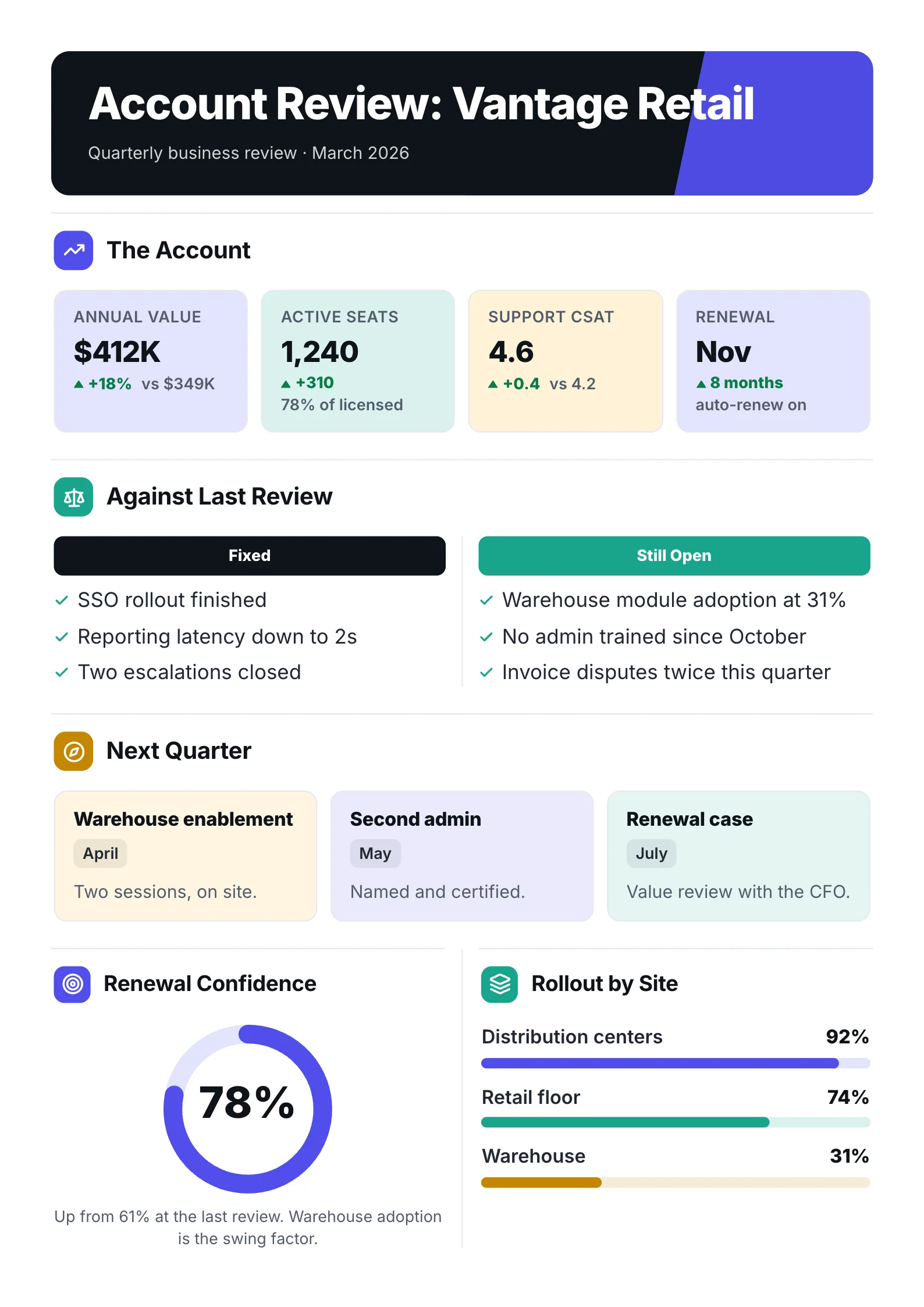 Quarterly business reviewOpen the template (opens in a new tab)
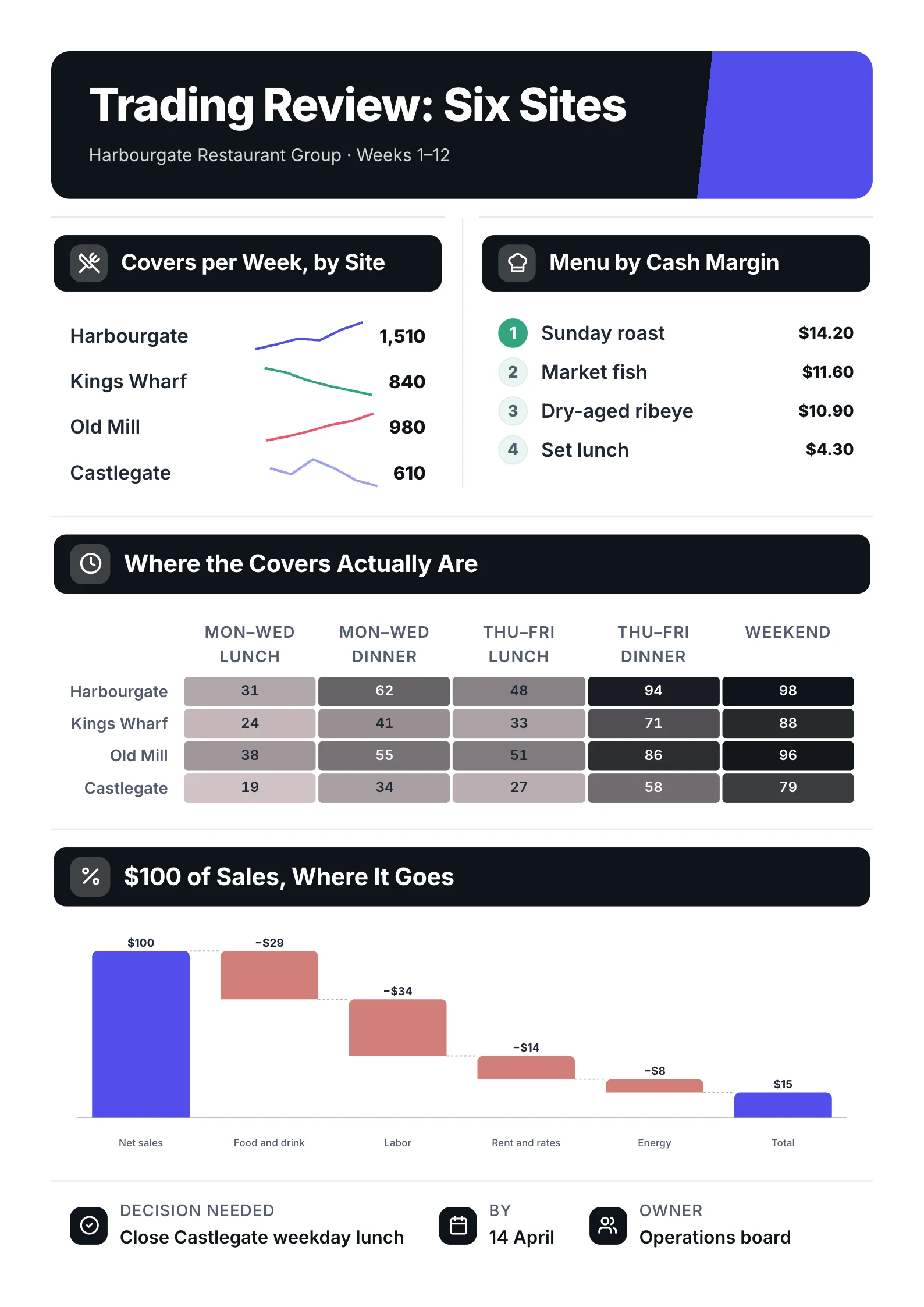 Trading reviewOpen the template (opens in a new tab)
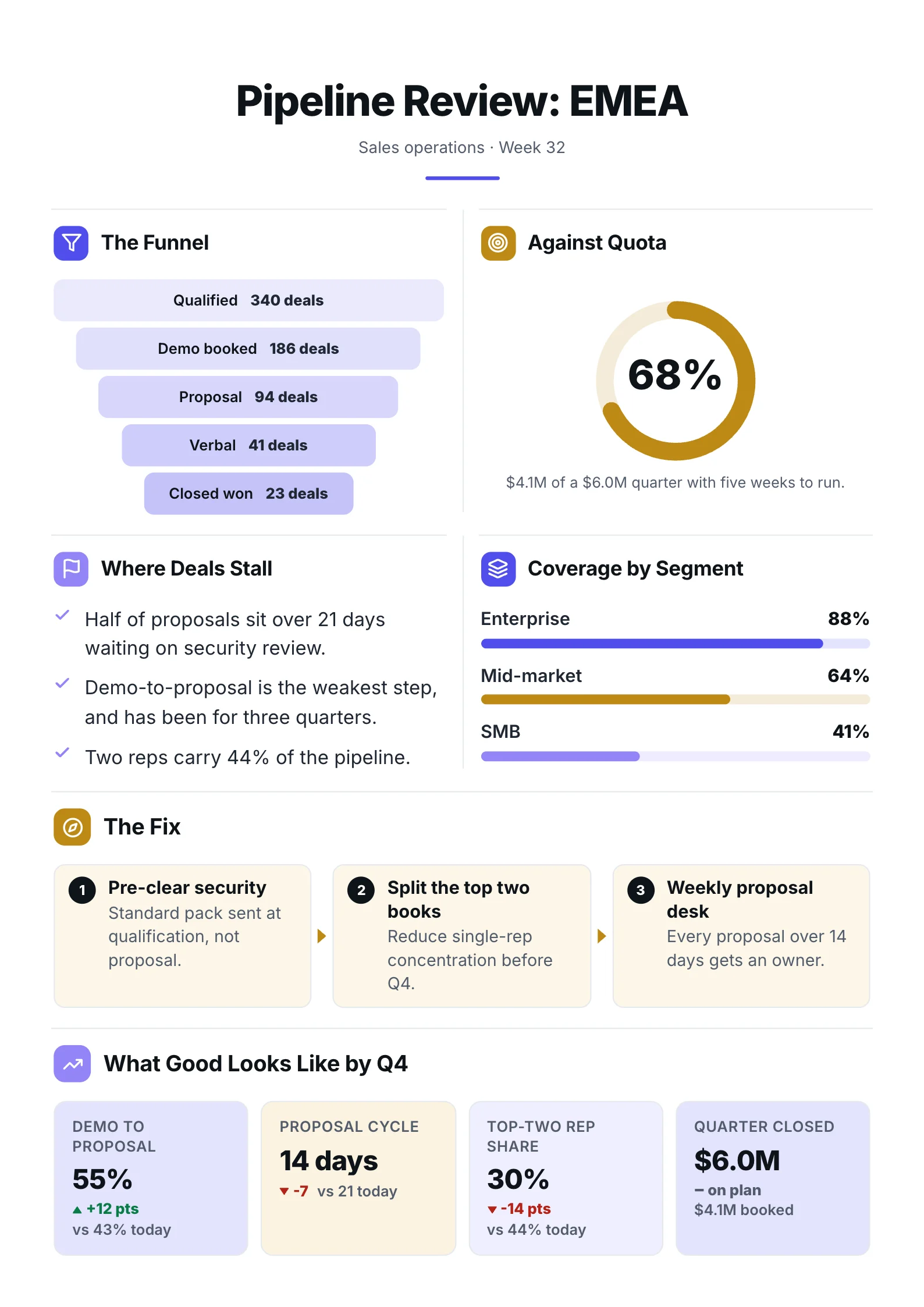 Sales pipelineOpen the template (opens in a new tab)
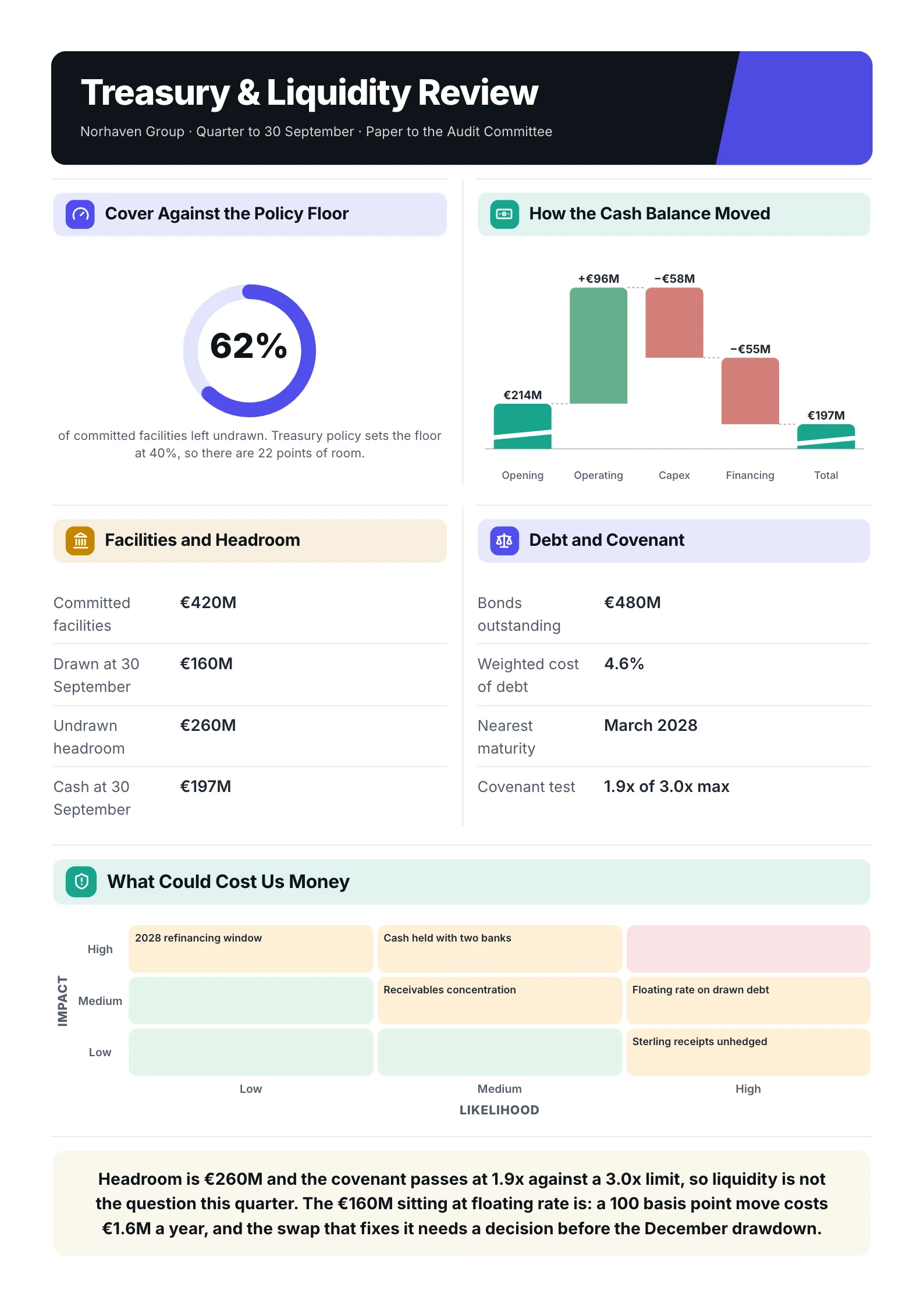 Treasury reviewOpen the template (opens in a new tab)
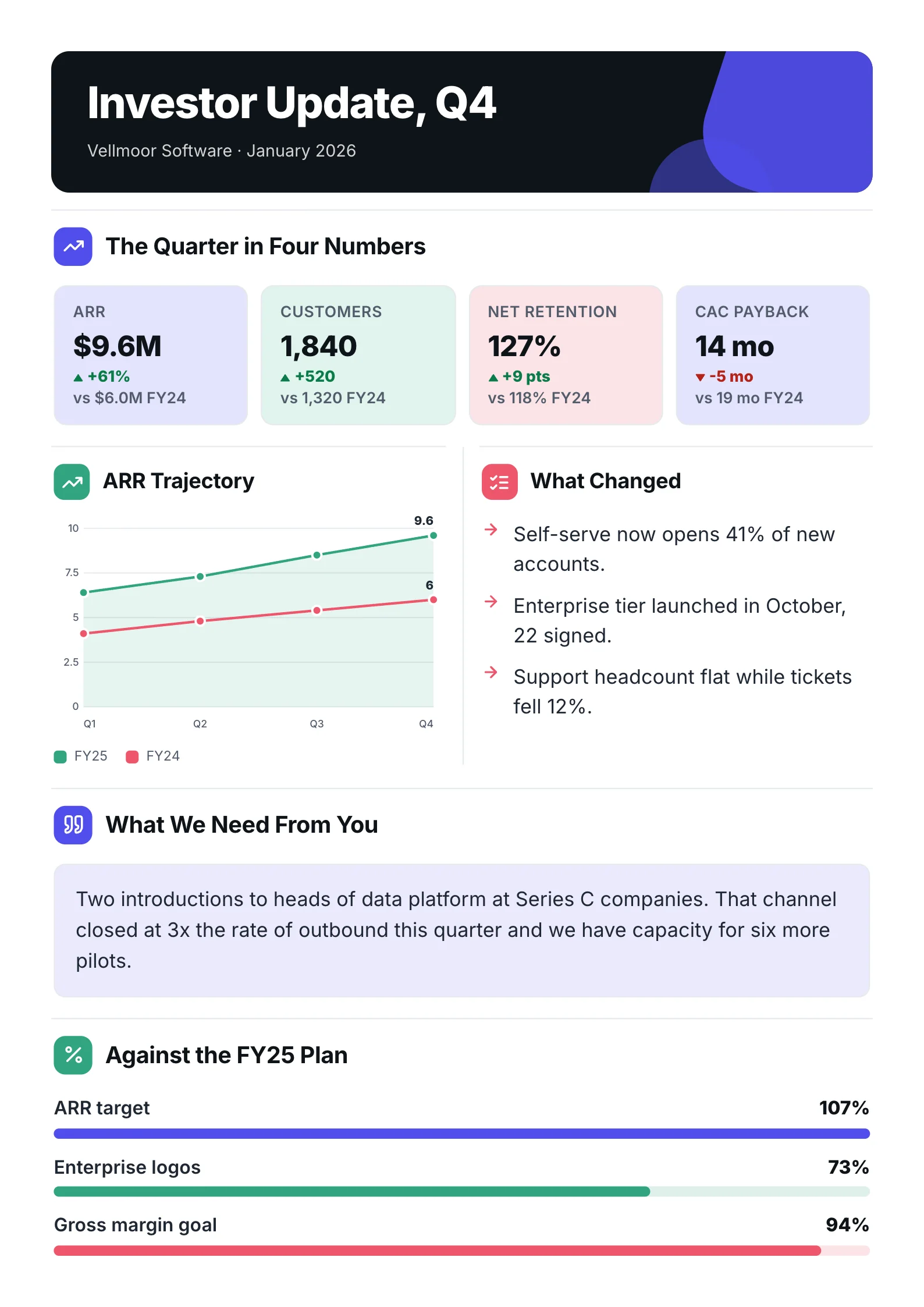 Board updateOpen the template (opens in a new tab)
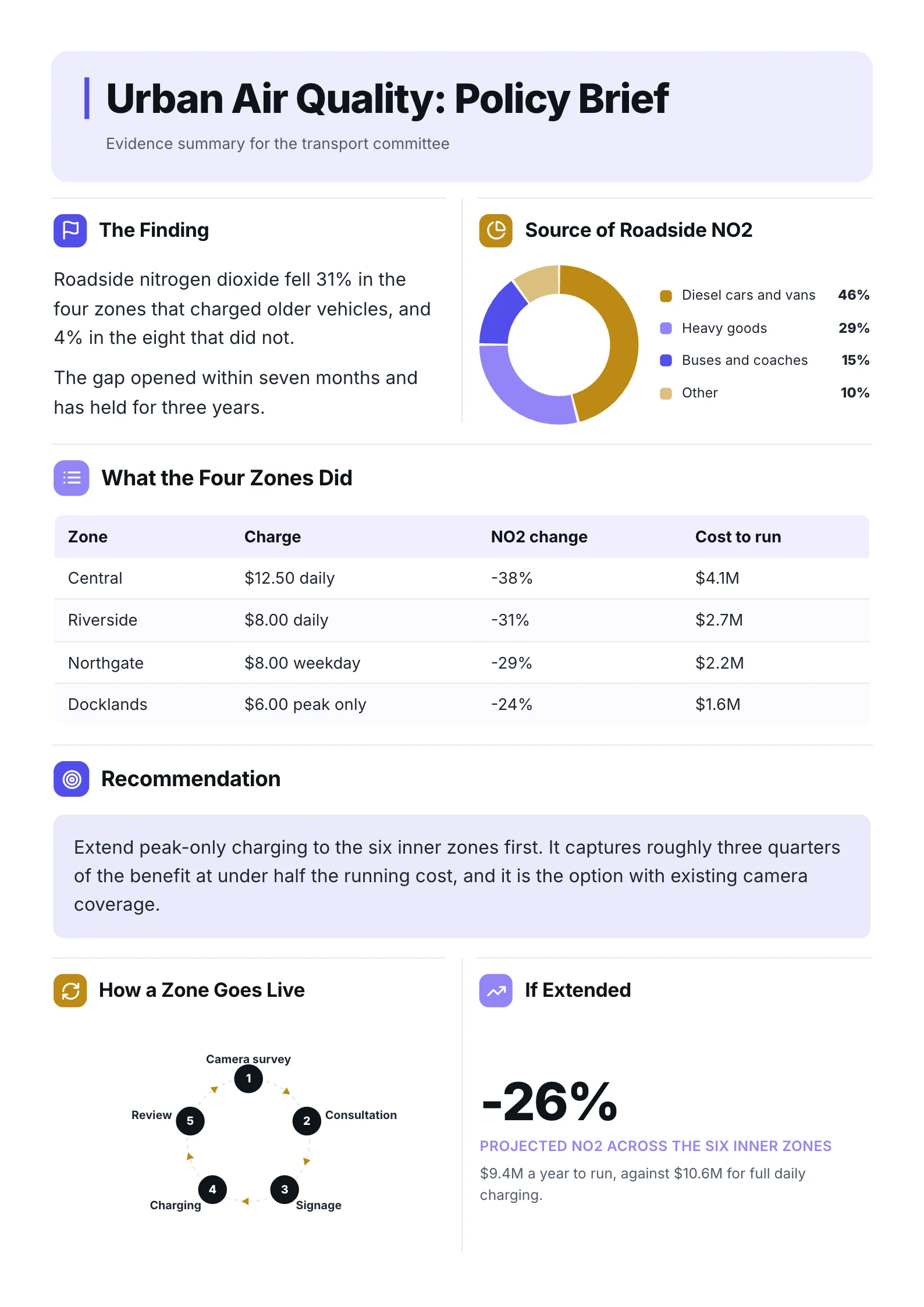 Policy briefOpen the template (opens in a new tab)
Frequently asked questions
What should a startup one-pager include?
The company and what it does, the problem, the solution, the market, traction, the business model, the team, the competition, how much you are raising, and contact details. Traction and the raise are the two sections investors look for first.
How long should a startup one-pager be?
One page, usually 300 to 500 words. The test is whether an investor can understand the business and the ask in about two minutes.
Is a startup one-pager the same as an executive summary?
They overlap. An executive summary is often the first section of a business plan, while a startup One-Pager is designed to stand alone and be forwarded. Our guide to the one-page executive summary covers the summary format.
Should I send a one-pager or a pitch deck to investors?
Send the One-Pager first when you are cold emailing or being introduced, and the deck when the investor asks for more or before a meeting. Many investors are happy to receive both, but a short first read gets opened more often.
How do I make a startup one-pager quickly?
Start from your pitch deck or business plan, not a blank page. Pull the best line from each section and cut everything else. A tool like MakeOnepagers can read the deck and draft the One-Pager for you, which you then edit.