BlogGuide
White Paper Template: The Structure 9 Real White Papers Use, Plus a One-Page Summary
We read 9 published white papers and measured their parts. A white paper template you can copy, with word counts, plus a one-page summary to share it.

By MakeOnepagers Team
Updated · 9 min read
A white paper template gives a white paper its standard order: a title page, a short summary (an abstract or executive summary), the problem, the background, the solution or findings, a conclusion or next steps, and references. The order exists for a reason. Most readers decide from the summary whether to read the rest, so it comes first and has to stand on its own.
One‑Pager examples
Real One-Pagers made with MakeOnepagers. Open any one to edit it as your own.
 Policy Brief: Rural TelehealthEdit for free(opens in a new tab)
 Executive SummaryEdit for free(opens in a new tab)
 Board Decision PaperEdit for free(opens in a new tab)
 Steering Committee PaperEdit for free(opens in a new tab)
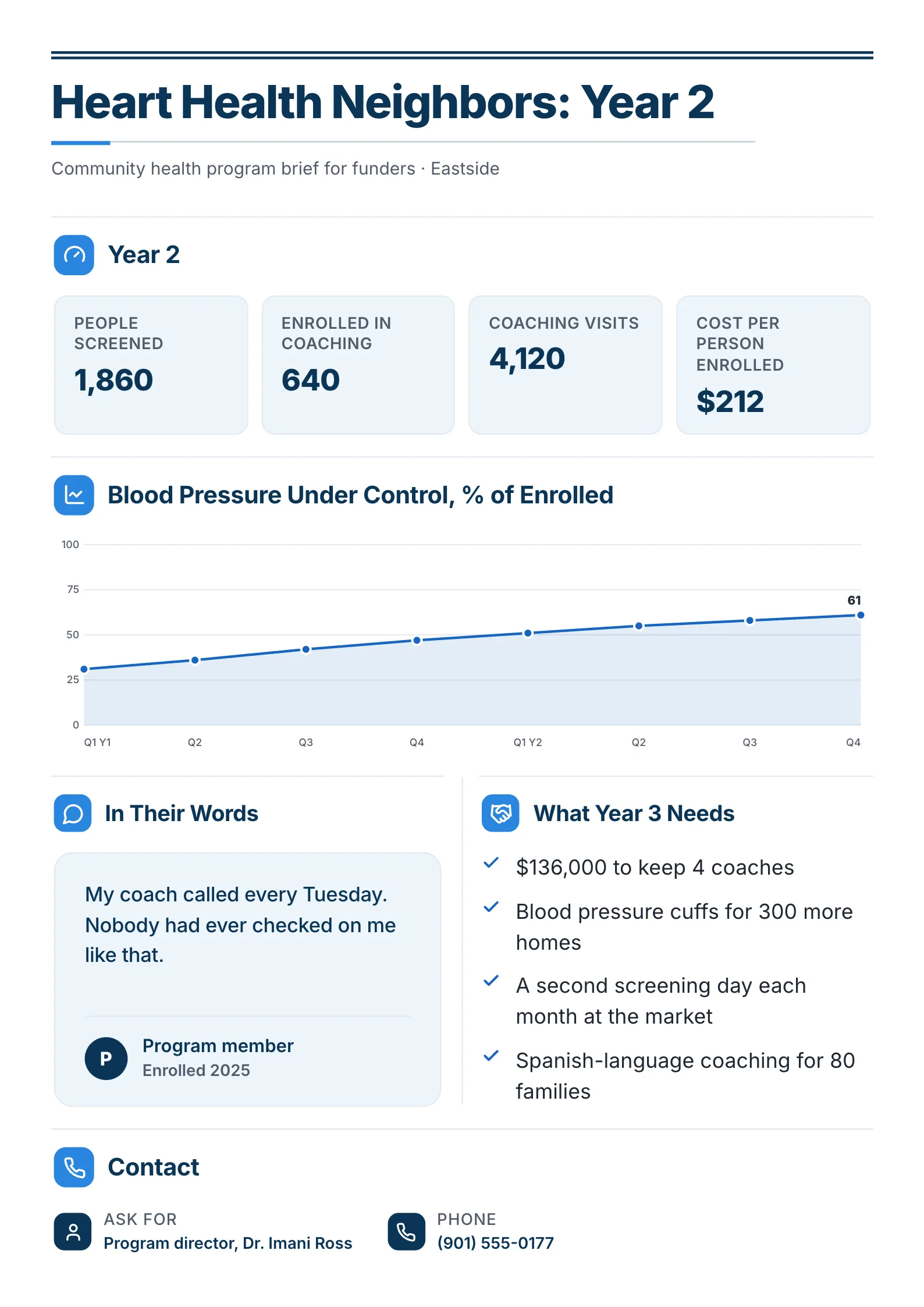 Community Health Program BriefEdit for free(opens in a new tab)
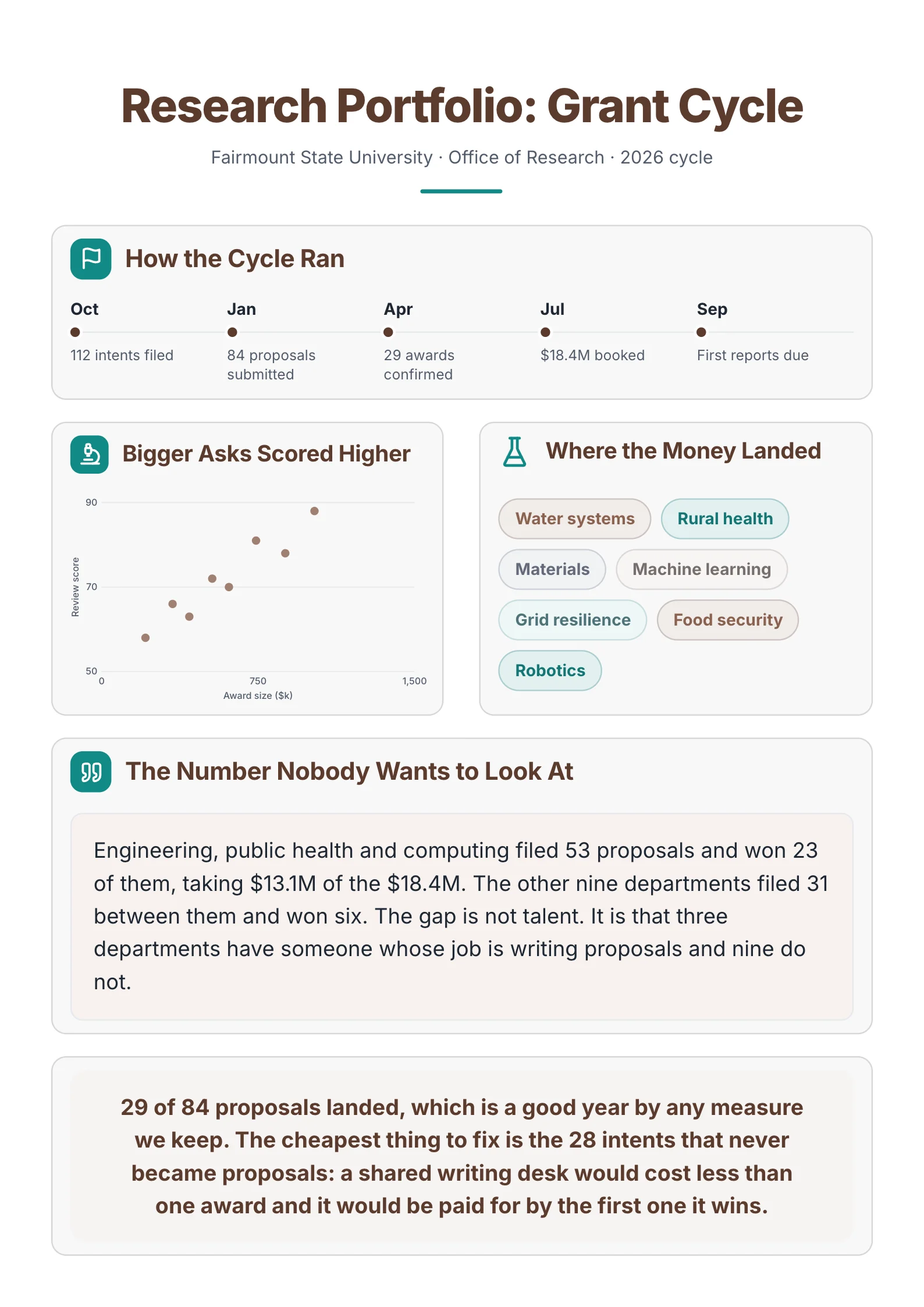 Research Funding ReviewEdit for free(opens in a new tab)
To give you real numbers rather than a guess, we read 9 published white papers from start to finish on 12 October 2026: eight from the US National Institute of Standards and Technology (NIST) Cybersecurity White Paper series and the original Bitcoin white paper. We counted their pages, words and parts. Below are the findings, a white paper template you can copy with a word budget for every section, and a one-page summary layout for sharing the finished paper.
What is a white paper?
A white paper is a report that explains a problem and argues for a solution, backed by evidence. Governments publish them to propose policy or technical guidance. Companies publish them to show expertise and win buyers who need to justify a decision.
It is not a brochure. A white paper persuades with facts, examples and reasoning, and the sales message, if there is one, stays at the end. It is longer than a blog post and shorter than a book: the papers we read ran 5 to 27 pages.
What 9 real white papers look like
Every paper below is free to read at its source.
| White paper | Published | Pages | Opens with |
|---|---|---|---|
| Bitcoin: A Peer-to-Peer Electronic Cash System | 2008 | 9 | Abstract |
| NIST CSWP 25: Integrity Protection with Erasure Capability | May 2022 | 5 | Abstract |
| NIST CSWP 26: Ordered t-way Combinations for Testing | June 2022 | 10 | Abstract |
| NIST CSWP 28: Security Segmentation in Small Manufacturing | April 2023 | 27 | Abstract |
| NIST CSWP 27: Profile for Hybrid Satellite Networks | June 2023 | 11 | Abstract |
| NIST CSWP 30: Automation Support for Control Assessments | Dec 2023 | 20 | Abstract |
| NIST CSWP 31: Proxy Validation for Critical AI Systems | Sept 2024 | 16 | Abstract and executive summary |
| NIST CSWP 42: Towards Automating IoT Security | Nov 2025 | 8 | Abstract |
| NIST CSWP 34: Telehealth Smart Home Integration | Dec 2025 | 23 | Abstract and executive summary |
What the count shows:
- Every one opens with a summary. All 9 have an abstract, and two of the NIST papers add an executive summary as well.
- The summary is short. The abstracts ran from 48 to 286 words, with a median of 156. The Bitcoin abstract, which introduced a new kind of money, is 179 words.
- The papers are shorter than most templates suggest. The median is 11 pages and about 3,950 words. The longest ran 27 pages and about 6,800 words.
- The ending matters less than the opening. 8 of 9 end with a reference list, but only 5 of 9 have a section called Conclusion. The summary at the top does the work a conclusion would do.
Page counts include the cover, contents and references, which is why a 5-page paper can hold only about 2,100 words.
A white paper template you can copy
Use this order. The word budgets come from the papers above: the summary is set by the abstracts we measured, and the total fits the middle of the range.
Title page
- Title: what the paper is about, in plain words. "Security Segmentation in a Small Manufacturing Environment" tells you the topic and the reader.
- Organization, authors and date. All 8 NIST papers print a date on the cover. The Bitcoin PDF carries none, so readers have to look the date up elsewhere.
Summary: 100 to 200 words
- The problem in one or two sentences.
- What the paper proposes or found.
- Why it matters, with one number if you have it.
- Who should read it.
1. Introduction and the problem: 300 to 600 words
- What is happening, who it affects, and what it costs.
- What the paper covers and what it leaves out.
2. Background: 400 to 800 words
- What has been tried and why it falls short.
- Terms the reader needs. One NIST paper we read adds a glossary as an appendix.
3. The solution or findings: 1,000 to 2,500 words
- The approach, step by step.
- The evidence: data, tests, examples, diagrams.
- Limits and open questions. Saying them builds trust.
4. Conclusion or next steps: 150 to 300 words
- What the reader should do now, and what happens next.
References
- Every source cited in the text, with a link.
Total: about 2,000 to 4,500 words, which is 6 to 12 pages with a cover and references.
Types of white paper
Most white papers fall into one of four kinds. The template above works for all of them; the middle section changes.
| Type | What it does | Example from the 9 |
|---|---|---|
| Problem and solution | Names a problem and argues for one fix | Security segmentation for small manufacturers |
| Technical proposal | Describes a new method or system in detail | The Bitcoin paper; ordered t-way testing |
| Framework or profile | Gives a structure others can apply | The satellite networks profile |
| Project update and vision | Reports progress and the plan ahead | Automation support for control assessments |
A company white paper is usually the first type: the problem a buyer has, and the approach the company recommends, with evidence that it works.
How to write the summary first
Write the summary before the paper and again after. The first version keeps the paper on track; the second matches what you actually wrote.
- One sentence for the problem. "Manufacturers are increasingly targeted in cyber-attacks" opens the NIST manufacturing paper's abstract.
- One sentence for what the paper does.
- Two or three sentences for the approach or findings.
- One sentence for what the reader gets or should do.
- Count the words. If it runs past 200, cut background, not findings.
Turn the white paper into a one-page summary
A white paper is read in full by a few people. Its summary is read by everyone else: the manager who forwards it, the committee that skims it before a meeting, the buyer who prints it. A one-page summary designed for that reader gets the paper's point across in a minute, and links to the full paper for those who want it.
At a median of 156 words, a white paper's abstract is about the size of a designed one-pager, which holds 100 to 200 words in our count of real One-Pagers. So the summary page does not need new writing. It needs the summary laid out so the problem, the proposal and the numbers can be seen at a glance. The two examples below were made with MakeOnepagers.
 Edit this template
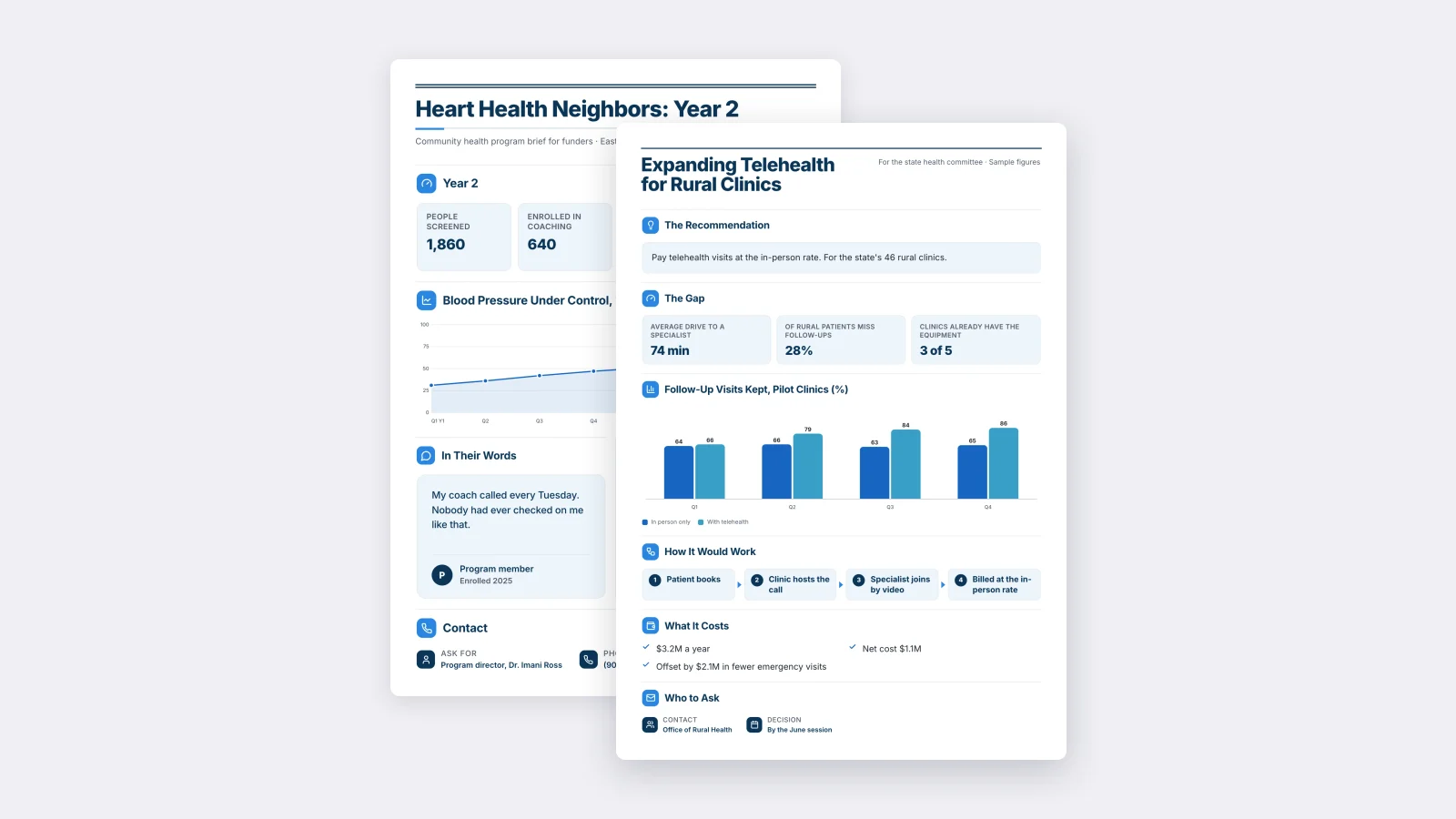
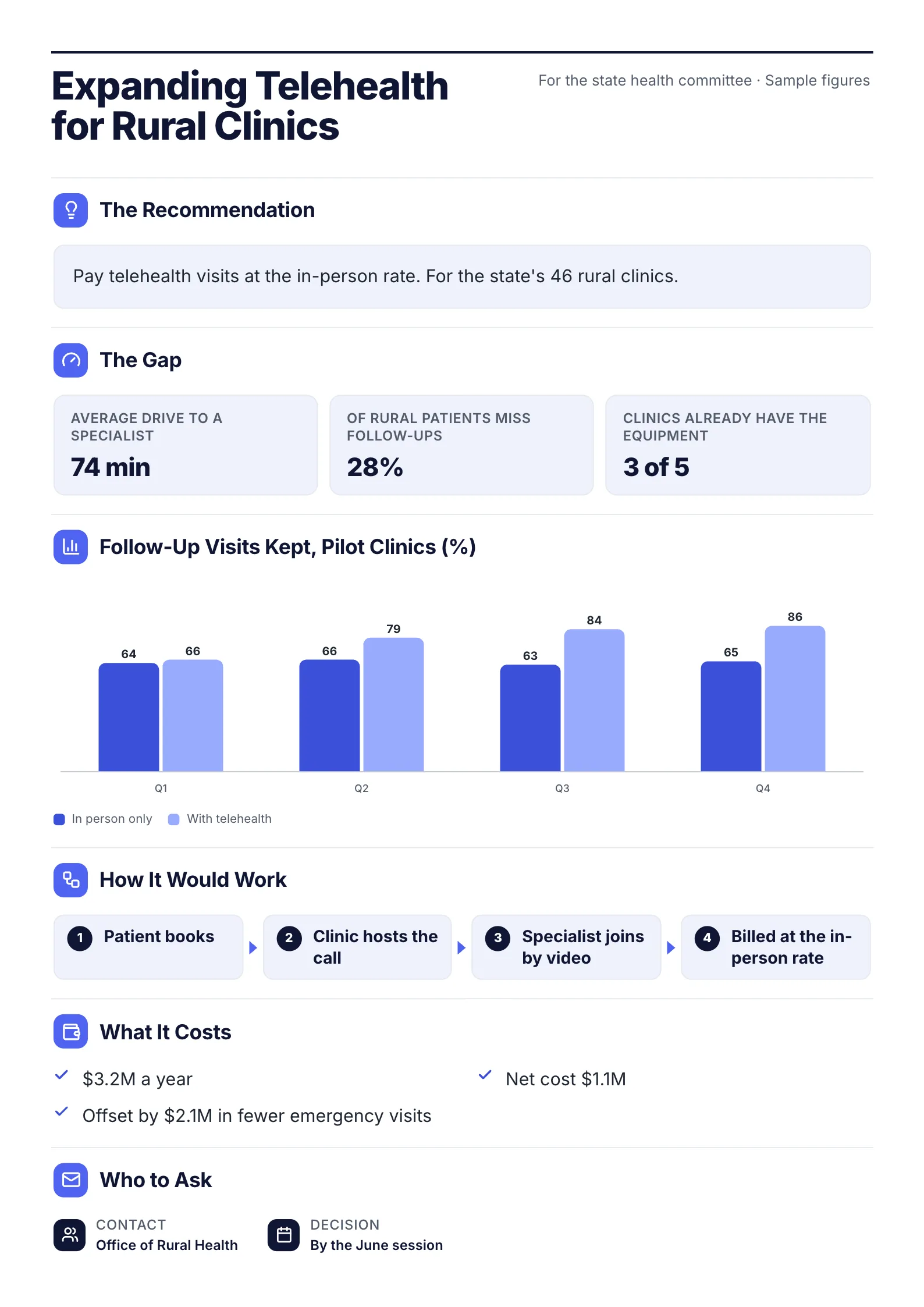
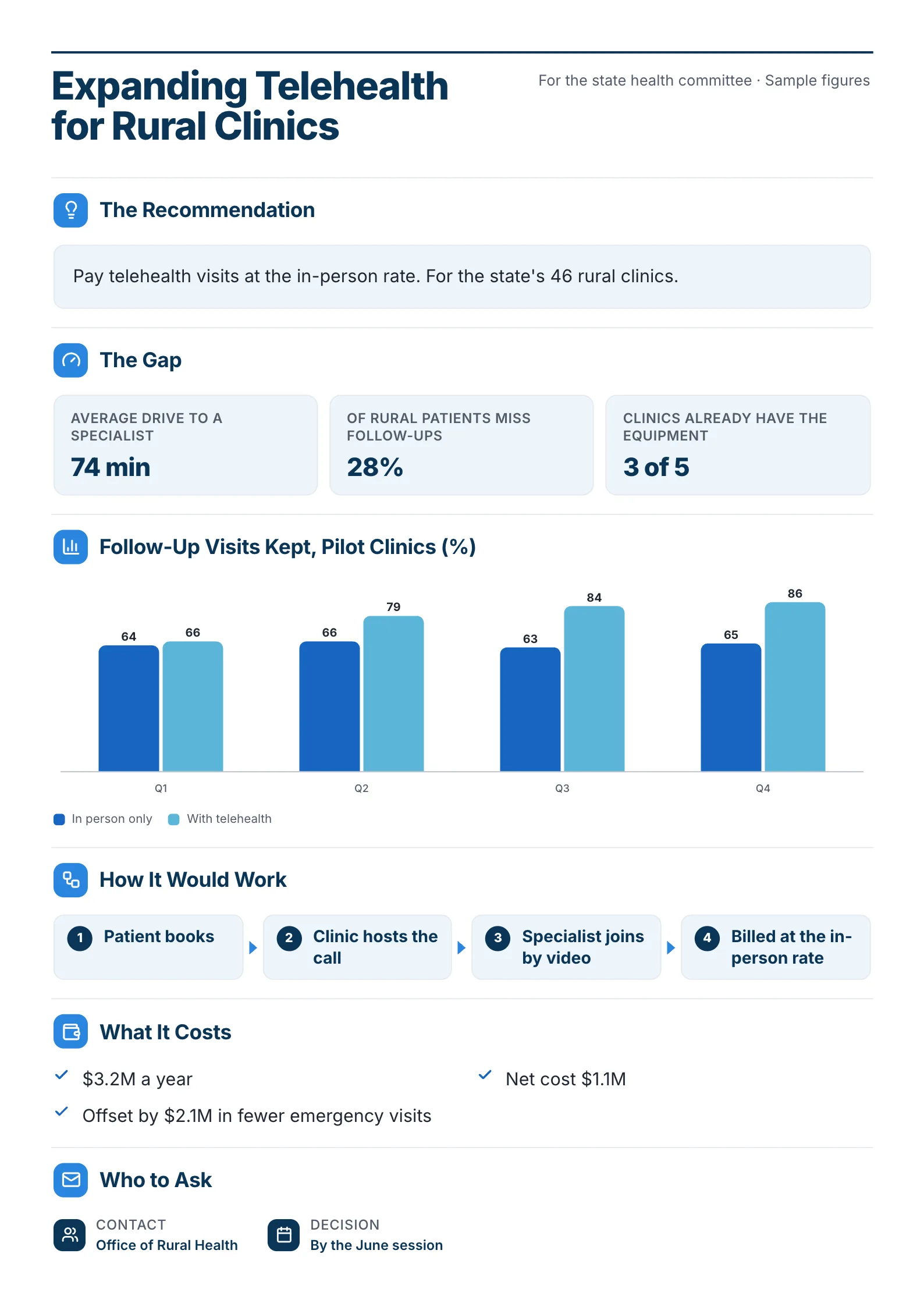
A white paper's argument on one page: the recommendation, the gap, the evidence, the plan and the cost.
What to copy:
- The recommendation at the top, in one sentence, as the abstract would state it.
- The problem in three numbers: a 74-minute drive to a specialist, 28% of rural patients missing follow-ups, 3 of 5 clinics already equipped.
- One chart of the evidence: follow-up visits kept, in person only against with telehealth, by quarter.
- How it works in four steps and what it costs, which are the sections a decision-maker reads first.
Edit for free: policy brief template. The figures are samples.
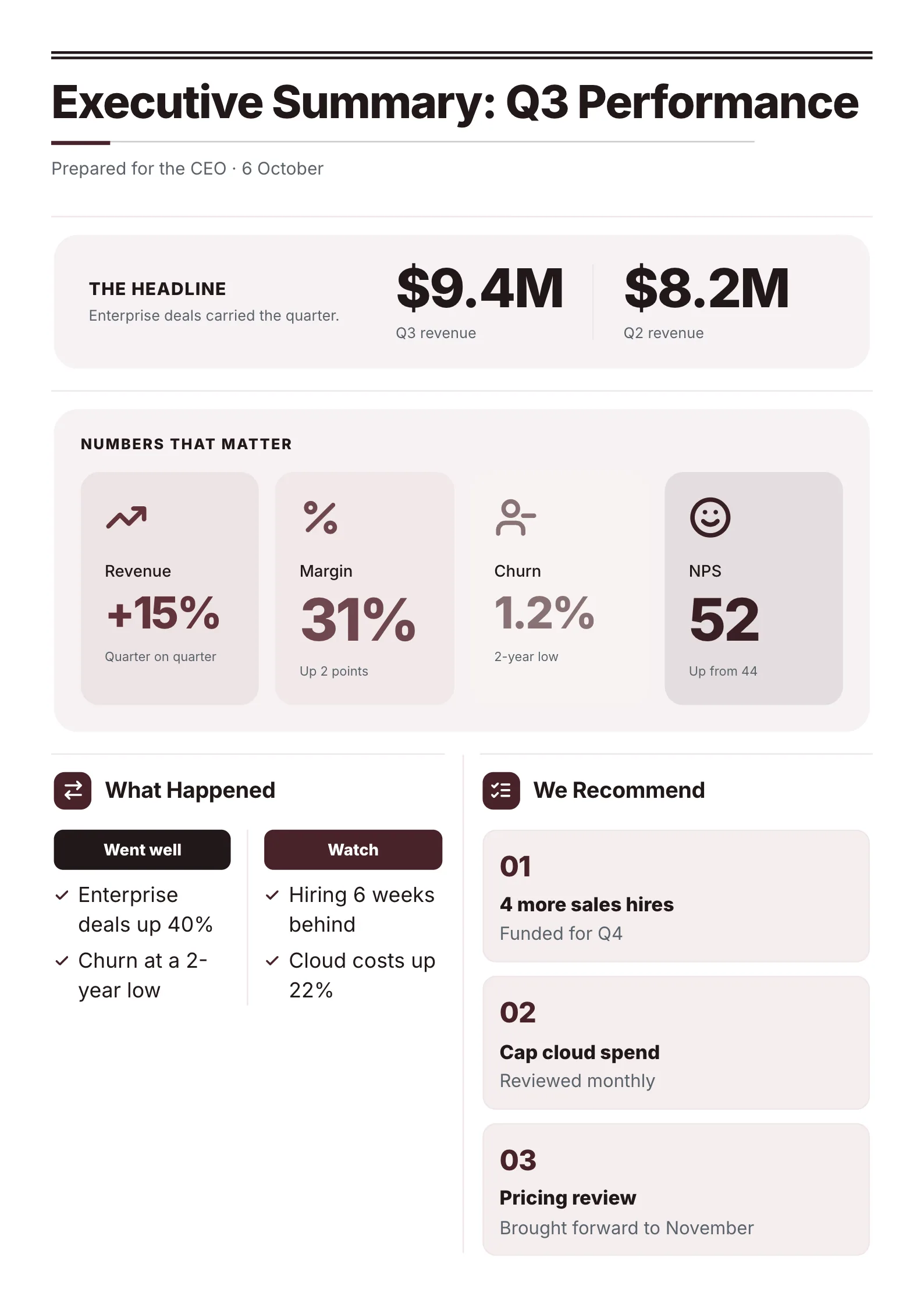
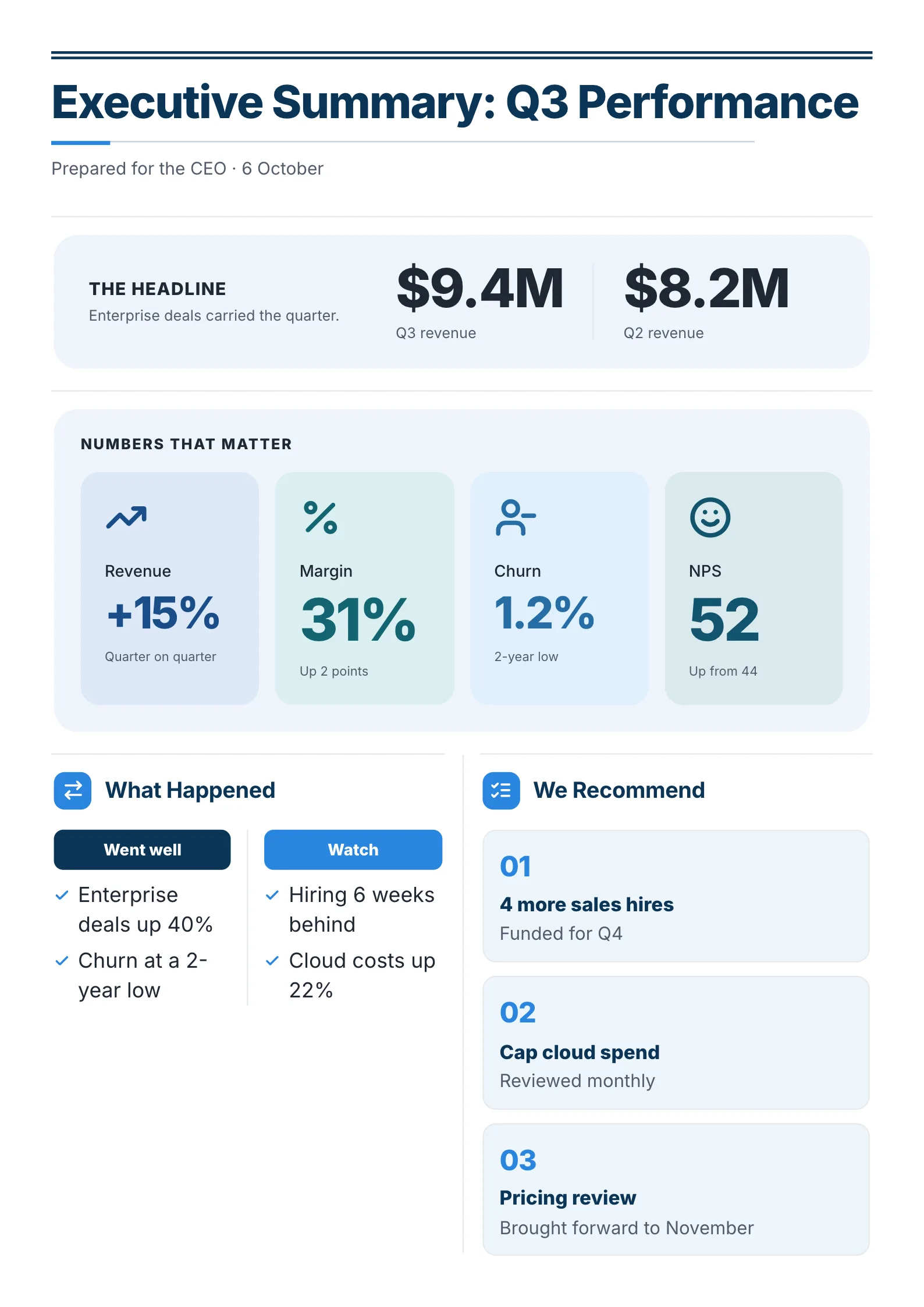
For a business white paper, the same idea works as an executive summary: the headline result, the numbers that matter and what you recommend.
 Edit this template
The business version: the headline number first, then what happened and what to do.
Edit for free: executive summary template.
White paper formats: Word, Google Docs or a designed page?
| Format | Good for | Watch out for |
|---|---|---|
| Word or Google Docs | Writing and reviewing the full paper with comments | Layout breaks when pictures move; plain look |
| Publishing and printing the final paper | Hard to update once sent | |
| A web page | Search, links and reading on a phone | Harder to print or attach |
| A designed one-page summary | Sharing the point, printing for a meeting, attaching to an email | Not a place for the full argument |
Most teams write the paper in a document, publish it as a PDF, and send a one-page summary with it.
White paper mistakes
- A summary that only describes. "This paper discusses security" says nothing. Say what the paper found or proposes.
- The sales pitch in the middle. Readers trust evidence, not adjectives. Keep any product mention to the end.
- No date. Readers need to know whether the facts are current. All 8 NIST papers print one on the cover.
- No sources. 8 of 9 papers end with references. A claim without a source reads as opinion.
- Writing to a page count. The papers we read run 5 to 27 pages. Length follows the argument.
Make the one-page summary of your white paper
Open the free policy brief template, put your recommendation at the top and your three strongest numbers under it, and download it as a PDF to send with the full paper.
Frequently asked questions
What is the format of a white paper?
A title page, an abstract or executive summary, an introduction that states the problem, background, the solution or findings with evidence, a conclusion or next steps, and references. All 9 white papers we read follow this order and open with an abstract.
How long is a white paper?
The 9 published white papers we read ran from 5 to 27 pages, with a median of 11 pages and about 3,950 words. The summary at the start ran 48 to 286 words, median 156.
Is there a white paper template in Word or Google Docs?
Yes, both offer report templates you can adapt. Use the outline above for the order and word budget, write the paper in a document, and make the one-page summary separately so it can be shared on its own.
What is the difference between a white paper and a one-pager?
A white paper makes the full argument, with evidence, across several pages. A one-pager gives the point on a single page: the problem, the proposal, the key numbers and who to contact. Teams often make a one-page summary of a white paper to share it.
What should a white paper summary include?
The problem, what the paper proposes or found, why it matters with one number, and who should read it, in 100 to 200 words.