BlogGuide
Character One‑Pager: What 6 Real Assignment Sheets Ask For, With an Example
We read 6 real character one-pager assignment sheets, counted what each asks for, and built a finished Jay Gatsby example with every part.

By MakeOnepagers Team
Updated · 9 min read
A character one-pager is a single sheet that analyzes one character from a novel, play or short story: who they are, three or so traits with proof, quotes cited by page or chapter, pictures or symbols, and a border tied to the book's themes. Teachers assign it instead of a character essay because it shows in one look whether you understood the character, not just the plot.
One‑Pager examples
Real One-Pagers made with MakeOnepagers. Open any one to edit it as your own.
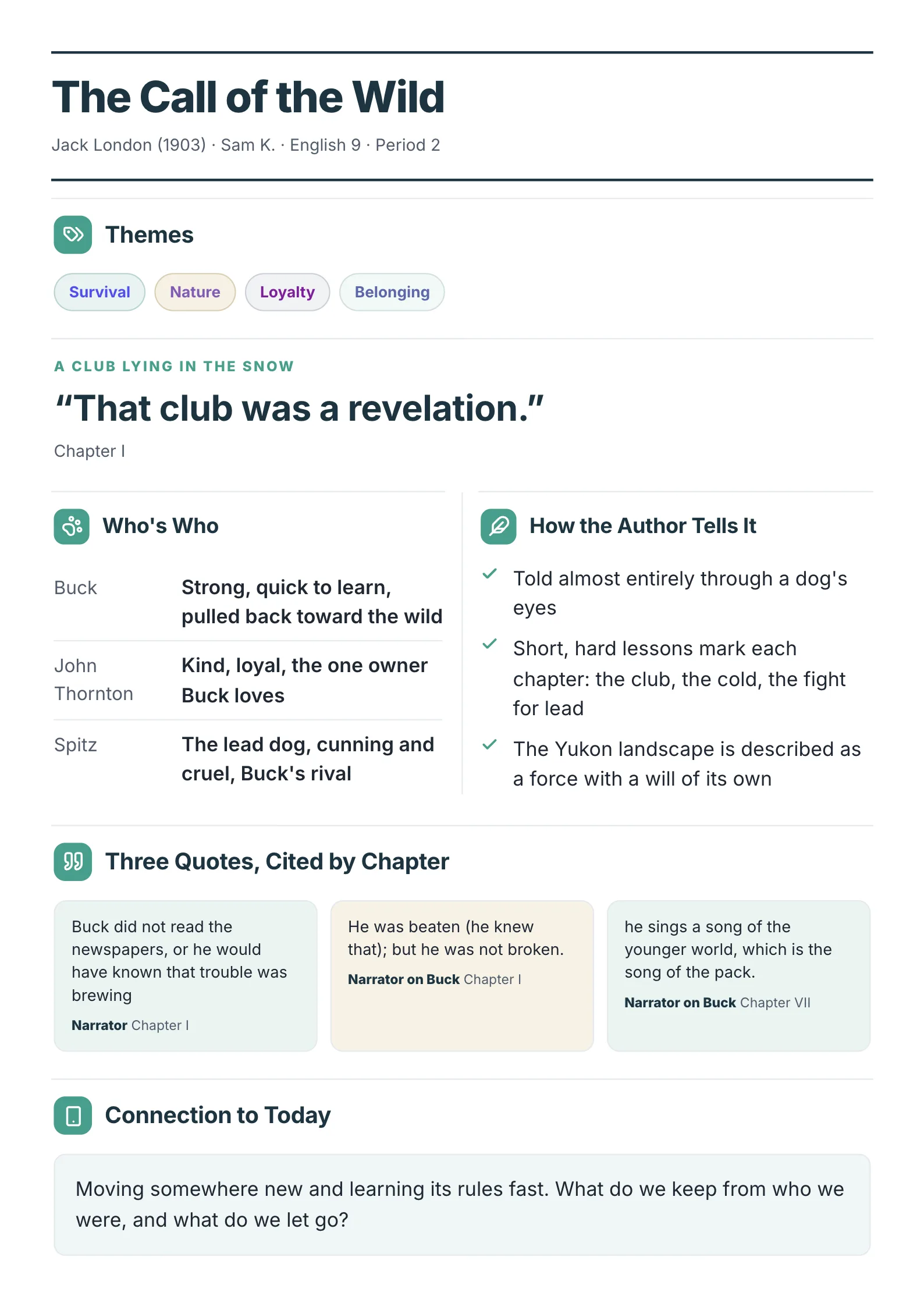
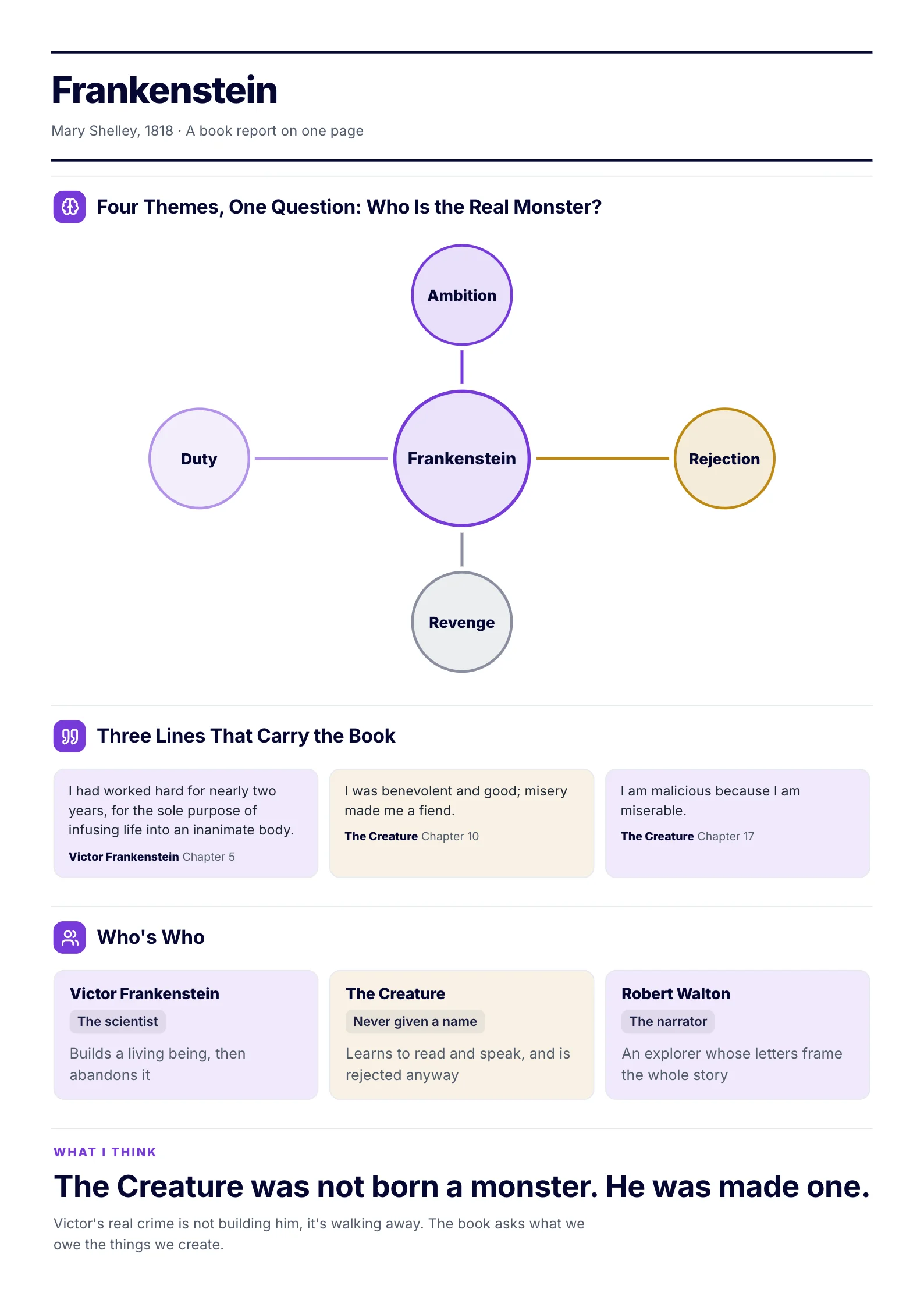
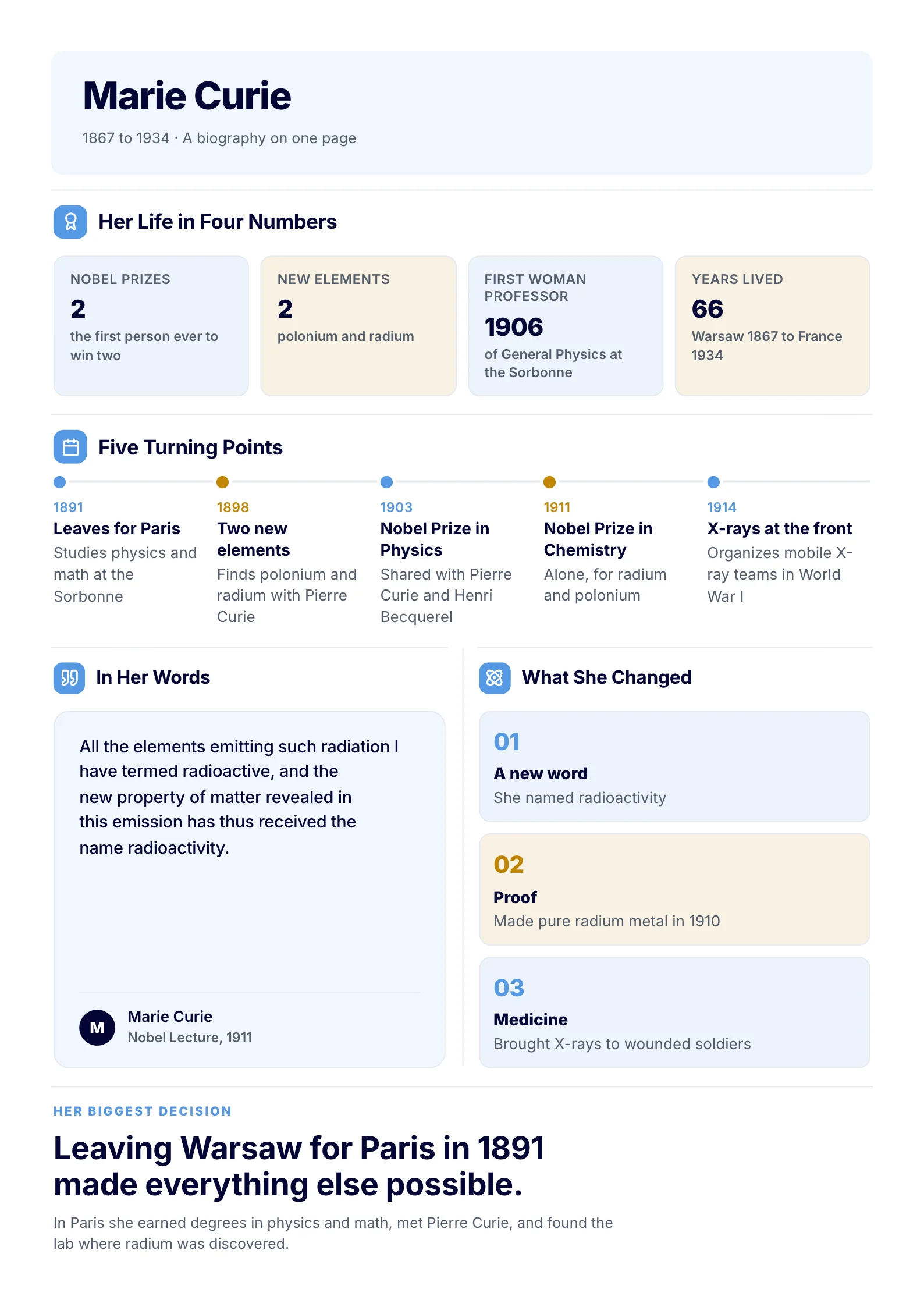
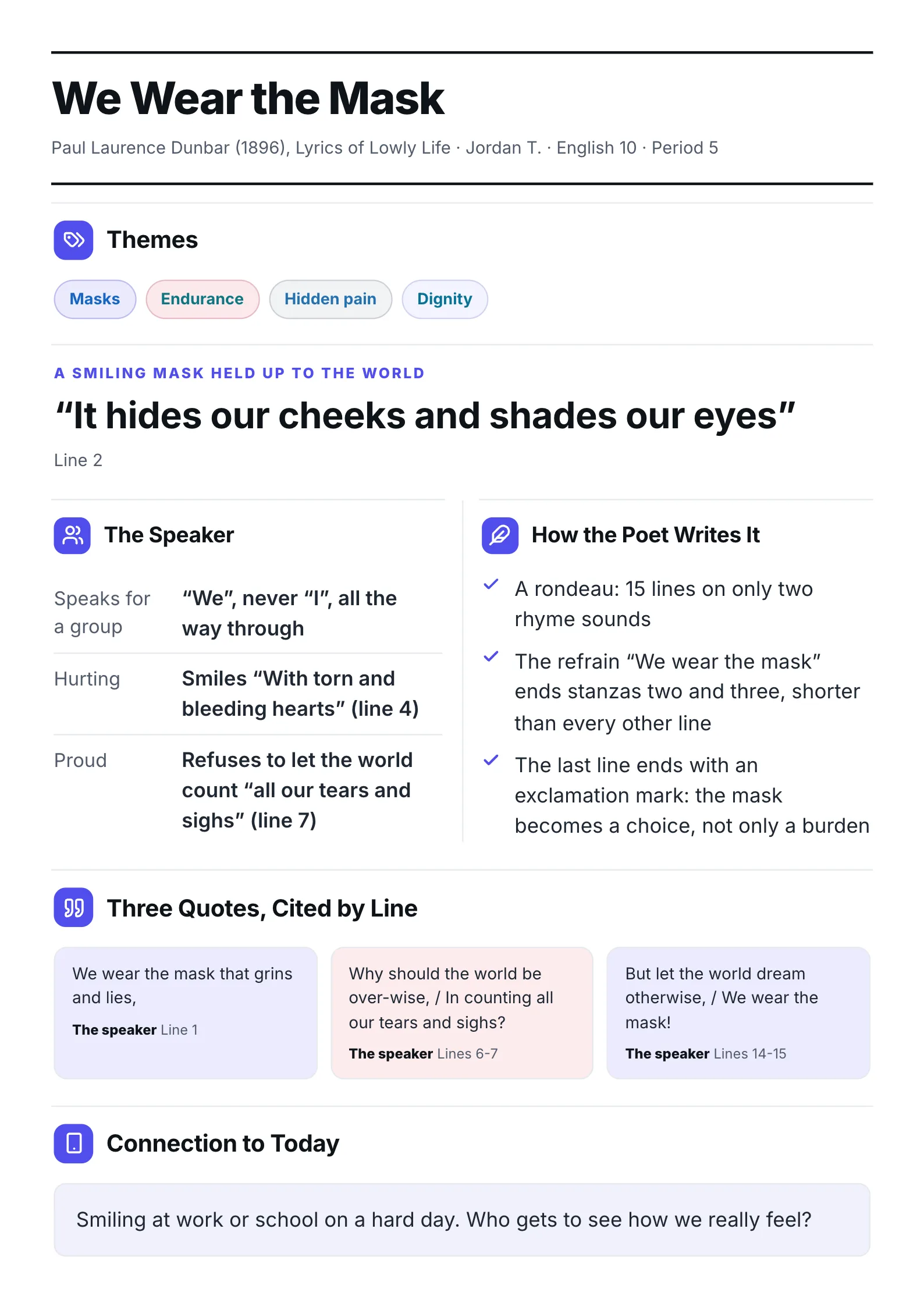
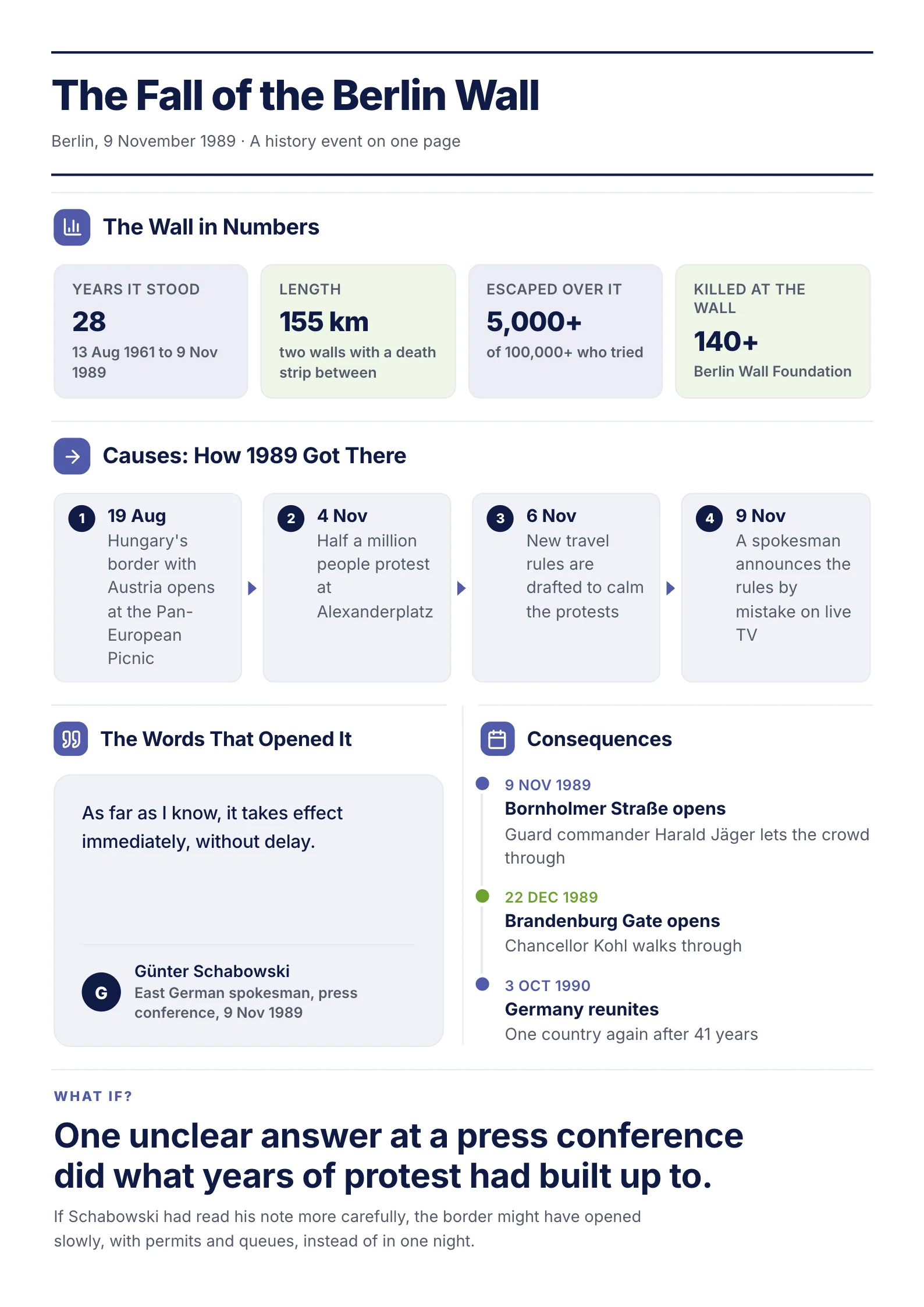
To find out what teachers actually grade, we read 6 real character and novel one-pager assignment sheets that schools and teachers publish online, and counted every part they ask for. Then we built a finished character one-pager on Jay Gatsby that covers all of it. Both are below, with a checklist you can tick before you hand yours in.
What is a character one-pager?
A character one-pager is a visual character analysis on one side of one sheet of paper. Instead of paragraphs, you show the character through short labeled parts: a name, a few traits, the quotes that prove them, a drawing or symbol, and how the character changes.
It differs from a regular novel one-pager in one way. A novel one-pager covers the whole book (plot, setting, themes, several characters). A character one-pager zooms in on one person and asks why they act the way they do. One middle school sheet we read puts the protagonist in its own box with "at least THREE character traits" beside a drawing of them.
What 6 real assignment sheets ask for
We read each sheet in full on 12 October 2026. They were published online by schools, teachers and a state teacher training site, for classes from grade 6 to high school. The sources are linked at the end of this section.
| Part the sheet asks for | Sheets | Share |
|---|---|---|
| Quotes with a page or chapter citation | 6 of 6 | All |
| Title and author | 5 of 6 | Most |
| Pictures, drawings or symbols | 5 of 6 | Most |
| A border | 4 of 6 | Most |
| The character drawn or described | 4 of 6 | Most |
| An explanation of each quote | 3 of 6 | Half |
| A personal connection | 3 of 6 | Half |
| Fill the page, no blank space | 3 of 6 | Half |
| How the character changes | 2 of 6 | Some |
| A question about the character, answered | 2 of 6 | Some |
Three things stand out.
- Three quotes is the usual number. Four of the six sheets ask for three quotes. One asks for four and one asks for a single quote.
- Explaining a quote scores as much as choosing it. The one sheet that prints its point values gives 20 points to the three quotes and another 20 to analyzing them, out of 100. Its top band asks for quotes that "support your analysis throughout".
- Change over time is rare, and that is your edge. Only two sheets mention it. One requires two drawings of the character, "beginning and end", with two quotes. If your sheet does not demand it, adding it is the fastest way to stand out.
The sheets we read: Dearborn Public Schools, Stout Middle School, the Franklin Learning Center 9th grade summer reading 2026 sheet, a grade 6 literature circle final project, Jackson Academy's 6th grade summer reading 2026, the CCEE one-pager instructions and rubric, and a high school English teacher's character study one-pager. Your own teacher's sheet always wins over this table.
A finished character one-pager, part by part
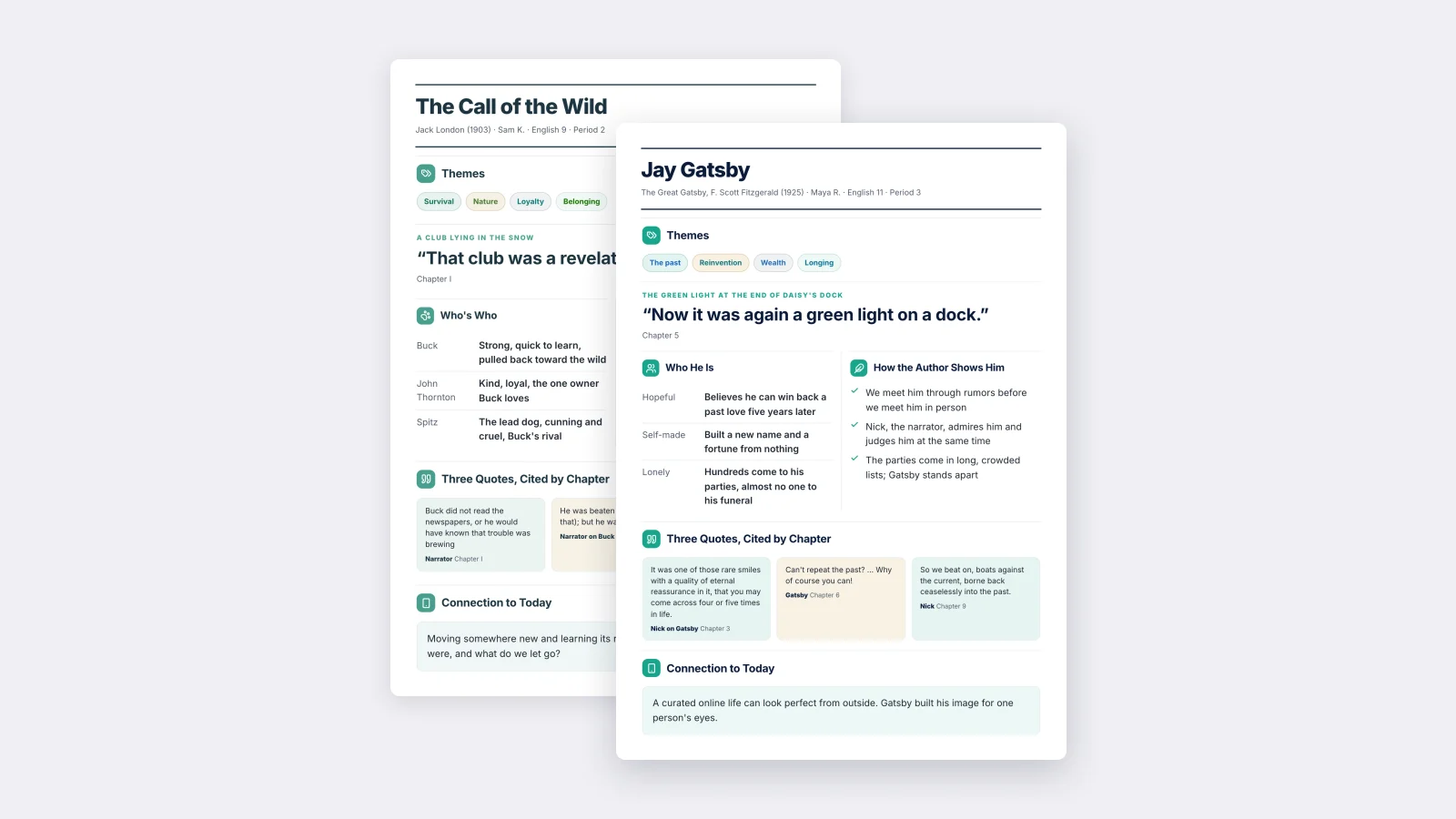
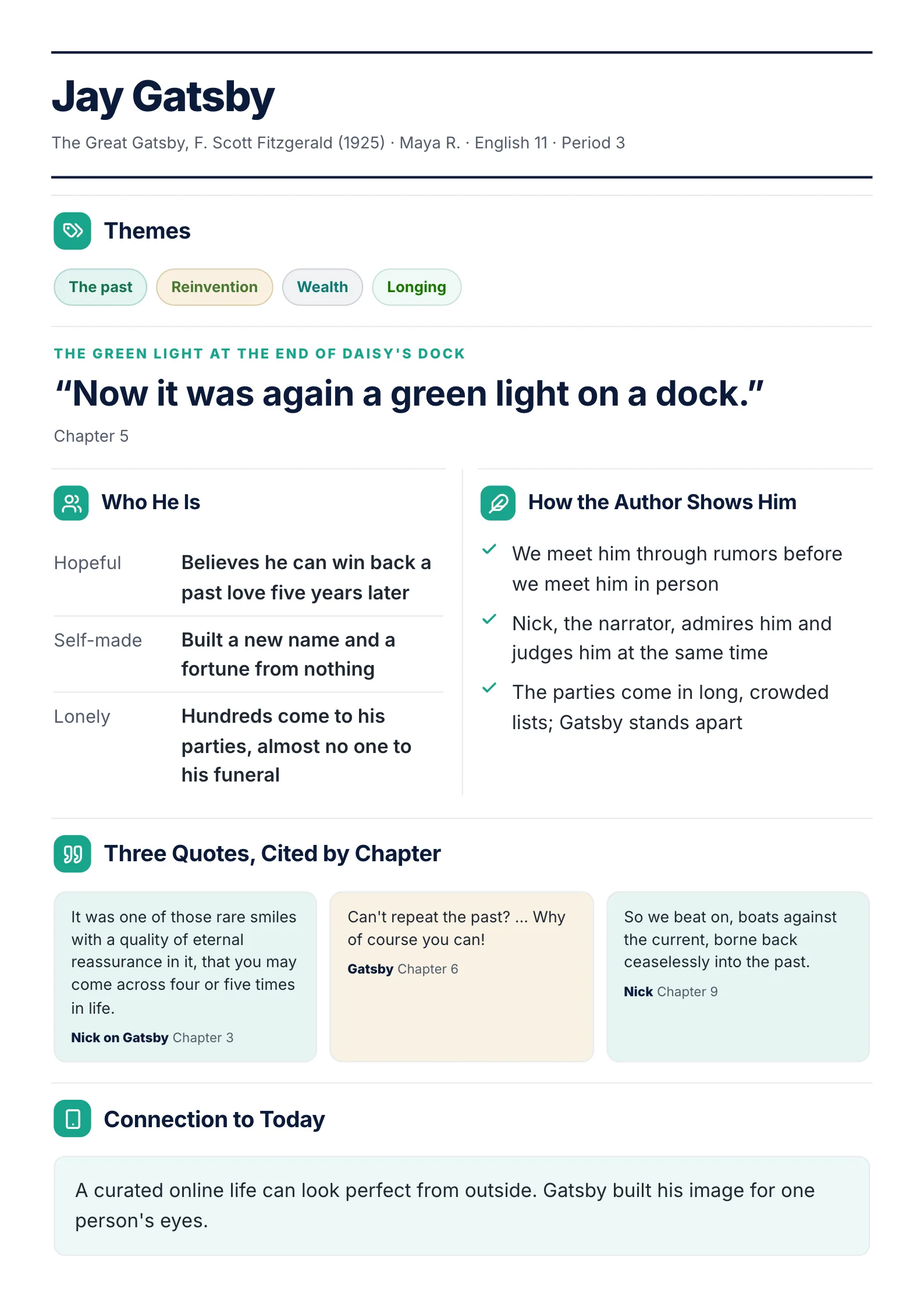
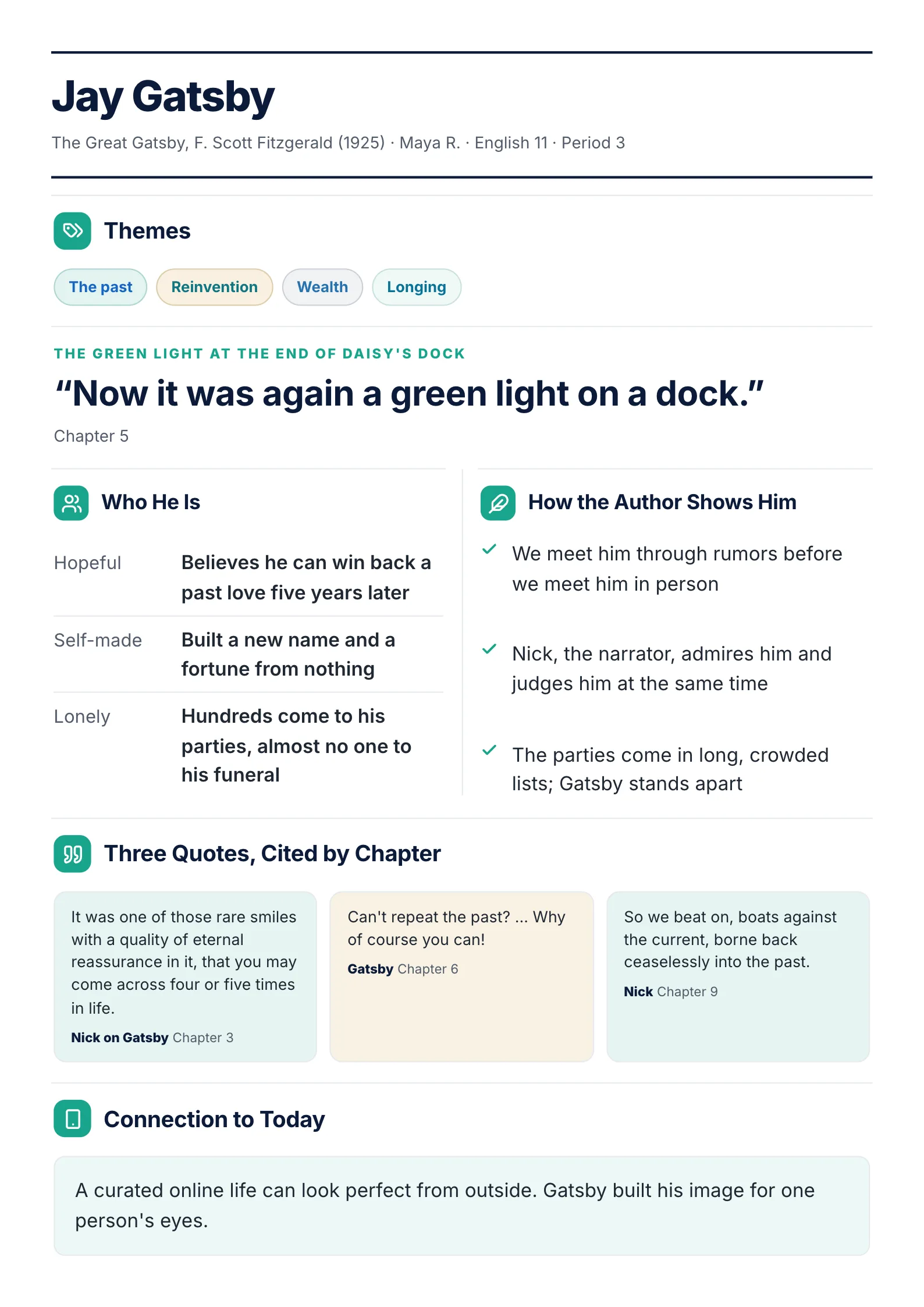
Here is a character one-pager on Jay Gatsby from The Great Gatsby (1925), made with MakeOnepagers. The student name is a sample. Every quote was checked against the public domain text of the novel.
 Edit this template
Every part a teacher grades, on one sheet: traits with proof, three cited quotes, the symbol and a connection to today.
Read it from top to bottom and you can see each part from the table above.
- Title, book, author and student. "Jay Gatsby" as the title, then The Great Gatsby, F. Scott Fitzgerald (1925), and the student's name, class and period on one line. Five of six sheets ask for this.
- Themes. The past, reinvention, wealth, longing. On paper these four words often become the border, which is where four of the six sheets want the themes.
- The symbol, with a quote. The green light at the end of Daisy's dock, with "Now it was again a green light on a dock." (Chapter 5). One sheet asks for exactly this pairing: the most important symbol, with a quote woven around it.
- Who he is: three traits, each with proof. Hopeful: he believes he can win back a past love five years later. Self-made: he built a new name and a fortune from nothing. Lonely: hundreds come to his parties, almost no one comes to his funeral.
- How the author shows him. We meet him through rumors before we meet him in person. Nick, the narrator, admires him and judges him at the same time. This is the analysis part, and it is what separates a character one-pager from a summary.
- Three quotes, cited by chapter. One from Nick about Gatsby's smile (Chapter 3), one from Gatsby himself, "Can't repeat the past? ... Why of course you can!" (Chapter 6), and the closing line (Chapter 9).
- Connection to today. A curated online life can look perfect from outside. Gatsby built his image for one person's eyes. Three of six sheets ask for a personal connection like this.
Open it and change the character: character one-pager template.
How to choose the three quotes
Pick quotes that prove a trait, not quotes that sound nice. Use this order.
- One quote per trait. If your traits are hopeful, self-made and lonely, find a line that shows each one. The quote and the trait then support each other.
- Spread them across the book. Take one from the beginning, one from the middle and one from the end. This also shows the reader how the character changes, without a separate section.
- Use a mix of voices. One line the character says, one line another character says about them, and one line from the narrator. In the Gatsby example, the smile quote is Nick on Gatsby, and "Can't repeat the past?" is Gatsby himself.
- Cite the way your teacher asks. Most sheets want a page number. One wants the author's last name and page in parentheses, and one wants MLA format. When page numbers differ between editions, as they do for older novels, cite the chapter and say which edition you used.
Traits with proof: weak against strong
A trait with no proof is an opinion. Here is the difference, using Gatsby.
| Weak trait line | Strong trait line |
|---|---|
| Gatsby is rich. | Self-made: he built a new name and a fortune from nothing. |
| Gatsby is nice. | Hopeful: he believes he can win back a past love five years later. |
| Gatsby is sad. | Lonely: hundreds come to his parties, almost no one comes to his funeral. |
The strong lines all do the same two things: one word for the trait, then something that happened in the book that proves it. Keep each line short enough to fit in a box.
Show how the character changes
Only two of the six sheets mention it, but every character worth a one-pager changes or refuses to change. Show it in one of three ways.
- Two drawings, beginning and end, each with a quote. This is what the middle school sheet asks for.
- A line across the bottom of the page with three points: who the character is at the start, the turning point, and who they are at the end.
- One sentence, in a box: "At the start he ... By the end he ..." For Gatsby, the change is that he refuses to change: he is still chasing the past when his story ends.
Where each part goes on the page
Three of the sheets give each part a fixed place, so the page has a shape. Here is a layout built from those three:
| Place on the page | What goes there |
|---|---|
| Border | Themes, a repeated key phrase, or the title and author |
| Upper left | A symbol with a quote |
| Upper right | The character drawn, with three traits |
| Middle | Title, author and your name |
| Lower left | How the author shows the character, or a connection to today |
| Bottom | How the character changes, beginning to end |
If your teacher gives you a template, follow it. If not, this layout fits every part in the table above on one side of letter paper.
Hand-drawn or digital?
Most sheets expect drawing and color, but not all. The Franklin Learning Center rubric gives full marks for work that is "typed or neatly written in ink", and two sheets allow images you print or cut out instead of drawing.
If your teacher accepts a digital page, a designed template saves the hour you would spend on layout, so the time goes on the analysis. Check one thing first: one rubric marks down images "simply found elsewhere and glued on", so add your own labels or captions to every picture.
Mistakes that cost points
- Retelling the plot. A character one-pager shows who someone is and why, not what happened.
- Quotes with no explanation. On the sheet that prints points, explaining the quotes is worth as much as choosing them.
- No citation. All six sheets ask for quotes to be cited. A quote with no page or chapter looks copied from a list.
- Empty space. Three sheets say the page should be full. Use the border and the gaps for themes, symbols or short phrases.
- Pencil. One rubric puts work "in pencil with no color or ink" in its lowest band for presentation.
Character one-pager checklist
Tick these before you hand it in.
- Title, author and your name
- The character's name and a drawing or symbol of them
- Three traits, each with proof from the book
- Three quotes, each cited by page or chapter
- One or two sentences explaining each quote
- A border tied to the themes
- How the character changes from beginning to end
- A connection to your life or to today
- No blank space, no pencil
Make your character one-pager
Open the free character one-pager template, replace Gatsby with your character and the quotes with your own, and print it or download it as a PDF. For a whole-book version, the novel one-pager template uses the same layout, and our one-pager examples for students cover books, science and history.
Frequently asked questions
What should be on a character one-pager?
The title and author, the character's name and a picture or symbol, three traits with proof, three cited quotes with a short explanation of each, a border tied to the themes, and how the character changes. In the 6 assignment sheets we read, cited quotes were the one part every sheet asked for.
How many quotes go on a character one-pager?
Three is the most common. Four of the six sheets we read ask for three, one asks for four and one asks for one. Cite each one with a page or chapter number.
What is the difference between a character one-pager and a novel one-pager?
A novel one-pager covers the whole book: plot, setting, themes and several characters. A character one-pager covers one person in depth: their traits, what they say, how the author presents them and how they change.
Can I make a character one-pager on a computer?
Often, yes. Some teachers want it drawn by hand and others accept typed or printed work, so check your sheet. If digital is allowed, start from the character one-pager template, change the text and download it as a PDF to print.
How do you do a character analysis one-pager for any novel?
Pick the main character, list three traits, find one quote that proves each trait from the beginning, middle and end of the book, then add the symbol most tied to them and one sentence on how they change. The layout table above shows where each part goes.