BlogGuide
Poetry One‑Pager: 2 Finished Examples, Part by Part, and What Teachers Grade
Two finished poetry one-pagers on public domain poems, taken apart part by part, plus the parts and points a real classroom sheet asks for.

By MakeOnepagers Team
Updated · 9 min read
A poetry one-pager is a single sheet that shows how you read one poem: the title and poet, its themes, the central image or symbol, who the speaker is, the devices the poet uses, three lines quoted and cited by line number, and what the poem means to you. Teachers assign it because a poem is short enough to analyze closely on one page, and the mix of words and pictures shows whether you saw more than the surface.
One‑Pager examples
Real One-Pagers made with MakeOnepagers. Open any one to edit it as your own.
Below are two finished poetry one-pagers we built on public domain poems, Paul Laurence Dunbar's "We Wear the Mask" and Robert Frost's "The Road Not Taken", with every quoted line checked against the poem. We take each one apart, then show the parts and points a real classroom poetry sheet asks for, and a checklist to finish yours.
What is a poetry one-pager?
A poetry one-pager is a visual poem analysis on one side of one sheet. Where a poetry essay argues in paragraphs, a one-pager shows the same reading in short labeled parts: a border, a few images, quoted lines with what they do, and your own response.
It is shorter than a novel one-pager because the text is shorter, so teachers expect closer reading. A novel one-pager can name three themes in passing. A poetry one-pager is expected to point at the exact line where each one shows.
What a real poetry one-pager sheet asks for
Most published one-pager sheets are written for novels. The poetry-specific one we found and read in full on 12 October 2026 is a poetry one-pager sheet adapted from NCTE, the National Council of Teachers of English. It splits the work into two mandatory parts and a menu.
| Part | Required? | Points |
|---|---|---|
| Title of the poem and the poet's full name | Yes | 1 |
| A border made from a key phrase of the poem | Yes | 3 |
| Draw 5 images from the poem and caption the imagery behind each | Choice, counts as 2 | 10 |
| Relate a main idea of the poem to your own life | Choice | 5 |
| Define 2 important words, one in your own words | Choice | 5 |
| Quote a line and explain how you relate to it | Choice | 5 |
| Explain how you connect with the poem | Choice | 5 |
| Explain why a friend or family member might want to read it | Choice | 5 |
| Write a short poem inspired by the poem | Choice | 5 |
You choose 3 of the menu items, for 15 points, plus the 4 mandatory points. Two things follow from it.
- The border is worth three times the title. It is the one creative part every student must do, so build it from a phrase that carries the poem's meaning, not a pattern.
- Most of the menu is about you. Three of the seven choices ask for your own connection to the poem. A one-pager with perfect analysis and no personal response leaves points on the table on a sheet like this one.
Novel and character one-pager sheets add what this one leaves out: quotes cited with a number, an explanation of each quote, and pictures of symbols. The two examples below cover both kinds of sheet.
Example 1: "We Wear the Mask", a classroom poetry one-pager
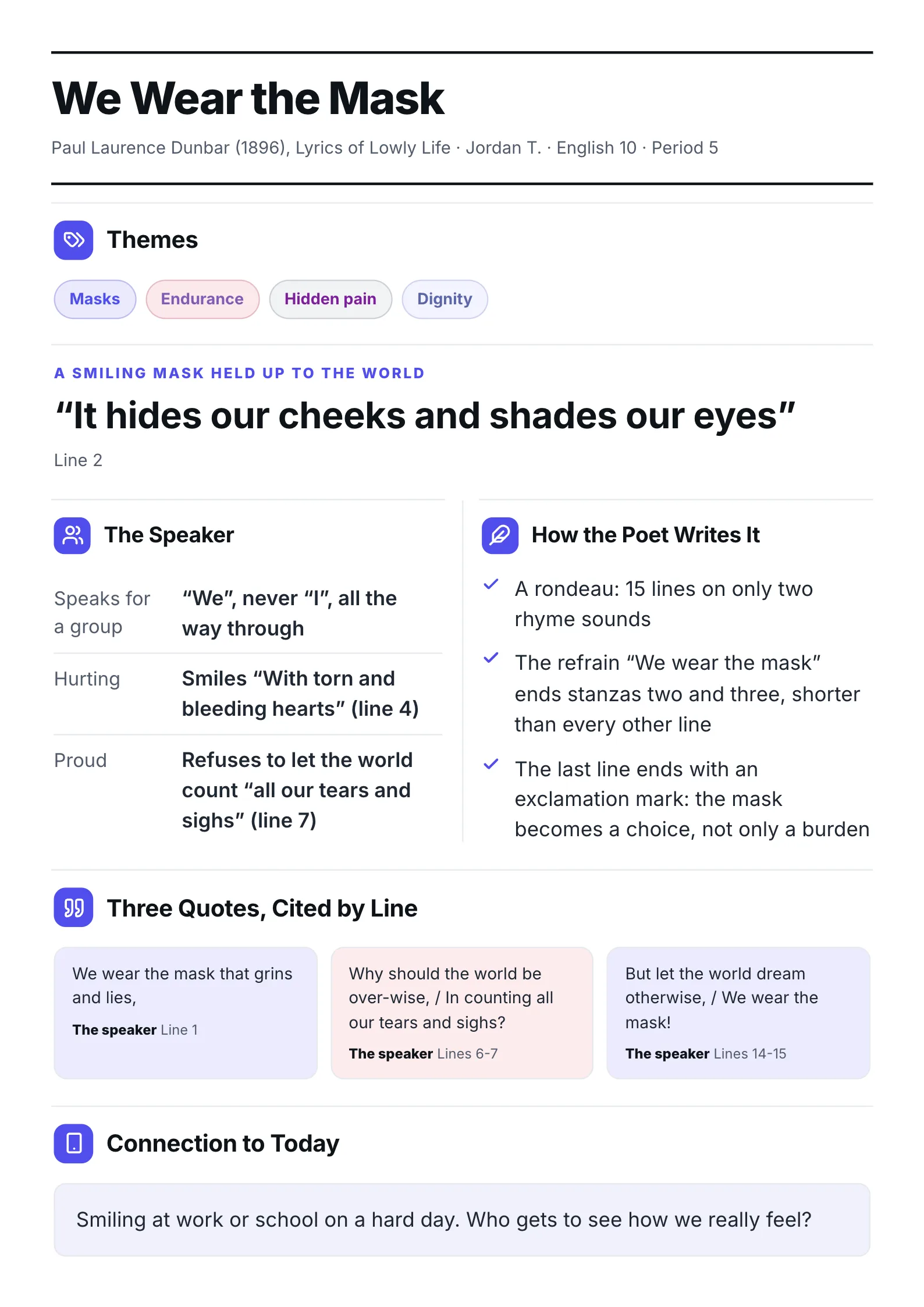
This one follows the shape most classroom sheets ask for. It was made with MakeOnepagers; the student name is a sample.
 Edit this template
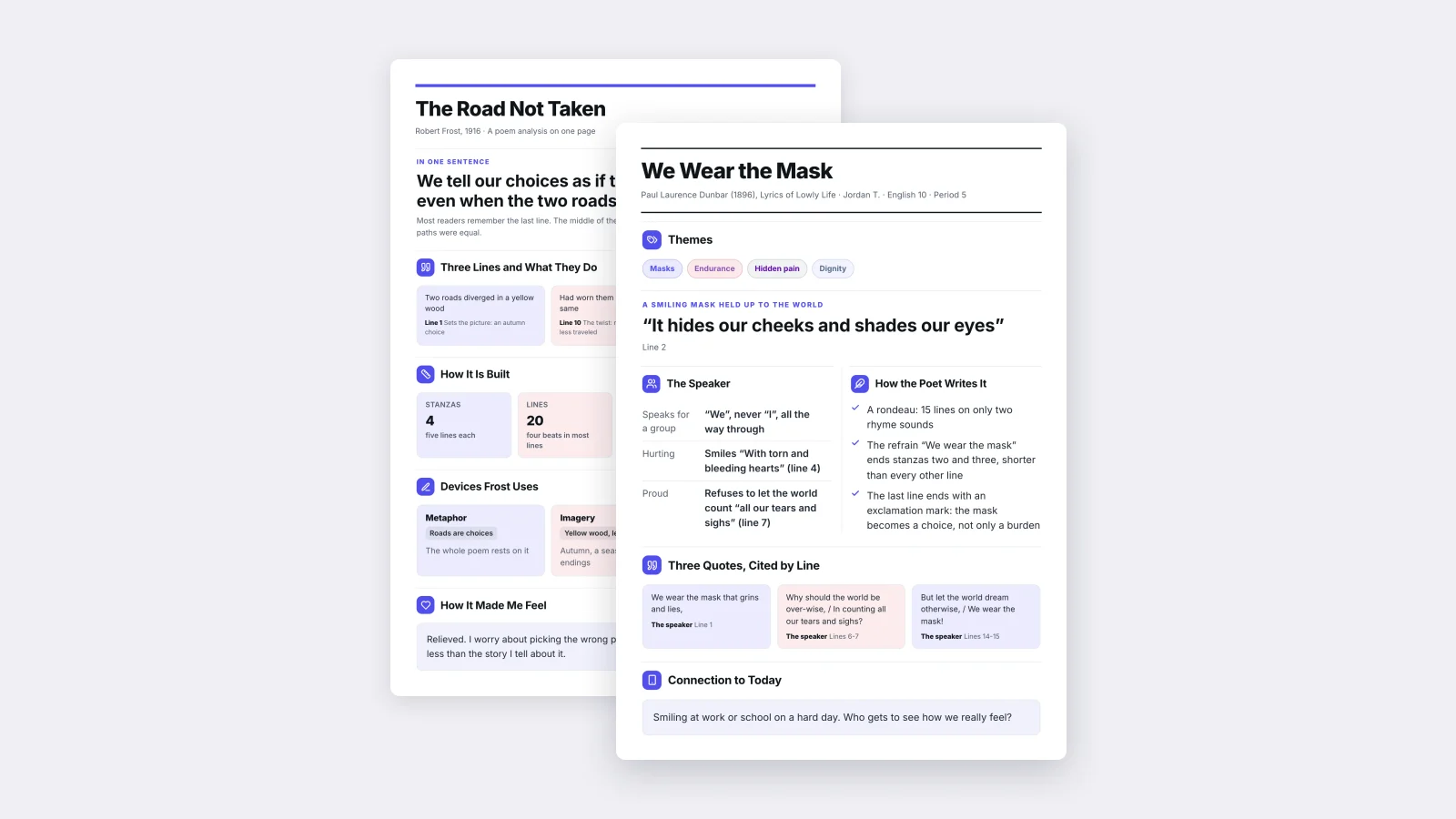
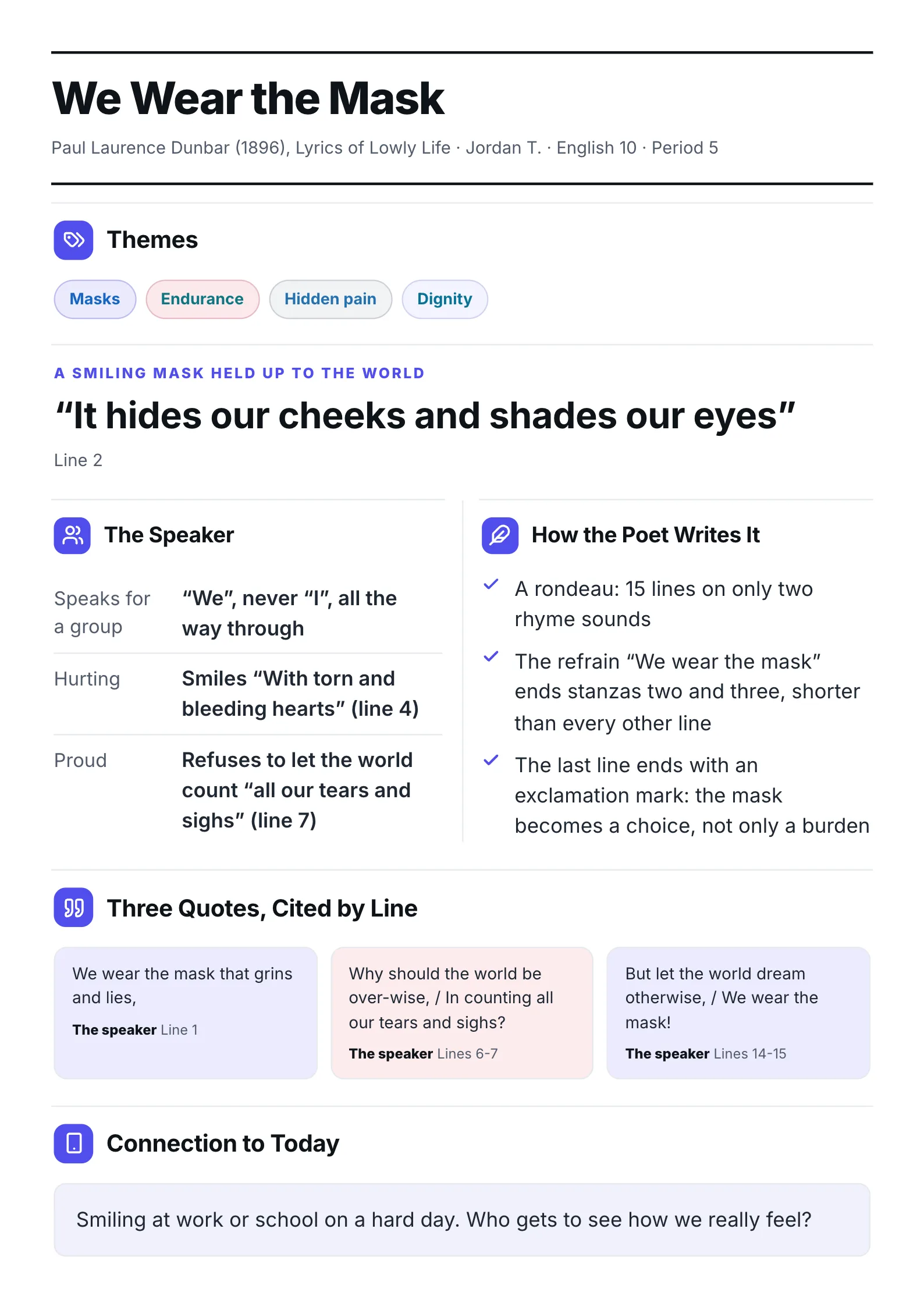
A 15-line poem read closely: the symbol, the speaker, the form and three lines cited by number.
Here is what each part does.
- Title, poet, year and collection. "We Wear the Mask", Paul Laurence Dunbar (1896), Lyrics of Lowly Life, then the student, class and period.
- Themes. Masks, endurance, hidden pain, dignity. Four words that can also run around the edge as the border.
- The symbol, with its line. A smiling mask held up to the world, with "It hides our cheeks and shades our eyes" (line 2).
- The speaker, in three traits with proof. Speaks for a group: "we", never "I", all the way through. Hurting: smiles "With torn and bleeding hearts" (line 4). Proud: refuses to let the world count "all our tears and sighs" (line 7).
- How the poet writes it. A rondeau: 15 lines on only two rhyme sounds. The refrain "We wear the mask" ends stanzas two and three, shorter than every other line. The last line ends with an exclamation mark, so the mask becomes a choice, not only a burden.
- Three lines, cited by line. The opening line, lines 6-7 and lines 14-15: the start, the question in the middle and the ending.
- Connection to today. Smiling at work or school on a hard day. Who gets to see how we really feel?
The form section is the one most students skip, and it is where this page gets specific. Counting the lines and the rhymes takes two minutes and gives you facts no one can argue with.
Open it and swap in your poem: poetry one-pager template.
Example 2: "The Road Not Taken", a poem analysis one-pager
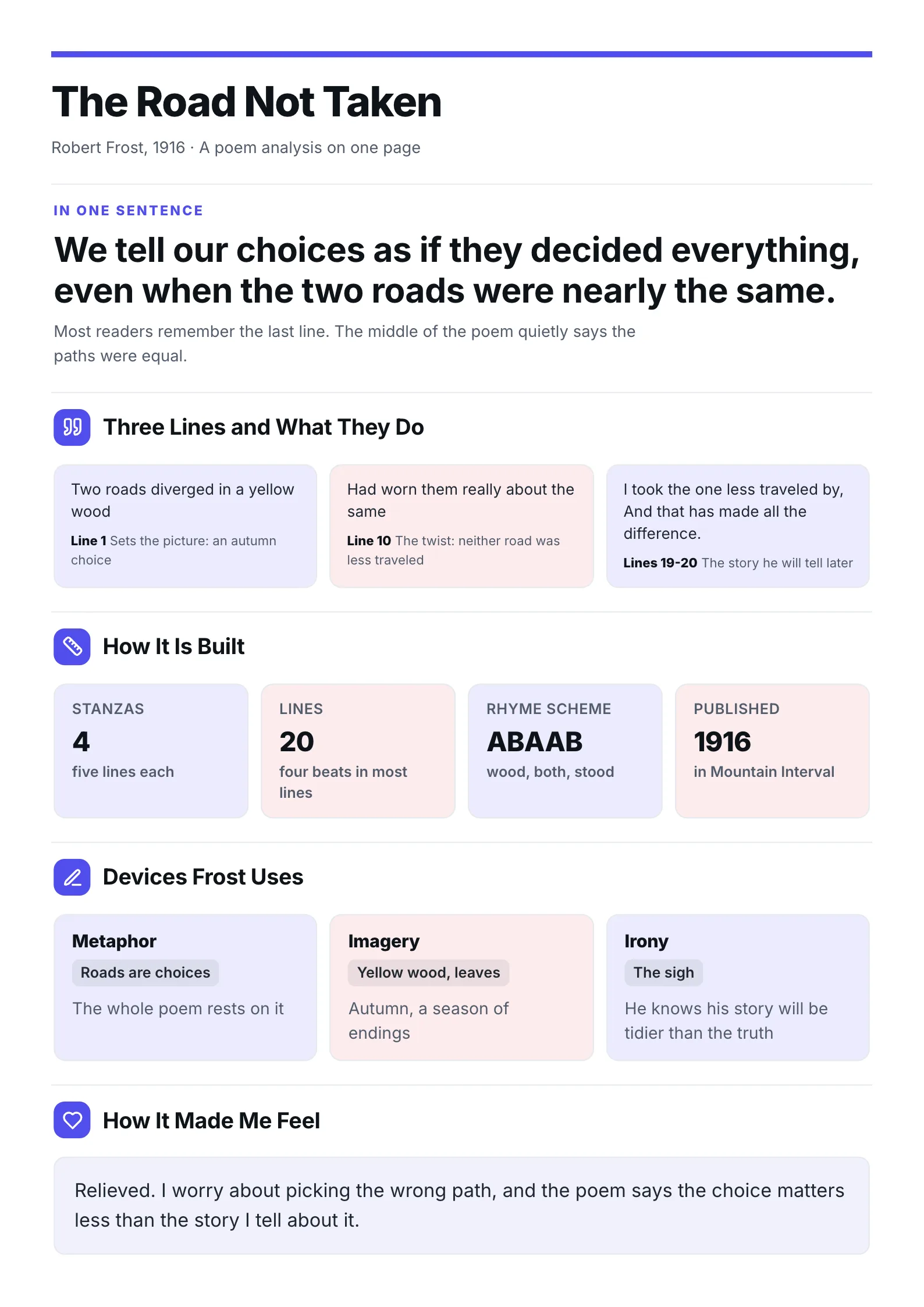
Some teachers want less art and more analysis. This layout leads with the poem's meaning in one sentence and gives each quoted line a job.
 Edit this template
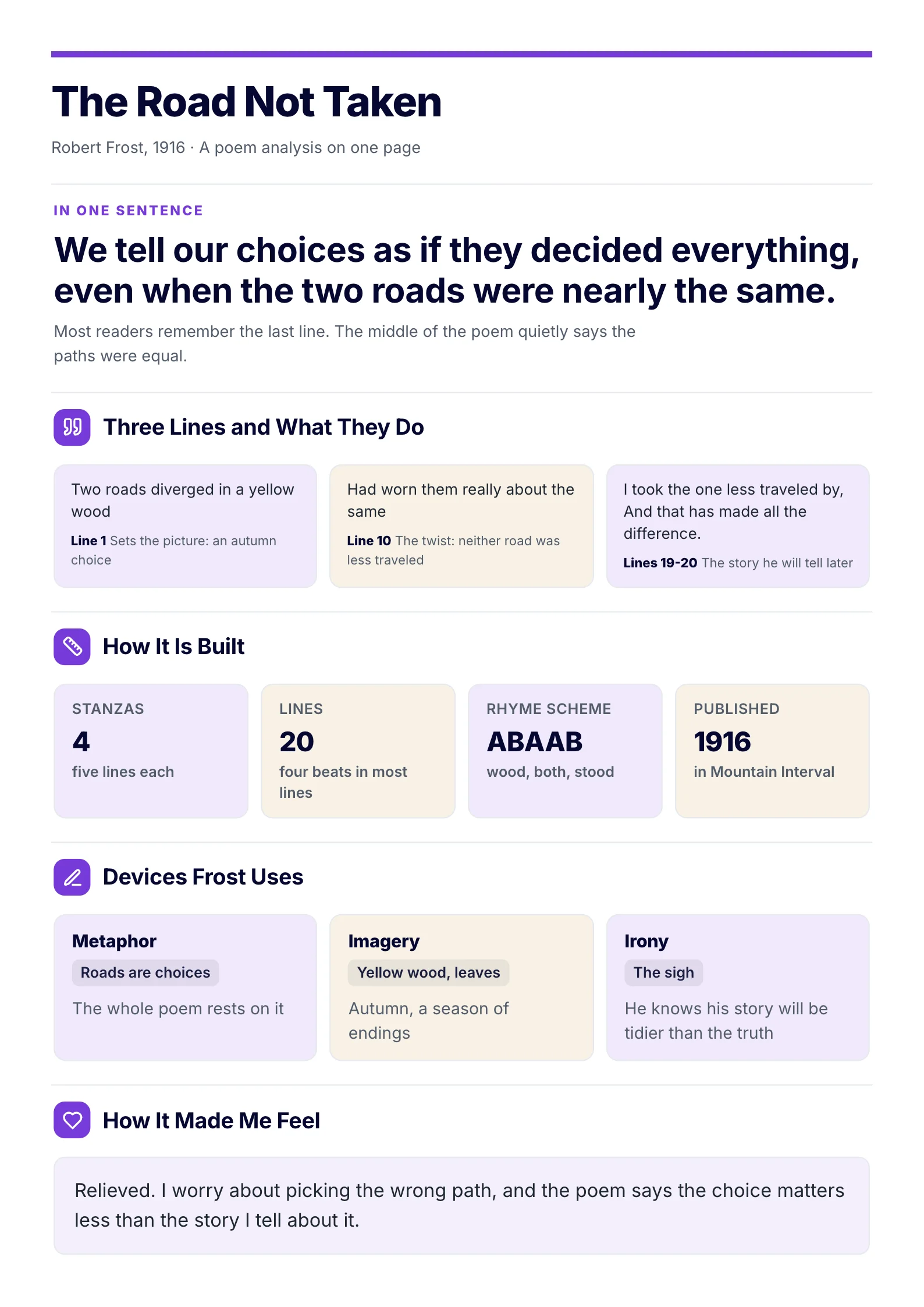
An analysis layout: the meaning first, then the lines that prove it, then the form in four numbers.
What to notice:
- The meaning in one sentence, at the top: "We tell our choices as if they decided everything, even when the two roads were nearly the same."
- Three lines, each with what it does. Line 1 sets the picture, line 10 is the twist ("Had worn them really about the same"), lines 19-20 are the story the speaker will tell later.
- The form as four facts: 4 stanzas of five lines, 20 lines, rhymed ABAAB, published in 1916 in Mountain Interval.
- Three devices with a label each: metaphor (roads are choices), imagery (yellow wood, leaves) and irony (the sigh).
- How it made the reader feel, in two sentences. This is the personal response the NCTE-adapted sheet gives points for.
Edit for free: poem analysis template.
How to read a poem for a one-pager in 20 minutes
- Read it twice, once out loud. You will hear the rhymes and the refrain you missed on the page.
- Count. Lines, stanzas, and the rhyme sounds at the line ends. "15 lines on two rhymes" is a real finding.
- Find the turn. Most poems change direction once. In "The Road Not Taken" it is line 10.
- Name the speaker. Who is talking, to whom, and how do they feel? "We" or "I" already tells you something.
- Pick three lines: one from the start, the turn and the end. Those become your quotes.
- Write the meaning in one sentence. If you cannot, read the turn again.
- Only then design the page. The analysis decides the layout, not the other way around.
Cite a poem by line, not by page
A poem's lines are numbered from the first line of the poem, so the citation stays right in any book or website. Page numbers change from edition to edition.
| What you quote | How to cite it |
|---|---|
| One line | "We wear the mask that grins and lies," (line 1) |
| Two lines in a row | "Why should the world be over-wise, / In counting all our tears and sighs?" (lines 6-7) |
| A phrase inside a line | smiles "With torn and bleeding hearts" (line 4) |
Use a slash with spaces on both sides to show where one line ends and the next begins. If your teacher asks for MLA, check their sheet for the exact format they want.
Devices worth a box
You do not need every device on the list. Pick the two or three that do the most work in your poem and say what each one does.
| Device | What to look for | Example from the two poems |
|---|---|---|
| Symbol | An object that stands for an idea | The mask |
| Refrain | A line that comes back | "We wear the mask" |
| Metaphor | One thing described as another | Roads as choices |
| Imagery | Words you can see, hear or feel | Yellow wood |
| Irony | The opposite of what is said or expected | The sigh in the last stanza |
| Form | The shape: lines, stanzas, rhyme | A rondeau on two rhymes |
Border ideas from a key phrase
The border is the one creative part the NCTE-adapted sheet makes mandatory, and it is worth 3 points there. Build it from the poem.
- Repeat the key phrase all the way around: "We wear the mask · We wear the mask".
- Use the four theme words, one on each side.
- Draw the symbol small and repeat it, with the key phrase on one side only.
- Write the poem's first and last lines along the top and bottom edges, and let the reader see how far the poem traveled.
Poetry one-pager mistakes
- Summarizing instead of reading. "The poem is about a mask" is a summary. "The speaker smiles while hurting, and the poem's two rhymes keep returning like the smile" is a reading.
- Page numbers instead of line numbers.
- Quotes with no job. Every quoted line needs a short note on what it shows.
- A border that means nothing. A pattern earns fewer points than a key phrase.
- No personal response, on sheets that give points for one.
Poetry one-pager checklist
- Title of the poem and the poet's full name
- A border built from a key phrase or the themes
- The central image or symbol, drawn and labeled
- The speaker, with what they feel
- The form: lines, stanzas, rhyme
- Two or three devices, each with what it does
- Three lines, cited by line number
- Your connection to the poem
- No blank space left on the page
Make your poetry one-pager
Open the free poetry one-pager template, replace "We Wear the Mask" with your poem, and download it as a PDF to print. Prefer an analysis layout? Start from the poem analysis template instead. More classroom ideas are in our one-pager examples for students.
Frequently asked questions
What goes on a poetry one-pager?
The poem's title and the poet's name, a border tied to a key phrase or theme, the central image or symbol, the speaker, two or three devices, three quoted lines cited by line number, and your personal response. Check your teacher's sheet, because the NCTE-adapted sheet we read makes only the title and the border mandatory and lets you pick the rest.
How do you cite a line from a poem on a one-pager?
Put the quoted line in quotation marks and add the line number in parentheses, for example (line 4). For two lines, add a slash where the line breaks and cite both numbers, for example (lines 6-7).
What is a good poem for a one-pager?
A poem of 12 to 30 lines with a clear image works best: short enough to read closely, long enough to find three lines worth quoting. "We Wear the Mask" (15 lines) and "The Road Not Taken" (20 lines) are both in the public domain.
Can a poetry one-pager be digital?
Often, yes, but check your sheet. The NCTE-adapted sheet asks for a printed copy if possible, a shared link, and a photo in case the original is lost. A designed template you can download as a PDF covers both.
What is the difference between a poetry one-pager and a poem analysis?
A poem analysis is usually an essay. A poetry one-pager shows the same reading on one sheet, with images, a border and short labeled parts instead of paragraphs.