Proposal vs Quote: What Changes at Colorado's $350,000 Line
Proposal vs quote, read from Colorado's own buying rules: below $350,000 a quote by email, above it a formal bid or a scored proposal held 180 days.

Picking between a proposal vs quote starts with what your buyer has already decided. A quote is a price for something they already know they want. A proposal makes the case for how you'd do the work, and the price is only one part of it. Start from a free one pager template.
One‑Pager examples
Real One-Pagers made with MakeOnepagers. Open any one to edit it as your own.
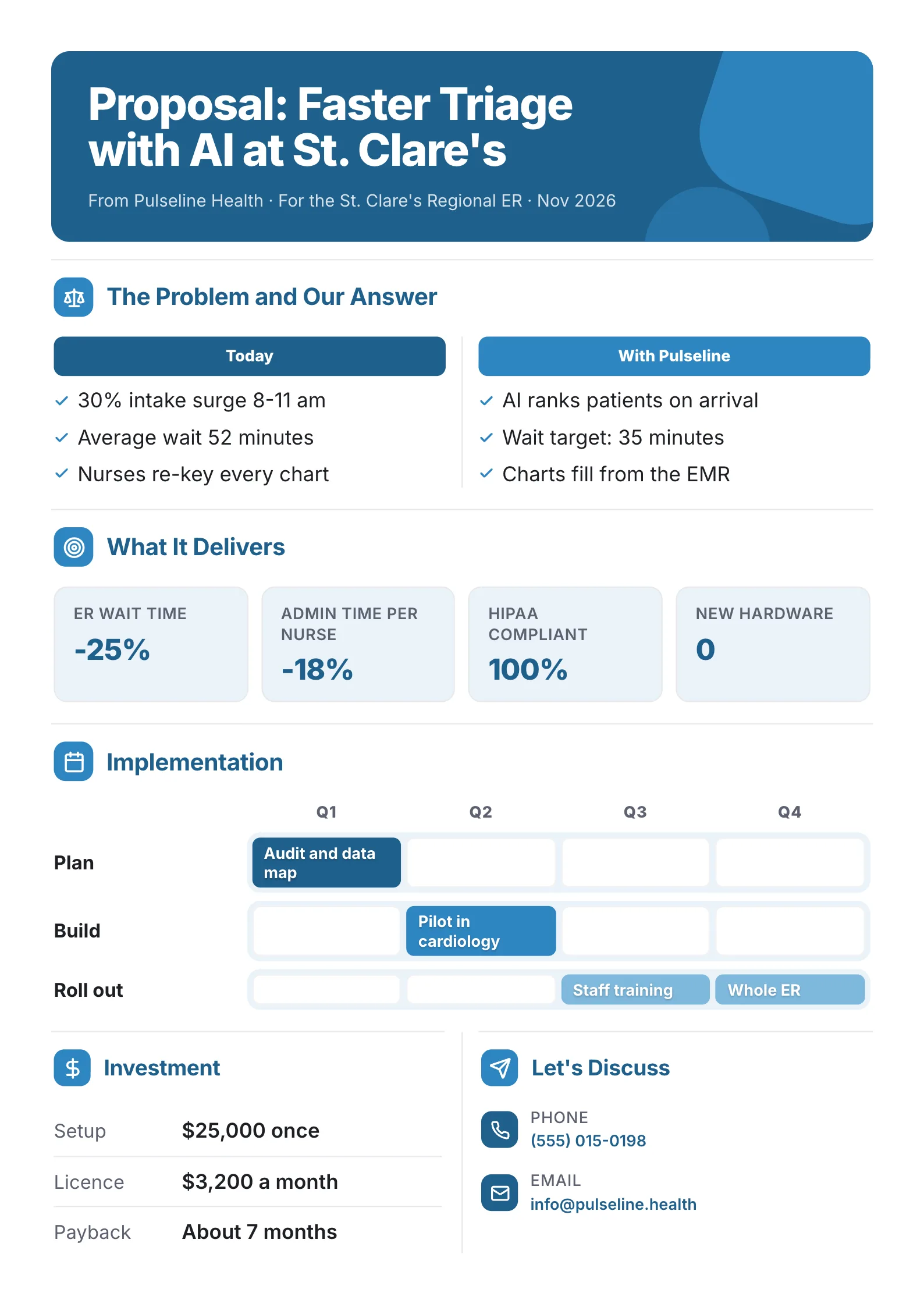 Business Proposal One-PagerEdit for free(opens in a new tab)
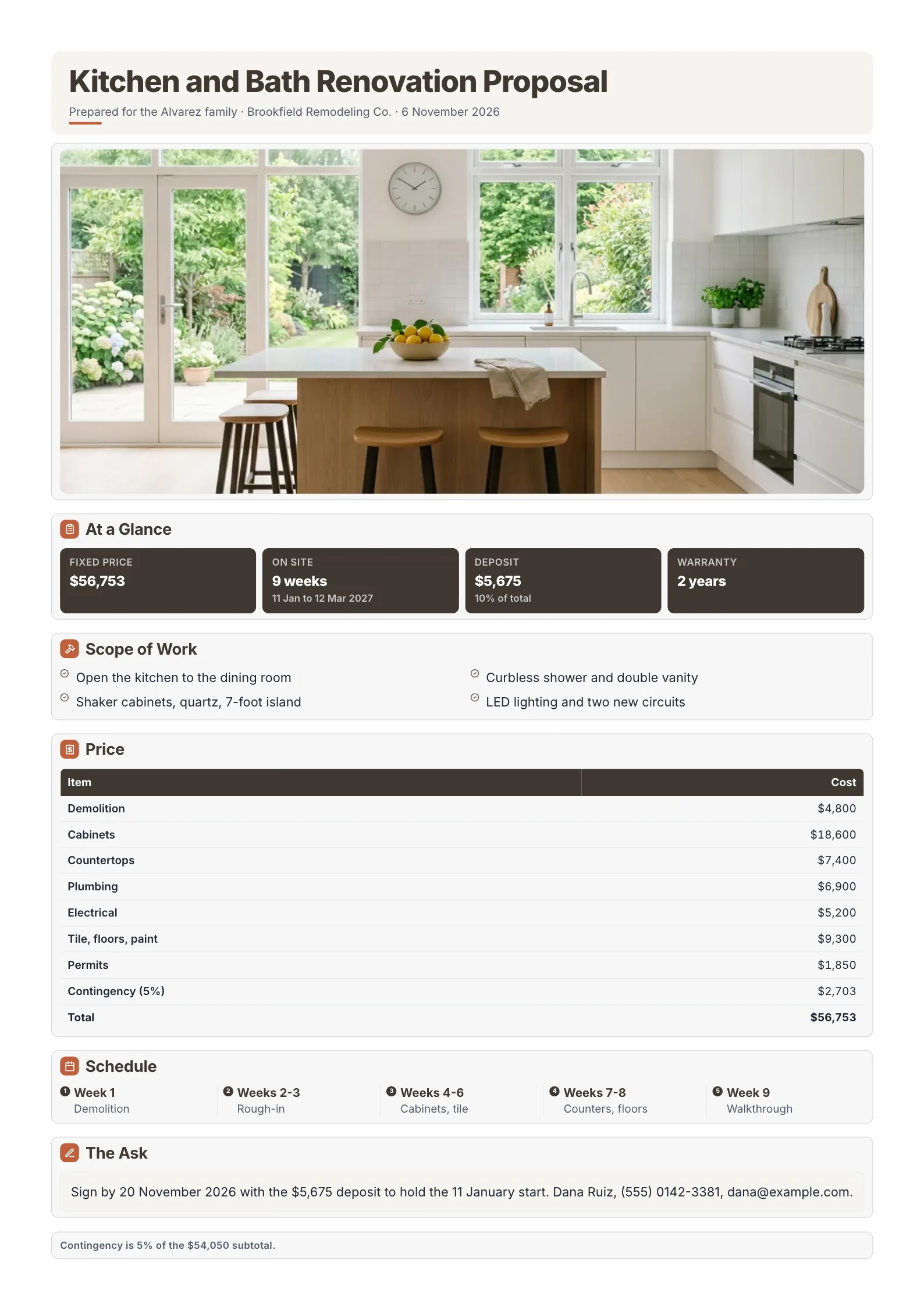 Renovation ProposalEdit for free(opens in a new tab)
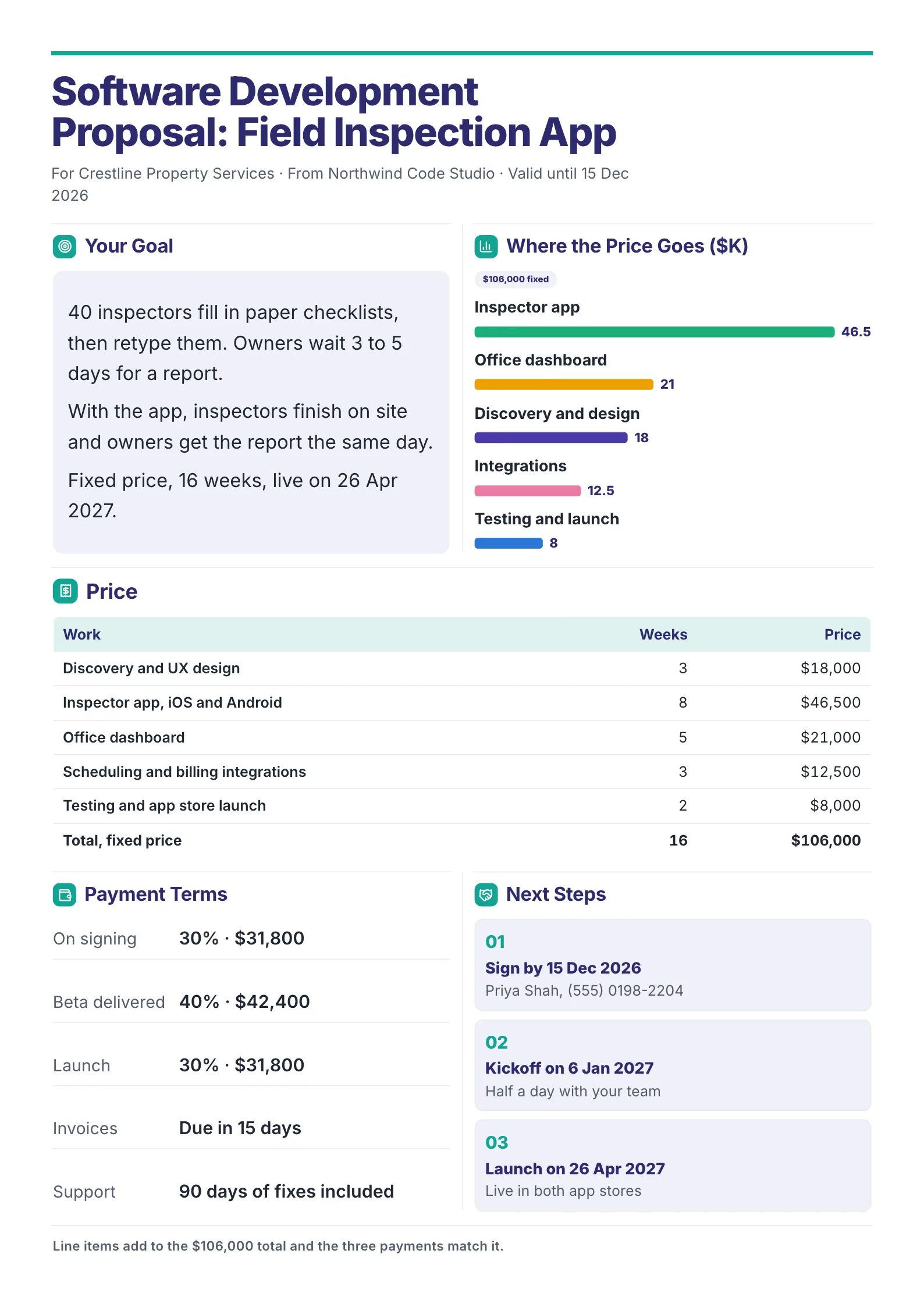 Software Development ProposalEdit for free(opens in a new tab)
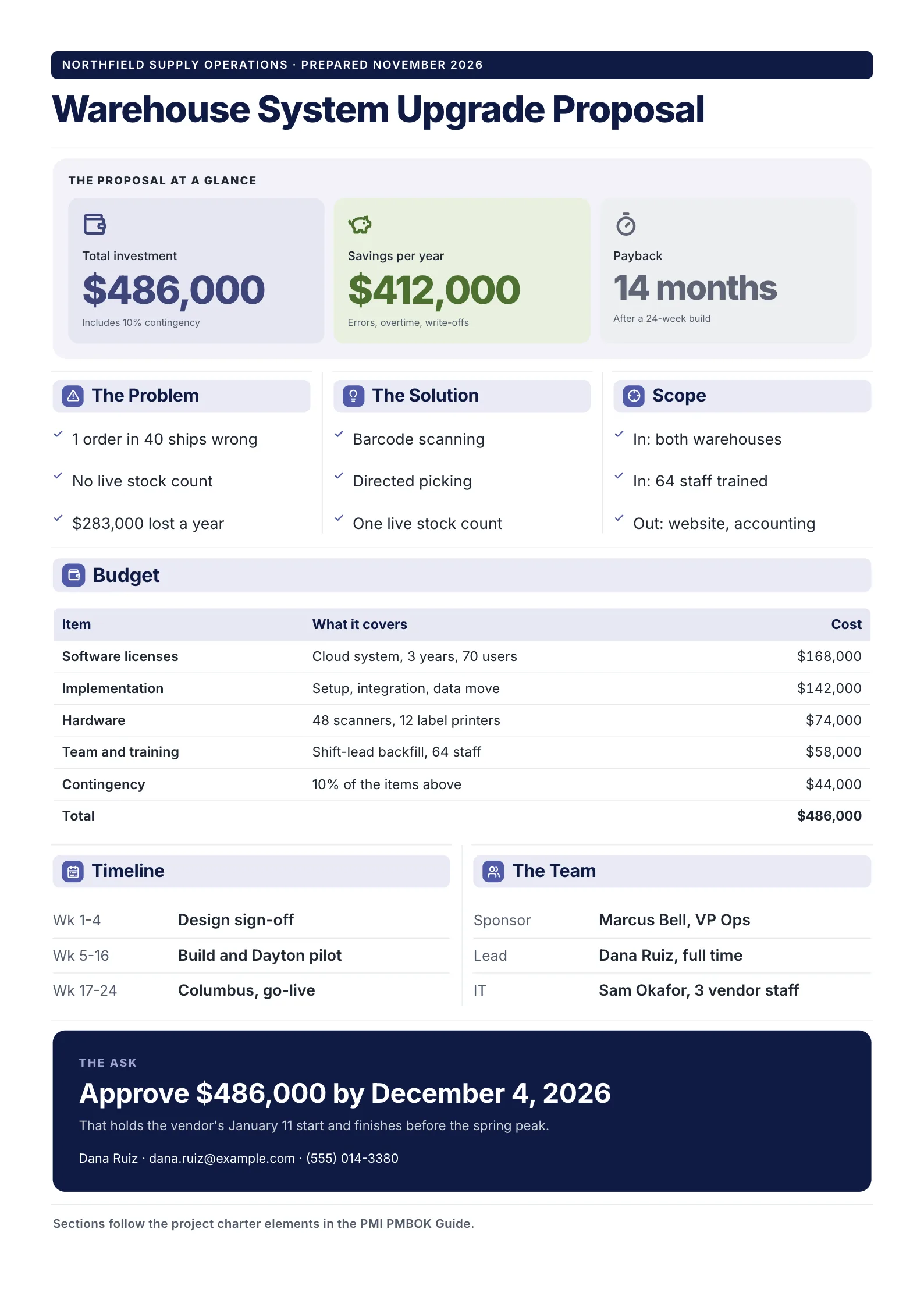 Project Proposal with BudgetEdit for free(opens in a new tab)
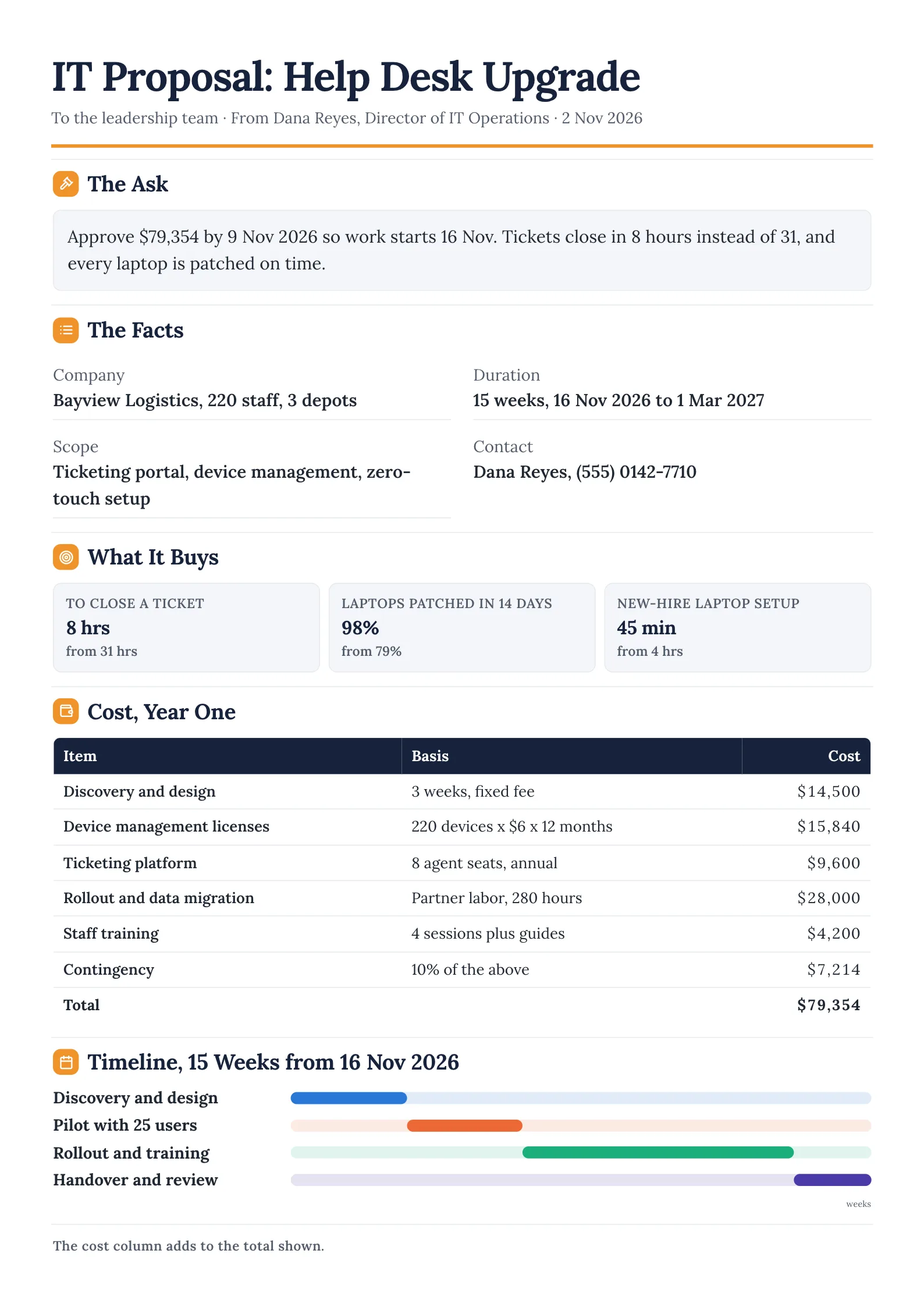 IT ProposalEdit for free(opens in a new tab)
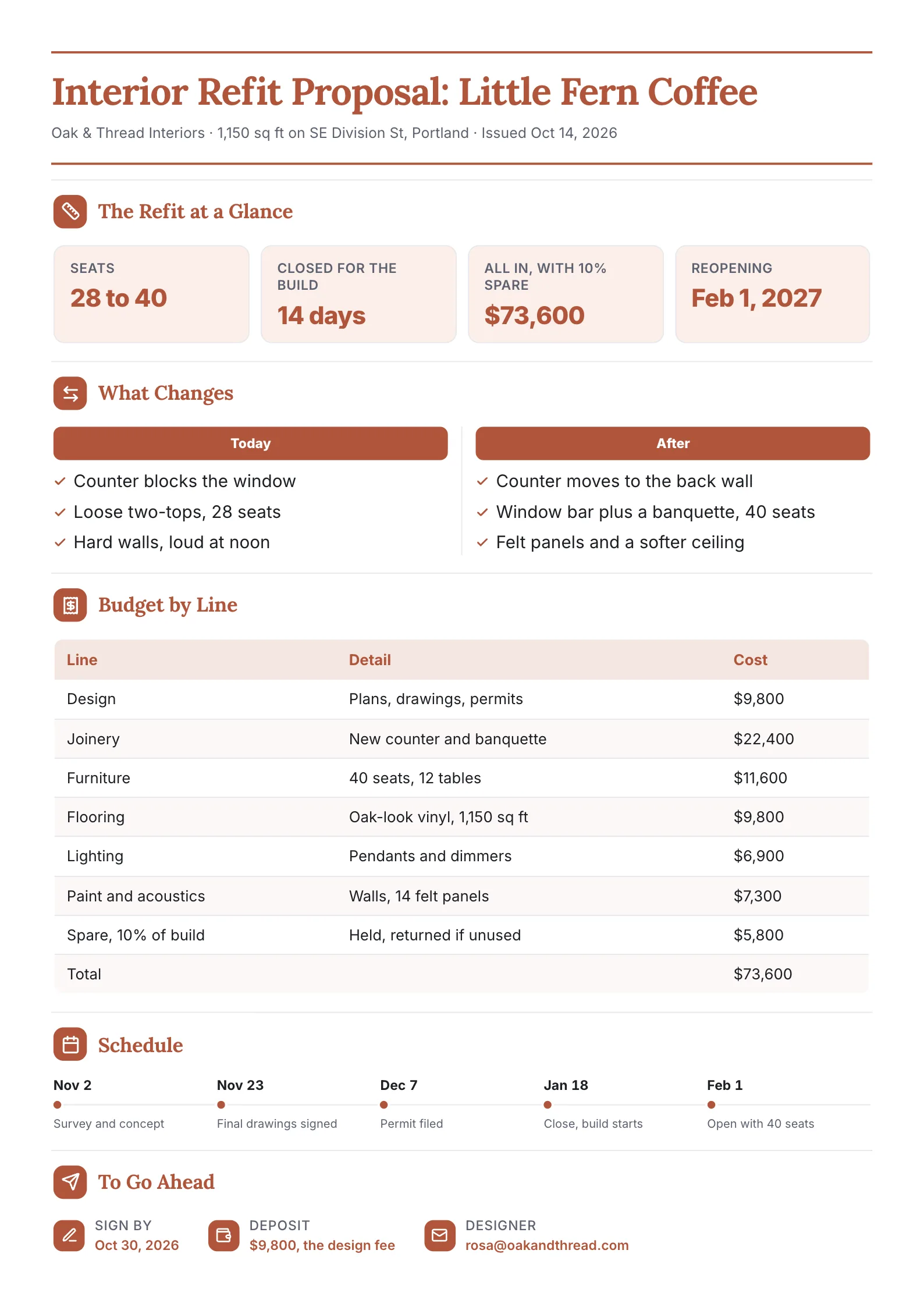 Interior Design Proposal One-PagerEdit for free(opens in a new tab)
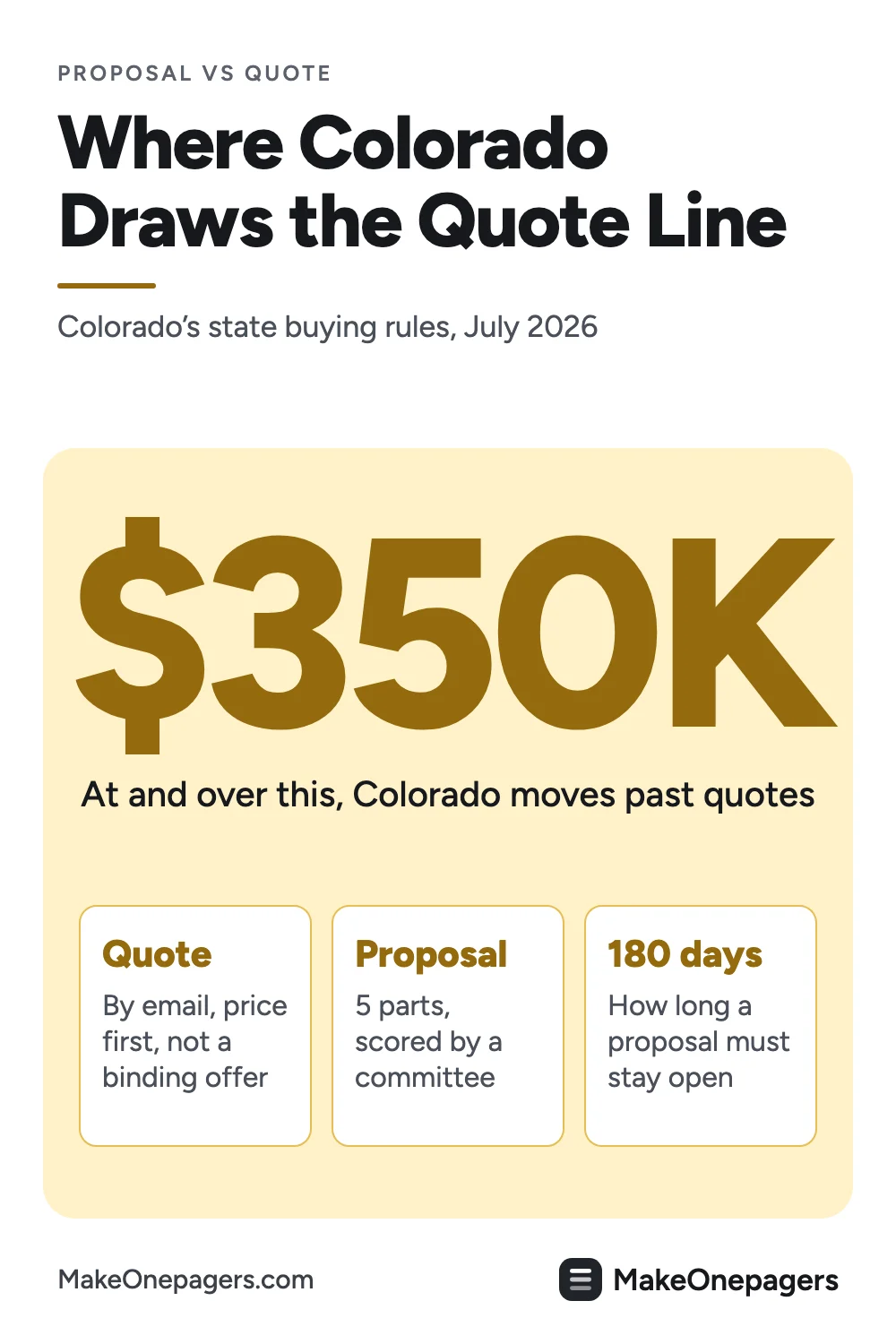
Most guides stop at that. We wanted to see where a real buyer draws the line, so we read the rules the State of Colorado uses to buy goods and services. On November 5, 2026, its purchasing office listed a clear number. Below $350,000, state buyers can ask for a documented quote by email. At $350,000 and over, they move to a formal solicitation. When that's a request for proposal, they score the answers and expect the seller to stand behind them for at least 180 days.
| Quote | Proposal | |
|---|---|---|
| Buyer has decided | What they want | Only that they have a problem |
| Answers | How much, and how soon | How, who, why you, and how much |
| Judged on | Price first | Price plus scored criteria |
| Length | Often a single sheet | As long as the questions need |
| Binding? | Often an invitation to buy | Often a firm offer |
| Typical size in Colorado | $50,000 to $350,000 | $350,000 and over |
Where Colorado draws the line
The State Purchasing and Contracts Office publishes its thresholds for goods and services, effective July 1, 2026:
- Up to $50,000: no competition required.
- $50,000 to $350,000: a Documented Quote, called a DQ.
- $350,000 and over: a Request for Proposal, an Invitation for Bid or an Invitation to Negotiate.
A footnote adds that the chief procurement officer "may approve or deny a request to use a DQ process" when the cost runs over the small purchase line. So the number moves a little, but the idea holds. Small, clear buys get quotes. Big buys get a formal bid, a negotiation or a request for proposal.
The federal government uses the same number. Its simplified acquisition threshold is $350,000, the line under which federal buyers can use their simpler methods.
What a Colorado quote asks for
The state's Documented Quote template, updated June 2026, is clear about what it isn't. It says "DQs are not intended to be “mini-RFPs” and should not involve an evaluation committee or formal evaluation criteria."
Here's what you'd send back as a seller:
- One price that covers everything. "Pricing must include any fees associated with the delivery of goods or services, including, but not limited to, shipping and installation."
- A price that holds. "Proposed pricing must remain firm during the initial term of the Contract or Purchase Order."
- An email. "Quotes will be submitted via email."
The award goes to the quote that's most advantageous to the state, "with price/cost being the primary consideration." Sample quality and delivery time can count too. The buyer still has to write down why they picked the winner, but no panel scores you. So when you quote, lead with the total, list what it includes and give the date it holds.
What a Colorado proposal asks for
The Request for Proposal template, updated the same month, asks for much more. Its proposal format lists 5 areas to cover:
- Demonstrated experience and capabilities
- Accessibility requirements
- Mandatory requirements
- A technical or business proposal
- A cost proposal
Price is one of the five, so don't let your cost table do all the work. An evaluation committee scores the rest against criteria set out in the request, and Colorado law says the award goes to the proposal "determined in writing to be the most advantageous to the state, taking into consideration the price and evaluation factors." The committee can ask questions, hold talks or ask for a best and final offer before it decides.
Check how to send yours, because the rules change too. The RFP's cover sheet says "Emailed proposals not accepted." Proposals go through the state's submission system, and the seller signs a page "evincing an intent by the vendor to be bound by its response."
Federal rules ask for the same shape. Under FAR 15.203, a request for proposals must describe the requirement, the terms, what the proposal must contain and the factors used to judge it.
Who's bound by what, and for how long
Here's the part most comparisons get backward. The top-ranked guide we read says a quote "once accepted, becomes a binding agreement" and a proposal is "typically not a legally binding contract." In public buying, the documents say the opposite.
- The federal rule. FAR 13.004 says "A quotation is not an offer and, consequently, cannot be accepted by the Government to form a binding contract." The buyer's order is the offer, and the deal exists once the seller accepts it.
- Colorado's quote. Its DQ template says "Neither this solicitation nor a Respondent’s Quote submitted in response to this solicitation constitute a legally binding offer."
- Colorado's proposal. The RFP's administrative appendix says "An Offeror’s proposal submitted in response to this solicitation shall constitute a binding offer." It also says the proposal, "including pricing, shall allow for a minimum of 180 calendar days for acceptance by the State."
So a quote invites the buyer to order, and a formal proposal is a promise the seller keeps open for half a year. Outside government, how firm your own paperwork is depends on its words. Say plainly how long your price holds, and read your terms once more before you sign.
Quote or proposal: how to choose for your business
You may never sell to the state, and the same test still works for you. Ask what your buyer still has to decide.
- They know exactly what they want. Send a quote with the items, the total and the date the price holds.
- They know the problem, but not the fix. Send a proposal that explains your plan, your team and your price.
- They're comparing you on more than price. That's a proposal, even for a small job. Give them the reasons to pick you.
- The job is big enough to need a promise. Put an expiry date on the offer, the way Colorado asks for 180 days.
Many good proposals contain a quote. Make your case first, then add a priced table near the end with the terms that make it firm.
Five proposals with the quote built in
The five MakeOnepagers proposals below use made-up firms and prices. Each one carries a priced table and a date, so it does a quote's job and a proposal's job on one sheet.
A catering proposal with a box called Your Quote
 Edit this template
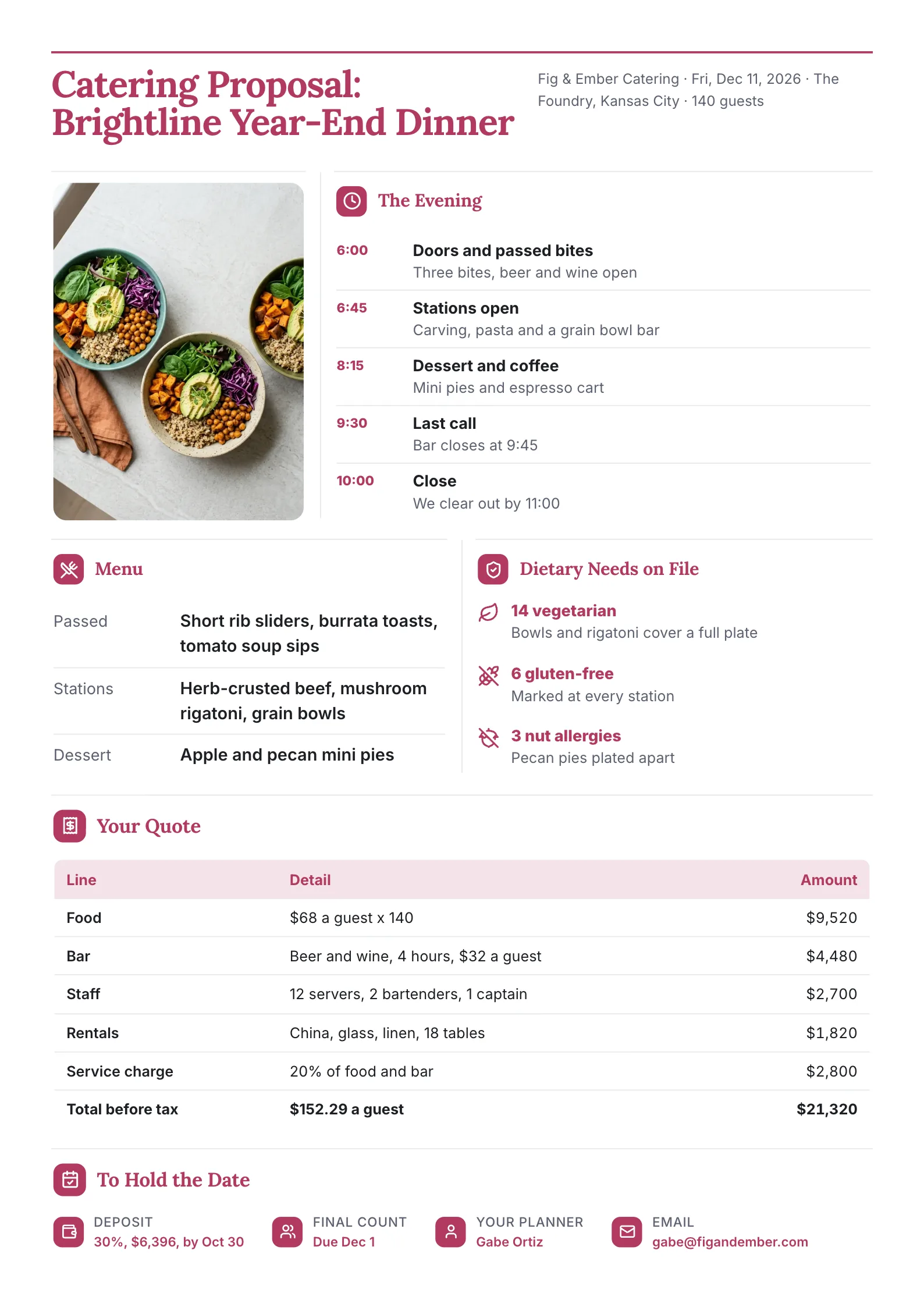
This catering proposal shows the two working together. The top half is the pitch, with the evening from 6:00 doors to a 10:00 close, the menu and the dietary needs on file, like 14 vegetarian guests and 3 nut allergies. Then comes a box called Your Quote. Food at $68 a guest for 140 guests is $9,520, and with bar, staff, rentals and a 20% service charge the total before tax is $21,320, or $152.29 a guest. A 30% deposit of $6,396 holds the date. Copy that order when you price an event. Sell the night first, then show the math.
A fee proposal for a client who's comparing firms
 Edit this template
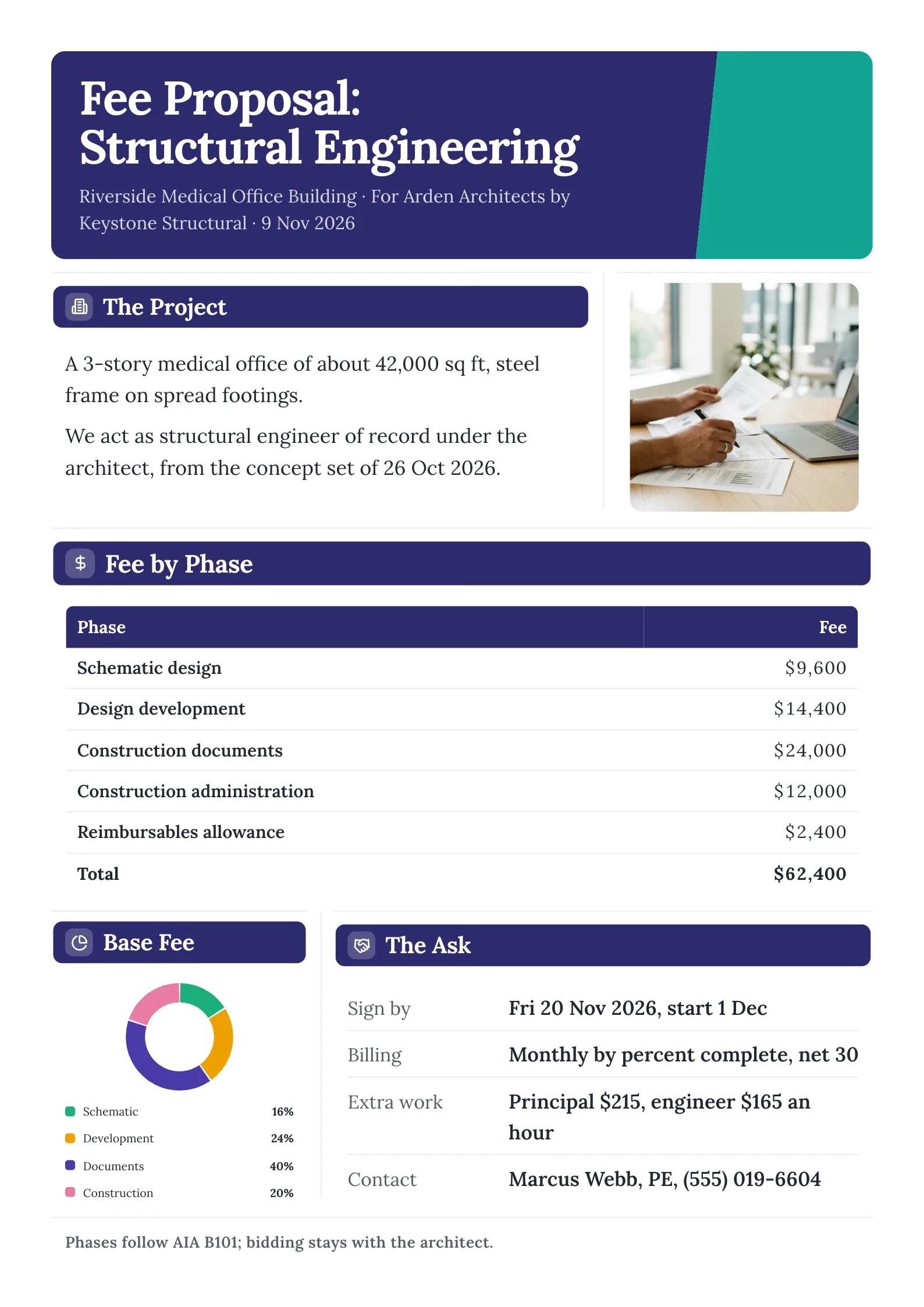
An architect picking an engineer weighs more than price, so this fee proposal opens with the project, a 3-story medical office of about 42,000 sq ft. The fee runs by phase: $9,600 for schematic design, $14,400 for design development, $24,000 for construction documents and $12,000 for construction administration, plus a $2,400 allowance for expenses, for $62,400 in all. It names the hourly rates for extra work, $215 for a principal and $165 for an engineer, and asks for a signature by Friday, November 20, 2026. Name your extra-work rates the same way, so your client knows the price of a change before asking.
A retainer proposal with an end date on the offer
 Edit this template
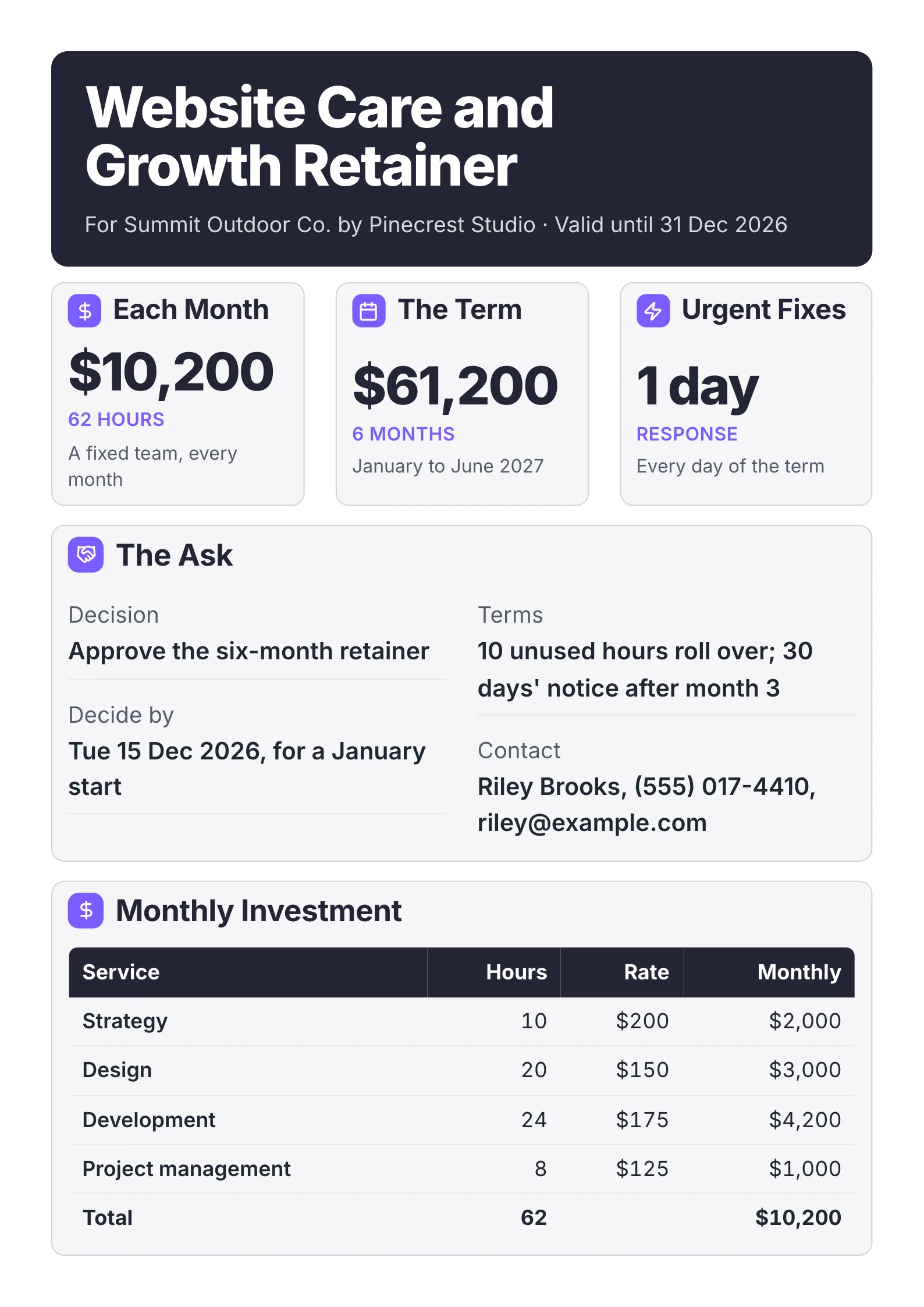
This retainer proposal puts its expiry date right under the title: valid until December 31, 2026. It sells a fixed team at $10,200 a month for 62 hours, split across strategy, design, development and project management. Over the 6-month term that's $61,200. The terms are short and clear. Ten unused hours roll over, and either side gives 30 days' notice after month 3. Put your own valid-until date just as high.
A solar proposal that shows its math
 Edit this template
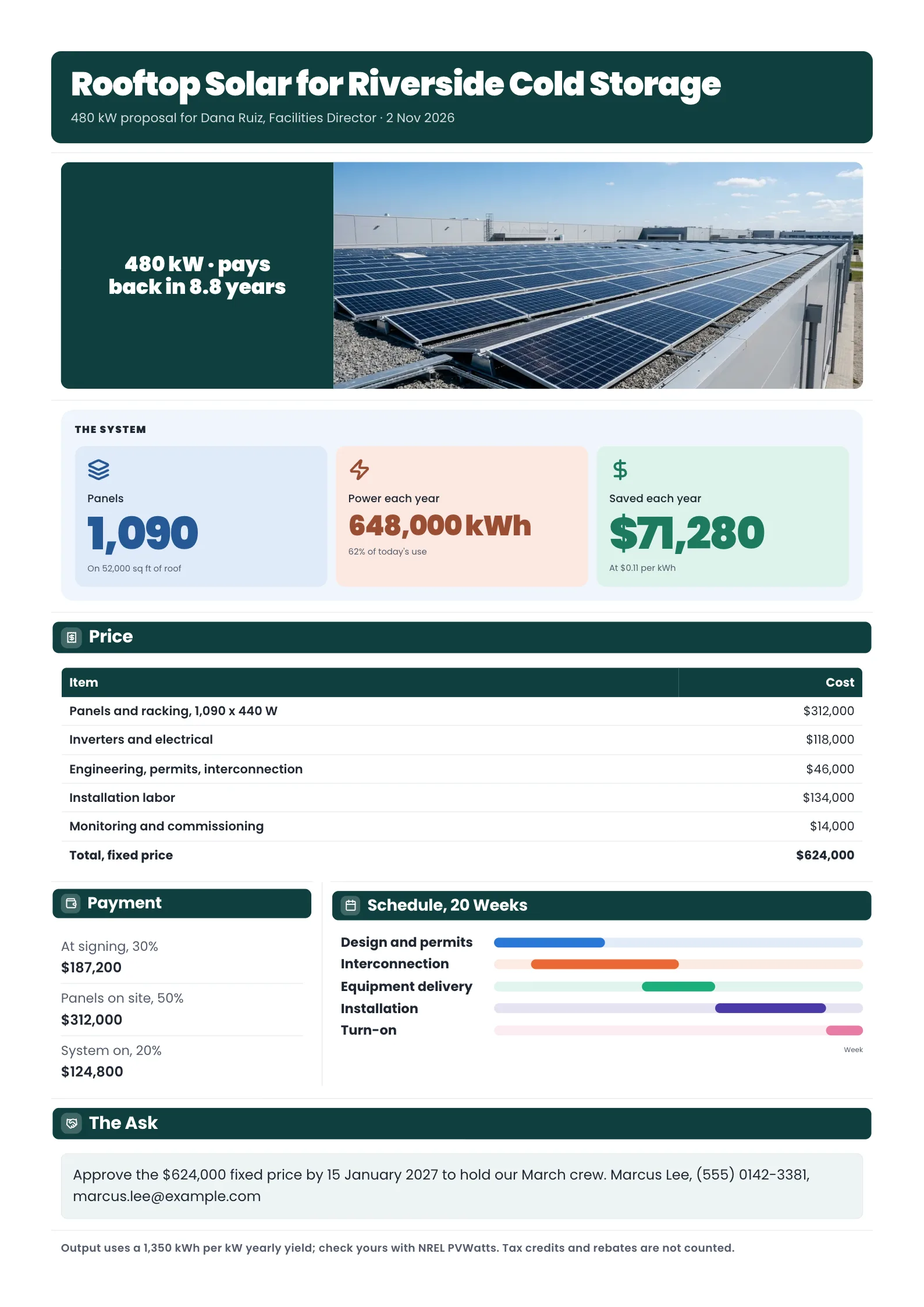
A $624,000 job needs more than a total. This solar project proposal explains the system first: 1,090 panels making 648,000 kWh a year, which saves $71,280 at $0.11 per kWh. Then the fixed price is itemized, from $312,000 for panels and racking to $14,000 for monitoring, and paid in three steps of 30%, 50% and 20%. It asks for approval by January 15, 2027 to hold a March crew, and it says plainly that tax credits and rebates are not counted.
A retreat proposal priced line by line
 Edit this template
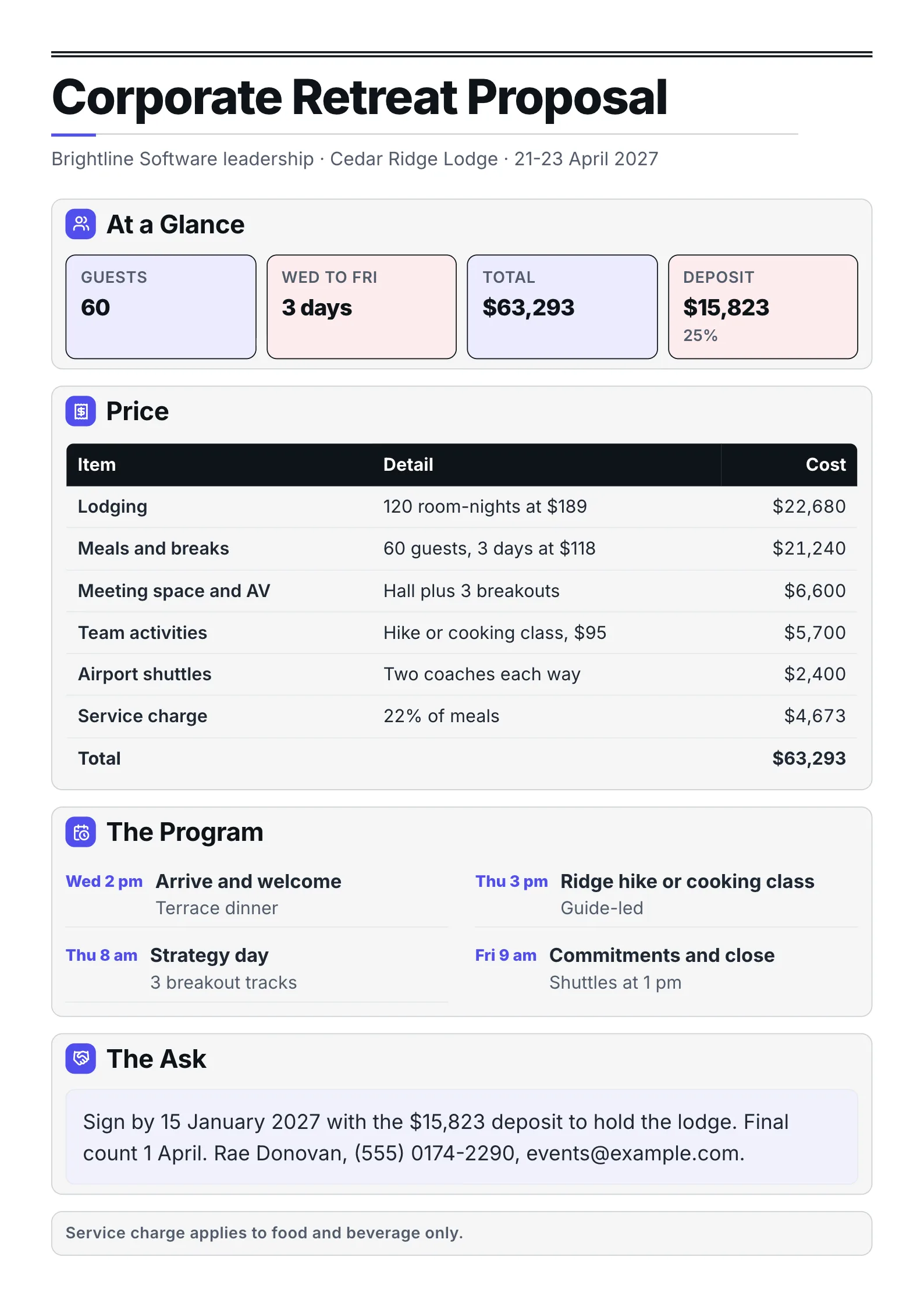
This corporate retreat proposal puts 60 guests, 3 days, a $63,293 total and a $15,823 deposit at the top. Its price table shows how each line was built, like 120 room-nights at $189 for $22,680, and notes that the 22% service charge applies to meals only. The program sits beside it, from Wednesday's welcome to Friday's close, and the ask is to sign by January 15, 2027.
Make your proposal
Pick the MakeOnepagers proposal closest to your job, write the case at the top and put your priced lines and a valid-until date at the bottom. If you're starting from notes or a brief, the free AI One-Pager generator can lay out the first draft. When your buyer only needs a price, use a quote template instead. To plan each section, read how to write a proposal, and for a general client pitch, open our business proposal template.
Frequently asked questions
Is a quote legally binding?
It depends on its wording and who's buying. In federal buying, a quote is not an offer, so the buyer's order is what starts the contract. Colorado's quote template says the same. In private deals, it turns on the quote's wording and your state's law, so say plainly how long the price holds and what makes the deal final.
Can a proposal include a quote?
Yes, and most good ones do. Put the case for your approach first, then a priced table with the total, payment steps and the date the price holds. The catering and solar samples above both work this way.
What's the difference between a request for quote and a request for proposal?
A request for quote asks sellers to price something the buyer has already defined, and price usually decides it. A request for proposal asks sellers how they'd solve a need, and a panel scores the answers on several factors. In Colorado, a documented quote covers buys from $50,000 to $350,000. At $350,000 and over, a request for proposal is one of three formal options, beside an invitation for bid and an invitation to negotiate.
How long should a proposal stay open?
Long enough for your buyer to decide. Colorado asks for at least 180 days on a formal proposal, because a scored review takes time. For a business client, pick a date that fits how fast they usually decide, and print it so nobody has to guess.
Should I send a quote or a proposal for a small job?
Send a quote if the client already knows what they want and is mainly comparing prices. Send a short proposal if they're comparing you on skill, approach or timing as well, even when the job is small. For the quote itself, our guide on how to write a quote for a job walks through each line with five trade examples.




