How to Write a Quote for a Job: 7 Steps and 5 Trade Examples
How to write a quote for a job in 7 steps, with roofing, plumbing, painting, electrical and HVAC examples, and the FTC's 3-day rule for quotes signed at home.

Here's how to write a quote for a job. See the work first, then put it on one sheet. Start with the scope, a quote number, the date and a valid-until date. Then price each line by a unit your customer can check, add tax and the total, set your terms and leave a place to sign. One more thing matters if your customer signs at home. On November 13, 2026 we read the Federal Trade Commission's Cooling-Off Rule. It covers most consumer sales of $25 or more agreed at the buyer's home, and none of the four top guides on this question mentions it. Below you'll find the 7 steps, five finished trade quotes to copy, and what the rule asks your quote to say. Start from a free one pager template.
One‑Pager examples
Real One-Pagers made with MakeOnepagers. Open any one to edit it as your own.
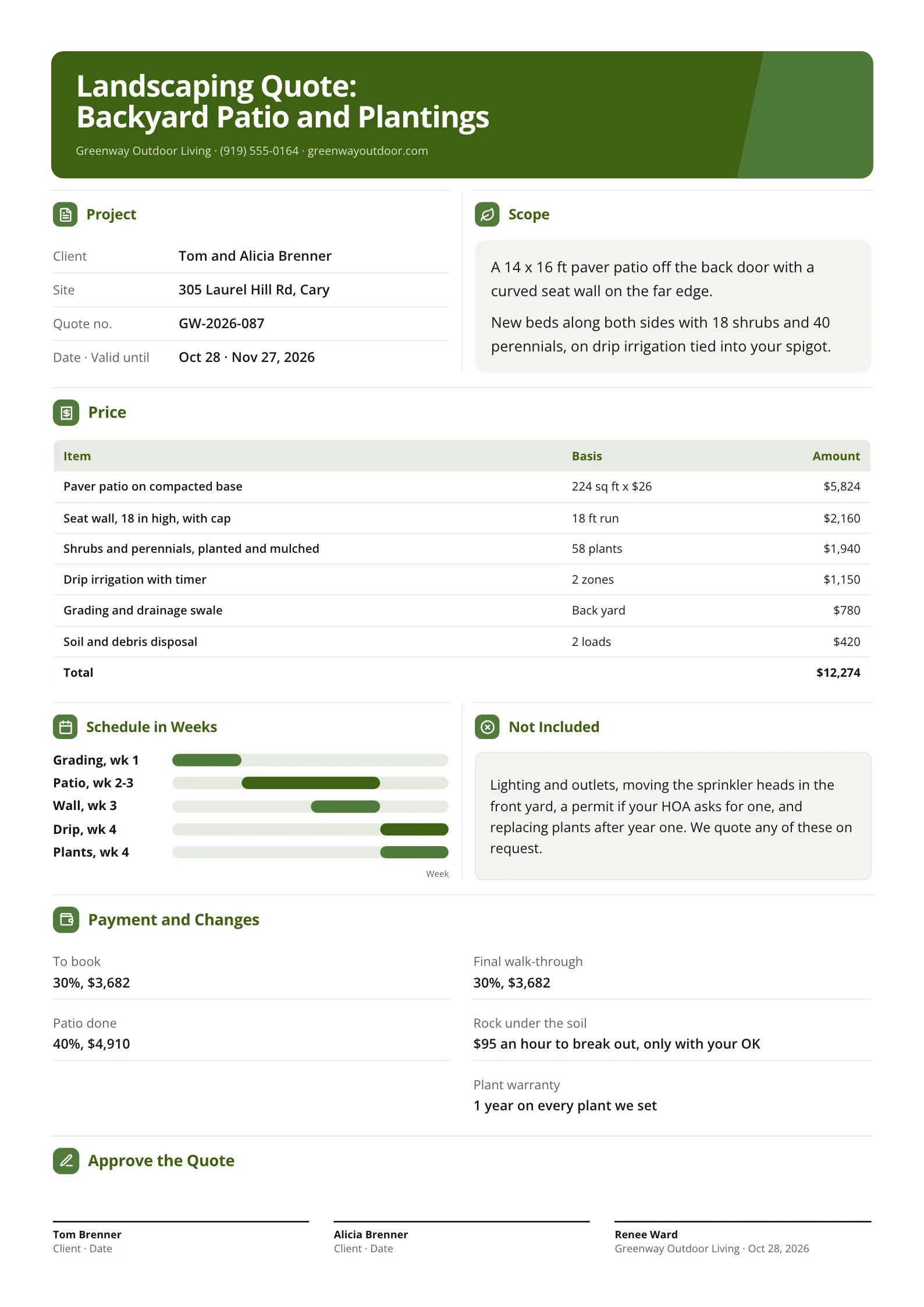 Landscaping Quote: Backyard Patio and PlantingsEdit for free(opens in a new tab)
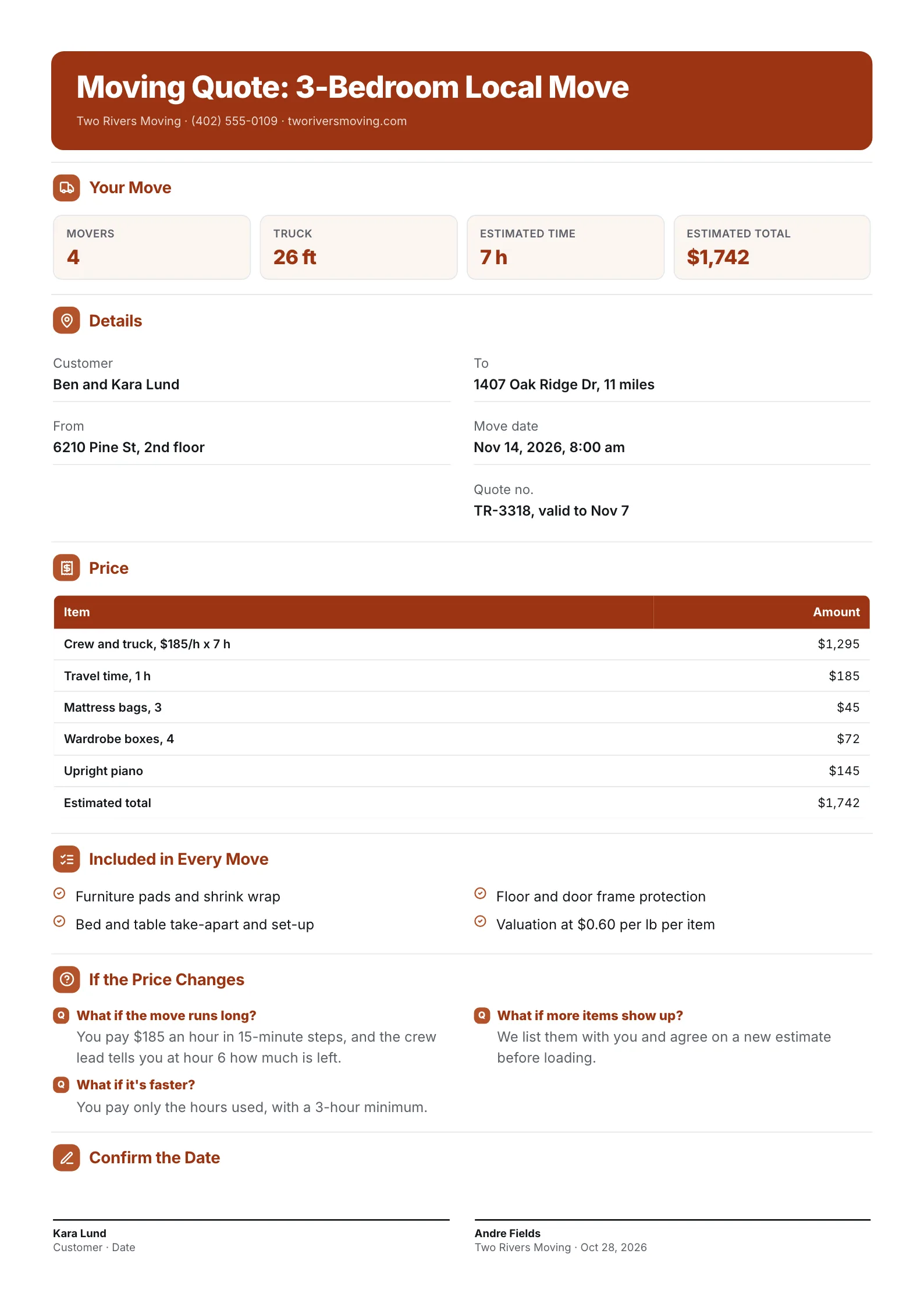 Moving Quote: 3-Bedroom Local MoveEdit for free(opens in a new tab)
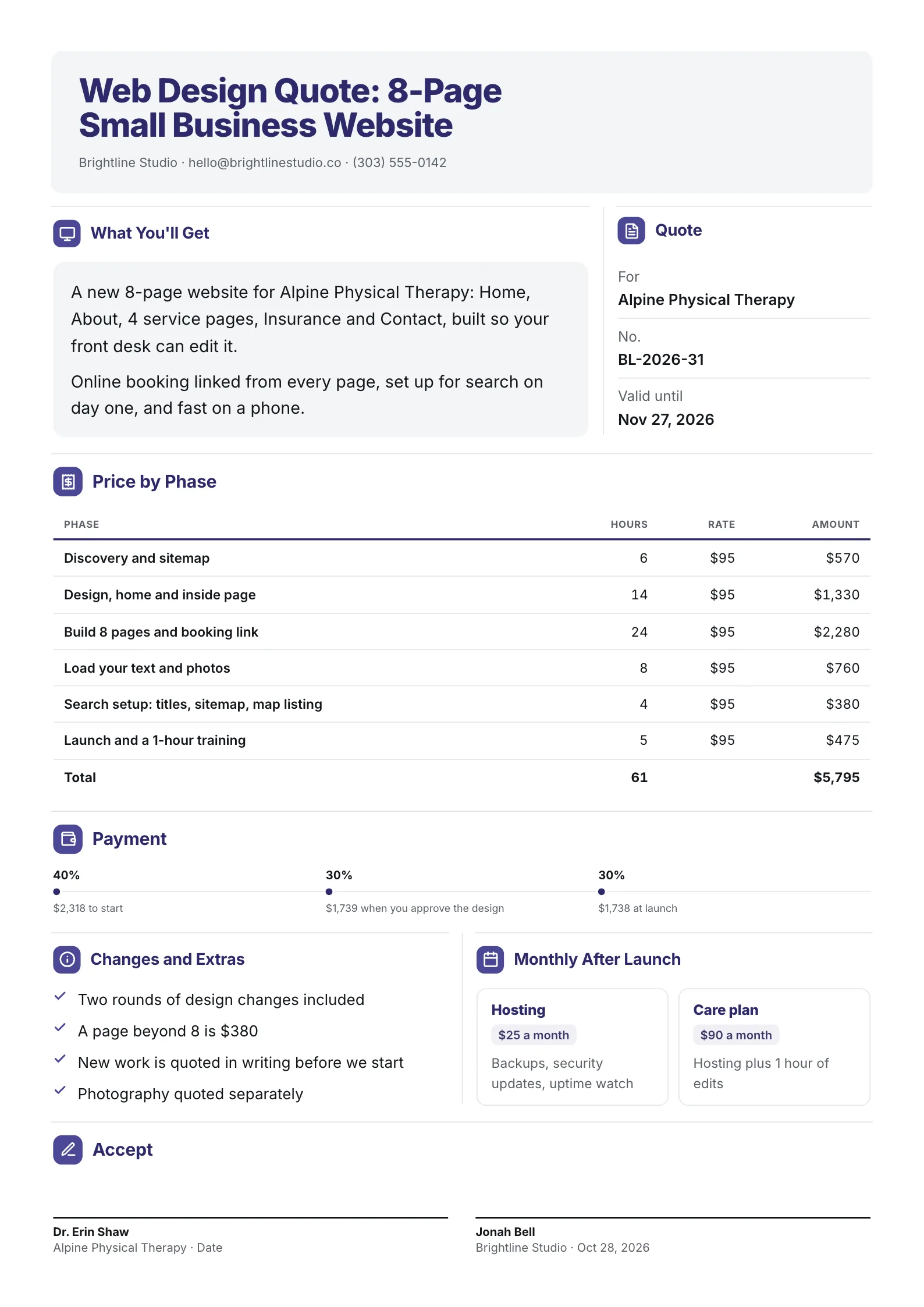 Web Design Quote: 8-Page Small Business WebsiteEdit for free(opens in a new tab)
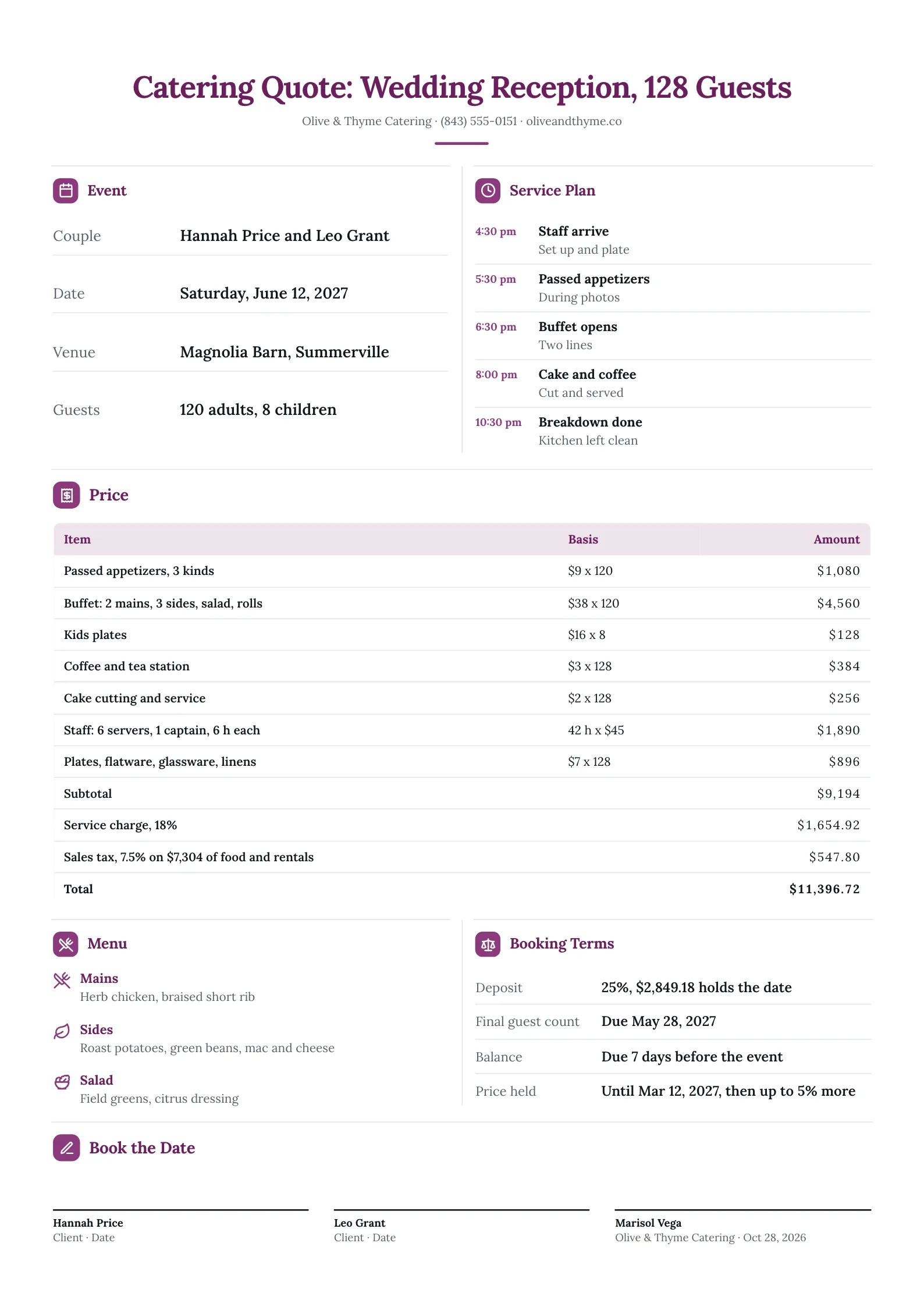 Catering Quote: Wedding Reception, 128 GuestsEdit for free(opens in a new tab)
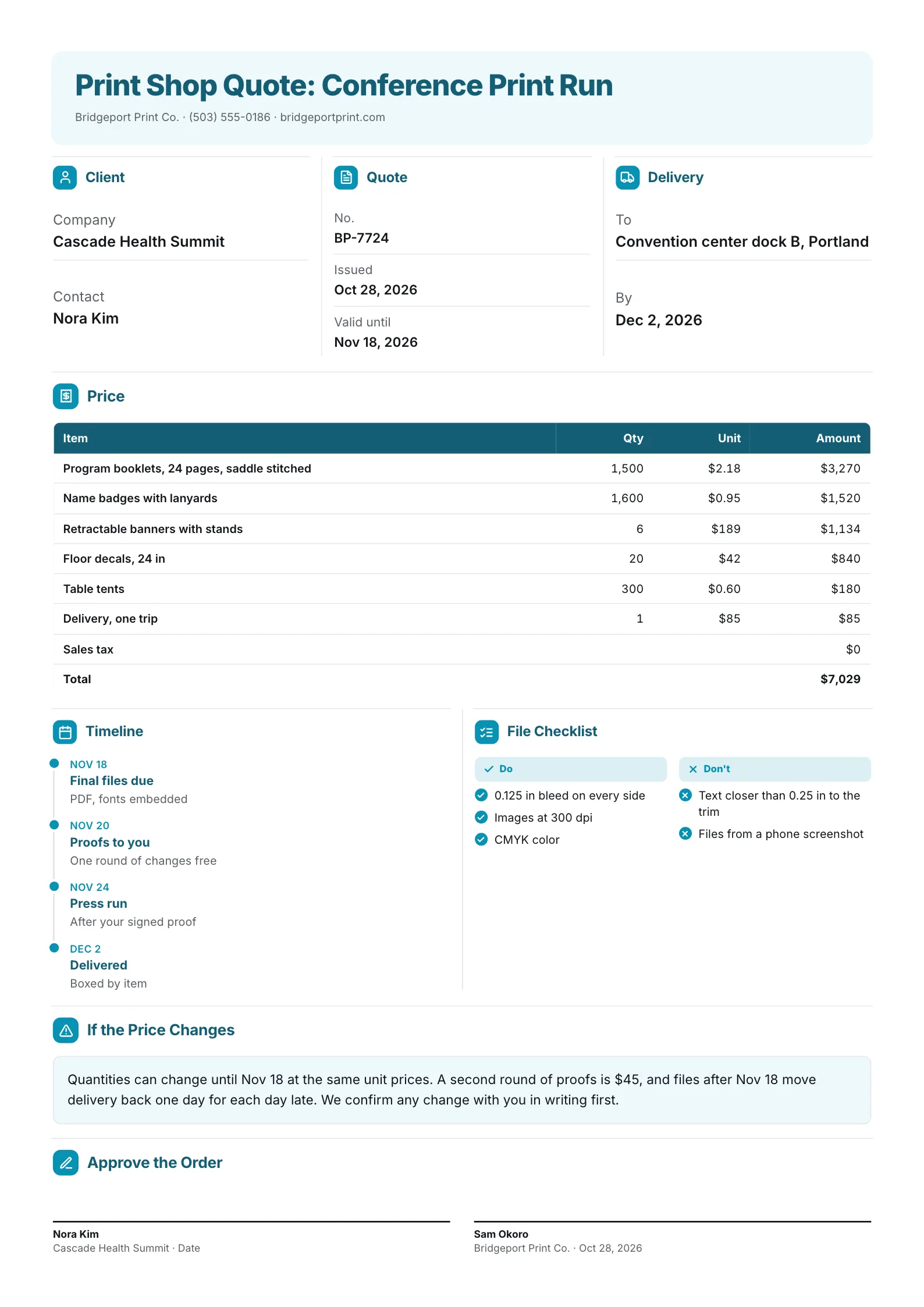 Print Shop Quote: Conference Print RunEdit for free(opens in a new tab)
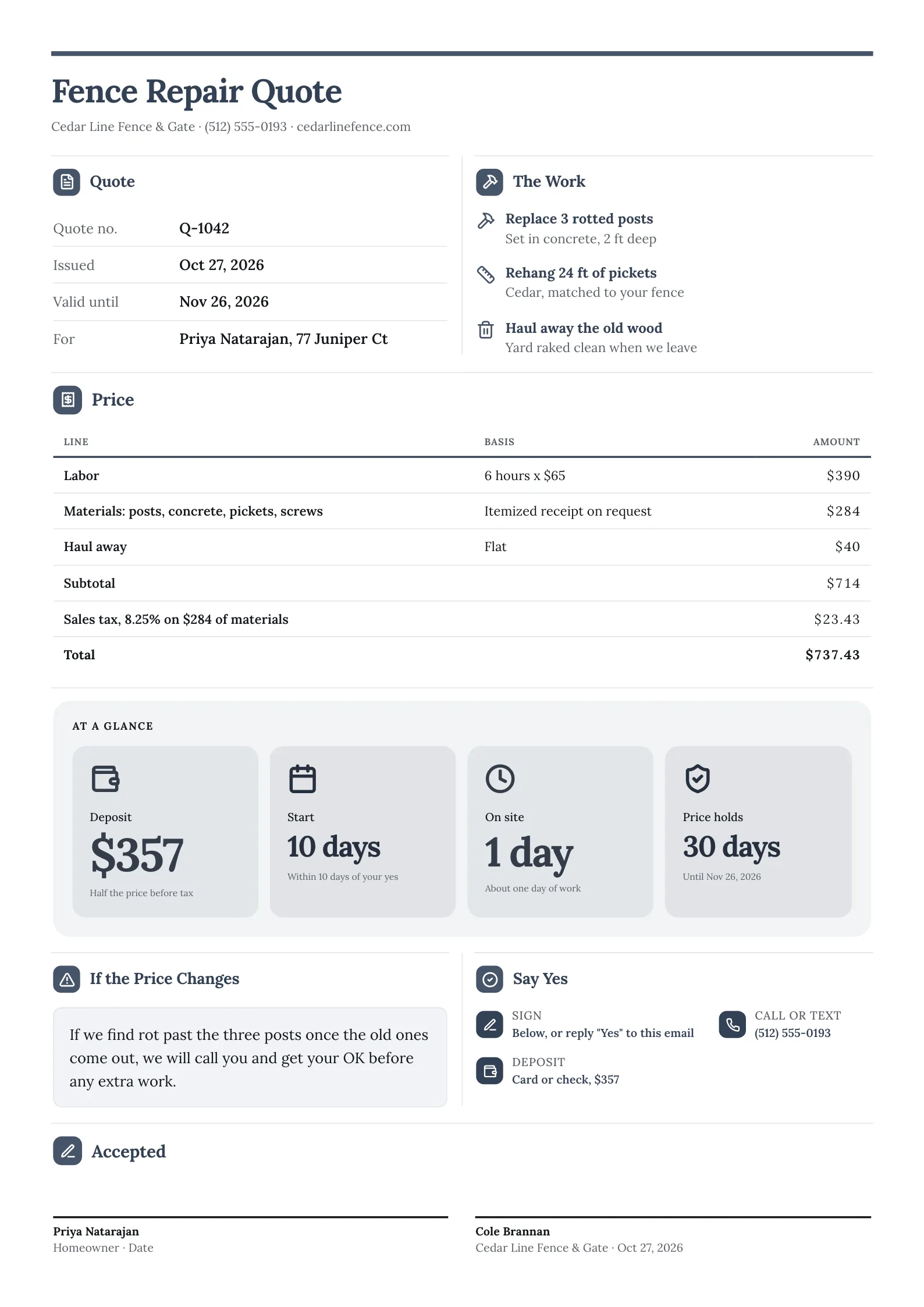 Fence Repair QuoteEdit for free(opens in a new tab)
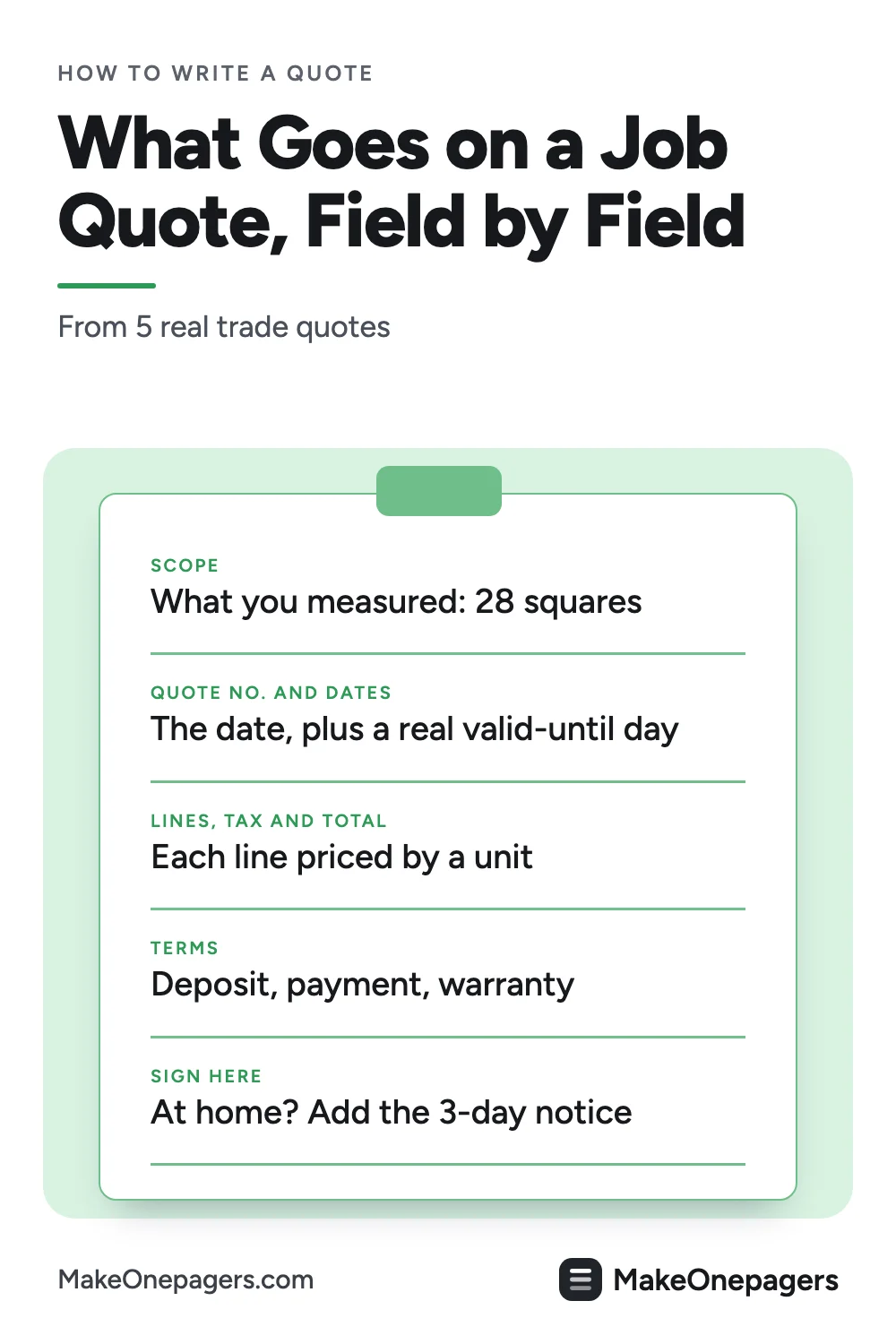
What your customer wants to know before saying yes
Strip away the logo and the layout, and every quote answers five questions:
- What exactly will you do? The work, in words a homeowner can picture.
- What will it cost, and why? Each part of the price on its own line.
- How long does this price last? A real date, written out.
- What happens next? The deposit, the start date and how payment works.
- How do I say yes? A line to sign or a reply to send.
If one of those is missing, the customer has to call you to ask. Every call like that is a chance for them to call someone else instead.
How to write a quote for a job, step by step
The examples below come from five quotes in our library, each for a different trade. Each one is a real layout you can edit with your own prices.
1. Walk the job and measure before you price
A quote written from a phone call is a guess. Go and look, take photos, and measure the things you'll charge by. Then write the scope in the customer's words and yours side by side, so you both mean the same thing.
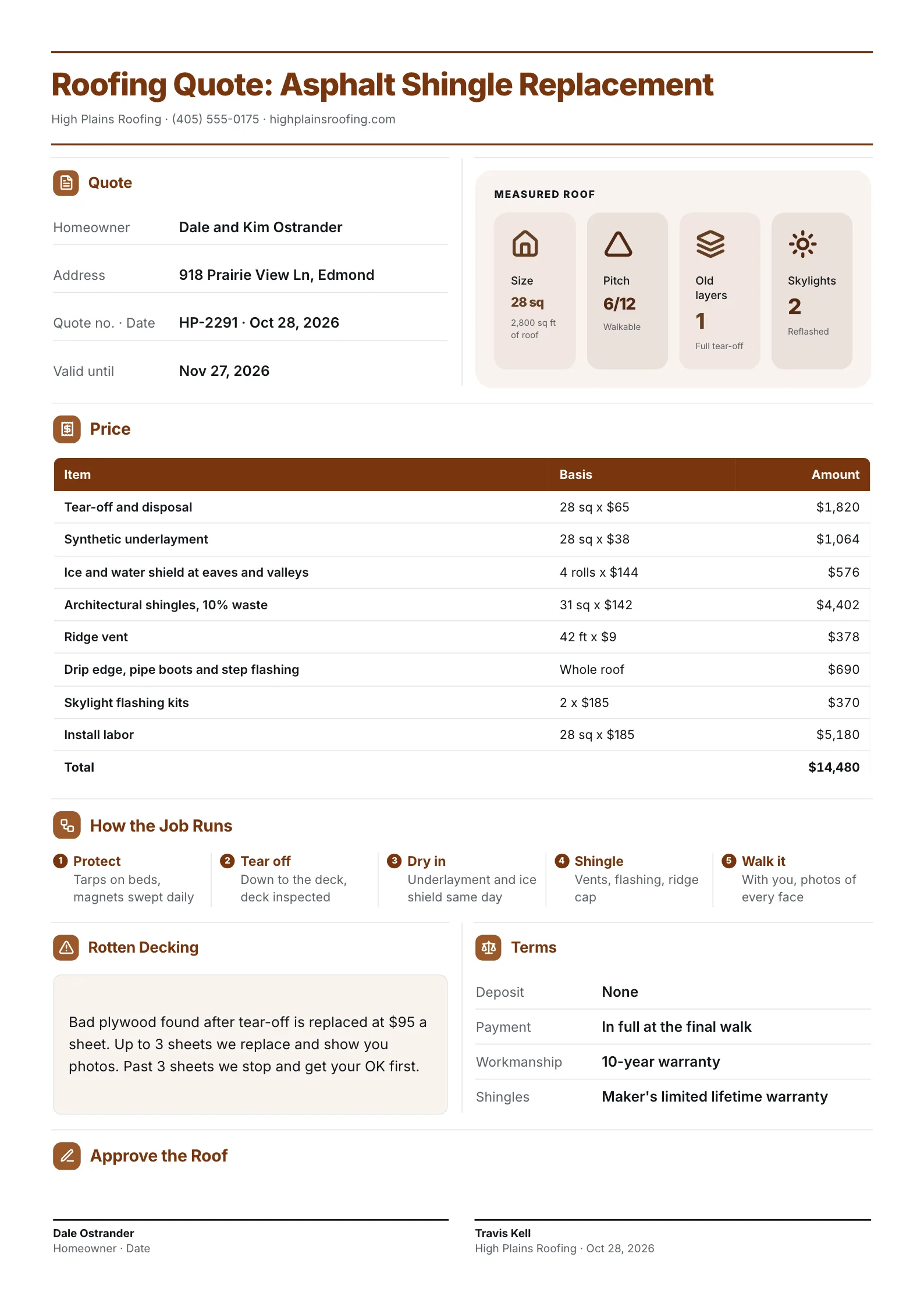
The roofing quote below opens with a "Measured Roof" box before a single price appears: 28 squares (2,800 sq ft of roof), a 6/12 pitch the crew can walk, one old layer to tear off and two skylights to reflash. A homeowner who has never heard the word "square" still sees that someone climbed up and counted.
 Edit this template
Open the roofing quote template to start from this layout.
2. Give it a number, a date and a last day
Put a quote number and the date at the top, so you and your customer can find it later. Then add a valid-until date. Write the actual day, such as "Valid until Nov 27, 2026", because "30 days" leaves your customer counting.
How long should it last? Base it on how fast your own costs move. The roofing quote above holds for 30 days. The plumbing quote further down holds for 14, from October 28 to November 11, which suits a part whose price can change from one supplier order to the next.
3. Price each line by a unit your customer can check
A single lump sum makes people wonder what's hiding inside it. Break the price into lines, and price each line by something your customer can see or count: doors, squares, feet, hours or rooms.
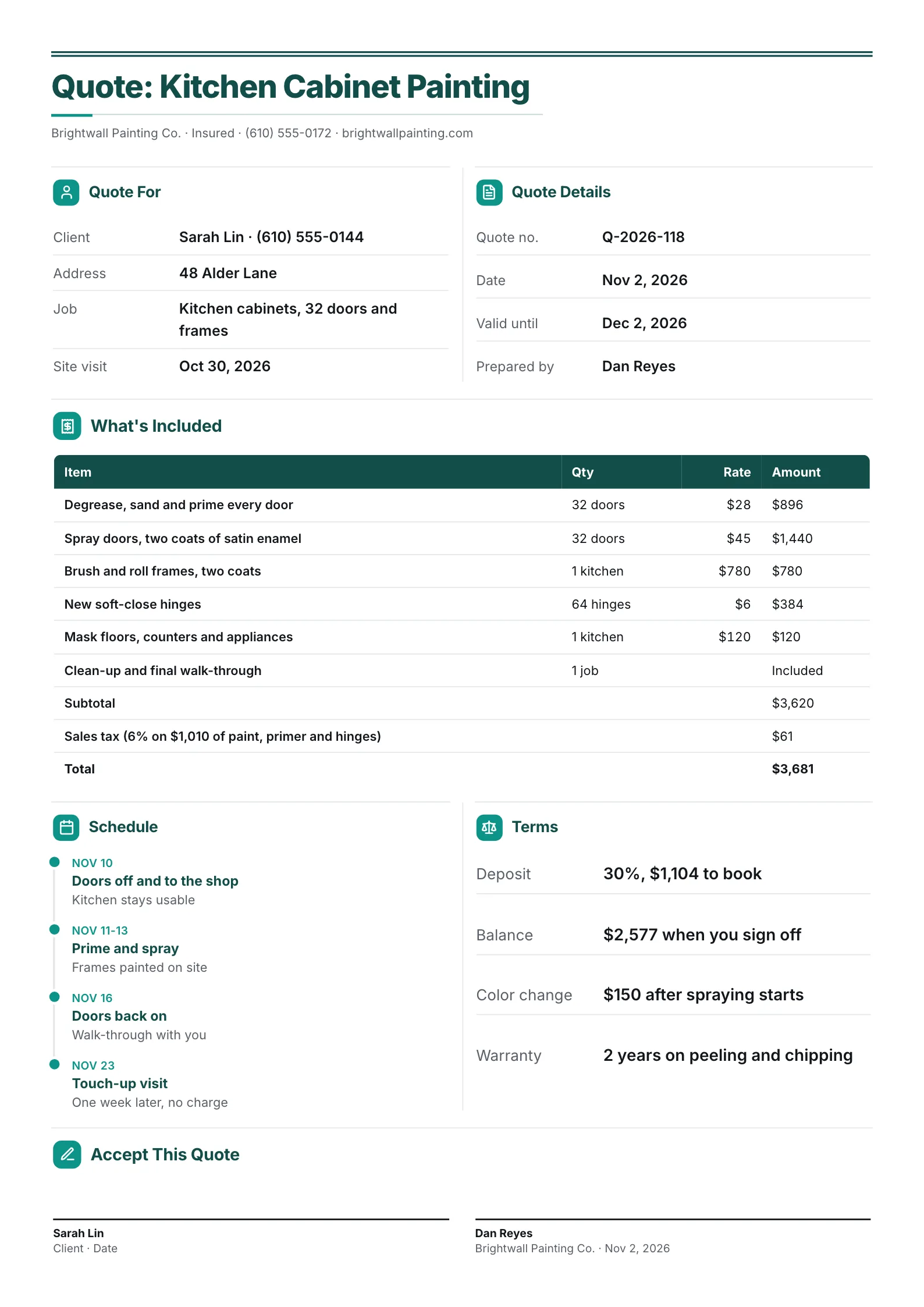
The kitchen cabinet painting quote does this with four columns: item, quantity, rate and amount. Spraying is 32 doors at $45, which is $1,440. Prep is 32 doors at $28, which is $896. New hinges are 64 at $6, which is $384. Your customer can count the doors in their own kitchen and get the same number you did. Build each rate from your materials, your crew's hours and your overhead, then add your profit, so every line pays its way if they say yes.
 Edit this template
Here's that price quote template, ready to edit.
4. Show the tax and the total, with the math visible
Write a subtotal, then the tax with what it's charged on, then the total. Whether labor is taxed depends on your state, so say which part the tax covers. The painting quote reads "Sales tax (6% on $1,010 of paint, primer and hinges)", which is $61, for a total of $3,681. Your customer never has to guess where that $61 came from.
Before you send it, add the lines up yourself on a calculator. A total that doesn't match its lines is the fastest way to lose trust.
5. Offer two or three options when the job allows it
Some jobs have one right answer. Many have a cheap fix, a solid middle and an upgrade. When yours does, put the options side by side on the same quote, so your customer chooses between your prices and not between you and another contractor.
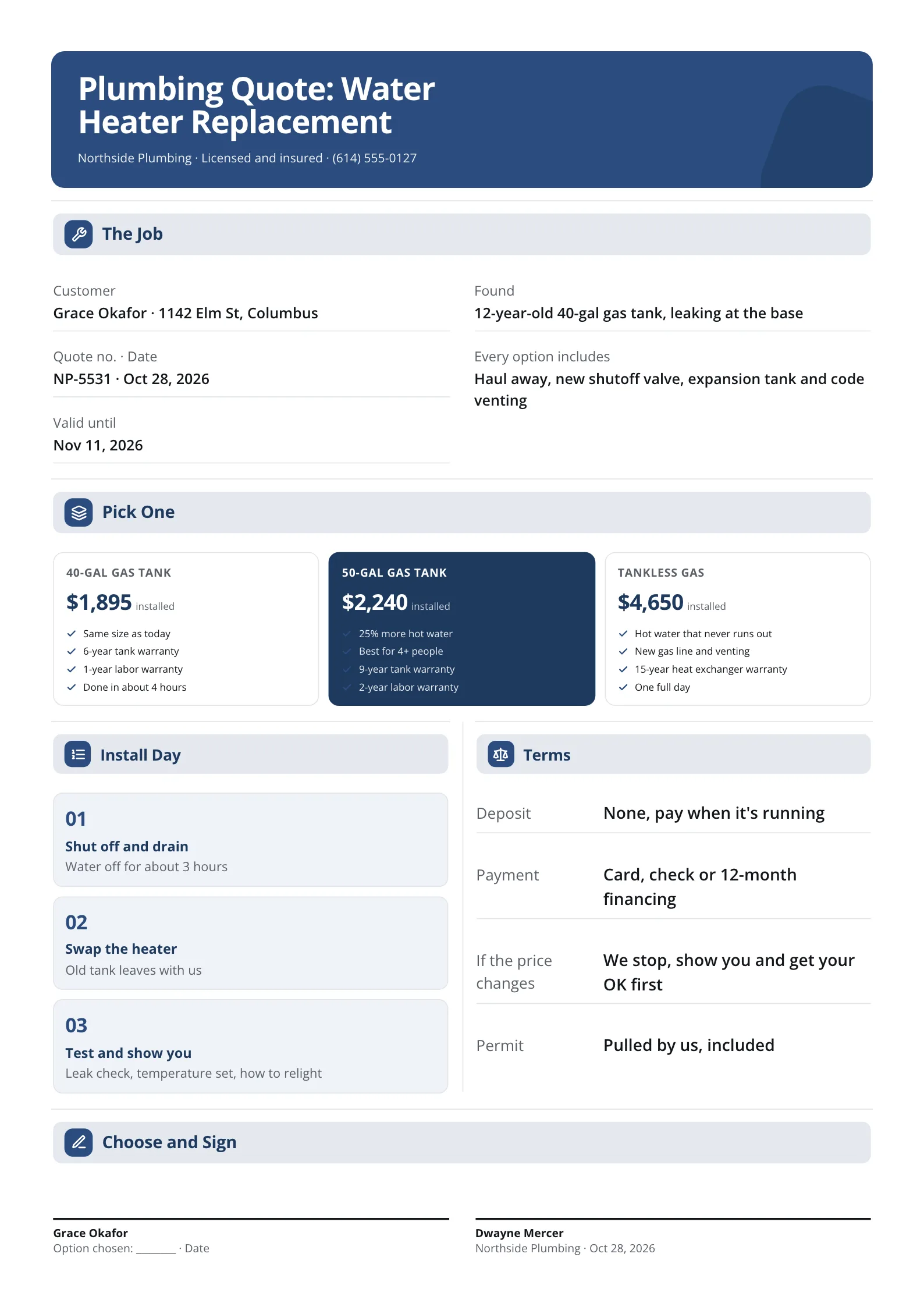
The plumbing quote offers a 40-gallon gas tank at $1,895, a 50-gallon tank at $2,240 and a tankless heater at $4,650, each with its own warranties and its own short list of what you get. Then a "Choose and Sign" box asks for the option chosen.
 Edit this template
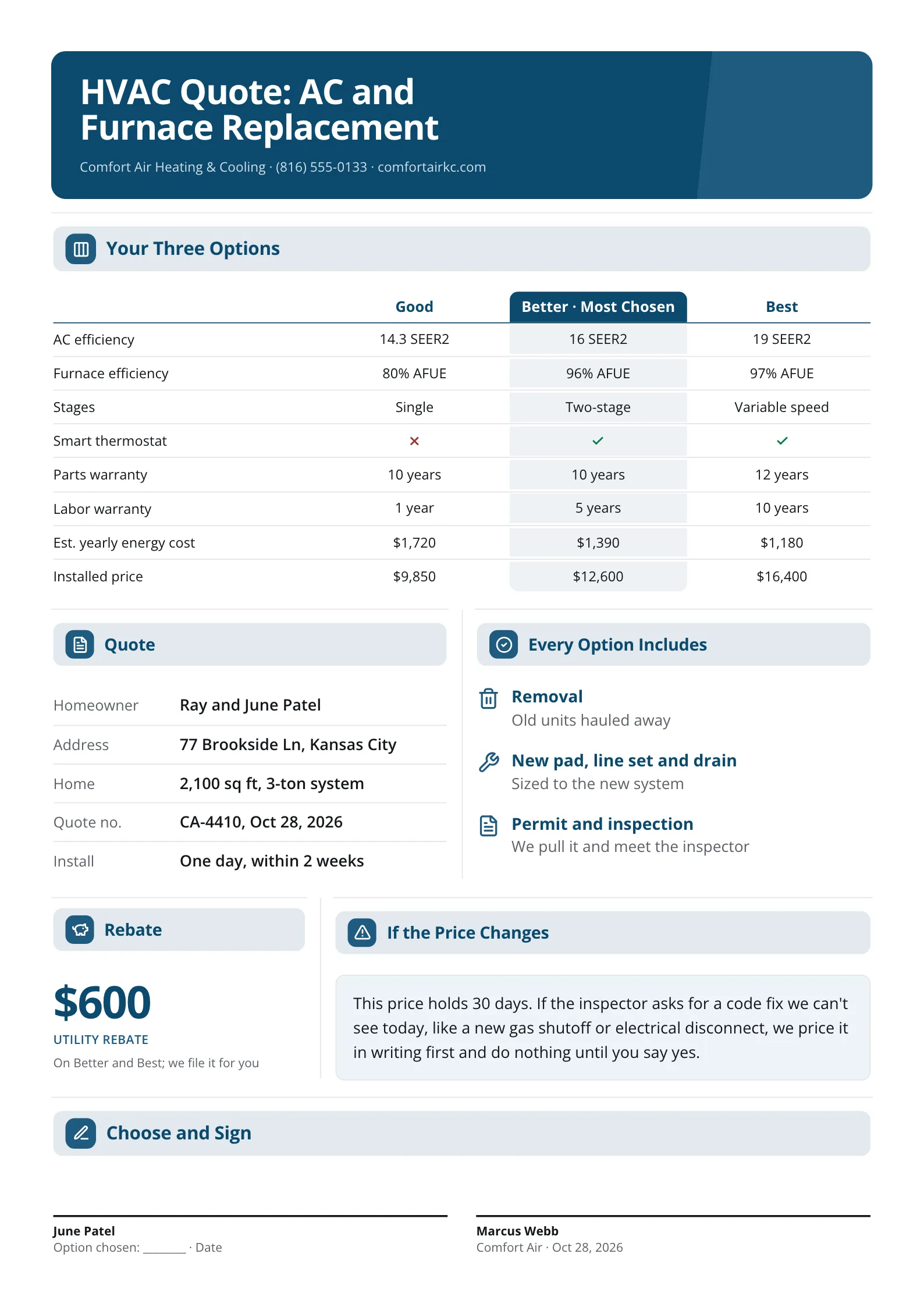
The HVAC quote goes further. It puts the yearly energy cost under each option: $1,720 for the $9,850 system, $1,390 for the $12,600 one and $1,180 for the $16,400 one. The middle option costs $2,750 more up front, or $2,150 after the $600 utility rebate the quote files for it, and about $330 less a year to run. Your customer can see all three numbers at once.
 Edit this template
Start from the plumbing quote or the HVAC quote.
6. Write the terms in short lines
Terms are where most disputes start, so keep each one to a line your customer will actually read:
- Deposit: how much, and when. The painting quote asks 30% ($1,104) to book. The roofing and plumbing quotes ask for none.
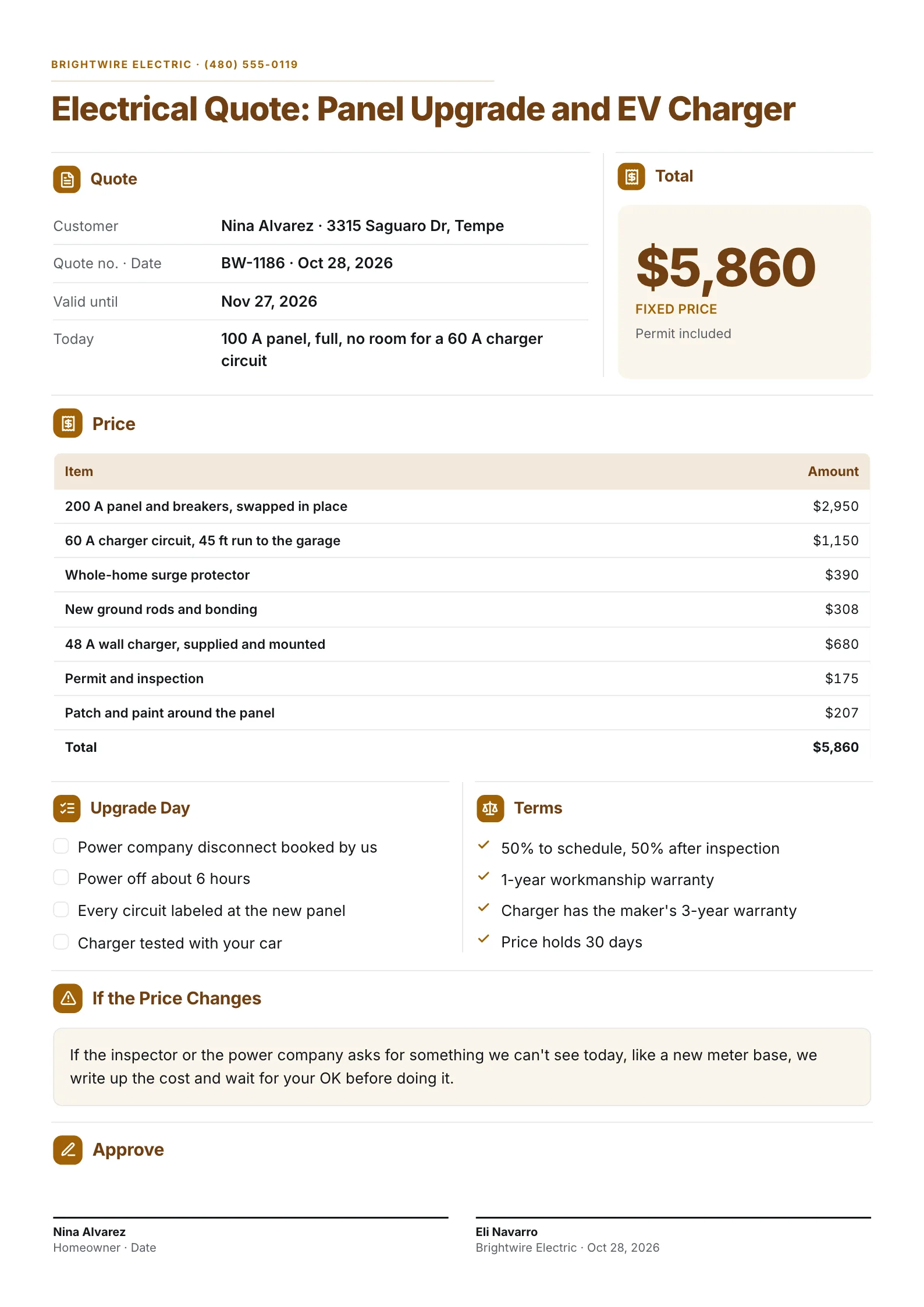
- Payment: when the rest is due and how. The electrical quote splits it 50% to schedule and 50% after inspection.
- Warranty: what you stand behind, and for how long.
- If the price changes: what you'll do before charging more. The electrical quote says that if the inspector or the power company asks for something no one can see today, you write up the cost and wait for the OK.
- Changes the customer makes: the painting quote charges $150 for a color change after spraying starts.
 Edit this template
Edit the electrical quote for your own panel jobs.
7. Make yes one step
End with a box your customer can't miss: their name, a signature line, the date and, if you gave options, a blank for the one they chose. Sign your own line before you send it, so the quote reads as an offer you've already committed to.
Sending it by email? Add one sentence such as "Sign below or reply Yes to book your date." Then follow up. A short note 2 or 3 days later asking whether they have questions about the quote is enough, and a second one before the valid-until date passes.
Signing at the customer's home: the FTC's 3-day rule
Most trades quote at the kitchen table. That is exactly the sale the Federal Trade Commission's Cooling-Off Rule (16 CFR Part 429) was written for. We read the rule itself on the eCFR site on November 13, 2026. Here is what it says, in plain words.
When it applies. A consumer sale of $25 or more agreed at the buyer's home, or $130 or more anywhere else away from your place of business, such as a hotel room, a fairground or the buyer's workplace. It still applies when the customer invited you over.
When it usually doesn't. A sale done entirely by mail or phone, with no visit from you before the work. A sale you negotiated earlier at your own shop or showroom. A visit the customer asked for to repair or maintain their own belongings (anything extra you sell on that visit, beyond the parts the repair needs, is covered). A real emergency the customer called you about, where they hand you a signed and dated statement in their own handwriting that gives up the right to cancel. A sale where federal truth-in-lending law already gives the buyer a right to cancel. Sales of real property, insurance or securities.
What your quote or contract has to carry when it applies:
| The rule asks for | Section |
|---|---|
| A completed copy for the buyer at signing, with the date and your name and address | 429.1(a) |
| The copy in the same language you used to sell, so Spanish if you sold in Spanish | 429.1(a) |
| Near the buyer's signature, in bold of at least 10 points: the buyer may cancel before midnight of the third business day | 429.1(a) |
| A filled-in Notice of Cancellation form, in two copies | 429.1(b), (c) |
| Telling the buyer out loud that they can cancel | 429.1(e) |
| A full refund within 10 business days if they do cancel | 429.1(g) |
How to count the 3 days. Under the rule's definition (429.0(f)), Saturdays count as business days, but the day after Saturday and federal holidays don't. So a quote signed on a Friday can be canceled until midnight on Tuesday, and a holiday Monday pushes that to Wednesday.
What this means for your quote: if you close jobs in people's homes, leave room under the signature box for the cancel statement, and keep the notice form with every quote you print. The rule bars any waiver of that right in your contract (429.1(d)), so starting work on day one doesn't remove it. Your state may add its own rules for home improvement contracts on top of the federal one. This is general information and not legal advice, so check your state's version before you rely on it.
Quote or estimate: which should you send?
An estimate is your best guess and can move once the work starts. A quote is a price you agree to hold, as long as the job is what you both described. Send an estimate when you can't see the whole job yet, such as a leak behind a wall. Send a quote when you've measured it and can stand behind the number.
Many trades blend the two. The roofing quote is a fixed price with one open item: rotten decking found after tear-off is $95 a sheet, up to 3 sheets, and past that the crew stops and asks. Your customer gets a firm number plus a clear rule for the one thing nobody can see. When a customer is choosing between firms on skill and approach as well as price, a short proposal may suit them better than a quote.
Mistakes that lose the job after the visit
- Sending it days later. The customer is collecting prices this week. Send yours while they still remember your visit, ideally the same day.
- A total with no lines. "$14,480" alone looks high. "$14,480 for 28 squares, tear-off to the deck and a 10-year workmanship warranty" looks like a plan.
- Leaving out what's excluded. If haul-away, permits or paint touch-ups aren't in the price, say so on the quote. The plumbing quote lists what every option includes: haul-away, a new shutoff valve, an expansion tank and code venting.
- No date on the price. Without a valid-until date, a customer can call you in six months and expect the same number.
- Words only you understand. "R&R 3 tab, I&W at eaves" means nothing to a homeowner. Write what they'll see on the roof.
Write your next quote from a finished one
Pick the trade quote closest to your job on MakeOnepagers, change the names, measurements and prices to yours, and download it as a PDF. Our quote template post walks through a filled-in fence repair quote line by line. Got only a page of site notes and measurements? The free AI One-Pager generator lays them out as a quote you can check and edit.
Frequently asked questions
What should a quote for a job include?
Your business name and contact details, the customer's details, a quote number and date, a valid-until date, the scope of work, priced line items, tax, the total, your deposit and payment terms, any warranty, and a place to sign. If you sign at the customer's home, add the cancellation notice the FTC rule asks for.
How do you write a quote for a small job?
Keep the same parts and make each one shorter. A $300 repair can fit the work, two or three lines, the total, a valid-until date and a signature on half a sheet. The rule leaves out a repair or maintenance visit the customer asked for on their own belongings, but anything extra you sell on that visit is covered, and the rule starts at $25 for sales at home.
Can a customer cancel a signed quote?
Often, yes. Under the Cooling-Off Rule, a buyer who agreed to a sale of $25 or more at their home usually has until midnight of the third business day to cancel, and you refund in full within 10 business days. Your state's own law may add to this.
Should a quote be a PDF?
Yes, when you email it. A PDF keeps your layout the same on any phone and can't be edited by accident. Write it in a template, then download it as a PDF and attach it.




