BlogGuide
How to Summarize a Report: The Method Behind 17 GAO Reports, and a 64-Page Report on One Page
How to summarize a report on one page, using the format GAO uses: why it was done, what it found, what it recommends. With a 64-page example.

By MakeOnepagers Team
Updated · 10 min read
To summarize a report, answer three questions in order: why the work was done, what it found, and what should happen next. Put the findings in the middle and give them the most space, use the report's own numbers, add one chart, and keep it to one page. Then write a second, shorter version of about 100 words for people who will only read a paragraph.
One‑Pager examples
Real One-Pagers made with MakeOnepagers. Open any one to edit it as your own.
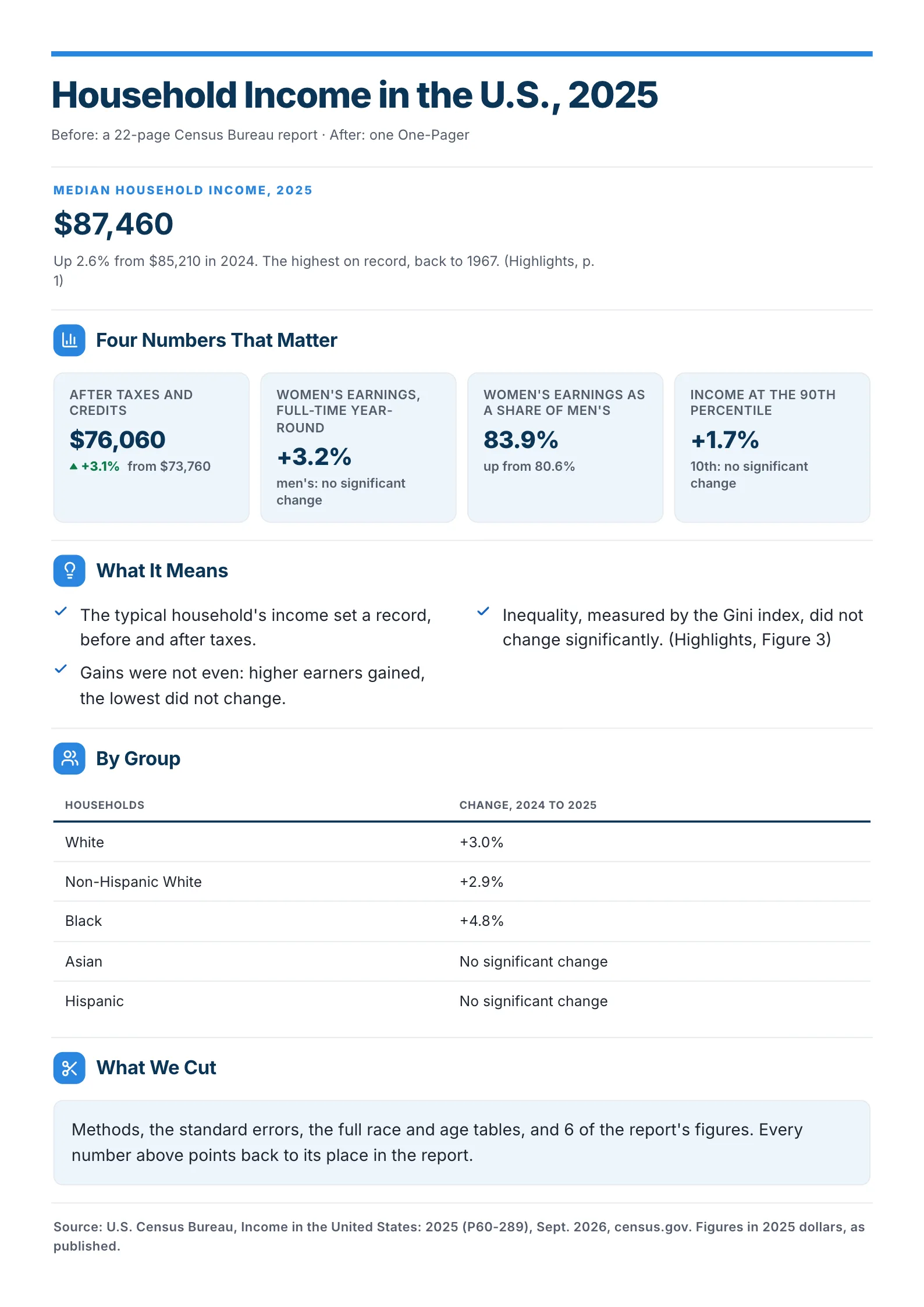 Report SummaryEdit for free(opens in a new tab)
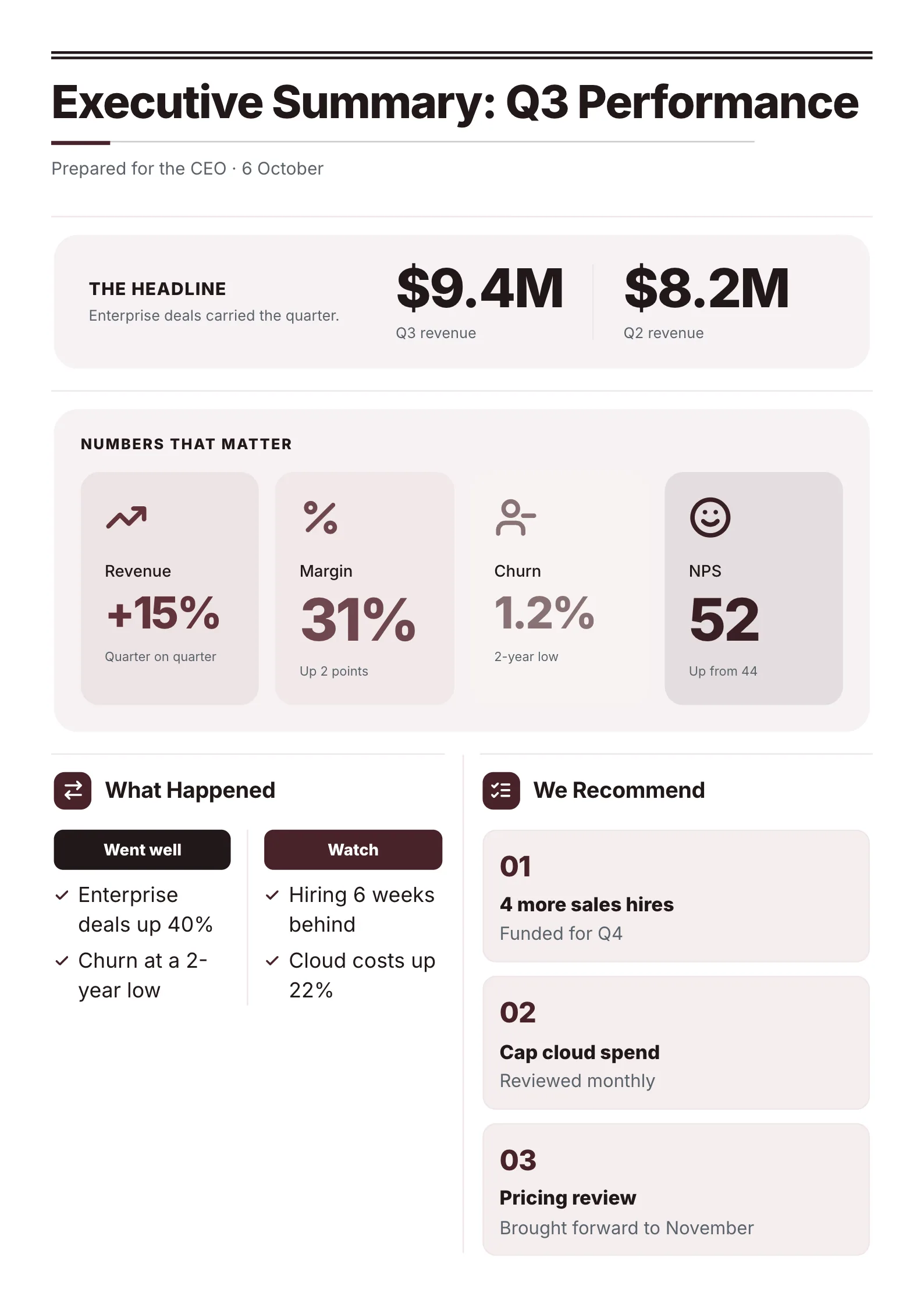 Executive SummaryEdit for free(opens in a new tab)
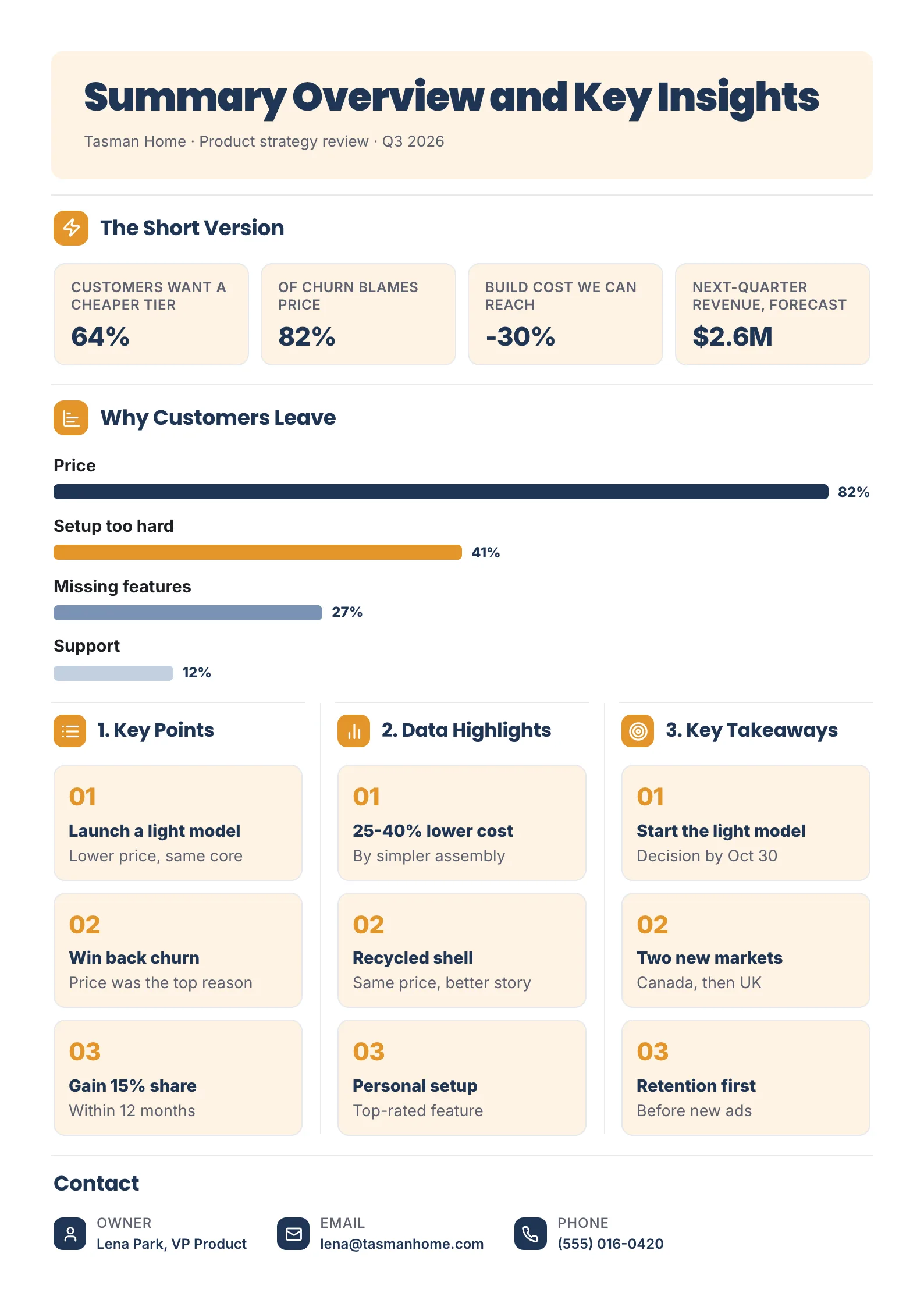 Summary and Key Insights One-PagerEdit for free(opens in a new tab)
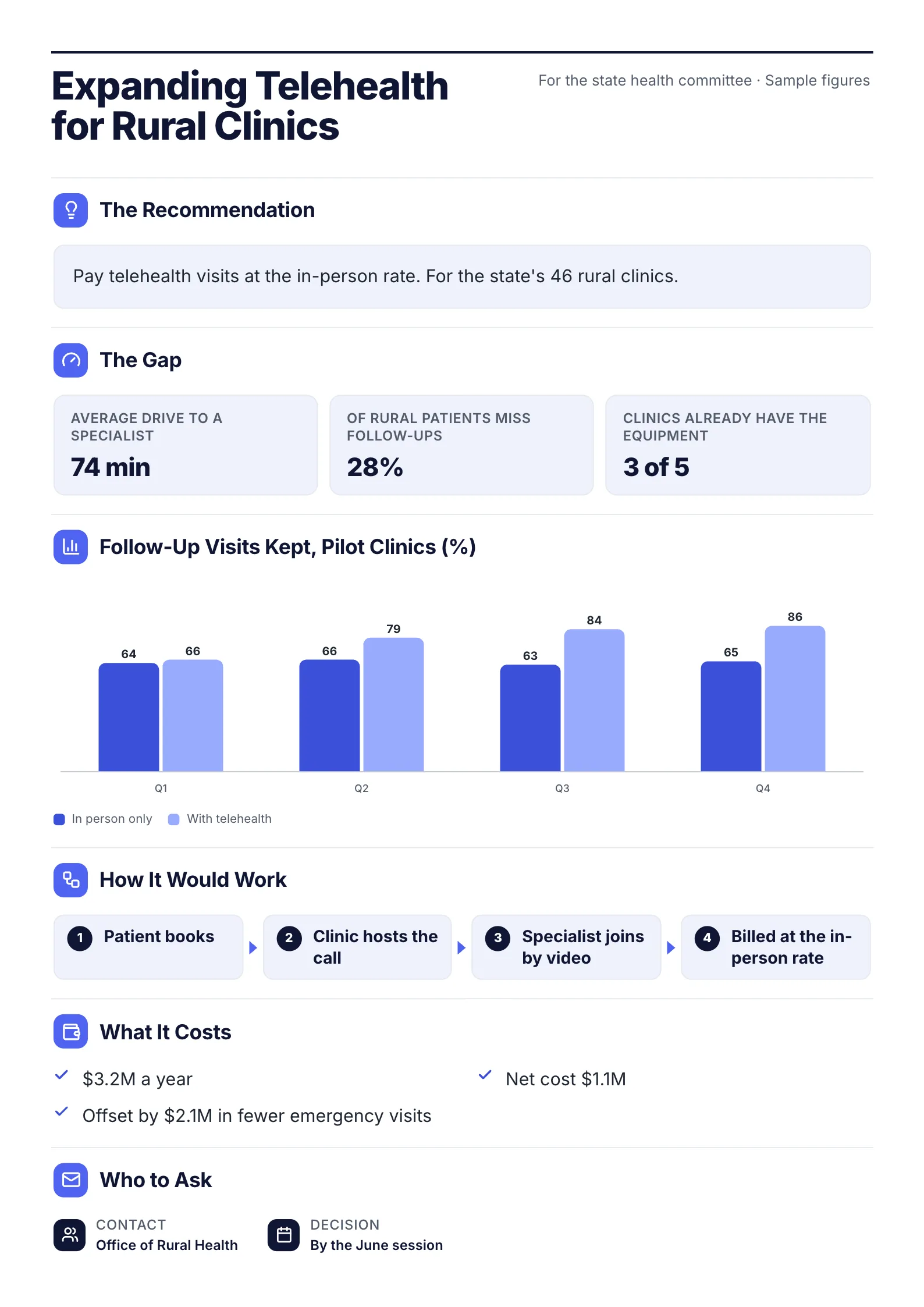 Policy Brief: Rural TelehealthEdit for free(opens in a new tab)
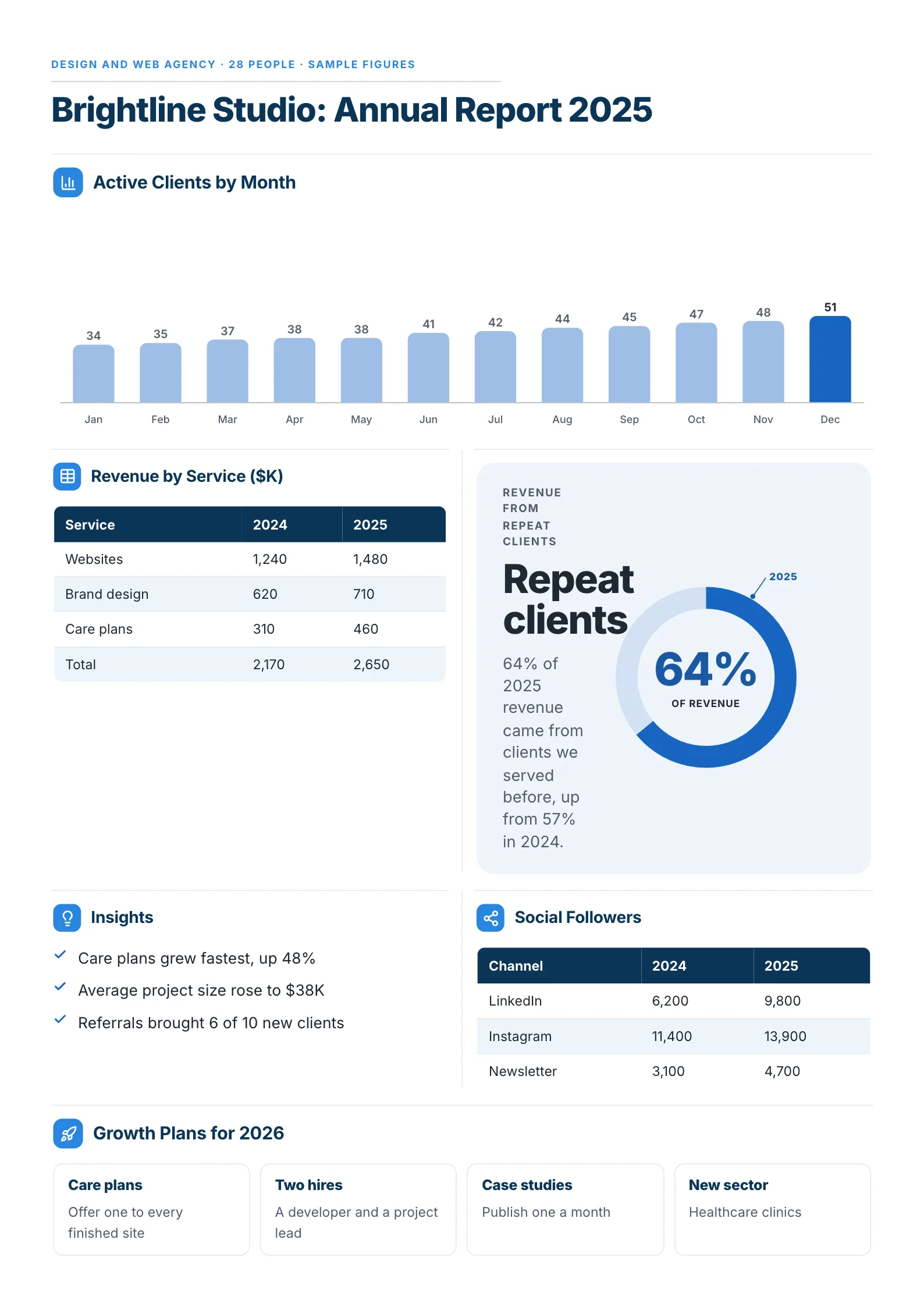 Annual Report SummaryEdit for free(opens in a new tab)
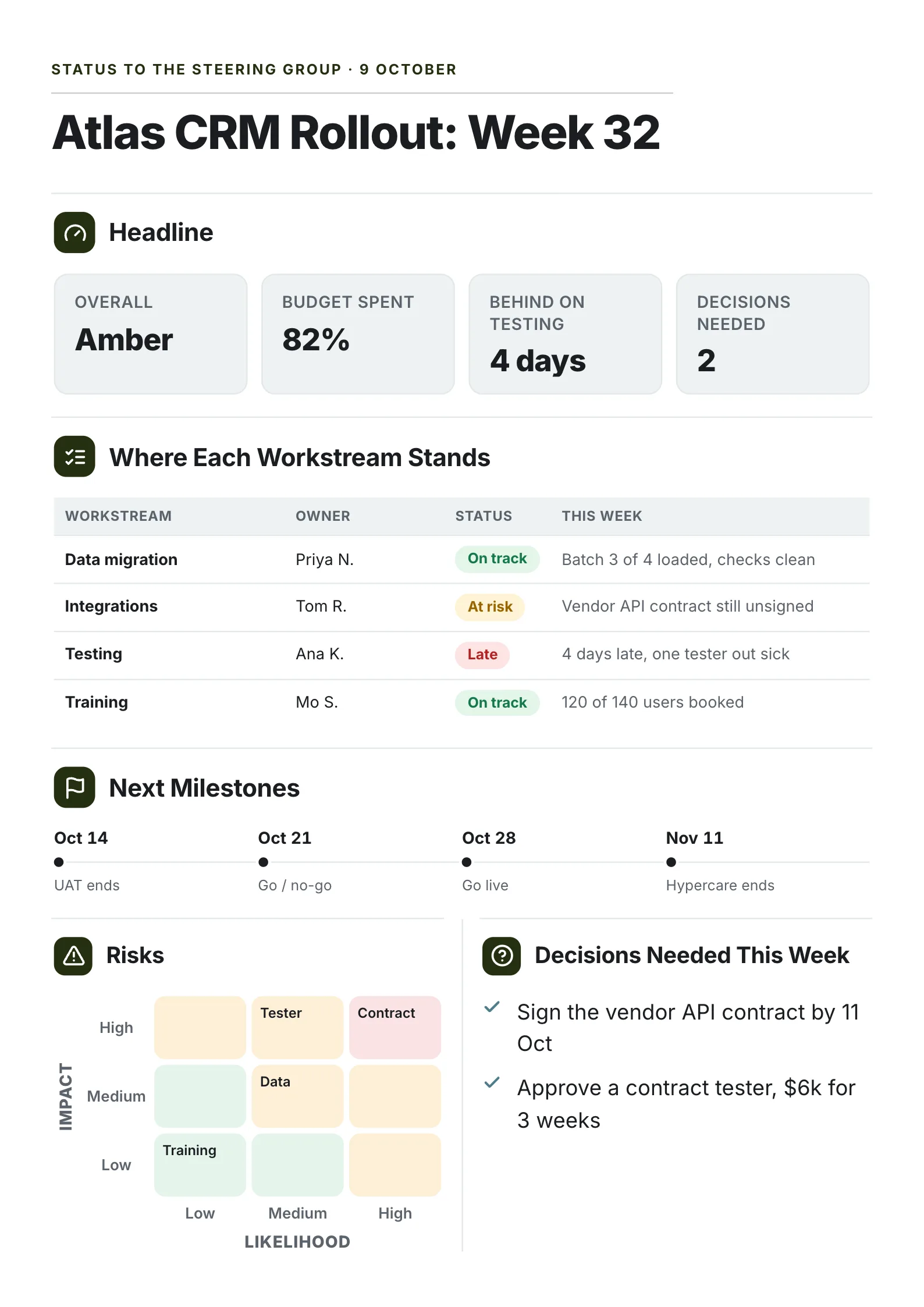 Project Status ReportEdit for free(opens in a new tab)
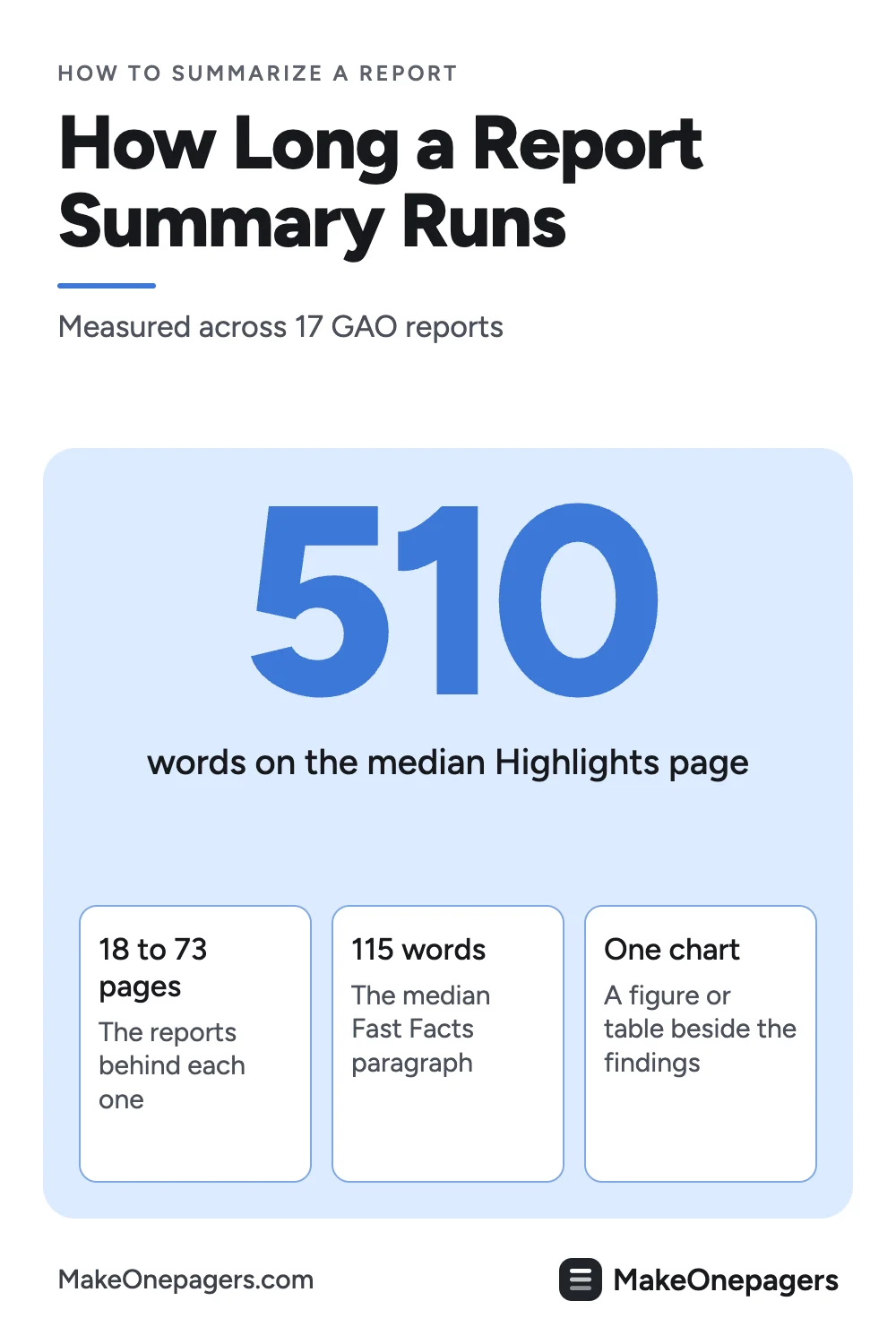
That is not our invention. It is how the US Government Accountability Office (GAO) summarizes the reports it sends to Congress. We measured 17 reports from its latest reports feed on 12 October 2026, to see how long the summaries are and what goes in them. Below are the numbers, a step-by-step method, and a 64-page GAO report taken down to one page.
What a report summary is for
A report summary lets someone decide, in a minute or two, whether they agree, what to do, and whether to read further. Most of your readers will read nothing else, so it has to stand on its own: no "see section 3", no terms the report defines on page 12.
It differs from an abstract, which describes a study for other researchers, and from a conclusion, which comes last. A summary comes first and is written for the person who has to act.
How GAO summarizes every report
GAO is the nonpartisan agency that audits federal spending for Congress. Every report it publishes comes with up to three layers of summary:
| Layer | Length | What it holds |
|---|---|---|
| Fast Facts | About 115 words | The problem, the finding and the recommendation in plain words, written as "we" |
| Highlights | One page | What GAO Found, Why GAO Did This Study and the recommendations, plus a figure |
| Full report | 11 to 73 pages in our sample | Everything, with methods and agency comments |
What we measured, from each report's page on gao.gov:
- 14 of 17 reports came with a separate one-page Highlights. The three without one were 11 to 20 pages long.
- The 14 with a Highlights page ran 18 to 73 pages, with a median of about 45. One page stood in for every one of them.
- The Highlights text ran about 430 to 640 words, median about 510. What GAO Found took most of it: 254 to 418 words. Why GAO Did This Study took 148 to 244.
- Every Highlights carried a figure or a table beside the findings in its web version. One picture, not five.
- Fast Facts ran 104 to 166 words, median 115, across all 17. In the two we read in full, the last line names the recommendation, such as "Our recommendations address this issue."
Word counts are from the web version of each Highlights and Fast Facts.
The 17 reports we measured
| Report | Full report | One-page Highlights | Fast Facts words |
|---|---|---|---|
| IT Dashboard: investment risk ratings | 73 pages | Yes | 108 |
| Economic Development Administration | 73 pages | Yes | 126 |
| Flood insurance coverage | 64 pages | Yes | 114 |
| Quantum computing and cyber threats | 60 pages | Yes | 113 |
| Precision navigation systems | 58 pages | Yes | 115 |
| Medicare Part D pharmacy payments | 46 pages | Yes | 166 |
| Disposal of federal laboratory equipment | 46 pages | Yes | 108 |
| State Department travel costs | 45 pages | Yes | 124 |
| Disability employment at federal contractors | 41 pages | Yes | 116 |
| Tobacco product application reviews | 37 pages | Yes | 106 |
| Geothermal permitting on federal lands | 36 pages | Yes | 139 |
| Concrete masonry promotion program | 31 pages | Yes | 113 |
| Interagency Council on Homelessness | 26 pages | Yes | 120 |
| Unwanted mortgage solicitations | 18 pages | Yes | 115 |
| SNAP access for veterans | 20 pages | No | 104 |
| Army Corps environmental mitigation | 11 pages | No | 119 |
| Rural Health Transformation Program | 11 pages | No | 115 |
How to summarize a report in 7 steps
- Read the report's own conclusions first, then the findings. Most reports tell you what matters; your job is to choose, not to discover.
- Write the one-sentence answer. If someone asked "so what did it find?", what would you say? This sentence opens the summary.
- Pick three to five findings, each with a number. A finding without a number is an opinion.
- Write why the work was done in two or three sentences: the problem, who asked, and what was examined.
- Write what should happen next: the recommendation, the decision needed or the next step. If the report makes none, say so.
- Choose one chart that shows the main finding. GAO uses one per Highlights page.
- Write the 100-word version last. Problem, finding, recommendation, in plain words. This is the paragraph that gets pasted into emails.
Example: a 64-page report on one page
GAO's recent flood insurance report runs 64 pages. Here is how its own summary layers break it down, which you can copy for any long report. Every number below is GAO's.
The one sentence: most US property owners at high risk of flooding have no flood insurance, and the rule meant to make them buy it misses many of them.
What was found (the middle, and the longest part)
- 86% of high-risk properties had no National Flood Insurance Program (NFIP) coverage as of April 2026.
- NFIP policies fell from 5.5 million in 2010 to 4.5 million in 2026; private policies made up 14% of all policies in 2025.
- About 43% of properties in FEMA's special flood hazard areas had flood insurance, against 2% outside them.
- The maps that set the requirement do not capture all flood risks, especially heavy rainfall; about 13 million high-risk properties sit outside those areas.
- Some owners underestimate their risk or believe homeowners insurance covers floods, when most policies exclude it.
Why it was done: flooding is the most common, costly and destructive natural disaster in the US. GAO examined how many people buy flood insurance, whether the purchase requirement works, what drives decisions, and what could raise coverage.
What should happen next: four actions for Congress, including counting all flood risks in the purchase requirement and making property-level flood risk public.
The Fast Facts version (about 60 words): almost 90% of high-risk US properties have no flood insurance. The federal maps that decide who must buy it leave out much of the risk, especially heavy rain. GAO recommends that Congress require FEMA to count flood risk from heavy rainfall, among other changes.
That is the whole 64-page argument, in under 300 words, in the order a reader needs it.
Lay the summary out on one page
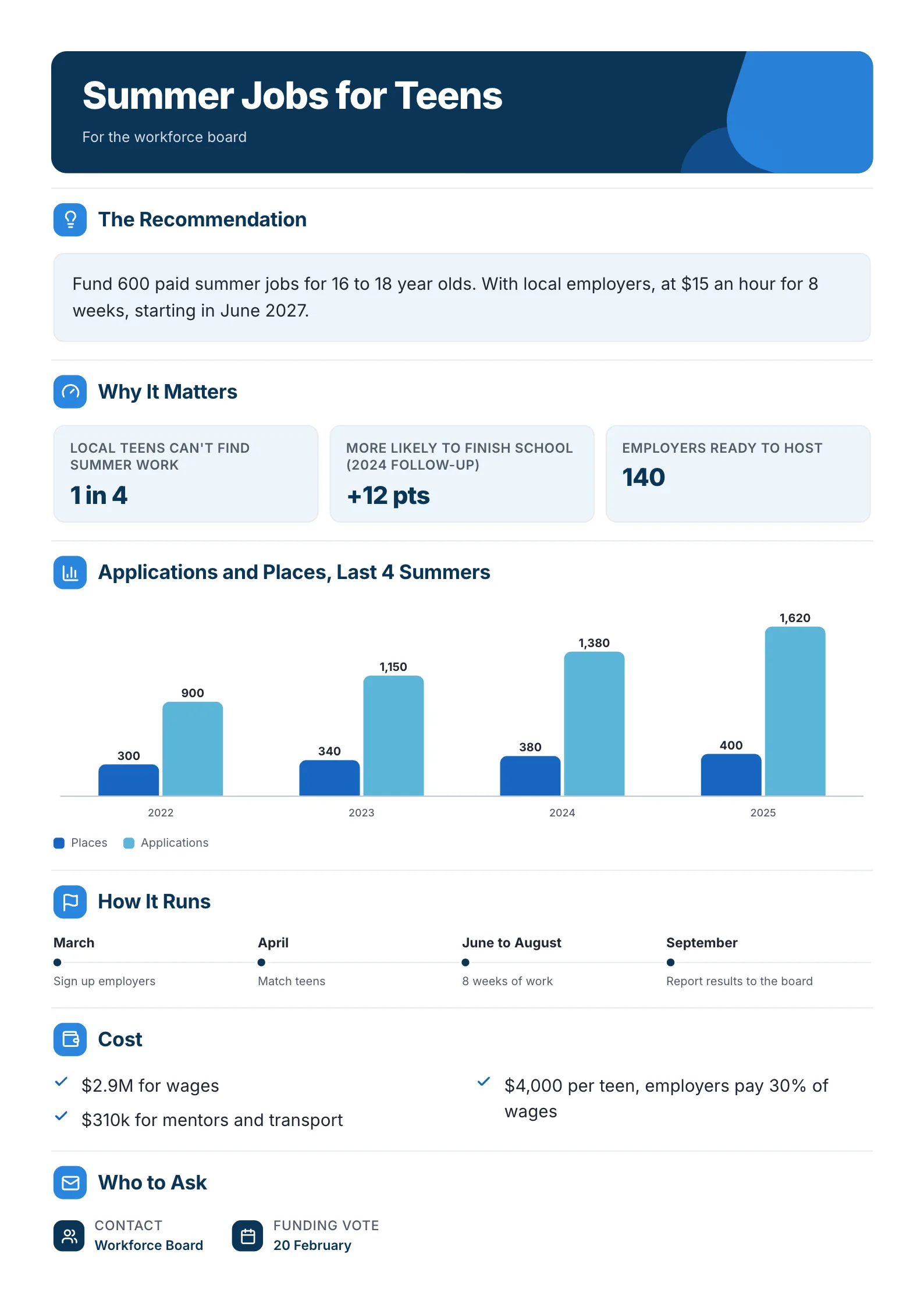
Text in that order works. Laid out as a page, it works faster: the recommendation in a box at the top, the three strongest numbers as big figures, one chart, the plan and the cost. This sample was made with MakeOnepagers, and it opens ready to edit: every word, chart and color.
 Edit this template
A long report's argument on one page: recommendation, three numbers, one chart, the plan, the cost.
What to copy:
- The recommendation first. "Fund 600 paid summer jobs for 16 to 18 year olds," with the rate, the length and the start date.
- Three numbers, each with its label: 1 in 4 local teens cannot find summer work, +12 points more likely to finish school, 140 employers ready to host.
- One chart of the main finding: applications against places for four summers, the gap growing every year.
- How it runs and what it costs, because those are the next questions.
Edit for free: policy brief template.
Report summary template
Copy this order. The word budgets follow the GAO Highlights we measured.
Title: the report's subject and its main finding, in a line.
The answer (1 sentence): what the report found.
What we found (250 to 400 words, or 3 to 5 bullets)
- Finding 1, with a number
- Finding 2, with a number
- Finding 3, with a number
- One chart or table
Why we did this (100 to 200 words)
- The problem
- Who asked, or why now
- What was examined, and how
What we recommend (1 to 4 lines)
- The action, who takes it, and by when
Source: the full report's title, date, length and where to find it.
How to summarize different kinds of report
| Report | Lead with | Keep | Cut |
|---|---|---|---|
| Audit or review | What was found wrong | Each finding with its number, the recommendations | Methodology detail |
| Financial report | The result against plan or last year | Revenue, profit, cash, the one variance that matters | Line items |
| Research or lab report | The answer to the research question | The key result with its measure, limits | Procedure |
| Project or status report | Whether it is on track | Dates, budget, top risks, decisions needed | Task lists |
| Incident or case report | What happened and the outcome | Timeline, cause, what changes | Background |
For a business audience, the same three parts are usually called an executive summary: the result, the numbers that matter and what you recommend.
Summary, abstract or conclusion?
| Summary | Abstract | Conclusion | |
|---|---|---|---|
| Where it sits | First, or as a separate page | First, in research papers | Last |
| Who it is for | The person who has to decide or act | Other researchers deciding whether to read | Readers who read the whole report |
| What it leads with | The answer and the findings | The question and the method | What the findings mean |
| Recommendations | Yes, if the report makes any | Rarely | Sometimes |
| Length | One page, plus a 100-word version | Usually one paragraph | A few paragraphs |
If someone asks you to summarize a report, they almost always mean the first column.
Report summary mistakes
- Following the report's order. Reports start with background. Summaries start with the answer.
- Describing instead of stating. "This report discusses flood insurance" says nothing. "86% of high-risk properties have no flood insurance" says it all.
- Too many findings. GAO's longest What GAO Found sections were about 400 words. Pick the findings that change the decision.
- Adding opinions. A summary reports what the report says. If you disagree, say so separately.
- No source. Name the full report, its date and its length, so readers know what they are not reading.
Report summary checklist
- The answer in the first sentence
- Three to five findings, each with a number
- Why the work was done, in two or three sentences
- What should happen next, or a clear "no recommendation"
- One chart or table
- Under one page; about 500 words at most
- A 100-word version for email
- The full report's title, date and length
Make your one-page report summary
Open the free policy brief template, put the report's answer in the recommendation box and its three strongest numbers below it, add your one chart, and download it as a PDF to send with the full report. For more layouts, see our one-page summary template guide.
Frequently asked questions
How long should a report summary be?
One page. In the 14 GAO reports we measured with a one-page Highlights, the summary text ran about 430 to 640 words for reports of 18 to 73 pages. A second version of about 100 to 150 words is useful for email and the web.
What are the main parts of a report summary?
What was found, why the work was done, and what should happen next, plus one chart. GAO's one-page Highlights is built on those three parts, with the findings taking the most space.
Should the summary follow the order of the report?
No. Reports usually open with background and methods. A summary opens with the answer and the findings, then explains why the work was done.
Can I use AI to summarize a report?
You can use it to draft, but check every number against the report. A summary with a wrong figure is worse than no summary, and the reader cannot tell which figures to trust.
What is the difference between a summary and an executive summary?
They do the same job. "Executive summary" is the usual name in business and in proposals; a public report may call it a summary, highlights or key findings.