SWOT Analysis Questions: The Exact Wording 3 Public Plans Used
SWOT analysis questions copied from 3 public plans: the 5 that drew 2,000 ideas at a university, a city's 9-question survey and a health district's data walk.

Good SWOT analysis questions are short, set a time frame, and ask for a specific answer. We read three public strategic plans that printed the questions behind their SWOT. James Madison University asked 5 questions, drew about 2,000 ideas from 172 survey responses and the talks that followed, and cut them to 41. The City of Cerritos asked its staff 9 questions and never once used the word "strength." A Nebraska health district started with data pinned around a room before anyone answered anything. Start from a free one pager template.
One‑Pager examples
Real One-Pagers made with MakeOnepagers. Open any one to edit it as your own.
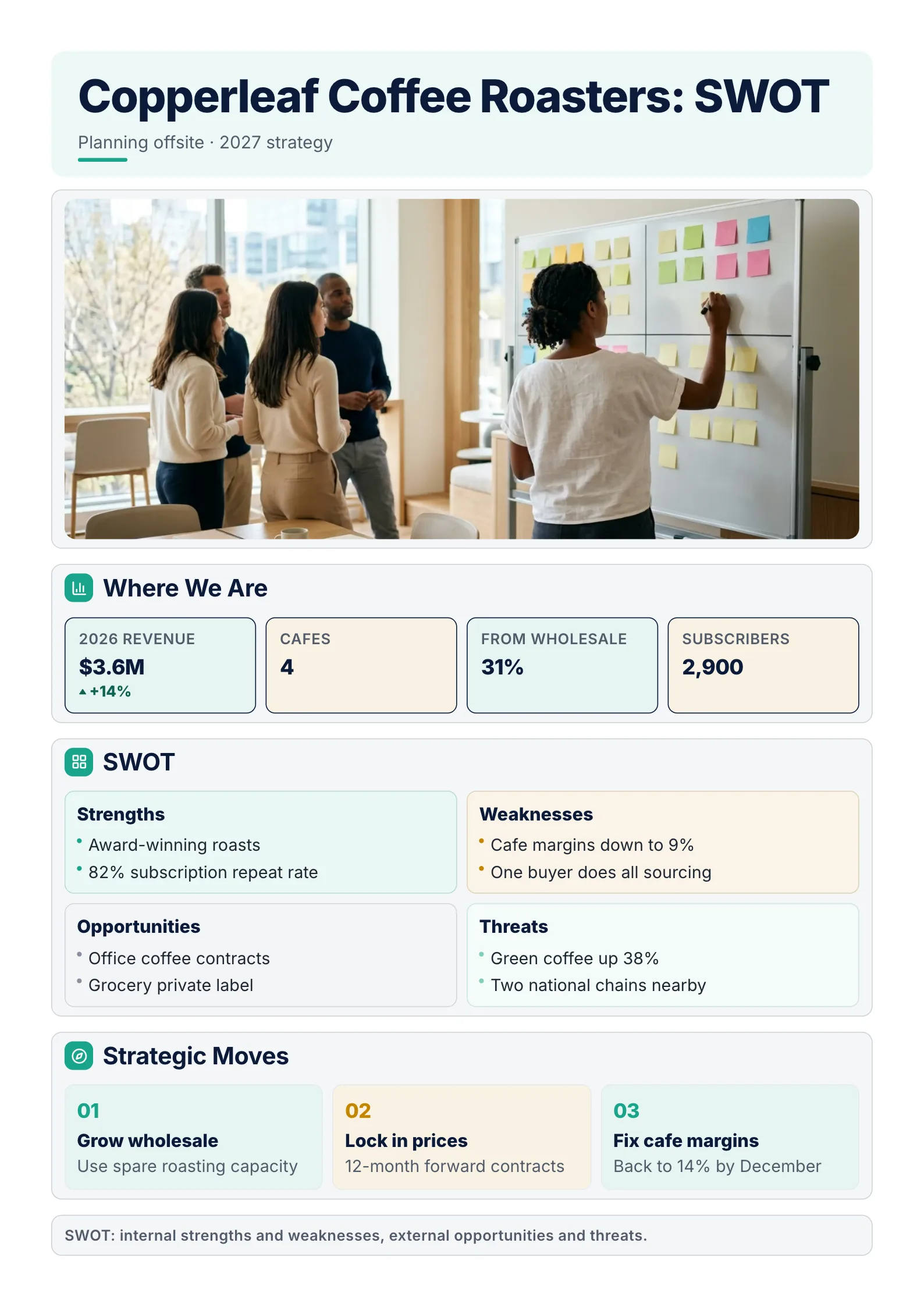 SWOT AnalysisEdit for free(opens in a new tab)
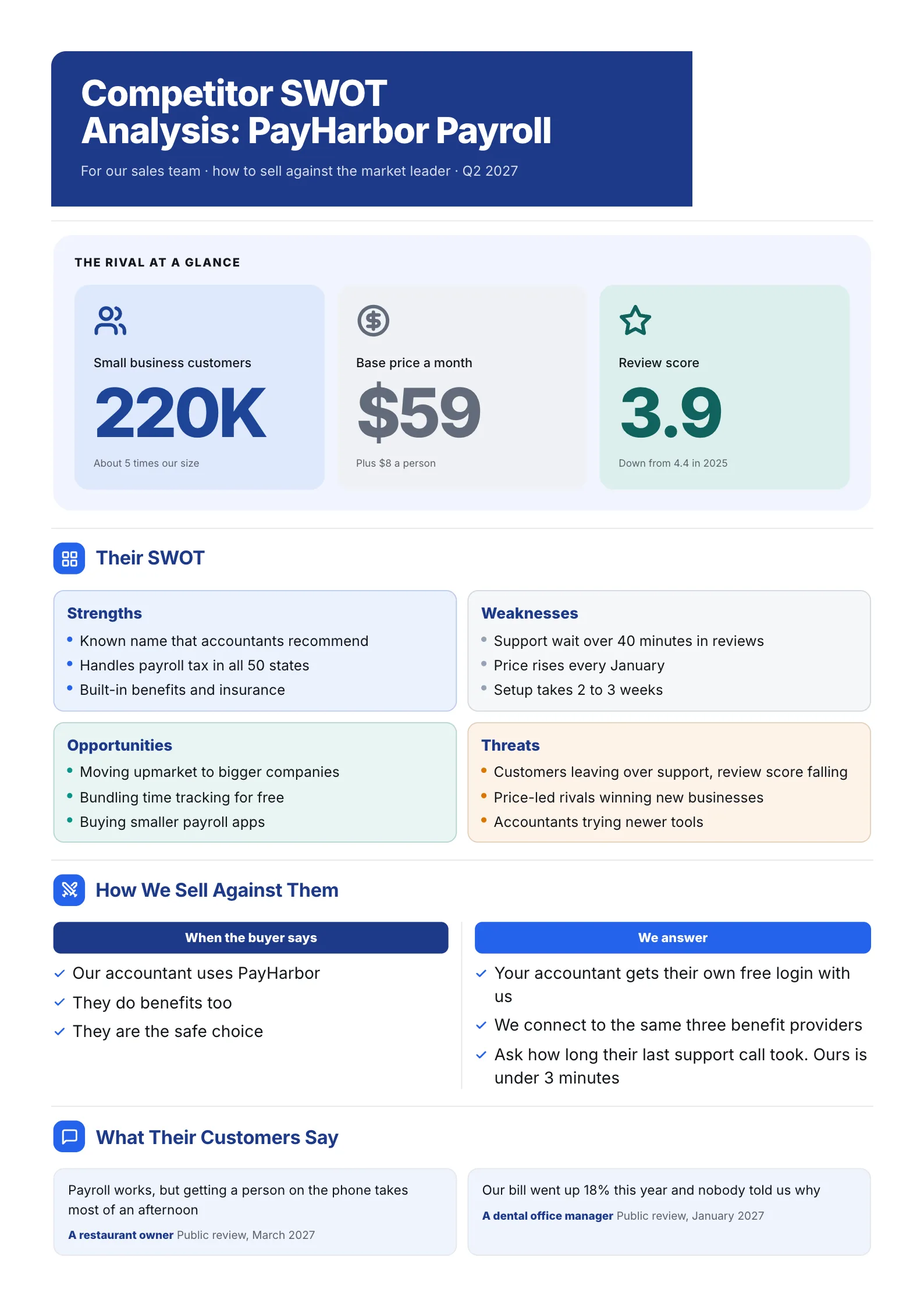 SWOT Analysis: CompetitorEdit for free(opens in a new tab)
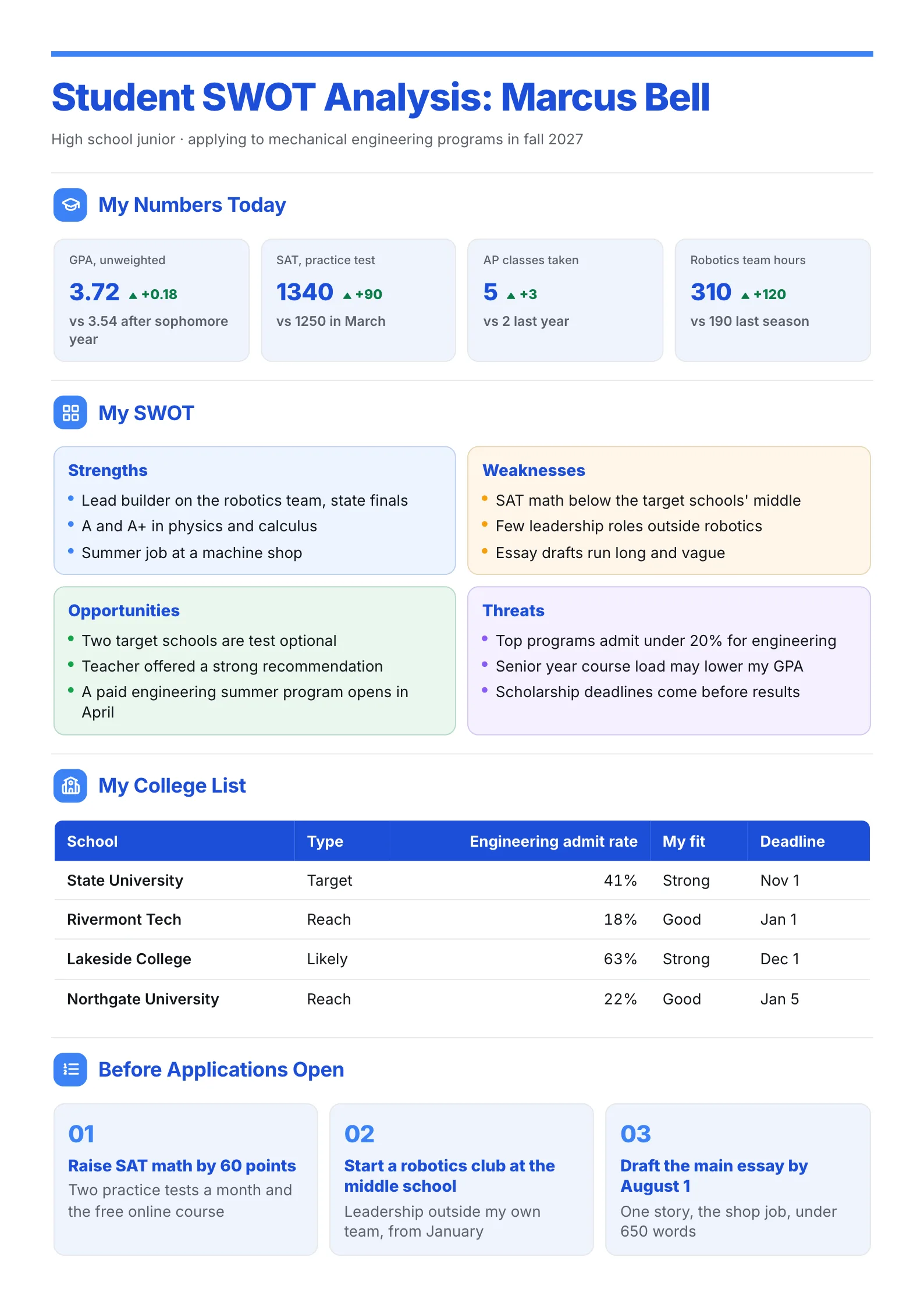 SWOT Analysis: StudentEdit for free(opens in a new tab)
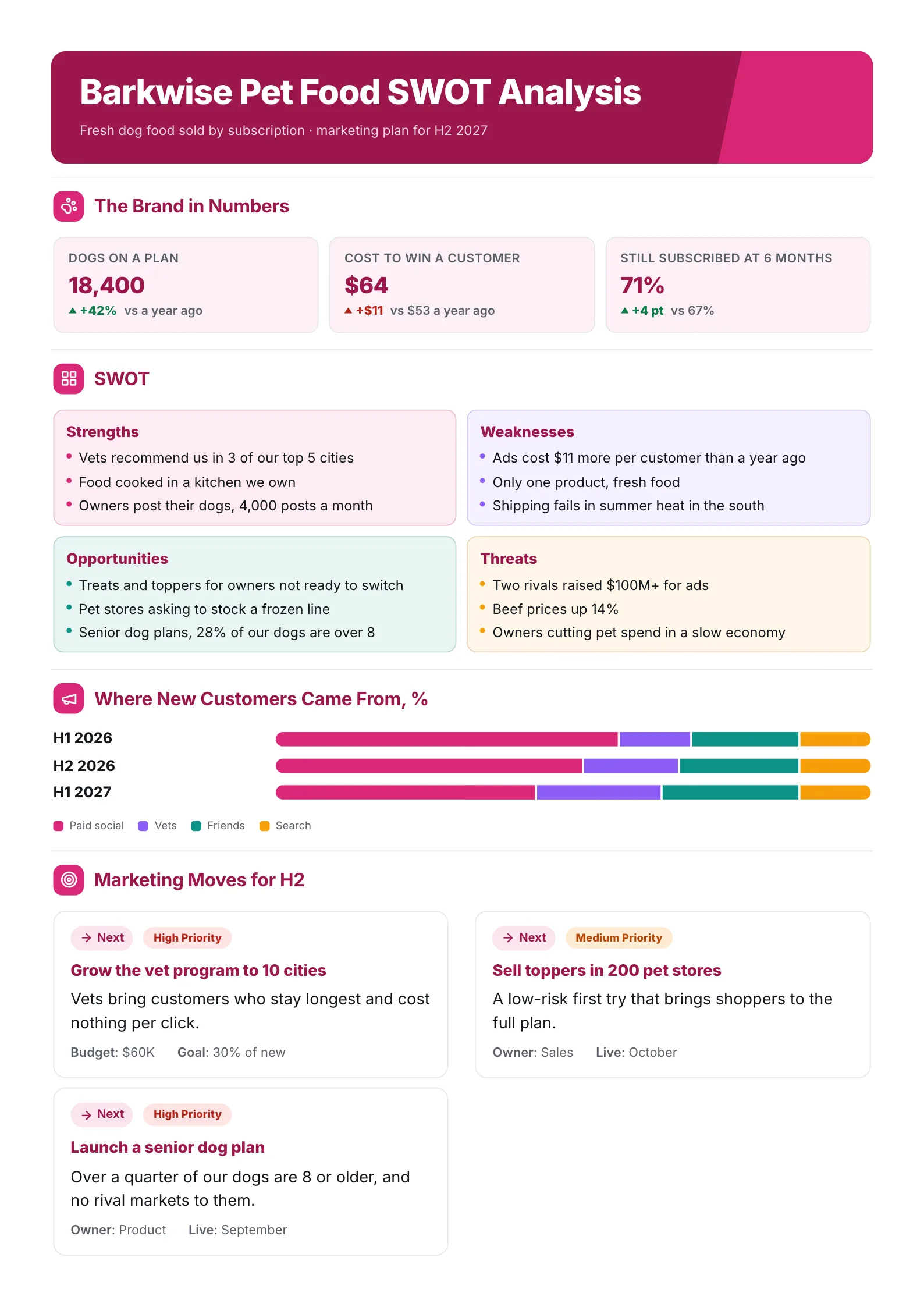 SWOT Analysis: Pet Food Brand MarketingEdit for free(opens in a new tab)
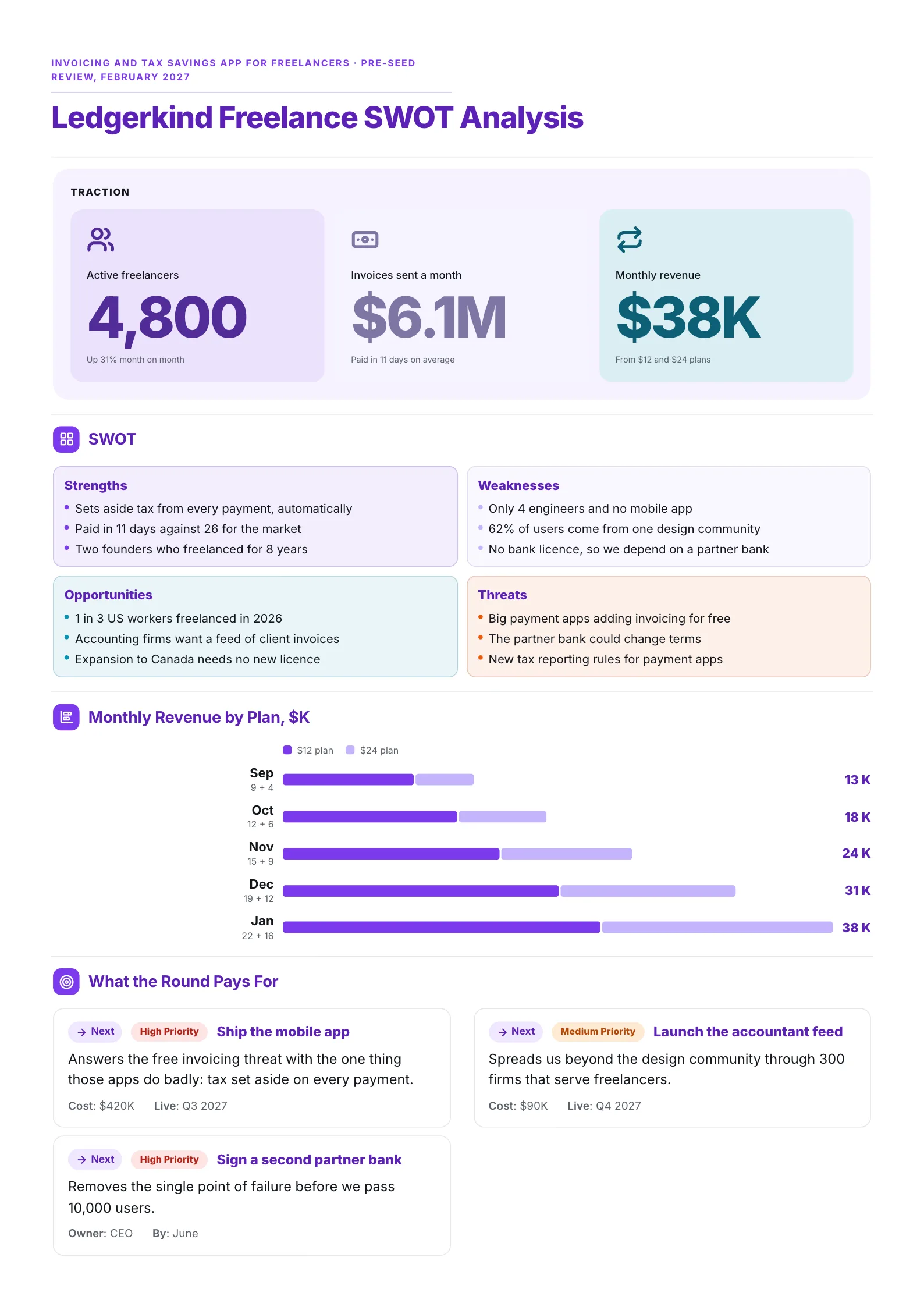 SWOT Analysis: StartupEdit for free(opens in a new tab)
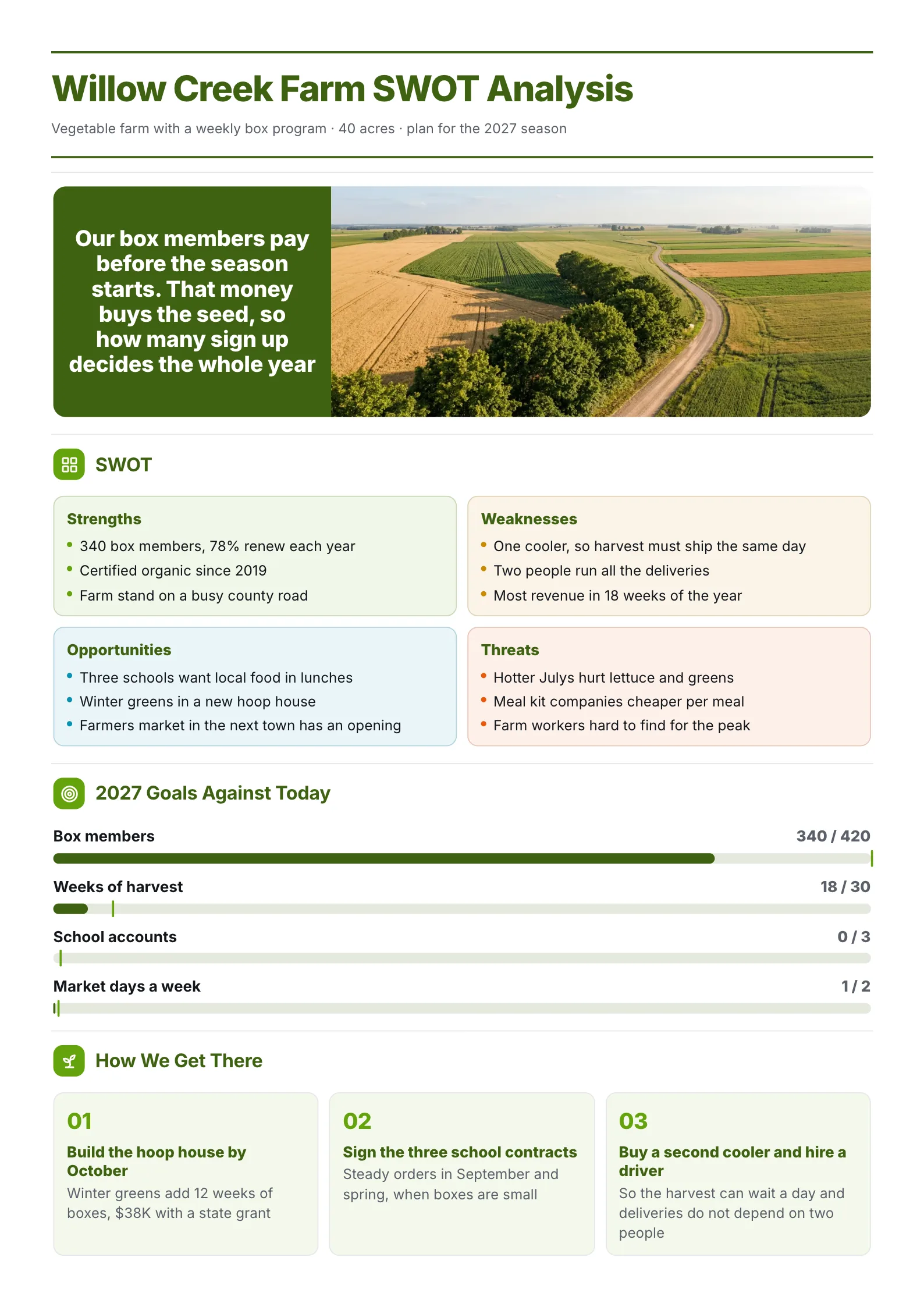 SWOT Analysis: FarmEdit for free(opens in a new tab)
Below is the exact wording each one used, what it got back, and a set of questions you can copy for your own MakeOnepagers SWOT.
| Plan | Who answered | Questions asked | What came out |
|---|---|---|---|
| James Madison University, 2025 | 14 leadership and advisory groups, then 2,715 complete surveys | 5 open questions, then ratings | 12 strengths, 12 weaknesses, 8 opportunities, 9 threats |
| City of Cerritos, California, 2024 | 76 staff, 163 community members, 25 workshop guests | 9 for staff, 10 for the community | 7 strengths, 7 weaknesses, 11 opportunities, 8 threats |
| North Central District Health Department, Nebraska, 2023 | 13 staff in one session | Data first, then one scan question | 11 themes to plan around |
The 5 questions one university asked
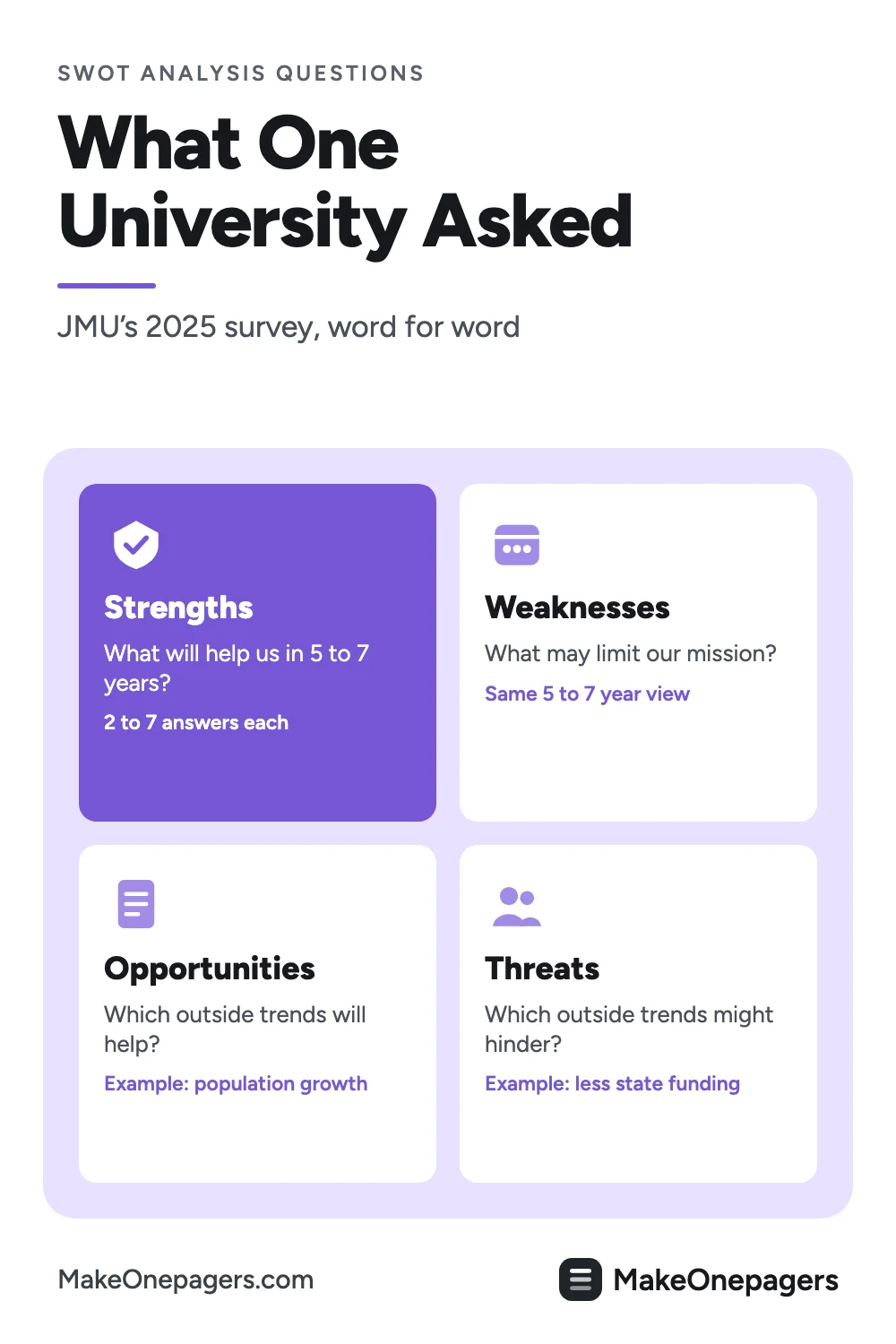
JMU ran its SWOT from February to May 2025 for its Board of Visitors. The report, written by the university's planning and research office, prints the survey word for word in Appendix B. Here are the four box questions, with the sample answer each one gave:
| Box | JMU's question | The example it gave |
|---|---|---|
| Strengths | "Looking ahead 5-7 years, what are JMU's key strengths that will help us achieve our mission as a higher education institution?" | "strong industry partnerships that enhance work-based learning and research collaboration" |
| Weaknesses | "Looking ahead 5-7 years, what are JMU's key weaknesses that may limit our ability to meet our mission as a higher education institution?" | "limited funding for research that hinders our ability to attract top faculty" |
| Opportunities | "What external influences, trends, and/or opportunities will help JMU better achieve its mission in the next 5-7 years?" | "population growth in key recruitment areas" |
| Threats | "What external influences or trends might hinder JMU's mission in the next 5-7 years?" | "decreasing state funding as a proportion of our budget" |
The fifth question was a catch-all: "What else would you like to share related to JMU's strengths, weaknesses, opportunities and threats that you feel will assist with JMU's strategic planning process?"
Copy these four habits into your own questions:
- A time frame in every question. All four say "5-7 years." It keeps your people answering for the same stretch of time as your plan.
- The goal inside the question. Strengths "help us achieve our mission." Weaknesses "limit our ability to meet our mission." Each answer has to connect to something.
- A number of answers. Each of the four asks for 2 to 7 answers ("2-7 specific responses" for strengths and weaknesses, "2-7 examples" for the outside two), with seven blank lines on the form. The floor of two asks for more than one idea, and the cap of seven keeps your lists short.
- One example, with a warning. The intro says the examples show "the recommended specificity only" and are "not meant to influence your ideas in any way." You get detail without planting the answer.
The intro also takes the pressure off sorting: "If you have ideas to share, but aren't sure which SWOT component to place it in, that's okay." Staff themed the answers later.
From about 2,000 ideas to 41
The open questions went to 14 groups, from the Faculty Senate to the Student Government Association. They sent 172 responses, then talked them through in person or online. That produced about 2,000 ideas. Staff sorted them into themes, and a planning team of about 30 people, the president, the division heads and a board committee cut them to 41: 12 strengths, 12 weaknesses, 8 opportunities and 9 threats.
Then came a second round with different questions. Everyone (students, faculty, staff, community members, alumni and board members) rated the 41 items for agreement and importance, each on a four-point scale, with a "No basis to judge" option. That survey drew 4,800 responses, and 2,715 were complete. To keep it short, each person first saw only two of the four boxes, one internal and one external. About 47% chose to go on and rate all four.
So plan two kinds of questions for your SWOT. Use open ones to find the items. Use rating ones to learn which items matter to your people.
The city that never said "strength"
Cerritos hired a consultant to run its strategic plan in fall 2024, and the adopted report prints both of its surveys as pictures in Appendices A and B. The staff survey had 9 questions. The first three did the SWOT work:
- "What are one to two things that the City does well?"
- "Are there any services or programs you feel the City should expand or improve?"
- "Are there any areas in which the City should spend less time and resources?"
Others asked which services people use most, which areas to rank first "in the next 3-5 years," what upcoming projects to plan for, and "What are one or two things the City could do to improve your job satisfaction?" The resident survey opened with the same first three questions.
None of the 9 staff questions uses any of the four SWOT words. Yet the report's SWOT, written by the consultant "as a result of all the input gathered," lists 33 items. Some trace back clearly. Staff and residents both ranked public safety first, and "Property crime increasing" sits under threats. The workshops raised communications, and "Communications, internal and external need improvement" sits under weaknesses.
Plain questions that people can answer in a minute will fill a SWOT. Steal question 3 for your own survey. It invites people to name weak spots without having to call them weaknesses.
The health district that started with data
The North Central District Health Department in Nebraska held its planning session on August 22, 2023, with 13 staff and two facilitators from the University of Nebraska Medical Center. Its 2023 to 2027 strategic plan describes a different start. Nobody was handed a blank grid. Data sets were placed around the room in three groups, with health programs in one corner and office matters in another, and small teams walked from table to table.
The administration table, for example, held the board of health's feedback, a benefits survey and claims data. As they read, teams were asked to "explore and identify related organizational strengths, weaknesses, opportunities, and challenges." Note the last word. The district ran a SWOC, with challenges in place of threats. At the end, each person was asked to "highlight 2-3 areas" to pay attention to.
Then came one question for the outside world: "What are the trends, events, ideas, and approaches emerging in the field of public health? And in our communities?" It came with five lenses to think through: social, political and legal; environmental; economic; technological and scientific; and other. People then placed stickers on the items that mattered most.
The output was a list of 11 themes, such as "Improve public perception" and "Disconnected veteran staff and new staff." Try this if your team argues from opinion. Put your data on the table first, and every strength has to point at something real.
SWOT analysis questions to copy
These are our own questions, built on the patterns above. Swap in your goal and your time frame, ask for 2 to 5 answers each, and give one example.
Strengths
- Looking ahead 3 years, what do we do well that will help us reach our goal?
- What do customers praise us for that rivals can't easily copy?
- What do we own, know or have that would be hard to replace?
Weaknesses
- Looking ahead 3 years, what could stop us from reaching our goal?
- Where should we spend less time and money?
- What do we keep fixing by hand, every week?
Opportunities
- Which outside trends will help us reach our goal in the next 3 years?
- Who has asked for something we don't sell yet?
- What change in rules, prices or people nearby could we use first?
Threats
- Which outside trends might hurt us in the next 3 years?
- What would happen if our biggest customer, supplier or funder left?
- What are rivals doing now that we would struggle to match?
After the list. Ask everyone to rate each item twice, once for "Do you agree?" and once for "How important is it?" That's JMU's second round, and it's how the 41 items became a ranked list.
Five SWOTs, and the question behind each box
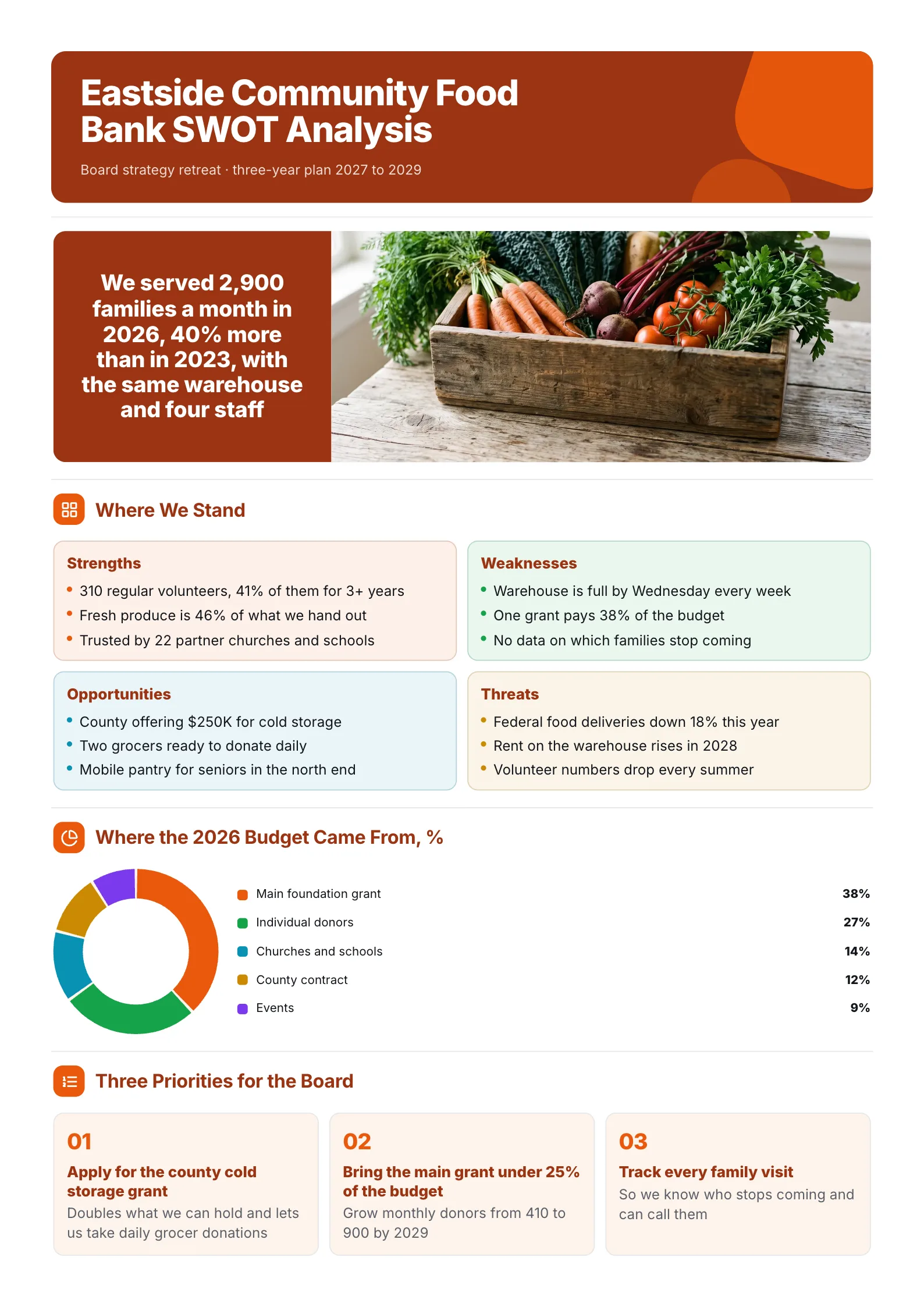
A food bank board planning three years out
 Edit this template
This nonprofit SWOT analysis is built for a board retreat with a three-year horizon, the same shape as JMU's questions. Look at the weakness "One grant pays 38% of the budget." See how it answers a "what could stop us" question with a number. The priority below it closes the loop: "Bring the main grant under 25% of the budget."
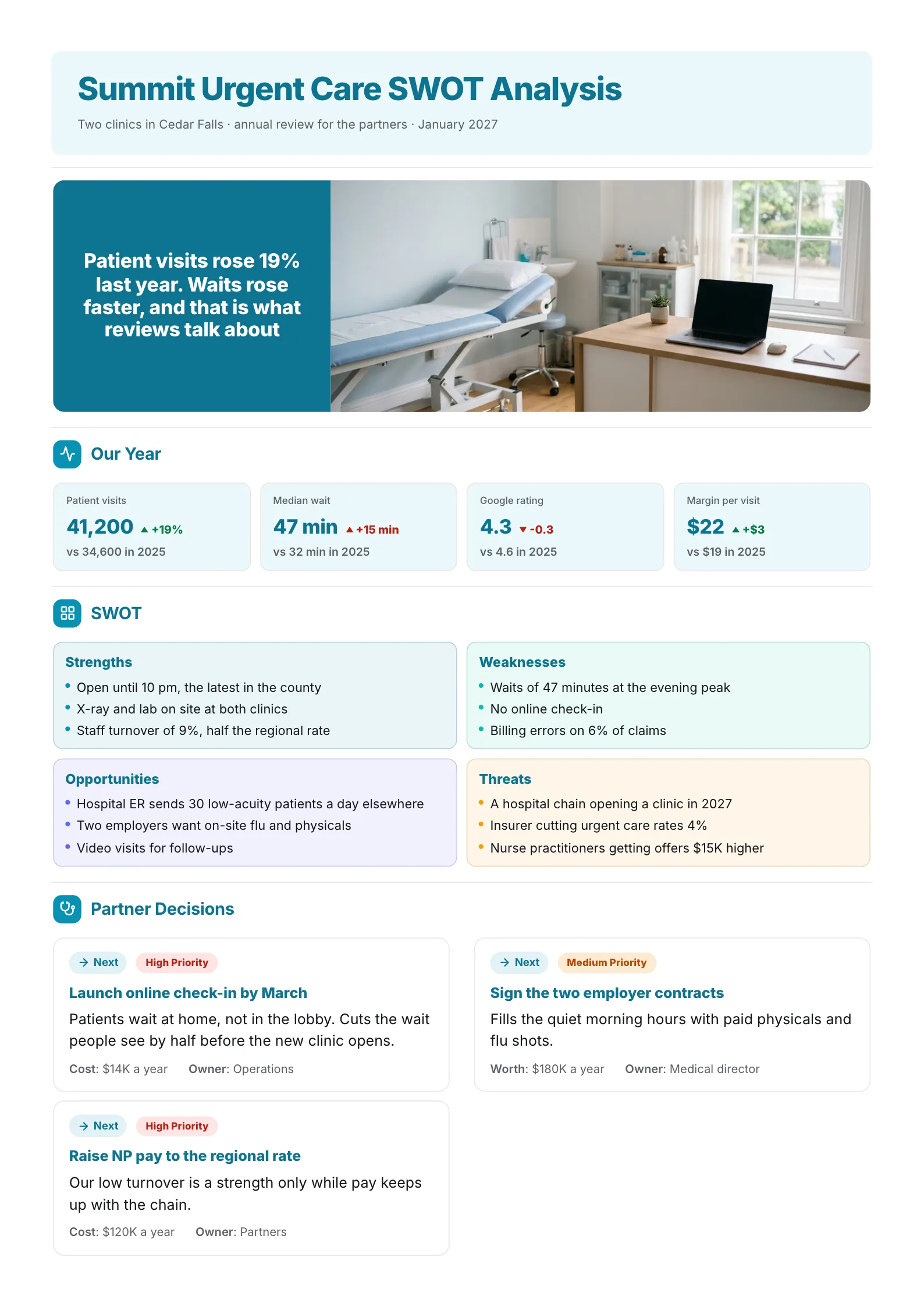
An urgent care clinic that reads its numbers first
 Edit this template
Start this one the health district's way, with the data. This urgent care SWOT analysis leads with four tiles: visits up 19% to 41,200, and the median wait up from 32 to 47 minutes. With those in front of the partners, "Waits of 47 minutes at the evening peak" is a weakness nobody can argue with, and "Launch online check-in by March" follows from it.
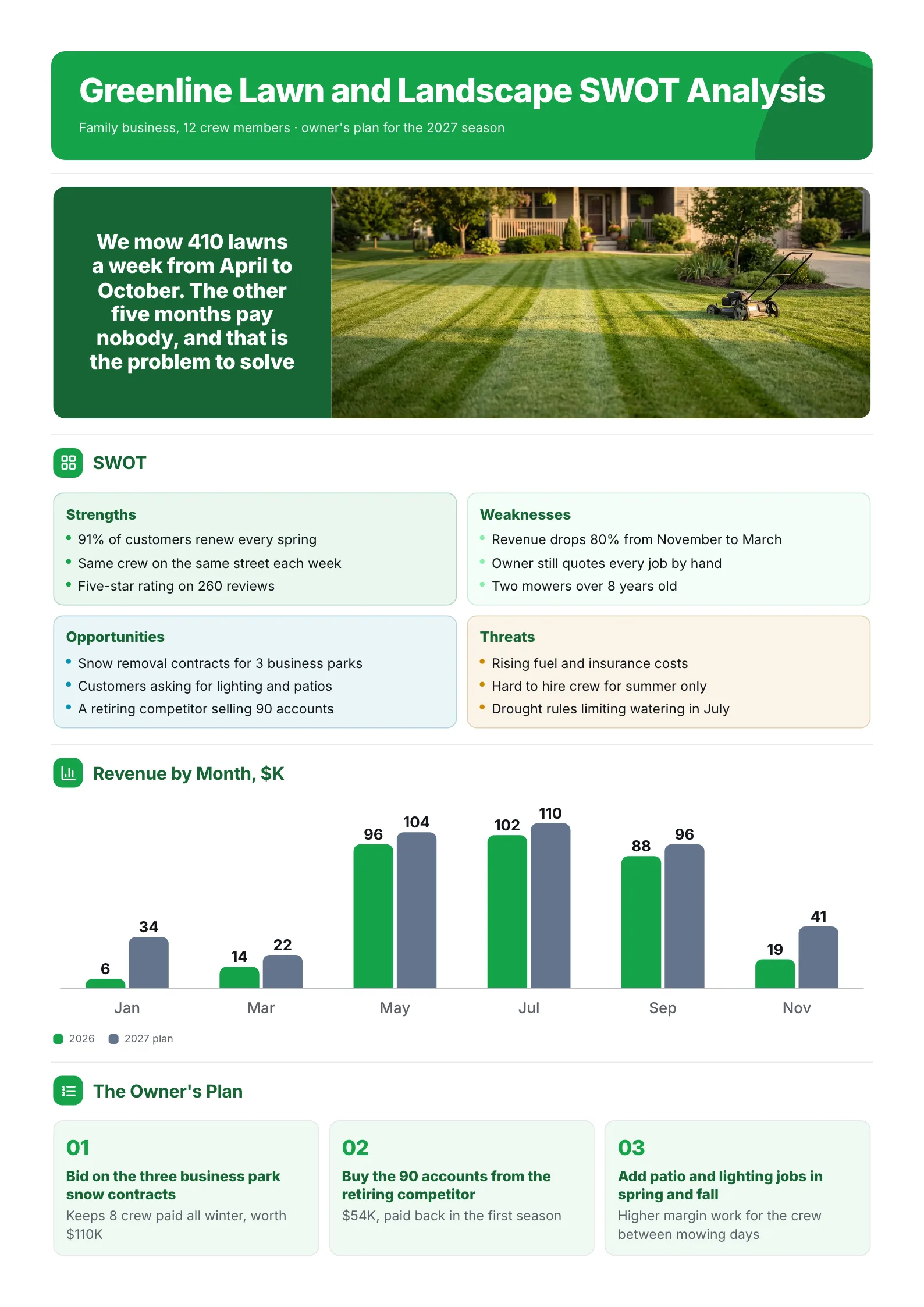
A lawn business asking where to spend less
 Edit this template
Cerritos asked what the city does well and where it should spend less. Ask your own crew the same two things. This small business SWOT analysis shows the answers side by side: "91% of customers renew every spring," and "Revenue drops 80% from November to March." The owner's plan aims at the gap, bidding on snow contracts that keep 8 crew paid all winter.
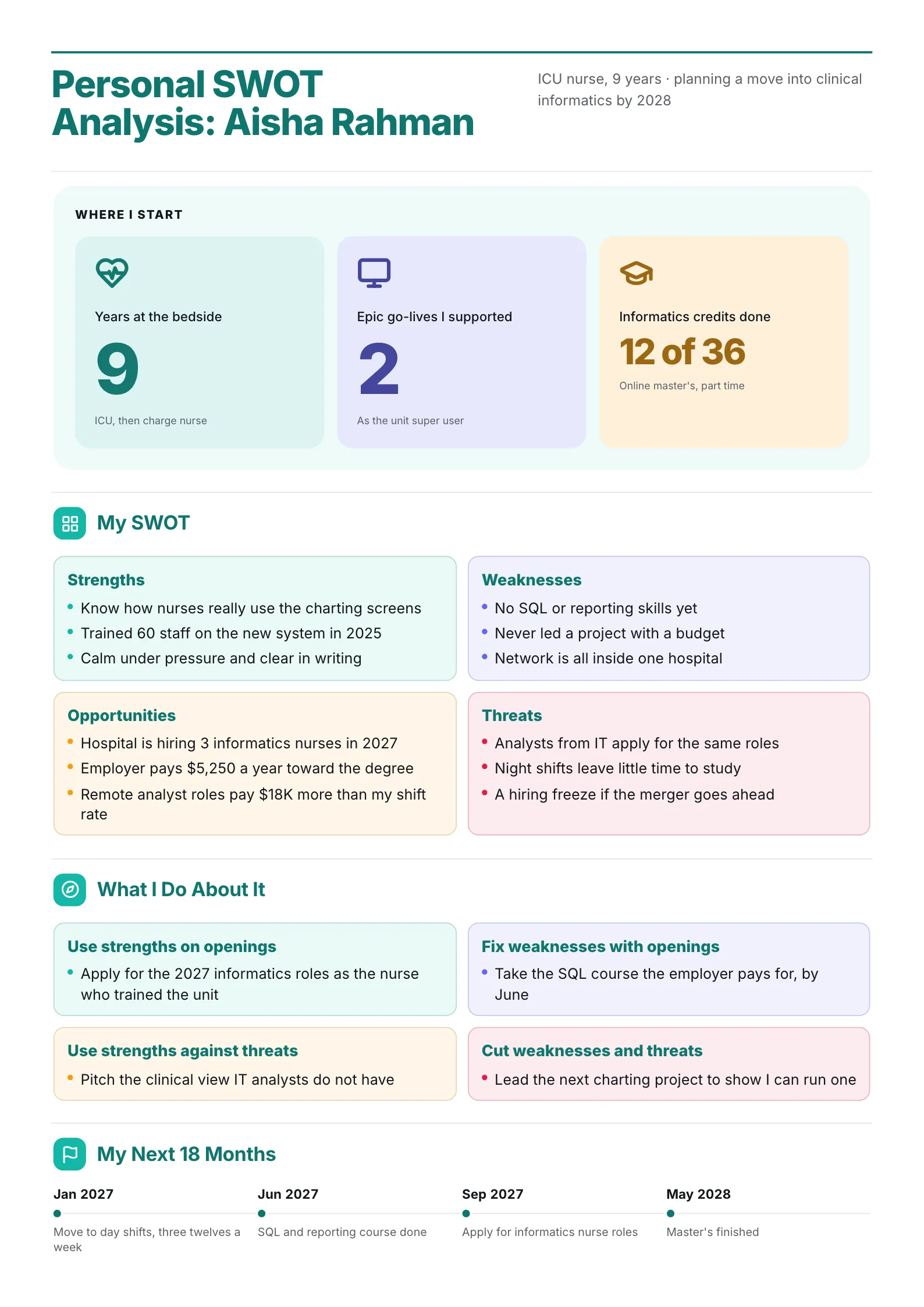
One nurse planning a career change
 Edit this template
You can use the same questions on yourself. Change "we" to "I." This personal SWOT analysis sets a date, clinical informatics by 2028, so every box answers to it. "No SQL or reporting skills yet" is a weakness. "Employer pays $5,250 a year toward the degree" is an opportunity. The action pairs them: take the SQL course the employer pays for, by June.
A product team that ranks its threats
 Edit this template
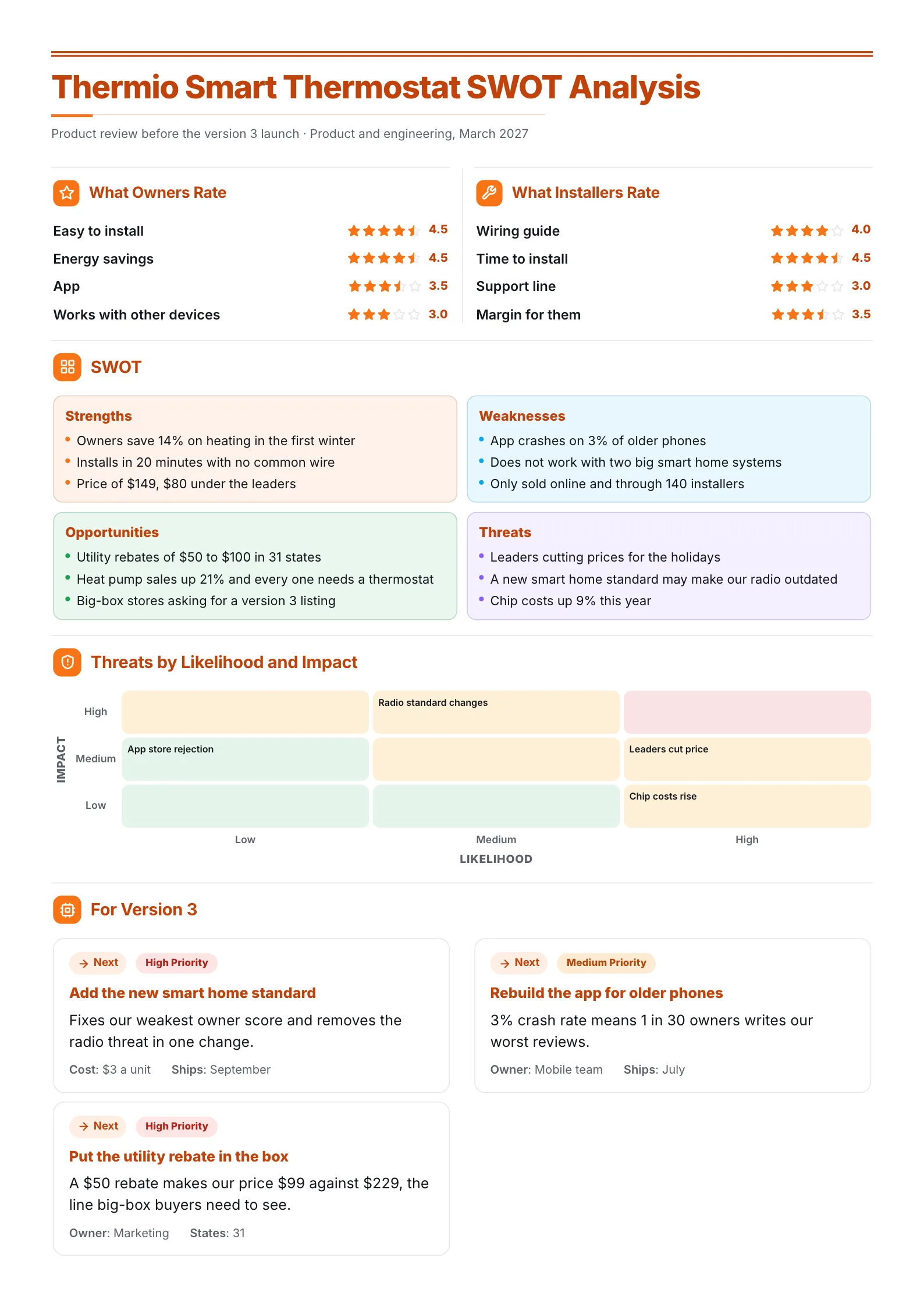
JMU's second round rated every item for importance. Do the same with your threats. This product SWOT analysis does that for threats, plotting four of them by likelihood and impact. The top fix, "Add the new smart home standard," earns its place because it "Fixes our weakest owner score and removes the radio threat in one change."
Make your SWOT analysis
Choose a MakeOnepagers SWOT that fits your business and paste in your answers. If you have a pile of survey replies, paste them into the free AI One-Pager generator, and it will sort a first draft into the four boxes for you to edit. To see how many items real plans keep in each box, read SWOT analysis examples. For the ways to lay it out, see SWOT analysis format, and for the full process, how to do a SWOT analysis.
Frequently asked questions
How many questions should a SWOT survey have?
Fewer than you think. JMU used 5 open questions, one per box plus a catch-all. Cerritos used 9 for staff, and only the first 3 did the SWOT work directly. Start with one question per box and leave your people room for 2 to 7 answers.
Should people sort their own answers into the four boxes?
You can ask them to, but keep it optional. JMU told people it was "okay" to put an idea in the wrong box, and its staff moved ideas later. Cerritos never mentioned the boxes at all, and the consultant sorted the answers.
What time frame should SWOT questions use?
Match your plan. JMU wrote "5-7 years" into every question. Cerritos asked about priorities for "the next 3-5 years." The health district set a 5-year vision. For a small business or a single project, pick 1 to 3 years.
What is a SWOC analysis?
It's a SWOT with "challenges" in place of "threats." The Nebraska health district used it in its 2023 session. The questions stay the same. Use whichever word your team is used to.
Who should answer SWOT questions?
More people than usual, in two rounds. JMU asked 14 leadership groups for the open answers, then let students, staff, alumni and community members rate the shortlist. Its report notes it was the first time students were included in a SWOT survey sample.




