SWOT Analysis Format: 6 Public SWOTs and the 3 Layouts
The SWOT analysis format in six public SWOTs: three used a grid, two a list and one prose, with 44 to 183 items. Here's which to use.

You probably picture a SWOT analysis as four boxes in a square. That's the most common format, but it isn't the only one, and the format you pick changes what your readers do with it. Start from a free one pager template.
One‑Pager examples
Real One-Pagers made with MakeOnepagers. Open any one to edit it as your own.
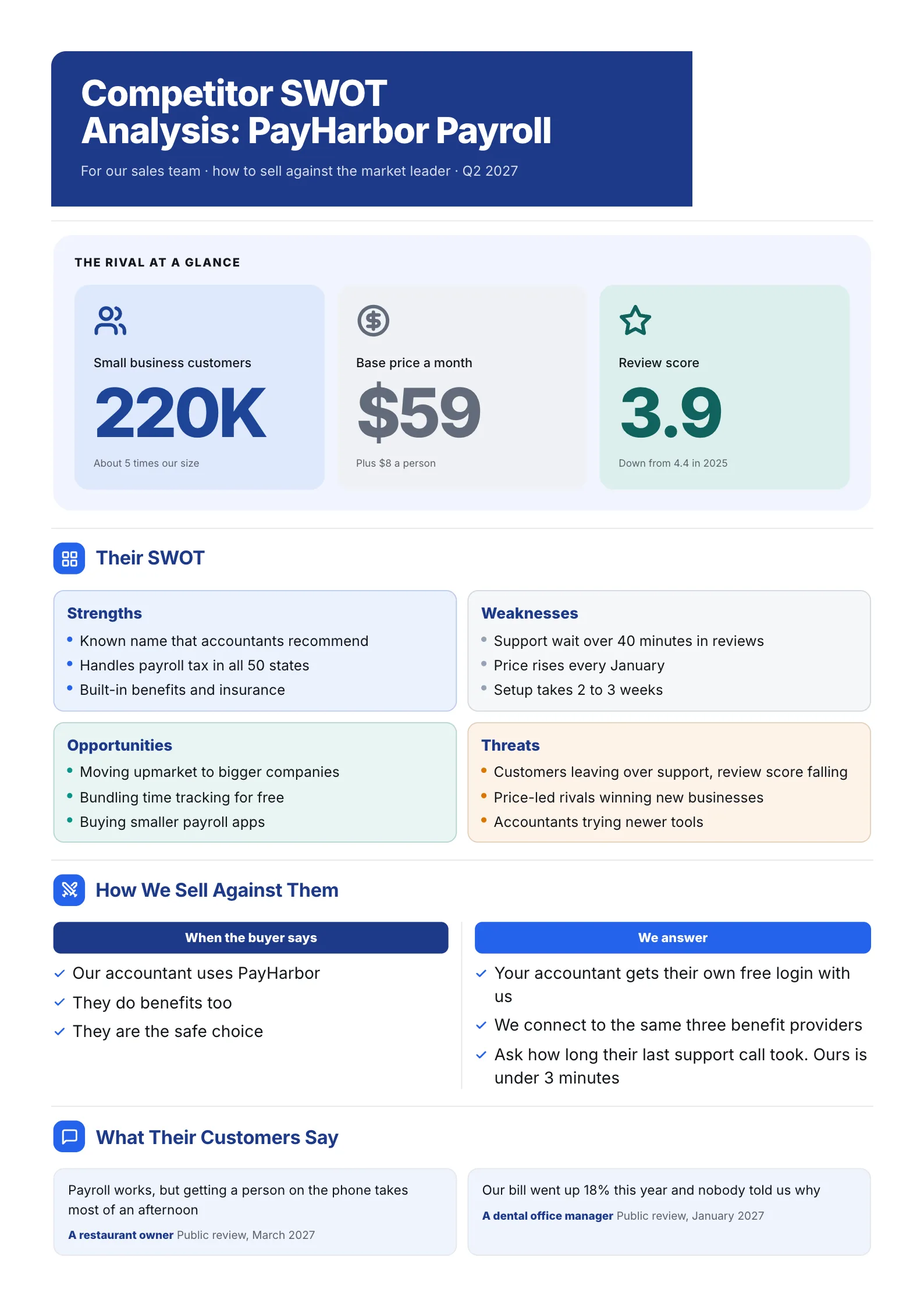 SWOT Analysis: CompetitorEdit for free(opens in a new tab)
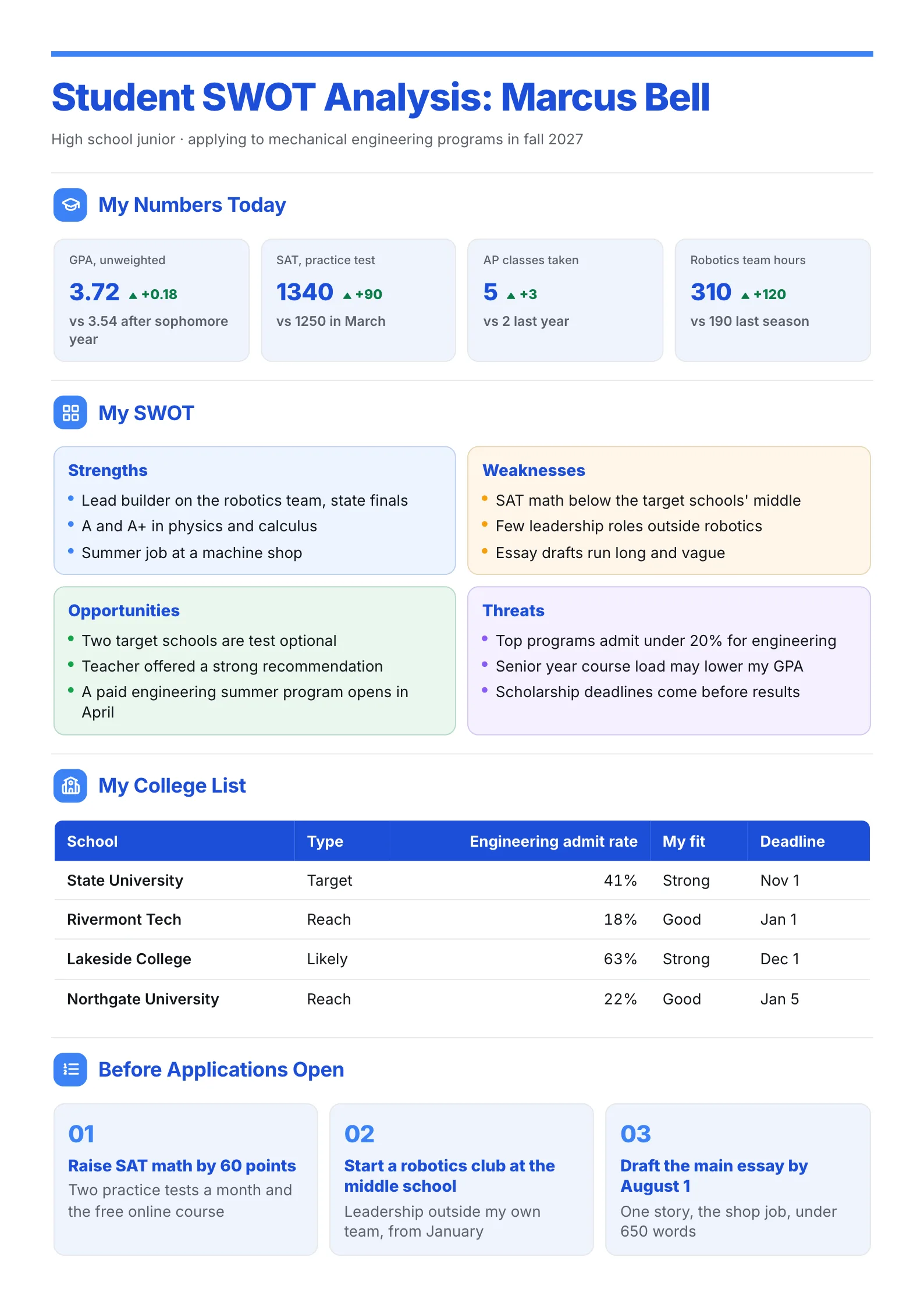 SWOT Analysis: StudentEdit for free(opens in a new tab)
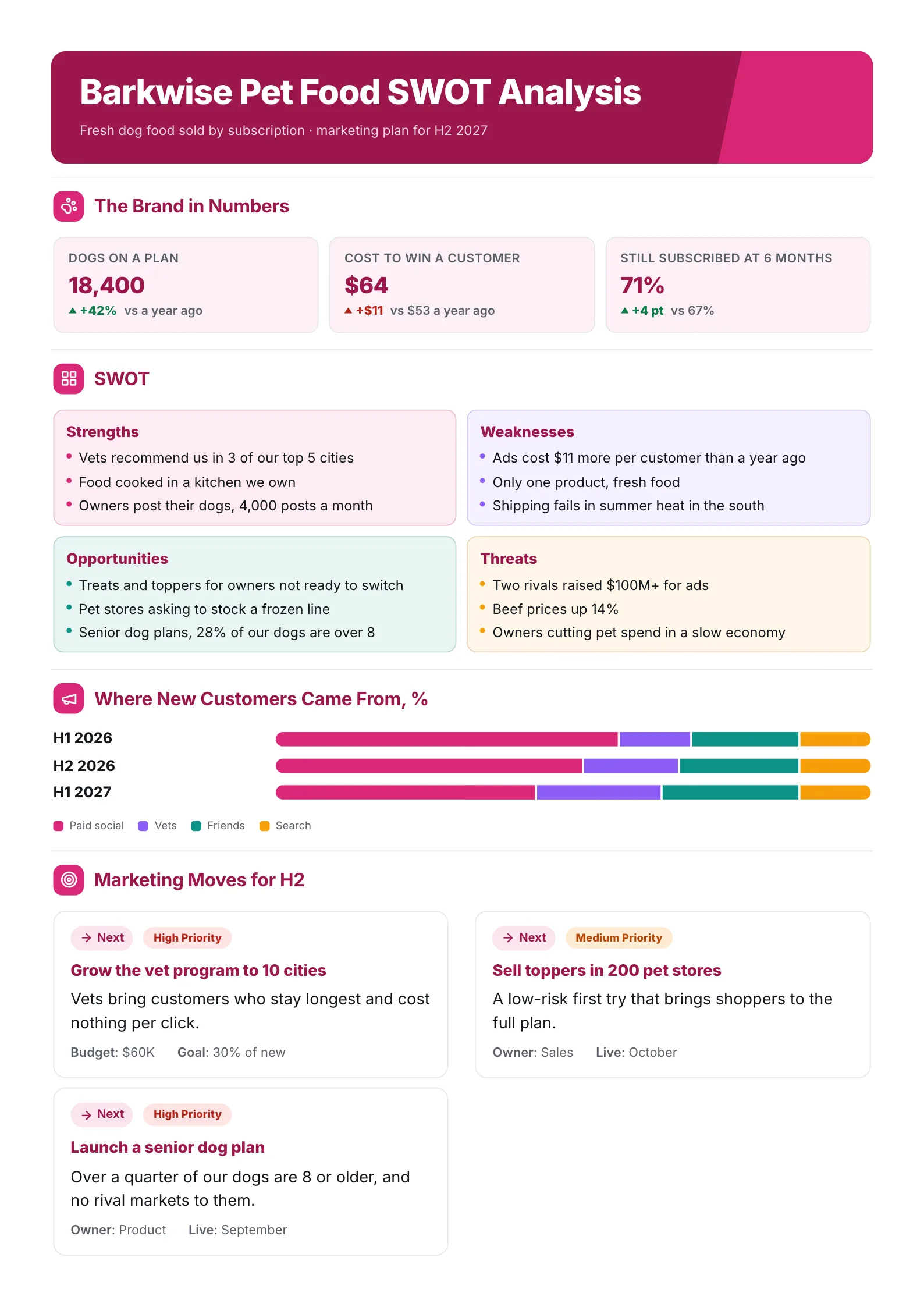 SWOT Analysis: Pet Food Brand MarketingEdit for free(opens in a new tab)
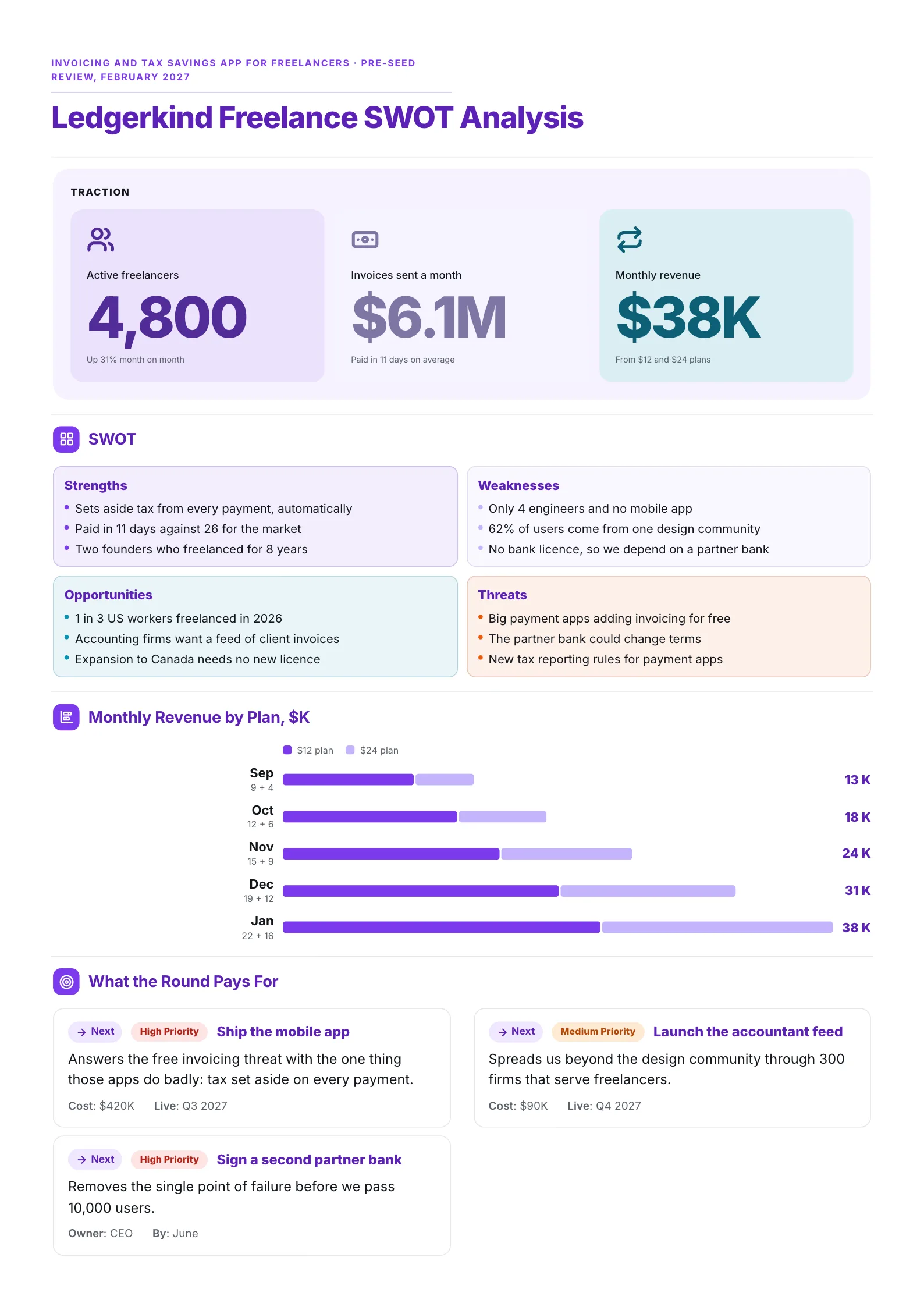 SWOT Analysis: StartupEdit for free(opens in a new tab)
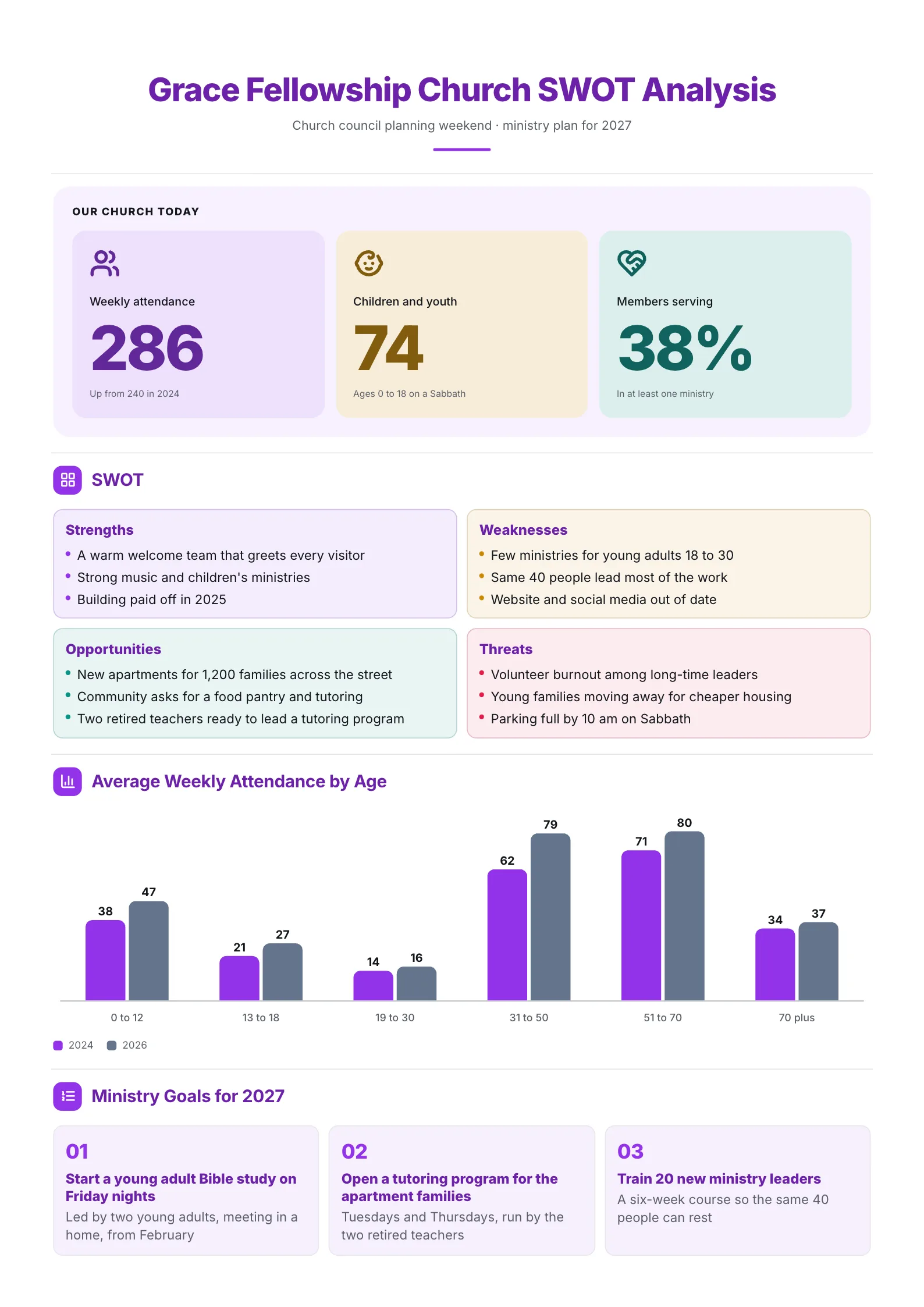 SWOT Analysis: ChurchEdit for free(opens in a new tab)
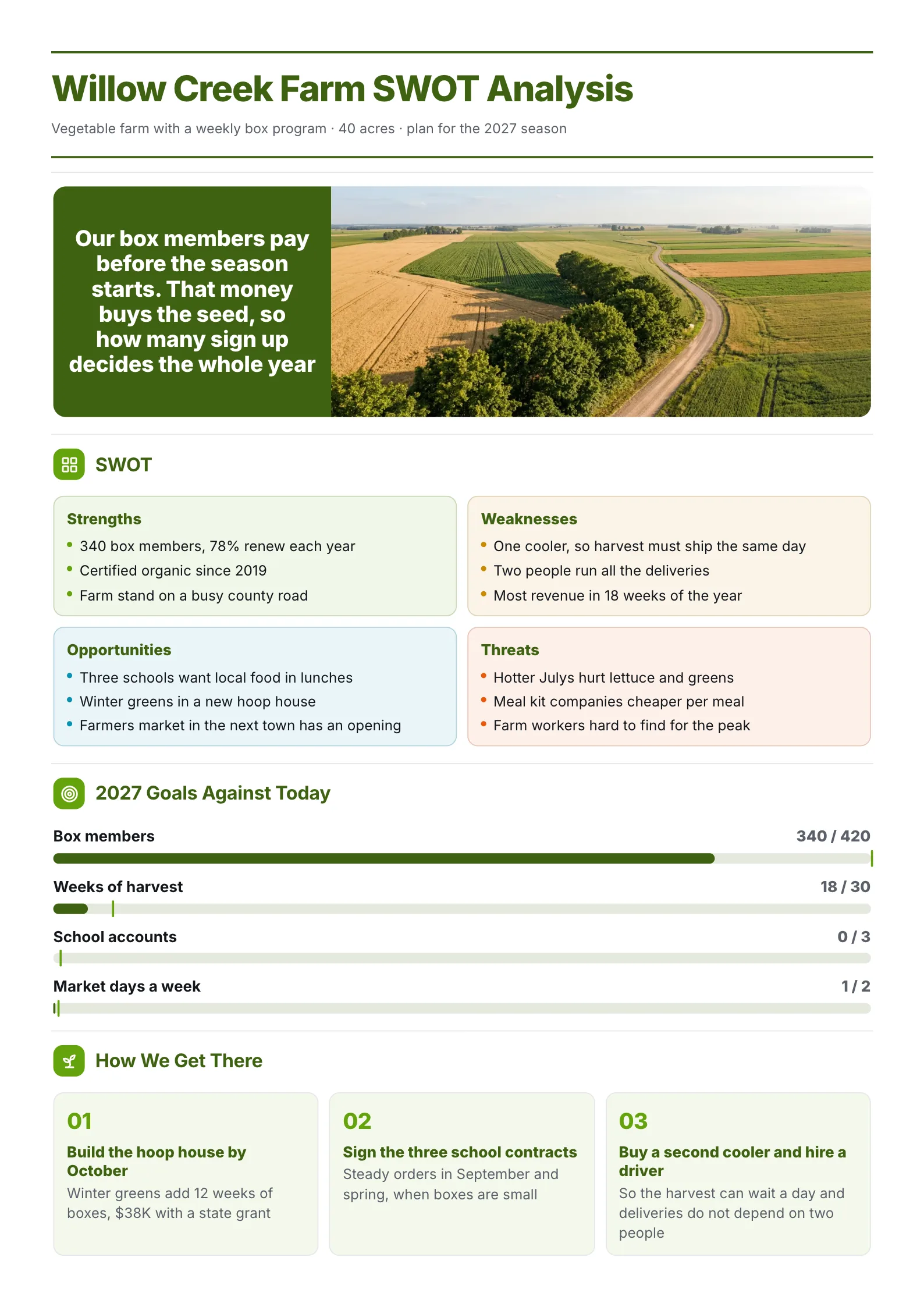 SWOT Analysis: FarmEdit for free(opens in a new tab)
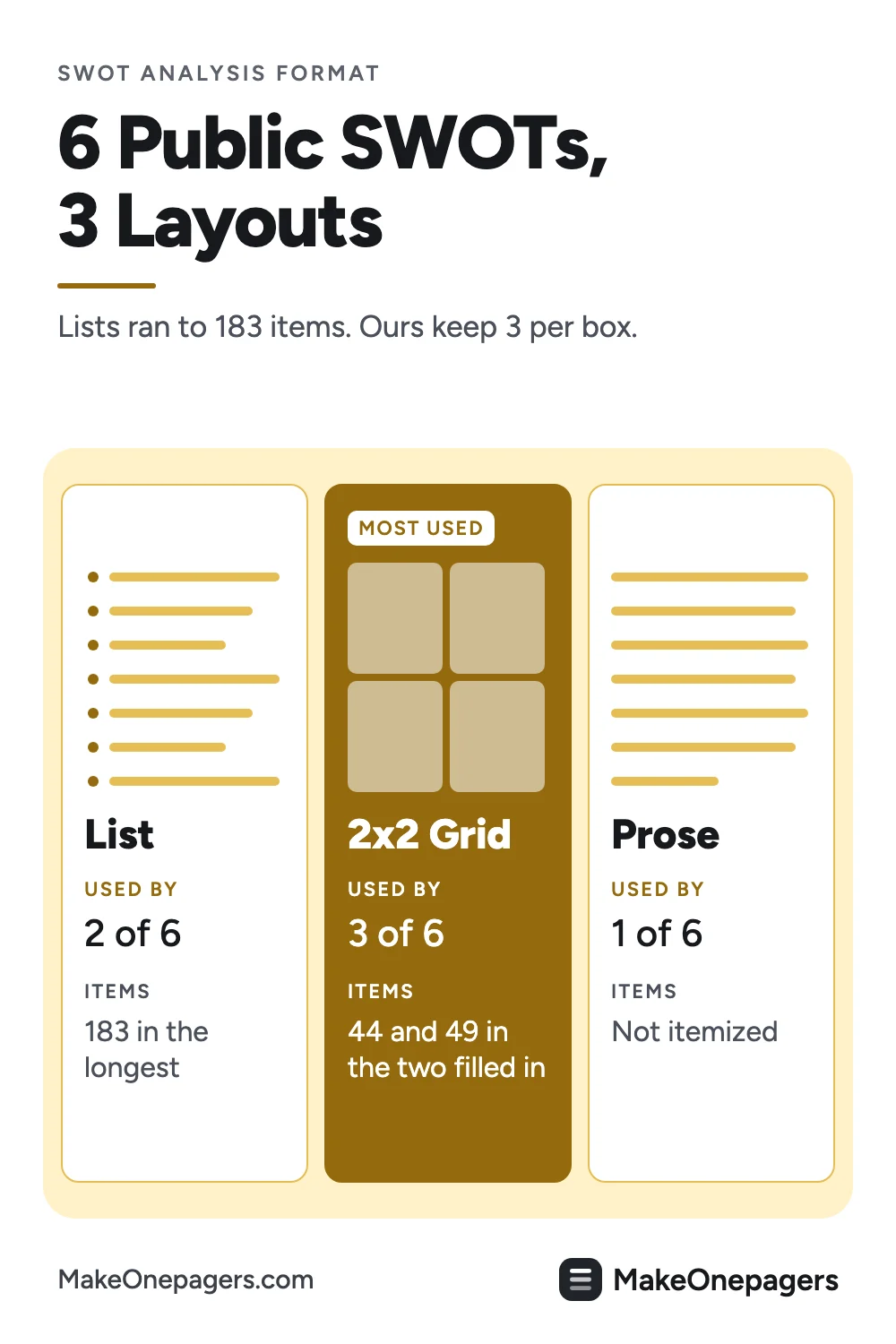
To see the options, we pulled six SWOTs and SWOT forms that public bodies and a national association published: four filled in, two blank templates. We counted how each one was laid out and how many items it held. Then we compared them with the one-page format we use, so you can choose the right shape for yours.
Six public SWOTs, side by side
| Who published it | Year | Format | Items |
|---|---|---|---|
| City of Red Bank, Tennessee (commission retreat summary) | 2025 | One bulleted list per box | 183 |
| City of Santa Clara, Utah (general plan kick-off) | 2025 | 2x2 graphic, then lists | 44 |
| Douglas County Health Department, Colorado (strategic plan) | 2023, revised 2024 | 2x2 grid in a table | 49 |
| Fresno County Public Library (strategic plan) | 2019 | Prose, four headed sections | Not itemized |
| South Dakota State Library (template for library boards) | 2023 | 2x2 grid | 24 bullet spaces |
| NACCHO (strategic planning template) | 2012 | Four headings in a list | Four empty headings |
Source: our count of each document, all read October 30, 2026. NACCHO is the National Association of County and City Health Officials.
Three of the six chose a grid. Two chose lists, and one wrote it out in paragraphs. Here's what each format does well, and when you'd pick it.
Format 1: the 2x2 grid
The grid puts internal factors on the top row and external ones on the bottom. Douglas County labels the rows outright, with "Internal Environment" on the left of the top row and "External Environment" beside the bottom. South Dakota puts the label inside each box title, so it reads "Strengths (Internal)" and "Threats (External)."
Santa Clara does something worth copying. Before its lists, it opens with a 2x2 graphic that defines each box in one line. Strengths are "internal attributes and resources that support the community." Opportunities are "external factors that the community can capitalize on or use to its advantage." If someone joins your meeting late, they still know where each idea goes.
Use the grid when your readers need to see the whole picture at a glance, like your board, your team or a funder. It also keeps you short, because a box only holds so much.
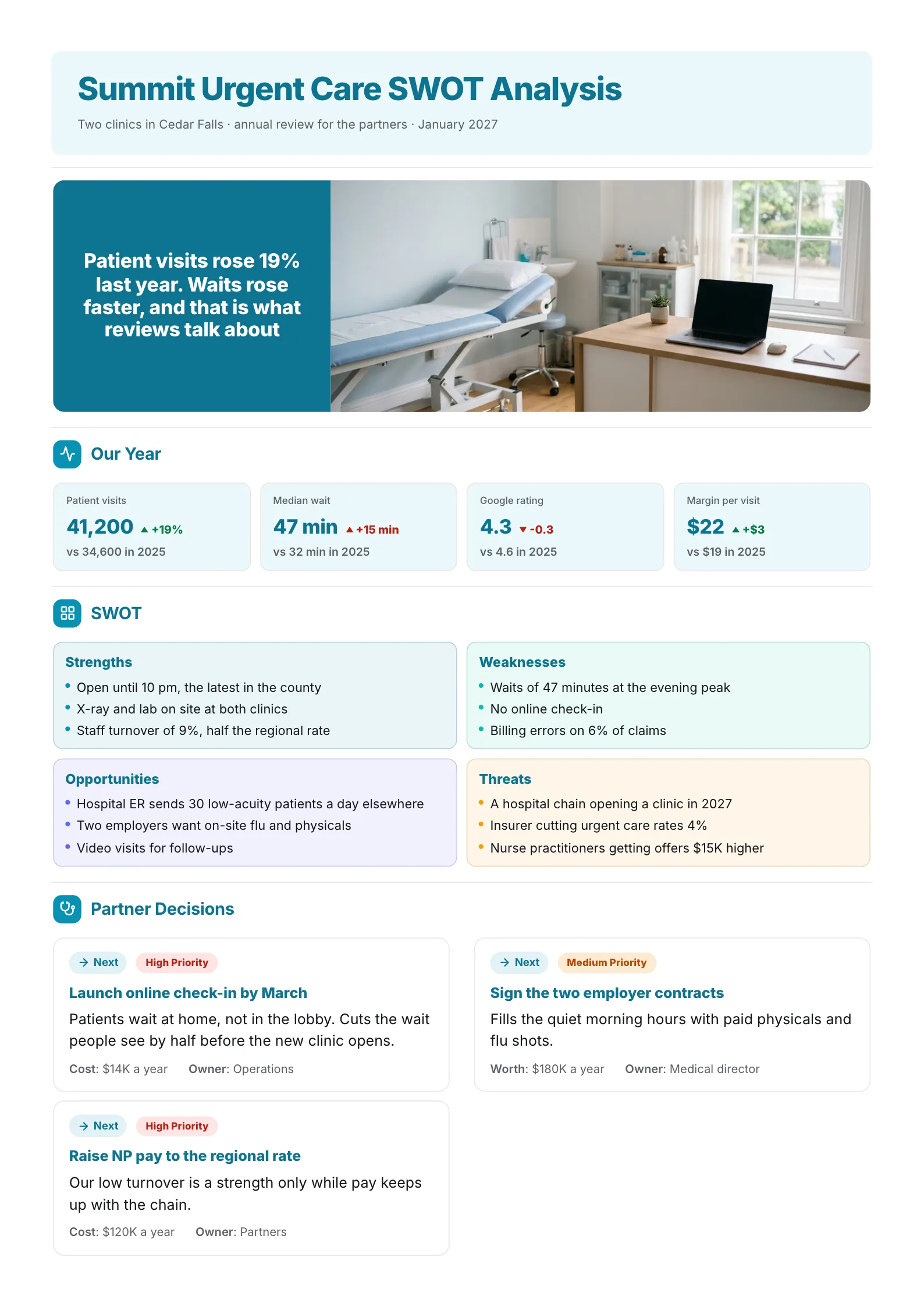 Edit this template
Sample names and figures. The 47 minute wait sits in Weaknesses, and the decision to add online check-in comes first in the decisions below the grid.
Format 2: the plain list
Red Bank's commission retreat summary, written up by the University of Tennessee's Municipal Technical Advisory Service, lists every item the commissioners said, one bulleted list per box. It runs to 60 strengths, 46 weaknesses, 42 opportunities and 35 threats. That's 183 items over several pages.
The summary is honest about what that means. Its items "were not necessarily agreed on by the entire team but were items offered by individual members." A list records everything your people said. It won't sort or rank it for you.
You can see that in the overlaps. "Vacant buildings" shows up as a strength, since they're available for new businesses, and also as a threat. Commuters passing through town show up as a weakness and a threat. In a list, nothing forces you to settle which box an item belongs in, so you may never settle it.
NACCHO's template takes the list format too, with four plain headings under a section called "Summary of key internal and external issues." It sits between the mission and values section and the goals, which tells you where the SWOT belongs in your own plan.
Use a list for your brainstorm, when you want every idea on the table. Then turn it into a grid before you or anyone else has to decide anything.
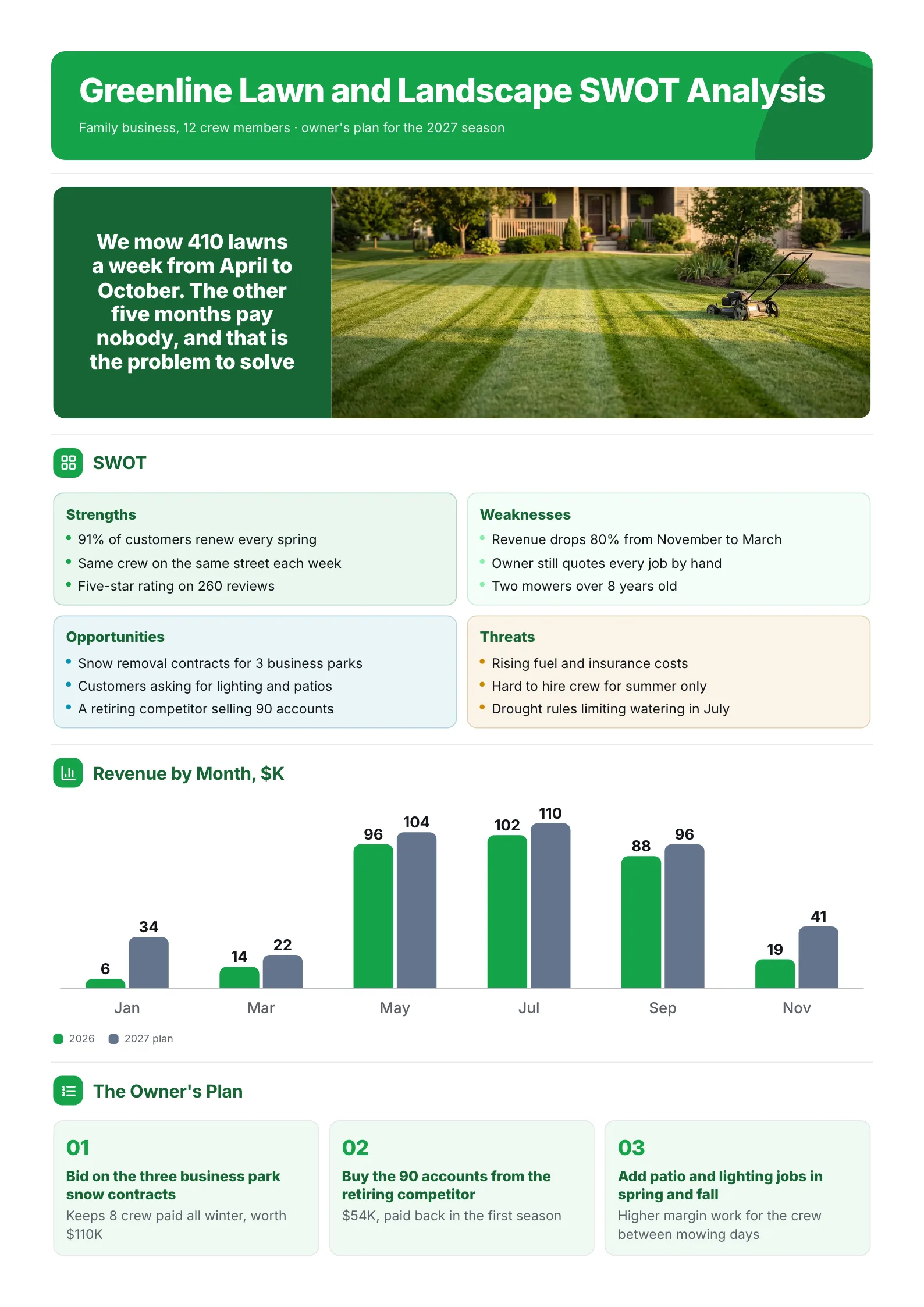 Edit this template
Sample names and figures. A busy brainstorm can be cut to three items a box once you keep only what leads to a decision.
Format 3: prose
Fresno County Public Library's strategic plan gives each of the four letters a heading and then writes paragraphs under it, across a two-page spread. It reads each one through three lenses, professional, organizational and community. The full brainstorm notes are kept in an appendix.
Prose works when you need to explain why something matters. Your board can read a paragraph on a weakness and understand the history behind it. The cost is speed, since you can't scan two pages of paragraphs in a meeting.
Use prose in a written plan your readers take home, and keep a grid version on the first page for everyone else.
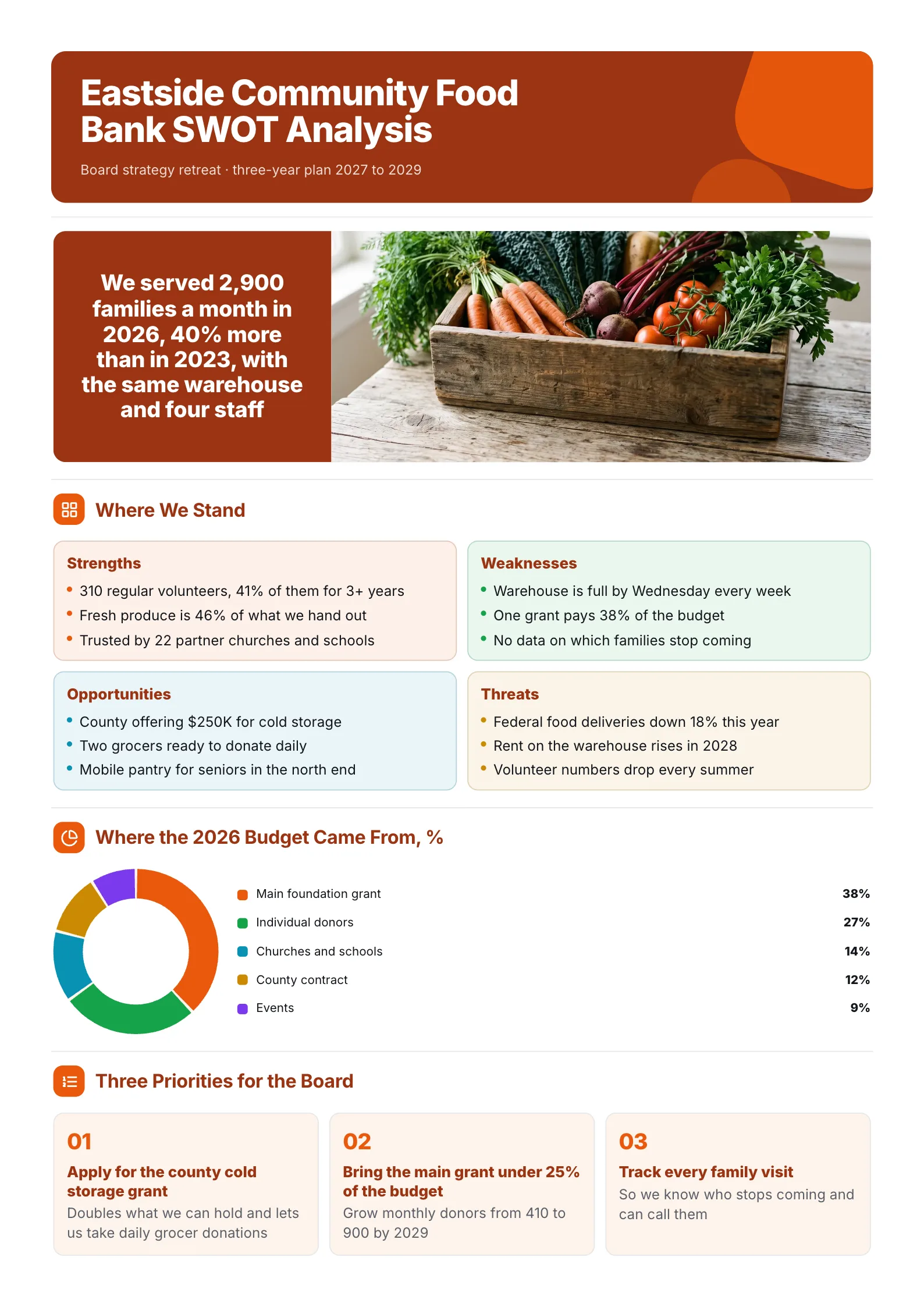 Edit this template
Sample names and figures. Each box keeps three items, and most carry a number a board member can check.
How many items per box?
The public SWOTs ranged from 44 to 183 items, and even the template from South Dakota leaves room for 6 per box. Ours keep 3. Here's why.
Douglas County's plan says it used its SWOT "to ensure proposed goals and objectives fit within" its internal and external environments. That's the job your SWOT does. It checks your plan. Three items per box is enough for that check, and few enough that your team can discuss every one.
Douglas County also shows the format is allowed to change. Seven of its 49 items carry a star marking them as revised in August 2024, a year after the plan was adopted. You can update a short grid like that in minutes. A 183-item list takes a meeting.
One more thing from Douglas County. "Legislation" sits in its opportunities box, and "changing public health laws" sits in threats. One outside force can help you and hurt you at once, so name the specific change in each box.
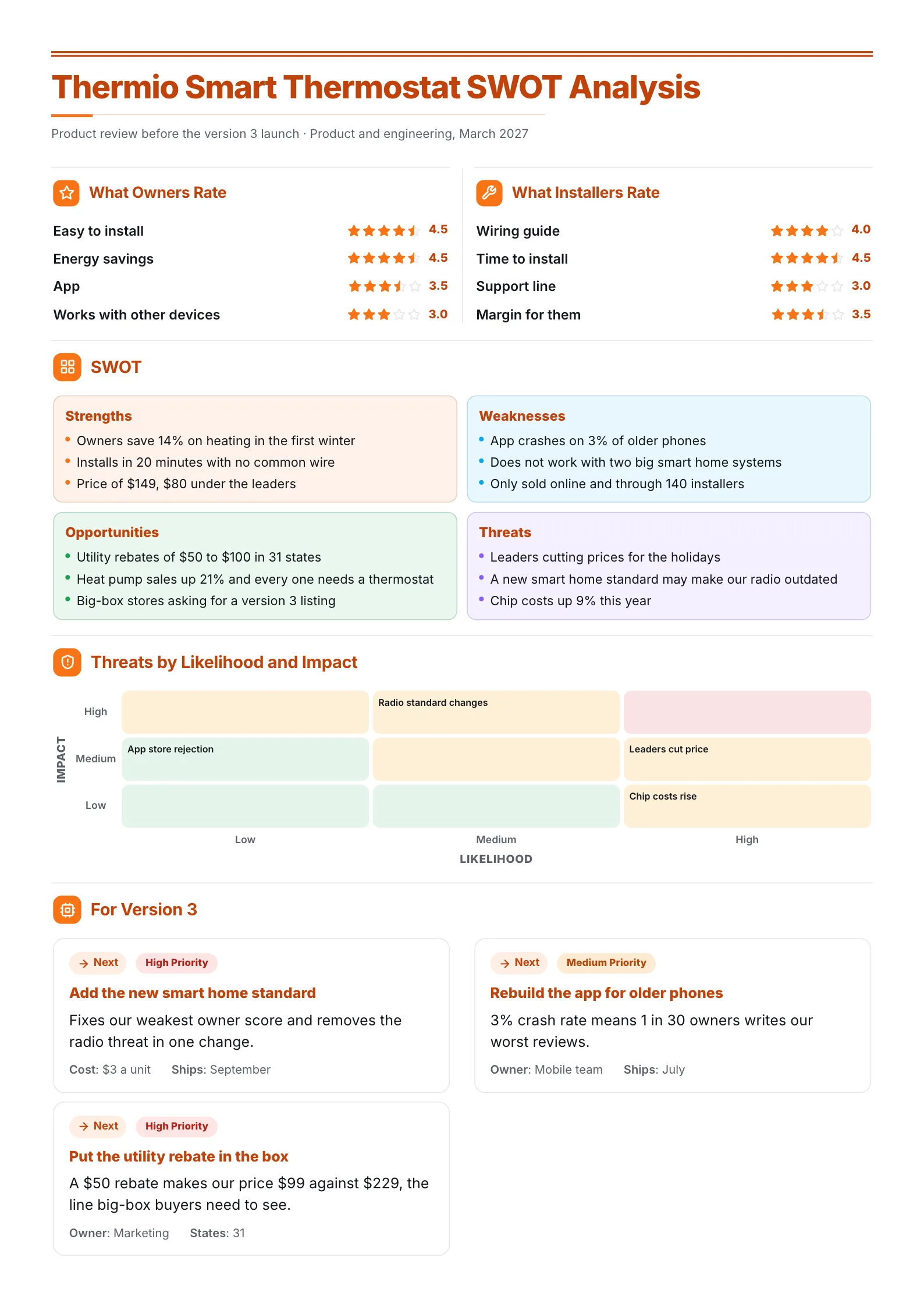 Edit this template
Sample names and figures. The plan line under the grid turns a $50 rebate into a $99 price against a $229 rival.
What goes under the grid
Three of the six show where the SWOT leads. Red Bank's commissioners took 20 goals and voted on them with five stickers each to pick 5. Douglas County used its SWOT to test its goals. NACCHO puts goals right after the SWOT section.
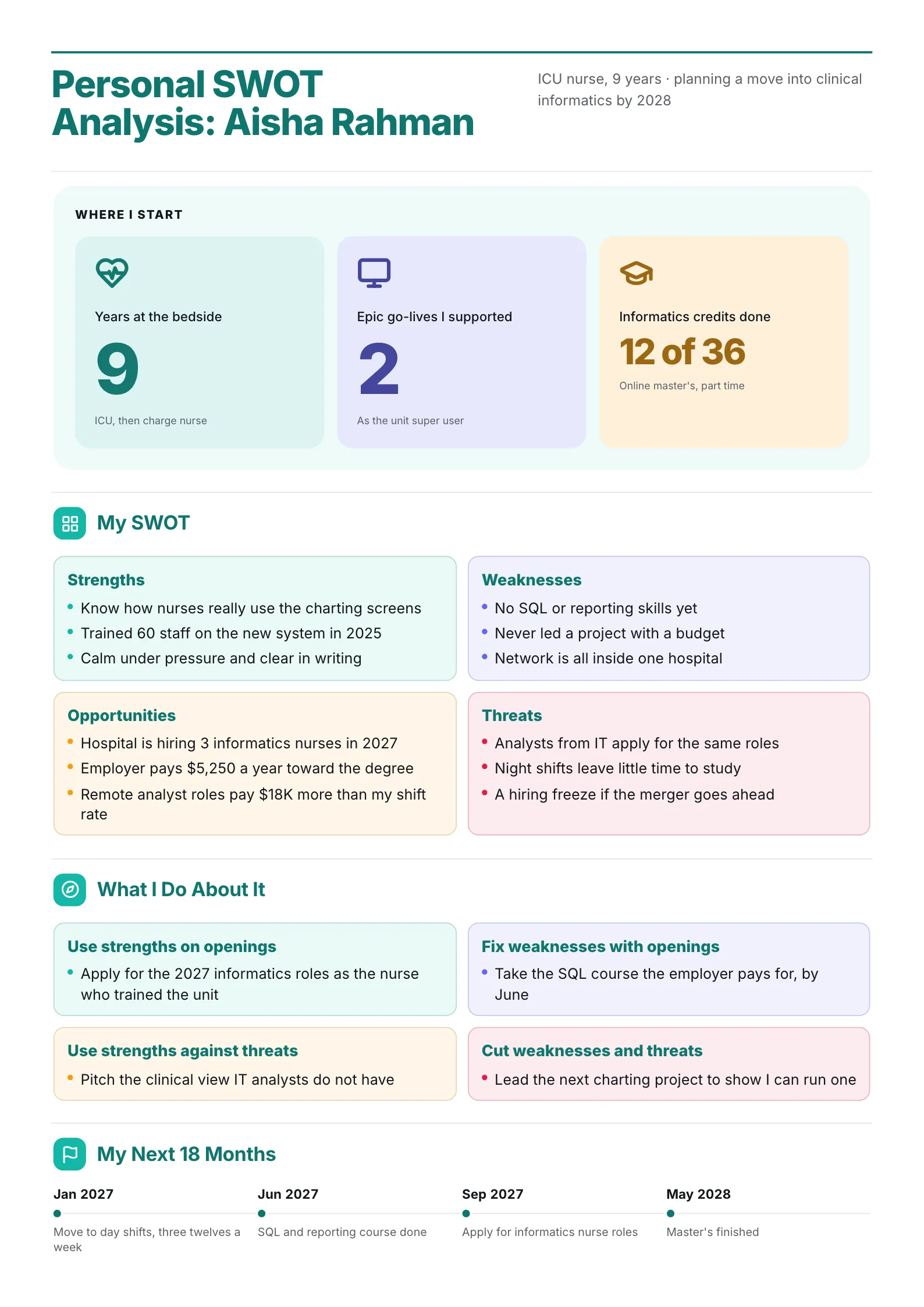
So give your format one more row. Under the four boxes, write the two or three things you'll do because of them, each with a number. Your personal SWOT works the same way.
 Edit this template
Sample names and figures. A strategy grid under the SWOT turns each pairing of strengths, weaknesses, openings and threats into one action.
The whole method, from picking the question to running the session, is in our guide on how to do a SWOT analysis. For more filled-in pages you can copy, our SWOT analysis template post shows the grid for several kinds of organization.
Fold the list into four
A long brainstorm list doesn't mean you start over. Pick the three items in each box that would change a decision, and fold the rest into an appendix the way Fresno did. Then set those twelve items and your two or three actions on a MakeOnepagers SWOT design and bring that page to the meeting.
Frequently asked questions
What is the standard SWOT analysis format?
A 2x2 grid. Strengths and weaknesses go on the top row as internal factors, and opportunities and threats go on the bottom row as external ones. Three of the six public SWOTs we read used it.
Can a SWOT analysis be written in paragraphs?
Yes. Fresno County Public Library wrote its SWOT as four headed sections of prose. It works for a plan your readers take in alone, but add a short grid if you'll present it.
How long should a SWOT analysis be?
Keep it to a single page if you can. The public versions we read held 44 to 183 items, but a grid with three to six items per box is easier for you to discuss and update.
Should a SWOT include an action plan?
It should lead to one. Red Bank, Douglas County and NACCHO's template all go from the SWOT straight to goals. When you add two or three actions under the grid, that link stays on the same page.




