SWOT Analysis Template: Free One-Page SWOT With 5 Examples and Questions
A free SWOT analysis template on one page: the four boxes, questions to fill each one, 5 SWOT examples and a worked example that ends in strategic moves.

A SWOT analysis template helps you sort what you know about your business or project into four boxes. Strengths and weaknesses sit inside your organization. Opportunities and threats sit outside it. It's one of the most used planning tools, because anyone can fill it in and it can start any strategy talk. The trouble is that most SWOTs stop at the four boxes. Below you'll find a free SWOT analysis template on one sheet and the questions that fill each box. You also get five SWOT examples, a worked example that ends in decisions, and the mistakes that turn a SWOT into a wasted afternoon. Start from a free one pager template.
One‑Pager examples
Real One-Pagers made with MakeOnepagers. Open any one to edit it as your own.
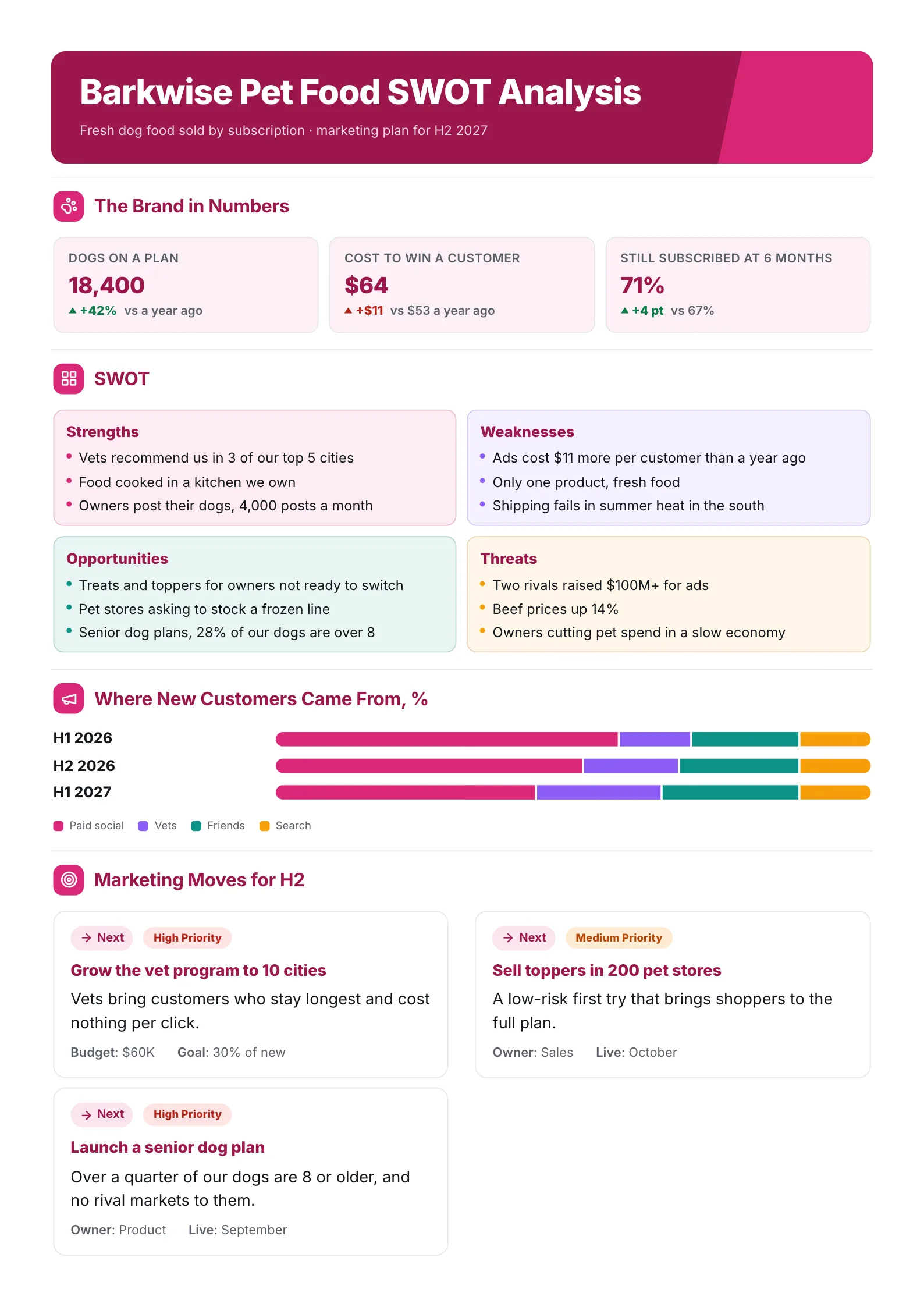 SWOT Analysis: Pet Food Brand MarketingEdit for free(opens in a new tab)
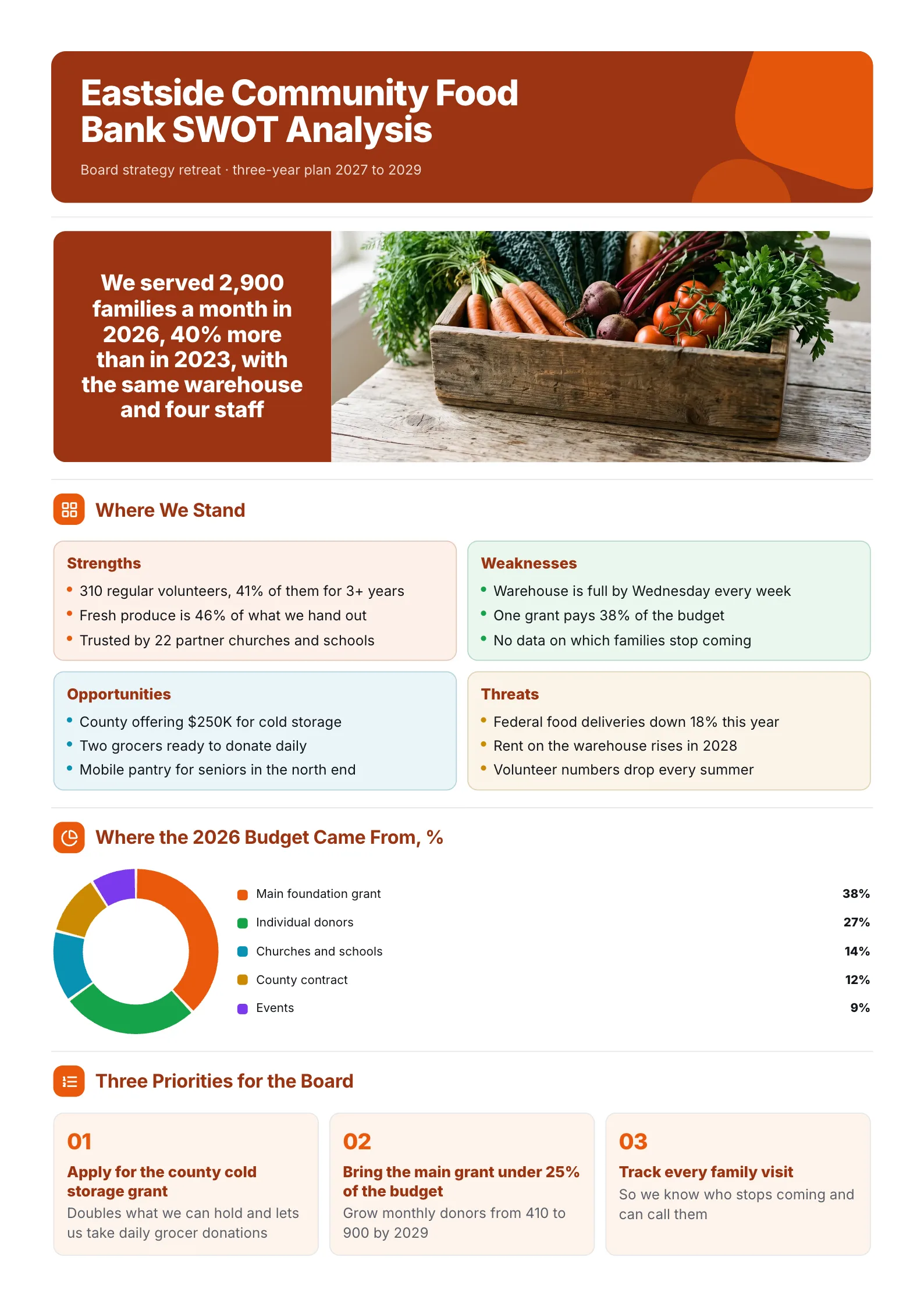 SWOT Analysis: Nonprofit Food BankEdit for free(opens in a new tab)
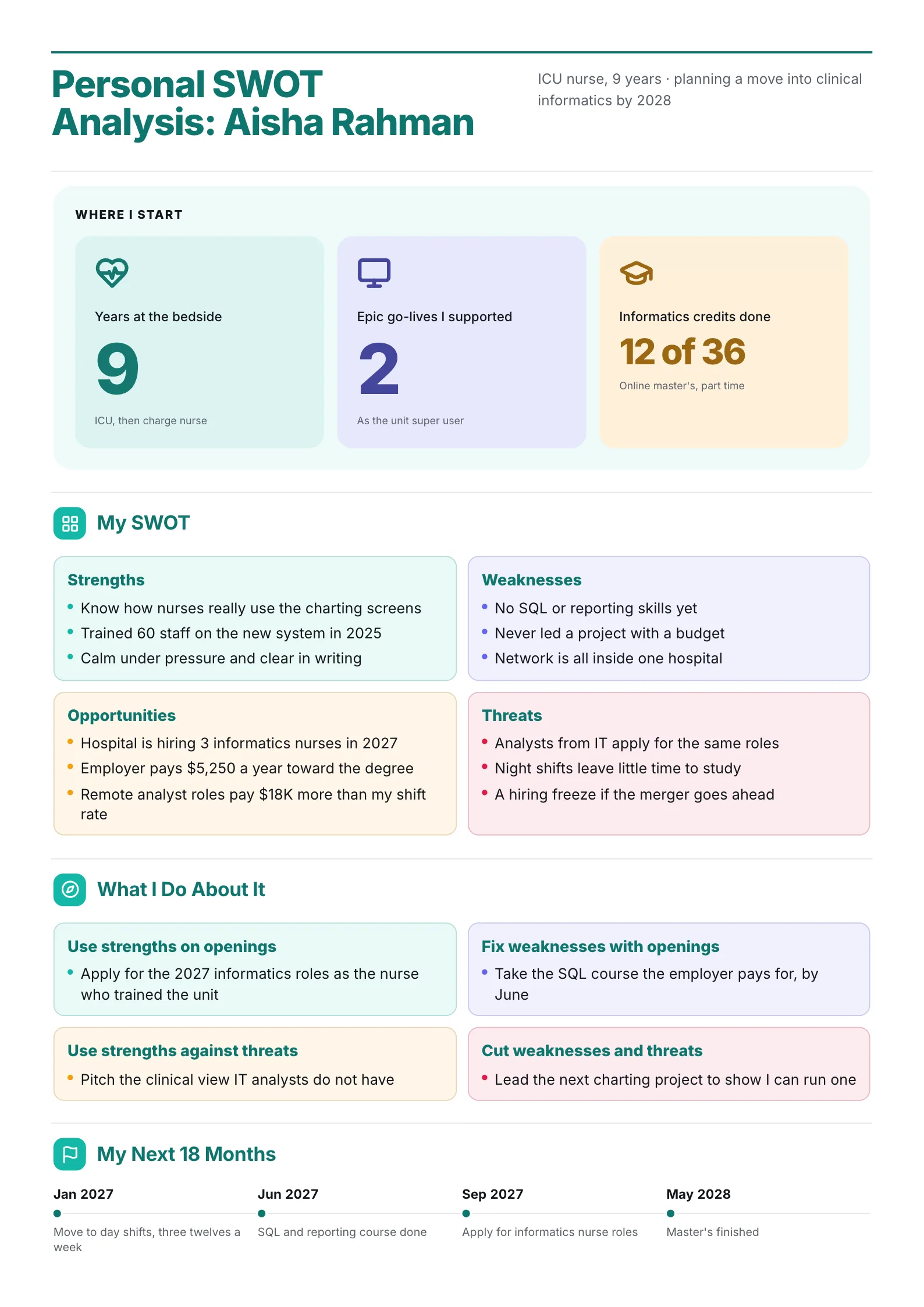 SWOT Analysis: Personal Career ChangeEdit for free(opens in a new tab)
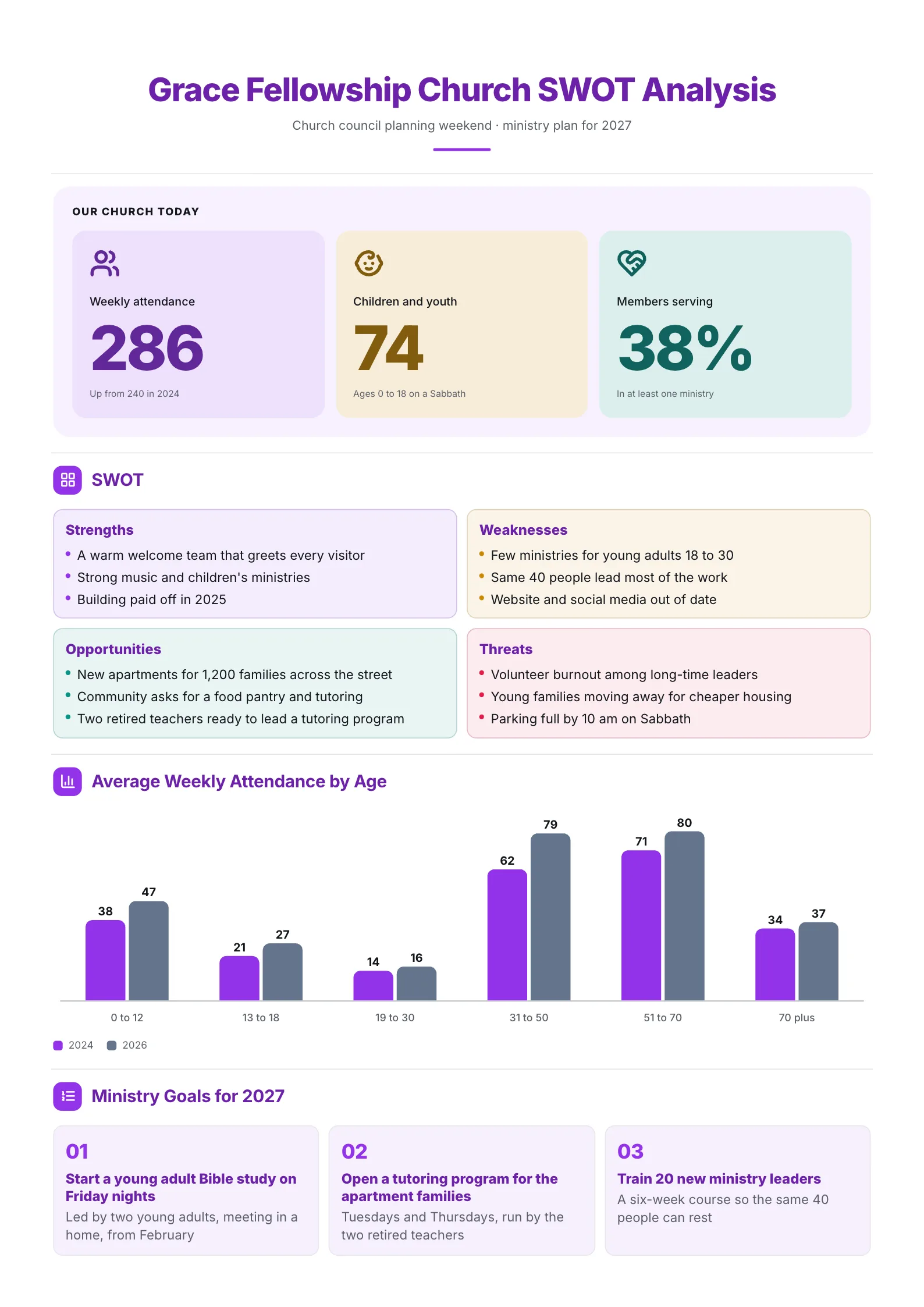 SWOT Analysis: ChurchEdit for free(opens in a new tab)
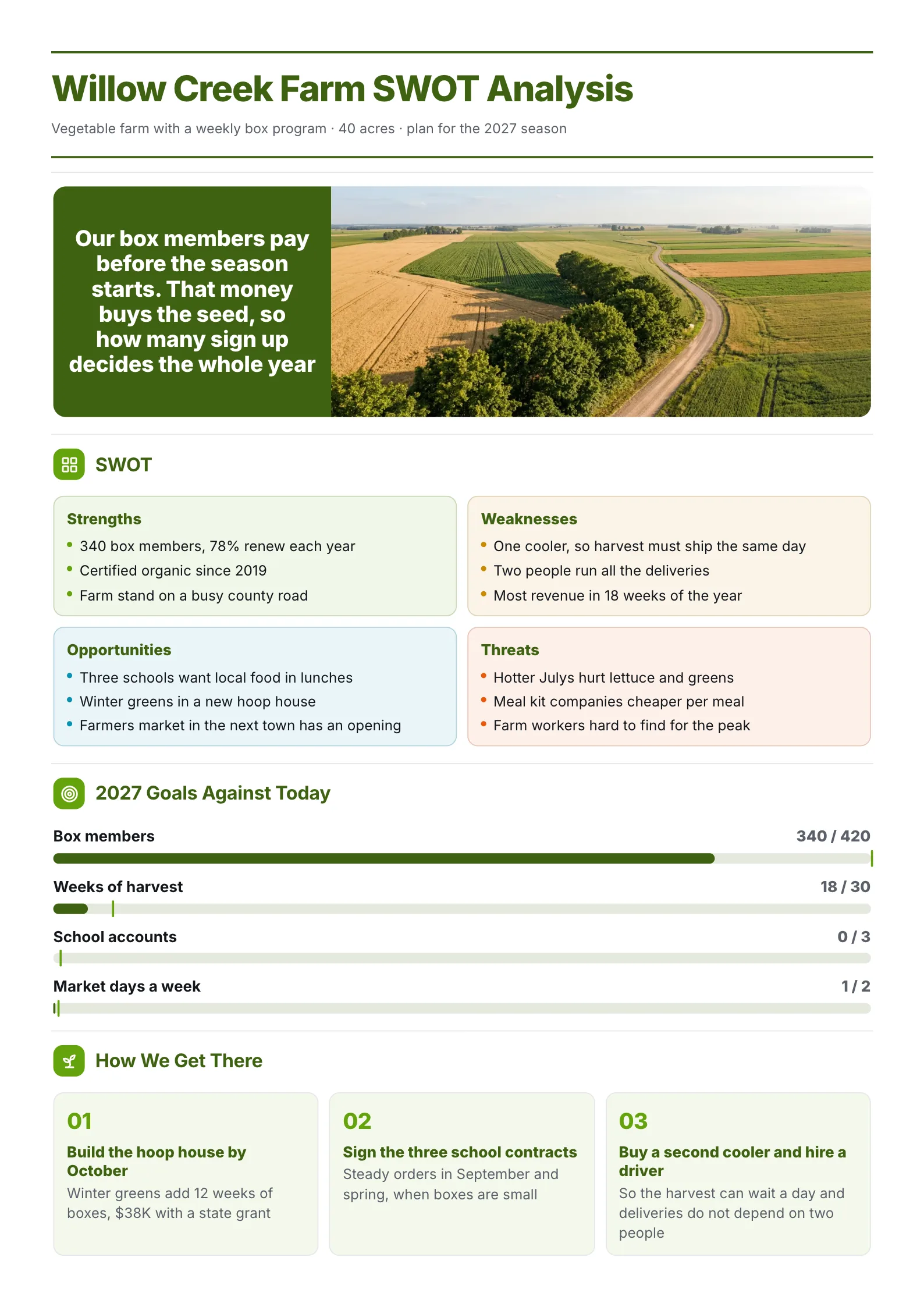 SWOT Analysis: FarmEdit for free(opens in a new tab)
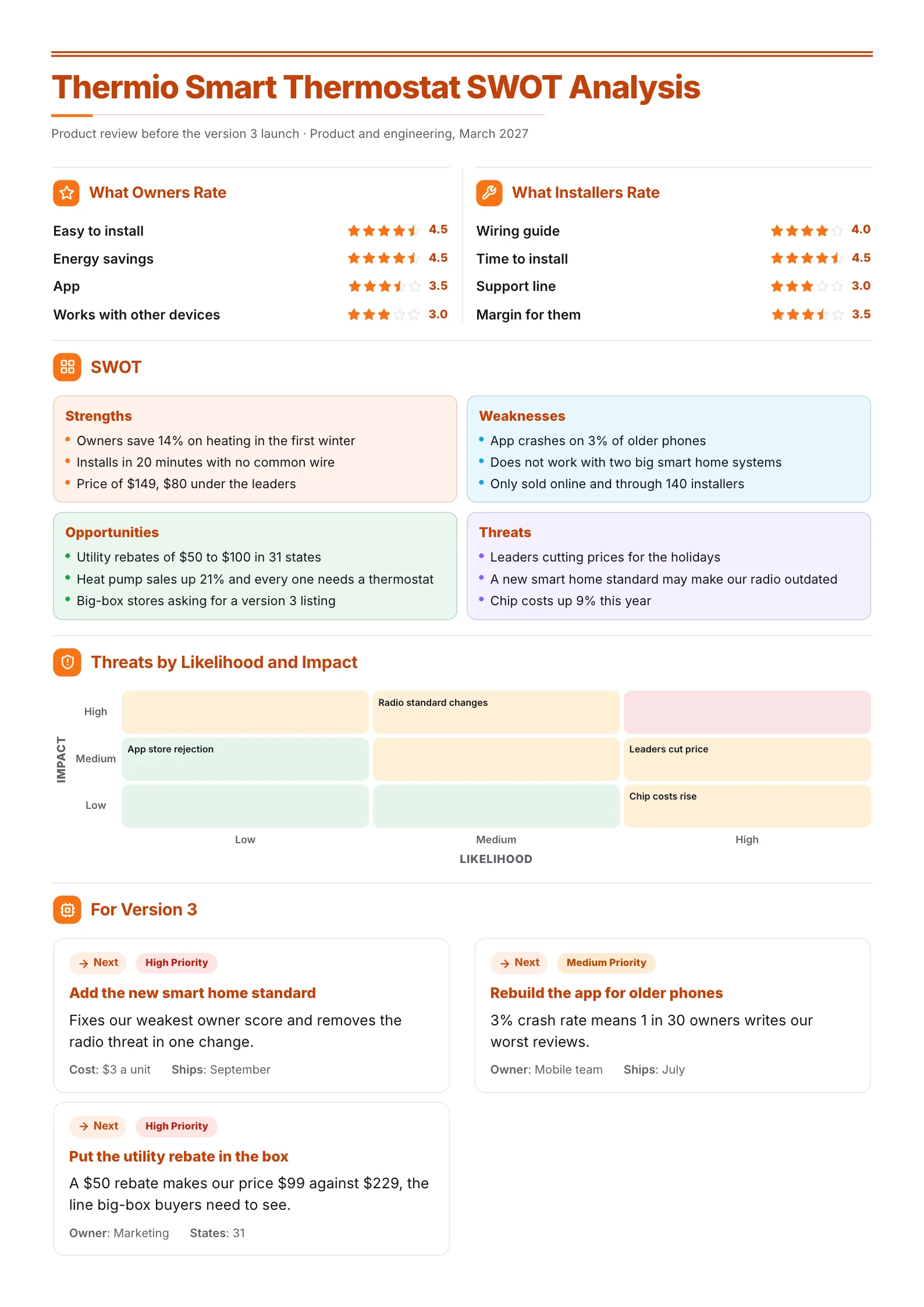 SWOT Analysis: Smart ThermostatEdit for free(opens in a new tab)
We made every example with MakeOnepagers. Each one opens as a template you can edit for free. You can change every word and chart, and pick your own colors.
What is a SWOT analysis?
SWOT stands for strengths and weaknesses, plus opportunities and threats. A SWOT analysis lists the most important of each. That way your team can see where it stands at a glance before you make a plan.
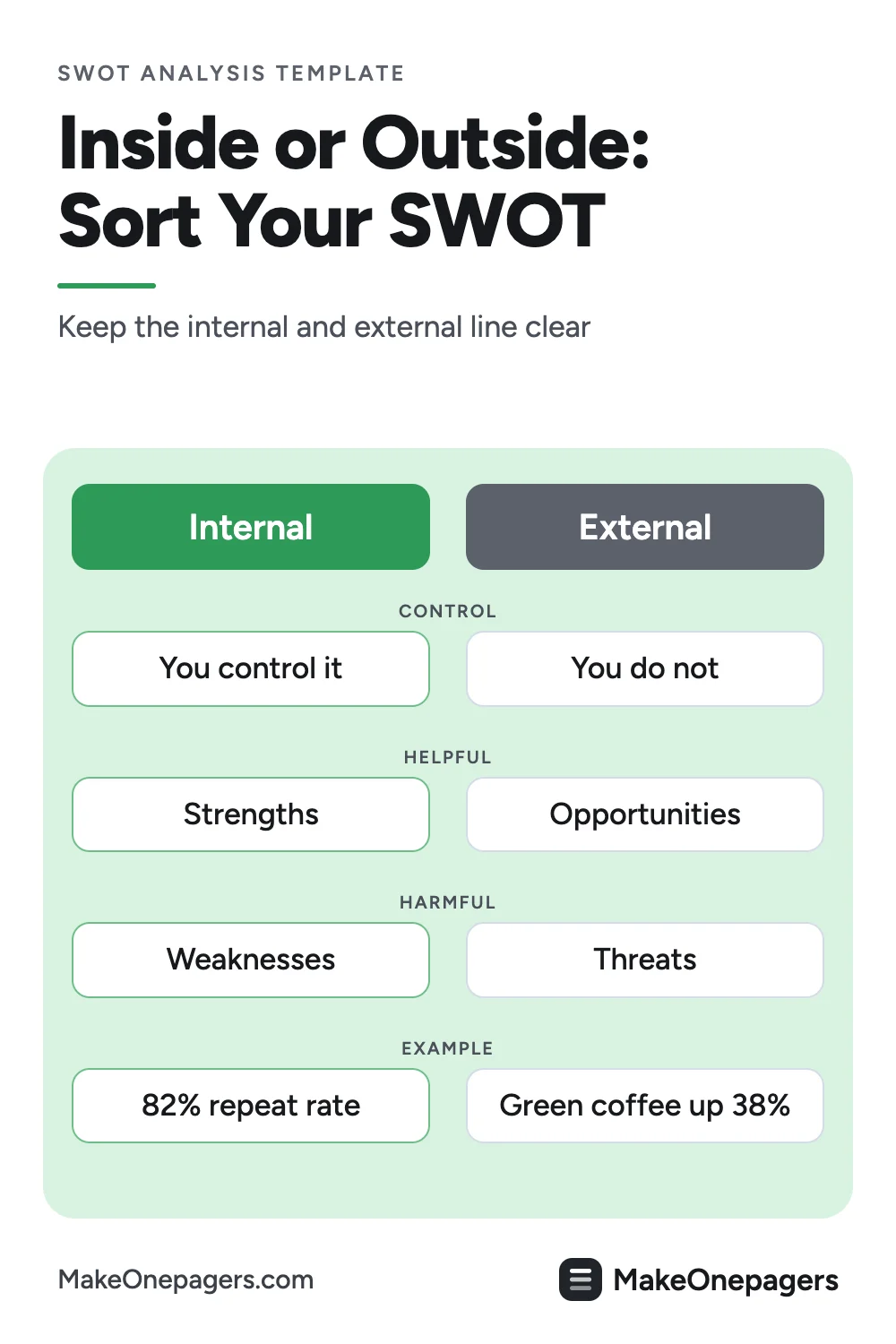
The four boxes split two ways:
| Helpful | Harmful | |
|---|---|---|
| Internal (you control it) | Strengths | Weaknesses |
| External (you do not control it) | Opportunities | Threats |
Strengths and weaknesses are about you. Think of your people, your product, your money and how you work, plus your reputation. Opportunities and threats are about the world around you. That means your customers and competitors. It also means prices and new rules, plus technology and the economy. Keep that line clear. It's the most useful habit you can build in a SWOT.
Questions to fill each box
Strengths (internal, helpful)
- What do customers praise us for, in reviews and on calls?
- What do we do better or cheaper than competitors?
- Which numbers are we proud of?
Weaknesses (internal, harmful)
- Where do we lose deals, customers or money?
- What do customers complain about?
- What depends on one person or one supplier?
Opportunities (external, helpful)
- Which customer groups are growing or underserved?
- What is changing in the market that we could use?
- What are competitors not doing?
Threats (external, harmful)
- What could raise our costs or lower our prices?
- Which competitors are moving closer?
- What rules, trends or events could hurt demand?
A free SWOT analysis template
Copy this into your own document, or open the example below and edit it.
| Part | What to write, with an example |
|---|---|
| Title | Company or project, purpose, date. Copperleaf Coffee Roasters: SWOT, 2027 strategy |
| Where we are | 3 to 4 numbers. Revenue $3.6M, up 14%; 4 cafes; 31% from wholesale |
| Strengths | 2 to 4, with a number each. 82% subscription repeat rate |
| Weaknesses | 2 to 4. Cafe margins down to 9% |
| Opportunities | 2 to 4. Office coffee contracts |
| Threats | 2 to 4. Green coffee prices up 38% |
| Strategic moves | 2 to 3 actions, each with a target |
5 SWOT analysis examples
Here are five SWOTs for five kinds of decisions. You'll see a strategy offsite and a sales team facing the market leader. There's also a startup raising money, a clinic's annual review and a small business planning its season. Each one keeps the four boxes and ends in moves.
1. Company SWOT analysis
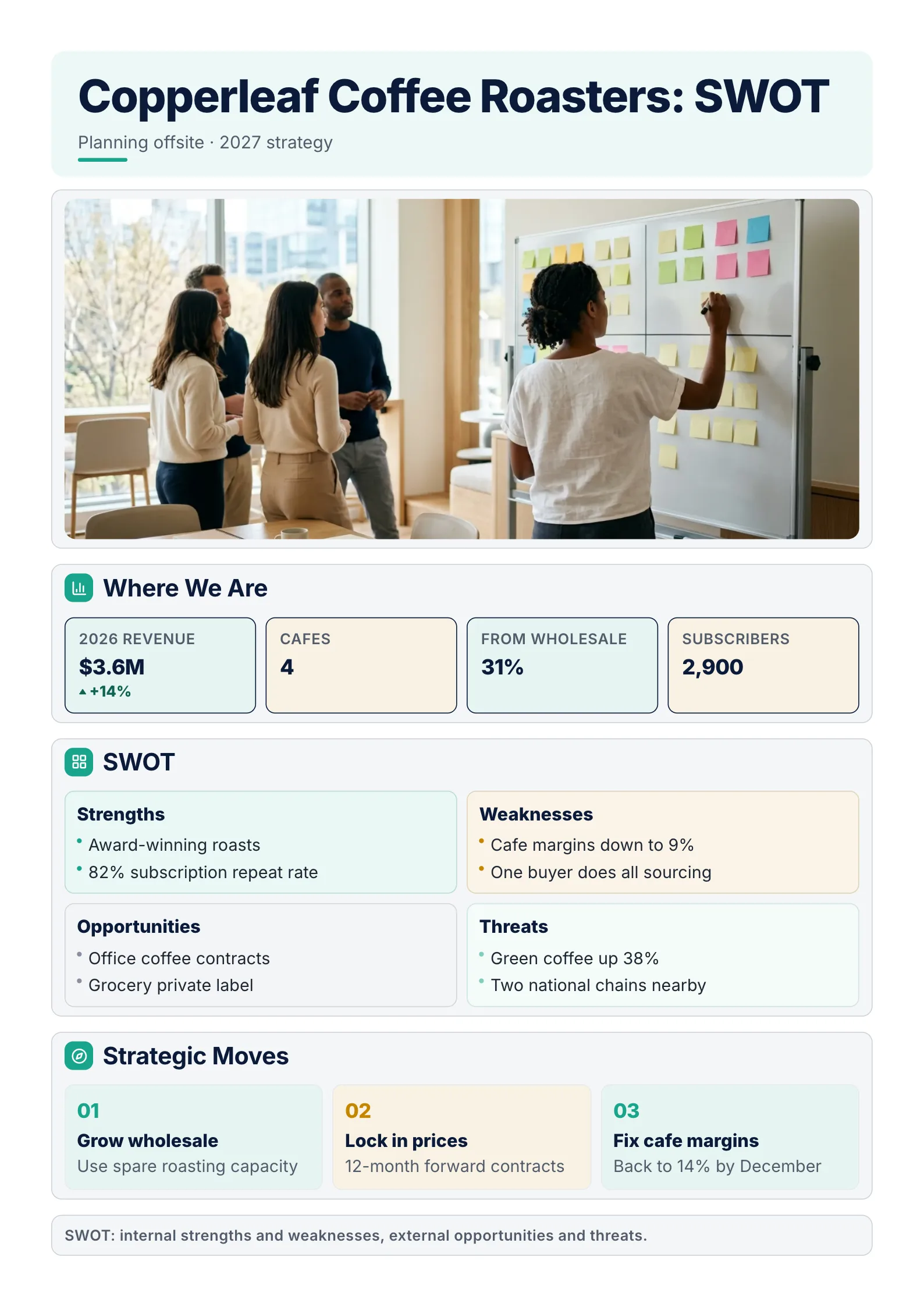 Edit this template
Four boxes, each point with a number, and three moves that answer them.
What to copy:
- The starting numbers above the grid: revenue, cafes, share from wholesale and subscribers. Everyone in the room starts from the same facts.
- A number in almost every point: "82% subscription repeat rate" and "green coffee up 38%" are harder to argue with than "loyal customers" and "rising costs."
- Two points per box, not ten: only what will change a decision.
- Strategic moves that answer the boxes: grow wholesale (using spare roasting capacity, a strength, to win office contracts, an opportunity), lock in prices with 12-month forward contracts (against the coffee price threat), fix cafe margins back to 14% by December (the weakness).
You can edit this SWOT analysis template for free.
2. Competitor SWOT analysis
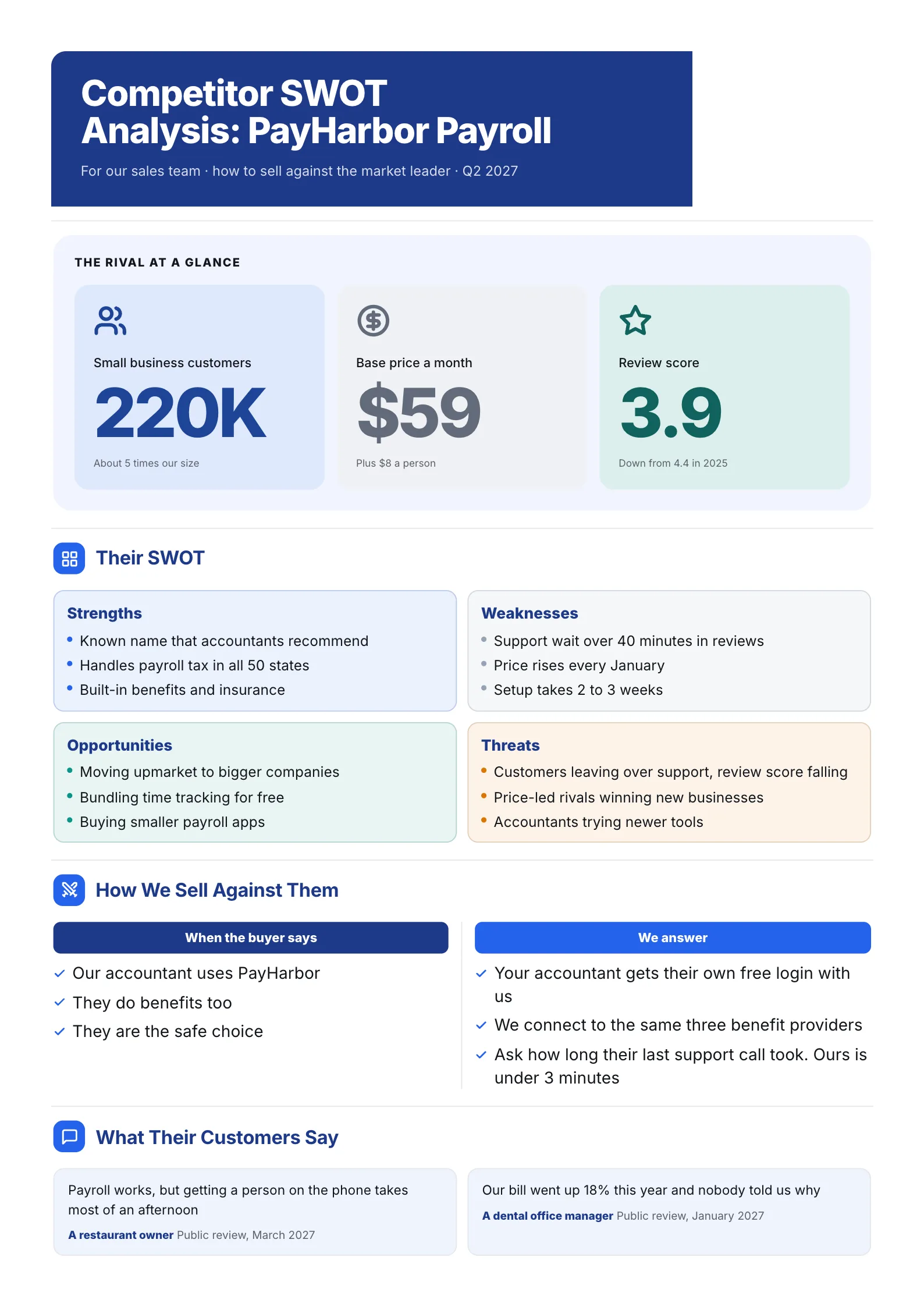 Edit this template
A sales team's SWOT of the rival it meets in every deal, turned into answers for the call.
What to copy:
- The rival's weak spot as a number. Support waits "over 40 minutes in reviews" is a point a rep can use.
- An answer for each objection. "Our accountant uses PayHarbor" gets "Your accountant gets their own free login with us."
- Their customers' own words. "Our bill went up 18% this year and nobody told us why."
You can edit this competitor SWOT analysis template for free.
3. Startup SWOT analysis
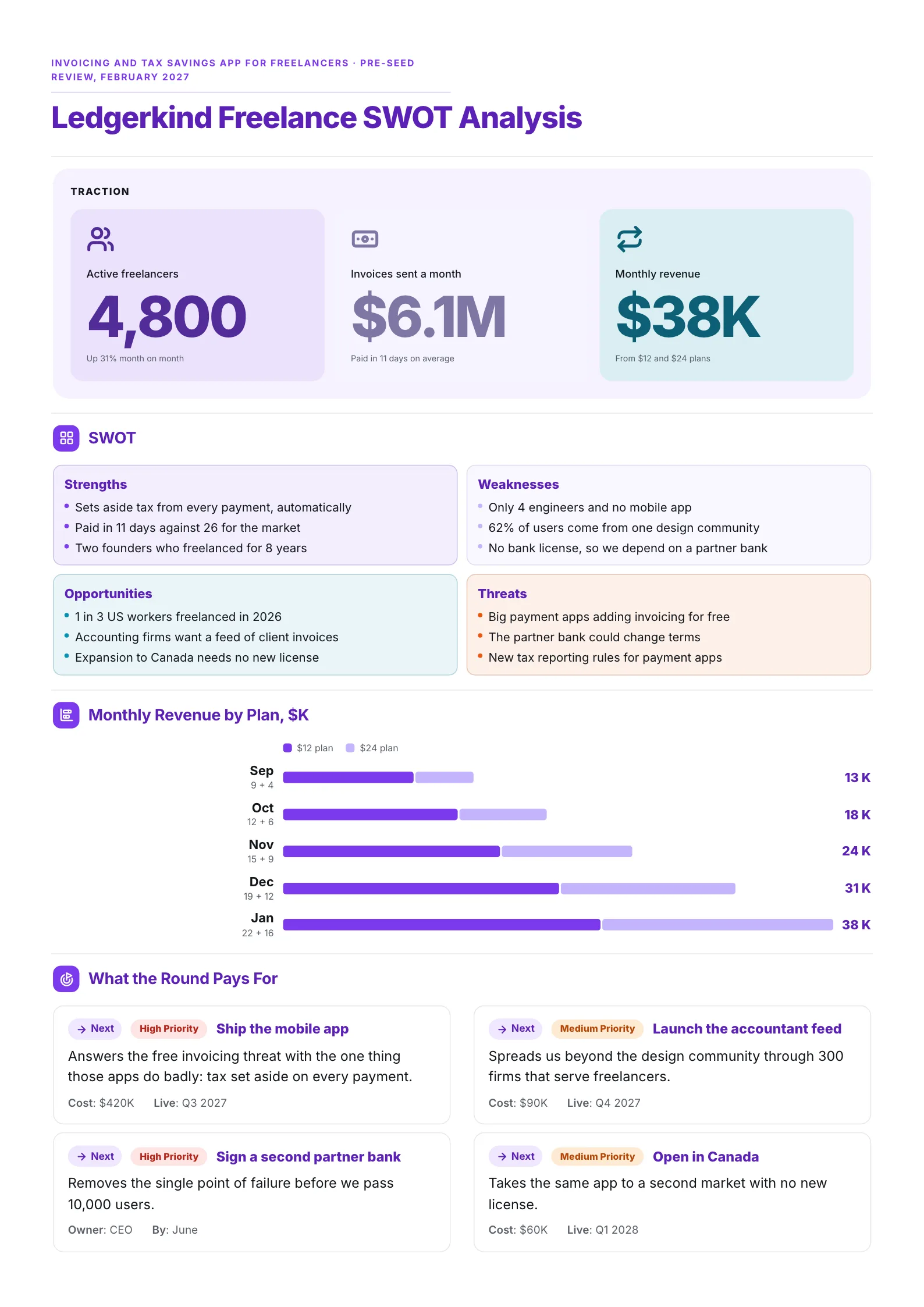 Edit this template
A pre-seed SWOT where every use of the money answers a threat or builds on a strength.
What to copy:
- Traction first. 4,800 active freelancers, up 31% month on month, and $6.1M in invoices sent a month.
- An honest weakness. "62% of users come from one design community" tells investors where the risk sits.
- The round tied to the threats. "Sign a second partner bank" removes the single point of failure before 10,000 users.
You can edit this startup SWOT analysis template for free.
4. Healthcare clinic SWOT analysis
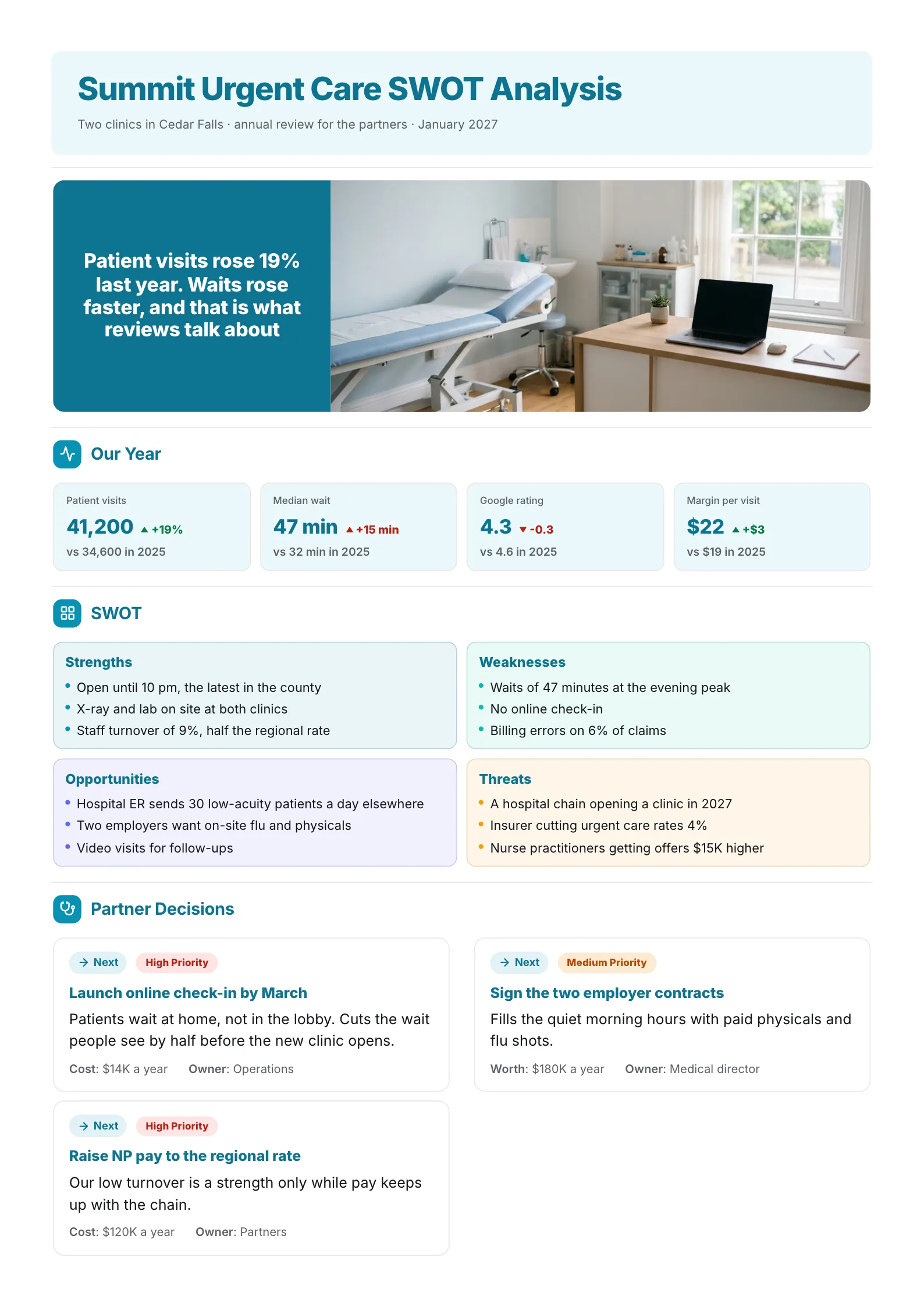 Edit this template
A clinic's year in four numbers, each beside last year, then the decisions the partners must make.
What to copy:
- The tension in one line. "Patient visits rose 19% last year. Waits rose faster, and that is what reviews talk about."
- Each number against last year. A 47 minute wait against 32 in 2025.
- Decisions with a reason. "Launch online check-in by March" so patients wait at home, not in the lobby.
You can edit this healthcare clinic SWOT analysis template for free.
5. Small business SWOT analysis
 Edit this template
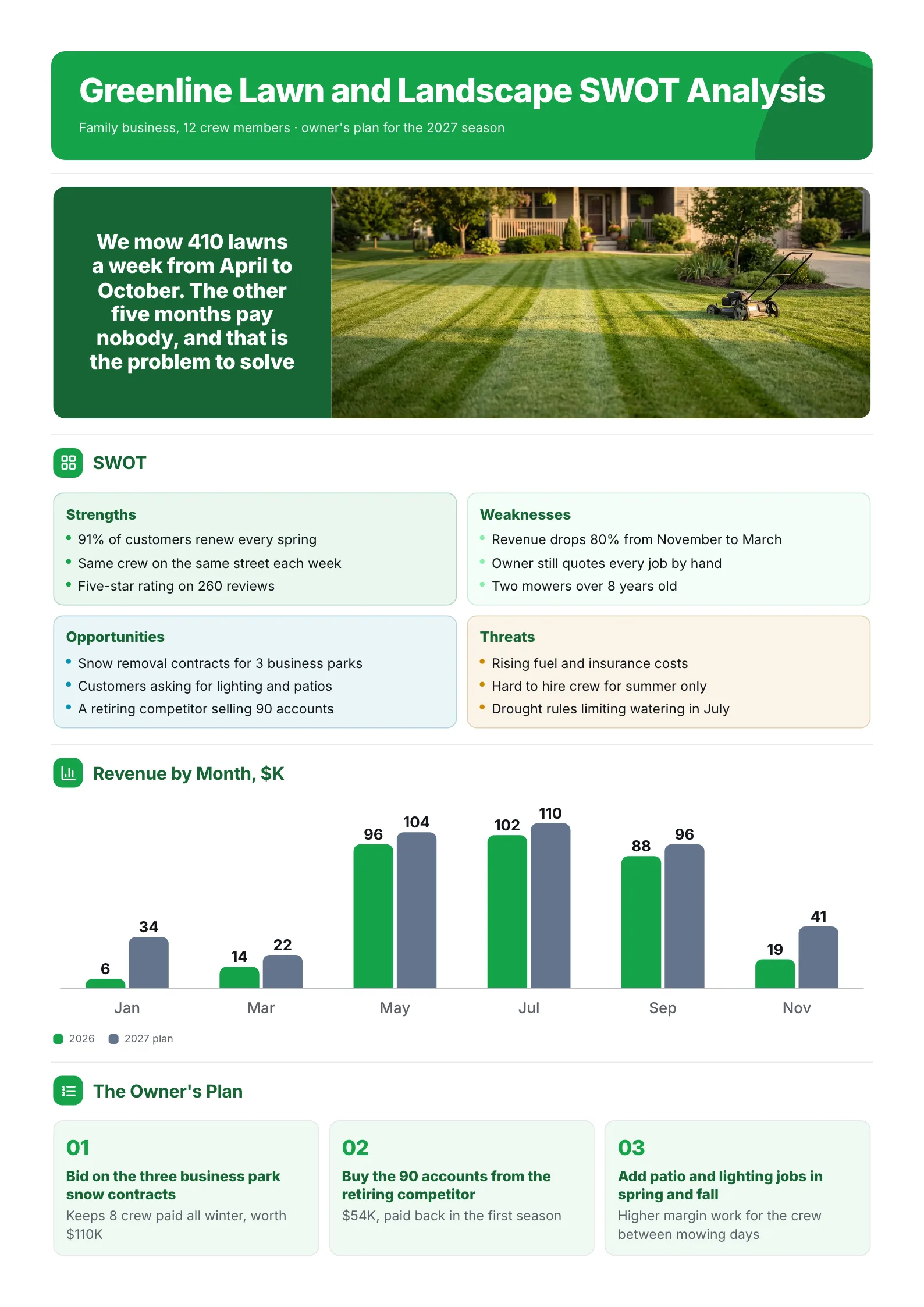
An owner's SWOT built around one problem: five months of the year that pay nobody.
What to copy:
- The problem in the opening line. "We mow 410 lawns a week from April to October. The other five months pay nobody."
- Revenue by month. The bars show the winter gap the plan has to fill.
- Moves with a price. Buy 90 accounts from a retiring competitor for $54K, paid back in the first season.
You can edit this small business SWOT analysis template for free.
A worked example: turning a SWOT into moves
The business and numbers below are an example, made up to show the method.
A dog grooming business with three locations runs a SWOT before planning next year.
| Strengths | Weaknesses |
|---|---|
| 4.8 average rating across 900 reviews | 2 of 9 groomers do half the bookings |
| 70% of clients rebook within 8 weeks | No online booking; phone only |
| Opportunities | Threats |
|---|---|
| A new apartment complex with 600 units opens nearby in spring | A national pet chain opens a salon 2 miles away |
| Clients ask for a mobile service for older dogs | Shampoo and supply costs up 12% this year |
Next, the owners match boxes to make moves. Some people call this a TOWS step. You use strengths to take opportunities, and you fix the weaknesses that threats would expose.
- Strength + opportunity: use the 4.8 rating in a launch offer to the new apartment complex in March. Target: 60 new clients by June.
- Weakness + threat: add online booking before the chain salon opens, so clients do not switch for convenience. Target: 40% of bookings online by May.
- Weakness: train two more groomers to senior level so the business does not depend on two people. Target: done by September.
The SWOT took an hour. The three moves are what made it worth the hour.
Which format should your SWOT be in?
People search for a SWOT analysis template in Word, PowerPoint, Excel, Google Docs and PDF. Pick your format by where you'll use the SWOT. A grid on one sheet suits a planning meeting, a printed handout or a board pack, because everyone sees the four boxes and the moves at once. A slide suits a live talk. A spreadsheet works if you'll rank or track your SWOT over time. Whatever you choose, keep the four boxes and the moves together so nobody reads one without the other.
How to run a SWOT analysis in 5 steps
- Set the scope: the whole company, one product, one location or one decision.
- Gather facts first: sales, reviews, costs, competitor moves. A SWOT built from opinions only is a guess.
- Fill the boxes as a group, using the questions above. Aim for many ideas, then cut to the two to four strongest in each box.
- Check the internal/external line: a competitor's new product is a threat, not a weakness.
- Write two or three moves with an owner, a target and a date.
Do you have planning notes, survey results or an offsite whiteboard photo typed up in a document? Drop it into the free AI One-Pager generator and you'll get it back as a designed SWOT on one sheet.
SWOT analysis mistakes
- Mixing internal and external. "The economy is slow" is a threat, not a weakness.
- Vague points. "Good team" and "strong brand" say nothing. Add a number or a fact.
- Too many points. Fifteen strengths means none of them stand out.
- Stopping at the boxes. A SWOT with no moves changes nothing.
- No evidence. If a point cannot be backed by data, a customer quote or a clear fact, mark it as a question to check.
- Done once a year and forgotten. Revisit it when something big changes.
Make your SWOT analysis
Open the free SWOT analysis template and fill in your own four boxes. Or drop your notes into the free AI One-Pager generator and you'll get a finished SWOT back on one sheet.
Frequently asked questions
What should a SWOT analysis template include?
Your template needs the scope and date, plus a few starting numbers. Then add two to four points in each of the four boxes. End with two or three strategic moves, each with a target and an owner.
What is the difference between strengths and opportunities?
Strengths are inside your business and under your control, such as a loyal customer base. Opportunities are outside it, such as a growing market or a gap a competitor left.
Can you do a SWOT analysis for a person?
Yes. A personal SWOT works for career planning: your skills and gaps are the internal boxes, and job market changes and openings are the external ones.
How long should a SWOT analysis be?
Keep it to one sheet. If yours needs more, your points are too long or you have too many of them.
What comes after a SWOT analysis?
You make strategic moves. Match your strengths to opportunities, and fix the weaknesses that threats could exploit. Then put each move into your plan with an owner and a date.




