How to Do a SWOT Analysis: Lessons From 4 Georgia Regional Plans
How to do a SWOT analysis, learned from 4 regional plans in Georgia: who to invite, how to sort the grid, and how to turn it into moves.

Here's how to do a SWOT analysis: choose who's in the room, sort your items into a few themes, and keep each item in the one box where it belongs. Back each item with a number where you can, then pair the four boxes into moves and give every move a measure. We learned that order from 4 real SWOTs, the ones in the economic plans of four Georgia regional commissions. Federal rules require each of those plans to contain a SWOT and the strategy that comes after it, so they show both halves of the job. Start from a free one pager template.
One‑Pager examples
Real One-Pagers made with MakeOnepagers. Open any one to edit it as your own.
 SWOT AnalysisEdit for free(opens in a new tab)
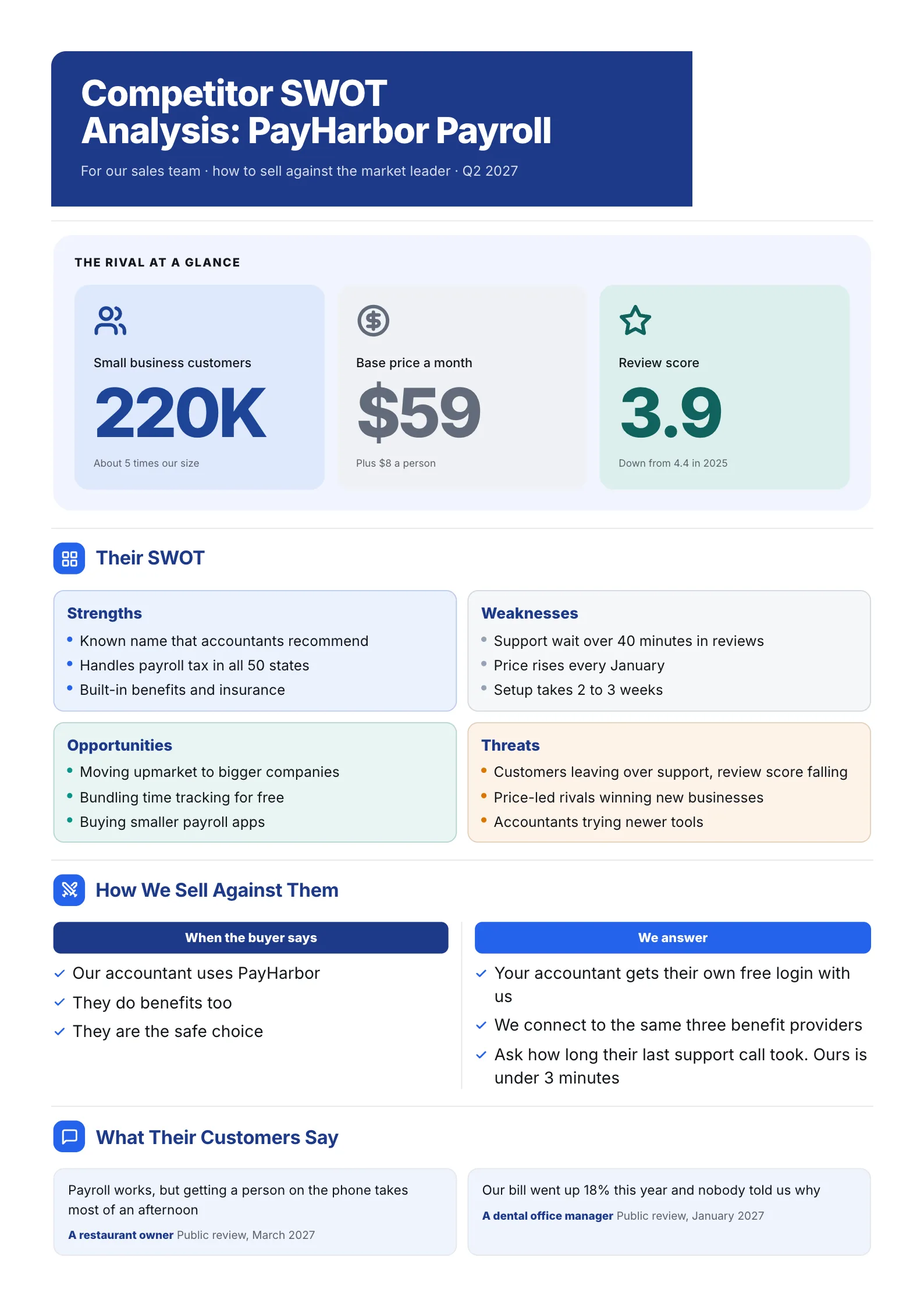 SWOT Analysis: CompetitorEdit for free(opens in a new tab)
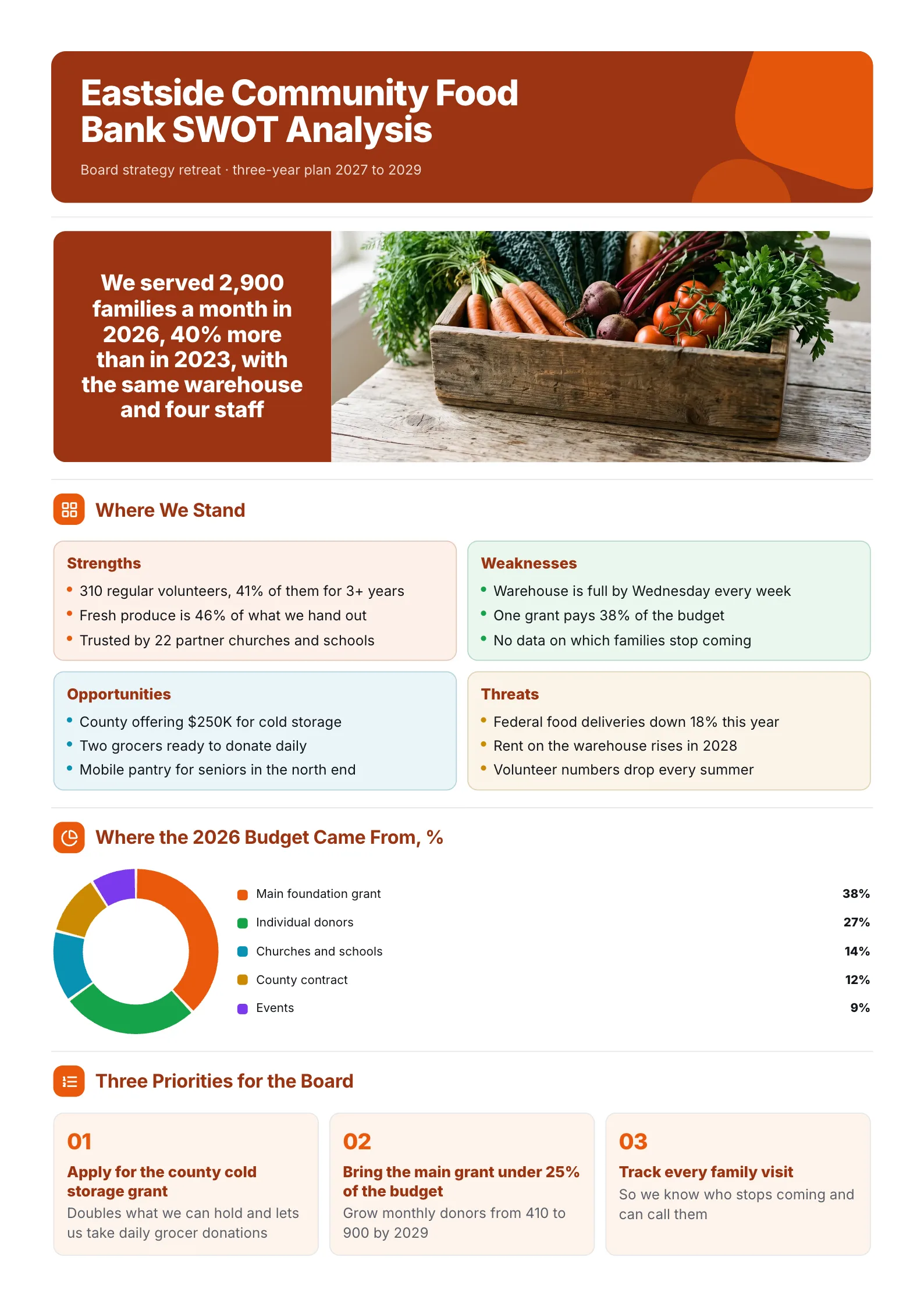 SWOT Analysis: Nonprofit Food BankEdit for free(opens in a new tab)
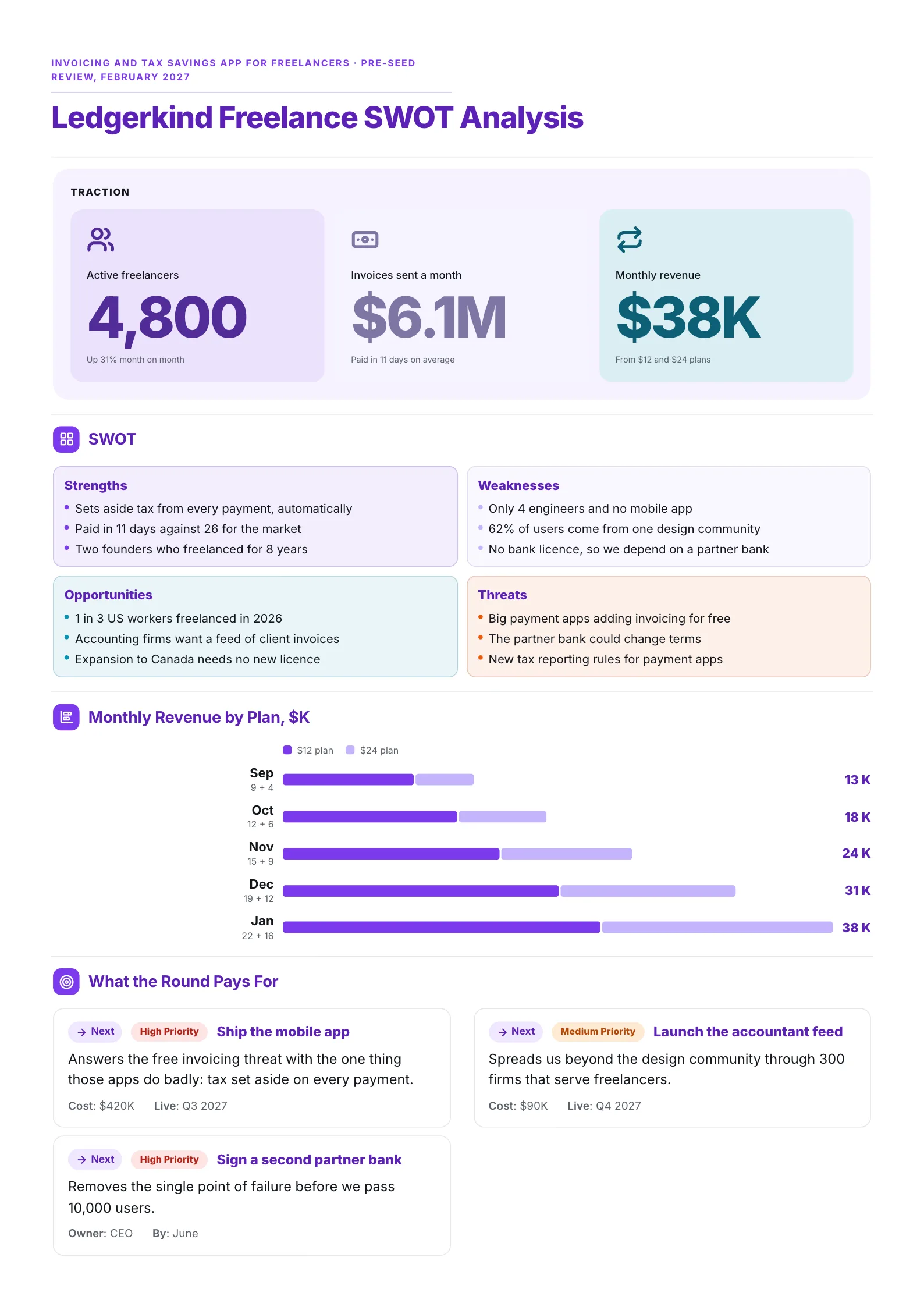 SWOT Analysis: StartupEdit for free(opens in a new tab)
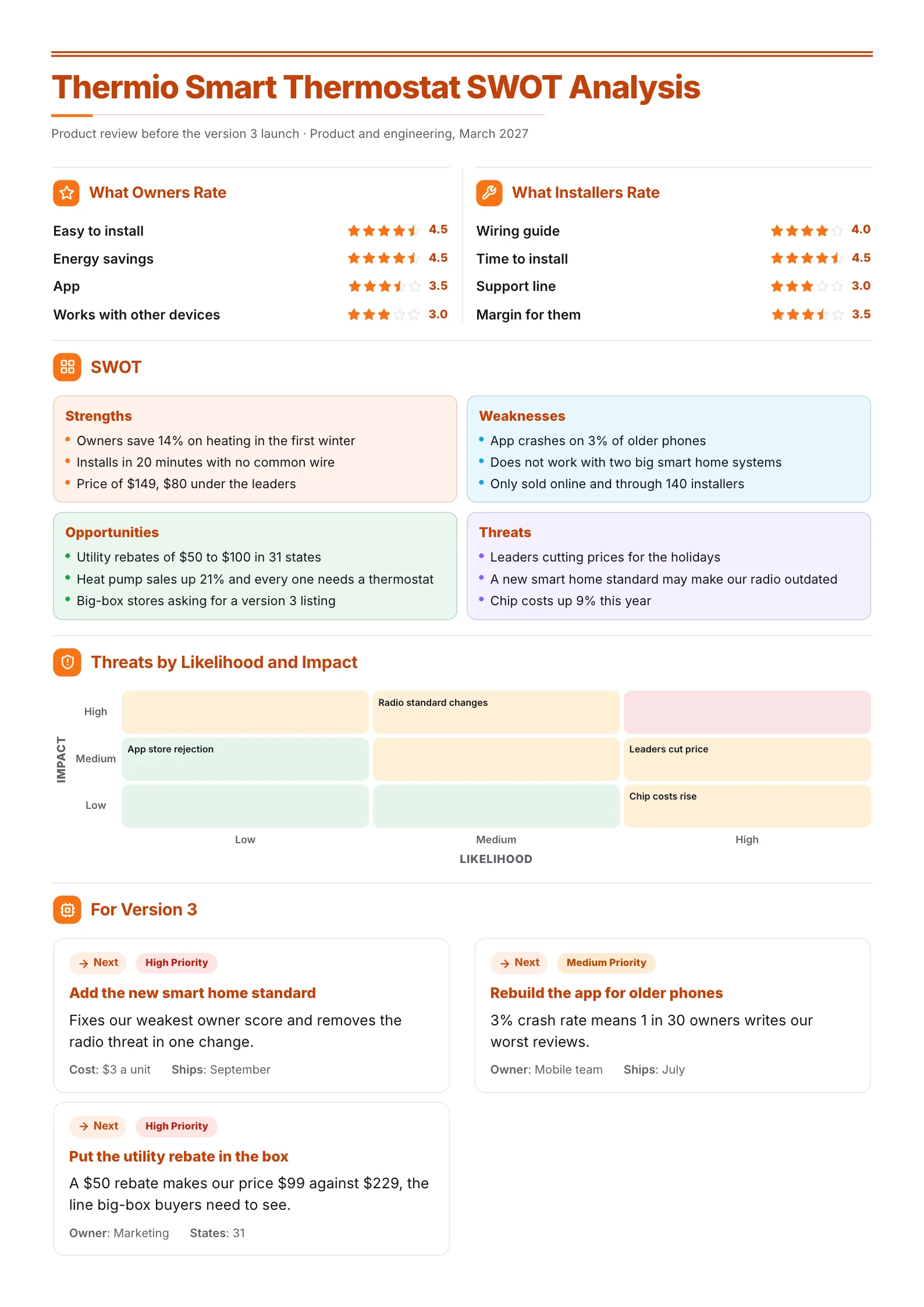 SWOT Analysis: Smart ThermostatEdit for free(opens in a new tab)
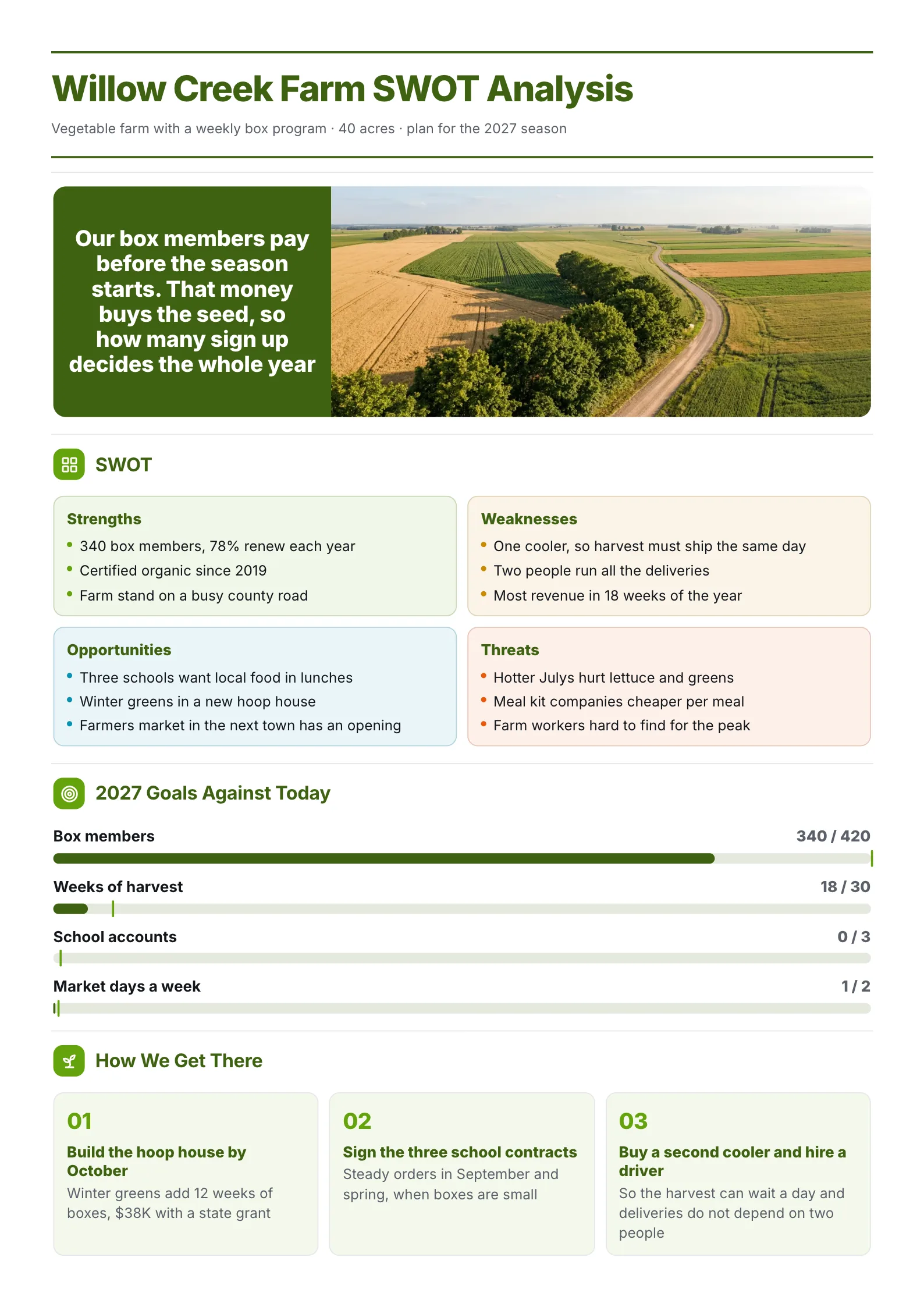 SWOT Analysis: FarmEdit for free(opens in a new tab)
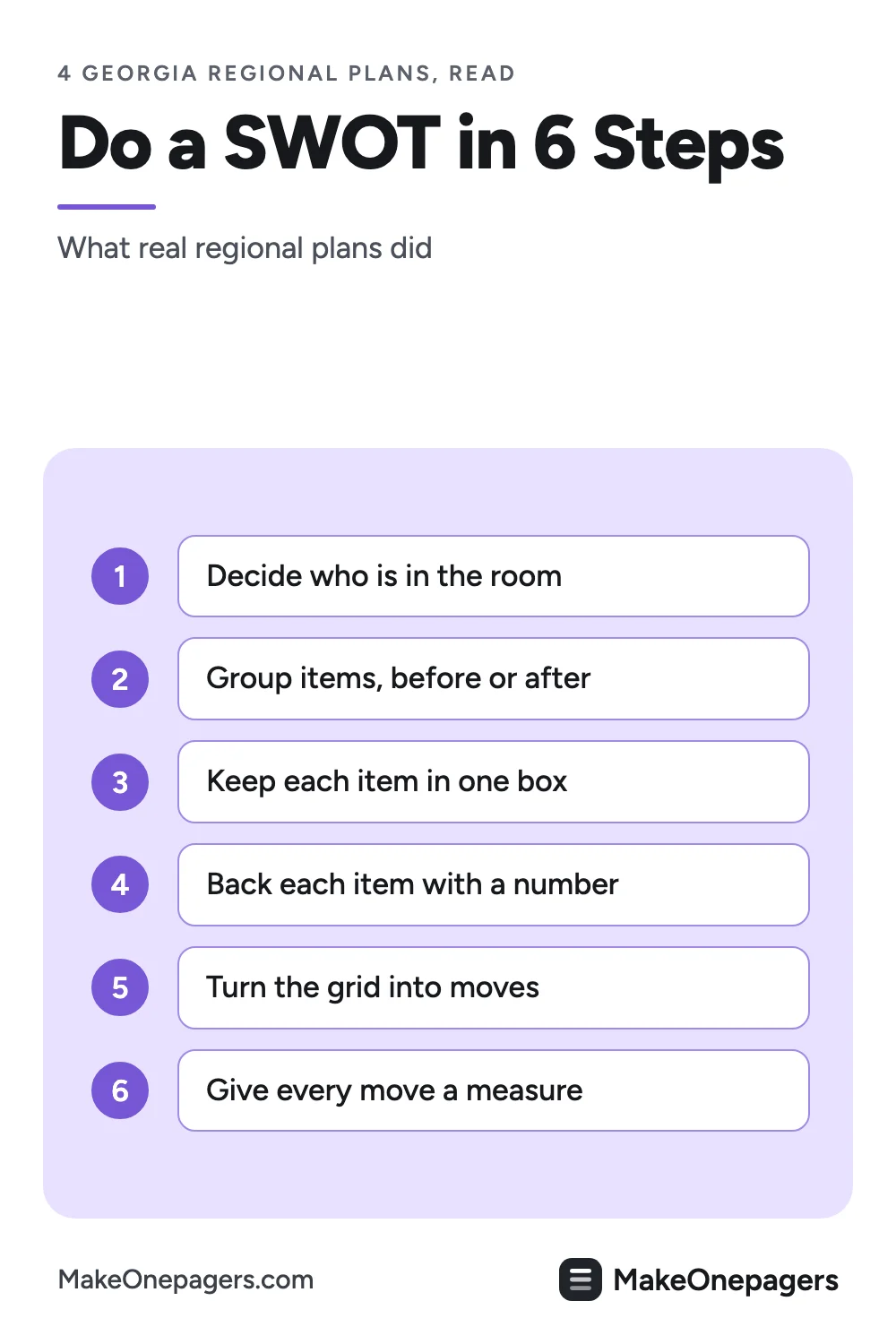
These SWOTs were written by real committees for real counties, so they also show the mistakes people make. Below are the four plans, what each one teaches, and a worked example that turns one of them into a plan you can copy.
Why public plans are a good place to learn
Every Economic Development District in the US writes a Comprehensive Economic Development Strategy, or CEDS. The federal rule for it, 13 CFR 303.7, says each CEDS must include "an in-depth analysis of economic and community development strengths, weaknesses, opportunities, and threats (commonly known as a 'SWOT' analysis)." The same rule asks for strategies that build on the strengths and opportunities and resolve the weaknesses and threats, plus performance measures to check the work.
That's the whole method in one paragraph of law: a grid, moves that come from it, and a way to tell if the moves worked. Districts post these plans online, so you can read how a committee actually does it and borrow what works for your own team.
The 4 SWOTs we read
On October 26, 2026, we searched for the newest full CEDS of each of Georgia's 12 regional commissions. We read the 4 that came up as full plan PDFs with a SWOT section. The other 8 didn't turn up that way in our search. For example, the Atlanta Regional Commission posts annual reports instead of a full plan, and the Georgia Mountains file returned a server error. For Northwest Georgia we read the full 2023 to 2028 plan, not its shorter 2024 and 2025 updates.
| Plan | Who built the SWOT | How it's sorted | What comes after the grid |
|---|---|---|---|
| Northwest Georgia, 2023 to 2028 | One open meeting of 40 partners from 14 of 15 counties, run by an outside facilitator, plus follow-up interviews | Results organized into 5 categories: human capital, community assets, infrastructure, business climate, resiliency | Goals and strategies under the same 5 themes, then performance measures |
| CSRA, FY2023 to FY2028 | The CSRA Regional Commission, for 13 counties around Augusta | One grid of 41 items, labeled internal and external | Goals by industry, each with numbered actions and performance measures |
| Southern Georgia, 2022 to 2026 | A survey to the CEDS committee and local officials, plus committee workshops in May and June | 4 focus areas, one full grid each | A goal and an action plan for each focus area, then measures |
| River Valley, 2022 update | A survey of 179 residents | Top 3 strengths and top 3 weaknesses, then opportunities and threats combined, with Columbus and the two rural hubs listed separately | Compared with the same survey from 2017 |
Step 1: Decide who's in the room
The four plans used three ways to gather input. Northwest Georgia held one open meeting with 40 partners from schools, colleges, utilities, chambers and local governments, and 14 of its 15 counties were there. River Valley ran a survey and got 179 answers. Southern Georgia combined both, with a survey in April and committee workshops in May and June.
You can copy whichever fits your size. A team of five can do the meeting version in an afternoon. A school, church or company with many people can send a short survey first, then meet to agree on the top items. The University of Kansas Community Tool Box gives the same advice: a SWOT "will be more effective if you take advantage of many stakeholders," led by a facilitator who keeps things moving and a recorder who writes it down. Northwest Georgia brought in a facilitator from outside the commission, so nobody in the room had to run the meeting and argue at the same time.
 Edit this template
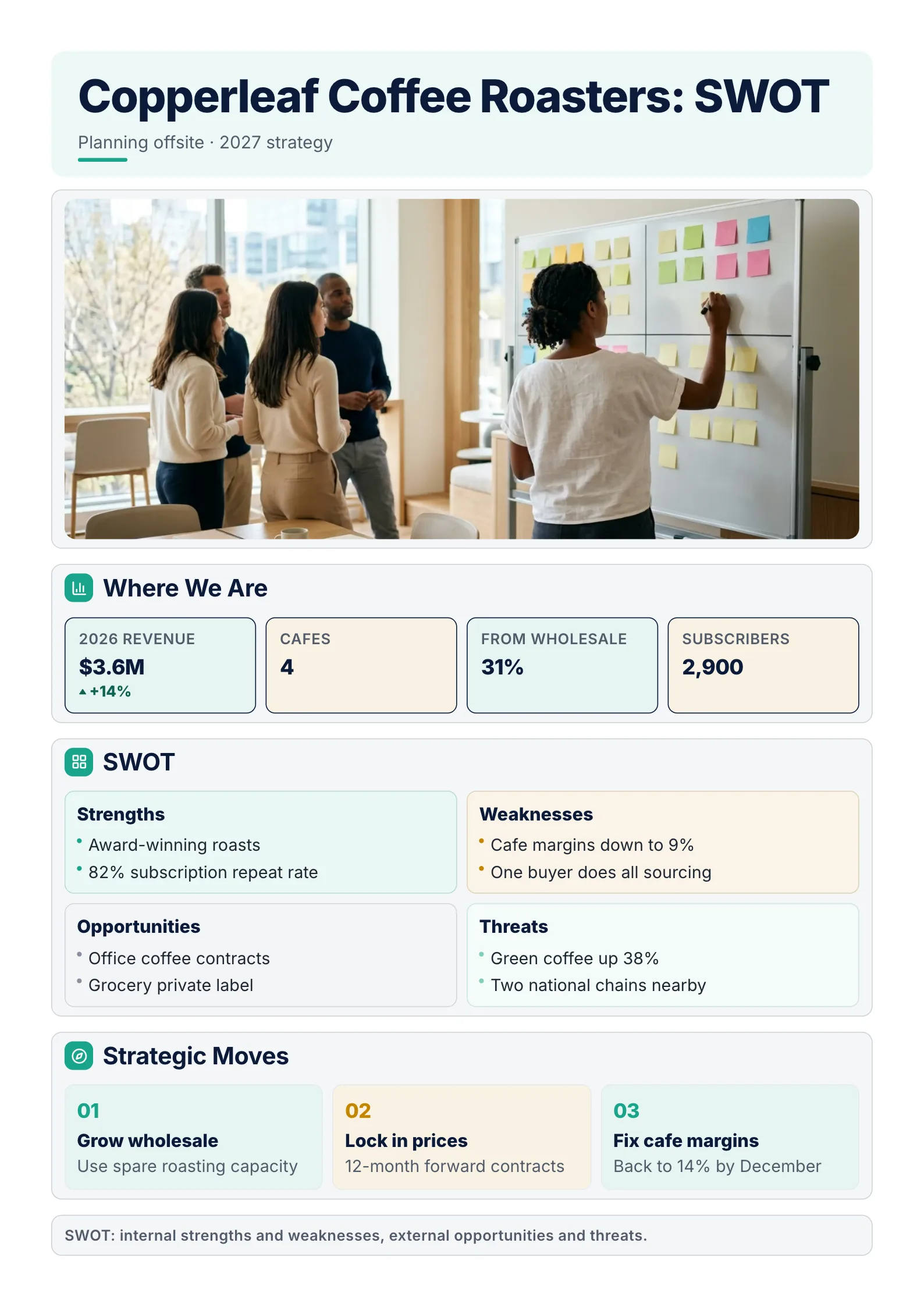
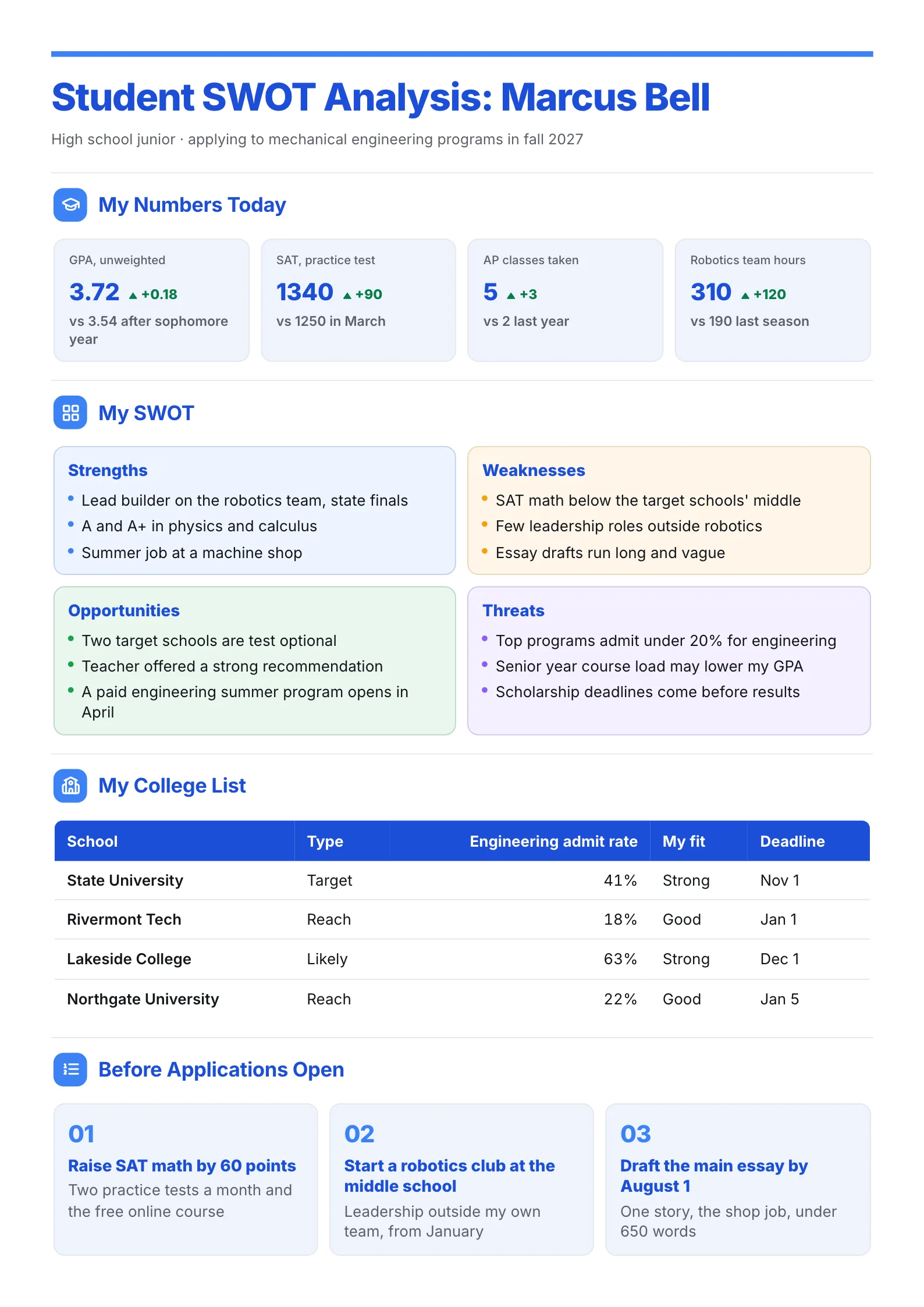
Sample names and figures. You can run it with one person in the room too. Each of the three steps answers one weakness and carries a count or a date, like raising SAT math by 60 points or drafting the essay by August 1.
Step 2: Sort your items into themes
Three of the four plans sorted their items into groups. Southern Georgia says its surveys, committee input and SWOT "identified four Strategic Focus Areas," and that those areas "served as the basis for the SWOT Analysis, Action Plan, and creation of the CEDS Vision Statement." It draws a separate grid for each one. Northwest Georgia's results "were organized into five broad categories," and its goals use the same 5, so each goal sits next to the items behind it. Its goals were "largely left unchanged from the previous CEDS," with new ones added for resiliency. River Valley lists the top answers for the whole region, then for Columbus, and analyzes its two rural hubs, Americus and Cordele, "separately." The CSRA kept one grid of 41 items, split only into inside and outside, with no themes.
You can sort your items either way. If you already know the areas you plan by, use them and fill the four boxes for each. If you don't, list freely, then group what you've got. For a small business your themes might be customers, people, money and operations. Keep it to three to five, so your themes can become the headings of your plan later.
Step 3: Keep each item in one box
This is where the real plans slip, so it's the most useful thing to learn from them. Strengths and weaknesses are inside your control. Opportunities and threats come from outside. One item belongs in one box.
- Southern Georgia's economy grid lists natural resources as both a strength and an opportunity, cost of living as a strength and low cost of living as an opportunity, and low labor force participation as both a weakness and a threat.
- The CSRA grid has "strong entrepreneurial spirit" as a strength and "strong entrepreneurial local business community" as an opportunity. It lists rural broadband twice, "low broadband infrastructure projects in rural areas" as a weakness and "lack of broadband infrastructure in rural counties" as a threat. It also lists inflation, which no region controls, as a weakness.
None of these is wrong as a fact. The problem is that your repeated item gets counted twice and planned for twice, and your team spends time on it twice. Use a simple test before an item goes in. Could you change it this year with your own people and money? Then it's a strength or a weakness. If you can only prepare for it, it's an opportunity or a threat.
Step 4: Back each item with a number
The CSRA grid holds 41 items: 10 strengths, 10 weaknesses, 10 opportunities and 11 threats. Not one has a number in it. Yet a page earlier the same plan says Augusta's cyber workforce is about 2,880 people outside the military, with average pay of $76,489. "Cyber Command Center" sits in the opportunities box with none of that beside it.
Northwest Georgia backs one item with a figure. "Manufacturing (representative of 25% of workforce)" tells you why manufacturing is a strength, and how much a threat to it would cost.
River Valley shows a second way to add evidence. It lists the top three strengths and the top three weaknesses, then combines opportunities and threats into one list, and compares the results with the same survey from 2017. That's how it can say faith in local schools and health care went up while worry about housing rose. If you run a SWOT every year, keep the old one and note what moved.
 Edit this template
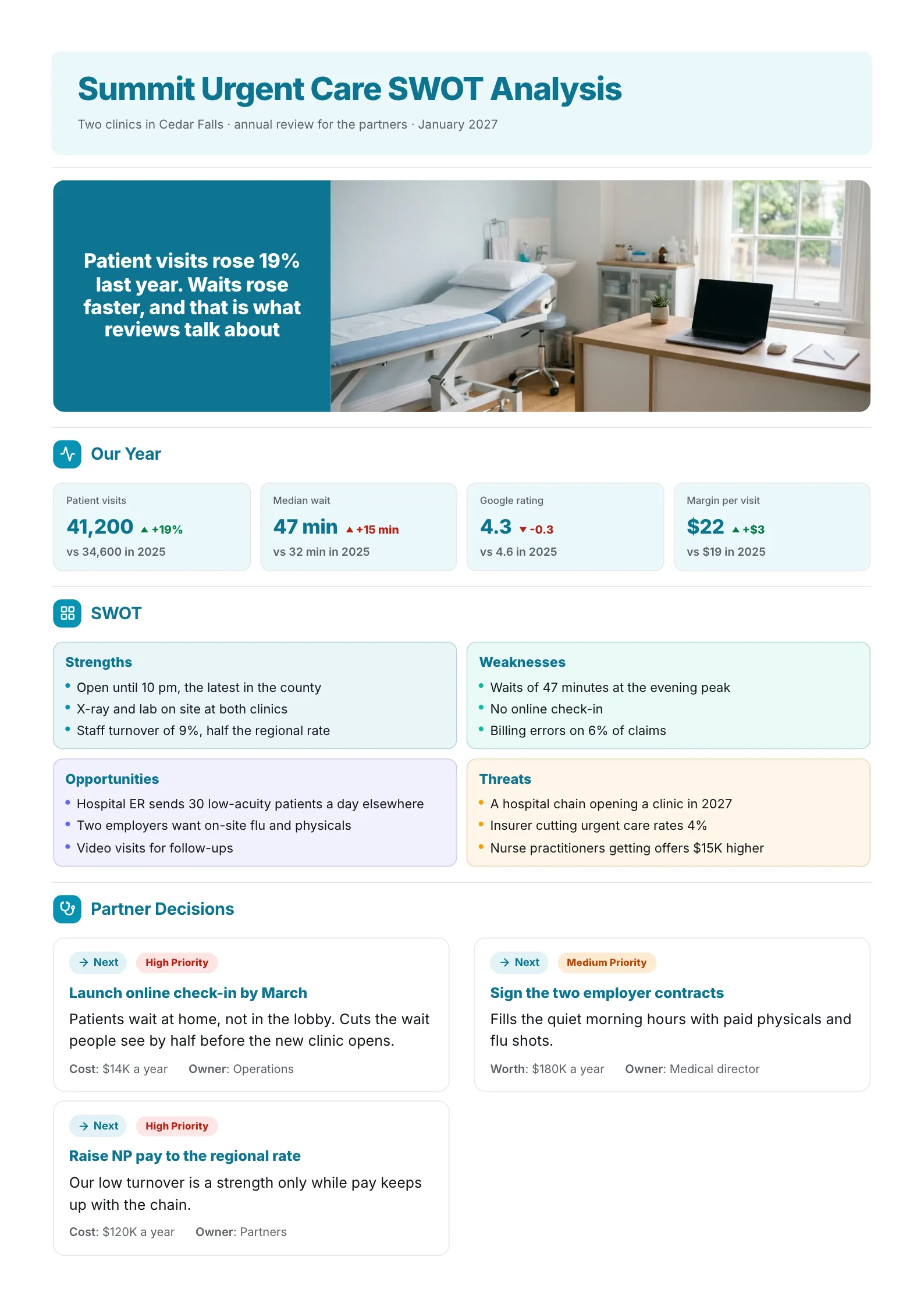
Sample names and figures. 9 of the 12 items carry a number you could check, such as waits of 47 minutes at the evening peak. The Our Year row compares each figure with 2025, the way River Valley compared its survey with 2017.
Step 5: Turn the grid into moves
The federal rule asks for strategies that build on strengths and opportunities and resolve weaknesses and threats. The usual way to find them is to pair the boxes, an approach often called a TOWS matrix. Here it is worked on the CSRA's real items. The pairings are our own illustration, so you won't find them in the CSRA plan.
| Pair | Items from the CSRA grid | A move they suggest |
|---|---|---|
| Strength + opportunity | Higher education + Fort Gordon mission growth and the Cyber Command Center | Build cyber training with the colleges, sized to the jobs the base brings |
| Weakness + opportunity | Lack of tech-skilled workers + biotech and energy sector growth | Use new employers' demand to fund training in rural counties |
| Strength + threat | Accessible industrial land + loss of anchor industries | Prepare sites ready for a replacement employer before a plant closes |
| Weakness + threat | Low rural broadband + business closures in rural areas | Put broadband first in the counties losing businesses |
Each move names items from two boxes, which is the test you can use on yours. A move that uses no strength and answers no threat is a wish. Pick three to five moves at most. Each SWOT pictured on this page has three or four, a number your team can actually track.
 Edit this template
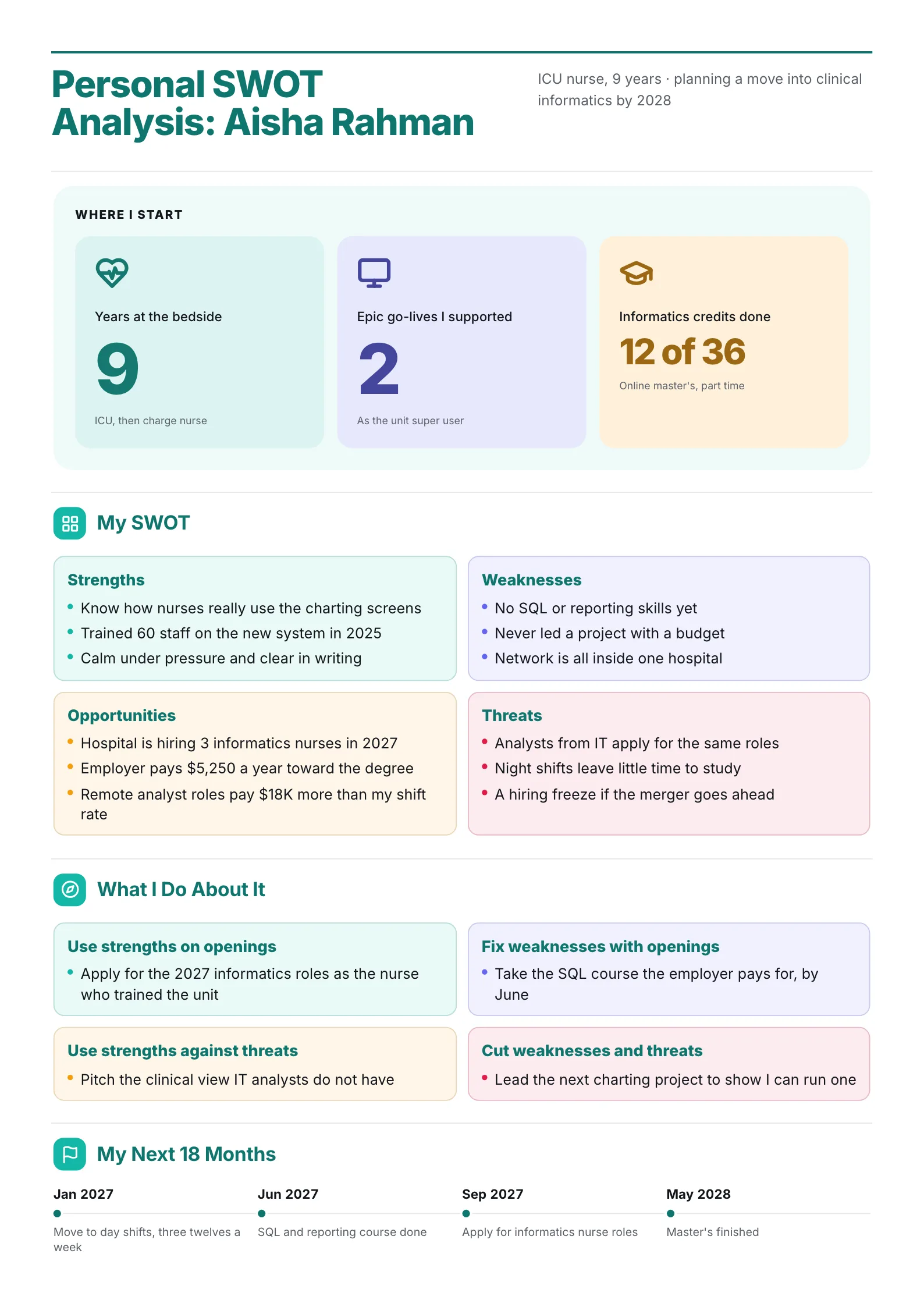
Sample names and figures. The What I Do About It panel is a TOWS matrix with one move per pair of boxes. Taking the SQL course her employer pays for answers a weakness, no SQL skills, with an opportunity, $5,250 a year toward the degree.
Step 6: Give every move a measure
The CSRA plan does this part well. Its manufacturing goal is to target recruitment "with a focus on value-added and niche manufacturing." Five numbered actions follow, including pursuing industrial parks and surveying manufacturers about the skills they need. Then come three performance measures, starting with "the number of new niche and value added jobs."
You can copy that shape: one goal, a few actions with an owner, and a measure you can count next year. Northwest Georgia and Southern Georgia both list their performance measures after the goals too, because the federal rule requires them.
 Edit this template
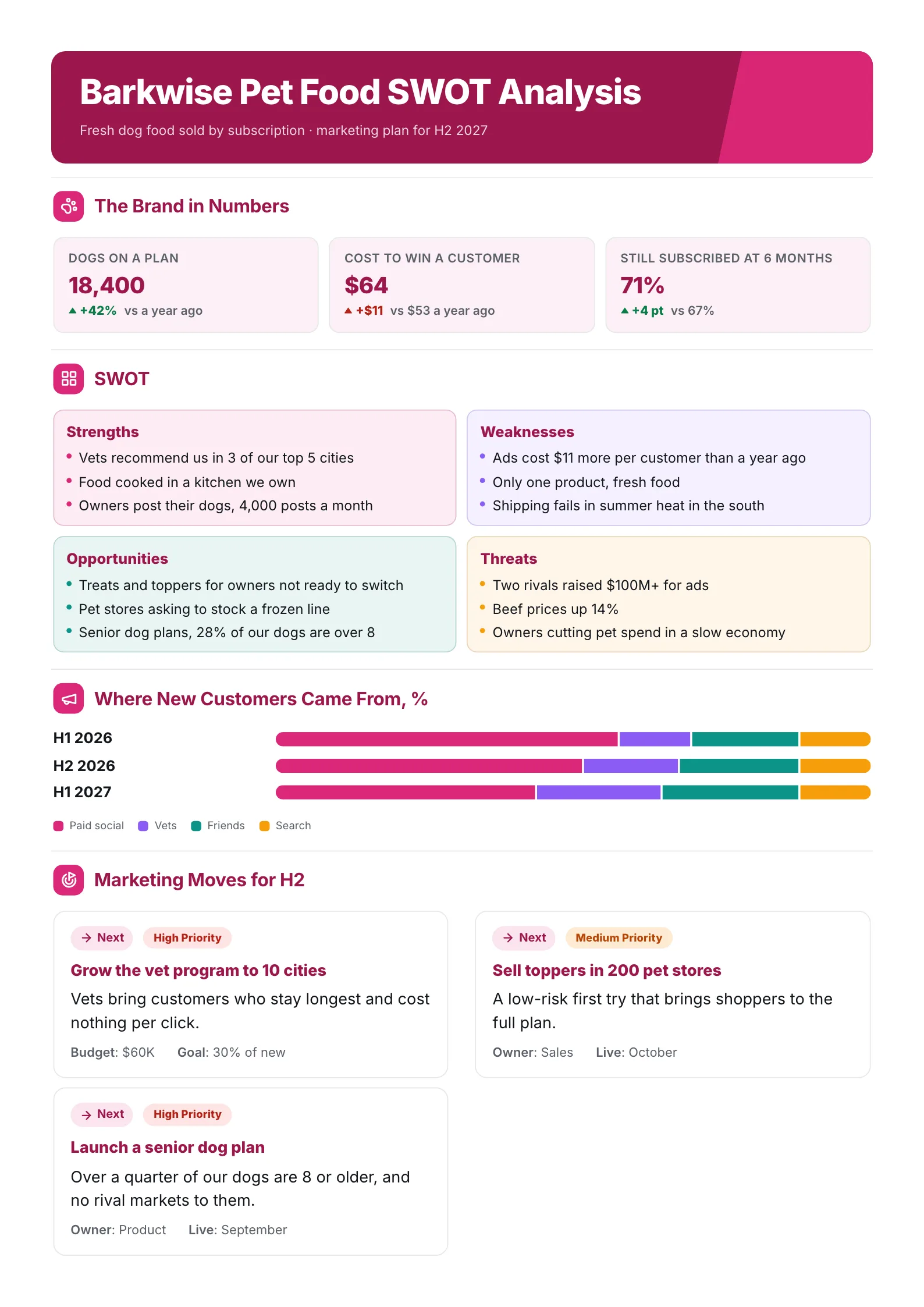
Sample names and figures. The first two moves carry a count you can check next year, 30% of new customers from vets and toppers in 200 pet stores. The senior dog plan has an owner and a September launch but no number to hit yet, so it's the one to fix.
Fit your SWOT on one sheet
The four plans run 14 to 159 pages, because a region needs that much room. Yours probably doesn't. A one-sheet SWOT that a team will actually reread has five parts, in this order:
- A title and a line saying who it's for and the period it covers.
- One number that frames the situation, like 410 lawns a week in the lawn company sample below.
- The four boxes, three to five items each, most with a number.
- Three to five moves, each pairing two boxes.
- A measure for each move, with a date.
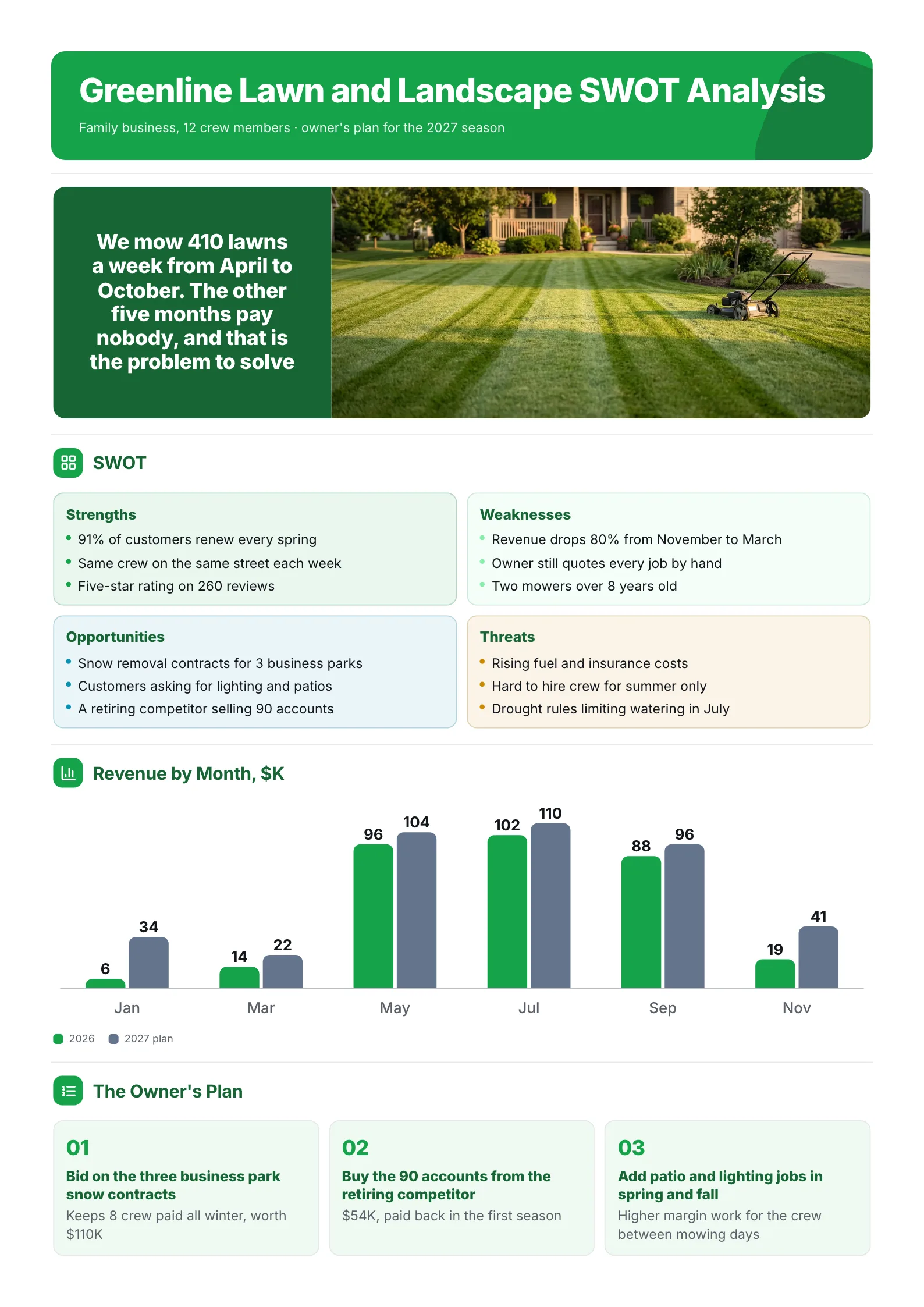 Edit this template
Sample names and figures. The banner gives you the framing number, 410 lawns a week from April to October and five months that pay nobody. The first step pairs a weakness, revenue dropping 80% from November to March, with an opportunity, snow removal contracts worth $110K.
Questions people ask about SWOT analysis
How many items should go in each box?
Three to five for a one-sheet SWOT. River Valley reports only its top three strengths and top three weaknesses, which forces a ranking. The CSRA's 10 or 11 per box is fine inside a long plan but hard to act on.
How often should you redo a SWOT?
When your plan changes, and at least once a year if you track it. Economic Development Districts like River Valley write a full plan every five years with annual updates, and River Valley reran its survey to compare.
How do you do a SWOT analysis on yourself?
Use the same steps with one person in the room. Strengths and weaknesses are your skills and habits, opportunities and threats are what's happening in your field. Ask a manager or a friend to add one item to each box, so it's not only your own view.
What is the difference between SWOT and TOWS?
SWOT is the list of four boxes. TOWS is the step after, where you pair the boxes to find moves, as in Step 5.
Make your SWOT analysis
Start from a design that already has the four boxes, a framing number and a row for your moves. You can browse every SWOT design in MakeOnepagers, see more layouts on our SWOT analysis template page, or turn your meeting notes into a first draft with our One-Pager maker (free for 7 days).




