SWOT Analysis Examples: 6 Real Plans Counted Box by Box
SWOT analysis examples from six published plans, from colleges and towns to a hospital, counted box by box beside five one-page templates.

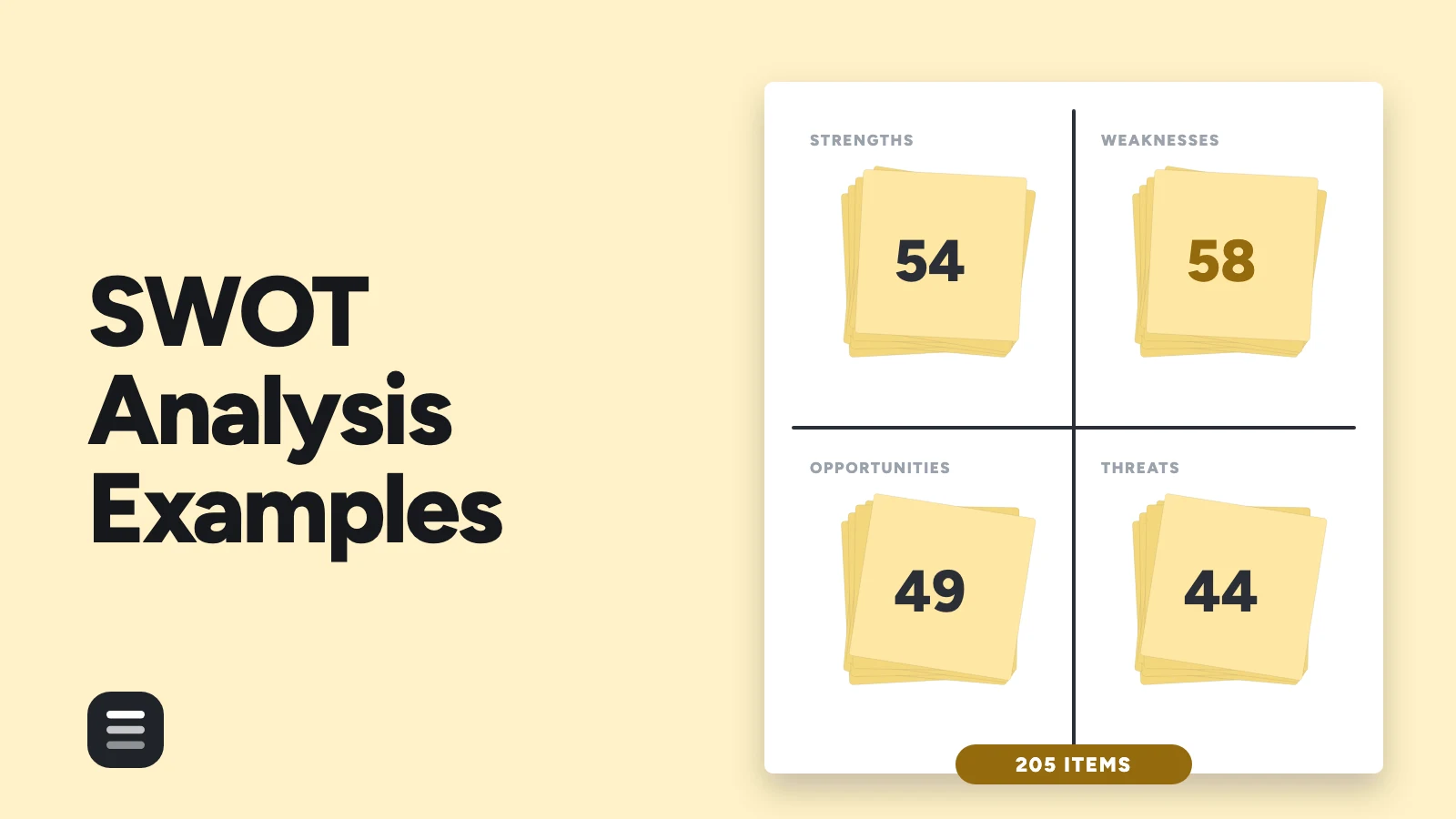
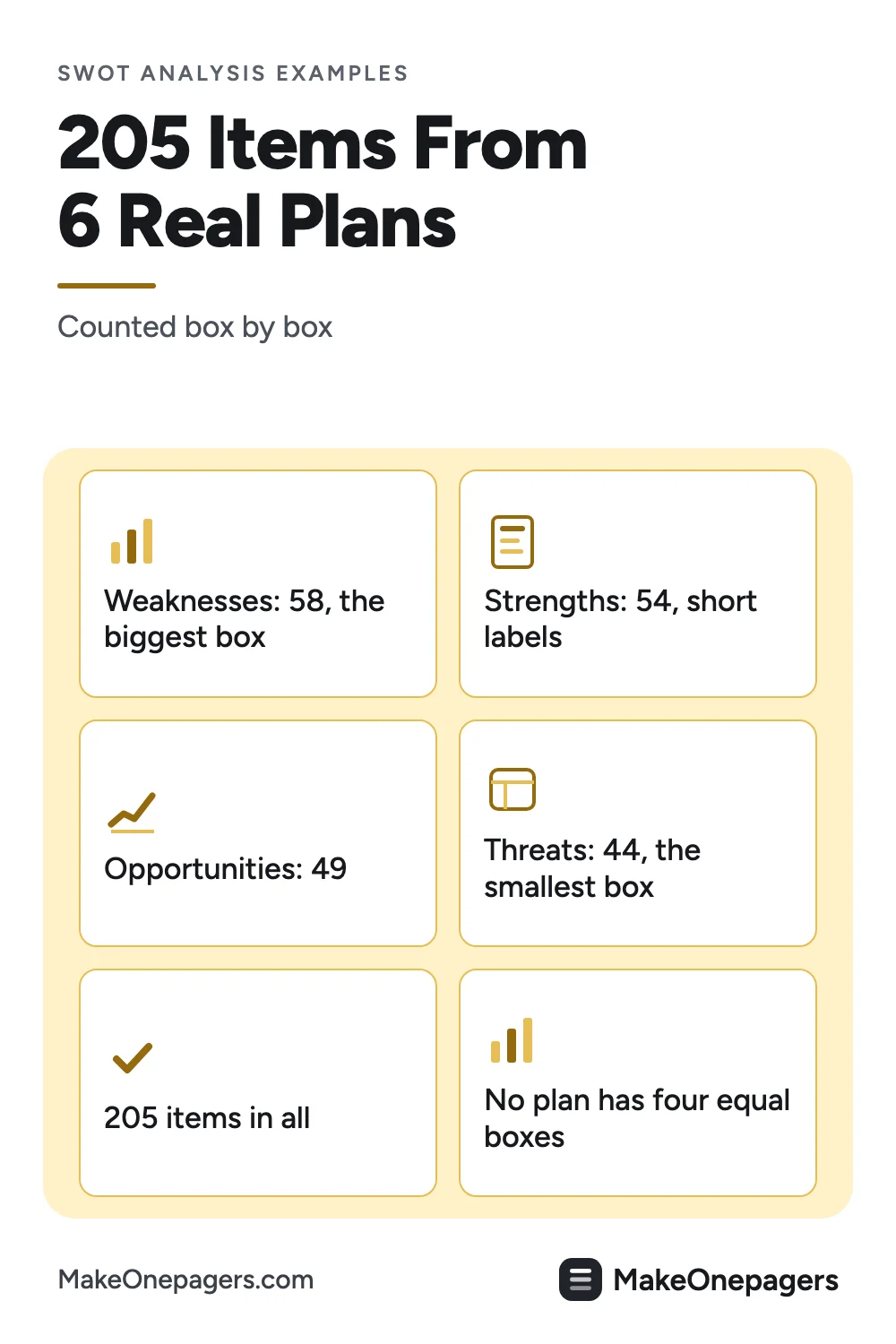
These SWOT analysis examples come from real plans. We counted every line in six SWOT analyses that real organizations published. Two are colleges, two are small towns, and two run health care. Together they list 205 items. Start from a free one pager template.
One‑Pager examples
Real One-Pagers made with MakeOnepagers. Open any one to edit it as your own.
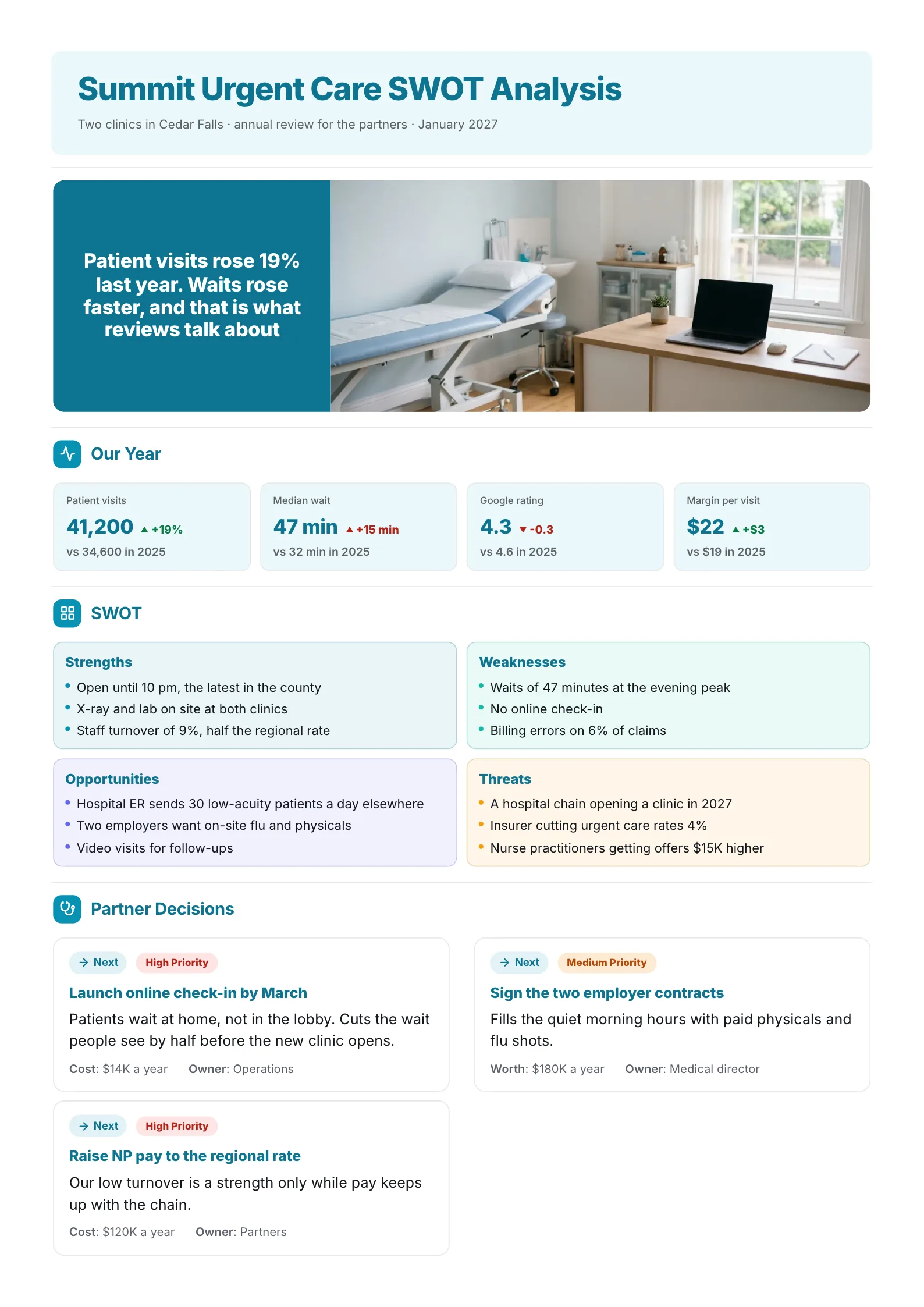 SWOT Analysis: Urgent Care ClinicEdit for free(opens in a new tab)
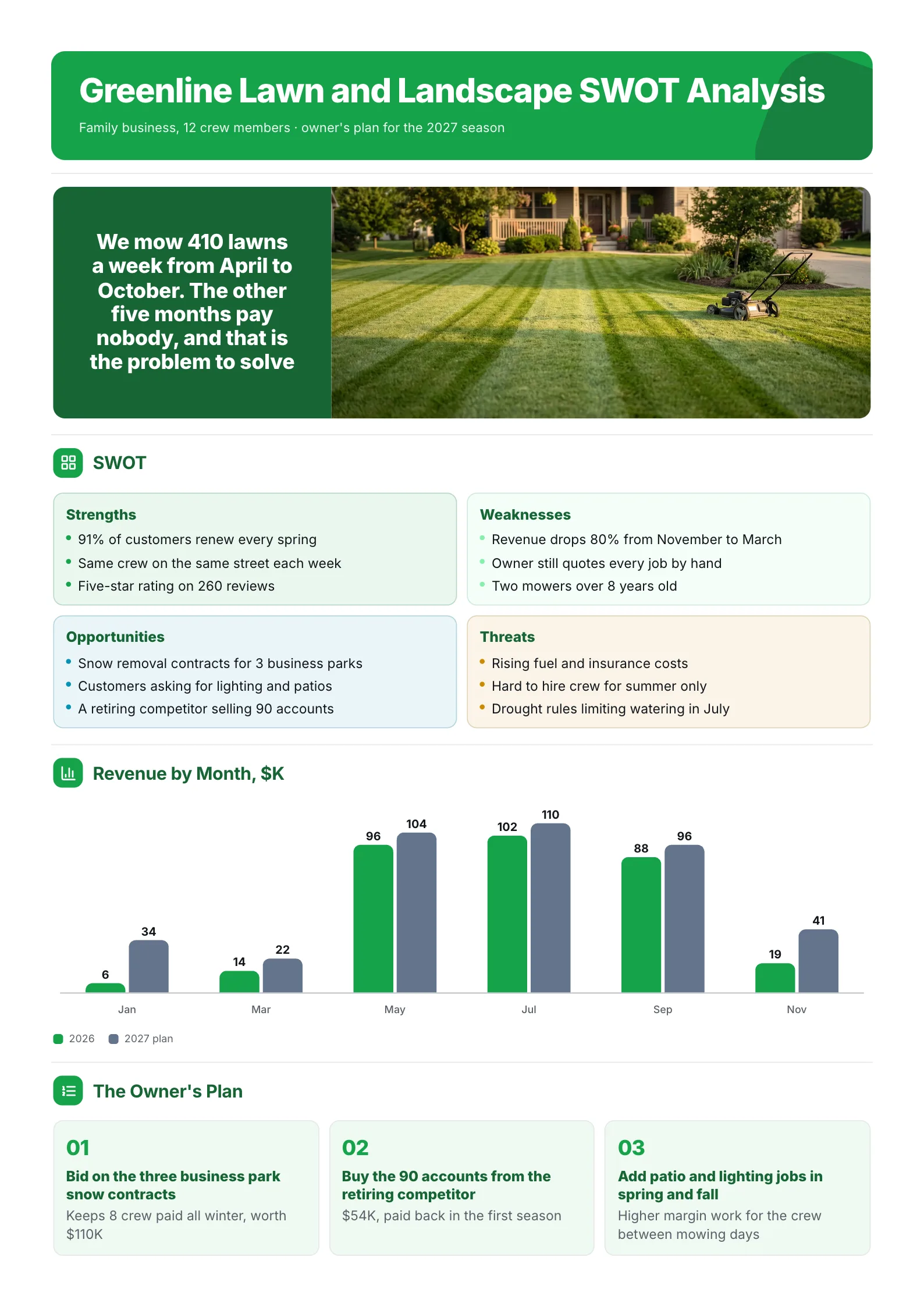 SWOT Analysis: Small BusinessEdit for free(opens in a new tab)
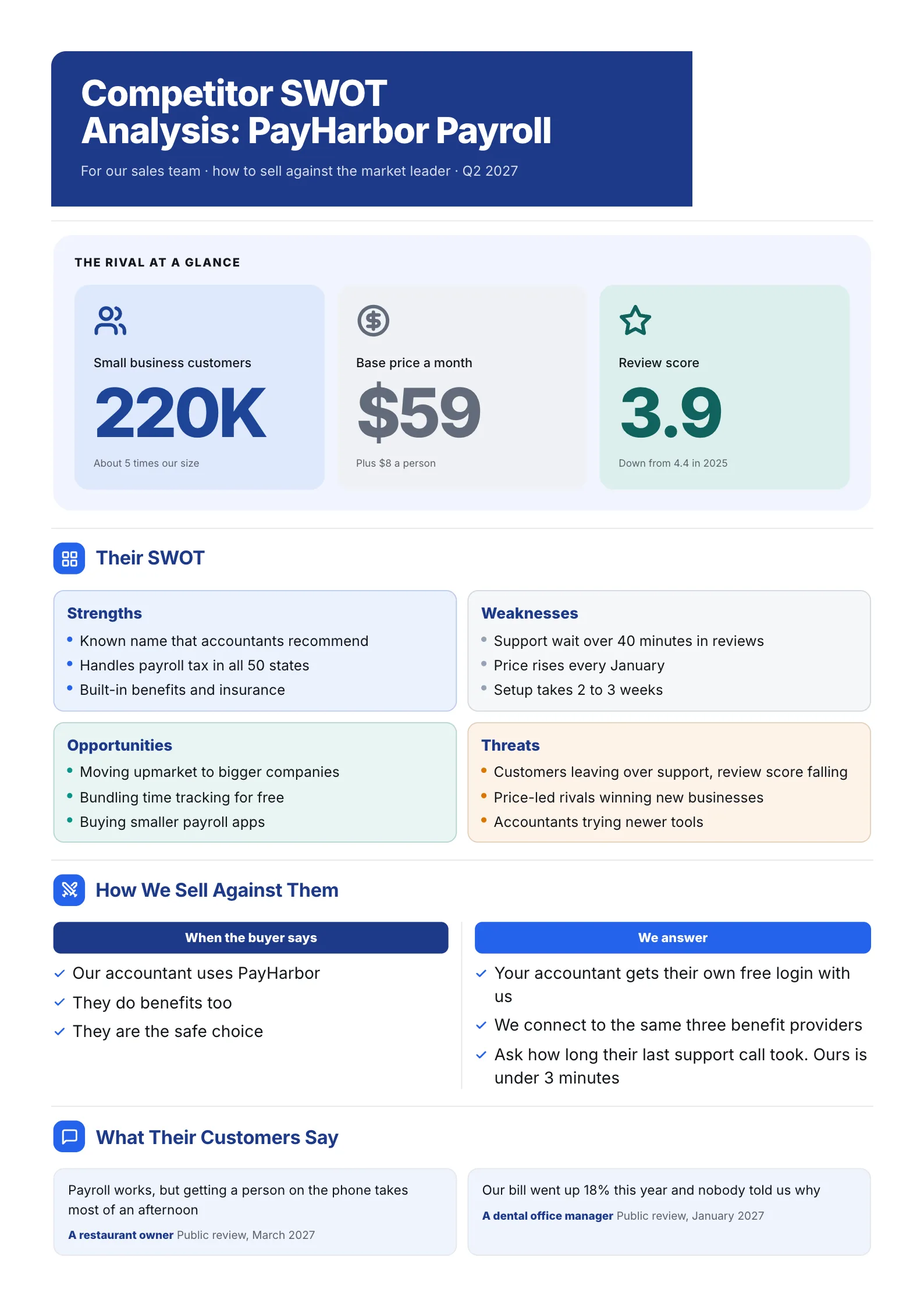 SWOT Analysis: CompetitorEdit for free(opens in a new tab)
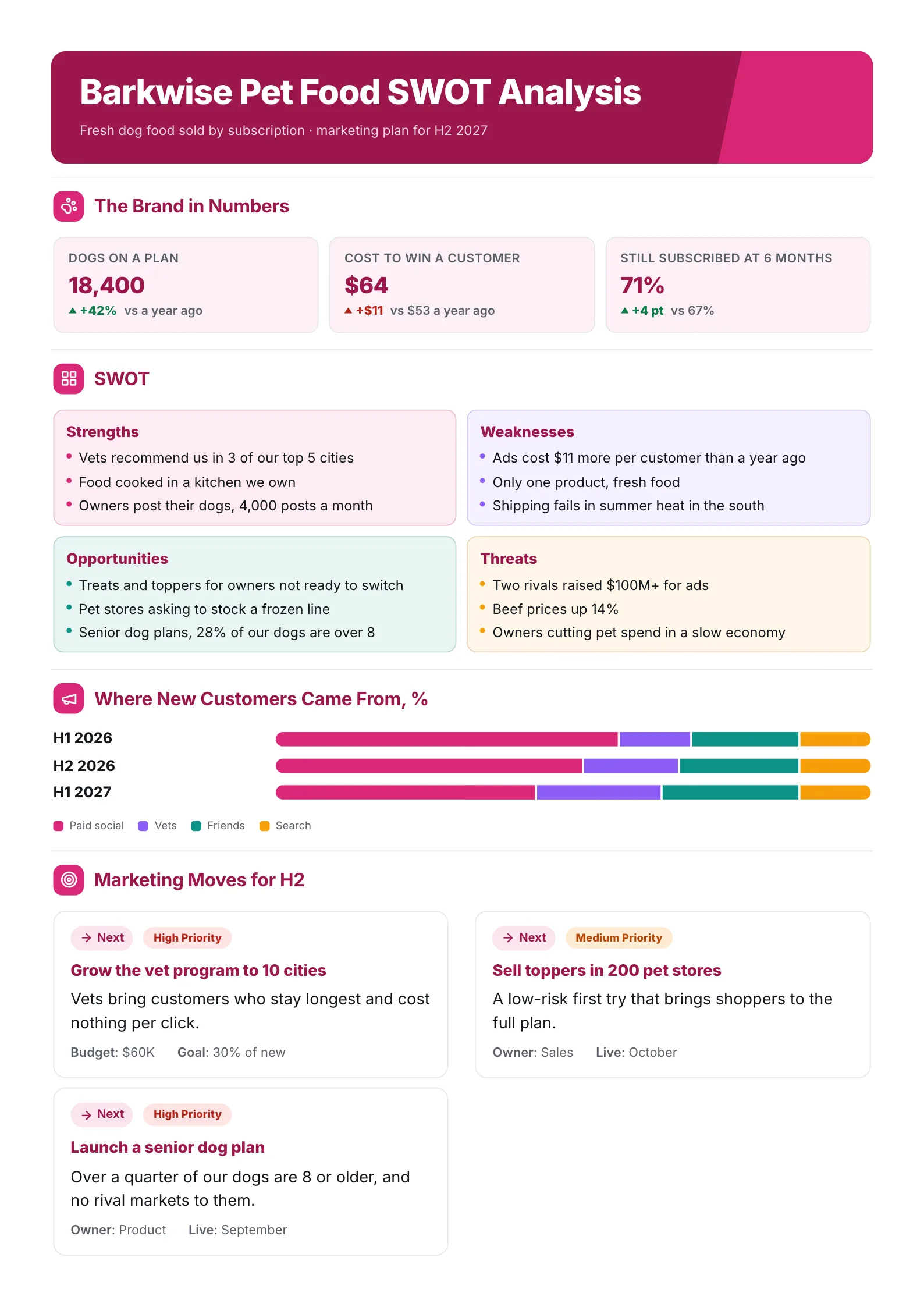 SWOT Analysis: Pet Food Brand MarketingEdit for free(opens in a new tab)
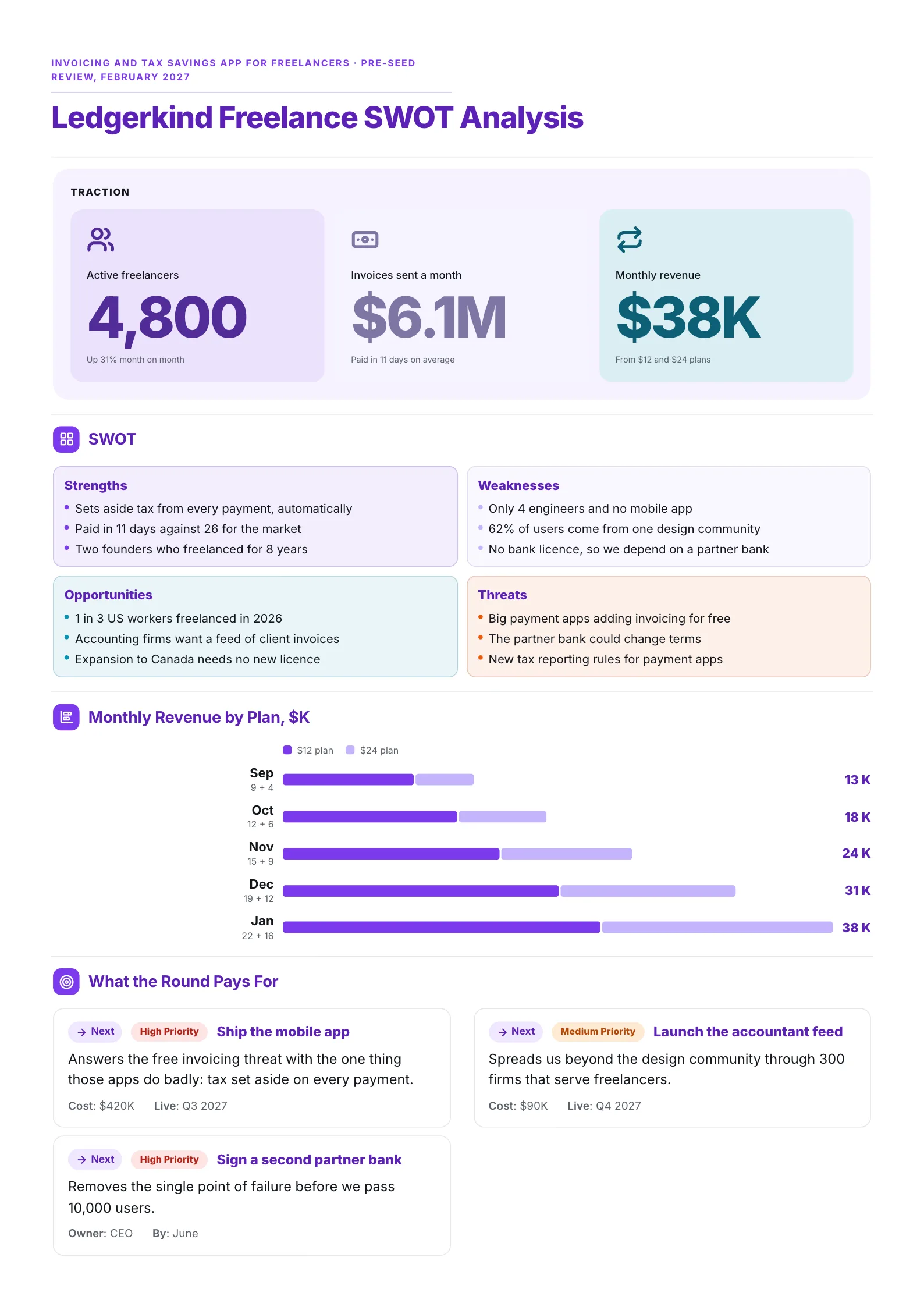 SWOT Analysis: StartupEdit for free(opens in a new tab)
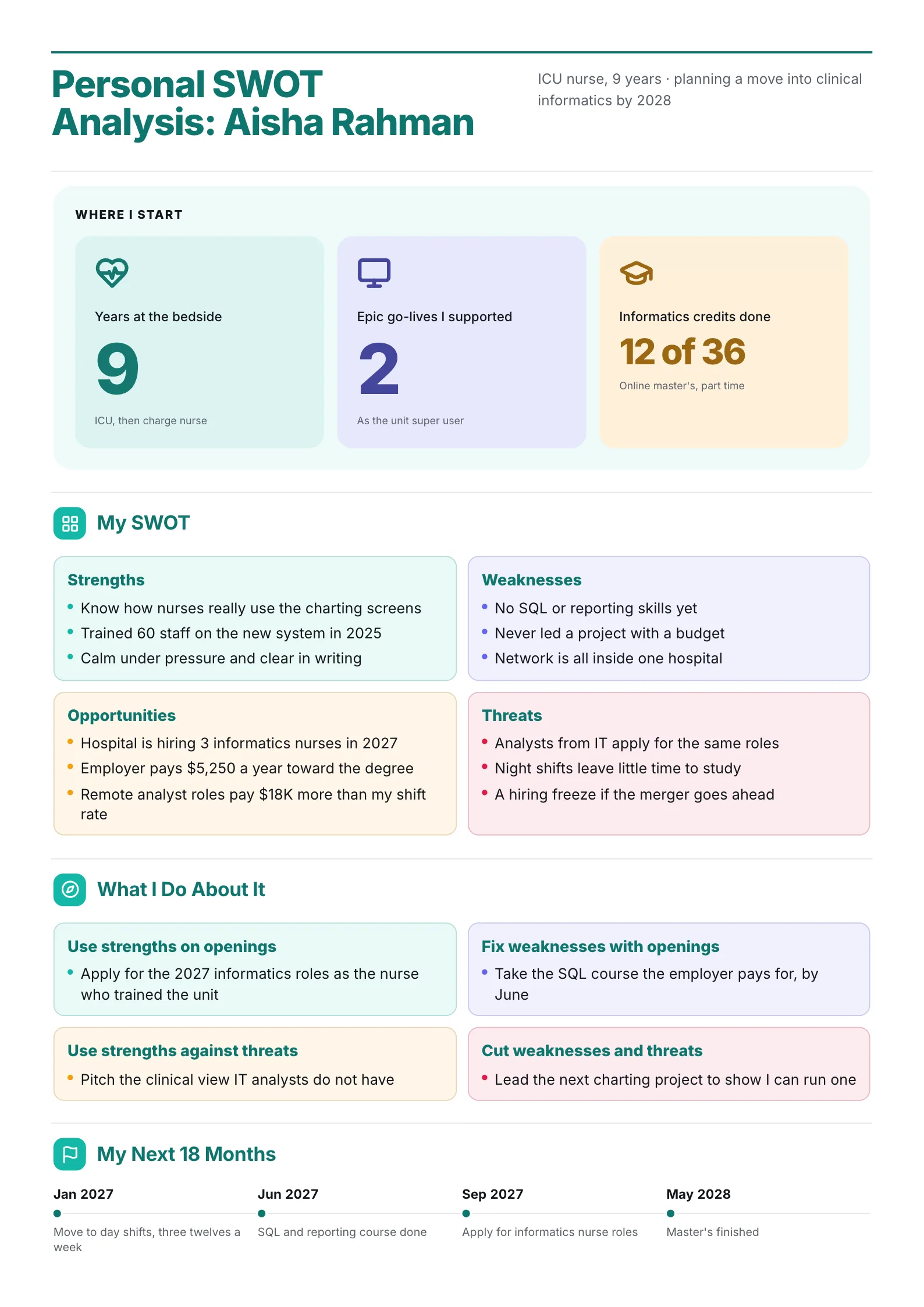 SWOT Analysis: Personal Career ChangeEdit for free(opens in a new tab)
Then we set them beside five SWOT templates from our MakeOnepagers library. Box by box, the real plans and the templates disagree on how long your list should run and where your evidence should go.
The six plans and their counts
| Plan | Who wrote it | Strengths | Weaknesses | Opportunities | Threats | Total |
|---|---|---|---|---|---|---|
| SUNY Morrisville Strategic Plan: 2030 | College, New York | 10 | 12 | 6 | 7 | 35 |
| Roxbury Community College, 2025 to 2030 draft | College, Boston | 6 | 6 | 7 | 7 | 26 |
| City of Lead, 2026 to 2030 | City, South Dakota | 12 | 7 | 9 | 4 | 32 |
| Town of Yorktown | Town, Indiana | 4 | 5 | 5 | 5 | 19 |
| Kumi Hospital, 2022 to 2026 | Hospital, Uganda | 16 | 23 | 18 | 16 | 73 |
| Desert Healthcare District, November 2025 | Health care district, California | 6 | 5 | 4 | 5 | 20 |
| All six | 54 | 58 | 49 | 44 | 205 |
Source: our count of the list items in each linked plan, read October 30, 2026.
No plan has four equal boxes, so yours doesn't need them either. Across all six, weaknesses come out on top and threats come last.
We opened three more plans that said they ran a SWOT. Southeast Arkansas College and Bristol Community College describe their SWOT workshops and print no list. The City of Ramsey's 2025 draft prints the four headings with nothing under them, and it calls the last box "Challenges." So if you've been hunting for a full SWOT to copy, it's rarer than you'd expect.
Our templates are much shorter. Most list 3 items per box, 12 lines in all, and the shortest lists 2. Now let's walk the boxes one at a time.
Strengths: short labels in the real plans
The City of Lead lists 12 strengths, more than any other box in its grid. They read like tags, such as "Balanced finances," "Employee quality" and "Physical location." Kumi Hospital lists 16, with lines like "Team work" and "Good Reputation."
None of them carries a number. A stranger reading Lead's list can't tell how balanced the finances are.
SUNY Morrisville solves that with a paragraph under each heading. Its athletics strength comes with a figure: athletes are 30% of the college's residential enrollment. The cost of all those paragraphs is length, and you'll read the strengths alone from page 3 to page 5.
 Edit this template
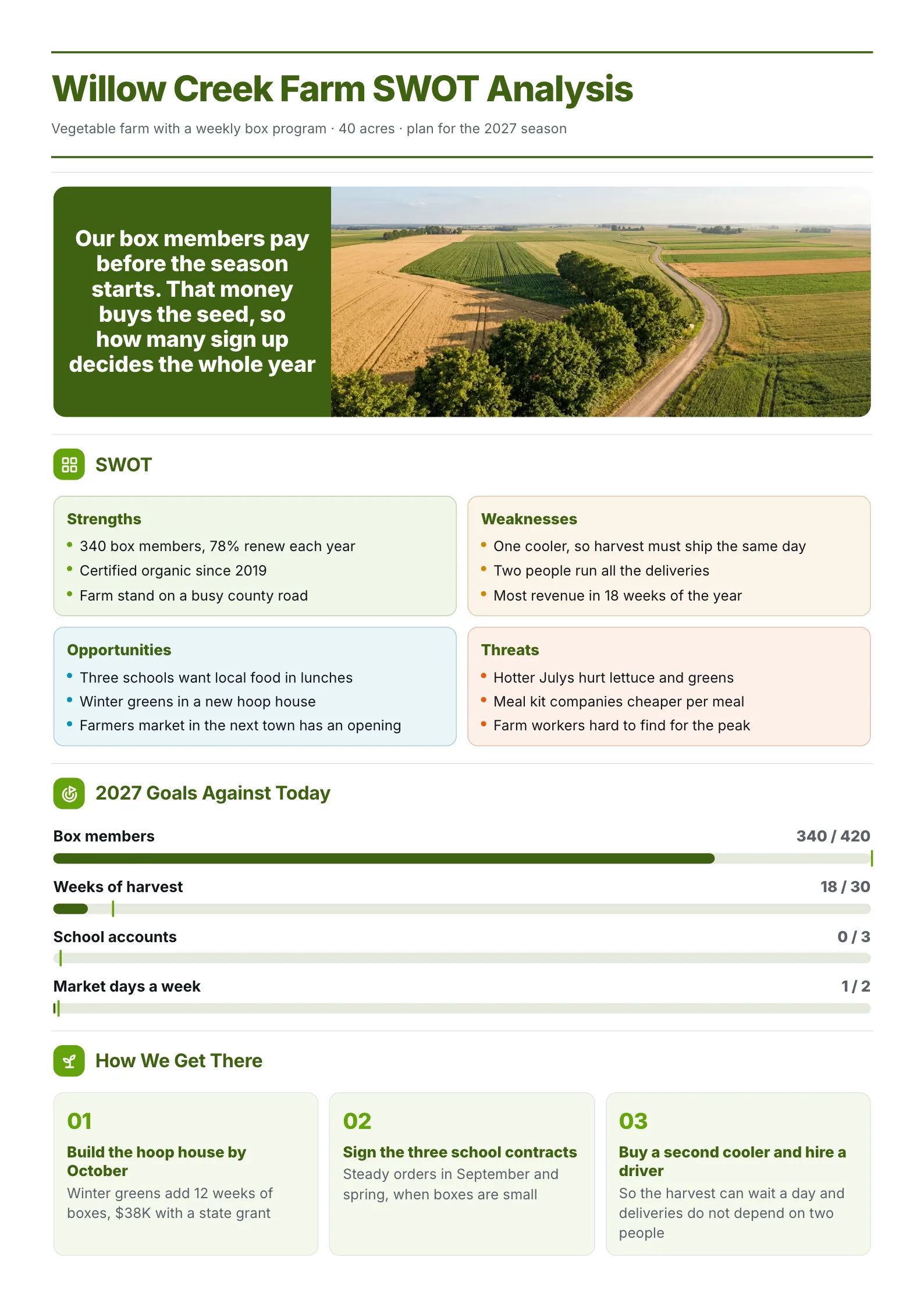
The farm's first strength puts its count and its renewal rate on one line.
Look at how the farm template does it in a single line: "340 box members, 78% renew each year." You get the label and the proof in the space Lead used for the label alone. On one page, that's the trade you want to make. Take your strongest label and ask what number would prove it to someone who's never seen your work.
Weaknesses: the biggest box
Weaknesses take 58 of the 205 items. Kumi Hospital wrote 23 of them, from "Inadequate vehicles to support service provision" to "High Staff turnover" and "Weak Q/QA systems." Morrisville wrote 12, and they're blunt. One says the college's operating costs still exceed its yearly revenue, so it now needs SUNY system approval for moderately sized expenses.
Morrisville also shows a weakness that used to be a strength. Its rural location was a strength in the past, the plan says, until there were fewer students of college age and more low-cost college options. An old SWOT of your own may hide the same slide in its strengths box.
Roxbury's list has a weakness you can learn from: "Declining completion rates despite enrollment gains." It names the good number and the bad one together, so you can't read the first without the second.
 Edit this template
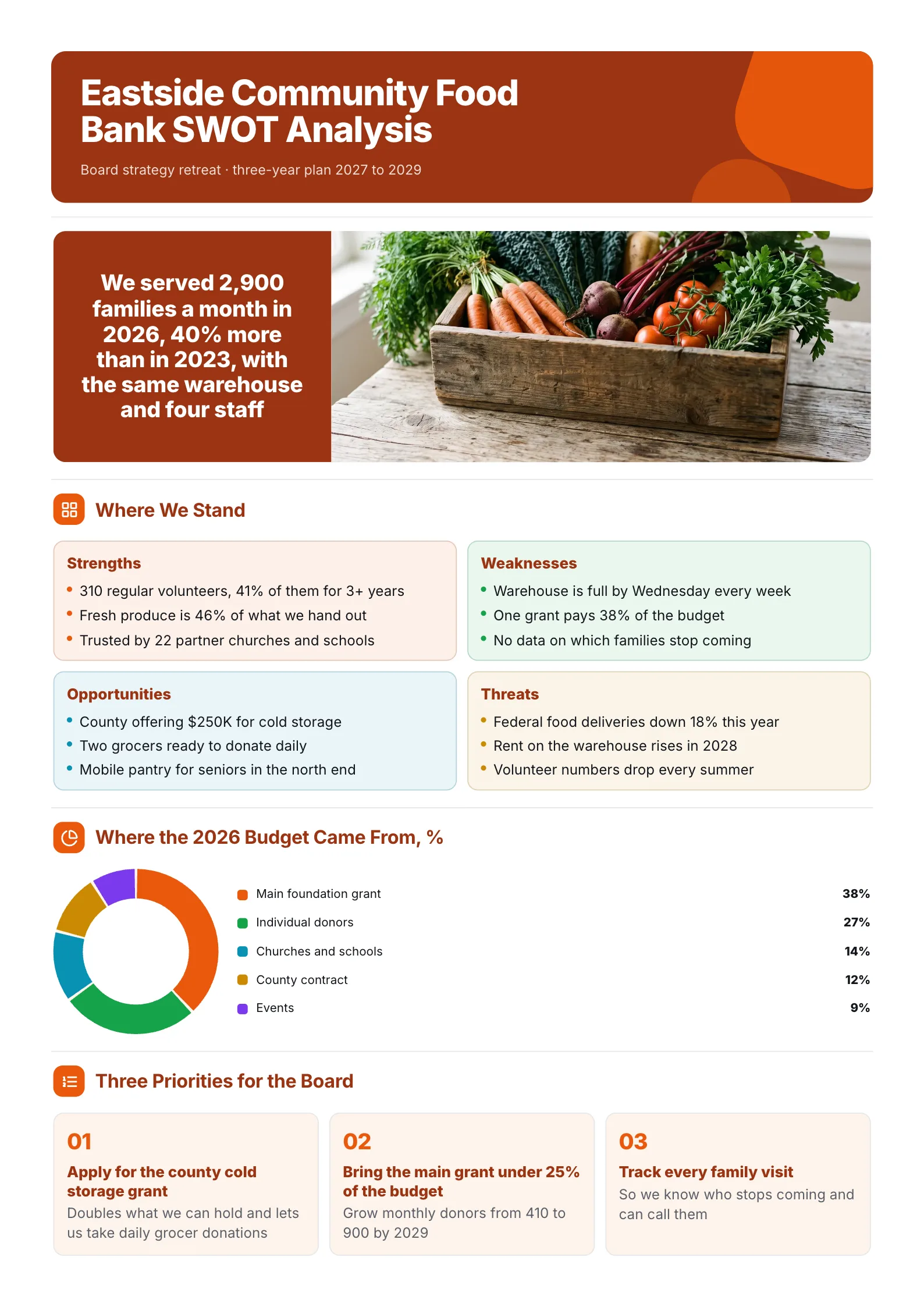
Seven of the food bank's twelve lines have a figure, and the budget chart shows where the money comes from.
The food bank template has three weaknesses. One is "One grant pays 38% of the budget," and the chart under the grid shows that 38 beside the other four sources. Its second board priority answers it: bring that grant under 25%.
Opportunities: where weaknesses turn around
Morrisville defines this box in a way you won't see in most guides. Opportunities, it says, are chances for something good that are "within our control," even though they usually start outside the college. Threats are "external and out of our control."
That definition explains its most interesting pair. The village is a weakness, listed as "Local village appearance and lack of resources," because students say there's not enough to do there. Under "Town and gown relations" it's also an opportunity, because the village counts as a food desert and Morrisville teaches agriculture. The plan turns the same problem into something it can work on. Try the same move on your own weakest line.
The Desert Healthcare District does the same with brand awareness. It lists low awareness as a weakness. It also lists the chance to raise it, using the visibility it gained when residents voted on a ballot measure about its hospital lease.
 Edit this template
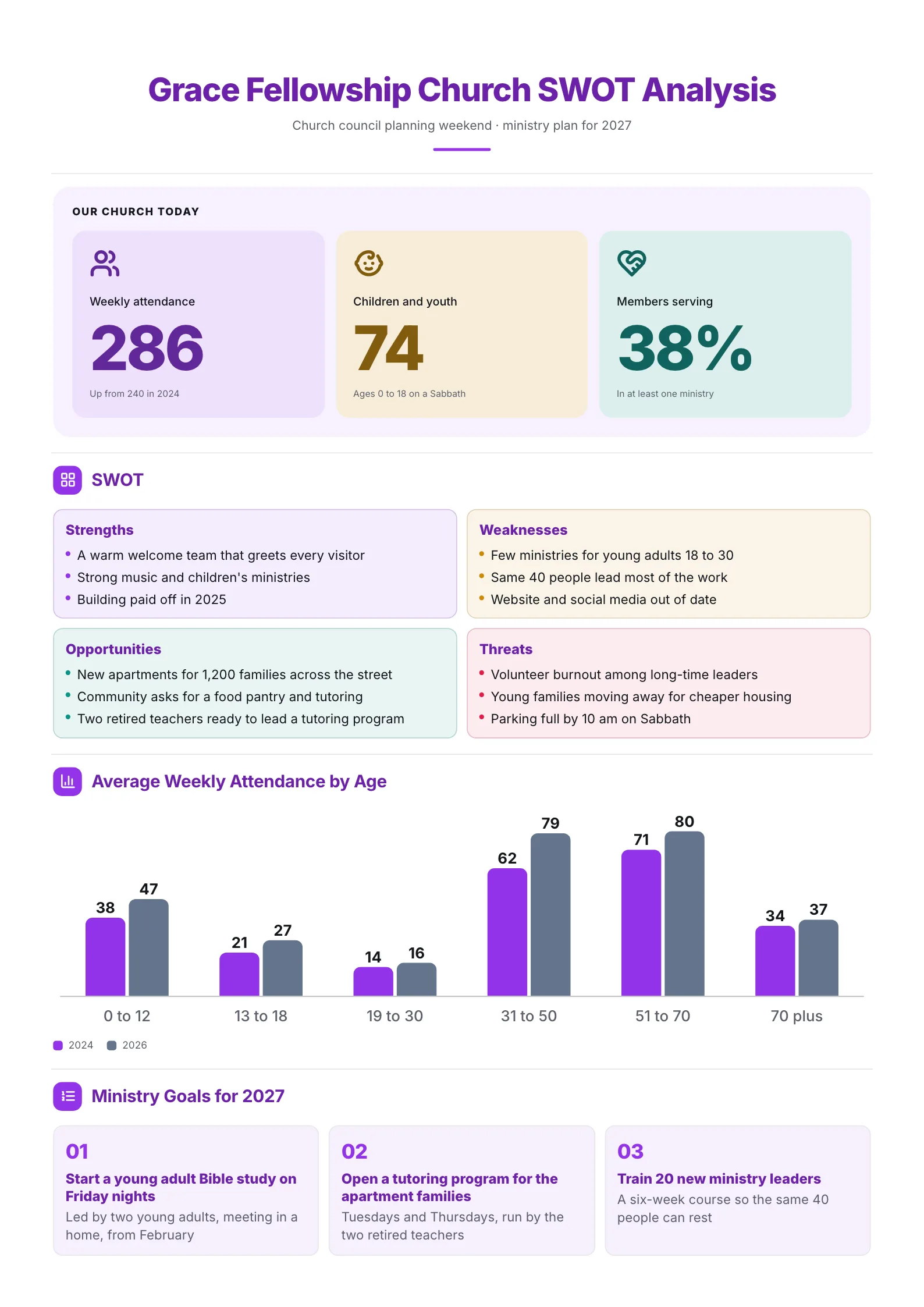
The church pairs the apartments across the street with two retired teachers who can serve them.
The church template gives you the cleanest version of this. One opportunity is "New apartments for 1,200 families across the street." Another is "Two retired teachers ready to lead a tutoring program." Put together, they become a goal: tutoring on Tuesdays and Thursdays for the apartment families.
Threats: the smallest box
Threats take 44 of the 205 items, the fewest. The City of Lead lists just 4. One of them is "Limited budget," while its strengths include "Balanced finances" and "Stable budget revenue." Both can be true, and your reader will still stop and wonder. A few extra words would settle it.
Morrisville gives its biggest threat a date. The number of high school graduates in the Northeast falls from the 2025 to 2026 enrollment cycle and keeps falling through 2031. A threat with a date tells you how long you have.
 Edit this template
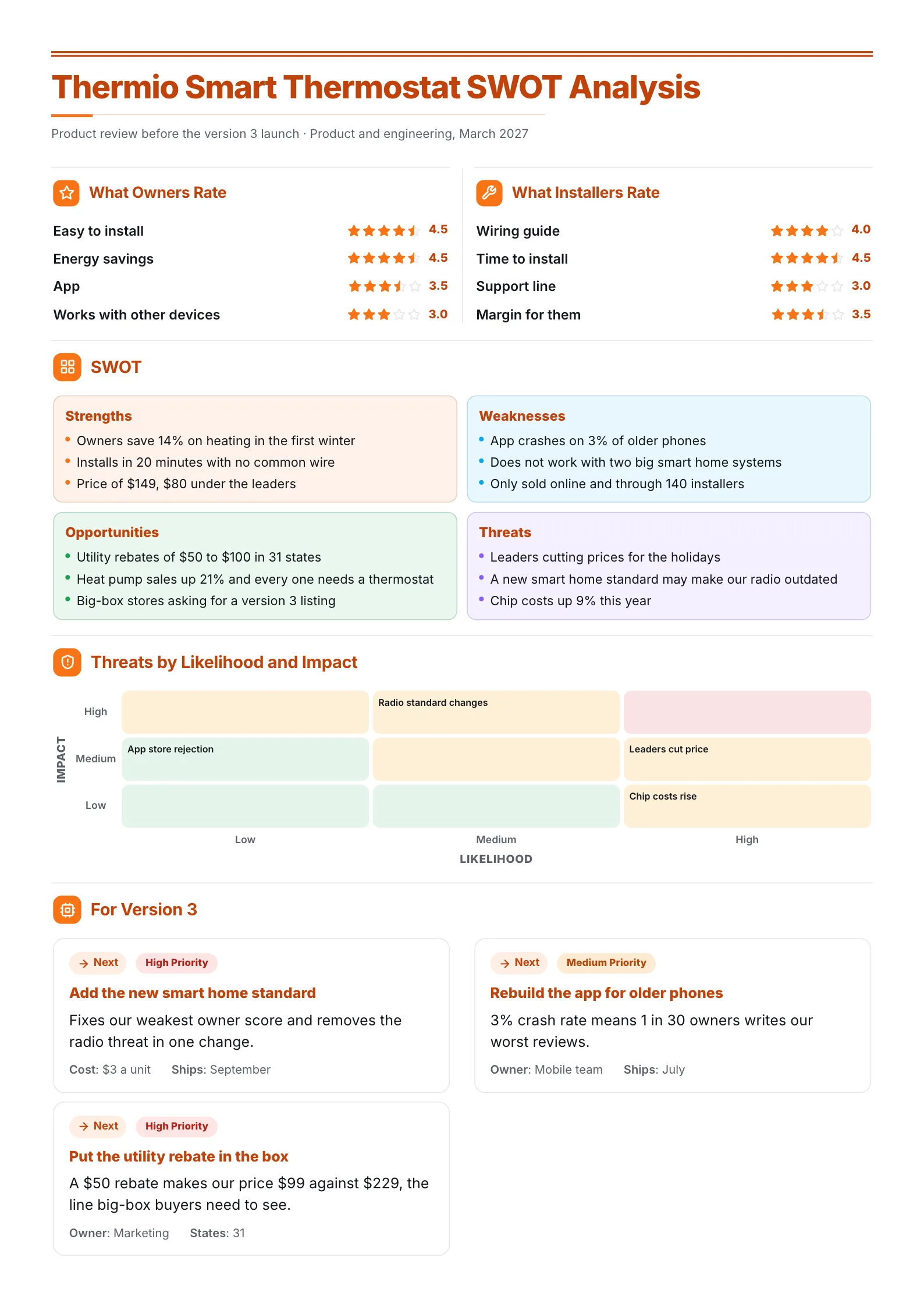
The thermostat team scores each threat for likelihood and impact before planning version 3.
None of the six real plans ranks its threats. The thermostat template does. It rates four threats from 1 to 3 for how likely they are and how much they'd hurt. "Leaders cut price" scores 3 for likelihood and 2 for impact. "Radio standard changes" scores 2 and 3. Then its first priority fixes the threat with the highest impact. If you have more threats than you can answer this year, score them the same way and answer the top one first.
One subject, two boxes
Every one of the six plans puts at least one subject in two boxes. Here's one from each for you to compare.
| Plan | Subject | Where it shows up |
|---|---|---|
| SUNY Morrisville | Faculty-to-student ratio, 18.2 against peers' 24.2 | Weakness, and the plan calls it a strength too |
| Roxbury | Free community college | Opportunity (public support) and threat (funding may not last) |
| City of Lead | Infrastructure projects | Weakness (projects coming) and threat (projects to finish) |
| Town of Yorktown | The Sports Park | Weakness (maintenance) and threat (fewer visitors) |
| Kumi Hospital | Staff pay | Weakness (pay that can't compete) and threat (better salaries elsewhere) |
| Desert Healthcare District | New money from the hospital lease | Strength, opportunity and three threats |
Source: our count of the list items in each linked plan, read October 30, 2026.
Most of these make sense once you split the subject in half. Yorktown's fields are in poor shape, which is the inside half. Fewer people visit the park, which is the outside half, and the plan says field and drainage problems cut tournament revenue by 30%. The Desert Healthcare District's new cash is a strength today. It also brings more grant requests and more public scrutiny, which it can't fully control.
On your page, write each half as its own line in its own box. Then your reader sees two facts instead of one fact twice.
The shortest SWOT we have
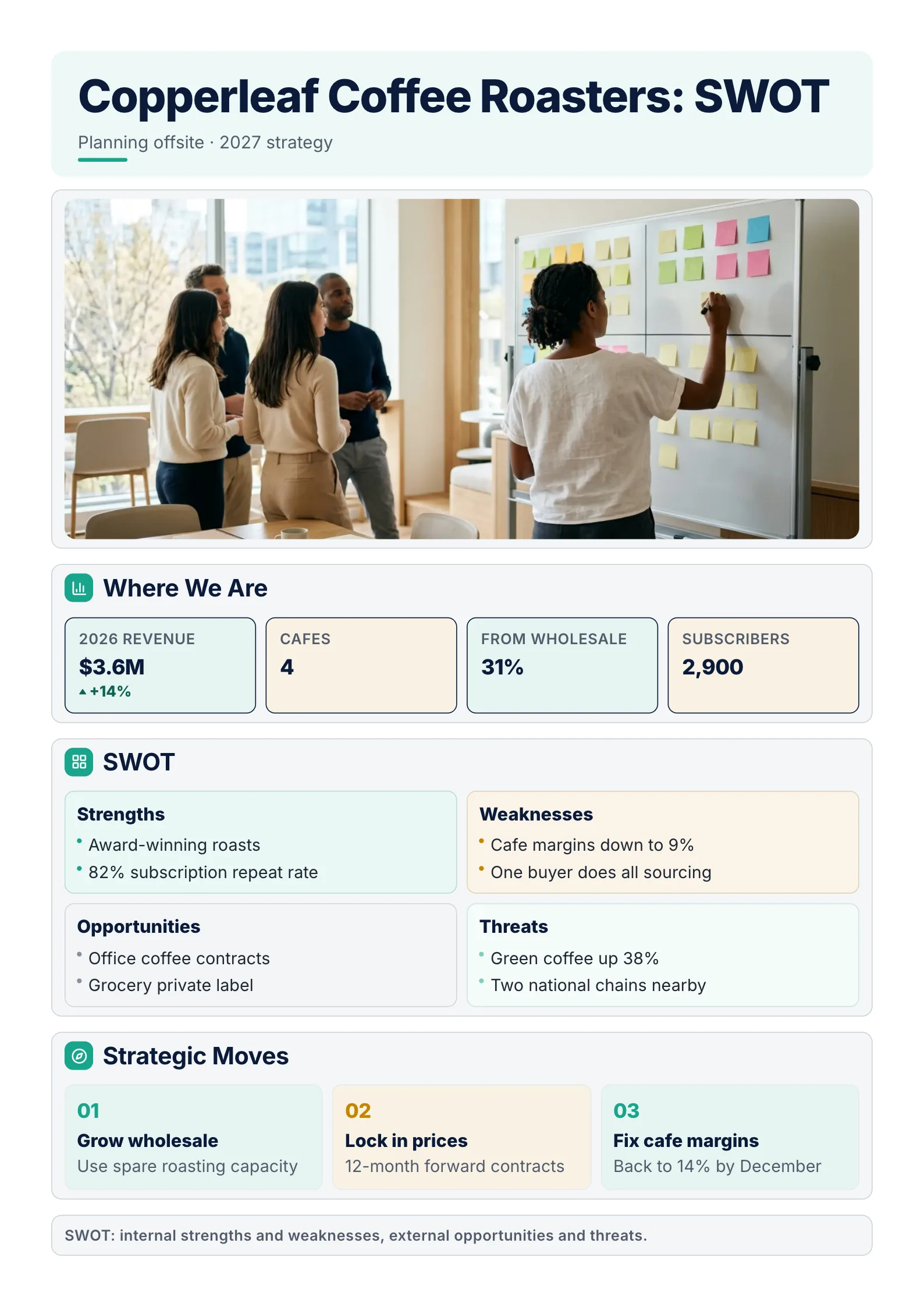 Edit this template
Copperleaf's grid holds only 8 lines, and every move under it has a target.
Copperleaf Coffee Roasters fits its whole SWOT into 8 lines, 2 per box. "Cafe margins down to 9%" is one weakness. "Green coffee up 38%" is one threat. The three moves underneath answer them, including "Fix cafe margins, back to 14% by December."
Kumi's table has 73. Both have a place in your process. Kumi's table came out of a five-day staff workshop and about 50 interviews, so it records what everyone said. Copperleaf's is for a planning offsite where your team needs to leave with three moves. A board or a lender will read something closer to Copperleaf's size, while the long list stays with you as notes.
What to borrow from each side
- From the real plans: give weaknesses the room they need, and split a two-sided subject into two lines.
- From Morrisville: write down what each box means before you fill it, so your team sorts the same way. Our guide on how to do a SWOT analysis shows how four regional plans from Georgia ran that sorting step.
- From the templates: put a number in the line itself, and keep each box to two or three items on one page. The SWOT analysis template post has questions that help you fill each box.
- From the thermostat: score your threats when you have more than you can answer.
A SWOT about you and your own career follows the same rules. The personal career template sorts a nurse's move into clinical informatics into the four boxes, then pairs them into moves with dates.
Start from the shortest real SWOT
Copy Yorktown's plan first. The town ran several SWOTs with residents, a steering committee and the council, then merged them into one grid of 19 lines, four or five per box. It's the shortest real SWOT we counted, and it still found the subject that sits in two boxes, the Sports Park. Run your workshop the long way, the way Kumi did, and then cut the result down the way Yorktown did. Aim for about 20 lines in your first draft, add a number to each one you can, and keep everything you cut as notes.
A lender or a board needs fewer, so trim your 20 to the 8 to 12 they need most, then write your three moves under them, the way Copperleaf and the food bank do.




