SWOT Analysis Mistakes: 179 Items From 4 Real Plans, Checked
SWOT analysis mistakes, counted in 4 real plans: 179 items, opportunities written as to-dos, threats as worries or wishes, one-word labels, and each fix.

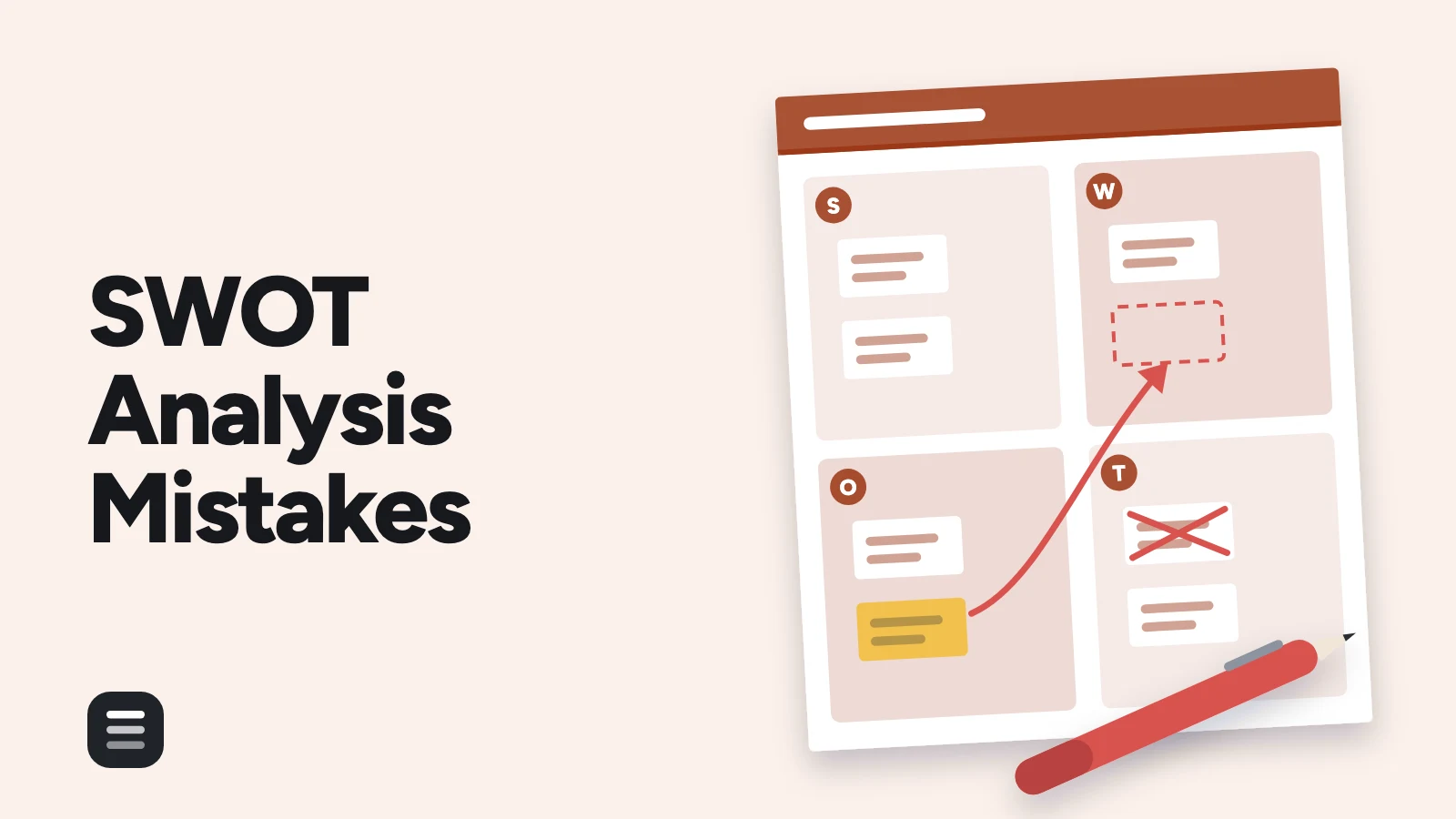
Most SWOT analysis mistakes look fine in a grid until someone tries to act on them. An opportunity written as your own to-do. A threat written as a worry. A one-word label nobody can act on. We read the SWOTs in four recent public plans and checked all 179 items one by one. Start from a free one pager template.
One‑Pager examples
Real One-Pagers made with MakeOnepagers. Open any one to edit it as your own.
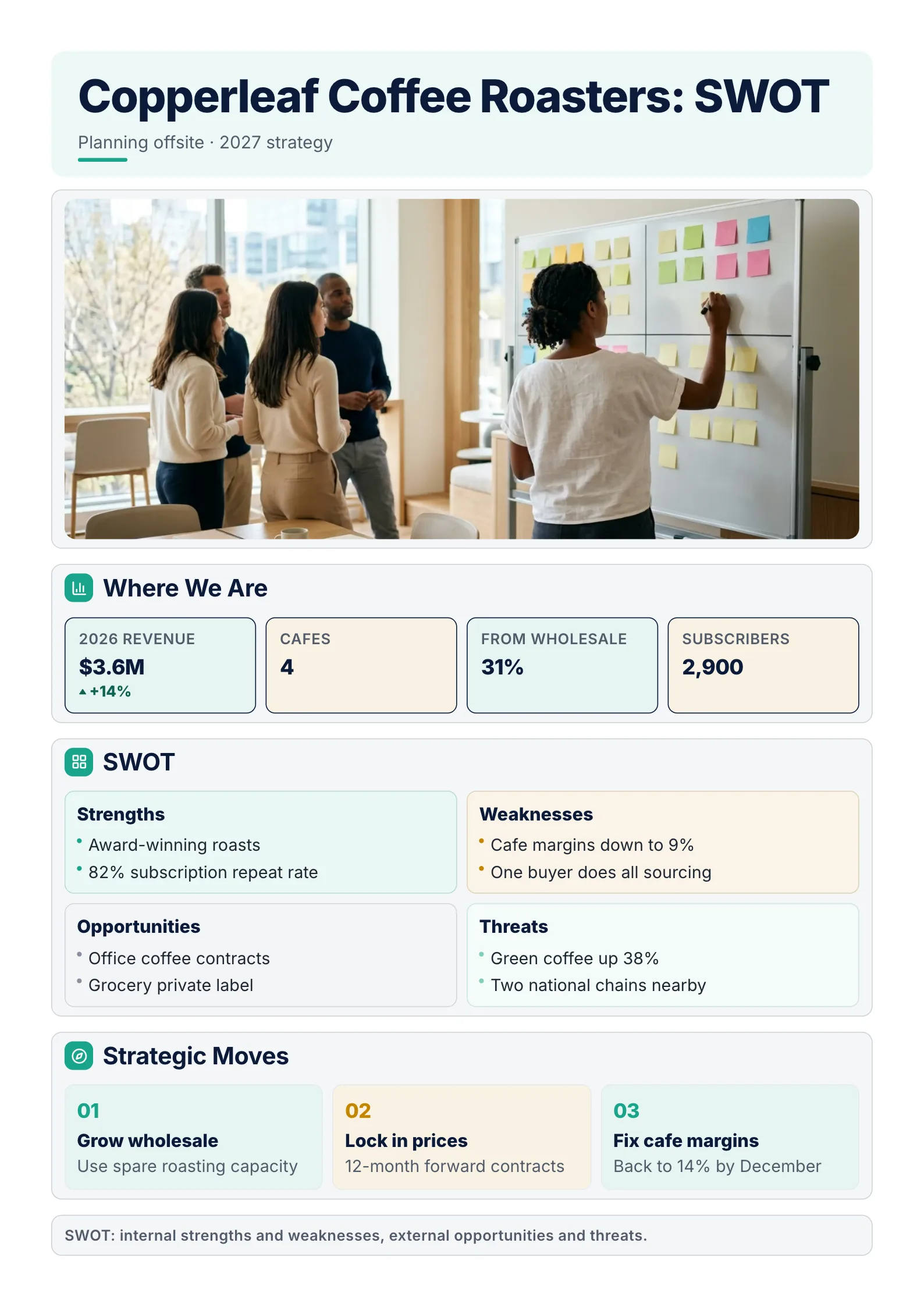 SWOT AnalysisEdit for free(opens in a new tab)
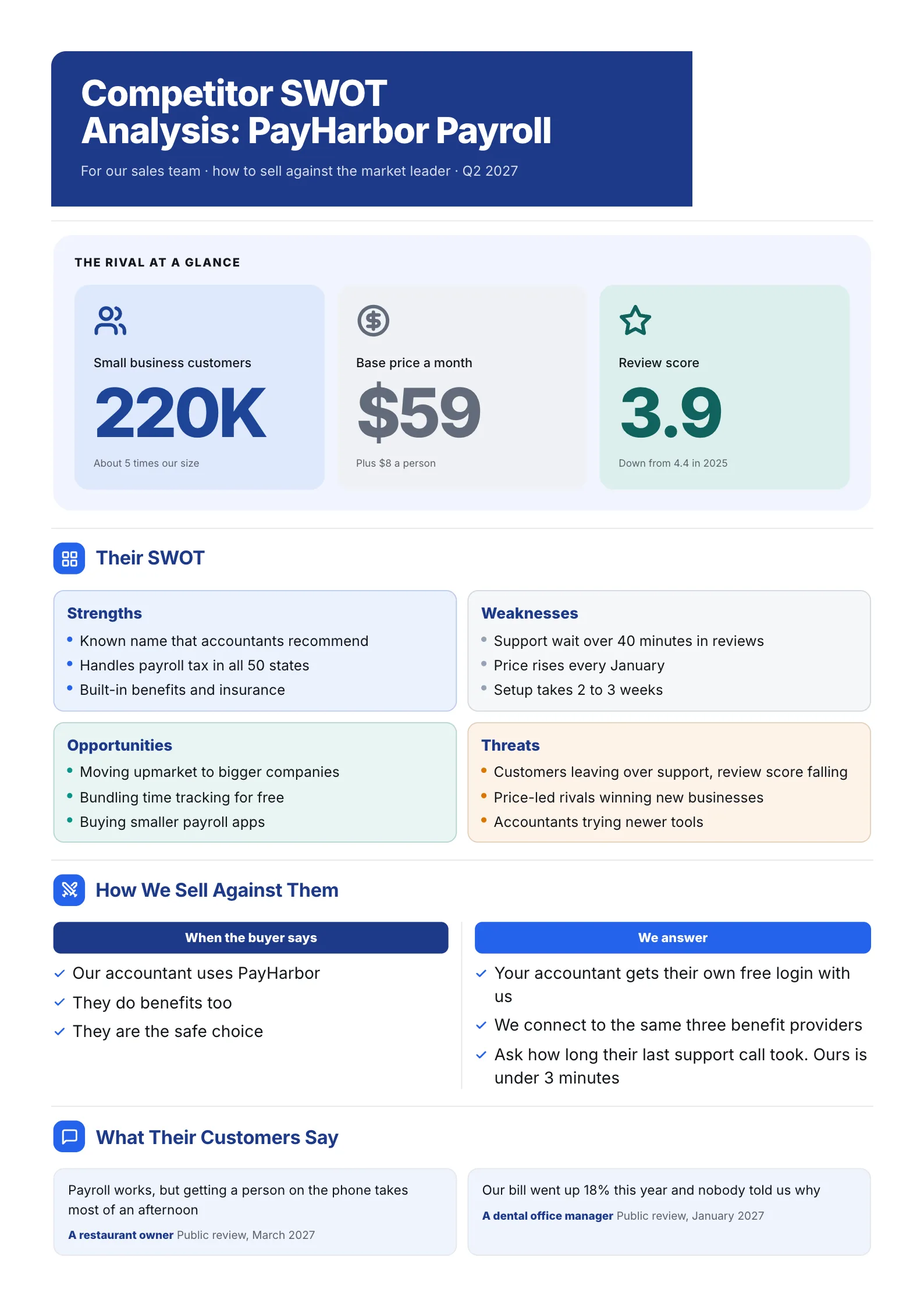 SWOT Analysis: CompetitorEdit for free(opens in a new tab)
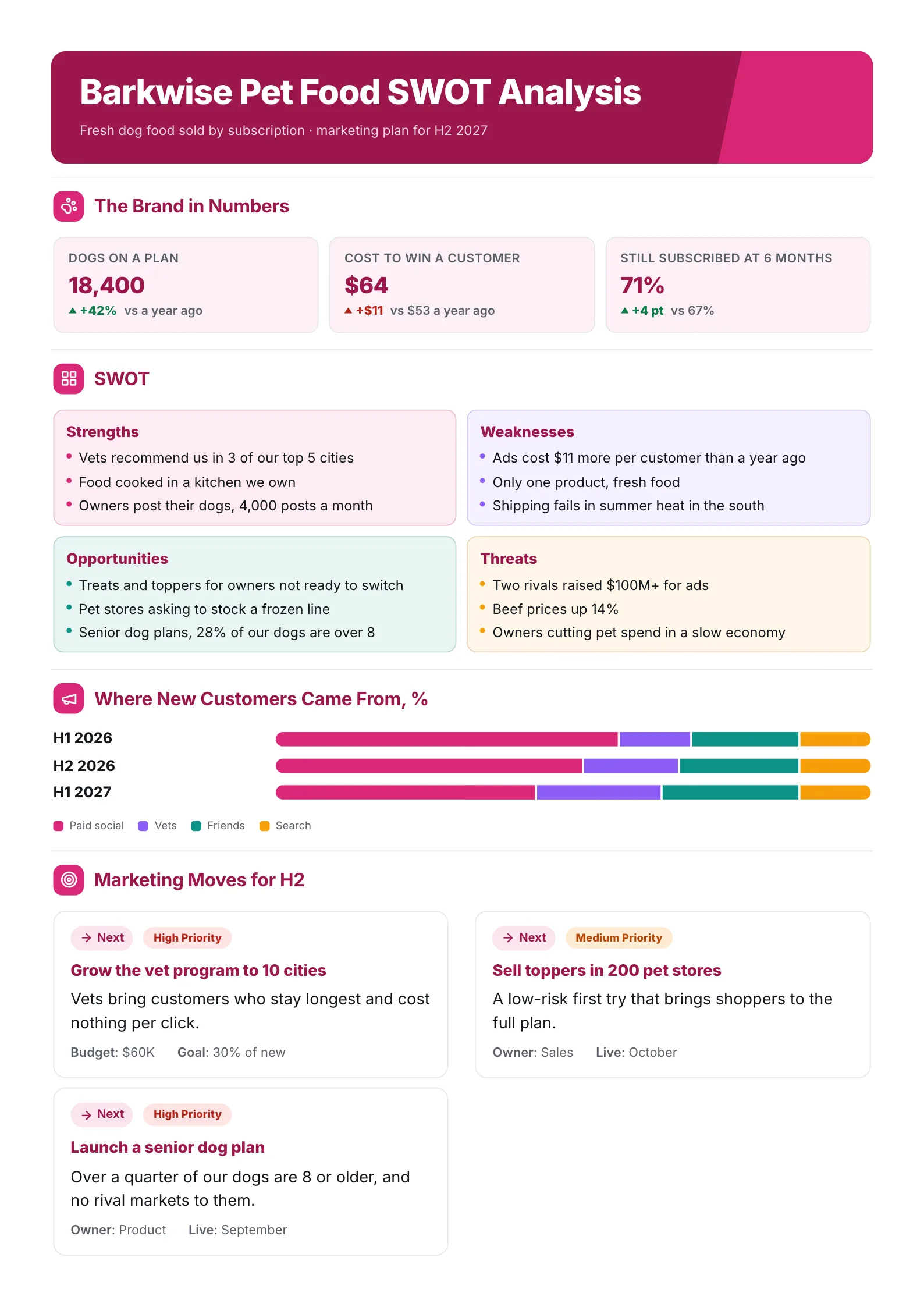 SWOT Analysis: Pet Food Brand MarketingEdit for free(opens in a new tab)
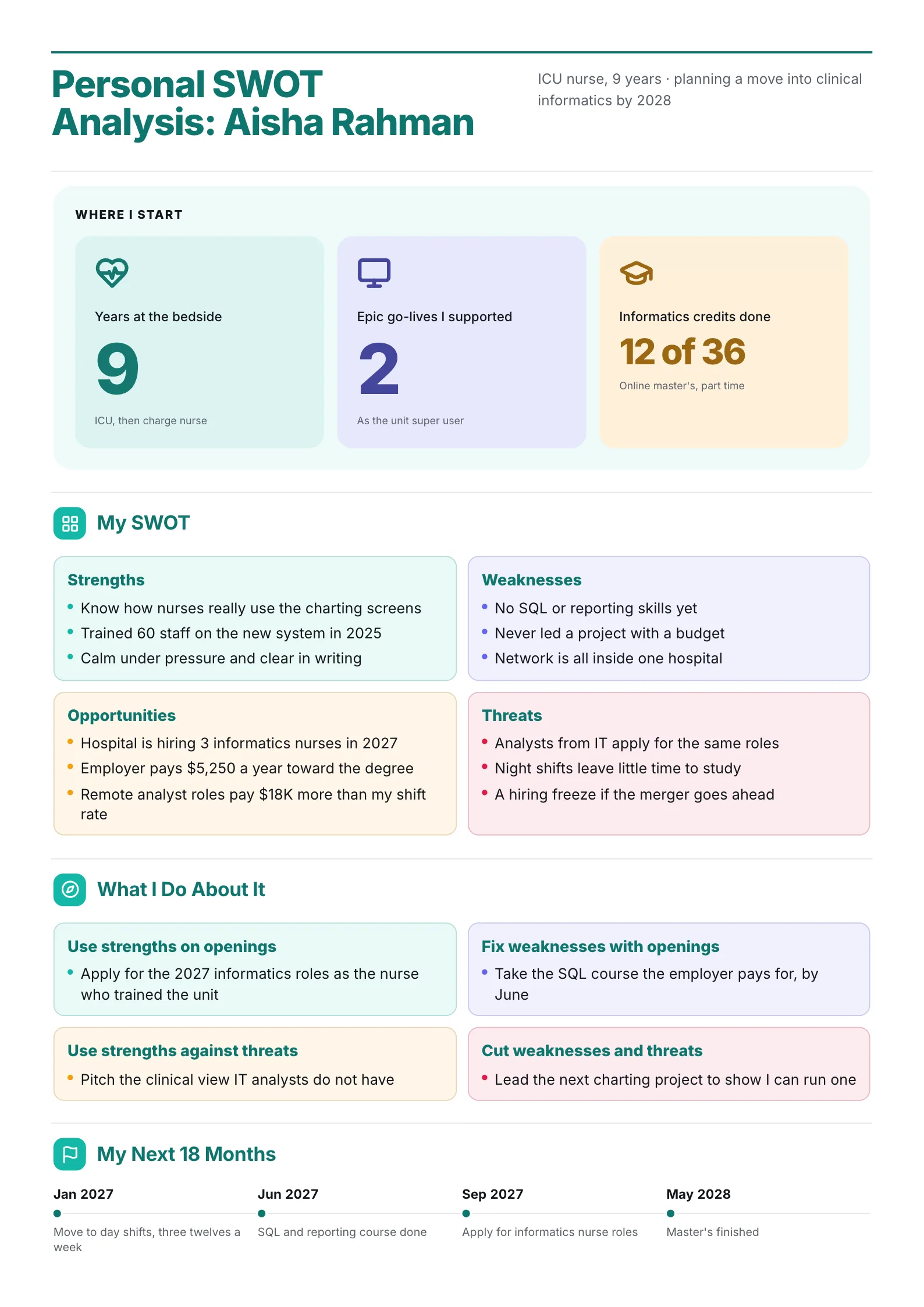 SWOT Analysis: Personal Career ChangeEdit for free(opens in a new tab)
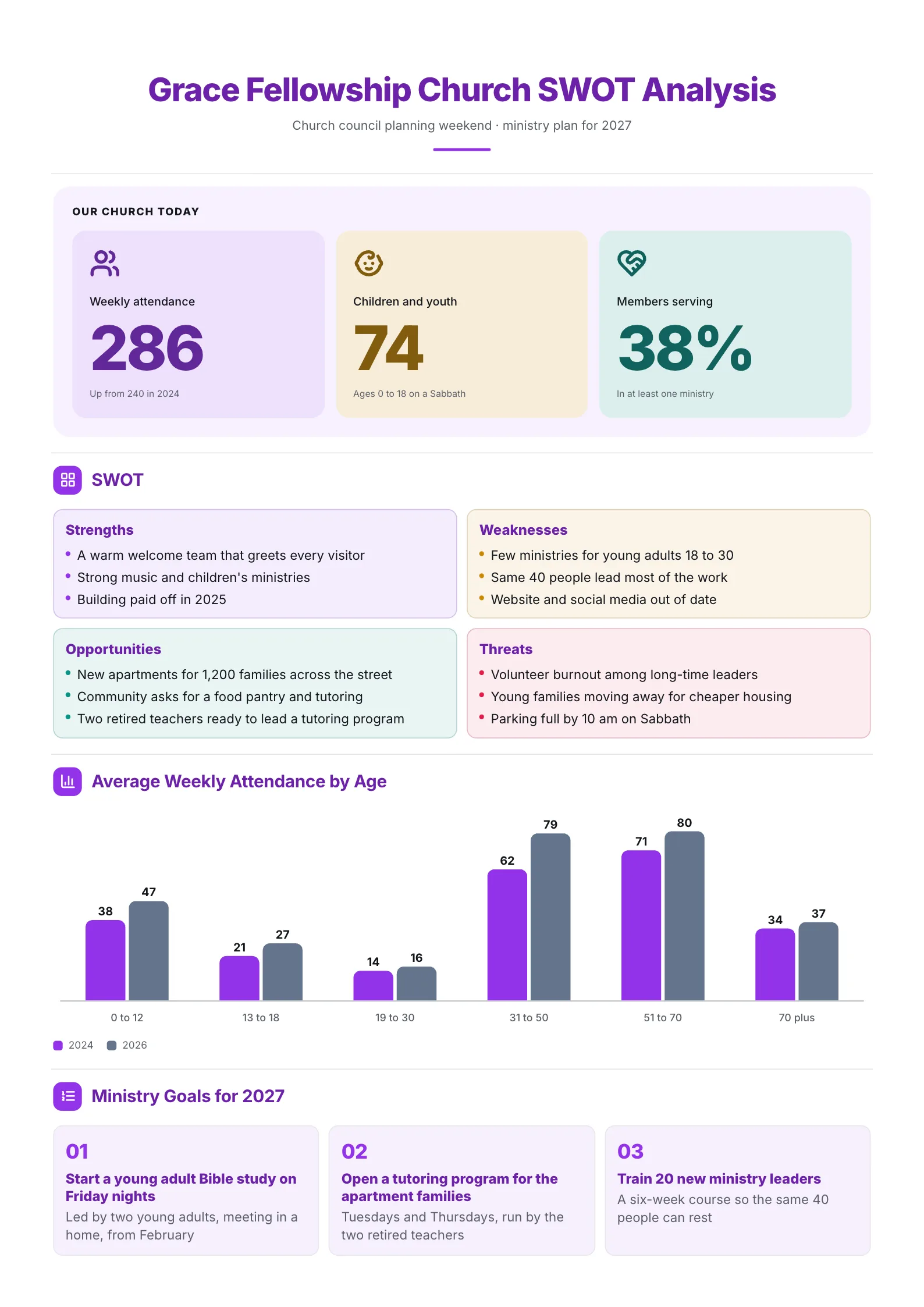 SWOT Analysis: ChurchEdit for free(opens in a new tab)
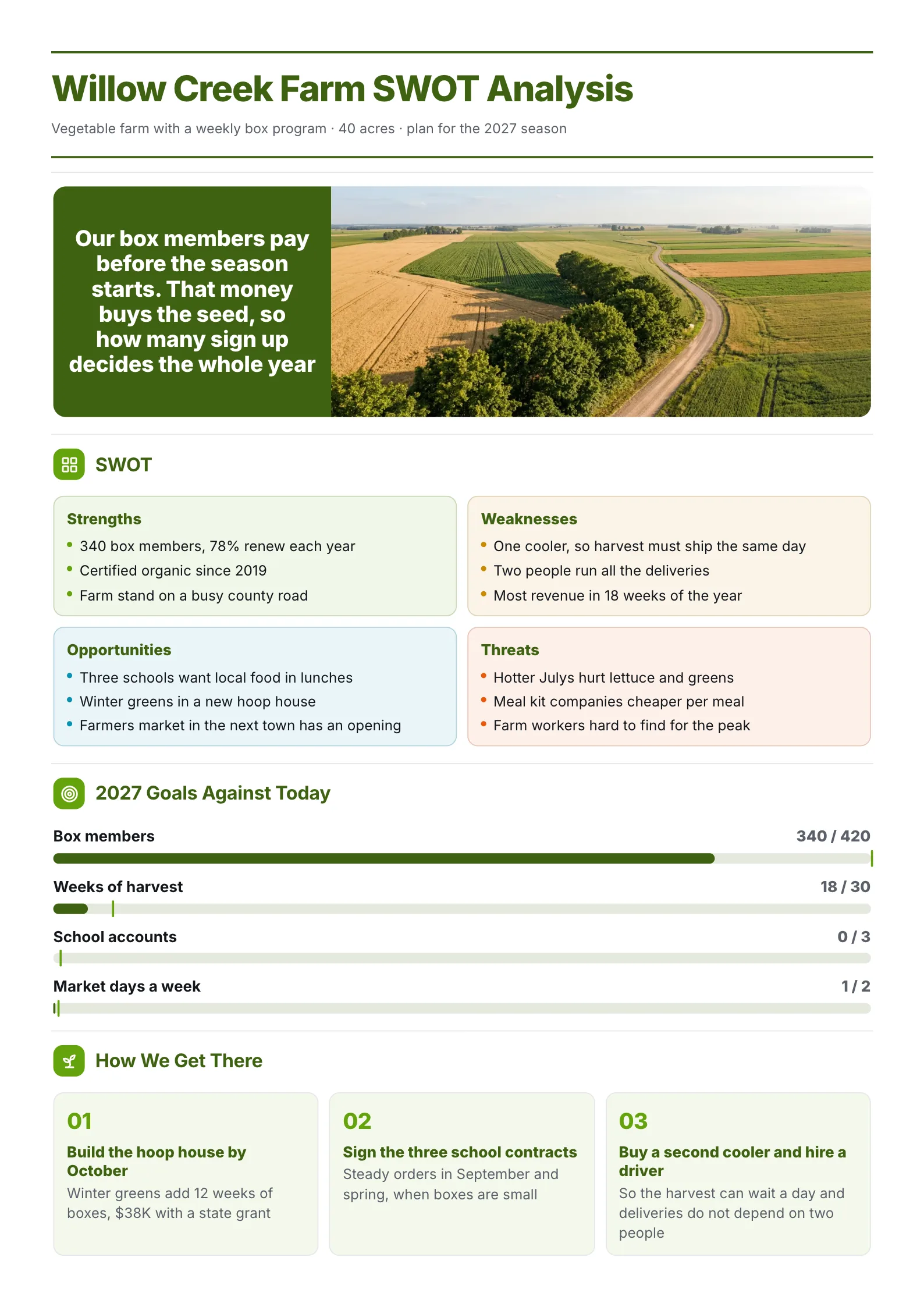 SWOT Analysis: FarmEdit for free(opens in a new tab)
The four come from the City of Holland, Michigan, the City of Tomball, Texas, the City of Côte Saint-Luc in Québec, and East Central University in Oklahoma. Every one of them shows at least one of the faults below. Each also does something right, and we'll point that out too.
| The plan | Strengths | Weaknesses | Opportunities | Threats | Items |
|---|---|---|---|---|---|
| Holland, Michigan, 2026 plan | 33 | 8 | 21 | 17 | 79 |
| Tomball, Texas, City Council SWOT | 20 | 10 | 14 | 9 | 53 |
| Côte Saint-Luc, Québec, 2025 to 2030 plan | 8 | 7 | 8 | 8 | 31 |
| East Central University, 2025 to 2030 plan | 4 | 4 | 4 | 4 | 16 |
| Total | 65 | 29 | 47 | 38 | 179 |
Tomball's plan holds 10 SWOTs. The first is the City Council's, and that's the one we counted.
Mistake 1: Opportunities written as your own to-do list
An opportunity is something happening outside your walls that you could use. It's easy to slip into writing what you plan to do instead.
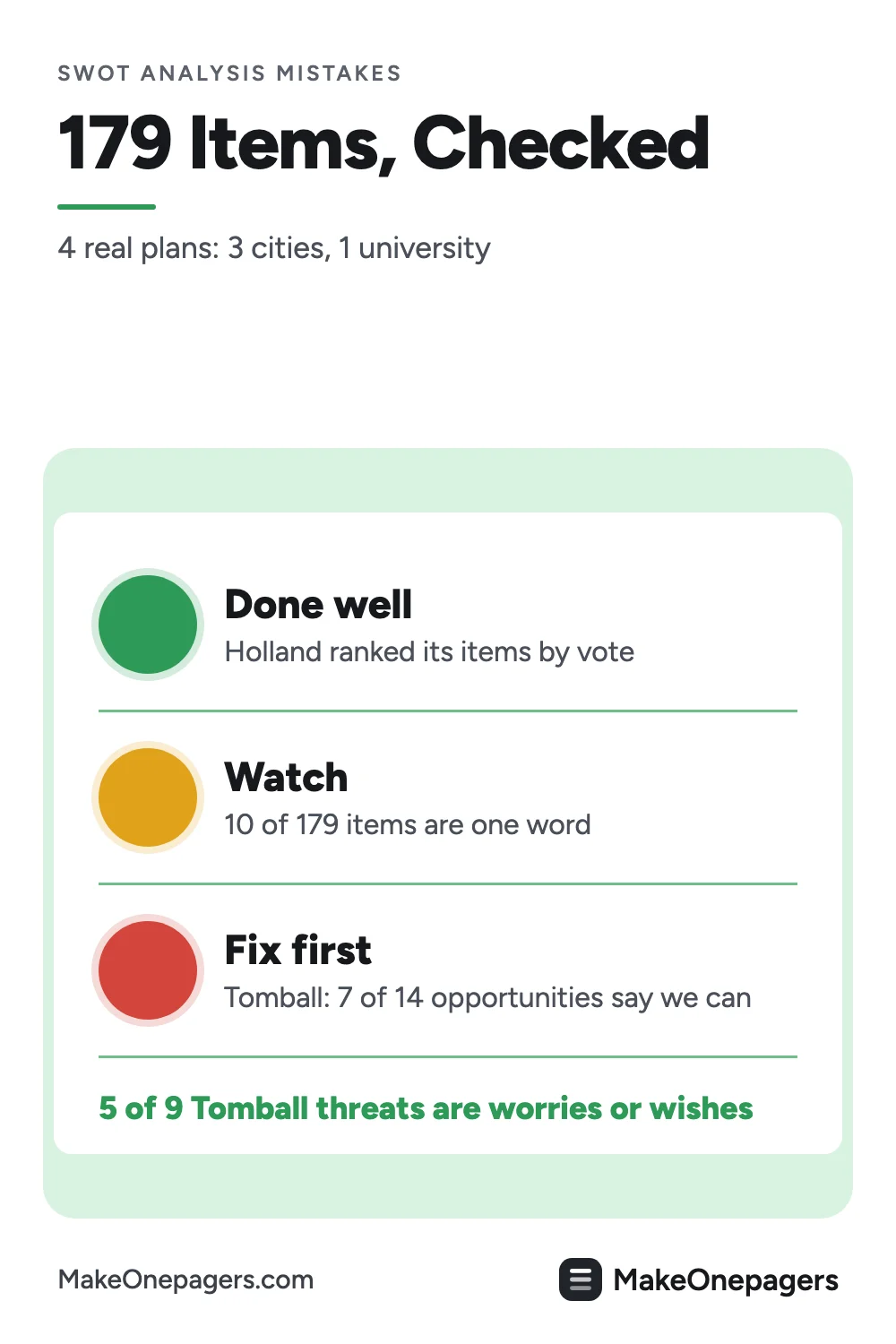
Tomball's council did this in 7 of its 14 opportunities. Each one has the words "we can" in it. "We can work with other agencies to help improve our community." "With some work, we can become a Texas Scenic City." "In addition to expanding our systems, we can also update them."
Each of those might be a good idea. But none of them tells you what changed outside, so nobody can judge whether the chance is real or how long it lasts.
How to check yours. Cross out "we" in each of your opportunities. If the line no longer says anything, you wrote a plan. Move it to your list of moves, and in its place write the outside fact that makes the plan possible, such as a new grant, a rival closing or a change in what your customers ask for.
Mistake 2: Threats written as worries or wishes
A threat is an outside event that could hurt you. Tomball's council wrote 5 of its 9 threats as warnings to itself or as hopes. "We must be careful to ensure that rumors regarding the City, its departments, and related organizations do not overshadow the truth about these organizations and mislead our citizens." "Tomball is a safe city, and we would like to keep it that way."
The same list shows what a threat should look like. "Texas Senate Bill 2 has greatly reduced the latitude given to the City in its affairs." It names the cause, says what it does, and you could look it up.
How to check yours. Try to put a source or a date beside each of your threats. If an item starts with "we must" or "we would like," it isn't a threat yet. Ask yourself what outside event you're worried about, and write that event down instead.
Mistake 3: Items in a box that doesn't fit them
Côte Saint-Luc labels its boxes clearly: "Strengths (internal)," "Weaknesses (internal)," "Opportunities (external)" and "Threats (external)." Yet "Strategic Plan itself" sits under Opportunities (external), and the city wrote that plan. Its weakness box already says "No proper planning or overarching vision for the city," so the plan is the city's own fix for its own weakness.
Holland lists "Staffing capacity" and "Succession planning" as threats, though both are about its own staff. Its strengths list "Preparation for succession planning" too. Some items sit in the wrong box for other reasons. Holland also files "Success of Holland Civic Center Place" under weaknesses. East Central University puts an item that begins "Opportunities for" in its weaknesses box, about simpler processes and services.
How to check yours. For each item, ask who would have to act for it to change. If your own team could change it, put it in strengths or weaknesses. If it would happen whatever you do, it goes in opportunities or threats. We walk through sorting items in more detail in how to do a SWOT analysis.
Mistake 4: A long list that leans one way and has no order
Holland lists 33 strengths and 8 weaknesses, about four to one. Its page says the items "are not ranked in any way, nor intended to be all-inclusive." With 79 items and no order, a reader can't tell whether "Parks" matters more than "Pension liabilities."
The lean shows across all four plans. Together they list 65 strengths and 29 weaknesses. Only East Central University keeps them even, with 4 in every box.
Holland does fix the order problem, on the very next page. Its council voted on priorities with weighted votes, and "Maintain strong financial position" led with 87. "Staff succession planning" scored 31. That vote is what makes the 79 items usable.
How to check yours. Count your strengths and your weaknesses. If one side is twice the other, spend ten more minutes on the short side, and ask a customer or a new hire to add to it. Then rank every box, top item first.
Mistake 5: Labels too short to act on
We found 10 items made of a single word, 8 in Holland and 2 in Côte Saint-Luc. Holland's include "Parks," "Pragmatism," "Tourism," "Volatility" and "Transit." Côte Saint-Luc lists "Mobility" as an opportunity and "Cyber-security" as a threat.
A one-word item could be good or bad, so readers fill in their own story. "Transit" as a threat could mean a bus route that's being cut, or one that never came. "Homelessness" shows up in both Holland's opportunities and its threats, which proves the word alone doesn't say which.
East Central University writes full phrases, but none of its 16 items names a program, a place or a number. "Increased competition from other institutions" doesn't say which institutions, or for which students.
How to check yours. Hand your list to someone who wasn't in the room and ask them to explain each item back to you. Where they can't, add the who, the what or the how much. "Transit" becomes the route, the change and the date. For prompts that pull out that detail, see our SWOT analysis questions.
Mistake 6: A grid that never becomes decisions
A SWOT that ends at the grid changes nothing. East Central University is the most direct about the next step. It says it "translated our SWOT findings into actionable strategic implications," with one line per box, and those "guided the formation of ECU’s 2030 goals." But the lines are general, like "Seizing new opportunities to grow and diversify," so a reader can't trace a goal back to one item.
Holland's vote is the clearer bridge. Items from the grid come back as ranked priorities, like "Waterfront Holland" at 54 and "Implement Holland City Fiber" at 45. Each one sits under one of the plan's four goals: Financial, Connection to Stakeholders, Organizational Improvement and Quality Services.
How to check yours. Mark every item you keep as a move, a watch or a drop. If you can't say which, cut it.
Six tests to run before you share your SWOT
| # | Check | What we found |
|---|---|---|
| 1 | Cross out "we" in every opportunity. Does it still say something? | 7 of 14 Tomball opportunities say "we can" |
| 2 | Can every threat carry a source or a date? | 5 of 9 Tomball threats are worries or wishes |
| 3 | Does each item fit its box? Could your own team change any outside item? | "Strategic Plan itself" filed as external |
| 4 | Are your strengths more than twice your weaknesses? Is each box ranked? | Holland: 33 to 8, "not ranked in any way" |
| 5 | Does any item have one word? | 10 of 179 |
| 6 | Does each item lead to a move, a watch or a drop? | Holland's vote ranks them; ECU's lines stay general |
Five SWOTs that pass the tests
These MakeOnepagers samples each fix one of the mistakes above. For layouts, see our guide to SWOT analysis format.
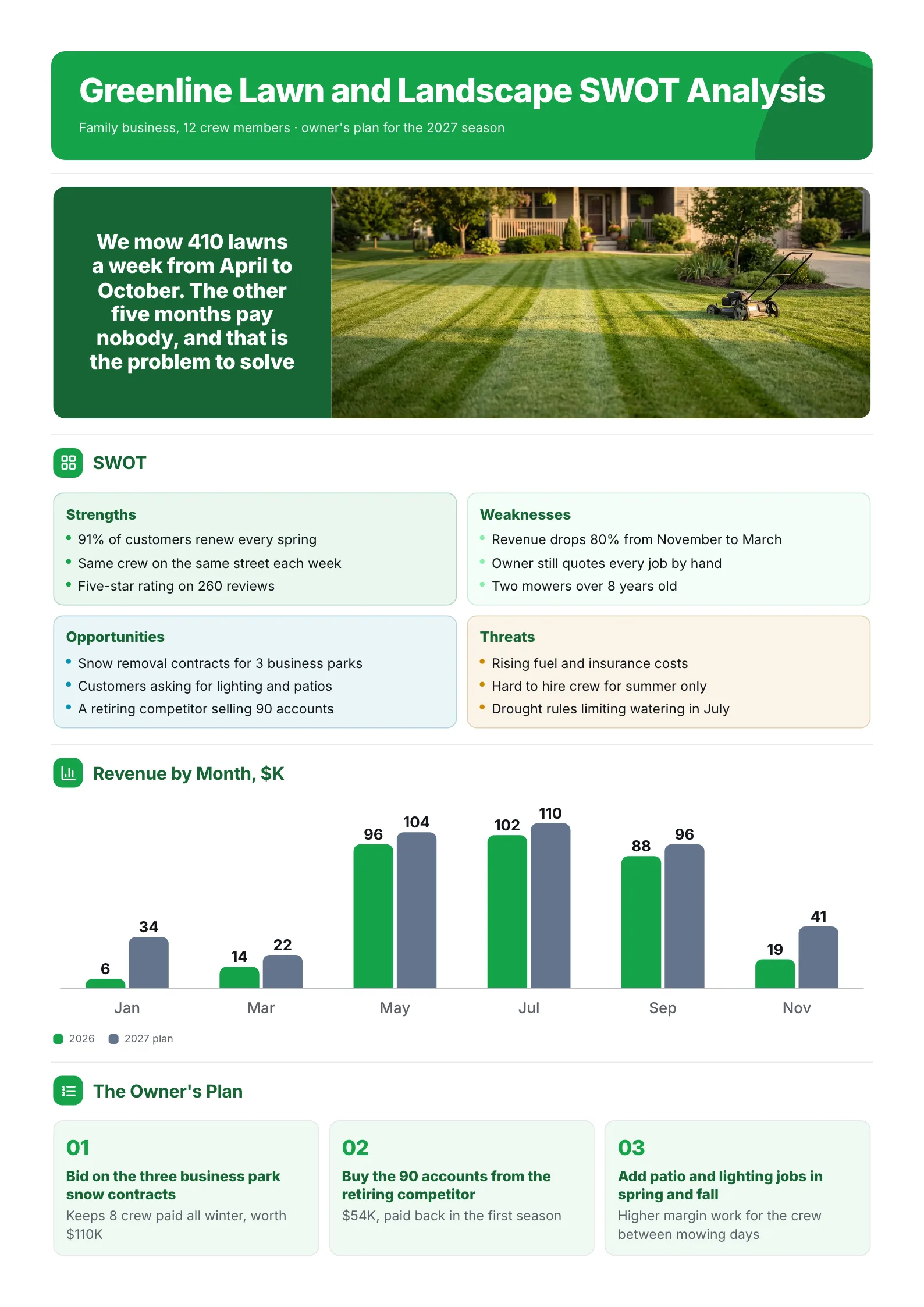
A lawn business whose opportunities happen without it
 Edit this template
This small business SWOT analysis fixes mistake 1. Its opportunities are things the owner didn't cause, like "A retiring competitor selling 90 accounts" and "Snow removal contracts for 3 business parks." The plans go in their own section. Buying those 90 accounts costs $54K, paid back in the first season. Winning the snow contracts would keep 8 crew paid all winter.
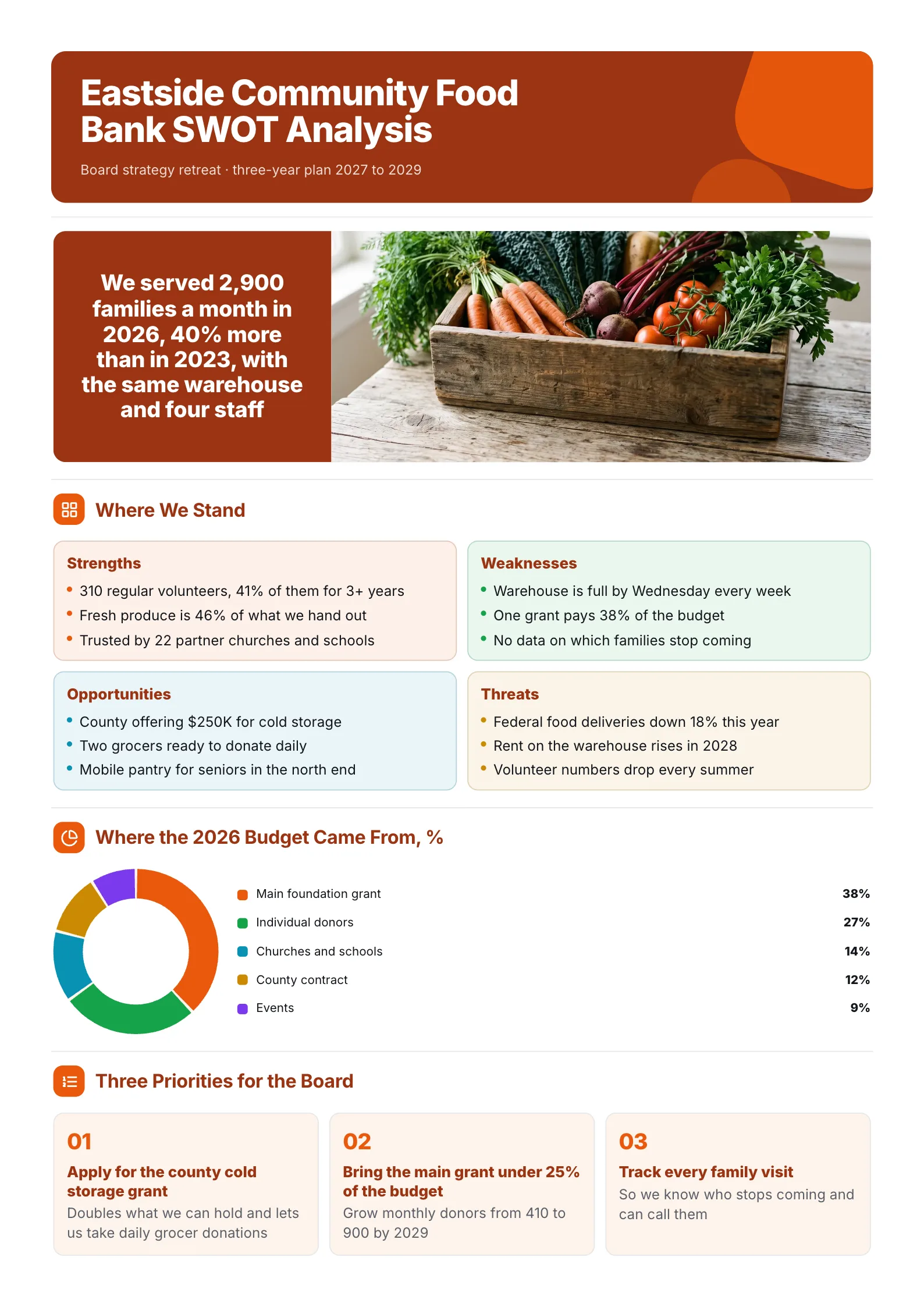
A food bank whose threats have numbers and dates
 Edit this template
This nonprofit SWOT analysis shows what mistake 2 should look like when fixed. Every threat is an outside event you could check: "Federal food deliveries down 18% this year," "Rent on the warehouse rises in 2028." Its weakness "One grant pays 38% of the budget" leads to a priority to bring that grant under 25%.
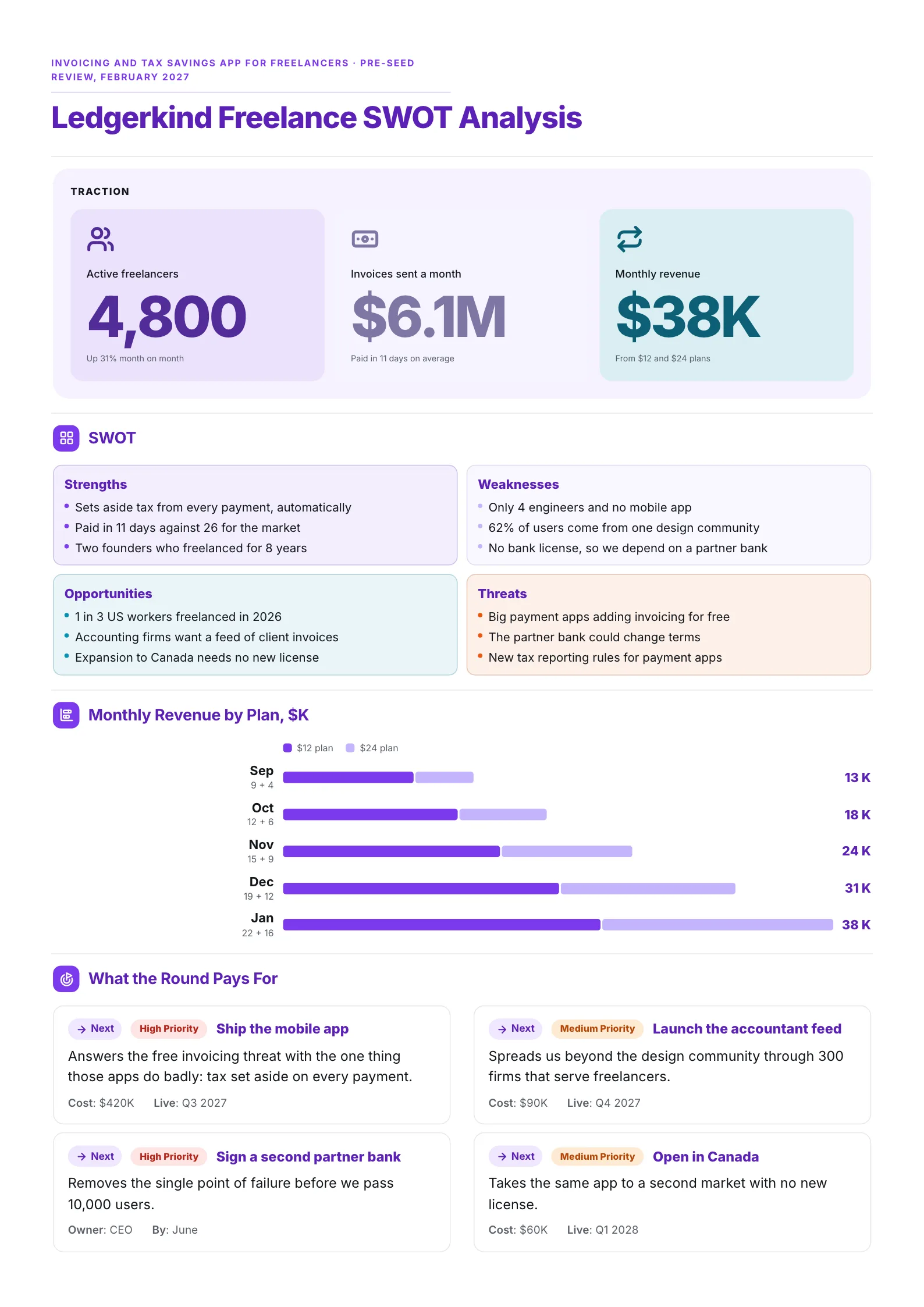
A startup that splits one subject into inside and outside
 Edit this template
This startup SWOT analysis handles mistake 3 well. The inside half, "No bank license, so we depend on a partner bank," is a weakness. The outside half, "The partner bank could change terms," is a threat. One move answers both: sign a second partner bank before passing 10,000 users.
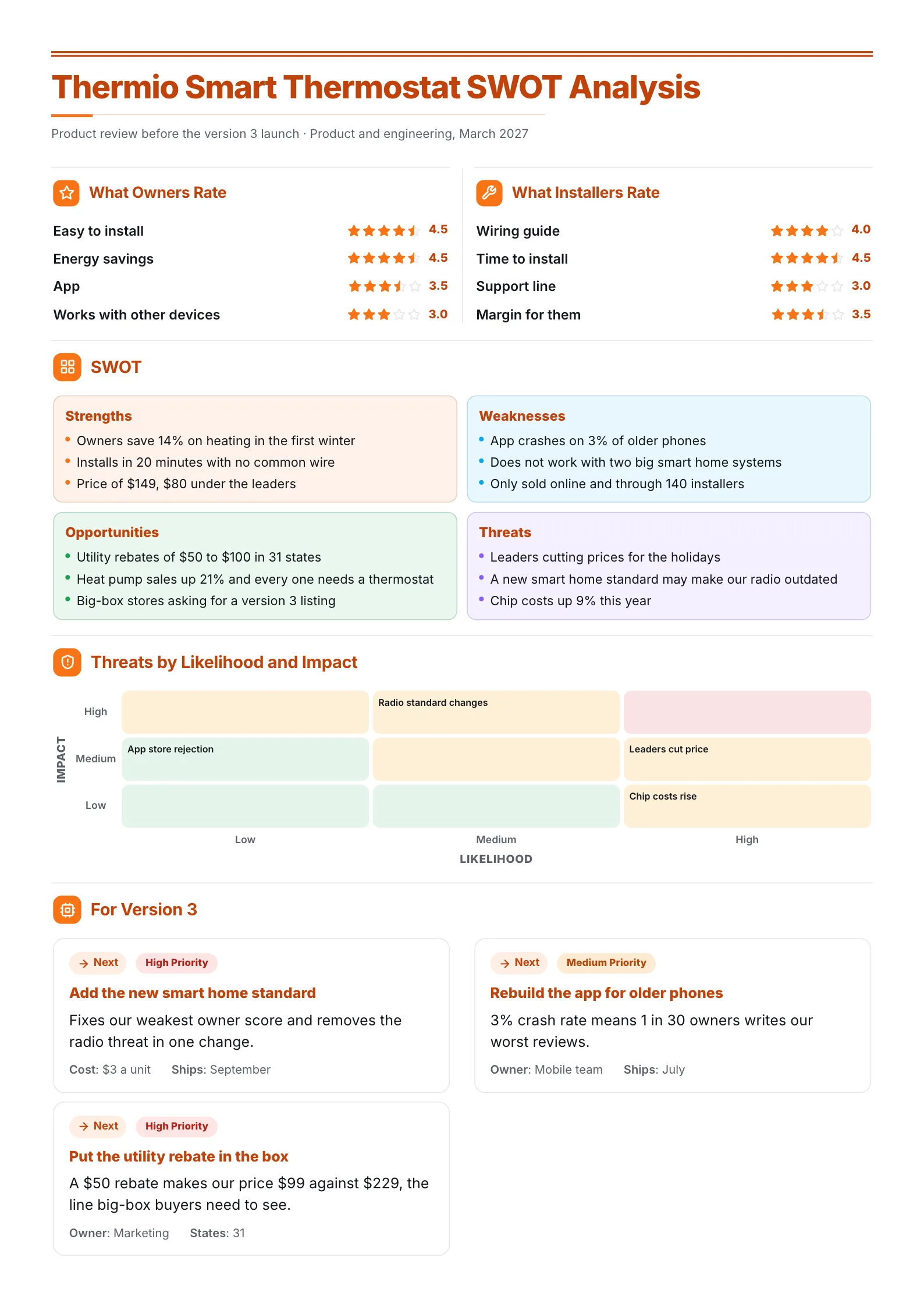
A thermostat plotted by likelihood and impact
 Edit this template
This product SWOT analysis answers mistake 4 with a chart of "Threats by Likelihood and Impact." Its top change, adding the new smart home standard, costs $3 a unit. The page says it "Fixes our weakest owner score and removes the radio threat in one change."
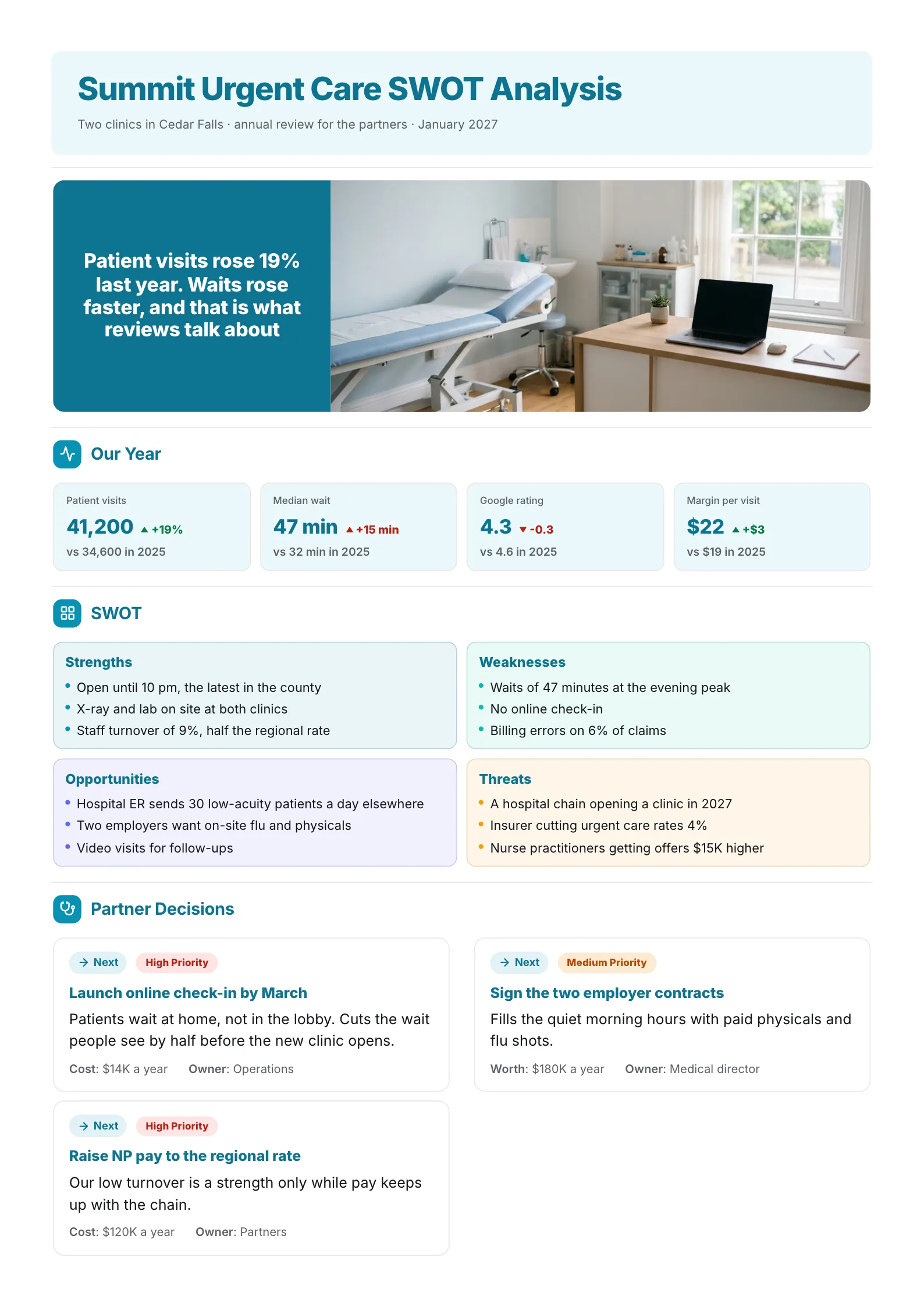
A clinic where every item carries its detail
 Edit this template
This urgent care clinic SWOT analysis fixes mistakes 5 and 6 together. Its staff strength reads "Staff turnover of 9%, half the regional rate." The matching threat is "Nurse practitioners getting offers $15K higher," so the partners choose to pay nurse practitioners the regional rate. The page prices that at $120K a year and names the partners as the owners.
Make your SWOT analysis
Write your four boxes, then run the six tests before anyone else reads them. Start from a MakeOnepagers SWOT analysis and swap in your own items, one specific phrase each. If your notes are still loose, paste them into the free AI One-Pager generator to get a first layout. Rank each box, top item first, before anyone sees it.
Frequently asked questions
Which SWOT mistake did the four plans make most?
In the four plans we read, it was putting items in a box that doesn't fit them. Opportunities were written as plans, threats as worries, and inside issues landed in the outside boxes. Tomball alone wrote 7 of 14 opportunities as "we can" lines.
How many items should go in each SWOT box?
Few enough that you can rank them and act on each one. East Central University used 4 per box. Holland used 33 strengths, and needed a separate vote to find which ones mattered.
Can the same item be a strength and a weakness?
The same subject can, but split it first. Write the part you control as a strength or weakness, and the outside part as an opportunity or threat. The startup sample above does this with its partner bank.
Why do SWOT analyses fail?
In the plans we read, the weak spot was the step after the grid. A SWOT helps when its items become ranked moves, the way Holland's council ranked its priorities by weighted vote under the plan's four goals. Give each move an owner and a cost, as the clinic sample does.
Should a SWOT analysis use full sentences?
Short phrases work if each one carries a detail, like "Staff turnover of 9%, half the regional rate." Tomball's full sentences ran long but still hid plans in its opportunities. One specific phrase per item beats a single word or a paragraph.




