BlogGuide
Safety Data Sheet Summary: All 16 Sections on One Page, From 8 Real SDSs
We measured 8 real safety data sheets: 5 to 12 pages. A safety data sheet summary that puts all 16 OSHA sections on one page, beside the full SDS.

By MakeOnepagers Team
Updated · 12 min read
A safety data sheet summary is a one-page version of a chemical's safety data sheet (SDS) that puts the parts people need in a hurry where they can see them: the product name, the signal word and hazards, first aid, what to do in a fire or a spill, how to store it, and what to wear. It is posted at the point of use or kept in the binder in front of the full SDS. It never replaces it.
One‑Pager examples
Real One-Pagers made with MakeOnepagers. Open any one to edit it as your own.
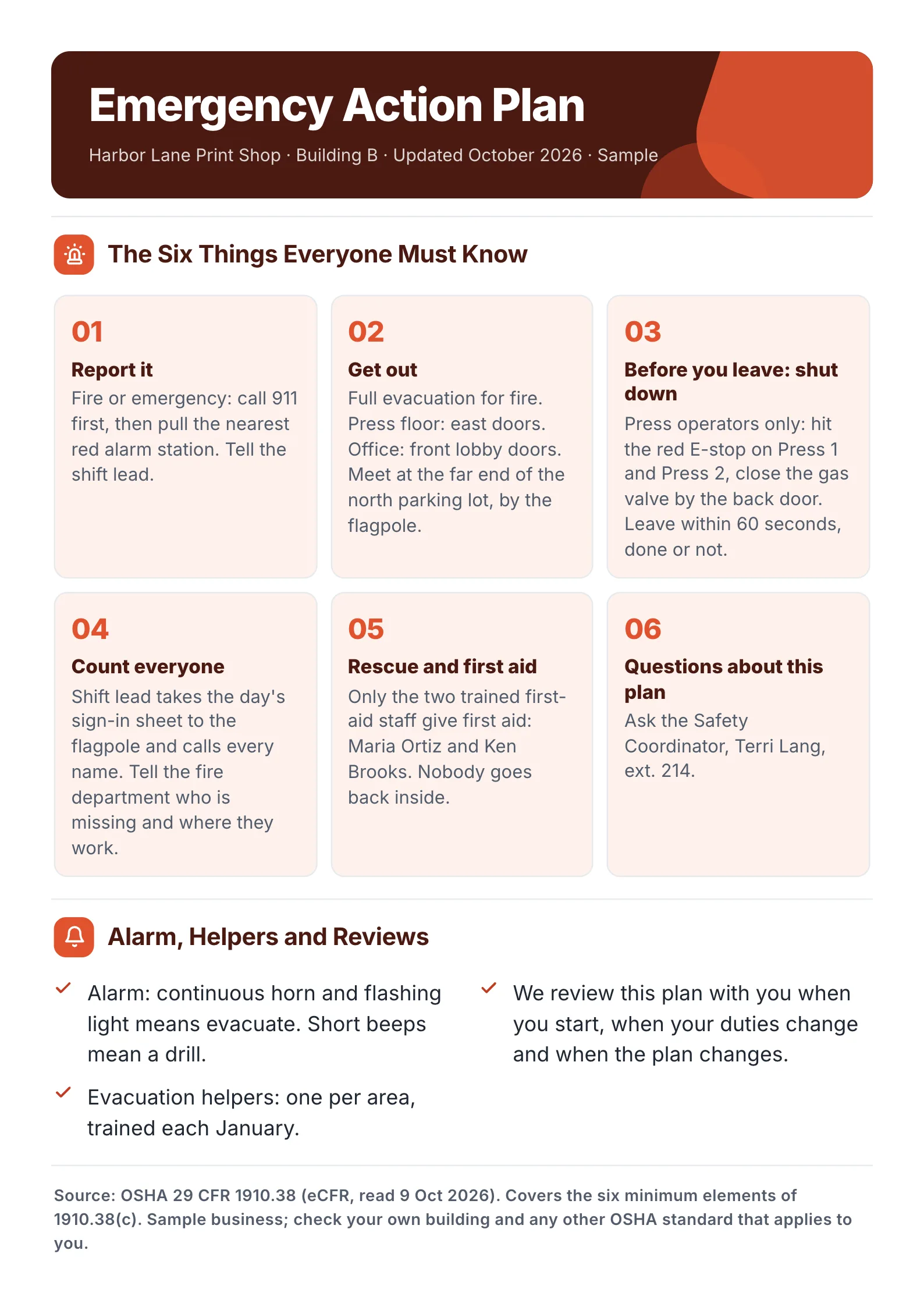 Emergency Action PlanEdit for free(opens in a new tab)
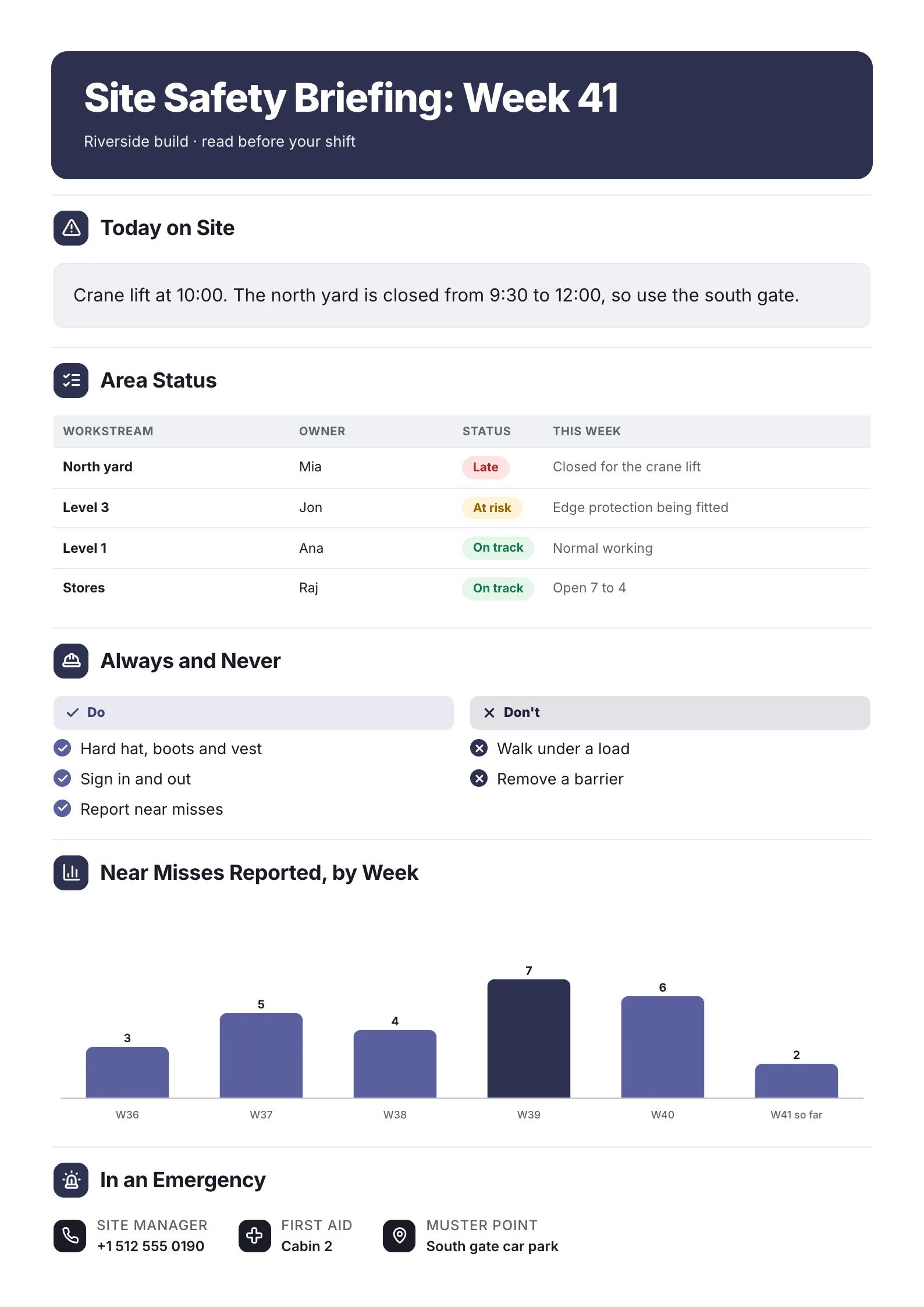 Safety BriefingEdit for free(opens in a new tab)
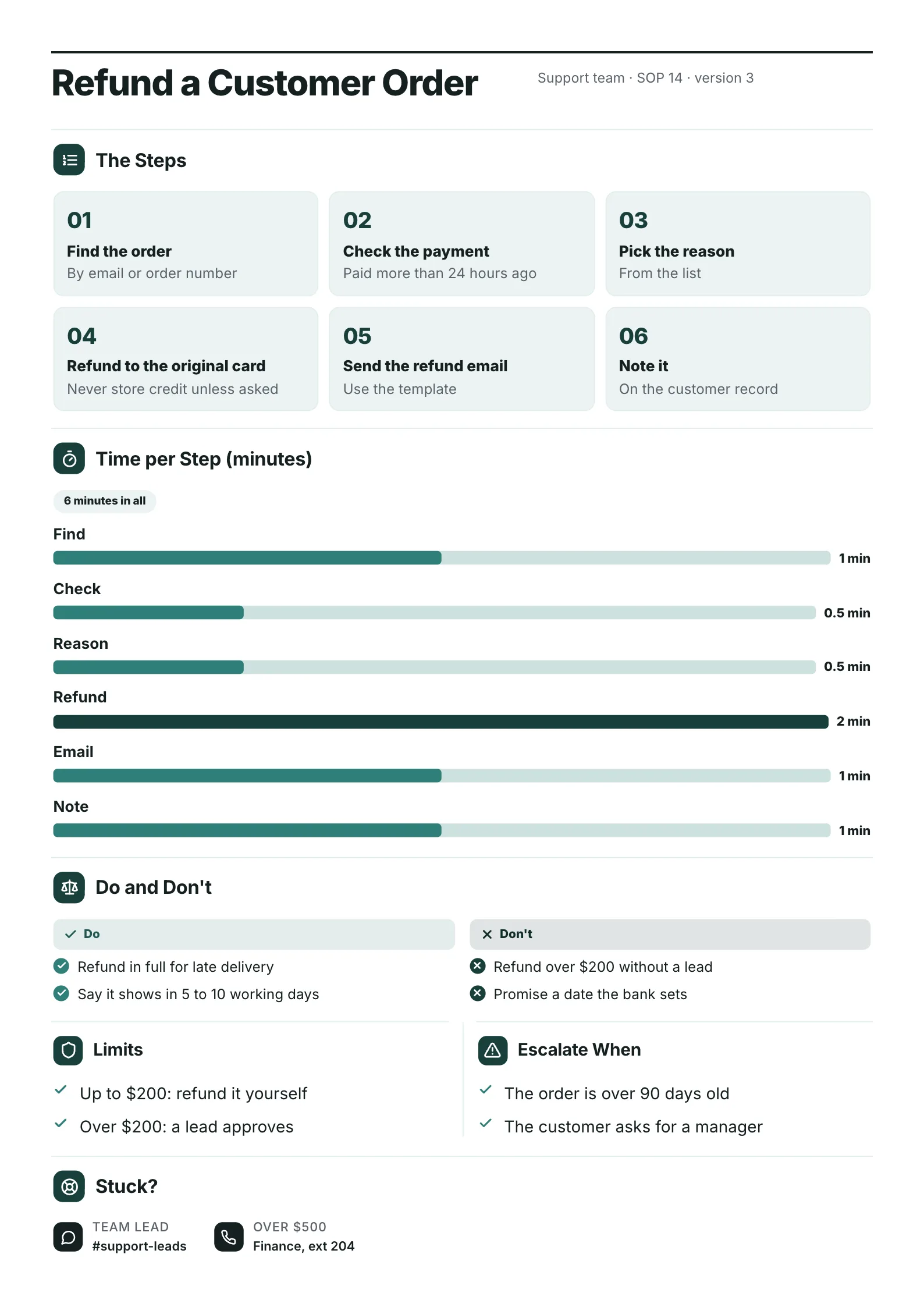 SOP Quick ReferenceEdit for free(opens in a new tab)
 Training Compliance ReportEdit for free(opens in a new tab)
 CPR Quick GuideEdit for free(opens in a new tab)
 RAID Log SummaryEdit for free(opens in a new tab)
To see why a summary helps, we measured 8 real safety data sheets for products found in shops, schools and offices, from bleach to spray paint, on 12 October 2026. Below are the numbers, what OSHA requires, all 16 sections and what goes on the summary from each, and a one-page safety data sheet summary template.
What is a safety data sheet summary?
A safety data sheet is the document a chemical's manufacturer or importer must provide under OSHA's Hazard Communication Standard. It follows 16 numbered sections, from identification to other information, and runs several pages.
A summary condenses those sections to what a worker, a supervisor or a first responder needs at a glance. It is not a legal substitute: the full SDS still has to be in the workplace. Think of the summary as the cover page that tells you which hazard you are dealing with and points you to the right section of the full sheet.
What OSHA requires
These rules come from 29 CFR 1910.1200, paragraph (g), read on 12 October 2026.
| Rule | What it says |
|---|---|
| Who writes the SDS | The chemical manufacturer or importer |
| Language | English, though the employer may keep copies in other languages too |
| Structure | At least 16 numbered sections and headings, in a fixed order, with the content set out in Appendix D |
| Sections 12 to 15 | The headings must appear, to stay consistent with the GHS, but OSHA does not enforce their content |
| Date | Section 16 includes the date of preparation or last revision |
| Access | The employer keeps an SDS for each hazardous chemical and makes it readily accessible to employees in their work area during each shift |
| Electronic copies | Allowed, as long as there are no barriers to immediate access |
The access rule is why a summary is a supplement. A one-page sheet on the wall helps, but the full SDS has to be one step away.
The 16 sections, and what goes on the summary
| # | Section heading | What it holds | On the summary? |
|---|---|---|---|
| 1 | Identification | Product name, uses, supplier, emergency phone | Yes: name, use and emergency phone |
| 2 | Hazard(s) identification | Signal word, hazard statements, pictograms | Yes, at the top |
| 3 | Composition/information on ingredients | Chemical names and concentrations | The main ingredient only |
| 4 | First-aid measures | What to do for eyes, skin, breathing, swallowing | Yes, every route |
| 5 | Fire-fighting measures | Extinguishing media, fire hazards | Yes, one line |
| 6 | Accidental release measures | Spill cleanup and protection | Yes, one line |
| 7 | Handling and storage | Safe handling, what to store it away from | Yes |
| 8 | Exposure controls/personal protection | Exposure limits, ventilation, PPE | Yes: gloves, eye protection, ventilation |
| 9 | Physical and chemical properties | Appearance, odor, flash point | Appearance and odor |
| 10 | Stability and reactivity | What it reacts with | Yes: "keep away from" |
| 11 | Toxicological information | Routes of exposure, symptoms | Symptoms, briefly |
| 12 | Ecological information | Effects on the environment | Optional |
| 13 | Disposal considerations | How to dispose of it | One line |
| 14 | Transport information | Shipping classification | Rarely needed |
| 15 | Regulatory information | Other regulations | Rarely needed |
| 16 | Other information | Date of preparation or last revision | Yes: the date of the SDS you summarized |
What 8 real safety data sheets look like
We downloaded the US English safety data sheet for 8 common products. Five came from the manufacturer's own website and three from distributors' copies. Pages and words count the English sheet only.
| Product | Signal word | SDS date | Pages | Words | Section 8 starts on |
|---|---|---|---|---|---|
| Simple Green All-Purpose Cleaner | None | Oct 2025 | 5 | 1,810 | Page 2 |
| Rust-Oleum metallic paint, 2 oz | Warning | Dec 2017 | 5 | 1,560 | Page 2 |
| WD-40 Multi-Use Product aerosol | Danger | May 2024 | 5 | 1,730 | Page 3 |
| Rust-Oleum aged metallic spray paint | Danger | Aug 2024 | 6 | 2,580 | Page 3 |
| Rust-Oleum chalked spray paint | Danger | Jan 2026 | 6 | 2,700 | Page 3 |
| Clorox Regular Bleach 2 | Danger | Dec 2020 | 9 | 2,670 | Page 4 |
| Goo Gone Goo & Adhesive Remover | Danger | Sep 2024 | 11 | 2,990 | Page 3 |
| Purell Advanced Hand Sanitizer Gel | Warning | Mar 2021 | 12 | 3,130 | Page 4 |
What the count shows:
- No SDS is short. 5 to 12 pages, median 6, and about 1,560 to 3,130 words, median about 2,600. Even the cleaner that is not classified as hazardous runs 5 pages.
- What to wear is never on page 1. Section 8, protective equipment, started on page 2 to 4. First aid started on page 1 or 2 in all 8.
- Household names carry "Danger". 5 of 8 use the stronger signal word, including the bleach, the spray lubricant and the adhesive remover. 2 use "Warning" and 1 needs none.
- Translations double the file. The two longest, Goo Gone and Purell, came with Spanish or French versions attached after the English sheet.
- Sheets get revised. The dates run from 2017 to 2026, and three of the sheets name the earlier version they replace. A summary made from an old SDS goes out of date with it.
A safety data sheet summary template you can copy
Fill one line per item, in this order. Keep the wording from the SDS; a summary is no place to soften a hazard.
Header
- Product name and code, exactly as on the SDS
- What it is used for here
- Emergency phone number from section 1
Hazards (from section 2)
- Signal word: Danger, Warning or none
- Hazard statements, word for word
- Pictograms
In an emergency
- First aid for eyes, skin, breathing and swallowing (section 4)
- Fire: what extinguishes it, and any special hazard (section 5)
- Spill: how to contain and clean it up (section 6)
Every day
- Handling and storage, and what to keep it away from (sections 7 and 10)
- What to wear: gloves, eye protection, ventilation (section 8)
- What it looks and smells like (section 9)
- Disposal (section 13)
Footer
- The date of the SDS you summarized (section 16)
- Where the full SDS is kept
- "This summary does not replace the safety data sheet."
A sample SDS summary, part by part
This sample covers all 16 section headings on one sheet, so a reader can see the whole structure and find the right section of the full SDS. It was made with MakeOnepagers; swap in your own product and the facts from its real SDS.
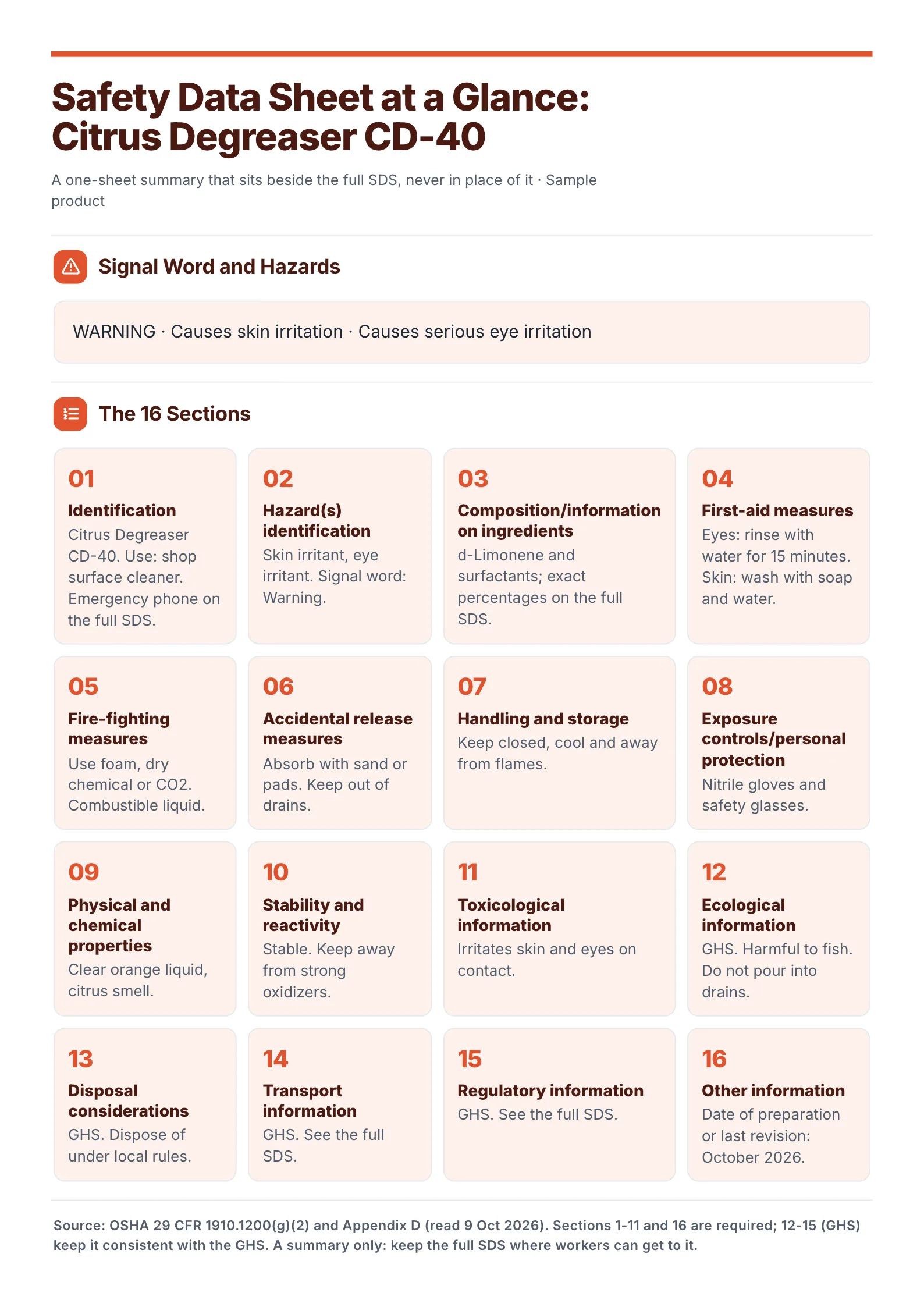 Edit this template
All 16 headings in OSHA's order, one line each, with the hazards above them.
What each part does:
- The subtitle says what it is not. "A one-sheet summary that sits beside the full SDS, never in place of it." Put that line on every summary you make.
- Signal word and hazards at the top, in the words of section 2: Warning, causes skin irritation, causes serious eye irritation.
- All 16 sections, numbered, in OSHA's order. Each box holds one line: for first aid, "Eyes: rinse with water for 15 minutes. Skin: wash with soap and water"; for protection, "Nitrile gloves and safety glasses."
- Section 16 carries the date. October 2026 here. When the supplier sends a new SDS, this is how you know the summary is stale.
Open it and swap in your product: safety data sheet summary template.
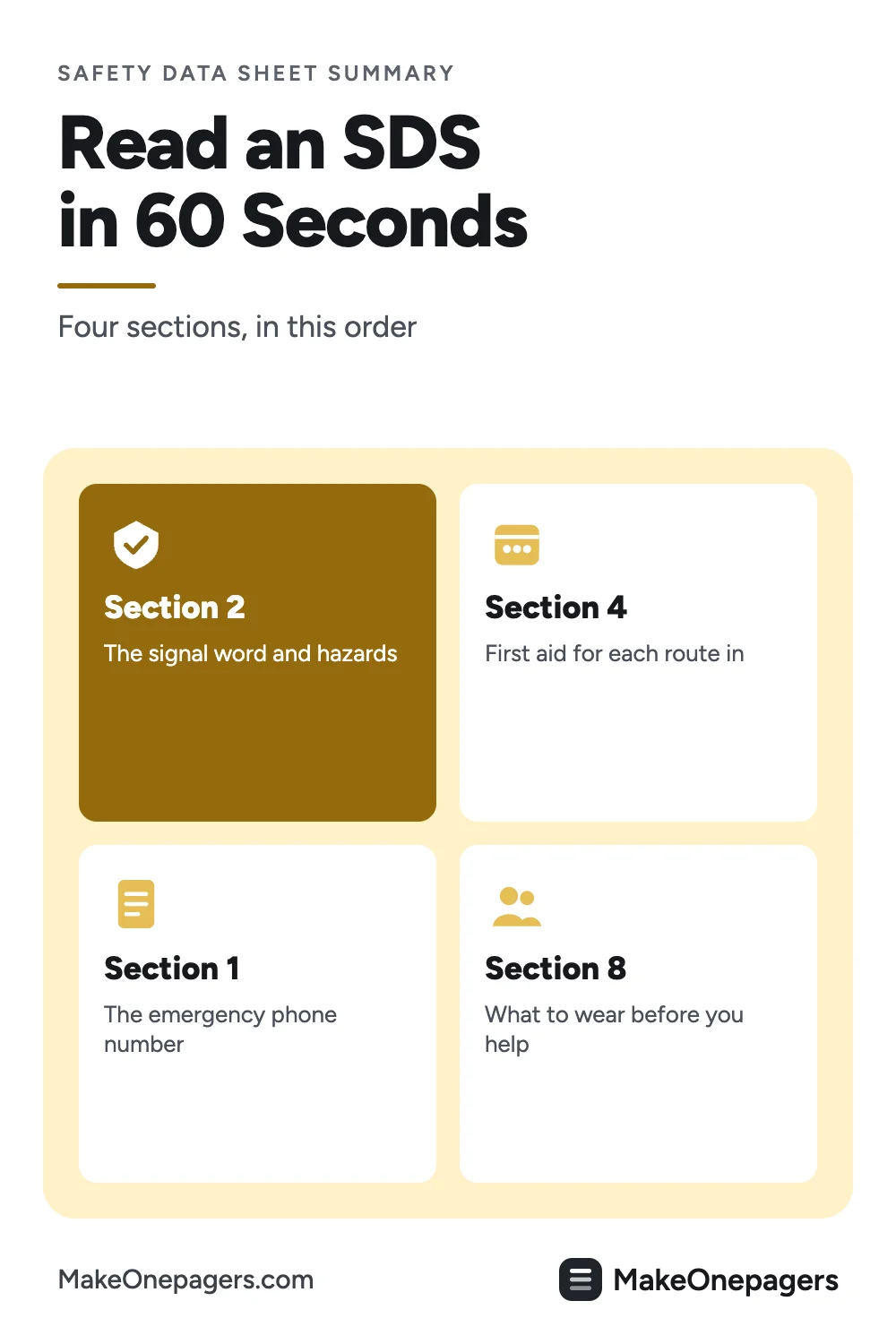
How to read an SDS in 60 seconds
When something has already gone wrong, read in this order:
- Section 2: the signal word and hazard statements. Danger or Warning, and what it does to you.
- Section 4: first aid for the route of exposure: eyes, skin, breathing or swallowing.
- Section 1: the emergency phone number.
- Section 8: what to wear before you help or clean up.
- Sections 5 and 6: fire and spill steps.
In the 8 sheets above, that path crosses pages 1 to 4. On a one-page summary it is all in one place, which is the point of making one.
Where to keep the summary and the SDS
| Item | Where | Why |
|---|---|---|
| Full SDS | In the work area, paper binder or electronic with no barriers to access | OSHA requires it to be readily accessible on every shift |
| One-page summary | Posted where the chemical is used or stored, and at the front of its SDS in the binder | The hazard and first aid are visible in a few seconds |
| Emergency plan | Beside the summaries | Tells people where to go and who to call; see the emergency action plan template |
When you train people on the chemicals they use, walk them through one summary and its full SDS side by side. Our training one-pager guide covers making the handout.
The nine pictograms and what each warns of
Section 2 of every SDS, and the label on the container, carry the hazard pictograms. OSHA's pictogram quick card (OSHA 3491, 2024) lists nine, each a symbol on a white background inside a red border:
| Pictogram | What it warns of |
|---|---|
| Health hazard | Carcinogen, mutagenicity, reproductive toxicity, respiratory sensitizer, target organ toxicity, aspiration toxicity |
| Flame | Flammables, pyrophorics, self-heating, emits flammable gas, self-reactives, organic peroxides, desensitized explosives |
| Exclamation mark | Irritant (skin and eye), skin sensitizer, acute toxicity (harmful), narcotic effects, respiratory tract irritant |
| Gas cylinder | Gases or chemicals under pressure |
| Corrosion | Skin corrosion or burns, eye damage, corrosive to metals |
| Exploding bomb | Explosives, self-reactives, organic peroxides |
| Flame over circle | Oxidizers |
| Skull and crossbones | Acute toxicity (fatal or toxic) |
| Environment | Aquatic toxicity; non-mandatory under OSHA's standard |
Two rules from the card help when you copy pictograms onto a summary: each pictogram appears only once on a label, even when several hazards call for it, and the pictogram is set by the chemical's hazard classification, not chosen by the writer. Copy exactly the pictograms in Section 2. Never add one, and never leave one out.
On the summary, put the pictograms beside the signal word at the top. A worker who cannot read the language of the sheet can still read a skull and crossbones.
Training people to use the sheet and the summary
OSHA's standard, 29 CFR 1910.1200(h), requires training on the hazardous chemicals in the work area at the time of each worker's first assignment, and again whenever a new chemical hazard they have not been trained on comes into the work area. The training must cover at least:
- How to detect the presence or release of a hazardous chemical, such as monitoring, or the look or smell of a release.
- The hazards of the chemicals in the work area.
- How workers protect themselves: work practices, emergency procedures and protective equipment.
- The employer's hazard communication program, including the labels, the safety data sheet, the order of its information, and how workers get and use it.
The summary does not replace any of that. It makes the last point easy to teach. A short session that works:
- Hand out one real SDS and its one-page summary.
- Ask everyone to find the signal word, the first aid for eyes and the gloves, first on the summary, then in the full sheet.
- Show where the binder or the electronic copy lives, and how to reach it on every shift.
- Repeat with the next chemical when it arrives.
Keeping sheets and summaries current
A summary is only as good as the sheet it was copied from, and sheets change. Under 1910.1200(g)(5), whoever prepares an SDS must add significant new information about a chemical's hazards, or how to protect against them, within three months of learning it. Your supplier's revised sheet is your cue to check the summary.
- Put the SDS revision date on the summary, in the footer, so anyone can tell whether the two match.
- When a revised SDS arrives, replace the old sheet and compare Sections 2, 4, 7 and 8 against the summary before posting it again.
- Keep the chemical list current. OSHA's standard requires a written hazard communication program with a list of the hazardous chemicals in the workplace; one summary per chemical on that list is a simple check that nothing is missing.
- Retire the summary with the chemical. A summary for something no longer used tells people the wrong hazards are in the room.
Safety data sheet summary mistakes
- Rewording the hazard. "May irritate" is not the same as "Causes serious eye irritation." Copy hazard statements word for word.
- No date. A summary without the SDS date cannot be checked against a newer sheet.
- Using it instead of the SDS. The full sheet must still be accessible in the work area.
- The wrong product. One brand can have several sheets with different hazards, one per formula or product code. Match the code on the container.
- Leaving out "none". If the SDS says no signal word is required, say so. A blank looks like a missing field.
SDS summary checklist
- Product name and code, matching the container
- Emergency phone number
- Signal word, hazard statements and pictograms, word for word
- First aid for every route of exposure
- Fire and spill steps
- Storage and what to keep it away from
- Gloves, eye protection and ventilation
- Date of the SDS it was made from
- Where the full SDS is kept
- A line saying it does not replace the SDS
Make your SDS summary
Open the free safety data sheet summary template, copy the product name, signal word, hazard statements and first aid from your supplier's SDS, add the SDS date, and print it for the work area. File it in front of the full sheet, never in place of it.
Frequently asked questions
Can a one-page summary replace a safety data sheet?
No. OSHA requires the employer to keep the safety data sheet for each hazardous chemical and make it readily accessible to employees in their work area on every shift. A summary helps people find the essentials fast, but the full SDS must still be there.
What are the 16 sections of a safety data sheet?
Identification; hazard(s) identification; composition/information on ingredients; first-aid measures; fire-fighting measures; accidental release measures; handling and storage; exposure controls/personal protection; physical and chemical properties; stability and reactivity; toxicological information; ecological information; disposal considerations; transport information; regulatory information; and other information, which includes the date.
How long is a safety data sheet?
The 8 US safety data sheets we measured ran 5 to 12 pages in English, with a median of 6 and about 2,600 words. Sheets that include translations are longer.
Which sections of an SDS does OSHA not enforce?
Sections 12 to 15: ecological, disposal, transport and regulatory information. The headings must still appear in order to stay consistent with the GHS, but OSHA does not enforce what they contain, because those areas are outside its jurisdiction.
What is the most important part of a safety data sheet?
In an emergency, section 2 (hazards), section 4 (first aid) and section 8 (protective equipment). Those three are what a summary should put at the top.