Resume Phrases: The 16 Verbs on All 6 Career Center Lists, and What to Cut
Resume phrases that work, from 6 career center guides and federal hiring rules: the 16 verbs on every list, and the phrase 5 of 6 tell you to cut.

The best resume phrases start with a past-tense verb that says what you did, name what you did it to, and end with a number. We read the action verb lists from 6 university career centers and counted them against each other. Only 16 verbs appear on all six lists. Five of the six guides also name the same phrase to cut: "responsible for." Start from a free one pager template.
One‑Pager examples
Real One-Pagers made with MakeOnepagers. Open any one to edit it as your own.
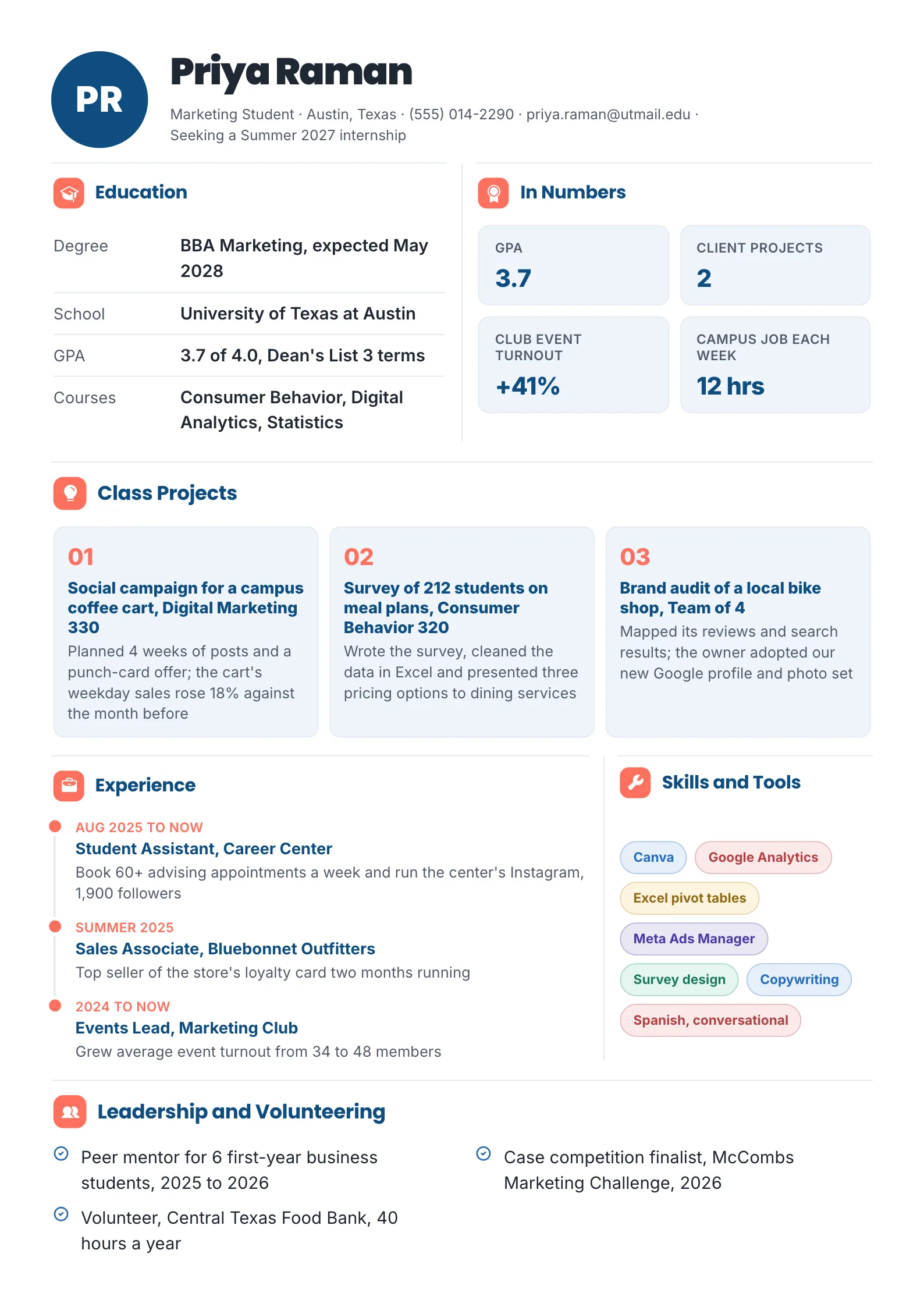 Resume: College StudentEdit for free(opens in a new tab)
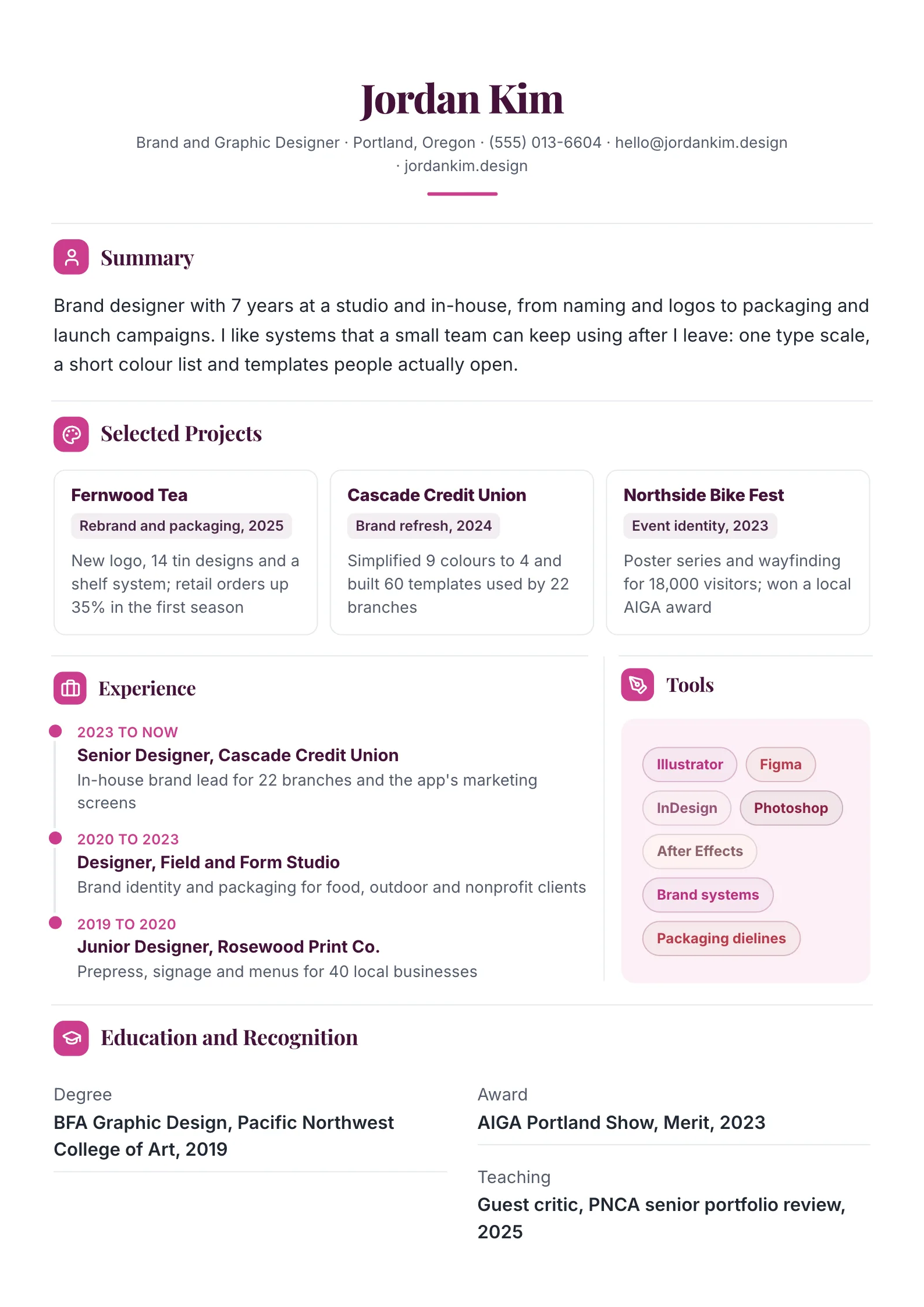 Resume: Graphic DesignerEdit for free(opens in a new tab)
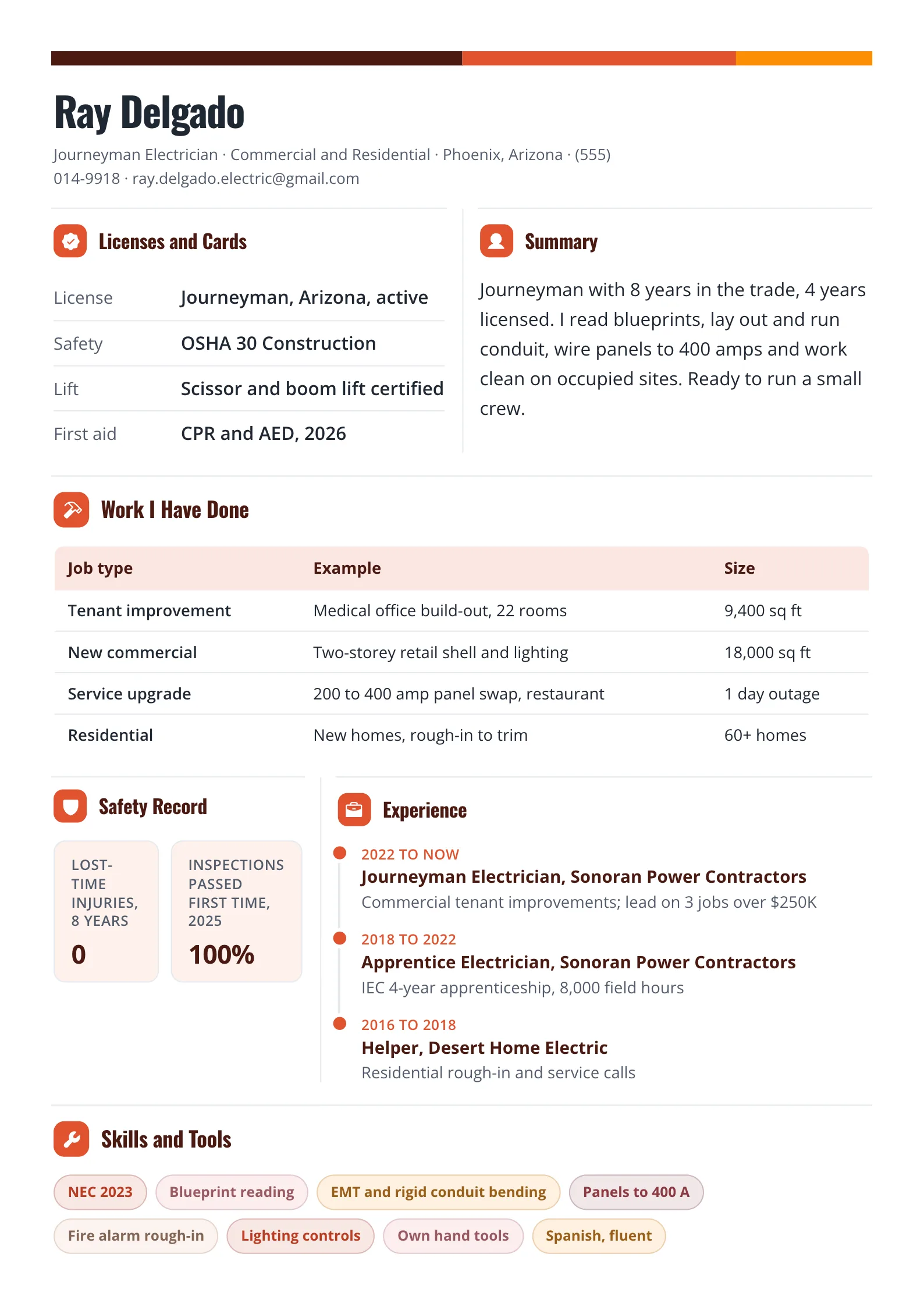 Resume: ElectricianEdit for free(opens in a new tab)
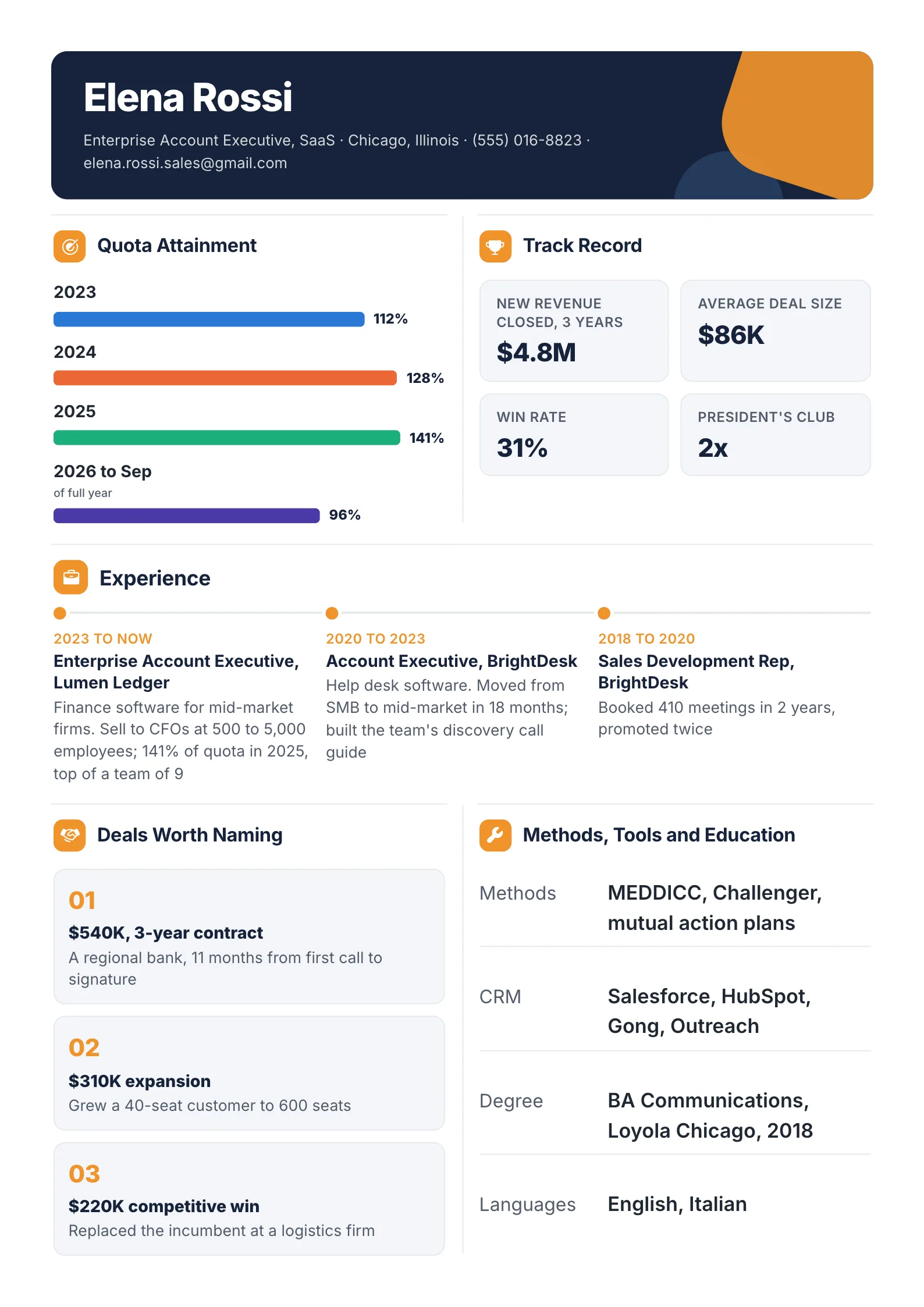 Resume: Sales Account ExecutiveEdit for free(opens in a new tab)
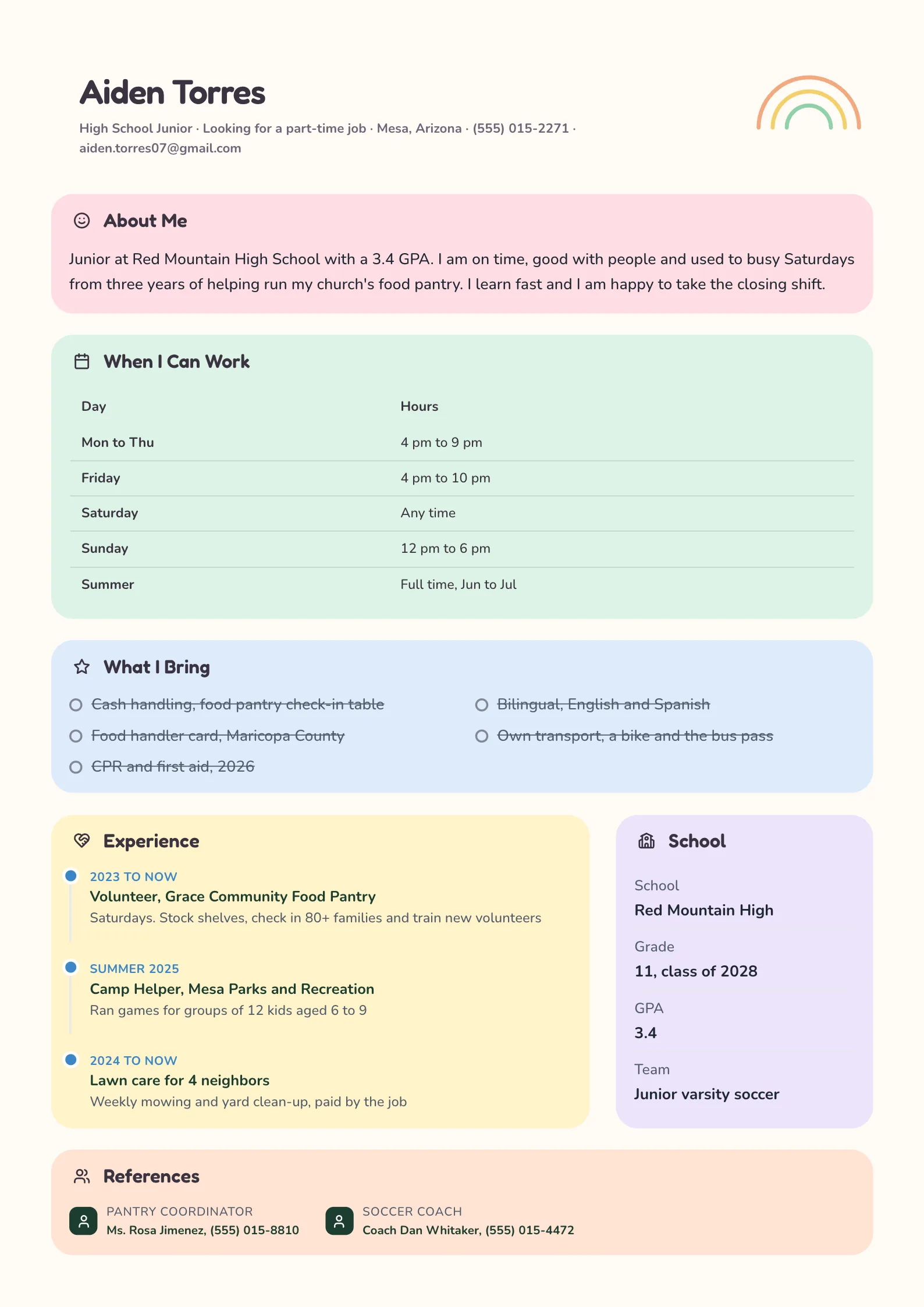 Resume: High School StudentEdit for free(opens in a new tab)
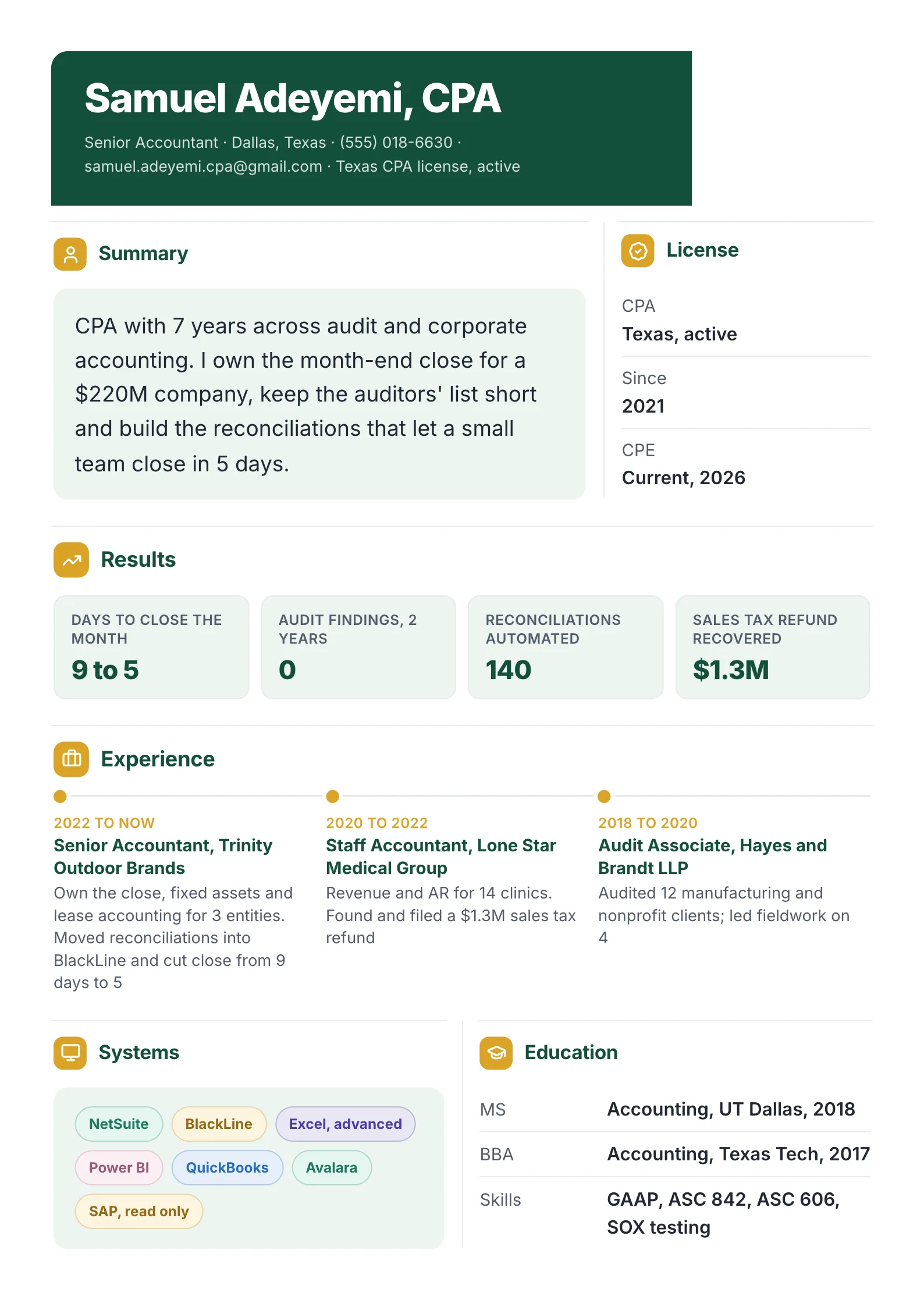 Resume: AccountantEdit for free(opens in a new tab)
That's useful to know before you open a list of 500 power words. The lists disagree far more than they agree, so no single verb will make your resume. What they share is a way of building a line, and that's what this guide walks through, ending with five sample resumes from MakeOnepagers read one phrase at a time.
The 16 verbs every list shares
Here are the six guides we read on November 5, 2026: Ohio State's College of Education and Human Ecology, Saint Louis University, the University of Alabama, Tufts, California State University San Marcos and the University of Colorado Colorado Springs. Their lists run from about 140 verbs (Tufts and UCCS) to about 350 (CSU San Marcos). Together they hold 502 different verbs, and 182 of those show up on just one list.
These 16 are on all six:
| Advised | Arranged | Communicated | Designed |
| Developed | Directed | Edited | Established |
| Guided | Identified | Improved | Influenced |
| Maintained | Performed | Planned | Supervised |
A few gaps surprised us. UCCS lists neither "managed" nor "led." Tufts has no "increased." Saint Louis has no "achieved." So even the famous resume verbs miss a list or two. Saint Louis calls its words "possible synonyms" and asks you to avoid "using the same verb more than once if possible."
At the other end, some verbs appear on one list only. CSU San Marcos offers "obliterated," "memorized" and "risked." UCCS offers "shattered." They're real options, but a hiring manager reading "Obliterated backlog" has to stop and translate. Pick the verb that says exactly what happened. "Cut," "trained," "wrote" and "built" usually beat anything fancier.
The phrases the guides tell you to cut
Every guide names at least one phrase to replace, and the names line up closely.
| Phrase to replace | Guides that name it |
|---|---|
| "responsible for" or "was responsible for" | 5 of 6 (Ohio State, Saint Louis, Tufts, CSU San Marcos, UCCS) |
| "duties include" or "duties included" | 4 of 6 (Ohio State, Tufts, CSU San Marcos, UCCS) |
| "responsibilities include" | Alabama |
| "served as" and "actions encompassed" | UCCS |
| "numerous" and "various" | Ohio State |
| personal pronouns like "I" and "my" | Ohio State |
Alabama explains the reason in one line: "Most employers do not want to see 'responsibilities include….' They want to know what actions you take (or took) in your role." A duty is what the job asked of anyone in your seat. A phrase that starts with a verb tells the reader what you did with it.
Ohio State adds "numerous" and "various" to its list, and it's worth a quick search of your own draft. "Managed various projects" leaves the reader guessing how many. "Managed 4 projects at once" answers the question.
How to build one line, in three parts
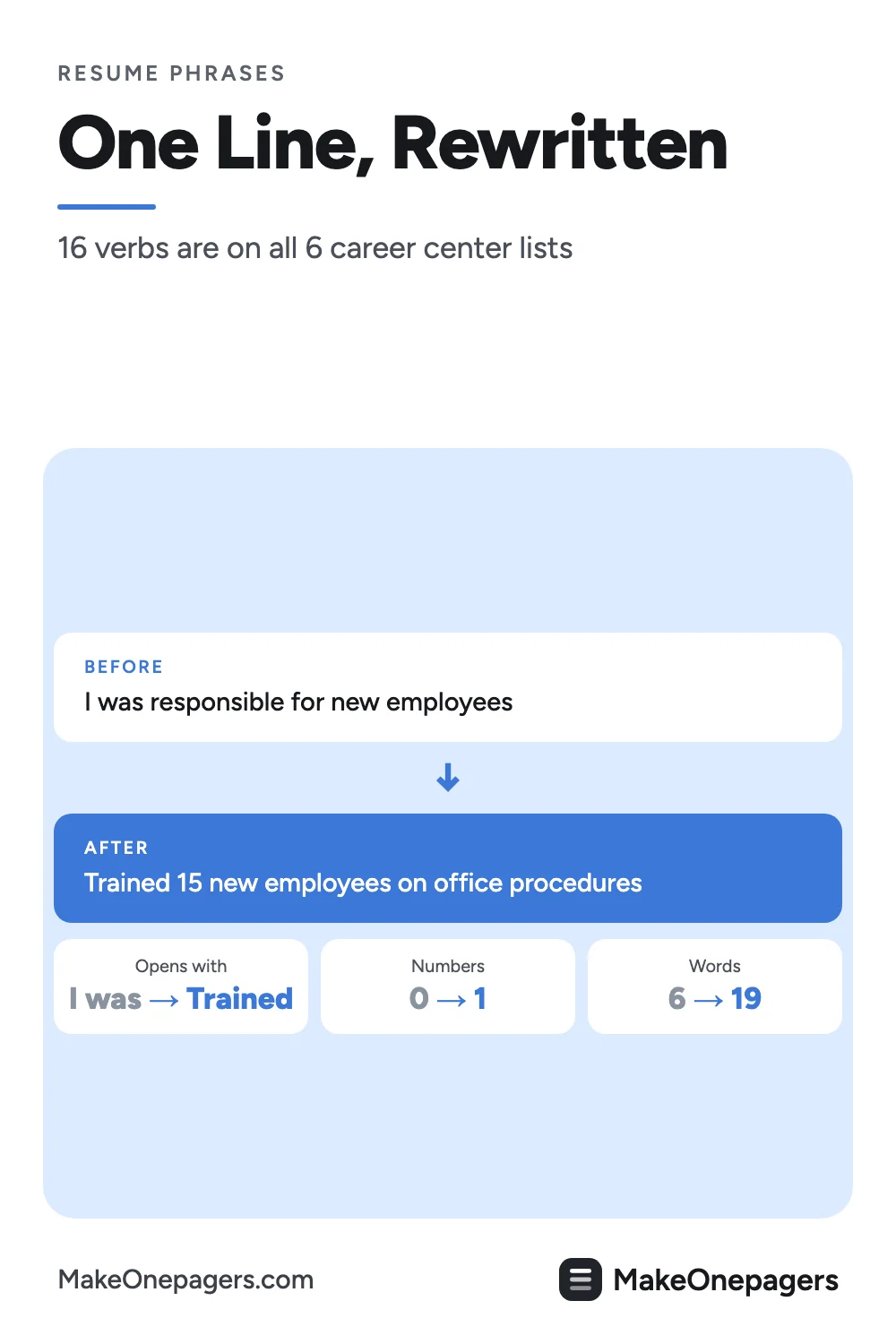
Saint Louis University puts the whole method in one box. It starts with a weak line:
I was responsible for new employees.
Then it asks three questions. What skill did you use, said as a past-tense verb? What did you do? What came of it, with "quantifiable data as proof"? The rewrite:
Trained 15 new employees on office procedures, customer service, and database management to increase productivity of team and organization.
The verb is "trained," the work is the three topics, and the number is 15. You could push it one step further if you know the result in numbers, such as how many weeks it took new hires to work alone. UCCS shows that last step in its own example: "Championed use of user feedback in program improvements, resulting in 50% boost in customer satisfaction ratings."
Keep the tense straight while you're at it. Alabama reminds you to "use the correct tense for current and former experiences." Your current job reads in the present ("Lead a team of 6"), and past jobs read in the past ("Led a team of 6").
For federal jobs, use the announcement's own words
Federal resumes add one rule the career center lists don't stress. A USAJOBS help sheet, shared by the Census Bureau in 2018, gives an example you can act on today: if the qualifications section asks for experience with "MS Project," then "you need to use the words 'MS Project' in your resume." It explains why, too. "Hiring agencies will look for specific terms in your resume."
That advice still holds under the current rules. Since September 27, 2025, USAJOBS has limited resumes to two pages, and OPM's guidance on that limit ends with five hints. Two are about phrasing: "Use concise, results focused language." and "Align language from the job announcement."
The USAJOBS sheet also gives four sample lines, and every one has a number in it:
- "Improved efficiency of document processing by 25% over the previous year"
- "Wrote 25 news releases in a three-week period under daily deadlines"
- "Managed a student organization budget of more than $7,000"
- "Wrote prospect letter that has brought in more than $25,000 in donations to date"
It suggests three kinds of number to look for: money you saved, earned or managed, and time you saved. It also asks you to write in plain language and avoid acronyms a reader may not know.
Five resumes, read one phrase at a time
The people in these samples are made up, and every line quoted below is on the template.
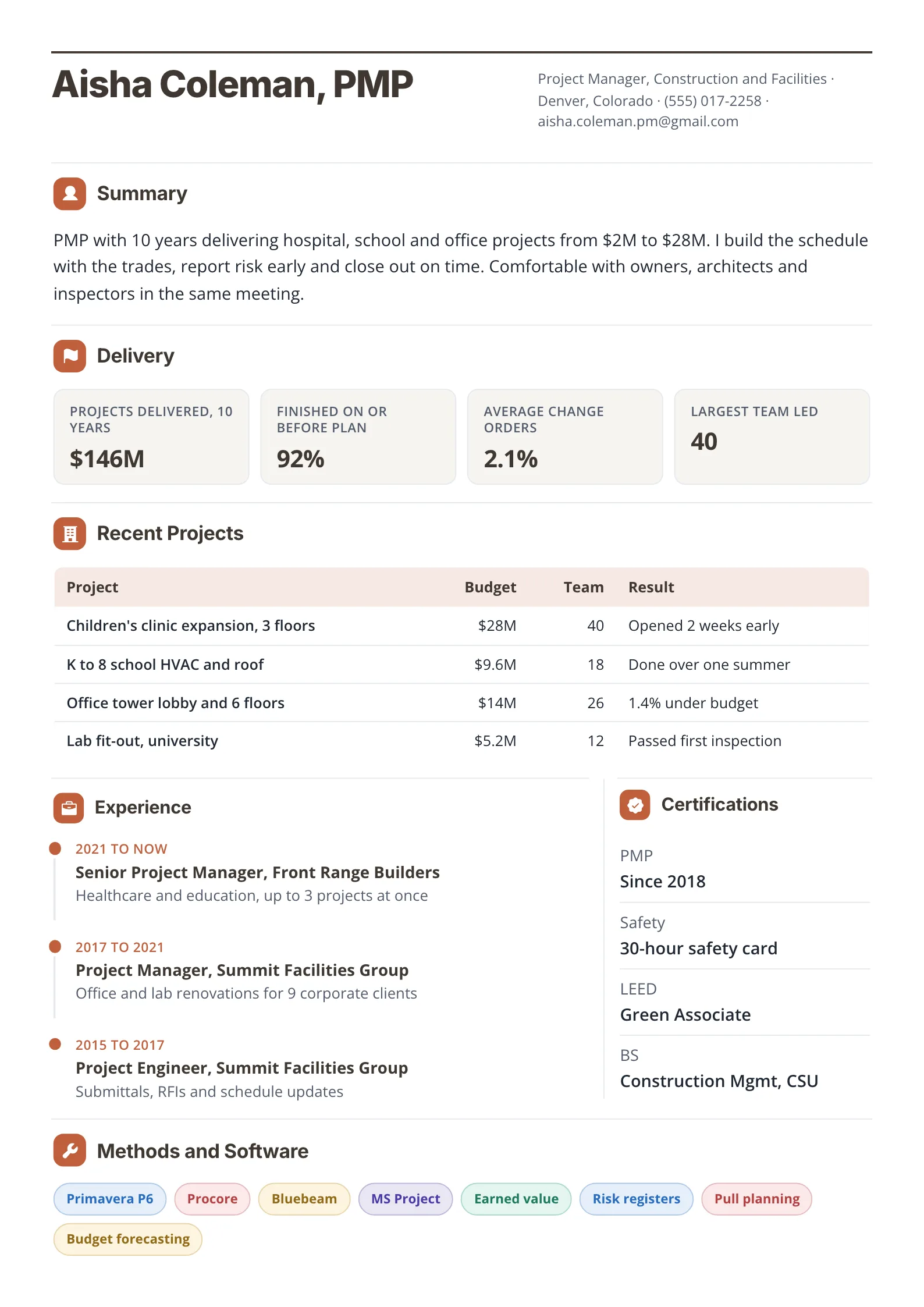
A project manager whose tools match the posting
 Edit this template
This project manager resume lists MS Project, Primavera P6, Procore and Bluebeam by name under Methods and Software. If a job post asks for Primavera P6, the exact words are already there, just like the USAJOBS example. The summary uses three plain verbs in a row: "Build the schedule with the trades, report risk early and close out on time." Each one is something a hiring manager can picture on site.
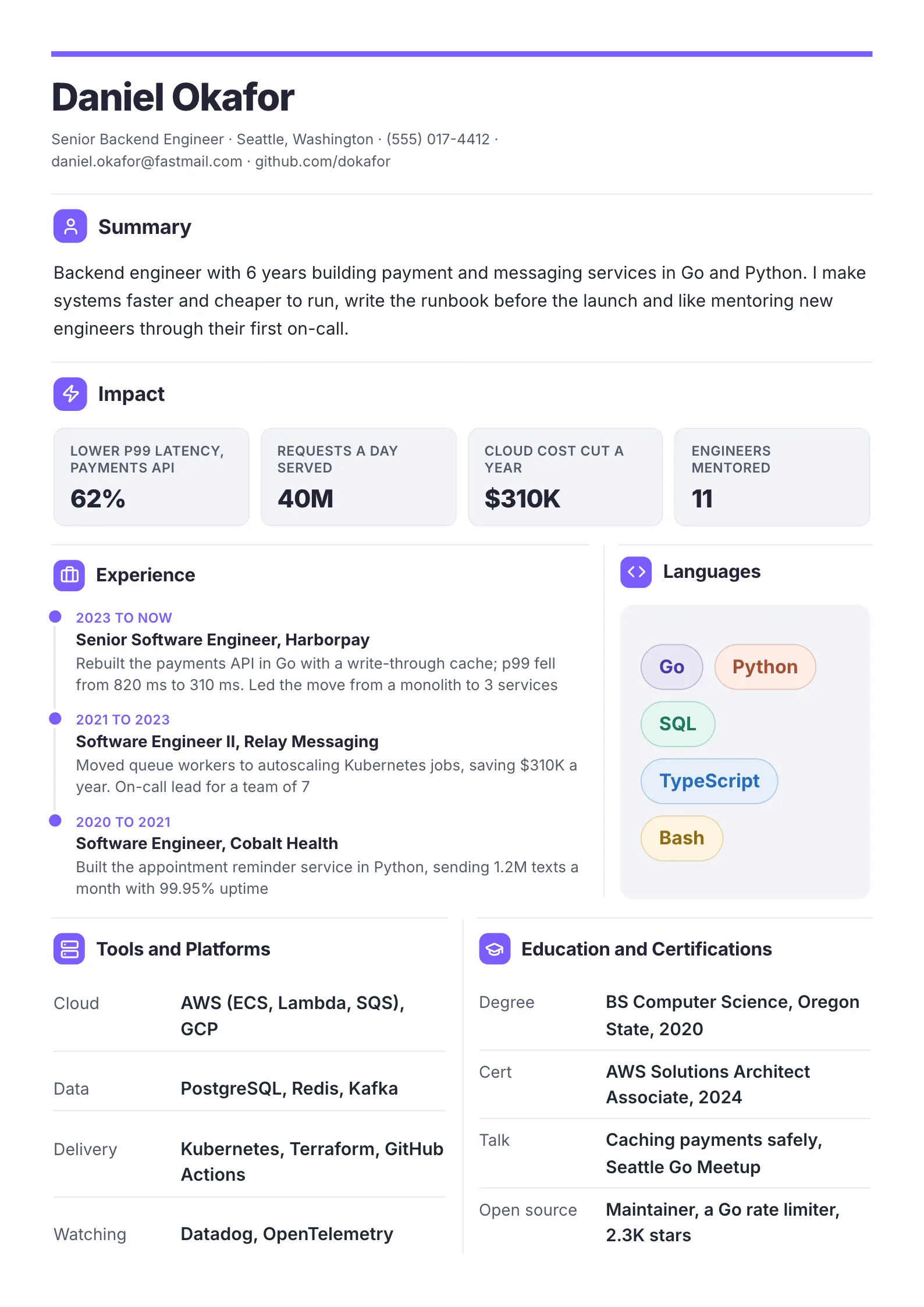
A software engineer who ends every line on a number
 Edit this template
Read the first line of this software engineer resume as three parts. "Rebuilt the payments API in Go with a write-through cache; p99 fell from 820 ms to 310 ms." The verb is "rebuilt," the work is the API and the method, and the result is two numbers. The next job's line follows the same order: "Moved queue workers to autoscaling Kubernetes jobs, saving $310K a year." That's the money-saved kind of number the USAJOBS sheet asks for.
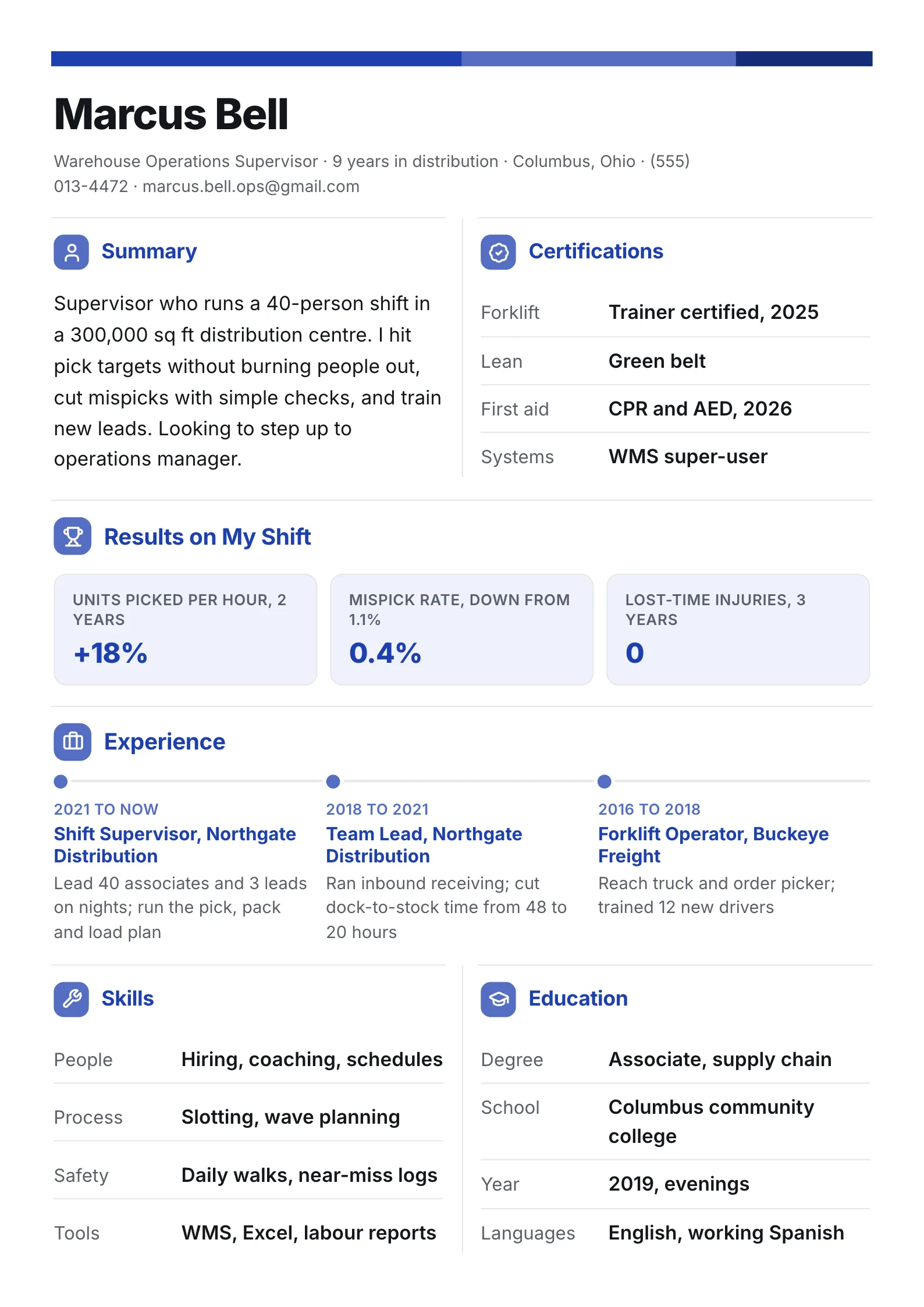
A warehouse supervisor with Saint Louis's example built in
 Edit this template
Saint Louis turned "responsible for new employees" into "Trained 15 new employees." This warehouse supervisor resume already writes it that way: "trained 12 new drivers." Its best line uses a short verb and a before-and-after number: "Ran inbound receiving; cut dock-to-stock time from 48 to 20 hours." That's time saved, the other kind of number the federal sheet asks for. "Cut" is on only two of our six lists, and it's still the clearest word for the job.
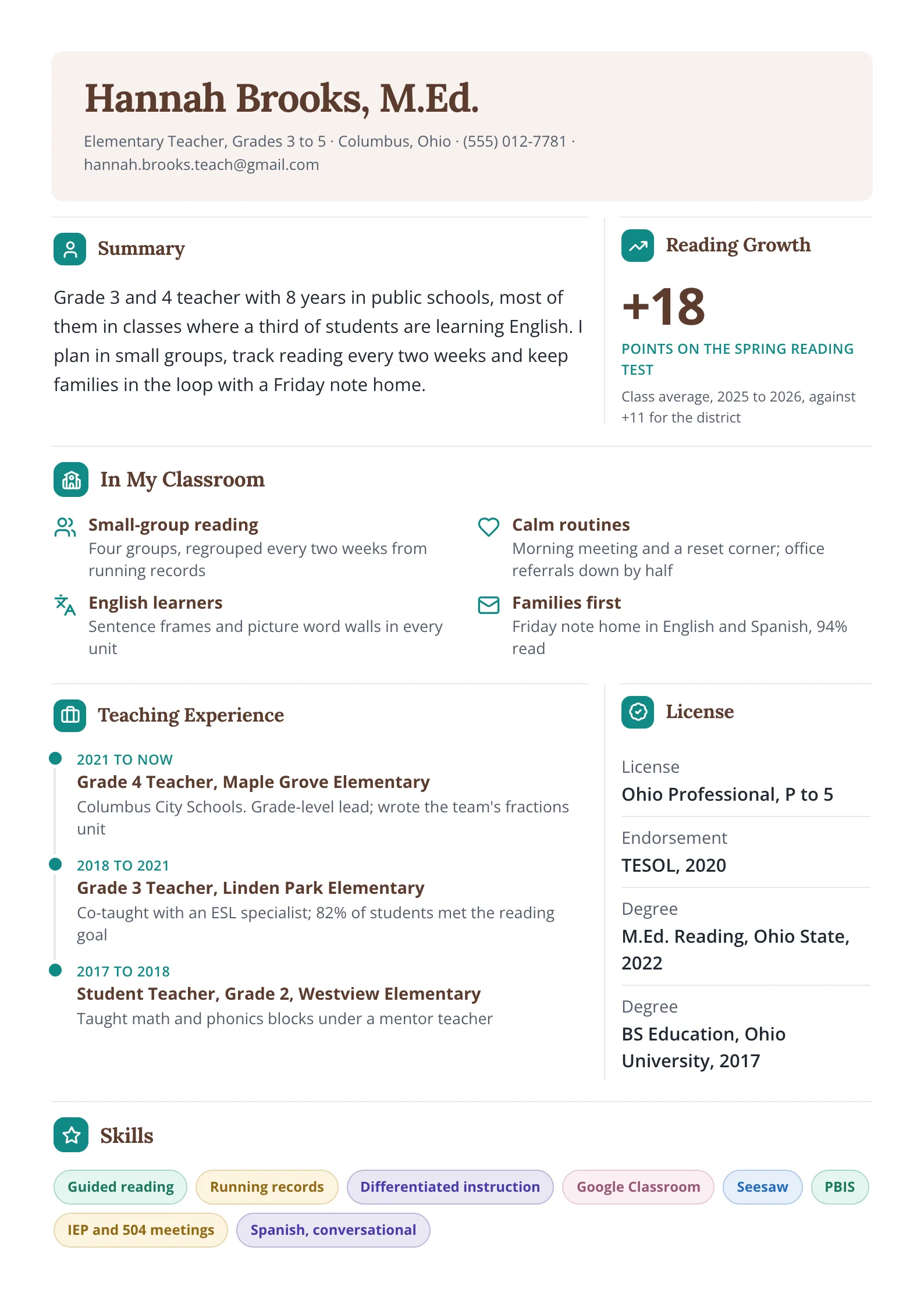
A teacher whose verbs name the shared work
 Edit this template
Teaching is team work, and this elementary teacher resume picks verbs that say who did what. "Co-taught with an ESL specialist; 82% of students met the reading goal." "Grade-level lead; wrote the team's fractions unit." "Co-taught" is honest about the shared class, and "wrote" claims the part that was hers. Both lines end on something a principal can check.
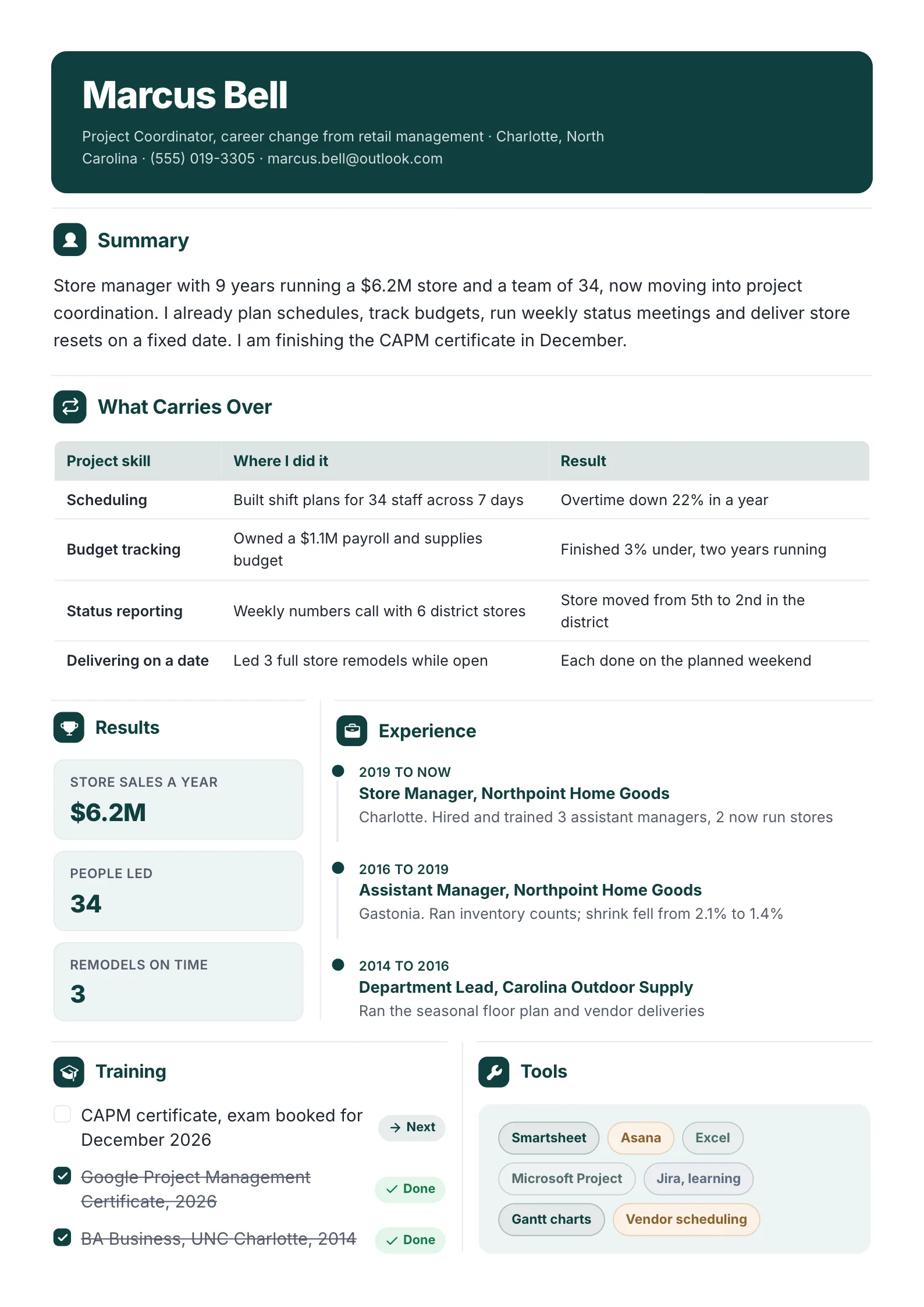
A career changer who rewrites retail in project words
 Edit this template
A career change is mostly a phrasing job. This career change resume sets the change in three columns. On the left is a project skill a hiring manager would search for, like "Status reporting." In the middle is where it happened in retail, "Weekly numbers call with 6 district stores." On the right is the result, "Store moved from 5th to 2nd in the district." The skill name matches the new field's words, while the proof stays true to the old job.
Check your draft in five minutes
Run these four searches on your resume before you send it. Each one comes from the guides above.
- Search for "responsible." Every hit gets rewritten to start with the verb for what you actually did.
- Search for "duties," "various" and "numerous." Replace each one with the actual task or count.
- Read only the first word of each line. If the same verb starts three lines, swap two of them, as Saint Louis suggests.
- Count lines without a number. Not every line needs one, but a job with no numbers at all usually has one you haven't dug up yet. Check old reviews, reports and emails.
For a federal job, add a fifth step. Put the announcement's qualifications section next to your resume and check that its key terms appear in your words.
Start from a resume that already reads this way
Each MakeOnepagers resume above is written in this style, verb first and number last. Put your jobs and numbers where the samples' are, and the lines stay strong. Have an old resume full of "responsible for"? Paste it into the free AI One-Pager generator, then rewrite each line with the three parts above. To set up the sections themselves, see how to write a resume, see which layout suits your history in the resume format guide, or browse more resume examples by job.
Frequently asked questions
What are good phrases to put on a resume?
Lines that start with a past-tense verb, name the work and end with a result. "Trained 12 new drivers" or "cut dock-to-stock time from 48 to 20 hours" are good models. The verbs found on all 6 career center lists we read include improved, developed, planned and supervised.
Is "responsible for" bad on a resume?
It's weak, and 5 of the 6 guides we read tell you to replace it. It describes the job rather than what you did in it. Rewrite each one to start with an action verb, as in Saint Louis University's example, "Trained 15 new employees."
Should I use "I" or "my" on a resume?
No. Ohio State's guide says to avoid personal pronouns. Start each line with the verb ("Led," "Built," "Wrote") and the reader understands it was you.
How do I find the right keywords for a federal resume?
Read the qualifications section of the job announcement and reuse its exact terms where they're true for you. USAJOBS' own example is software. If the post asks for "MS Project," write "MS Project." OPM's 2025 guidance says the same thing in one line: "Align language from the job announcement."
Do I need different verbs for every line?
Variety helps, but clarity matters more. Saint Louis University suggests avoiding the same verb twice "if possible." If "led" is the true word for three jobs, keep it and make the numbers after it do the work.




