Resume Examples for Every Career Stage, From a First Job to a CPA License
Resume examples from a high school junior to a licensed CPA, with the line each reader checks first, 6 career center guides and the federal two-page rule.

A high school junior and a CPA both need a resume, but your resume leads with different things depending on which one you are. The junior leads with the hours he can work and a food handler card. The CPA leads with his license and a month-end close cut from 9 days to 5. These five resume examples run along that path, from a first job to about eight years in, and each one puts the line your reader checks first at the top. Start from a free one pager template.
One‑Pager examples
Real One-Pagers made with MakeOnepagers. Open any one to edit it as your own.
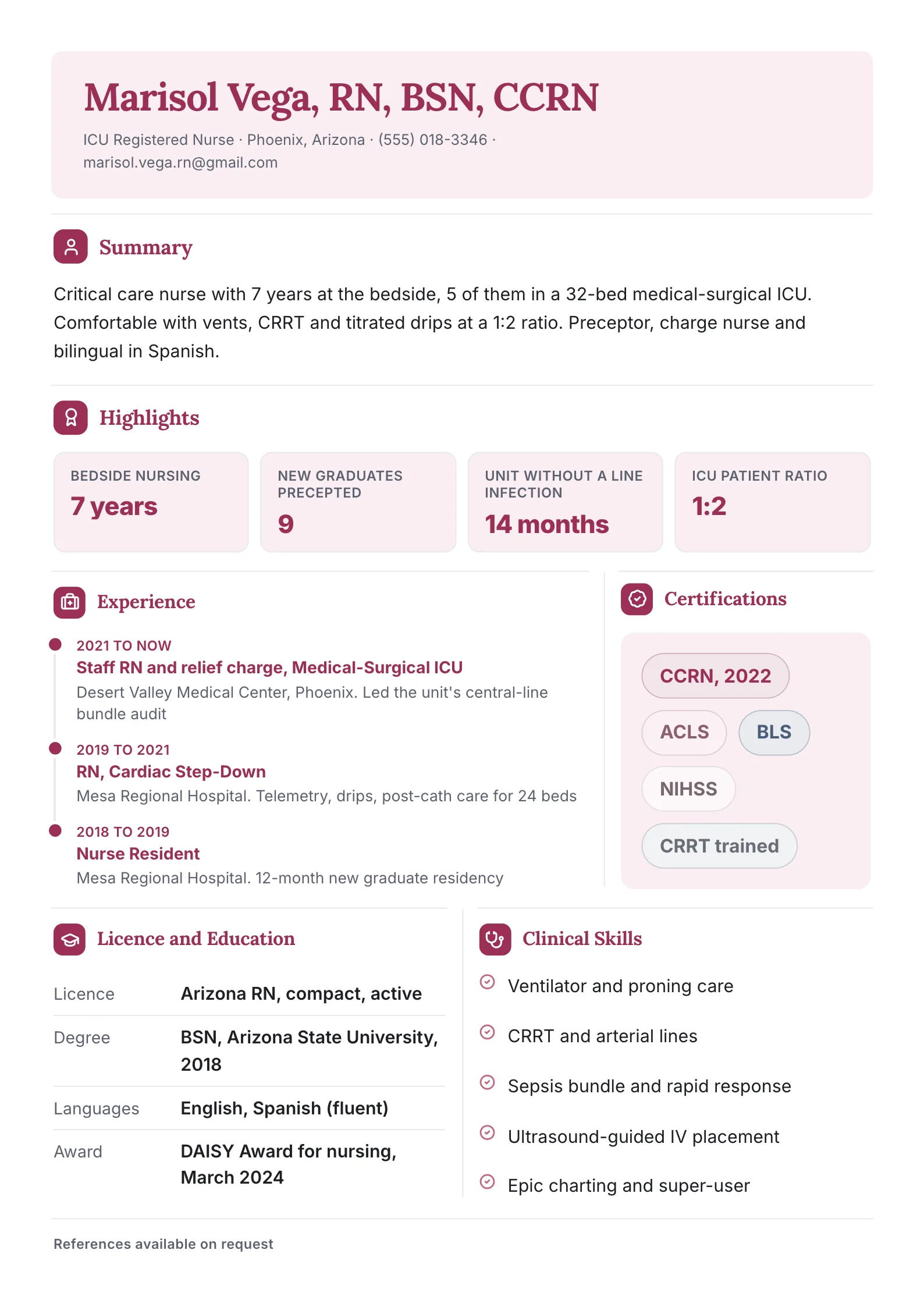 One-Page Resume for NursesEdit for free(opens in a new tab)
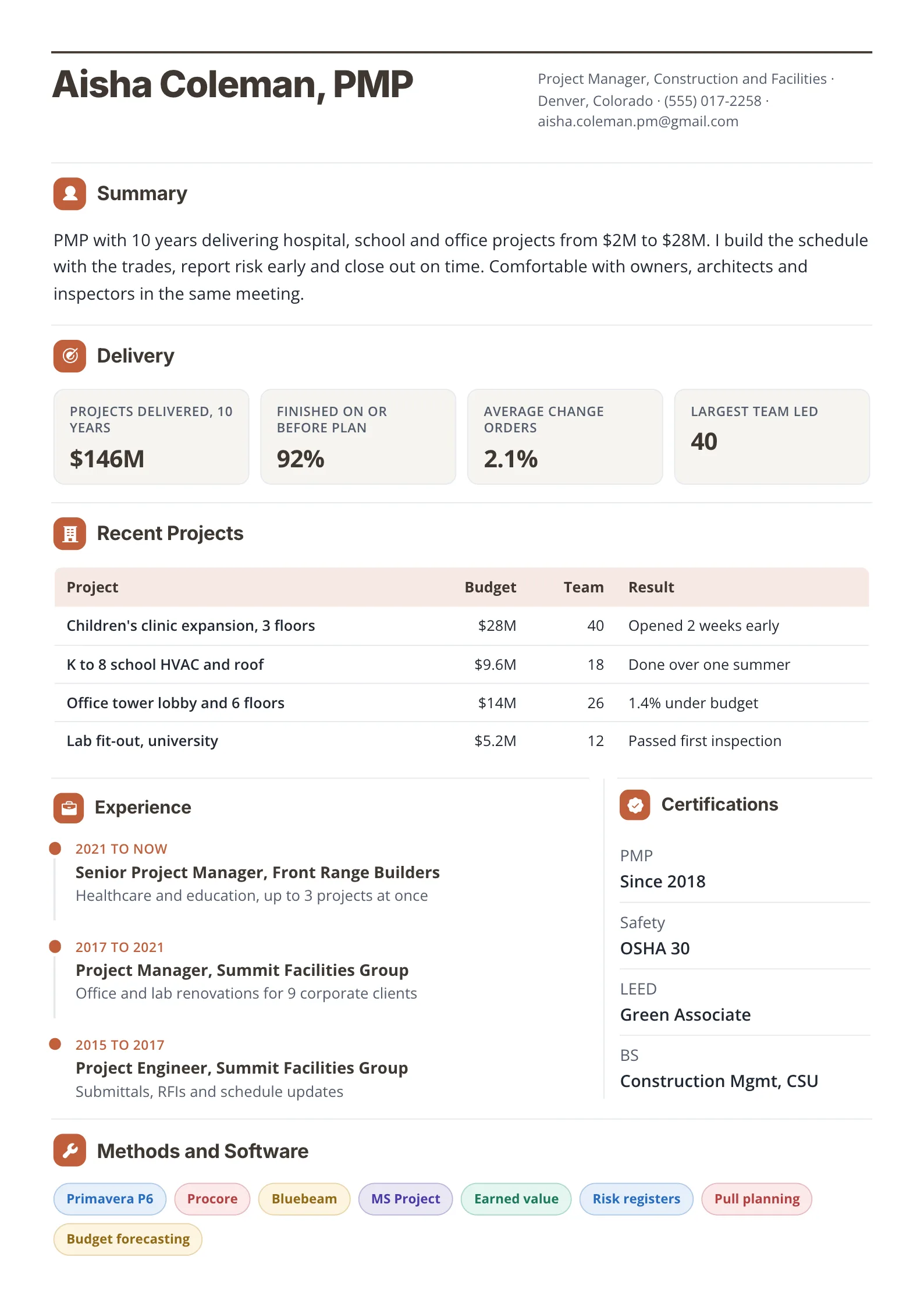 Resume: Project ManagerEdit for free(opens in a new tab)
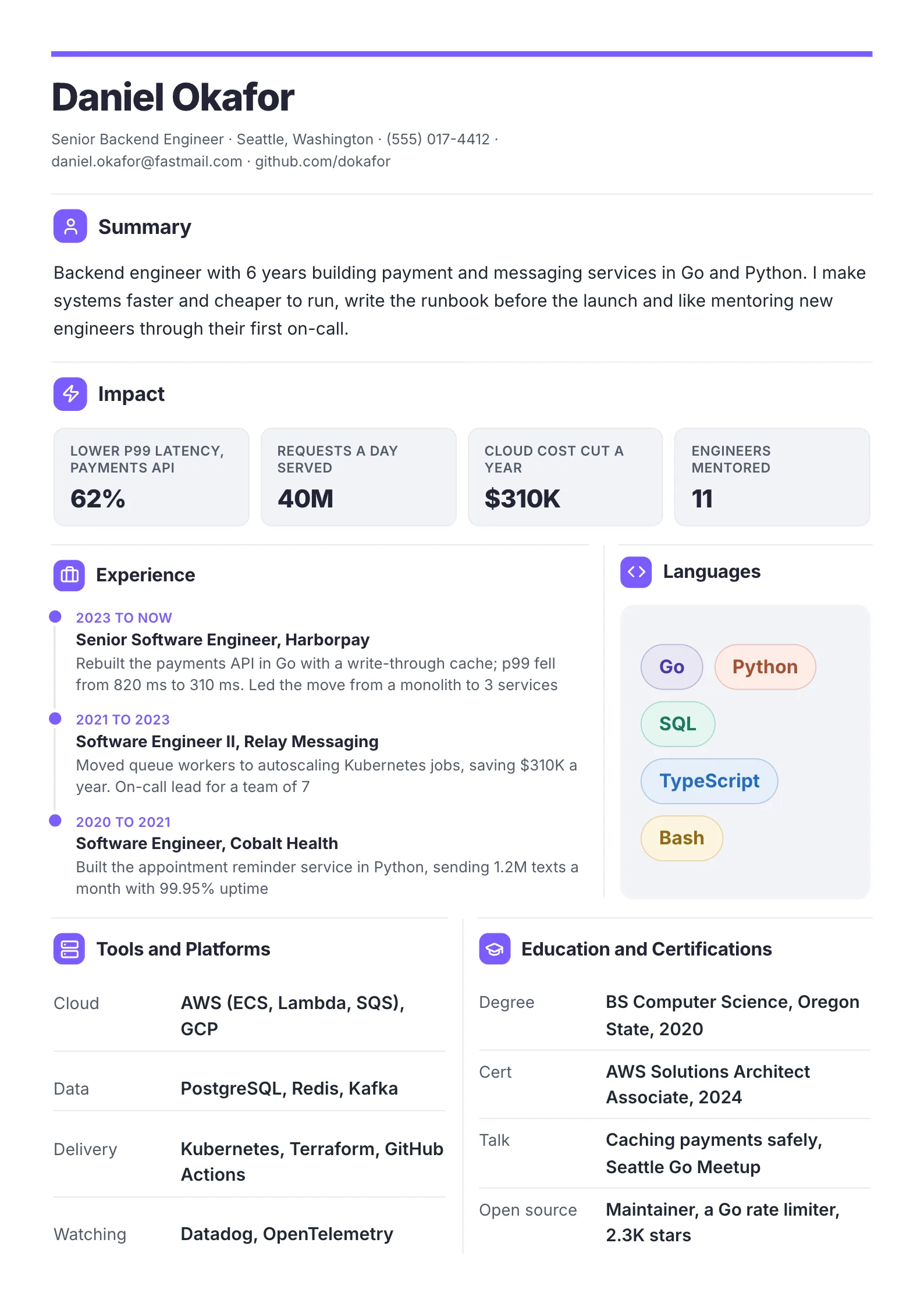 Resume: Software EngineerEdit for free(opens in a new tab)
 Resume: Graphic DesignerEdit for free(opens in a new tab)
 Resume: Sales Account ExecutiveEdit for free(opens in a new tab)
 Resume: Elementary TeacherEdit for free(opens in a new tab)
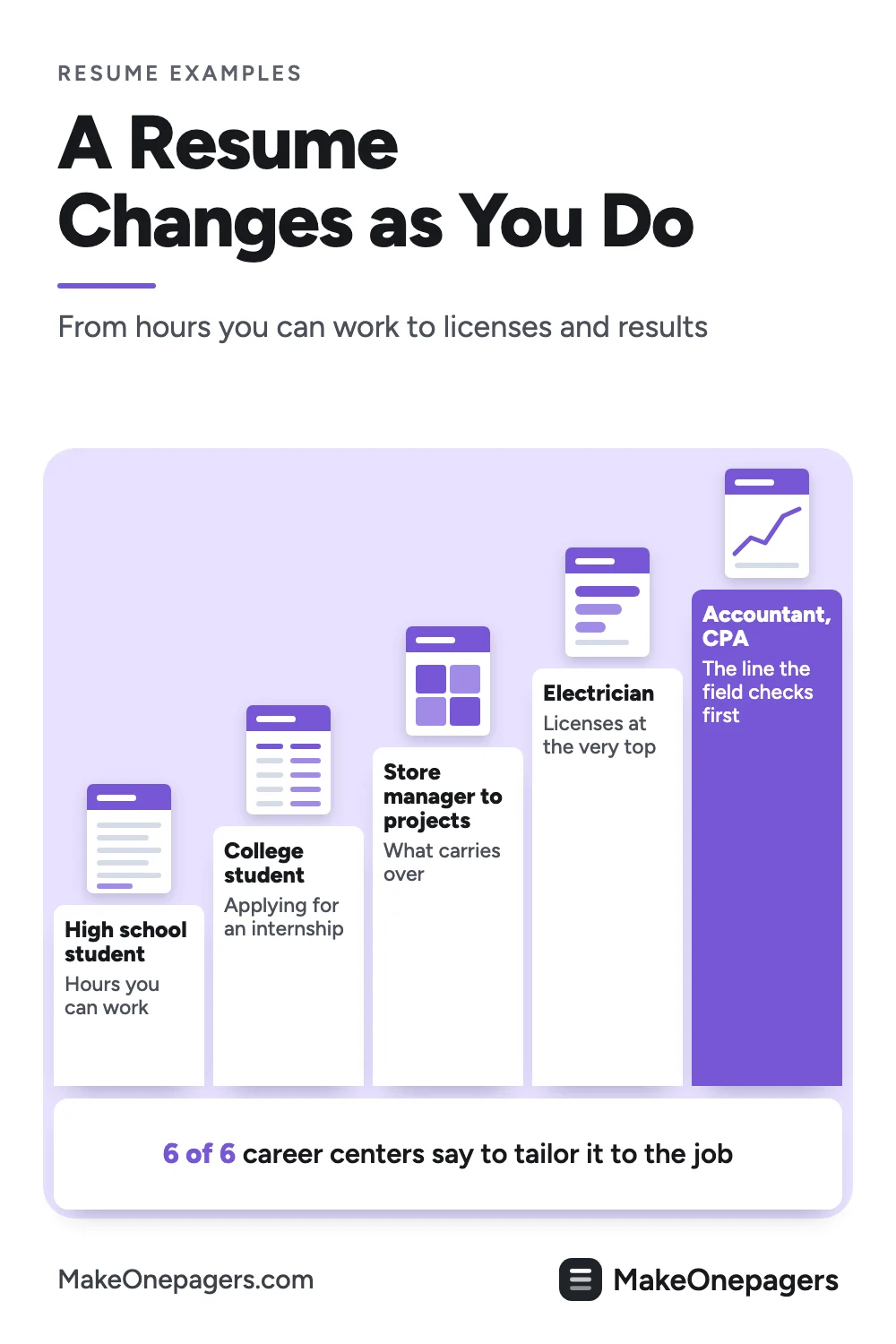
Resume guides from 6 university career centers back that up, and all 6 tell you to tailor the page to the job. A federal agency asks for more. There, your resume is capped at two pages and must show details, like hours a week, that most private employers never request.
Still in school
With little paid work behind you, your resume has to show what you can do from school, volunteering and part-time jobs. Two of the six guides we read say to leave high school off once you're in college. The two examples below show how different those two pages look.
High school student looking for a first job
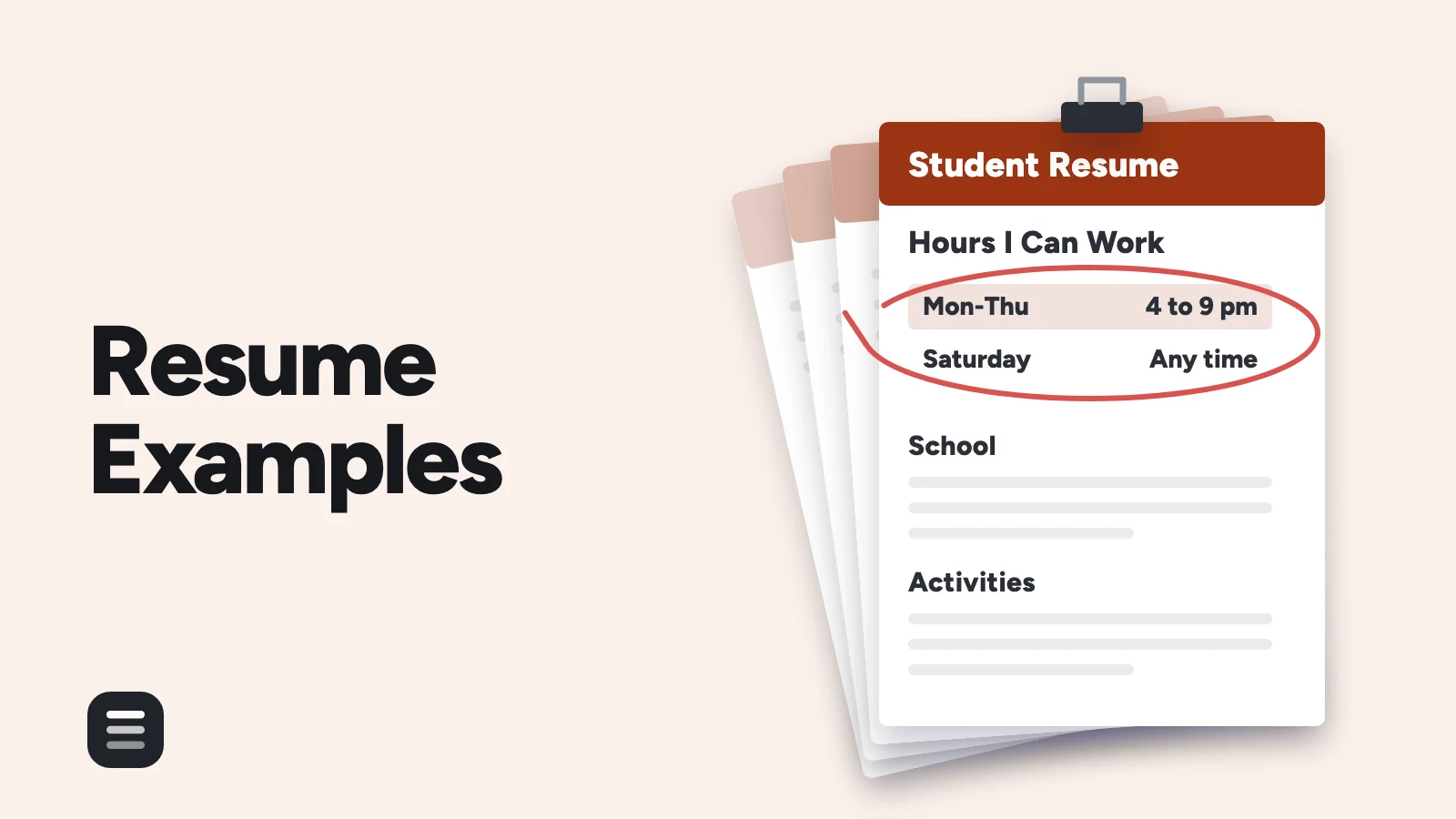
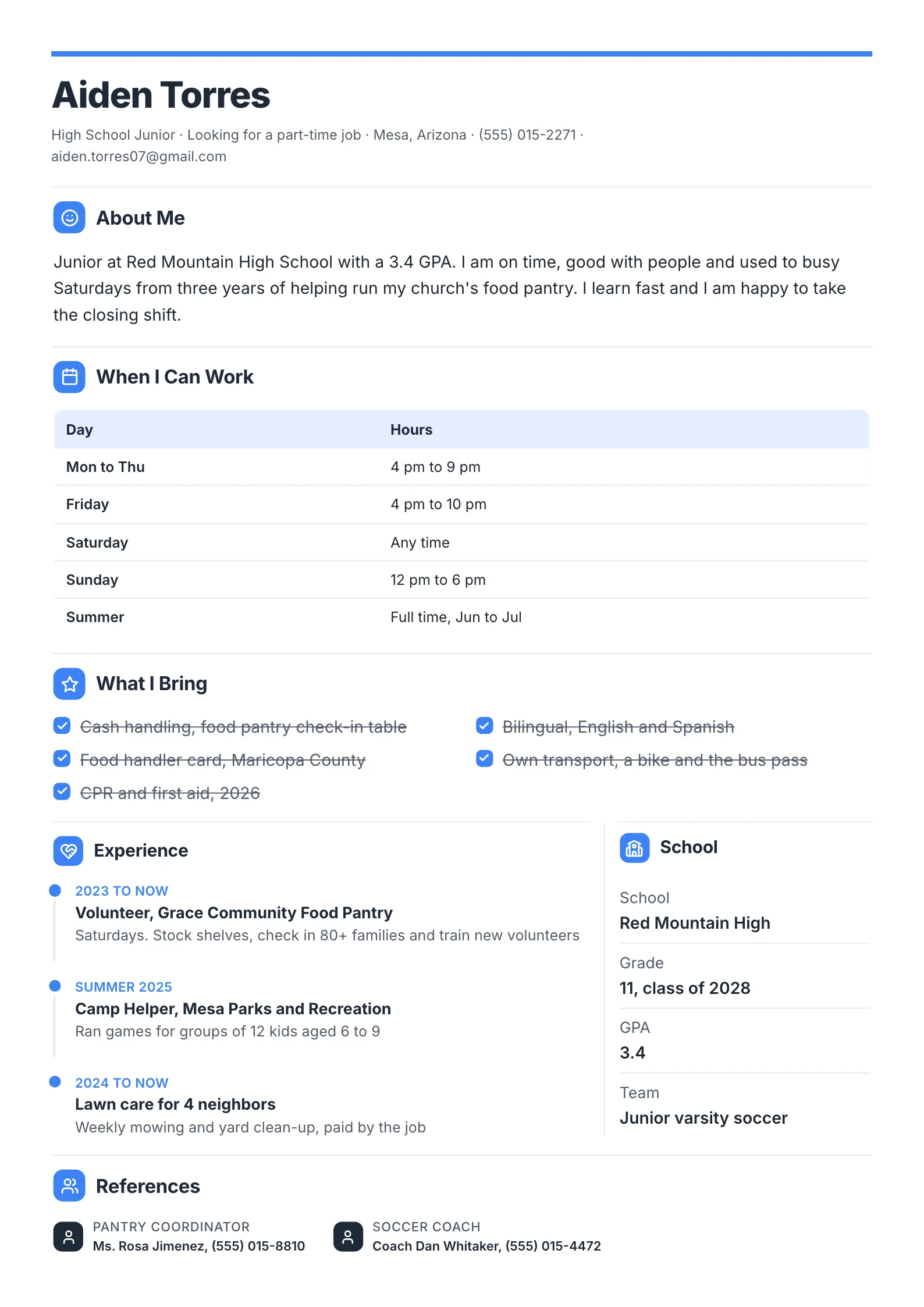
Aiden Torres is a junior in Mesa, Arizona, looking for part-time work at a grocery store or cafe. He has no past boss to list, so his page opens with a short About and his 3.4 GPA. Then comes a table that most resumes never have. It shows the hours he can work each day, from 4 pm to 9 pm Monday to Thursday to any time on Saturday.
That table answers a store manager's first question before you're even asked it. His Strengths list does the same job for skills, with a food handler card, CPR and first aid, and both English and Spanish. Most of his experience is unpaid, and all of it is real. He checks in 80+ families at a food pantry, ran games for groups of 12 kids at a city camp and mows lawns for 4 neighbors, paid by the job.
 Edit this template
Sample name, school and phone numbers. The hours table is the line your hiring manager reads first.
Two of the career center guides say references don't belong on a resume. Those guides are written for college students, though. A first-time job seeker with a pantry coordinator and a soccer coach willing to vouch for them gives a manager someone to call, so Aiden keeps both on the page. Our brag sheet guide helps a first-time applicant gather the stories those two references might tell.
College student applying for an internship
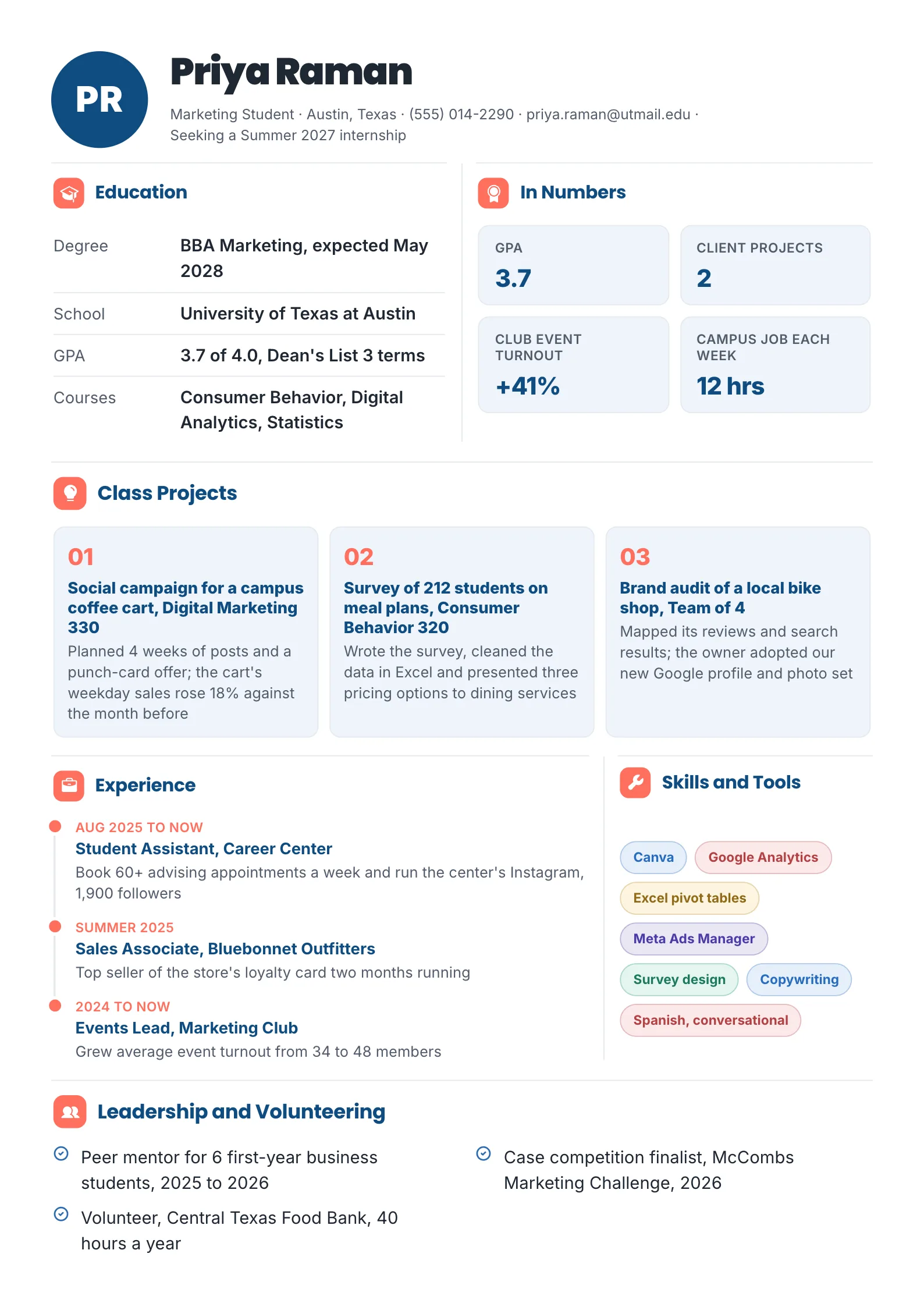
Priya Raman studies marketing at the University of Texas at Austin and wants a summer 2027 internship. Her resume puts Education first, which is exactly what Penn's undergraduate checklist asks for. Her 3.7 GPA clears both cutoffs we found. Pepperdine says to list a GPA above 3.2, and Penn says above 3.00.
Her class projects show you where the page earns its interview. A social campaign for a campus coffee cart lifted weekday sales 18% on the month before. A survey of 212 students turned into three pricing options for dining services. Her club role adds one more number, with event turnout growing from 34 to 48 members.
 Edit this template
Sample student and projects. Each class project ends on a result, the habit only 3 of the 6 guides tell you to build.
Changing fields
Moving into a new kind of work is the hardest resume to write, because your job titles point the wrong way. Governors State's guide explains the fix. It says employers have grown wary of purely functional resumes, which group skills and hide dates. It recommends a hybrid instead, with skill groups up top and your jobs still listed newest first.
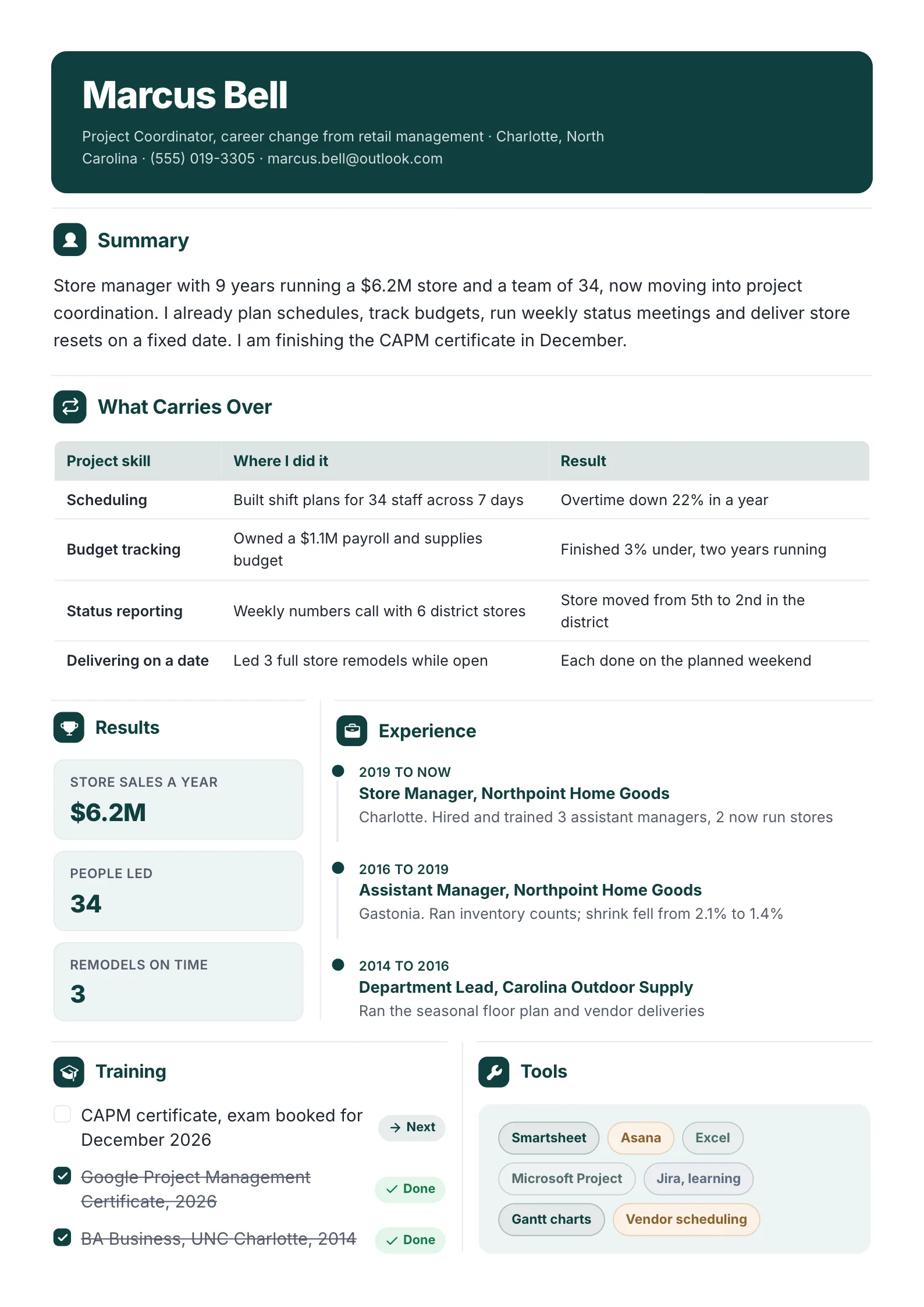
Darius Hayes's resume shows you exactly that. He ran a $6.2M home goods store with a team of 34 and now wants to be a project coordinator. His What Carries Over table puts each project skill beside the retail work that proves it, and beside the result. Scheduling shift plans for 34 people cut overtime 22% in a year. He owned a $1.1M budget and finished 3% under it two years running. Three full store remodels each finished on their planned weekend.
 Edit this template
Made-up candidate and employers. The middle column of the table is what turns a store manager into a project coordinator on paper.
His Training list shows a certificate already done and a CAPM exam booked for December 2026. If you're changing fields, put the course you're finishing on the page with its date. It tells the reader you're already moving.
Seven years in and more
After several years of work, your resume stops asking for a chance and starts showing proof. The two examples below lead with the line their field checks first. They also use the formula the Treasury Department suggests for federal applicants: "Accomplished [X] as measured by [Y], by doing [Z]."
Electrician moving to a commercial contractor
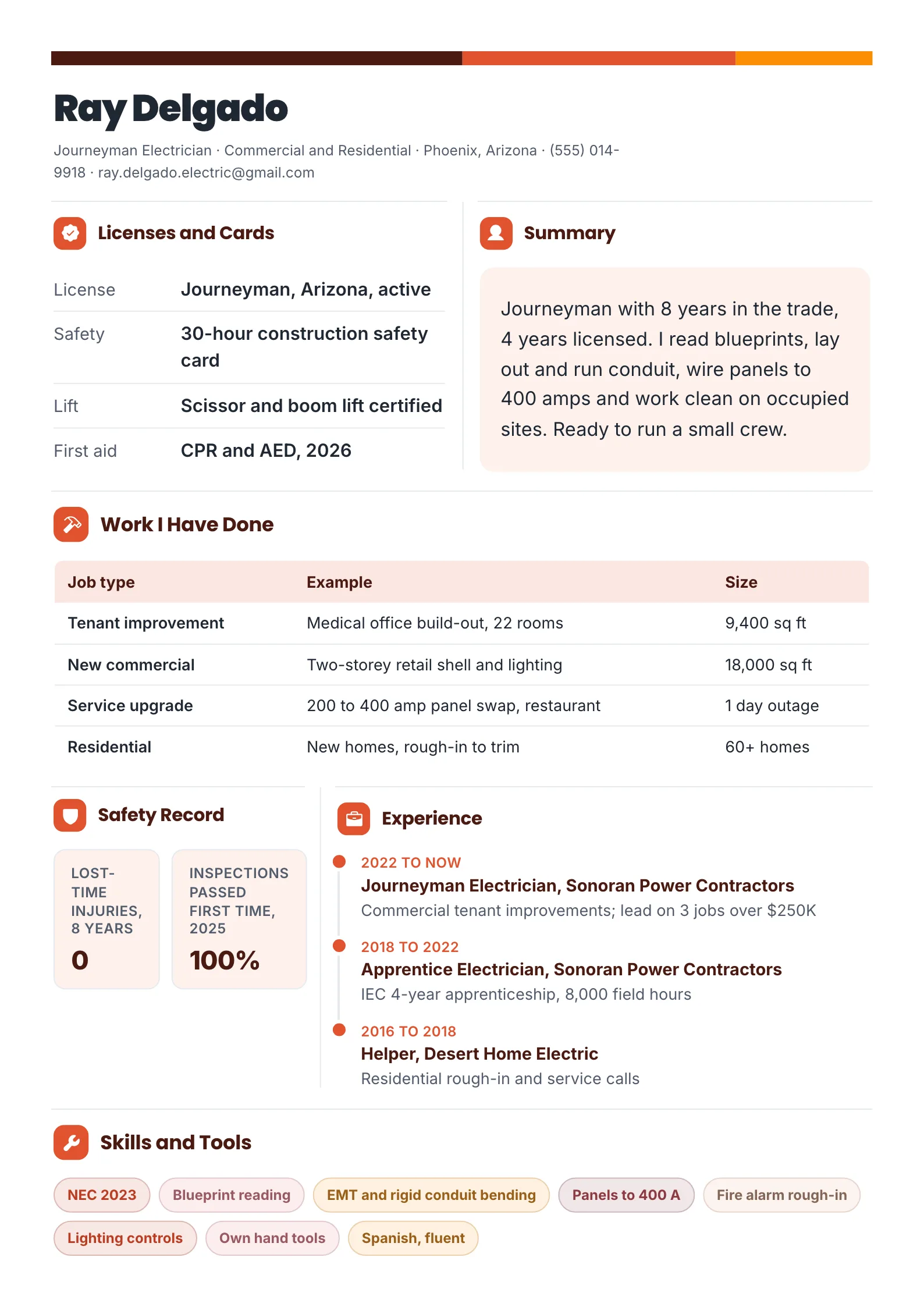
If you work in a trade, look at Ray Delgado's page. He's a journeyman electrician in Phoenix with 8 years in the trade and 4 of them licensed. His Licenses and Cards block sits at the very top, with his Arizona journeyman license, a 30-hour safety card, lift certification and CPR. A contractor checks those before anything else, so you shouldn't make them hunt.
His Work Done table gives each kind of job a real size, which is what your next contractor wants to see. A medical office build-out covered 9,400 square feet, a retail shell 18,000 square feet and a restaurant panel swap from 200 to 400 amps took a one-day outage. His safety record is two numbers you can't argue with, 0 lost-time injuries and 100% of inspections passed the first time in 2025.
 Edit this template
Sample electrician and contractors. The license block comes before the summary because a contractor checks it first.
Accountant with a CPA license
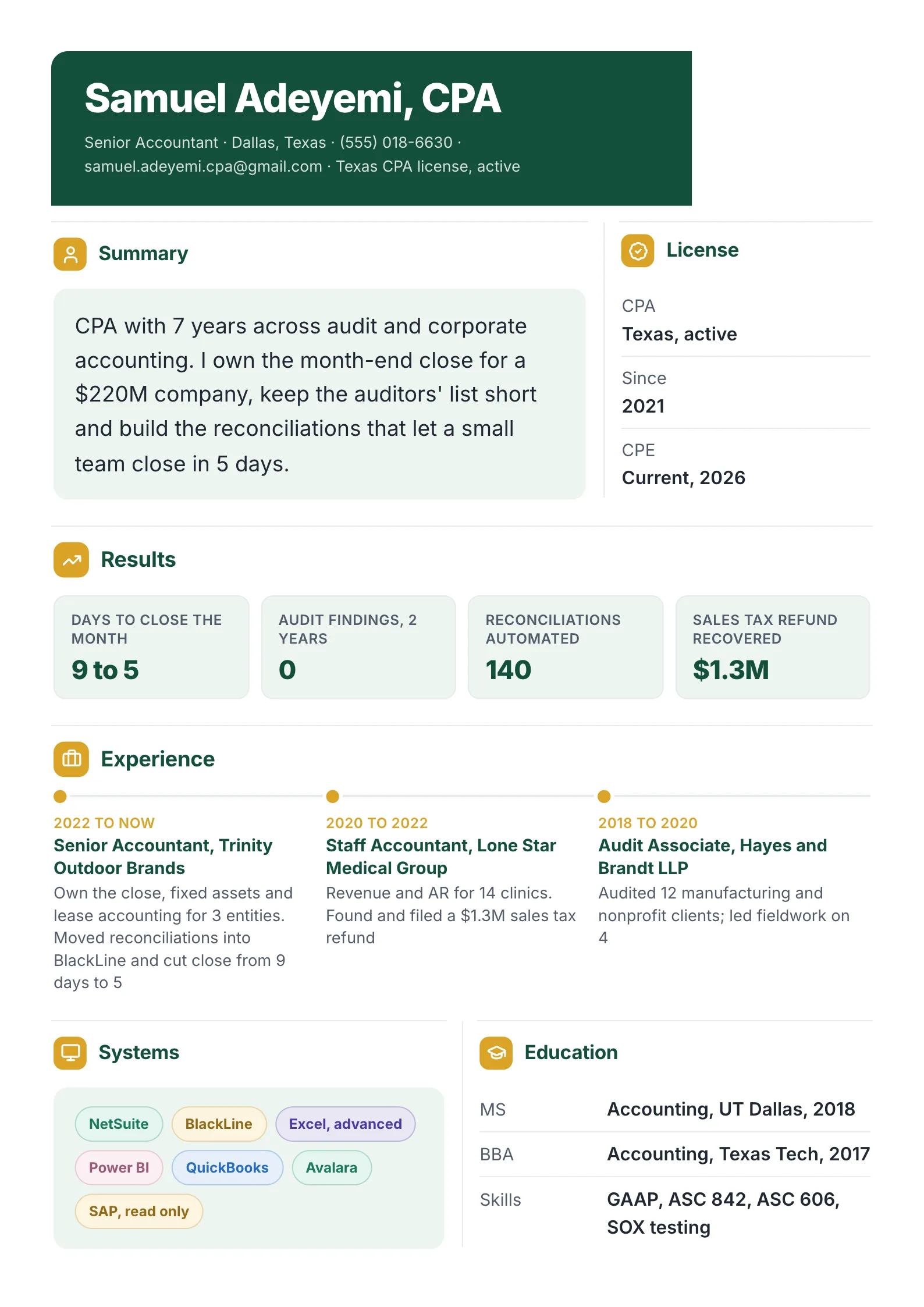
Samuel Adeyemi is a senior accountant in Dallas with a Texas CPA license, active since 2021. Just like Ray's license, his CPA line sits right under his name. His results fit the Treasury formula almost word for word. He cut the month-end close from 9 days to 5 by moving reconciliations into BlackLine.
The rest of his numbers are the ones your future controller will ask about. He has gone 2 years with 0 audit findings, has automated 140 reconciliations and recovered a $1.3M sales tax refund for a group of 14 clinics. His Systems list names NetSuite, BlackLine and the other tools a hiring manager will search for.
 Edit this template
Sample name, firms and figures. Each result names what changed and how, so your reader doesn't have to guess.
More resume examples by job
The five pages above follow a career from a first job to a license. The designs below cover other jobs you might apply for, and each one puts its field's first check at the top, the same way Ray's license and Aiden's hours do.
| Job | Example | What sits at the top |
|---|---|---|
| Backend software engineer | Daniel Okafor, Seattle | An Impact block right under the summary |
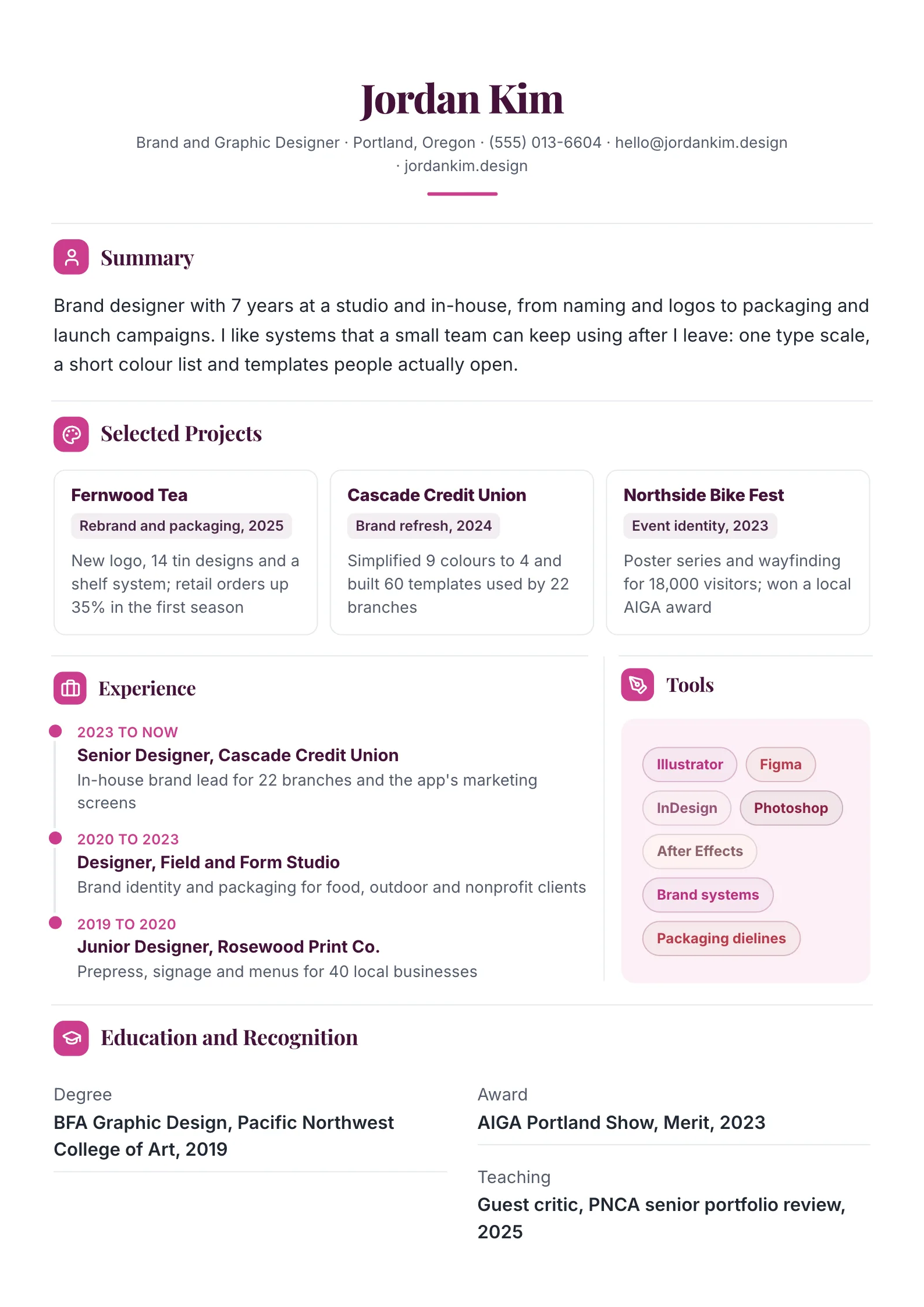
| Brand and graphic designer | Jordan Kim, Portland | Selected Projects before any job history |
| Construction project manager | Aisha Coleman, PMP, Denver | The PMP beside the name and a Delivery block |
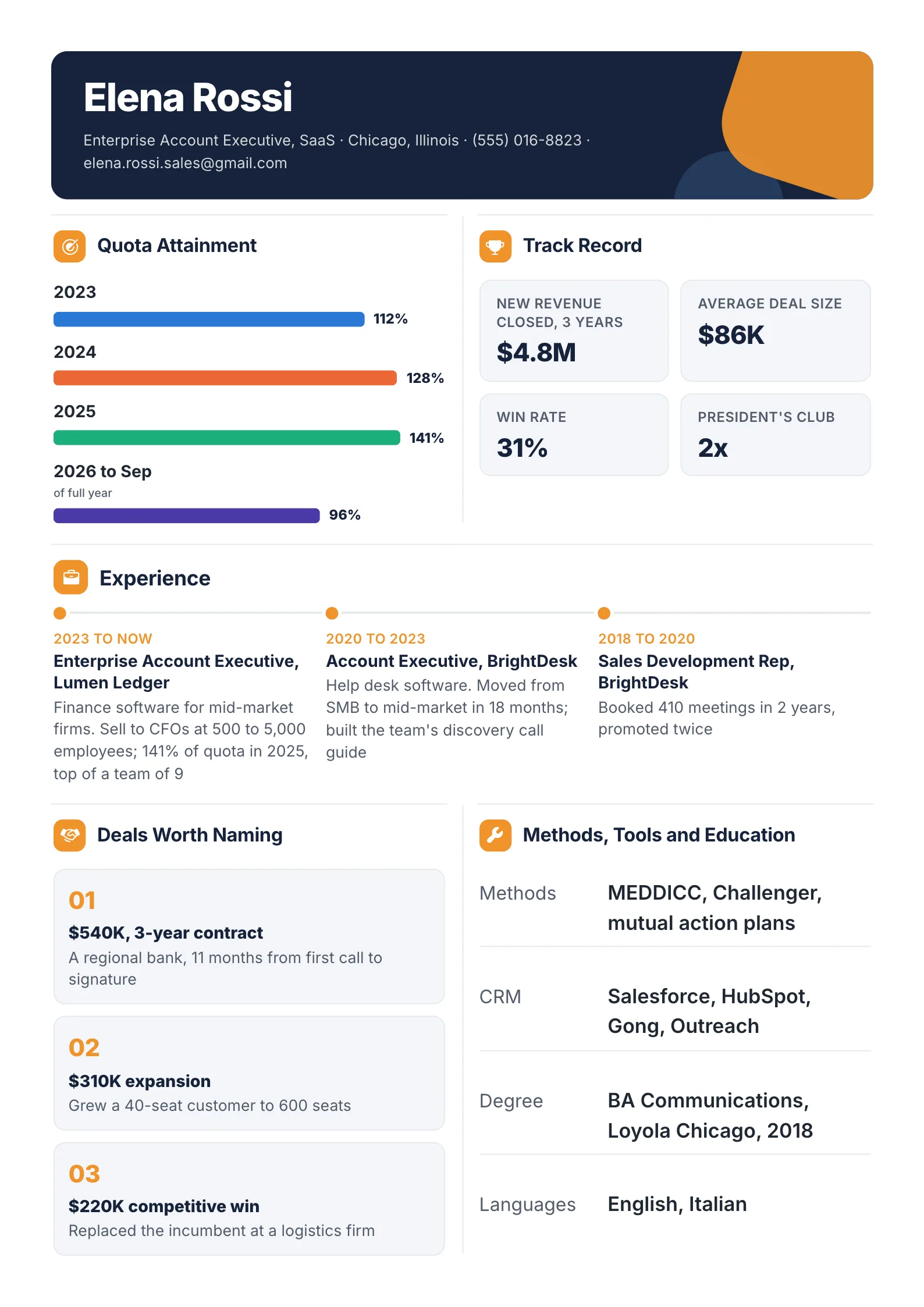
| Enterprise account executive | Elena Rossi, Chicago | Quota attainment, before anything else |
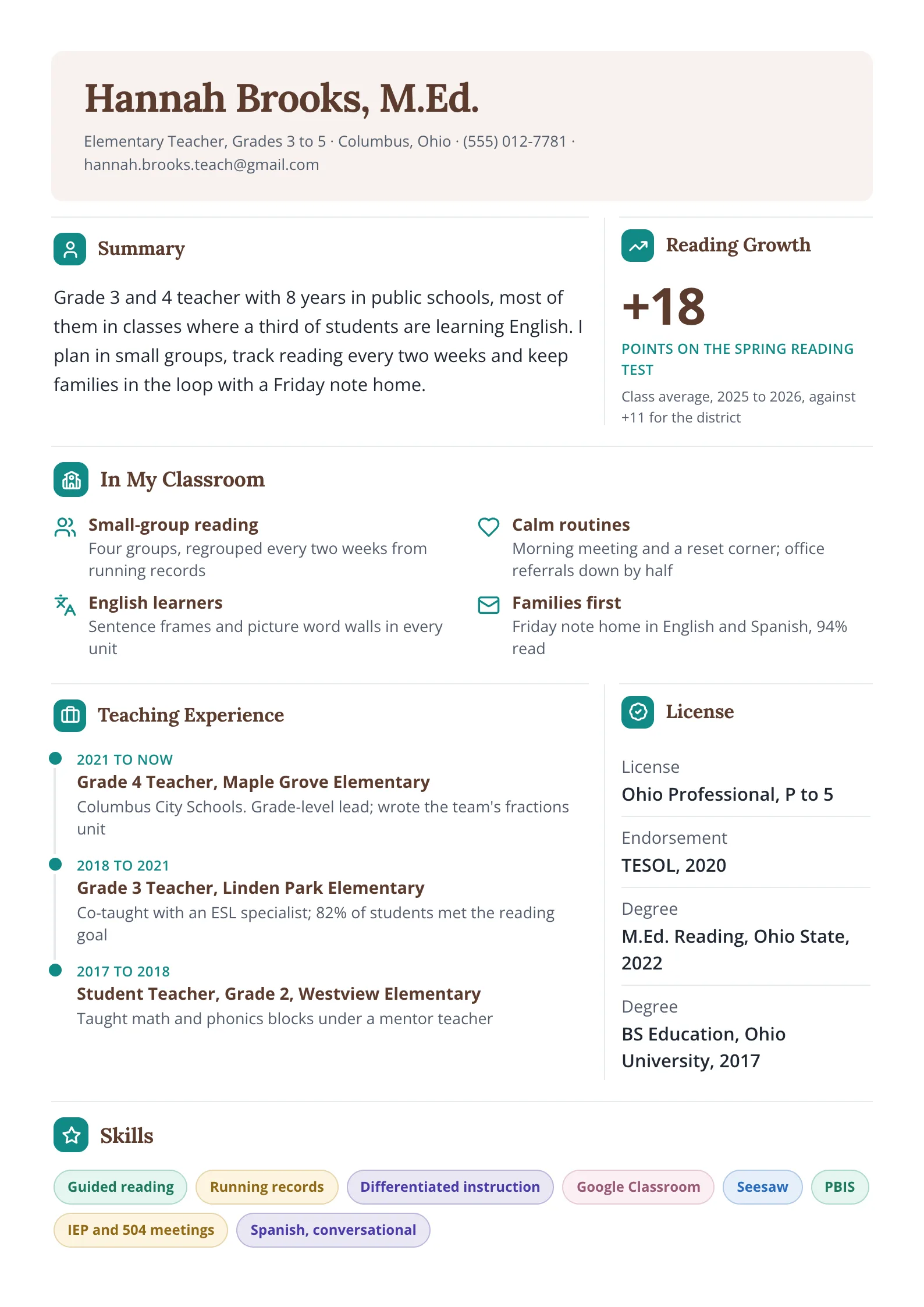
| Elementary teacher, grades 3 to 5 | Hannah Brooks, M.Ed., Columbus | Her students' reading growth |
| ICU registered nurse | Marisol Vega, RN, BSN, CCRN, Phoenix | Her credentials beside her name and 7 years at the bedside |
What a federal resume asks for that others skip
If you apply for a job on USAJOBS, your resume is read against a stricter list. Federal agencies cap resumes at two pages under the Office of Personnel Management's Merit Hiring Plan, dated May 29, 2025. The Treasury Department's resume tips and NIST's application guide spell out the details. Here's what they ask for, beside how many of the six career center guides ask for the same thing.
| What federal guidance asks for | In its words | Career center guides that ask too |
|---|---|---|
| Hours a week for every job | "The number of hours you worked per week." | 0 of 6 |
| Series and grade for past federal jobs | "Series and grade for federal jobs only." | 0 of 6 |
| The job post's exact words | "You need to use the words MS Project in your resume." | 3 of 6 say to use key words |
| No acronyms or shorthand | "The hiring agency will not make assumptions about what's in your resume." | 1 of 6 warns against jargon |
| A hard page limit | "USAJOBS will not allow you to upload or build resumes longer than two pages." | 3 of 6 say one page for students |
| No photo or personal details | "Social Security Number (SSN)", "Photos of yourself", "Personal information, such as age, sex, religious affiliation" | 2 of 6 say to skip photos or images |
NIST adds the reason behind most of these rules. Its reviewers "cannot infer experience from job titles or general statements," so your page has to state the hours, the dates and the result in full. If Samuel applied for a federal job, his one-page resume would need a line of hours for each job and a month on every date. It would still fit inside two pages.
What 6 career centers agree on
We read resume guides from six schools, Pepperdine's Seaver College, Cal State San Bernardino, the University of Maine, Penn, Illinois Tech and Governors State. Then we counted how many gave each piece of advice.
| Advice | Guides that give it |
|---|---|
| Tailor your resume to the job | 6 of 6 |
| Keep the format consistent | 6 of 6 |
| Proofread for spelling and grammar | 6 of 6 |
| Start each bullet with an action verb | 5 of 6 |
| List your newest experience first | 5 of 6 |
| Include volunteer work, class projects or activities | 5 of 6 |
| Use body text of 10 points or larger | 5 of 6 |
| Put numbers on your results | 3 of 6 |
| Keep it to one page as a student or new graduate | 3 of 6 |
| List your GPA only above a cutoff | 2 of 6 |
| Leave high school off in college | 2 of 6 |
| Keep references off the page | 2 of 6 |
The surprise is the numbers row. Only half the guides tell you to quantify, yet every example above leans on numbers more than anything else. Pepperdine's guide shows why with its own sample bullet, a tracking system that cut costs by 30% and added $50K in revenue. Of everything below the top three rows, that habit changes a page the most.
Three lines at the top
Fonts and layout can wait. The lines that carry your resume are the three at the top: your name, the credential or fact your field checks, and your strongest result with a number. For Aiden that's his hours, for Ray it's his license, and for Samuel it's the close he cut from 9 days to 5.
Which resume design you choose in MakeOnepagers matters far less than those three lines. Check the second one against each job post you answer. A posting that asks for a commercial driver's license, a security clearance or weekend shifts has just told you what that line should say.
Frequently asked questions
How long should my resume be?
One page suits most students and people early in their careers. Three of the six career center guides say so outright, and Illinois Tech suggests a second page only after five years of full-time work. Federal jobs allow up to two. Our one-page resume guide shows you how to fit more on your single sheet without shrinking the type.
Should I put my GPA on my resume?
Put it on while you're in school or just out, if it clears the bar your field expects. After a few years of work, a result with a number, like Samuel's 9-day close cut to 5, tells your reader more than a GPA.
Do I need references on my resume?
Usually not. Governors State calls the line "references available upon request" unnecessary, and Maine says to put references on a separate page. A first-time job seeker like Aiden is the exception, since a coach or volunteer coordinator may be your only proof of how you work.
Can I send the same resume to every job?
All six guides say no. Change your summary and the order of your results for each job, and borrow the posting's own words for your skills. Before an interview, our interview one-pager guide helps you build a matching page to bring along.




