Research Summary Examples, and the Word Caps Even CDC Runs Past
Five research summary examples by kind of study, plus the word caps CDC, PLOS and ClinicalTrials.gov set. All 5 CDC summary boxes we counted ran over the cap.

A research summary has a word cap, and even the people who set the cap run past it. We counted the summary boxes on 5 recent reports in CDC's weekly journal, MMWR, and all 5 went over CDC's own limit. On ClinicalTrials.gov it's the reverse. In 100 new registry entries, the median summary used 109.5 words of a 5,000-character allowance. Start from a free one pager template.
One‑Pager examples
Real One-Pagers made with MakeOnepagers. Open any one to edit it as your own.
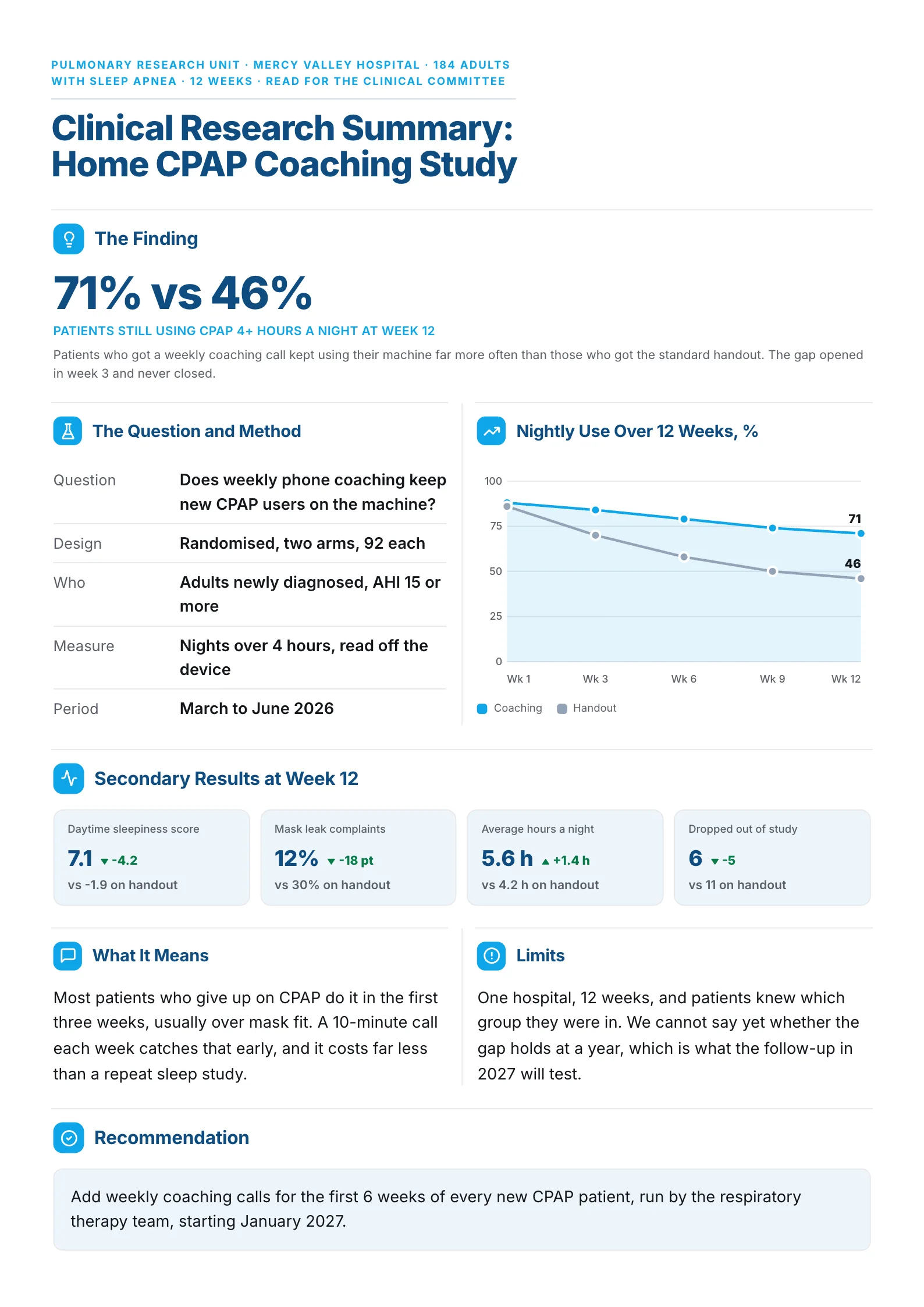 Research Summary: Clinical StudyEdit for free(opens in a new tab)
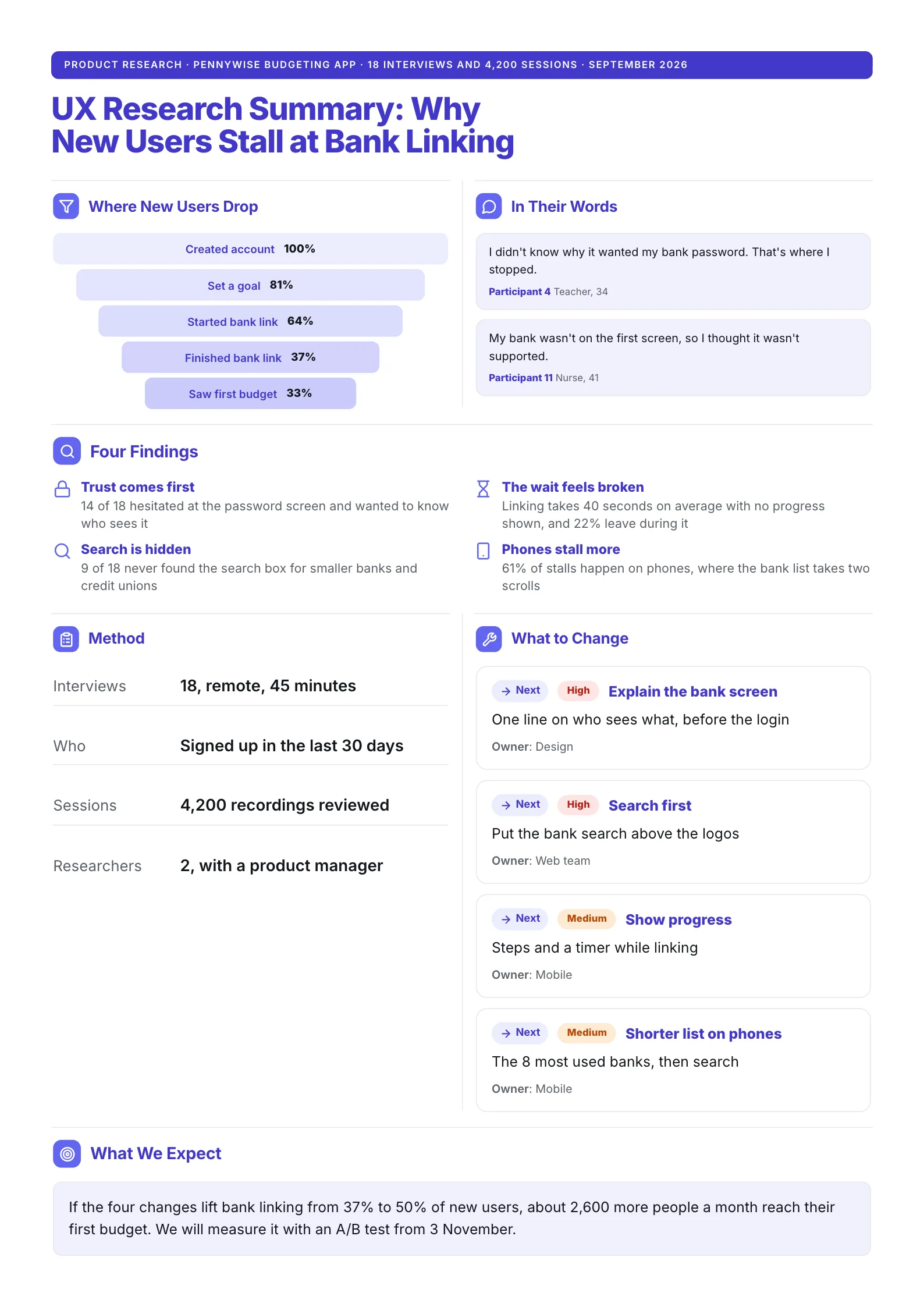 Research Summary: UX InterviewsEdit for free(opens in a new tab)
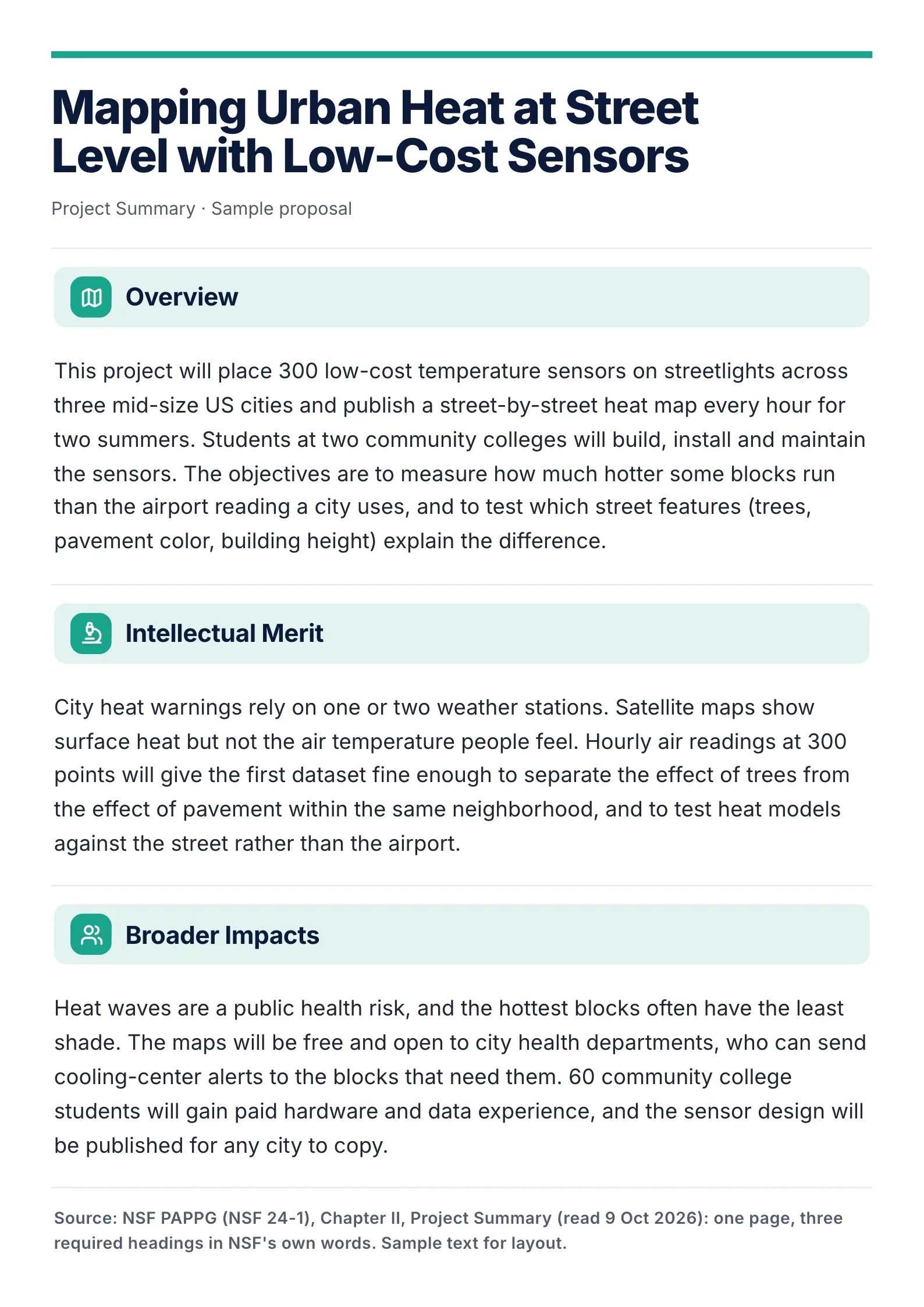 Research Project SummaryEdit for free(opens in a new tab)
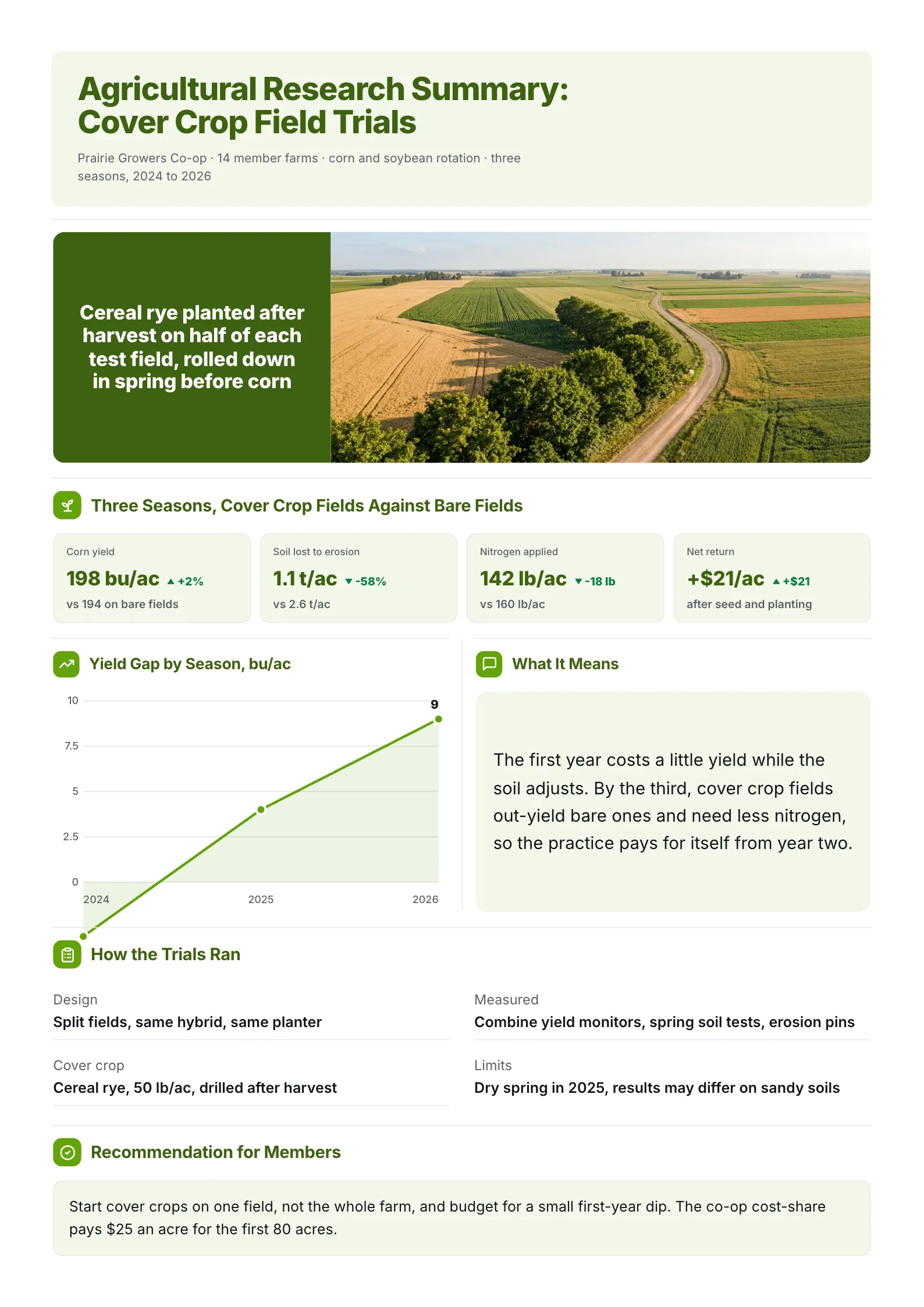 Research Summary: Farm Field TrialsEdit for free(opens in a new tab)
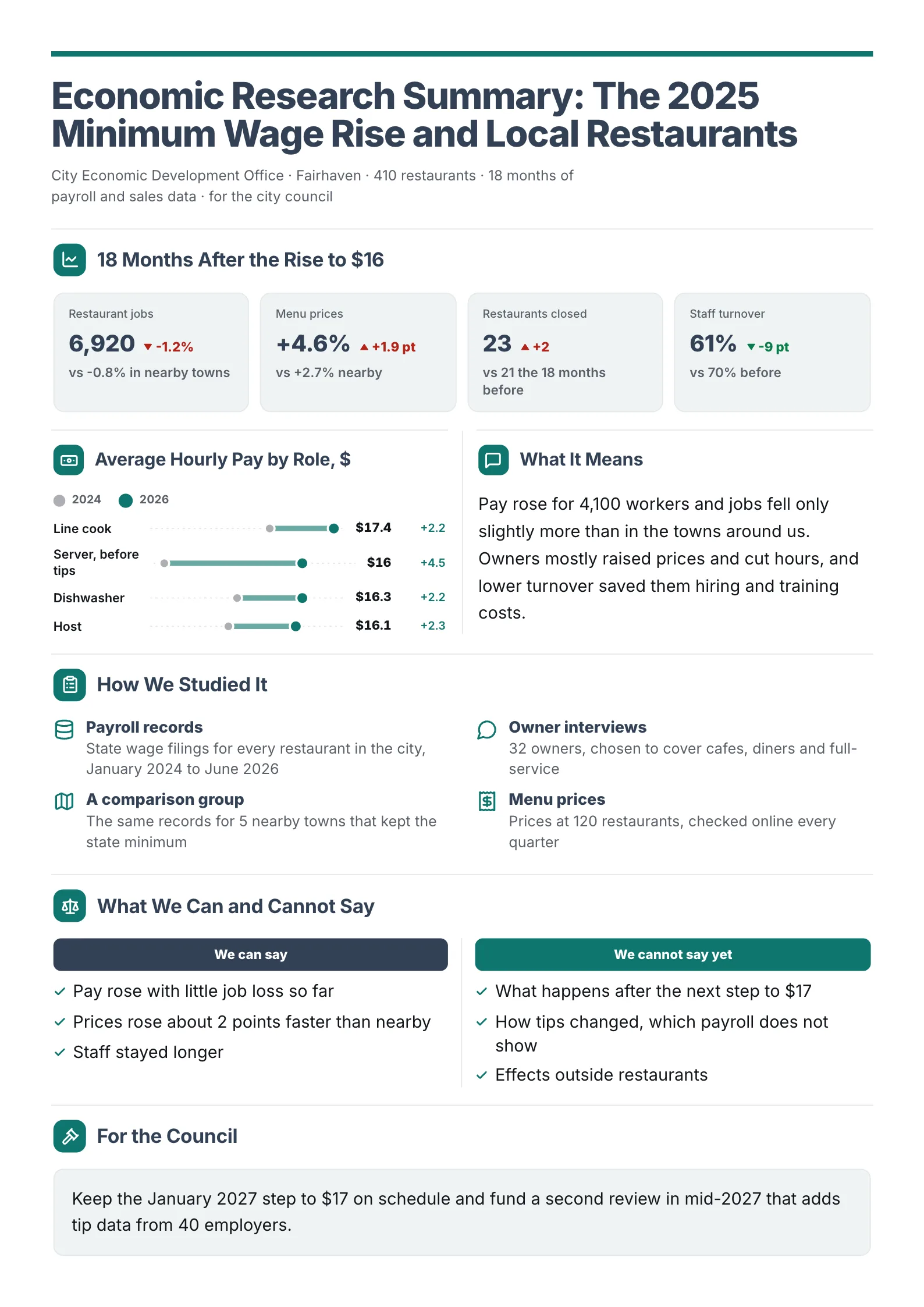 Research Summary: Economic Impact StudyEdit for free(opens in a new tab)
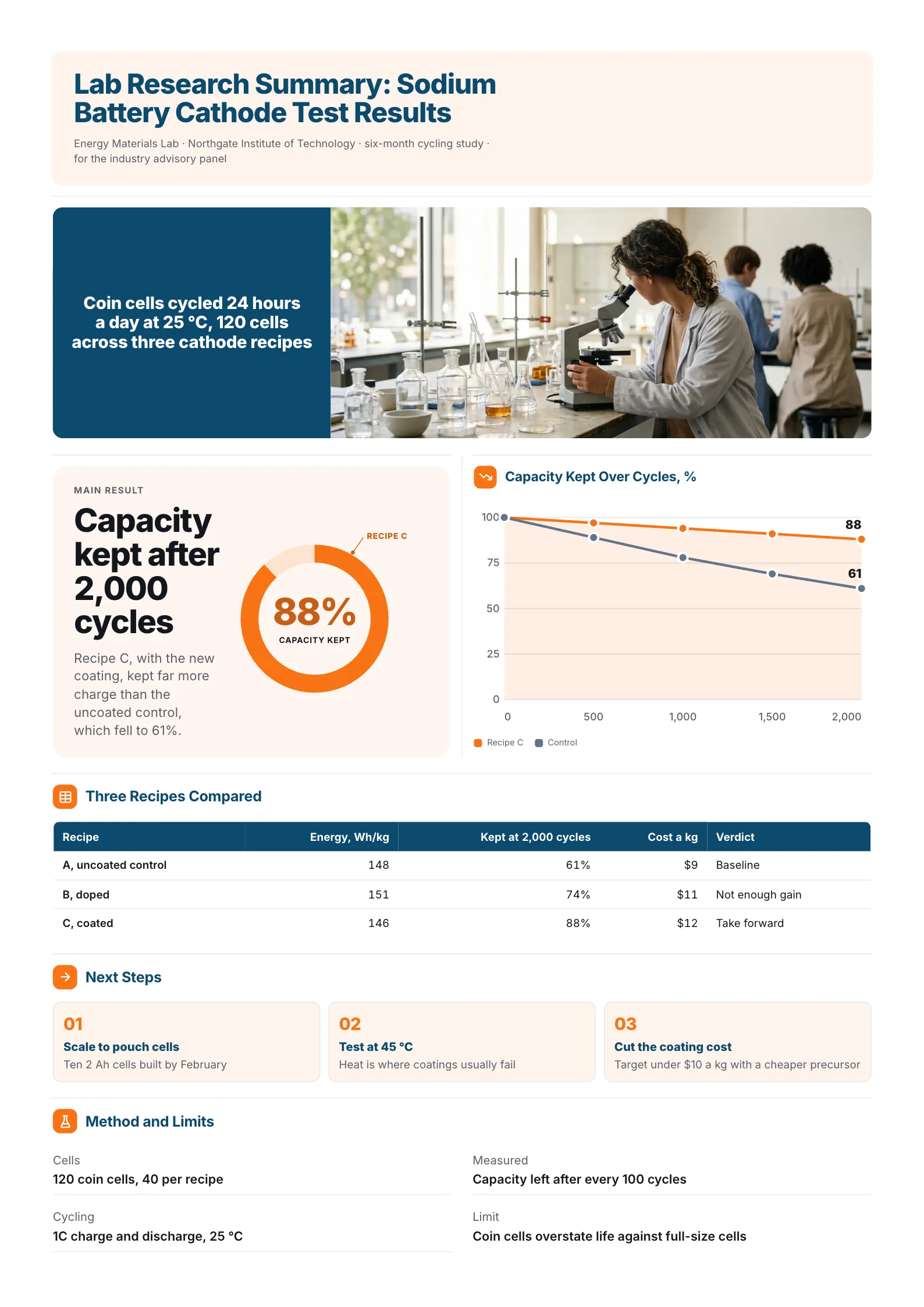 Research Summary: University Lab ResultsEdit for free(opens in a new tab)
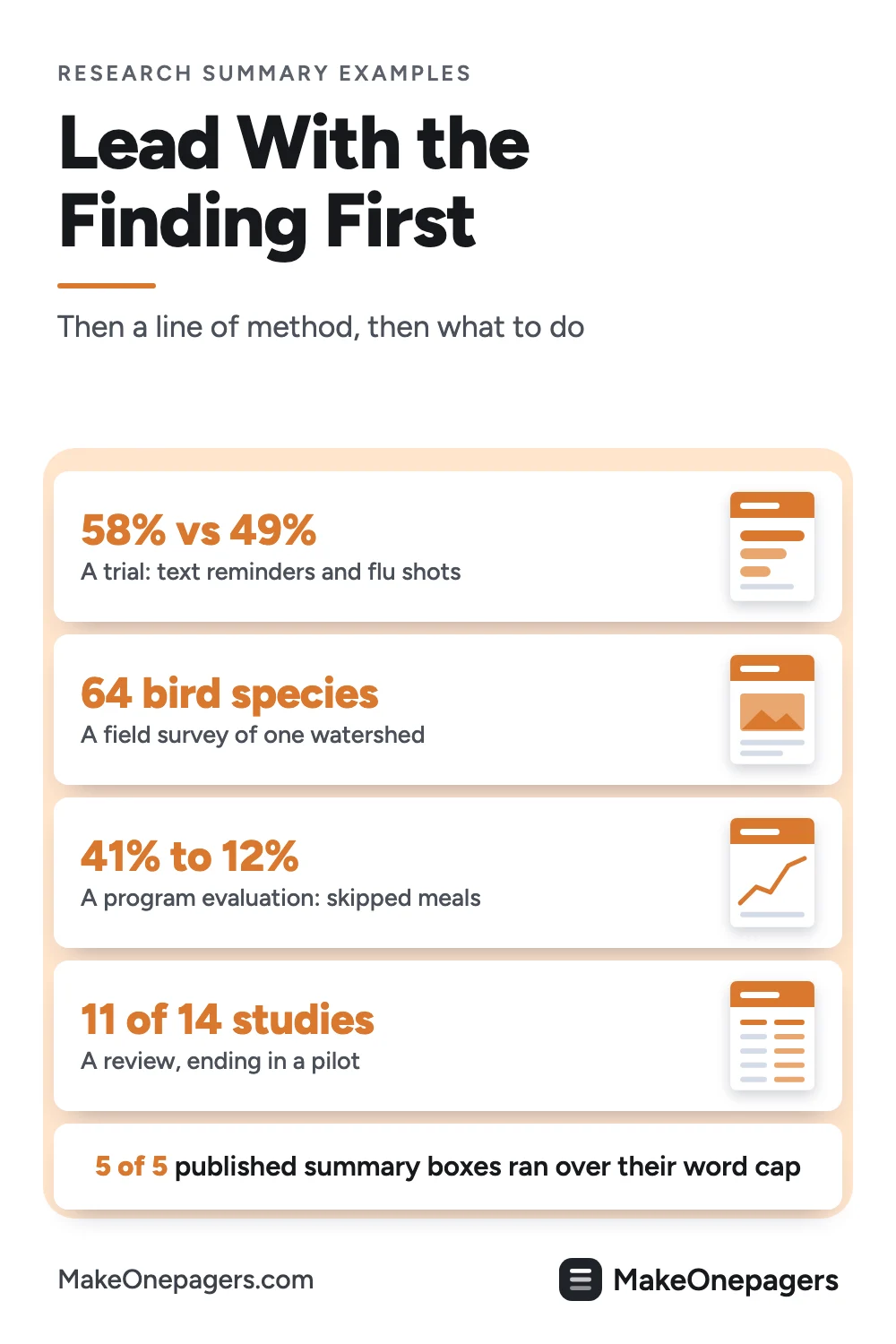
So the job is to say the finding, the method and the next step in 100 to 150 words, about the length of this paragraph and the one above it. The five examples below from MakeOnepagers show how, one for each kind of study: a trial with one comparison, a field survey, a program evaluation, a review of many studies and a summary of someone else's paper. The steps, in the order you take them, are in our guide on how to write a research summary.
Summaries built on one headline number
 Edit this template
Sample names and figures. Swap in your own study and keep the layout.
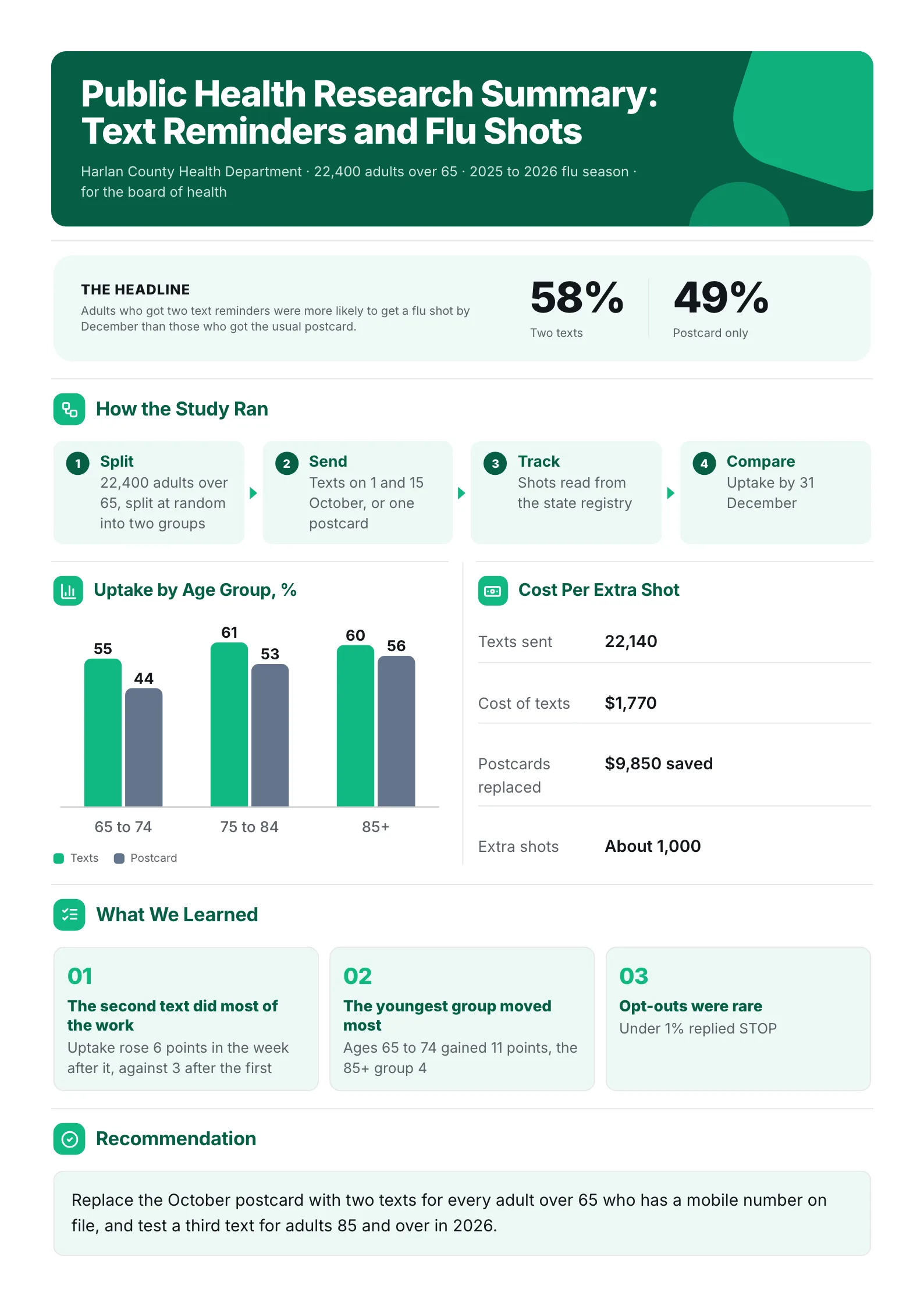
Your public reader may stop after the headline, and this flu shot summary makes the headline count. The headline is a gap you can see from across the room. Among adults over 65, 58% of those who got two text reminders had a flu shot by December 31, against 49% of those who got a postcard.
Everything after that headline answers a question a board member or a reporter would ask. How did the study run? In four steps, from splitting 22,400 adults into two groups to comparing who got a shot. What did it cost? The texts came to $1,770 and replaced $9,850 in postcards, for about 1,000 extra shots. The last block turns the result into one recommendation you could vote on.
Use this layout when your reader is a board of health, a city council or a newsletter audience. It suits your study if one clear comparison sits at its heart.
 Edit this template
Figures on this sample are made up for the demo.
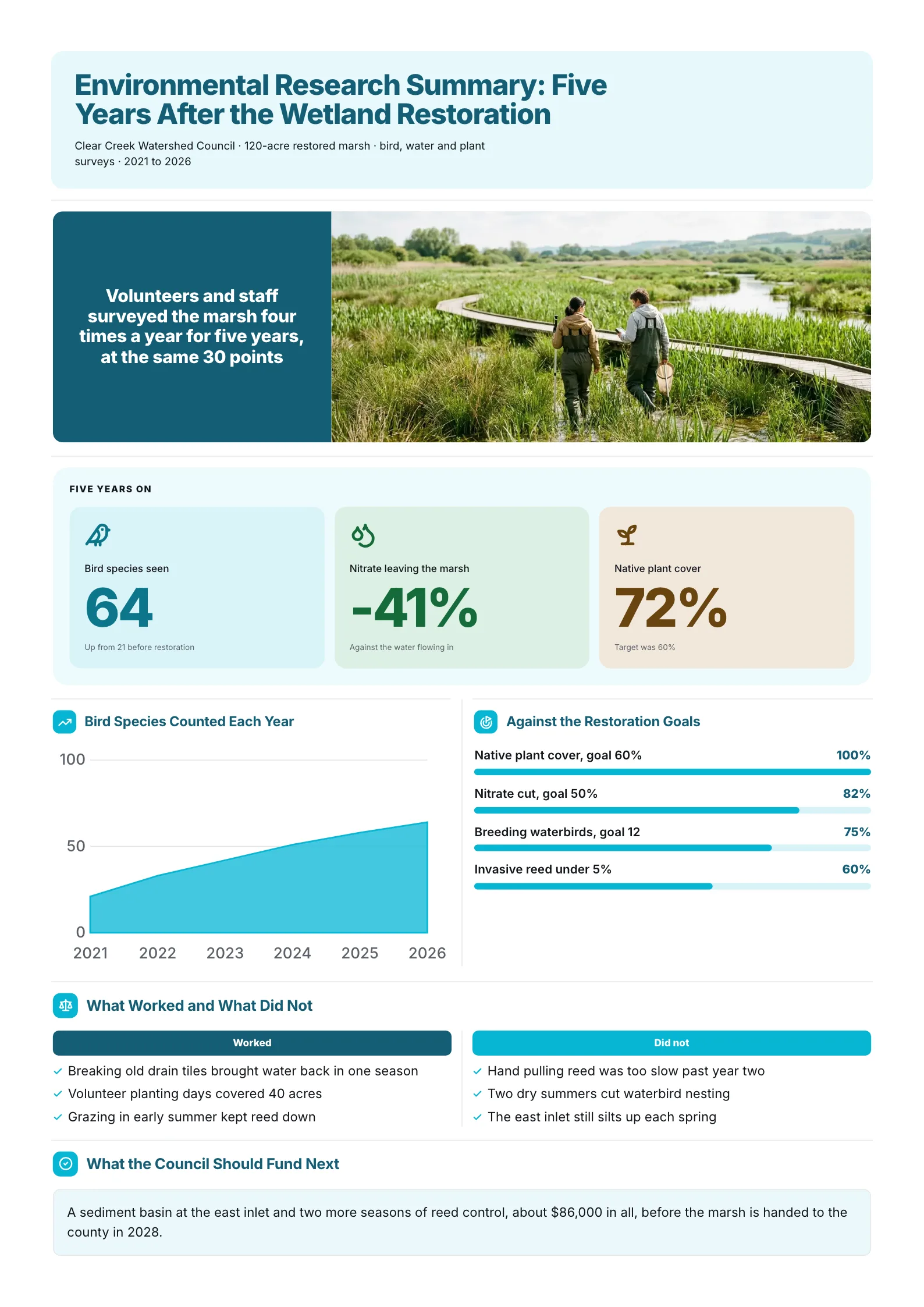
The wetland summary speaks to neighbors and the local council, so it opens with a photo of volunteers working in the marsh. Then come the big numbers. Bird species rose to 64 from 21 before the restoration, nitrate leaving the marsh fell 41%, and native plants now cover 72% of the ground against a 60% goal.
What makes it honest is the split box near the bottom. One side lists what worked, like breaking old drain tiles to bring the water back. The other lists what didn't, including the east inlet that still silts up each spring. Your public reader trusts a summary more when it admits a miss, and this one ends with a costed ask of about $86,000 before the marsh goes to the county in 2028.
A program evaluation that states its limits
 Edit this template
Example data, ready for your own program's results.
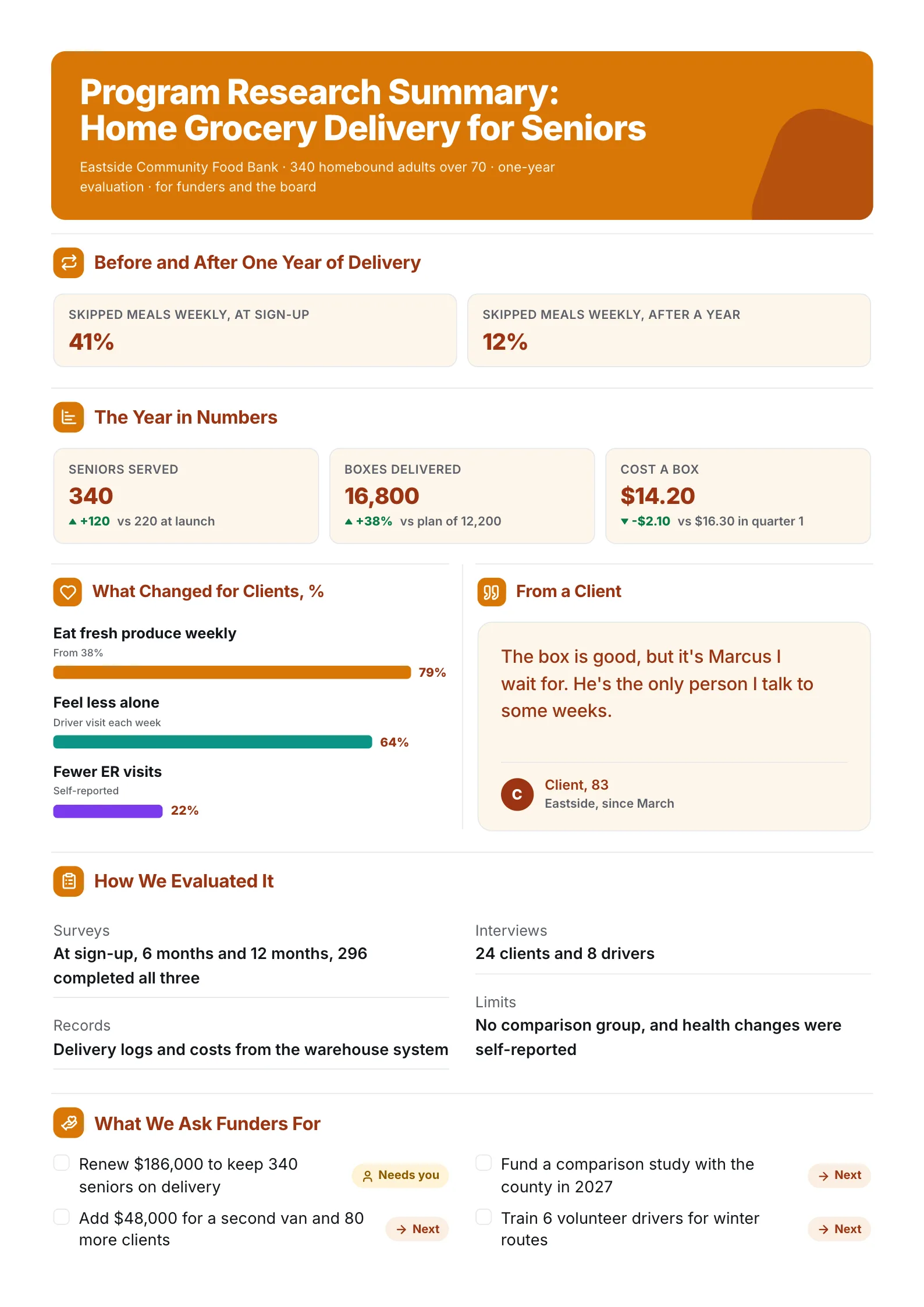
A funder reads your summary to decide whether to pay again. This grocery delivery evaluation answers that in its first block with a before and after. At sign-up, 41% of homebound seniors skipped meals each week, and after a year that fell to 12%.
Money comes next, because it's your funder's second question. The program served 340 seniors and delivered 16,800 boxes against a plan of 12,200. The cost of a box dropped from $16.30 in the first quarter to $14.20. A single client quote follows, short enough to read in one breath.
The method block is the part funders respect most. It says plainly that there was no comparison group and that health changes were self-reported. Then the checklist asks for one renewal of $186,000 and a few smaller items. When you write for a foundation, copy that order: the result, the cost, one human voice, the limits and then the ask.
A review of 14 studies that ends in a pilot
 Edit this template
The company and studies here are invented to show the format.
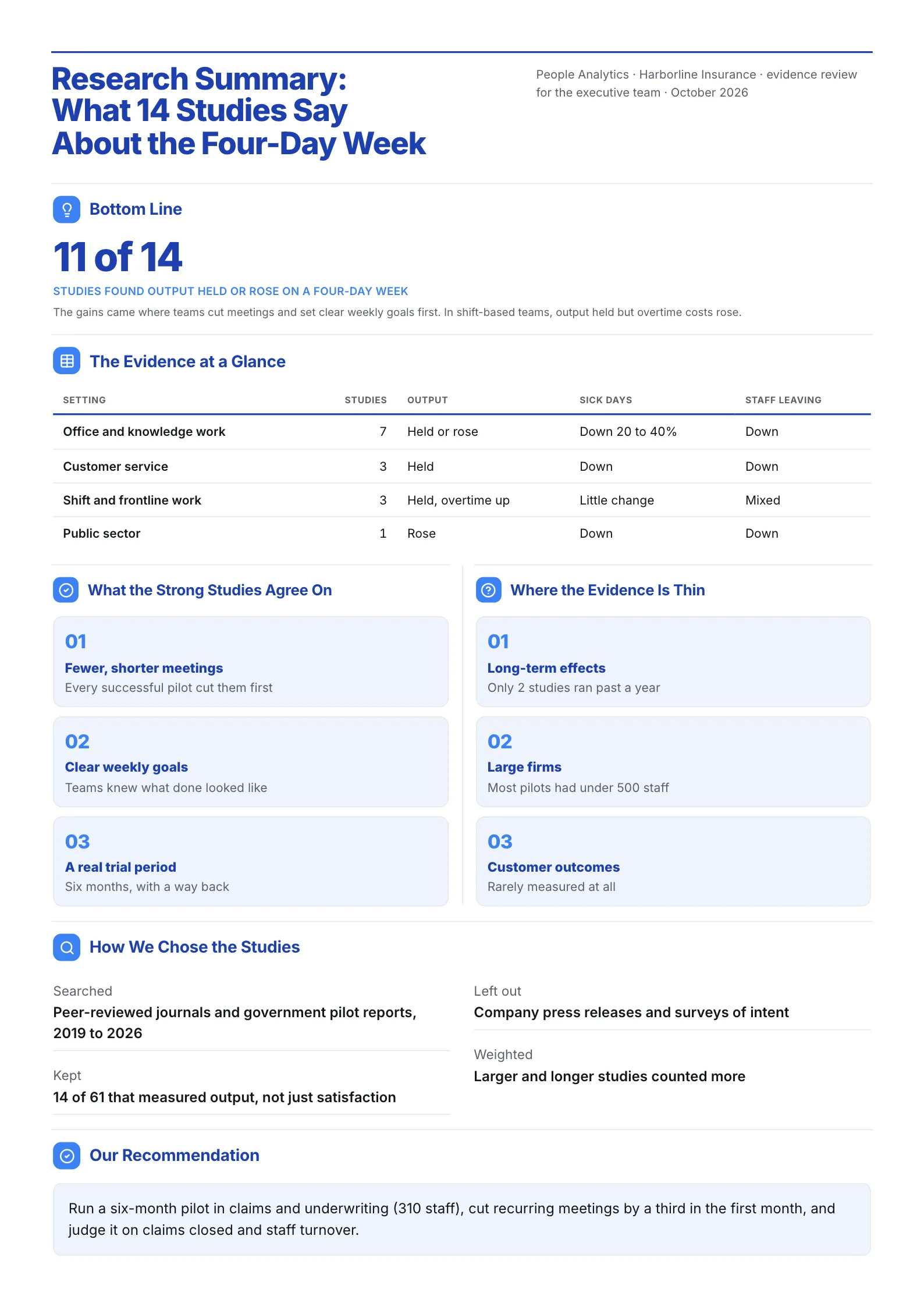
Your manager wants to know what to do on Monday morning. This review of studies on the four-day week opens with the count that matters most, 11 of 14 studies finding that output held or rose. The sentence under it tells your boss where the gains came from, which was teams that cut meetings and set weekly goals first.
The evidence table sorts the studies by setting. If you manage shift workers, you see right away that output held there but overtime costs rose. Two short lists follow, one for what the strong studies agree on and one for where the evidence runs thin. Only 2 studies ran past a year, and the summary says so out loud.
It closes on a pilot with a size and a test. The plan is six months in claims and underwriting, covering 310 staff, judged on claims closed and staff turnover. That's a decision your manager can approve in one meeting.
A summary of someone else's paper
 Edit this template
Student, course and journal details are samples.
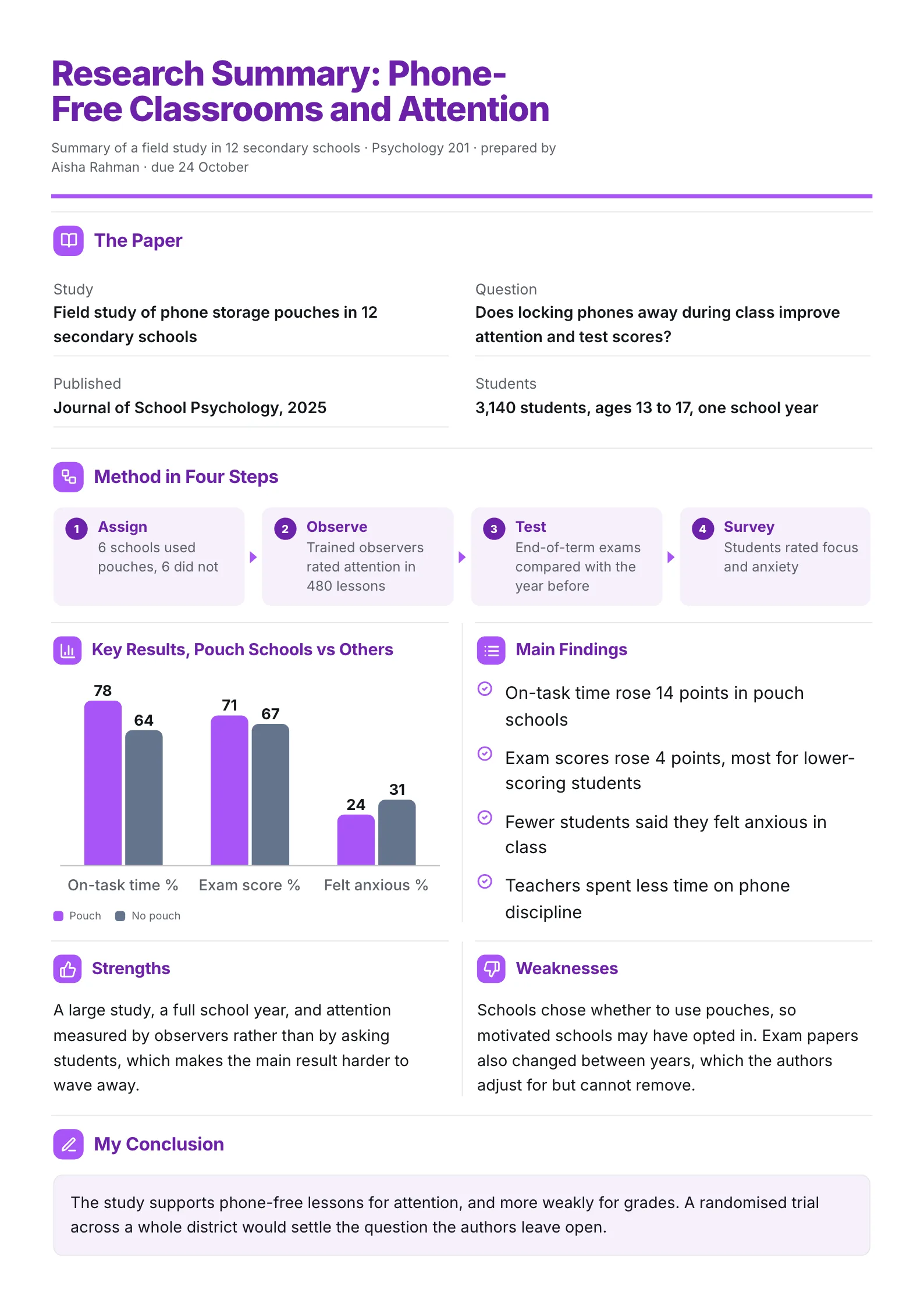
When you summarize someone else's paper for a class, your professor grades two things. Did you understand it, and can you judge it? This summary of a phone pouch study in 12 schools shows both on one page.
The top block names the study, the journal, the question and the sample of 3,140 students. The chart puts the key results side by side, with on-task time at 78% in pouch schools against 64% in the others. Then the page does what many student summaries skip. It gives strengths and weaknesses their own boxes, and it points out that schools chose whether to use pouches, which could tilt the result.
The conclusion is careful in a way teachers like. It says the study supports phone-free lessons for attention, and more weakly for grades. The same hedge fits any summary where the evidence points two ways.
Two real lay summaries, side by side
To show you how professional writers handle the same job, we read two public summaries on October 30, 2026. Both are free to read, and both were written for people outside the field.
| CDC report summary box | ClinicalTrials.gov brief summary | |
|---|---|---|
| Study | Pertussis vaccine report, Alaska, October 15, 2026 | Family Health Promoter, NCT07870304 |
| Written for | MMWR readers, in plainer words that can travel to social media | Anyone browsing the public trial registry |
| Shape | Three set questions, one or two short sentences under each | A goal sentence, what taking part involves, then four numbered questions |
| Length, counted October 30, 2026 | 113 words of answers, 134 with the headings | 103 words, 666 characters |
| Against its own limit | Over the 125-word cap | Far under the 5,000-character cap |
The CDC box is built on three questions. They ask what was already known, what this report adds and what it means for public health practice. CDC's author guide calls the box an abstract of the abstract, which gives you a handy test for your own draft. If a reader saw nothing else, would they know the finding and why it matters?
The registry summary is built for a different reader. Someone scanning a registry wants to know what they'd be asked to do, so the entry says it in one line. Participants use the app for two weeks and then talk about it in an interview. After that come the four questions the study hopes to answer, starting with how easy the app is to use.
Here's the lesson for you. The CDC box is built around a finding because the study is finished. The registry summary leads with a goal because studies are usually registered before there are any results. Match your opening to where your research stands today.
Word limits, publisher by publisher
Your readers may never see a word count, but your editor will. These are the caps you may be held to, as we read them at each source on October 30, 2026.
| Publisher | Summary type | Limit |
|---|---|---|
| CDC, MMWR | Summary box on a full report | 125 words, headings included |
| CDC, MMWR | Summary box on a Notes from the Field report | 100 words, headings included |
| CDC, MMWR | Abstract | 150 to 200 words |
| PLOS Computational Biology | Author summary, written in the first person | 150 to 200 words |
| PLOS Computational Biology | Abstract | Up to 300 words |
| ClinicalTrials.gov | Brief summary | 5,000 characters |
| ClinicalTrials.gov | Brief title | 300 characters |
The CDC caps are tight, and the writers go over them. We counted the boxes on five reports from 2026. With headings, the three longer reports, on pertussis, measles and a transplant virus, came to 134, 152 and 139 words against a 125-word cap. The two Notes from the Field boxes, on strep and dengue, came to 147 and 124 words against 100.
ClinicalTrials.gov runs the other way. Its cap is loose, and writers stay far below it, so you're unlikely to hit it. In 100 studies first posted between October 1 and 28, 2026, the median brief summary ran 109.5 words, and 44 came in under 100. Only 5 passed 300 words. The longest reached 696 words and still fit, at 4,793 characters.
So 100 to 150 words puts you right where these publishers land in practice. Any spare space on the page earns more as a chart than as more words.
Research summary FAQ
How long should a research summary be?
For a lay reader, aim for 100 to 150 words, and never past 200. That covers the CDC boxes, the PLOS author summary and the median registry summary we counted. A one-page summary with a chart and a short method block can carry more detail, because your reader scans it instead of reading line by line.
What's the difference between an abstract and a research summary?
An abstract is written for your fellow researchers and follows a journal's format. A research summary is written for someone outside your field, like a funder, a manager or a parent. PLOS asks for both and tells you to keep the summary distinct from the abstract, written in the first person.
Should a research summary include limits?
Yes, in a line or two. Three of the five examples above name a limit of the study, from self-reported health changes to schools that picked themselves. When a reader hears about the weak spot from you, they trust the rest of your page. Our research summary templates post shows more ways to fit limits onto one page.
Count your words before you send it
CDC's 100 and 125 words are the tightest summary caps in the table above, and a PLOS author summary may run to 200. Past 150 words, cut the method down to one line and leave the finding alone, since the finding is what your reader came for. A summary you send along with a grant application pairs well with one of our grant summary layouts.
A summary you squeeze into a journal's box stays as plain text. One you hand to a board, a funder or a class can fill a whole page, and every example above is that kind of page, made in MakeOnepagers.




