Grant Summary Template: Free One-Page Grant Summary, With Example
A free grant summary template that puts a proposal on one sheet: the 7 parts funders read first, a worked literacy grant with its budget, and mistakes to avoid.

A grant summary template puts a whole funding request on one sheet: the need, what you will do about it, what it costs, when it happens, what will change and exactly how much you are asking for. Program officers and review panels often read the summary first, and sometimes it is all a board member reads before a vote. Below you'll find the seven parts every grant summary needs and a free template to copy. You'll also see a worked example with a real-looking budget, and the mistakes that get a good project passed over. Start from a free one pager template.
One‑Pager examples
Real One-Pagers made with MakeOnepagers. Open any one to edit it as your own.
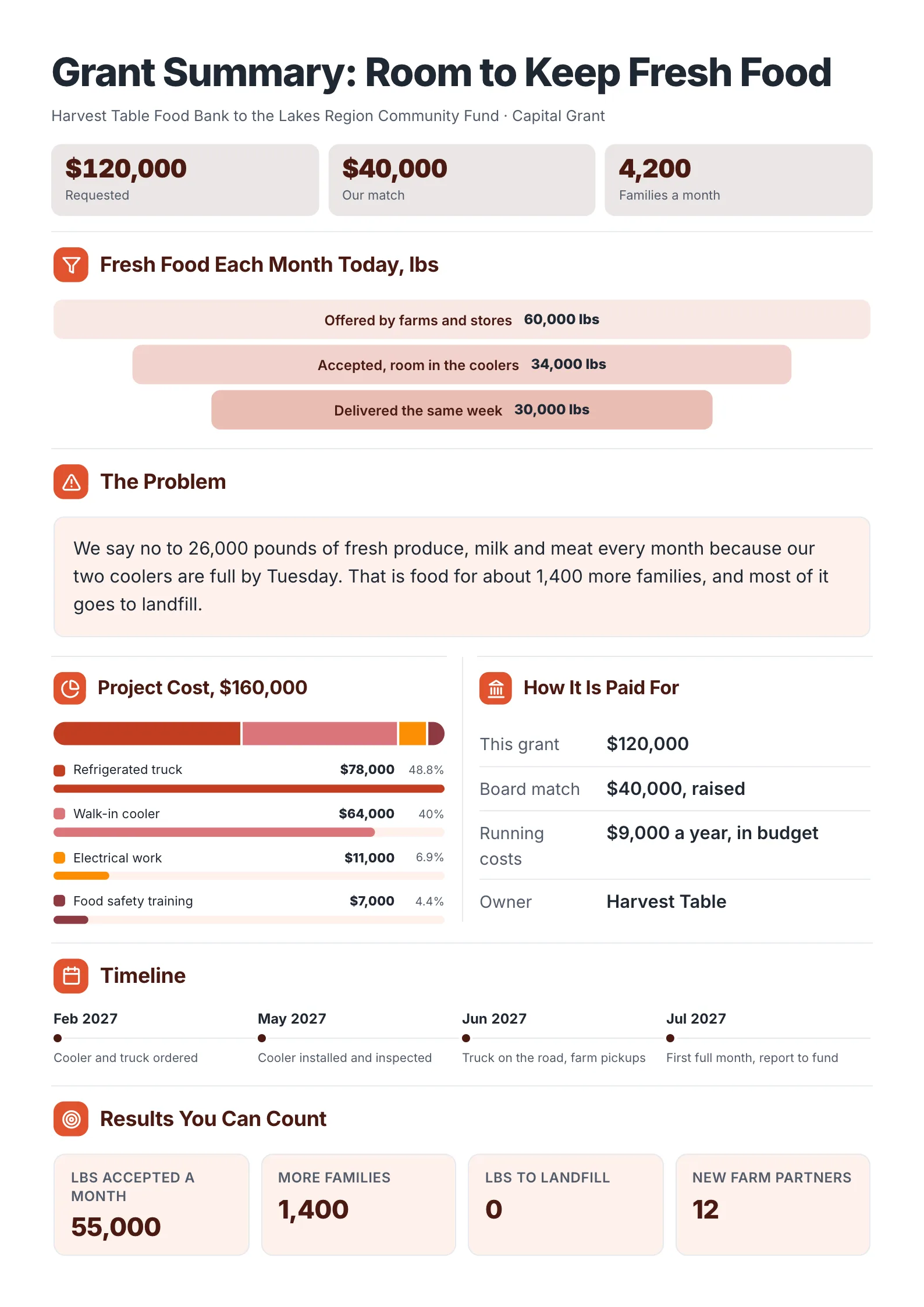 Grant Summary: Food Bank Cold StorageEdit for free(opens in a new tab)
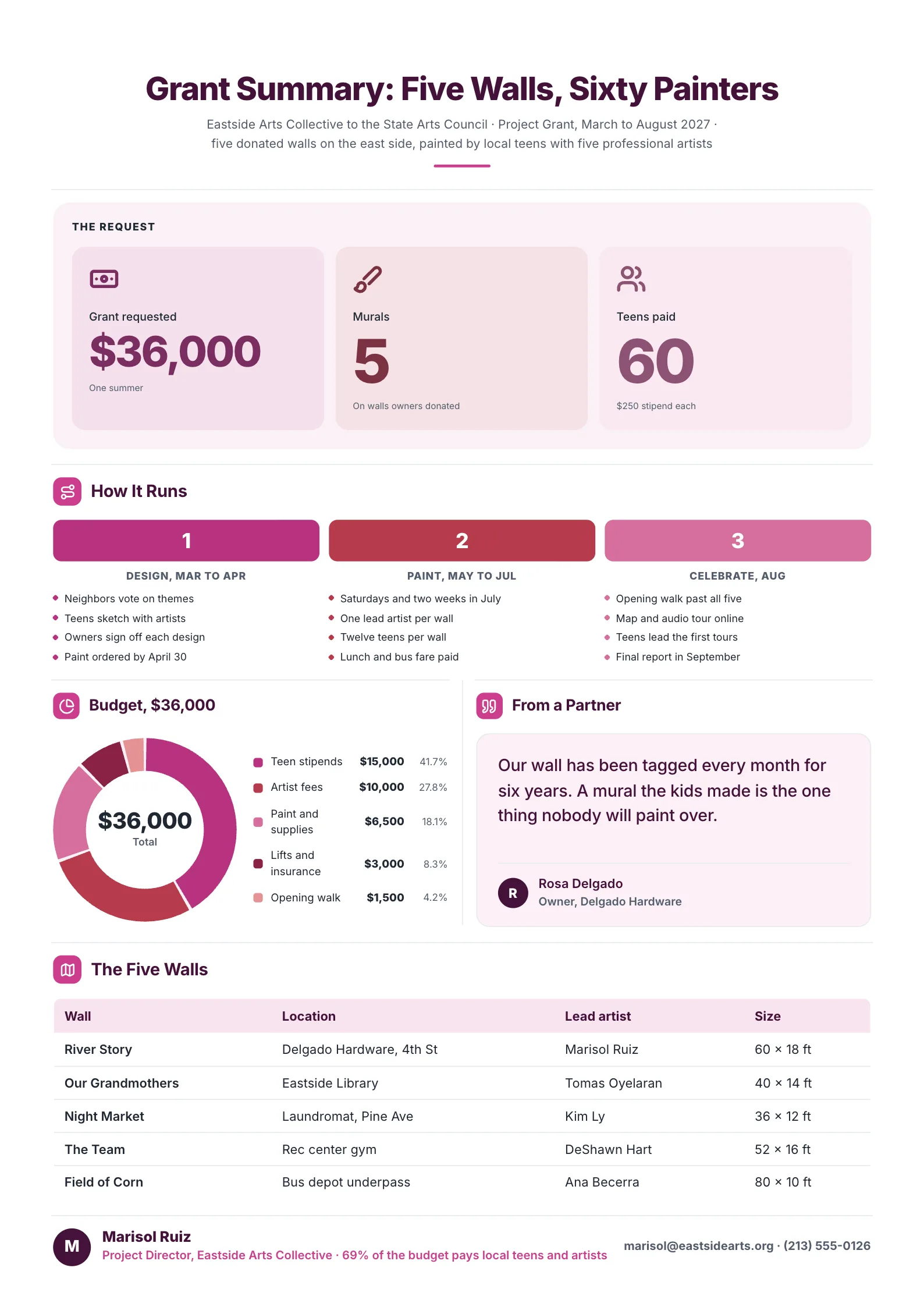 Grant Summary: Public Art Mural ProjectEdit for free(opens in a new tab)
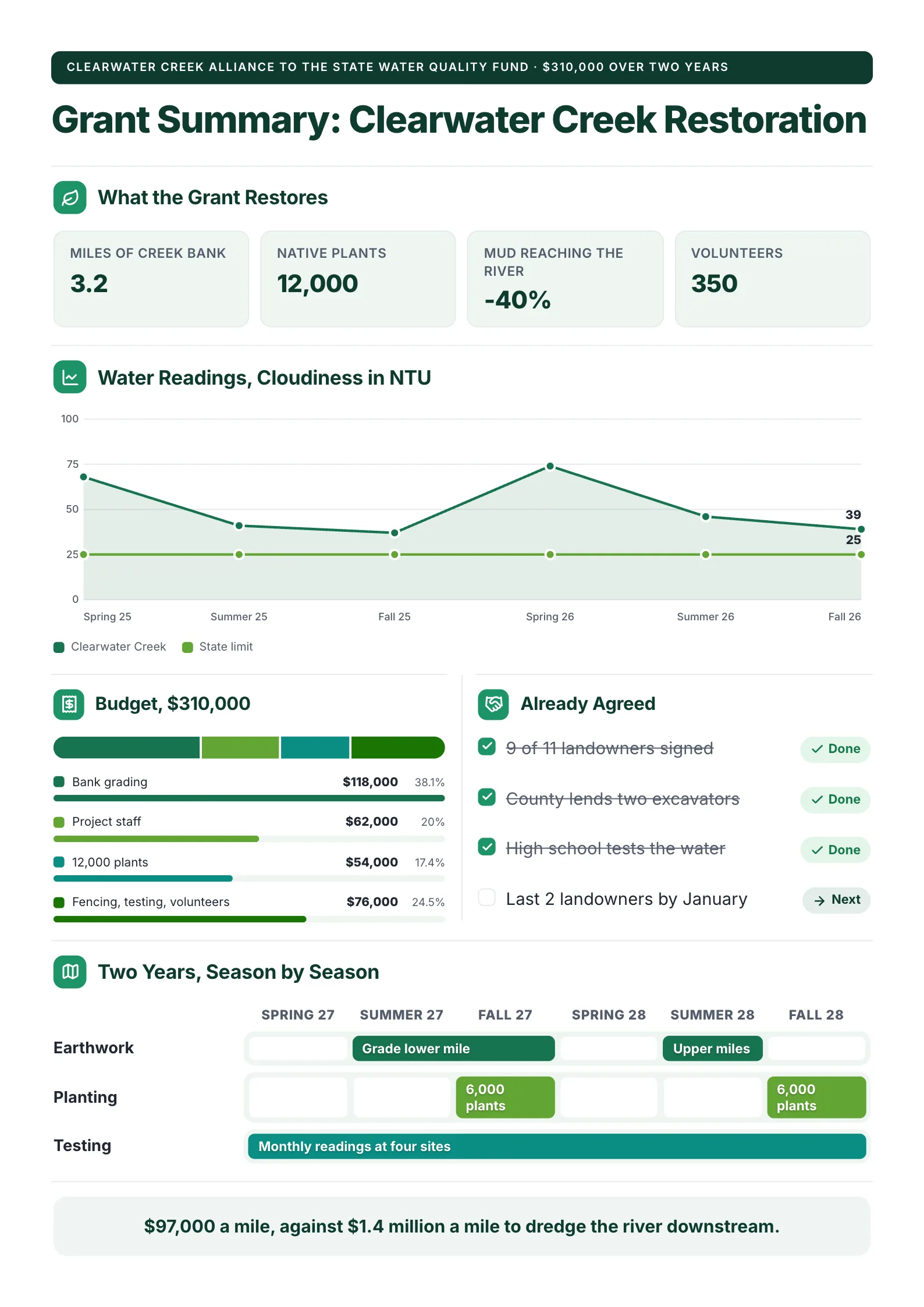 Grant Summary: Watershed RestorationEdit for free(opens in a new tab)
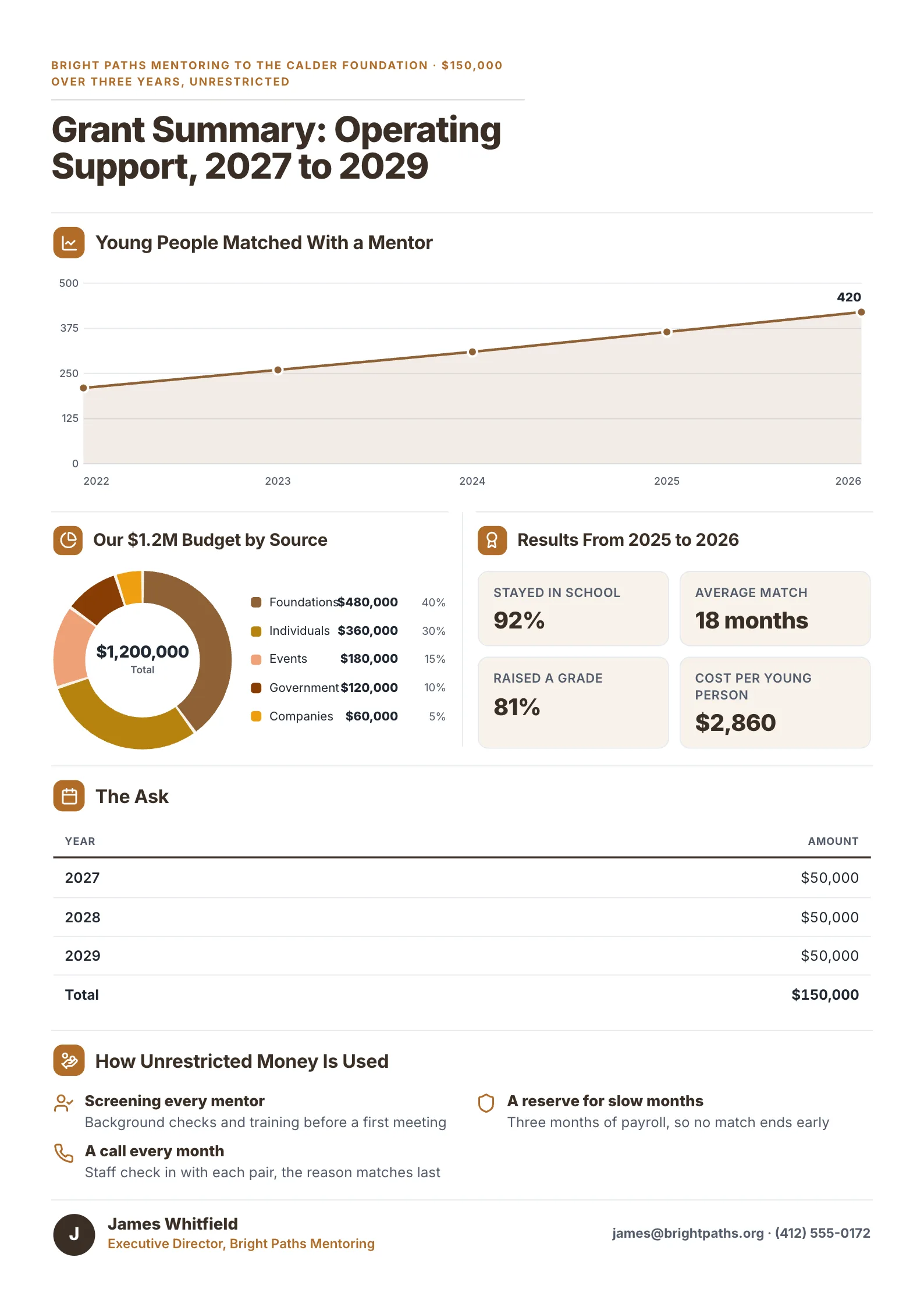 Grant Summary: General Operating SupportEdit for free(opens in a new tab)
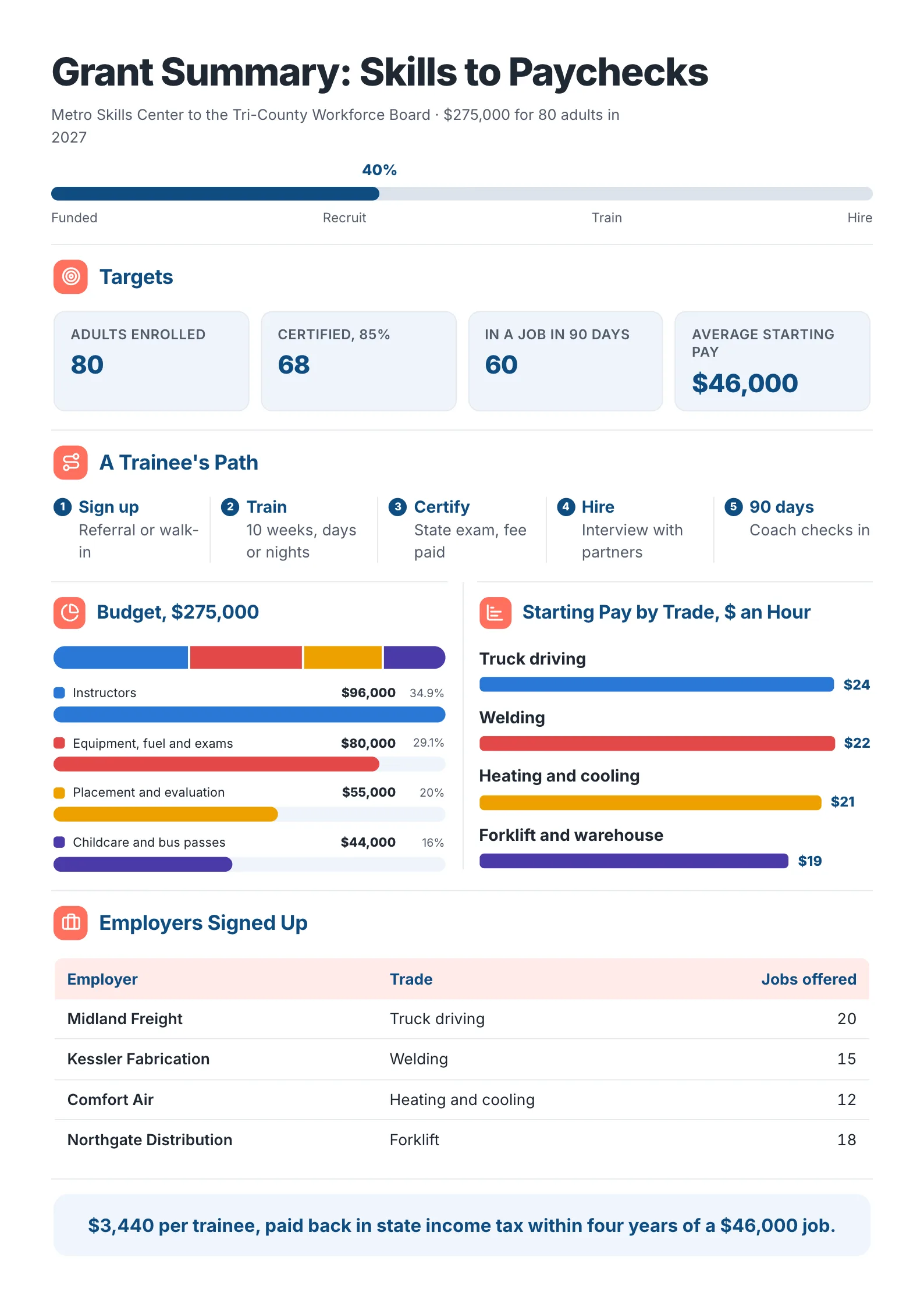 Grant Summary: Workforce Training ProgramEdit for free(opens in a new tab)
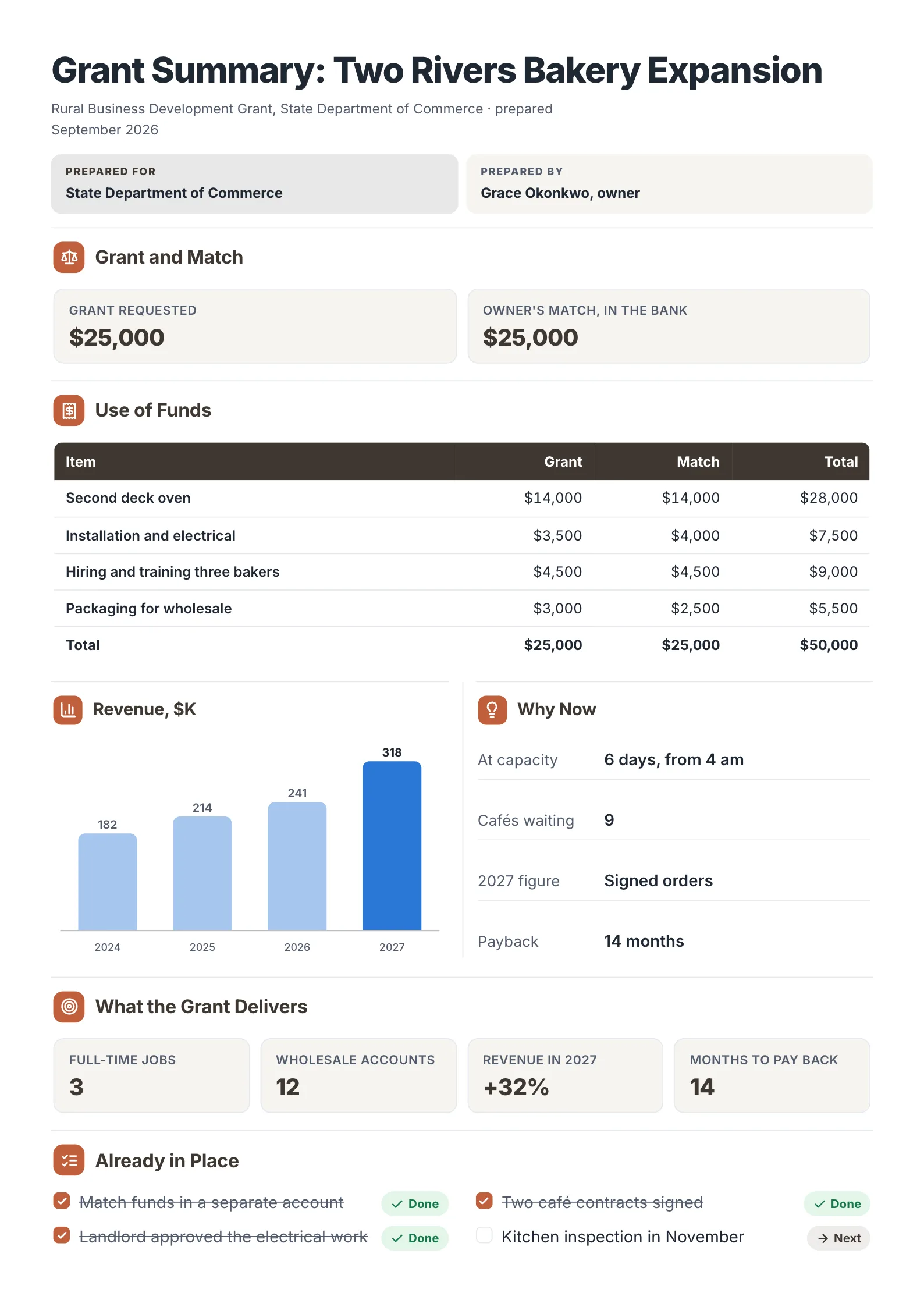 Grant Summary: Small Business ExpansionEdit for free(opens in a new tab)
Every example was made with MakeOnepagers, and each one opens as a template you can edit for free.
What is a grant summary?
A grant summary is the short version of a grant proposal. Funders call it different things: an executive summary, a project summary, an abstract or a proposal summary. The job is the same. On one sheet, it answers the questions every reviewer asks:
- What problem are you solving, and for whom?
- What exactly will you do?
- How much will it cost, and what does the money buy?
- When will it happen?
- How will you know it worked?
You'll often need a second kind of grant summary later. That's the grant summary report, written after the money is spent, which compares what you promised with what happened. The structure below covers the proposal. The report section near the end covers the follow-up.
One rule beats every template. If your funder publishes its own summary format, word limit or headings, use theirs exactly. A summary that ignores the funder's instructions is often screened out before anyone reads it.
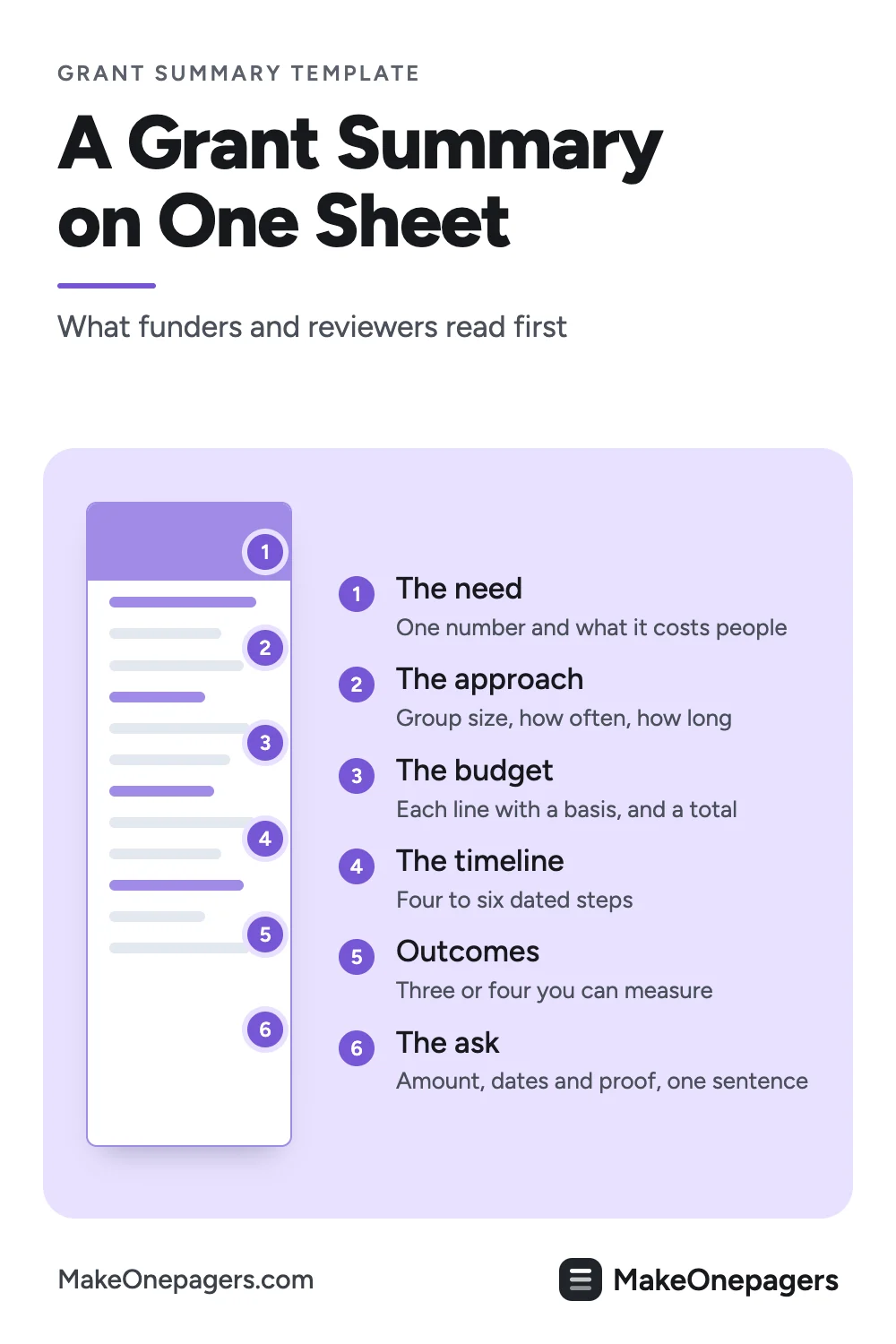
The 7 parts of a grant summary
- A title that names the project and the people it serves. "Read to Rise: Summer Literacy for Grades 2 to 4" says more than "Literacy Initiative."
- The applicant and the funder, with the funding cycle. Reviewers sort by these.
- The need, with one number. "38% of grade 2 to 4 students in Cedar Valley read below grade level." Name where the number comes from in the full proposal.
- The approach, as three to five concrete actions. Who does what, how often and for how long.
- The budget, line by line, with the basis for each line and a total that adds up.
- The timeline, as four to six dated steps from start to final report.
- Outcomes and the ask. Three or four outcomes you can measure, then the request in one sentence: amount, dates and your evidence it works.
A free grant summary template
| Part | What to write, with an example |
|---|---|
| Title | Project and who it serves. Read to Rise: Summer Literacy for Grades 2 to 4 |
| Applicant and funder | Brightpath Reading Alliance, Cedar Valley Community Foundation, 2027 cycle |
| The need | One number and what it costs people. 38% read below grade level |
| Approach | 3 to 5 actions. Groups of 6 with a trained coach, 4 mornings a week |
| Budget | Line, basis, amount. Reading coaches, 6 coaches for 10 weeks, $21,600 |
| Timeline | 4 to 6 dates. Mar enroll, Jun program opens, Sep final report |
| Outcomes | 3 or 4, measurable. 75% hold or gain a reading level |
| The ask | One sentence. Fund $48,500, 1 March to 30 September 2027 |
| Contact | Name, phone, email |
Grant summary example: a summer literacy program
 Edit this template
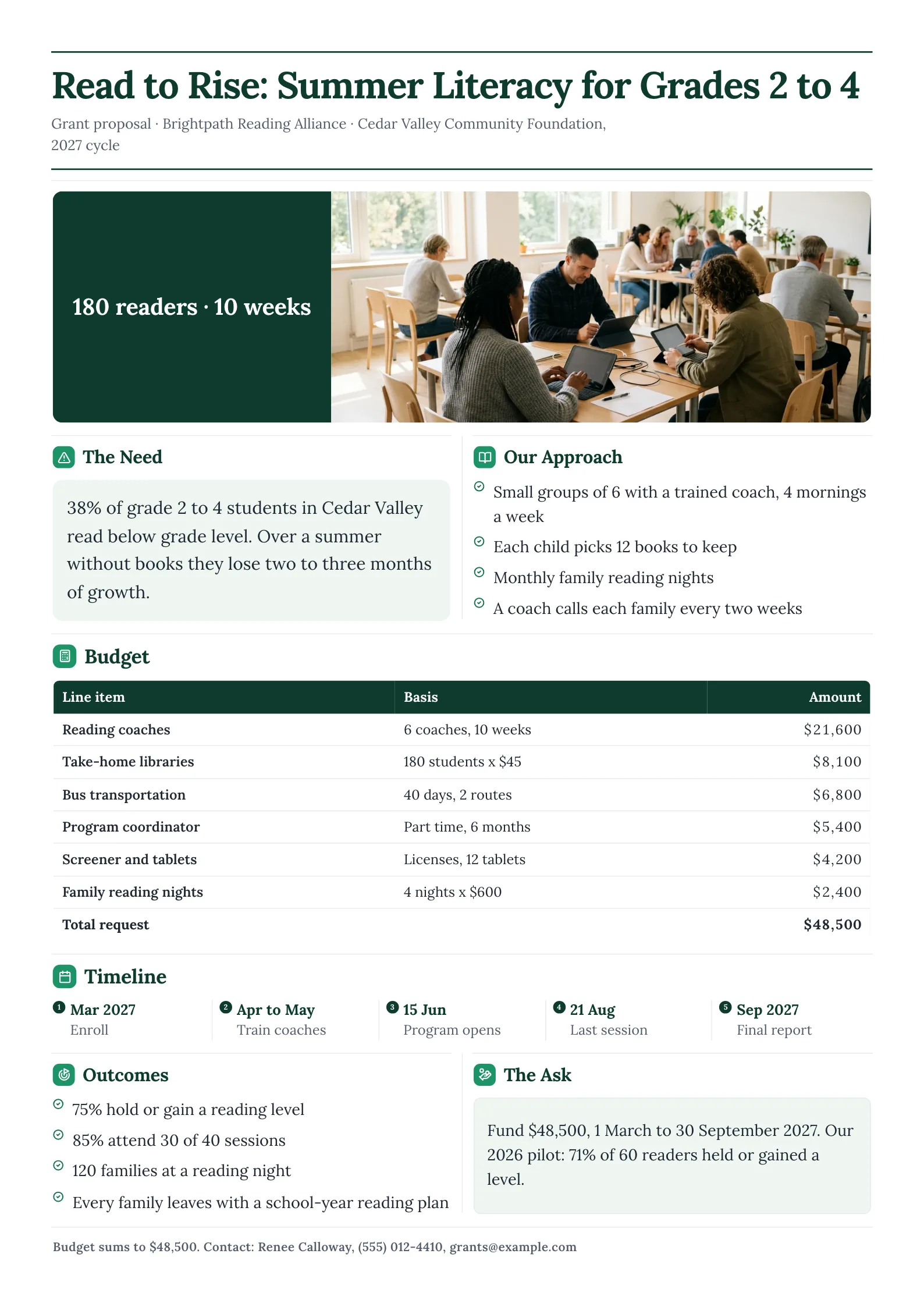
An example grant summary from a small reading charity to a local community foundation. Every name and figure is made up.
What to copy:
- The scale in the banner: "180 readers, 10 weeks." A reviewer knows the size of the project before reading a word of the need.
- A need that names a loss. Not only "38% read below grade level" but "over a summer without books they lose two to three months of growth." The second sentence is the reason to fund this summer, not next year.
- A budget with a basis column. "180 students x $45" for take-home libraries and "4 nights x $600" for family nights. Each line can be checked, and the total, $48,500, is stated twice: in the table and in the footer.
- Outcomes with numbers a funder can hold you to: 75% hold or gain a reading level, 85% attend 30 of 40 sessions, 120 families at a reading night.
- An ask with proof: "Fund $48,500, 1 March to 30 September 2027. Our 2026 pilot: 71% of 60 readers held or gained a level."
You can edit this grant proposal template for free.
5 more grant summary examples
A clinic, a teacher, a university lab, a city and a tutoring program that already has its grant. The funders differ, and so does what each one reads first, but every summary keeps the seven parts you saw above.
1. Mobile health clinic grant summary
 Edit this template
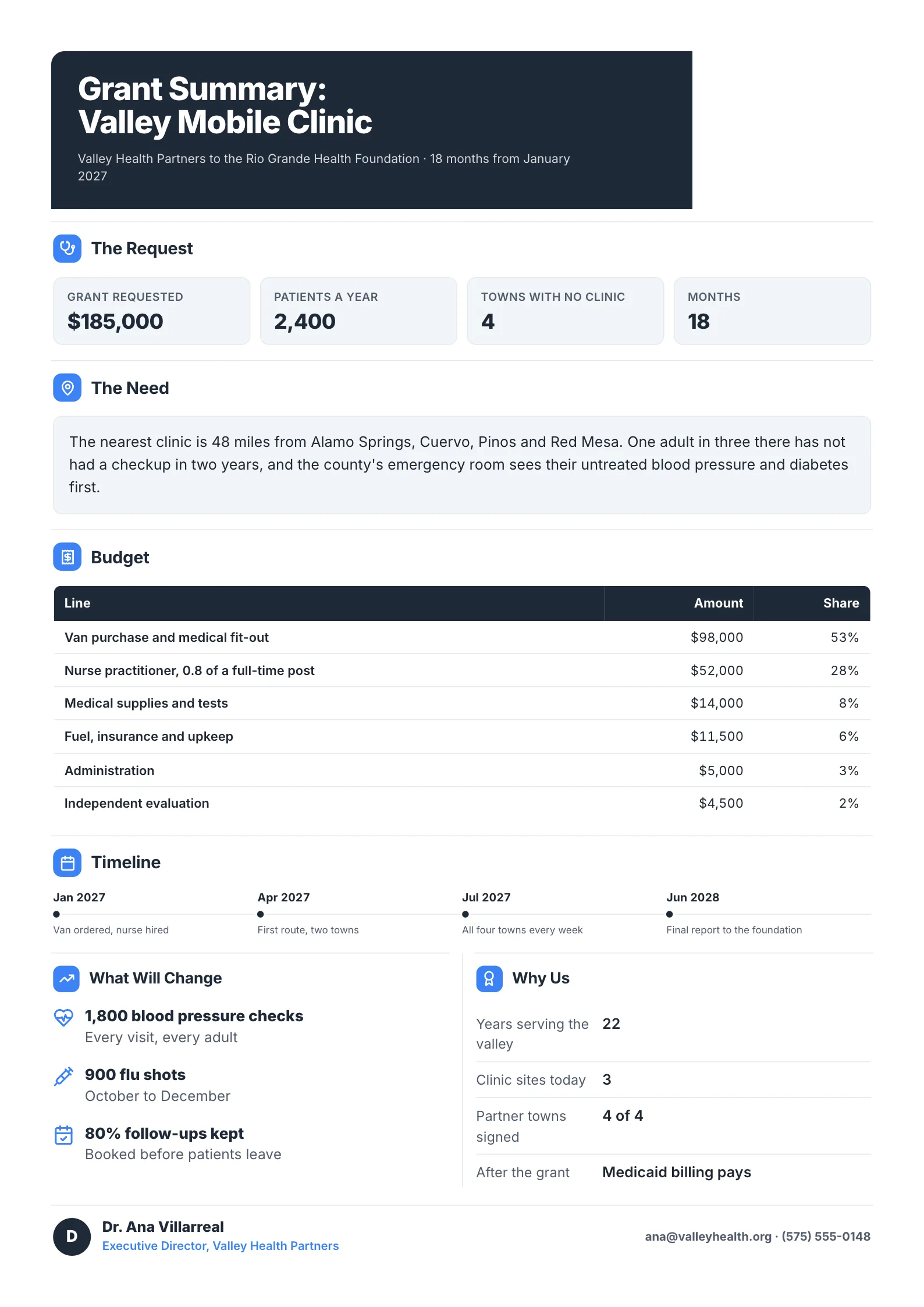
A health nonprofit asking a regional foundation to put a clinic on wheels for four rural towns.
What to copy:
- The need as a distance. "48 miles to the nearest clinic" is a fact a board member can repeat.
- A share beside every budget line. The van is 53% of the ask, so a reviewer sees at once where the money goes.
- What happens after the grant. Medicaid billing pays for the van's second year, which answers the question every funder asks about sustainability.
You can edit this mobile health clinic grant summary template for free.
2. Classroom grant summary
 Edit this template
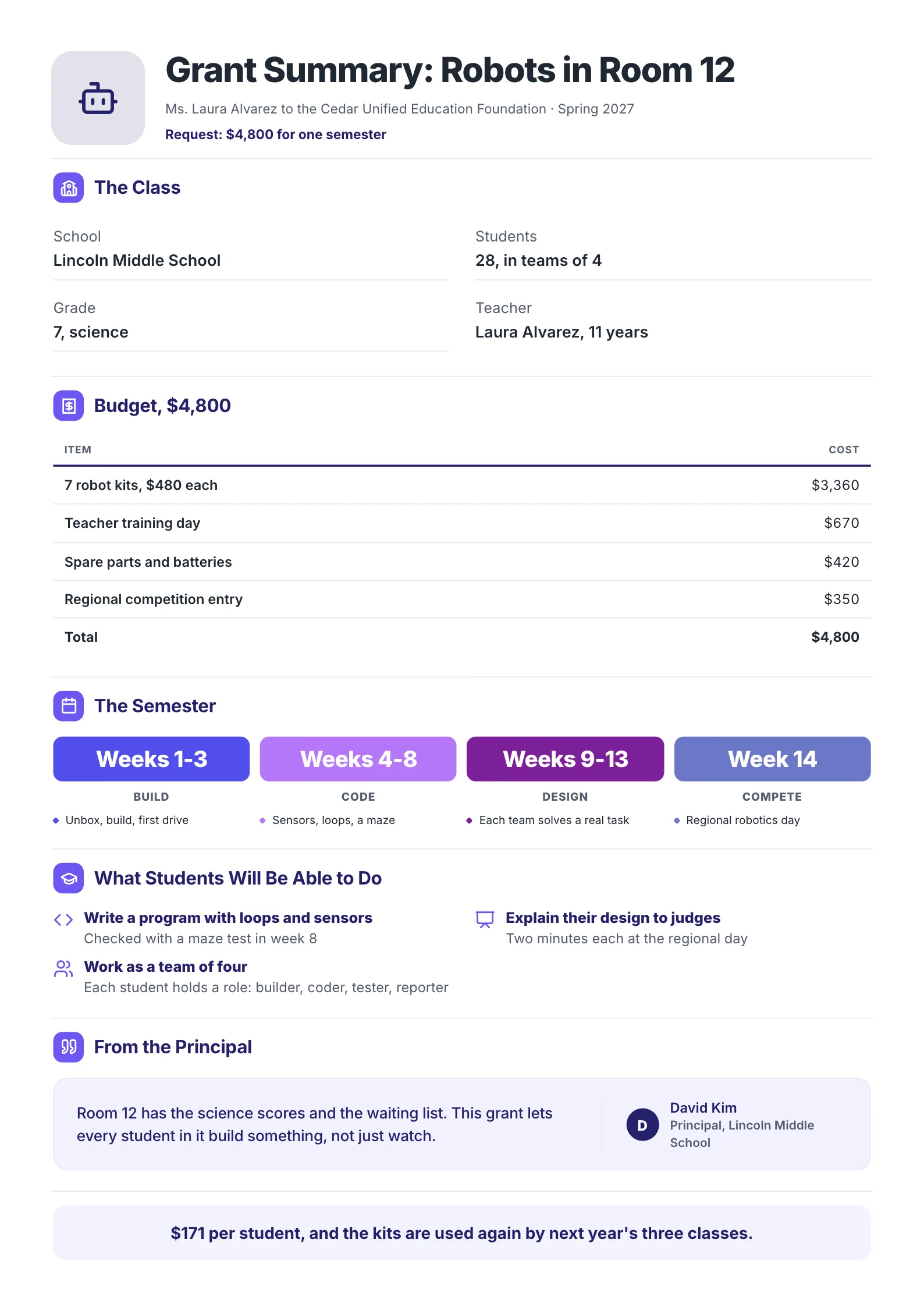
One teacher, one classroom, one semester: the smallest grant here, and still the same parts.
What to copy:
- The cost per student: $4,800 for 28 students is $171 each, and the kits are used again next year.
- A semester plan in four steps a parent volunteer could follow.
- The principal's words, which tell a school foundation the request has the school behind it.
You can edit this classroom grant summary template for free.
3. University research grant summary
 Edit this template
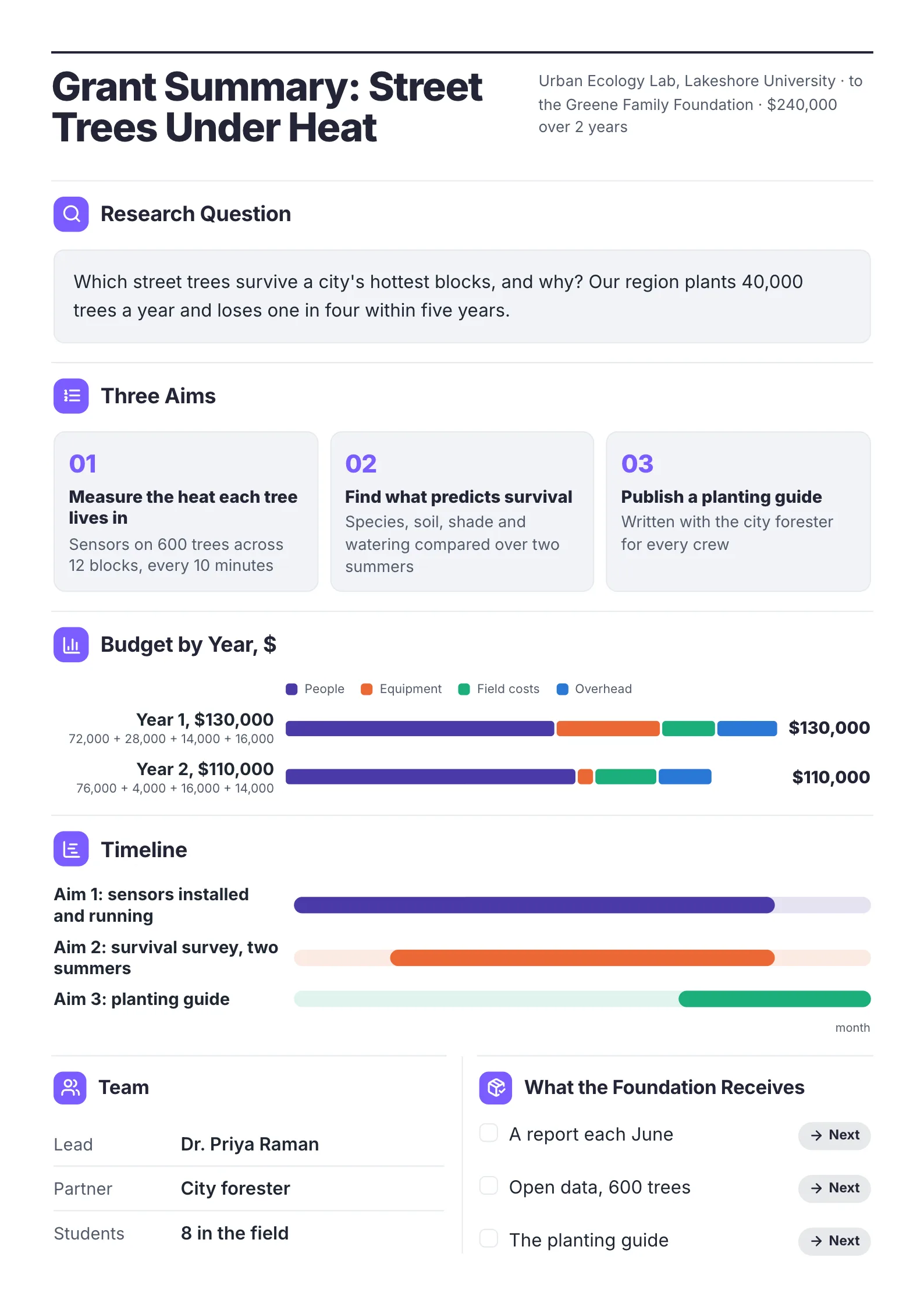
A two-year study written for a foundation board instead of a peer review panel.
What to copy:
- The question in plain words, with the number that makes it urgent: one tree in four lost within five years.
- The budget by year. Year one carries the sensors, so it costs $20,000 more than year two.
- What the funder receives, listed: reports, open data, a guide and a talk.
You can edit this university research grant summary template for free.
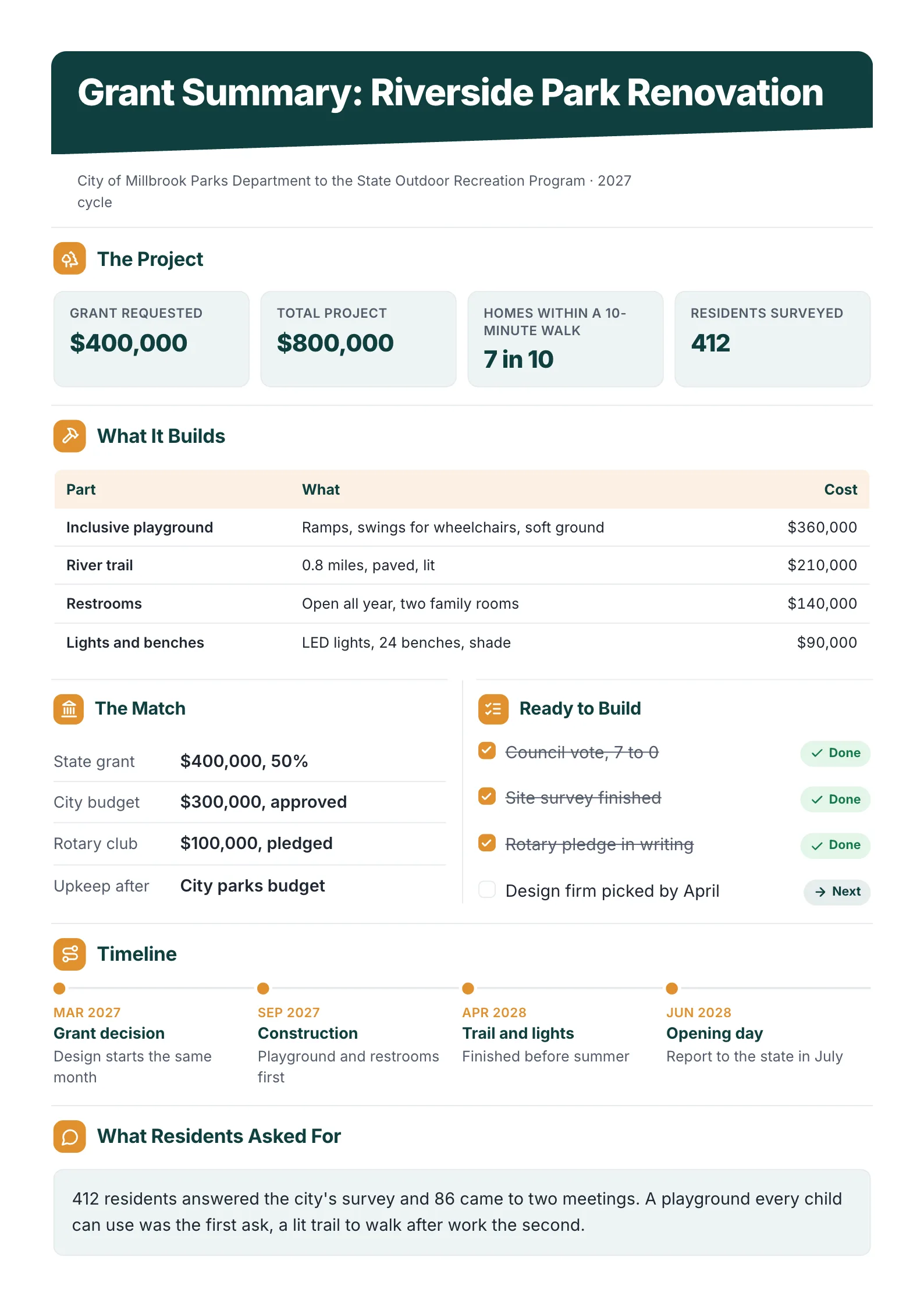
4. City park renovation grant summary
 Edit this template
A city applying to a state matching program, where the match matters as much as the ask.
What to copy:
- The match in one list: the state grant at 50%, $300,000 from the city budget and a $100,000 Rotary pledge.
- Ready to build, checked off: council vote, site survey and pledge done, design firm next.
- Community input with numbers: 412 survey answers and 86 people at two meetings.
You can edit this city park renovation grant summary template for free.
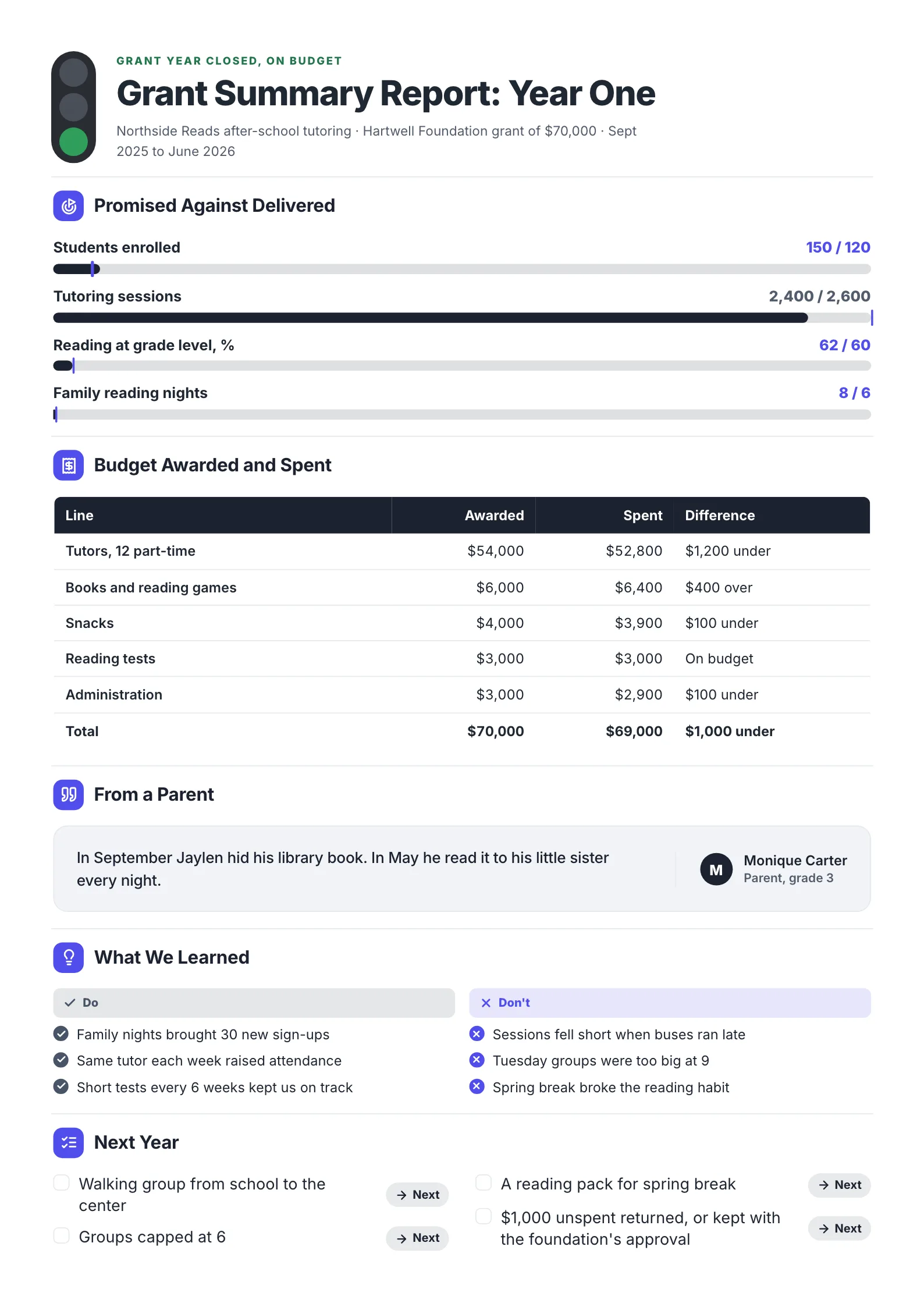
5. Grant summary report after the grant
 Edit this template
The follow-up a funder reads at renewal time, described in the report section below.
What to copy:
- Promised against delivered, side by side. 150 students enrolled against 120 promised, and 2,400 sessions against 2,600, with the shortfall explained.
- Every budget line with its difference, including the $400 overspend on books.
- What will change next year, which is the first paragraph of the renewal request.
You can edit this grant summary report template for free.
Worked example: checking a budget before you send it
The budget is where most summaries lose trust. If your total doesn't match its lines, a reviewer will guess the rest was rushed too. Here's the example budget above, checked line by line.
| Line | Basis | Working | Amount |
|---|---|---|---|
| Reading coaches | 6 coaches, 10 weeks | $360 a week each | $21,600 |
| Take-home libraries | 180 students | $45 each | $8,100 |
| Bus transportation | 40 days, 2 routes | $85 a route a day | $6,800 |
| Program coordinator | Part time, 6 months | $900 a month | $5,400 |
| Screener and tablets | Licenses, 12 tablets | quoted | $4,200 |
| Family reading nights | 4 nights | $600 each | $2,400 |
| Total | $48,500 |
Each working line multiplies back to its amount, and the six amounts add to the total. Do this check on your own summary before you send it. It takes five minutes, and it catches the most common error reviewers see.
How to write a grant summary in 6 steps
- Write the full proposal first. A summary of a proposal that does not exist yet changes every time the plan does.
- Pull one number for the need from your evidence section, and keep its source in the full proposal.
- Cut the approach to what a reviewer can picture: group size, frequency, duration, who delivers it.
- Copy the budget lines from your budget sheet, add a basis to each, and add them up again.
- Pick three or four outcomes you will actually measure, with the measure named.
- Write the ask last, in one sentence, and read it aloud. If it needs a breath in the middle, it is too long.
Grant summary mistakes
- Jargon in place of a picture. "A holistic, evidence-based intervention" tells a reviewer nothing. "Groups of six with a coach, four mornings a week" does.
- A need with no number, or a number with no place. "Many children struggle" is a feeling. "38% of grade 2 to 4 students in Cedar Valley" is a need.
- Outcomes nobody can count. "Improved confidence" cannot be checked. "75% hold or gain a reading level on the spring screener" can.
- A budget total that appears in three places with two different numbers. Check every mention.
- No ask. Some summaries describe the project beautifully and never say how much they want or for what dates.
The grant summary report
After the grant ends, many funders ask for a summary of results on one sheet. Use the same layout and change three parts:
- Need becomes "What we set out to do": the outcomes you promised, word for word.
- Budget becomes "Budget against actual": each line with what was planned and what was spent, and a short reason for any line more than 10% off.
- The ask becomes "What we learned and what is next": one honest lesson and the next step, which is often the start of your renewal request.
If you need that second half, a grant budget report is built for it. The after-school tutoring report above shows all three parts on one sheet.
Make your grant summary
Open the free grant proposal template and replace the example with your project. Or drop your full proposal into the free AI One-Pager generator, and you'll get a finished summary One-Pager back with your figures pulled from the file.
Frequently asked questions
What should a grant summary include?
Your summary needs the project title, the applicant and funder, the need with one number and the approach. Add a line-by-line budget with a total and a dated timeline. Then list three or four measurable outcomes and the ask in one sentence, with the amount and dates.
How long is a grant summary?
Keep it to one sheet, or to whatever limit your funder sets. Federal and foundation programs often set a word or character limit for the summary or abstract, and you should follow it exactly.
What is the difference between a grant summary and a grant abstract?
They're often the same thing under different names. Some research funders use "abstract" or "project summary" for a structured text field. Community foundations more often ask you for a short executive summary on one sheet that they can share with a board.
Can I use one grant summary for several funders?
Yes. Keep one as your master copy. Then change the title, the funder line, the ask and the outcomes to match each funder's priorities and amounts. Never send a summary with another funder's name still in it.




