BlogGuide
Research Summary: How to Write One, With a Template and 5 One-Page Examples
What a research summary is, the 6 parts it needs, how to write one in 6 steps, a template, and 5 one-page research summary examples.

By MakeOnepagers Team
Updated · 8 min read
A research summary is a short version of a study that gives the reader its question, how it was done, what it found and what that means, usually on one page. Students write one to show they understood a paper. Researchers and analysts write one so a manager, a funder or a committee can use the findings without reading the full report. Below are the six parts every research summary needs, how to write one in six steps, a template you can copy, and five real one-page research summary examples.
One‑Pager examples
Real One-Pagers made with MakeOnepagers. Open any one to edit it as your own.
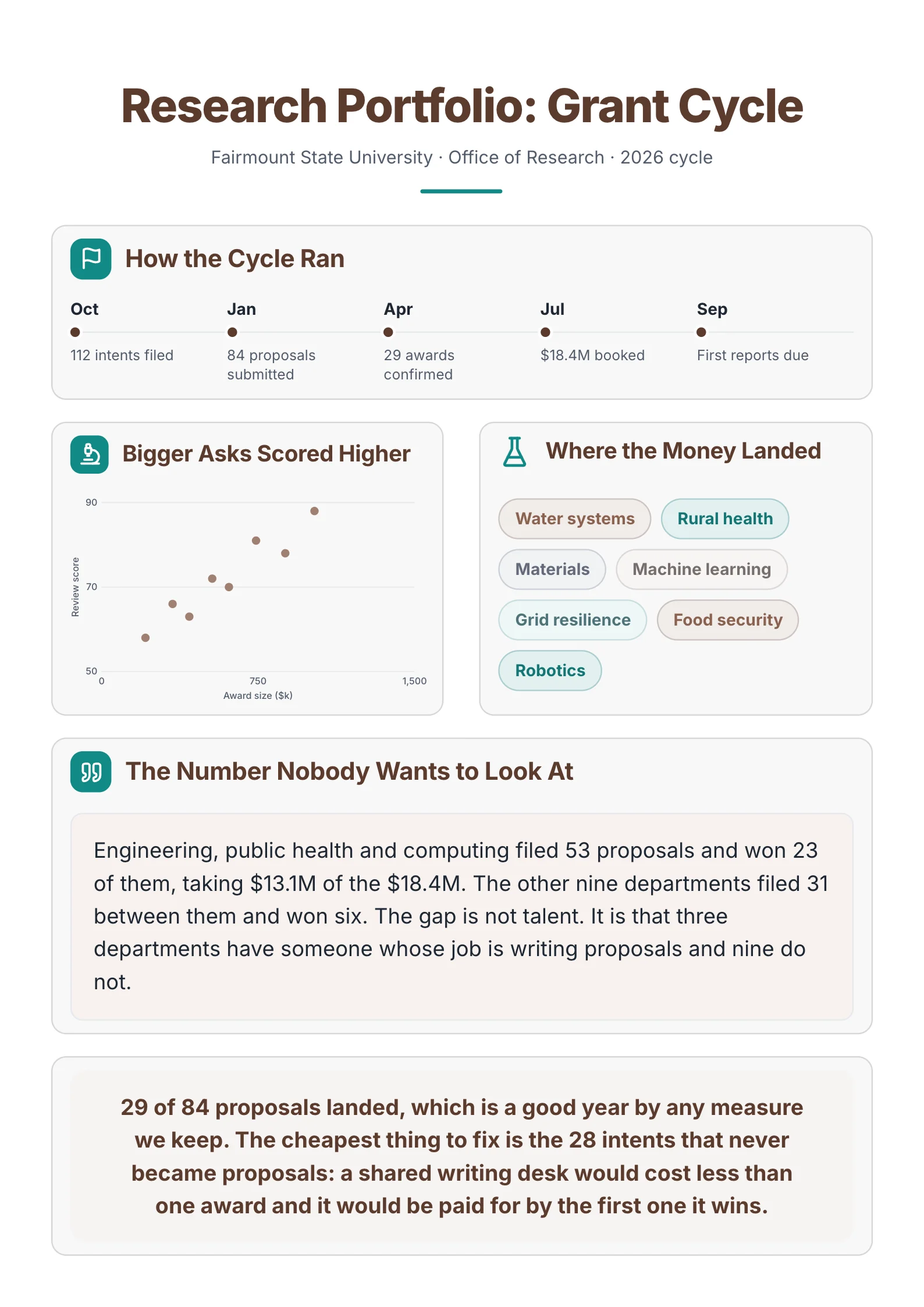 Research Funding ReviewEdit for free(opens in a new tab)
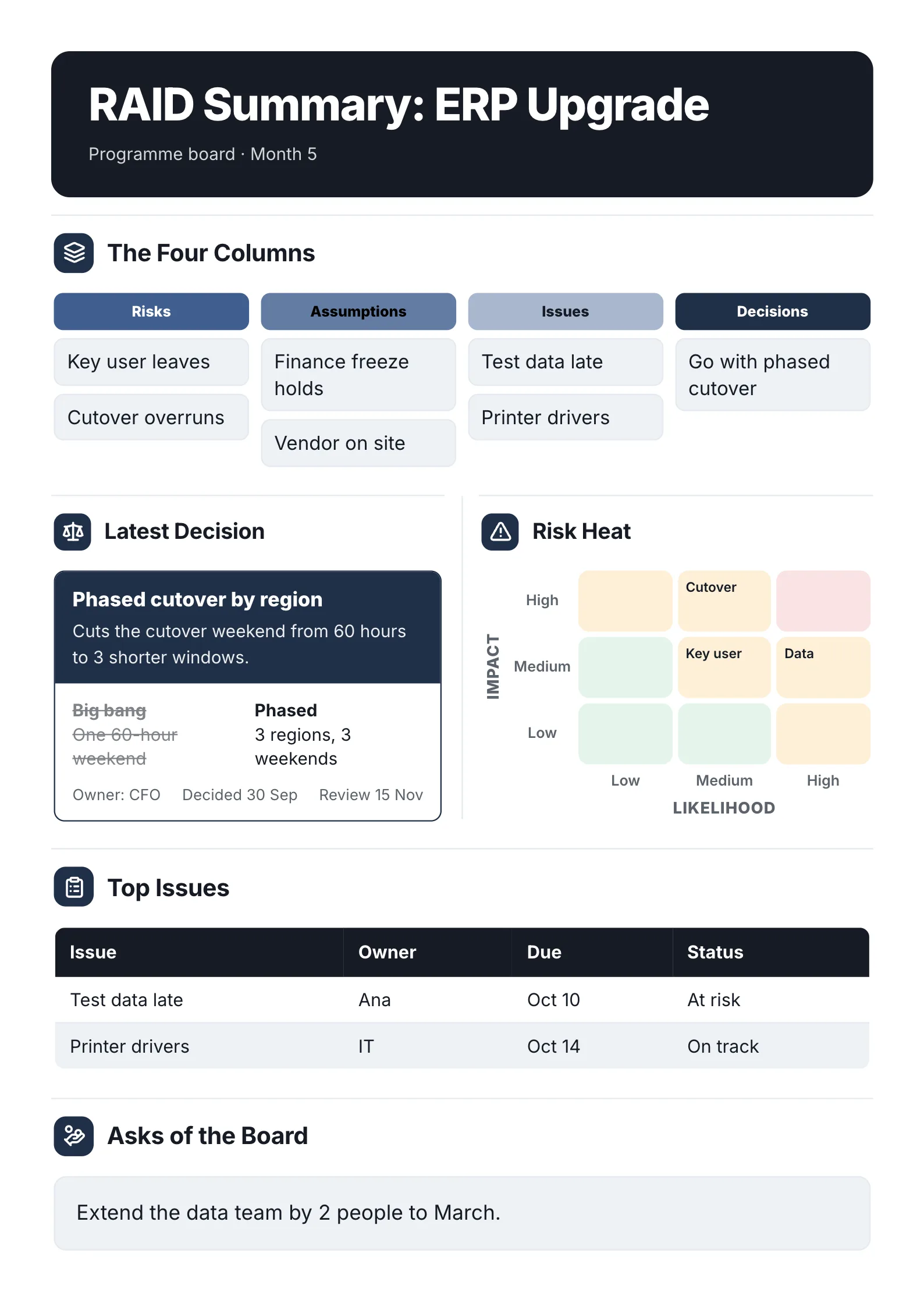 RAID Log SummaryEdit for free(opens in a new tab)
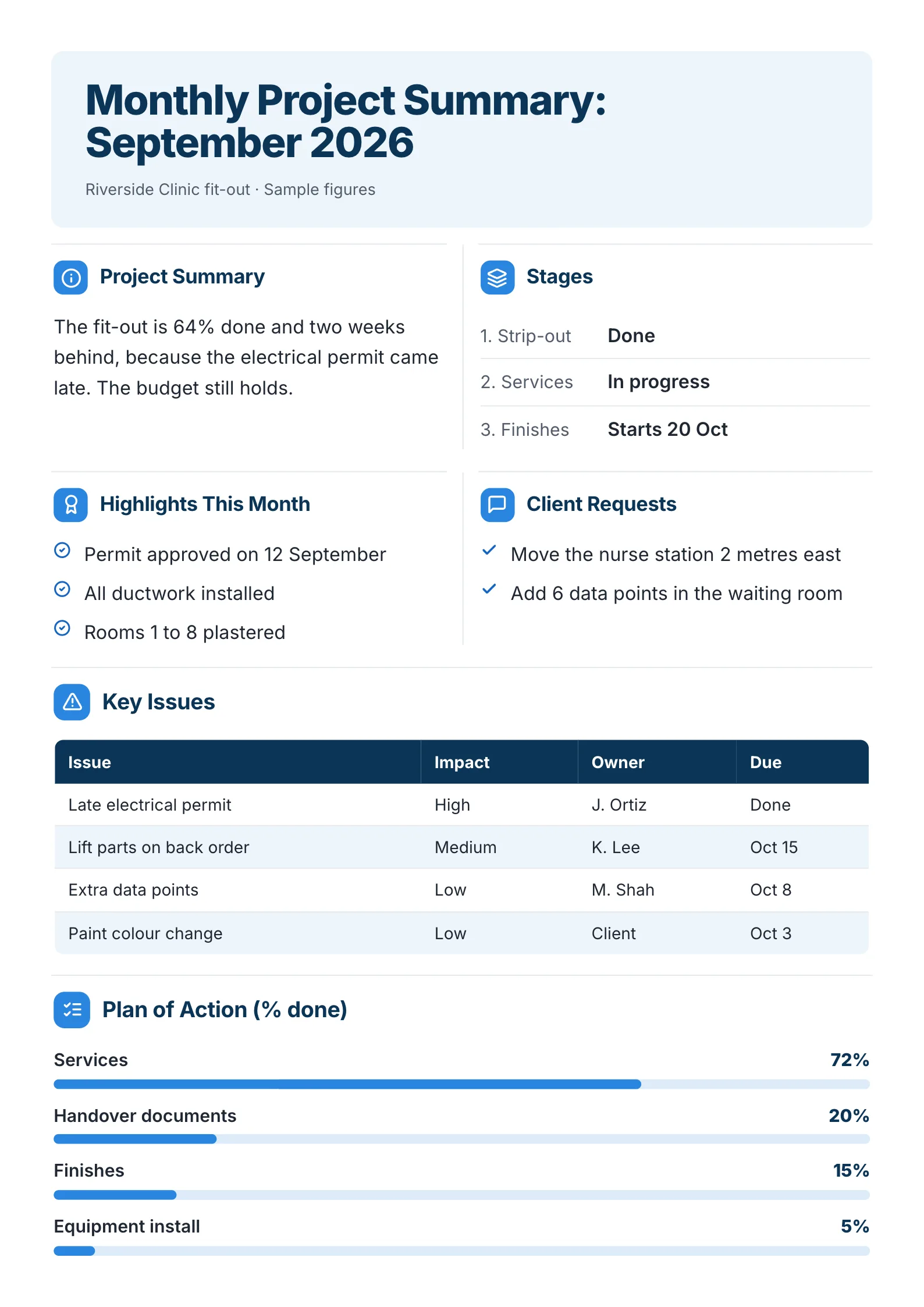 Monthly Project SummaryEdit for free(opens in a new tab)
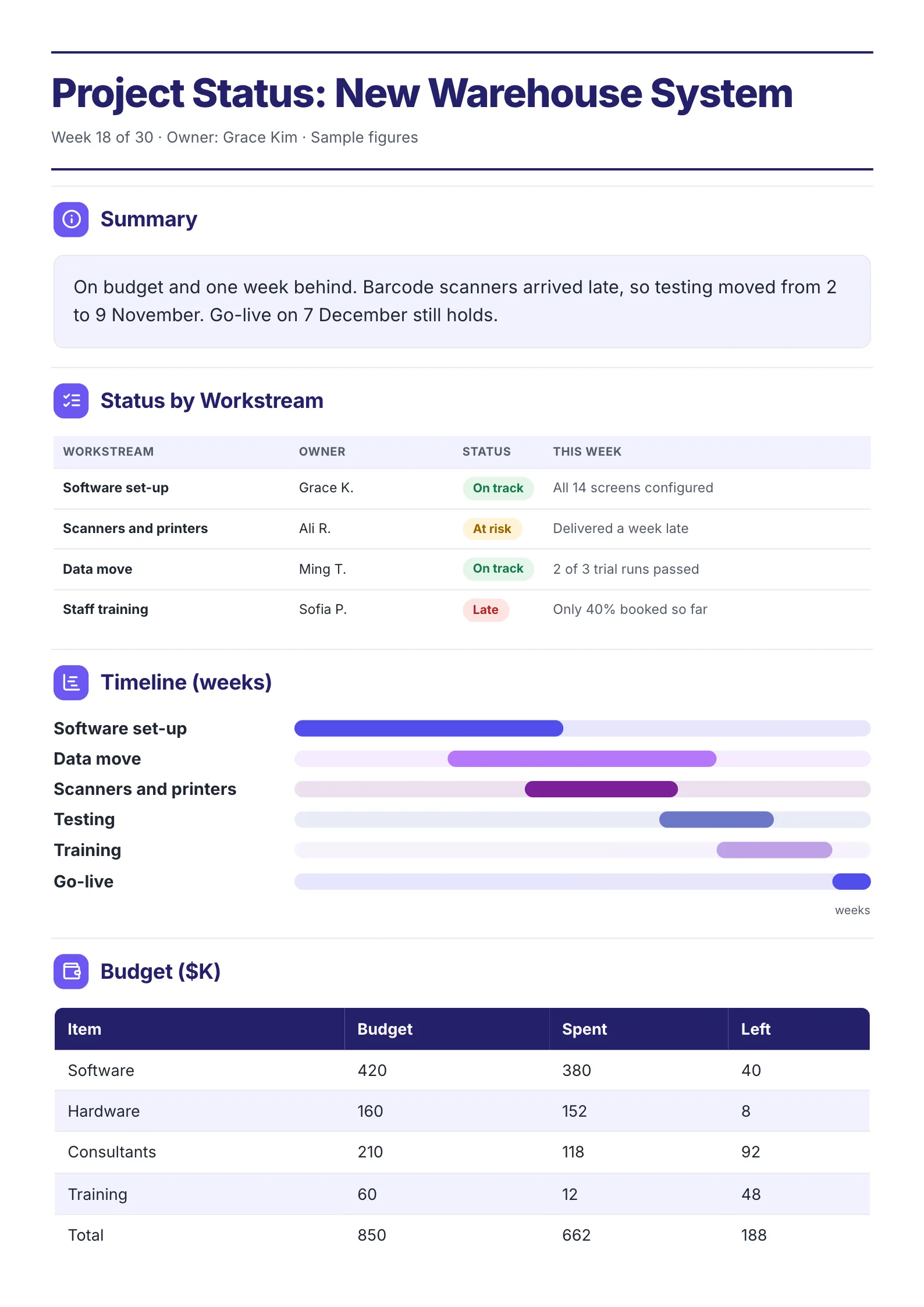 Project Status SummaryEdit for free(opens in a new tab)
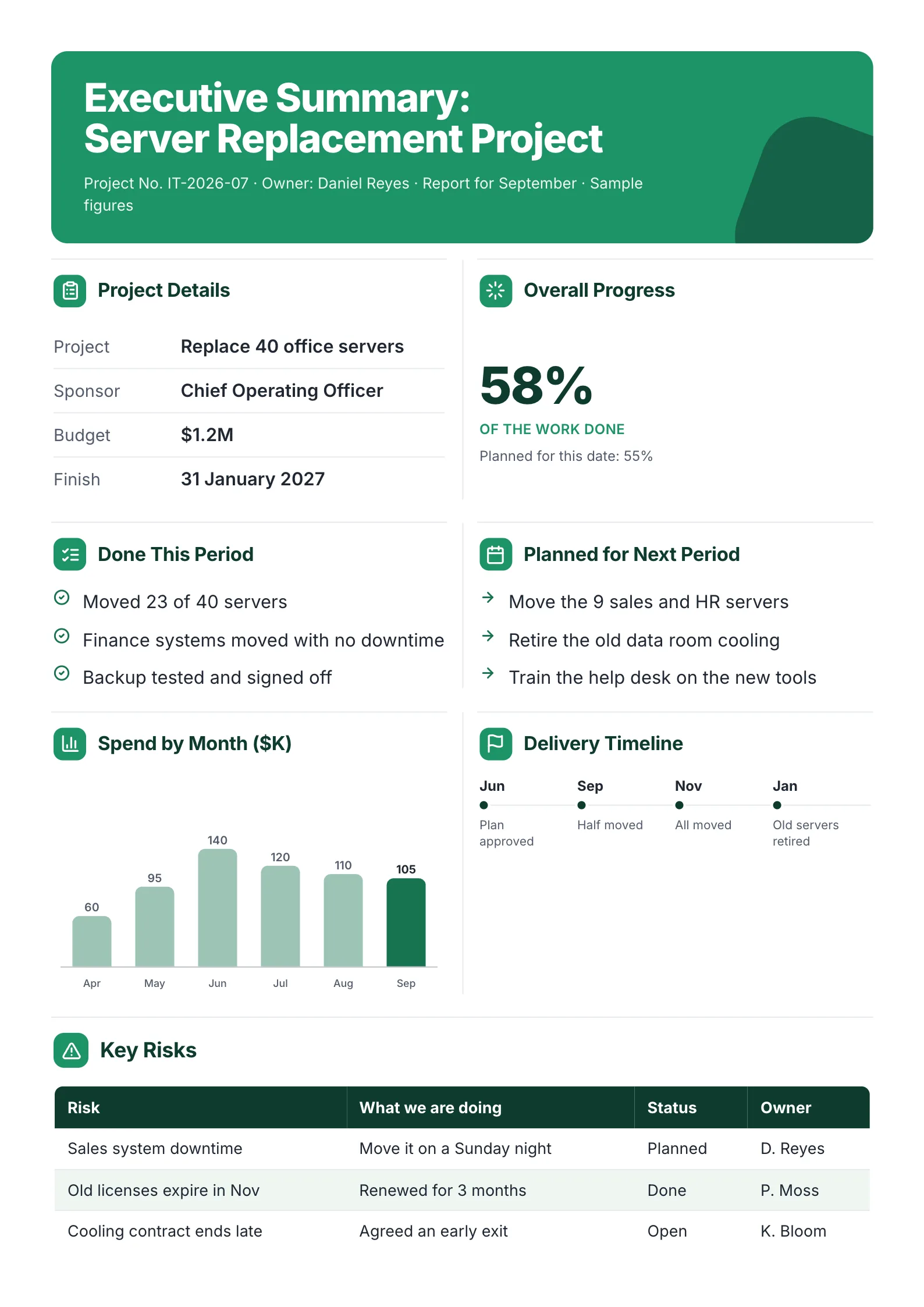 Executive Summary of a Project ReportEdit for free(opens in a new tab)
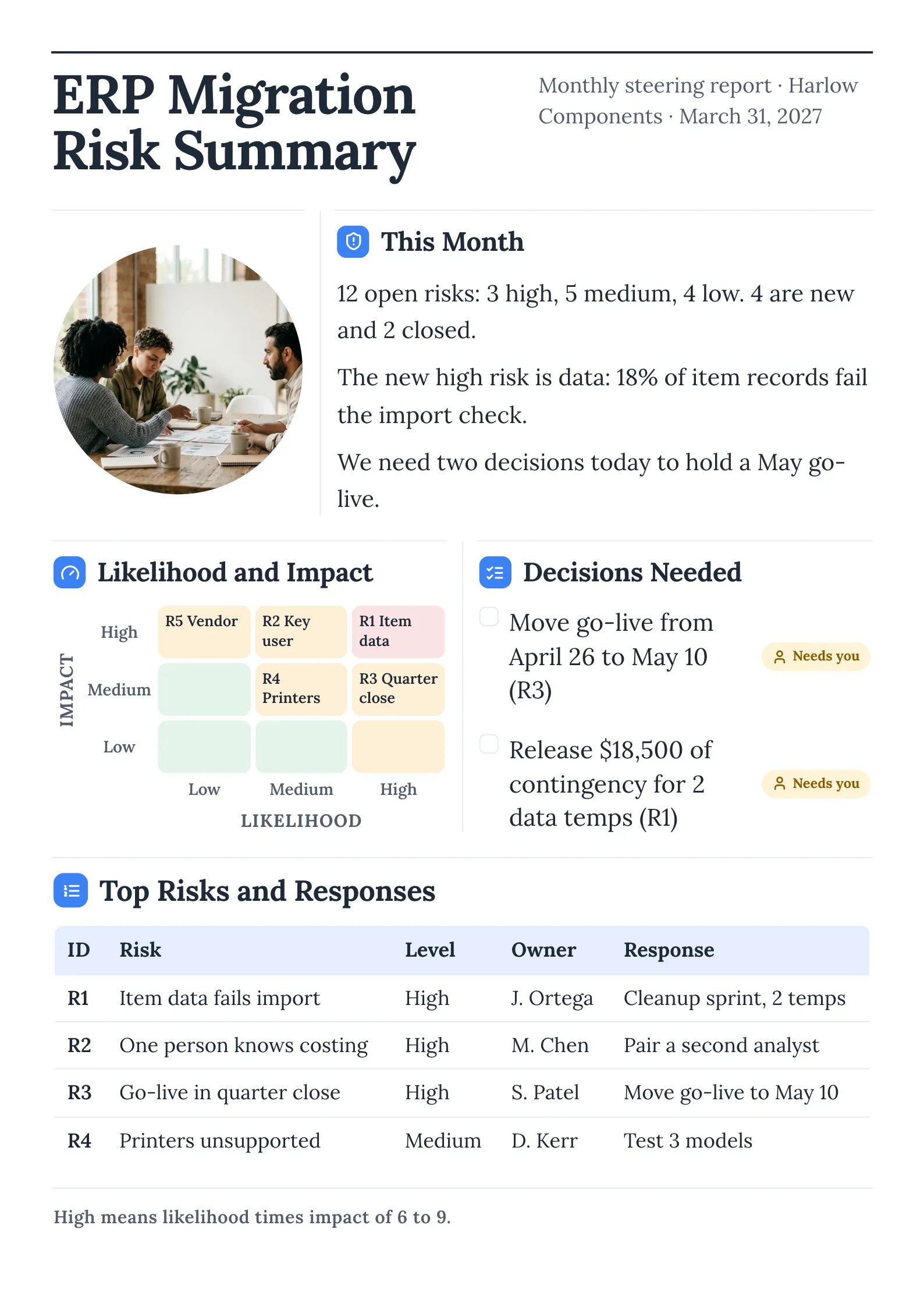 Risk Register SummaryEdit for free(opens in a new tab)
Every example was made with MakeOnepagers. Each one opens as a template you can edit for free: every word, chart and color.
What is a research summary?
A research summary is a condensed account of a piece of research, written for someone who will not read the original. It keeps the parts a reader needs to trust and use the result: the question, the method in brief, the key findings with their numbers, and the conclusion. It leaves out the literature review, the full method and most of the tables.
There are two common kinds:
- A summary of someone else's paper. Often a school or university assignment. You show the paper's question, method, findings and conclusions in your own words.
- A summary of your own research for decision makers. A policy brief, a study readout or a survey report. It leads with the finding and ends with what the reader should do about it.
The structure is nearly the same. The difference is the order: an academic summary follows the paper, while a summary for decision makers puts the finding first.
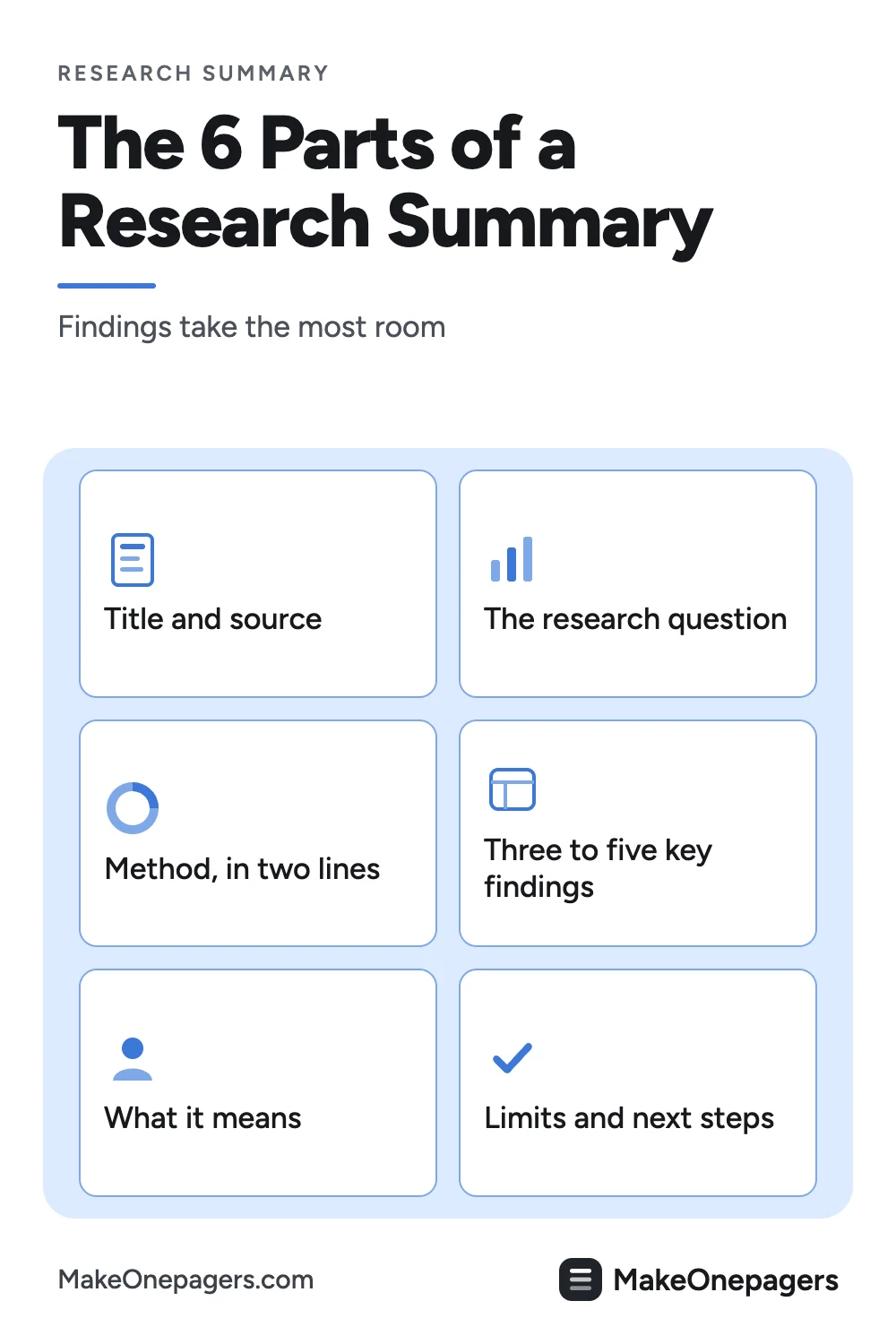
The 6 parts of a research summary
- Title and source. What was studied, by whom, and when. "Phase II Readout: RVX-311, 312 patients, 16 weeks."
- The research question. One sentence on what the study set out to find. "Does charging older vehicles cut roadside pollution?"
- Method, in brief. Who or what was studied, how many, over what period. Two lines are usually enough.
- Key findings. Three to five results, each with its number and a comparison. This is the biggest part of the page.
- What it means. The conclusion or recommendation in one or two sentences.
- Limits and next steps. What the study can't tell you, and what should happen next.
How to write a research summary in 6 steps
- Read the whole study once without taking notes. Get the shape of it first: the question, the answer, and how they got from one to the other.
- Write the research question in one sentence. If the paper has several, pick the main one.
- Pull out the three to five findings that answer it. Copy the numbers exactly, with what they're compared against: "68% against 39% on placebo."
- Summarize the method in two lines. Sample size, setting, time period and the main measure. Skip the detail unless the reader needs it to trust the result.
- Write the conclusion in your own words. What do the findings mean? For a decision maker, add what they should do.
- Cut it to one page and check it against the source. Every number in the summary should match the original. Cite the study at the top or bottom.
A research summary template
| Section | What to write, with an example |
|---|---|
| Title and source | Study, author or team, date. Urban Air Quality, evidence for the transport committee |
| Question | What the study asked. Do low-emission zones cut roadside NO2? |
| Method | Sample, setting, period. 12 zones compared over three years |
| Key findings | 3 to 5 results with numbers. NO2 fell 31% in charging zones, 4% elsewhere |
| What it means | The conclusion in 1 or 2 lines. Peak-only charging gets most of the benefit |
| Limits and next steps | What it can't show, what comes next. Six inner zones first, review after a year |
5 research summary examples
1. Clinical study summary
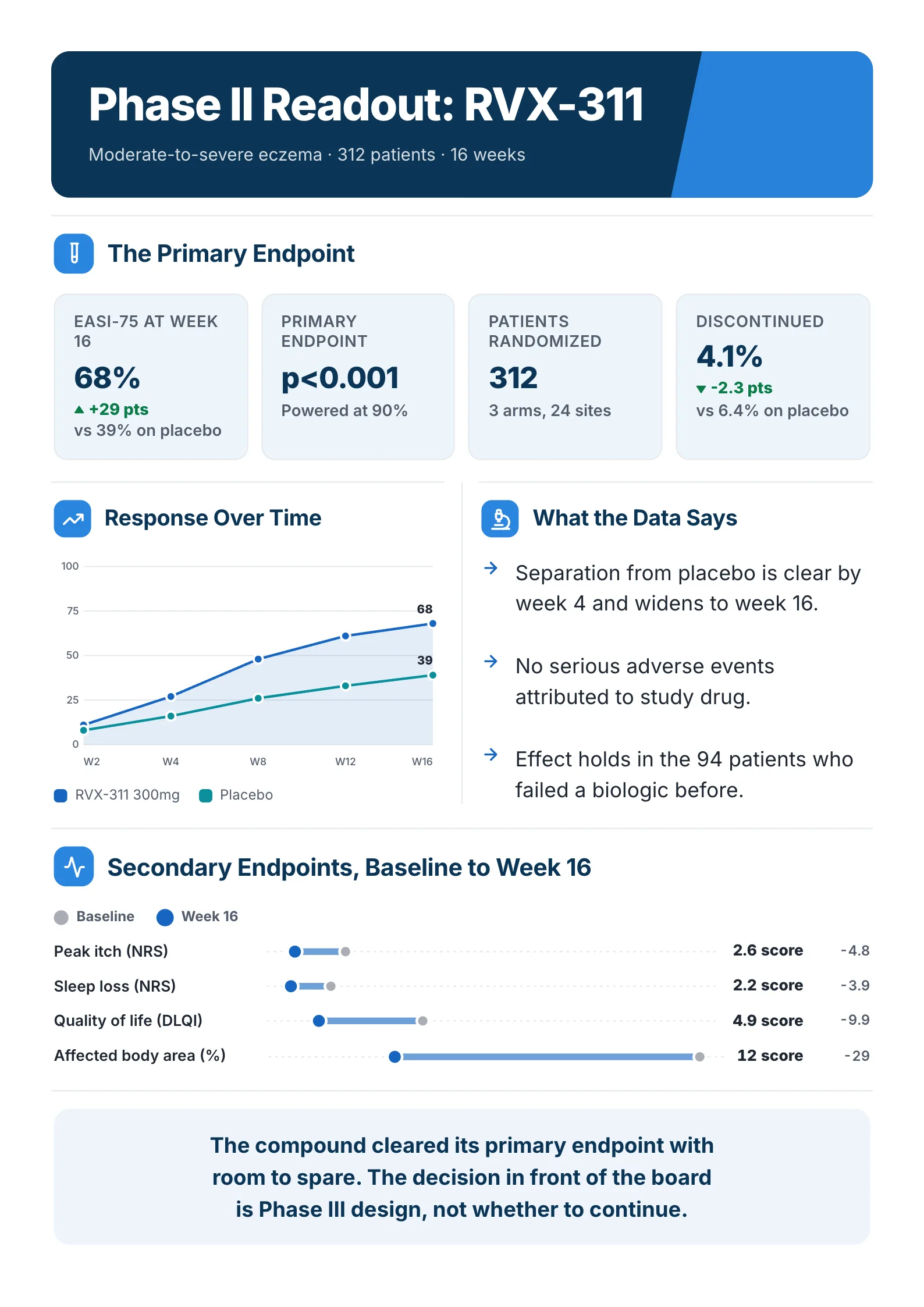 Edit this template
A sample study readout: the main result against placebo, the trial size, response week by week, what the data says and the decision it leads to.
What to copy:
- The primary result against the control. "68% vs 39% on placebo" is the finding. Everything else on the page supports it.
- The method in the subtitle. "312 patients, 16 weeks" tells the reader how much to trust the result before they reach it.
- The conclusion as a decision. "The decision is Phase III design, not whether to continue" turns a result into a next step.
Edit for free: clinical study summary template.
2. Policy research summary
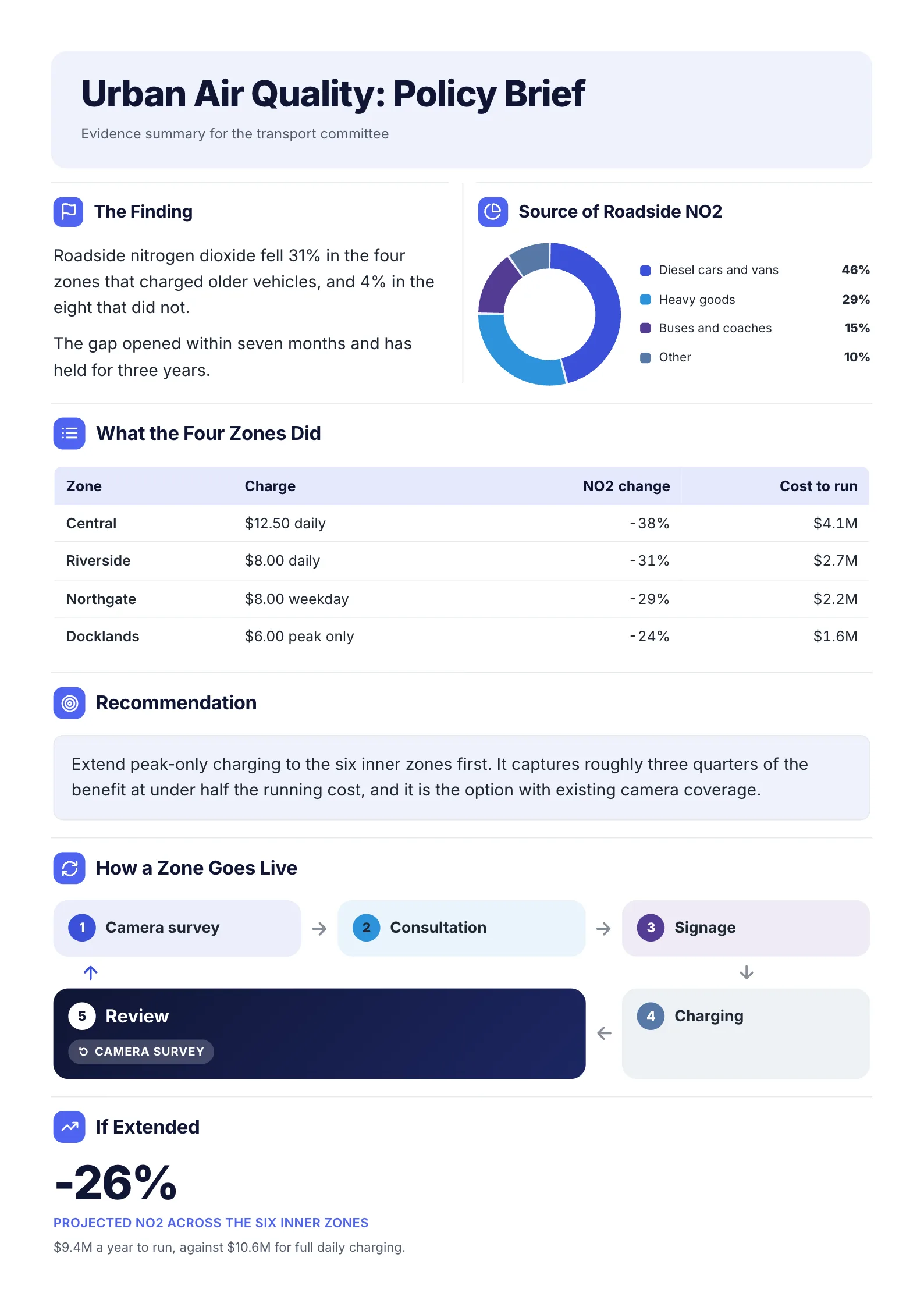
A sample evidence summary for a committee: the finding in two sentences, results zone by zone, a recommendation and what happens if it's adopted.
What to copy:
- "The Finding" is the first block. "Roadside nitrogen dioxide fell 31% in the four zones that charged older vehicles, and 4% in the eight that did not."
- A comparison group. The eight zones that didn't charge are what make the 31% believable.
- Cost beside effect. The table shows the NO2 change and the cost to run each zone, so the recommendation follows from the numbers.
Edit for free: policy research summary template.
3. Survey research summary
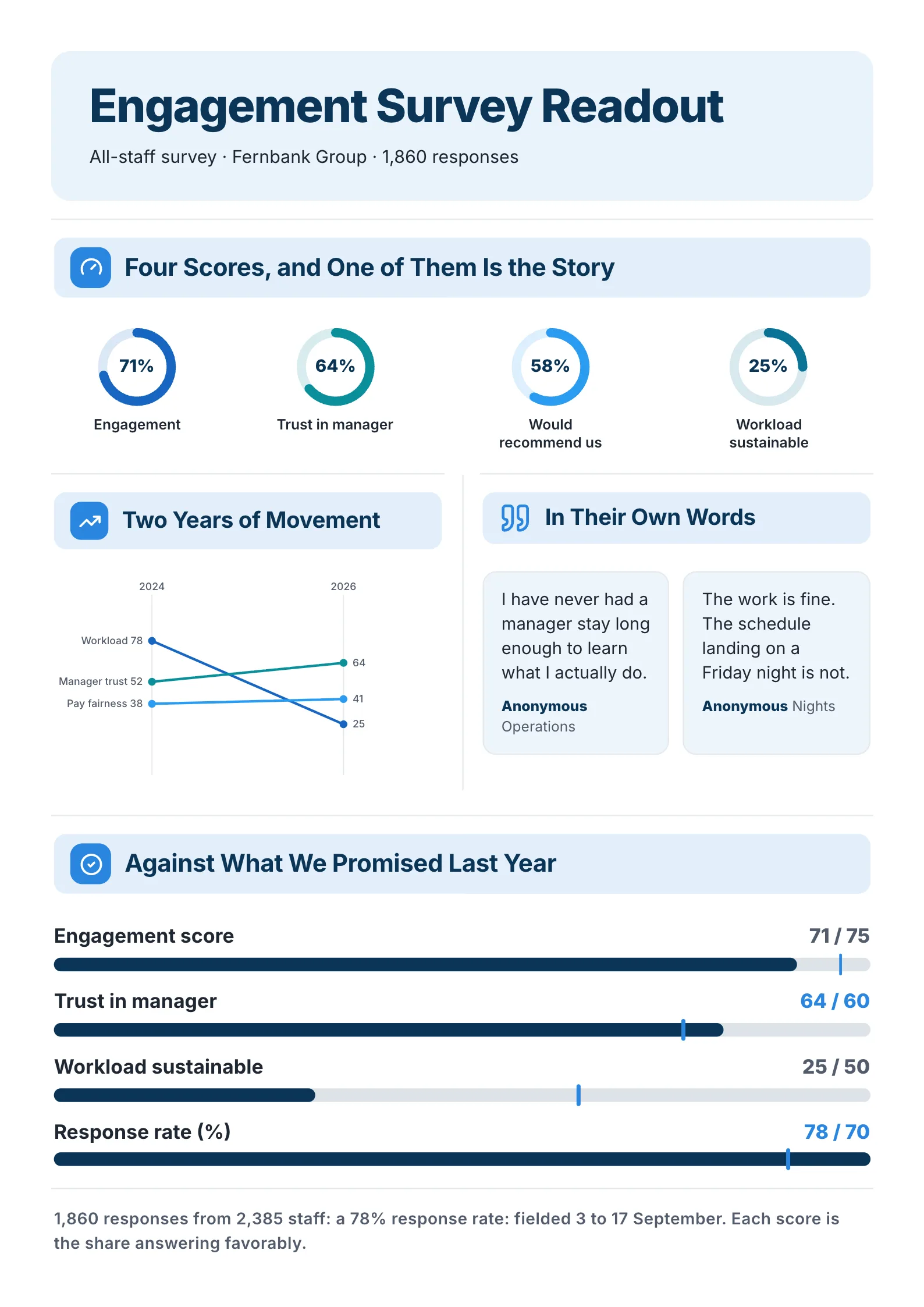 Edit this template
A sample survey summary: four scores, the one that tells the story, two years of change, staff in their own words and how the response rate was reached.
What to copy:
- "One of them is the story." Four scores, and the heading tells the reader which one matters: workload, at 25%.
- Quotes beside the numbers. Two short anonymous answers explain the score better than a paragraph would.
- The method at the bottom. "1,860 responses from 2,385 staff, a 78% response rate, fielded 3 to 17 September."
Edit for free: survey research summary template.
4. Program outcomes study
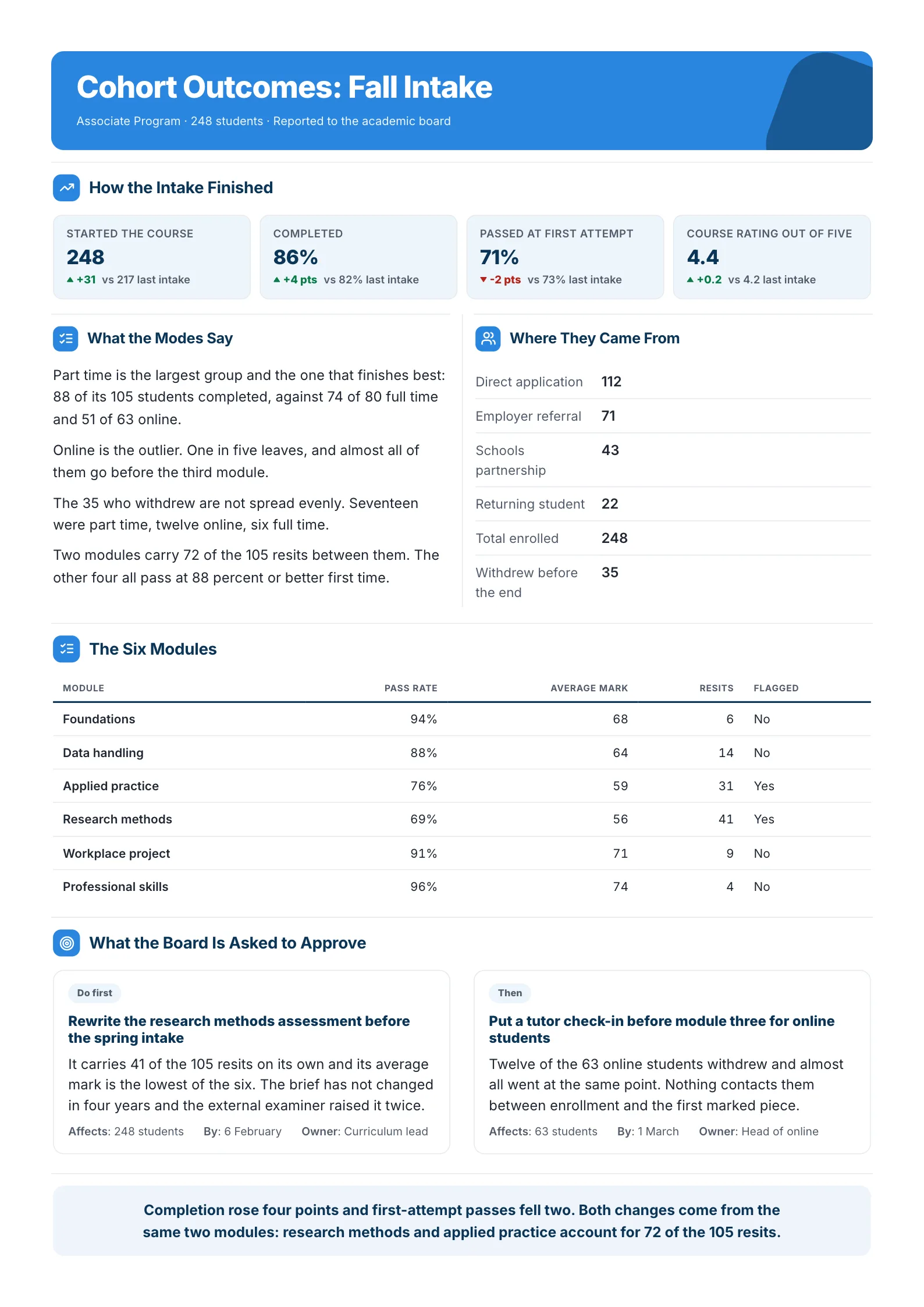 Edit this template
A sample outcomes study for an academic board: four results against last year, what the data shows by group, module results and two recommended changes.
What to copy:
- Every result against the last group. "86%, up 4 points vs 82% last intake" tells the board the direction.
- Findings that explain the numbers. "Two modules carry 72 of the 105 resits" points straight at the cause.
- Recommendations with an owner and a date. "Rewrite the research methods assessment, by 6 February, curriculum lead."
Edit for free: program outcomes study template.
5. Market research summary
 Edit this template
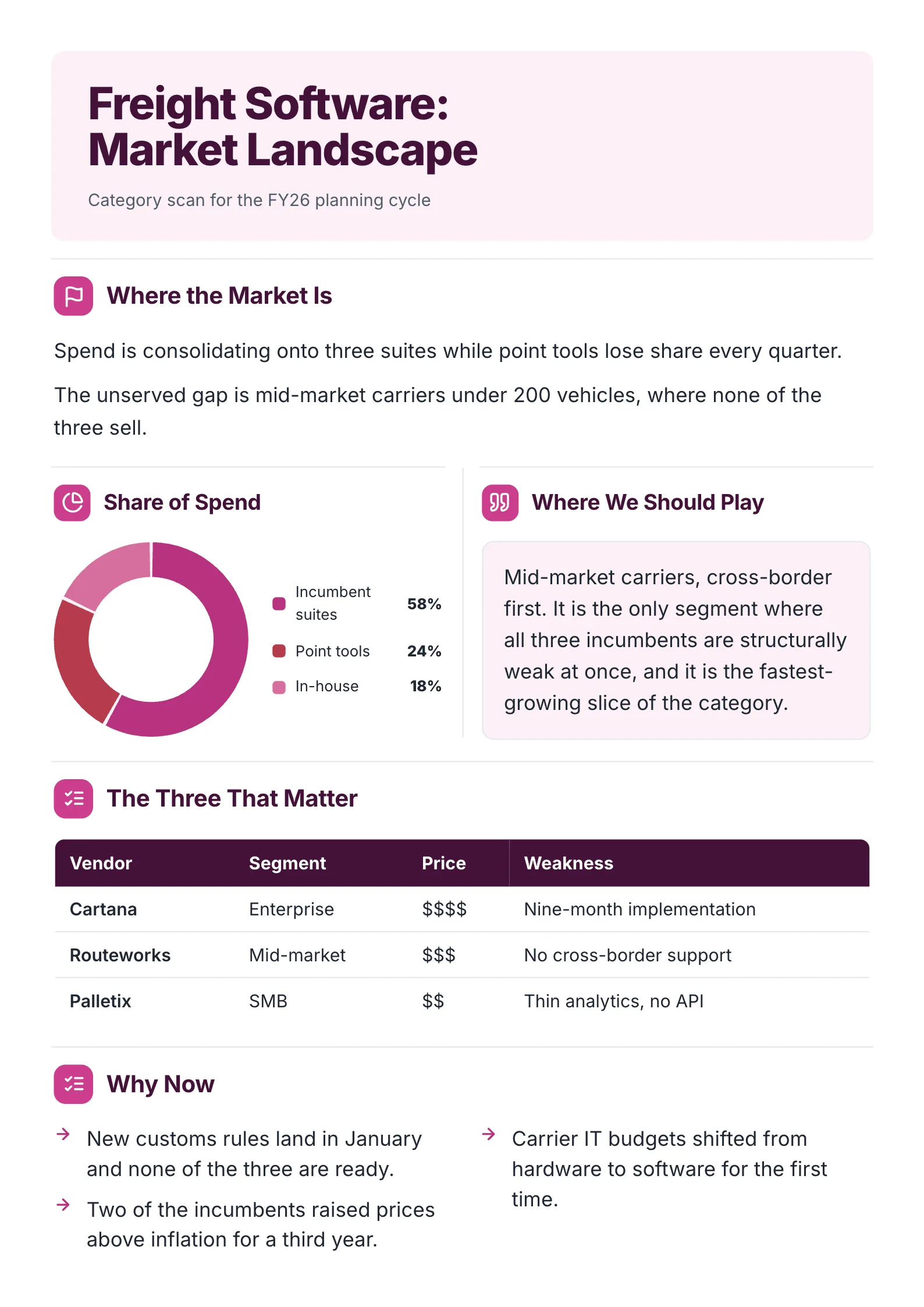
A sample market study: where the market is in two sentences, share of spend, the three competitors that matter and where the opportunity is.
What to copy:
- The finding as a gap. "The unserved gap is mid-market carriers under 200 vehicles, where none of the three sell."
- Competitors in one table. Segment, price and weakness for each, so the opportunity is obvious.
- "Why now" as its own block. Three reasons the finding matters this year, not someday.
Edit for free: market research summary template.
Research summary mistakes
- Starting with the method. Readers want the finding first. Put the method in two lines after it, or at the bottom.
- Numbers without comparisons. "68% responded" means little until the reader sees 39% on placebo.
- Copying sentences from the paper. A summary in the original's words isn't a summary. Rewrite it, and quote only where the wording matters.
- Leaving out the limits. A small sample or a short period changes how far the result can be trusted. Say so.
- No conclusion. Ending on the findings leaves the reader to work out what they mean.
Research summary vs abstract vs executive summary
| Document | What it does |
|---|---|
| Research summary | Stands alone and explains a study to someone who won't read it |
| Abstract | Sits at the top of a paper, about 250 words, for other researchers |
| Executive summary | Opens a longer report and usually asks for a decision |
For a general summary of any report, not only research, see our guide to the summary report.
Frequently asked questions
What should a research summary include?
The title and source, the research question, a short description of the method, three to five key findings with their numbers, what the findings mean, and the study's limits or next steps.
How long is a research summary?
Usually one page, or about 300 to 500 words. A summary written for a class may have a set word count, so check the assignment. A summary for decision makers should never run past one page.
What is the difference between a research summary and an abstract?
An abstract is written by the authors and sits at the top of the paper, for other researchers deciding whether to read it. A research summary can be written by anyone, stands on its own, and is often written for readers outside the field.
How do I start a research summary?
With the title and source, then the main finding or the research question in one sentence. For an assignment, start with the question. For a manager or committee, start with the finding.
Can I make a research summary on one page?
Yes, and it's easier to read that way. Copy the template above, or open any of the examples on this page in MakeOnepagers and replace the findings with your own. Make yours free with the AI One-Pager Generator, and editing by hand is always free. If your study is already written up, MakeOnepagers reads the file and builds the summary from what's in it, which you then edit.