Proposal Checklist: 10 Checks From 4 Real Submission Lists
A proposal checklist built from 4 real government submission lists with 104 items in all. See what all 4 ask for, and the 10 checks to run before you send.

Small misses get strong proposals thrown out, and a proposal checklist is how you stop them. To build one you can trust, we read 4 checklists that real buyers hand to people sending them proposals. Together they hold 104 items. The National Science Foundation's list has 57, a Hawaii state agency's has 5, a New York State request has 36, and Kentucky's state template has 6. Start from a free one pager template.
One‑Pager examples
Real One-Pagers made with MakeOnepagers. Open any one to edit it as your own.
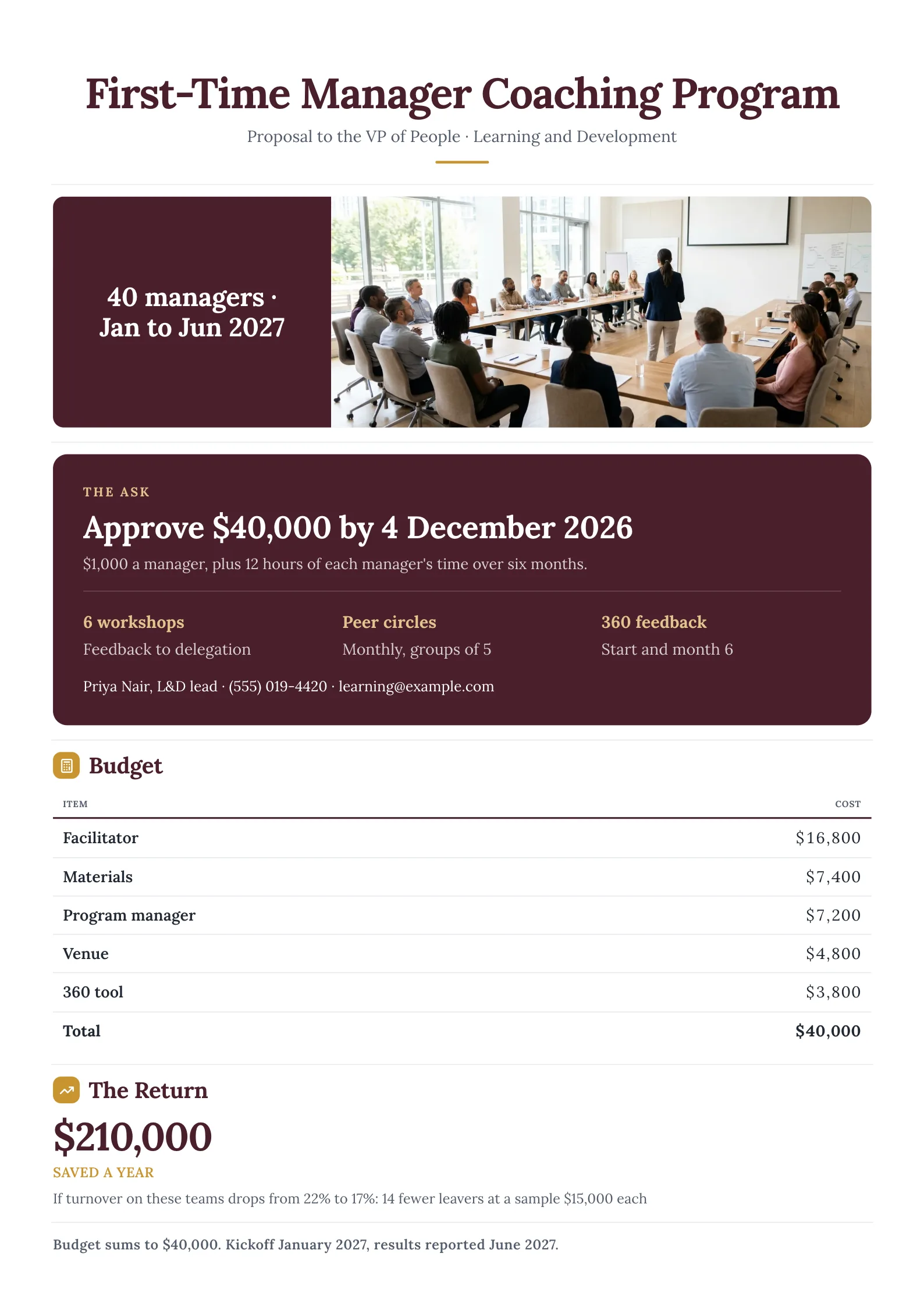 Training ProposalEdit for free(opens in a new tab)
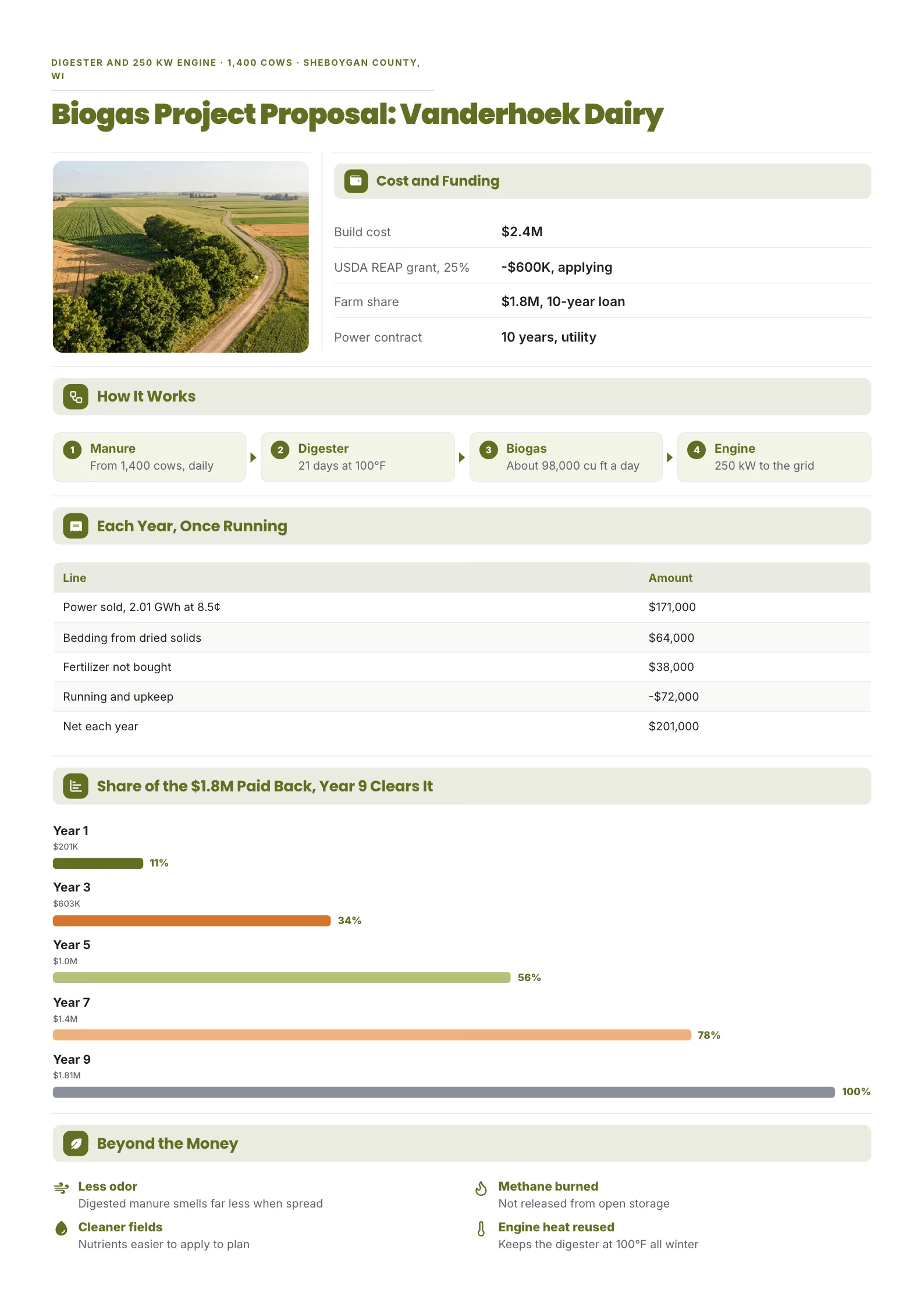 Biogas Project Proposal One-PagerEdit for free(opens in a new tab)
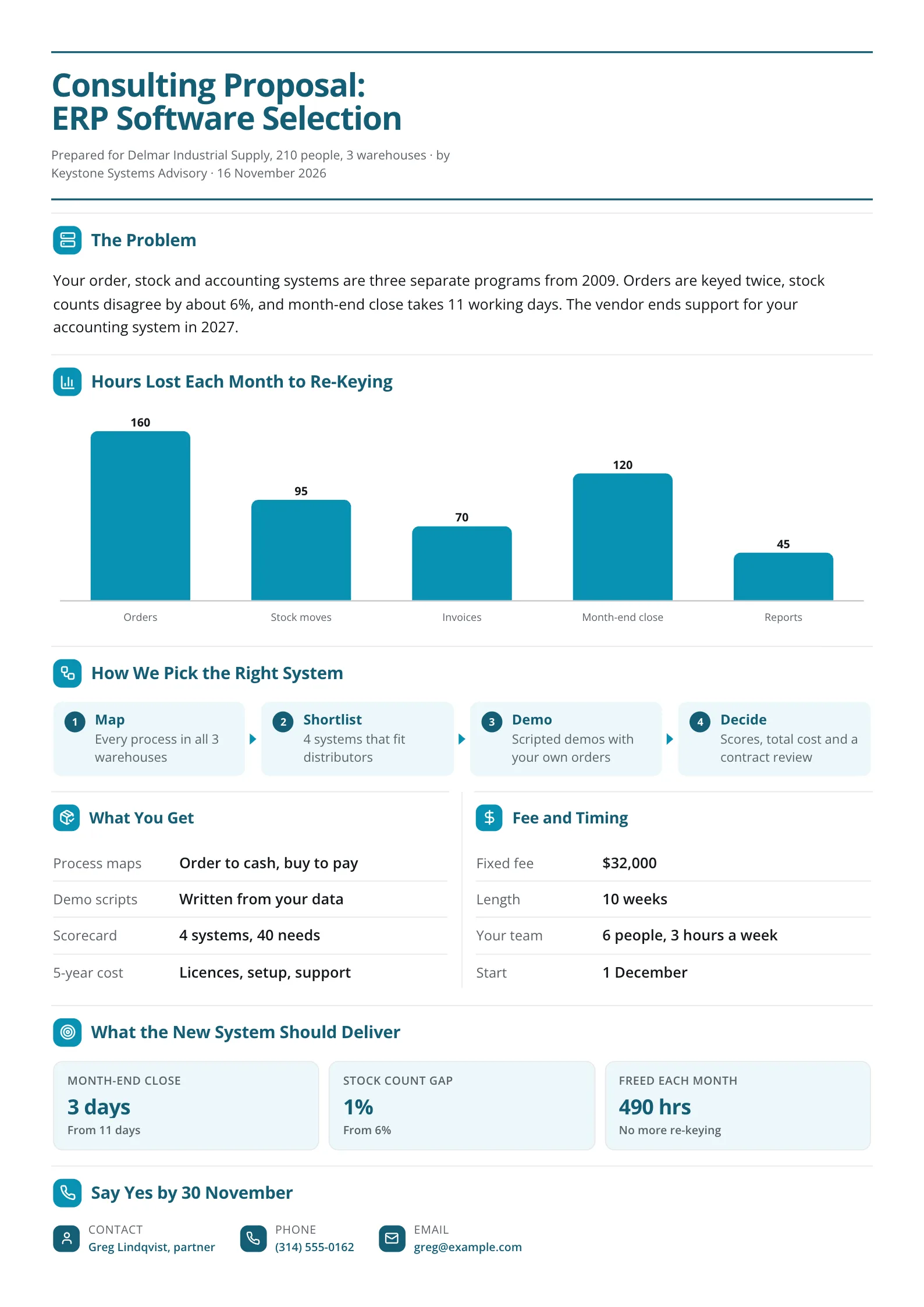 Consulting Proposal: ERP Software SelectionEdit for free(opens in a new tab)
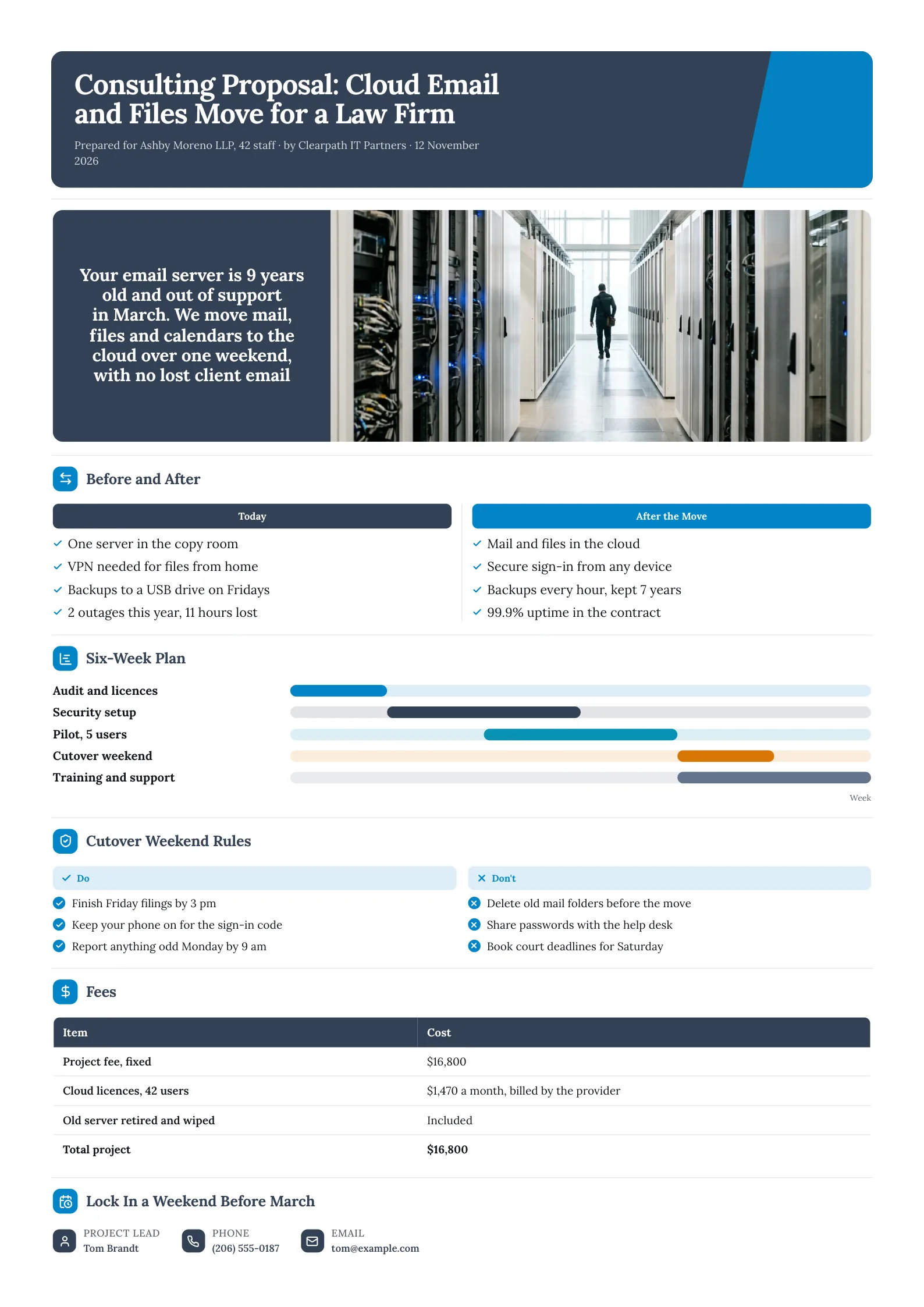 Consulting Proposal: Cloud Email and Files Move for a Law FirmEdit for free(opens in a new tab)
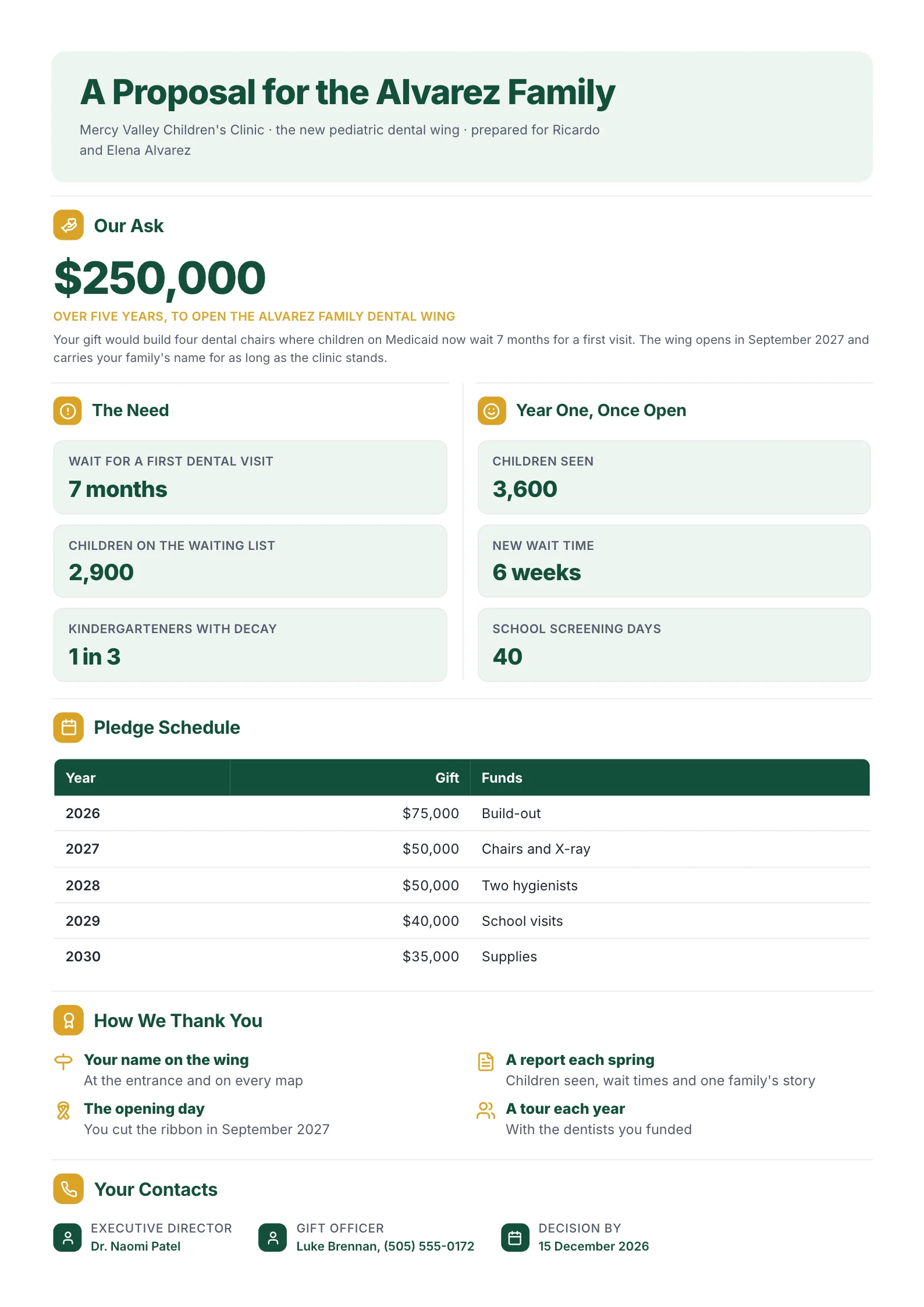 Donor Major Gift ProposalEdit for free(opens in a new tab)
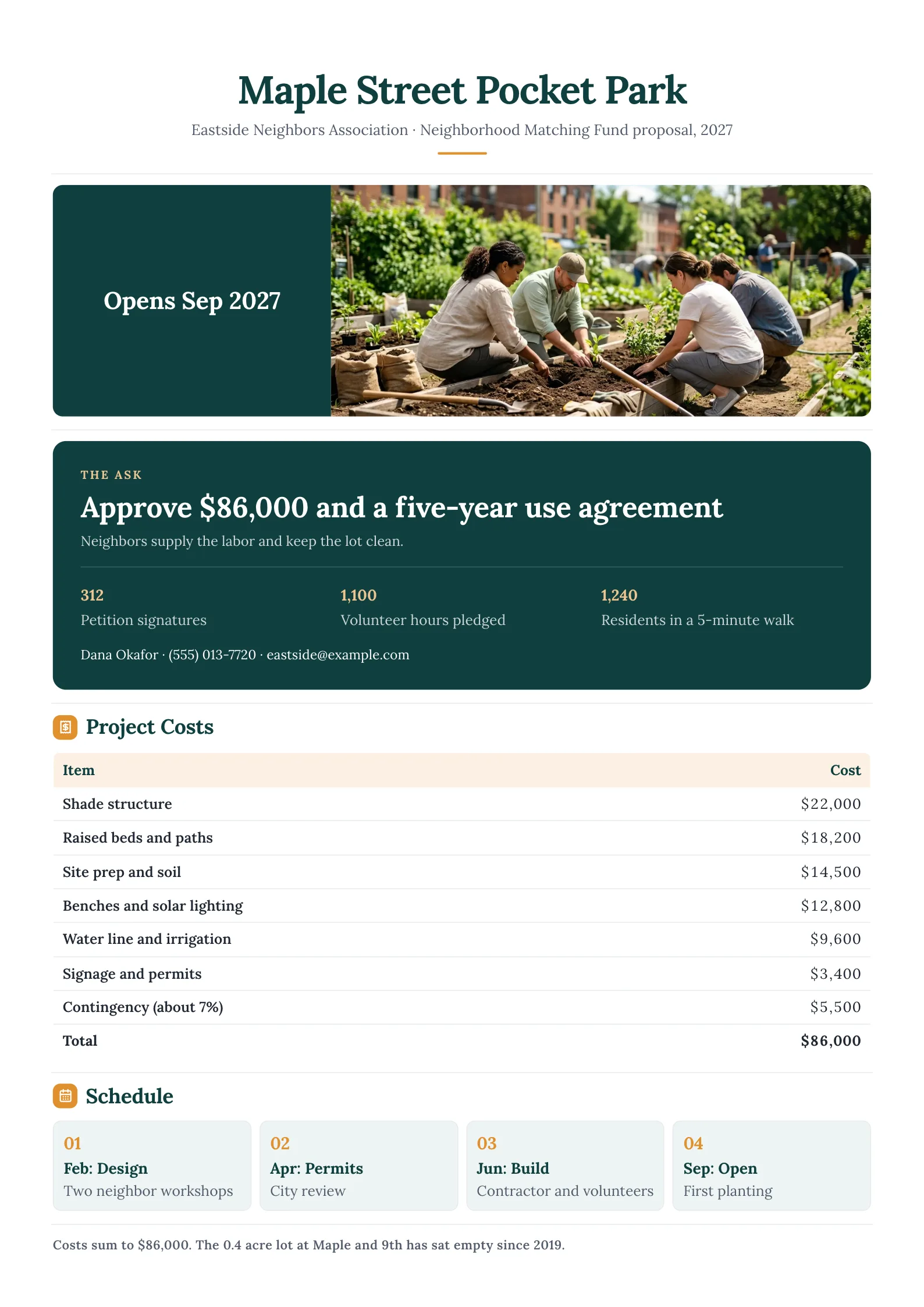 Community Improvement ProposalEdit for free(opens in a new tab)
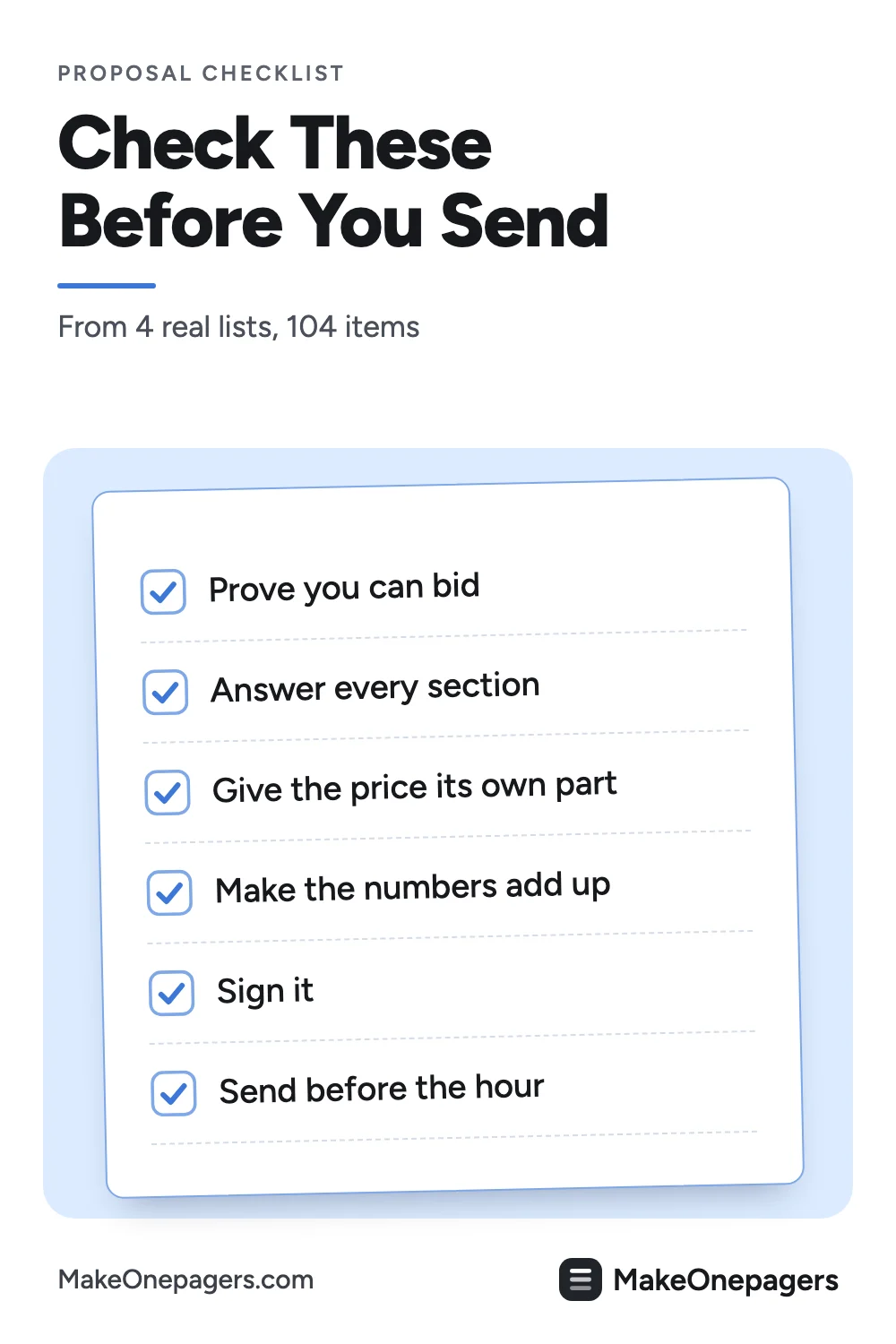
All 4 ask you to prove you're allowed to bid and to answer the work they asked for. Three of the 4 want a signature, and three warn that a missing item can sink you. Here's what each list asks, then 10 checks you can run on any proposal.
The 4 checklists we read
| Checklist | Who uses it | Items | Its warning |
|---|---|---|---|
| NSF Proposal Preparation Checklist | Researchers asking the National Science Foundation for a grant | 57, in 16 sections | NSF may refuse a proposal that breaks its rules, or return it without review |
| Hawaii OHA Proposal Submittal Checklist | Firms answering the Office of Hawaiian Affairs' RFP No. SI 2026-021 | 5, one with 4 parts | The offeror is responsible "for complying with all aspects" |
| New York Proposal Submission Requirements Checklist | Firms bidding on New York State's vision plan services | 36: 18 administrative, 17 technical, 1 cost | The state "reserves the right to disqualify" bids missing mandatory items |
| Kentucky RFP template checklist%20PSC%20Template.docx) | Firms answering a Kentucky personal service contract request, template revised April 2026 | 6 | Missing key items make a proposal "non-responsive" |
The lists differ in size because they do different jobs. NSF's runs line by line through a research proposal. Hawaii's names the forms to attach and leaves the rest to the request itself. New York's points to the section of the request where each part is explained. Kentucky's sits near the front of a template that state agencies fill in, so every request built from that template carries it.
What all 4 lists ask for
We sorted the 104 items by what they ask you to do. Six kinds of check came up in two or more lists.
- Prove you can bid (4 of 4). NSF wants an active SAM registration and a valid UEI. Hawaii wants a certificate of vendor compliance or tax clearance papers. New York wants its Vendor Responsibility Questionnaire and state tax forms. Kentucky wants proof of registration with the Secretary of State for out-of-state firms.
- Answer the work they asked for (4 of 4). NSF checks that your proposal is "responsive to the relevant program description." New York lists 17 technical sections, each tied to a section of its request.
- Sign it (3 of 4). Hawaii asks for a cover letter with an "original signature." New York needs its offer letter signed and notarized. Kentucky asks for a signed and completed solicitation.
- Give the price its own part (3 of 4). NSF has a budget section with a justification for every line. New York has a separate cost checklist. Kentucky wants the cost proposal under its own sealed cover.
- Warn you about rejection (3 of 4). NSF, New York and Kentucky each say what happens to a proposal that's missing a required piece.
- Name a deadline (2 of 4). NSF says the proposal goes in by 5 p.m. in your organization's local time. Kentucky wants both parts by the closing date.
Some checks show up only once, but they're worth borrowing. Hawaii asks you to acknowledge every addendum to the request. NSF caps 6 parts by page count, from a one-page summary to a 15-page project description. It also says your project description must leave out web links.
The proposal checklist
Run these 10 checks before you send any proposal, to a government buyer or a private client.
- Read the buyer's own instructions first. NSF says that when a solicitation changes its standard rules, the solicitation's rules must be followed. The same goes for a client's request.
- Prove you're eligible. Attach the registration, license, insurance or tax papers the buyer names.
- Answer every section they asked for, in their order. Use their headings, so a reviewer can find each answer fast.
- Give your price its own section. Keep it out of the pitch, so the buyer can compare it line by line.
- Explain every line of your budget. NSF asks for each line item to be "documented and justified." Add a short basis, like 6 coaches for 10 weeks.
- Make every number add up. Add the lines again and check the total in the table and in your ask.
- Get the right person to sign. Hawaii asks for a corporate resolution naming who can sign. Check who can sign for your firm before the due date.
- Acknowledge every addendum. If the buyer changed the request, say you've read each change.
- Stay inside the limits. Check page counts, file size and file type. Kentucky's template caps attachments at 65,000 KB.
- Send it before the deadline hour. Note the time zone, and say how long your price holds. Kentucky asks for proposals to stay valid for at least six months.
Five sample proposals, matched to the checks
The MakeOnepagers samples below use invented organizations and figures. Look at each one for the check it shows best, then copy that part into your own proposal.
A grant proposal with a basis for every budget line
 Edit this template
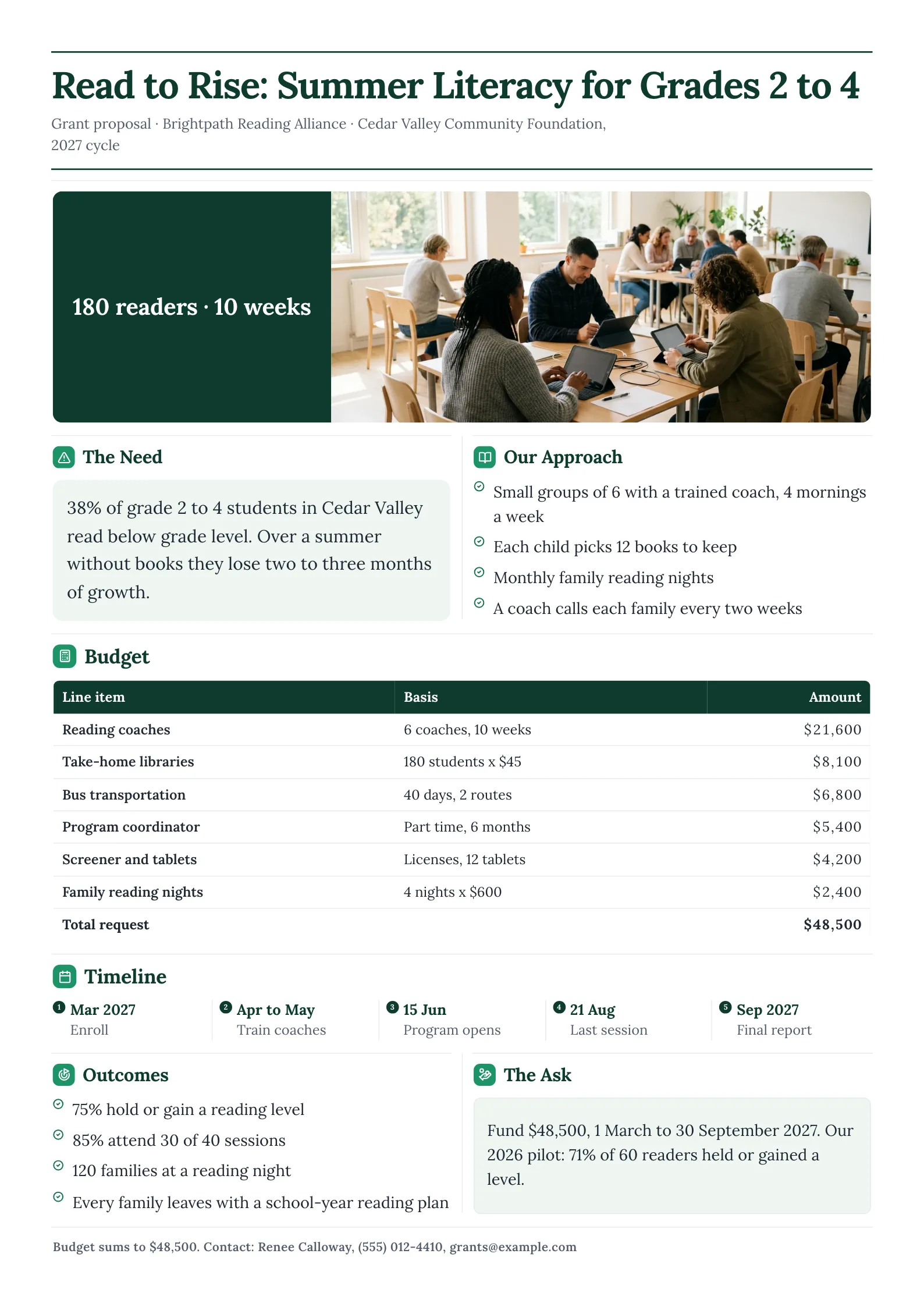
This grant proposal passes check 5. Its budget table has a Basis column, so each amount shows how it was built. Reading coaches are 6 coaches for 10 weeks at $21,600, and take-home libraries are 180 students at $45 each, for $8,100. The six lines add to the $48,500 total request, which passes check 6 too. The ask names the dates, March 1 to September 30, 2027, and backs it with a 2026 pilot where 71% of 60 readers held or gained a level.
A technology request with the split and a deadline
 Edit this template
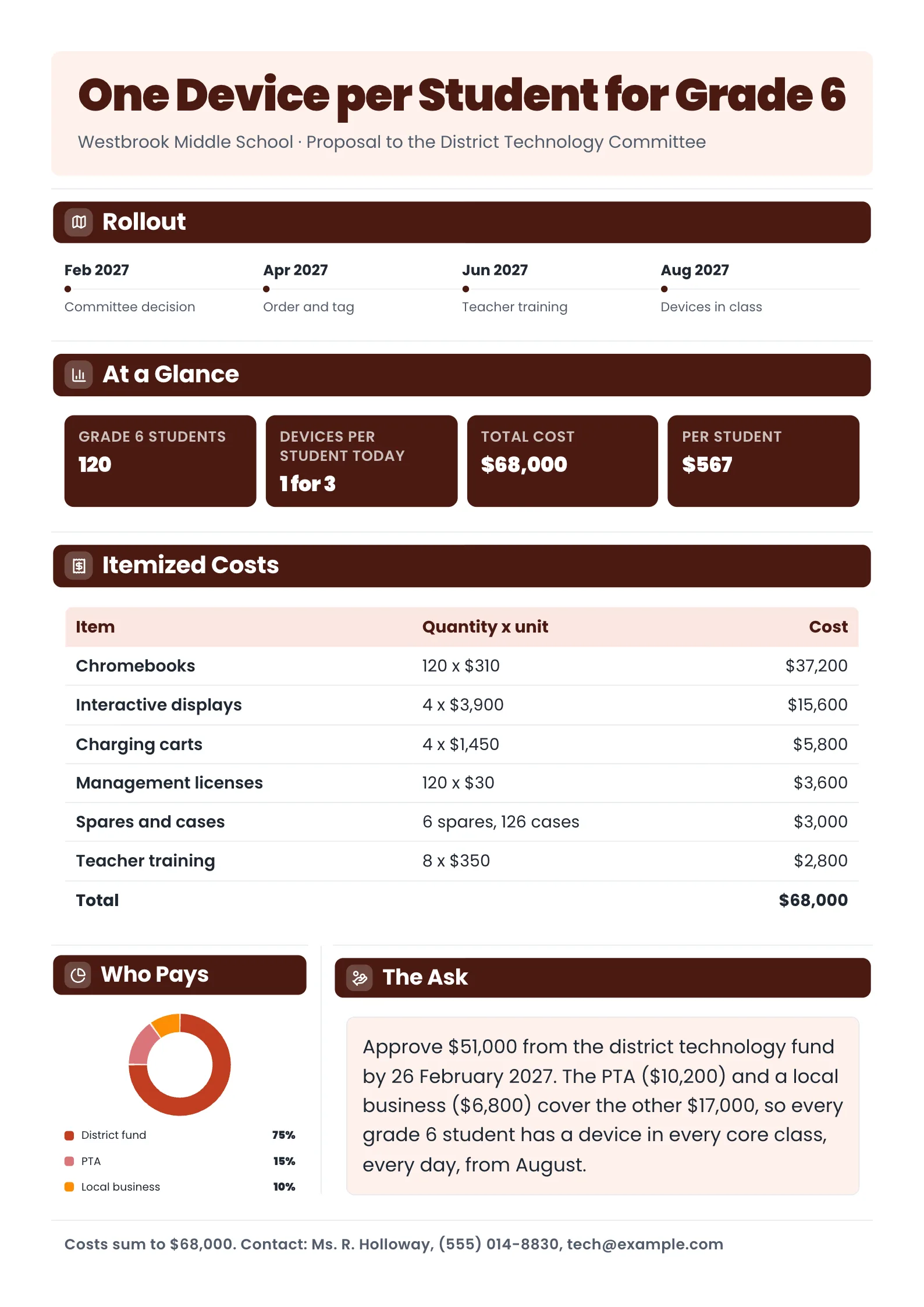
This classroom technology proposal shows checks 4, 6 and 10 on one sheet. The itemized costs sit in their own table and add to $68,000, or $567 a student. The ask is clear. Approve $51,000 from the district fund by February 26, 2027, while the PTA gives $10,200 and a local business $6,800. A line at the bottom says the costs sum to $68,000, so the committee doesn't have to check the math.
A research proposal that lists approvals first
 Edit this template
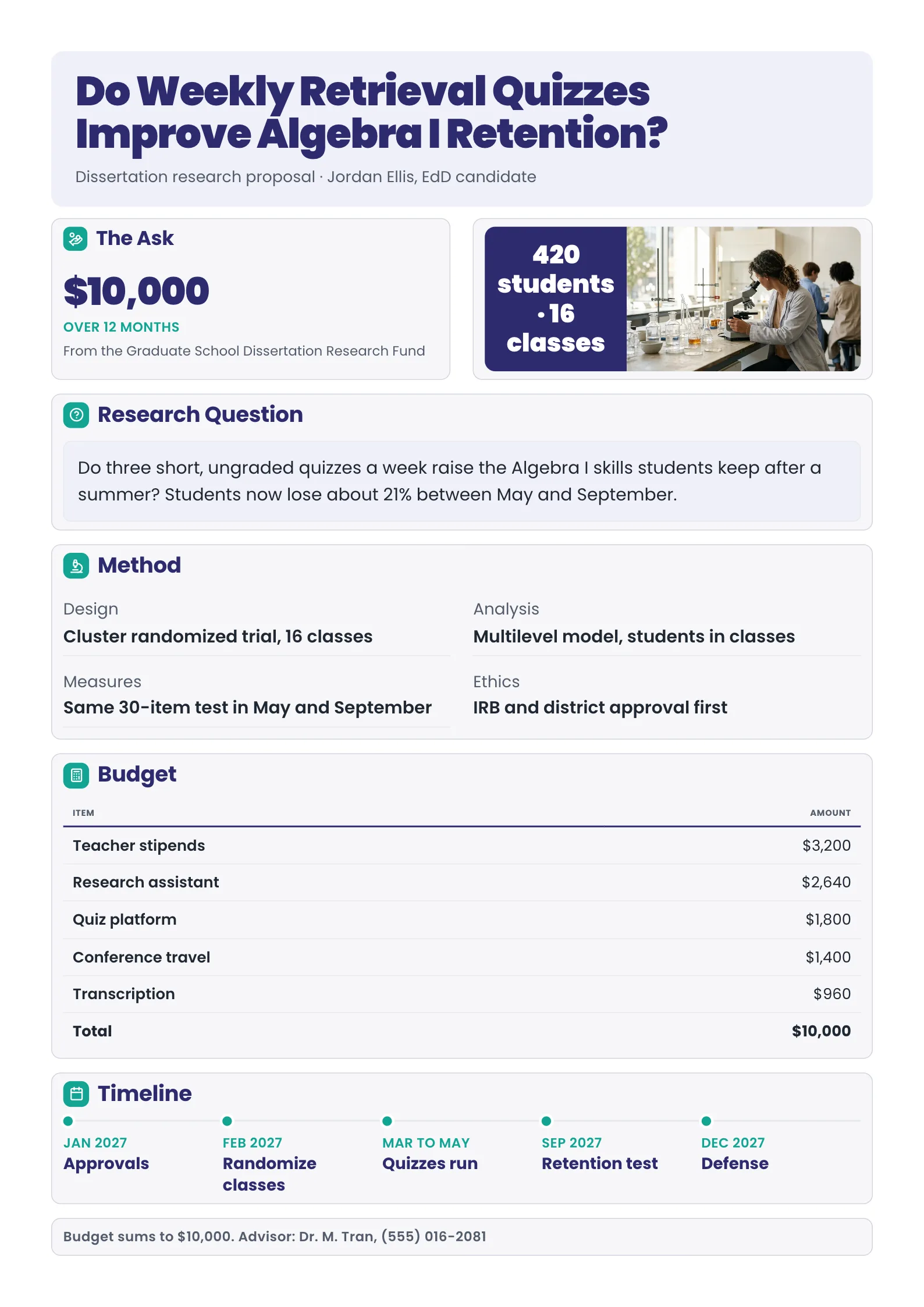
Grant checklists often ask about approvals before any work starts. This research proposal puts it in the method box: "IRB and district approval first." Its timeline then starts with approvals in January 2027, before classes are randomized in February. The $10,000 ask comes from a dissertation fund, and five budget lines add up to it. If your project needs a permit, a license or a sign-off, put it on the page and on the timeline.
A consulting proposal that names what the client must provide
 Edit this template
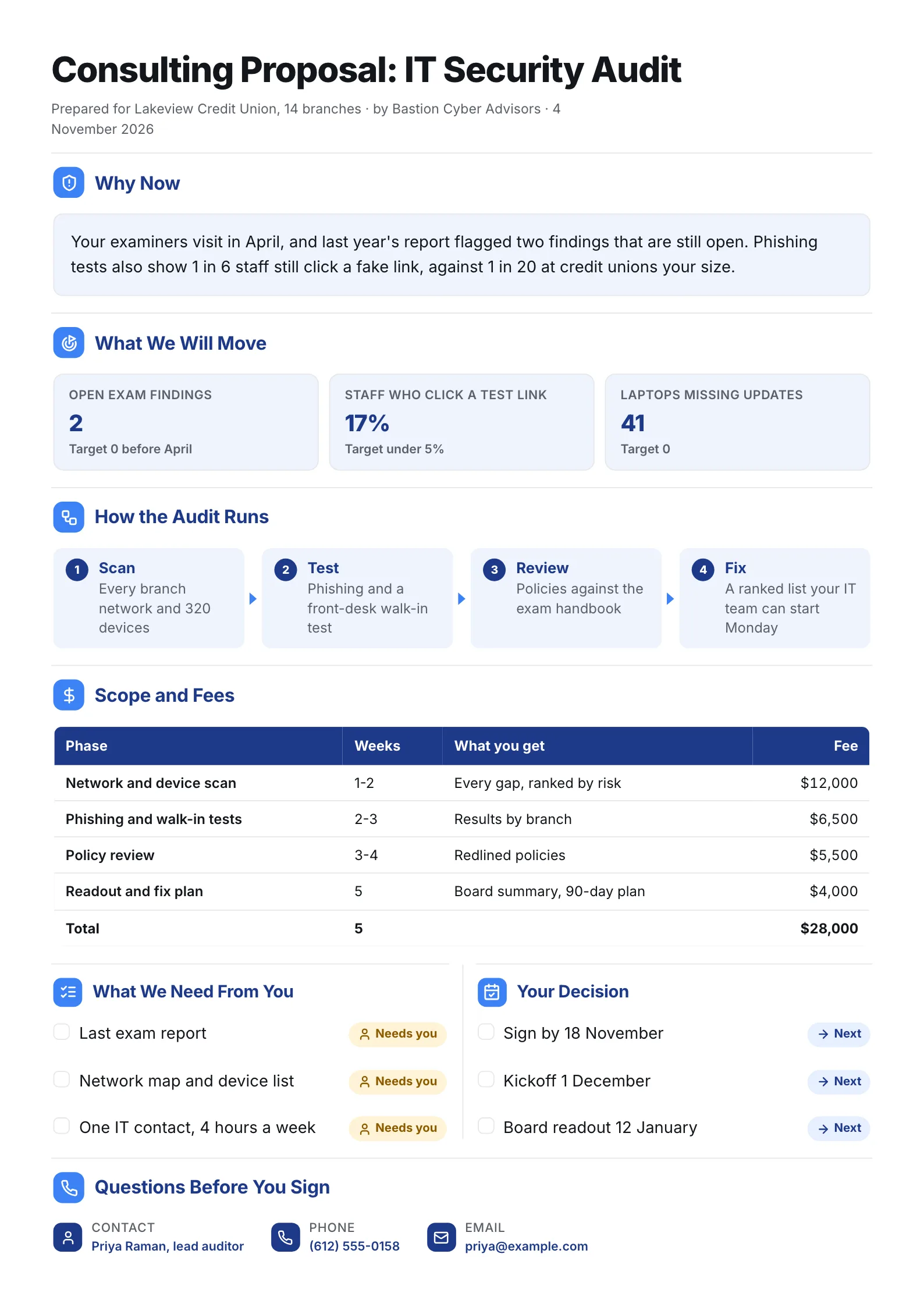
A private client won't hand you a checklist, so write one into the proposal. This IT security audit proposal lists what it needs from the client: the last exam report, a network map and device list, and one IT contact for 4 hours a week. Fees run by phase and add to $28,000. The decision box asks for a signature by November 18, with kickoff on December 1.
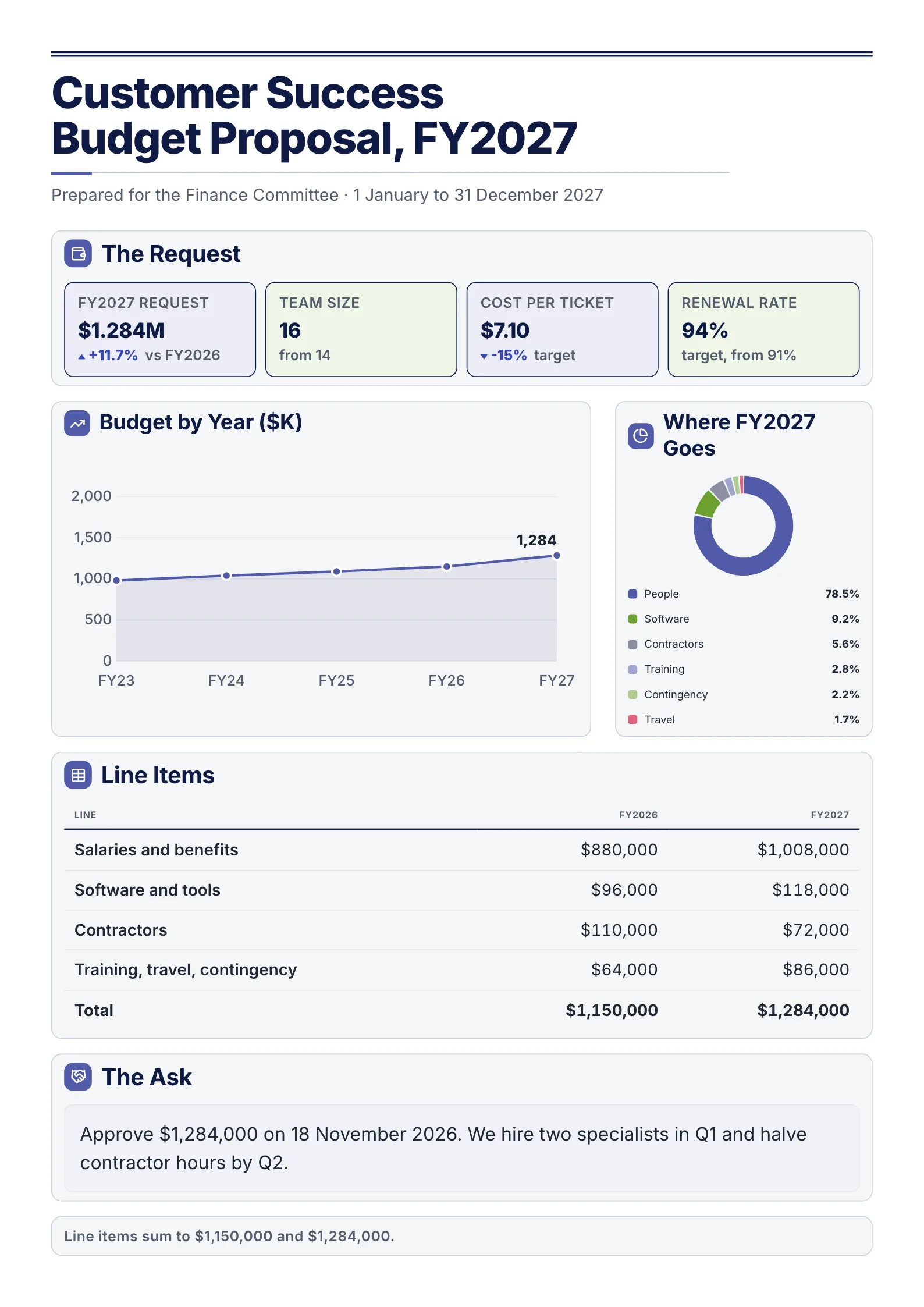
A budget proposal with both years side by side
 Edit this template
Inside a company, the buyer is often a finance committee. This budget proposal asks for $1.284 million for 2027, up 11.7% from 2026. Its line items show both years, so the committee can see where the extra $134,000 goes. A note at the foot confirms the lines sum to $1,150,000 and $1,284,000. The ask names a meeting date, November 18, 2026, and says what happens next: two hires in Q1 and half the contractor hours by Q2.
Make your proposal
Pick a MakeOnepagers proposal for your kind of work, then run the 10 checks above before you hit send. Drop your notes or the buyer's request into the free AI One-Pager generator to get a draft on the page fast. To plan the sections, read how to write a proposal. For a grant, see what 6 common applications ask in how to write a grant proposal. When your buyer only wants a price, compare the two in proposal vs quote.
Frequently asked questions
What should be on a proposal checklist?
Start with the buyer's own list, if they give one. Then check that you've proved you're eligible, answered every section, put the price in its own part, made the numbers add up, signed it, and sent it before the deadline hour.
Who makes the proposal checklist?
Often the buyer does. Government requests usually attach one, like New York's 36-row list or Hawaii's 5-item list. For a private client, make your own from the client's request and the 10 checks above.
Is a buyer's checklist the full set of rules?
No. NSF says its checklist "is not intended to be an all-inclusive repetition" of the proposal rules. Hawaii's says the same in its own words. Use the checklist to catch misses, then read the full request.
What happens if I leave something off?
It depends on the buyer and the item. Kentucky's template says it will treat a proposal missing key items as non-responsive and won't consider it for award. NSF may refuse to accept it or return it without review. With a private client, a missing price or signature means another round of emails before anyone can say yes.
Should I check the proposal more than once?
Yes. Run the checklist once when your draft is done, and again on the final file just before you send it. Any edit made after the first check can change a total or push a section past its page limit.




