How to Write a Grant Proposal: What 6 Common Applications Ask
How to write a grant proposal, built from 6 common applications US funders share: the cover letter, narrative, budget and attachments.

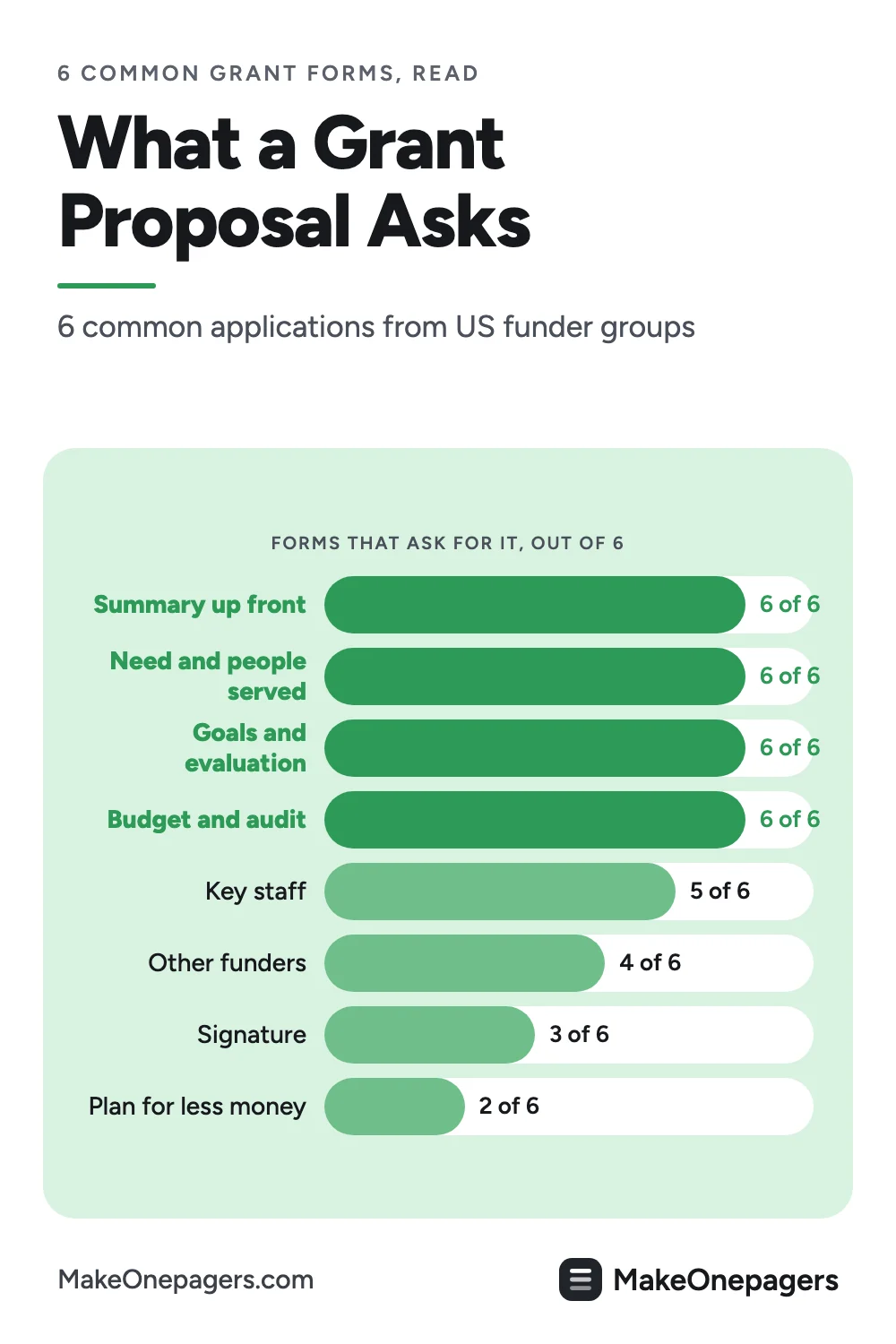
Here's how to write a grant proposal: open with a short summary of your ask, then explain the need, who you serve, your goals, what you'll do and how you'll measure it, and back it with a budget. To check that list against the real thing, we read 6 common grant applications on October 26, 2026. A common application is one form that a group of foundations agrees to accept, so you can write once and send it to several of them. All 6 asked for a summary, the need, your goals, an evaluation plan and a budget. Only 2 asked what you'd change if you got less money than you asked for. Start from a free one pager template.
One‑Pager examples
Real One-Pagers made with MakeOnepagers. Open any one to edit it as your own.
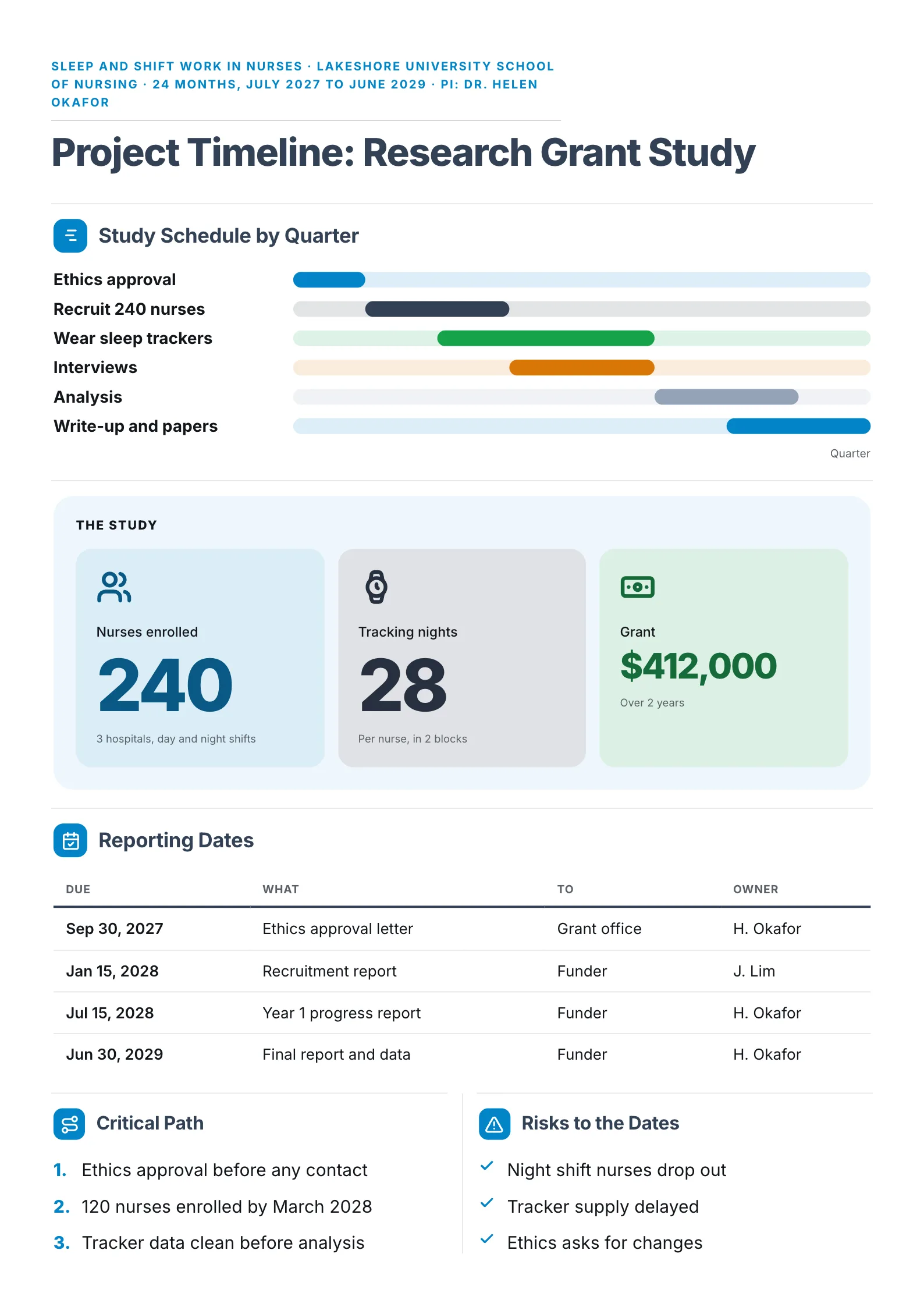 Project Timeline: Research Grant StudyEdit for free(opens in a new tab)
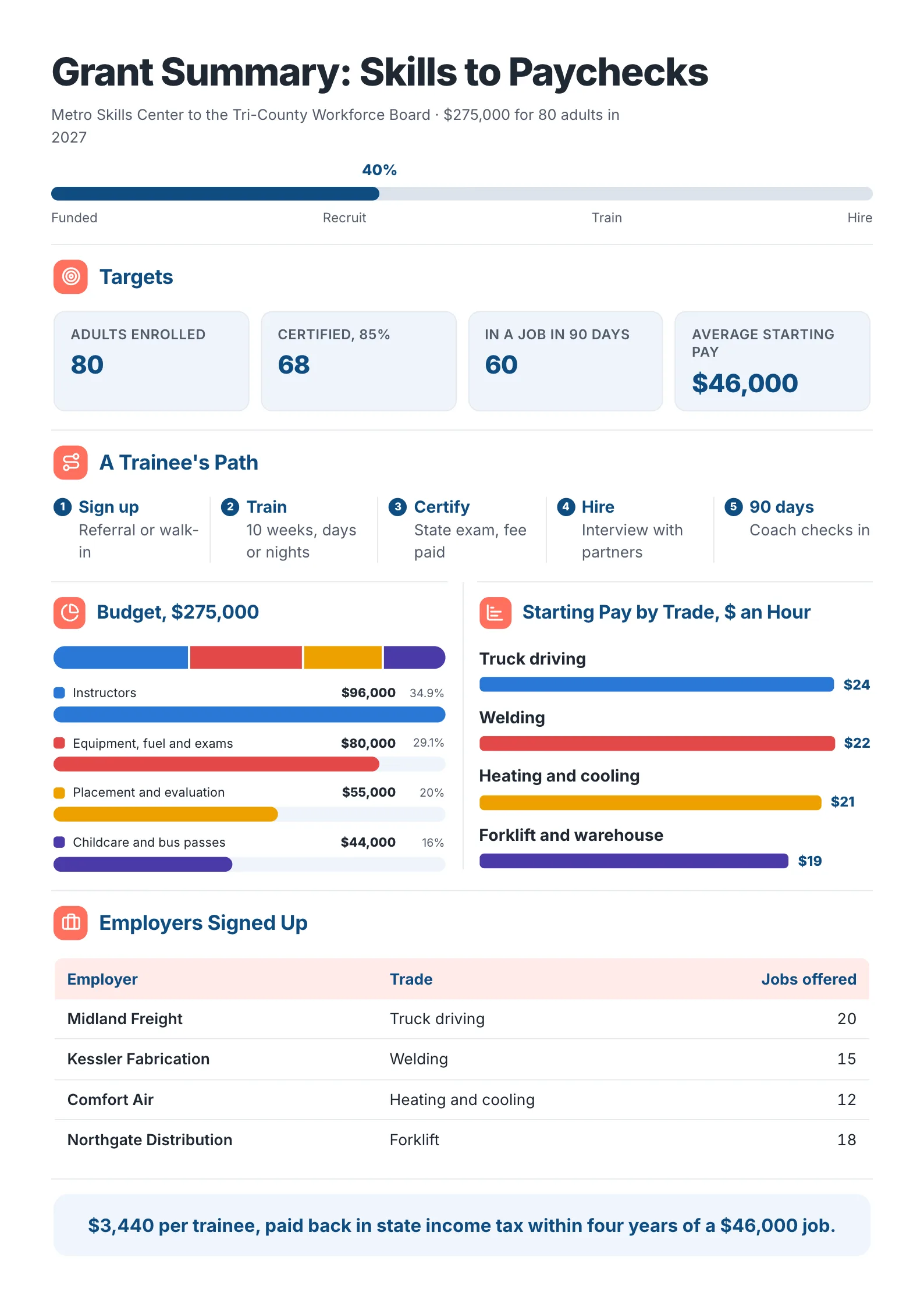 Grant Summary: Workforce Training ProgramEdit for free(opens in a new tab)
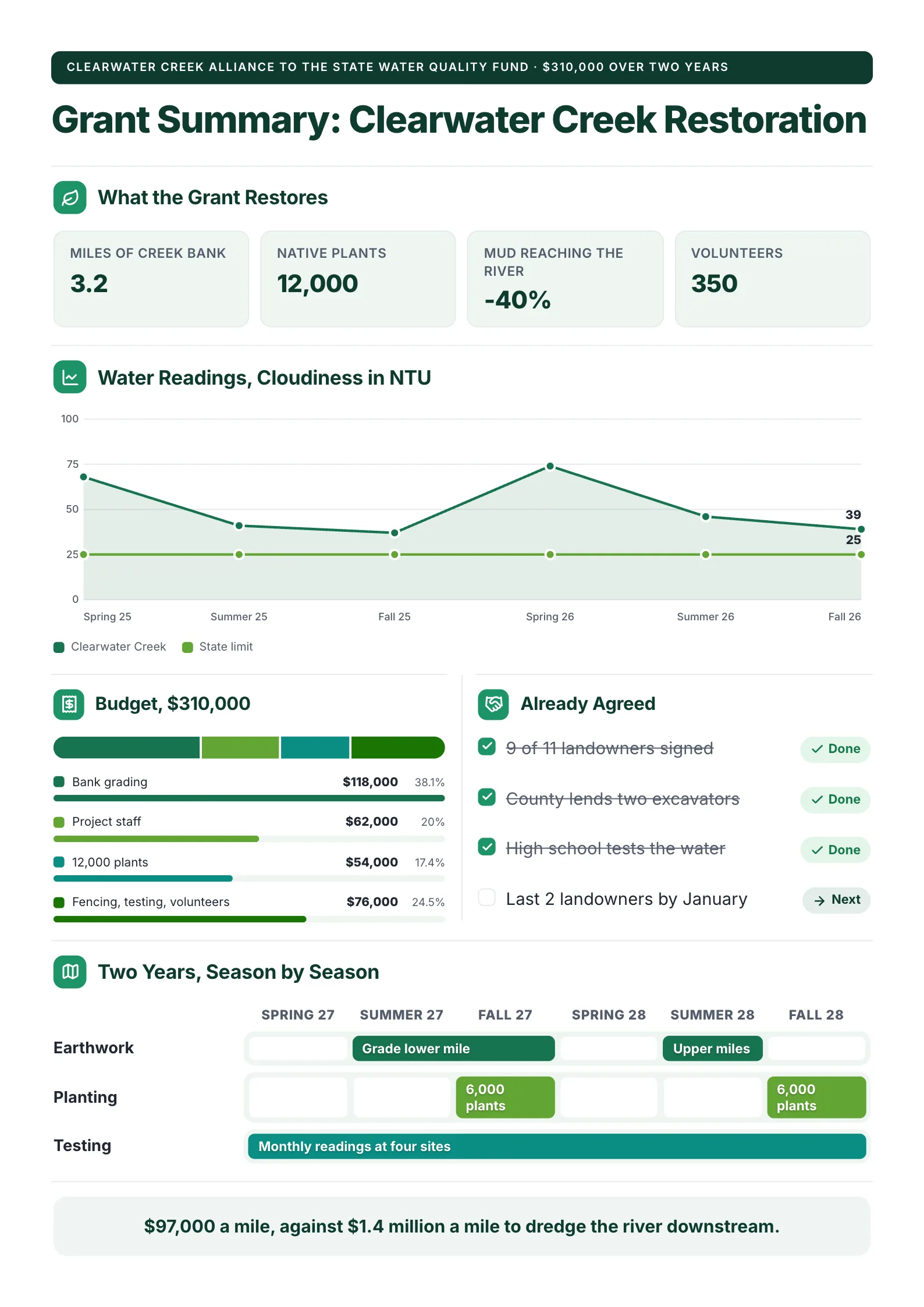 Grant Summary: Watershed RestorationEdit for free(opens in a new tab)
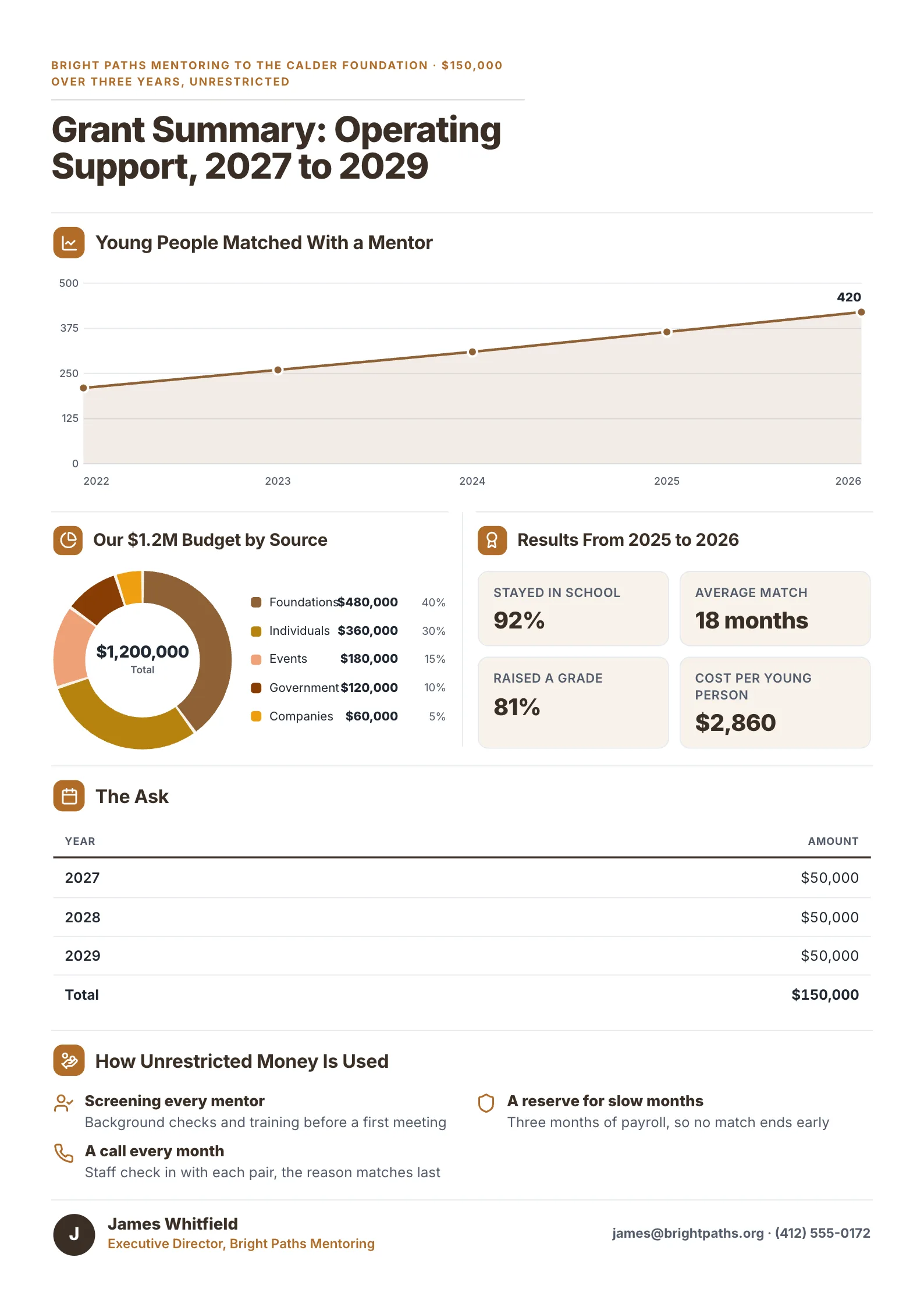 Grant Summary: General Operating SupportEdit for free(opens in a new tab)
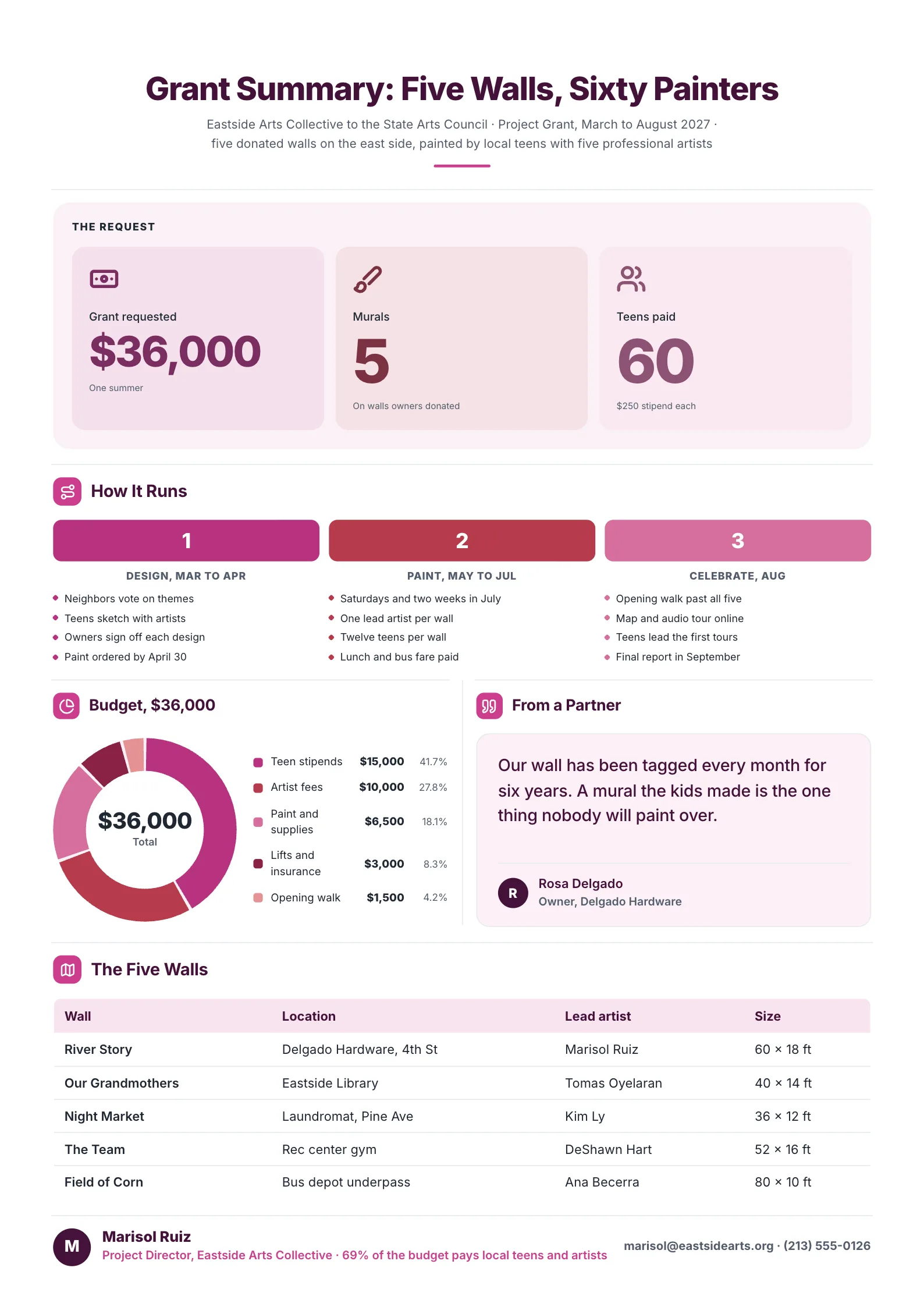 Grant Summary: Public Art Mural ProjectEdit for free(opens in a new tab)
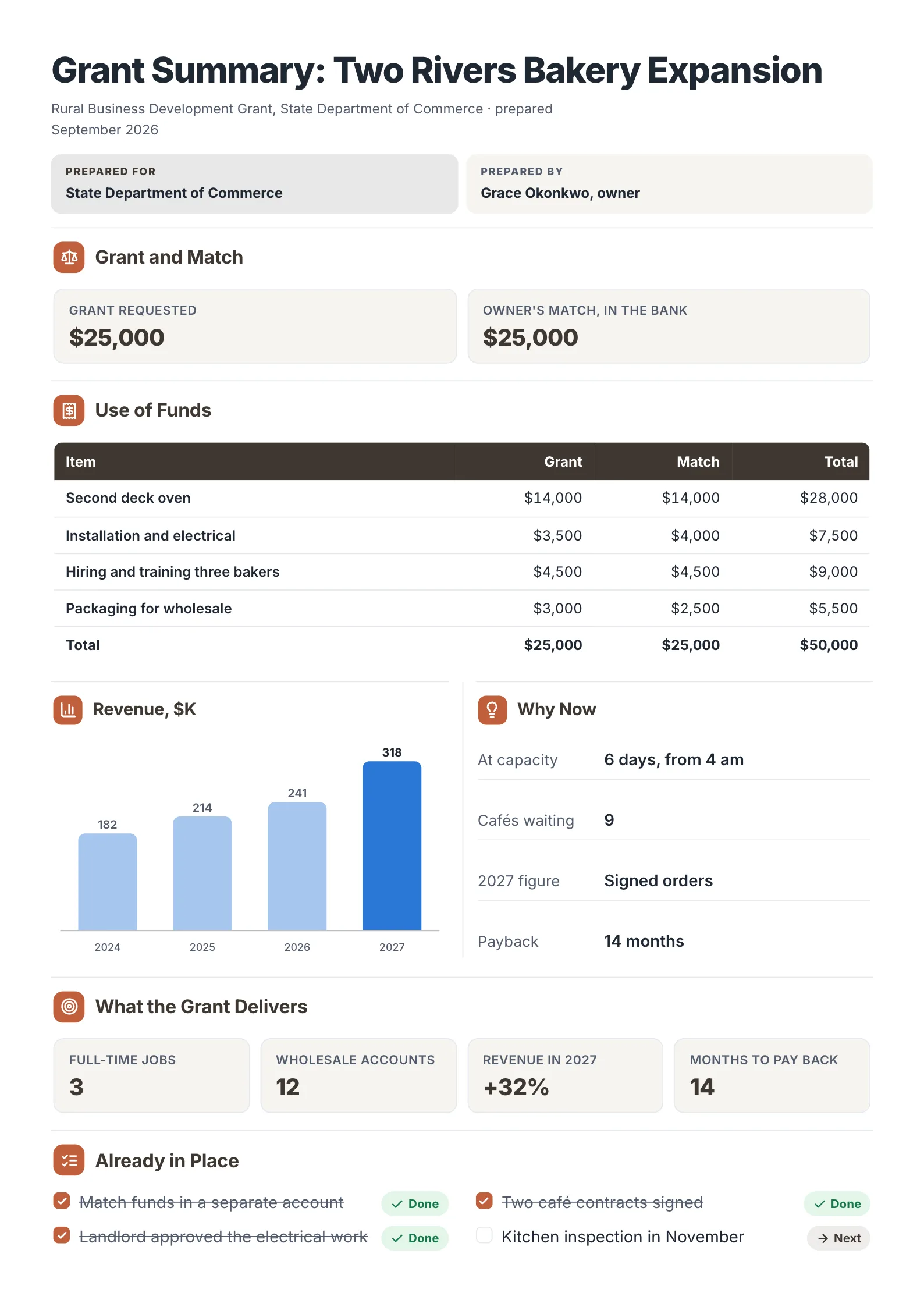 Grant Summary: Small Business ExpansionEdit for free(opens in a new tab)
Below you'll find what goes in the packet, the narrative part by part, how long it can run, and five grant summaries you can open and edit for free.
The six applications we read
Each funder still sets its own rules, and two of these forms, Santa Barbara and the National Network of Grantmakers, tell you to contact the funder before you apply. Read the funder's guidelines first. Then use these forms as your outline, since they show what many funders agree on:
- The Minnesota Common Grant Application, from the Minnesota Council on Foundations, the 2023 version. The council calls it a suggested form.
- The Colorado Common Grant Application, dated 2010.
- The Santa Barbara County Common Grant Application, from the Foundation Roundtable, revised February 2020.
- The Council of Michigan Foundations Common Grant Application. It carries no date. The copy we read was posted in 2022.
- The National Network of Grantmakers Common Grant Application, a national form. It carries no date. The copy we read was posted in 2023.
- The New York and New Jersey Common Application Form, from Philanthropy New York and the Council of New Jersey Grantmakers. The copy we read was posted in 2018.
We went through each form question by question and marked which of 24 asks it makes. Every count below comes from that table, and each form above links to the copy we read, so you can check any row yourself.
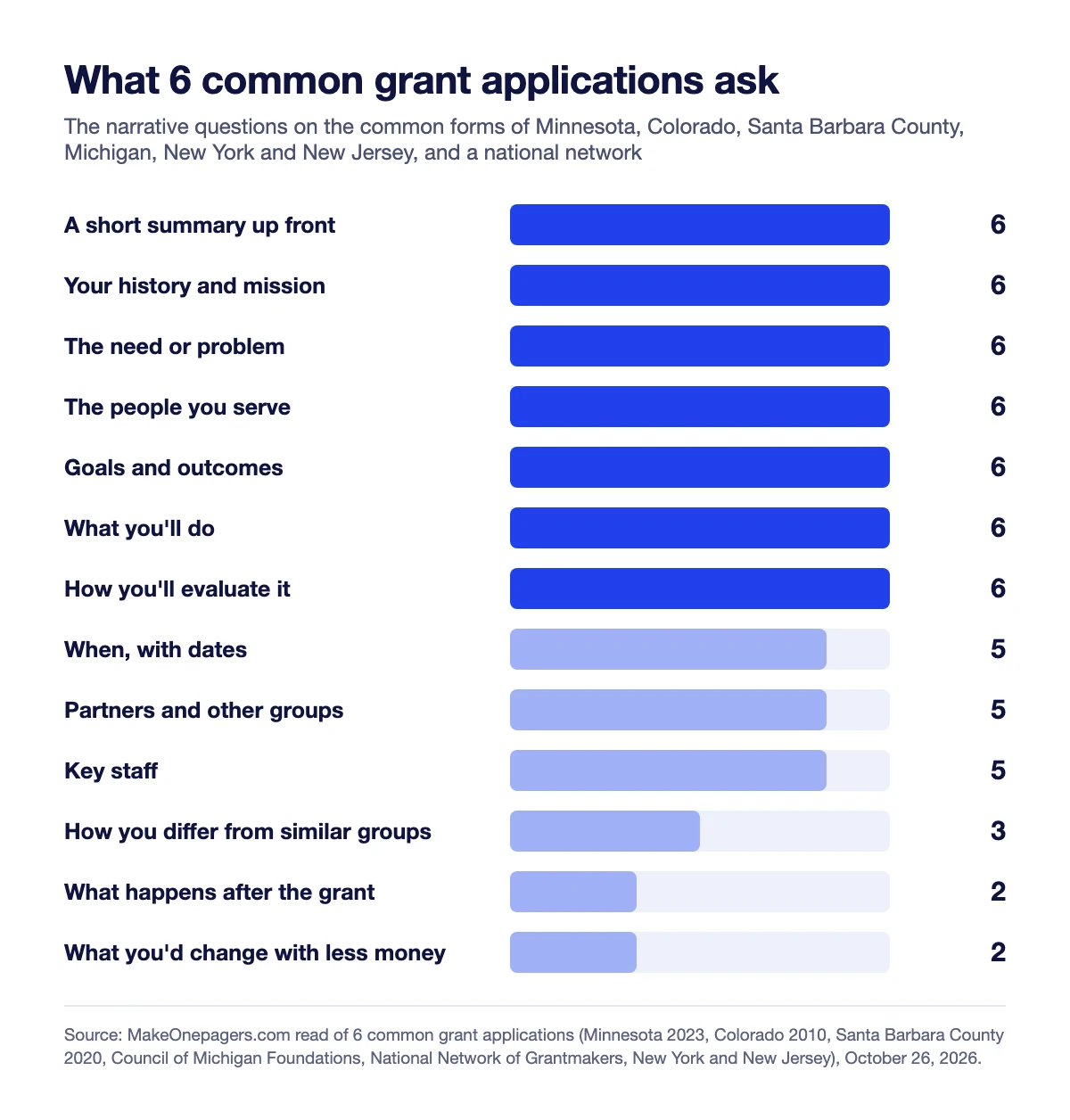
Source: MakeOnepagers.com read of 6 common grant applications (Minnesota 2023, Colorado 2010, Santa Barbara County 2020, Council of Michigan Foundations, National Network of Grantmakers, New York and New Jersey), October 26, 2026.
What goes in the packet
A full proposal has four pieces. All 6 forms ask for the narrative, the budget and the attachments, and 2 also ask for a cover letter.
- A cover letter. Colorado asks for one page with the purpose of the request and how it fits the funder's mission. The National Network of Grantmakers asks for a brief letter that links your proposal to the funder's interests and sums up the project in one paragraph.
- The narrative. This is the story of your project, with its own summary on top. The next section takes it part by part.
- The budget. All 6 forms want your whole organization's budget, and a project budget when you ask for a project. Minnesota and the National Network of Grantmakers skip it for general support.
- The attachments. Your audit or latest financial statement, your board list, and usually your IRS 501(c)(3) letter.
The narrative, part by part
A short summary of the request
All 6 forms open with one. Three keep it tiny. Santa Barbara and the National Network of Grantmakers ask for 2 to 3 sentences on a cover sheet, and Minnesota gives you 400 characters. Michigan and New York and New Jersey want a half-page summary, and their cover sheet asks for the purpose in one sentence on its own. Write yours last, once you know every number in it. Name the amount, the project, the people it helps and how long it runs. For more one-page layouts, see our grant summary template page.
Your history and mission
All 6 forms ask who you are. Keep it to a paragraph. Say when you started, what you do, and one result you can count.
The need
Every form asks what problem the grant will solve. Use a number from your own work or a public source, and name the source. "The nearest clinic is 48 miles away" tells a reader more than "access to care is limited". Show who has the problem and how many of them there are.
The people you serve
All 6 forms ask who benefits. Give a count and describe them in plain words: their ages, where they live, what they need. Colorado's form asks for the numbers outright, so have them ready.
Goals and outcomes
All 6 forms ask what will change. Michigan asks for measurable objectives. Write each goal as something you can count by a date, like "1,800 blood pressure checks in 18 months". A goal you can count is one the funder can report to its own board.
What you'll do, and when
All 6 forms ask what you'll do. Five ask when, and New York and New Jersey ask only how long the project runs. Minnesota lets a general operating request skip this question, and Colorado's version is for project requests. List the steps in order with a month beside each one.
How you'll evaluate it
Every form asks how you'll know it worked. Say what you'll measure, how often and who measures it. Minnesota's form asks how you track your impact. The National Network of Grantmakers puts its evaluation questions in a section each funder ticks, so check whether yours asks. Name the report the funder gets at the end.
Partners and how you differ
Five of the 6 forms ask who else is involved. The National Network of Grantmakers asks it only of state, regional and national groups, and asks a grassroots group to describe its community instead. Three forms (Santa Barbara, Michigan, and New York and New Jersey) also ask how you differ from groups doing similar work. Answer that with something a reader can check, like the towns only you reach.
Key staff
Five of the 6 forms ask who will run the project. Give each person's role and one line on why they're right for it. Colorado wants names, qualifications and length of service, and says not to send job descriptions or resumes. New York and New Jersey ask for a one-paragraph resume of each.
The budget, and the question about less money
Every form wants a project budget, and the best ones show you how to lay it out. Michigan's form lists the lines in order, from salaries and fringe benefits to evaluation and marketing. Each line has two amounts, the part you're asking this funder for and the total cost of the project. The National Network of Grantmakers gives a similar list of expense lines, from salaries and wages to rent and utilities, followed by your income by source.
Then explain each line. Only Michigan asks for this outright: a separate sheet showing how each budget item relates to the project and how the amount was worked out. Two more forms point the same way. Santa Barbara's budget gives every line a Notes column, and New York and New Jersey ask you to show the specific uses of the grant. Under your budget, add one line per item that says what it buys and how you got the number, like "Tutors: 2 part-time tutors, 10 hours a week for 30 weeks at $20 an hour, $12,000."
Four forms ask who else is paying and how sure that money is. Michigan splits your income into committed and pending. Santa Barbara's budget has pending and secured columns. The National Network of Grantmakers asks what is received, committed or pending. New York and New Jersey ask which other funders you're asking and where each request stands. Colorado asks only for your major donors from the past two years, and Minnesota for the expected sources of income.
Then answer the question most proposals skip. Only Santa Barbara and Michigan ask what you'd do with less than the full amount. Santa Barbara asks for your plan if full funding isn't available, and Michigan asks you to list your priority items. A short priority list in your budget answers that one. Two forms also ask what happens after the grant ends: Michigan asks for your long-term funding plan, and the National Network of Grantmakers asks about future fundraising. Answer that in one or two sentences of its own, naming who you'll ask next and when.
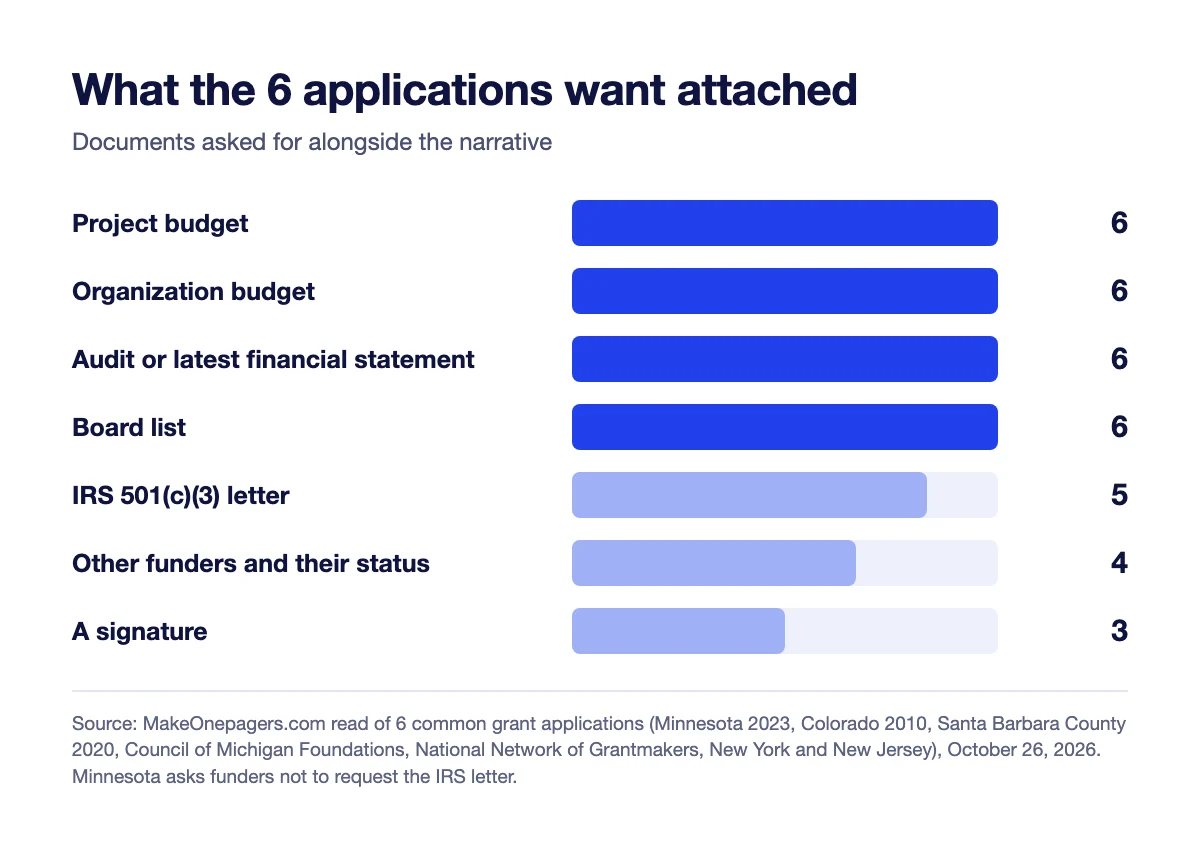
Source: MakeOnepagers.com read of 6 common grant applications, October 26, 2026. Minnesota asks funders not to request the IRS letter.
What to attach, and who signs
All 6 forms want your audit or latest financial statement and a list of your board. Five ask for your IRS 501(c)(3) letter. Minnesota tells funders not to ask for that letter, so check before you send it there. Three forms ask for a signature: Colorado from your chief executive, Santa Barbara from two board members, and Michigan from your board chair and executive director. Find out who signs before the deadline week, and gather the attachments early, since an audit can take days to find.
How long your proposal can be
Five of the 6 forms set a limit for the narrative, and none allows more than 5 pages. Santa Barbara allows 4 pages. Minnesota sets four answers of 3,000 characters each, about a page apiece. Colorado allows 5 pages for a project request and 4 for general support. The National Network of Grantmakers allows 5. New York and New Jersey allow 5 plus the half-page summary. Michigan leaves the length to you.
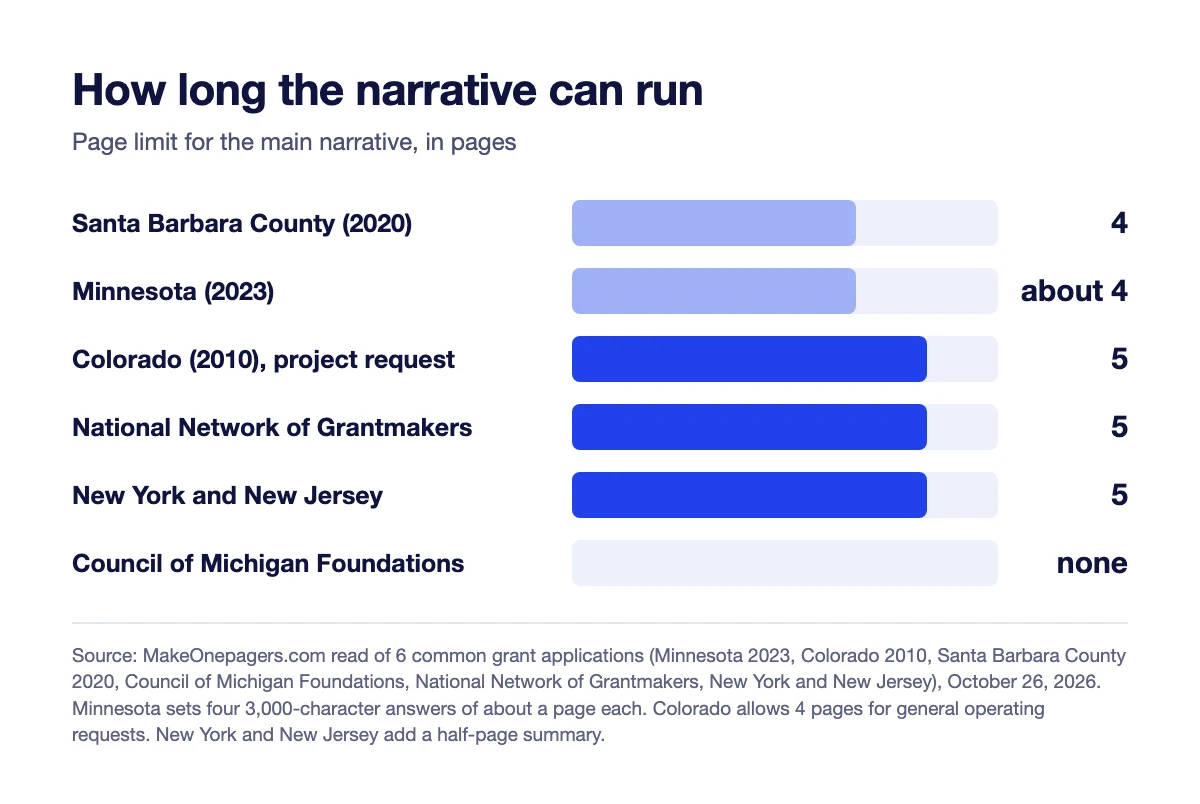
Source: MakeOnepagers.com read of 6 common grant applications, October 26, 2026. Minnesota sets four 3,000-character answers of about a page each. Colorado allows 4 pages for general operating requests. New York and New Jersey add a half-page summary.
So plan on 4 pages, and treat 5 as your ceiling. If a funder sets no limit, a one-page summary on top still helps every reader find the ask fast.
Five grant summaries to start from
Each of these opens in MakeOnepagers, and you can edit every word for free. They're one-page summaries of a full proposal, the sheet that goes on top. We picked them for the part of a proposal each one shows best.
 Edit this template
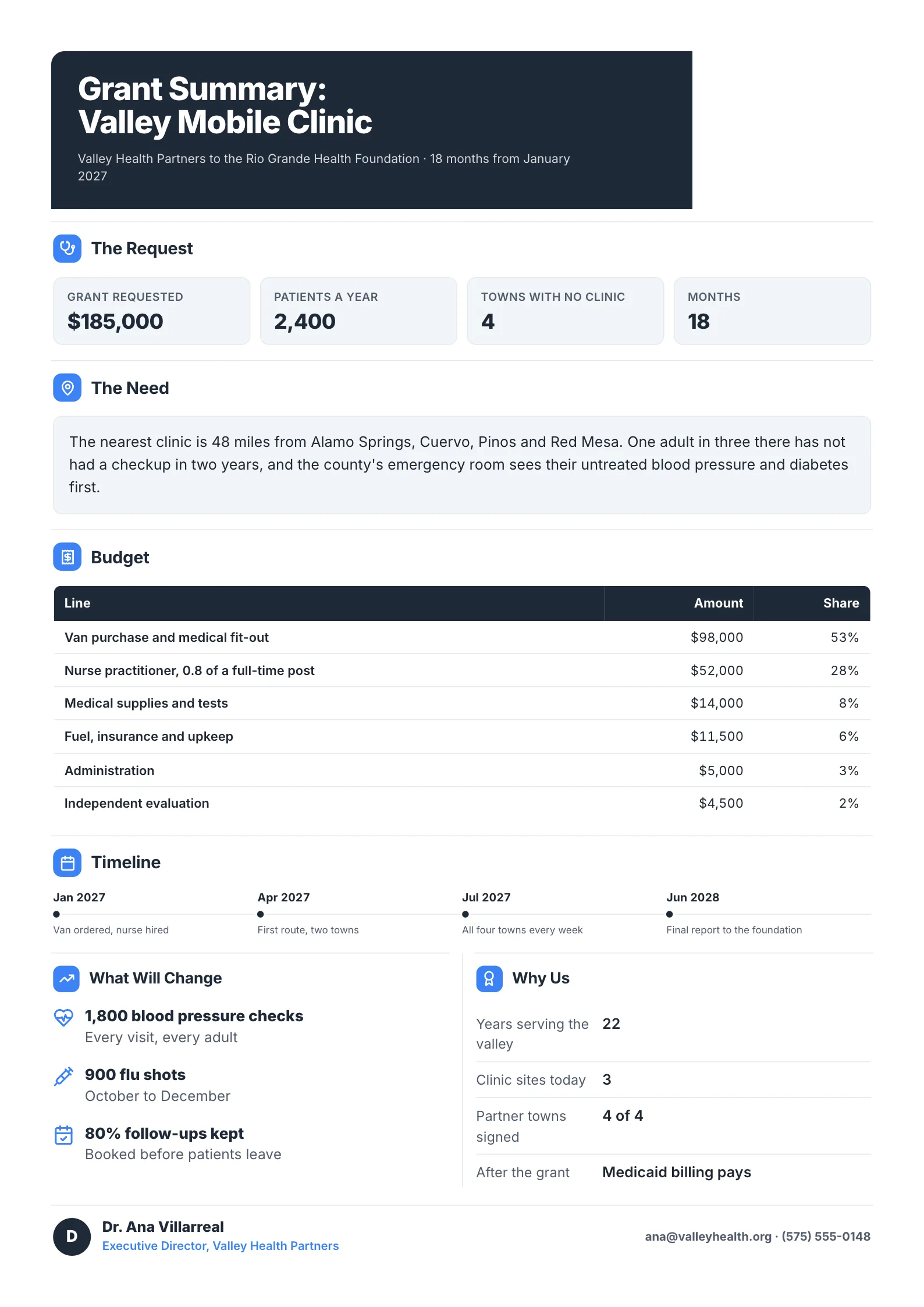
This clinic summary shows the need written with one hard number: the nearest clinic is 48 miles away. Its six budget lines add up to the ask, and its Why Us box says who pays after the grant: Medicaid billing. Open this mobile health clinic grant summary and put in your own towns and distance.
 Edit this template
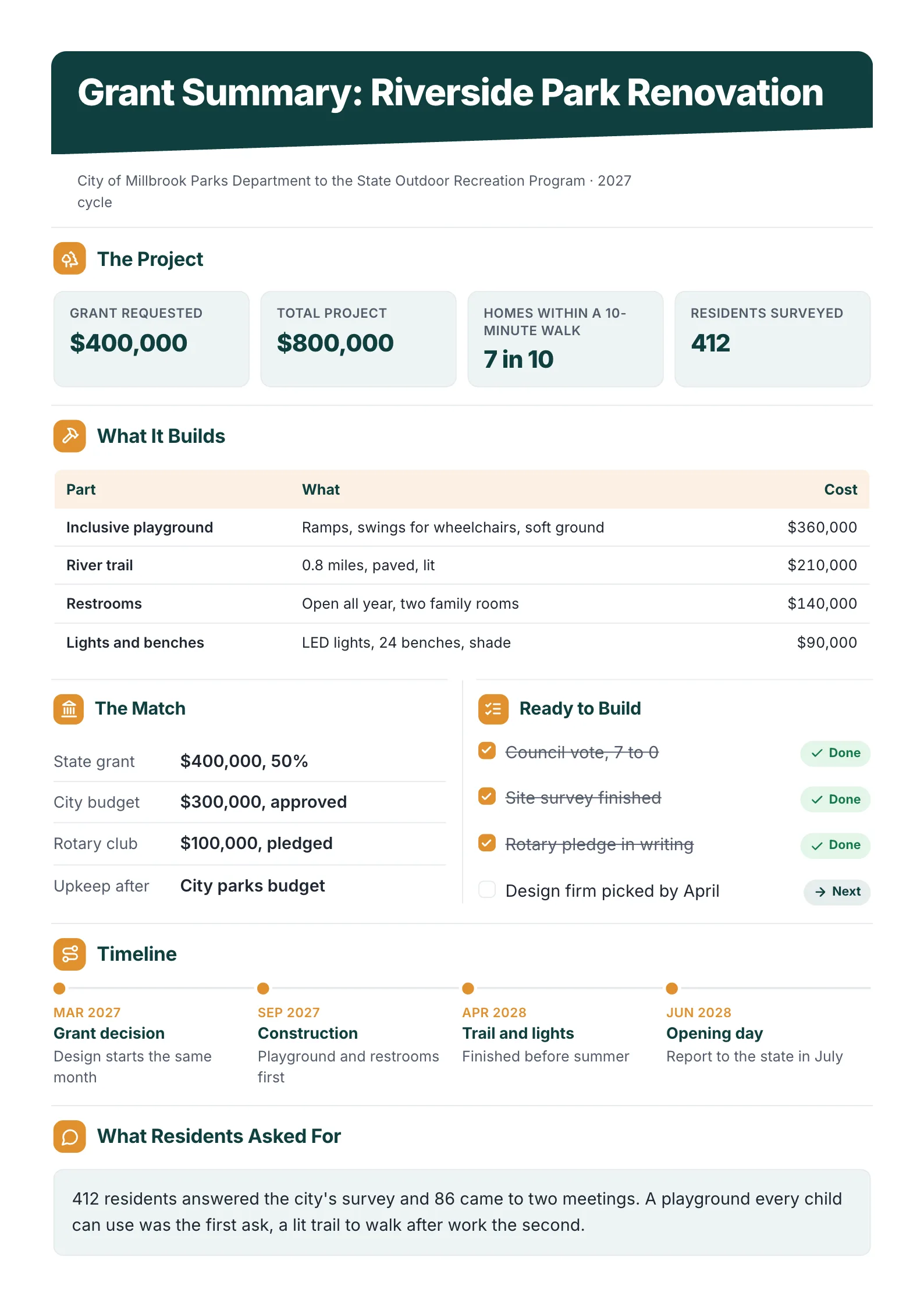
The park summary shows the other money and how sure it is, the part 4 of the 6 forms ask about. The state grant covers half, the city's $300,000 is approved and the Rotary club's $100,000 is pledged. It also says who pays for upkeep after the grant, and backs the need with a survey of 412 residents. Start from this city park renovation grant summary if your project has more than one funder.
 Edit this template
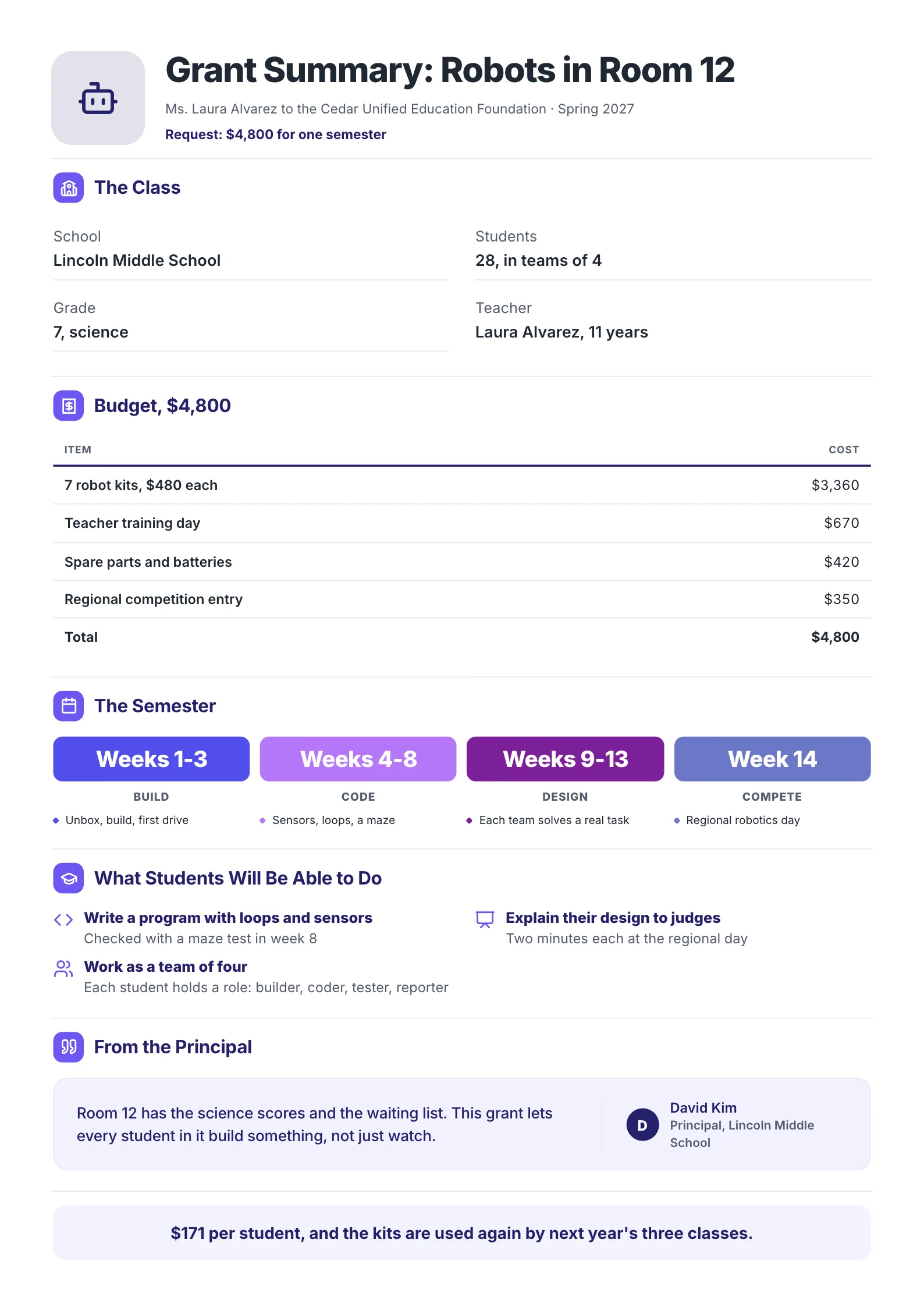
This classroom summary shows how small a good proposal can be. It asks for $4,800 and still names the people served, a timeline by week and outcomes you can check, like a maze test in week 8. Add a signature line before you send it. Try this classroom robotics grant summary for a small school request.
 Edit this template
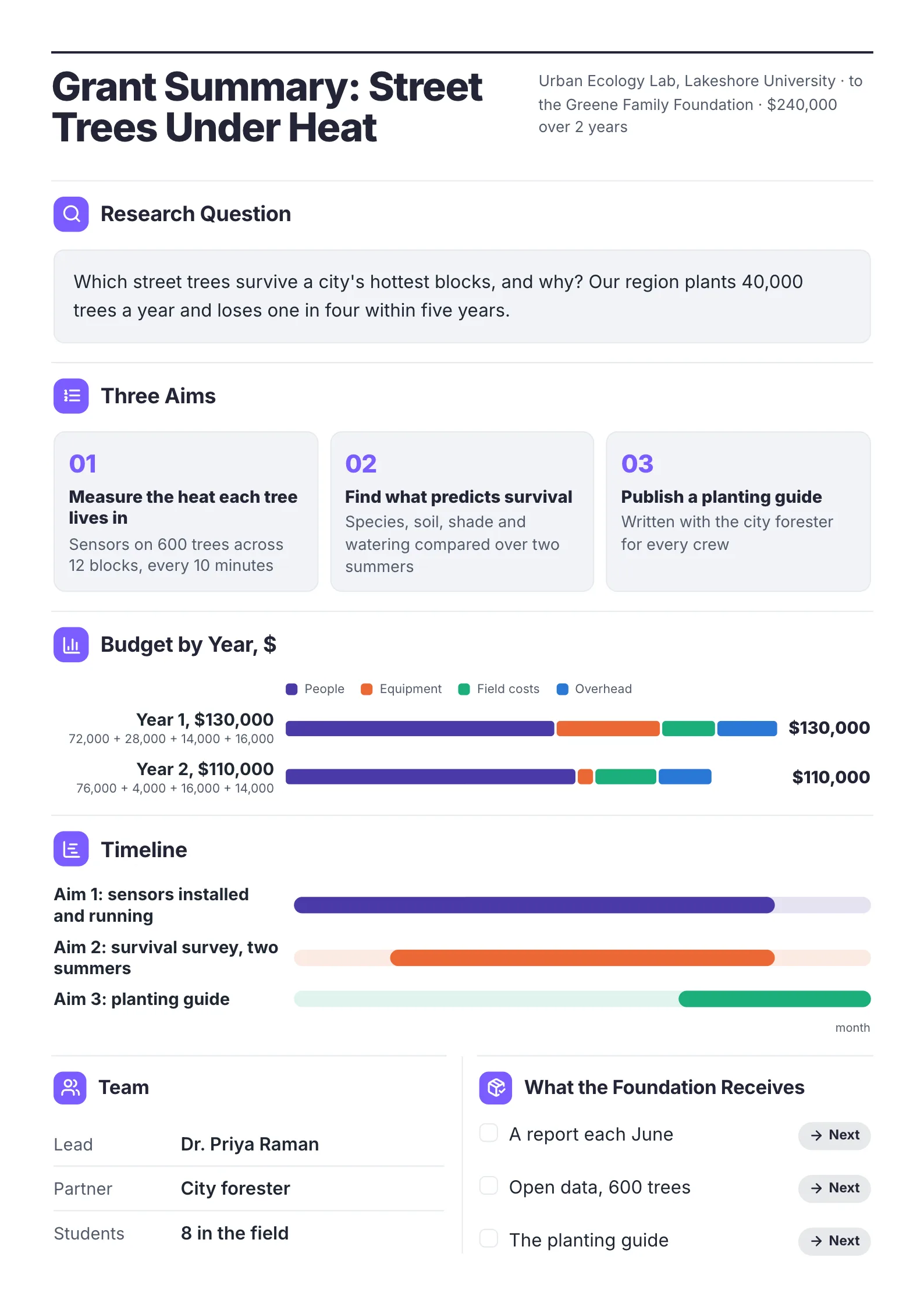
The research summary shows goals tied to measures. Its first two aims say what will be measured and how, like sensors on 600 trees every 10 minutes, and the third names a product, a planting guide. It closes with exactly what the funder gets: a report each June, open data and the guide. Swap in your own aims on this university research grant summary.
 Edit this template
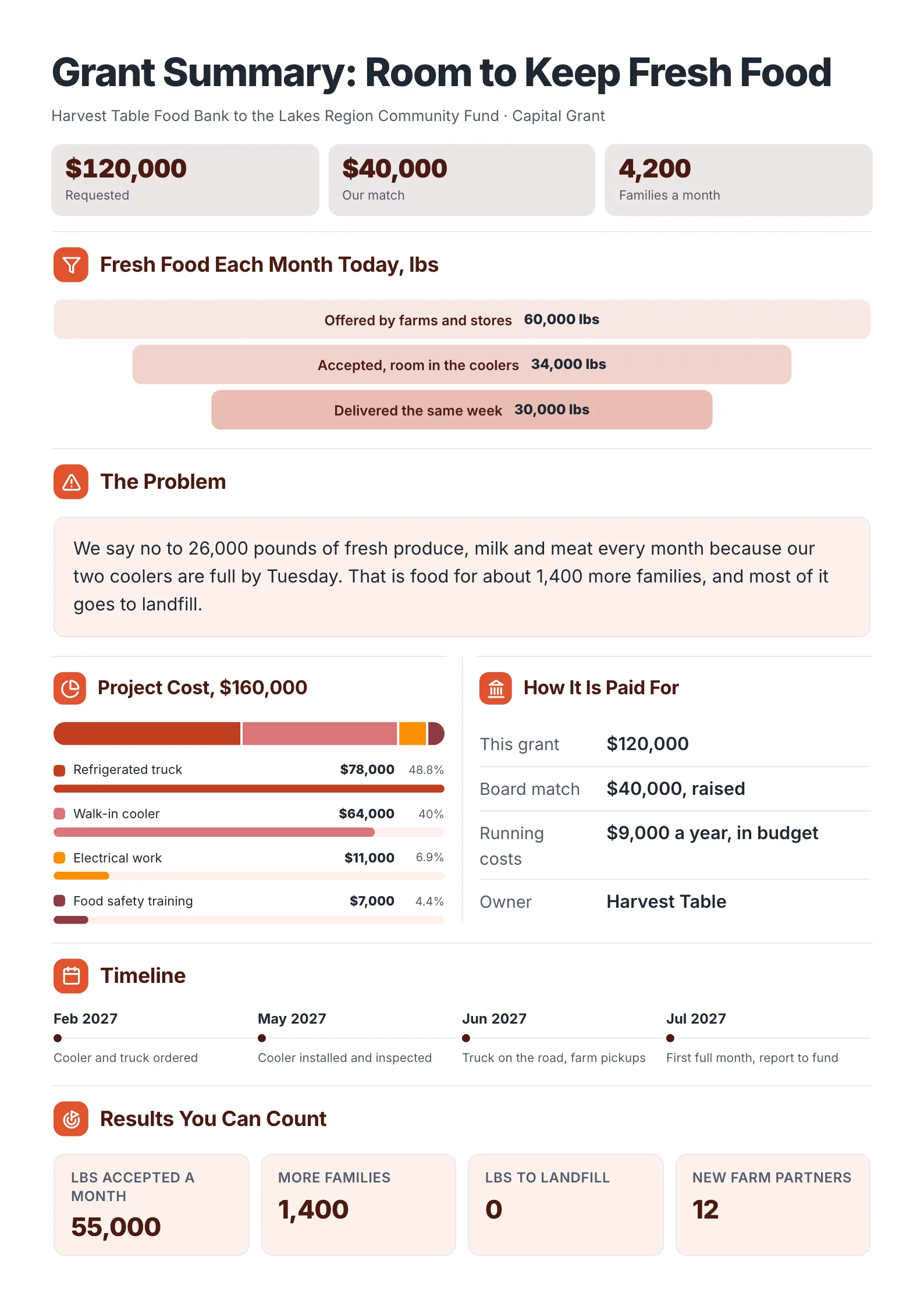
The food bank summary shows the need as a chart you can read in seconds: 60,000 pounds offered each month and 34,000 accepted. Its How It Is Paid For box lists the grant, the board's match, and the $9,000 a year in running costs already in the budget. Change the chart to your own numbers on this food bank grant summary.
Before you send it
- The ask is in the first lines. The summary names the amount, the project, the people and the time.
- Every goal has a number and a date.
- The budget adds up to the ask and shows each other funder as committed or pending.
- Each budget line has one line of its own saying what it buys and how you worked out the amount.
- You've said what you'd cut first if the grant comes in smaller.
- The narrative fits the funder's page limit, or 5 pages if it sets none.
- The attachments are in the order the funder lists them, and the right people have signed.
Questions people ask about writing a grant proposal
What are the main parts of a grant proposal?
A cover letter, a narrative, a budget and attachments. In the narrative, the 6 forms we read share a summary, your history and mission, the need, the people served, goals, activities and evaluation. All 6 want an organization budget, an audit and a board list beside it, plus a project budget when you ask for a project.
Sending a proposal to a client or a review panel rather than a funder? See how to write a proposal for the parts each of those readers checks.
How long should a grant proposal be?
Plan on 4 to 5 pages for the narrative. Five of the 6 forms we read set a limit, and none allows more than 5 pages. Always follow the funder's own limit when it gives one.
Should I include a cover letter?
Yes, unless the funder says not to. Colorado asks for a one-page letter and the National Network of Grantmakers asks for a brief one. Say what you're asking for and how it fits the funder's mission.
How do I write a grant proposal with no experience?
Start with a common grant application from your region, since it lists the questions in order. Answer each one in plain words, with a number wherever you can. Then ask someone outside your group to read it and repeat your ask back to you.
Can I send the same proposal to several funders?
Yes, and that's what a common grant application is for. Change the cover letter and the summary for each funder, and answer any questions a funder adds on top of the common form.
Put the ask on one page
Open any of the summaries above, or start a blank one, in MakeOnepagers. Fill in the parts from this guide, check that the numbers add up, and download it as a PDF to send on top of your proposal.




