Progress Report Format: The Order 5 Official Forms Agree On
A progress report format read from 5 official forms, from a federal SF-PPR to a state quarterly report. See their sections in order, due dates and limits.

Most official progress report formats run in the same order. First comes a short block that says who you are, which project and which dates. Then what you did, goal by goal. Then what went wrong and your fix. Then what you made, the money and a signature. Start from a free one pager template.
One‑Pager examples
Real One-Pagers made with MakeOnepagers. Open any one to edit it as your own.
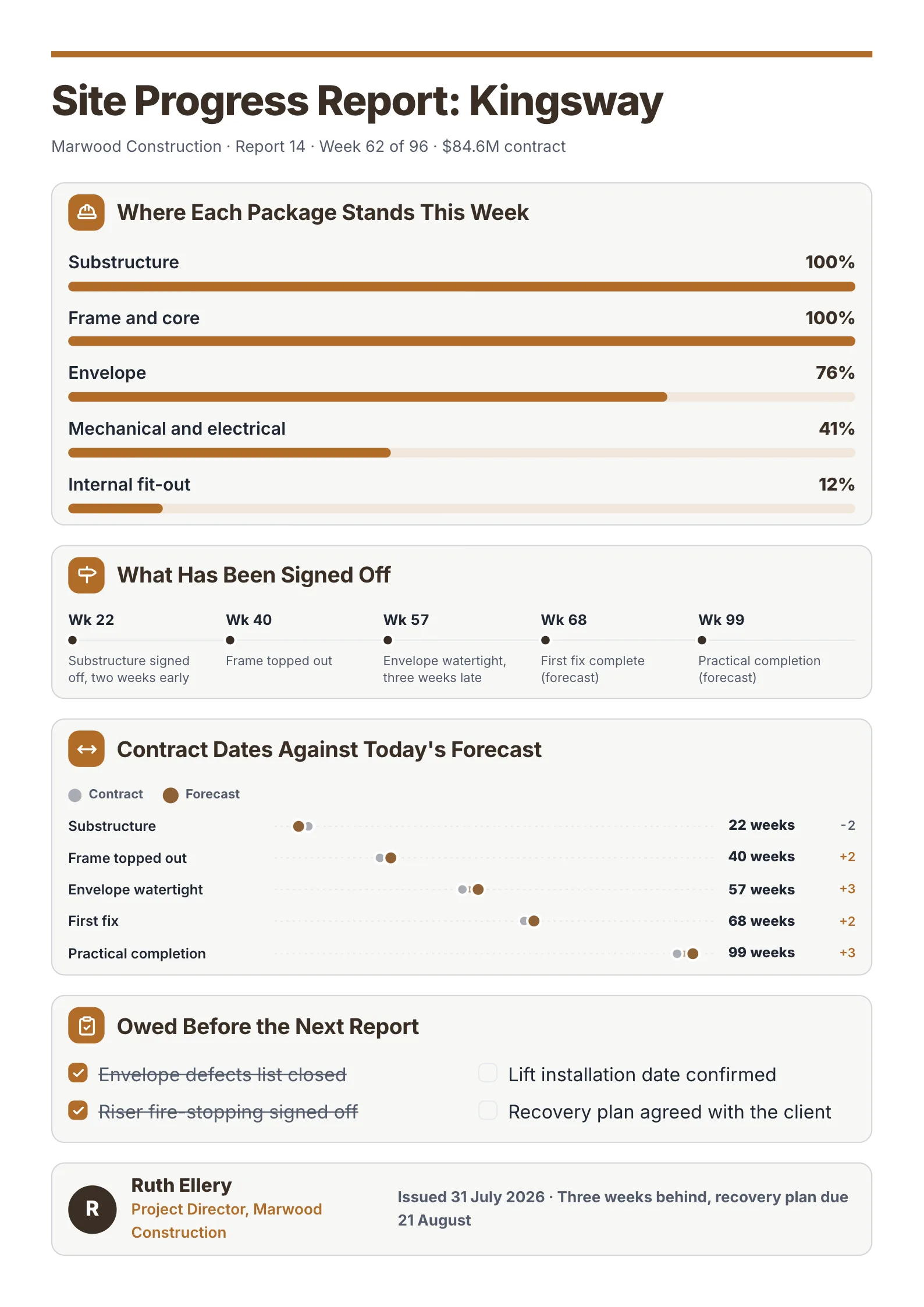 Construction Progress ReportEdit for free(opens in a new tab)
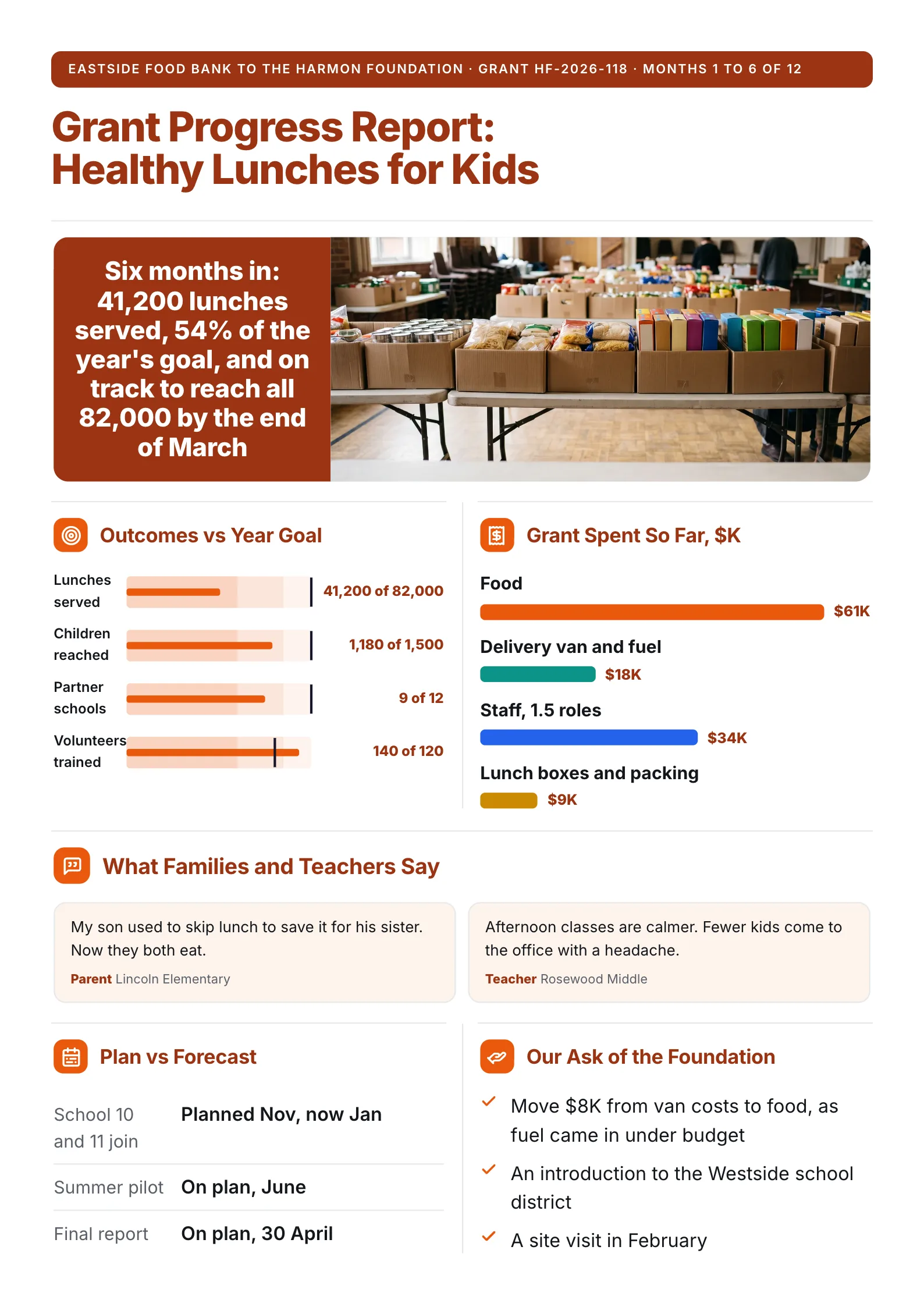 Progress Report: Grant InterimEdit for free(opens in a new tab)
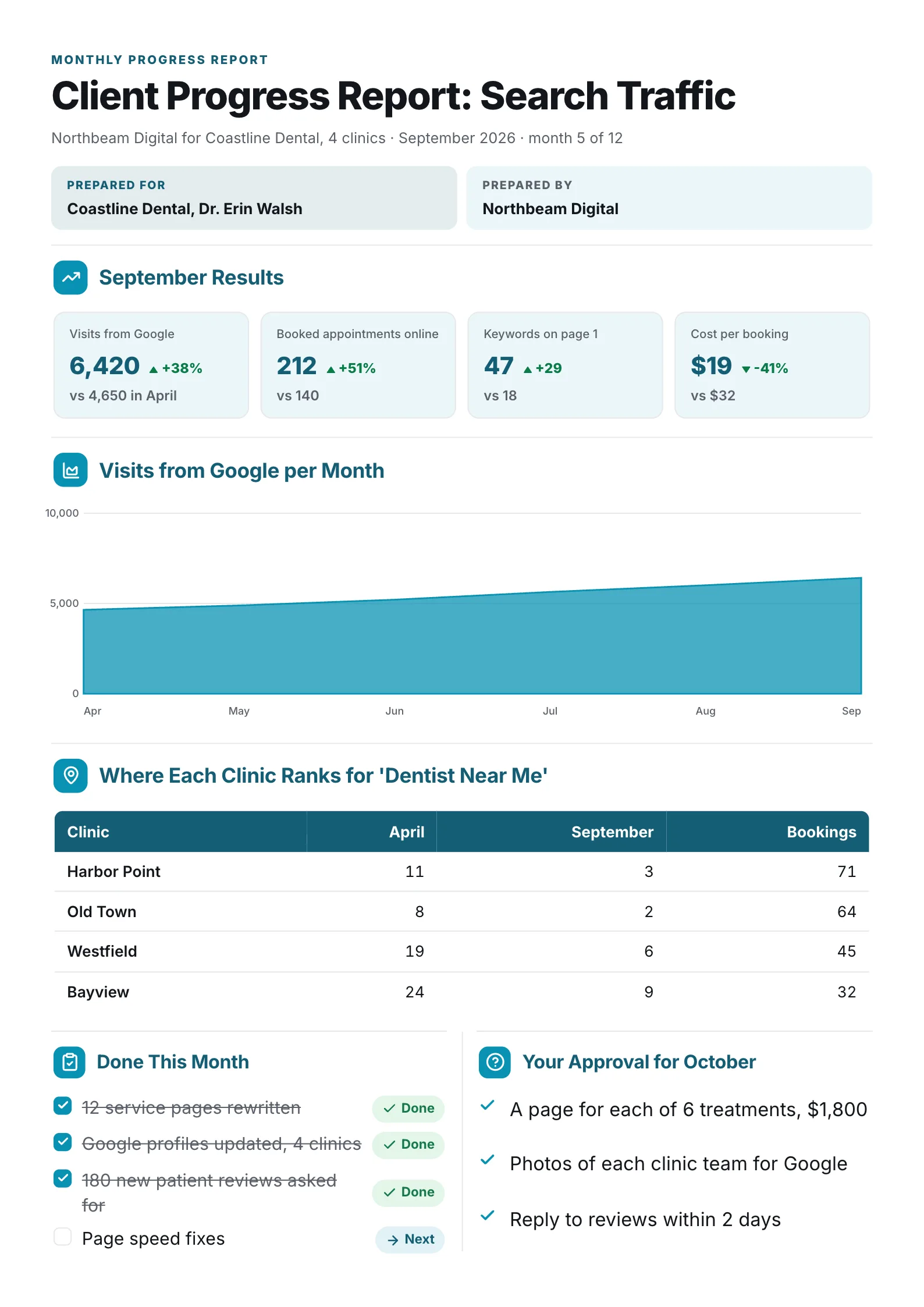 Progress Report: Monthly ClientEdit for free(opens in a new tab)
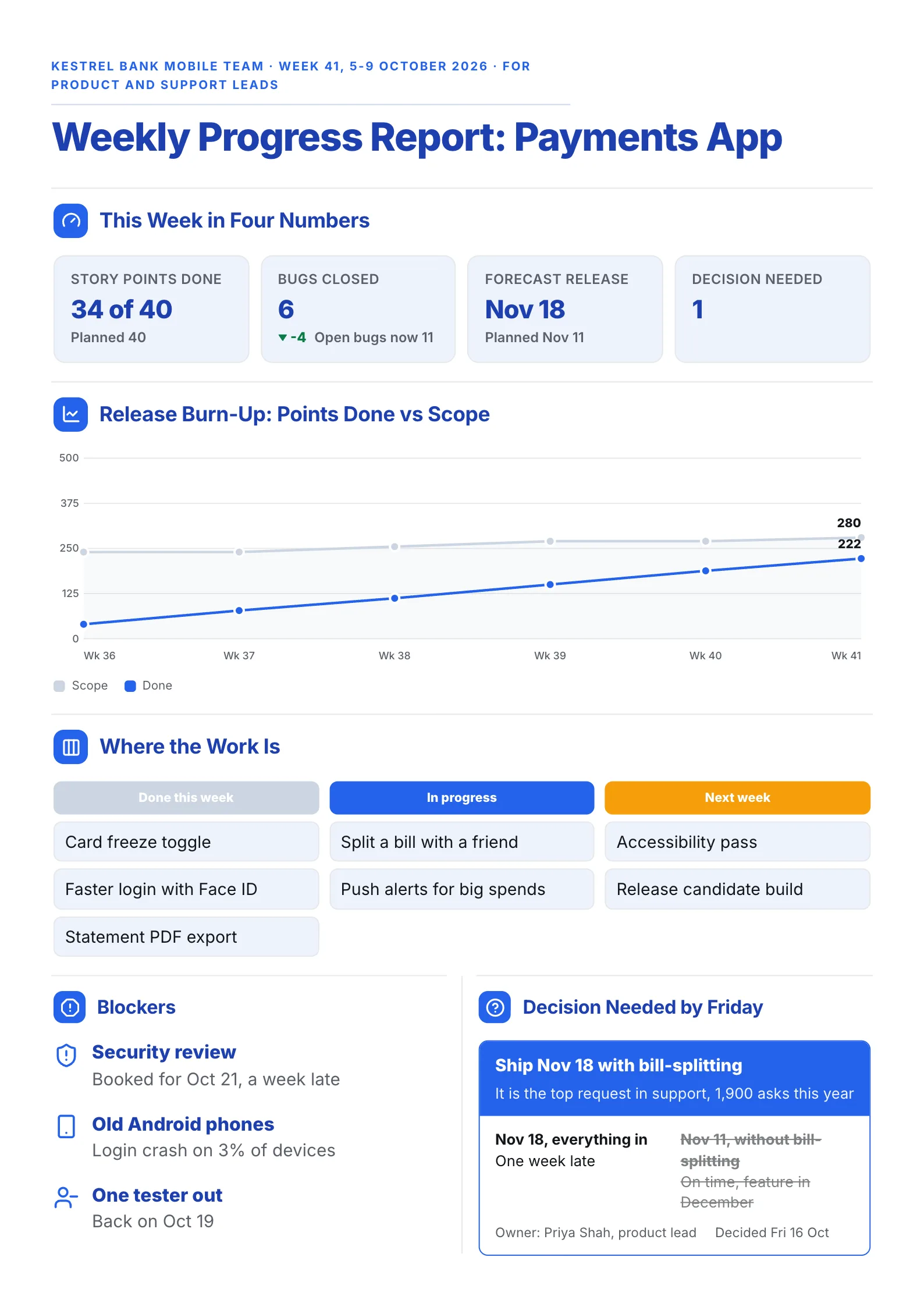 Progress Report: Weekly Team UpdateEdit for free(opens in a new tab)
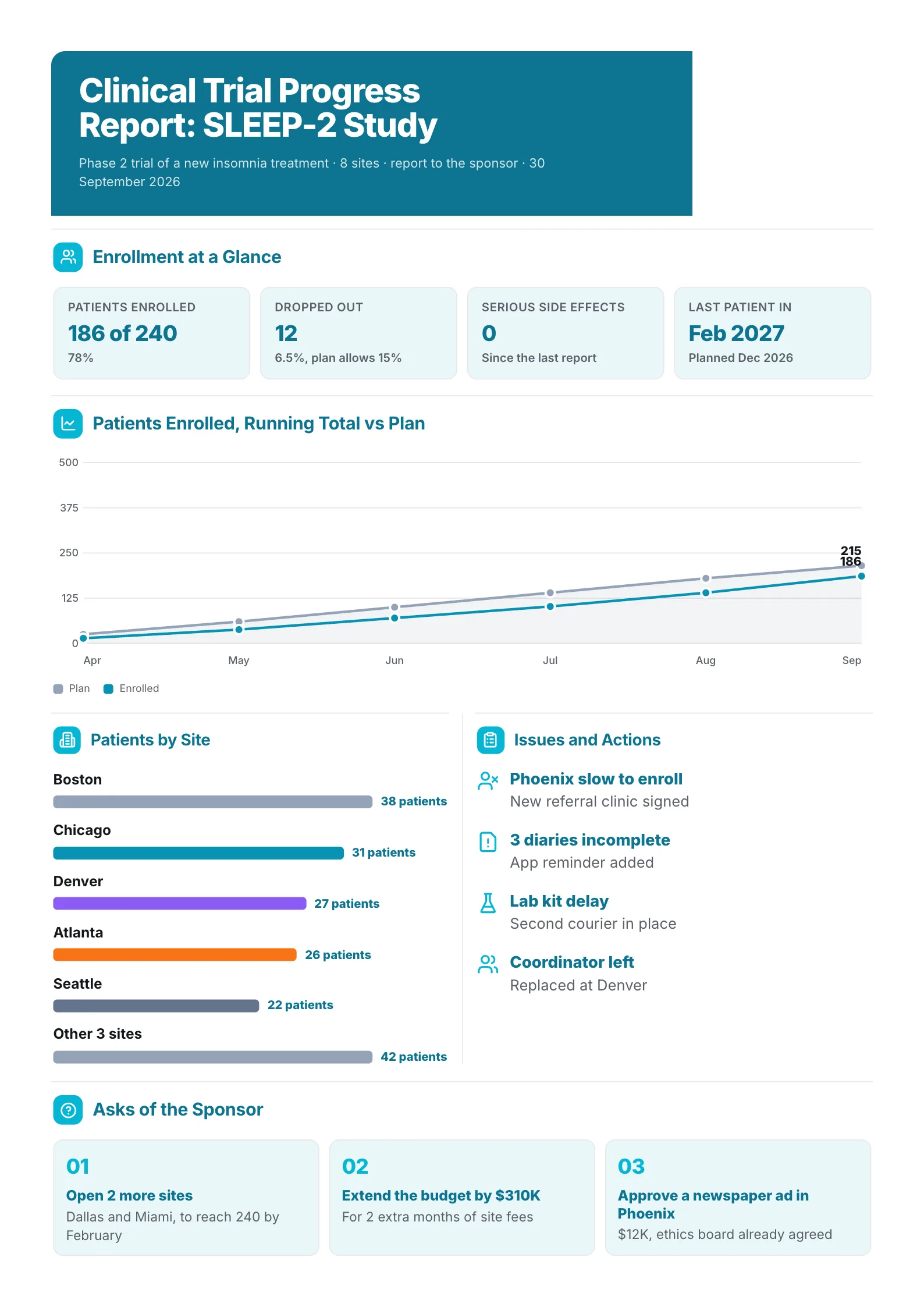 Progress Report: Clinical TrialEdit for free(opens in a new tab)
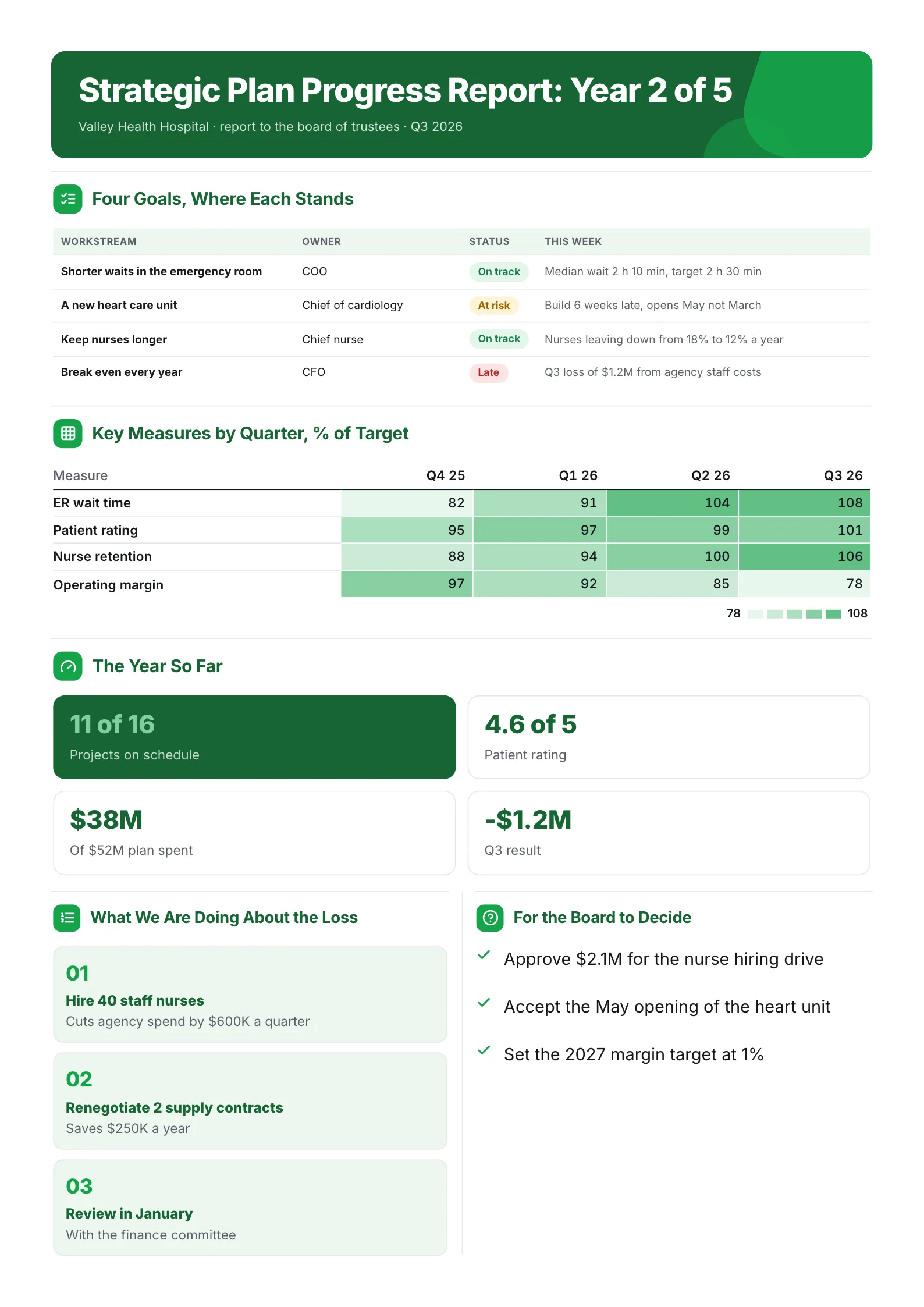 Progress Report: Strategic PlanEdit for free(opens in a new tab)
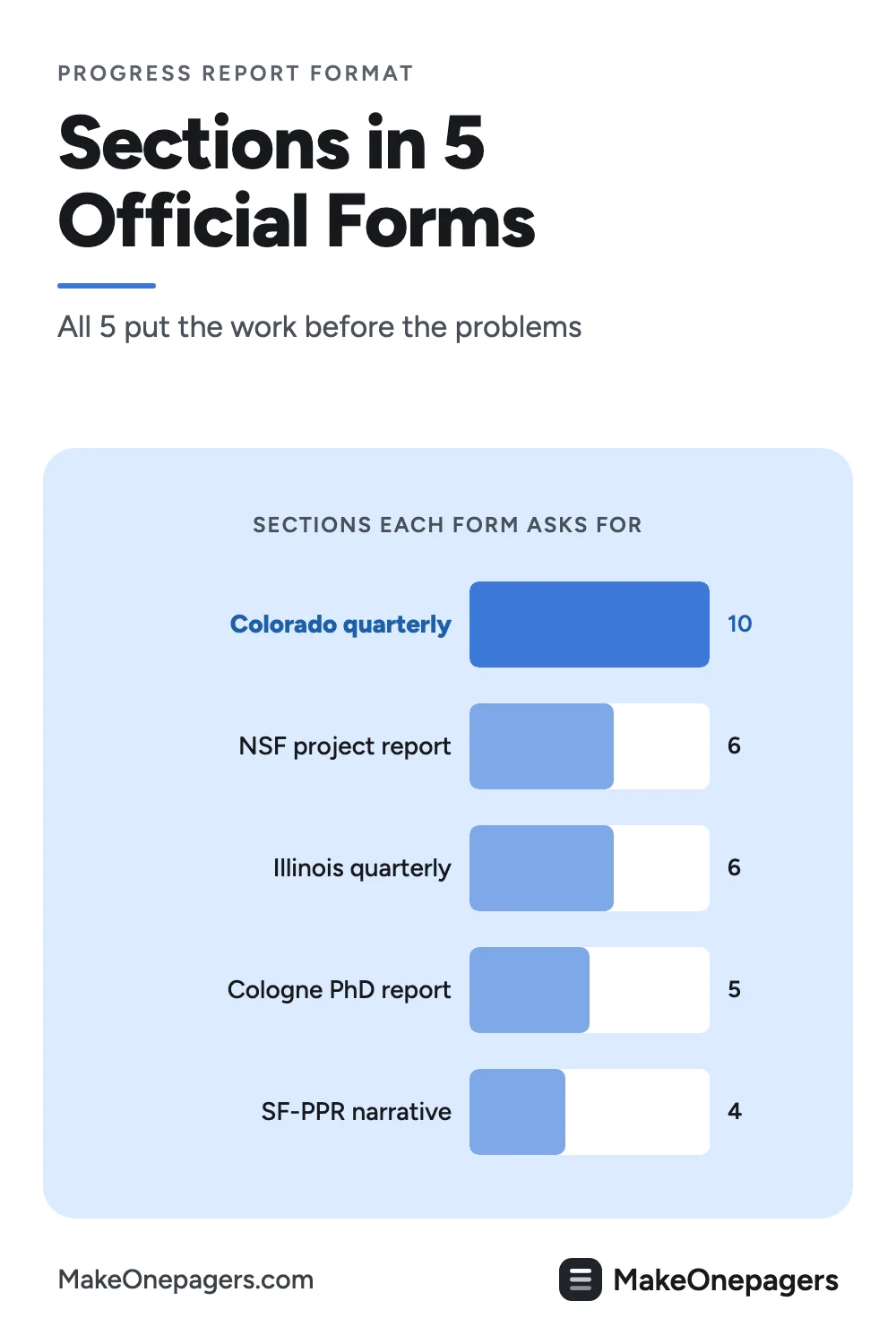
We read 5 official progress report formats on November 5, 2026, the kind funders and universities hand out. They ask for anywhere from 4 to 10 sections. Every one of them puts the work before the problems. If you write your report in that order on a MakeOnepagers One-Pager, it will read the way a grants officer expects.
The 5 formats side by side
These are real forms and rules, read at the source. Two are federal, two come from states and one from a PhD program in Germany.
| Format | Who asks for it | Sections | Where problems go | When it's due |
|---|---|---|---|---|
| SF-PPR, as the Northern Border Regional Commission uses it | Federal grant holders | 4 narrative categories | 3rd of 4 | Within 90 days after each quarter |
| NSF project report | Science researchers | 6 tabs, plus a 7th for some awards | Last tab | Not stated in the guide |
| Colorado DCJ Form 2-Q | State justice grants | 10 numbered items | 4th in each goal | Within 15 days after each quarter |
| Illinois quarterly narrative | Apprenticeship grants | 6 categories | 5th of 6 | Not stated in the guide |
| University of Cologne | PhD students | 5, plus 1 optional | 3rd | No date given, 3,000 words at most |
Add them up and you get 31 sections across the five. They use different names, but the same jobs keep coming back. Each job gets its own section below, in the order the forms put it.
Part 1: who, which grant and which period
Four of the five open with a block of plain facts before any writing starts.
The federal SF-PPR is the most formal. Its cover has boxes numbered 1 to 13: the agency, your grant number, your organization's name and address, the grant period, the end date of this reporting period, whether this is the final report and how often you report. Box 10 is the narrative. Box 12 is the signature.
You don't fill in every box. NBRC's guidance says "Leave this blank" four times, for boxes 3a, 3b, 5 and 13. Box 3a asks for a DUNS number, and NBRC writes that "DUNS numbers are no longer used." So read your funder's notes before you hunt for a number nobody wants.
NSF's report opens on a Cover tab that's already filled in. You only check it. Colorado's form starts with the grantee, grant number, project title, project dates, who prepared it and a tick box for the calendar quarter. Illinois has you pick the year and the quarter before any text box opens.
The Cologne PhD rules skip this block, because a student hands the report to their own committee. If your reader already knows who you are, a title and a date are enough.
For your One-Pager, write a title, the project name, the period it covers and the date you sent it. One line under the title is enough room for all four.
Part 2: what you did, goal by goal
This is the heart of every format, and it always comes before the problems.
Colorado is the strictest about it. Its form repeats the same 4 questions under every goal: what you did, if you're on time, the numbers that show progress and the problems you hit. The blank form prints three goal blocks in a row. The instructions say to "give a numeric value where available," like staff trained or records updated.
Colorado also says "Report this information for the current quarter only. Do not cut and paste from prior quarters." That rule is worth borrowing even if nobody makes you. A report that repeats last quarter's text hides what changed.
NBRC asks for "a summary of progress on tasks in the work plan." If a task is finished, describe the outcome. If nothing happened this quarter, say so, say why and say what it does to the timeline.
NSF's Accomplishments tab asks for major goals, objectives and results. Illinois asks for a summary of grant activities first and a summary of grant goals second. Cologne asks for "Progress made," right after a short intro into the field.
For your One-Pager, list each goal from your original plan, in that plan's order. Under each, write one line on what you did and one number against the plan.
Part 3: what went wrong and what you're doing about it
Not one of the five forms opens with problems. Here's where each one puts them:
- NBRC: "Project Challenges and/or Successes," third of four.
- NSF: "Changes/Problems," the last of the six standard tabs.
- Colorado: "Problems Encountered," fourth inside every goal block.
- Illinois: "Key Issues and Technical Assistance Needs," fifth of six.
- Cologne: "Problems encountered with discussion of the reasons," third, right after progress.
Colorado's question is the most useful one to copy. It asks what the problems were, how they affected the project, how you handled them "and what is your plan to get back on track?" That's four answers, and a reader who gets all four rarely writes back with questions.
Illinois adds a twist. It pairs the issues with "Technical Assistance Needs," so the problem section doubles as a request for help. If you need something from your reader, put the ask right next to the problem it solves.
For your One-Pager, add a short box after your goals. Name the problem and its effect on the date, then add the fix and the help you need.
Part 4: what you made and who heard about it
Three of the five ask for proof that work turned into something people can see.
NSF has a Products tab that lists anything the project produced in the period. Colorado's item 7 asks for products too, and it names "reports and publications, new or improved technologies, record quality audits, presentations, data collections, databases/datasets, and trainings." NBRC's last category is "Media coverage," where you share links to any article or public announcement about the project.
NSF and Colorado also have an Impact section, separate from the work you did. Colorado wants it "in quantifiable terms." So does your reader, even when the form doesn't say it.
For your One-Pager, keep a short list of what's finished and live, with links. If the local paper covered you, link that too.
Part 5: the money, kept in its own block
Only one of the five puts money inside the progress report. Colorado's last two items are the unexpended fund balance and a detailed list of what grant money bought this quarter. It also asks if you'll spend it all by the end date, and why not if you won't.
Illinois keeps money out of the narrative completely. Grantees upload a separate Periodic Fiscal Report, with a trial balance to back up the costs. The NBRC narrative and NSF's tabs have no money section at all.
So keep your money where a reader can find it fast. A block of four or five figures at the side beats spend numbers scattered through the text.
Part 6: a name, a date and the length
Three of the five ask for a signature or a certification. The SF-PPR has a certification in box 12, with the name, title, signature, phone, email and the date submitted. NBRC accepts electronic signatures. Colorado's Project Director signs. NSF asks you to certify the report before you submit it.
Deadlines are tight. Colorado wants the report within 15 days after each quarter ends, and warns that "Requests for funds may be denied" if it's late or incomplete. NBRC gives you 90 days after the reporting period.
Only Cologne sets a length, a maximum of 3,000 words. It also says the report "should assume the format of a thesis." For a PhD student that's a full document. For everyone else, one page is plenty. The state and federal forms above collect their narrative in a few text boxes.
One more thing we noticed. NBRC's written guidance says to "Always check quarterly," yet the filled sample on page 1 of the same file ticks semi-annual. When a form's example and its instructions disagree, follow the written instruction and check with your grants officer.
Five One-Pagers in this format
You don't need a federal form to use this order. Here are five progress reports for very different readers, each built from the same parts.
A thesis report that reads like the Cologne rules
 Edit this template
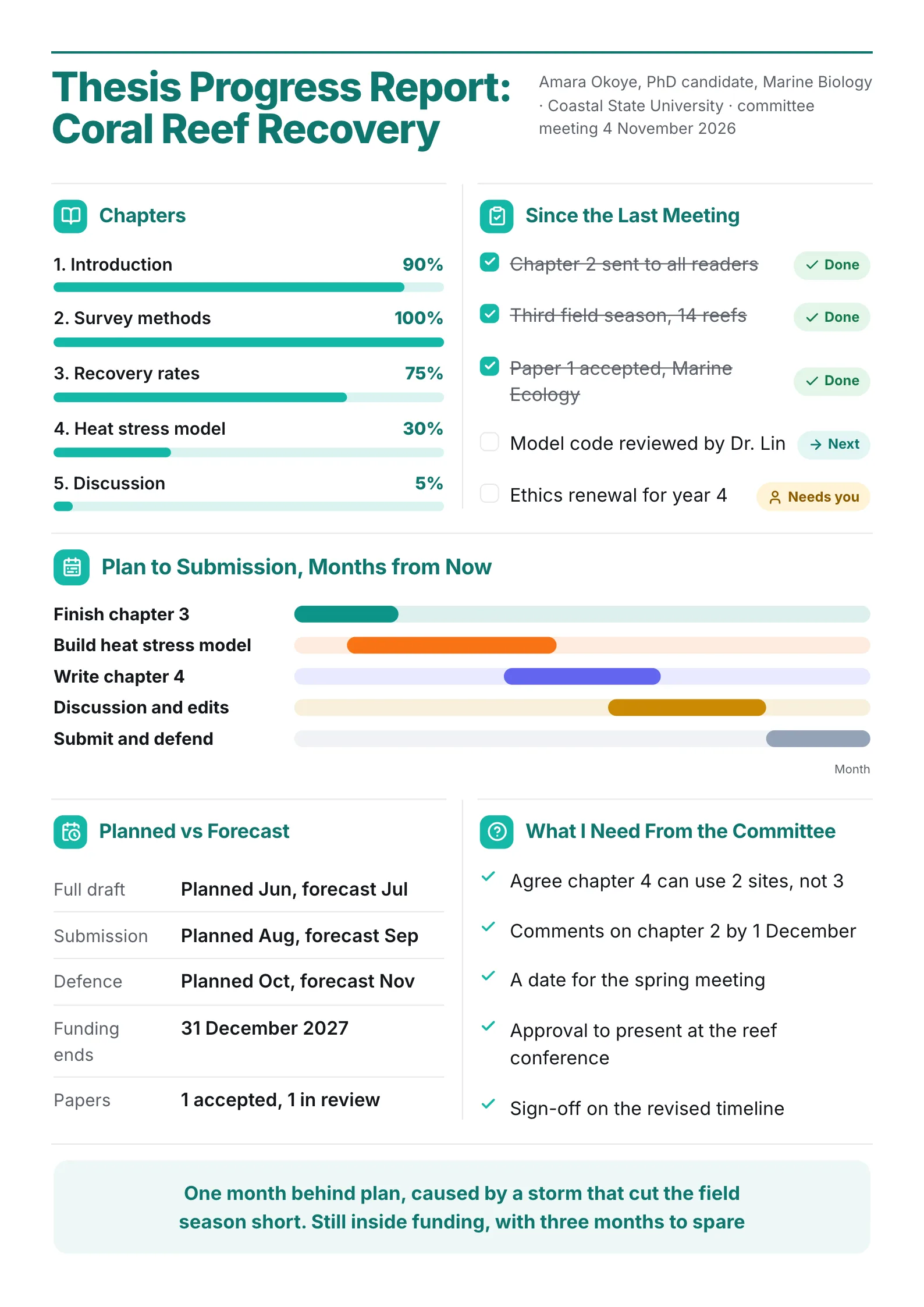
Amara Okoye's thesis progress report is for her committee meeting on November 4, 2026. It lists 5 things done since the last meeting, including a third field season on 14 reefs and a first paper accepted.
The dates come next, planned against forecast. The full draft moves from June to July, submission from August to September and the defense from October to November. Then she lists 5 asks of the committee, like comments on chapter 2 by December 1.
The bottom line explains the slip in one sentence: one month behind, caused by a storm that cut the field season short.
A training report built goal by goal
 Edit this template
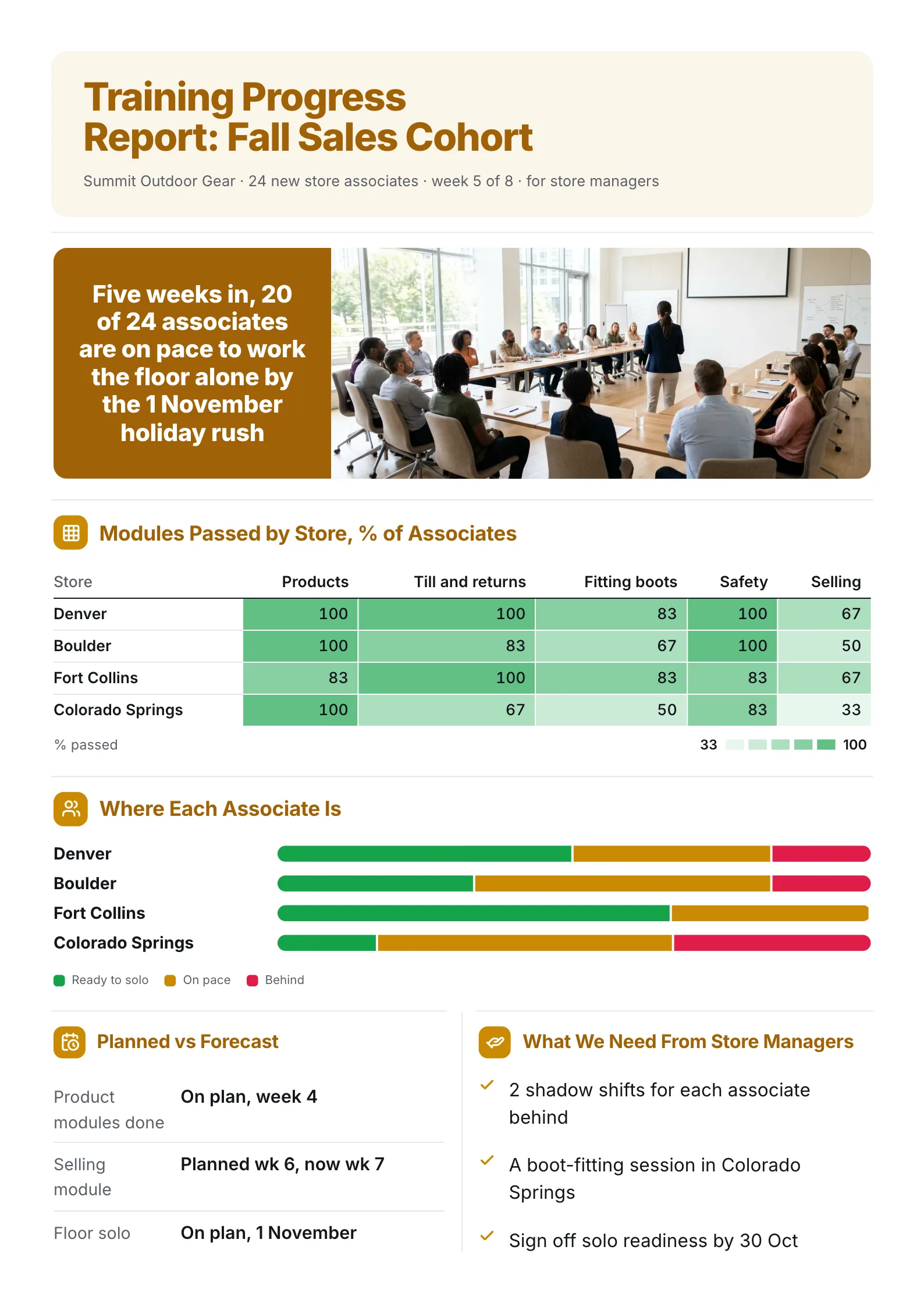
This training progress report covers 24 new store associates at week 5 of 8. The headline says 20 of 24 are on pace to work the floor alone by the November 1 holiday rush.
It works like Colorado's goal blocks. Modules passed are shown store by store, and associates are sorted into ready to solo, on pace and behind. One date moved. The selling module was planned for week 6 and is now week 7.
The report ends with 3 asks of store managers, the last one to sign off solo readiness by October 30.
An investor update with the money in its own box
 Edit this template
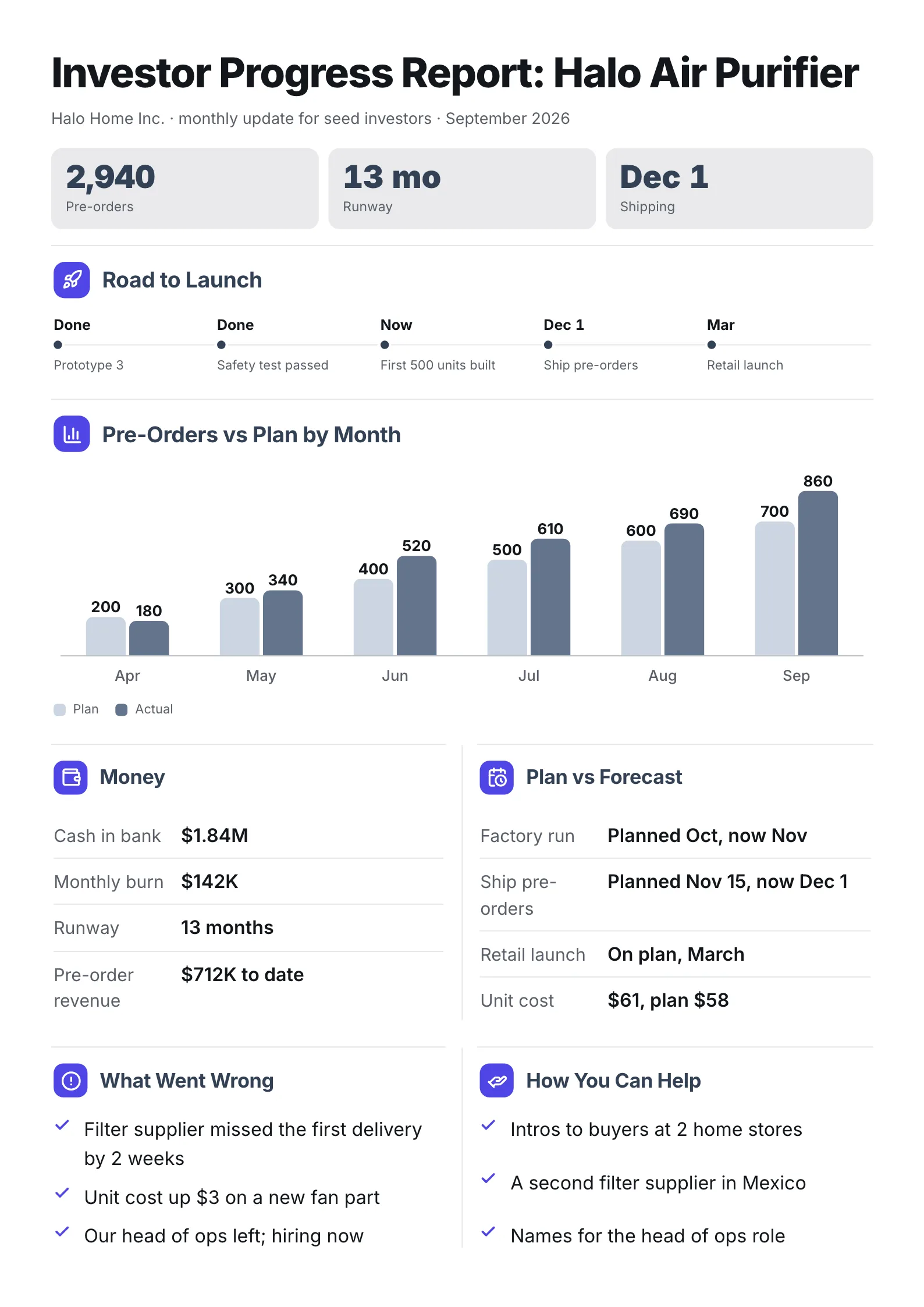
Halo Home's investor progress report is a monthly report for seed investors, dated September 2026. The money sits in one block: $1.84M cash in the bank, $142K monthly burn, 13 months of runway and $712K in pre-order revenue to date.
Plan against forecast shows that pre-orders now ship on December 1, after a planned November 15. Unit cost is $61 against a $58 plan.
"What Went Wrong" lists 3 problems, among them a filter supplier that missed its first delivery by 2 weeks. Right after it, "How You Can Help" asks for 3 things, like intros to buyers at 2 home stores. That's Illinois' pairing of a problem with a request.
A campaign report with a status for every stage
 Edit this template
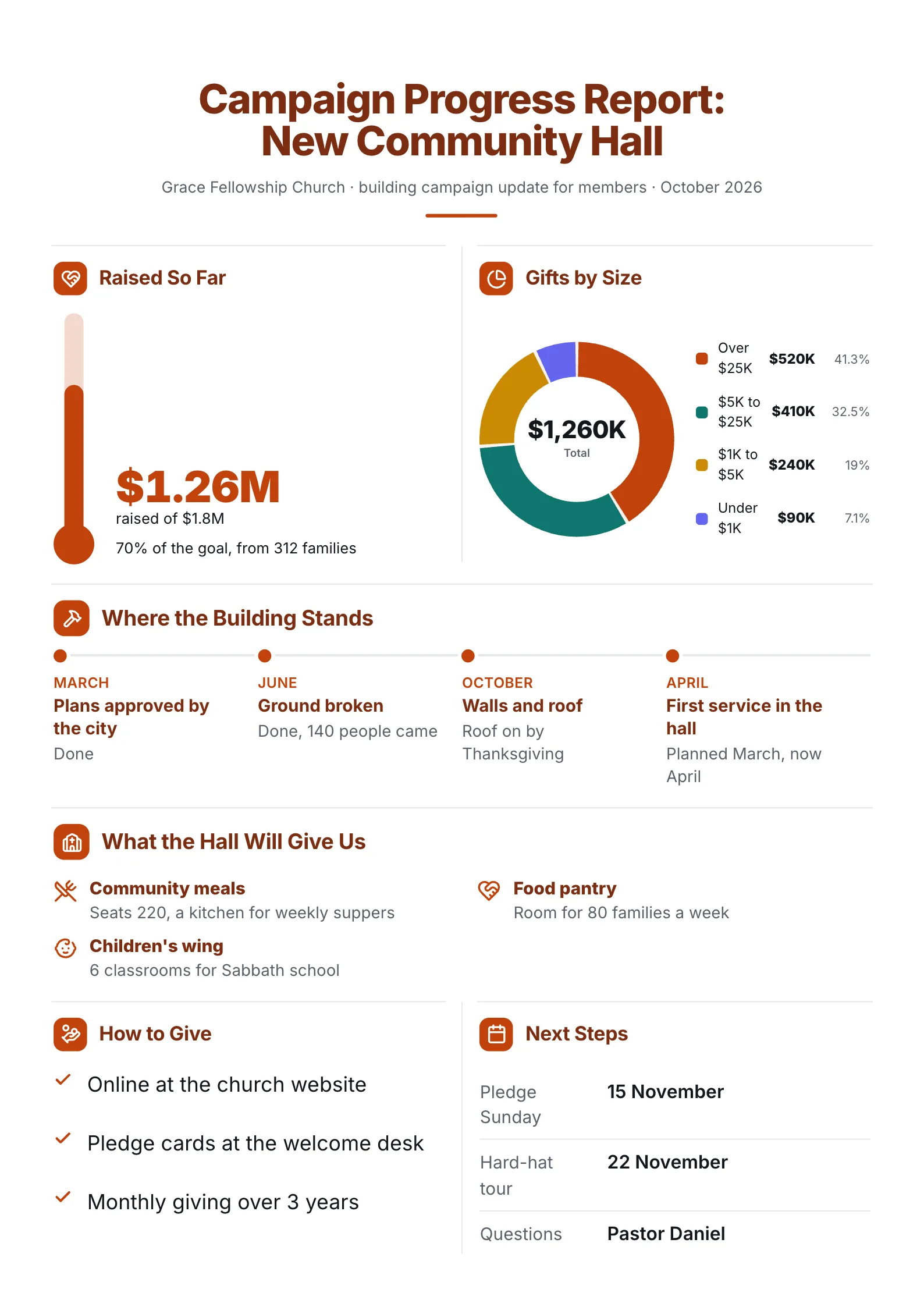
Grace Fellowship Church's campaign progress report for October 2026 leads with $1.26M raised of a $1.8M goal. That's 70%, from 312 families.
"Where the Building Stands" gives each stage a status, like the Planned, In-progress and Complete labels on NBRC's form. City approval in March and the June groundbreaking are both done. October is walls and roof, with the roof on by Thanksgiving. The first service in the hall is now set for April, after a planned March.
Next steps give two dates: Pledge Day on November 15 and a hard-hat tour on November 22.
A therapy report that ends with a signature
 Edit this template
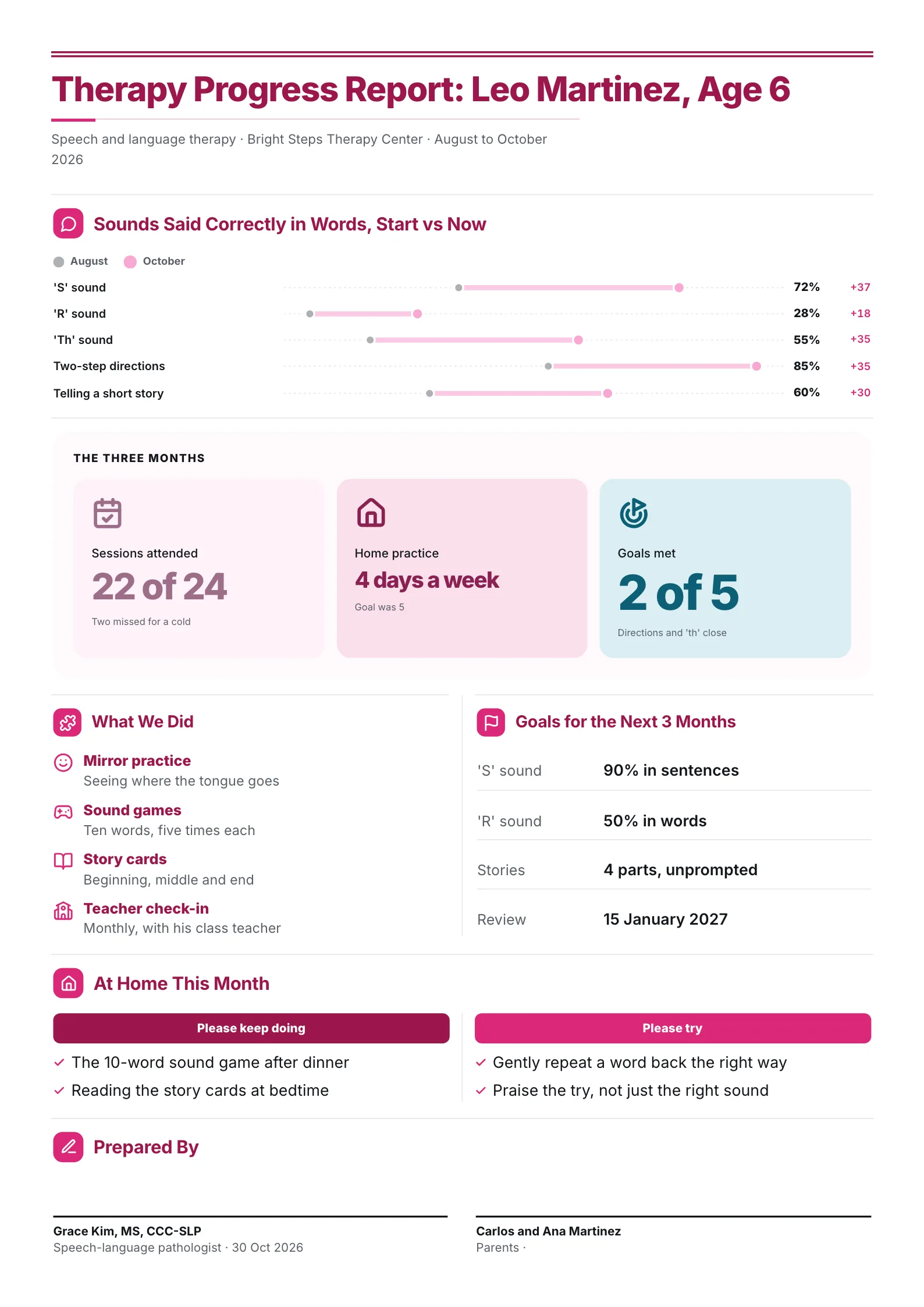
Leo Martinez's therapy progress report covers August to October 2026. He attended 22 of 24 sessions, with two missed for a cold. Home practice ran 4 days a week against a goal of 5, and 2 of 5 goals are met.
Goals for the next three months carry a number each, like the 'S' sound at 90% in sentences, and a review date of January 15, 2027.
Like box 12 on the SF-PPR, it closes with who wrote it and when: Grace Kim, MS, CCC-SLP, on October 30, 2026, for his parents.
Write yours in the order your reader expects
Put your who, what and when at the top. List the work goal by goal before any problem, keep the money in one block and sign it with a date. Pick a progress report from MakeOnepagers or describe your project to the AI One-Pager generator, and fill in the parts in this order.
Frequently asked questions
What is the standard format of a progress report?
There's no single standard, but the five official formats we read share an order. They start with an identity block, then the work done against each goal, then problems, then products, then a signature. Most also ask for numbers wherever you have them.
What is the format of a progress report for a project?
Use one block per goal, with what you did, if you're on time, a number against the plan and any problem. Colorado's Form 2-Q repeats exactly those 4 questions for every goal. Our guide on how to write a progress report walks through filling in each block.
Should money go in a progress report?
Only if your funder asks for it there. One of the five formats, Colorado's, asks for the fund balance and spending inside the report. Illinois wants a separate fiscal report, and the other three have no money section.
How long should a progress report be?
The longest limit we found was the University of Cologne's 3,000 words for PhD students. The federal and state forms collect their narrative in a few text boxes. For a project update, one page is enough. These progress report examples show how much fits.
Is a progress report the same as a status report?
No. A progress report covers a period and compares the work with the plan. A status report gives where things stand today, often as a color. See progress report vs status report for the difference in detail.




