Program One‑Pager Template: Free Briefs, Evaluations and Proposals
Free program one-pager templates for a funder brief, an evaluation, a cohort report, a loyalty program and a proposal, laid out like a logic model.

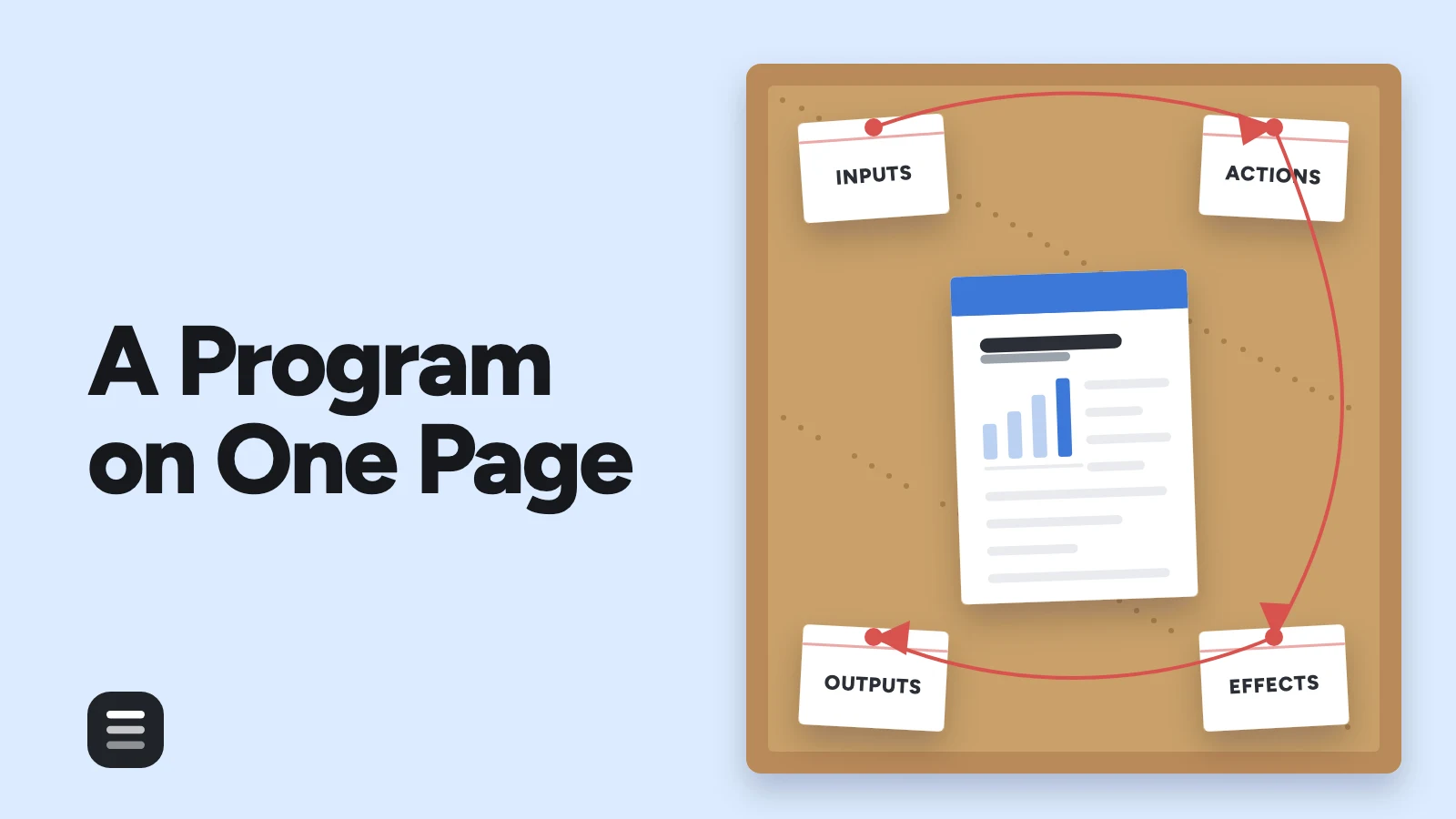
A program officer reading renewals has a stack of reports and one question for each: did the money do what it was supposed to? Your program one pager answers that on a single sheet. It says what you put in, what you did, what you counted and what changed for people. Start from a free one pager template.
One‑Pager examples
Real One-Pagers made with MakeOnepagers. Open any one to edit it as your own.
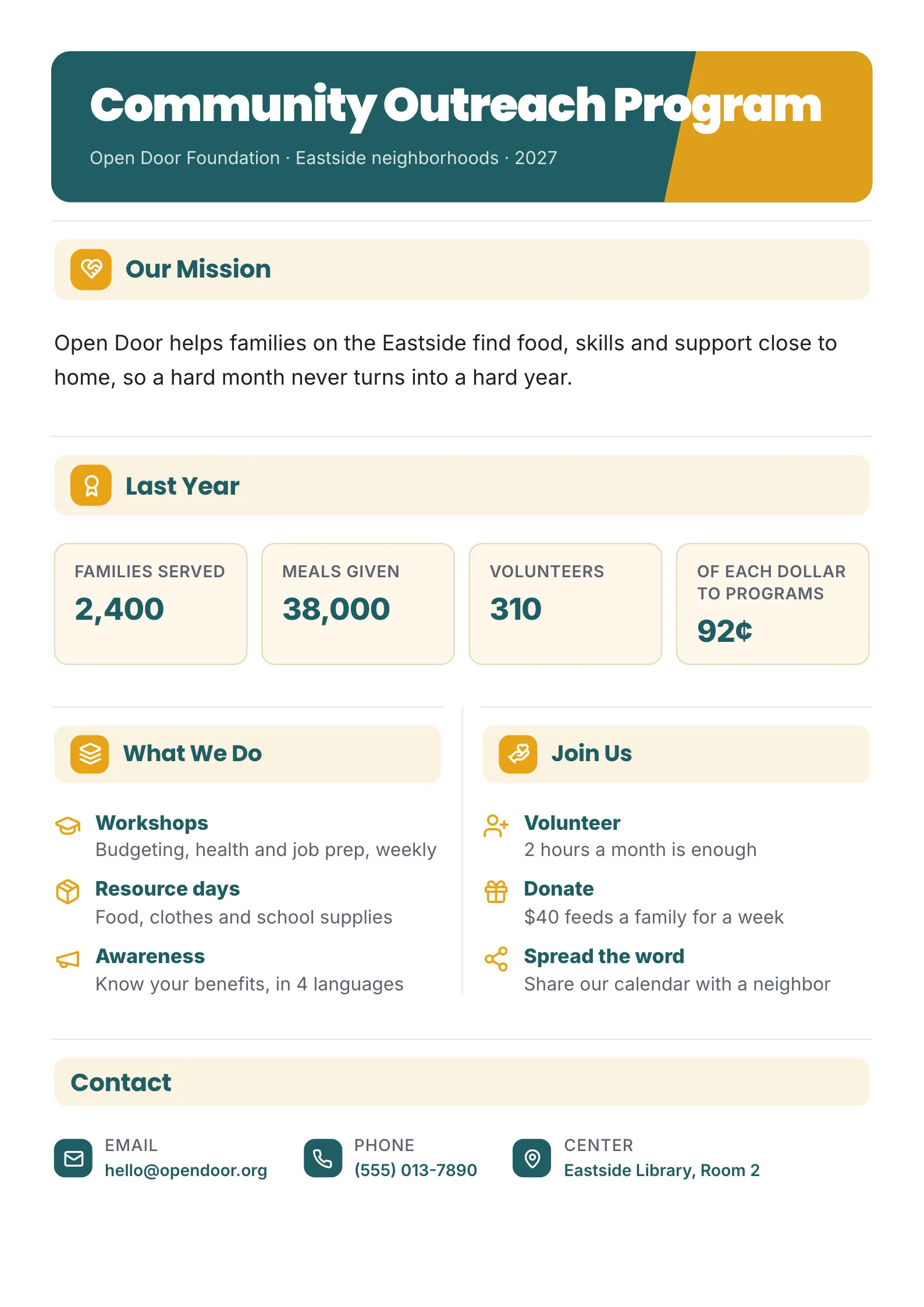 Community Outreach ProgramEdit for free(opens in a new tab)
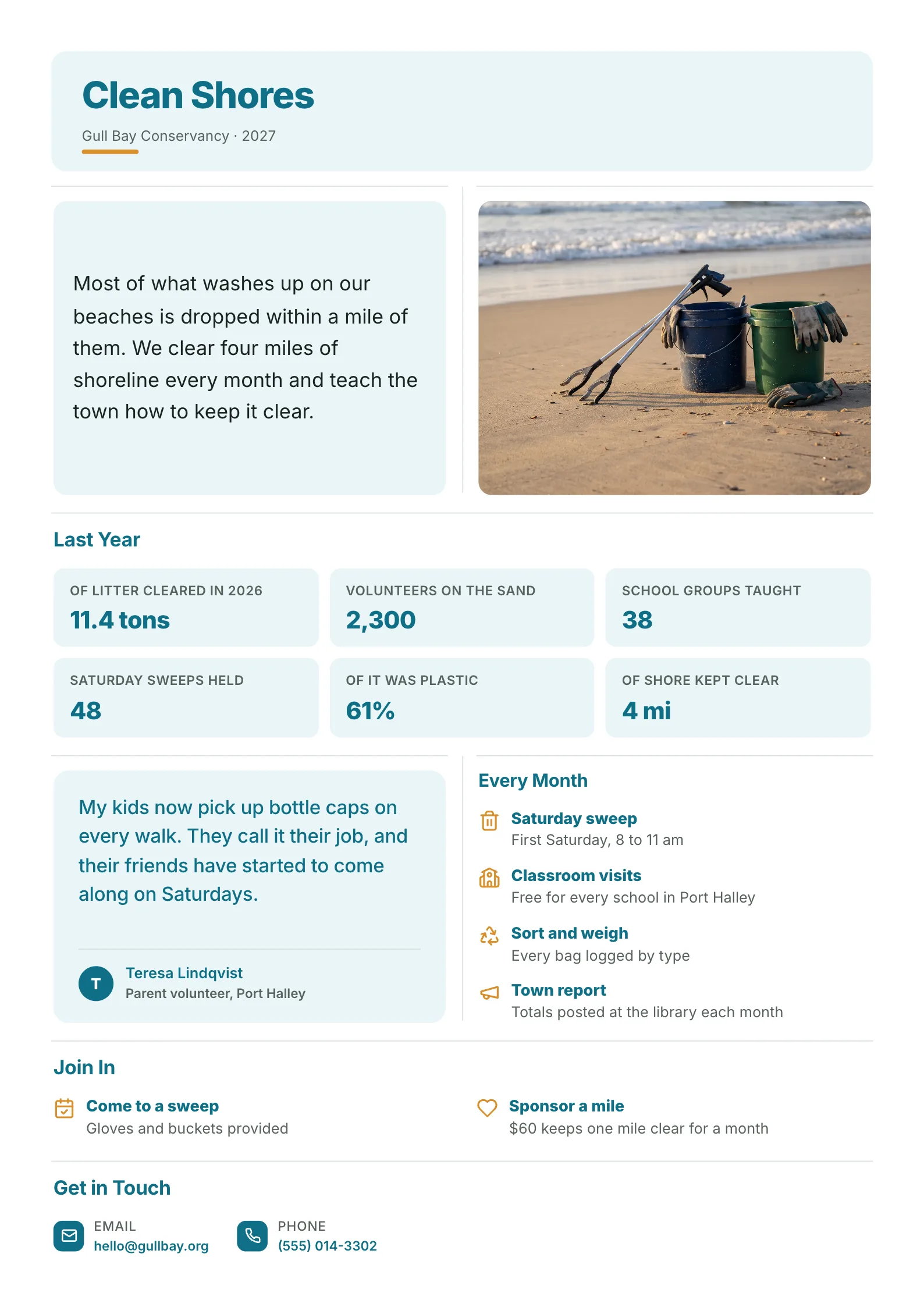 Beach Cleanup ProgramEdit for free(opens in a new tab)
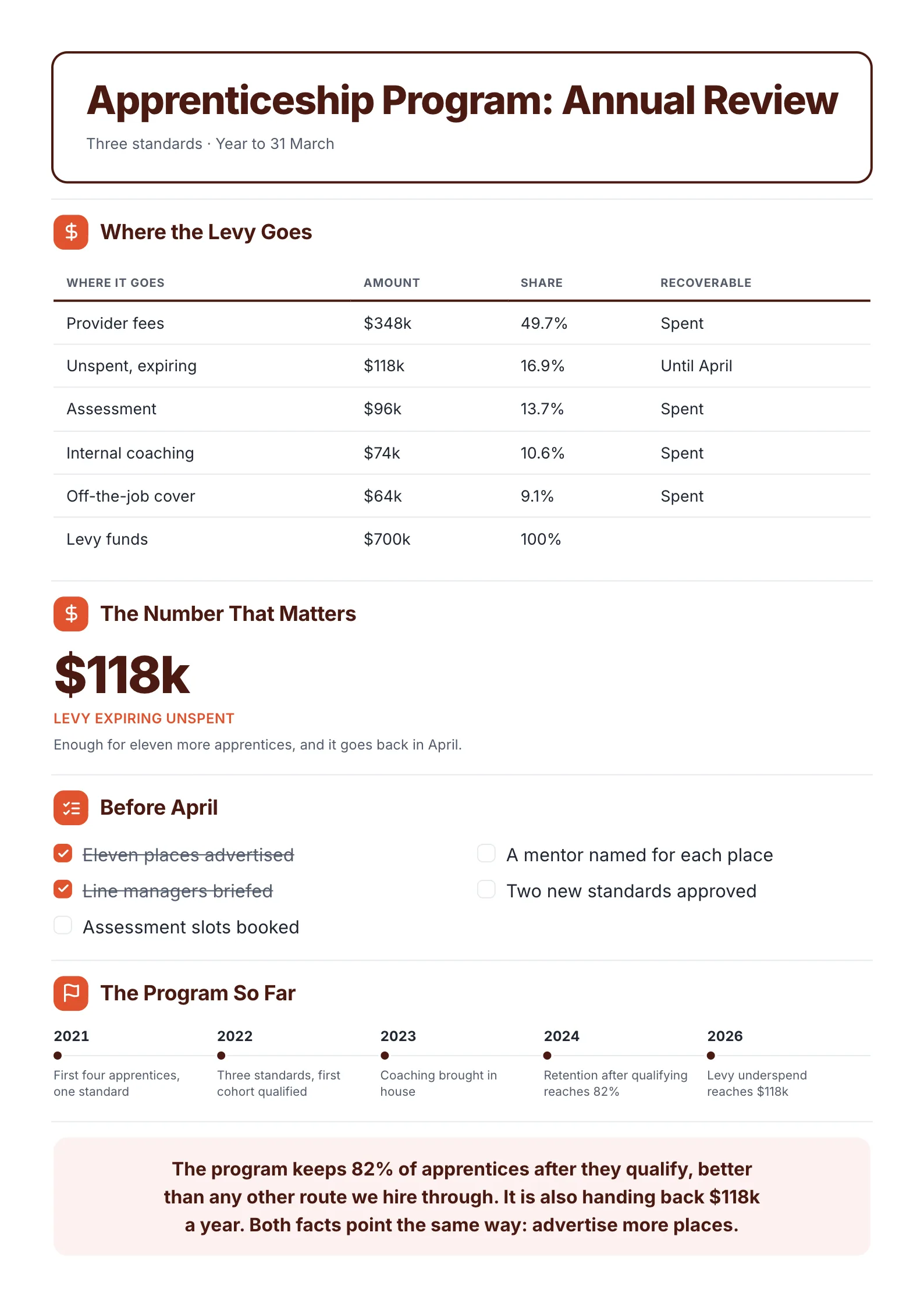 Apprenticeship Program ReportEdit for free(opens in a new tab)
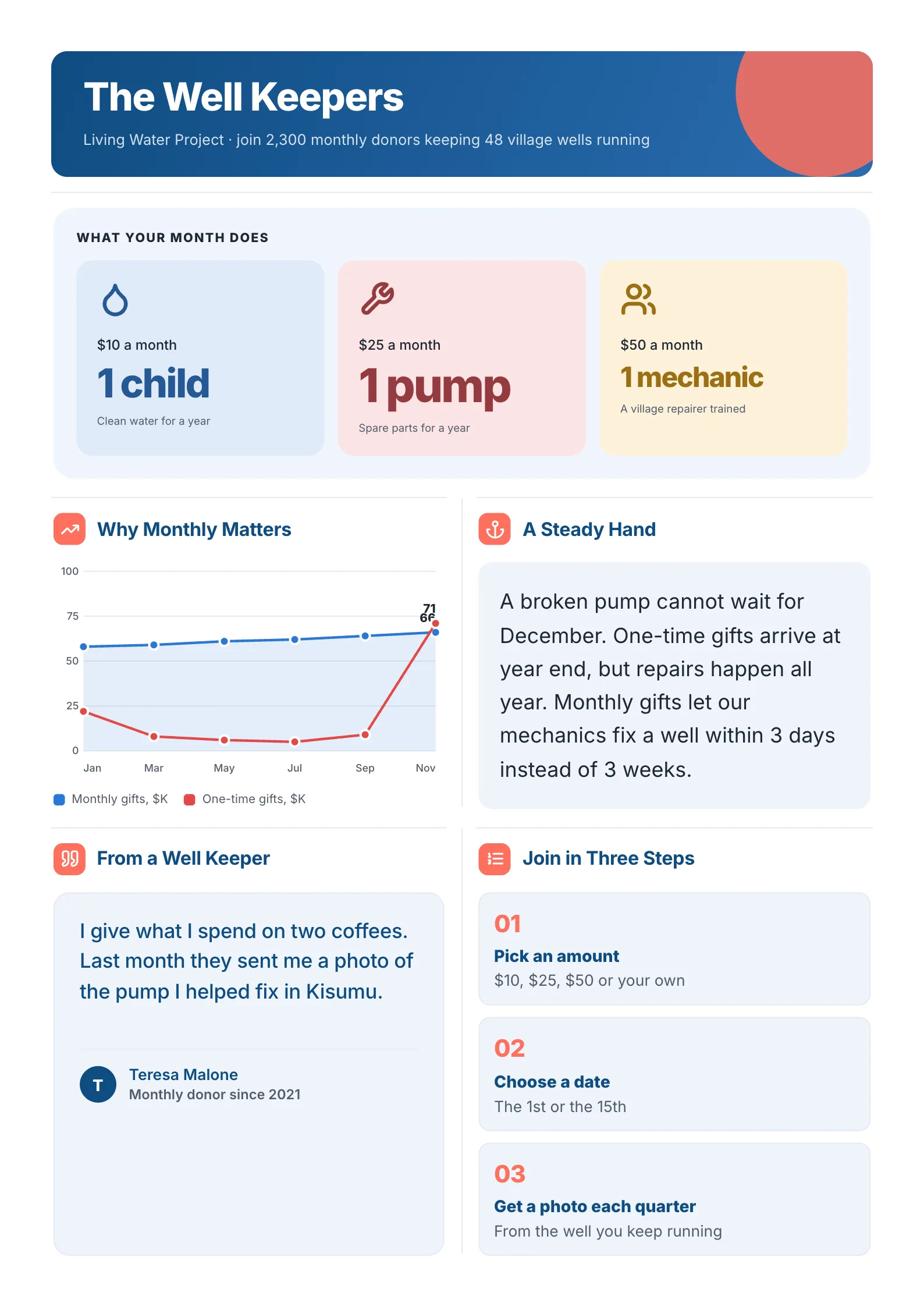 Donor Monthly Giving ProgramEdit for free(opens in a new tab)
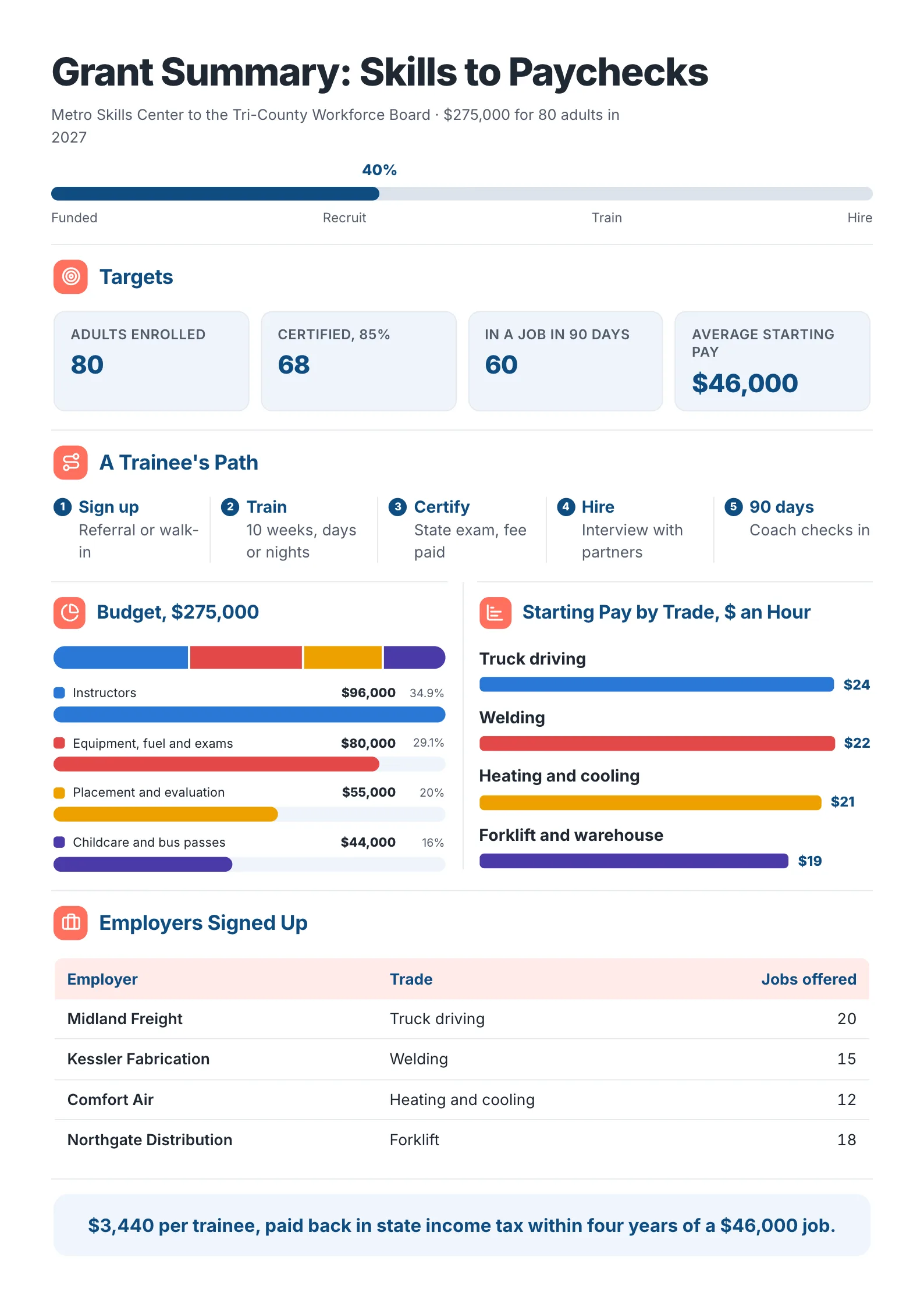 Grant Summary: Workforce Training ProgramEdit for free(opens in a new tab)
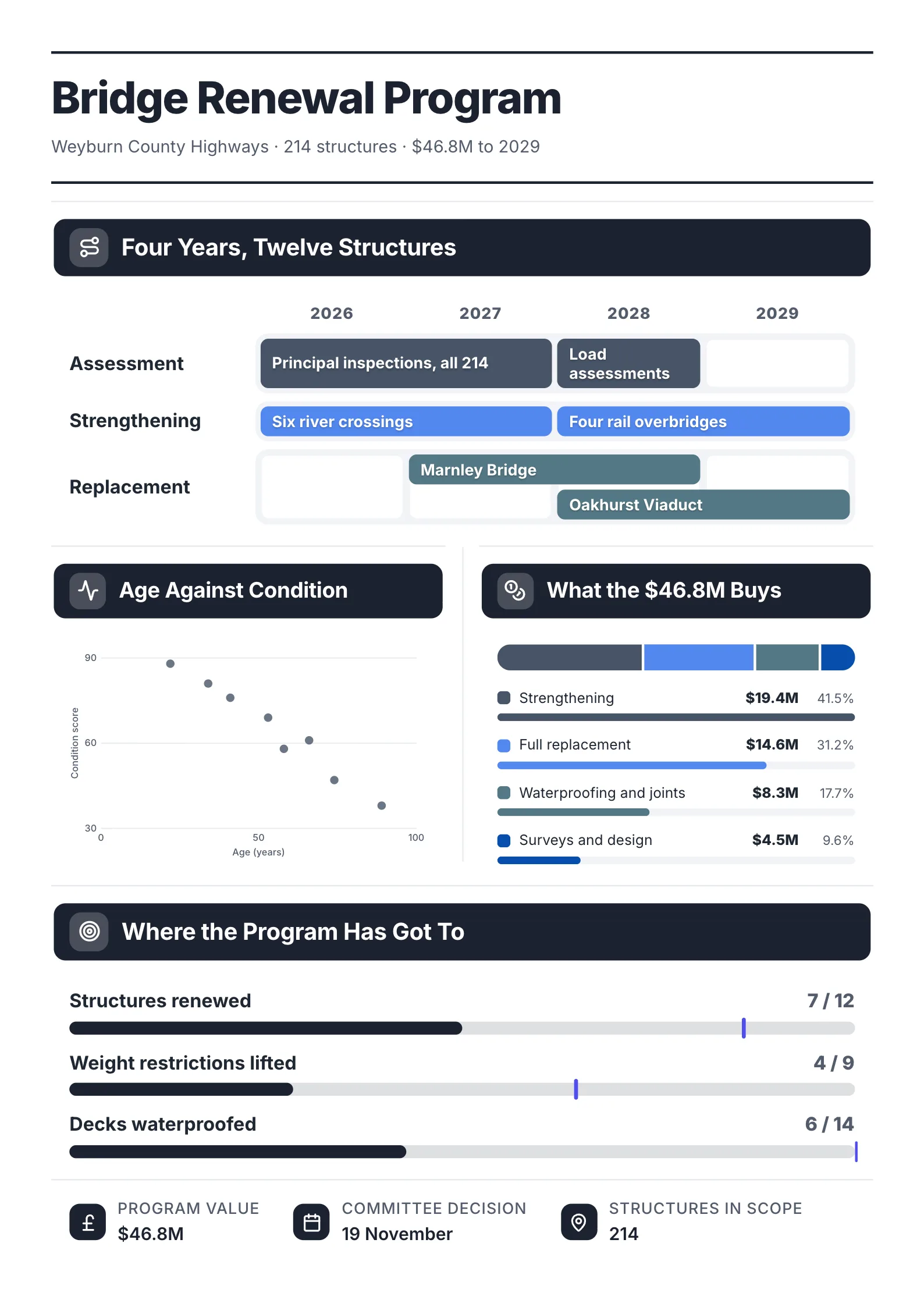 Infrastructure Program PlanEdit for free(opens in a new tab)
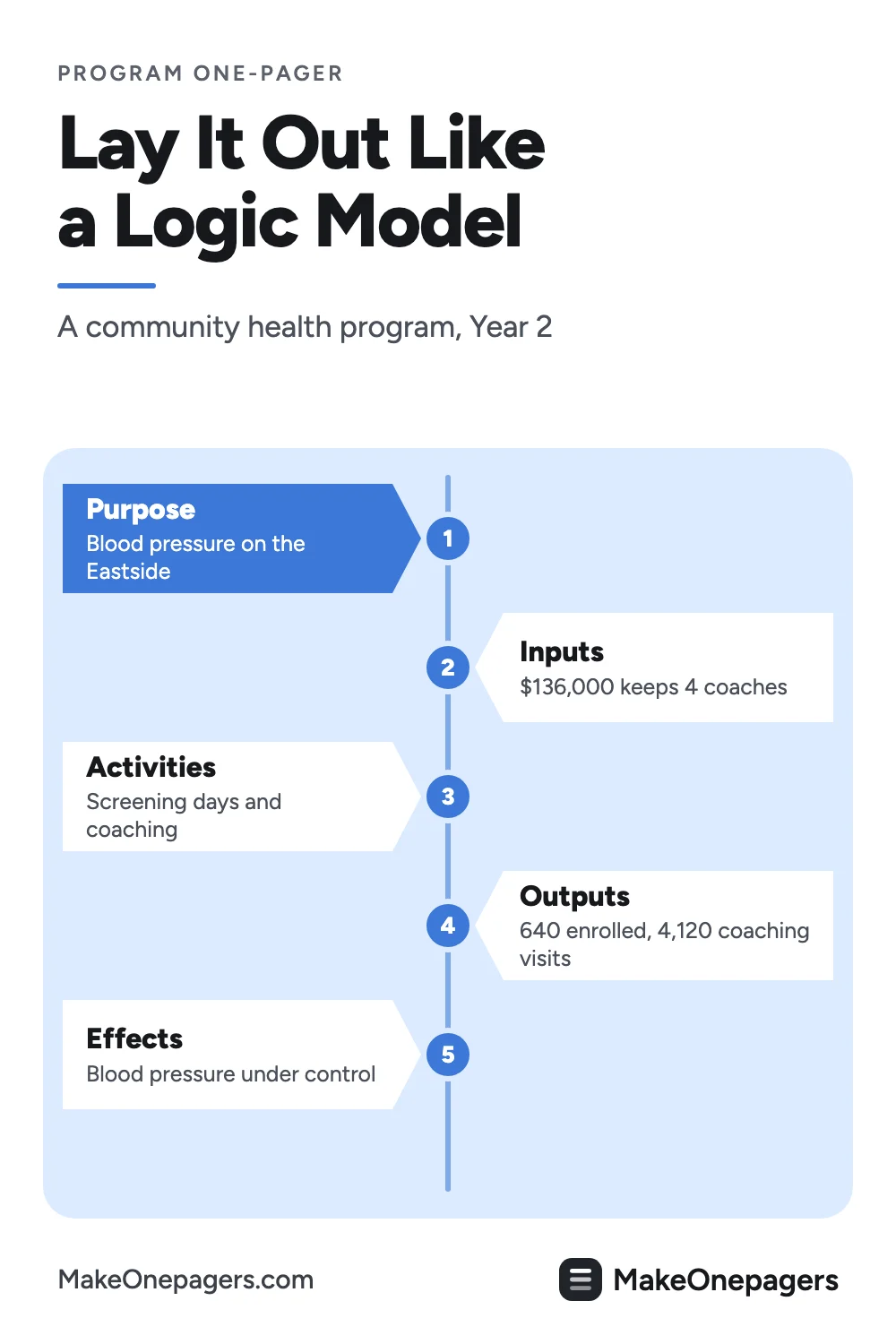
That order comes from the logic model, a planning tool built for this kind of work. Build your page on it and a reader who knows the format finds things where they expect them.
Lay it out like a logic model
The University of Kansas Community Tool Box, a free public guide for community programs, explains logic models in its chapter on developing a logic model or theory of change. It names six parts. Five of them map to a block on your page, and the sixth, context, asks about "the climate in which change will take place". Give it one line if there's room.
| Logic model part | What the Tool Box asks | On your one pager |
|---|---|---|
| Purpose | What motivates the need for change? | One sentence on the problem |
| Inputs | What resources will be used? | Staff, money, partners |
| Activities | What will the initiative do with them? | Screenings, coaching, classes |
| Outputs | What evidence is there the activities happened? | Counts: people reached, sessions held |
| Effects | What changed as a result? | The outcome, against a target |
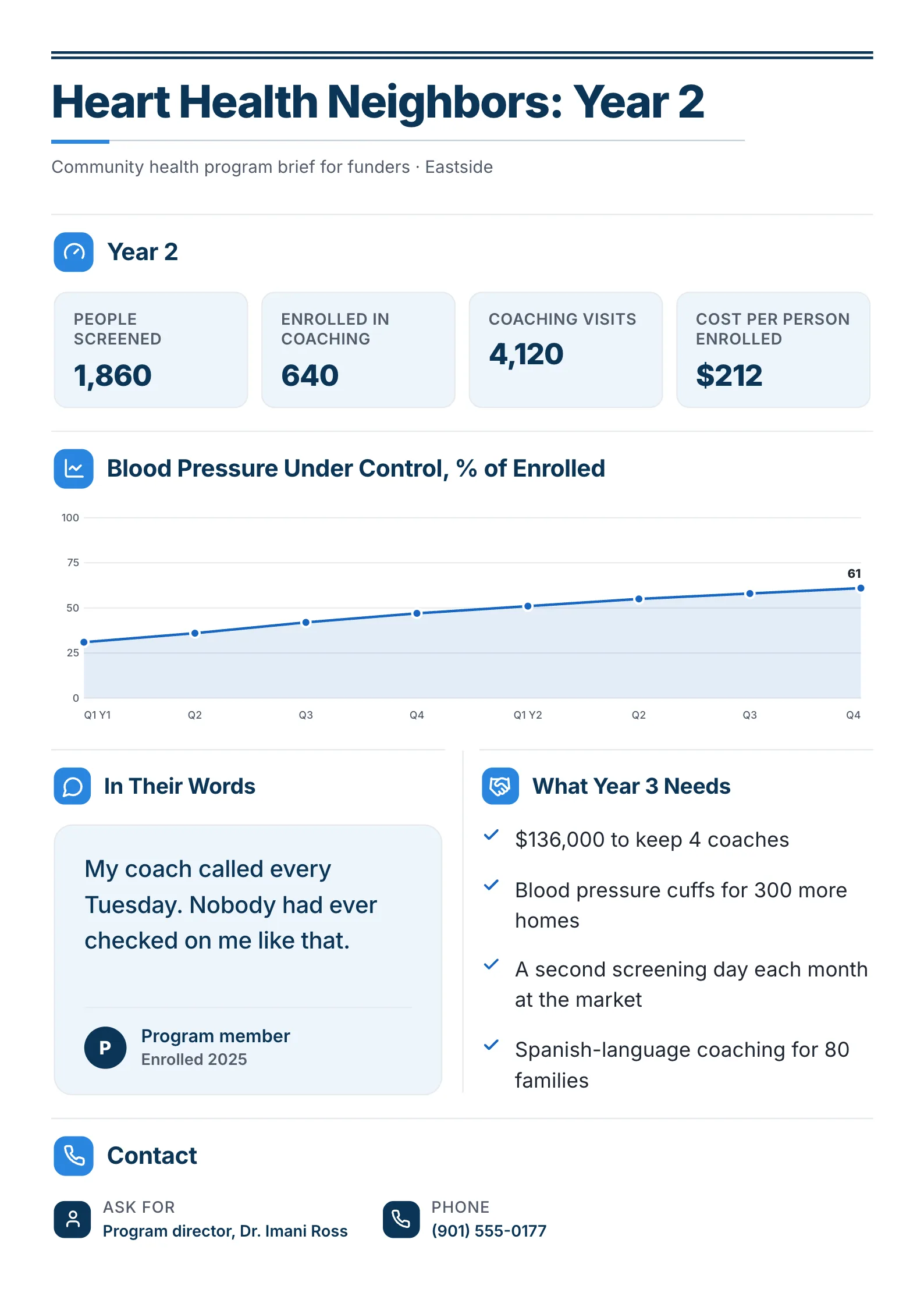
The row you're most likely to mix up is outputs. The Tool Box defines outputs as evidence that the activities were performed, like "the number of mentors trained". That's not the same as a result. 640 people enrolled in coaching is an output. Blood pressure under control is an effect. Your page should show both and never pass one off as the other.
Ask "But why?" and "But how?"
The Tool Box suggests two questions for testing a model, and they work just as well on your draft one pager.
- "But why?" Start from an activity and move forward. We run screening days. But why? To find people with high blood pressure. But why? So coaching can bring it down.
- "But how?" Start from the effect and move back. Blood pressure comes down. But how? Through coaching visits. But how do people get to coaching? Through screening days.
If a line on your page can't answer one of these, it's either missing a step or doesn't belong.
Five programs, read as logic models
A community health brief for funders
 Edit this template
Read it as a logic model and you'll see the parts line up. The three counts across the top are outputs. The chart, blood pressure under control by quarter, is the effect. "What Year 3 Needs" lists the inputs for next year, $136,000 to keep 4 coaches. One member's quote stands in for the 640. The community health program brief keeps the same blocks for your program.
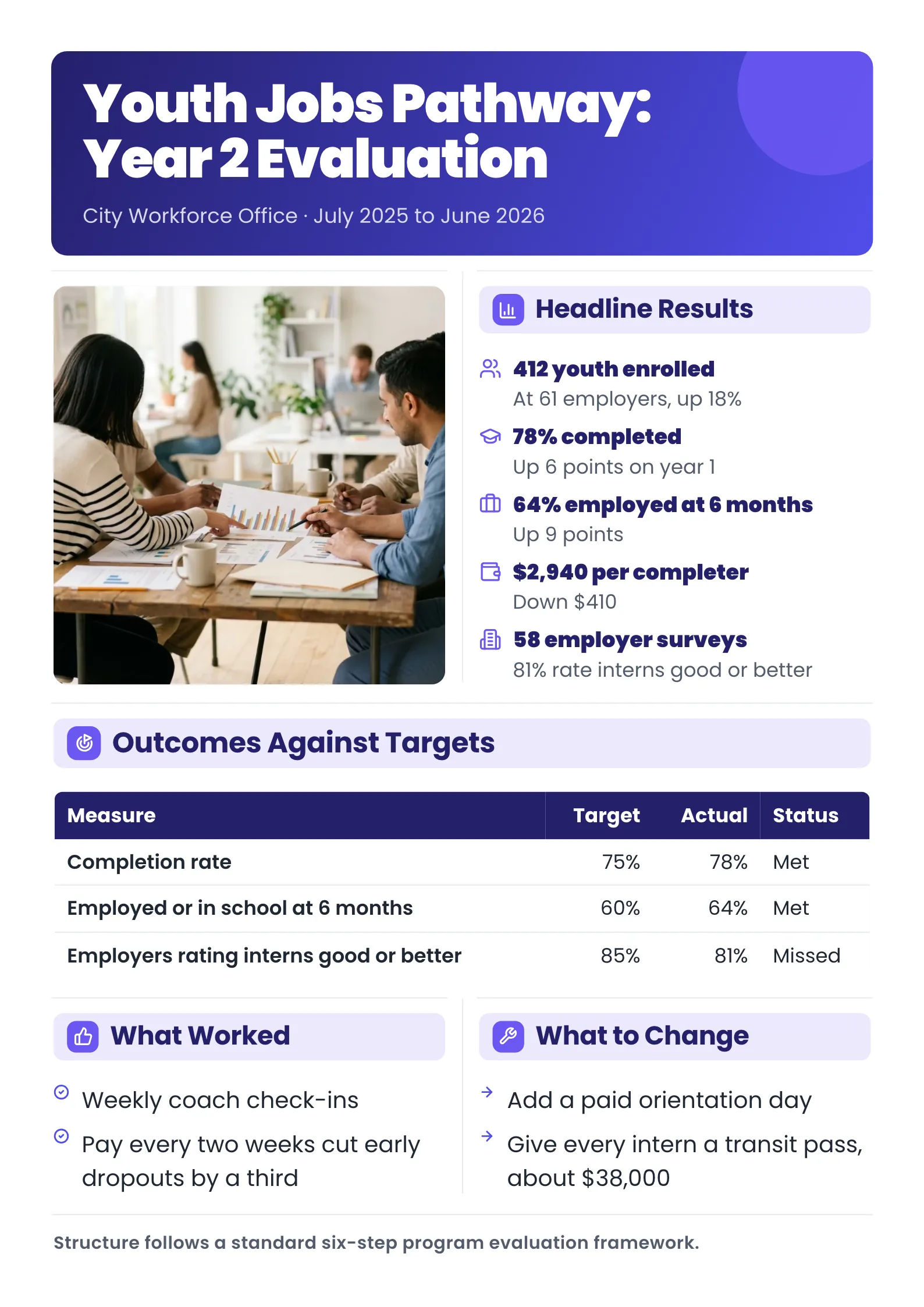
An evaluation against targets
 Edit this template
Your evaluation earns trust when it shows the miss. Two targets were met, and one wasn't: employers rated 81% of interns good or better, against a goal of 85%. The fixes are specific, a paid orientation day and a transit pass, and the program evaluation summary has a row for each target. Our impact report template post covers the version for donors.
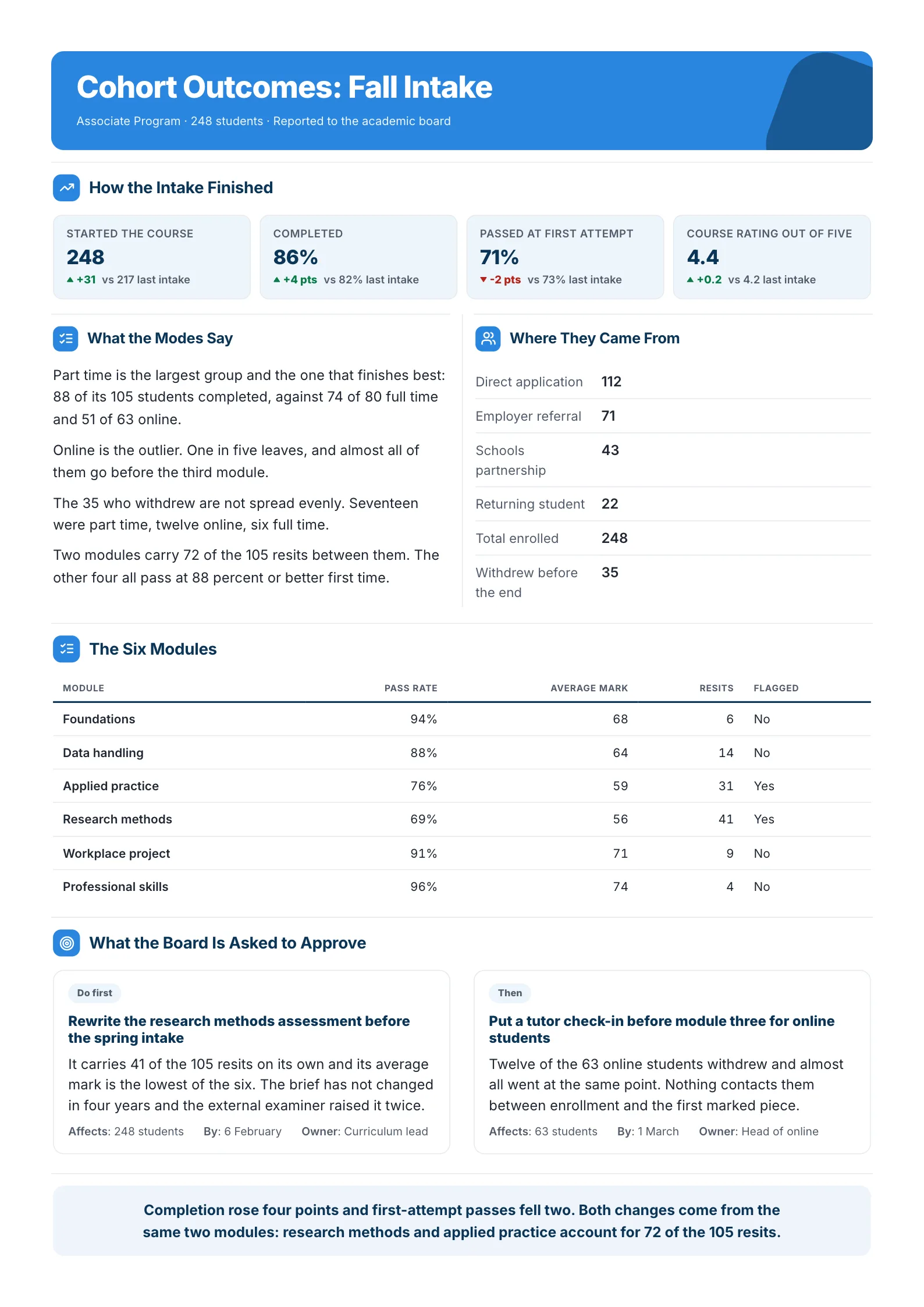
A cohort report for an academic board
 Edit this template
The headline is fine at 86%, so the page looks underneath it. Online loses one student in five, almost all before the third module. Two modules account for 72 of the 105 resits. Those two findings tell your board where to look next. Use the program outcomes report for your own intake.
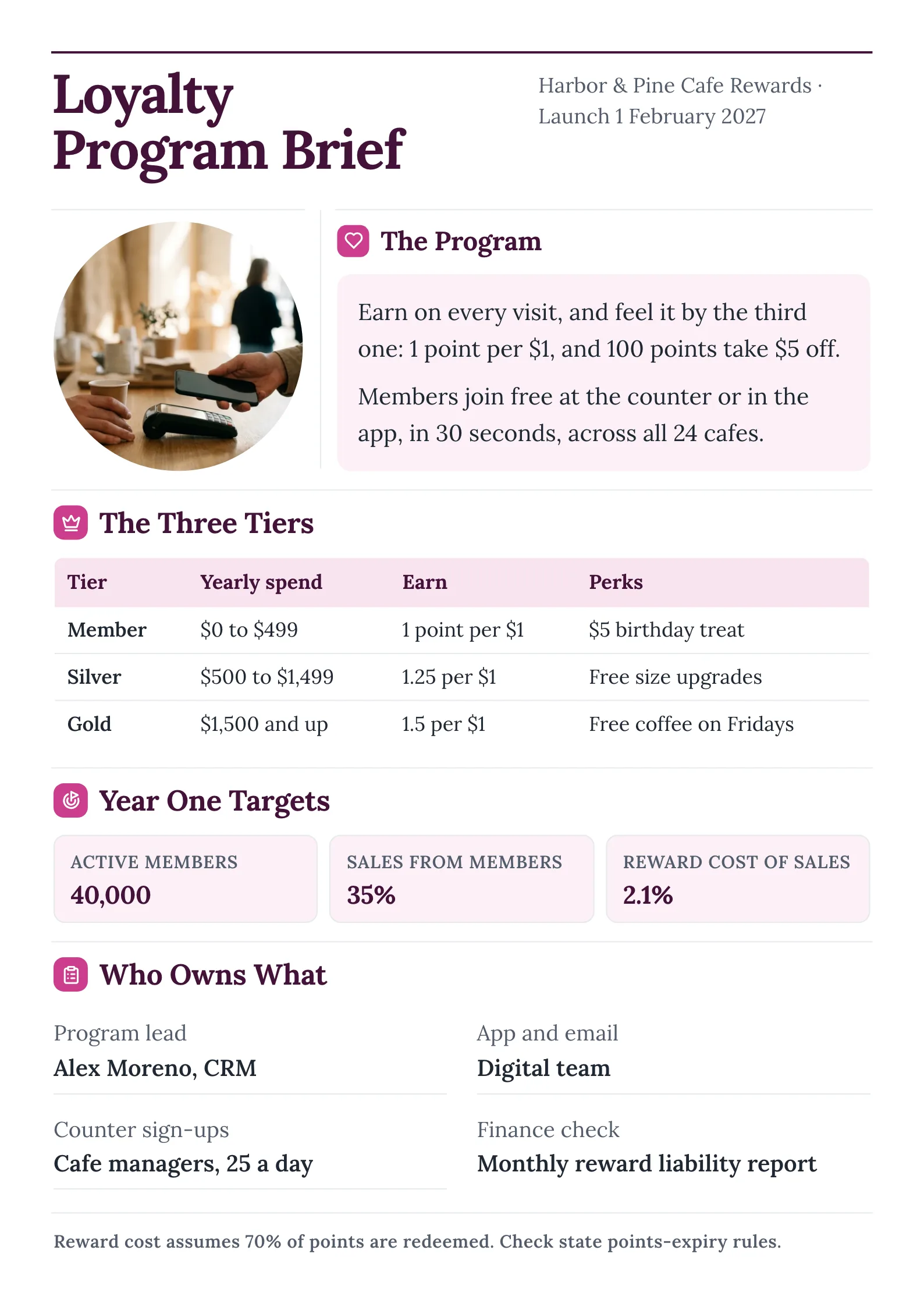
A loyalty program brief
 Edit this template
Your program might be a business one. It uses the same logic. The input is the reward budget, 2.1% of sales, the activity is earning and redeeming, and the effect is 35% of sales from members. The footnote on the loyalty program brief is honest about the big assumption: the 2.1% cost assumes 70% of points get redeemed.
A proposal for a new program
 Edit this template
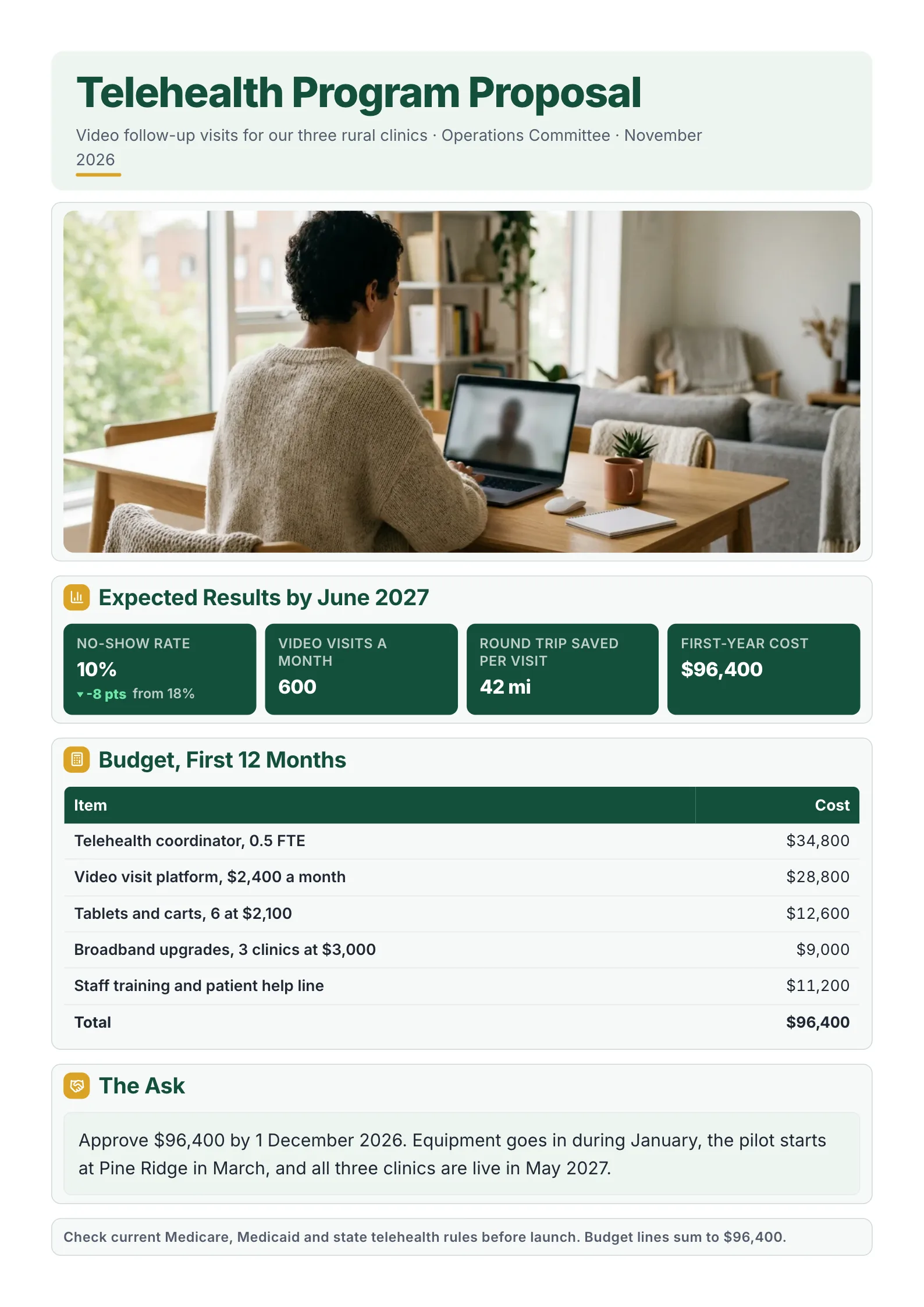
A proposal is a logic model looking forward, so you lead with the expected effect. Here that's no-shows falling from 18% to 10%. The budget table lists the inputs line by line and adds up to $96,400. The ask has a date, and the rollout on this telehealth program proposal has three steps, ending with all three clinics live in May 2027. The grant summary template guide shows how funders like to see the money.
What makes the cut
- Three or four outputs, as numbers. People, sessions, places.
- One effect, with a target beside it. A chart if you have more than two time points.
- One quote, from someone the program served, picked because it sounds like many of them.
- One ask or one next step. Money, approval, or the change you'll make.
- Cost per person, if you know it, so a funder can compare it with other programs.
Writing for a nonprofit board rather than a funder? The one-pager for nonprofits post covers that reader.
Make your program one pager
Sketch the logic model on paper first: purpose, inputs, activities, outputs, effects. After that, each part goes into its own block on a program page in MakeOnepagers. Sitting on a long annual report or evaluation? Let the free AI One-Pager generator pull out a summary, then check every number against the source.
Frequently asked questions
What is a program one pager?
A single page that describes a program for a funder, board or partner: the problem, what goes in, what the program does, what it counted and what changed.
What should a program one pager include?
A one-line purpose, the resources, the main activities, three or four outputs as numbers, the main outcome against its target, one quote and the ask or next step.
What is the difference between outputs and outcomes?
Outputs show the activities happened, like people enrolled or sessions held. Outcomes, or effects, are the changes that came from them, like better blood pressure or more people employed.
Is a program one pager the same as a logic model?
Not quite. A logic model is the planning diagram. A program one pager tells the same story to a reader, with numbers, a quote and an ask.
Is there a free program one pager template?
Yes. Our program layouts cost nothing to edit. Fill each block with your inputs, outputs and outcome, and attach the PDF to your report or grant.
Write your outputs and your one effect first, and the rest of the page has something to hang on.




