Performance Review Ideas: 12 Borrowed From 5 Employers' Own Forms
Performance review ideas taken from 5 real employers' review forms, from check-ins at 3, 6 and 9 months to giving the employee 7 days for the last word.


These performance review ideas come from the forms real employers hand their staff. We read 5 of them, from Case Western Reserve University, the cities of Little Rock, Boston and Falls Church, and MIT. Each form carries habits its HR team built in on purpose. We pulled out 12 of them that you can use in your next review, whatever your team's size. Start from a free one pager template.
One‑Pager examples
Real One-Pagers made with MakeOnepagers. Open any one to edit it as your own.
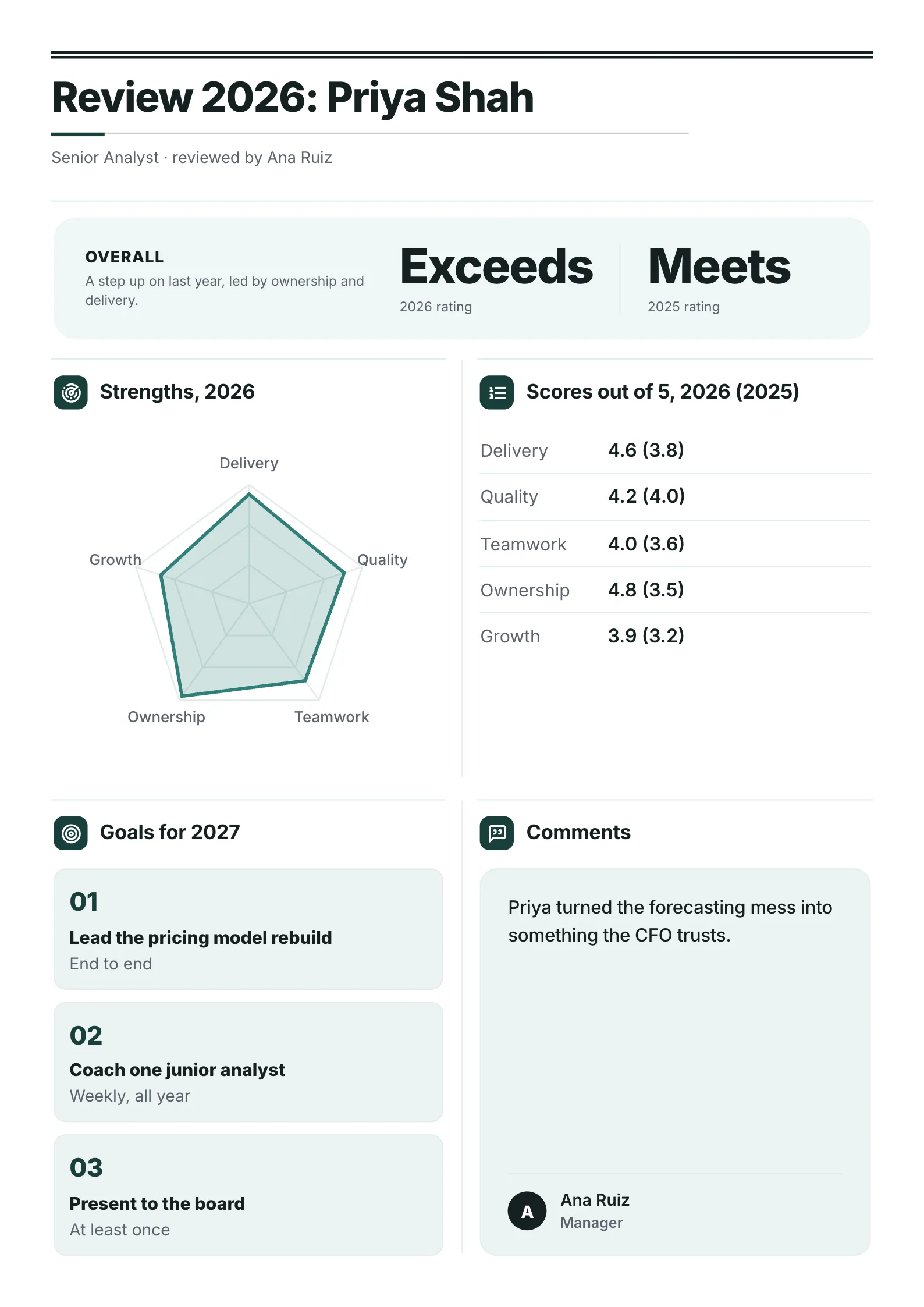 Performance Review SummaryEdit for free(opens in a new tab)
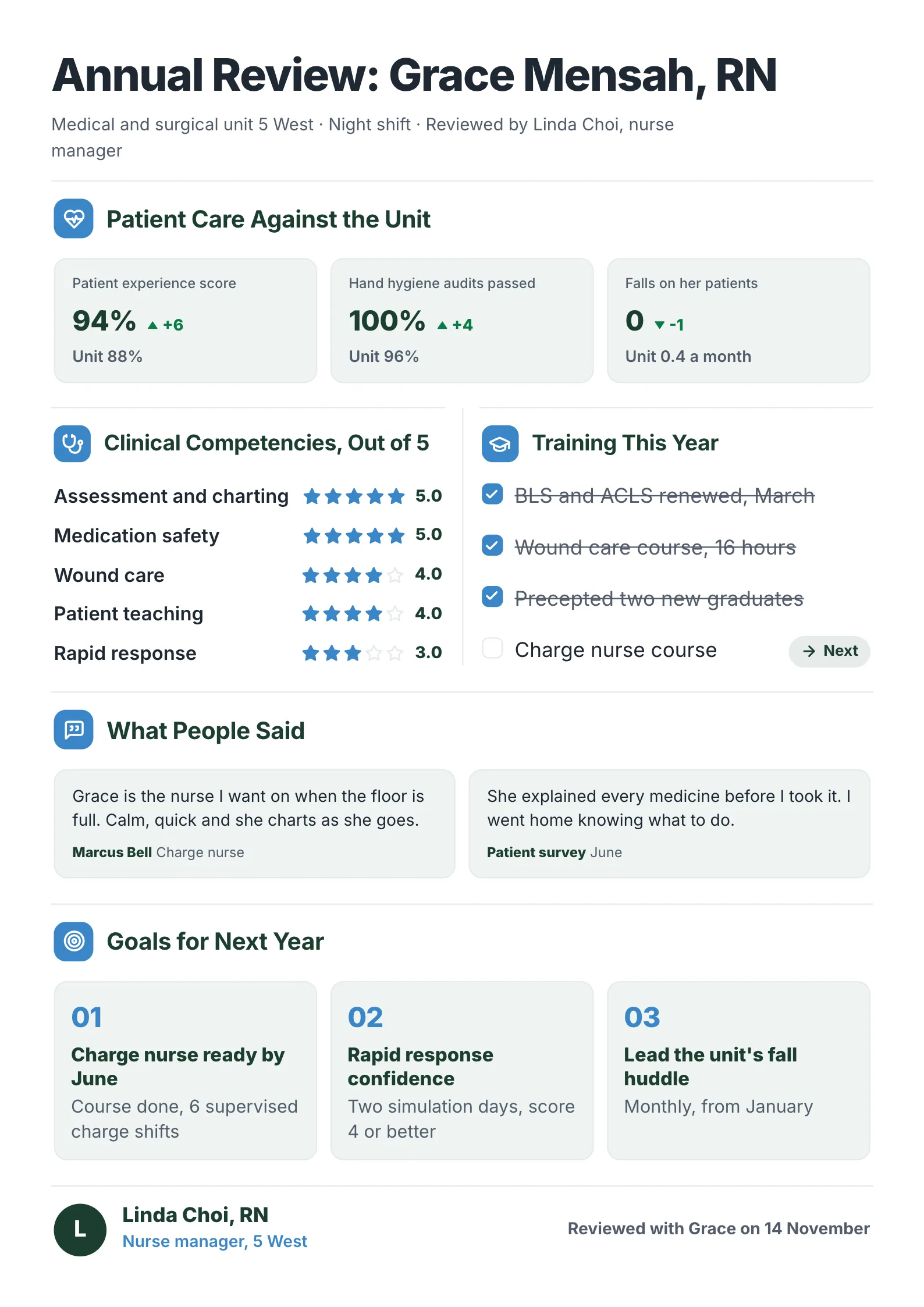 Performance Review: NurseEdit for free(opens in a new tab)
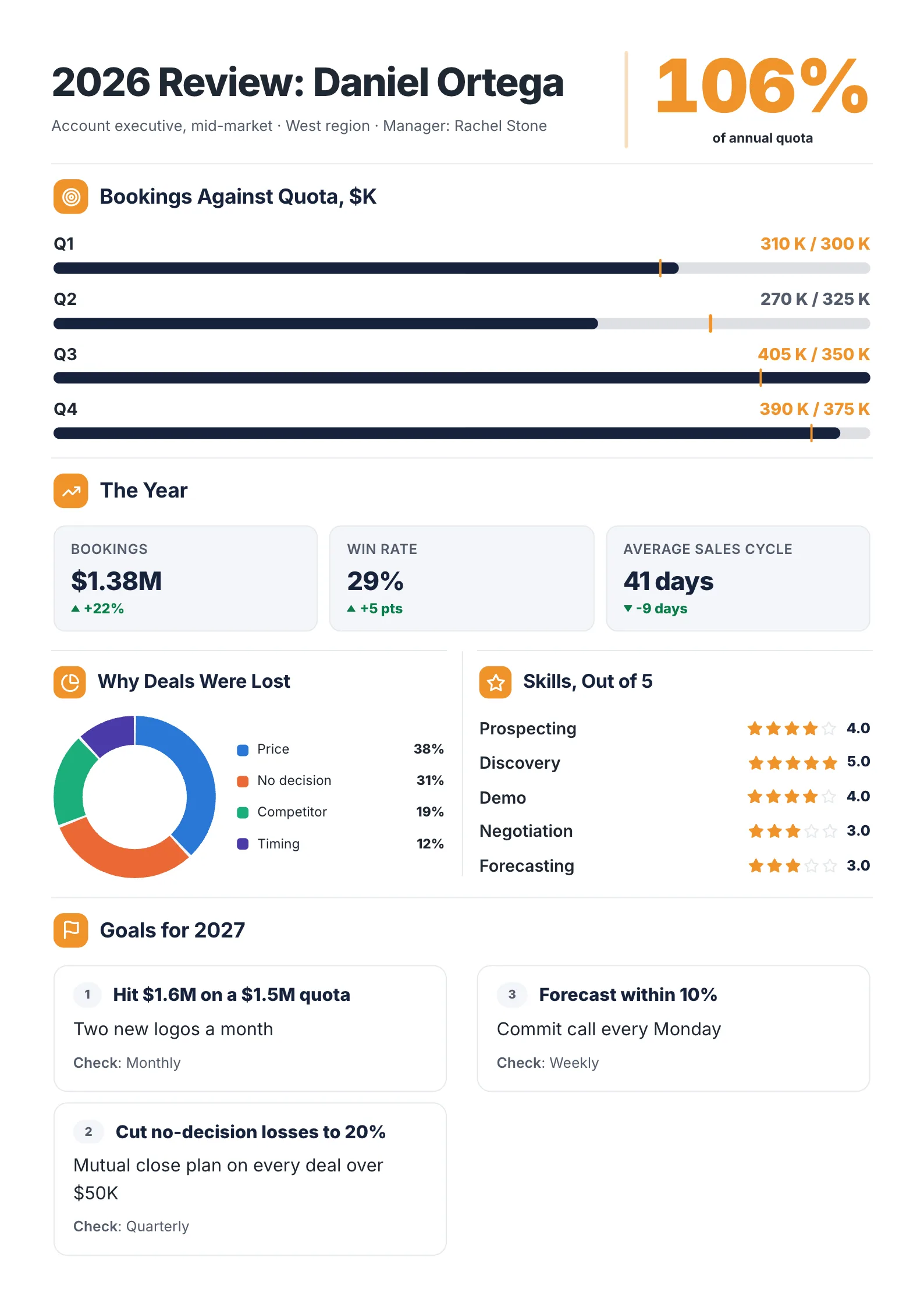 Performance Review: SalesEdit for free(opens in a new tab)
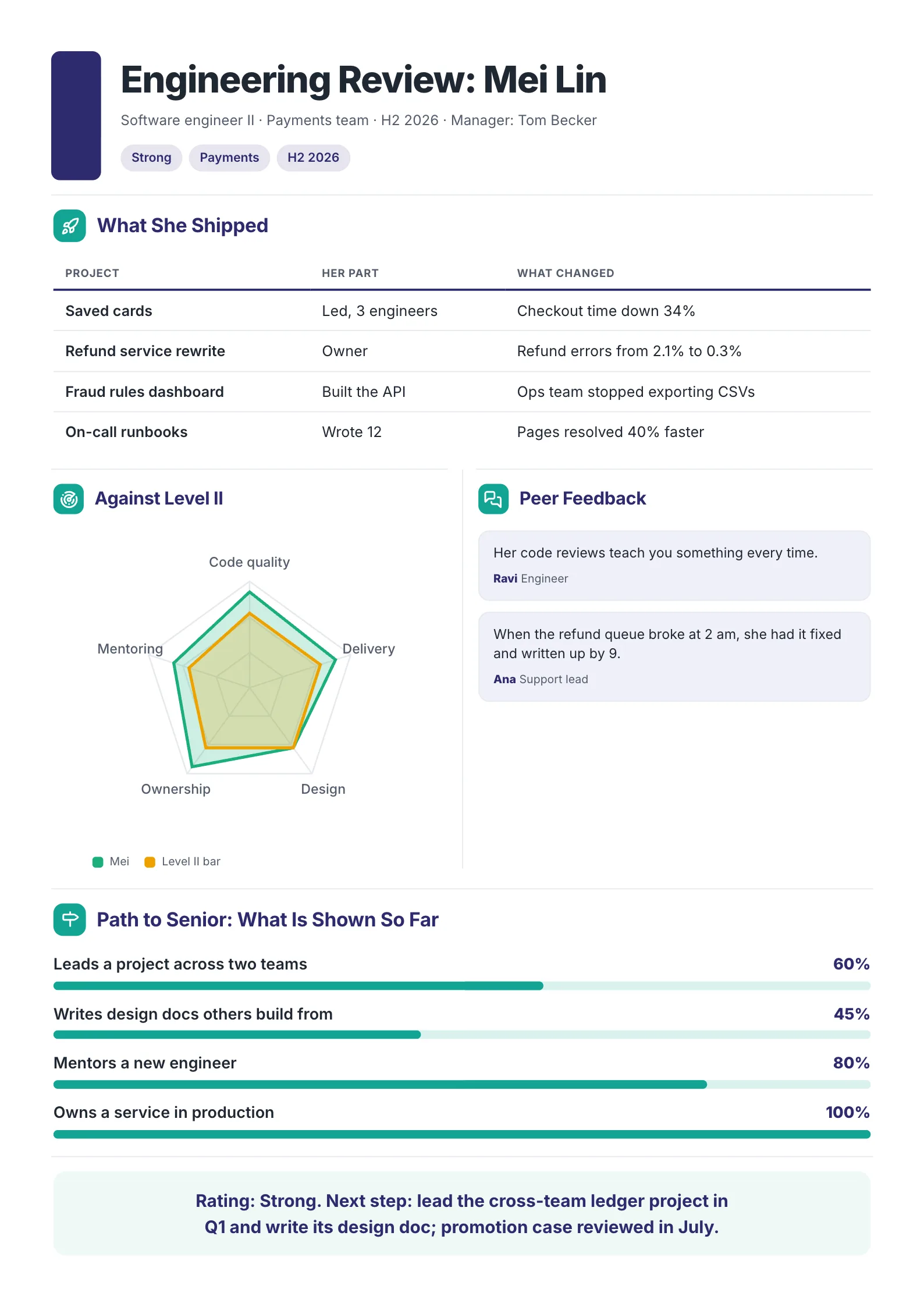 Performance Review: Software EngineerEdit for free(opens in a new tab)
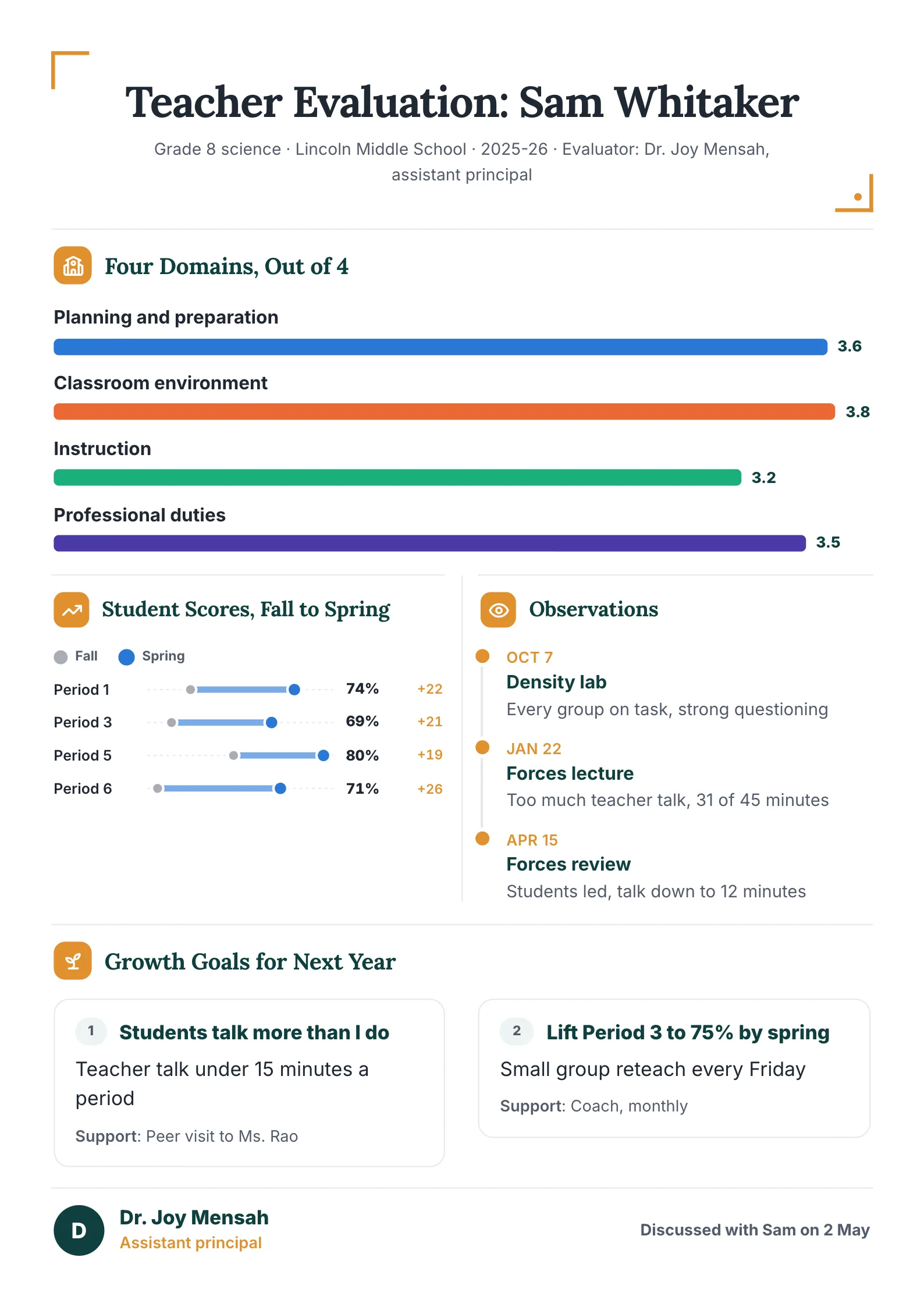 Performance Review: TeacherEdit for free(opens in a new tab)
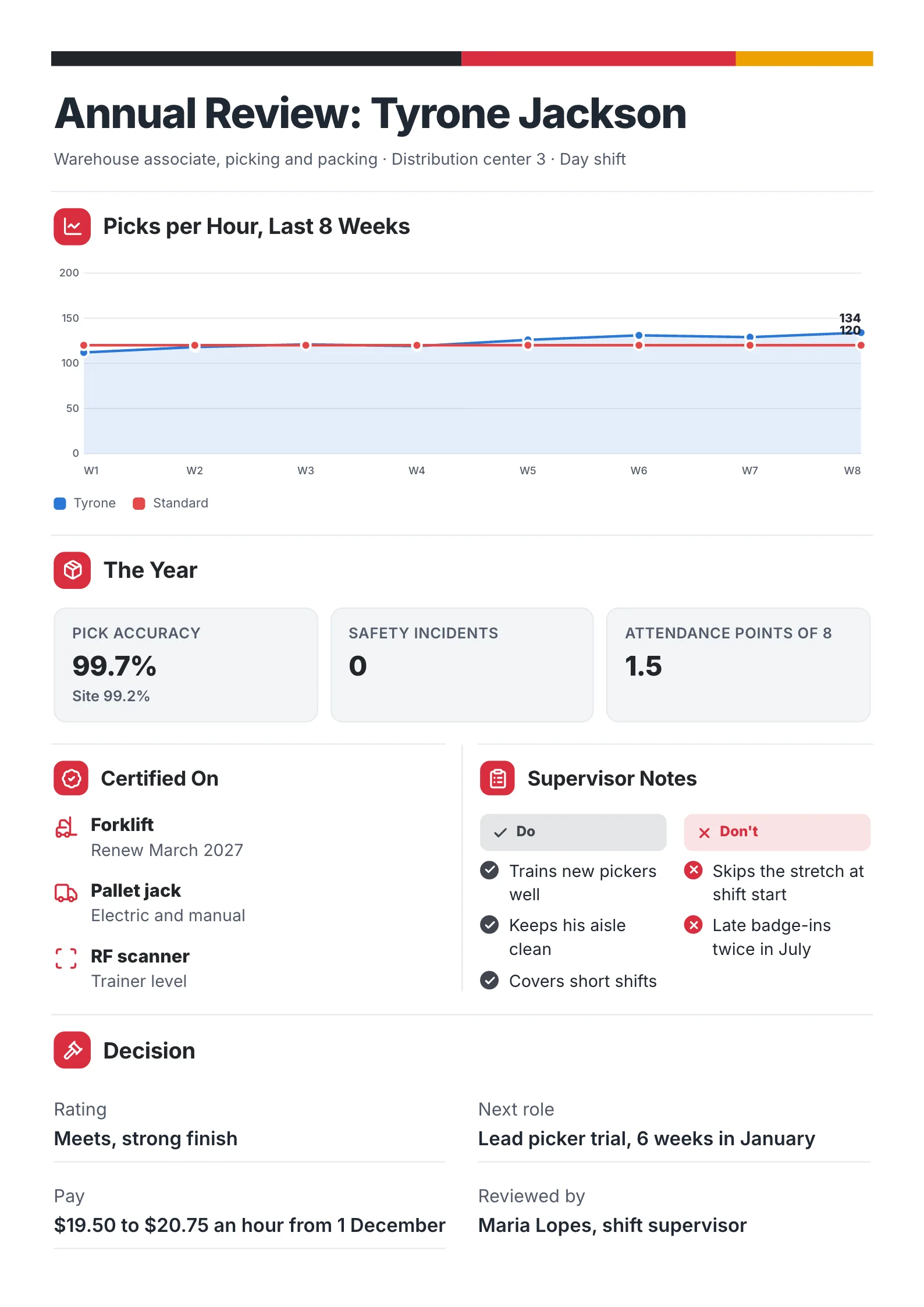 Performance Review: WarehouseEdit for free(opens in a new tab)
You'll find them in the order a review runs. First come the months before the meeting, then the meeting itself, then what happens after. Each idea names the form it came from, so you can read the original yourself. You'll also see five filled-in reviews from MakeOnepagers that put the ideas on one page.
Which 5 review forms did we read?
| Employer | What we read | What stands out |
|---|---|---|
| Case Western Reserve University | Performance Goals Check-In, revised February 2024 | Check-ins at 3, 6 and 9 months |
| City of Little Rock | 2025 individual contributor form | Every score from 1 to 5 leads to a next step |
| City of Boston | Performance Review System form | Plans checked within 30 days, comments within 7 |
| City of Falls Church | Directions and definitions, 9 parts | Rates the how and the what apart |
| MIT | Performance Review Form steps | Employee writes before the manager rates |
Here's how often you'll find the same habit across the five.
| Habit | Forms that have it |
|---|---|
| A written part for the employee | 5 of 5 |
| A signature or receipt step | 4 of 5 |
| The employee writes before the manager rates | 3 of 5 |
| A required plan after a low rating | 3 of 5 |
| A separate section for managers | 2 of 5 |
Ideas for the months before the review
1. Check in at 3, 6 and 9 months
Case Western's check-in form has boxes for 3, 6 and 9 months, and the 12-month mark uses the annual form. The reason is printed on the page. The annual review "should not be the first time that significant comments are addressed." Even one short check-in in the middle of your year means the year-end talk has nothing new in it for you or your employee.
 Edit this template
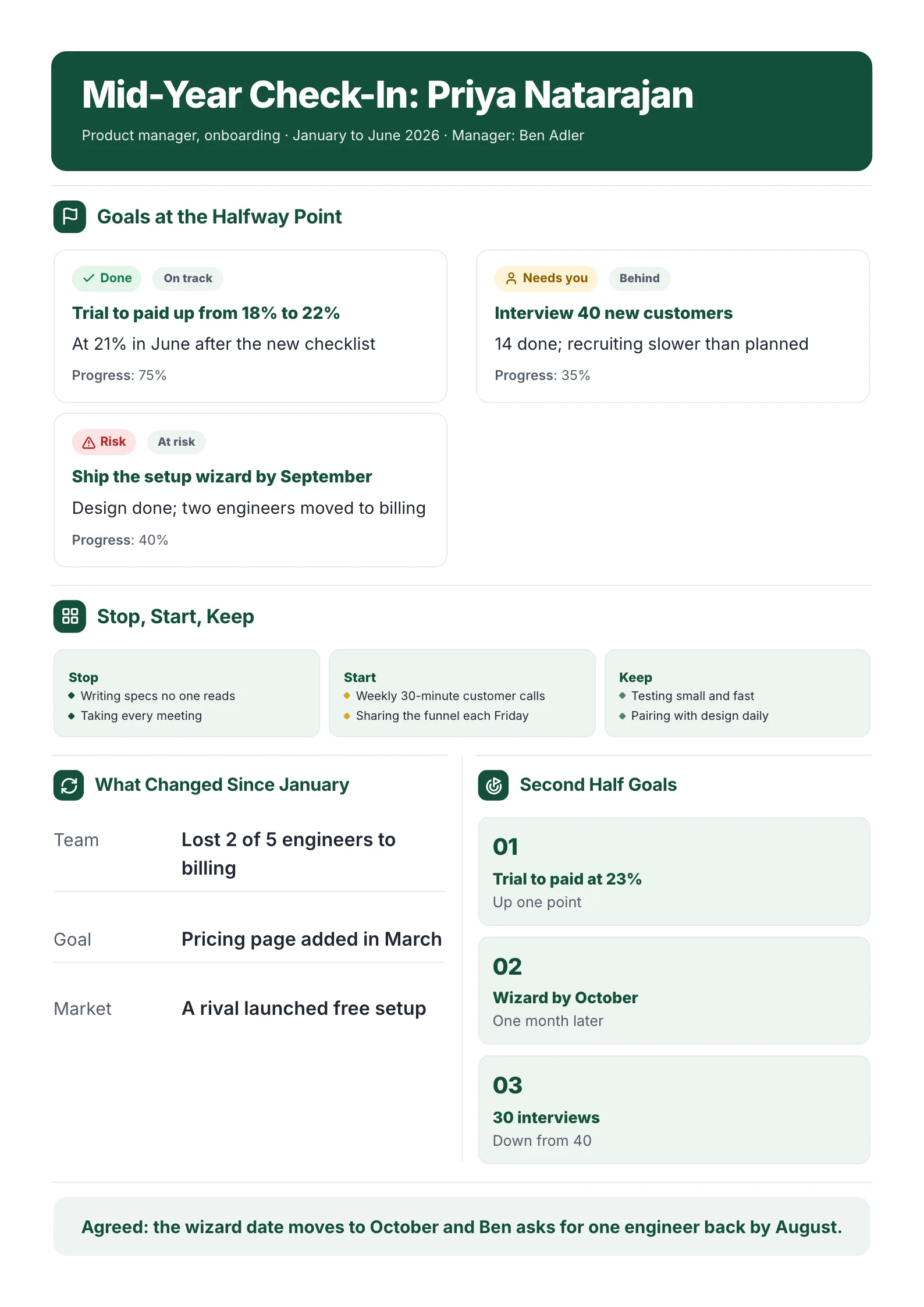
This mid-year performance review is the check-in Case Western has in mind. Priya's goal to lift trial to paid from 18% to 22% is on track at 21%. The setup wizard sits at 40% and is flagged at risk, because 2 of her 5 engineers moved to billing. So the second half goals change on the spot. The wizard moves to October, and customer interviews drop from 40 to 30.
2. Agree on what the job is
Falls Church opens its review with the job itself. Part 1 asks the manager and the employee to read the job specifications together and "reach clarity and agreement on the general duties." It sounds basic. Yet you can't rate someone fairly on work nobody told them was theirs, and this step catches that before you write any score.
3. Let the employee write first
At MIT, the employee writes comments on every goal and an overall summary before the manager rates anything. Case Western says staff "should take the lead" on goal progress. Boston gives employees 4 questions to answer first, such as which parts of the job are going best and what ideas they have to grow. Case Western's version is shorter. It asks how things have gone, how you'd rate yourself, what your biggest win was and what you need to keep going. For more prompts like these, see our list of performance review questions from 6 employer forms.
 Edit this template
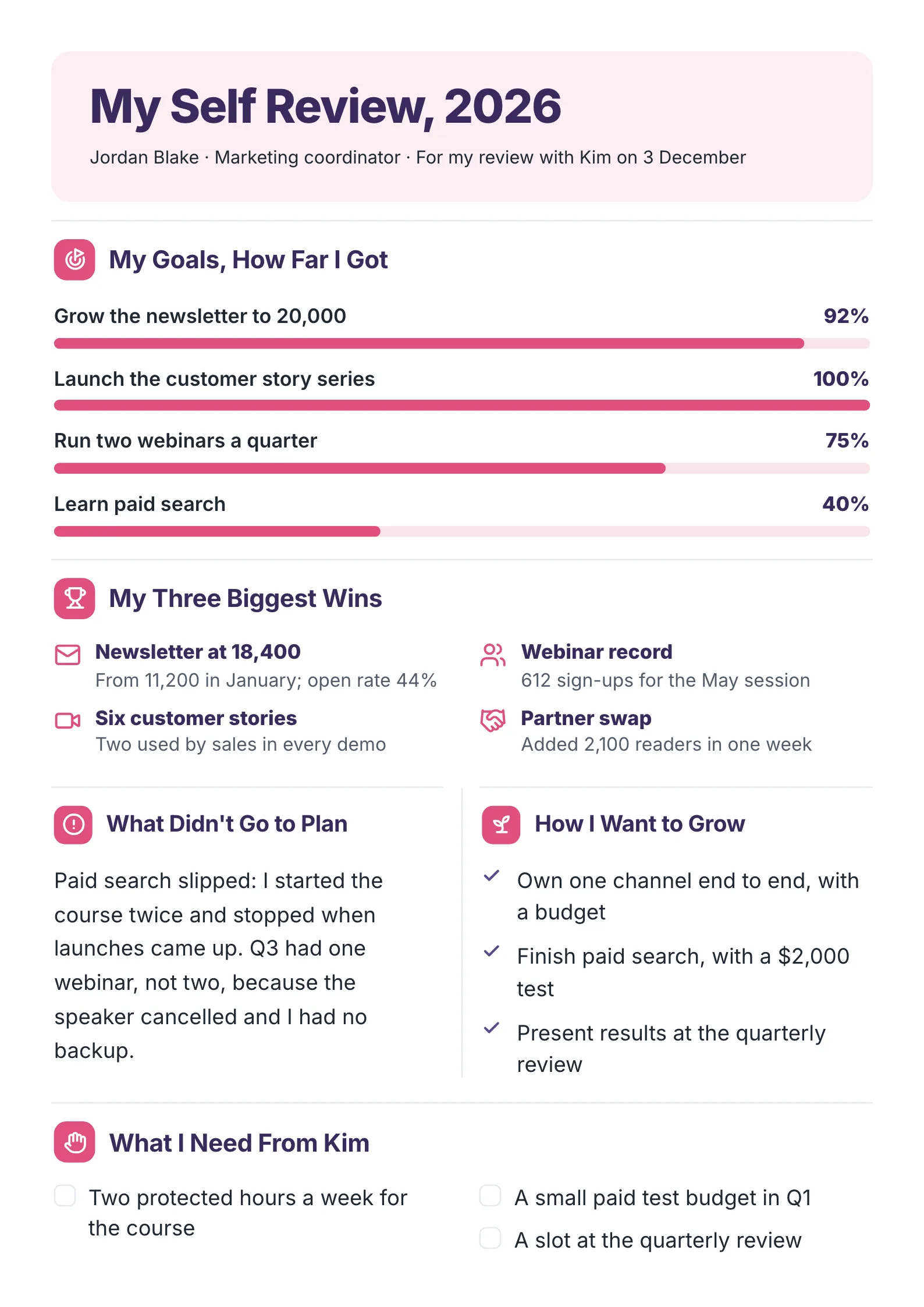
This self assessment performance review is what your employee brings in. Jordan's newsletter goal is at 92%, after growing from 11,200 readers in January to 18,400 with a 44% open rate. Paid search is at 40%, and the What Didn't Go to Plan box says why in two plain sentences. It closes on three requests for Kim, and the first is time blocked out each week to finish that course.
Ideas for the review meeting
4. Put both views side by side
Case Western gives each goal three columns. There's an employee assessment, a supervisor assessment, and resources or needs moving forward. Seeing both views on one line shows you where you agree in seconds. It also turns your talk toward the third column, which is what your employee needs to finish the goal.
5. Rate the how and the what apart
Falls Church splits every review in two. Its 4 core values cover how someone works, such as integrity and teamwork. Its 6 job success factors cover what they get done, such as quality of work and productivity. Managers also get 4 extra factors of their own, and Boston adds 3 manager-only areas to its 7 core ones. With this split, you can see a strong result reached the wrong way.
 Edit this template
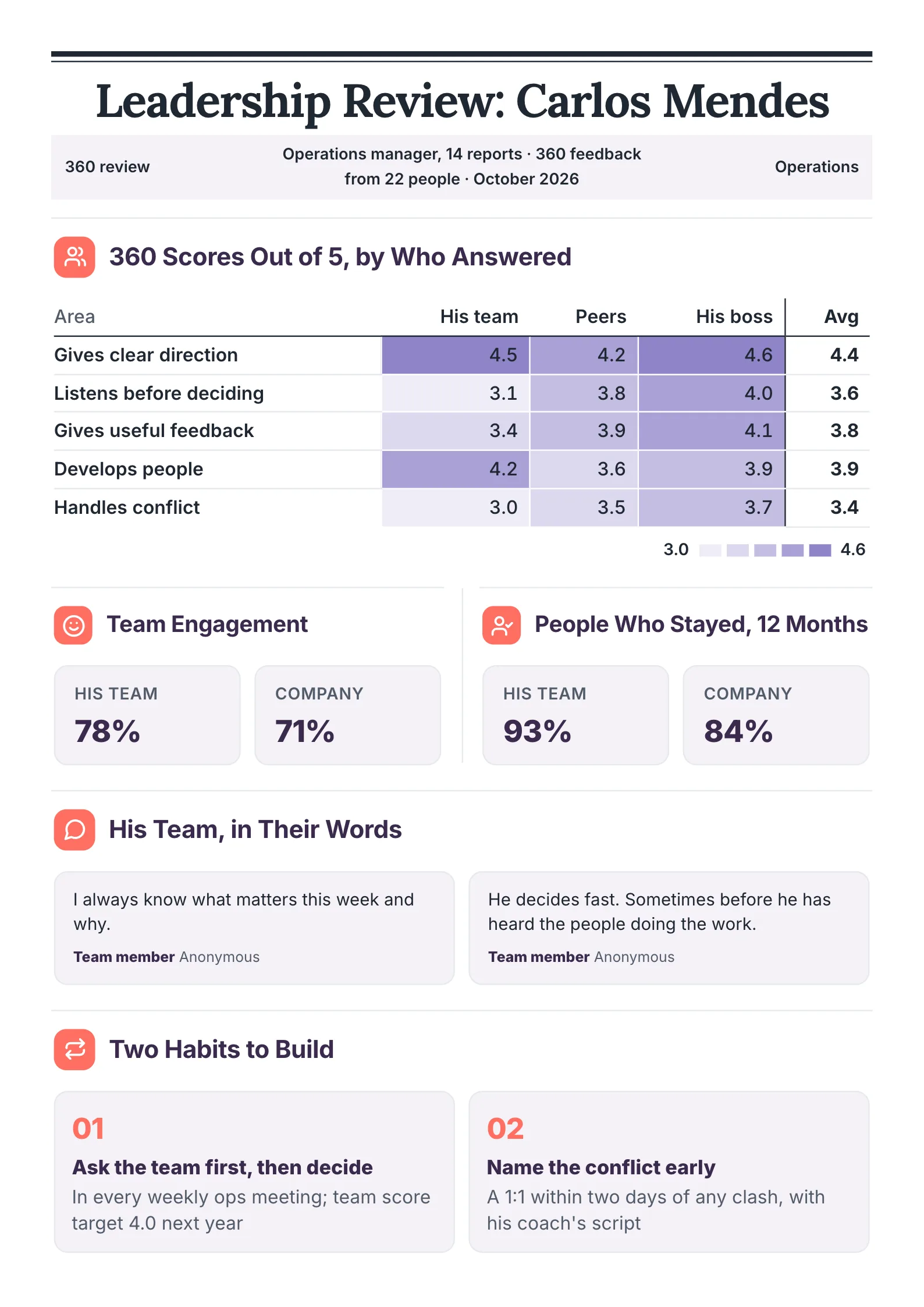
This manager 360 performance review shows the split in action. Carlos gets strong results, with team engagement at 78% against 71% for the company and 93% of his people staying 12 months. The how is weaker. His team scores him 3.1 out of 5 on listening before deciding, while his boss gives him 4.0. So his first habit to build is asking the team first, with a target score of 4.0 next year.
6. Back every score with evidence
Little Rock asks managers to write "specific examples or situations that justify the score given." It suggests completed projects, attendance records and data points. Boston has a comments box under every rating for the same reason. A number with no example behind it is hard for anyone to act on, so write at least one fact under each score.
7. Tie each score to a next step
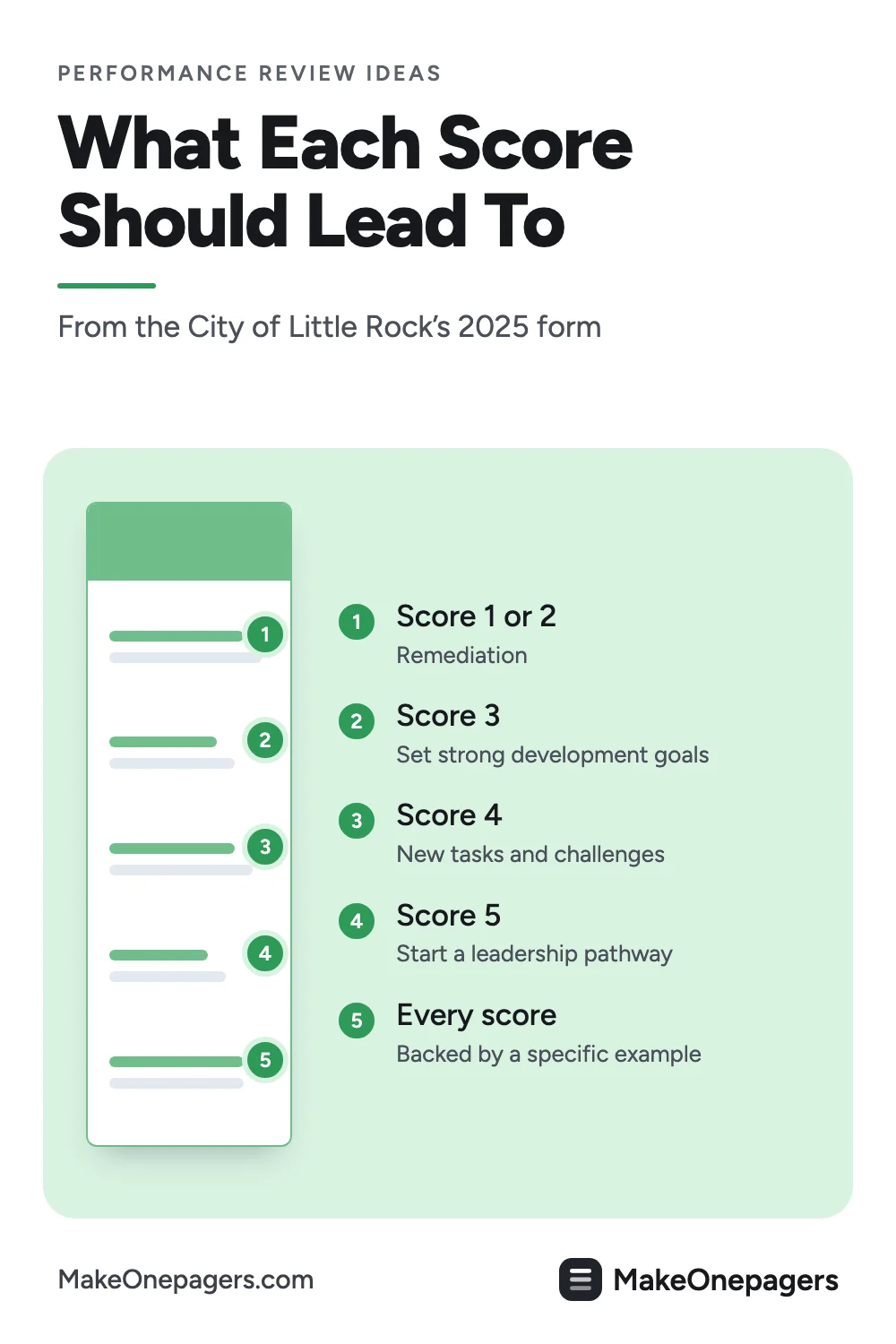
This is the idea in Little Rock's form we liked most. Its 5 scores each lead somewhere. A 1 or a 2 leads to remediation. A 3 means you set strong development goals. A 4 earns new tasks and challenges, and a 5 starts a leadership pathway. With that rule on the page, your employee sees where their score leads instead of just a number.
8. Keep promotion talk to what you control
Falls Church warns managers to be careful about "making promotion promises," since many factors sit outside one manager's hands. You can still build your case. Lay out the evidence and send it to whoever decides.
 Edit this template
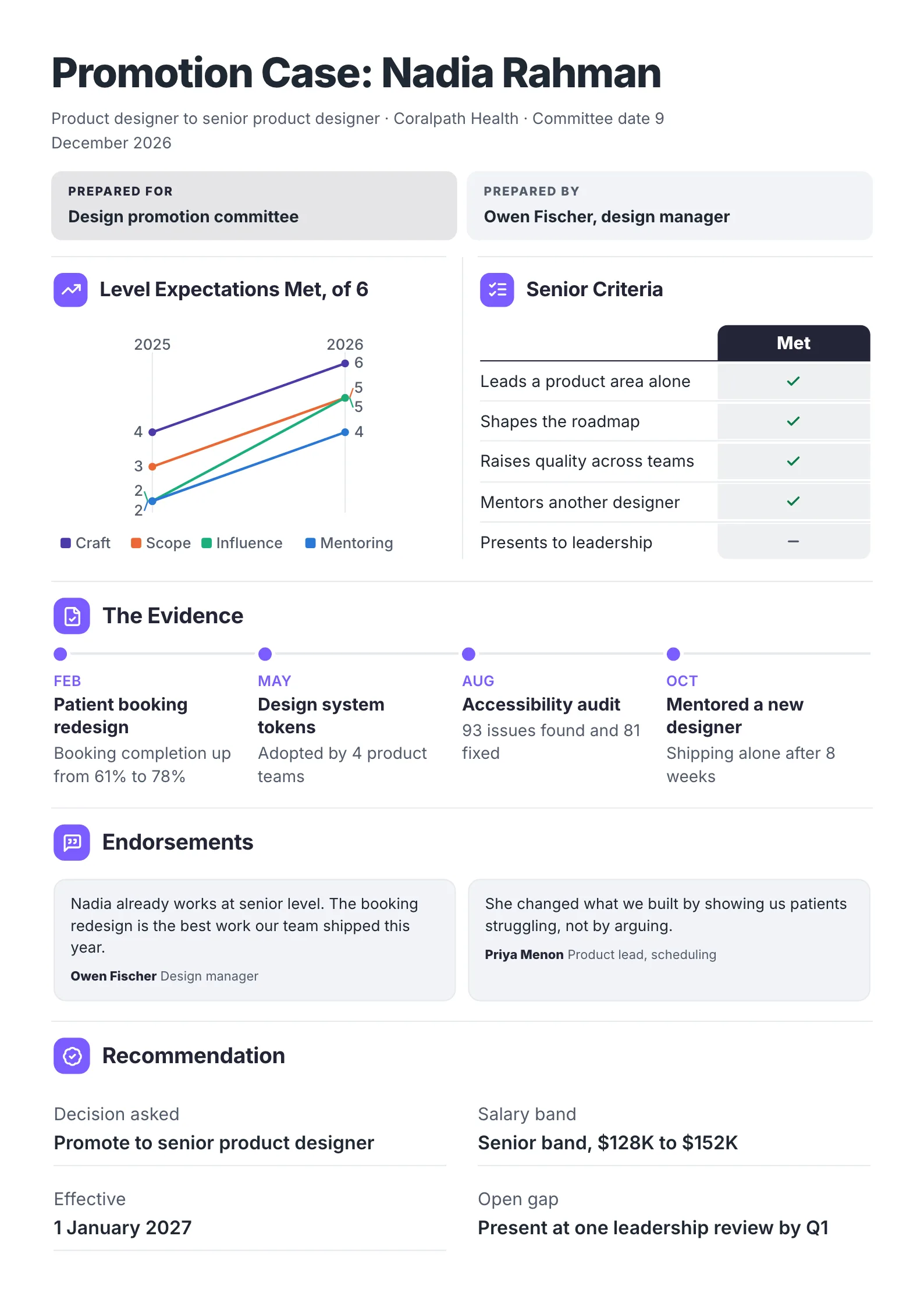
This promotion case performance review does it the careful way. Owen prepares it for a committee meeting on December 9, 2026, so the decision isn't his alone. Nadia's craft score rose from 4 to 6 of 6 and influence from 2 to 5. Her redesign lifted booking completion from 61% to 78%. One gap stays open in plain sight, since she meets 4 of 5 senior criteria and still needs to present at a leadership review by Q1.
9. Decide the one message they need to hear
Falls Church says there's no formula for the overall rating. Instead, it gives managers one test. "What is the message that the employee needs to hear?" Pick your message before the meeting and say it early. Then let every score and example you give back it up. For a walk through each rating level, see these performance review examples.
Ideas for after the review
10. Give every low rating a plan, checked in 30 days
Boston requires an action plan for any "Partially Meets" or "Does Not Meet" rating, written in the meeting. Plans "must be reviewed within 30 days." Falls Church requires an improvement plan after an overall Needs Improvement, and Little Rock sends a 1 or 2 to remediation. That's 3 of the 5 forms, so if you rate someone low, plan to write one with them on the spot.
 Edit this template
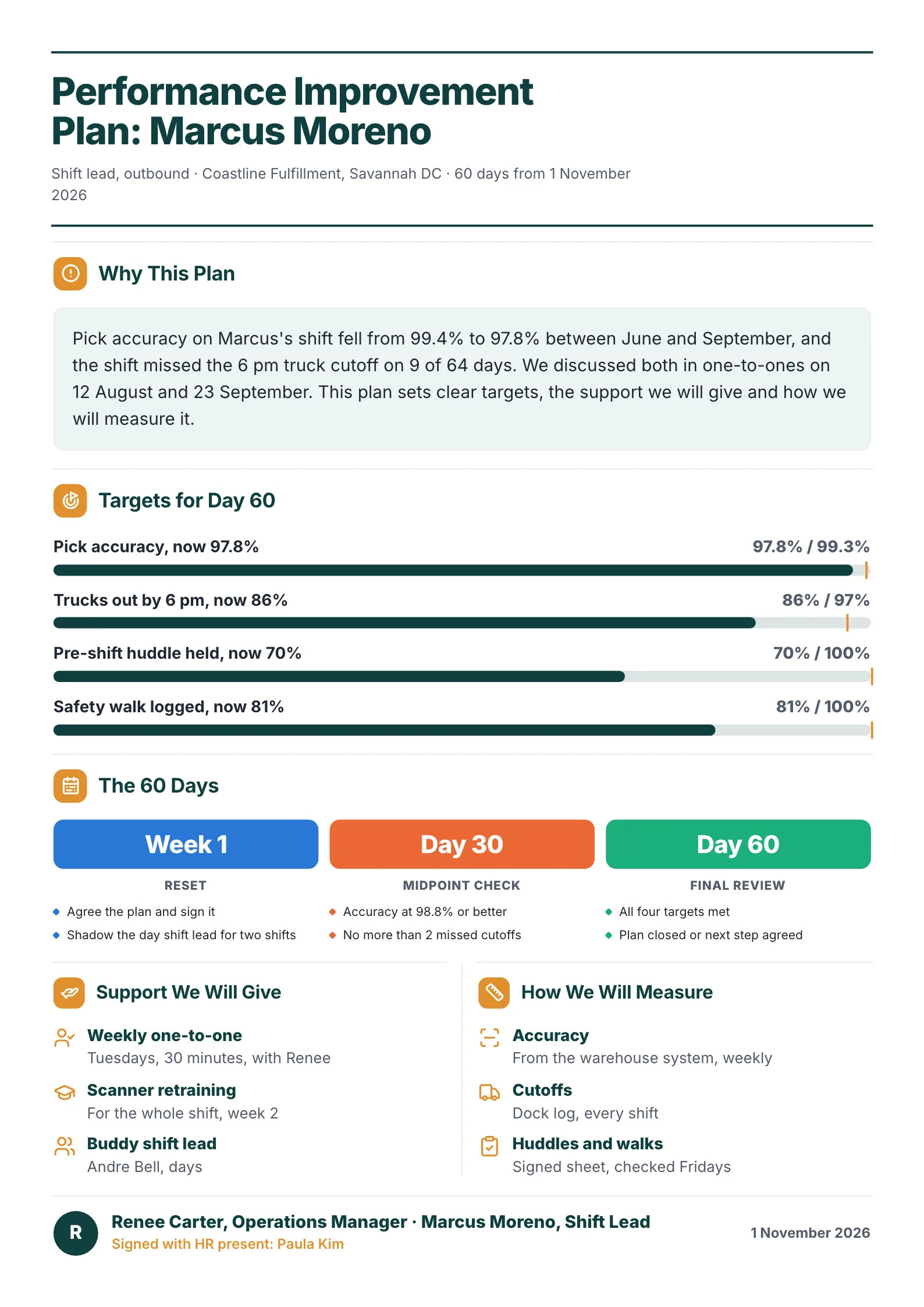
This performance improvement plan review has Boston's 30-day check built in. Marcus's pick accuracy fell from 99.4% to 97.8%, and his shift missed the 6 pm truck cutoff on 9 of 64 days. The Day 30 midpoint asks for accuracy of 98.8% or better and no more than 2 missed cutoffs. By day 60 the target is 99.3%, with a weekly 30-minute one-on-one as support.
11. Keep growth goals to 2 or 3
Boston's development section asks for "2-3 SMART goals," meaning specific, measurable, attainable, relevant and time-based. Little Rock adds a development plan page with the same five columns. Two or three goals fit in your employee's real week, while a list of eight usually gets dropped by spring.
12. Give them the last word, and set the next date
Boston gives the employee 7 days to add final comments. Falls Church says plainly that signing "is not necessarily agreeing" with the review. MIT ends with the employee clicking Acknowledge Receipt, and goals added to Next Year's Goals show up on next year's form. Case Western adds one more habit. Both people keep a copy, and the date of the next review is set before the meeting ends. For the full write-up from first draft to signature, see how to write a performance review.
A one-page review plan you can copy
Here are the 12 ideas as a single plan you can fill in for your next review.
| When | What to do | Taken from |
|---|---|---|
| Months 3, 6 and 9 | Short check-in on each goal | Case Western |
| Before the meeting | Agree the job, then the employee writes first | Falls Church, MIT |
| In the meeting | Both views per goal, how and what rated apart | Case Western, Falls Church |
| Each score | One fact behind it and one next step | Little Rock |
| The rating | One message, said early | Falls Church |
| Any low score | A plan, checked in 30 days | Boston |
| Growth | 2 or 3 SMART goals | Boston |
| The close | 7 days for comments, next date set | Boston, Case Western |
Put your review on one page
Choose a MakeOnepagers review, add your goals with their progress, and write one fact and one next step under each score. Your employee walks in knowing the message, the numbers and the next date.
Frequently asked questions
What are good ideas for a performance review?
Hold short check-ins during the year so nothing is a surprise. Let the person write about their own goals first. Back each score with a fact, tie it to a next step, and set the date of the next review before you leave.
How often should you check in between reviews?
Case Western suggests meeting quarterly or twice a year, with check-ins at 3, 6 and 9 months. The annual review then covers the full year.
Should employees write a self review first?
It helps. At MIT the employee writes comments and a summary before the manager rates. Boston calls its self review recommended, though optional.
What should happen after a low rating?
Write an action plan in the meeting. Boston requires one for any rating below Successfully Meets and checks it within 30 days.
How many development goals should a review set?
Boston asks for 2 or 3 SMART goals. That's enough to grow on without crowding out the person's day job.




