How to Write a Performance Review: What 7 Public Employers' Forms Ask For
How to write a performance review using 7 published government and university forms: evidence beside every rating, and no surprises.

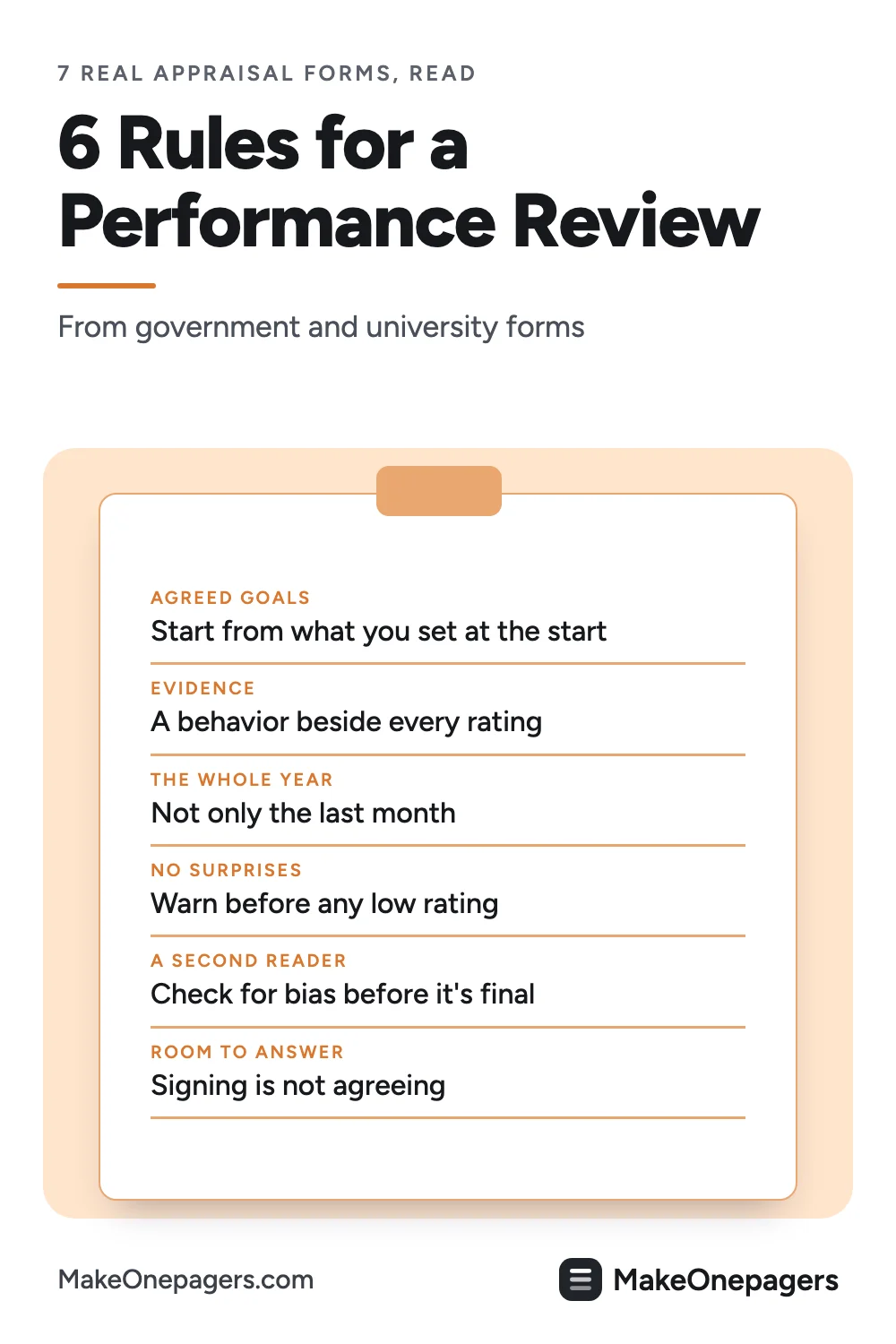
The forms employers make managers fill in are the best guide to how to write a performance review. We read 7 performance appraisal forms published by US state agencies, a federal department and a public university. Six of them ask you to write the evidence beside each score. Most also ask for more before a low rating, a second person to check the review, and a place for the employee to answer. You can follow the same rules in a small company that has no form at all. Start from a free one pager template.
One‑Pager examples
Real One-Pagers made with MakeOnepagers. Open any one to edit it as your own.
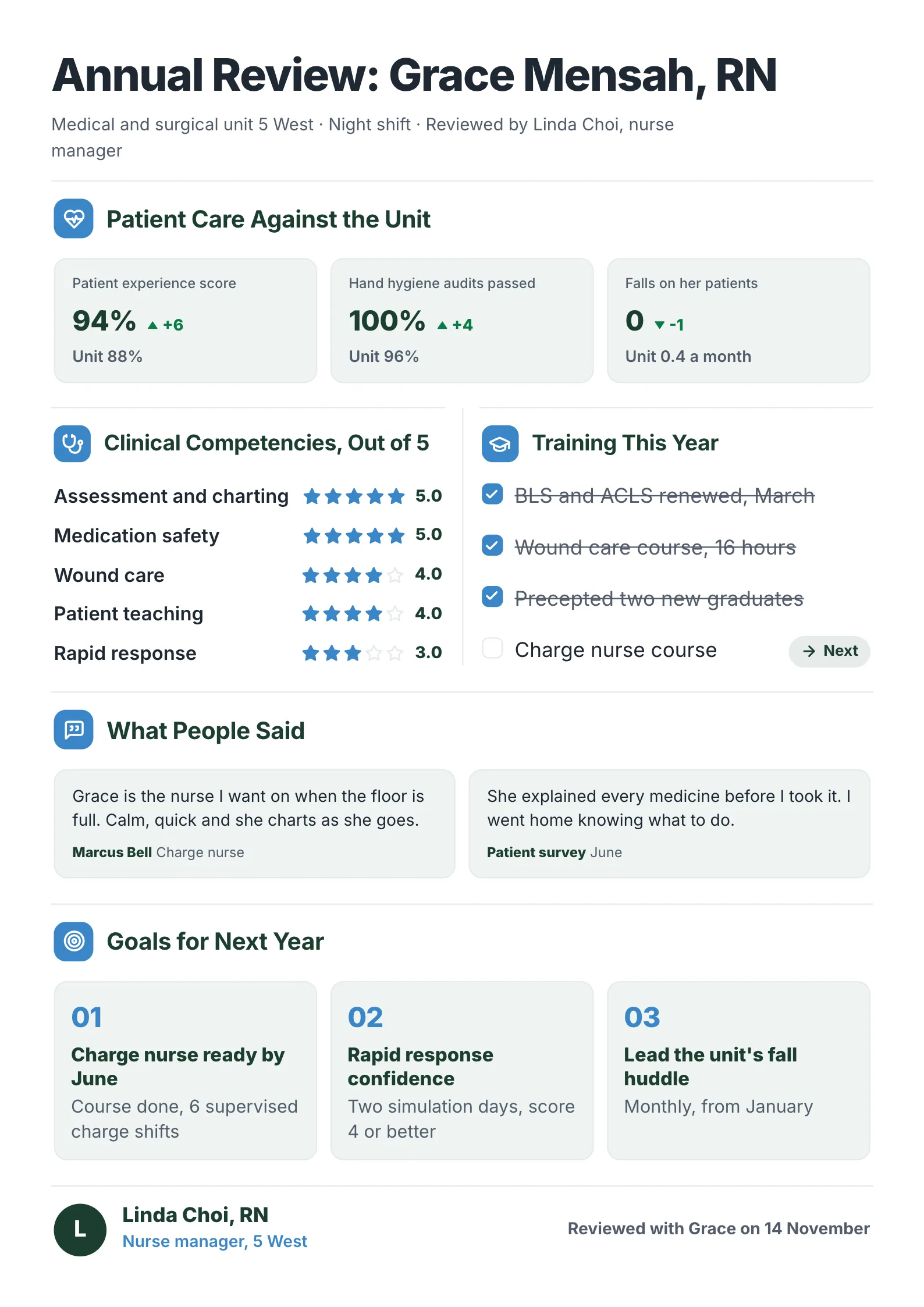 Performance Review: NurseEdit for free(opens in a new tab)
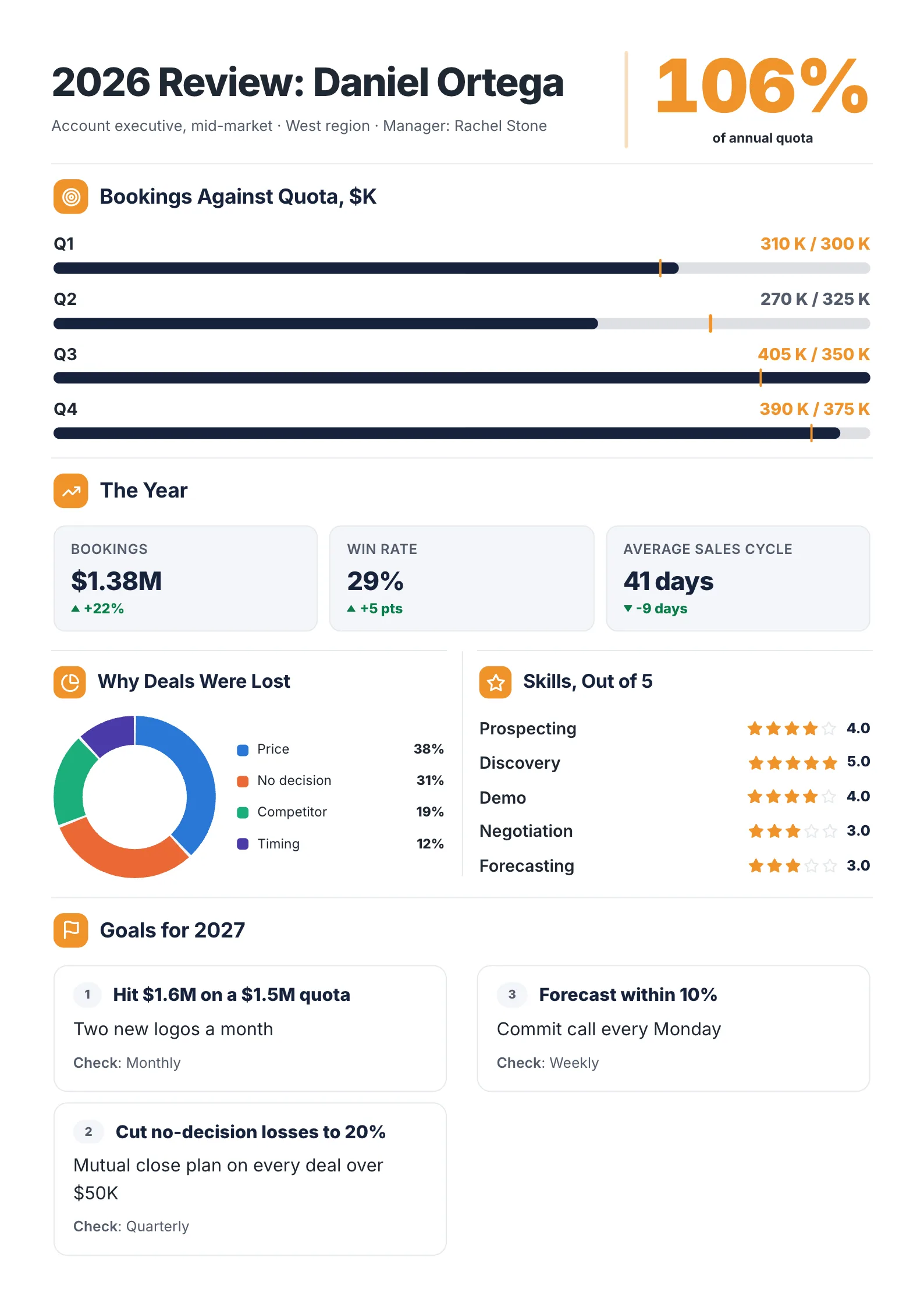 Performance Review: SalesEdit for free(opens in a new tab)
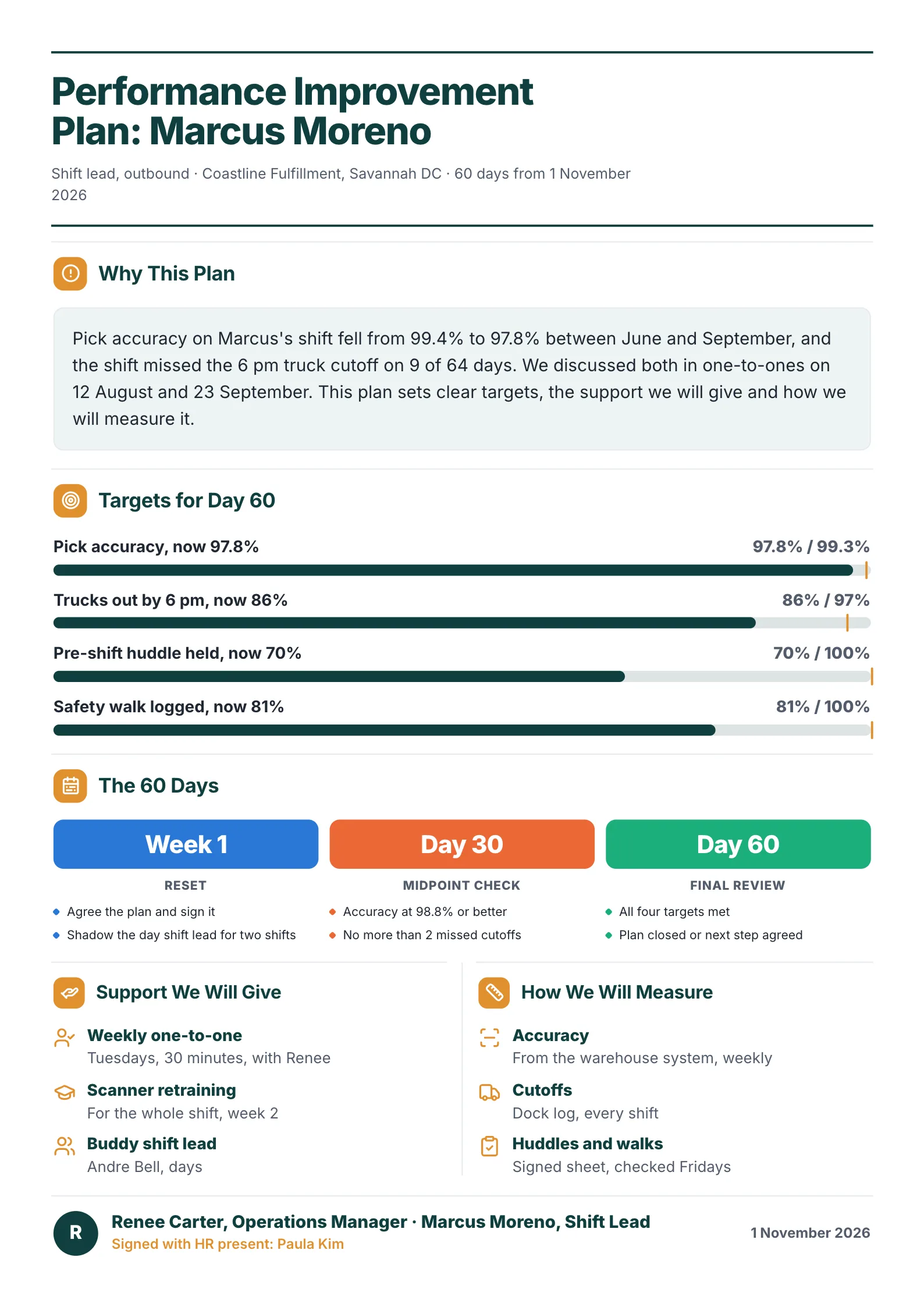 Performance Review: Improvement PlanEdit for free(opens in a new tab)
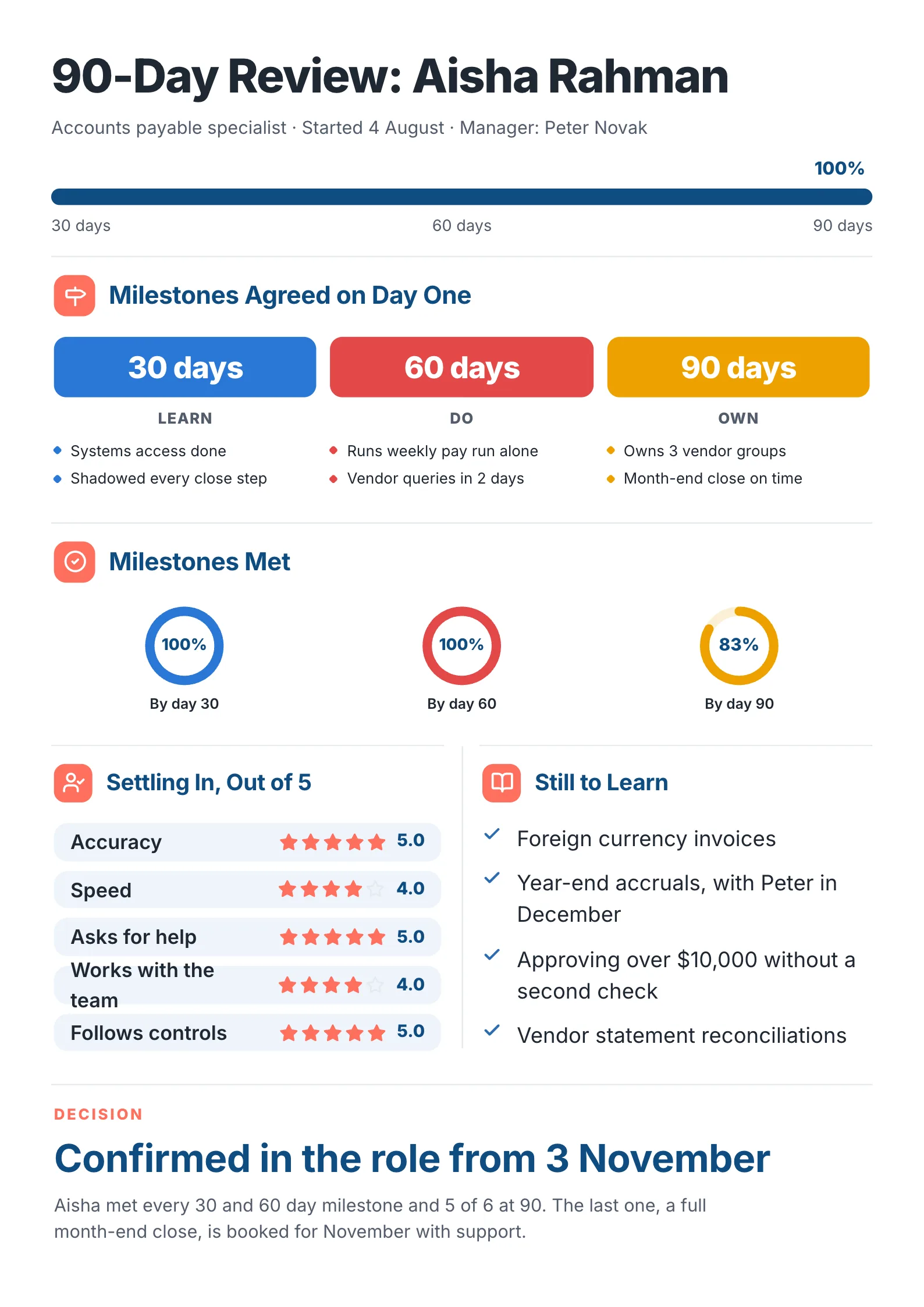 Performance Review: 90 DaysEdit for free(opens in a new tab)
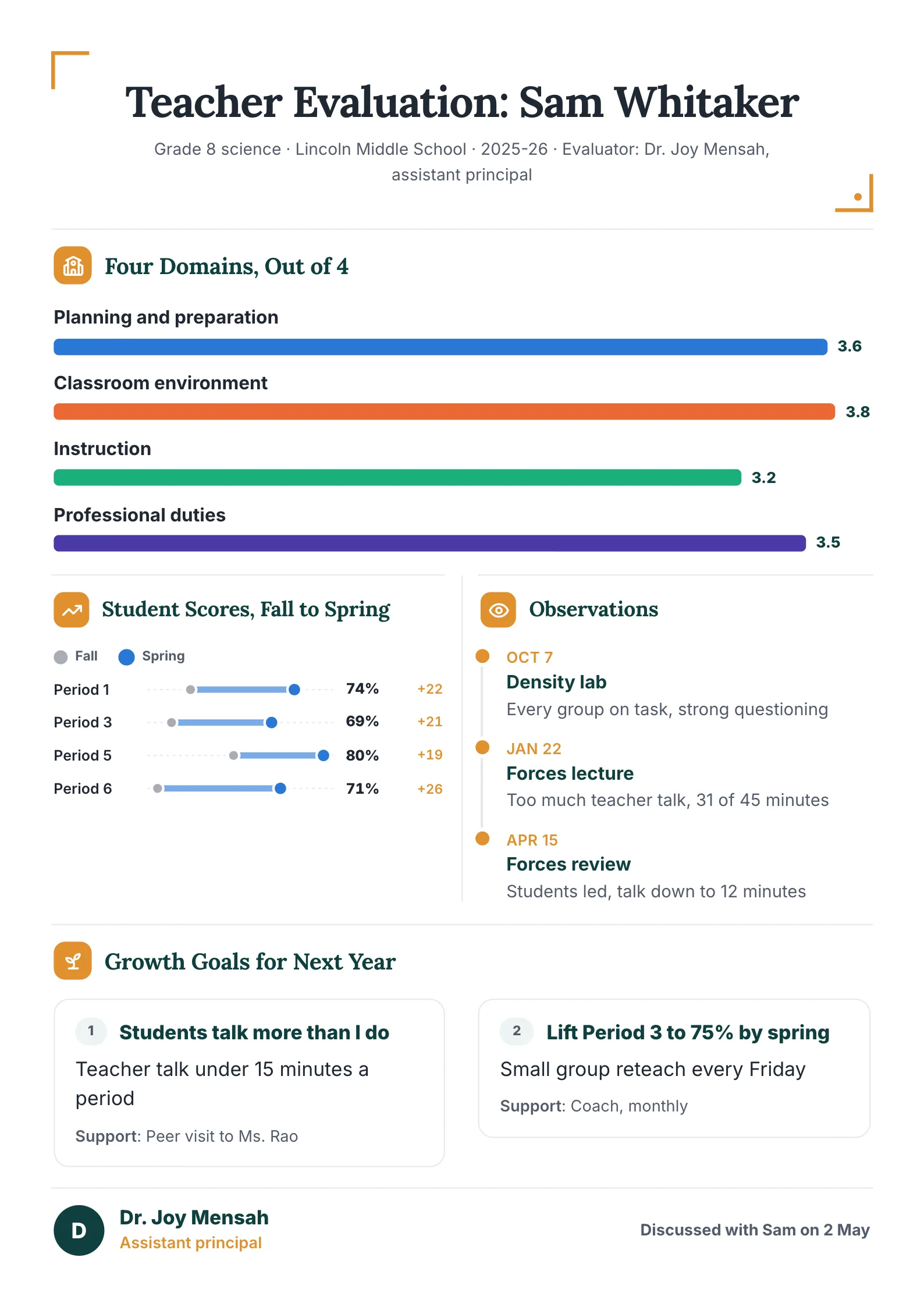 Performance Review: TeacherEdit for free(opens in a new tab)
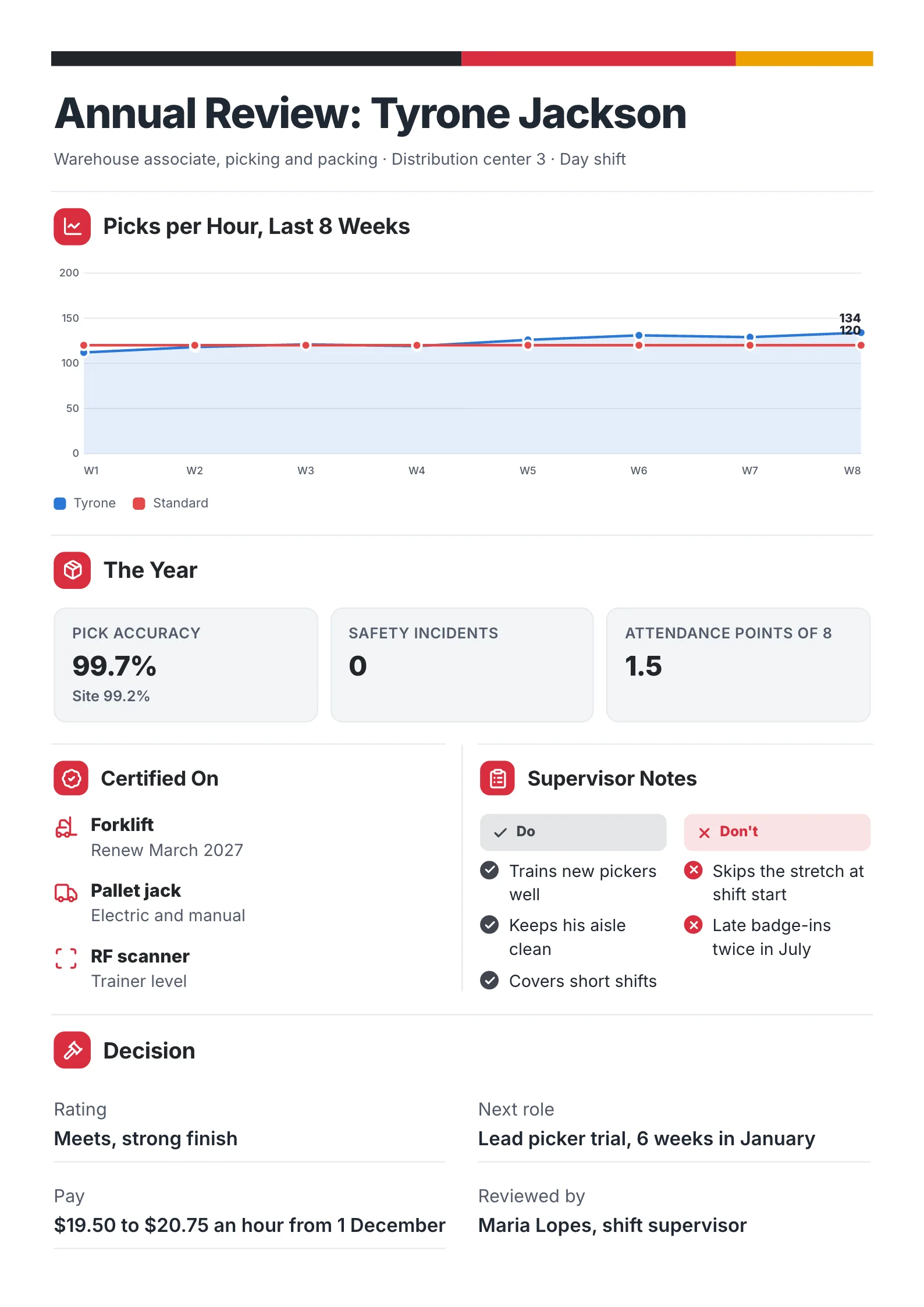 Performance Review: WarehouseEdit for free(opens in a new tab)
Below are the forms, the six rules they share, and how to put each rule into the review you're writing.
The 7 forms we read
Public employers post their appraisal forms online, so anyone can read what a manager is required to write. On October 26, 2026, we read these seven, chosen to cover state staff, a federal agency and university staff. Each is a form the employer itself posts for its own managers. Five are current versions. Two are older: Montana's is an appraisal filled in for the State Librarian in late 2007, and Washington's evaluation form is the February 2013 version (OFM 12-012).
| Employer | Form | Rating levels |
|---|---|---|
| State of Indiana | Performance Appraisal Report, State Form 52403 | 3 per item, 5 overall |
| State of Indiana | Working Test Appraisal, State Form 53740 (for new hires) | 3 |
| State of Hawaii | Employee Performance Appraisal, HRD 526 (Rev. 7/17), printed with instructions in the state's 2017 supervisory manual, pp. 43-48 | 2 |
| Montana State Library | Performance Appraisal Form, filled in for the State Librarian | 5, plus "No basis" |
| US Department of State | Employee Performance Report, JF-57-EPR, for family members of US staff hired at posts abroad | 5 |
| University of Oregon | Classified Employee Performance Appraisal, IT positions | 3 |
| Washington State | Performance and Development Plan: Expectations (OFM 12-015) and Evaluation, as posted by Shoreline Community College | None, written assessment only |
Hawaii rates only Meets Expectations or Does Not Meet Expectations, while Montana and the State Department use 5, so the number of levels is the thing these forms agree on least. Washington's form is the one state rule requires: WAC 357-37-040 tells employers to use the state's standard forms unless the director approves an alternate one, and the two above are the standard pair. The State Department form covers a small group, family members of US staff hired at embassies and consulates, so for federal staff in general we also read the rating rule itself, 5 CFR 430.208.
Rule 1: Start from what you agreed at the start
None of these forms lets your review be the first time your employee hears what they're judged on. Hawaii's form has a goals section to complete "by the beginning of the rating period," and the employee signs that the expectations were discussed. The State Department's form for family members hired at posts abroad wants the work requirements written within 45 days of each new cycle. Montana's form lists each objective with its target date and a line for "How observed/measured."
In your review, copy each goal you agreed, then write the result next to it in numbers. "Cut ticket time to 15 minutes: 14 minutes by October" tells your employee more than "Met." If you never set goals, say what you expected and when you said it.
Rule 2: Write the behavior behind every rating
Six of the 7 forms ask you for words beside each score. Indiana prints a box beside every rating headed "Behaviors during the review period which support the rating." Oregon puts a comments line under each one. The JF-57 says the rater's narrative "is mandatory" and must "support the summary performance rating." Washington skips scores and asks for a written assessment that "must be based on performance observed or verified." The one exception is Hawaii: its form has no evidence box beside each rating, and it says you "may use" a comments column for general comments.
In your review, write one specific example for every rating you give: what the person did, when, and what it changed. If you can't name one, you don't have the evidence for that rating yet.
Rule 3: Cover the whole year, not the last month
The federal rule says a rating "must be based only on the evaluation of actual job performance for the designated appraisal period." Hawaii gives supervisors a separate form, Supervisor's Discussion Notes (HRD 529), to record notable work all year. The JF-57 requires at least one documented counseling session, "preferably mid-year." Oregon even has a field for "Unplanned accomplishments," the work nobody put on the goals list.
In your review, pull from your notes, emails and one-on-ones across all twelve months. Read January's work as closely as last week's. If you don't keep notes yet, start a short running file for each person today, so next year's review is easier.
Rule 4: No low rating should come as a surprise
Five of the forms ask for more when a rating is low. Hawaii won't allow "Does Not Meet Expectations" until the employee has had a notice and "a reasonable period, up to three months," to improve. The JF-57 allows "Needs Improvement" only after a documented discussion or improvement plan 30 to 120 days before the period ends. Montana asks for "specific examples," the "steps to correct the problem," and the "consequences if the problem is not corrected." Indiana attaches a work improvement plan tied to the exact item that wasn't met. Its working test form for new hires turns a "Needs Improvement" into a six-month extension, with up to three development activities for each skill to build and the State Personnel Director's approval.
In your review, make sure any problem you write down was raised earlier, with a date. Then write the fix as a step with a deadline, so your employee knows what good looks like next quarter.
Rule 5: Keep bias out, then let a second person read it
These forms build in checks against unfair reviews. Hawaii tells supervisors to weigh "conditions beyond the employee's control." Washington's reviewer signs that "the process has been properly followed." And 6 of the 7 forms have a line for a second signature, from a reviewer or an appointing authority. The JF-57 adds a committee that checks every report for "inadmissible comments."
That second read is a small version of what larger companies call calibration, where managers compare ratings across a team before they're final. Since August 6, 2026, the federal rule lets the Office of Personnel Management set a standardized distribution of ratings for agencies (430.208(c)). The change was published on July 7 and took effect a month later.
In your review, check three things before you send it. Do you judge everyone on your team by the same measures? Is every sentence about the work instead of the person's personality? Did something outside their control, like a lost teammate, shape the result? Then ask your own manager or HR to read your draft.
Rule 6: Leave room for the employee to answer
Six of the 7 forms make clear the employee's signature isn't agreement: both Indiana forms, Hawaii, Montana, the JF-57 and Oregon, whose line says the signature is "only to indicate" the employee has read it. Indiana's line reads, "I am aware that my signature does not necessarily mean I agree with the rating." Five give the employee space to write back, and Montana allows a written response within ten working days. Two ask for the employee's view up front. Montana puts a self-rating beside the supervisor's on every objective. Washington gives the employee their own section at the start of the year, to say how their supervisor, co-workers and agency "can better support you."
In your review, ask for a self-review a week before you meet, and read it before you finish yours. End the meeting with what your employee needs from you, and write it down.
Five reviews written the forms' way
Here's what the six rules look like in finished wording. These are our own examples with made-up names and figures, each written to the employee, the way most of the forms ask you to talk to them.
A strong year (customer support rep). You set three goals with me in January, and you hit two. You cut first reply time from 6 hours to 2 hours by June, and you held it there for the rest of the year. Your customer rating rose from 4.3 to 4.7. The third goal, writing 20 help articles, reached 12, because you spent August training both new hires on returns. That was the right call, and it's why I rate you Exceeds on teamwork. For next year, let's agree on 15 articles by September, and I'll protect two hours a week for them.
A mixed year (account manager). You kept all 31 of your accounts and grew them 9%, against a team goal of 6%. That's a Meets, close to Exceeds. Two launch dates moved this year without notice to the sales team, in March and again in July. We talked about it on April 3 and July 21, so this isn't new to you. For the next quarter, send the sales lead a status note every Friday, and we'll check in on October 15. Your comments go in the box below, and your signature only means we discussed this.
A year below the bar (warehouse associate). You met the pick standard of 120 an hour in 7 of 12 months. Accuracy averaged 98.6%, under the site's 99.2%. We put a 60-day plan in place on August 4 with two targets, 99% accuracy and the standard every week, and you reached the first by the end. I rate you Needs Improvement on productivity and Meets on safety, where you had no incidents. Next step: keep the plan running to December 1, with a check every two weeks. You've told me the scanner on aisle 9 slows you down, and I've asked for it to be replaced.
A new hire at 90 days (junior accountant). When you started on July 7, we agreed on three goals for your first 90 days. You closed your first month-end on your own in September, two weeks ahead of plan. You learned the expense system and cleared the 140 open reports you inherited by August 22. Your reconciliations came back with 6 corrections in July and 1 in September. The third goal, presenting the cash report at the team meeting, moved to October because the meeting was called off twice. I rate you Meets for this period. For the next 90 days, own the vendor payments run, and I'll review your first two with you.
A team lead's year (operations manager). You took over a team of 9 in February, after two people had left. You hired both replacements by April and kept everyone else, so turnover fell from 4 people last year to 0. On-time shipping rose from 91% to 96%. Your team's survey score on "I know what's expected of me" went from 3.4 to 4.2 out of 5. The weekly report was late 5 times between May and July, and we agreed on July 30 that you'd hand it to Ana. It's been on time since. I rate you Exceeds on leading people and Meets on planning. For next year, train a second person to run the floor, so the team can cover a week without you.
Each one starts from agreed goals, puts a number or a date behind every rating, covers the whole year, and points to an earlier talk before any low mark.
| Area | Vague line | Line with evidence |
|---|---|---|
| Customers | Great with customers | Handled 46 tickets a day in Q3 against a team average of 38 |
| Communication | Needs to communicate better | Two launch dates moved without notice to sales, in March and July |
| Teamwork | Strong team player | Trained both new hires on the returns process in August |
| Quality | Attention to detail is good | Pick accuracy 99.7% against the site's 99.2% |
| Initiative | Takes initiative | Rewrote the onboarding checklist unasked, and new hires now ship in week 2 instead of week 4 |
| Reliability | Dependable | Covered 9 short shifts this year, and was late only twice, both in July |
| Growth | Should develop leadership | Lead the Q1 pricing project with two analysts, with a written plan by January 31 |
| Problem | Struggles with deadlines | Missed 3 of 10 report deadlines, all in the busy month of April |
What the finished review looks like
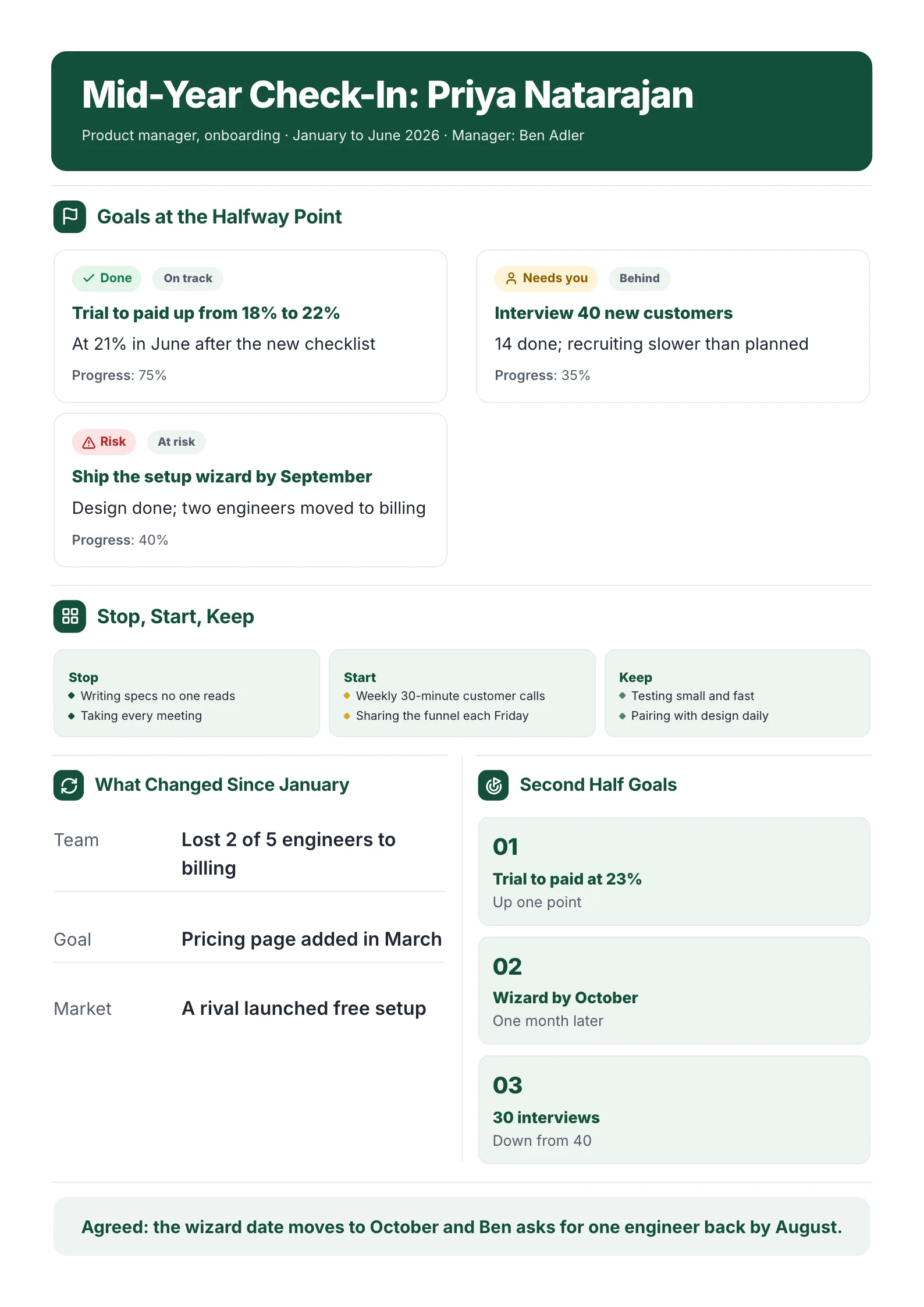 Edit this template
Sample names and figures. Every goal shows its result in numbers (Rule 1), and the "What Changed Since January" table records conditions outside the person's control, such as 2 of 5 engineers moved to billing (Rule 5).
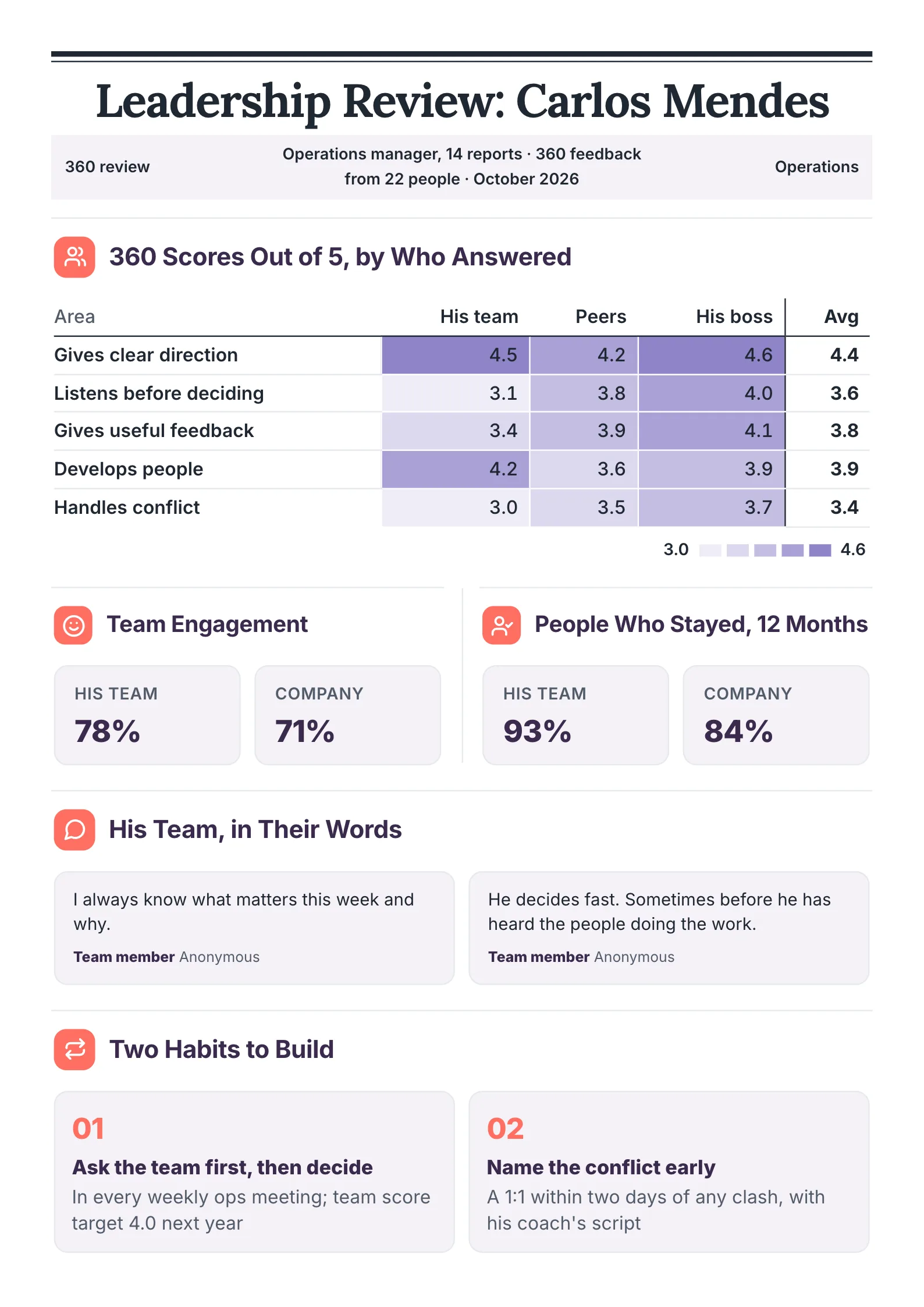 Edit this template
Sample names and figures. Scores come from 22 people, so no single reader decides the result, and the first habit to build comes with a target (Rules 2 and 5).
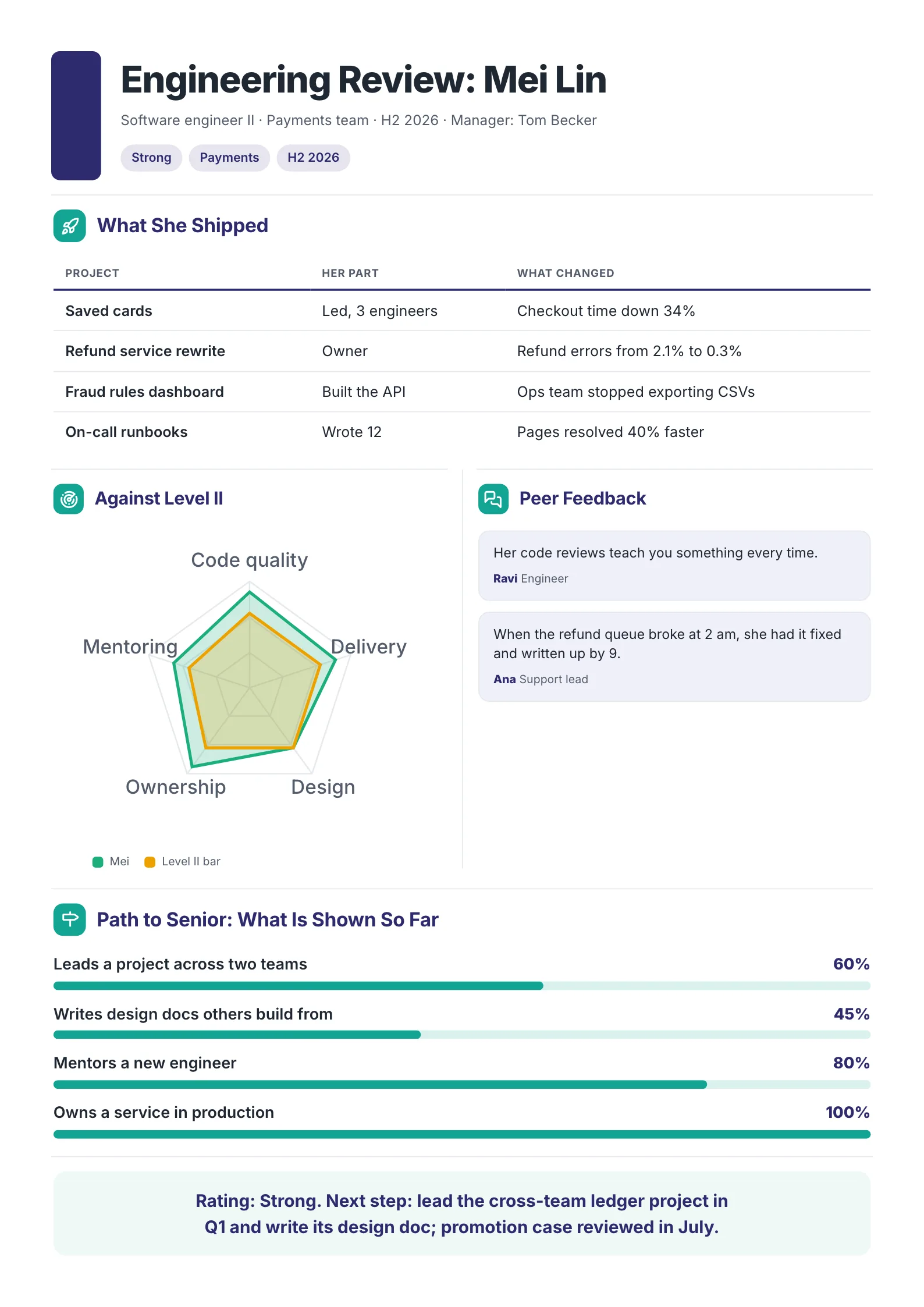 Edit this template
Sample names and figures. The project table puts the behavior and the result side by side, like refund errors cut from 2.1% to 0.3%, so the "Strong" rating has its evidence on the same sheet (Rule 2).
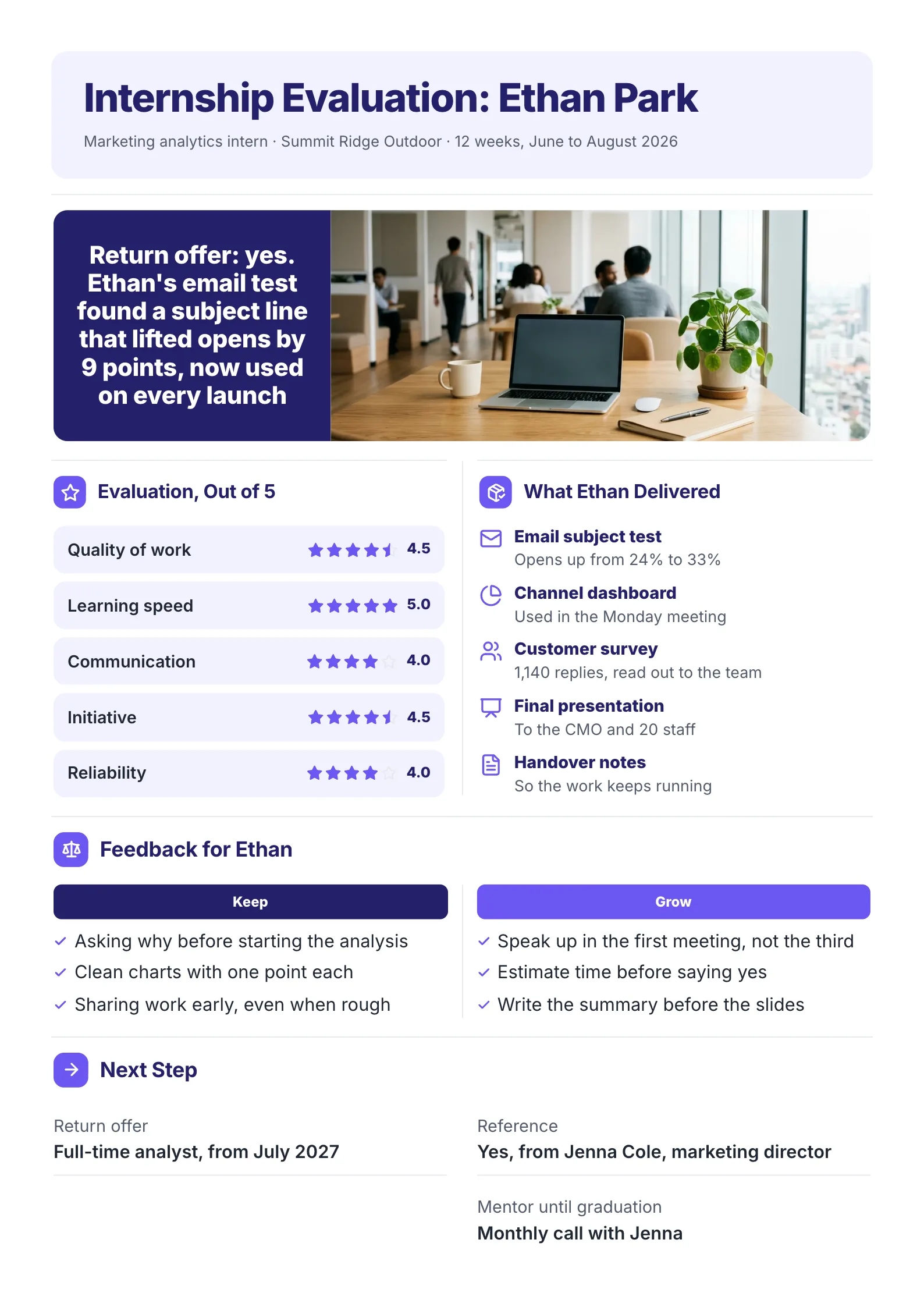 Edit this template
Sample names and figures. Each rating sits beside a list of what he delivered, and the Grow list turns feedback into habits he can act on, like estimating time before saying yes (Rule 2).
 Edit this template
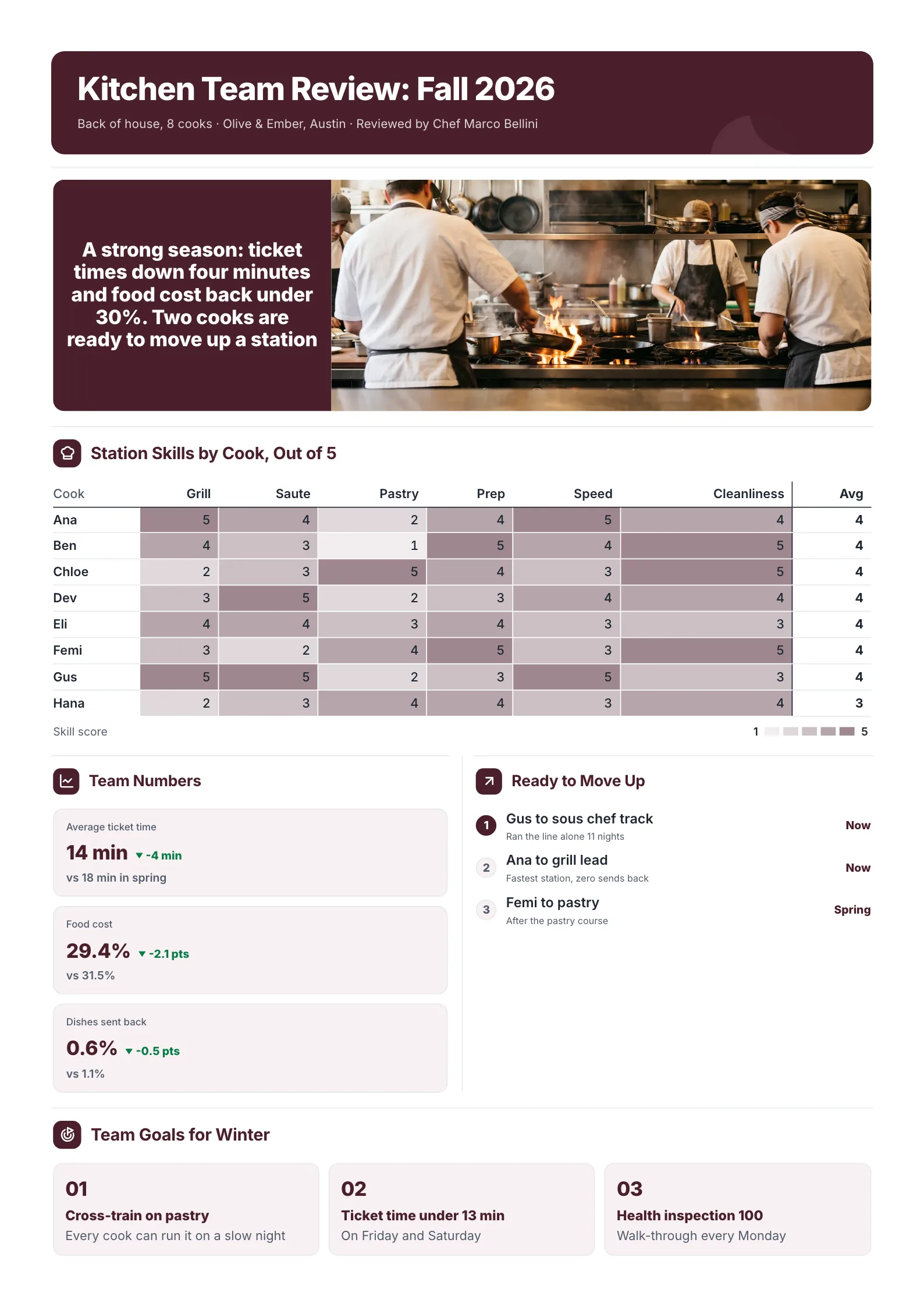
Sample names and figures. All 8 cooks are scored on the same six stations, so everyone on the team is judged by the same measures (Rule 5).
Write your review, step by step
- List the goals you agreed and write each result in numbers.
- Gather the whole year: notes, emails, one-on-ones and the person's self-review.
- Rate each area and write one example of behavior and result beside it.
- Check every problem you mention was raised before, with a date.
- Read it for bias: same measures for everyone, work not personality, conditions outside their control.
- Ask a second person to read it before the meeting.
- Set two or three goals for next period, each with a date and a measure.
- Leave space for the employee's comments, and say their signature means it was discussed.
Questions people ask about performance reviews
How long should a performance review be?
Long enough to give one example per rating. The forms we read run from 2 to 15 pages, and most of that is instructions and boxes. The written parts are short. A single page per person works for most small teams.
How do I write a performance review for myself?
Use the same rules on yourself. List each of your goals with its result in numbers, give one example for each strength, and name one thing that didn't go to plan and why. Montana's form asks employees to rate themselves on every objective, which is a useful model.
What if the employee disagrees with the review?
Let your employee write it down. Most of the forms we read give the employee space to respond, and their signature only confirms the review was discussed. Keep their comments with the review.
How many rating levels should I use?
The forms range from none (Washington) to 5. Fewer levels are quicker for you and your team to agree on. More levels show finer differences, but they need clear definitions, like Montana's description of each level from 1 to 5.
Make your review
Six of the seven forms we read ask for written evidence behind the ratings, so gather yours before you pick a score. Then open a performance review design in MakeOnepagers and write one example under each goal. Our performance review template post shows more filled-in reviews, and our One-Pager maker can build the page from the evidence you gathered, with 7 days to try it at no cost.




