Performance Review Questions: What 6 Real Employer Forms Ask
Performance review questions from 6 real self-review and check-in forms: 59 in all, ranked by how many forms ask each one, with the exact wording.

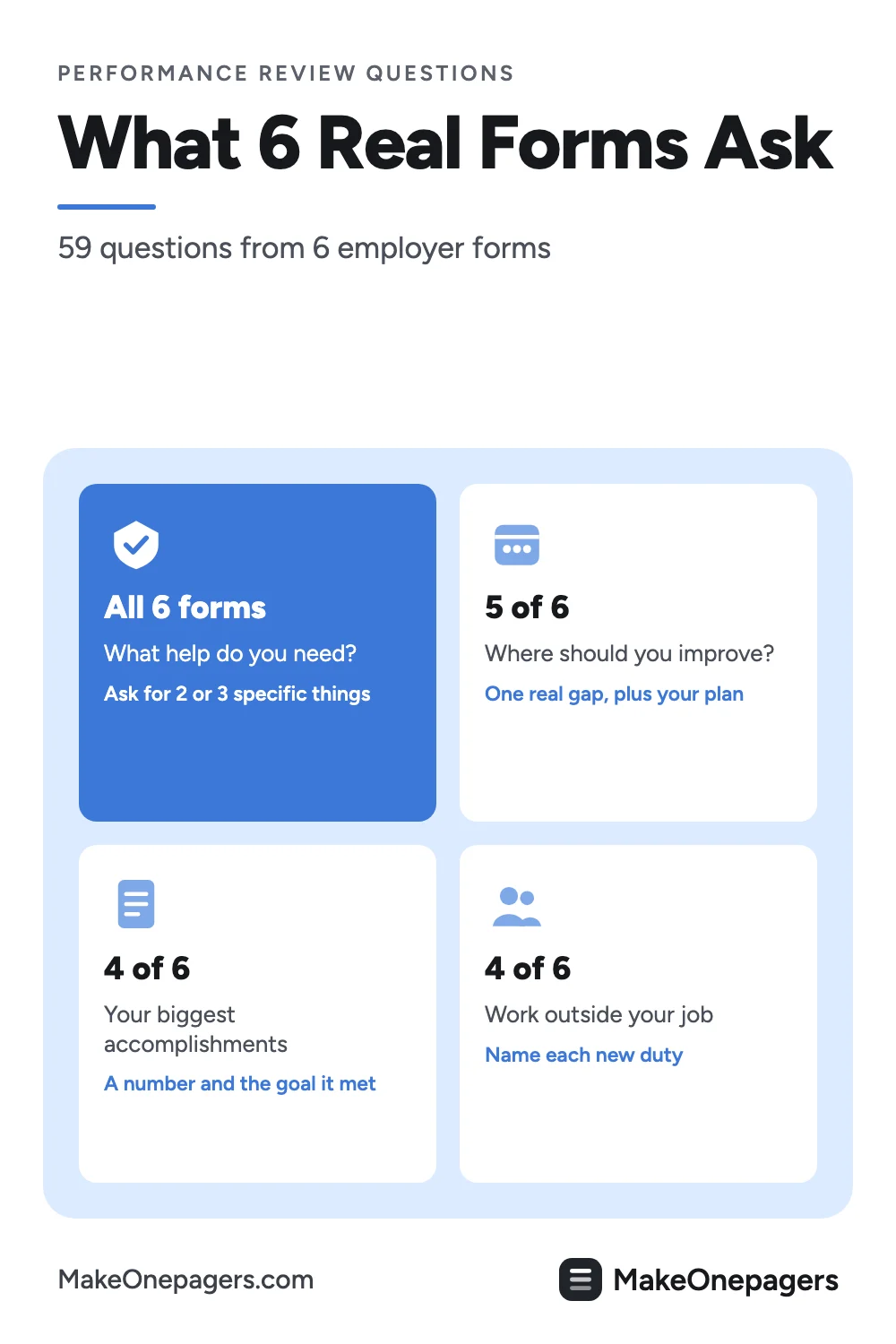
Employers print their performance review questions on their own forms, so that's the best place to see what you'll be asked. We read 6 self-review and check-in forms published by the HR offices of US universities and colleges and counted 59 questions and prompts between them. Only one question shows up on all six: what help do you need? Next come where you need to improve (5 of 6), your most significant accomplishments (4 of 6) and work you did outside your job description (4 of 6). Start from a free one pager template.
One‑Pager examples
Real One-Pagers made with MakeOnepagers. Open any one to edit it as your own.
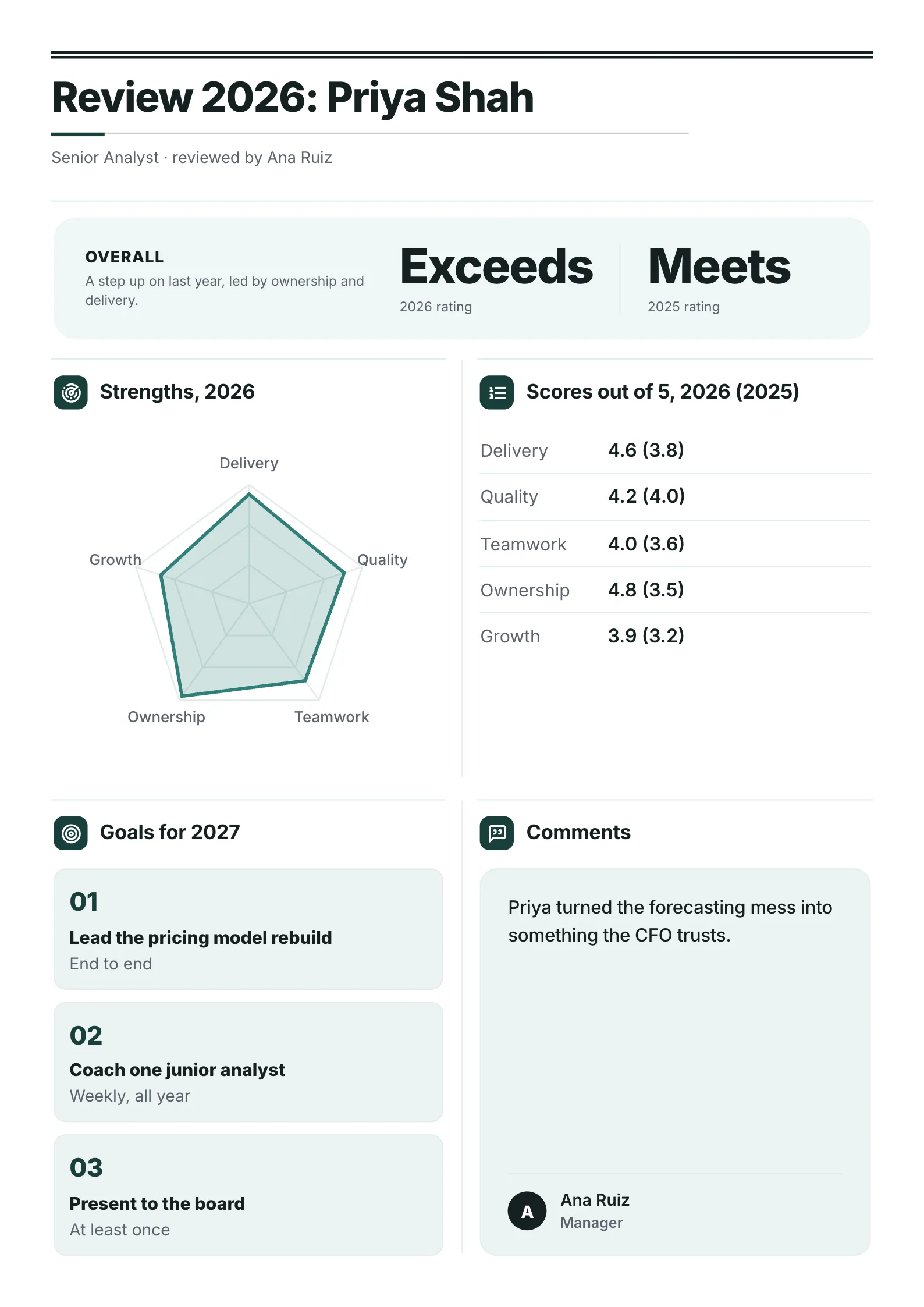 Performance Review SummaryEdit for free(opens in a new tab)
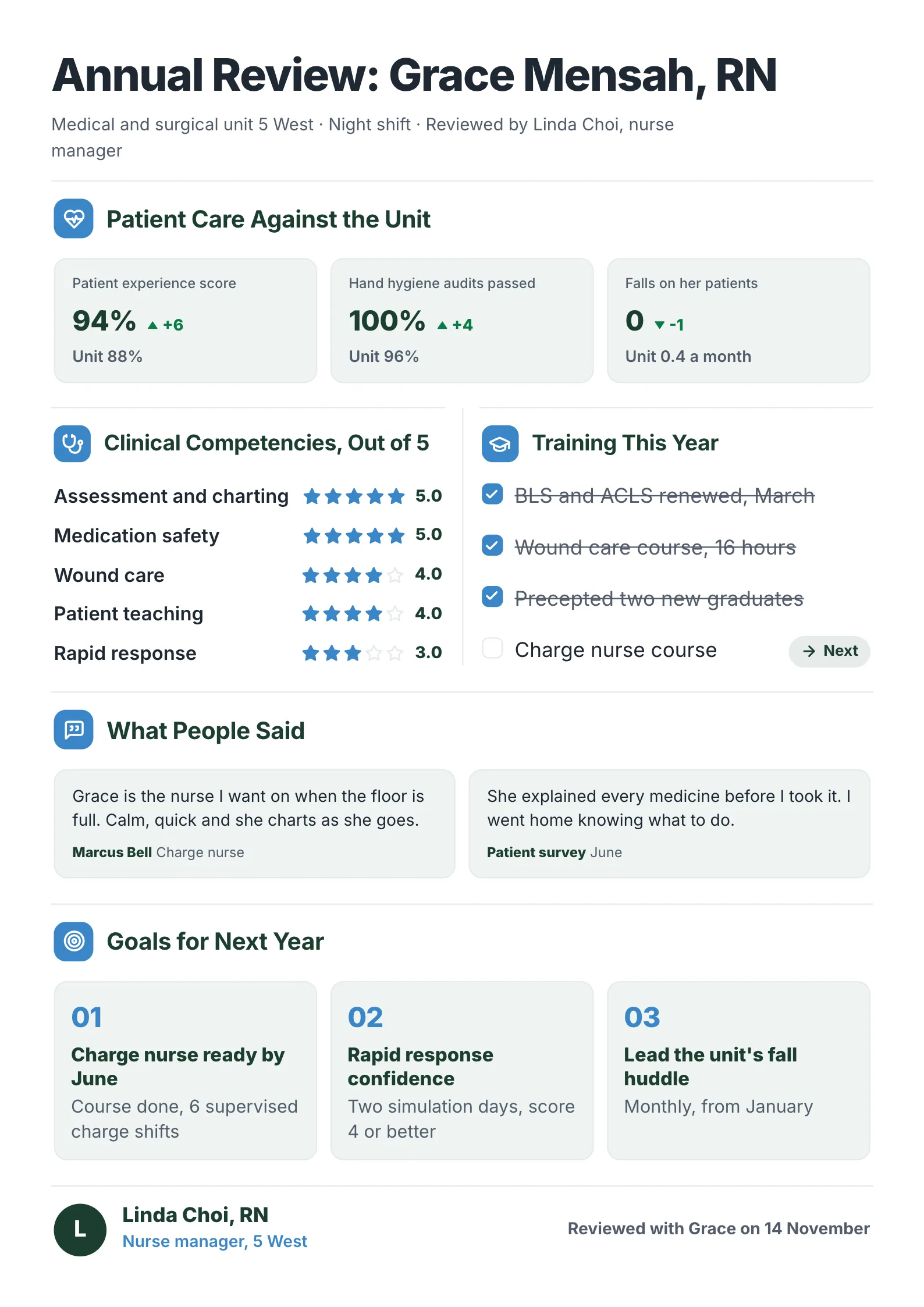 Performance Review: NurseEdit for free(opens in a new tab)
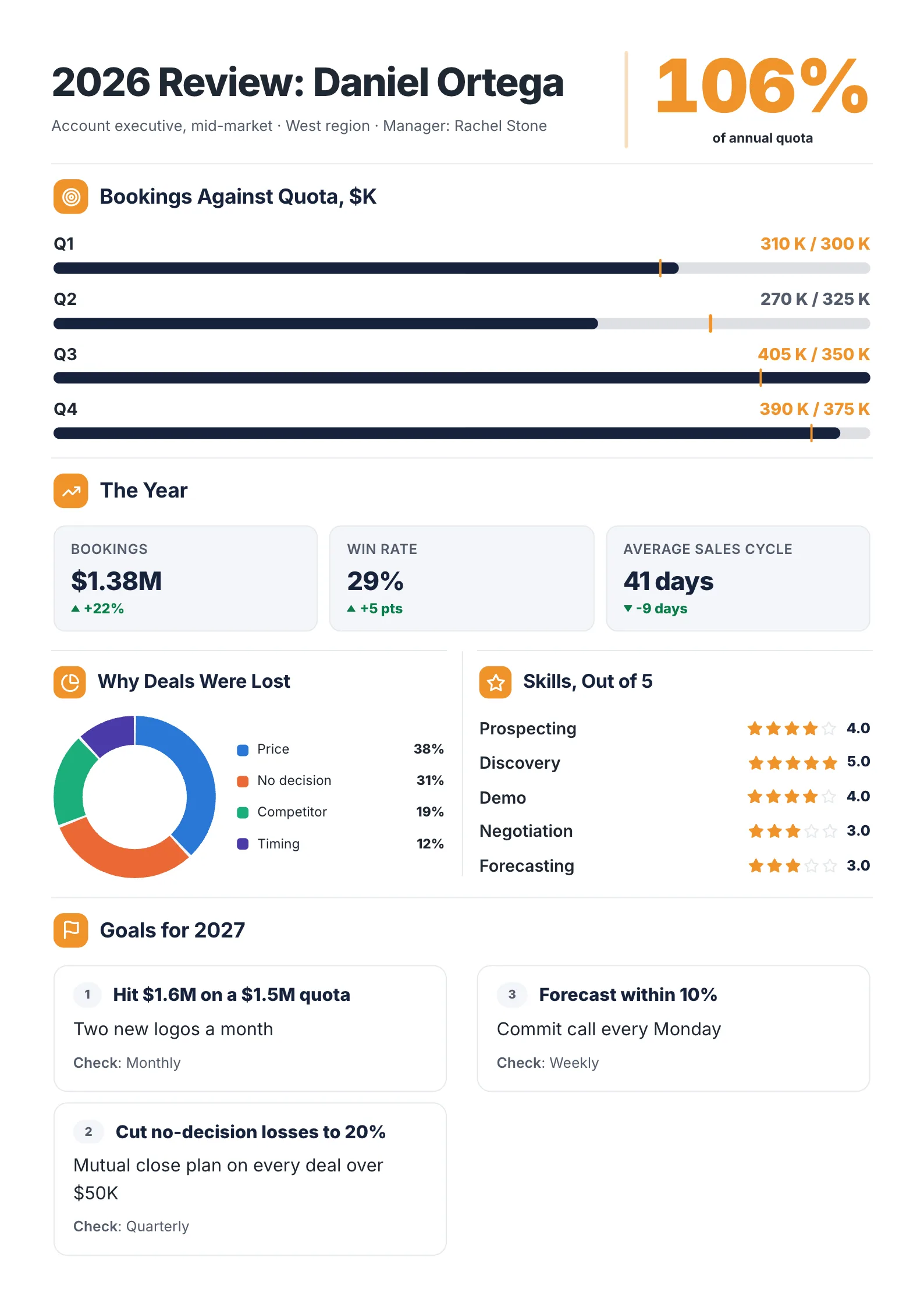 Performance Review: SalesEdit for free(opens in a new tab)
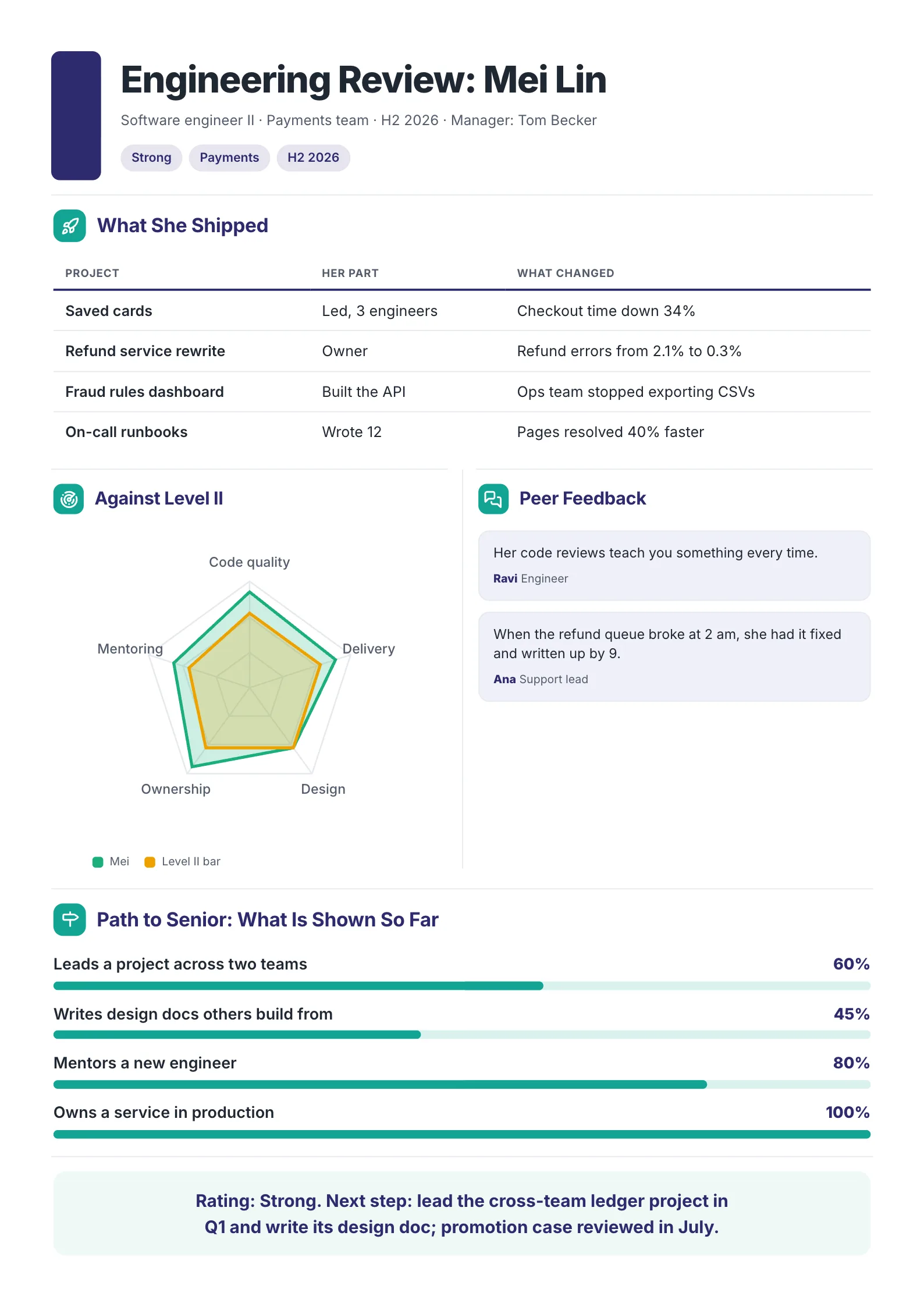 Performance Review: Software EngineerEdit for free(opens in a new tab)
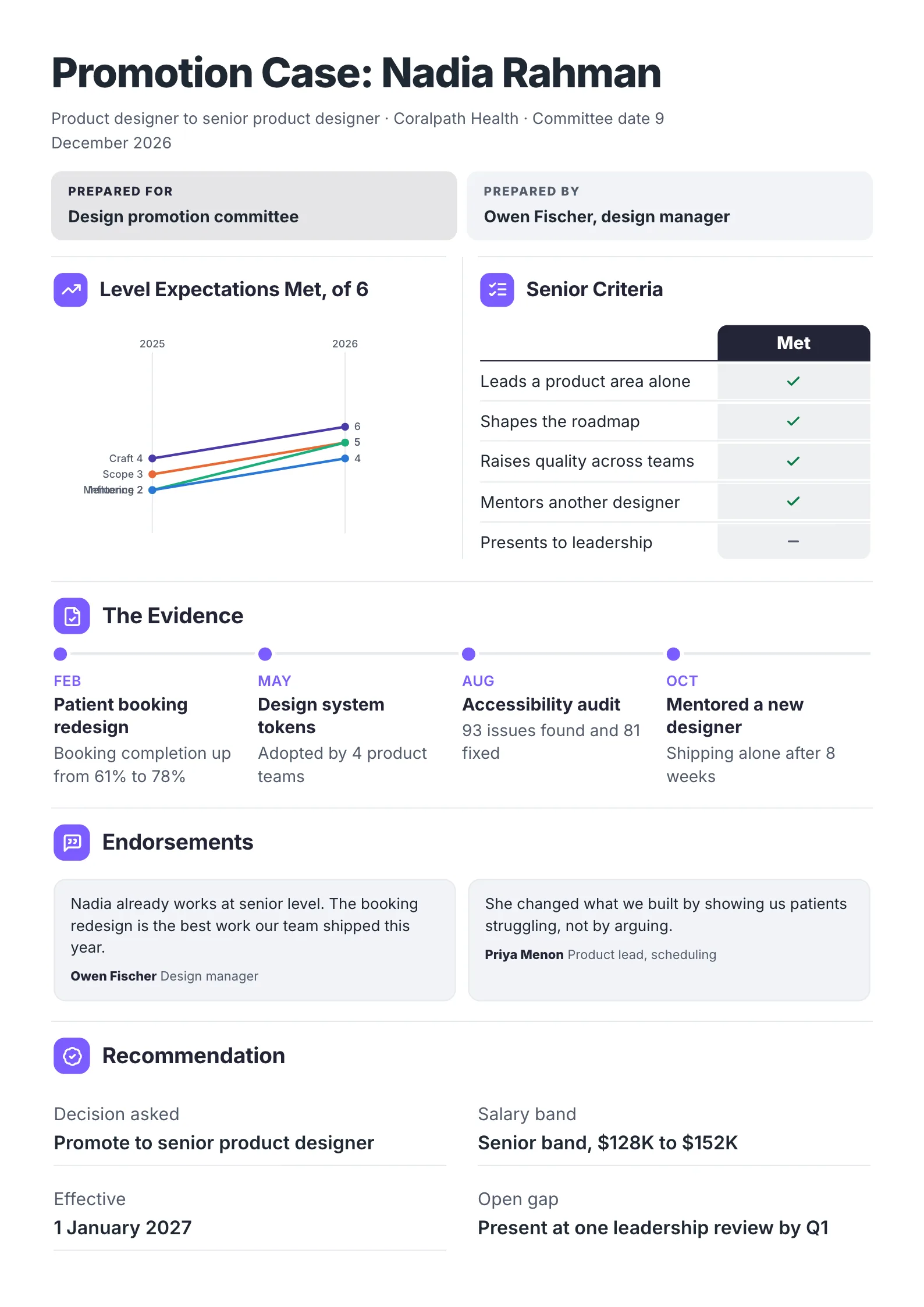 Performance Review: Promotion CaseEdit for free(opens in a new tab)
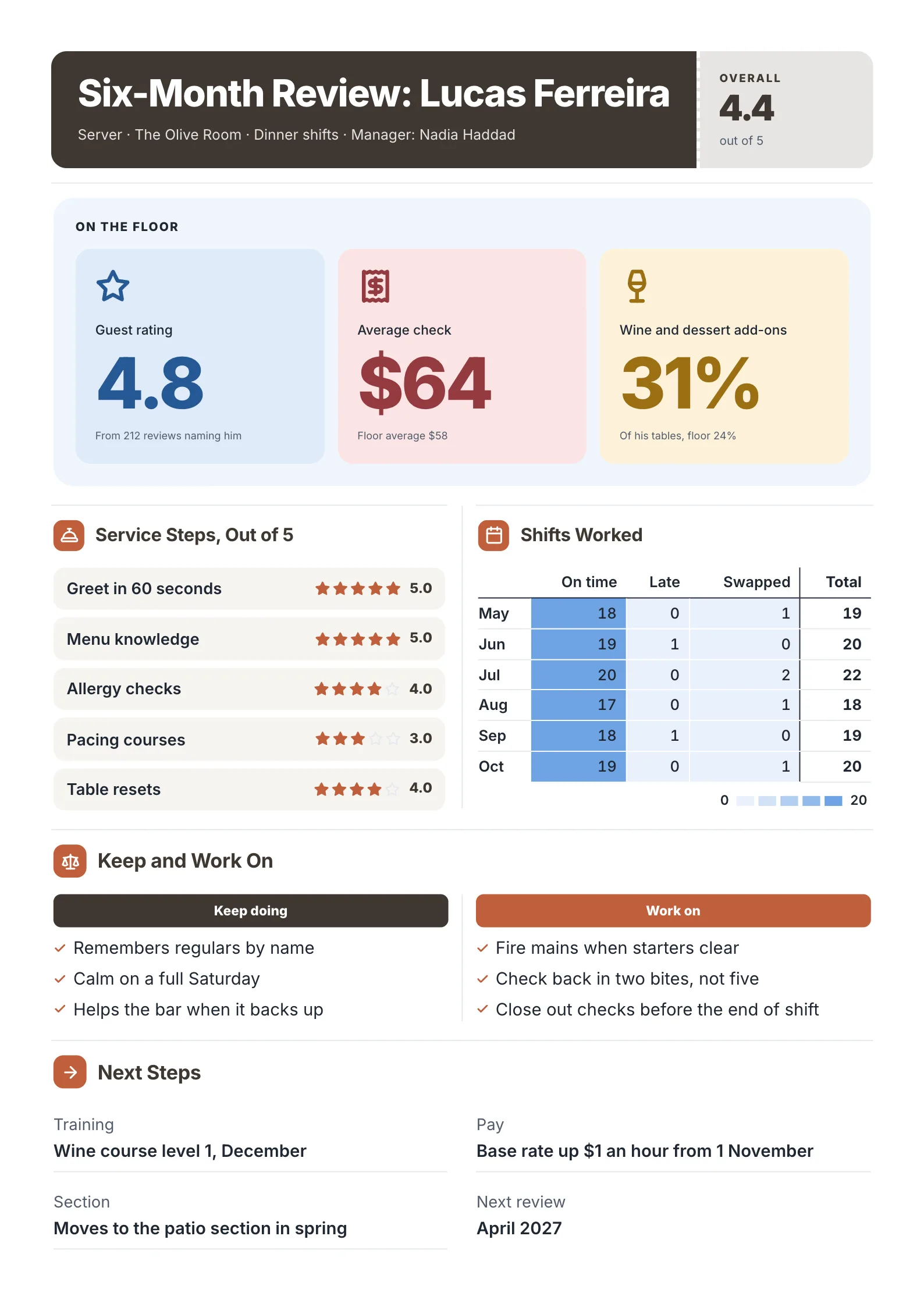 Performance Review: Restaurant StaffEdit for free(opens in a new tab)
So if your review is coming up, start with those four. Below you'll find each one in the forms' own words, what a good answer holds, the questions a manager asks in a check-in, and five sample reviews made with MakeOnepagers that answer them. Every name and number on the samples is made up.
The 6 forms we read
Each form is a public PDF from an employer's HR office. On five of them the employee writes the answers. Marshall's is the list a supervisor works through in a check-in.
| Form | Who fills it in | Questions | Latest date on the form |
|---|---|---|---|
| Utica University self-evaluation | Staff, brought to the review meeting | 7 | Review period June 1, 2025 to May 31, 2026 |
| Brown University self-evaluation | Staff, as part of the review | 6 prompts | May 2026 |
| University of Maryland self evaluation | Staff, before the evaluation | 8 | Revised June 6, 2017 |
| Lincoln University (Missouri) staff self-evaluation | Staff, before the meeting | 11 | Filed with the 2024 forms |
| Harvey Mudd College question menu | Supervisors pick from it to build a form | 20 | PDF dated February 2014 |
| Marshall University check-in questions | The supervisor, in a check-in | 7 | PDF dated October 2024 |
The forms run from 6 items to 20. Harvey Mudd's is a menu, and its HR office tells supervisors to "tailor the questions for your department." No single form asks all 59. You'll face a handful, and they repeat across forms more than you'd guess.
On all 6 forms: what help do you need?
Every form asks this, in its own words:
- Utica: "If there are resources or support you may need to achieve these goals, please include this information as well."
- Brown: "any additional support/guidance you would like from your supervisor."
- Maryland: "What would help you enhance your performance (training, equipment, etc.)?"
- Lincoln: "List the steps you plan to take and/or the resources you need to accomplish this."
- Harvey Mudd: "What can your supervisor do to help you be successful in performing your responsibilities?"
- Marshall: "Is there any way I can assist you?"
Treat it as the most useful question on the page. It's your one chance in writing to ask for something specific. Write two or three requests your manager can say yes to, each tied to a goal. "More support" gets nothing. "Two hours a week for the course" gets a calendar block.
Sample answer. "To finish the analytics course by March, I need two hours a week blocked on my calendar. To run the pricing test in Q1, I need a $1,500 budget and access to the ad account."
Notice where each form puts it. Utica and Lincoln attach it to your goals or your growth plan. Marshall pairs it with "What are your plans to achieve your goals?" So answer the help question last, after you've named the goal it serves.
On 5 of 6: where do you need to improve?
Maryland asks it the bluntest way: "What are your weaknesses (the things you don't do so well) and how do they impact your job?" Harvey Mudd softens it to "In what areas, if any, do you need to change or improve?" Marshall's supervisor simply asks, "What do you want to improve?"
Only Utica skips it. Its form asks you to "describe the areas in which you excelled" and never asks where you fell short.
Give one real gap, the effect it had, and your plan. Lincoln's form spells out the shape it wants: describe the areas, then "List the steps you plan to take and/or the resources you need to accomplish this." Brown asks the same and adds a separate prompt for "challenges or obstacles" with the action plans you used. Pick a gap your manager has already seen. Naming it first shows you know.
Sample answer. "My reports went out late four times this year, because I left the checks to the last day. Since October I check the numbers on Wednesday, and the last two went out on time."
On 4 of 6: your most significant accomplishments
Utica, Brown and Lincoln all use the same words: "List your most significant accomplishments." Harvey Mudd asks "what contributions have you made to your work team/unit, your department or the College?" over the past 12 months.
Two of the forms add a second half you shouldn't miss. Utica asks how your achievements "align with the goals/objectives outlined in your last review." Lincoln asks how they line up with the university's strategic plan. So for each win, write the result with a number, then the goal it served. Three wins is plenty. Brown even lets you attach proof, such as "performance metrics or reports" and "formal feedback or recognition," as one file.
Sample answer. "I cut the time to answer a support ticket from 2 days to 6 hours by setting up a shared inbox. That was goal 2 from my last review."
On 4 of 6: work outside your job description
Utica, Brown, Lincoln and Harvey Mudd all use the phrase "outside the scope." Utica's version: "have you successfully performed any new tasks or additional duties outside the scope of your regular responsibilities?"
This is where you get credit for the extra work. Name each new duty, when it started and how often you do it. If it's now a regular part of your week, say so, because Lincoln's form tells staff they'll review the job description with the supervisor and "submit necessary changes." Maryland comes at it another way, with "What changes in duties or priorities did you face during the review period and how did you handle them?"
Read your job description before you answer. Brown calls that "a best practice in preparing" your self-evaluation.
Sample answer. "Since April I've trained every new hire on the booking system, about one a month. It takes three hours each time and isn't in my job description, so I'd like to add it."
The rest: what fewer forms ask
| Question | Forms that ask it | Wording from one form |
|---|---|---|
| Goals or expectations for next period | 4 of 6 | Lincoln: "What are your professional goals for the upcoming year?" |
| Your strengths | 3 of 6 | Harvey Mudd: "What strengths do you bring to your job?" |
| Training you've done or want | 4 of 6 | Lincoln: "In what areas do you feel additional education, training, and/or development would be beneficial to you?" |
| What you'd change about the job or team | 2 of 6 | Lincoln: "What are some things you would like to see improved or changed within your department?" |
| What you want to discuss | 2 of 6 | Marshall: "What else would you like to discuss?" |
| Goals you missed, and why | 1 of 6 | Harvey Mudd: "What goals from the last review period were not accomplished and why?" |
| Rate yourself | 1 of 6 | Maryland: "How would you rate your overall performance for this review period?" |
The training count covers Utica, Brown, Lincoln and Harvey Mudd, which each ask about courses or development you've done. A few questions belong to one employer's mission. Utica asks how you "contributed to student success" through customer service, and Lincoln asks how you helped "recruitment and retention" of students. Expect one question like that on your own form, tied to whatever your employer cares about most.
Only Maryland asks you to rate yourself, on five levels from Outstanding to Unsatisfactory. If your form has that box, pick the level your evidence supports, and write one line on why.
Questions to ask your manager
Two forms give you room to raise your own topics. Lincoln's last item is "List what you would like to discuss during your annual performance evaluation meeting with your supervisor." Marshall's supervisor asks, "What else would you like to discuss?"
Use that space. Here are four questions to bring, each one the mirror of something the forms ask you:
- What's the one thing you'd like me to do more of next year?
- Which of my goals matters most to the team right now?
- What would you need to see from me to rate this year a level higher?
- Is there anything in my job description we should change?
What a manager asks in a check-in
Marshall's guide is short. A supervisor asks seven questions, with a line for the answer under each:
- What are you currently working on?
- What's going well?
- Are you having any challenges?
- What do you want to improve?
- What are your plans to achieve your goals? Is there any way I can assist you?
- What else would you like to discuss?
- What alternative approaches can we consider for future occasions? Any thoughts, recommendations, or enhancements?
If you're the manager, you can run a mid-year talk on this list alone. If you're the employee, have one sentence ready for each.
Five reviews that answer the questions
Each sample below answers one or more of the questions the forms share. Open any of them and type over the sample text with your own.
 Edit this template
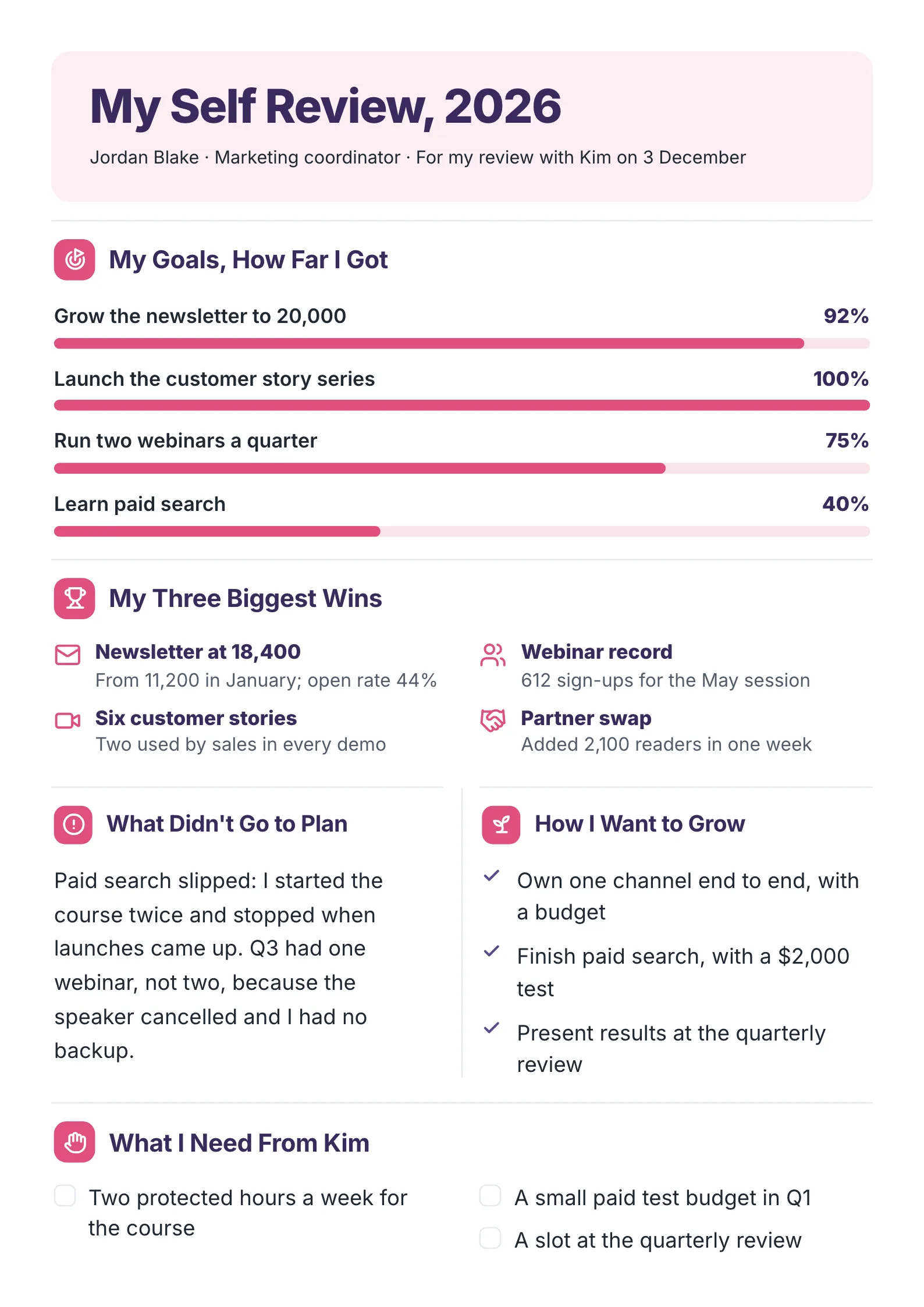
This self assessment performance review answers the four big questions in order. Jordan's wins come with numbers, like the newsletter growing from 11,200 to 18,400. "What Didn't Go to Plan" names the gap: the paid search course was started twice and dropped when launches came up. Then "What I Need From Kim" asks for two protected hours a week for the course, a small paid test budget in Q1 and a slot at the quarterly review.
 Edit this template
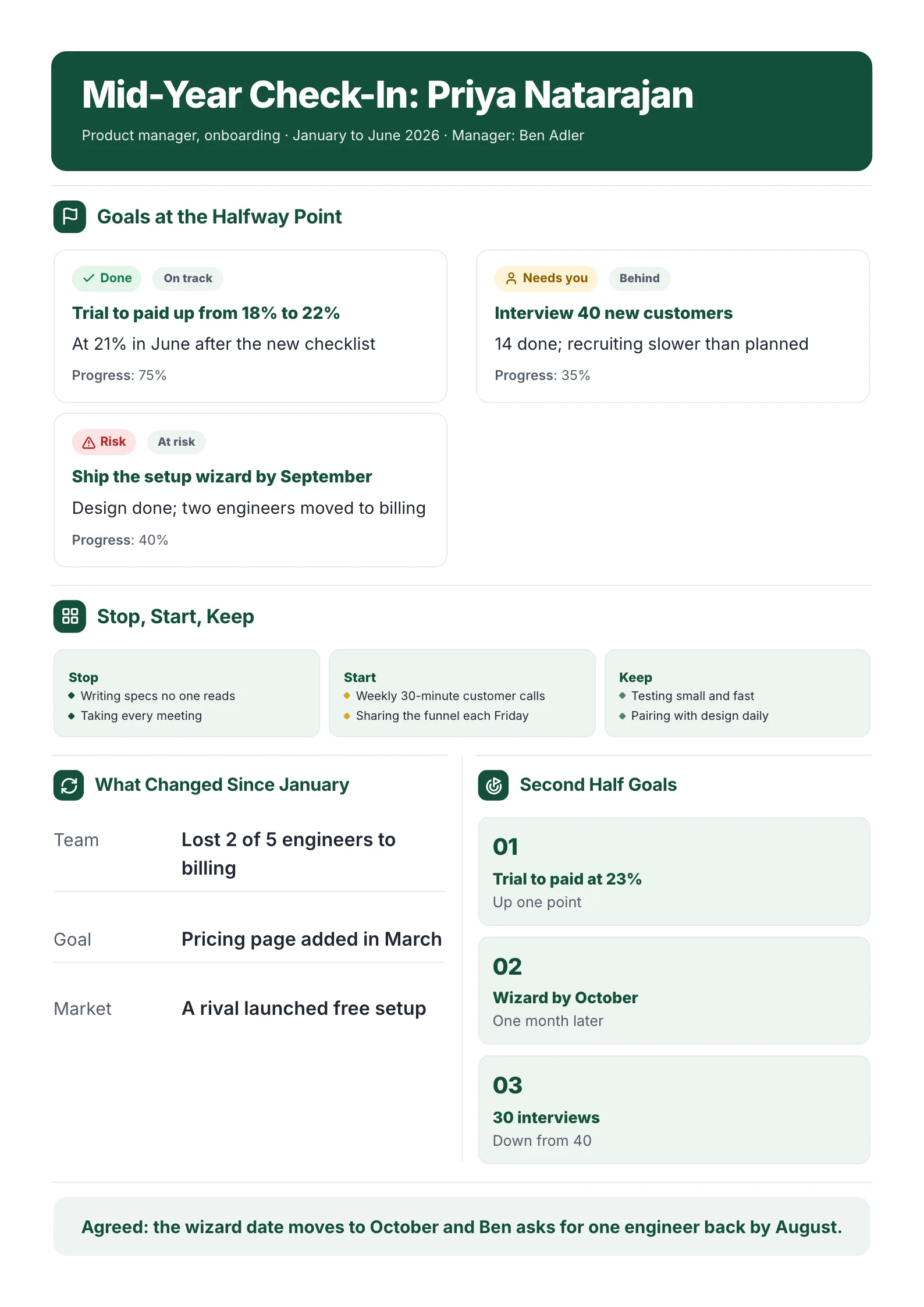
This mid-year performance review follows Marshall's check-in. It shows what Priya is working on, what's going well and her challenges. Trial to paid is at 21% against a 22% goal, while the setup wizard sits at 40% after two engineers moved to billing. Even the help question gets an answer here. Her manager, Ben, agrees to ask for one of the two engineers to come back by August.
 Edit this template
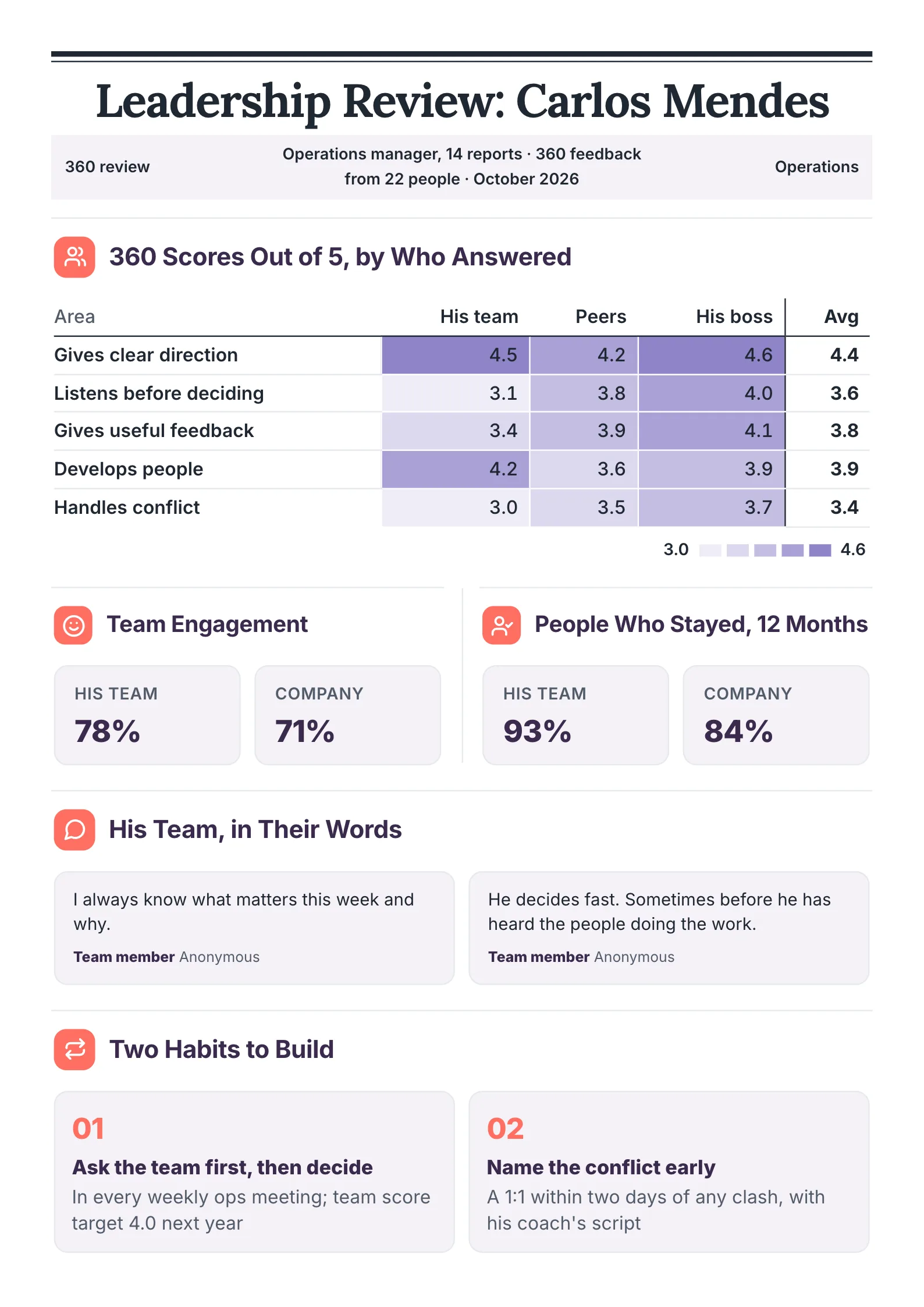
The improve question works for managers too. This manager 360 performance review gathers answers from 22 people. Carlos's team is at 78% engagement against 71% for the company. One quote names the gap plainly: "He decides fast. Sometimes before he has heard the people doing the work." The habit that answers it is "Ask the team first, then decide," with a team score target of 4.0.
 Edit this template
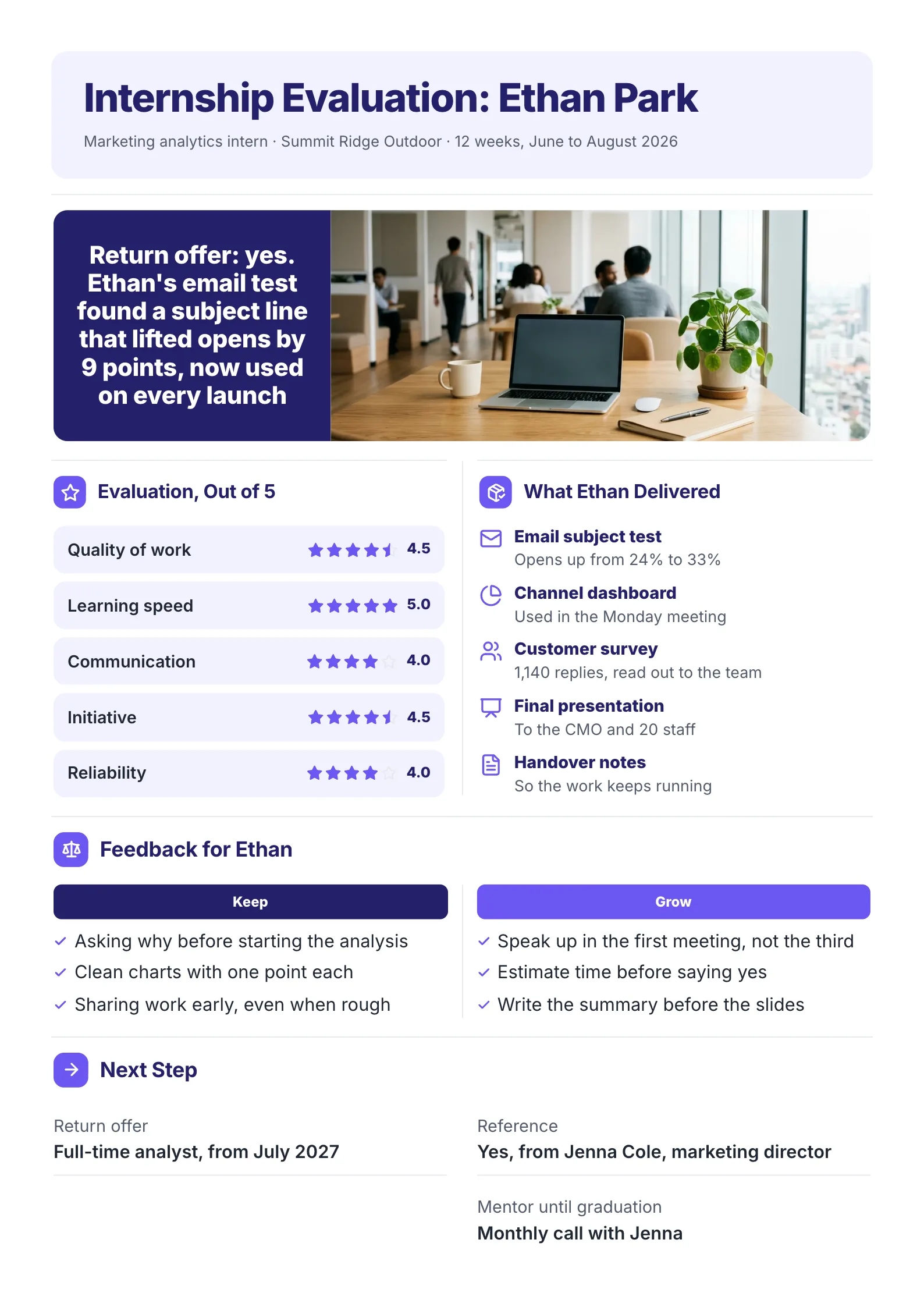
An internship performance review puts accomplishments up front, since a 12-week stint is judged on what got done. Ethan's email test lifted opens from 24% to 33%, and his survey drew 1,140 replies. The Grow list answers the improve question with habits he can act on, like "Speak up in the first meeting, not the third."
 Edit this template
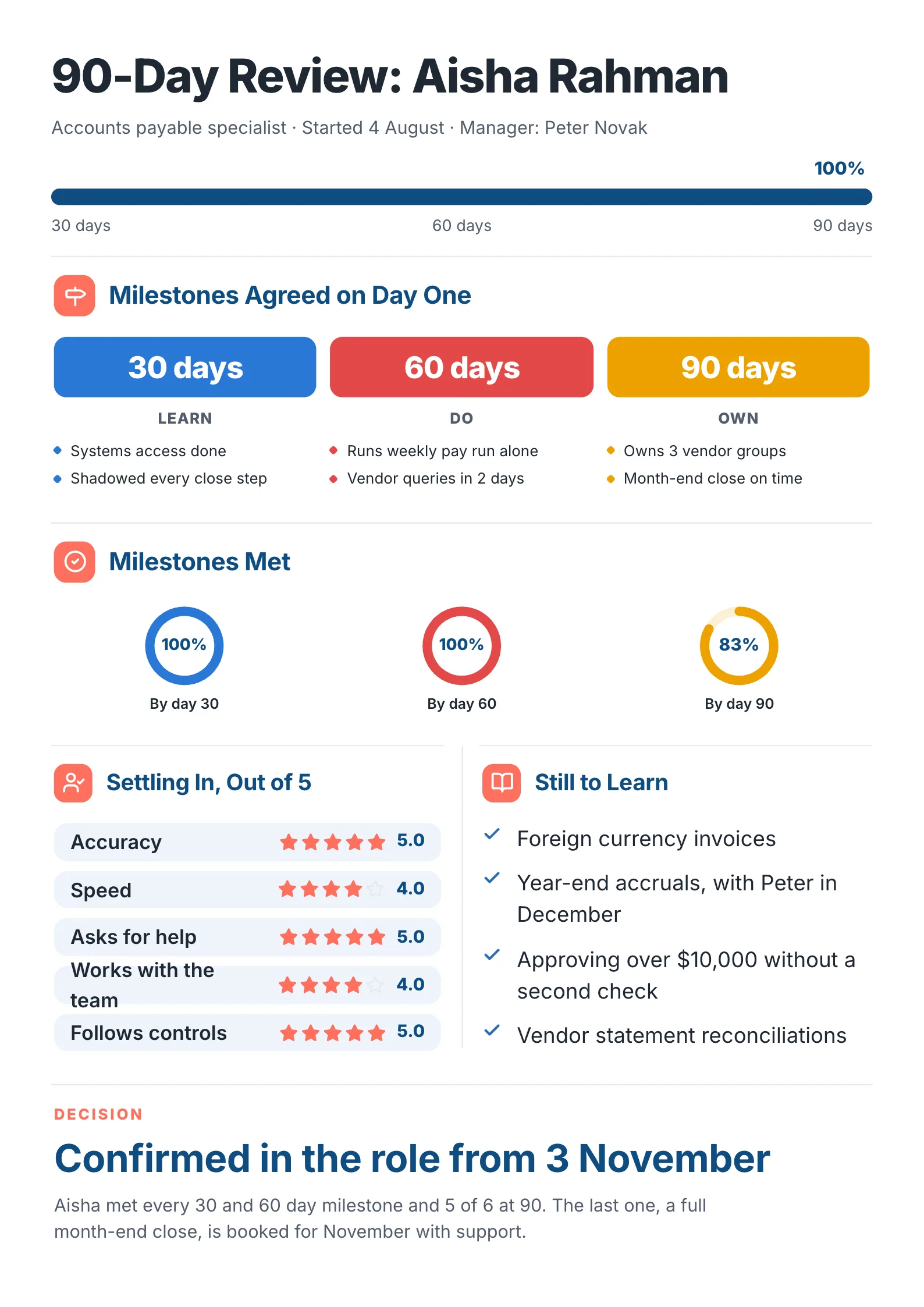
A new hire's review asks the same questions over a shorter span. This 90-day performance review sets milestones at 30, 60 and 90 days, and Aisha met every 30 and 60 day milestone and 5 of 6 at 90. The "Still to Learn" list, starting with foreign currency invoices, is her improve answer. The decision line confirms her in the role from November 3.
Make your review
Start from a MakeOnepagers review for a job like yours, and answer the four common questions on it before your meeting. Or drop your notes into the free AI One-Pager generator, and it sets up a version you can change line by line. When it's your turn to write about someone else, read how to write a performance review, and borrow wording from our performance review phrases.
Frequently asked questions
What questions are asked in a performance review?
On the 6 forms we read, the most common are what help you need (all 6), where you need to improve (5), your most significant accomplishments (4), work outside your job description (4) and your goals for the next period (4).
How do I answer "what support do you need" in a review?
Name two or three specific requests, each tied to a goal, such as time for a course, a budget for a test or a seat at a meeting. Every one of the 6 forms asks this, so have it ready.
How many questions are on a self-evaluation form?
On these forms, between 6 and 11. Harvey Mudd's menu holds 20, but supervisors pick from it to build a shorter form for their own department.
Should I list weaknesses in my self-review?
Yes, if the form asks, and 5 of the 6 forms we read do. Give one real gap, what it affected and the steps you'll take. Lincoln's form asks for exactly that.
What should I ask my manager in a performance review?
Ask what to do more of, which goal matters most and what it would take to reach the next rating level. Lincoln's form gives you a line to list what you'd like to discuss.




