How to Write a Grant Summary That Fits Any Funder's Limit
NIH, NSF and 6 common grant applications set summary limits from 400 characters to one page. Here's how to write one that fits all of them.

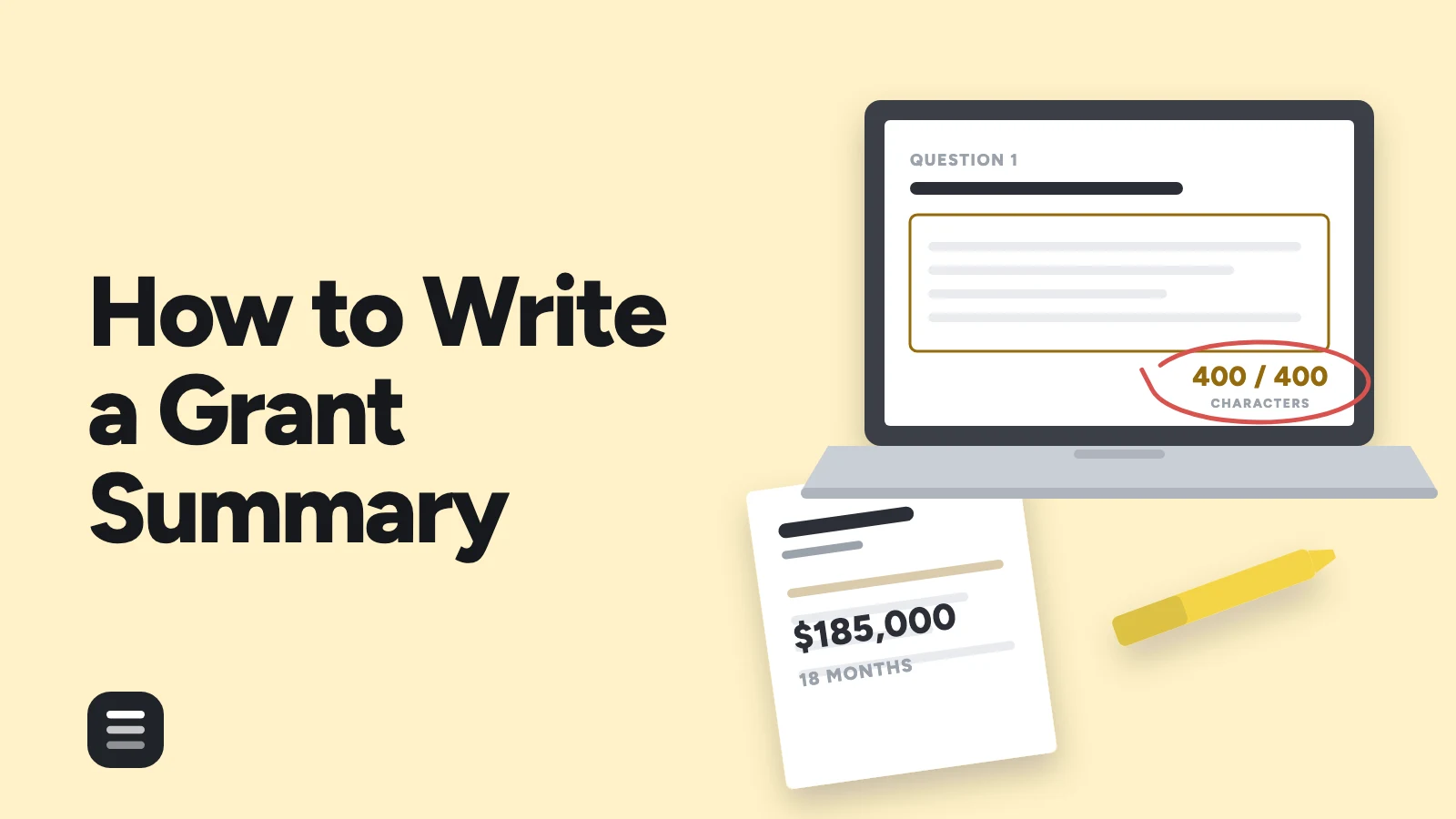
Every funder sets its own limit for a grant summary. Some give you 400 characters. Others give you a page. Inside that space you say who you are, the amount you want, what it pays for, who it helps and how you'll know it worked. A reviewer often reads it first and decides how closely to read the rest. So write it to fit the tightest limit you'll face. Start from a free one pager template.
One‑Pager examples
Real One-Pagers made with MakeOnepagers. Open any one to edit it as your own.
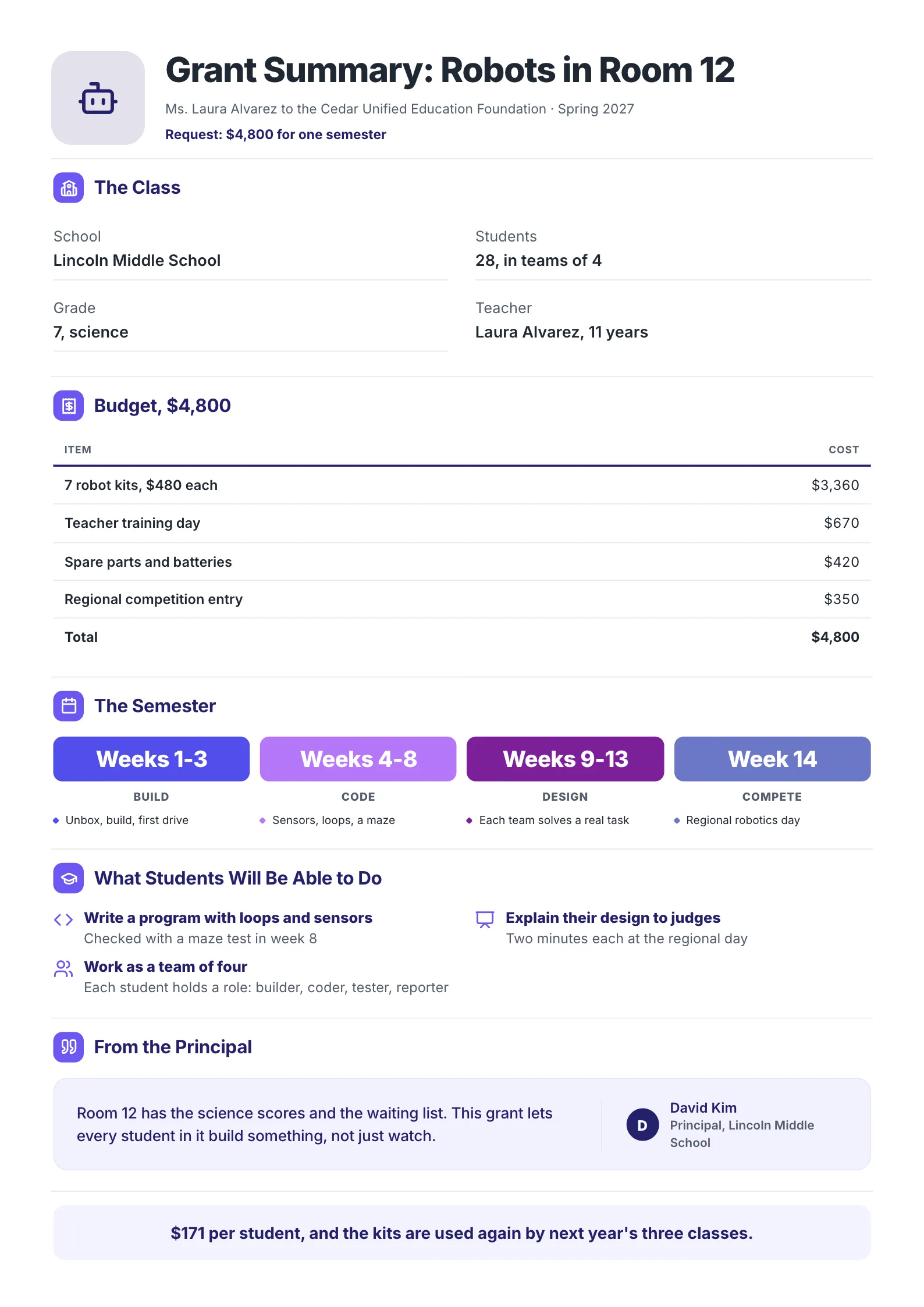 Grant Summary: Classroom RoboticsEdit for free(opens in a new tab)
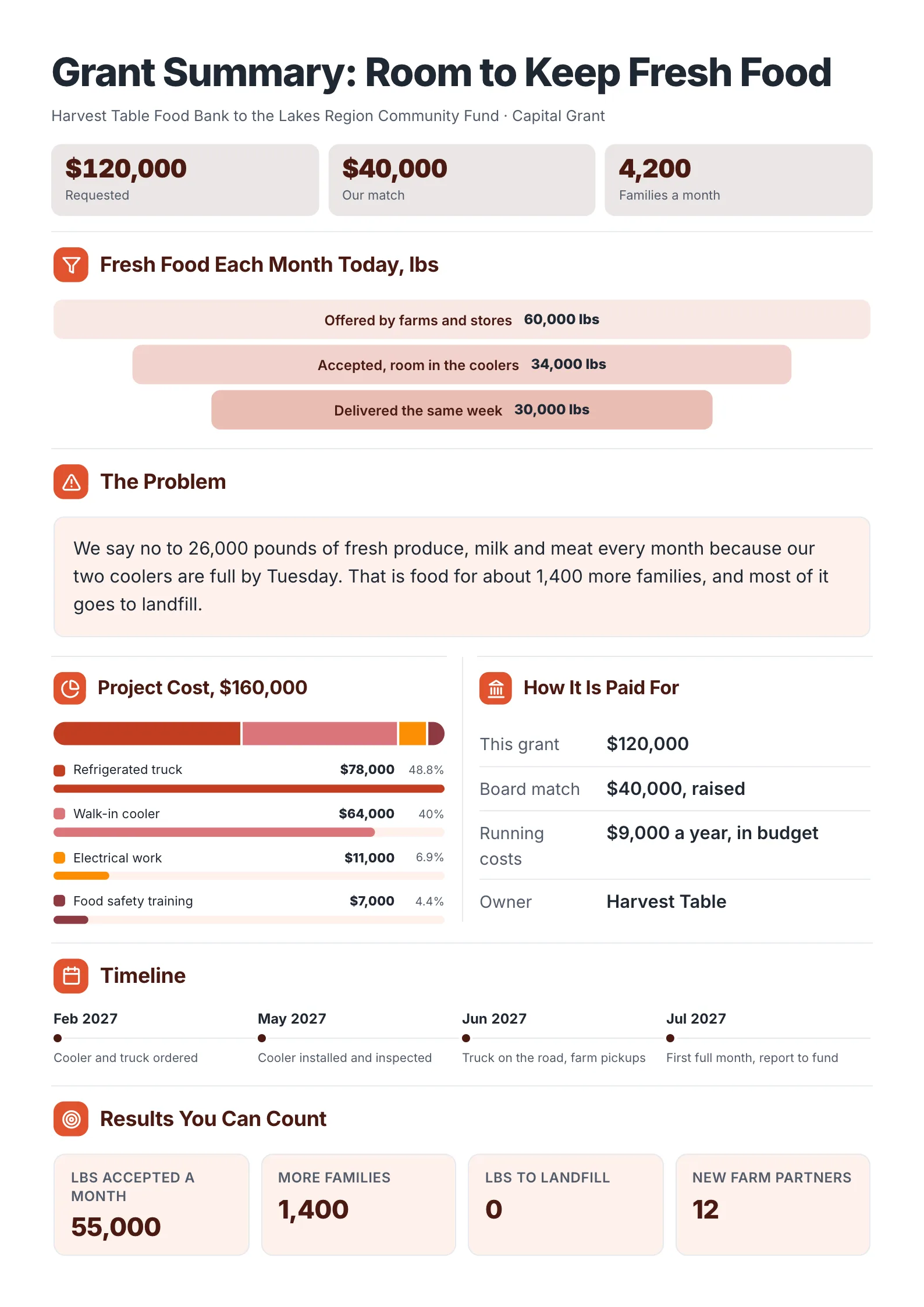 Grant Summary: Food Bank Cold StorageEdit for free(opens in a new tab)
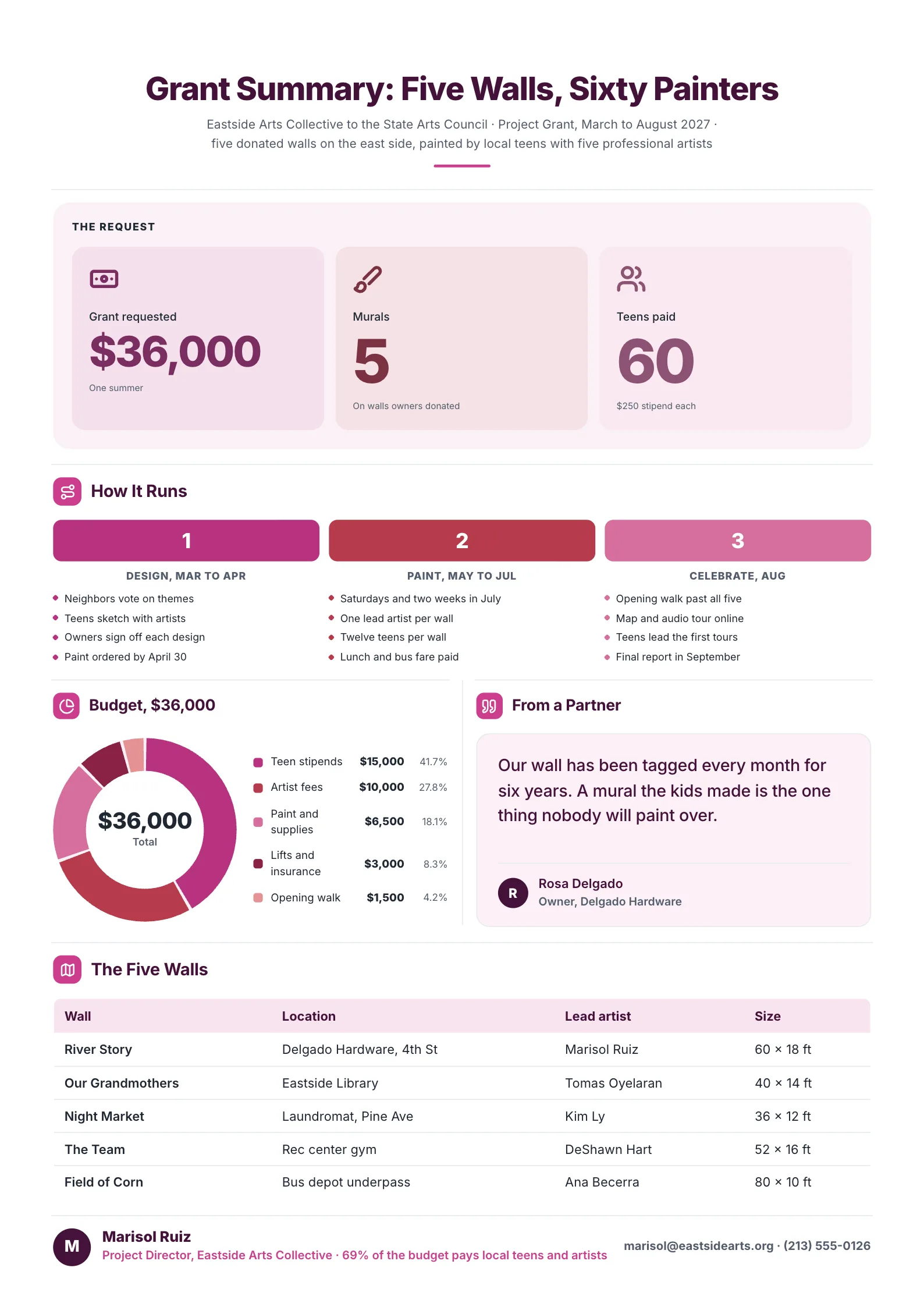 Grant Summary: Public Art Mural ProjectEdit for free(opens in a new tab)
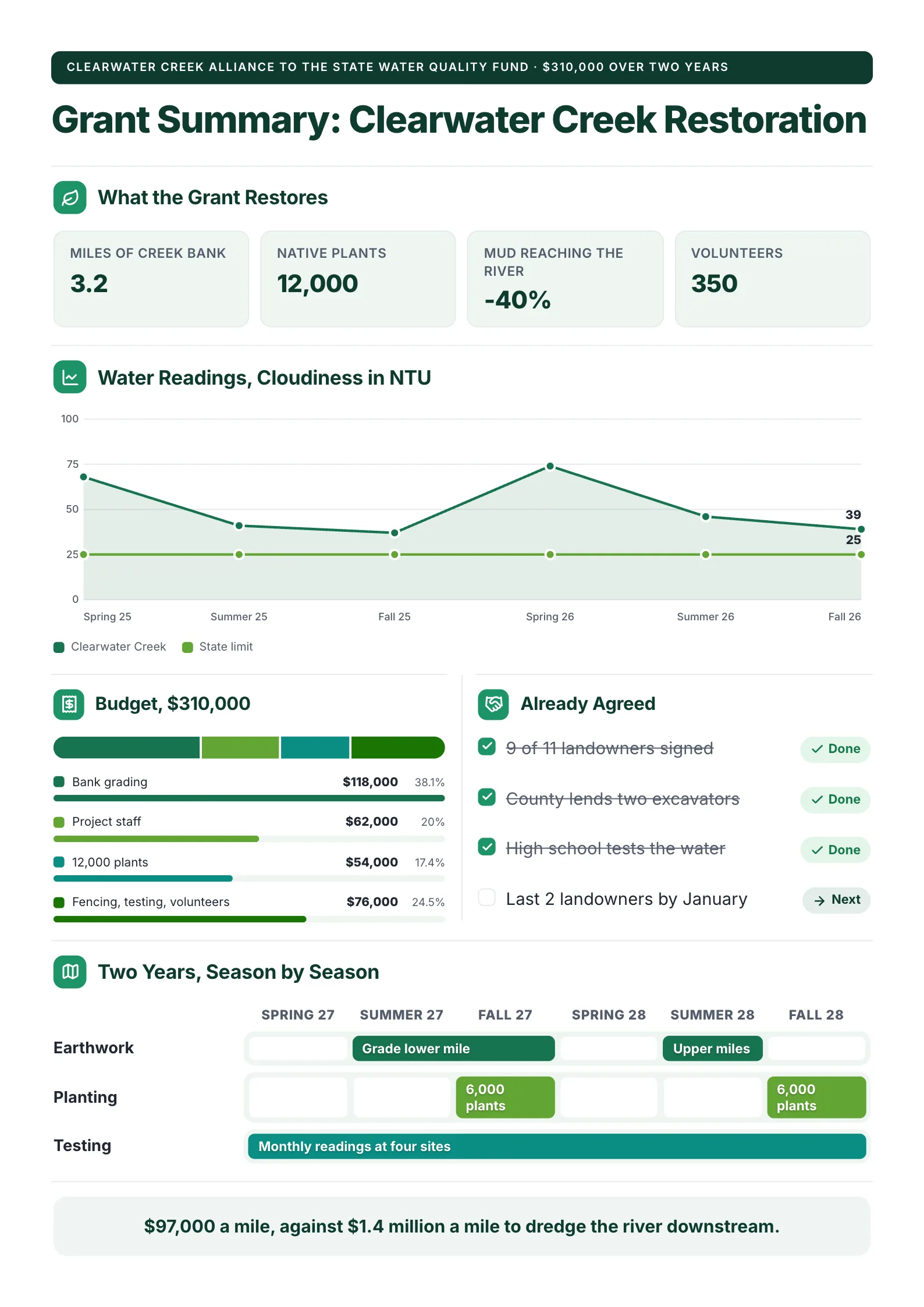 Grant Summary: Watershed RestorationEdit for free(opens in a new tab)
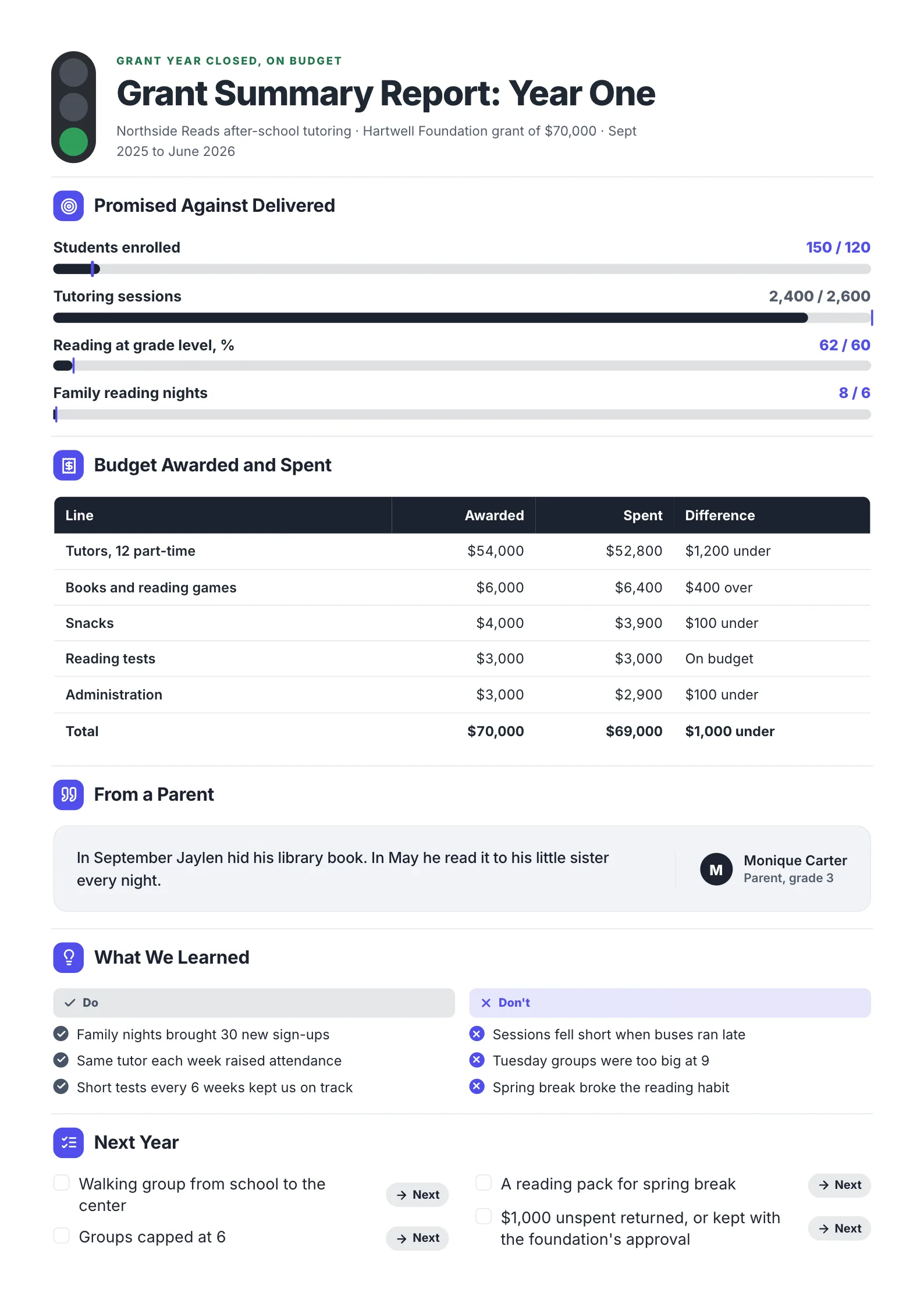 Grant Summary Report: After-School TutoringEdit for free(opens in a new tab)
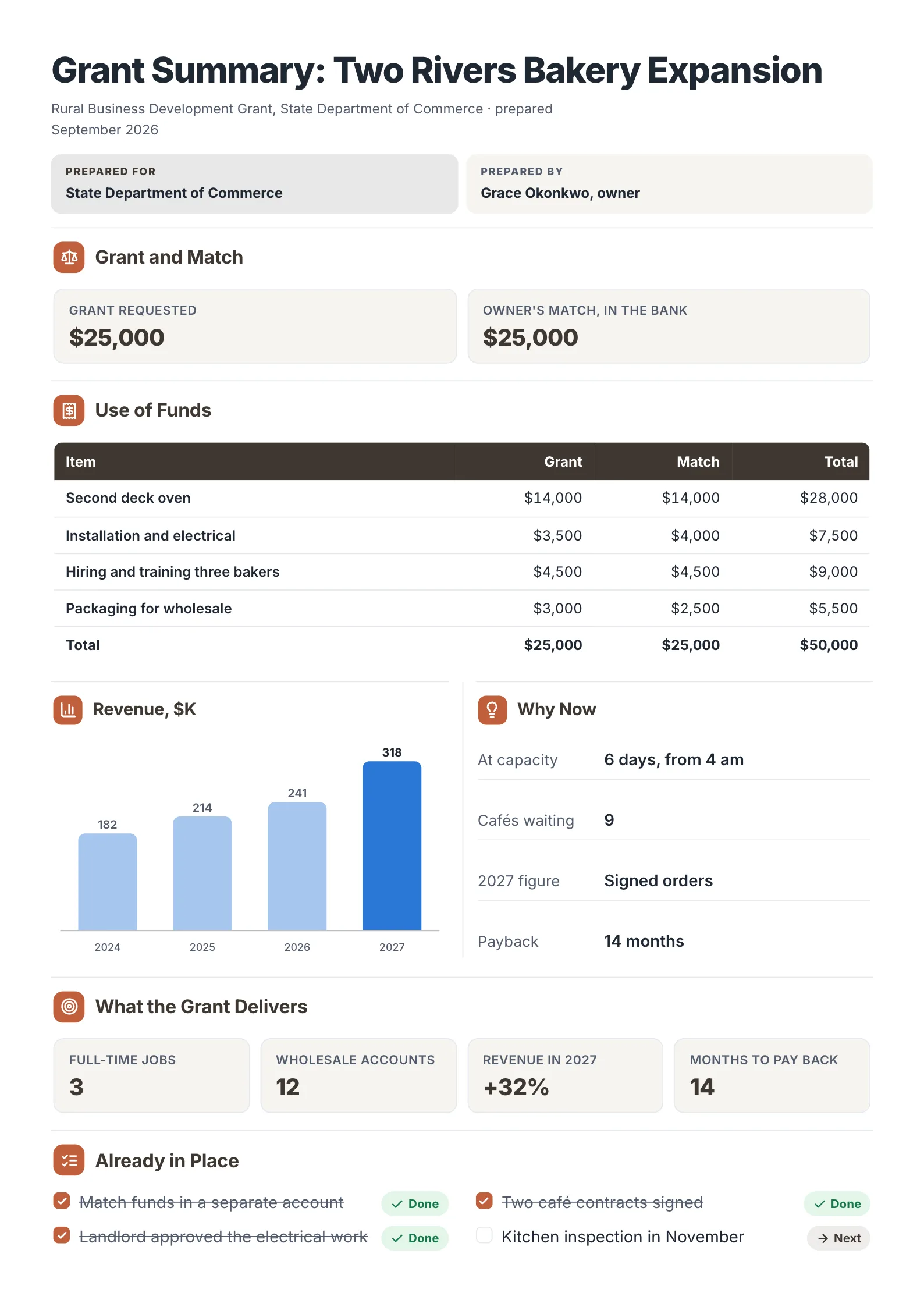 Grant Summary: Small Business ExpansionEdit for free(opens in a new tab)
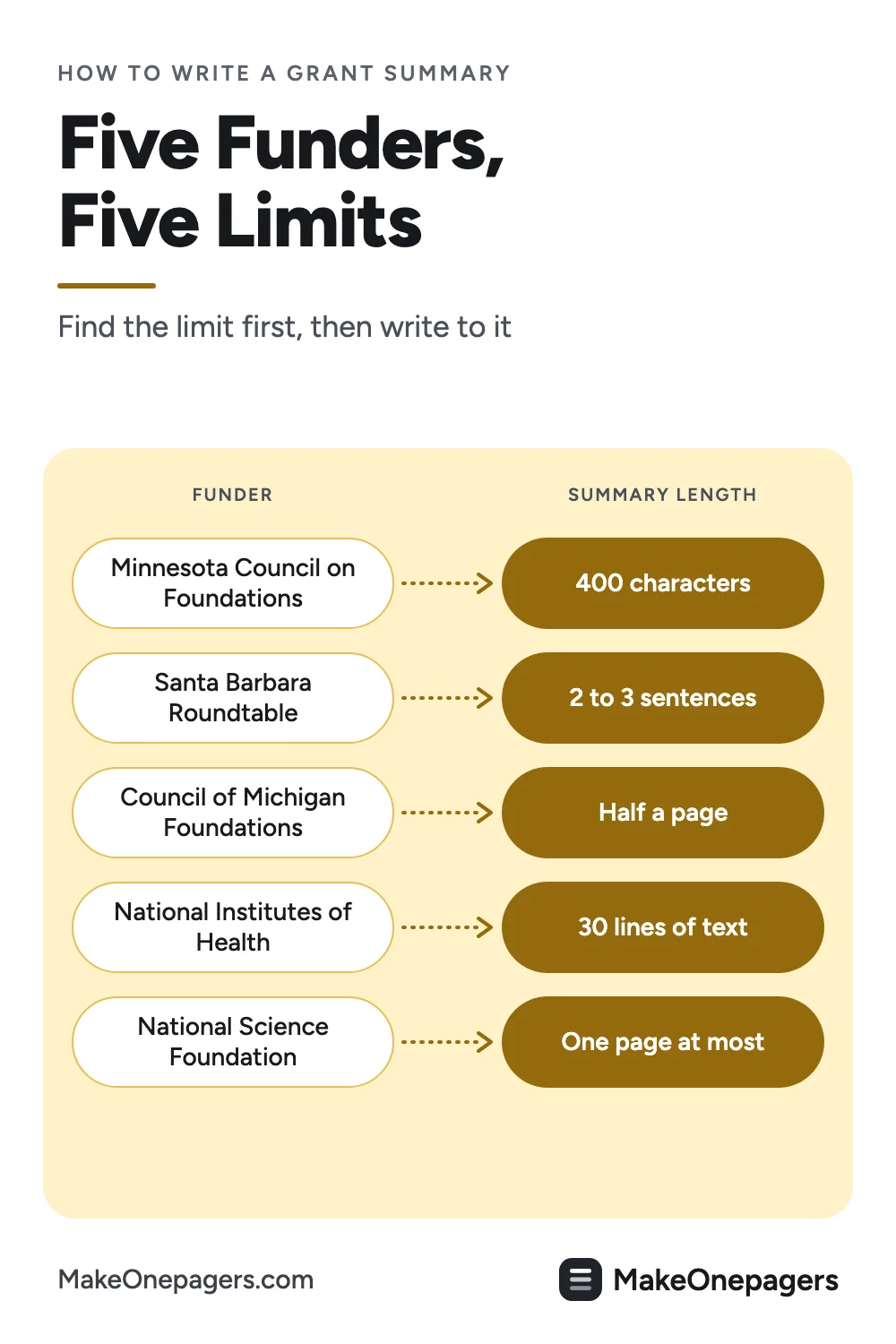
We read the summary rules in 8 funder forms and guides. Two are federal, the National Institutes of Health and the National Science Foundation. The other six are common applications that groups of foundations share. Four are regional ones (Minnesota, Colorado, Santa Barbara County and Michigan), one serves New York and New Jersey together and one comes from a national network of grantmakers. All 8 ask for a short summary. Their limits run from 400 characters to one page. Two ask you to state the purpose in a single sentence.
Step 1: Find the funder's limit and format
Before you write a word, look up the limit in the funder's own guidelines. Characters, sentences, lines and pages all count differently. NIH counts lines of text and flags a summary that runs past 30 lines as an error. Minnesota counts characters, so 400 is about 60 to 70 words.
Note the parts the funder wants named, too. NSF's one page must have three parts, an overview, a statement on intellectual merit and a statement on broader impacts. If a funder gives headings, use them in the same order.
| Funder | What they call it | Length |
|---|---|---|
| Minnesota Council on Foundations | Question 1 | 400 characters |
| Santa Barbara County Foundation Roundtable | Cover sheet summary | 2 to 3 sentences |
| National Network of Grantmakers | Cover sheet summary | 2 to 3 sentences |
| Council of Michigan Foundations | Executive summary | Half a page, purpose in one sentence |
| Philanthropy New York and New Jersey grantmakers | Proposal summary | Half a page, purpose in one sentence |
| Colorado Common Grant Application | Summary sheet | One sheet on what the grant will be used for |
| National Institutes of Health | Project summary | 30 lines of text |
| National Science Foundation | Project summary | Not more than one page |
Source: MakeOnepagers read of NIH and NSF rules, October 30, 2026, and of 6 common grant applications, October 26, 2026. Each one is linked further down.
That's a big range. A sentence that fits the NSF page might not fit Minnesota's box. So write the short version first and grow it, rather than cutting a long one down.
Step 2: Open with the request in one sentence
Michigan and the New York and New Jersey form both ask you to state the purpose of the grant in one sentence. That's the sentence to write first, whatever the funder. Put five things in it. Who you are, how much, for what, for whom and over what time.
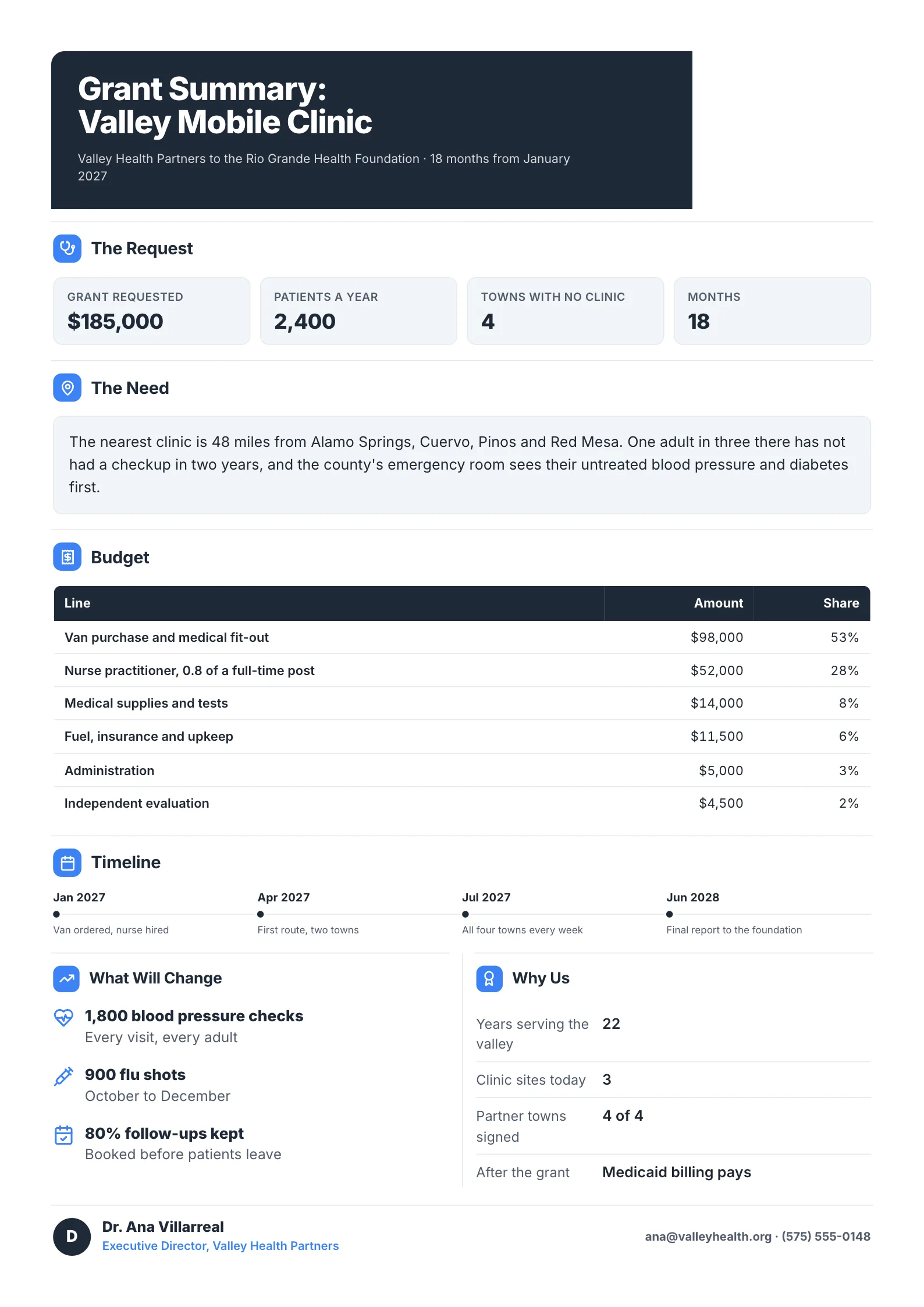
Here's the pattern. "Valley Health Partners requests $185,000 over 18 months to run a mobile clinic for 2,400 patients a year in four towns with no clinic." A reviewer who reads only that line knows what you want. A 2 to 3 sentence limit leaves room for the need and the outcome, and nothing more.
 Edit this template
Sample names and figures. The amount, the patients and the months sit in one row at the top, the one-sentence request drawn as numbers.
Step 3: State the need with one number
Every one of the six common applications asks about the need your project meets. In a summary, you only have room for the strongest fact. Pick one number your reader can picture, like how far people travel or how many go without.
"The nearest clinic is 48 miles away" does more than "rural residents face access barriers." Between a local number and a national one, the local one wins. It's the one only you can give.
Step 4: Promise outcomes you can count
All six common applications ask for goals and how you'll measure them. So write two or three outcomes with numbers and dates. Say how many people, what changes for them and by when.
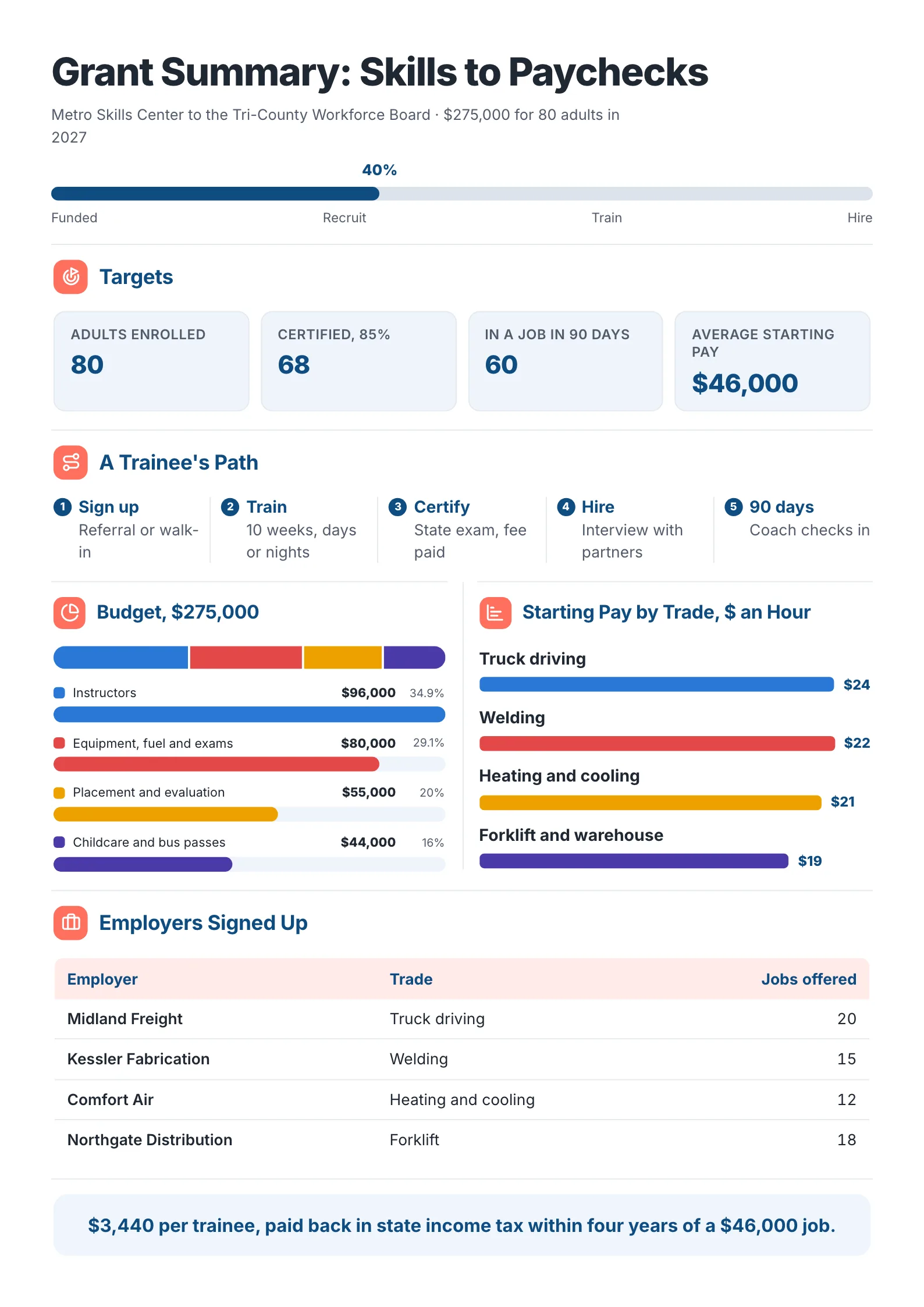
Keep them to what you'll really track. A workforce program might promise 80 adults enrolled, 85% certified and an average starting pay of $46,000. Anything you can't measure belongs in the proposal, where you have room to explain it.
 Edit this template
Sample names and figures. The targets sit at the top as counts, so the funder can check them in the final report.
Step 5: Show the money and who else is paying
Your summary should show the total project cost and the part this grant covers. Four of the six common applications ask which other funders you've asked and where each stands. It shows your reviewer the project doesn't rest on one grant.
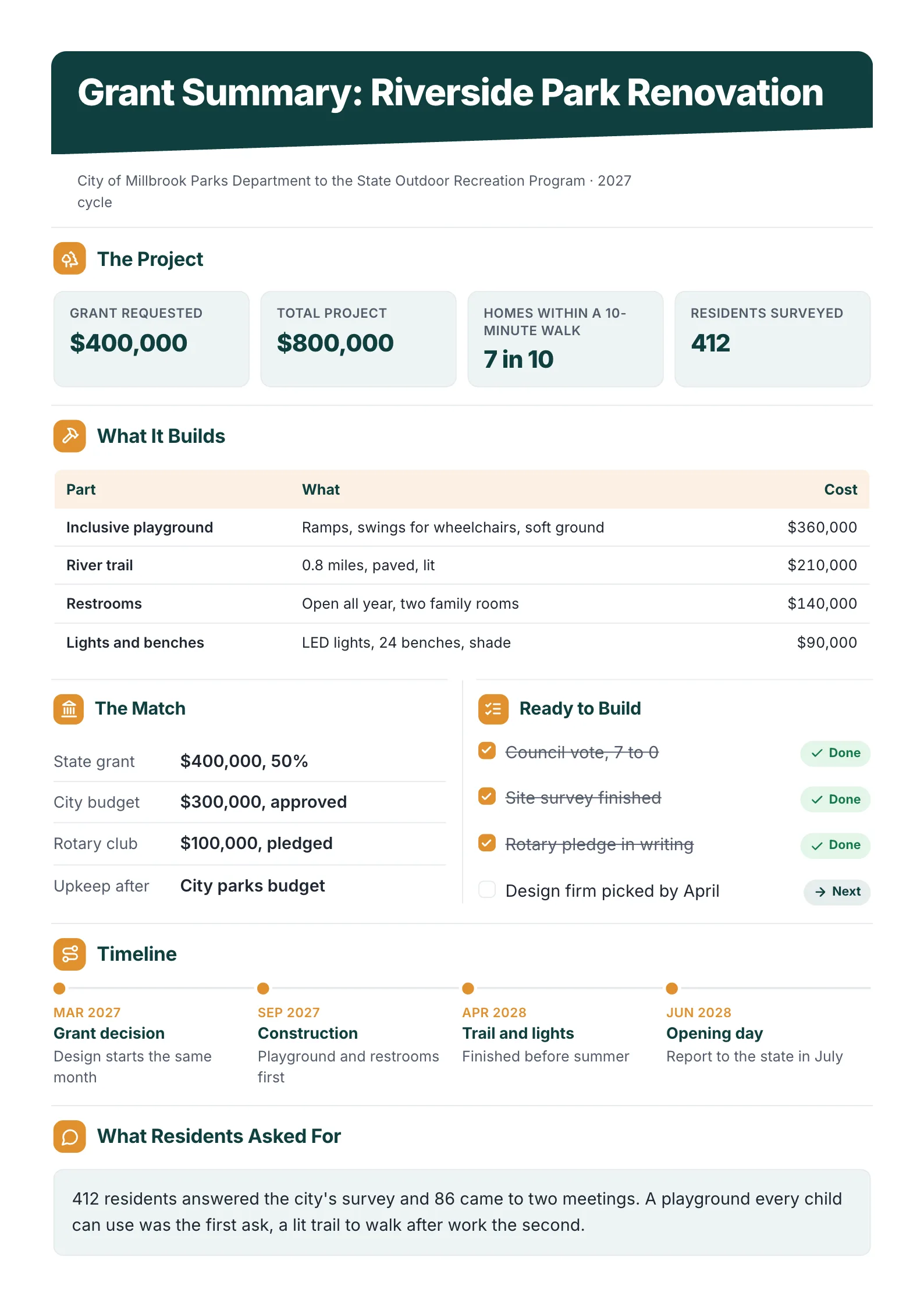
Write it plainly. "We request $400,000 of an $800,000 project. The city has approved $300,000 and the Rotary club has pledged $100,000." That one line answers the question every funder asks next.
 Edit this template
Sample names and figures. The match box shows every dollar of the $800,000 and whether it's approved or pledged.
 Edit this template
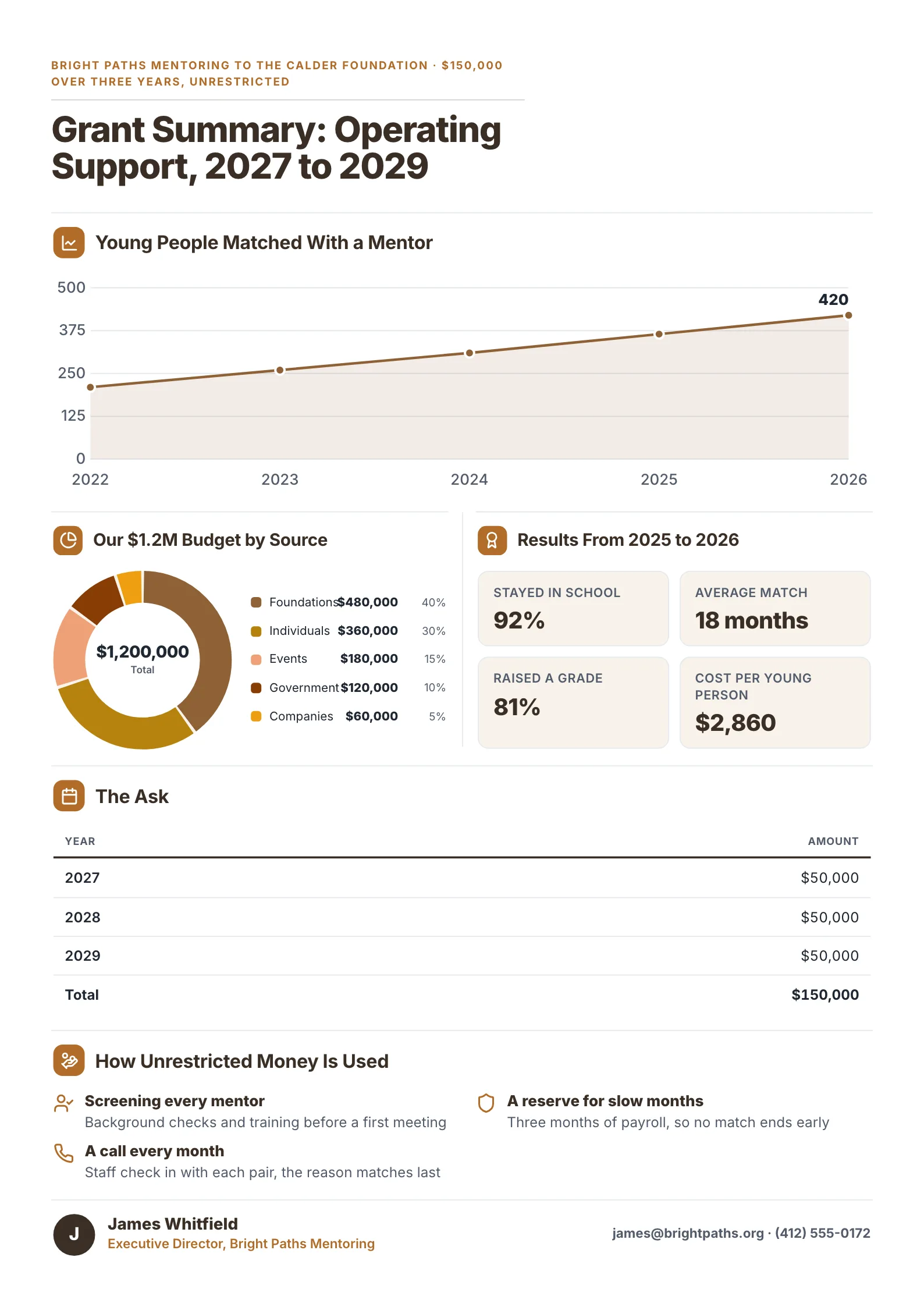
Sample names and figures. For unrestricted money, the summary shows the whole budget by source and what it costs to serve one person.
Step 6: Read it alone, then fix it
NIH says the project summary should be able to stand on its own, separate from the application. It also asks you to avoid describing past accomplishments and to avoid the first person. NSF says its summary should be understandable to a broad audience in the field. It also says the summary should not be an abstract of the proposal.
So test yours by itself. Give it to someone who hasn't read the proposal. Ask them to tell you the amount, the purpose, who it helps and how you'll measure it. If they miss one, that part needs a clearer sentence. Then check the funder's voice rules. NIH wants no "we," so "The project will..." replaces "We will..."
Here's what that test does to a typical first draft. The request is the made-up mobile clinic from the first picture above.
| Part of the summary | First draft | After the test |
|---|---|---|
| Opening | Our organization has served the valley since 1998 | Valley Health Partners requests $185,000 over 18 months |
| Need | Rural residents face access barriers | The nearest clinic is 48 miles away |
| Outcome | Improve community health | 2,400 patients a year, checkups for adults who skipped them |
| Money | Not mentioned | Van, nurse practitioner and an independent evaluation |
| Length | Two paragraphs | Three sentences |
The second version fits Santa Barbara's 2 to 3 sentences and still carries every number a reviewer would score.
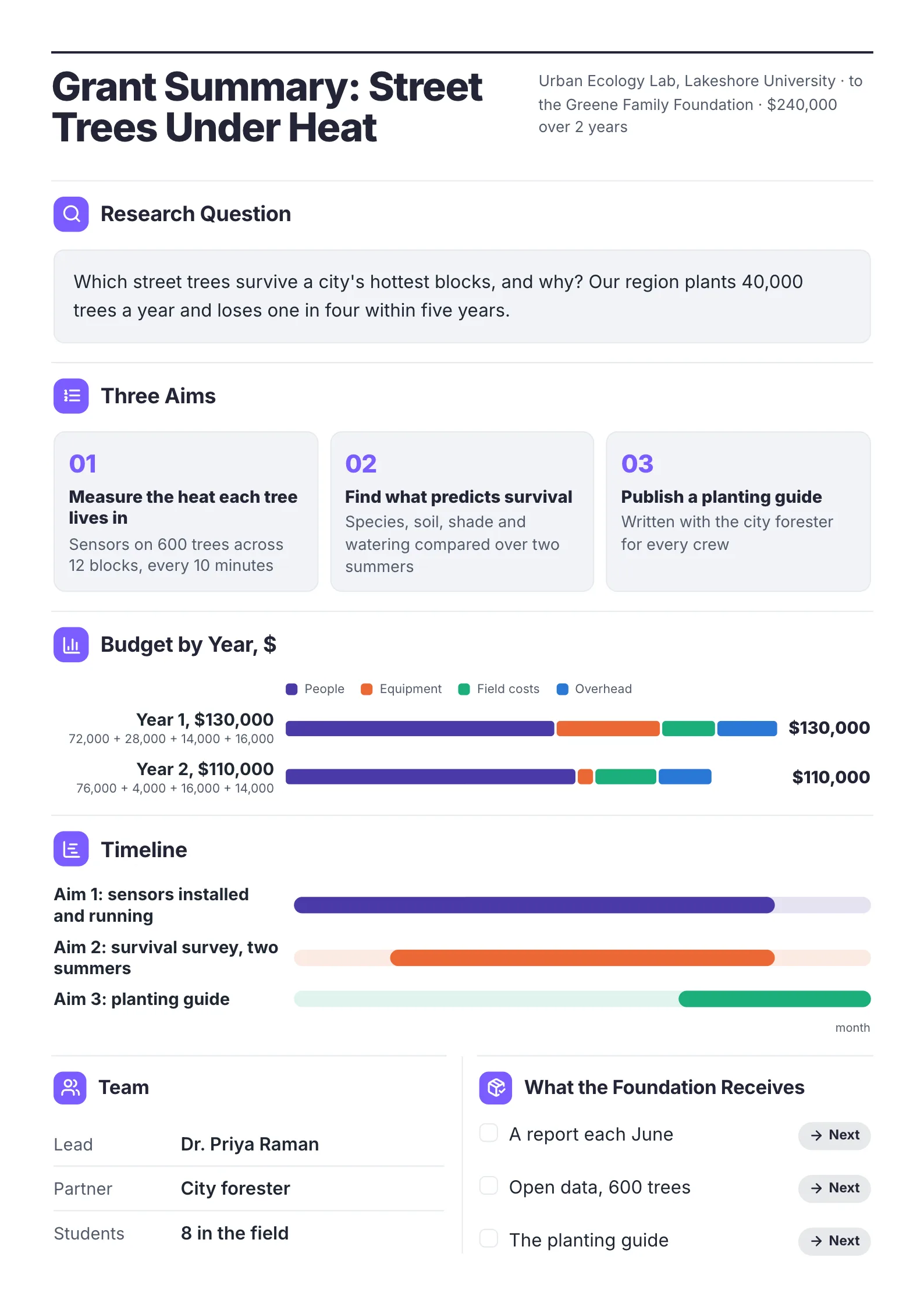 Edit this template
Sample names and figures. The research question and three aims read on their own, without the proposal behind them.
Make the summary your one-page handout
Even when a funder allows a full page, a summary that fits on half a page is easier to score. Put the request sentence at the top, the need and outcomes as three or four numbers and the budget as a short table. If you need a one-page version for your board or a site visit, add the timeline and contact at the bottom.
In MakeOnepagers, a grant summary design puts the request in a strip across the top, with a budget table and an outcomes box below it. Your amount, outcomes and match go in those three spots. The grant summary template post holds several filled-in samples. For the full application, the grant proposal guide walks through the six common forms question by question.
The NIH, NSF and six common forms, linked
| Source | What we read | Who made it |
|---|---|---|
| G.220 R&R Other Project Information Form | Project summary and narrative rules | National Institutes of Health |
| PAPPG 24-1, Chapter II | Project summary rules | National Science Foundation |
| Minnesota Common Grant Application | Question 1, 2023 version | Minnesota Council on Foundations |
| Colorado Common Grant Application | Summary sheet, revised 2010 | Colorado grantmakers, a copy hosted by the State of Nevada |
| Common Grant Application | Cover sheet, revised February 2020 | Foundation Roundtable of Santa Barbara County |
| Common Grant Application | Executive summary | Council of Michigan Foundations |
| Common Grant Application Form | Cover sheet | National Network of Grantmakers |
| Common Application Form | Proposal summary | Philanthropy New York and the Council of New Jersey Grantmakers |
We read the NIH and NSF rules on October 30, 2026. We read the six common applications question by question on October 26, 2026, for our grant proposal guide.
Write your grant summary before the rest of the proposal
Look up the limit and write the one-sentence request. Add one number for the need, two or three outcomes and the budget with other funders. Then hand it to someone who hasn't read the proposal. Save the finished half page in MakeOnepagers, and trim it to each funder's limit every time a new deadline comes up.
Frequently asked questions
What is a grant summary?
It's the short version of a grant request that funders read first. It says who's asking, how much, for what, for whom and how success will be measured. Some funders call it an executive summary, a proposal summary or a project summary.
How long should a grant summary be?
As long as the funder allows and no longer. The 8 we read range from 400 characters to one page. If there's no limit, half a page is a safe length.
Is a grant summary the same as an abstract?
Not for NSF, which says its project summary should not be an abstract of the proposal. It wants an overview, intellectual merit and broader impacts. For most foundations, the summary is a plain description of the request.
What is a grant summary report?
It's a short report you send after the grant, often at the end of each year. It compares what you promised in the summary with what happened. Our progress report post covers that format.




