How to Write a Competitive Analysis That Names Your Rivals
We read the competition sections of 6 company annual reports. Only 2 named a rival and only 1 gave a market share. Your own analysis can do better.

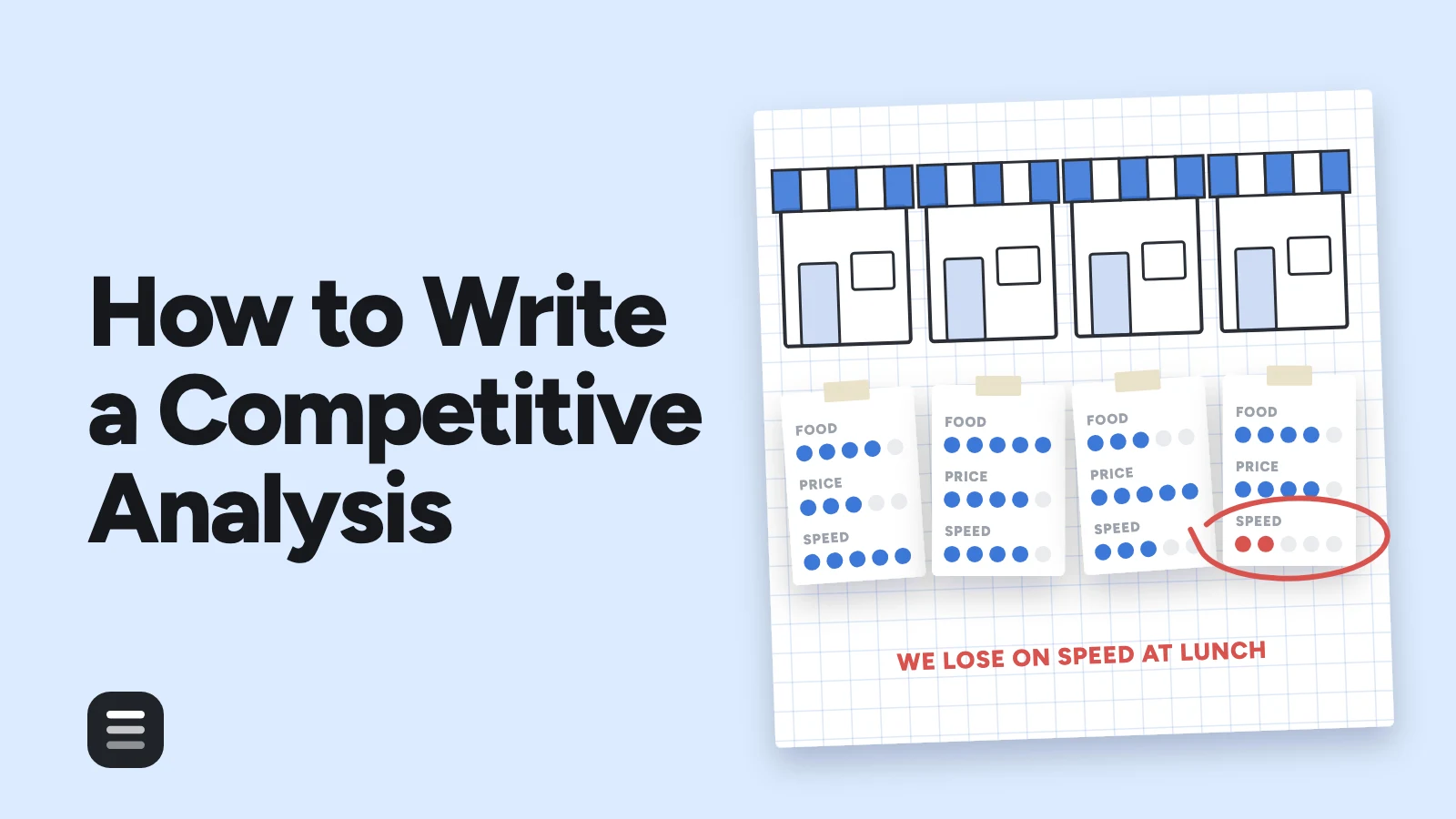
Ask one question about your customers before you write a competitive analysis. When they don't buy from you, who do they buy from instead? Those are your real rivals. You name them, list what buyers compare, score everyone on the same factors and say where you win and lose. Then you decide what to change, and how. Start from a free one pager template.
One‑Pager examples
Real One-Pagers made with MakeOnepagers. Open any one to edit it as your own.
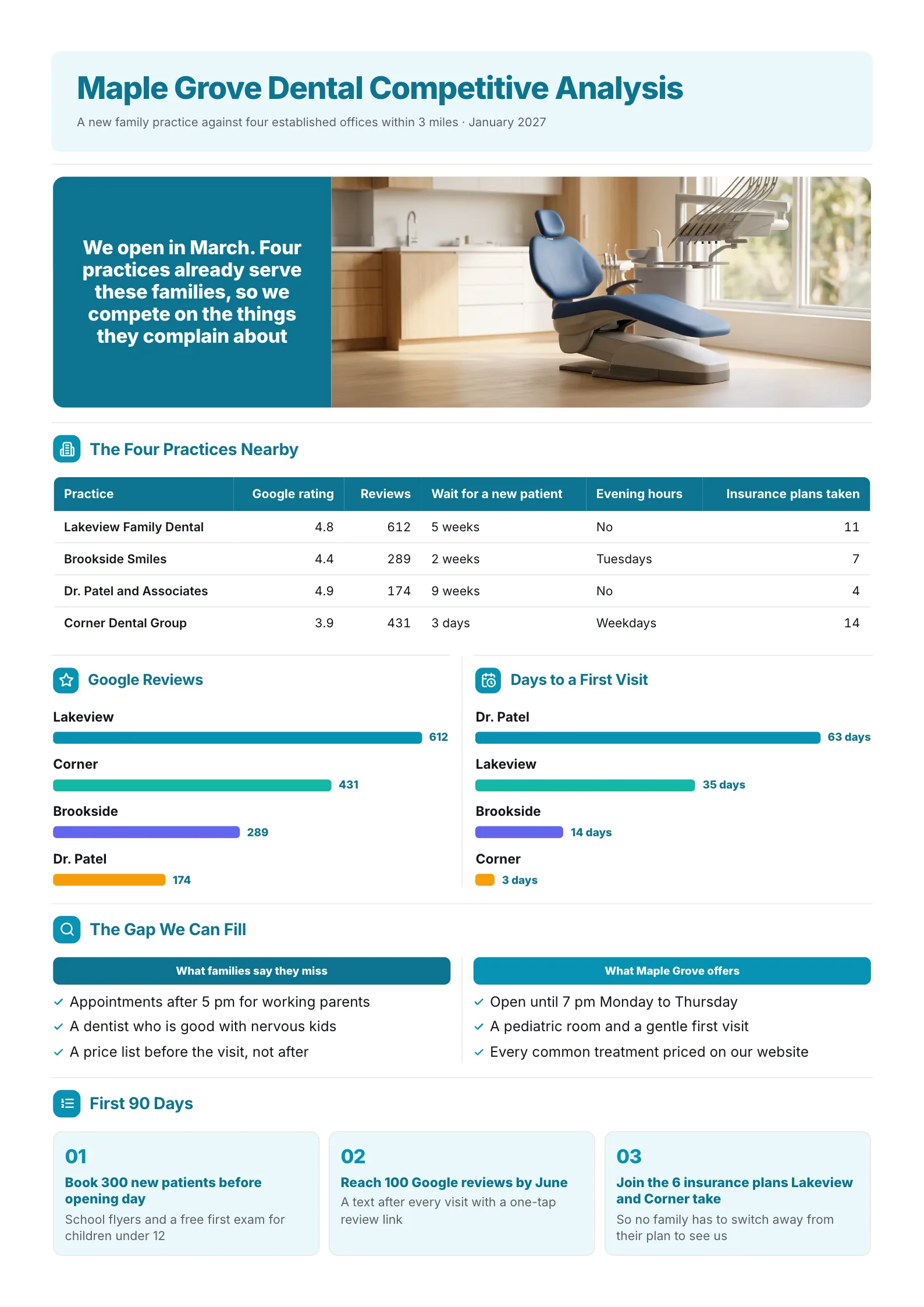 Competitive Analysis: Dental PracticeEdit for free(opens in a new tab)
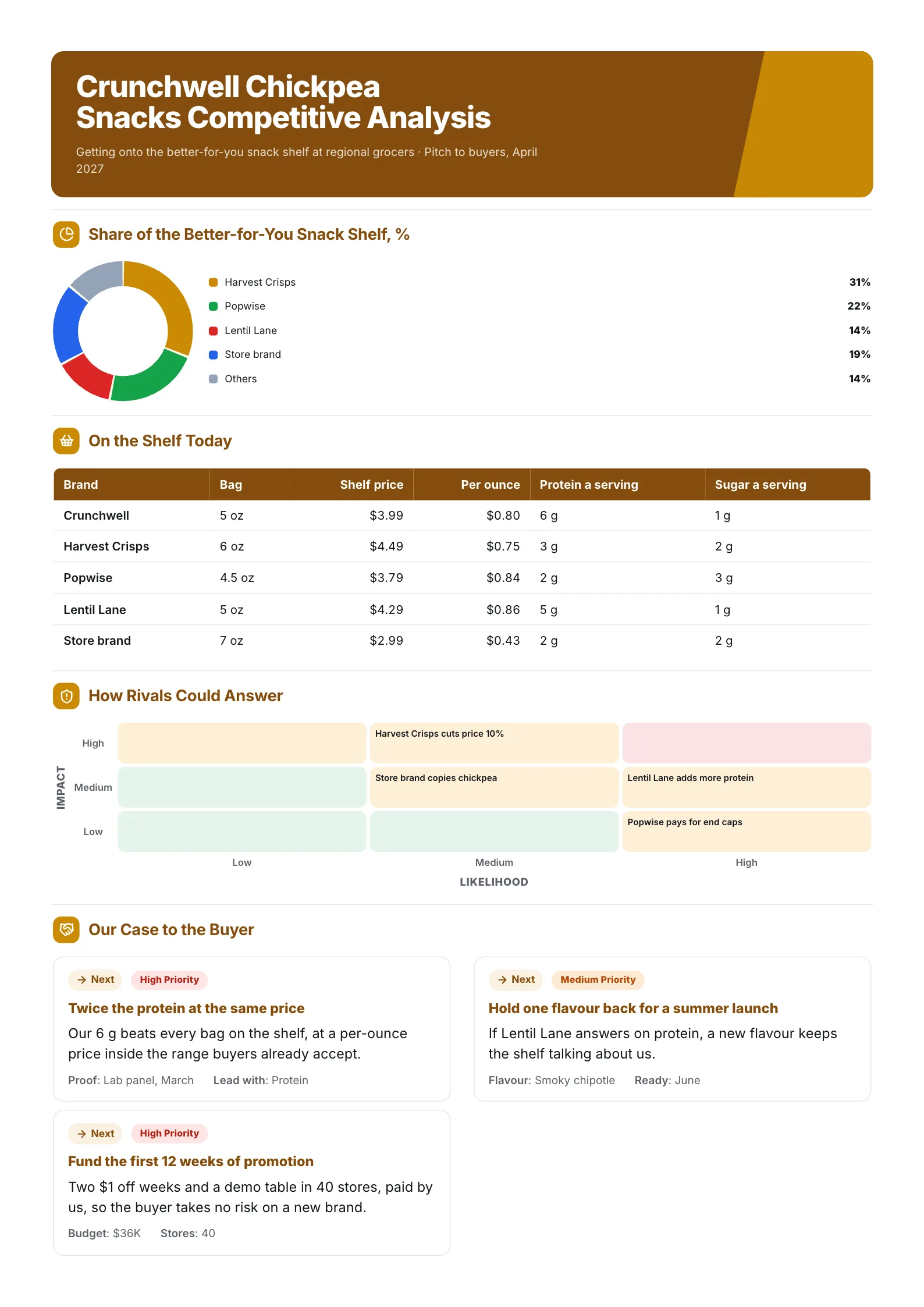 Competitive Analysis: Snack Product LaunchEdit for free(opens in a new tab)
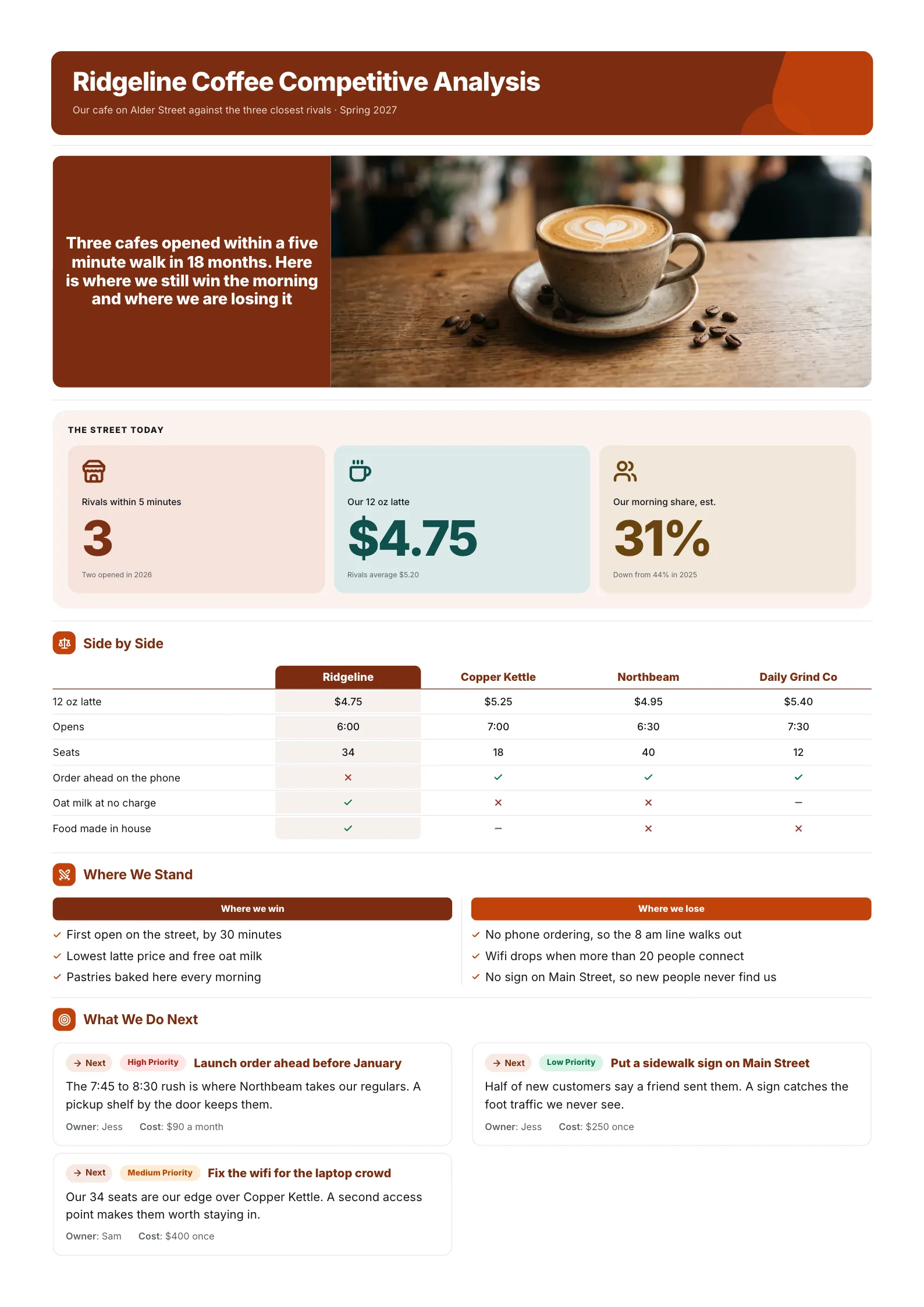 Competitive Analysis: Coffee ShopEdit for free(opens in a new tab)
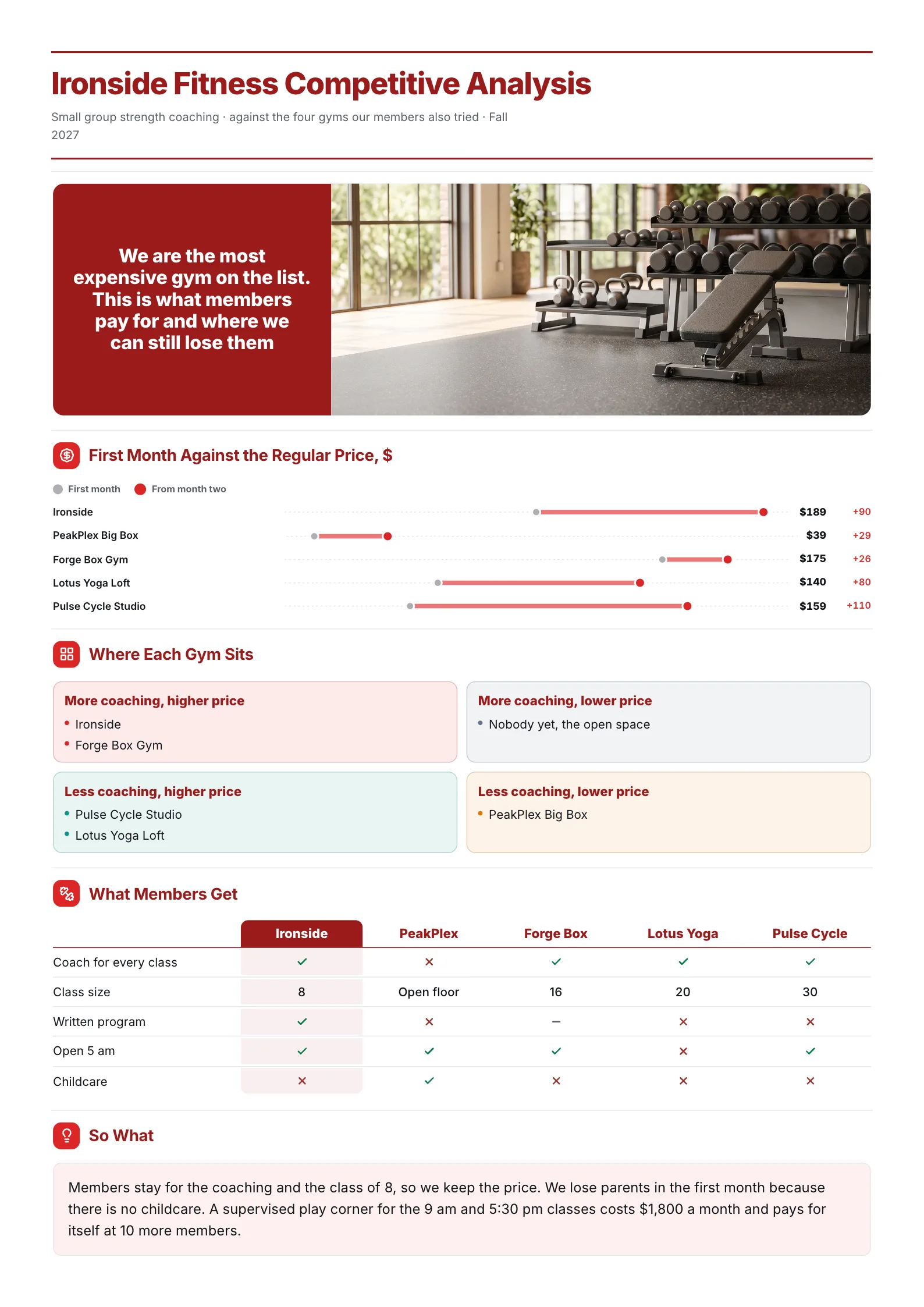 Competitive Analysis: GymEdit for free(opens in a new tab)
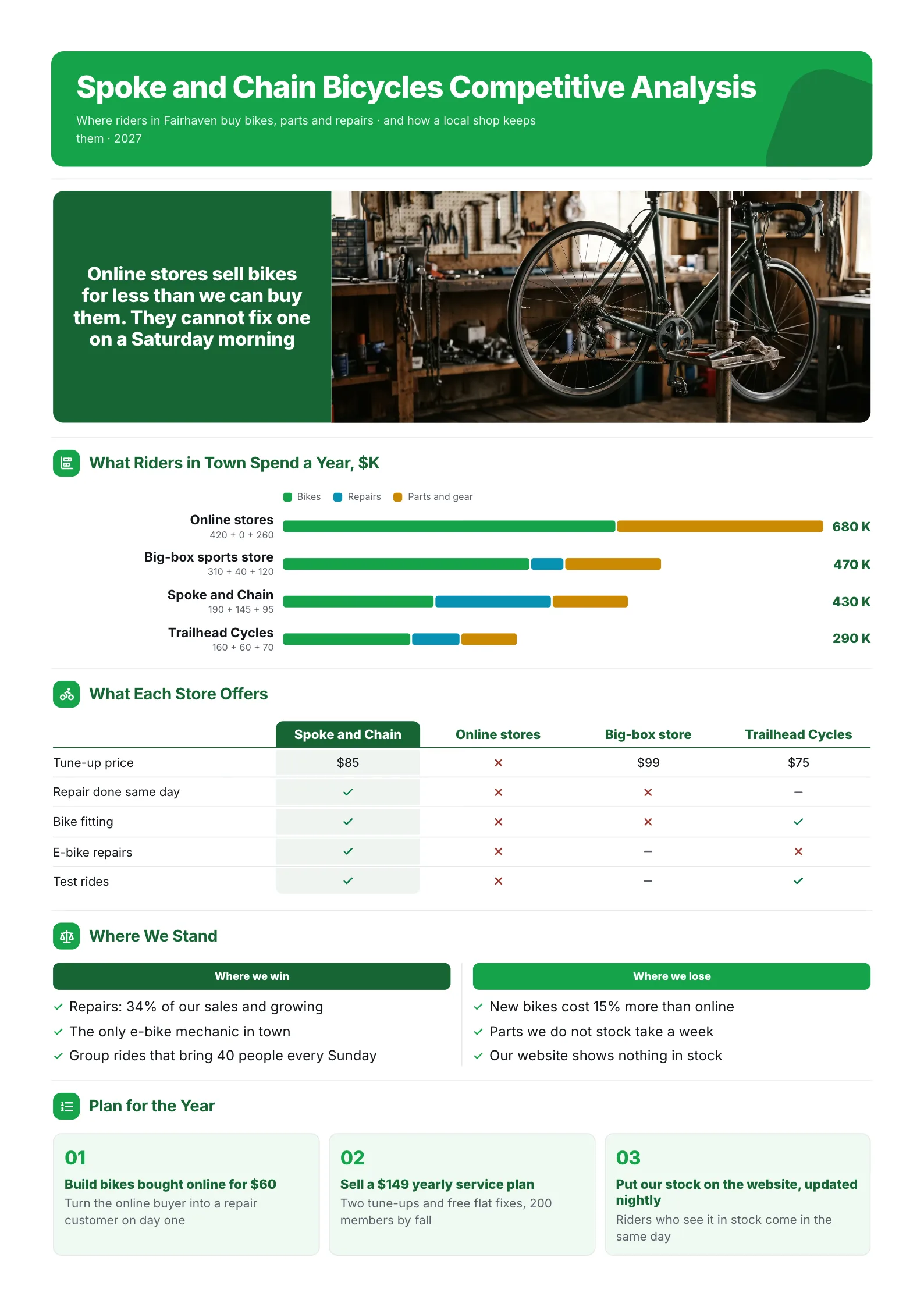 Competitive Analysis: Bike ShopEdit for free(opens in a new tab)
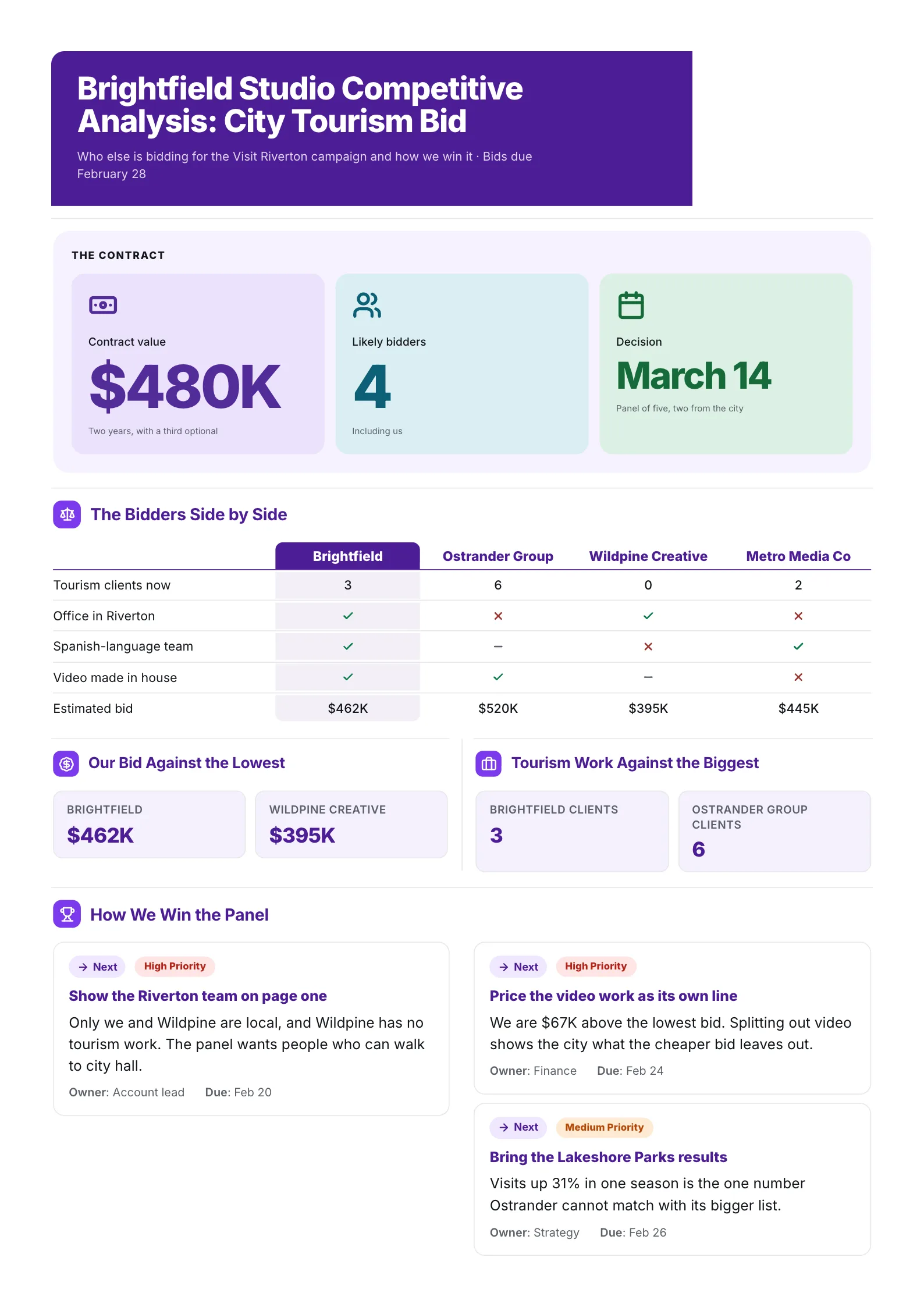 Competitive Analysis: Agency BidEdit for free(opens in a new tab)
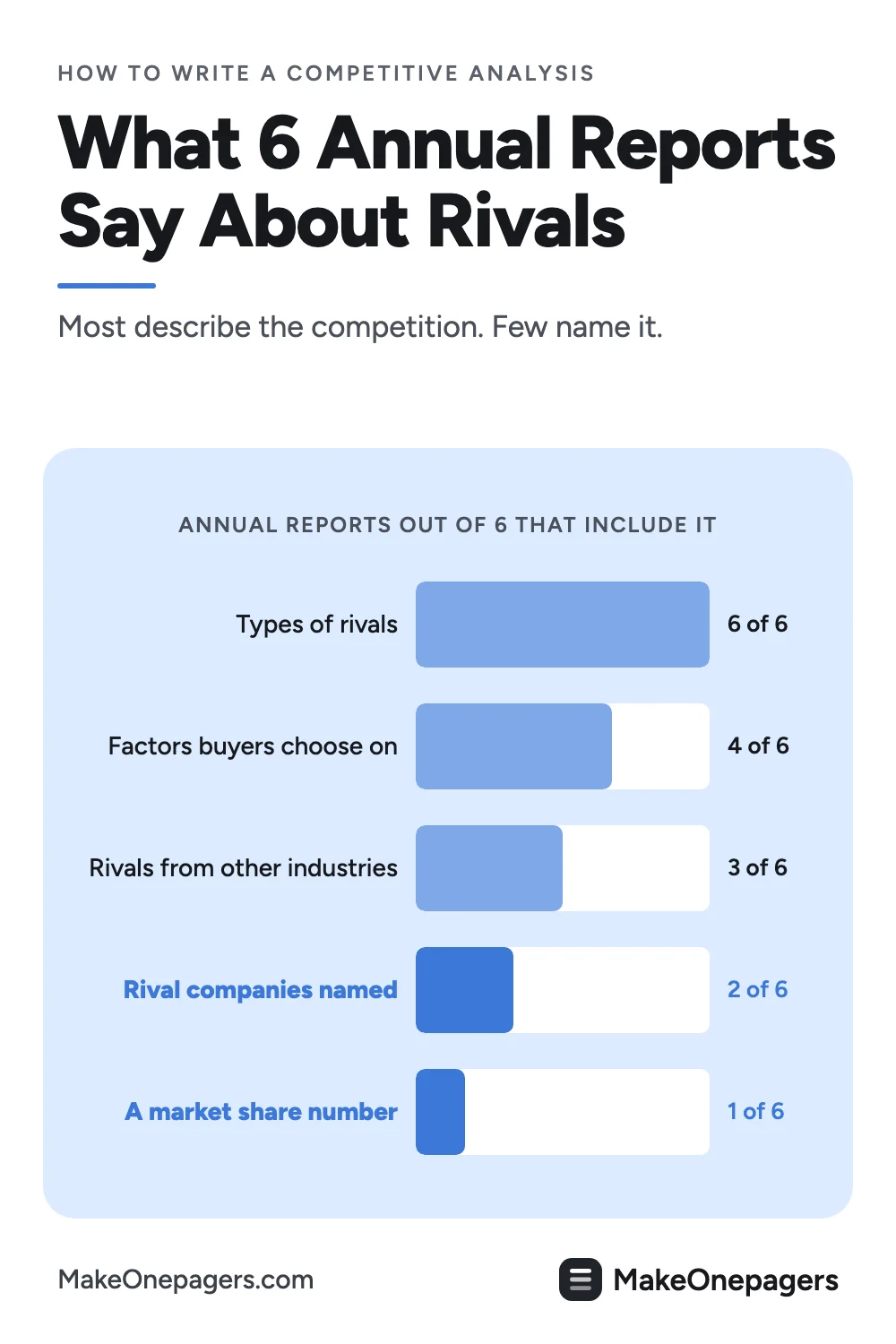
Every year, each public company must describe its competition in the annual report it files with the SEC, called a 10-K. We read the competition sections of 6 of them, from Planet Fitness, Chipotle, Hilton, Dutch Bros, Compass and Warby Parker. All 6 describe types of rivals. Only 2 name a rival company. Only 1 gives a share of the market as a number. And 3 count rivals from outside their own industry, like tanning salons for a gym.
The 6 annual reports we read, and the merger guidelines
| 10-K | Company | What it said about competition |
|---|---|---|
| Planet Fitness 10-K | Planet Fitness | 14 kinds of rivals, including tanning salons and home equipment |
| Chipotle 10-K | Chipotle Mexican Grill | 8 factors, local and national chains and delivery services |
| Hilton 10-K | Hilton Worldwide | 11 criteria and 6 named rivals |
| Dutch Bros 10-K | Dutch Bros | 7 factors, 4 rival types plus convenience stores |
| Compass 10-K | Compass | Rival types and "competes favorably" |
| Warby Parker 10-K | Warby Parker | 5 factors, 3 named rivals and a 40% share for independent shops |
All six cover the year 2025 and were filed in 2026. We read each competition section on October 30, 2026. The market tests come from the 2023 Merger Guidelines of the Justice Department and the FTC, read on October 28, 2026.
Step 1: Find out who your customers switch to
Start with your buyers before you look at your industry. The US antitrust agencies face this question every time they review a merger. Their 2023 Merger Guidelines list the evidence they read to see which products compete. It includes switching data, win and loss reports, customer surveys and past shifts in what people bought.
You can collect the same evidence on a small scale. Ask lost prospects who they chose. Look at your win and loss notes. Ask new customers what they used before. The guidelines also use a test built on a small but significant price rise, usually 5%. Ask yourself where your customers would go if you raised prices 5%. Wherever enough of them would go is part of your market.
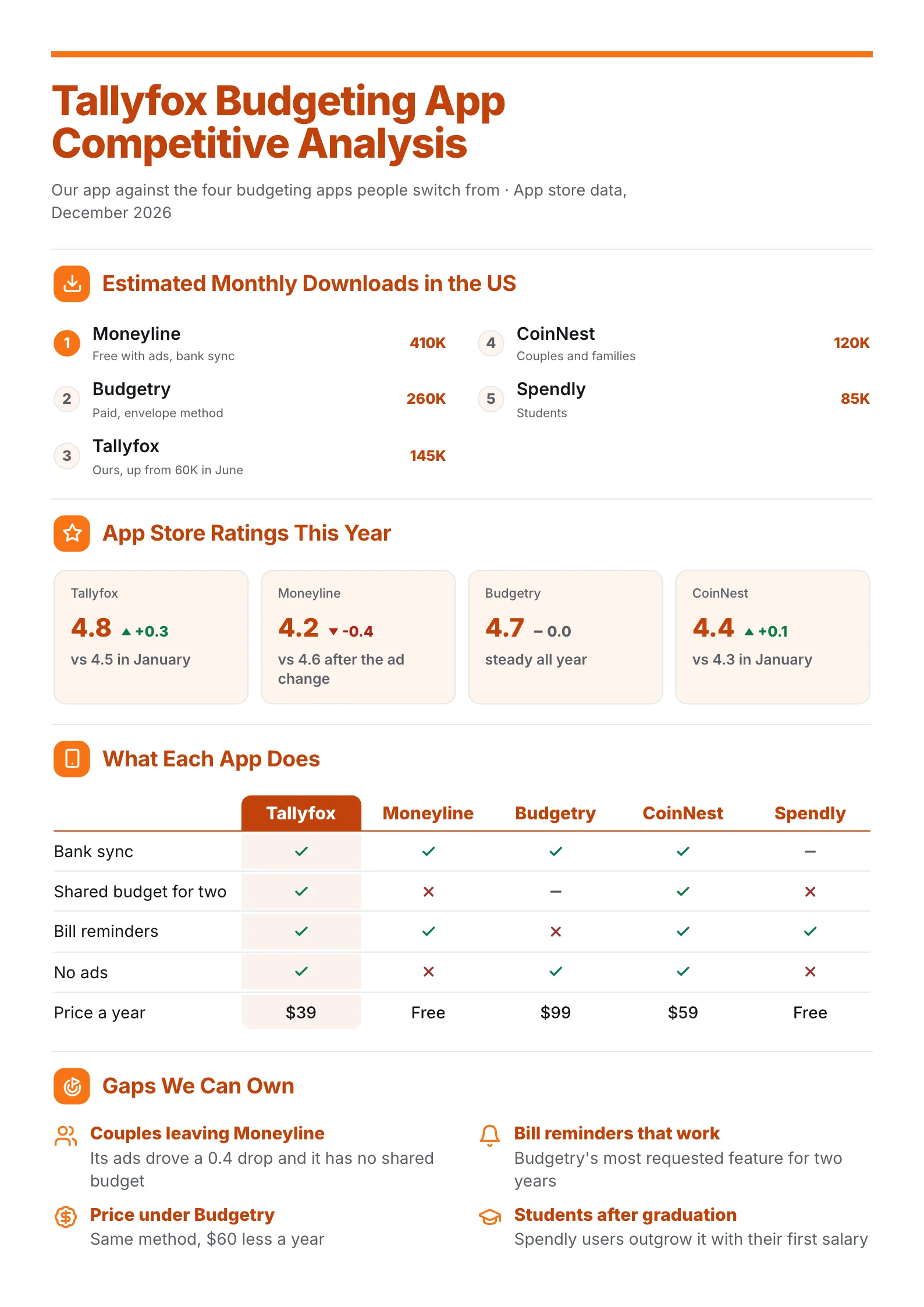 Edit this template
Sample names and figures. The rival set is defined by switching, the apps people left to come here.
Step 2: Count rivals from outside your category
Three of the six 10-Ks list rivals that aren't in their own industry. Planet Fitness lists 14 kinds of rivals for its members' time and money. They range from other gyms and the YMCA to home fitness equipment and local tanning salons. Dutch Bros says it also competes with convenience stores. Chipotle notes rising competition from food delivery services, which offer meals from many restaurants.
Do the same for your business. A coffee shop competes with the office coffee machine. A budgeting app competes with a spreadsheet. Add one or two of these to your list, because they often explain lost sales your direct rivals don't.
Step 3: Put names on your rivals
Only 2 of the 6 companies named a rival. Hilton names six primary competitors on a global scale, Accor, Choice Hotels, Hyatt, IHG, Marriott and Wyndham. Warby Parker names EssilorLuxottica and VSP as large players and Zenni Optical as a low-priced online one. The other four describe groups, like national and regional coffee chains.
| What the competition section includes | 10-Ks that do |
|---|---|
| Types of rivals | 6 of 6 |
| A list of factors customers choose on | 4 of 6 |
| Rivals from outside their own industry | 3 of 6 |
| Rival companies named | 2 of 6 |
| A market share number | 1 of 6 |
Source: MakeOnepagers read of 6 annual reports on Form 10-K filed in 2026, October 30, 2026. Each one is linked at the top of this post.
A 10-K is a public legal filing, so companies write it with care. Your competitive analysis is for your own team. You can name names, give numbers and be blunt about where you lose.
Pick three to five rivals your customers mention most, plus one from outside your category. A named rival can be scored, and a vague group can't.
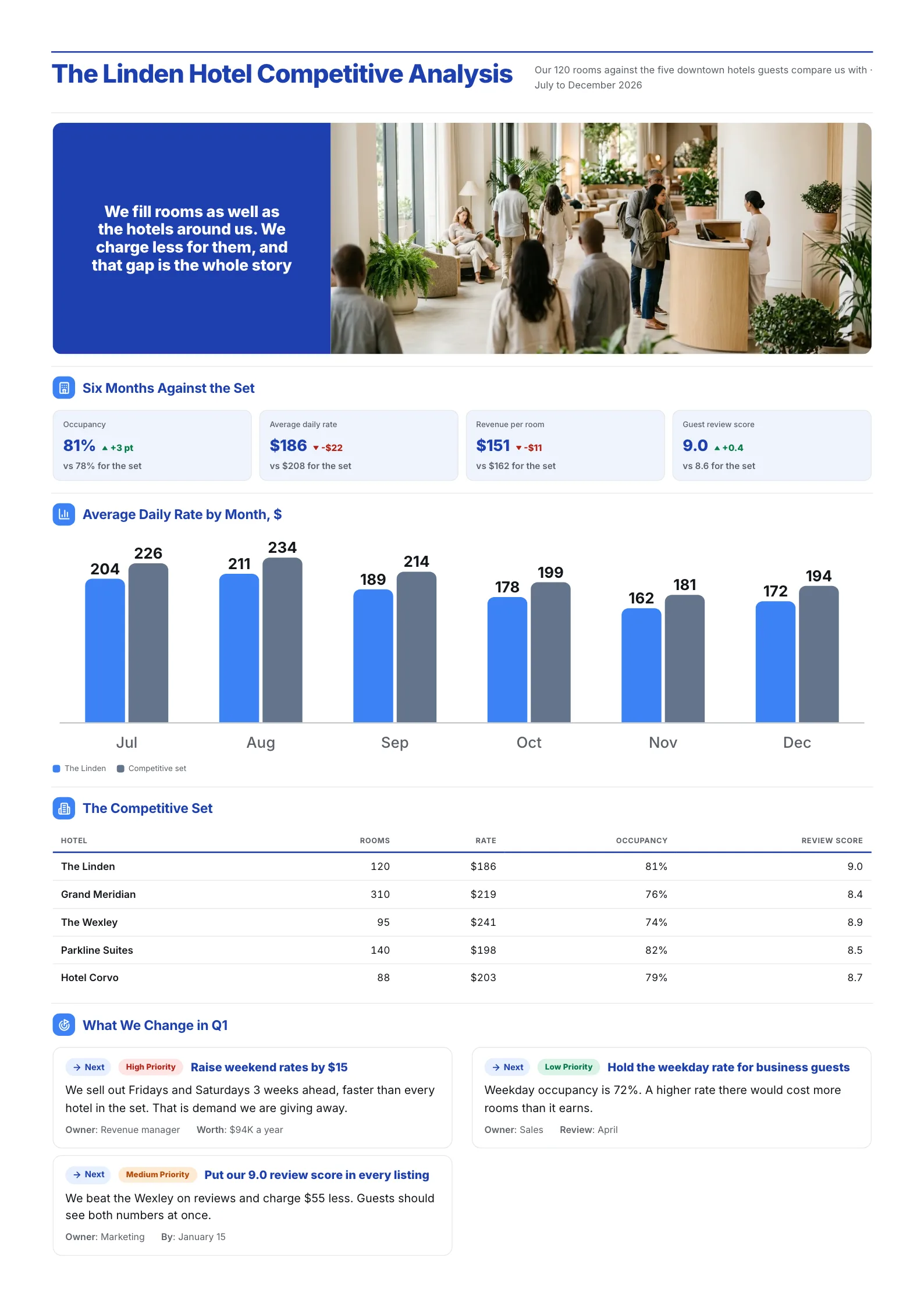 Edit this template
Sample names and figures. The five hotels are the ones guests compare, and every number sits beside the set's.
Step 4: List the factors buyers choose on
Four of the six 10-Ks list what customers compare. Chipotle names eight, including taste, price, food quality, service, location, convenience, brand reputation and cleanliness. Hilton lists eleven criteria, from location and room rate to its loyalty program. Dutch Bros names seven, including convenience, taste and price. Warby Parker names five, brand, quality, price, innovation and style.
Pick five to eight factors for your list. Use your customers' words where you can. Then score yourself and each rival on every factor, from 1 to 5. Use real data wherever it exists, like prices, wait times, ratings and review scores. Where you have to judge, ask a few customers to score instead of your own team.
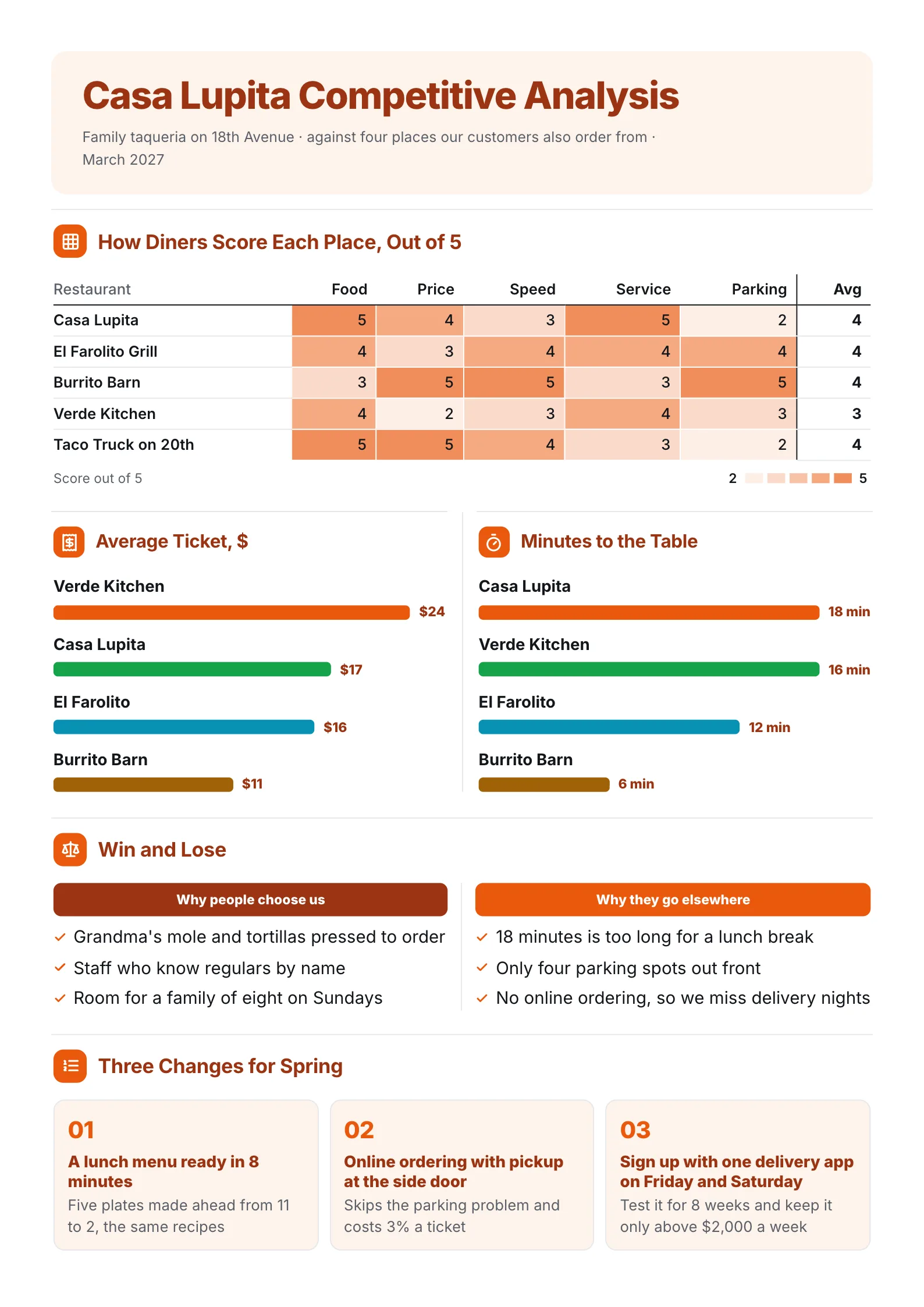 Edit this template
Sample names and figures. The five factors are the ones diners named, and the win and lose box turns the scores into reasons.
Step 5: Size the market and each share
Only Warby Parker gave a market number. It says independent optical shops made up about 40% of prescription optical retail sales in 2025, with national chains holding most of the rest. That one line tells you more about the market than a page of description.
Try to find a share for yourself and each rival, even a rough one. Listings, downloads, store counts, revenue or seats sold all work. The merger guidelines turn those shares into a single number for how crowded your market is. Square each firm's share and add them up. Above 1,800 counts as highly concentrated. Five rivals of equal size give 2,000.
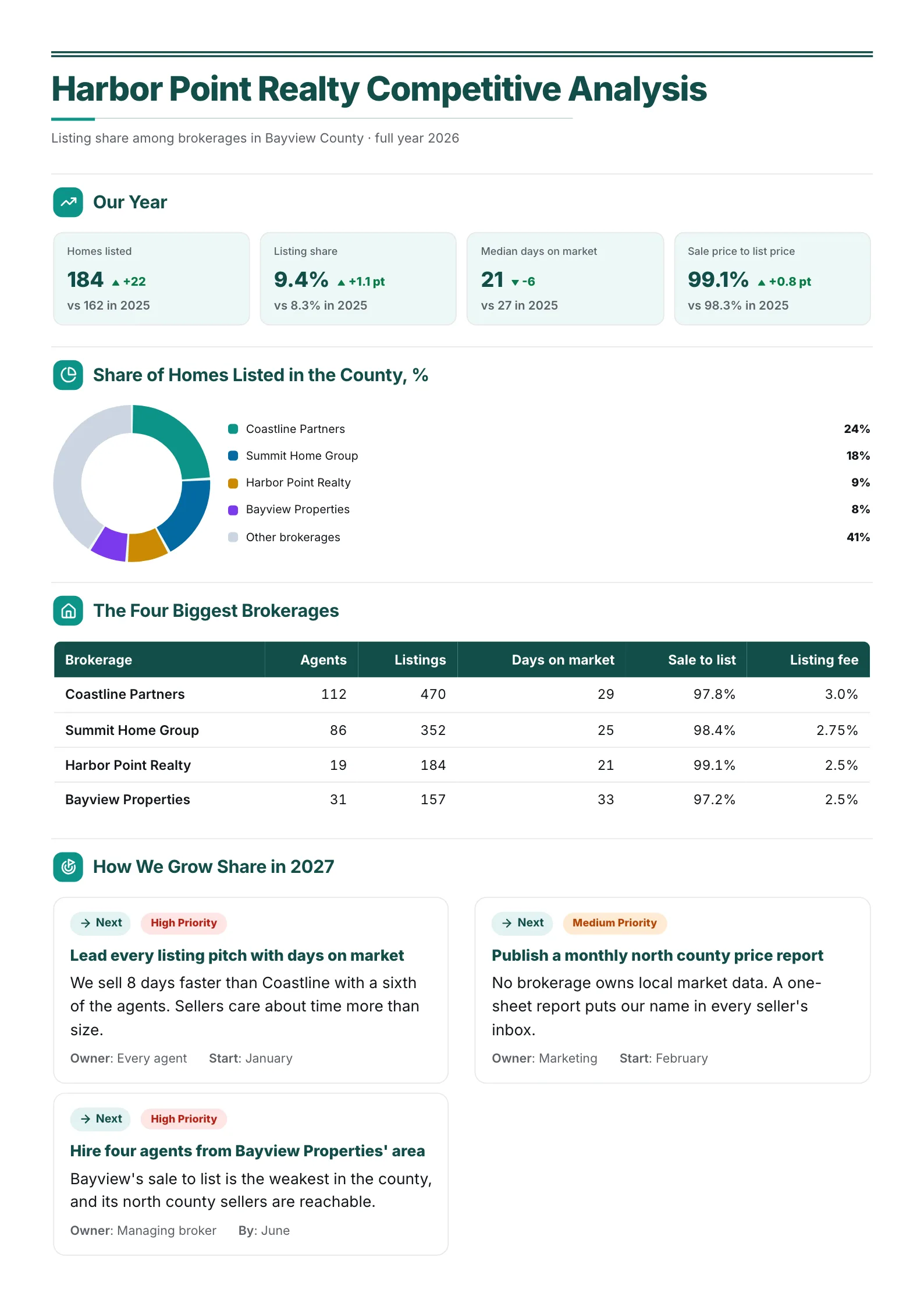 Edit this template
Sample names and figures. The share chart shows the whole county, so the 9.4% has something to sit against.
Step 6: Turn the scores into wins, losses and fixes
Compass's 10-K says it believes it competes favorably based on multiple factors. That's fine for a legal filing. Your analysis has to be more useful than that. Write two short lists, why customers pick you and why they pick someone else. Then turn the second list into two or three actions with owners and dates.
Keep the actions tied to the scores. If you lose on speed, the action is about speed. Put a date to redo the analysis at the bottom, like each quarter or before your next price change. If you also run a SWOT, your two lists feed straight into it, and our SWOT analysis guide shows where each one goes.
Here's how far that is from a 10-K paragraph, using the made-up restaurant from Step 4.
| Section | 10-K style | The restaurant's version |
|---|---|---|
| Rivals | National and regional chains | Verde Kitchen, El Farolito, Burrito Barn, the taco truck |
| How chosen | Not stated | Where lost customers said they went |
| Factors | Price, quality, service | Food, price, speed, service and parking, scored 1 to 5 |
| Share | Not stated | Our share of local orders, by month |
| Verdict | We compete favorably | We lose on speed at lunch, so we add a second line |
The owner can act on the last row by next week. The 10-K version gives them nothing to change.
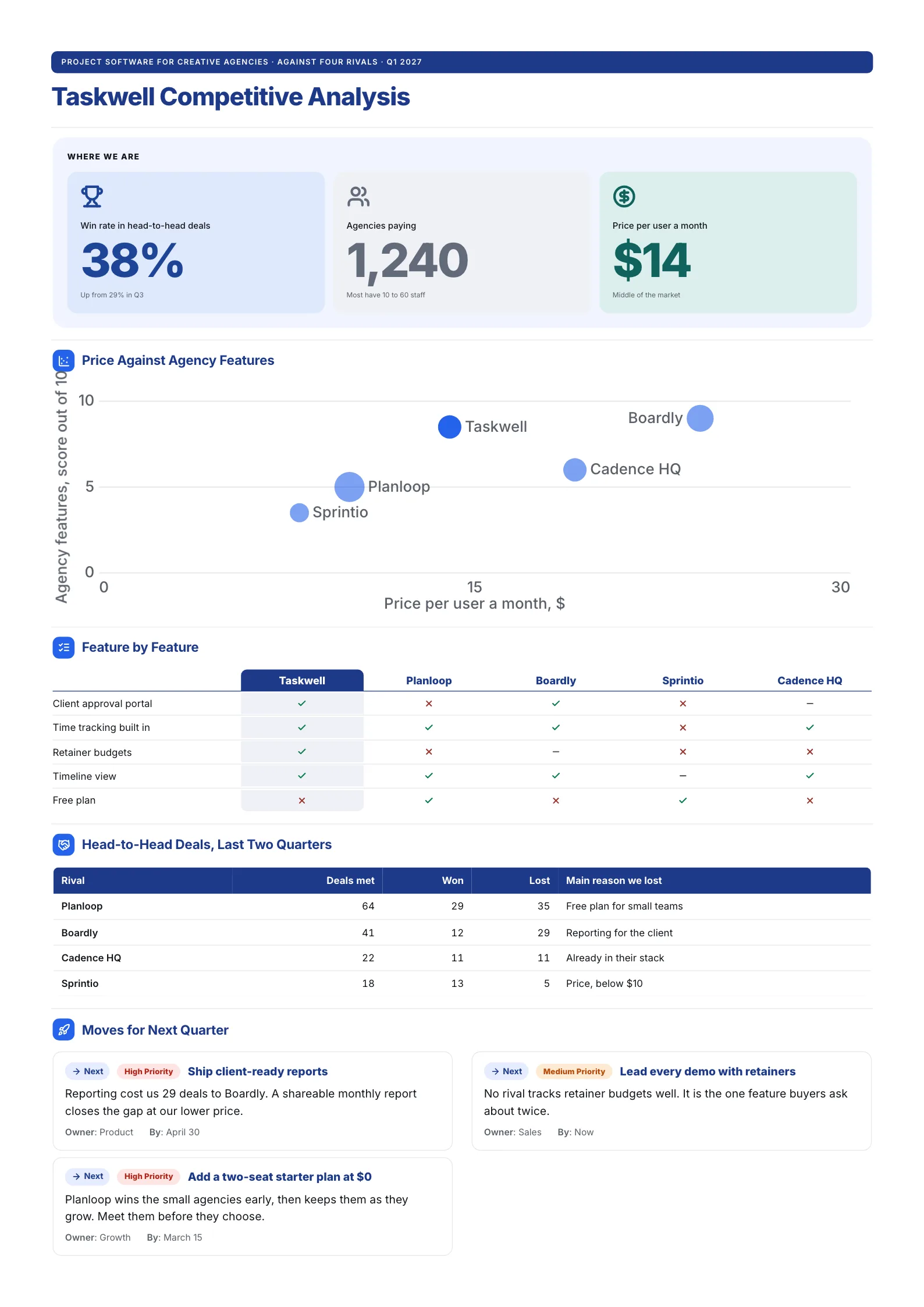 Edit this template
Sample names and figures. The win rate sits at the top, and the feature table shows which gaps the team is closing.
Rivals, scores and actions on a single page
You don't need a long report. Put your rivals and the factors in one scored table, add one chart of share or price and close with why you win, why you lose and your actions. That's one page.
Every MakeOnepagers competitive analysis design is built around a scored rival table, with a share chart and a box for why you win and lose. Add your rivals and scores, and the page reads top to bottom. See more filled-in examples in our competitive analysis template post. The battlecard template post turns each rival into a quick answer sheet for your sales team.
Call five lost prospects first
Ask your last five lost prospects who they chose. Name those rivals, list the factors buyers mention and score everyone. Add a rough share, then write why you win and lose. Build the scored page in MakeOnepagers, bring it to your next team meeting and ask which loss to fix first.
Frequently asked questions
What should a competitive analysis include?
Your named rivals, the factors buyers choose on, a score for everyone on each factor, a rough market share and what you'll change. Add one rival from outside your category if your customers use it instead.
How many competitors should I include?
Three to five direct rivals and one or two from outside your category. Hilton names six on a global scale, which is a lot for a one-page analysis.
Where can I find data on competitors?
Their prices, reviews, ratings, job posts and public filings. Ask your own customers and lost prospects too, since switching is the evidence regulators read first.
How often should I update a competitive analysis?
Each quarter, or before a big decision like a price change or launch. A new rival or a lost deal is also a good reason to redo it.




