Competitive Analysis Template: Free One-Page Competitor Comparison
A free competitive analysis template on one page: market share, a side-by-side table and a clear recommendation, with a worked example.


A competitive analysis template lays out how you compare with your main rivals on the things buyers actually weigh. That means price, features, speed and service, plus who they sell to and how much of the market they hold. Then it says what that means for you. Most competitive research dies in a spreadsheet with 40 rows that nobody reads twice. A one-page competitive analysis forces you to pick the comparisons that matter and to write down a recommendation. Below you'll find the parts of a good one and a free competitive analysis template. You'll also see six competitive analysis examples and the mistakes that waste your work. Start from a free one pager template.
One‑Pager examples
Real One-Pagers made with MakeOnepagers. Open any one to edit it as your own.
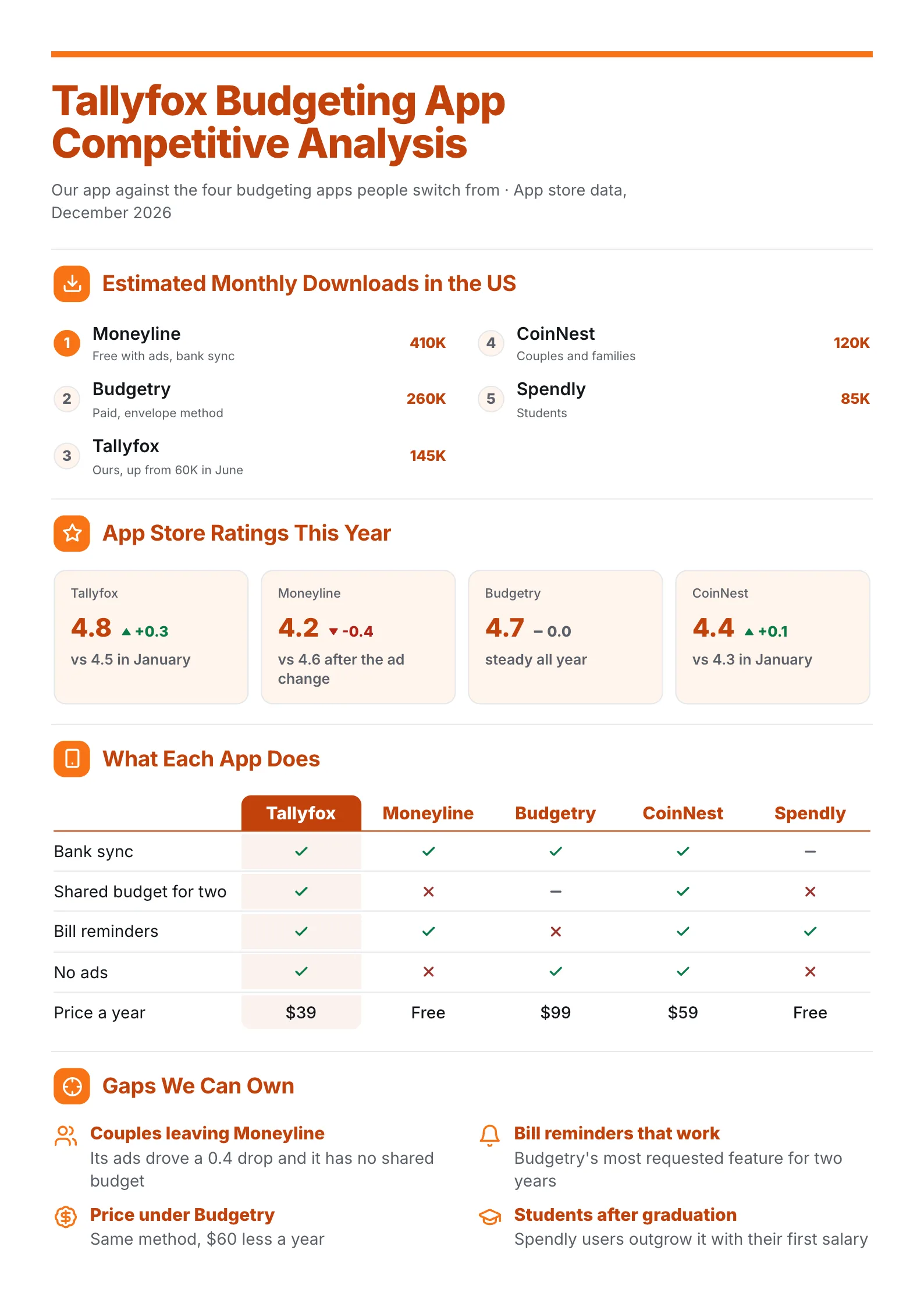 Competitive Analysis: Mobile AppEdit for free(opens in a new tab)
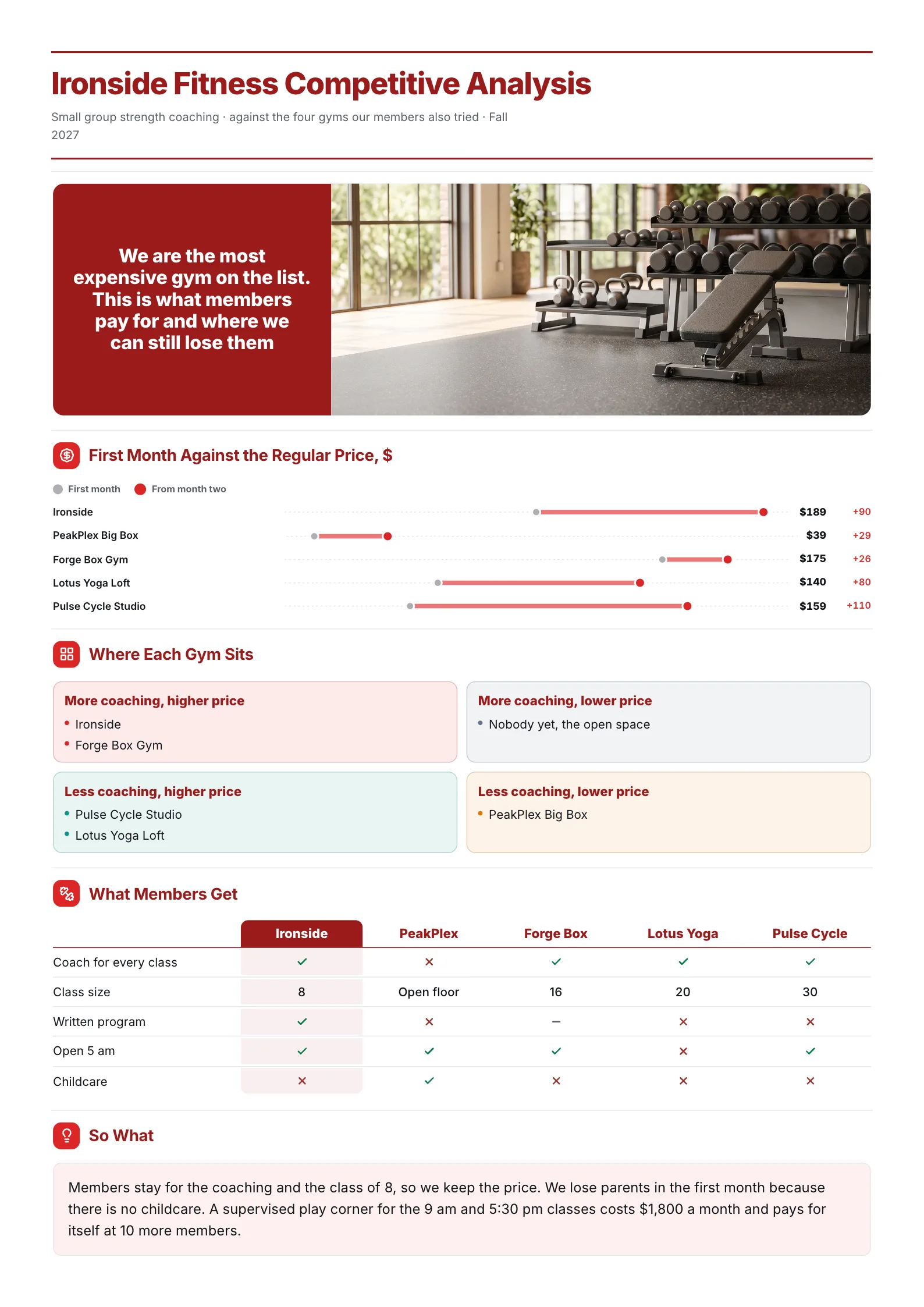 Competitive Analysis: GymEdit for free(opens in a new tab)
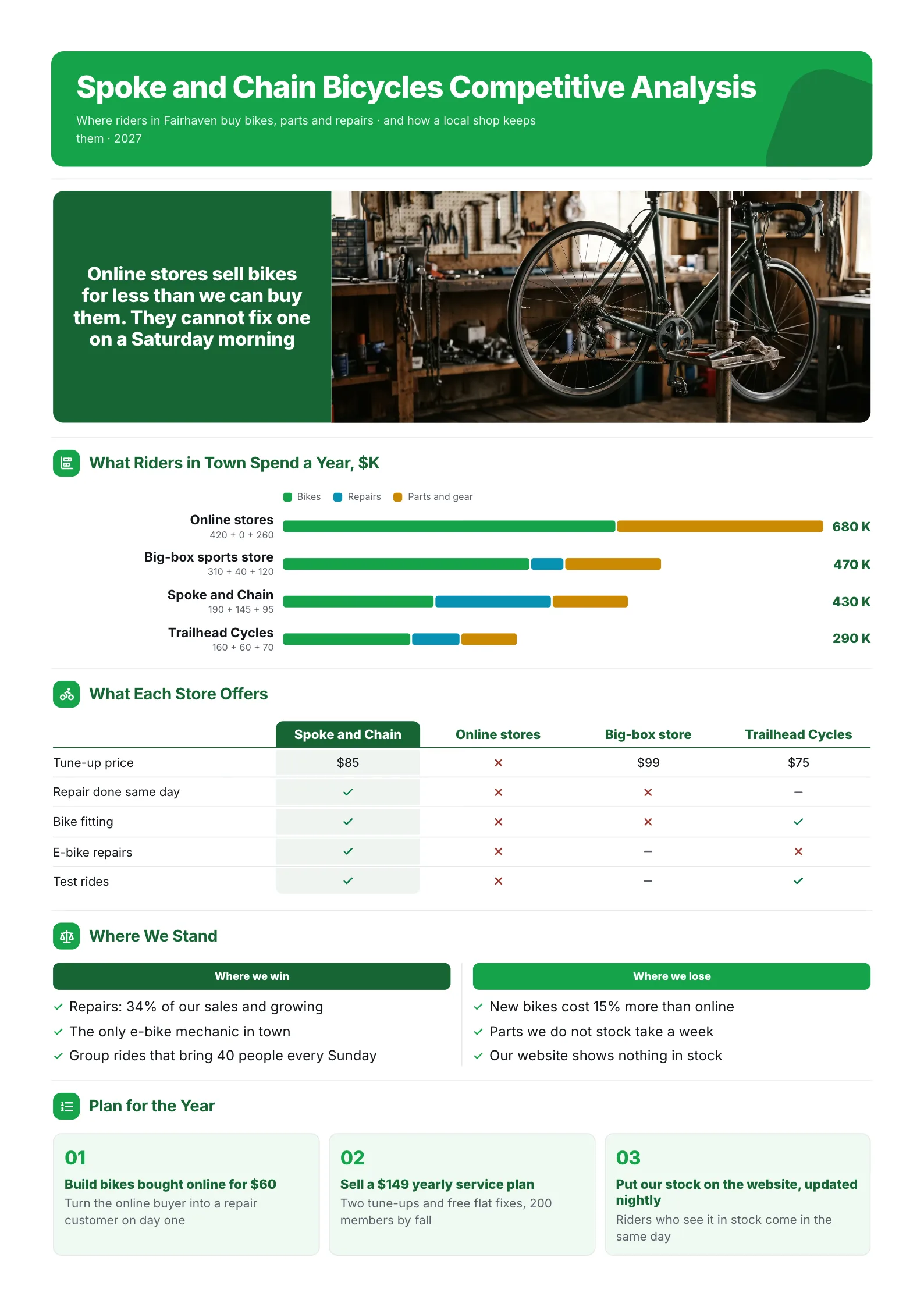 Competitive Analysis: Bike ShopEdit for free(opens in a new tab)
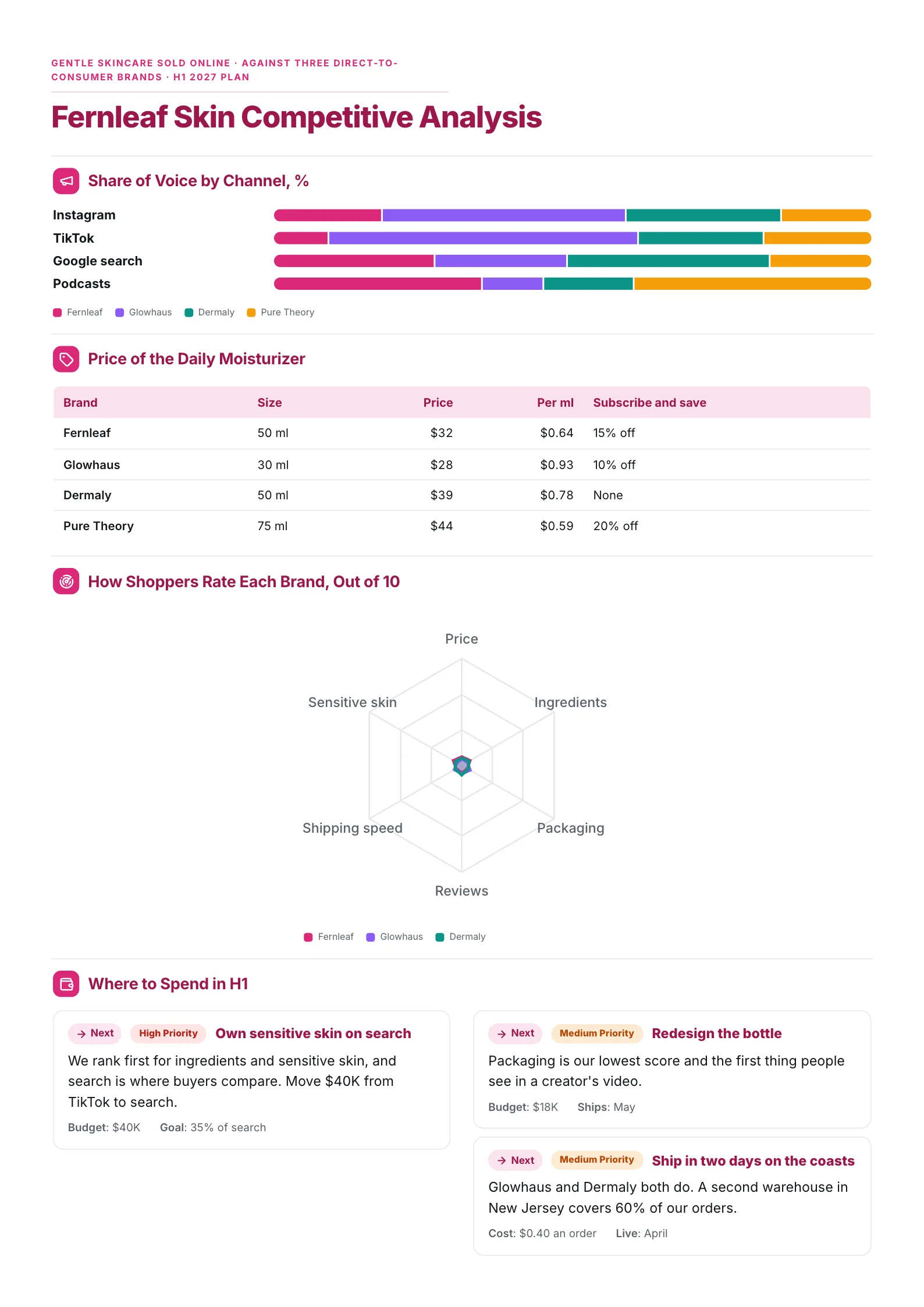 Competitive Analysis: Skincare BrandEdit for free(opens in a new tab)
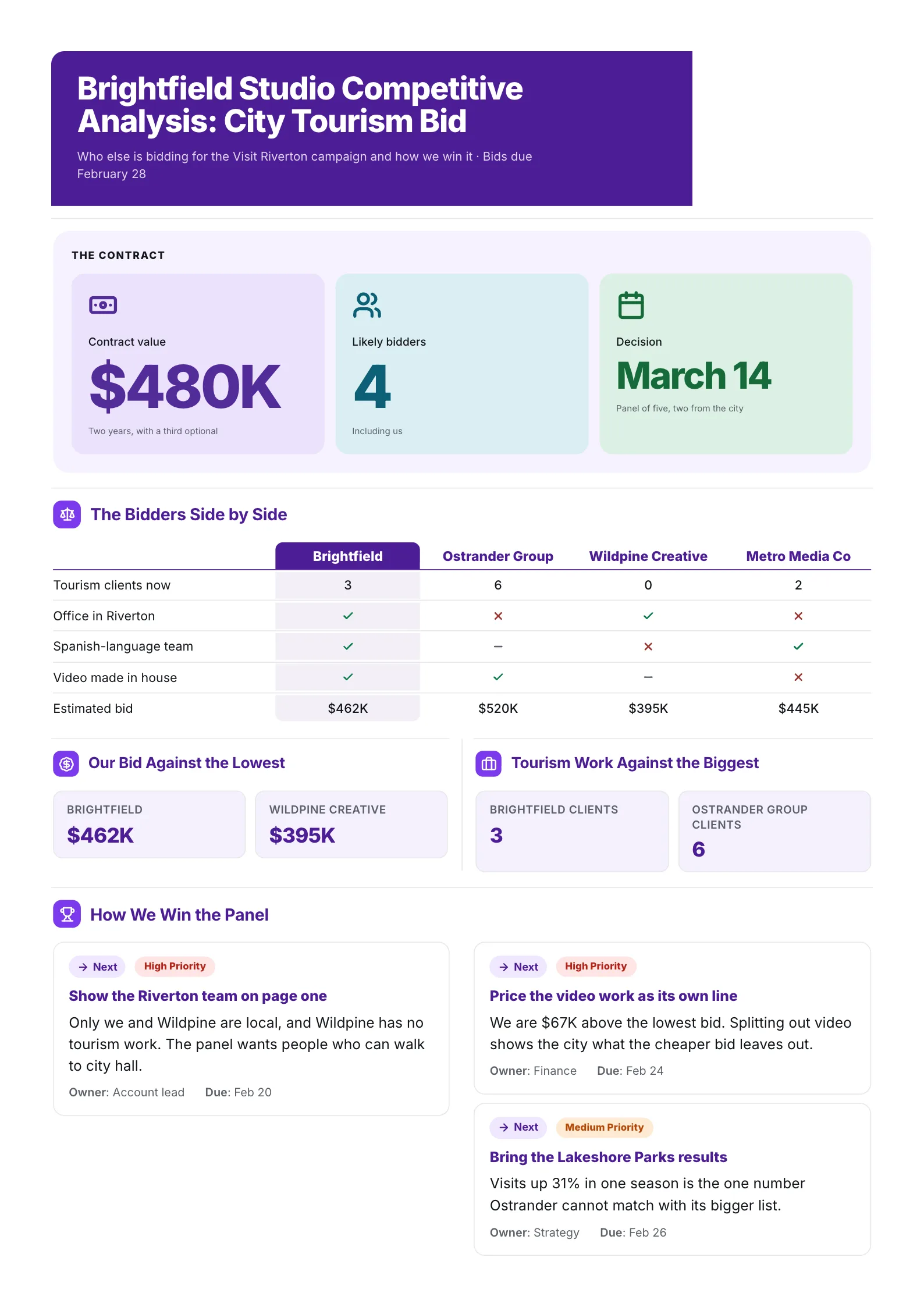 Competitive Analysis: Agency BidEdit for free(opens in a new tab)
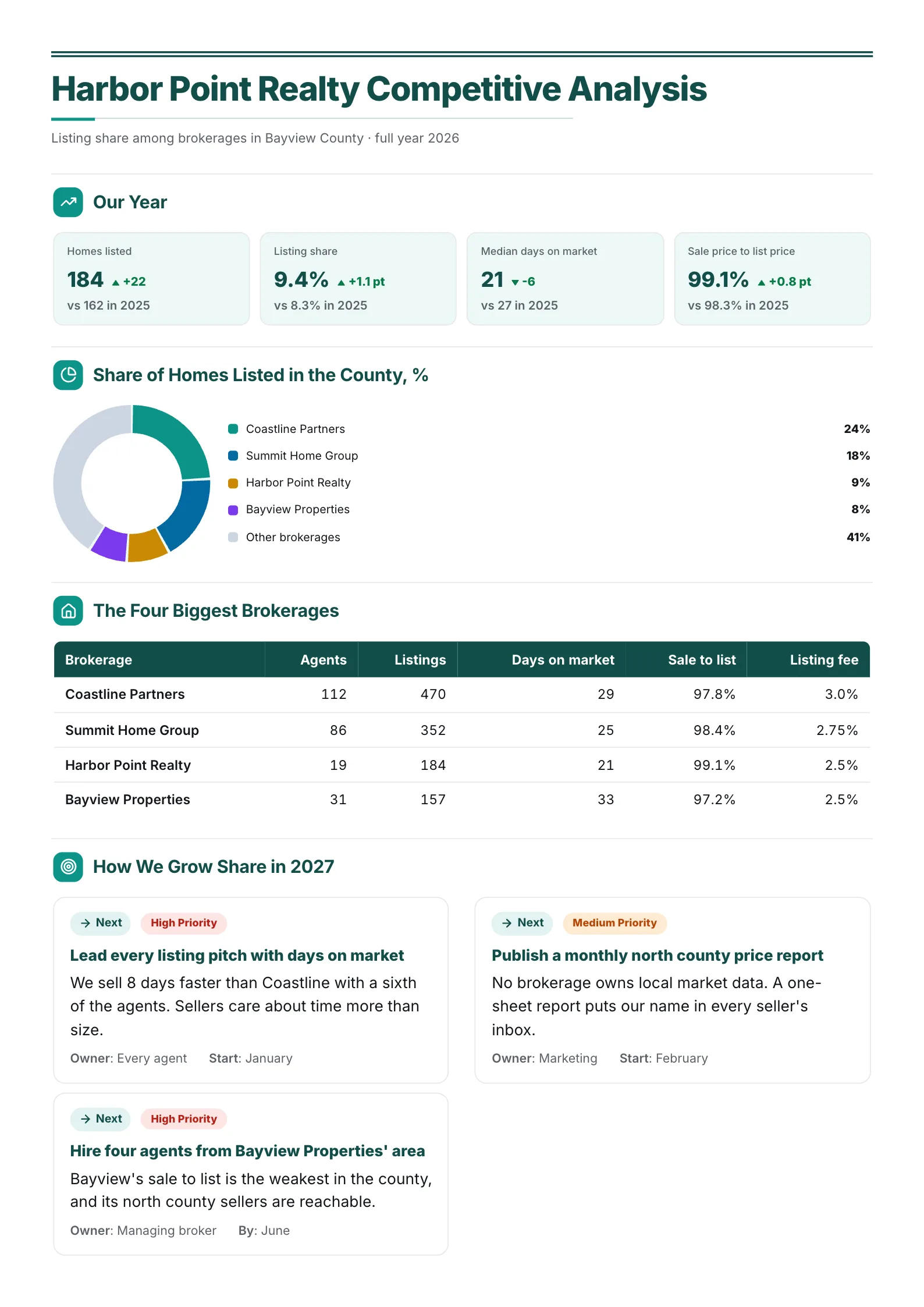 Competitive Analysis: Real Estate BrokerageEdit for free(opens in a new tab)
Every example was made with MakeOnepagers. Each one opens as a template, and you can edit every word, chart and color for free.
What is a competitive analysis?
A competitive analysis (also called a competitor analysis or competitive landscape) is a structured look at the companies your buyers could choose instead of you. It compares you and them on the same set of points so you can see the differences. Then you turn those differences into decisions about pricing, product, positioning or sales.
It can be broad (every player in a market, for a strategy meeting) or narrow (one rival, for a sales team). The narrow version that sales reps use on calls is a battlecard. This guide covers the broader one-page view.
How many competitors should you include?
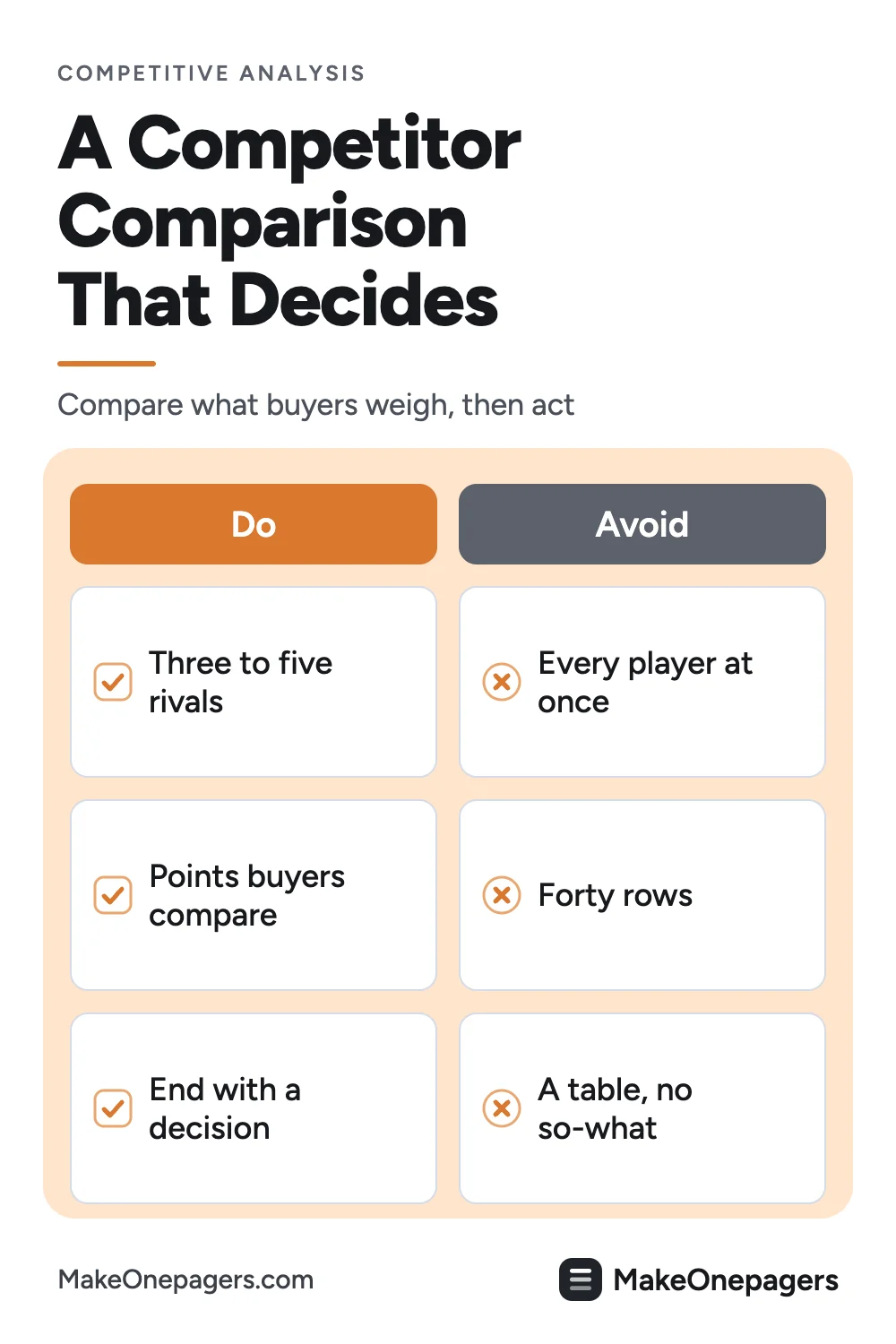
Three to five direct competitors is usually enough for a working document. Pick the ones you meet most often in deals or that hold the most share. Add one indirect competitor if your buyers often solve the problem another way, for example with a spreadsheet, an agency or by doing nothing. More than five and your table becomes too wide to read.
What to include in a competitive analysis template
- The market and who you compared: the segment, the rivals and the date.
- Market share or size: who holds how much, even as an estimate, with the source.
- Side by side: five or six points buyers compare, with each company's answer.
- Where we stand: what you already win on, and where you are at risk.
- Strengths and weaknesses of each rival: one or two lines each, if there is room.
- The so-what: two or three sentences on what to do next.
Which points should you compare?
Pick what your buyers ask about. Something that's easy to find may not matter to them at all. Here's a good test. Would a buyer mention it when explaining why they chose one company over another? Common choices are price, the main features, speed or setup time, service, who it is built for and how it is sold. Keep the same points for every rival so your comparison stays fair.
A free competitive analysis template
Copy this into a document, or open the example below and edit it.
| Part | What to write, with an example |
|---|---|
| Title | Market and team. Meal Kits for Busy Families: Competitive Landscape |
| Share | Each rival as a percent. PlateWise 34%, FreshCrate 27%, us 19% |
| Side by side | 5 points x 4 companies. Price per serving: $8.49, $9.99, $7.29, $11.50 |
| Where we stand | 2 wins, 2 risks or gaps |
| So what | 2 to 3 sentences with an action and a date |
| Footnote | Source and date of every number |
6 competitive analysis examples
Here are six businesses sizing up their rivals. You'll see a meal kit company, a coffee shop, a software product, a new dental practice, a snack brand and a hotel. Each compares on the points its buyers weigh, then says what to do.
1. Market competitive analysis
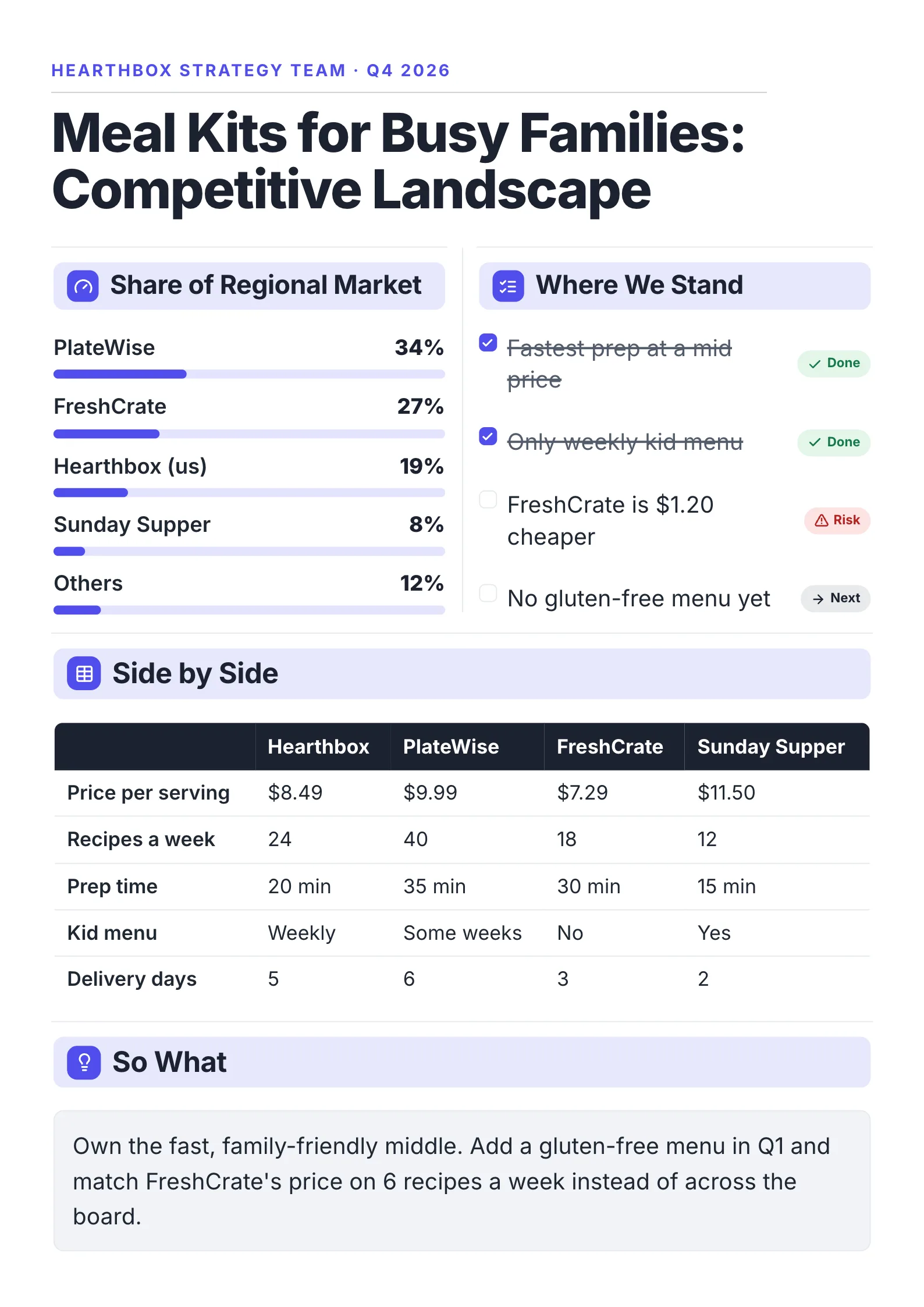 Edit this template
Four companies compared on five points, and a recommendation at the bottom.
What to copy:
- Share as bars, not a pie: 34%, 27%, 19% and 8% read at a glance and leave room for the table.
- Where we stand as a checklist: two wins ticked, one risk ("FreshCrate is $1.20 cheaper") and one gap ("No gluten-free menu yet") with a next step.
- A table buyers would recognize: price per serving, recipes a week, prep time, kid menu, delivery days. No internal jargon.
- A so-what with dates: add a gluten-free menu in Q1 and match the cheapest rival's price on 6 recipes a week instead of across the board. That is a decision a leadership team can approve.
You can edit this competitive analysis template for free.
2. Coffee shop competitive analysis
 Edit this template
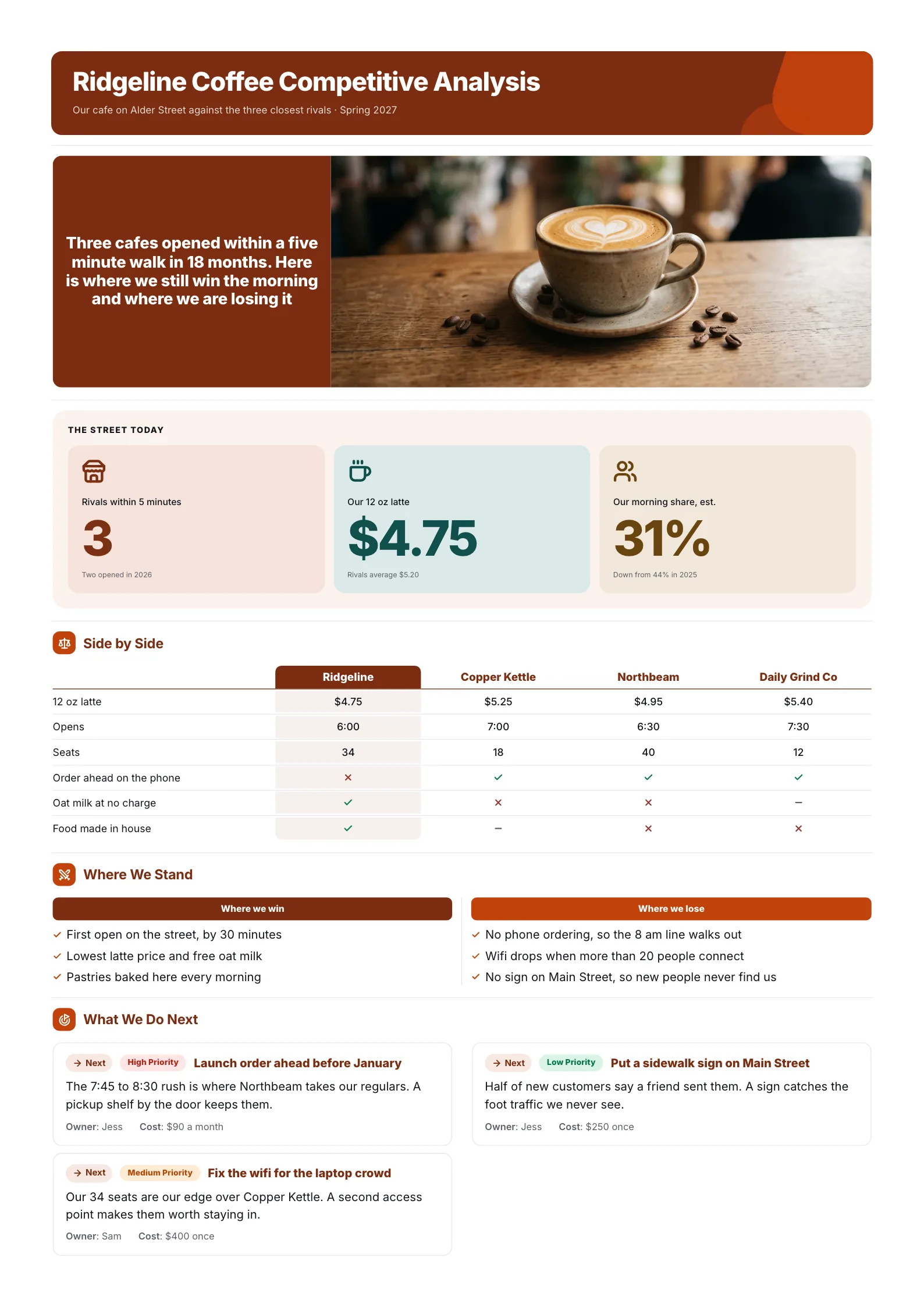
A neighbourhood cafe sees three new rivals open within a five minute walk.
What to copy:
- The loss in one number. Morning share is 31%, down from 44% in 2025.
- Wins and losses in plain lines. "No phone ordering, so the 8 am line walks out."
- A move tied to the hour it fixes. Order ahead before January, because "the 7:45 to 8:30 rush is where Northbeam takes our regulars."
You can edit this coffee shop competitive analysis template for free.
3. SaaS competitive analysis
 Edit this template
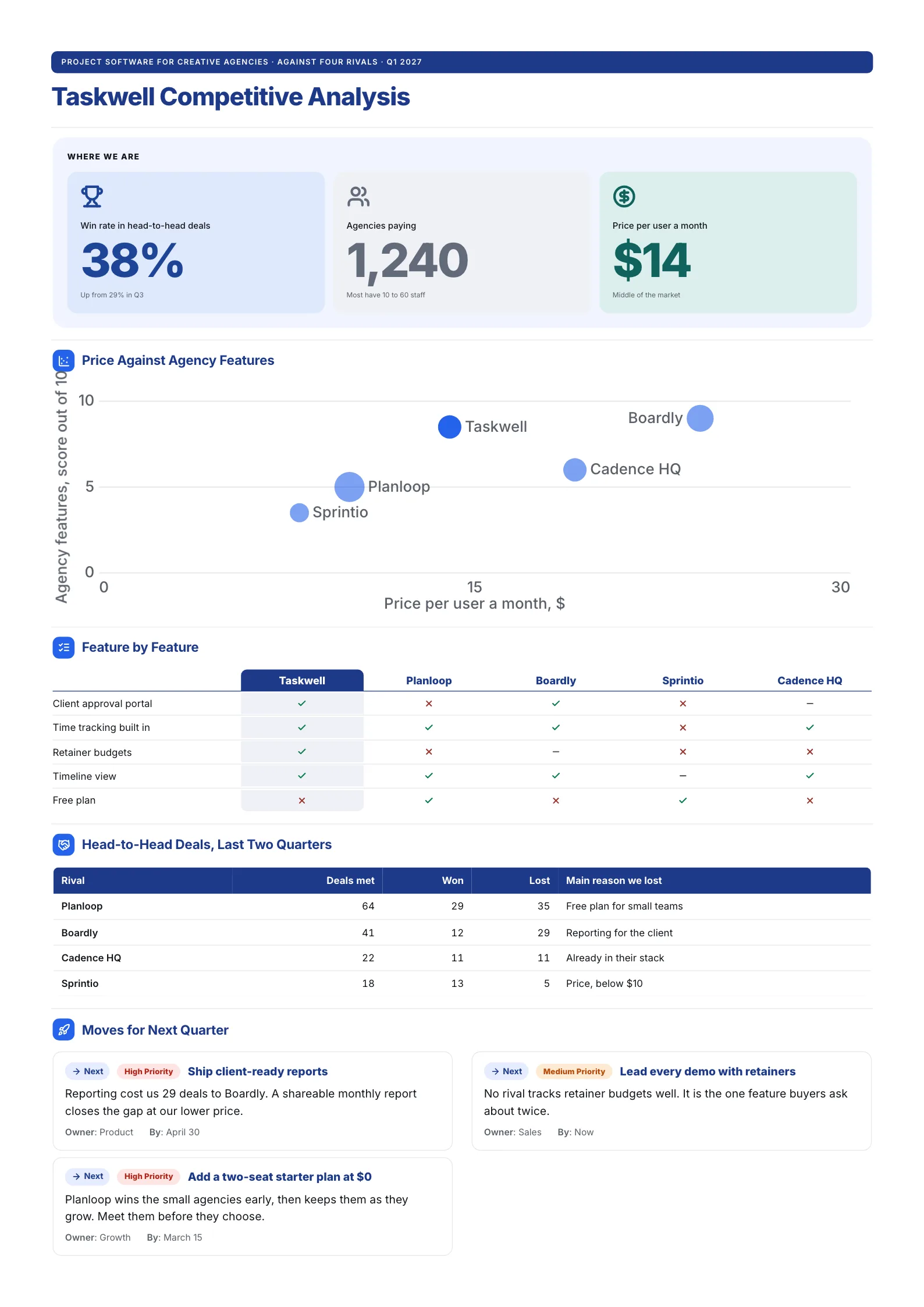
A software product reads its own deal record to see where each rival beats it.
What to copy:
- The win rate, with its trend. 38% in head-to-head deals, up from 29% in Q3.
- Every loss with its reason. Planloop won 35 of 64 deals on a "free plan for small teams".
- A move sized by the deals it lost. "Reporting cost us 29 deals to Boardly", so client-ready reports ship first.
You can edit this SaaS competitive analysis template for free.
4. Dental practice competitive analysis
 Edit this template
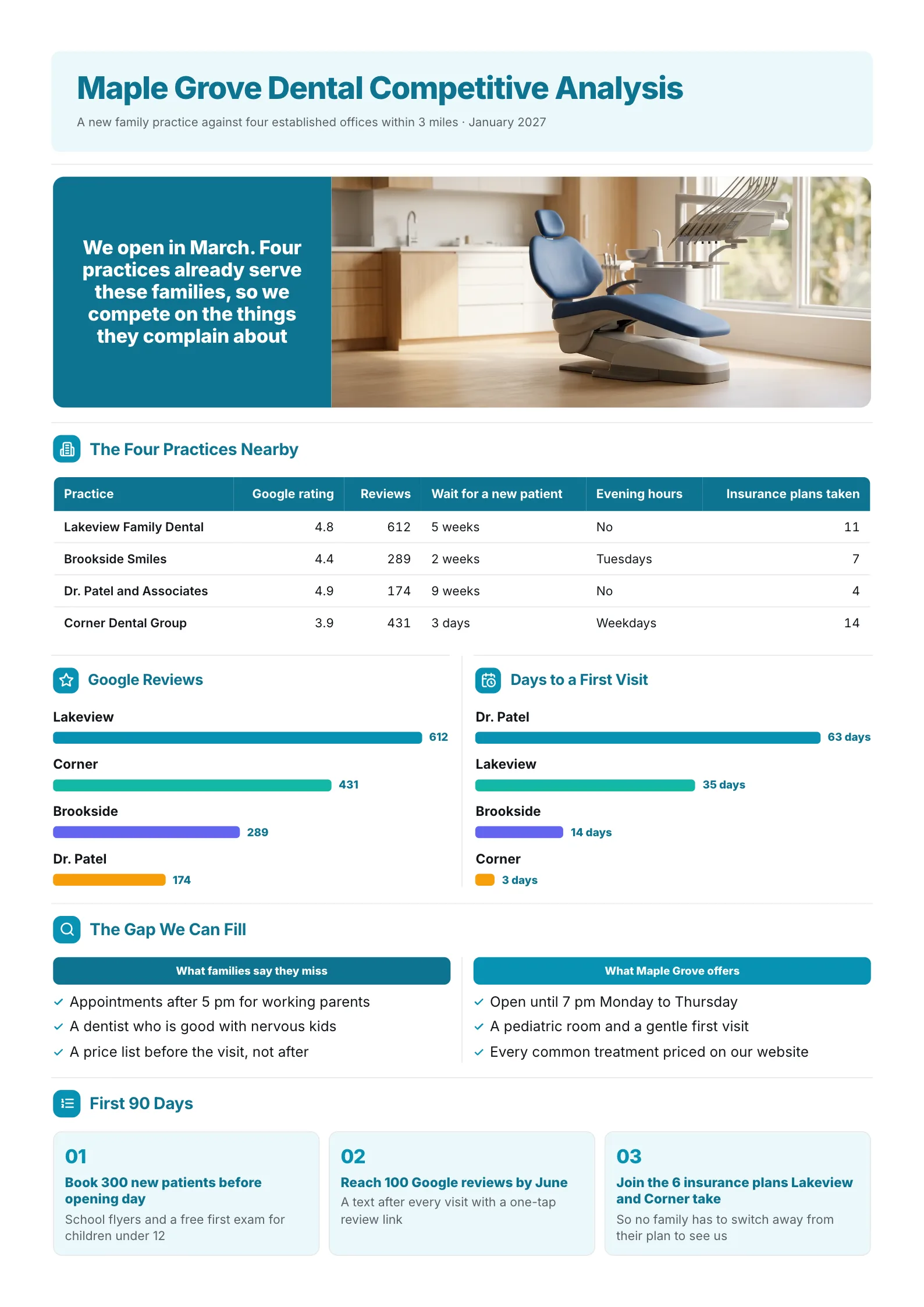
A practice that opens in March competes on what families say they miss.
What to copy:
- A table of the facts families check. Dr. Patel and Associates rates 4.9 but makes a new patient wait 9 weeks.
- The gap, then the answer. Families want "appointments after 5 pm for working parents", so Maple Grove is open until 7 pm Monday to Thursday.
- A target for opening day. Book 300 new patients before the doors open.
You can edit this dental practice competitive analysis template for free.
5. Snack brand competitive analysis
 Edit this template
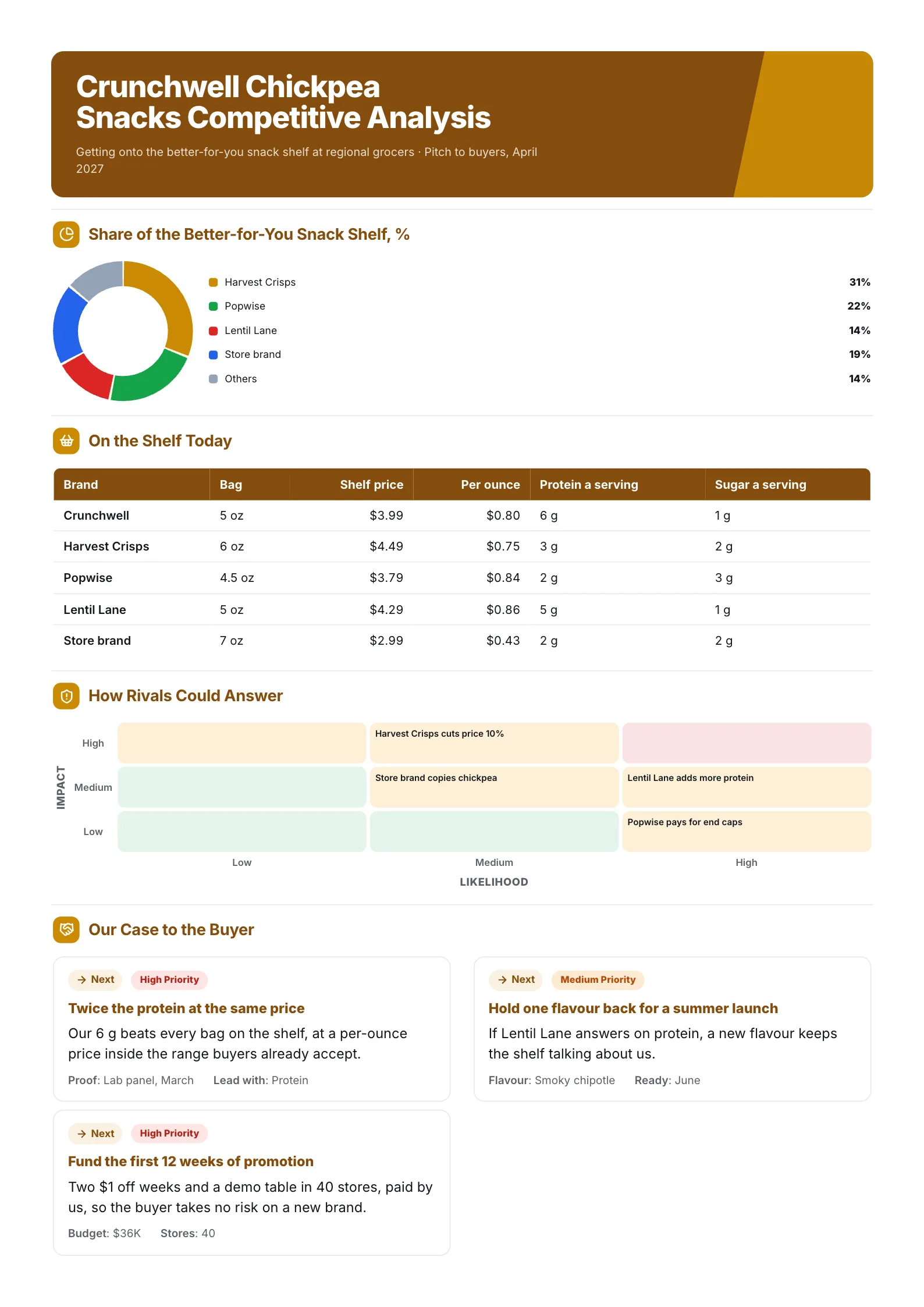
A new snack brand makes its case to a grocery buyer, bag by bag.
What to copy:
- Price per ounce, not shelf price. $3.99 a bag is $0.80 an ounce, against $0.43 to $0.86 for the rest of the shelf.
- The one fact nobody else has. "Our 6 g beats every bag on the shelf", at a price per ounce buyers already accept.
- Take the risk off the buyer. "Two $1 off weeks and a demo table in 40 stores, paid by us."
You can edit this snack brand competitive analysis template for free.
6. Hotel competitive analysis
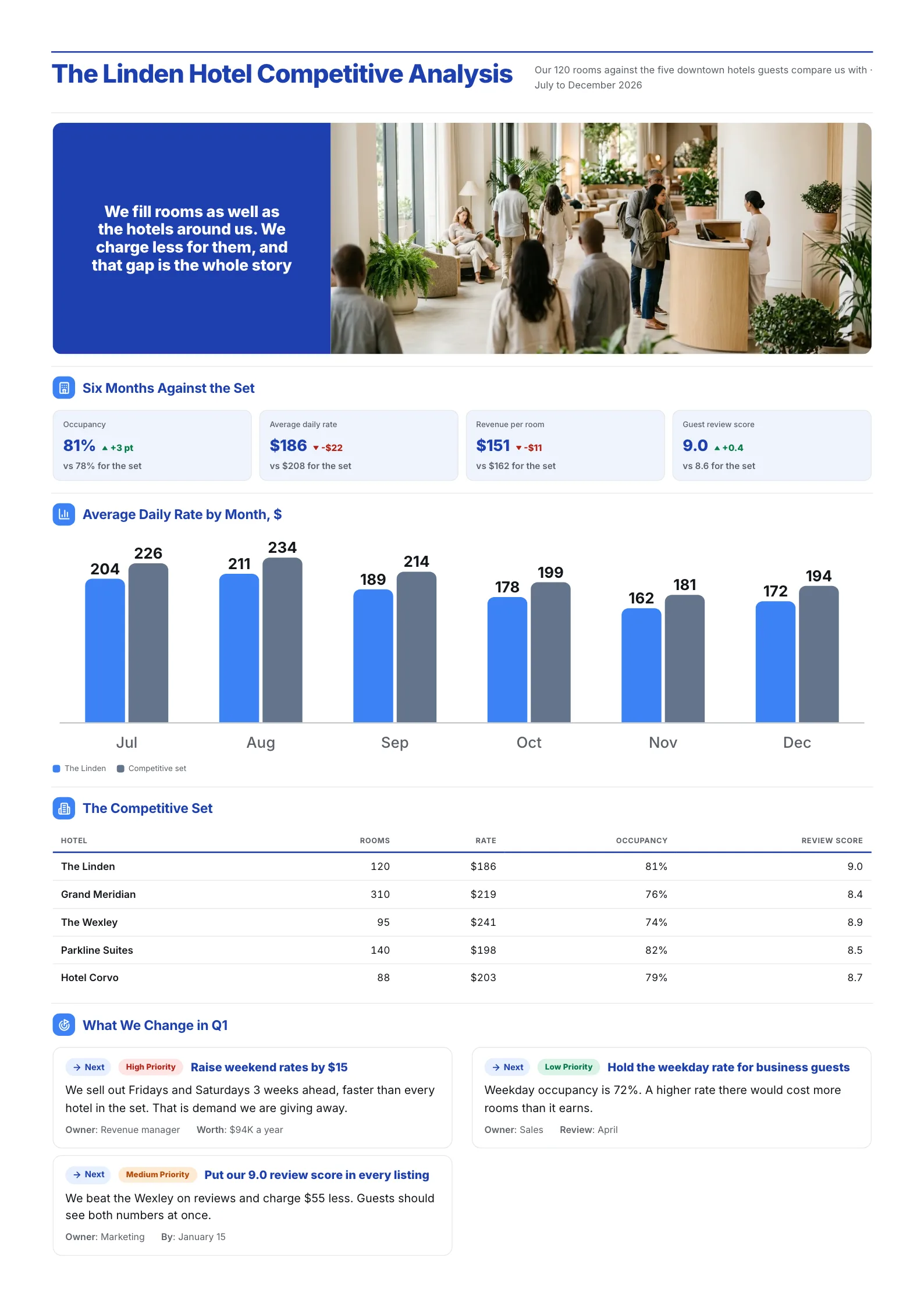 Edit this template
A downtown hotel fills rooms as well as its rivals and charges less for them.
What to copy:
- Each number against the set. Occupancy 81% against 78%, daily rate $186 against $208.
- The story in one sentence. "We charge less for them, and that gap is the whole story."
- A price move backed by demand. Raise weekend rates by $15, because Fridays and Saturdays sell out 3 weeks ahead.
You can edit this hotel competitive analysis template for free.
A worked example: from notes to a recommendation
The companies and numbers below are an example, made up to show the method.
A company that sells project software to architecture firms compares itself with three rivals. The product marketer reads the last 30 lost deals in the CRM and the rivals' public pricing pages.
| Us | Rival A | Rival B | Rival C | |
|---|---|---|---|---|
| Price per user a month | $24 | $19 | $32 | $15 |
| Drawing file preview | Yes | No | Yes | No |
| Time to set up | 1 day | 1 week | 2 weeks | 1 day |
| Built for | Architects | Any team | Engineers | Any team |
| Phone support | Yes | No | Yes | No |
The CRM shows 30 lost deals last year. Rival A took 14, Rival B took 9 and Rival C took 7. The notes on the Rival A losses mention price in 11 of the 14.
The so-what says, "We win on drawing previews and setup time and lose to Rival A on price at small firms. Offer a 5-user starter plan at $19 by March, and lead small-firm sales calls with the drawing preview." You end with one table, one count and one recommendation. A manager can say yes to that in a meeting.
How to do a competitive analysis in 6 steps
- List the rivals buyers actually mention, from sales notes, lost deals and reviews.
- Pick five or six points buyers compare. Use their words, not yours.
- Gather the facts from public pricing pages, product pages, reviews, sales calls and trial accounts. Note the source and date for each.
- Fill in the table honestly, including the rows where a rival beats you.
- Write where you stand: two or three wins, two or three risks.
- Write the so-what last: what to change, by when and who owns it.
Have a long research document or a messy spreadsheet? Drop it into the free AI One-Pager generator and get it back as a designed competitive analysis One-Pager.
Competitive analysis mistakes
- Comparing everything. Forty rows hide the five that matter.
- Only your strengths. If you never lose a row, nobody will trust the table.
- No sources or dates. Prices and features change. Write where each number came from and when.
- Too many rivals. Beyond five, the table is too wide and the story gets lost.
- No so-what. Without a recommendation, the work changes nothing.
- Done once. Review it every quarter, and whenever a rival changes its price or launches something big.
Make your competitive analysis
Open the free competitive analysis template and put in your own market, or drop your research into the free AI One-Pager generator and get a finished One-Pager comparison back.
Frequently asked questions
What should a competitive analysis template include?
Include the market and the rivals you compared, plus market share or size. Add a side-by-side table of five or six points your buyers care about. Then say where you stand and give a short recommendation, with the source and date of every number.
How many competitors should be in a competitive analysis?
Include three to five direct competitors. Add one indirect alternative if your buyers often use it instead, such as a spreadsheet or an agency.
What is the difference between a competitive analysis and a SWOT analysis?
A competitive analysis compares you with named rivals, point by point. A SWOT analysis looks at your own strengths and weaknesses and the opportunities and threats around you, which can include rivals but is not limited to them.
Where do you find information about competitors?
Start with their public websites and pricing pages, product reviews, job postings and press releases. Then read your own sales and lost-deal notes, and talk to customers who considered them.
How often should you update a competitive analysis?
Update it every quarter. Also update it whenever a competitor changes its pricing, launches a major product or starts showing up in more of your deals.




