Go to Market Strategy vs Marketing Strategy: What 4 IPO Filings Put Under Each
Go to market strategy vs marketing strategy, read in 4 IPO filings: one plans who buys and how they're sold, the other how people hear of you. See both.

Go to market strategy vs marketing strategy comes down to two different jobs. A go to market strategy plans who buys, who sells to them and through which channels, usually for a launch or a new market. A marketing strategy plans how people hear about you and why they pick you, and it runs all the time. Start from a free one pager template.
One‑Pager examples
Real One-Pagers made with MakeOnepagers. Open any one to edit it as your own.
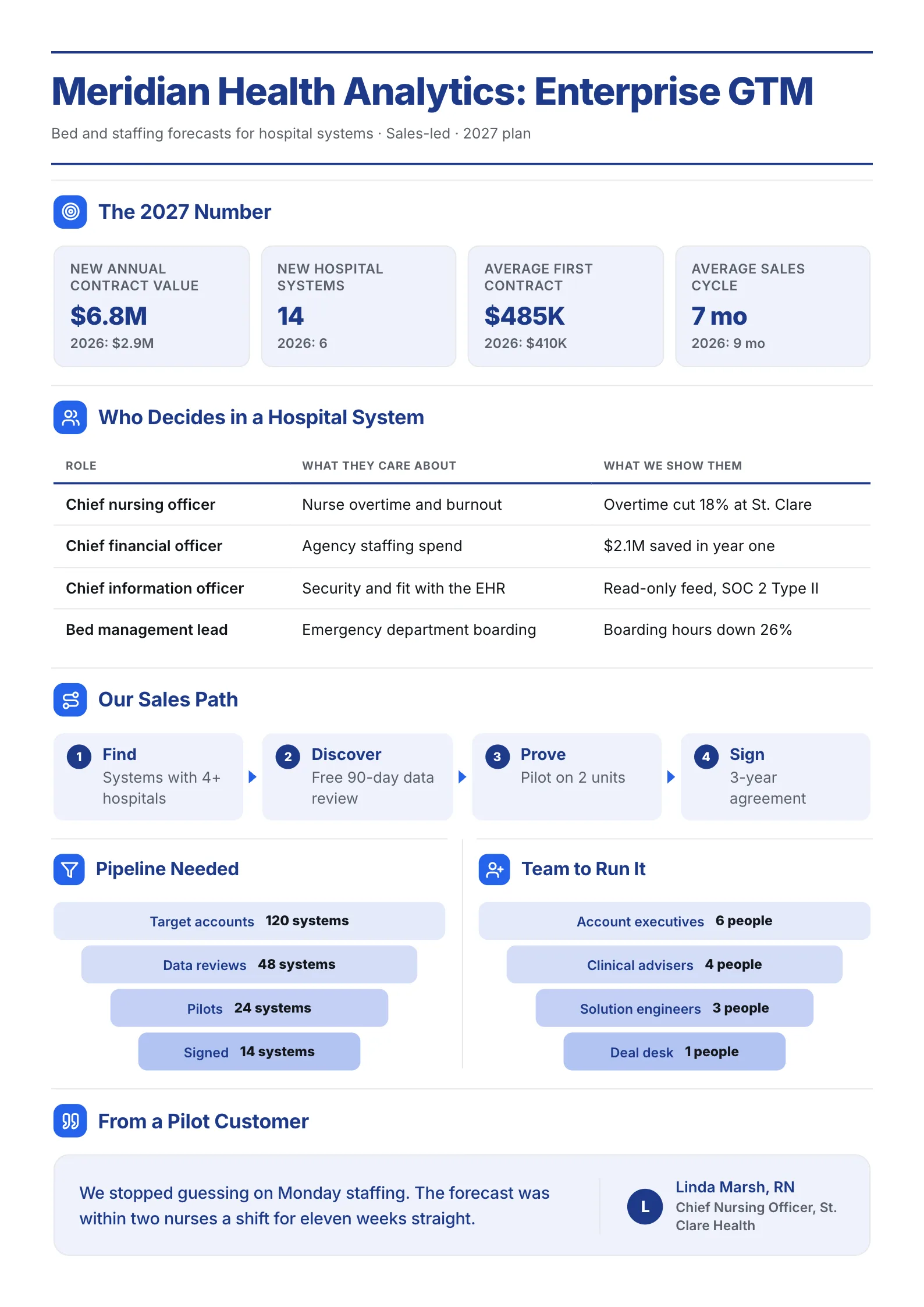 Go-to-Market Strategy: Enterprise SalesEdit for free(opens in a new tab)
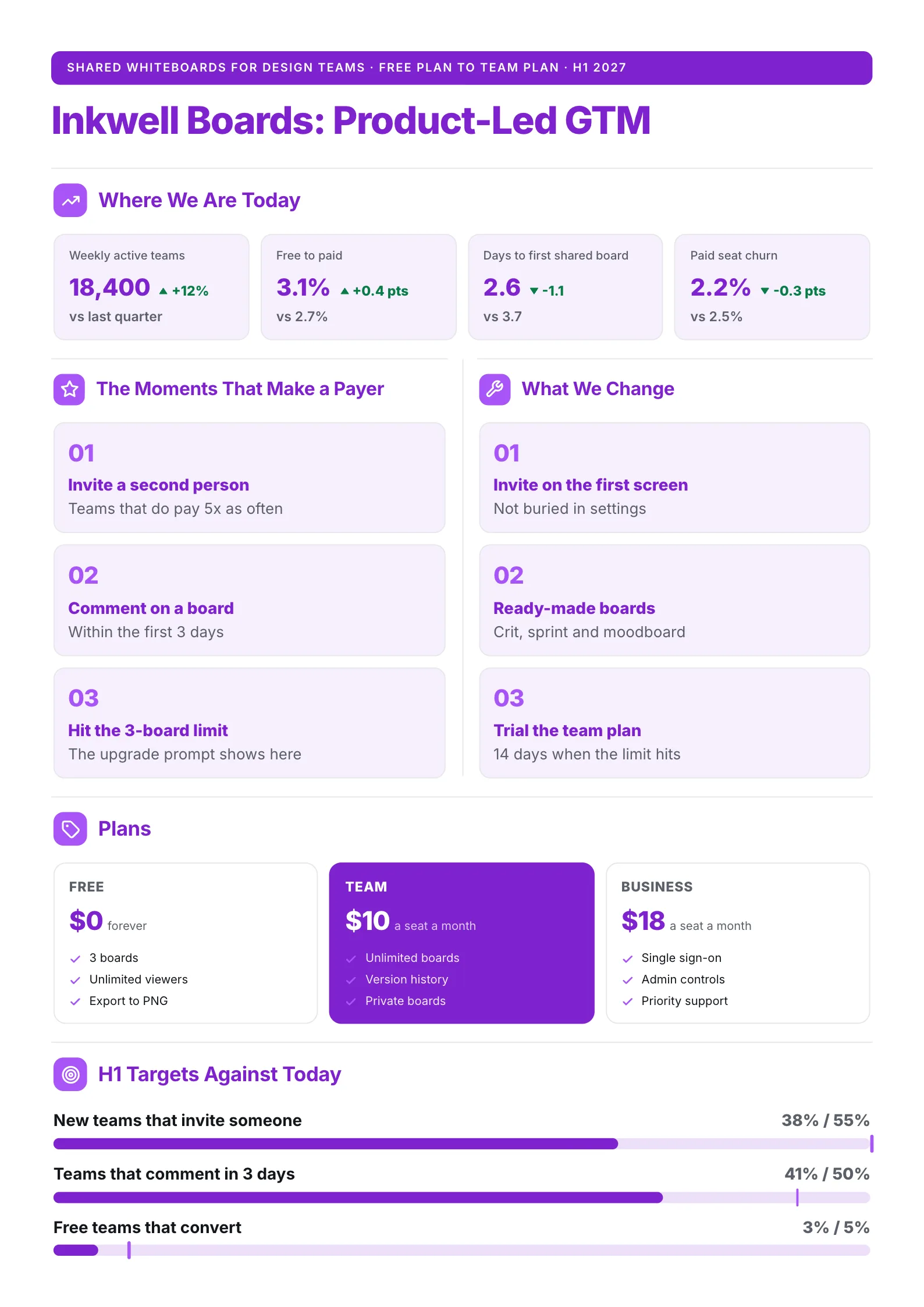 Go-to-Market Strategy: Product-Led GrowthEdit for free(opens in a new tab)
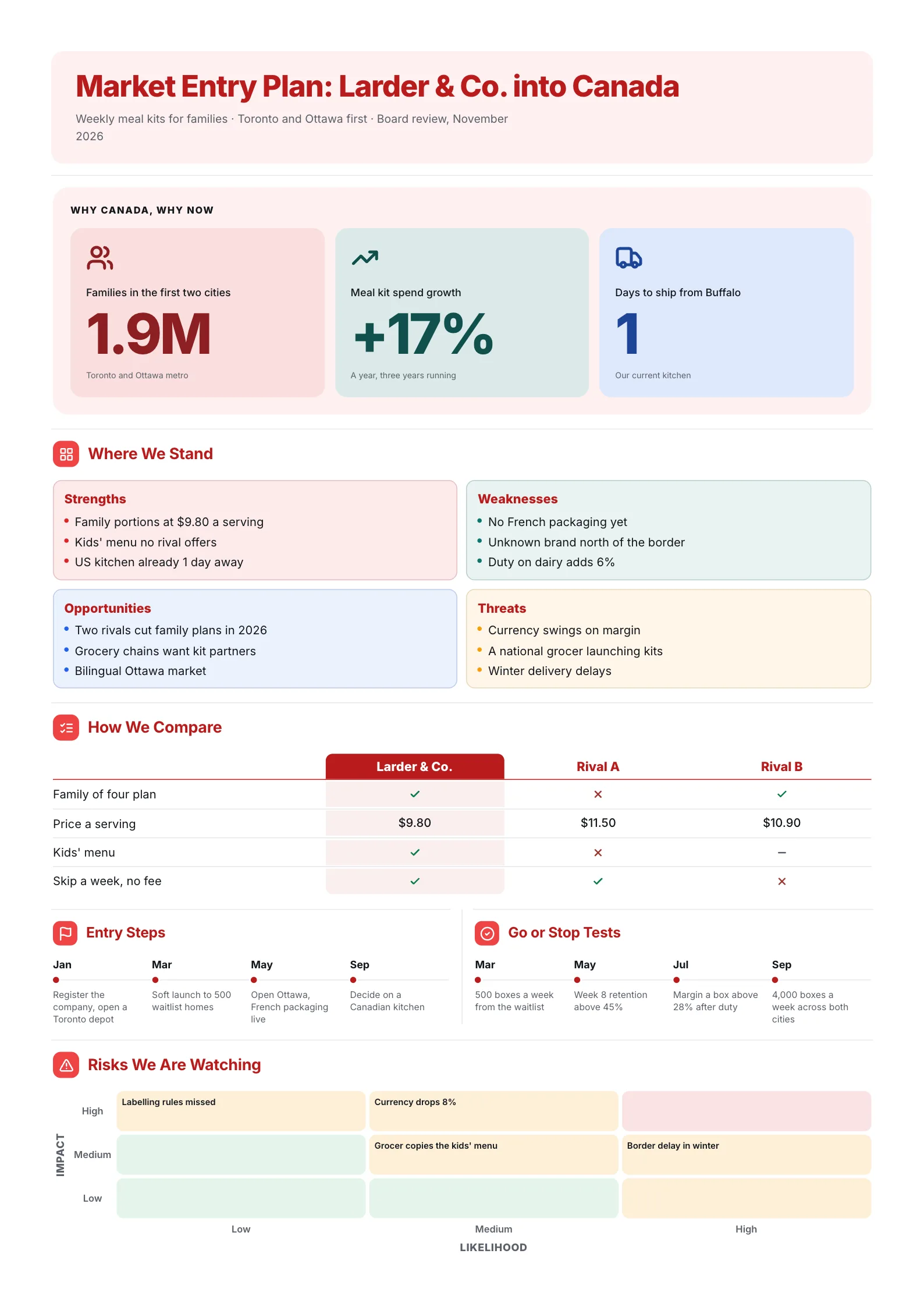 Go-to-Market Strategy: New Country EntryEdit for free(opens in a new tab)
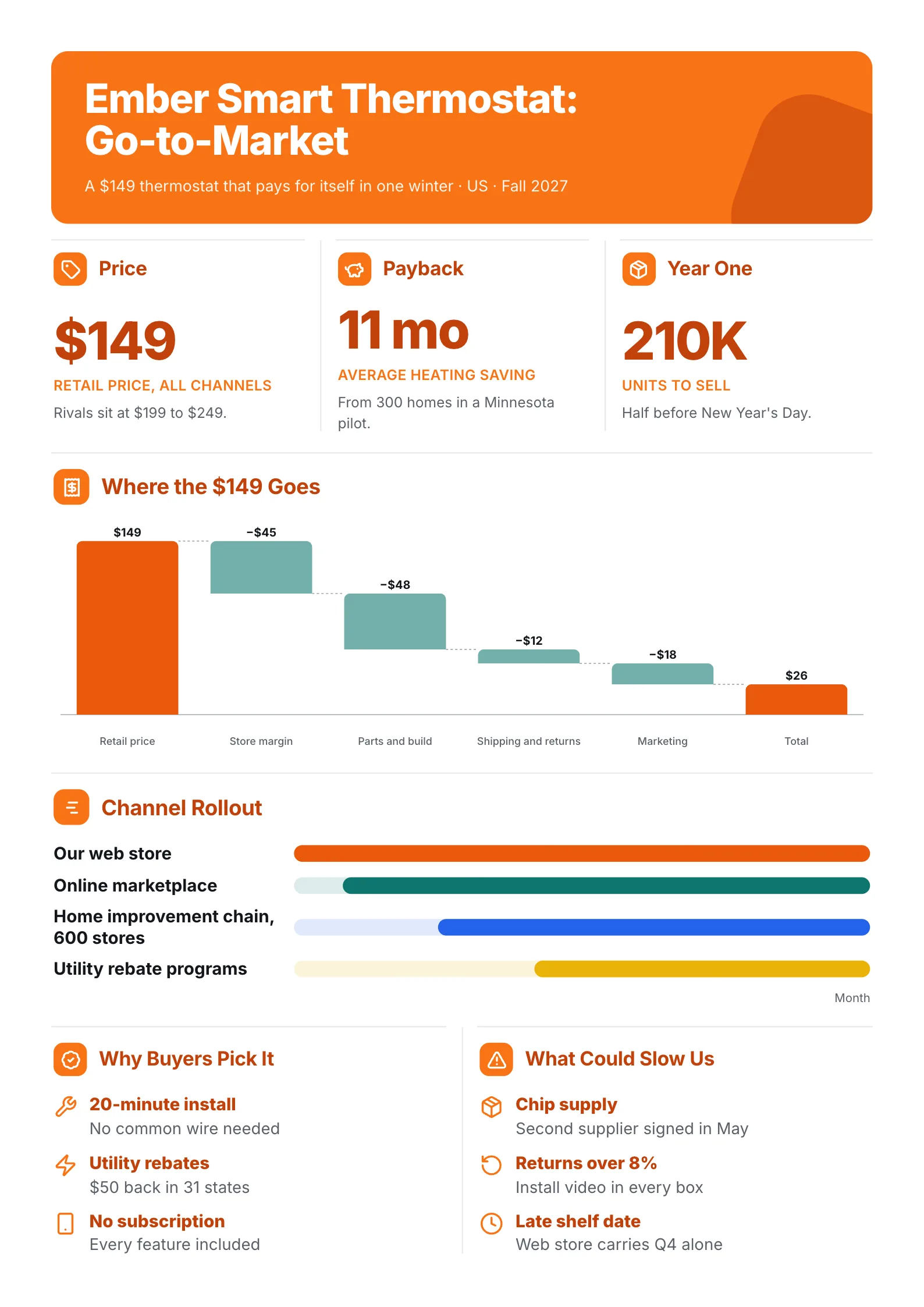 Go-to-Market Strategy: Hardware ProductEdit for free(opens in a new tab)
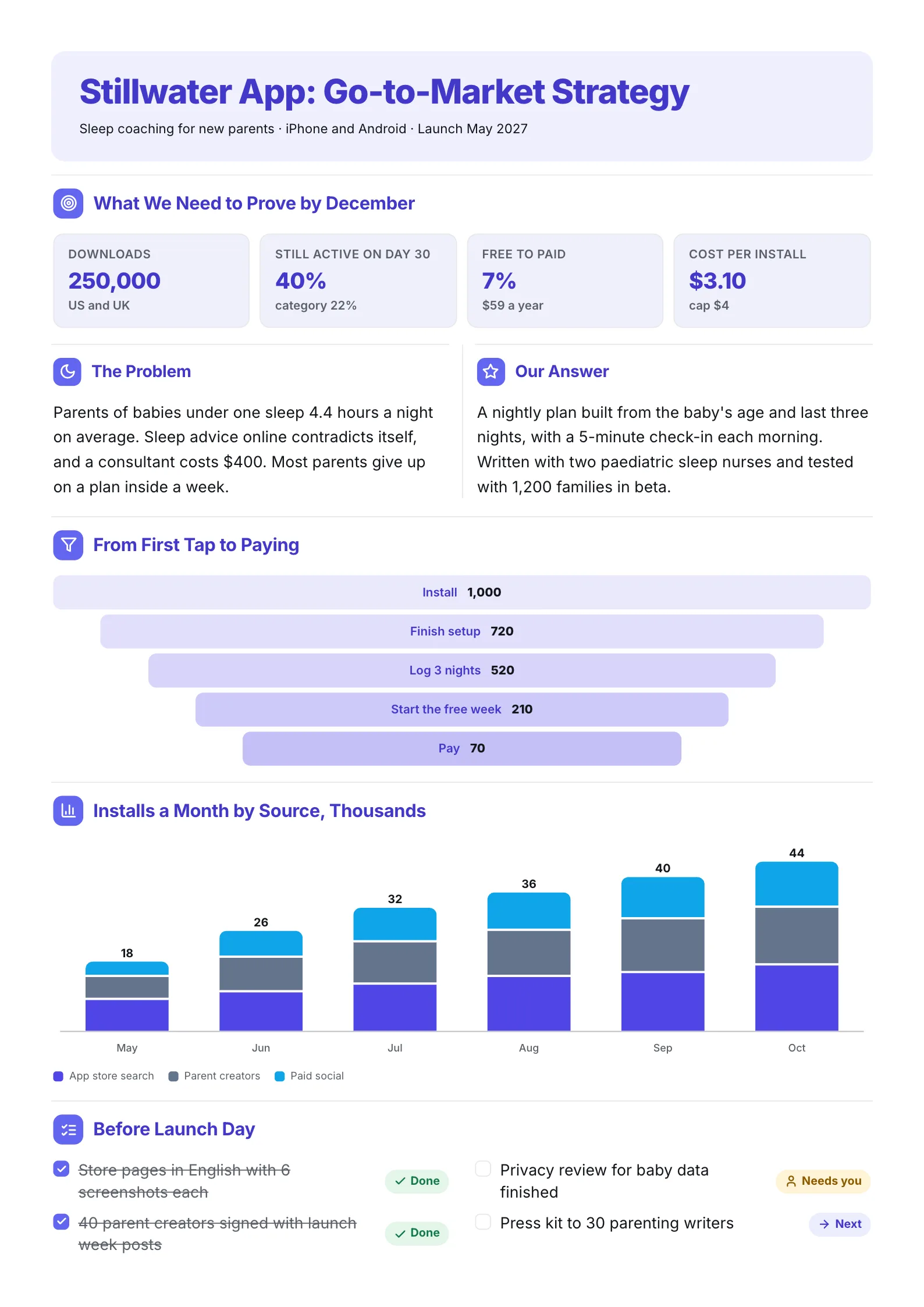 Go-to-Market Strategy: Mobile AppEdit for free(opens in a new tab)
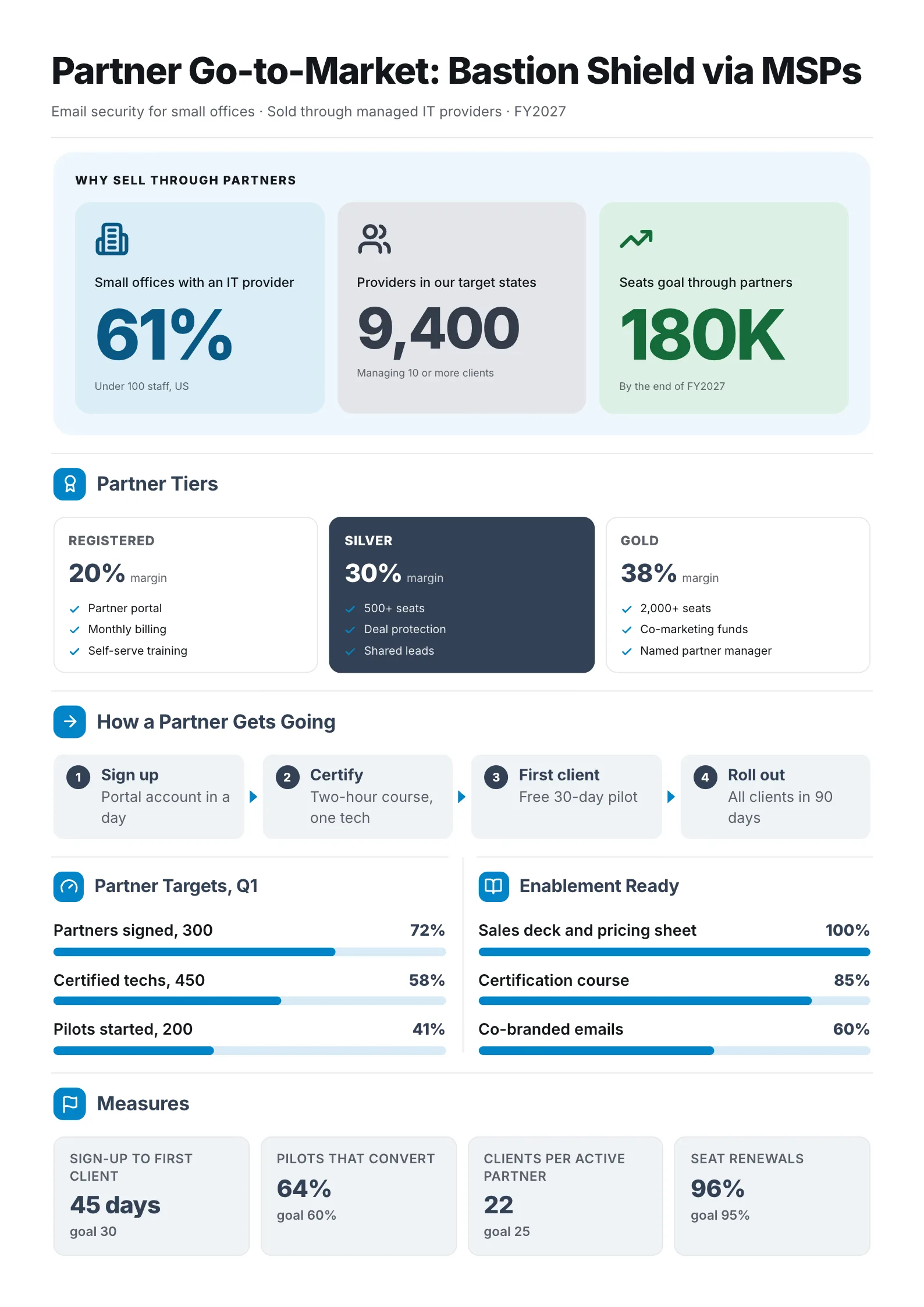 Go-to-Market Strategy: Channel PartnersEdit for free(opens in a new tab)
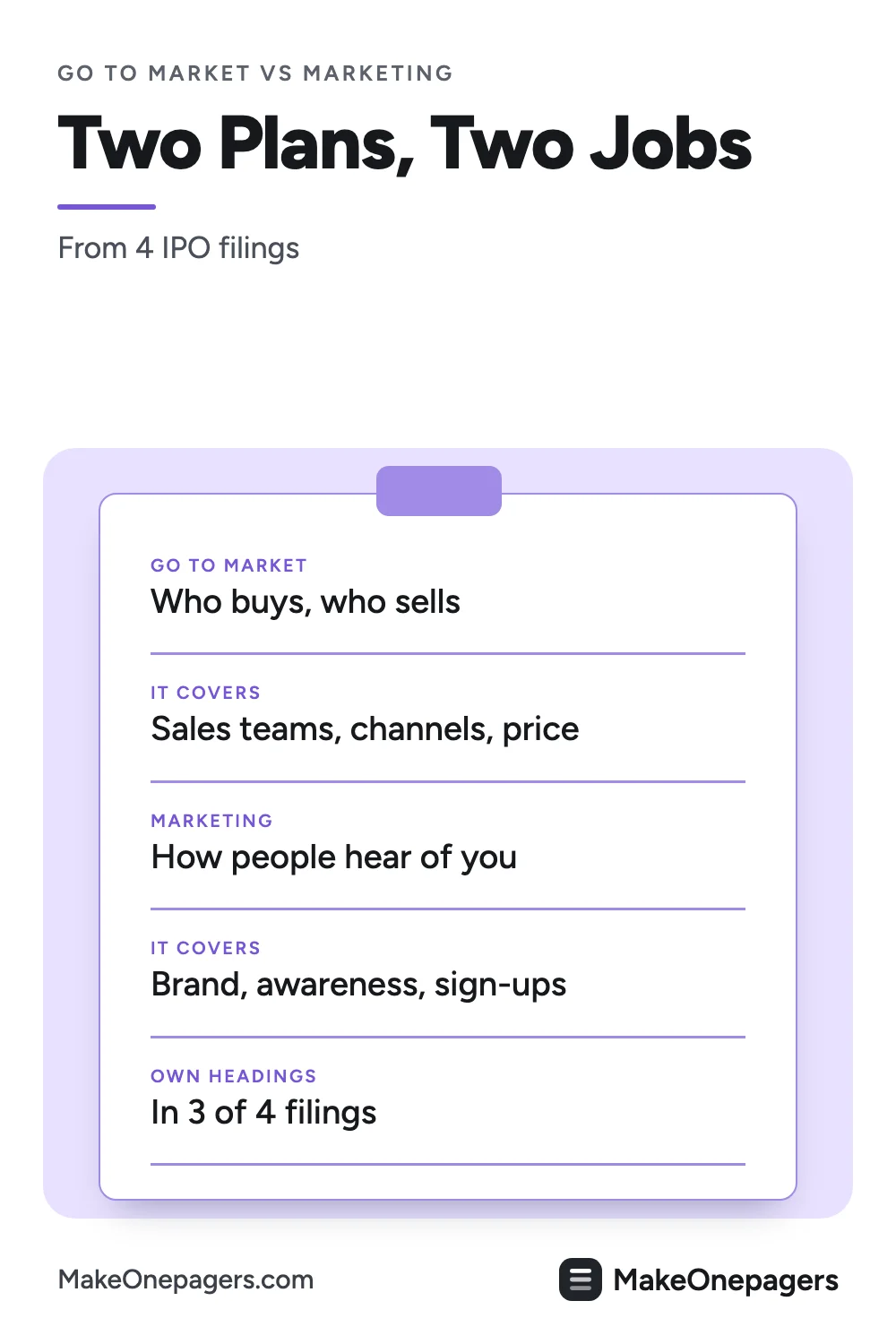
We checked that against four companies that had to write both down for investors. Hinge Health, Omada Health, Wella and Apnimed each filed an S-1, the registration statement a company files before it goes public. 3 of the 4 give go to market and marketing separate headings. In all 4, the go to market part names the buyers and the routes that reach them, and the marketing part is about getting known: brand, awareness or sign-ups.
| Company | Go to market part covers | Marketing part covers |
|---|---|---|
| Hinge Health (digital physical therapy) | A direct sales force plus over 50 partners, a sales cycle of about five months | Three teams for enterprise, product and growth marketing |
| Omada Health (programs for chronic conditions) | Selling to employers, mostly through health plans and pharmacy benefit managers | A B2B team for brand and PR, and a team that drives member sign-ups |
| Wella (hair and nail brands) | Salon sales reps, educators, distributors and retail channels | Brand and performance marketing, campaigns and how spend is measured |
| Apnimed (a sleep apnea drug awaiting approval) | Field reps, payers, pharmacies and telehealth for a launch | Teaching patients about the condition through digital media |
What the four filings put under each heading
Hinge Health: marketing works for a sales plan
Hinge Health's S-1/A, filed April 7, 2025, has a section called "Scalable and Efficient Go-to-Market Strategy." It's about who sells and to whom. "We sell through our direct sales force and our partners." The employer sales team had 45 people and the partnership sales team 34 at the end of 2024, and an employer sale took, on average, "roughly five months between engagement and signing."
Marketing gets its own heading, and it opens with "There are three main components to our marketing: enterprise marketing, product marketing, and growth marketing." Enterprise marketing handles brand awareness and demand, "meant to support our sales teams in acquiring new clients." Growth marketing reaches the employees of clients who already signed, to get them to enroll.
Two lines show how the pieces fit. Product marketing is responsible for "go-to-market readiness across our operational teams," so marketing gets the launch ready while sales runs it. And "While marketing takes place on an ongoing basis, we increase marketing during periods when we expect more enrollments from eligible lives." The filing names new client launches, New Year resolutions and open enrollment.
Take that idea into your own plan. Give your marketing a calendar that rises around your launch dates, and keep it running in between.
Omada Health: sold to employers, marketed to members
Omada's S-1/A, filed May 29, 2025, has a "Go-to-Market Approach" section. "Our go-to-market strategy follows a business-to-business-to-consumer (“B2B2C”) motion. We sell primarily to employers." Most of those employers buy through someone else. Customers using a channel partner, such as a health plan or a pharmacy benefit manager, were "more than 90% of our customer base" at the end of 2024.
Its marketing section names two jobs. The B2B marketing team "is responsible for brand strategy, thought leadership, PR campaigns, and strategic market positioning." The enrollment outreach team "is responsible for driving member awareness and enrollment outreach" after the sale. The size of that outreach is counted in the go to market section, not the marketing one: "approximately 98 million emails across approximately 4,900 outreach campaigns" in 2024.
Omada shows where the two overlap. Member outreach appears in both sections, because for Omada a sale to an employer only pays once that employer's people sign up. When your buyer and your user are different people, aim your go to market at the buyer and your marketing at the user.
Wella: a 145-year-old brand still writes both
Wella's S-1/A, filed September 23, 2026, has a "Go-to-Market Approach" section followed by a separate "Marketing Strategy" section. Its go to market section is about getting into salons and stores. Wella trains stylists across 46 Wella Studios and over 60 Training Centers, and in fiscal 2026 it put about 3% of net revenue into its educator network and 10% into its global salesforce. It also gained about 4,700 new strategic salon doors that year.
The marketing part is about demand. Wella says it uses "a balanced mix of brand and performance marketing" to grow in consumer channels. It lists campaigns like "Make It You" for Wella Professionals, and it says it raised its advertising and consumer promotion spend by 150 basis points of net revenue from fiscal 2024 to fiscal 2026. Then it explains how that spend is judged, with "brand health tracking, marketing mix modeling, multi-touch attribution, creative testing, and retailer-level performance data."
So even a brand that's been selling for 145 years keeps a go to market strategy. Wella adapts it by brand, channel and market, as its "go-to-market playbook." Keep yours short enough to reuse each time you open a new channel.
Apnimed: a go to market strategy before there's anything to sell
Apnimed's S-1/A, filed July 27, 2026, is the clearest launch case, because its sleep apnea drug, Oxnimbi, was still waiting on FDA approval. One strategy point reads "Build and execute a focused, scalable go-to-market strategy to support the launch and adoption of Oxnimbi, if approved." The next is a different job: "Educate people living with OSA about the benefits of neuromuscular treatments like Oxnimbi," including "through digital media consumer awareness and activation."
Under "Sales and Marketing," it lists 8 capabilities for the launch. They include "a targeted field sales organization of 125 to 150 representatives" covering "15,000 to 20,000 sleep specialists and high-volume primary care practices," talks with payers about "potential 2027 formulary inclusion," specialty pharmacies and telehealth. It also picks who goes first. The launch focuses on "approximately 10.5 million people in the United States who are diagnosed with OSA but untreated."
Most of those 8 face doctors, insurers and pharmacies rather than patients. That's why a launch plan can be mostly go to market and only a little marketing. When your launch depends on approvals, partners or insurers, settle those in your plan before you spend on ads.
Is a go to market strategy part of marketing?
Many guides say yes. Aha!, one of the top results for this search, calls the go to market "a subset of the overall marketing strategy," driven by product marketing.
The filings agree in part. At Hinge Health, product marketing owns "go-to-market readiness." But in all four filings, the go to market material is mostly about sales teams, partners, distributors and payers. That's work a marketing team usually doesn't own. A better way to see it is that your go to market plan sets who you sell to and how the sale happens, and marketing feeds that plan with attention and sign-ups.
| Launch plan (go to market) | Ongoing plan (marketing) | |
|---|---|---|
| The question | Who buys first, and how do they buy? | How do people find us and choose us? |
| What it names | Buyers, sales teams, channels, partners, price | Brand, message, campaigns, outreach |
| Time span | A launch, a new market or a new buyer | Ongoing, with peaks around launches |
| How it's judged | Deals signed, sales cycle, doors opened | Awareness, sign-ups, return on spend |
| In the filings | Hinge: sales force and partners. Apnimed: 125 to 150 reps | Omada: a team for brand and PR. Wella: brand and performance mix |
Which one do you write first?
Write your go to market plan first when something is new. That's a new product, a new country or city, or a new kind of buyer. It decides who you go after, so your marketing knows who it's talking to. List every person whose yes you need before money changes hands, and put each of them in the plan.
Write your marketing strategy first when you're already selling and the question is growth. Then add a short go to market plan each time you launch something. Hinge Health works this way. Its marketing runs all year and peaks "around new client launches."
On a small team, you'll often want both on one sheet. Each plan below does that, and you can see the two kinds of line kept apart.
Five plans, with the go to market and the marketing lines picked out
You can edit each of these in MakeOnepagers. Every company and number on them is made up, so put yours in before you share one.
 Edit this template
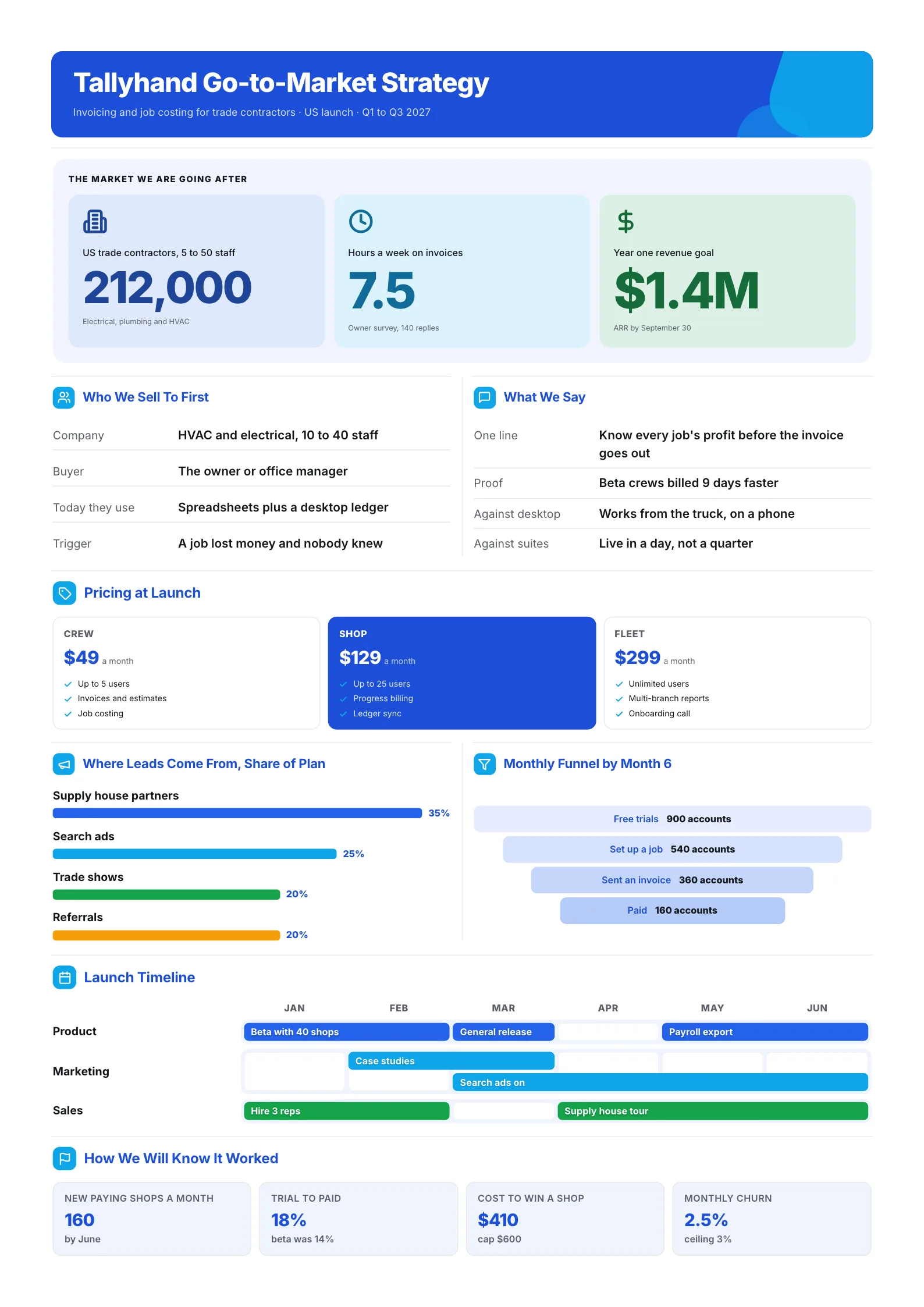
This SaaS go to market strategy splits its launch timeline into three rows: product, marketing and sales. The marketing row holds case studies and switching on search ads. The sales row holds hiring 3 reps and a supply house tour. Above it, the go to market choices come first: HVAC and electrical firms with 10 to 40 staff, and three prices, $49, $129 and $299 a month.
 Edit this template
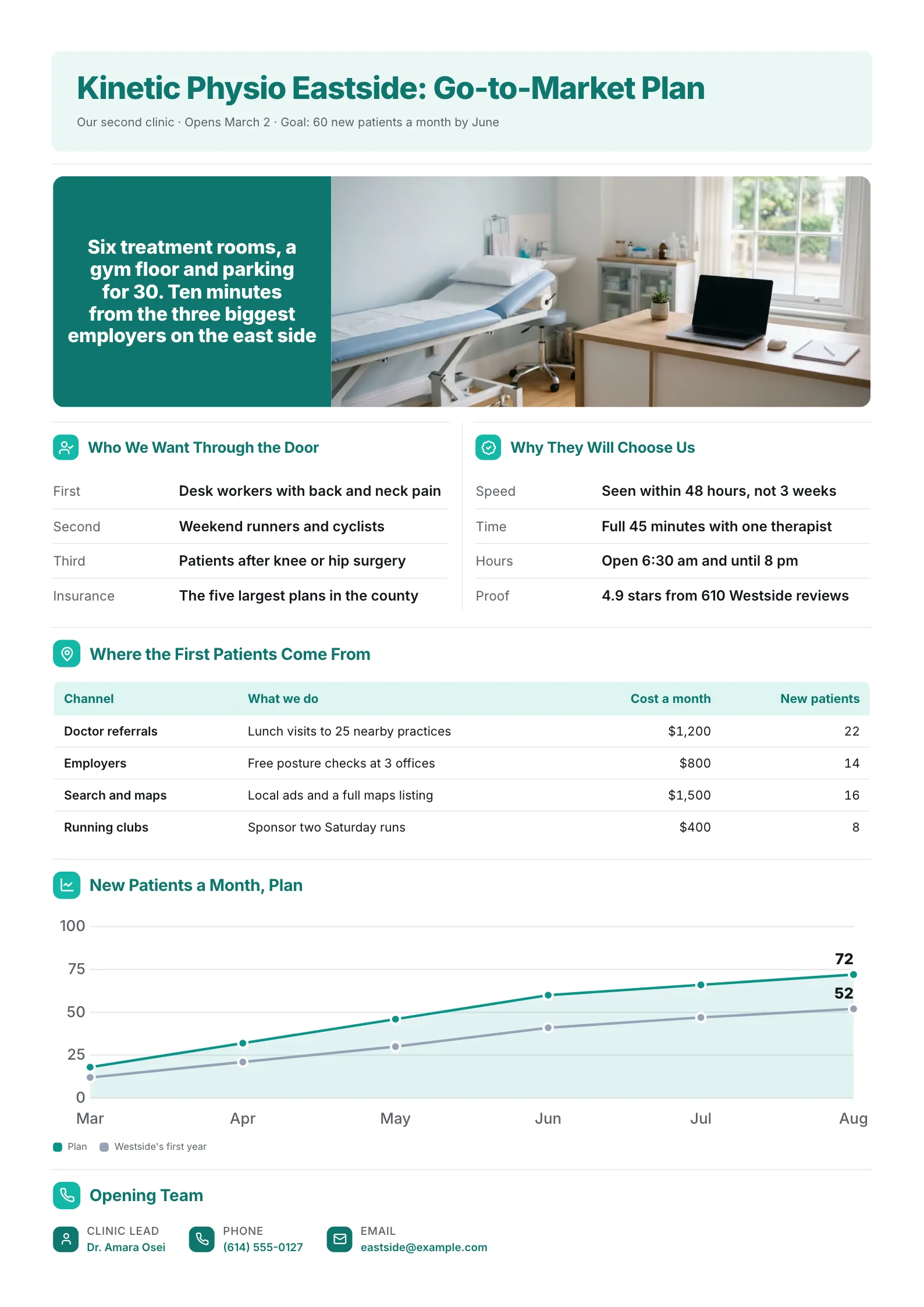
This local business go to market plan is for a clinic that opens March 2 and wants 60 new patients a month by June. Its channel table is the go to market core. Doctor referrals bring 22 patients a month, employers 14, search and maps 16, and running clubs 8, which adds up to 60 for $3,900 a month. Only search and maps is classic advertising. The other three are visits, free checks and sponsored runs.
 Edit this template
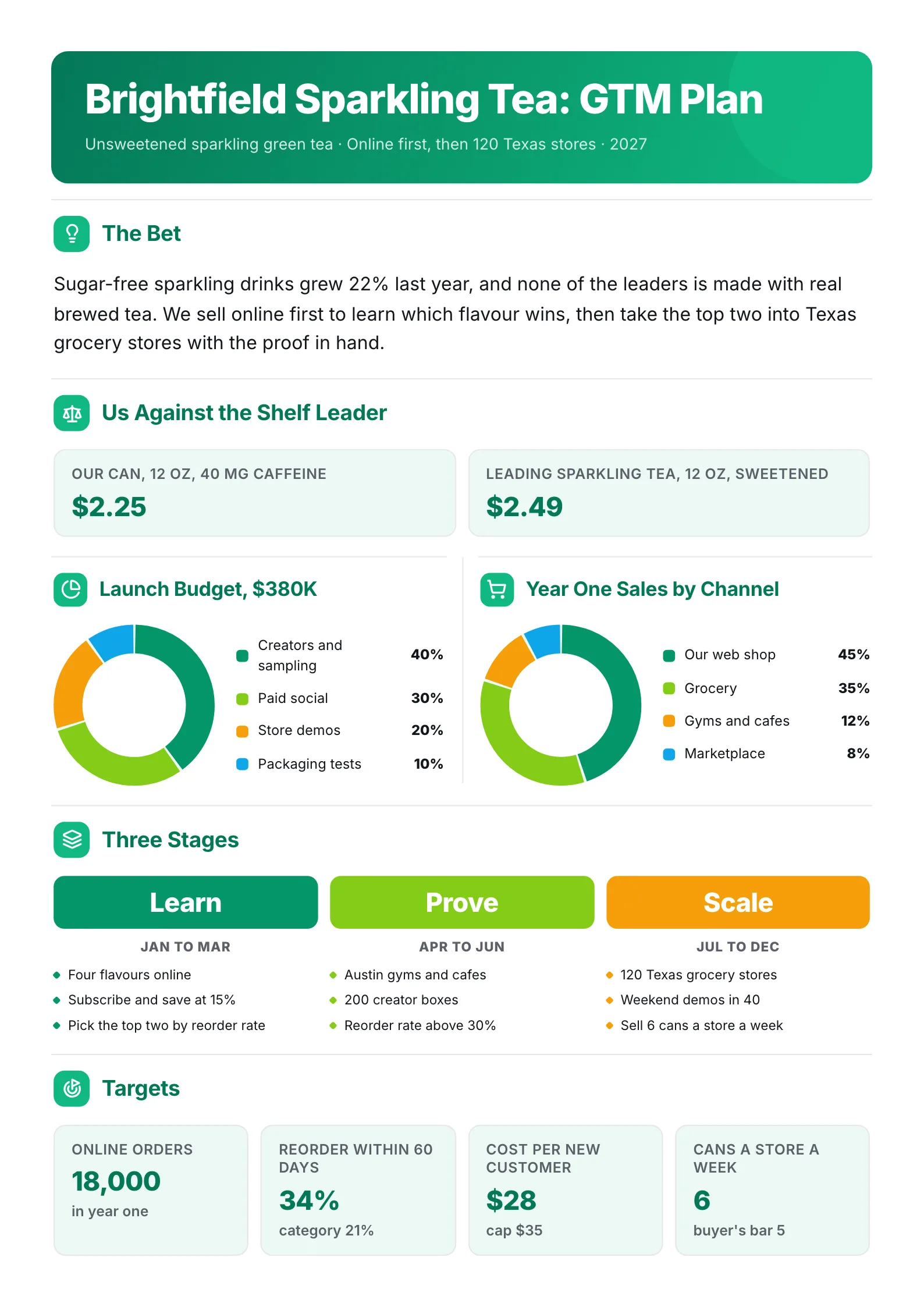
This consumer brand go to market plan shows both kinds of line side by side. The $380K launch budget is marketing, split across creators and sampling, paid social, store demos and packaging tests. The three stages are go to market. The brand sells online first, then in Austin gyms and cafes with a target reorder rate above 30%, then in 120 Texas grocery stores.
 Edit this template
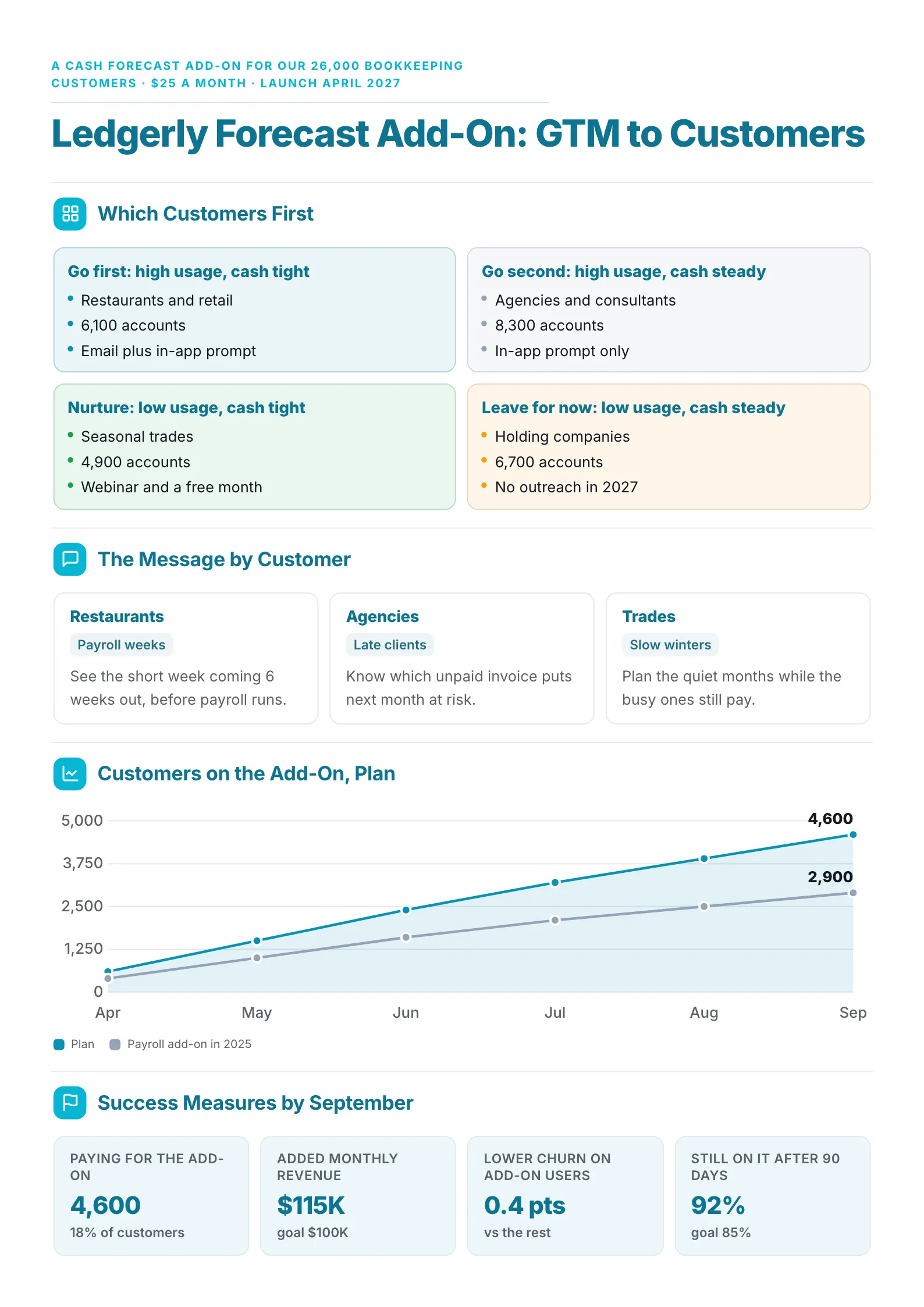
A go to market strategy also decides who you leave alone. This add-on launch go to market plan splits 26,000 customers four ways. Restaurants and retail, 6,100 accounts, go first by email and in-app prompt. Agencies and consultants, 8,300, get an in-app prompt only. Seasonal trades, 4,900, get a webinar and a free month. Holding companies, 6,700, get "No outreach in 2027." The marketing message then changes by group, such as "See the short week coming 6 weeks out, before payroll runs" for restaurants.
 Edit this template
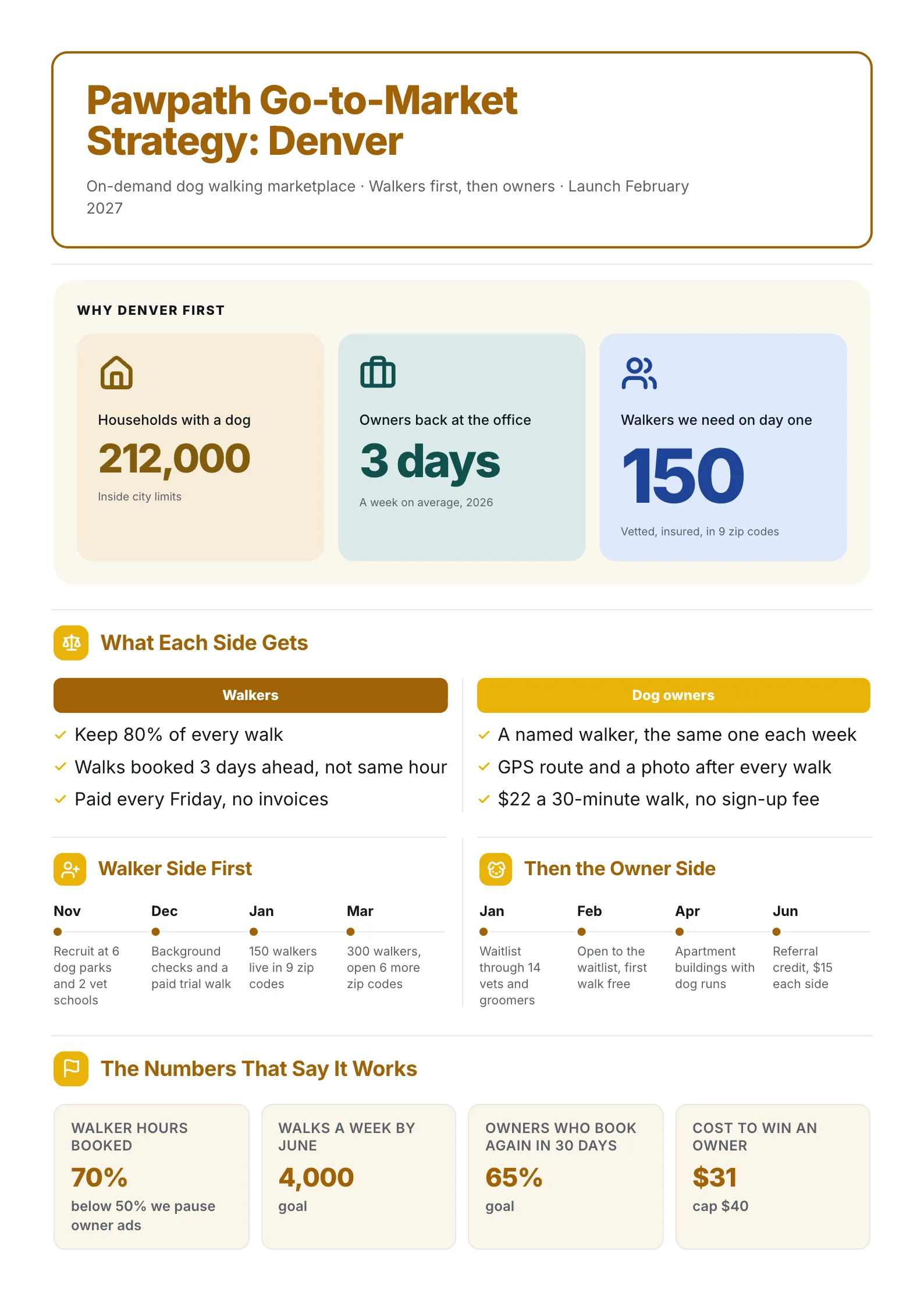
In this marketplace go to market strategy, the launch order controls the ad budget. It gets 150 walkers live across 9 zip codes in January, a month before the owner side opens. Its first measure is walker hours booked, at 70%, and the rule beside it reads "below 50% we pause owner ads." The ads only run while the launch plan says the walker side can keep up.
Make your plan
Open the MakeOnepagers plan closest to the launch you have coming. Fill in your buyers, channels and prices before anything else, then add the lines on how people will hear about you. Working from rough notes? Paste them into the free AI One-Pager generator, then sort the draft it gives you into the two kinds of line. For a step-by-step build, read how to write a go to market strategy, check a draft against our go to market strategy checklist, and see our marketing plan templates for the ongoing side.
Frequently asked questions
Is a go to market strategy part of a marketing strategy?
Some teams file it that way, and product marketing often gets the launch ready. But in the four S-1 filings we read, the go to market material is mostly about sales teams, partners, channels and payers, which sit outside most marketing teams. Treat them as two plans that feed each other.
Who owns a go to market plan?
It's shared. At Hinge Health, product marketing owns "go-to-market readiness," while the employer and partnership sales teams run the selling. At Apnimed, a chief commercial officer joined in January 2024, and the company has been building its commercial team since then. Name one owner for the plan and list every team that signs off.
Does a go to market strategy end after launch?
The launch plan does, but companies keep writing new ones. Wella points to a 145-year history and still describes a "go-to-market playbook" it adapts by brand, channel and market. Each new product, country or buyer gets its own.
Do I need a go to market strategy if I already have a marketing strategy?
Yes, when you launch something new. Your marketing strategy says how you build awareness in general. It won't say which buyers come first, who closes the sale or what the price is for the new thing. Apnimed wrote its go to market strategy before its drug was even approved.
What does a marketing strategy cover that a go to market strategy doesn't?
The ongoing work of being known and chosen. That means brand, message, campaigns, content and how you measure your spend. Wella's filing describes brand health tracking, marketing mix modeling and creative testing, none of which belongs in a launch plan.




