How to Write a Go to Market Strategy That Fits on One Page
How to write a go to market strategy in 5 steps: who buys and when, who goes first, who signs, the channel's terms and a measure that can stop you.

To write a go to market strategy, you answer five questions in order. Who buys, and what makes them start looking? Which group do you go after first? Who signs off on the purchase? How does the channel work, in numbers? And which result would make you stop and rethink? Start from a free one pager template.
One‑Pager examples
Real One-Pagers made with MakeOnepagers. Open any one to edit it as your own.
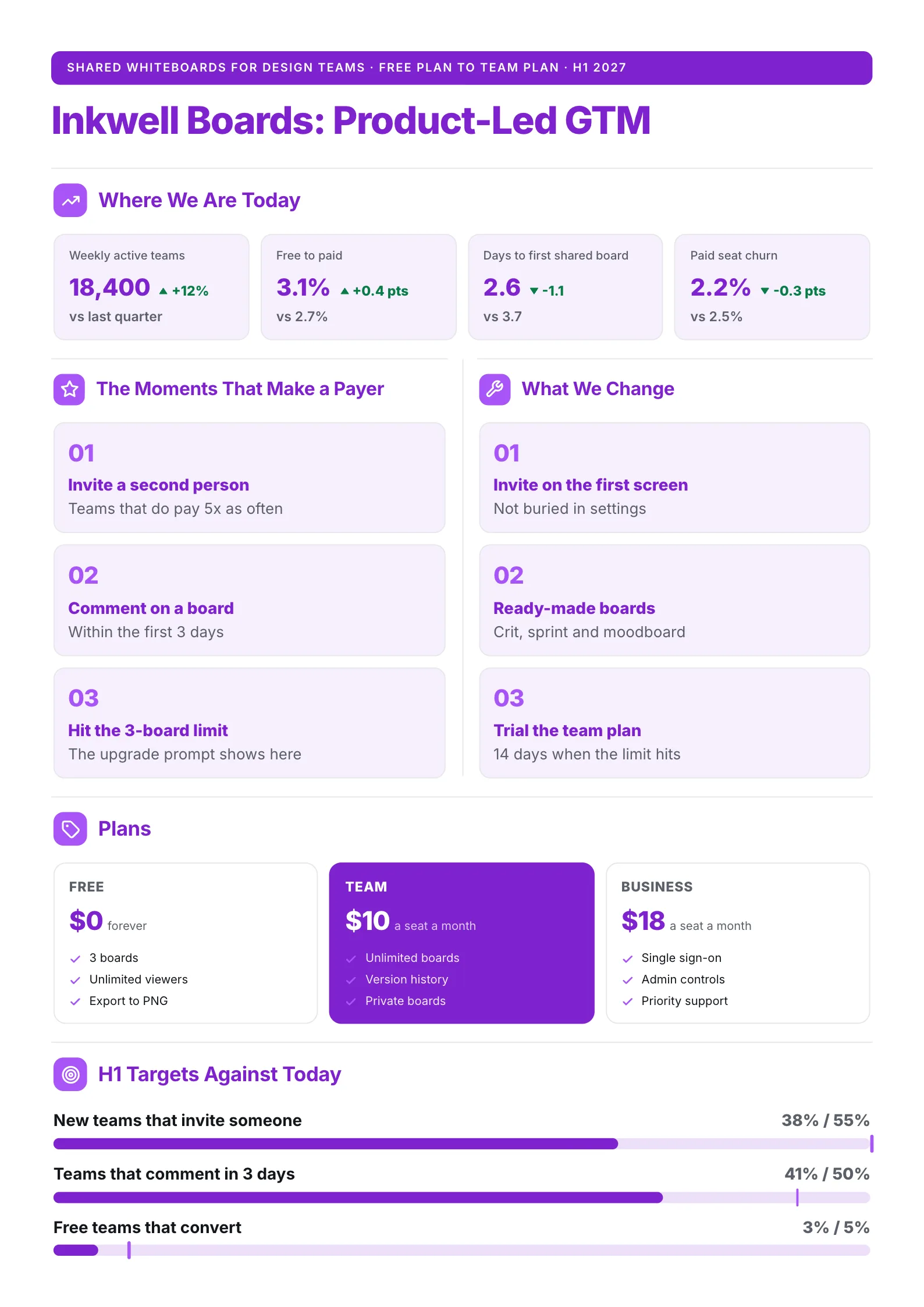 Go-to-Market Strategy: Product-Led GrowthEdit for free(opens in a new tab)
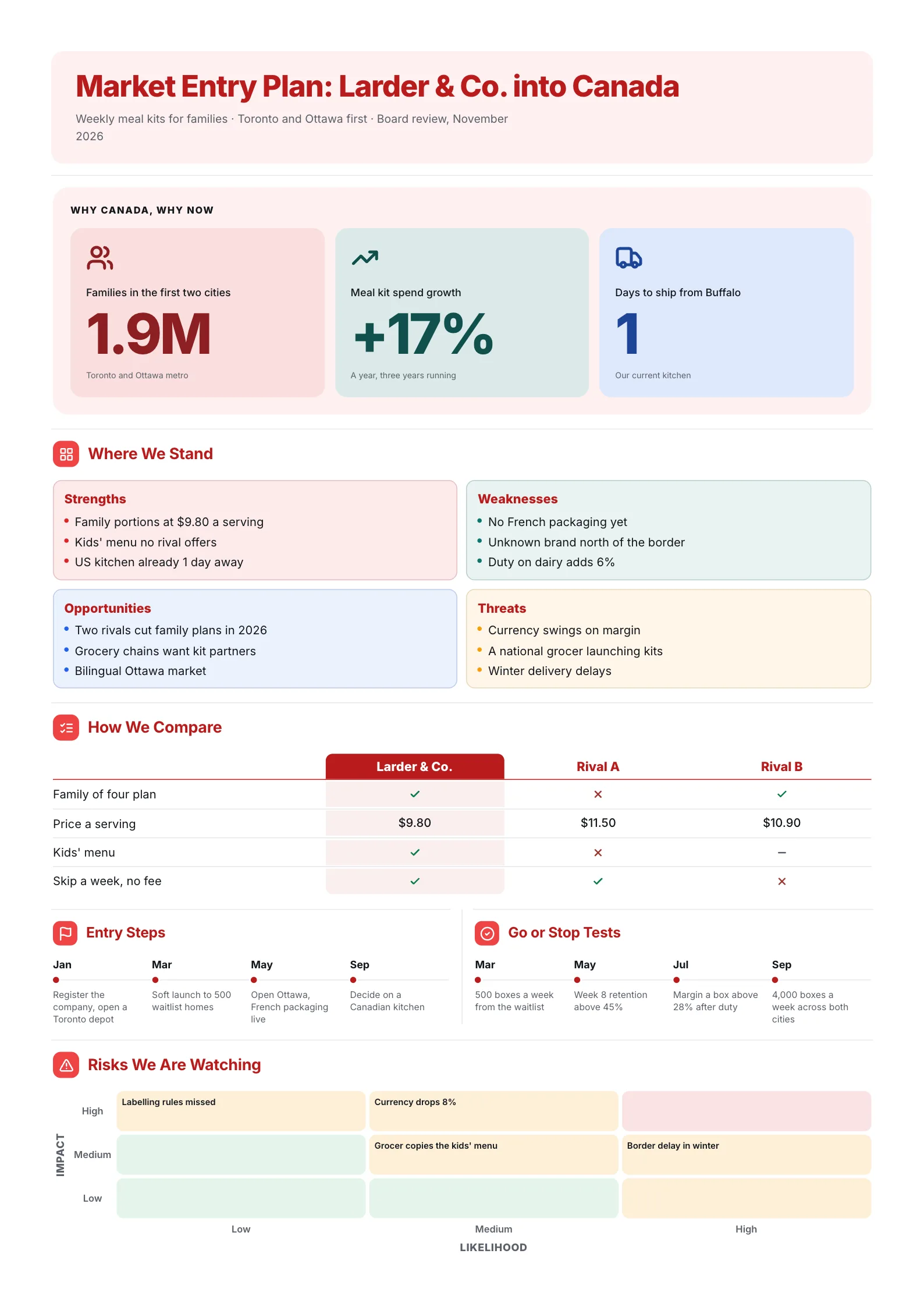 Go-to-Market Strategy: New Country EntryEdit for free(opens in a new tab)
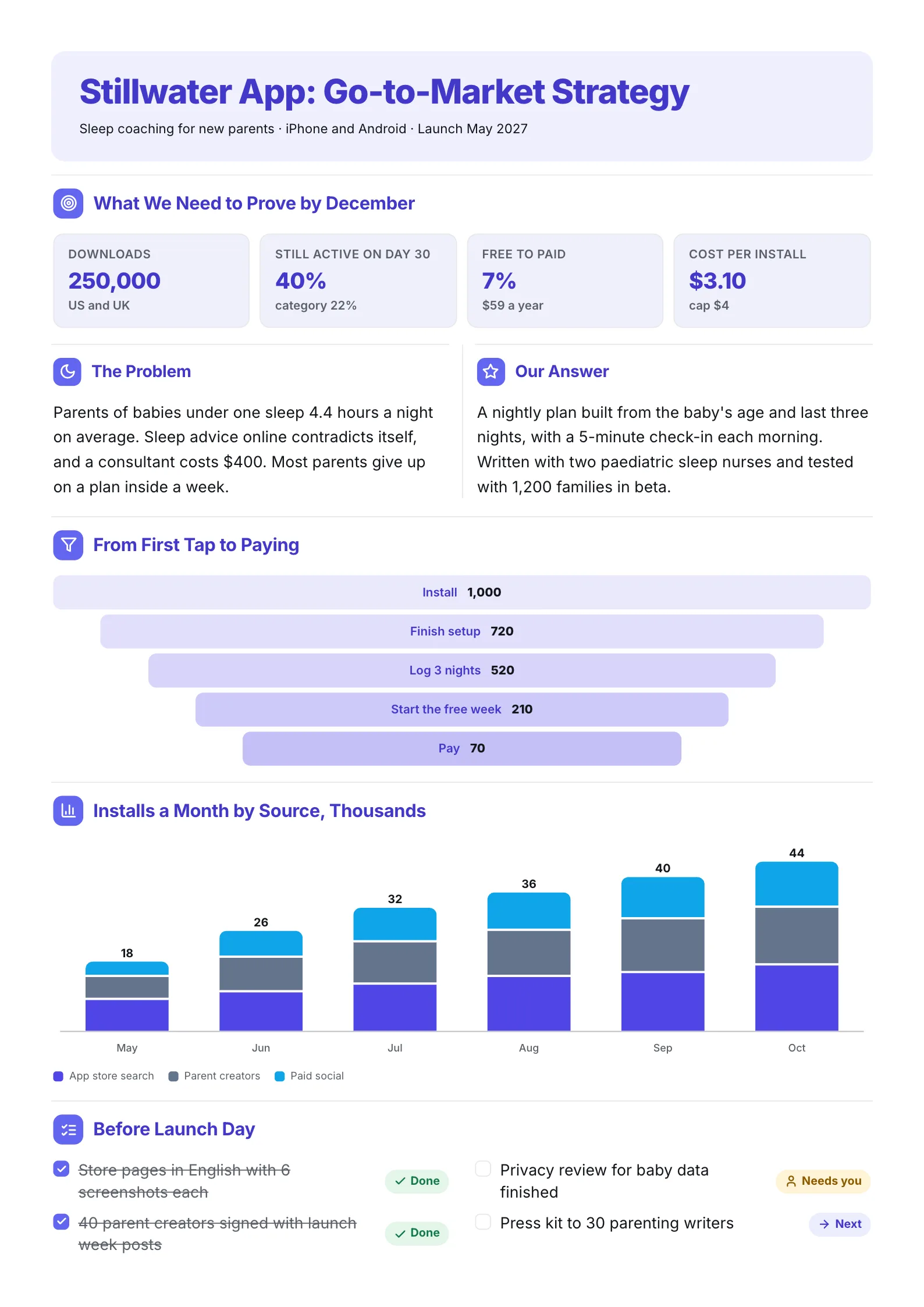 Go-to-Market Strategy: Mobile AppEdit for free(opens in a new tab)
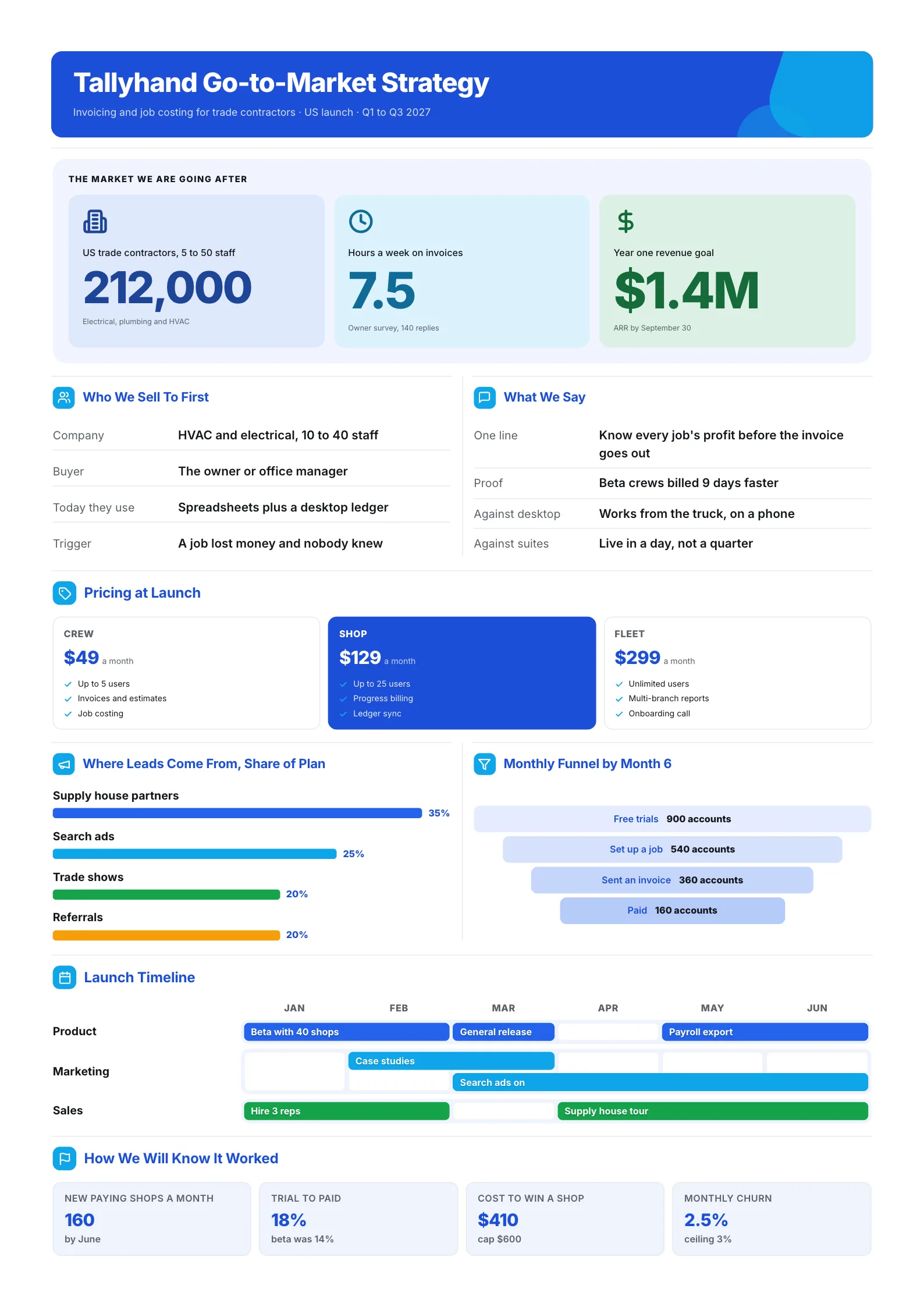 Go-to-Market Strategy: SaaS LaunchEdit for free(opens in a new tab)
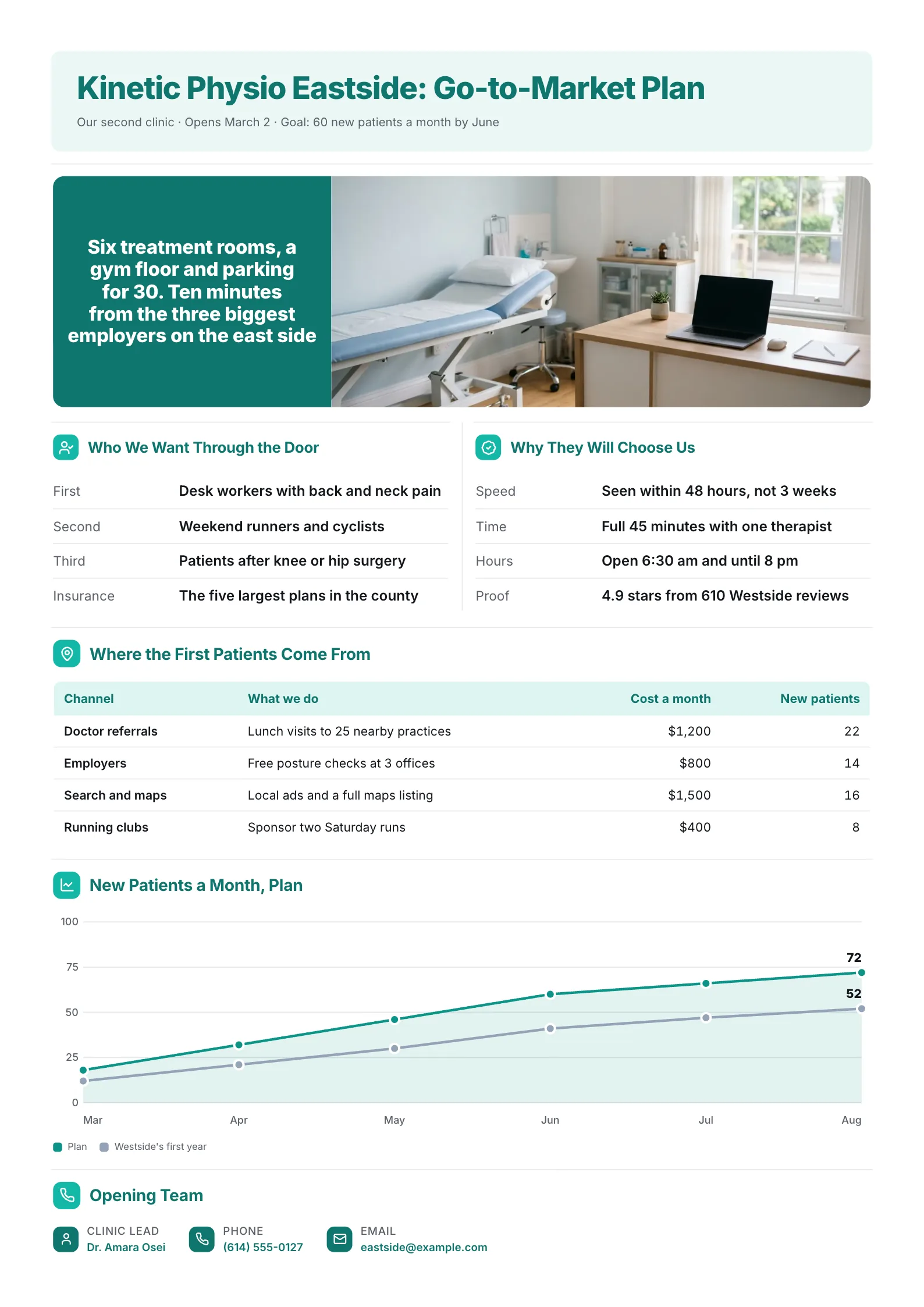 Go-to-Market Strategy: Local BusinessEdit for free(opens in a new tab)
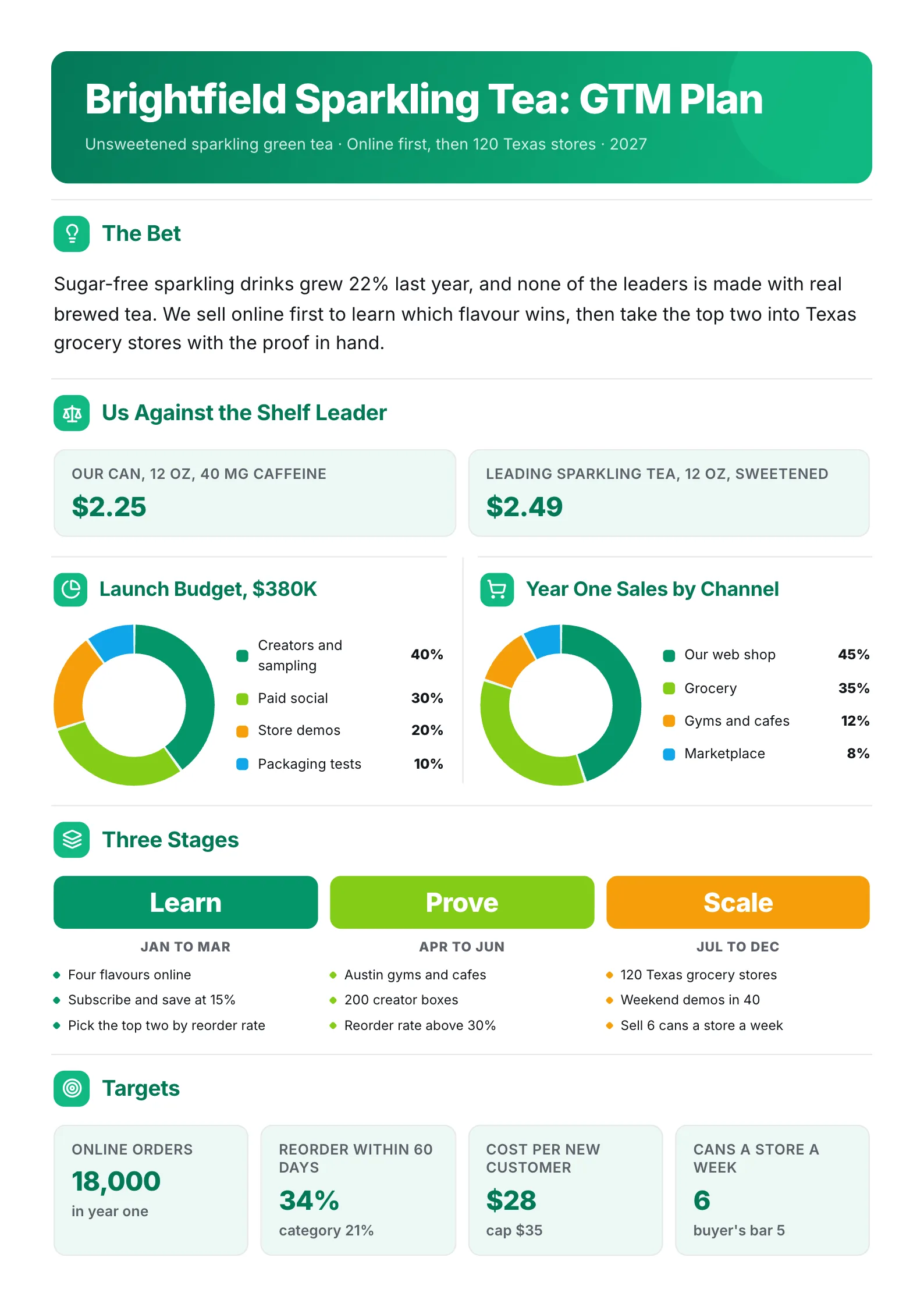 Go-to-Market Strategy: Consumer BrandEdit for free(opens in a new tab)
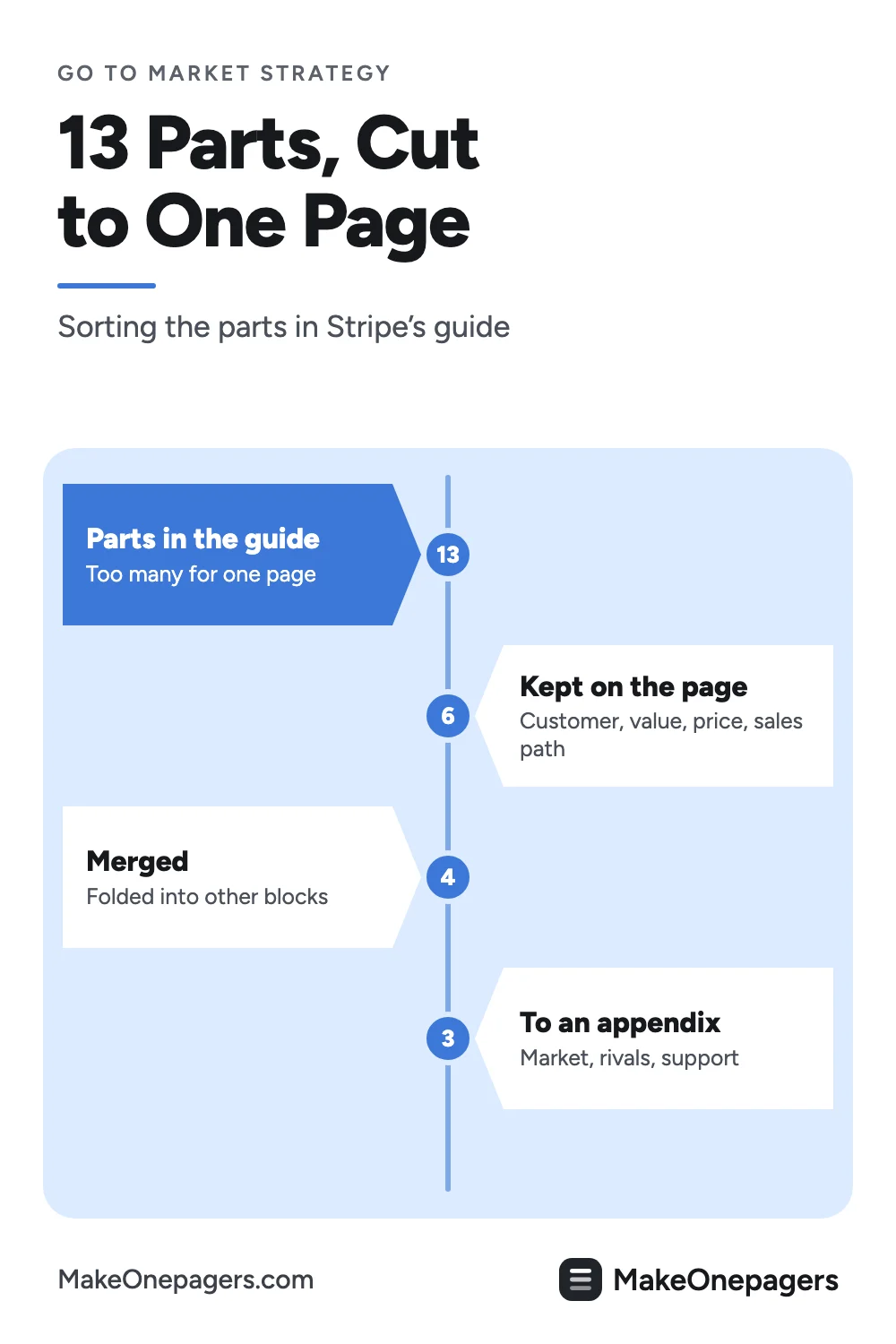
Most guides hand you a much longer list. Stripe's go to market guide, last updated March 15, 2026, names 13 parts, from market analysis to a timeline. Every part is real, but 13 sections ask a lot of the people who approve the plan. So the writing job is choosing. Below is what to keep, then the five steps, each shown on a sample page from MakeOnepagers. The companies and figures on the samples are made up.
Stripe's 13 parts, sorted for one page
Stripe describes a go to market strategy as narrower than a business plan, one that "focuses on launching a single product or entering one new market." That focus is what lets it fit on a page. Here's how the 13 parts sort when space runs out.
| Stripe's part | On a one-page plan |
|---|---|
| Target customer definition | Keep, as the first block |
| Value proposition | Keep, in the customer's words |
| Pricing strategy | Keep, as real prices |
| Sales strategy | Keep, as the path from first contact to signed |
| Metrics and KPIs | Keep, with a target and a stop line |
| Timeline | Keep, as dated milestones |
| Product positioning | Merge into the value proposition |
| Distribution plan | Merge into the sales path |
| Marketing and promotion plans | Merge into where customers come from |
| Budget | Merge into the measures, as a cost cap |
| Market analysis | Move to an appendix, keep one number |
| Competitive analysis | Move to an appendix, keep one comparison |
| Customer support and service | Move to an appendix, unless support is what you sell |
Moving a part to the appendix doesn't mean skipping the work. You still size the market and study rivals. You just don't make your reader wade through it to find the plan.
Step 1: Write who buys, and the moment they start looking
 Edit this template
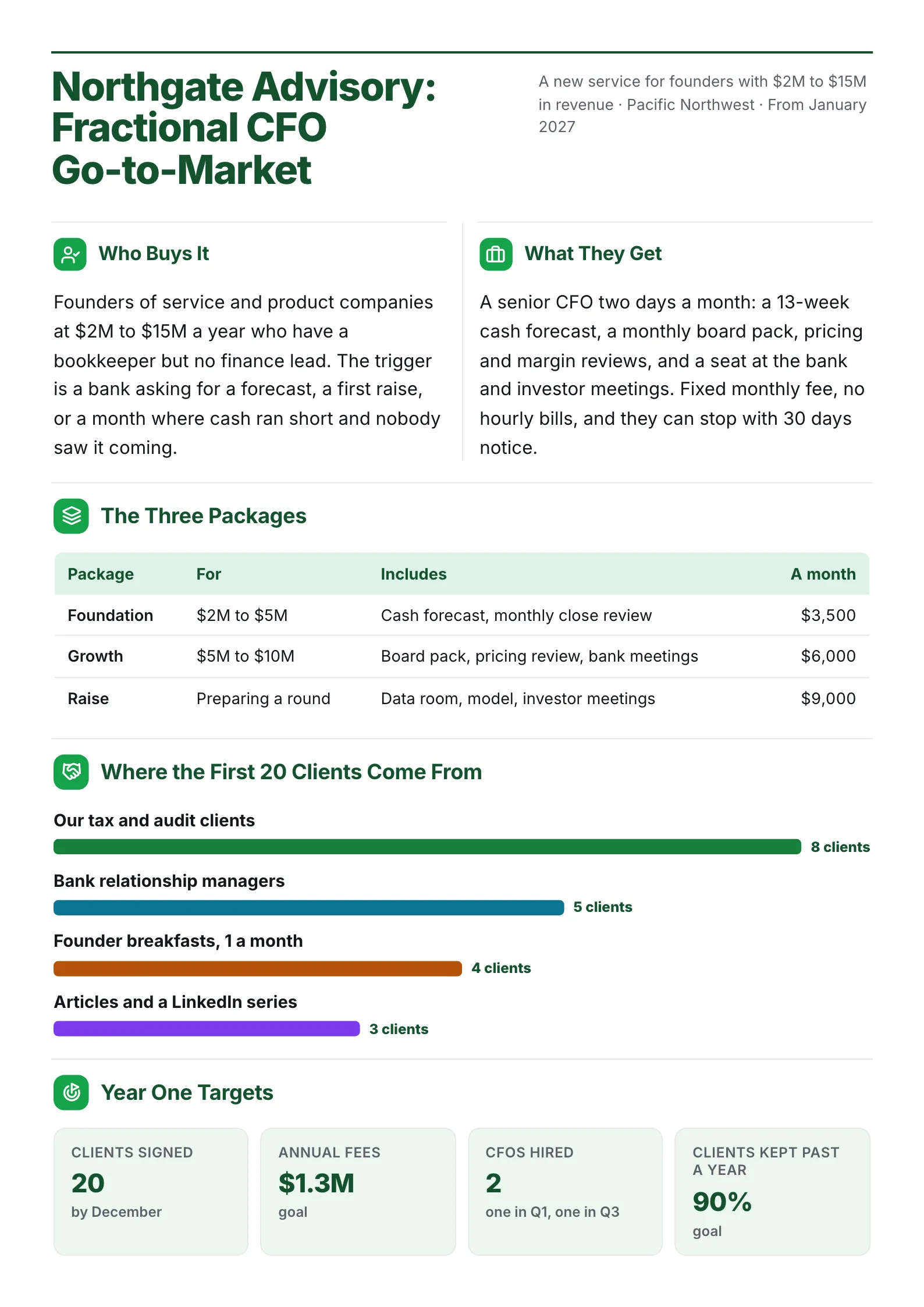
A segment alone tells your team who to aim at. A trigger tells them when to reach out. This professional services go to market strategy names founders at $2M to $15M a year with a bookkeeper but no finance lead. Then it names the moment they reach out, like a bank asking for a forecast, a first raise, or a month where cash ran short.
The same page counts where its first 20 clients will come from, and 8 of them are the firm's own tax and audit clients. Adding a service? Start with the people who already pay you.
Step 2: Decide who goes first, and who you'll leave alone
 Edit this template
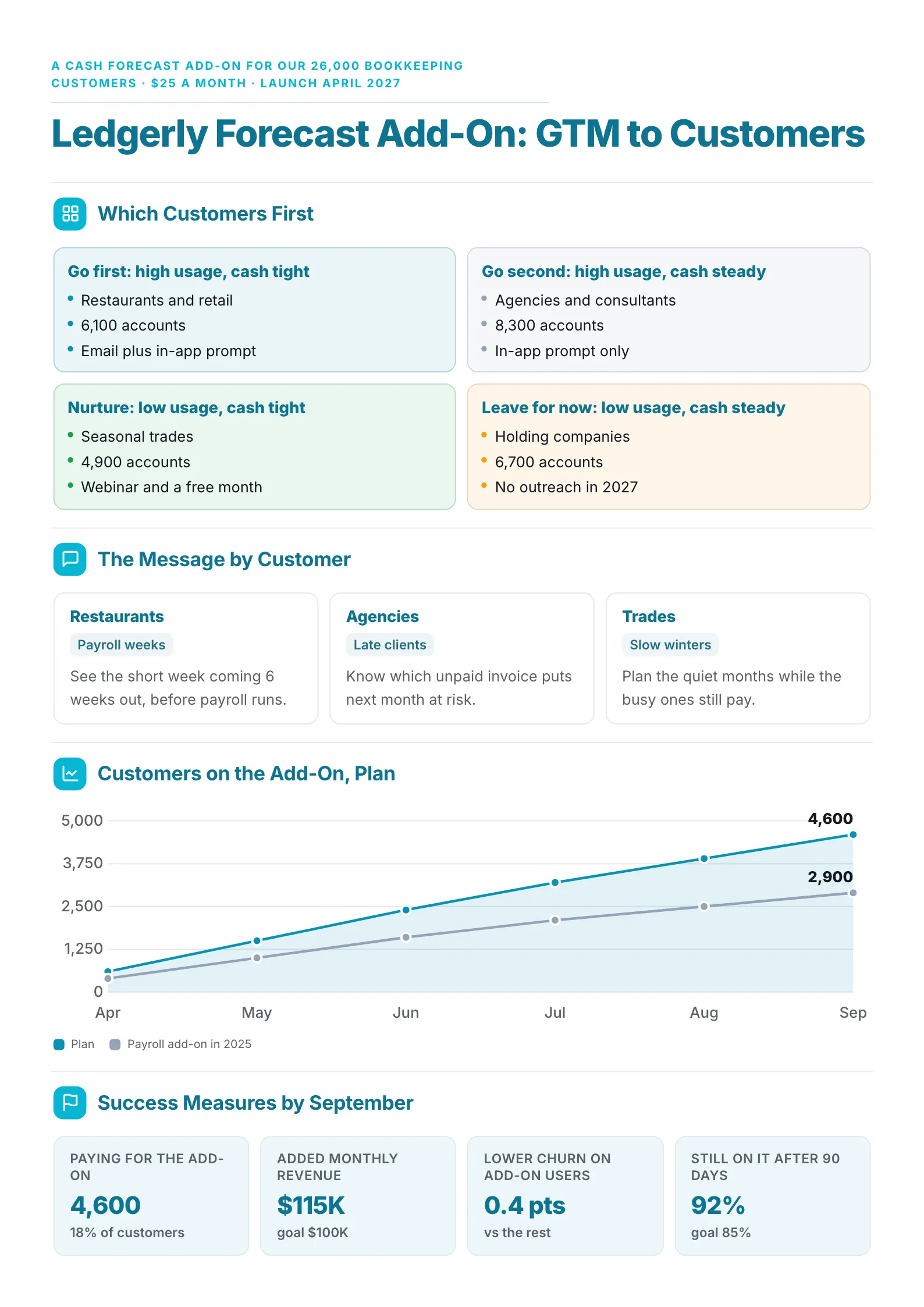
Your plan gets sharper when it says no to someone. The add-on launch plan sorts its customers into four groups. Restaurants and retail go first, with 6,100 accounts. Holding companies, 6,700 accounts, get "No outreach in 2027."
Each group you keep gets its own message. Restaurants hear about payroll weeks, and agencies hear about late clients. The adoption line is set against the company's last add-on, so the target of 4,600 customers by September has a real comparison behind it.
Step 3: Name everyone who signs
 Edit this template
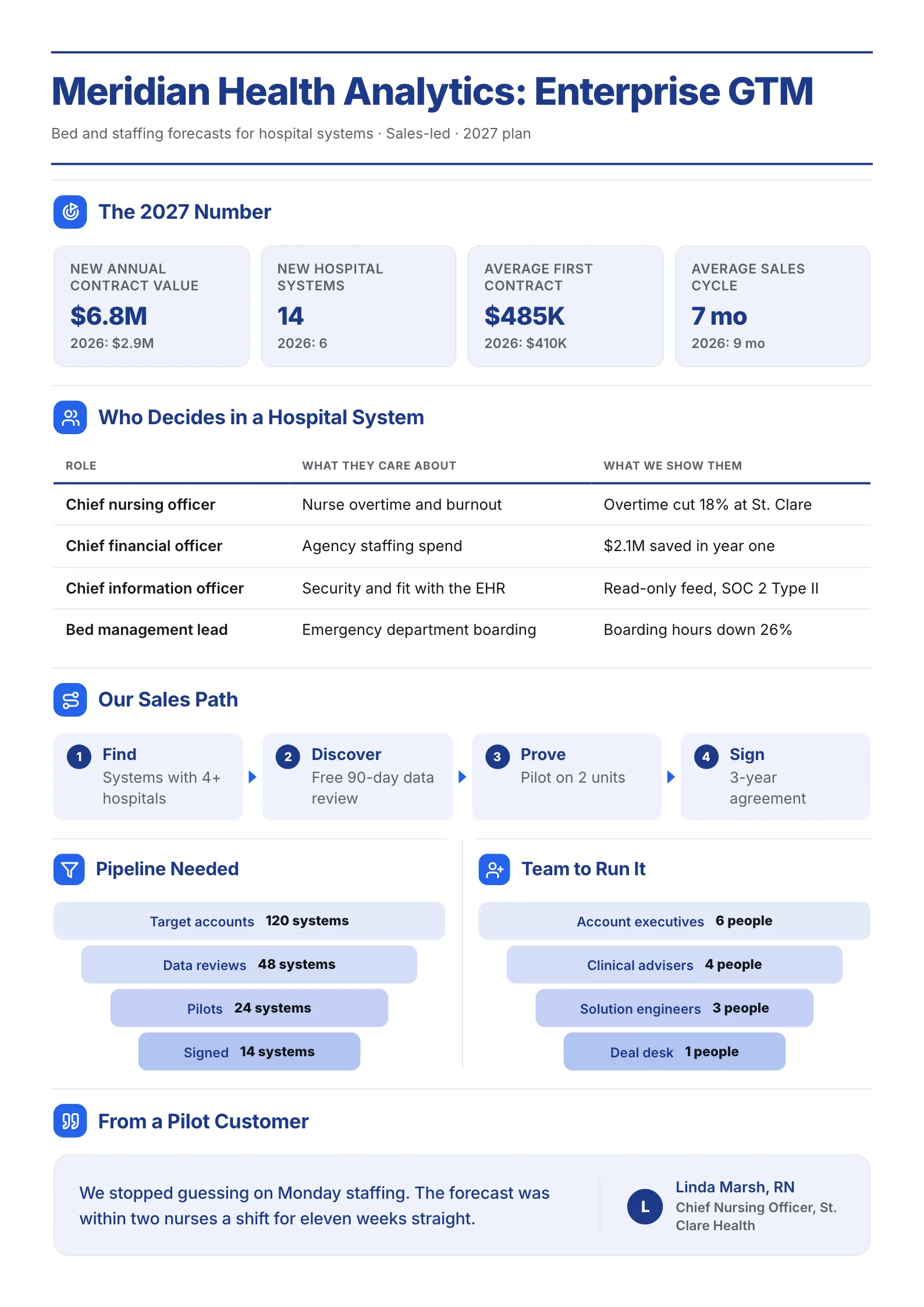
Stripe notes that B2B plans stress return on investment and use cases, and that B2B sales lean on demos and pilots. So if you sell to companies, write down each person who has to say yes. The enterprise sales go to market plan lists four roles in a hospital system and what each one needs to see. The chief financial officer cares about agency staffing spend, so the proof shown is $2.1M saved in year one.
Then work the pipeline backward from the goal. 14 signed systems needs 24 pilots, 48 data reviews and 120 target accounts. Your reader can check whether the sales team you're asking for can carry that load, and you can check it too.
Step 4: Put the channel's terms in numbers
 Edit this template
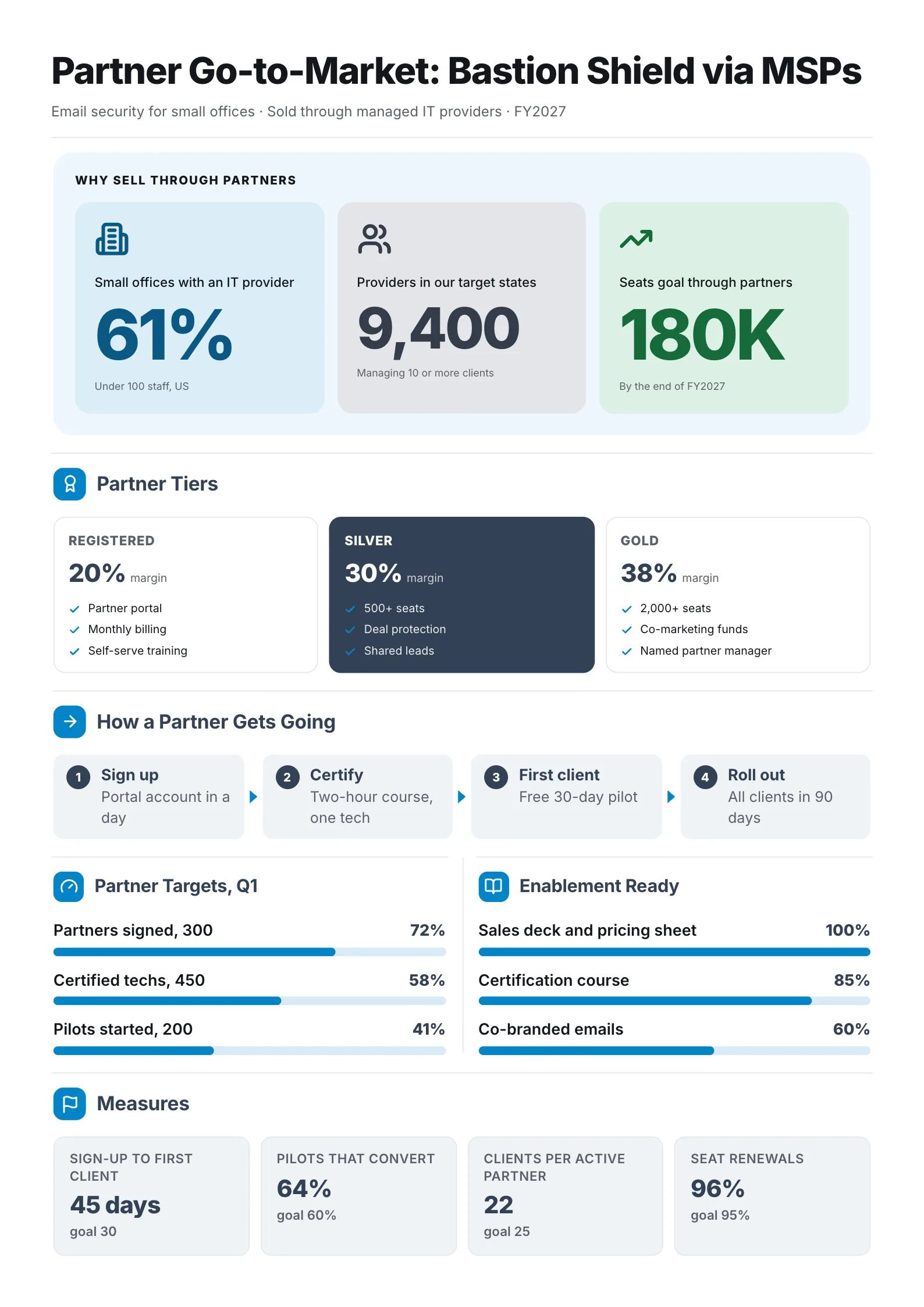
"We'll sell through partners" is a wish until the terms are written down. The channel partner go to market plan gives each partner tier its margin, 20%, 30% or 38%. It also maps the path from sign-up to rollout, with a two-hour certification and a free 30-day pilot.
Its measures include one that's behind. Sign-up to first client takes 45 days against a goal of 30. A plan that shows its own weak number is easier to trust, and it tells you where your next fix goes.
Step 5: Order the launch, and write a measure that can stop you
 Edit this template
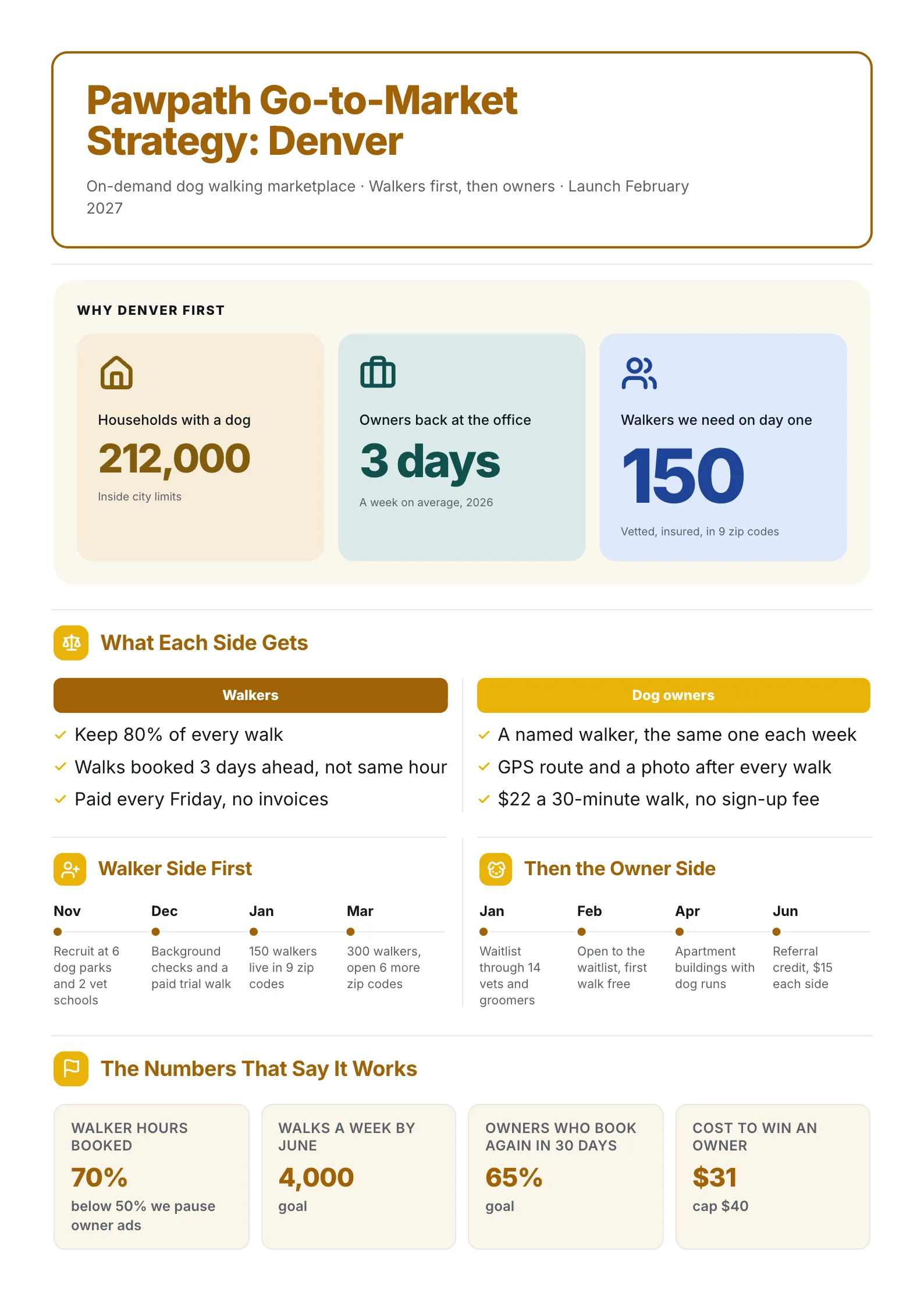
Some launches have an order you can't skip. A marketplace needs sellers before buyers, so the marketplace go to market strategy recruits 150 walkers in 9 zip codes before owners can book. It shows the two timelines one after the other, so your reader sees the walker side finish first.
The best line on the page is a rule you can copy. Walker hours booked has a goal of 70%, and "below 50% we pause owner ads." That turns a target into a decision made in advance. Add one to your own plan, so nobody has to argue about it in month three.
Make your go to market strategy
Write the five answers in a document first, one paragraph each. Then pick the closest layout in MakeOnepagers and swap in your own customers, prices and dates. Already have a long plan or a deck? The free AI One-Pager generator lays it out as a draft page you can trim. For finished plans to compare against, see our go to market strategy examples, and the launch plan guide covers the weeks around launch day.
Frequently asked questions
What comes first in a go to market strategy?
The customer. Write who buys and what makes them start looking before you choose channels or prices, because both depend on it.
What is the difference between a go to market strategy and a business plan?
A business plan covers the whole company. The go to market strategy is written for one launch, a single product or one new market, so it runs shorter and carries dates.
Is a go to market strategy different for B2B and B2C?
Yes. B2B plans lean on return on investment, demos and pilots, and they name everyone who signs. B2C plans lean on simplicity and fit with how people live.
How many sections should a one-page go to market strategy have?
About five or six blocks. Keep the customer, the offer and price, the path to a sale, the milestones and the measures, and move market and competitor research to an appendix.
How do you know if a go to market strategy is working?
Set a target and a stop line for each main measure before launch. When a number crosses the stop line, you change course on schedule instead of waiting for a bad quarter.




