Go to Market Strategy Examples: Write the Numbers You'll Be Judged On First
5 go to market strategy examples on one page: an app, a whiteboard tool, a meal kit, a thermostat and a partner channel, checked against SBA's 6 questions.

A go to market strategy answers one question for your team: how does this product reach its first paying customers? Each of these go to market strategy examples answers it on a single page, with the target numbers printed where everyone can see them. Start from a free one pager template.
One‑Pager examples
Real One-Pagers made with MakeOnepagers. Open any one to edit it as your own.
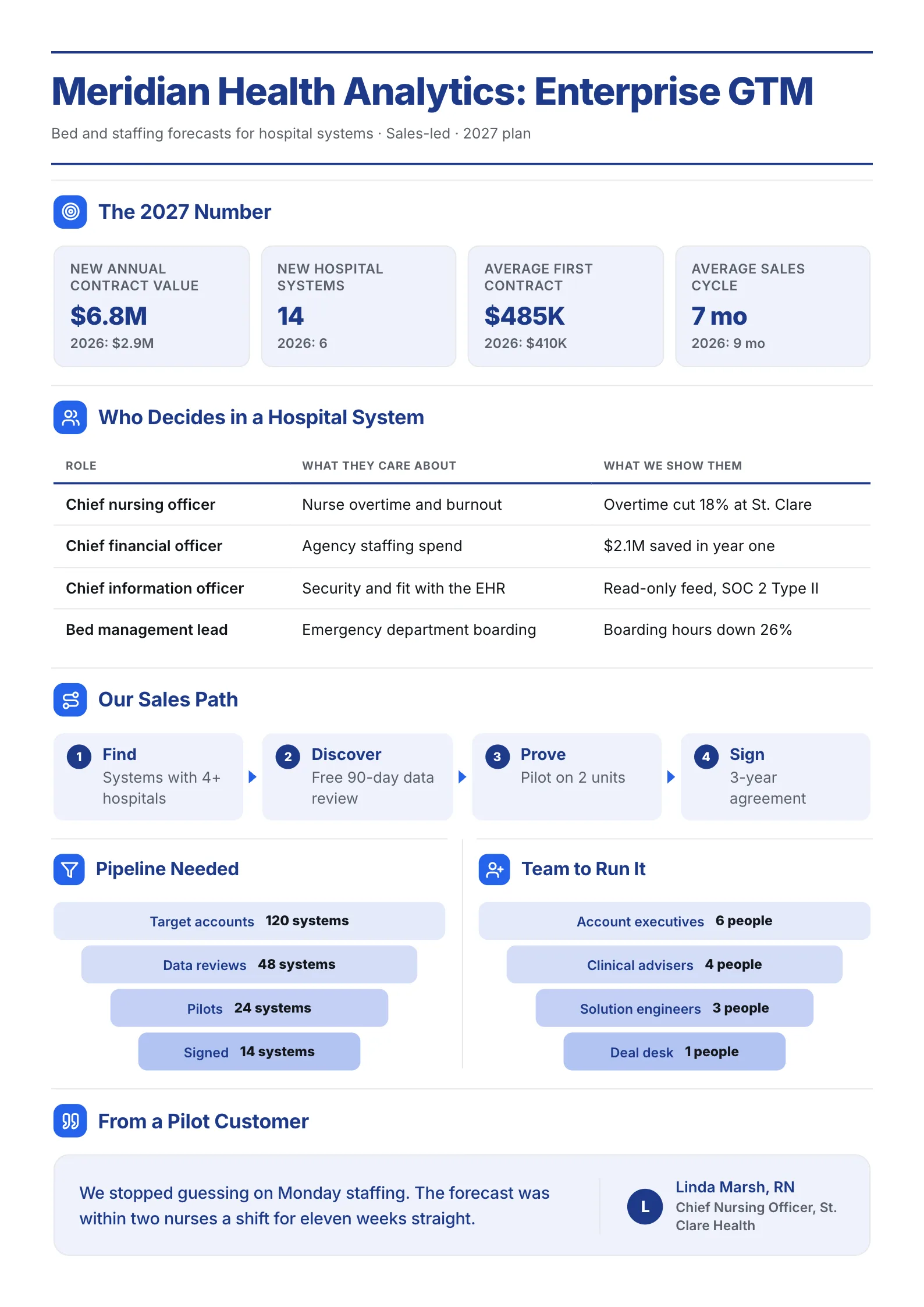 Go-to-Market Strategy: Enterprise SalesEdit for free(opens in a new tab)
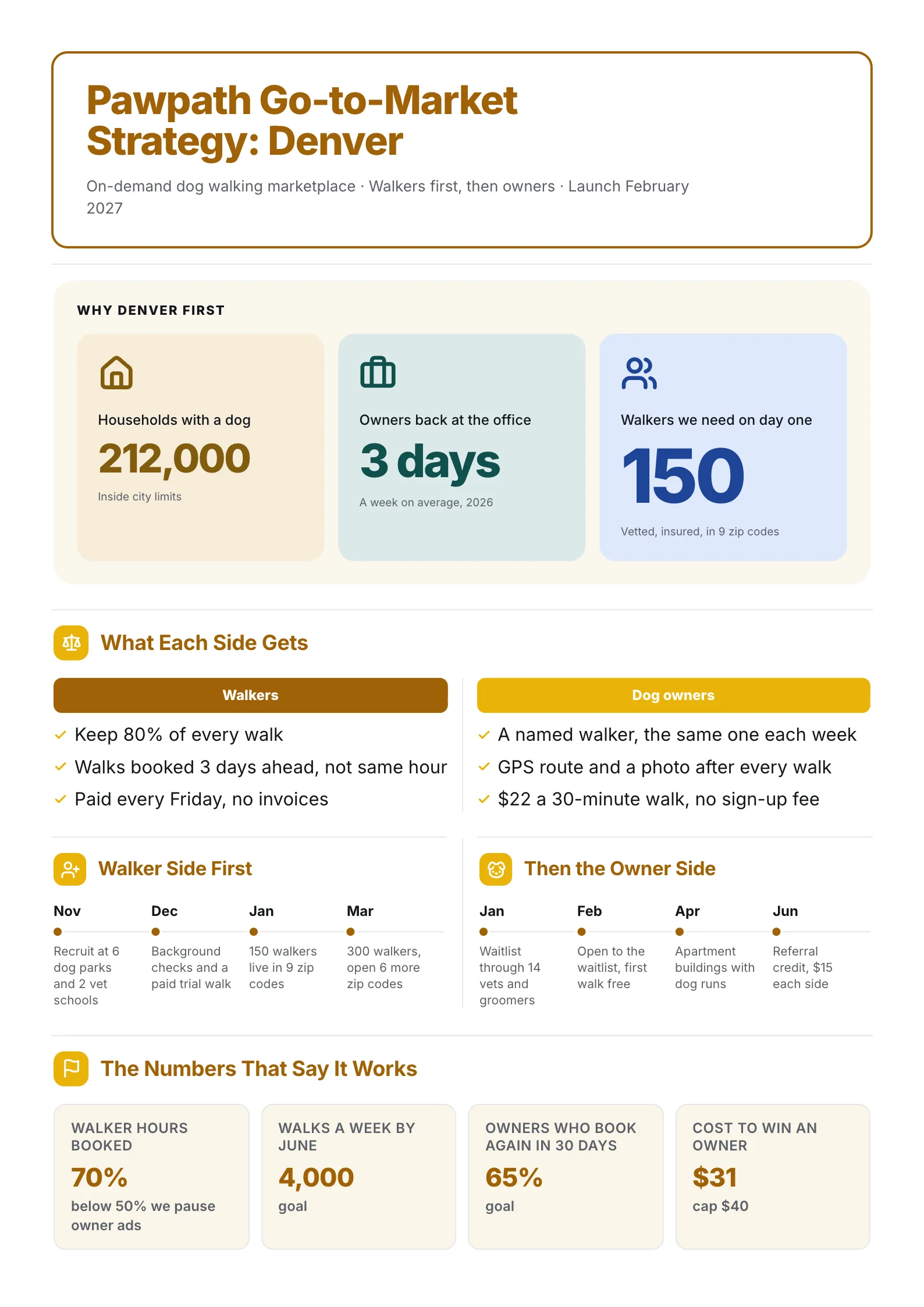 Go-to-Market Strategy: Marketplace LaunchEdit for free(opens in a new tab)
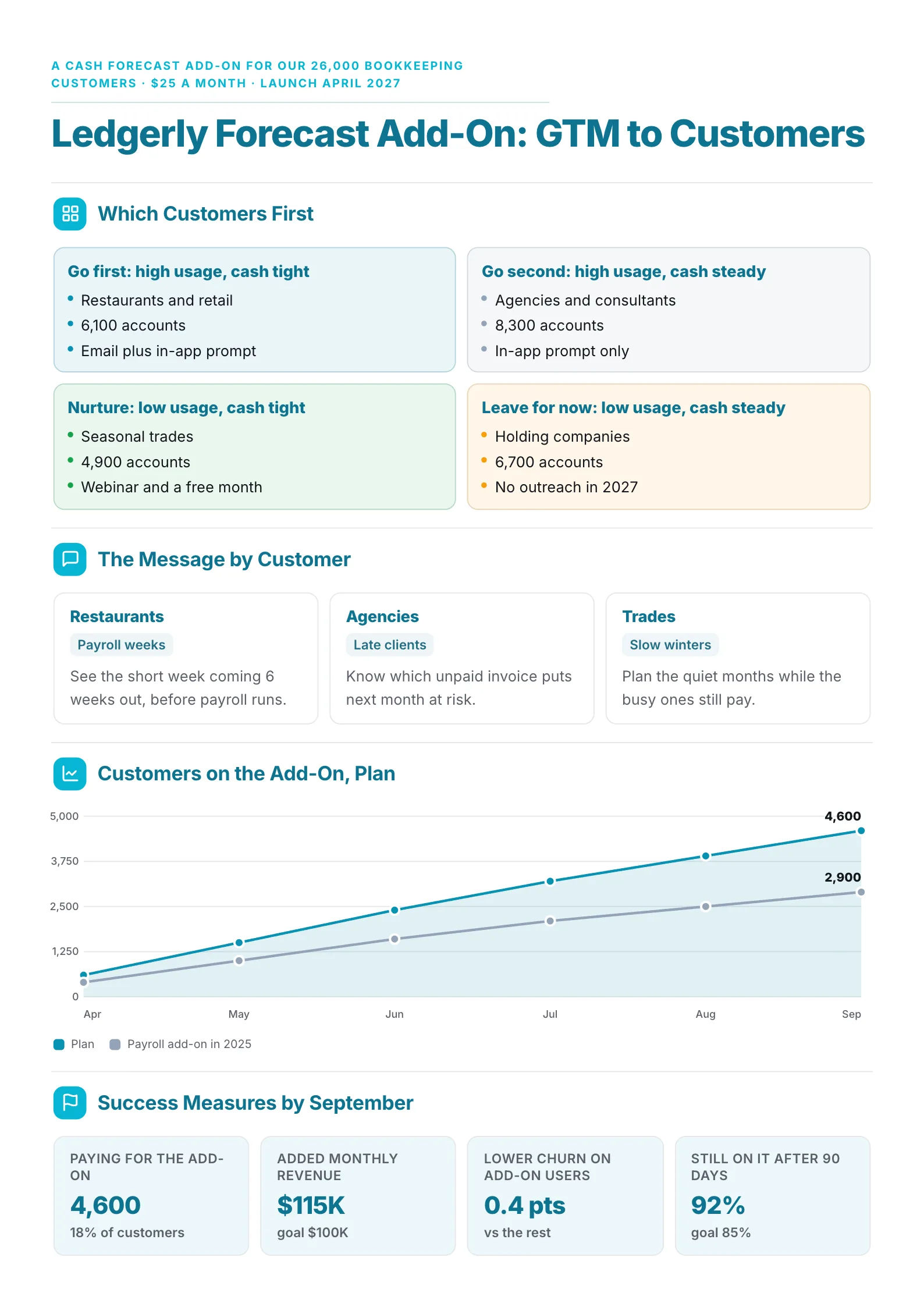 Go-to-Market Strategy: Add-On for CustomersEdit for free(opens in a new tab)
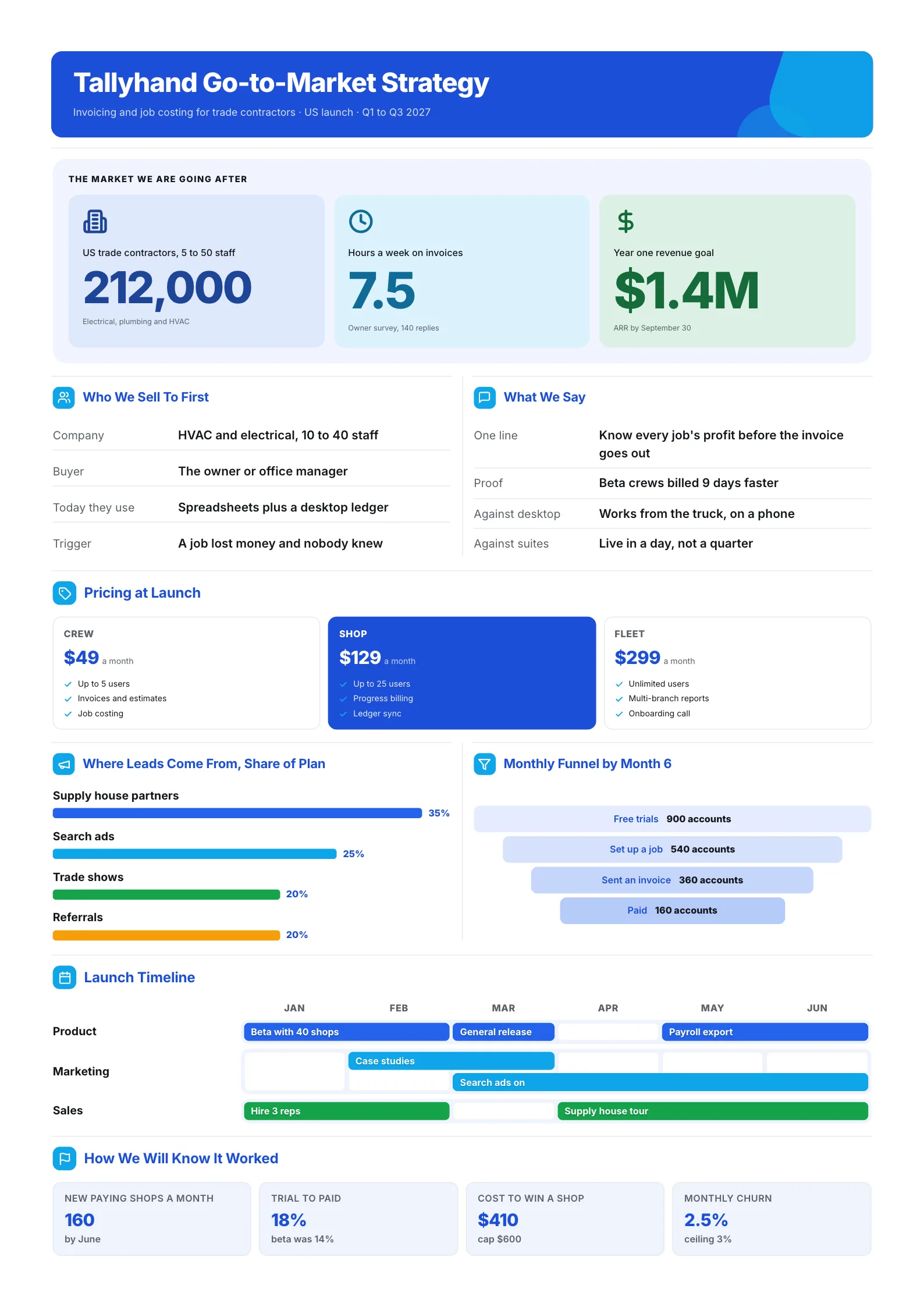 Go-to-Market Strategy: SaaS LaunchEdit for free(opens in a new tab)
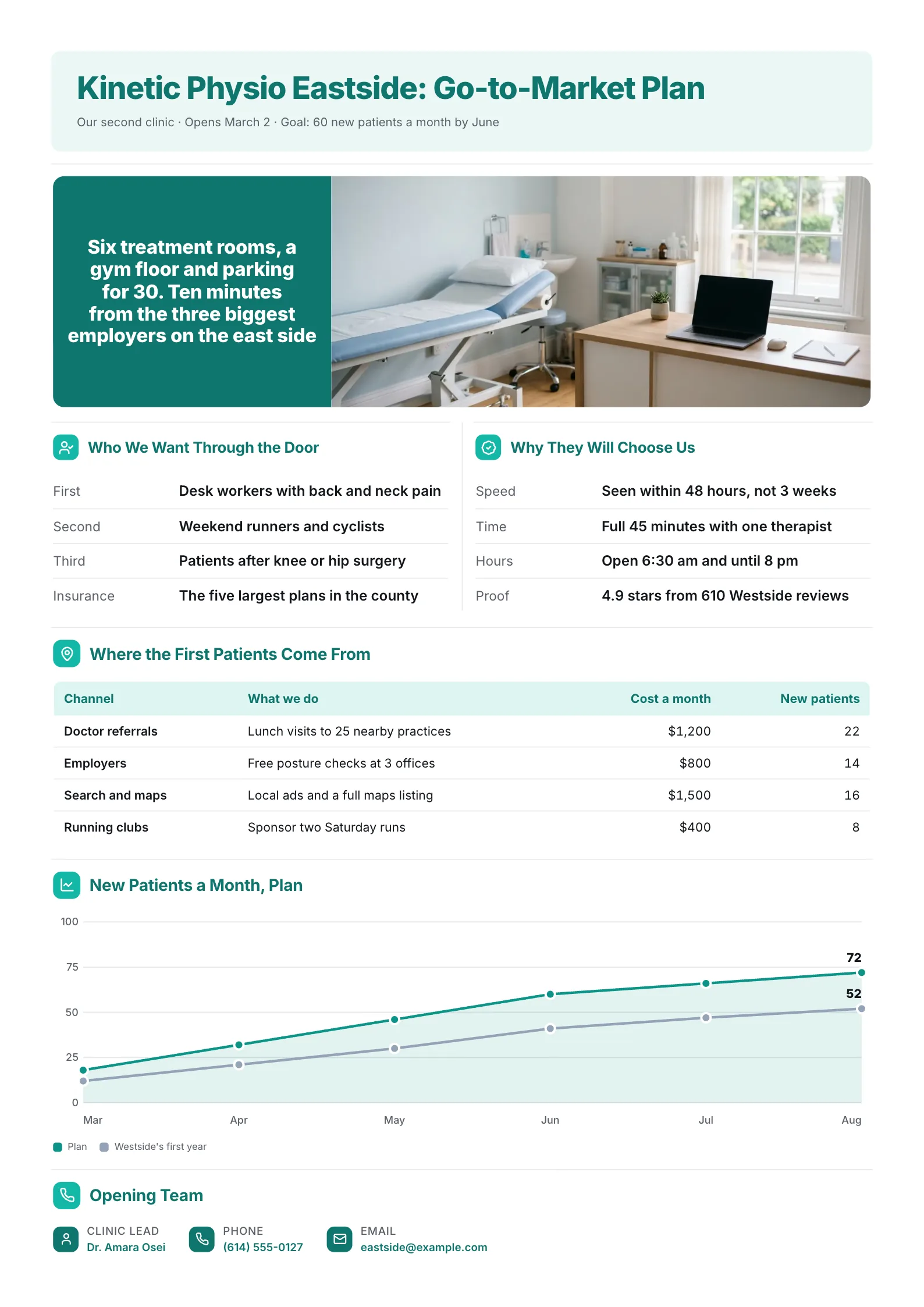 Go-to-Market Strategy: Local BusinessEdit for free(opens in a new tab)
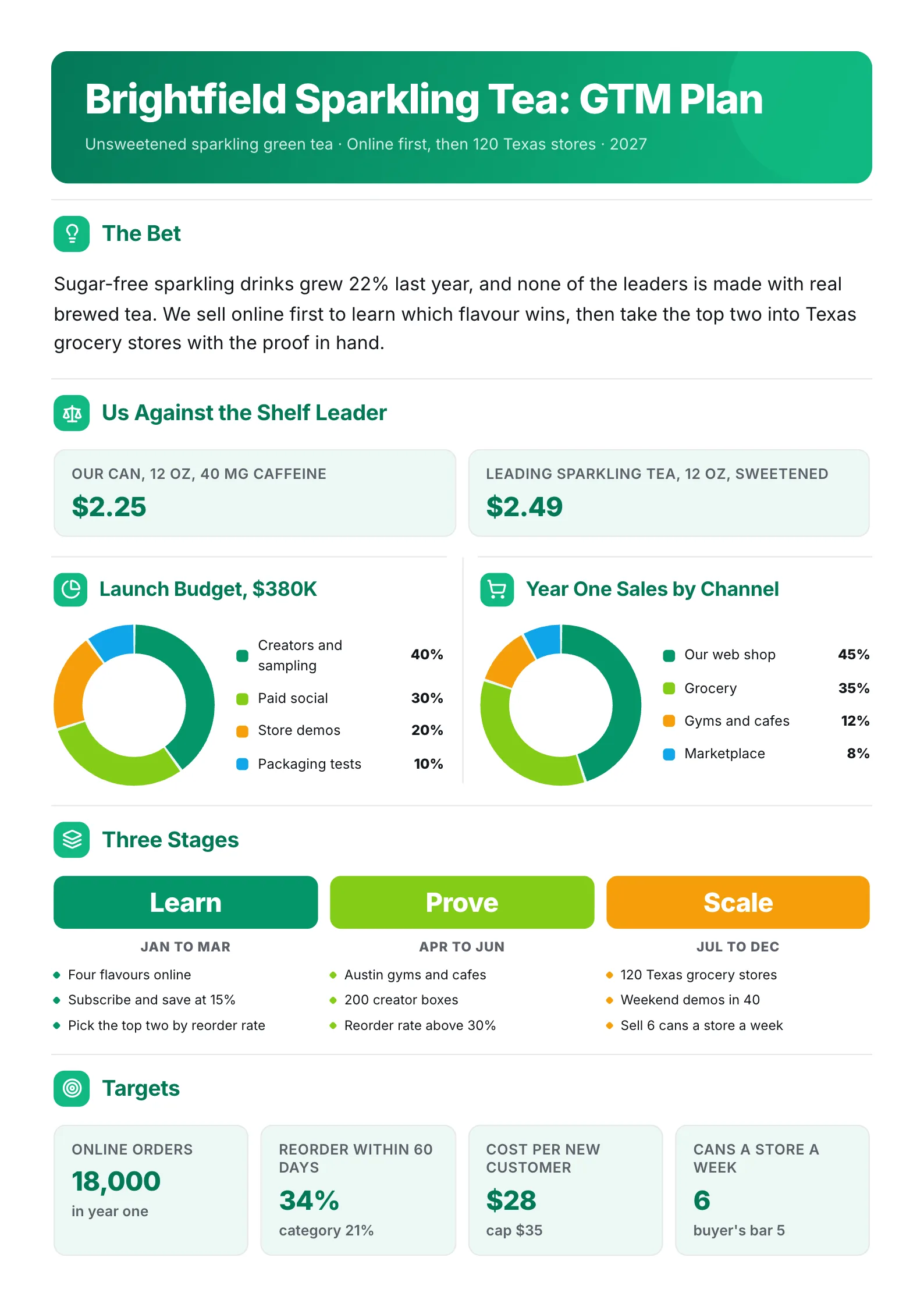 Go-to-Market Strategy: Consumer BrandEdit for free(opens in a new tab)
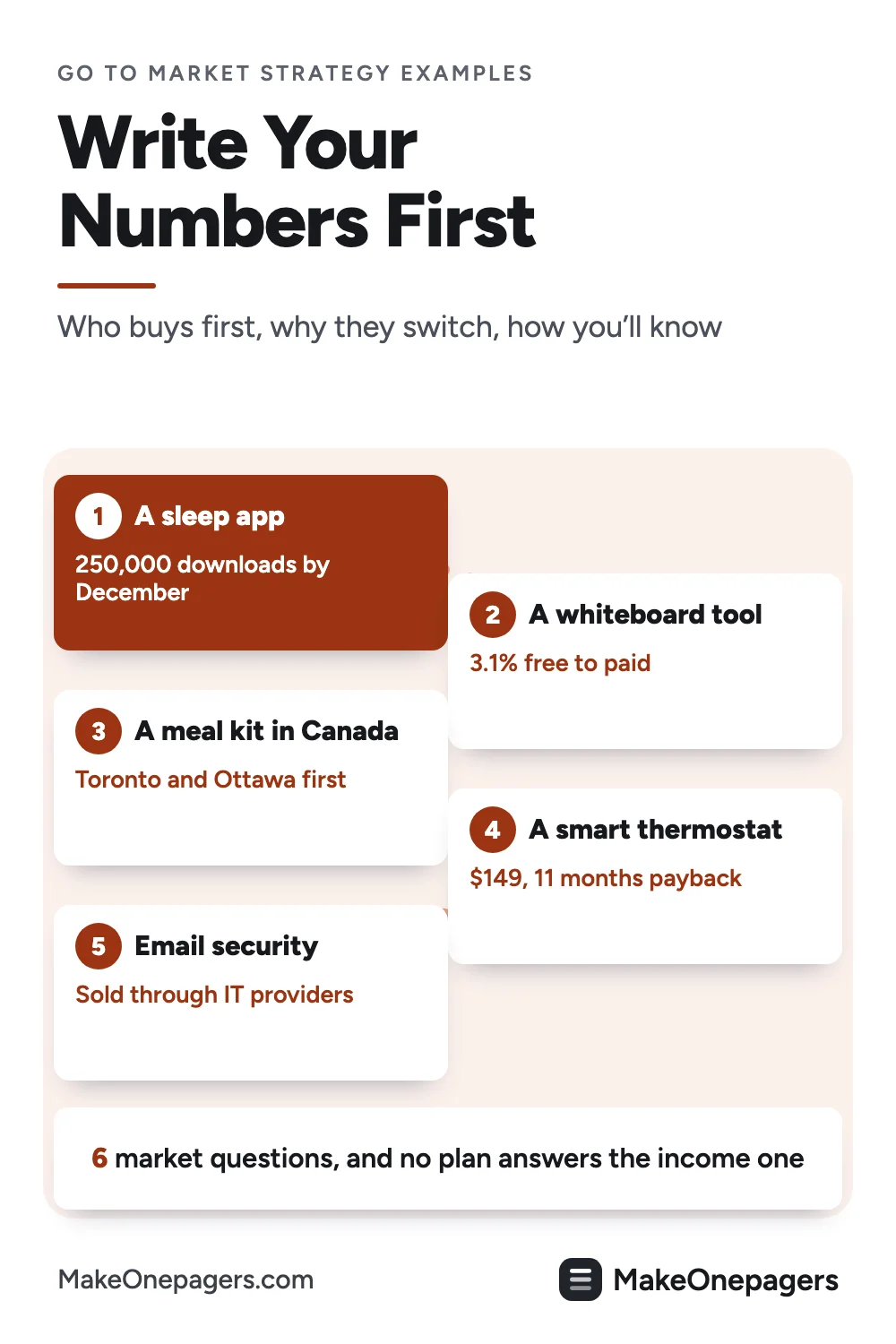
These five launches pull in different directions. A sleep app has to prove itself by December, a whiteboard tool has to turn free teams into paying ones, and a meal kit company has to win over a board before it enters Canada. A $149 thermostat has to earn its shelf space, and an email security product has to win IT providers before it reaches a single office. A table at the end shows which of SBA's six market research questions each plan answers.
A sleep app that has to prove itself by December
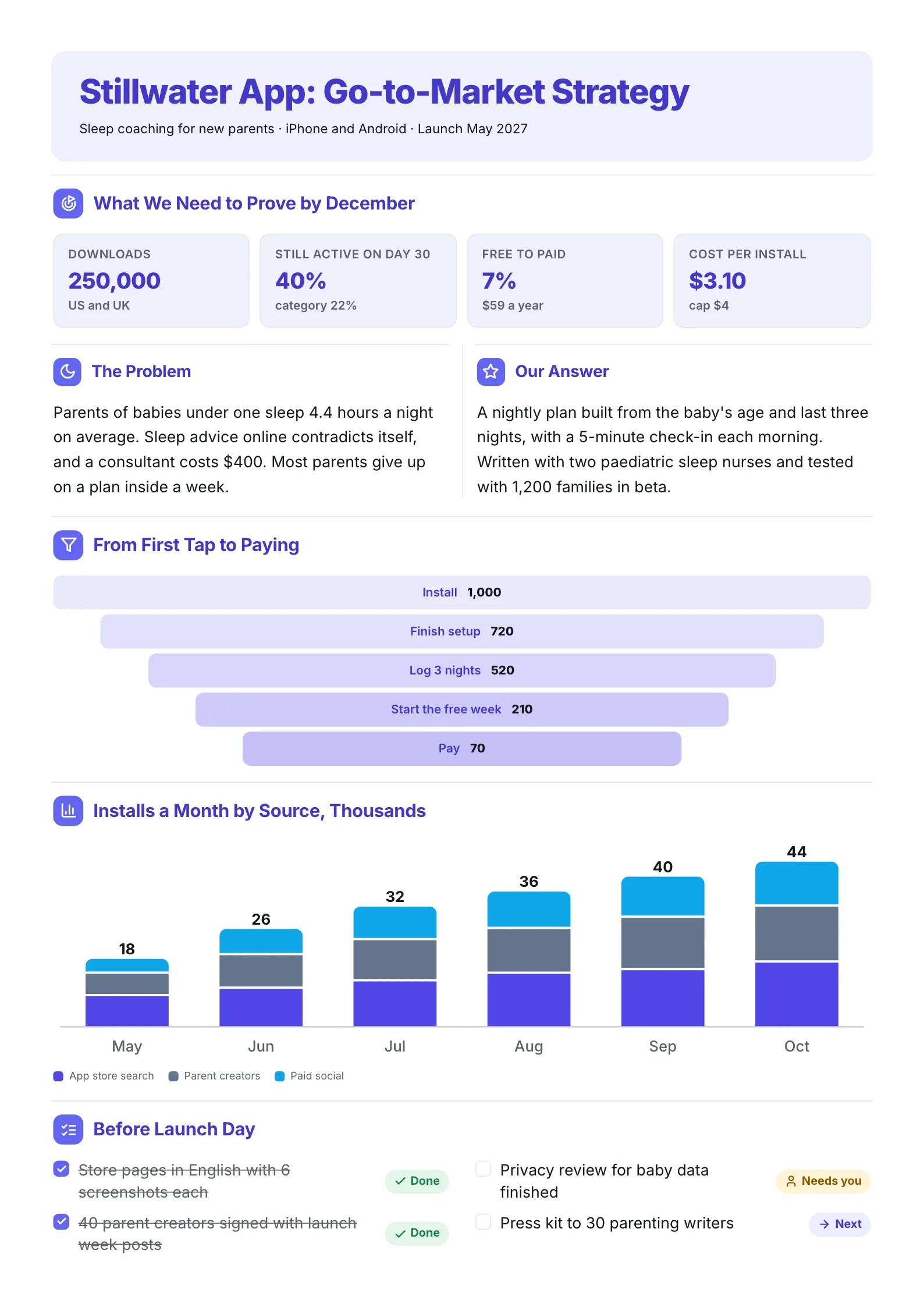
Stillwater is a sleep coaching app for new parents on iPhone and Android, launching May 2027. The first box is titled "What We Need to Prove by December," which tells your investors exactly how to judge it.
 Edit this template
Stillwater is invented. The four targets are the whole bet, written so anyone can check them in December.
Stillwater has to hit four numbers: 250,000 downloads, 40% still active on day 30, 7% going from free to paid and a cost per install of $3.10. If you only read one box, you'd still know whether the launch worked.
"From First Tap to Paying" is the funnel in five steps. Install, finish setup, log 3 nights, start the free week, pay. Logging 3 nights gets its own step, because it's the moment a tired parent sees the app actually helping.
The pre-launch list is concrete enough to tick off. Store pages in English with 6 screenshots each, and 40 parent creators signed with launch week posts.
A whiteboard tool that grows from a free plan
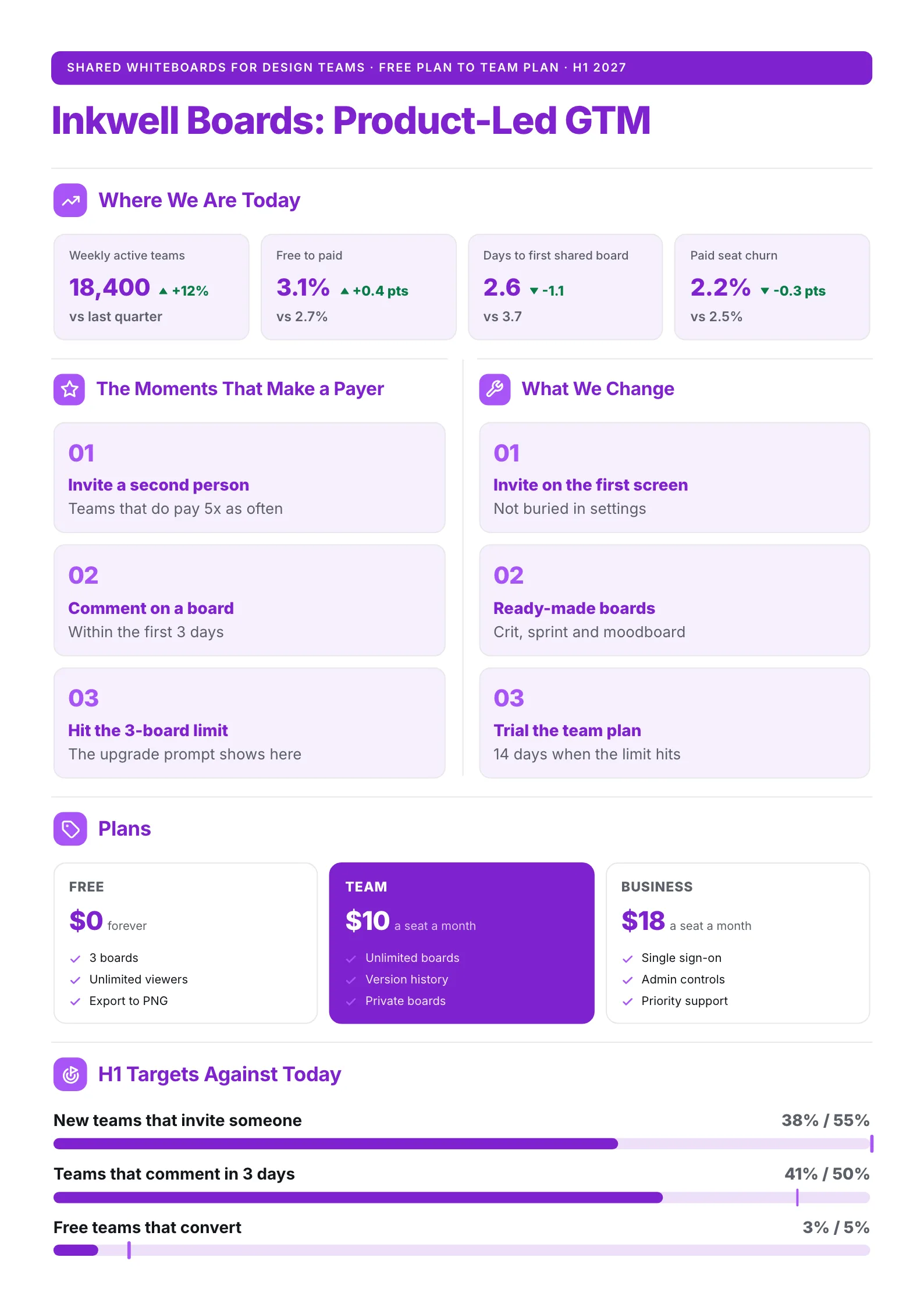
Inkwell Boards sells shared whiteboards to design teams, moving users from a free plan to a team plan in the first half of 2027. If your product sells itself through use, this is the layout to study.
 Edit this template
A sample product with sample numbers. The middle box is the one your product team will argue about.
Inkwell has 18,400 weekly active teams and only 3.1% going from free to paid, so the whole plan is about one invite. "Where We Are Today" adds 2.6 days to the first shared board and 2.2% paid seat churn. Without a baseline, you can't say later whether anything moved.
Teams that invite a second person pay 5x as often, so that's the moment the plan is built around. Commenting on a board in the first 3 days matters too, and hitting the 3-board limit is where the upgrade prompt shows. Then "What We Change" acts on each one: put the invite on the first screen, offer ready-made boards for crits, sprints and moodboards, and trial the team plan for 14 days. Find your own payer moment before you write your plan.
A meal kit company entering Canada
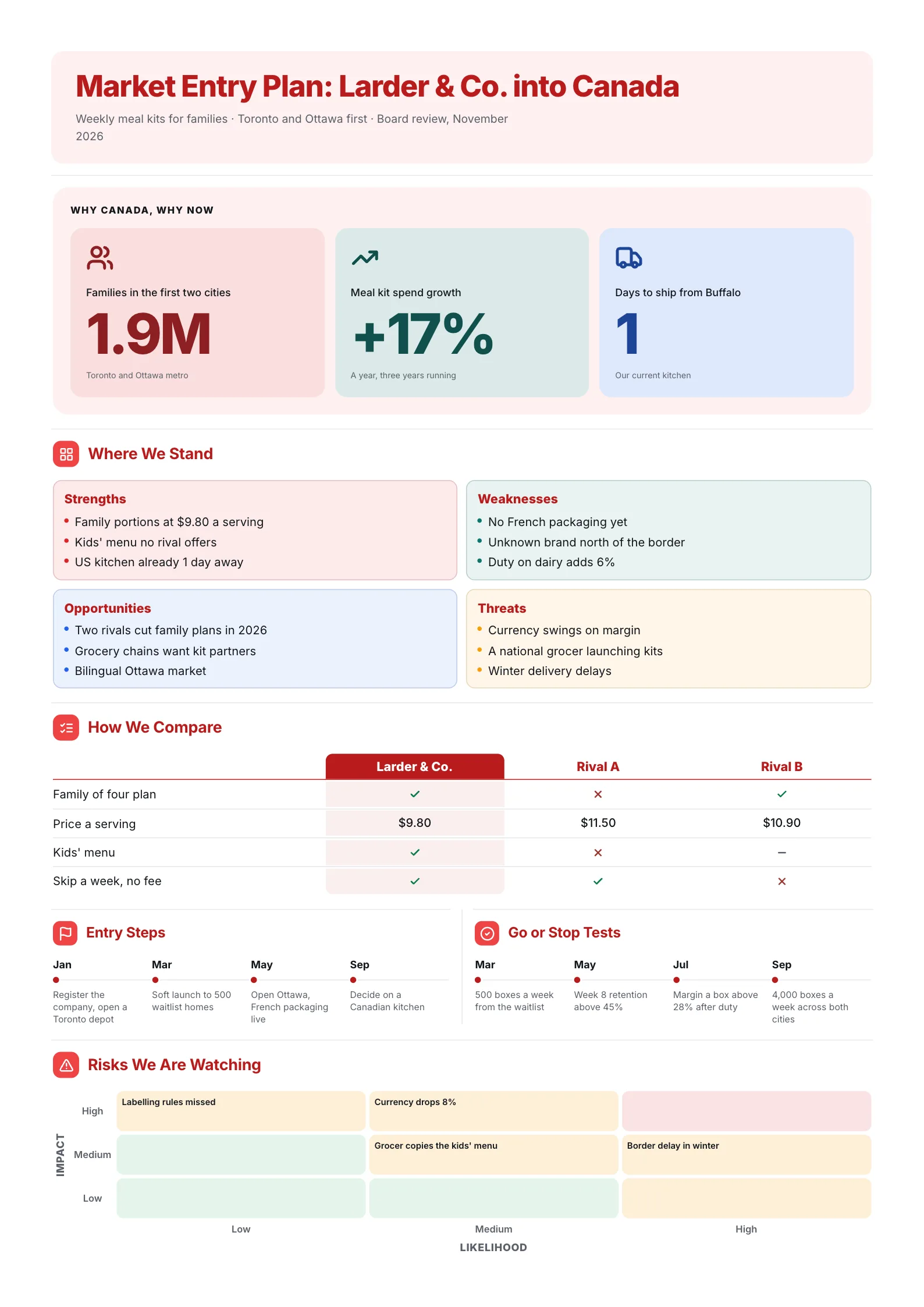
Larder & Co. sells weekly meal kits for families, and if you're expanding abroad, its plan to start in Toronto and Ottawa is worth a look. The plan is dated for a board review in November 2026, so it's written to win a yes.
 Edit this template
Larder & Co. is invented. "Why Canada, Why Now" answers the board's first question with three numbers.
Larder has to convince a board, so it gives three reasons to go now. There are 1.9M families across the Toronto and Ottawa metros. Meal kit spend is growing 17% a year, three years running. And it's 1 day to ship from the company's current kitchen in Buffalo.
"How We Compare" lines Larder up against rivals on the things families notice: a family of four plan, price per serving, a kids' menu and skipping a week with no fee. The entry steps run in order, from registering the company and opening a Toronto depot to a soft launch for 500 waitlist homes and French packaging when Ottawa opens.
A $149 thermostat sold in stores
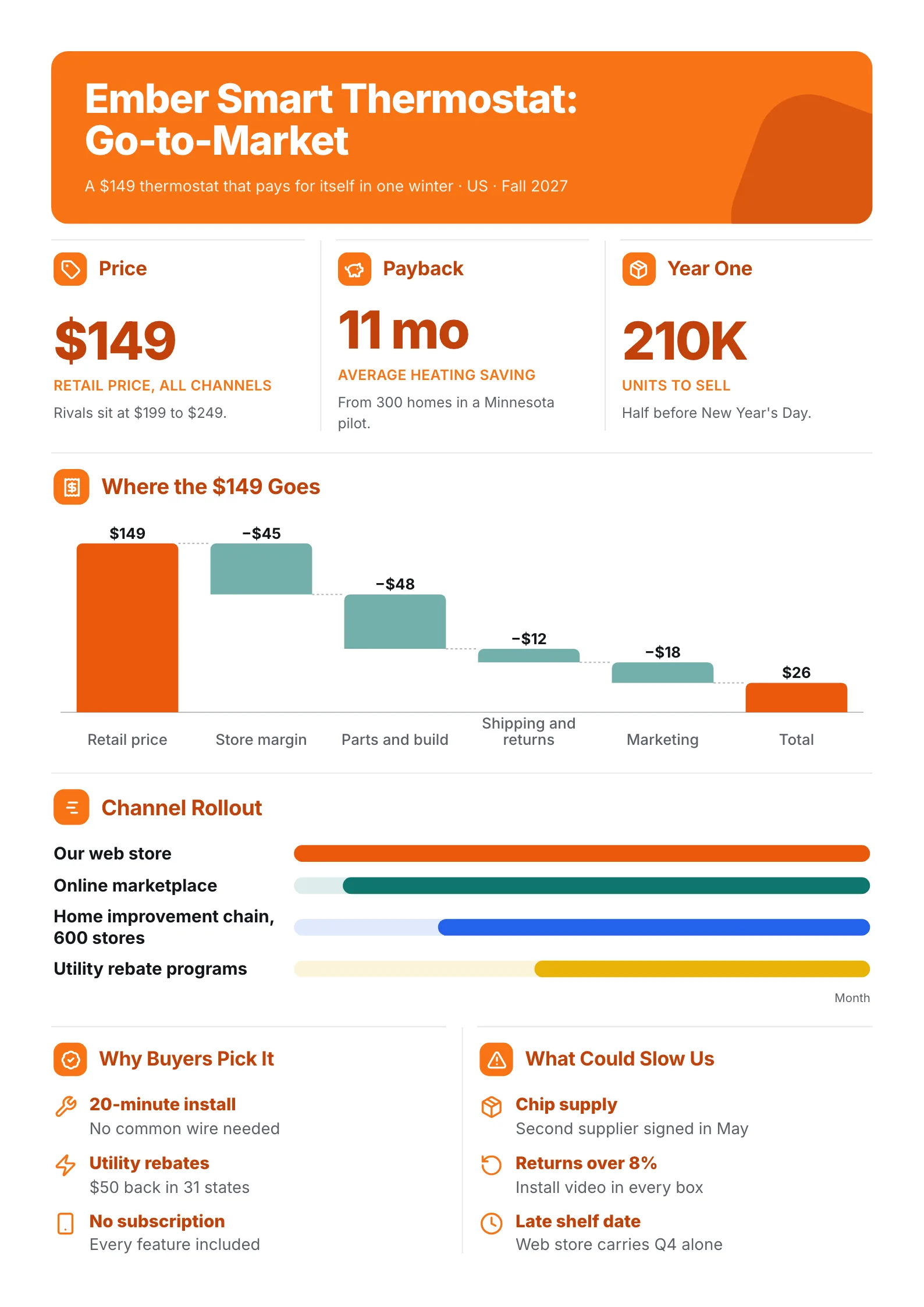
Ember's one-line pitch is a $149 thermostat that pays for itself within a year. It launches in the US in fall 2027.
 Edit this template
Ember is a sample product. The "Where the $149 Goes" bar shows your margin.
Ember has to sell 210K units in year one at a single price. The top row sets that goal beside the $149 retail price in all channels and an 11-month average payback on heating. "Where the $149 Goes" splits the price into store margin, parts and build, shipping and returns, and marketing, so your retail partner and your finance lead see the same math.
The channel rollout starts with the web store, then an online marketplace, then a home improvement chain with 600 stores, then utility rebate programs. "Why Buyers Pick It" gives four reasons a shopper can repeat in the aisle: a 20-minute install, no common wire needed, $50 back from utilities in 31 states and no subscription.
An email security product sold by IT providers
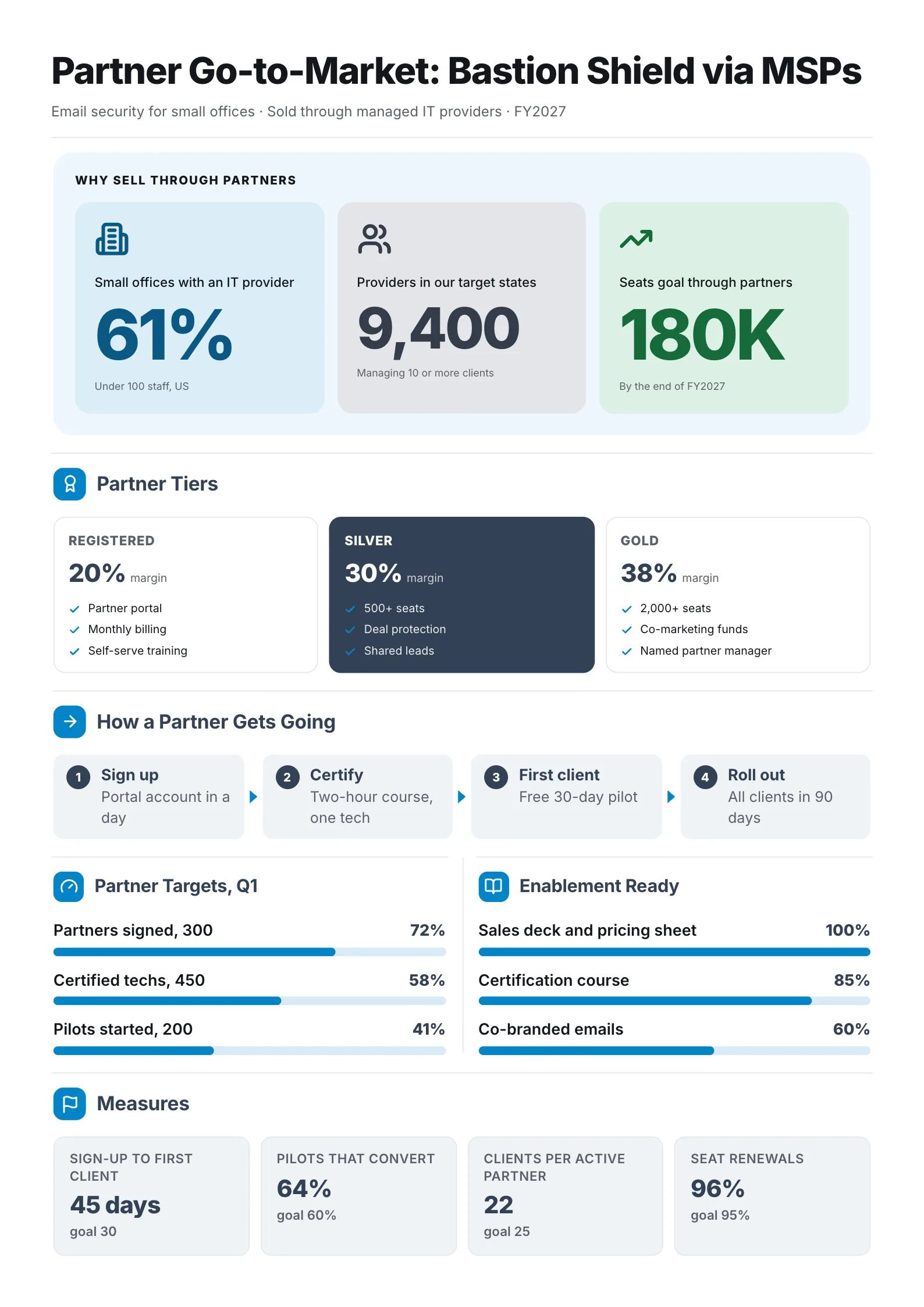
Bastion Shield protects small offices from email threats, and it's sold through managed IT providers in FY2027. If you sell through partners, your go to market strategy has two customers, and this plan treats them that way.
 Edit this template
A sample vendor. The four onboarding steps are what your partner manager will send out.
Bastion needs IT providers before it needs a single office, and three numbers make that case. Of US small offices under 100 staff, 61% have an IT provider. There are 9,400 providers in the target states managing 10 or more clients each. The goal is 180K seats through partners by the end of FY2027.
"How a Partner Gets Going" fits on one line each. Sign up for a portal account in a day. Certify one tech with a two-hour course. Start a first client on a free 30-day pilot. Roll out to all clients in 90 days. Partner tiers run from Registered to Silver to Gold, so your best partners can see what they're working toward.
SBA's six market questions, checked against each plan
SBA's market research guide, read October 30, 2026, lists six questions to answer about your market. Here's where each plan answers them on the page.
| SBA question | Stillwater | Inkwell | Larder & Co. | Ember | Bastion |
|---|---|---|---|---|---|
| Demand: is there a desire for it? | The problem box | Not shown | Spend up 17% a year | Not shown | Not shown |
| Market size: how many would be interested? | Not shown | Not shown | 1.9M families | Not shown | 9,400 providers |
| Economic indicators: income range and employment rate | Not shown | Not shown | Not shown | Not shown | Not shown |
| Location: where do customers live? | US and UK | Not shown | Toronto and Ottawa | US, 600 stores | Target states |
| Market saturation: how many options exist? | Not shown | Not shown | How We Compare | Not shown | Not shown |
| Pricing: what do they pay for alternatives? | A $400 consultant | Not shown | Price a serving | Rivals at $199 to $249 | Not shown |
Larder answers five of the six, and it's the plan going to a board. Inkwell answers none, because its page is about teams it already has. None of the five plans shows income or employment data for its buyers, and SBA suggests gathering population data on age, wealth and family. If you sell to households, add that line.
Write the December test first
Before you design the funnel or pick the channels, write down the four numbers that will tell you by the date you set whether this worked. Stillwater's plan from MakeOnepagers does it in its first box, with 250,000 downloads and a $3.10 cost per install. Every other box on the page exists to hit those numbers.
Frequently asked questions
What are the main parts of a go to market strategy?
Who buys first, the problem you solve for them, how they'll find you, the price, and the targets that prove it worked. Most plans add a timeline. Our go to market strategy template post covers each part.
How is a go to market strategy different from a marketing plan?
A go to market strategy covers one launch: a new product, a new city or a new channel. A marketing plan usually covers all your marketing for a year. The launch plan feeds the yearly one.
Should a go to market plan include a budget?
If you're asking someone to approve spending, yes. Ember shows where each $149 goes, and a launch budget split by channel works the same way. For the steps after launch day, see our guide on how to write a launch plan.




