How to Write a Launch Plan: 7 Real Launches, Counted Day by Day
How to write a launch plan, from 7 real product launches: a median of 16 days from announcement to shelves. Here's how to date every step of yours.

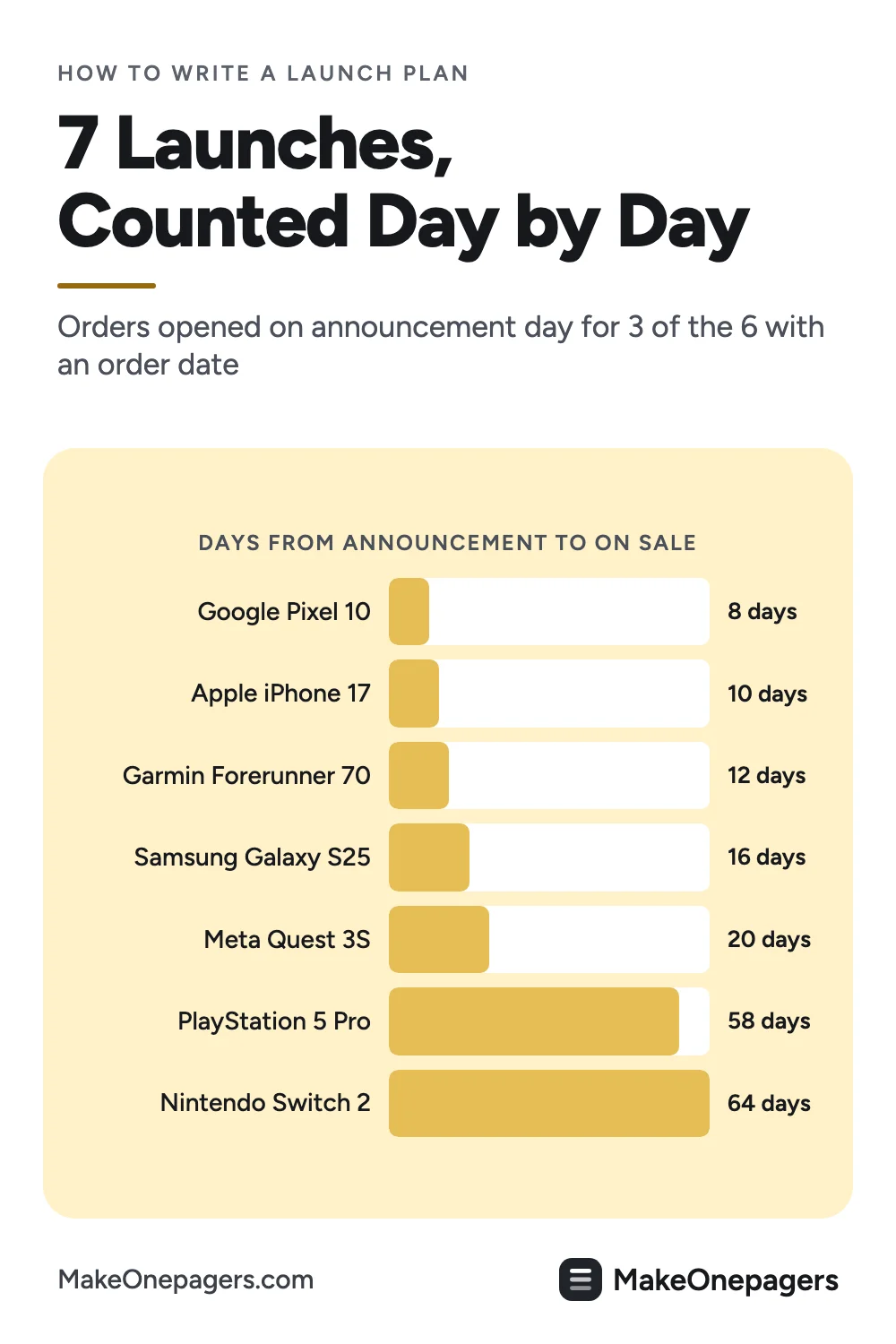
How long does a product launch take, from the day it's announced to the day it's on sale? In 7 launch announcements on the companies' own sites, from Apple's iPhone 17 to Garmin's newest running watches, we wrote down every date. The median launch went from announcement to on sale in 16 days. The fastest took 8. The slowest took 64, and that was the one that had to move a date after it was announced. Start from a free one pager template.
One‑Pager examples
Real One-Pagers made with MakeOnepagers. Open any one to edit it as your own.
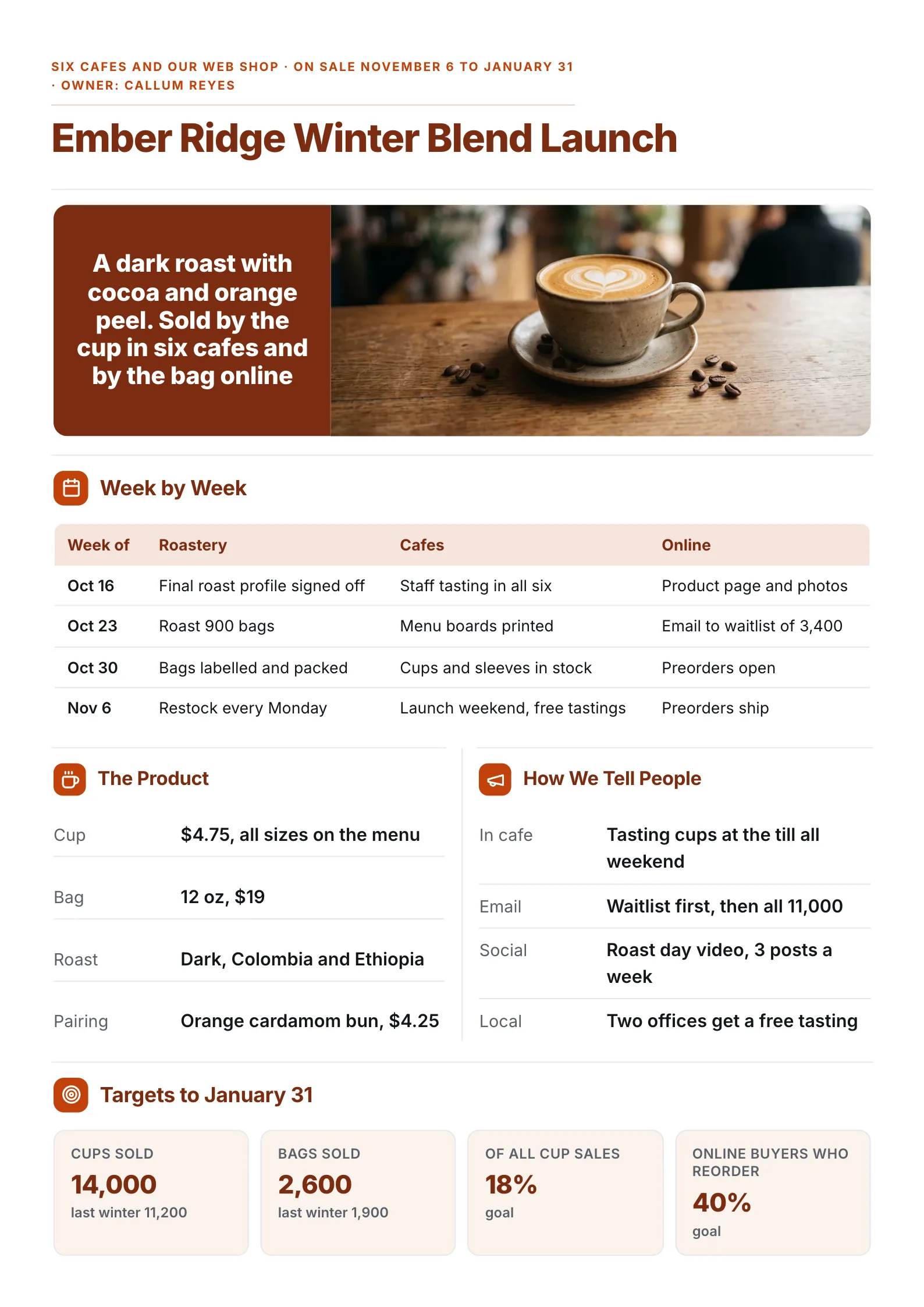 Product Launch Plan: Seasonal ProductEdit for free(opens in a new tab)
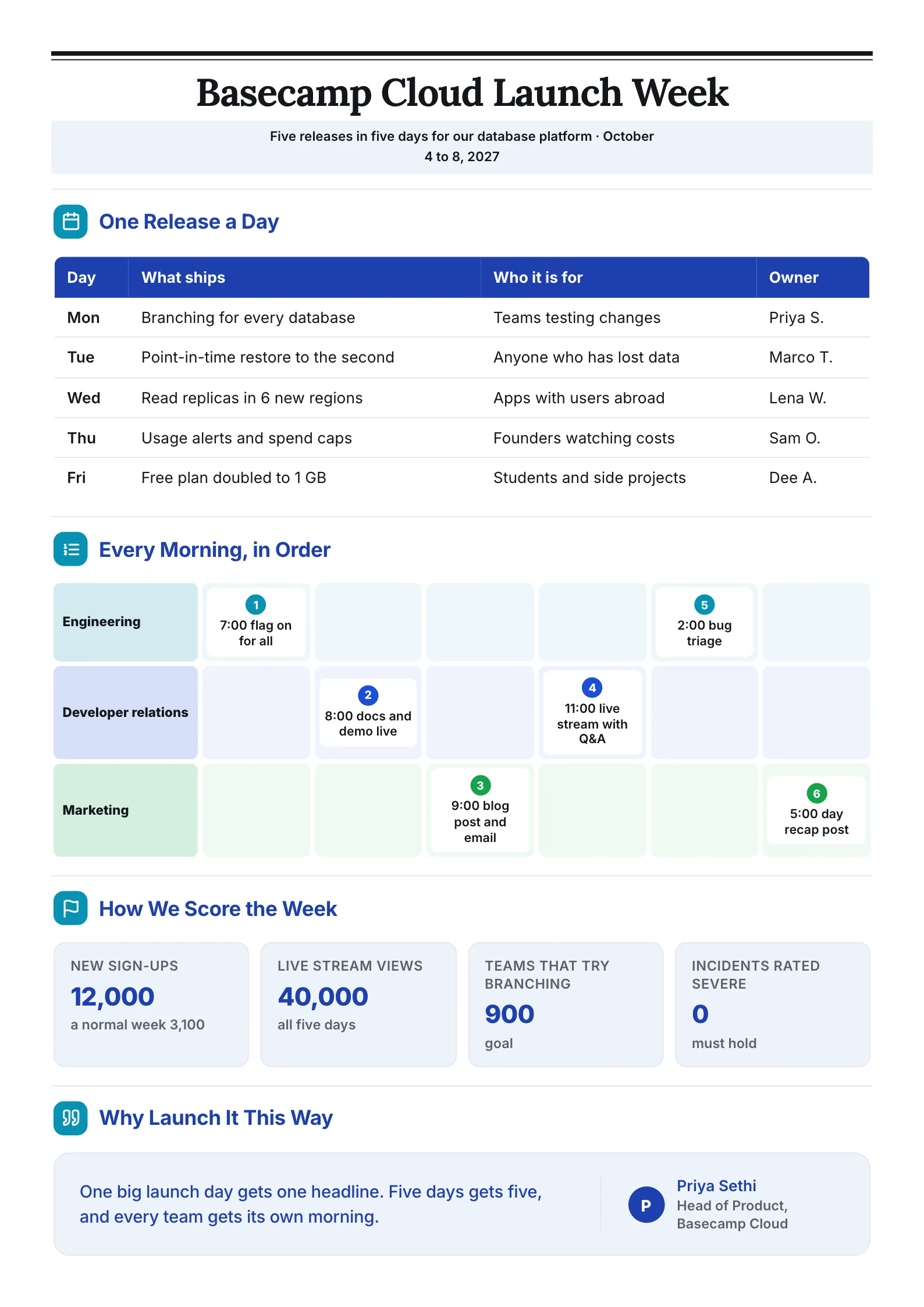 Product Launch Plan: Launch WeekEdit for free(opens in a new tab)
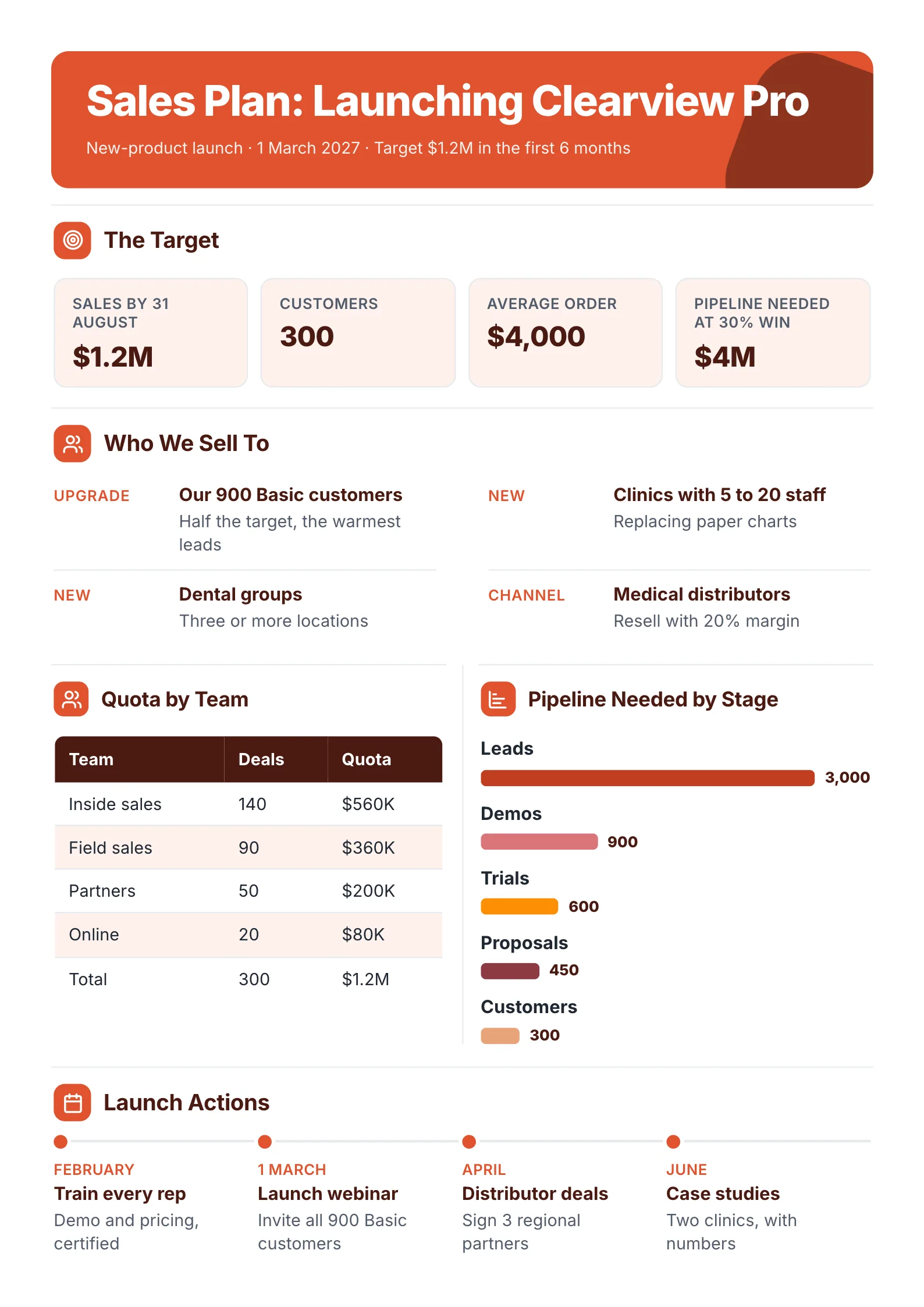 Product Launch Sales PlanEdit for free(opens in a new tab)
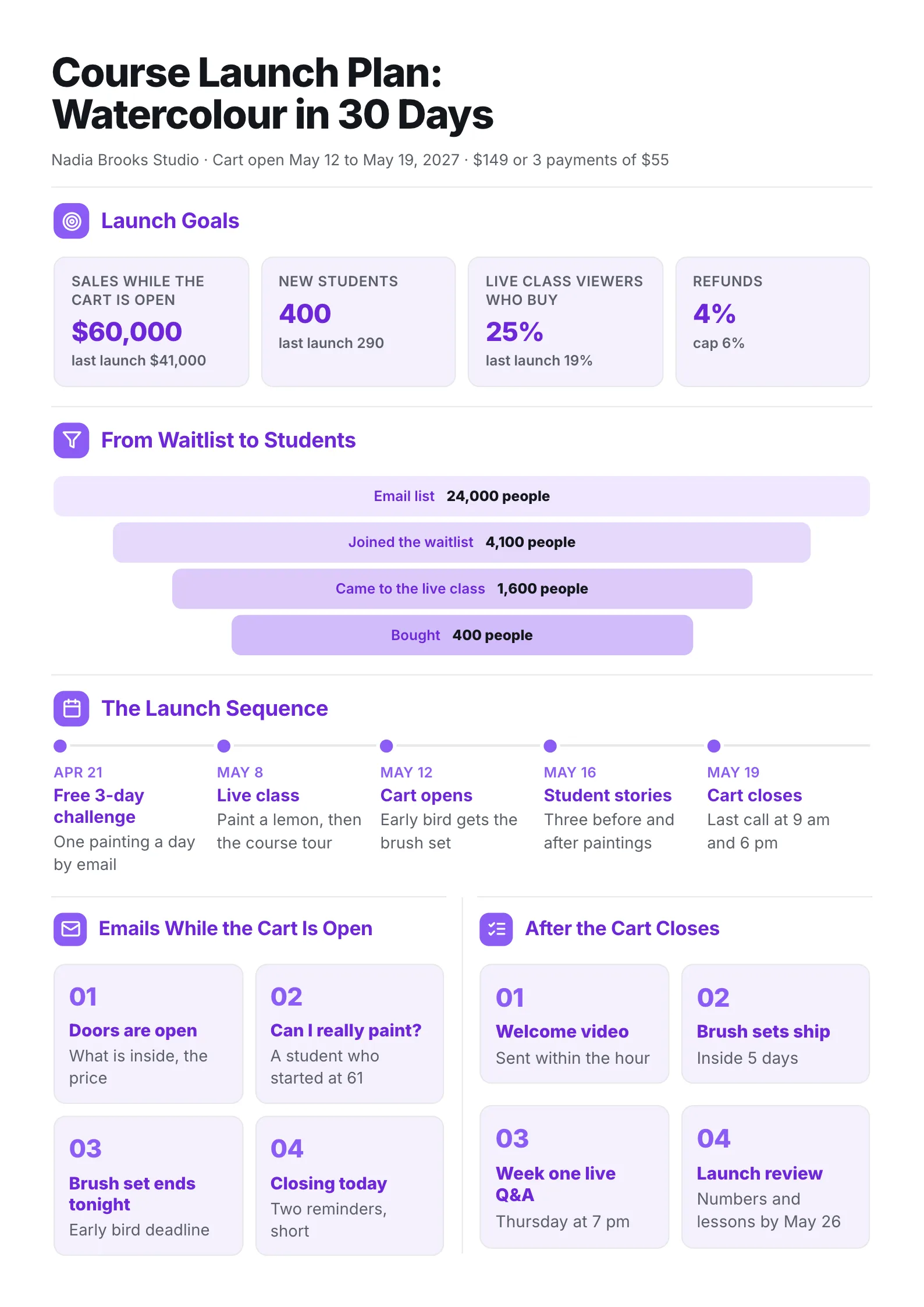 Product Launch Plan: Online CourseEdit for free(opens in a new tab)
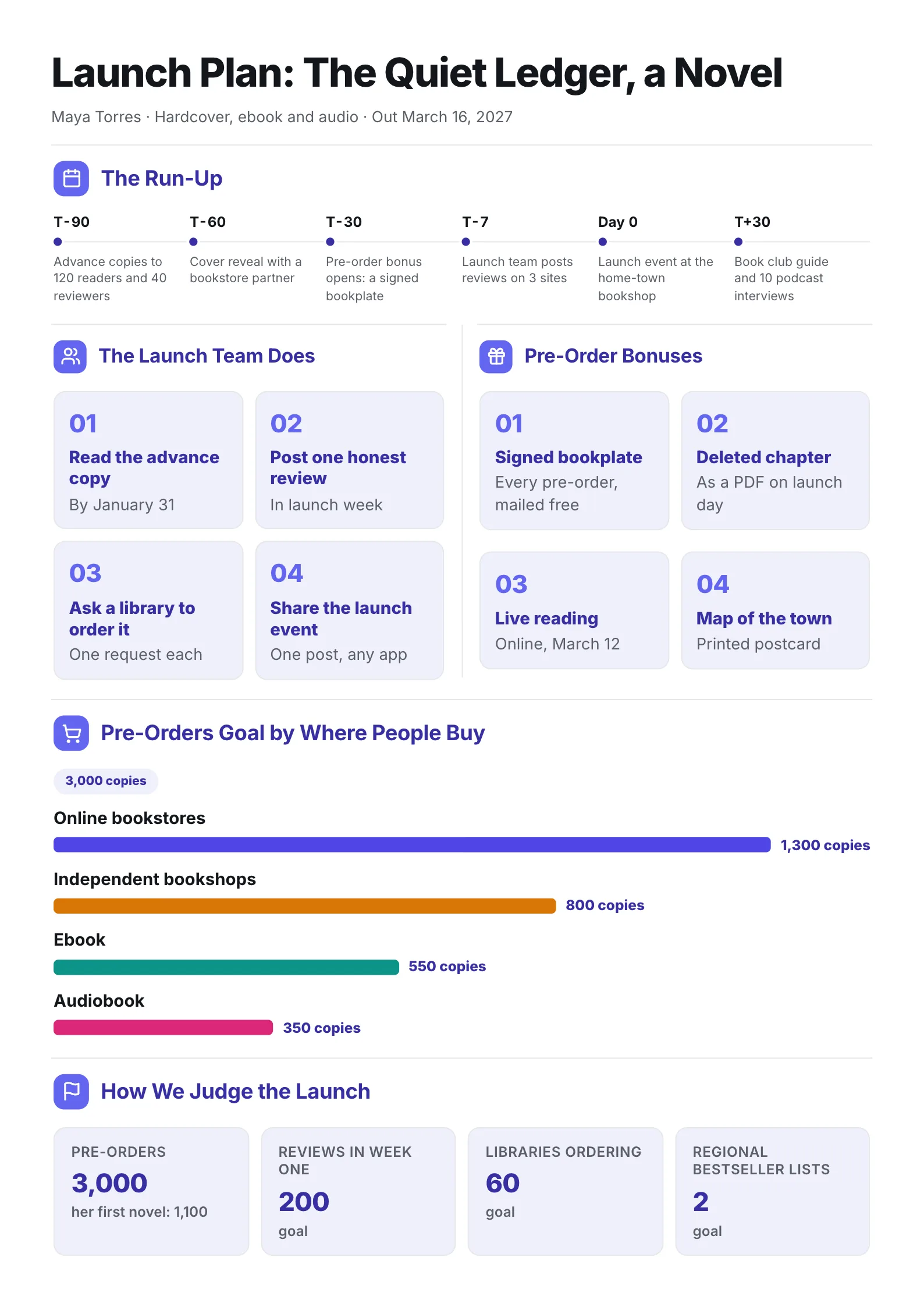 Product Launch Plan: Book LaunchEdit for free(opens in a new tab)
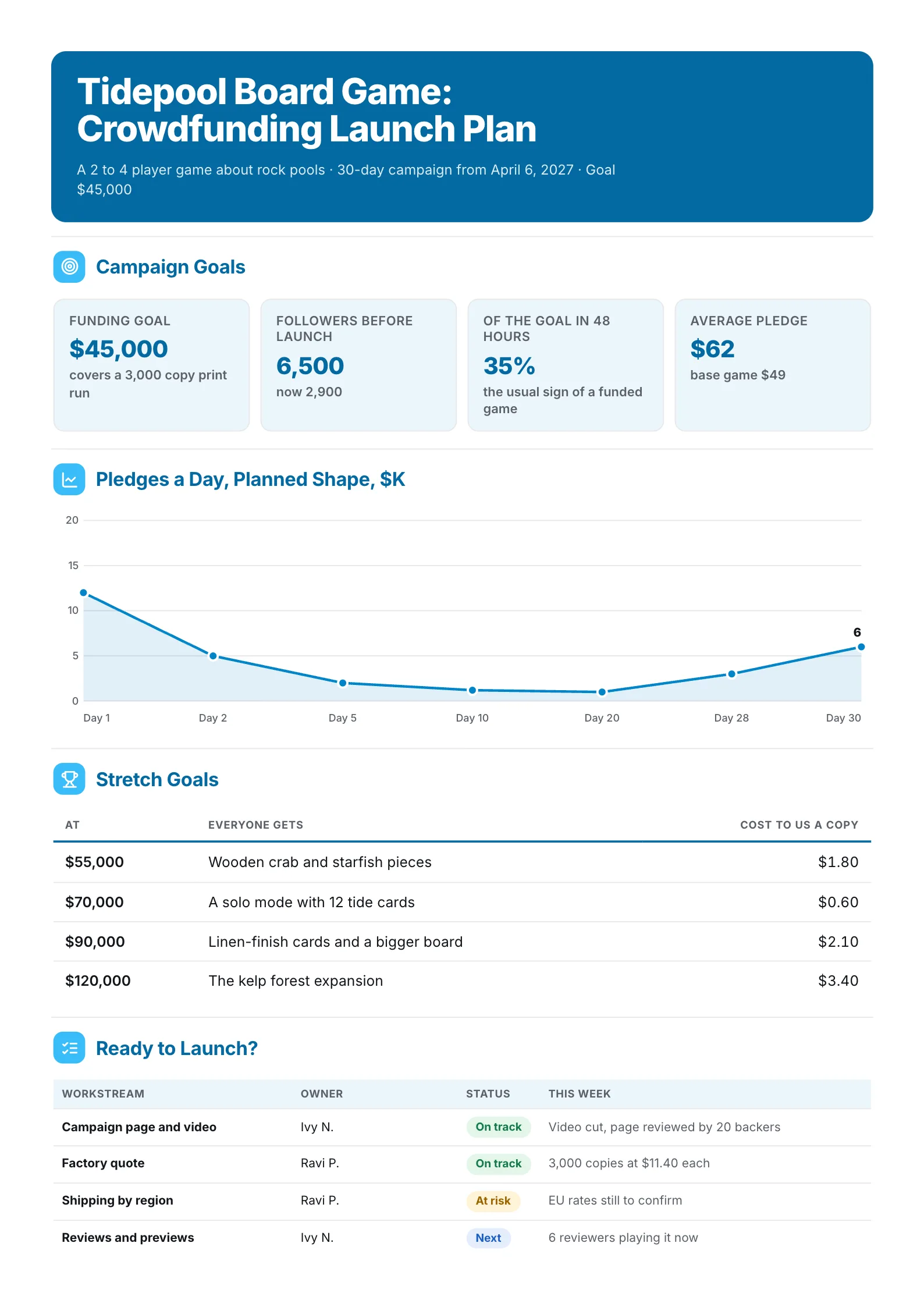 Product Launch Plan: Crowdfunding CampaignEdit for free(opens in a new tab)
Those dates are where you start when you learn how to write a launch plan. Every guide tells you to set goals and know your audience, and you should. But your plan is only real once each step has a day on the calendar. The steps below build one the way these teams appear to, with your dates worked out from the day you go on sale.
The 7 launches, by the numbers
Each row below comes from one announcement. "Orders open" is the day you could pre-order, and "On sale" is the day the product shipped or reached stores.
| Launch | Announced | Orders open | On sale | Days to on sale |
|---|---|---|---|---|
| Google Pixel 10 | August 20, 2025 | Same day | August 28, 2025 | 8 |
| Apple iPhone 17 | September 9, 2025 | September 12 | September 19, 2025 | 10 |
| Garmin Forerunner 70 and 170 (Philippines) | May 22, 2026 | Same day | June 3, 2026 | 12 |
| Samsung Galaxy S25 | January 22, 2025 | Same day | February 7, 2025 | 16 |
| Meta Quest 3S | September 25, 2024 | Not stated | October 15, 2024 | 20 |
| Sony PlayStation 5 Pro | September 10, 2024 | September 26 | November 7, 2024 | 58 |
| Nintendo Switch 2 | April 2, 2025 | April 24 (moved from April 9) | June 5, 2025 | 64 |
A few more counts from the same 7:
- All 7 state the price, the on-sale date and where to buy.
- 3 of 6 that give an order date opened orders on the day of the announcement.
- 3 of 7 attach an offer to the launch, like store credit, trade-in credit or a free subscription.
- 2 of 7 plan a second wave in the same announcement.
- 1 of 7 moved a date after announcing it.
The links to all 7 are in the sources section.
Start with the on-sale date
Every one of the 7 announcements names its on-sale date, and you should pick yours before anything else. It's the date your customers will remember and the one your whole team plans around.
Choose it by looking at what has to be true on that day. The product is built and tested. Stock is where buyers can get it. Your website or store listing is live, and someone is ready to answer questions. If any of those can't be done by the date you like, pick a later date now. Moving it after you've announced is much harder.
Write the on-sale date at the top of your plan, in bold, with the day of the week. "Friday, September 19" is harder to misread than "9/19."
 Edit this template
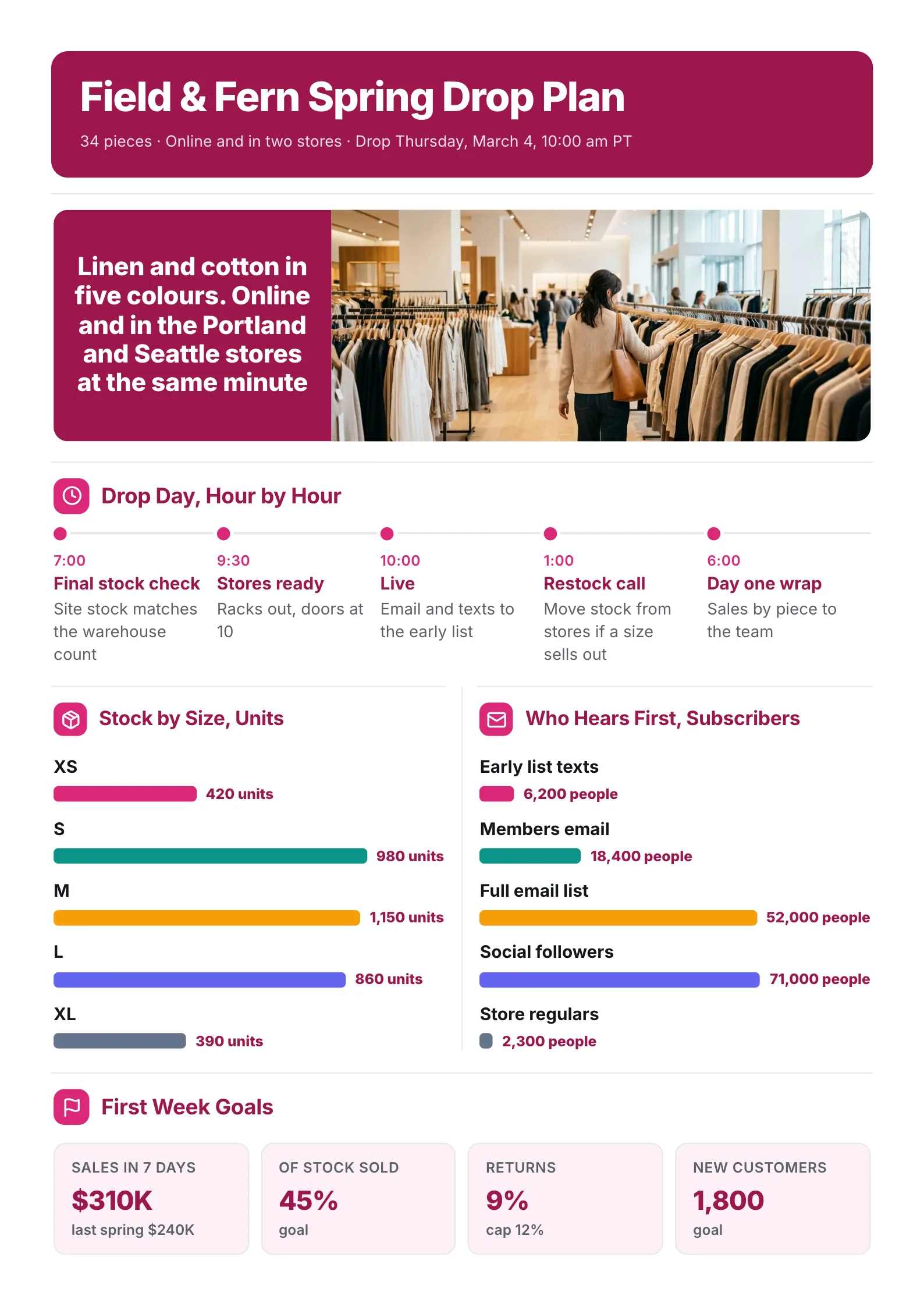
A clothing drop plan that puts the weekday, the date and the minute it goes live in its subtitle: Thursday, March 4, 10:00 am PT.
Work backward to the announcement
Once you have the on-sale date, count backward to decide when you'll announce. The 7 launches suggest two patterns.
A short gap, about 1 to 3 weeks. Pixel 10, iPhone 17, Garmin's watches and the Galaxy S25 all landed here. These are products people already know how to buy, so there's little to explain. A short gap keeps interest high and gives buyers less time to forget.
A long gap, about 2 months. Both game consoles sat here, at 58 and 64 days. A new platform needs time for game makers, stores and buyers to get ready, and a long gap gives pre-orders time to build.
For your own plan, ask how much your buyers need to learn before they'll pay. A new flavor of something they already buy needs a short gap. A new kind of product needs a longer one. If you're unsure, start near the median of 16 days and adjust.
Decide when orders open
Orders opening is its own step, and it's easy to forget. Three of the launches opened orders on the day they were announced. Apple waited 3 days. Sony waited 16 days and then opened orders in two stages, first through its own store on September 26 and then at every other retailer on October 10.
Opening orders on announcement day works when your stock is ready and your checkout can handle the rush. A short delay gives you time to watch early reactions and fix your store page. A staged opening, like Sony's, lets you test demand on your own channel before you hand stock to partners.
Whatever you pick, put the time on it too. Apple's announcement says orders open at 5 a.m. PDT, so buyers in every time zone know exactly when to show up.
 Edit this template
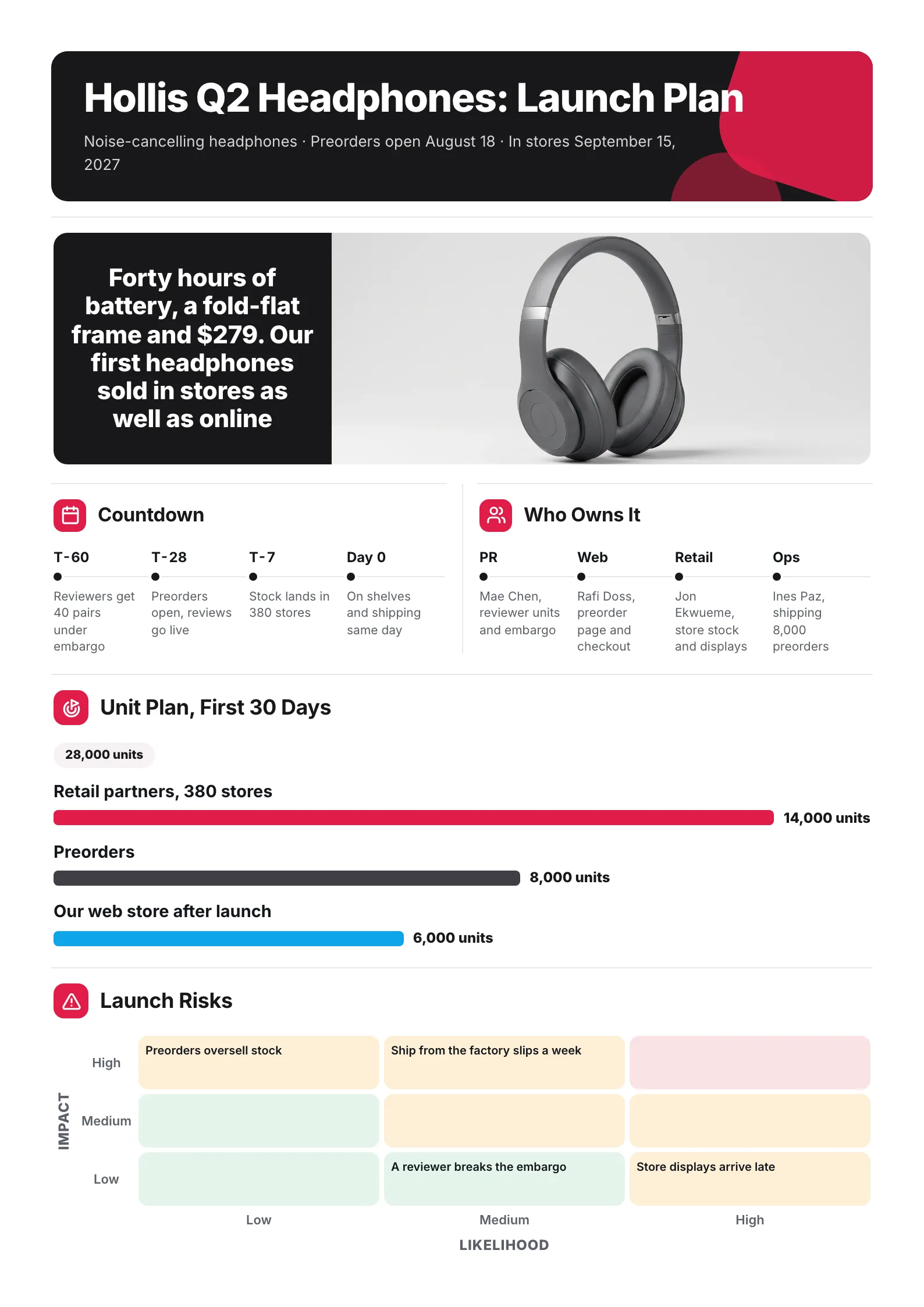
A headphone launch that opens preorders four weeks before stock reaches 380 stores, and lists "Preorders oversell stock" among its launch risks.
Write the one message everyone uses
All 7 announcements answer the same three questions near the end, and your plan should write those answers down before you write anything else. How much does it cost? When can I get it? Where do I buy it?
Samsung's version is a good model. It says the phones are available for pre-order "starting today, January 22," names the stores, and gives general availability as February 7. Google's says "Preorder today, with phones on shelves August 28."
Write your answers as two or three sentences, then copy them word for word into your website, emails, social posts and store listings. If someone on your team asks "what's the date again?", the answer is already written.
 Edit this template
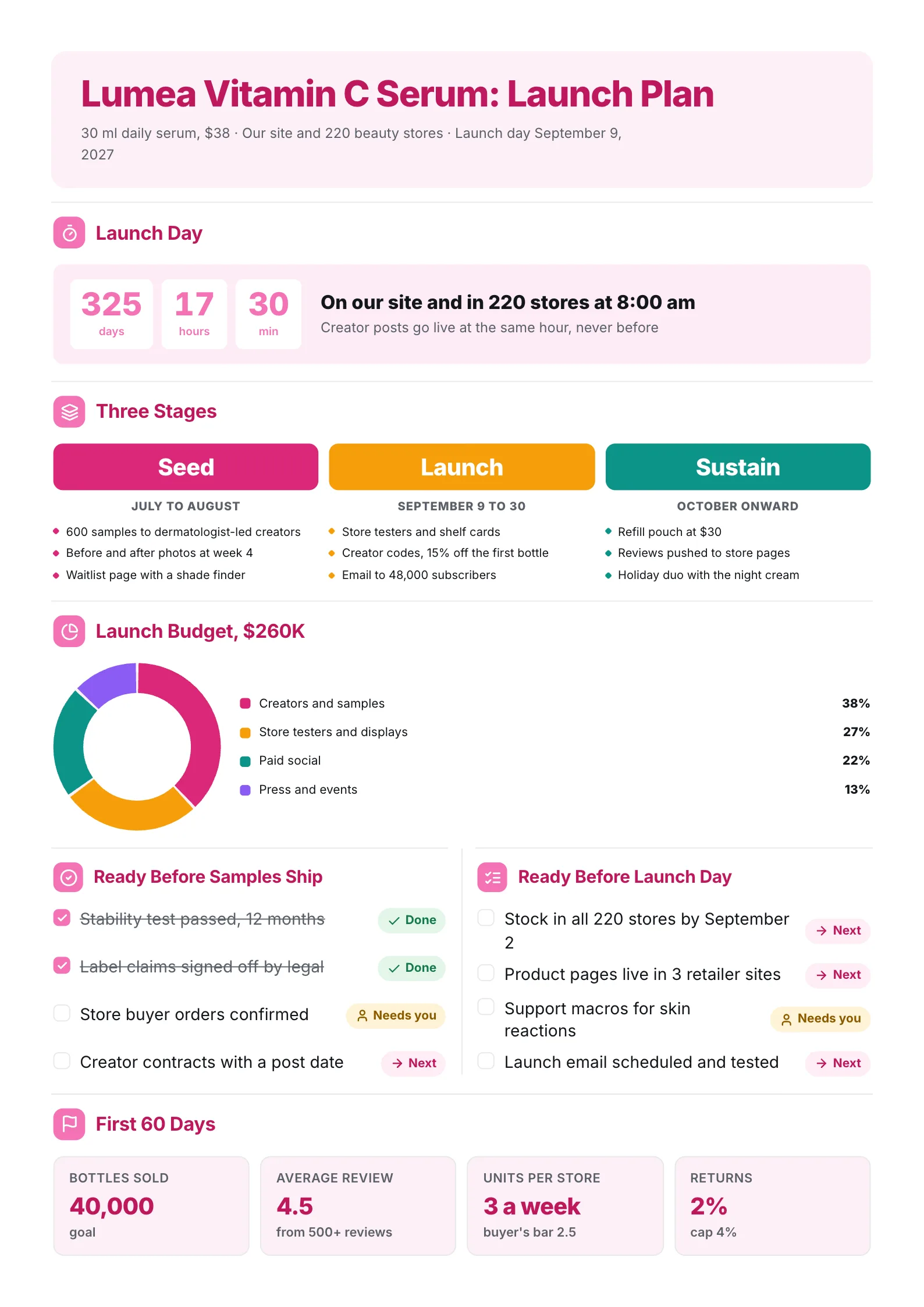
A serum launch whose subtitle answers all three questions in one line: the $38 price, its own site plus 220 beauty stores, and the September 9 date.
Give early buyers a reason to act
Three of the 7 launches attached an offer, and Samsung's was the only one tied to buying early. Samsung gave $50 in credit to people who reserved before the event and 15% off its device protection plan for pre-orders. Apple listed its trade-in credit. Google gave Pixel 10 Pro buyers a year of its Google AI Pro plan.
You don't need a big budget for this. A small bonus, free shipping or a first-week price gives your announcement something to act on today. Put the offer in your plan with its end date, so nobody keeps honoring it by accident three months later.
Plan your second wave before the first one ships
Two of the 7 planned a second wave in the same announcement. Apple's iPhone 17 went on sale in more than 63 countries and regions on September 19, then in 22 more countries and regions on September 26. Sony staged its pre-orders a different way, opening its own store two weeks before other retailers.
A second wave helps you in two ways. It spreads the work, so your team and your stock aren't stretched on one day. And it gives you a second reason to talk about the launch a week later.
For a small business, a second wave might be a new sales channel, a second city or the wholesale accounts that get stock after your own store does. Write its date into the plan now, beside the first one.
Write down what happens if a date moves
Only 1 of the 7 launches moved a date, and how it handled the change is worth copying. Nintendo announced the Switch 2 on April 2, 2025, with retail pre-orders set for April 9. Before that day came, pre-orders were put on hold. On April 18 it posted an update that reset pre-orders to April 24 and kept the console's price at $449.99. It also said accessory prices would change because of market conditions, and it apologized for the delay. The June 5 launch date never moved.
There's a lesson for your plan here. Decide in advance which date you'll protect. Nintendo protected the on-sale date and let the pre-order date slip. Write that choice into your plan, along with who decides and where the update will be posted.
 Edit this template
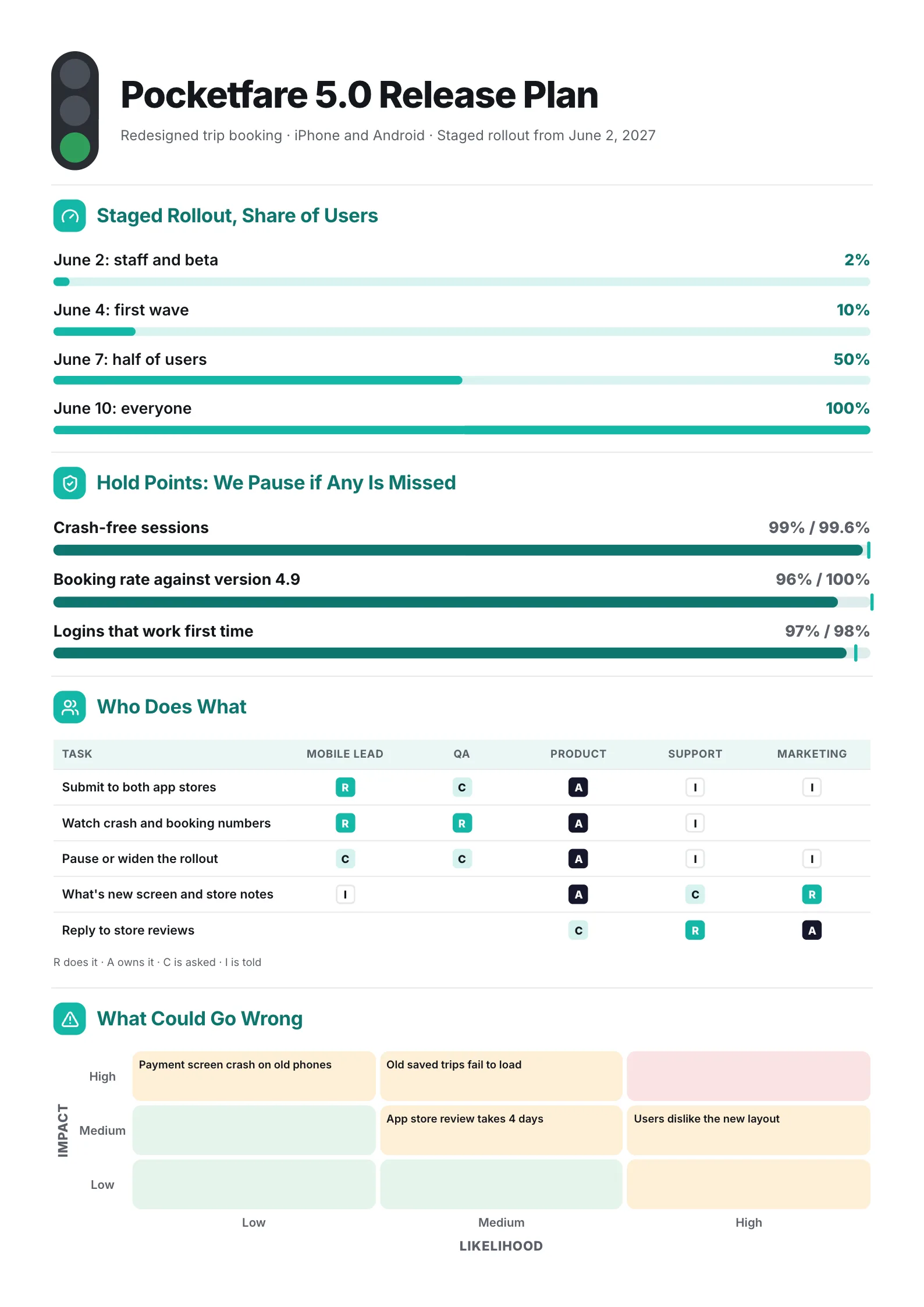
An app release that decides in advance when to stop: the rollout pauses if crash-free sessions, bookings or first-time logins miss their hold points.
Give every date an owner
If a date has no owner, nobody is watching it. Next to each step in your plan, write the one person responsible for it. Product owns the on-sale date. Marketing owns the announcement and the message. Operations owns stock and shipping. Support owns the help page and the first week of questions.
Then set a go or no-go check about a week before launch. Each owner says whether their part is ready. If one isn't, you decide right then whether to move the date or cut the piece that isn't ready.
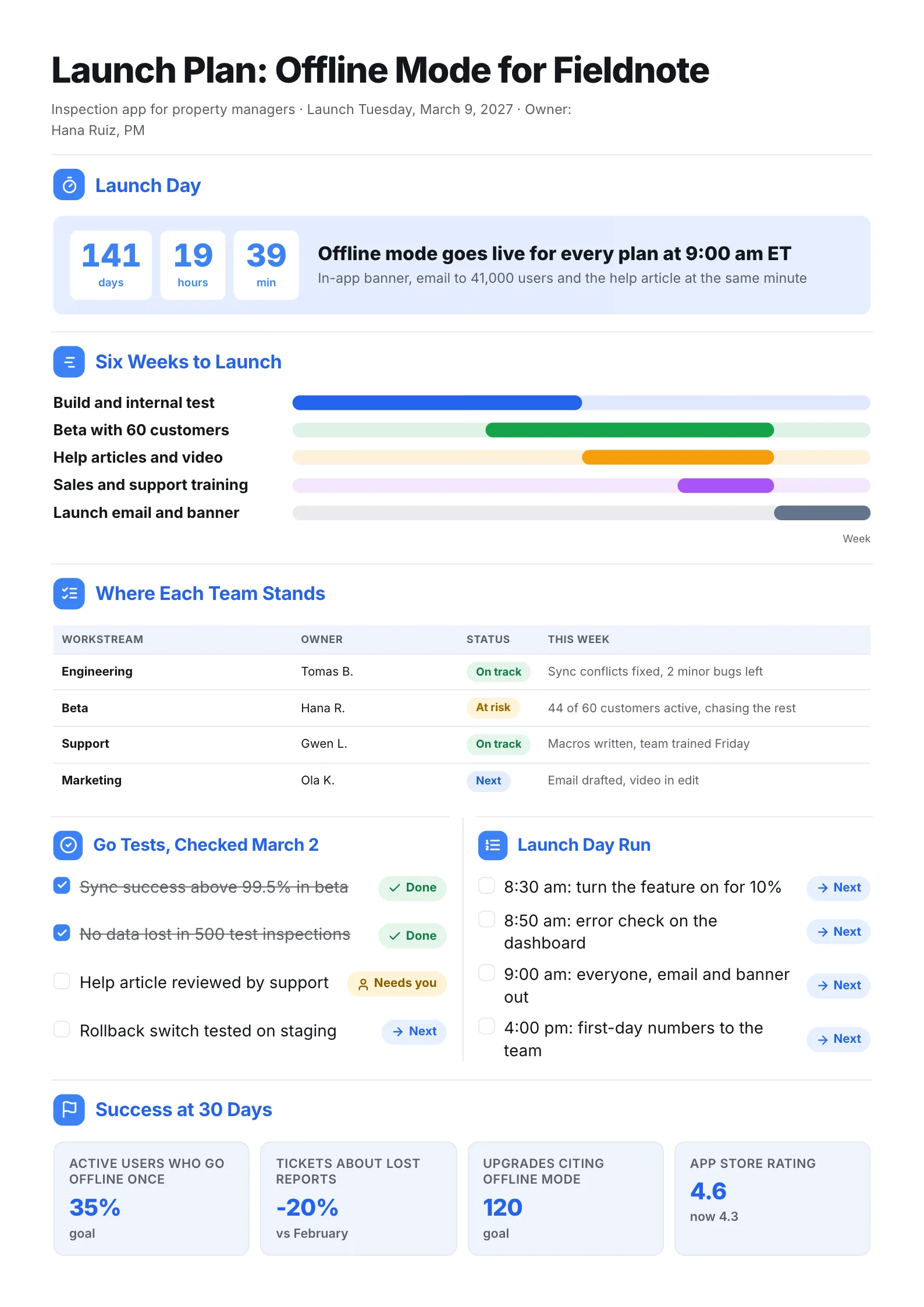 Edit this template
A feature launch where every team has one named owner and a status color, and the go tests were checked a week before launch day.
Plan the day after launch
Meta updated its own Quest 3S announcement on the morning it went on sale, adding a line that said it was now available with a link to buy. That's a small step most plans skip. Your launch post can do the same, so anyone who finds it later sees the current status.
Then decide what you'll report and when. You might not publish your numbers, but your team should agree before launch day which numbers you'll look at, and on what date. Pick a review date one or two weeks after you go on sale, and put it in the plan with an owner, like any other step.
A launch plan for a small shop, with dates
Here's how the same steps look for a small business launching a seasonal product in fall 2027, with your on-sale date set first.
| Step | Date | Owner |
|---|---|---|
| Go or no-go check | Monday, October 4 | Owner |
| Announce to email list and social | Tuesday, October 5 | Marketing |
| Pre-orders open on your site | Tuesday, October 5, 9 a.m. | Online store |
| Early-bird price ends | Saturday, October 16 | Online store |
| On sale in the shop | Thursday, October 21 | Shop manager |
| Second wave, two local cafés stock it | Thursday, October 28 | Owner |
| First results review | Friday, November 5 | Owner |
That's 16 days from announcement to on sale, the median of our 7. Every row has a date and an owner. The message (price, date, where to buy) is written once and used in every channel.
The 7 launch announcements we read
| Announcement | What stood out |
|---|---|
| Apple, iPhone 17, September 9, 2025 | A pre-order time with a time zone, and a second wave in 22 more countries |
| Google, Pixel 10, August 20, 2025 | Orders open the same day, on shelves 8 days later |
| Samsung, Galaxy S25, January 22, 2025 | Named stores, a reservation credit and a pre-order discount |
| Nintendo, Switch 2 pre-order news, April 18, 2025 | A moved pre-order date, a held launch date and an apology |
| Garmin Philippines, Forerunner 70 and 170, May 22, 2026 | Pre-orders through named online stores, on sale 12 days later |
| Sony, PlayStation 5 Pro, September 10, 2024 | Pre-orders in two stages, 58 days to launch |
| Meta, Quest 3S, September 25, 2024 | The same post updated on launch morning |
Put the dates in first
Open your launch plan and look for the on-sale date. If it isn't there, or it doesn't have a weekday beside it, start there and work backward. Give each step a date and a name, then write the price, the date and where to buy in one short paragraph. For a ready layout, pick a launch plan design in MakeOnepagers, and see the product launch plan template post for more examples.
Frequently asked questions
How far in advance should you write a launch plan?
Start the plan as soon as you know roughly when you'll go on sale, often two to three months ahead. The plan should be finished before you announce. In our 7 launches, the public part alone ran from 8 to 64 days, and the work before the announcement takes longer than that.
What's the difference between a launch plan and a marketing plan?
A marketing plan covers how you'll find and keep customers over a year or more. A launch plan covers one product going on sale, with a set of dated steps around one day. Your launch plan borrows the message and channels from your marketing plan and puts dates on them.
How long should a launch plan be?
For most launches, a single page holds it all. You need the on-sale date, the steps before and after it with dates and owners, the core message, and what happens if a date moves. A bigger launch can link out to a detailed task list, but your team should be able to read the plan itself in a few minutes.
Should you take pre-orders?
Take them if your stock and checkout are ready and you want an early read on demand. At least 6 of the 7 launches we read opened orders before the on-sale date. If you can't ship on time, skip pre-orders, because a late shipment costs you more trust than a later announcement.




