Product Launch Plan Template: Free One-Page Launch Plan and Countdown
A free product launch plan template on one page: a 30-day countdown, a go or no-go test, an owner per team, 6 launch plan examples and a worked example.

A product launch plan template lays out everything that must happen to release your product, and it shows who owns each part and when it's due. It runs from about a month before launch to the review two weeks after. It covers your launch goal, your audience and your message. It also holds the countdown, the go or no-go test, each team's job on launch day and how you'll measure the result. Launches rarely fail on the big idea. They slip because support wasn't ready, sales had no talk track or nobody owned the rollback. A product launch plan on one sheet shows you those gaps while there's still time to fix them. Below you'll find the parts of a launch plan and a free template. You also get five product launch plan examples, a worked example and the mistakes that make launches slip. Start from a free one pager template.
One‑Pager examples
Real One-Pagers made with MakeOnepagers. Open any one to edit it as your own.
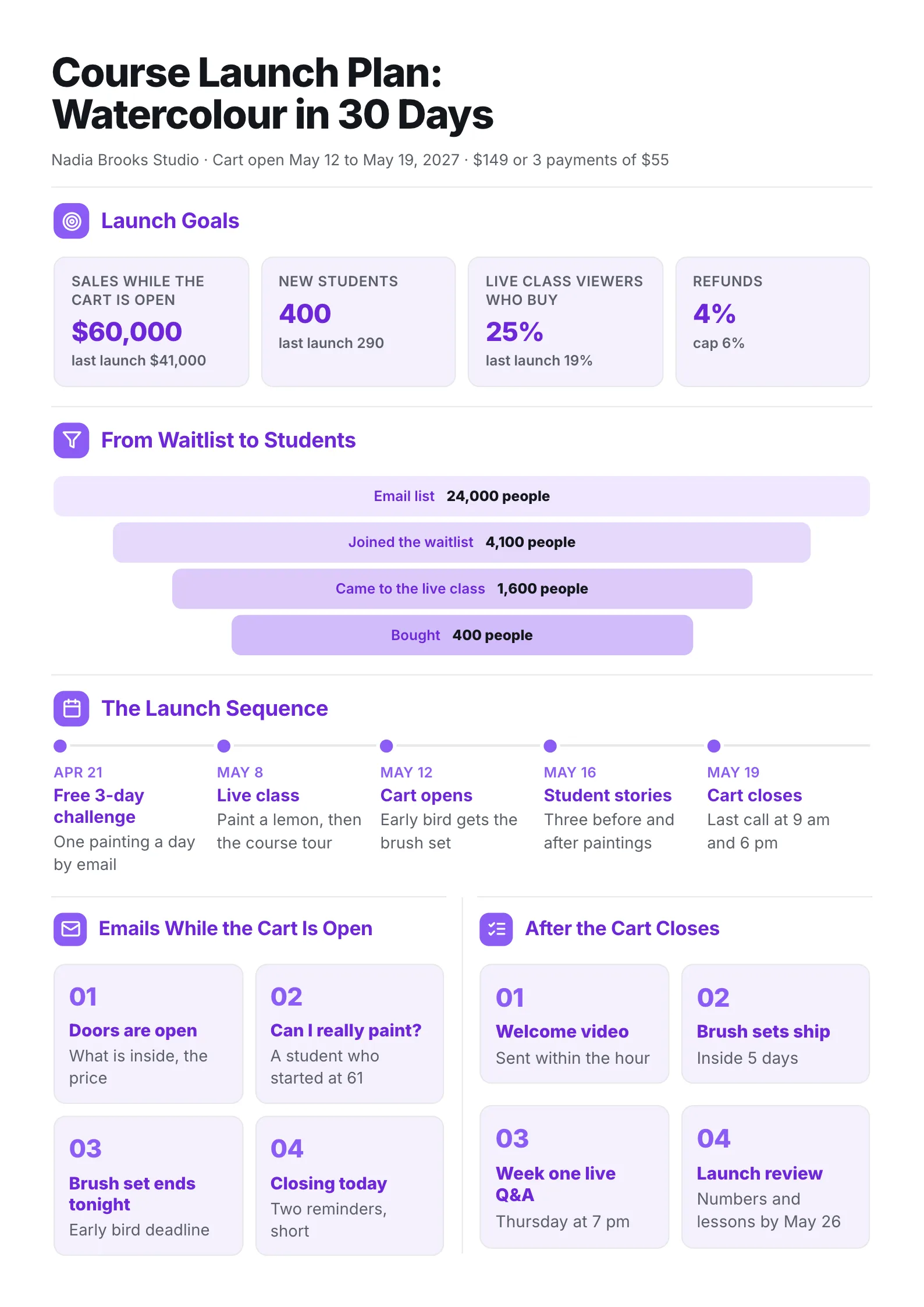 Product Launch Plan: Online CourseEdit for free(opens in a new tab)
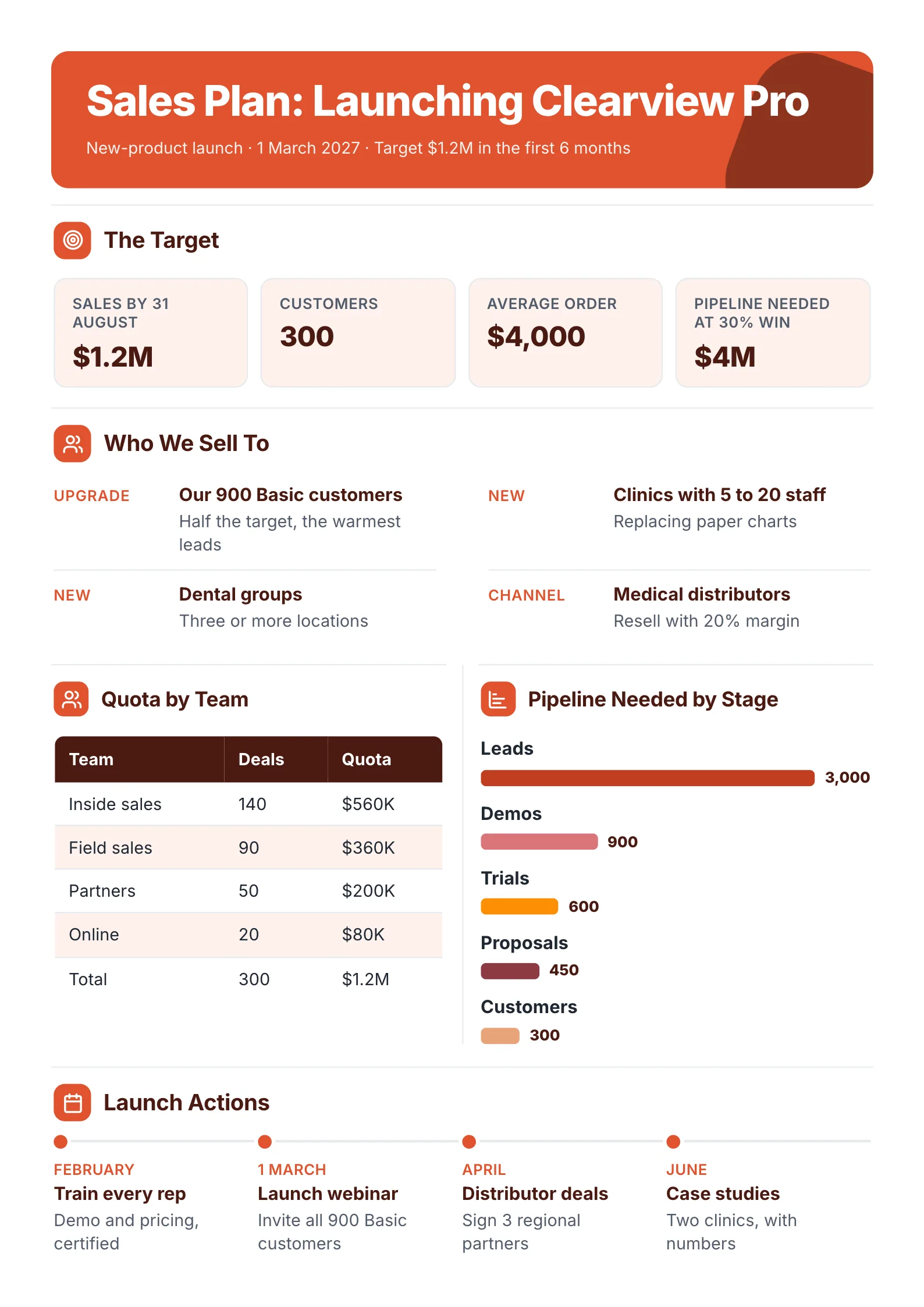 Product Launch Sales PlanEdit for free(opens in a new tab)
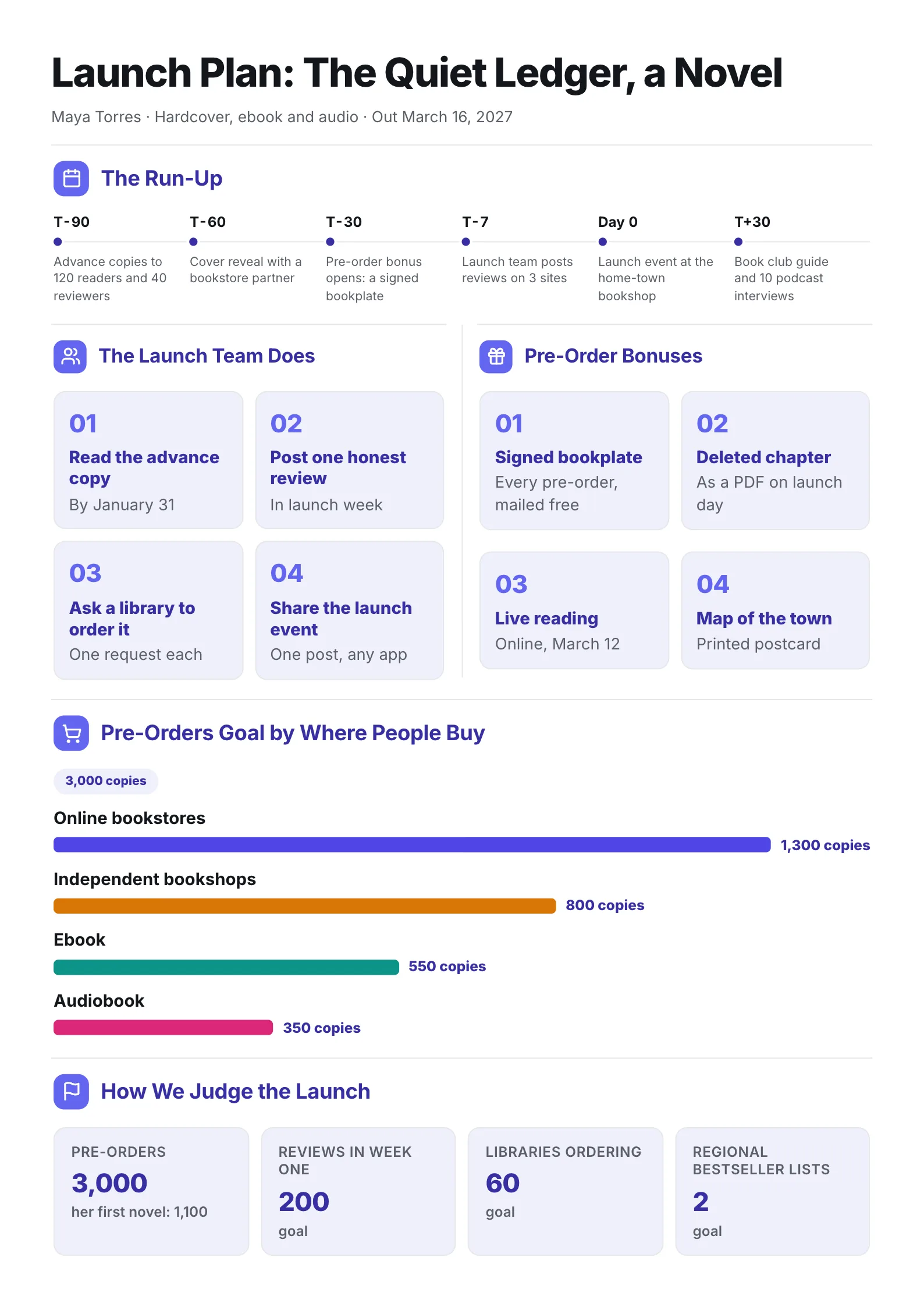 Product Launch Plan: Book LaunchEdit for free(opens in a new tab)
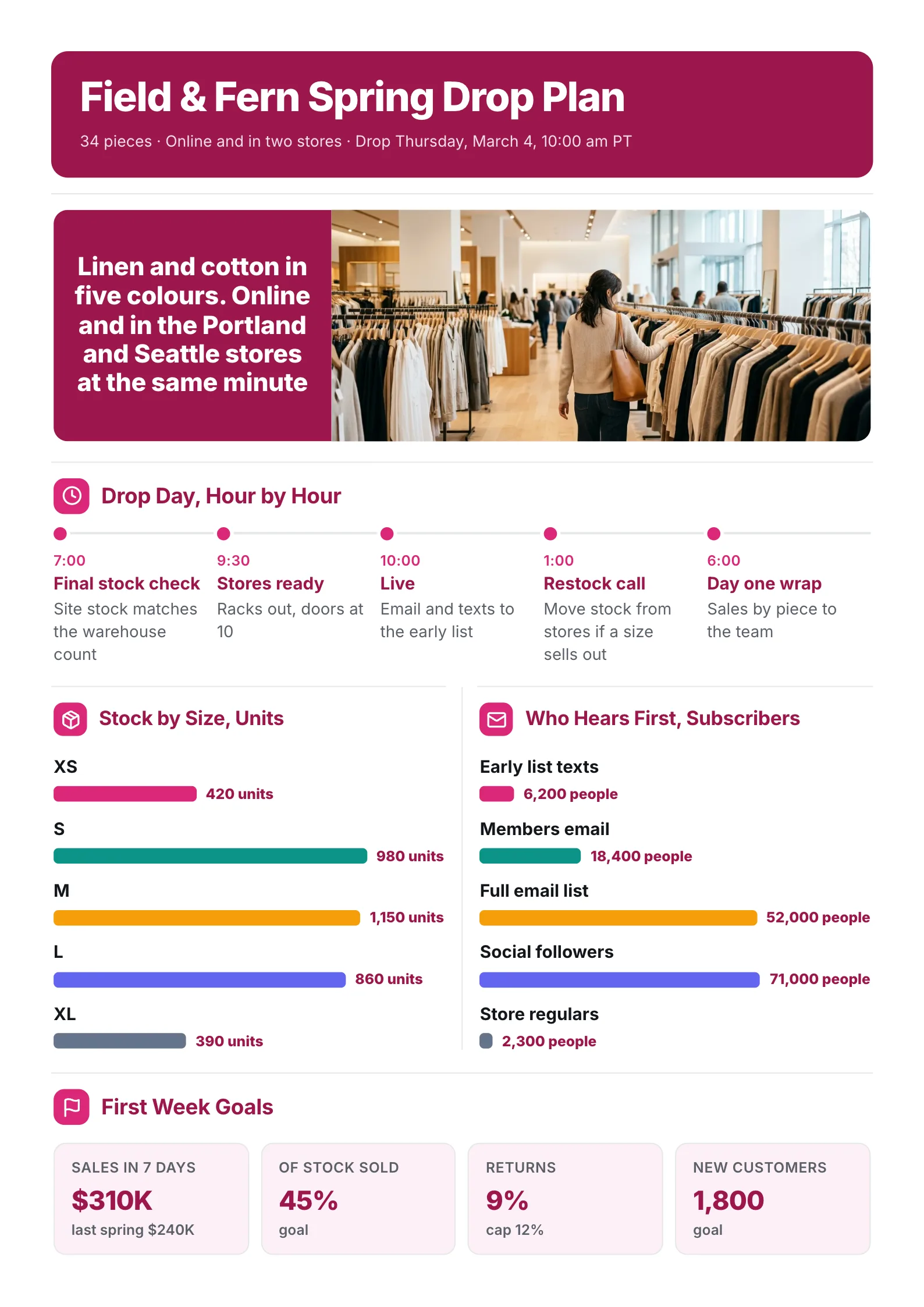 Product Launch Plan: Collection DropEdit for free(opens in a new tab)
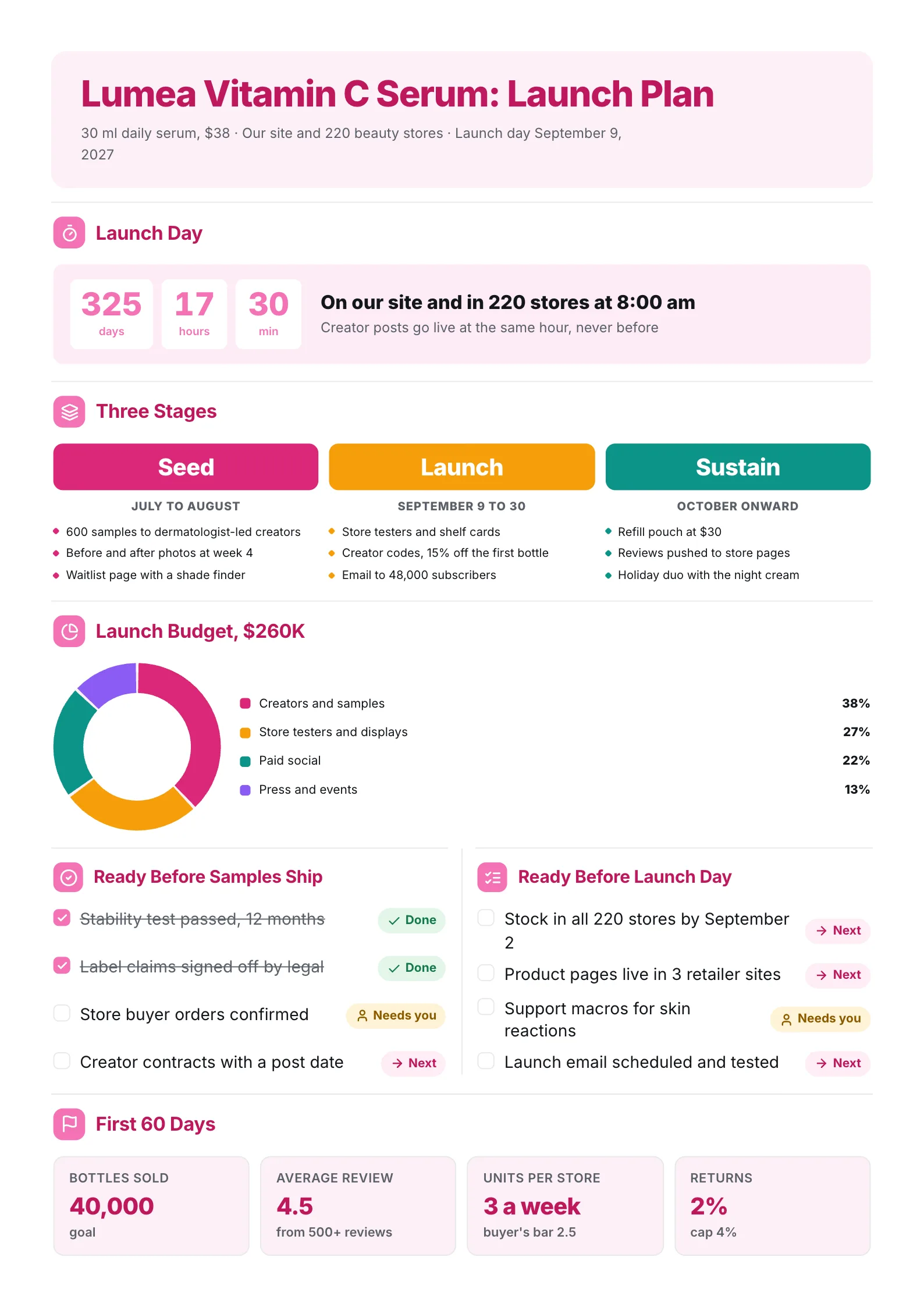 Product Launch Plan: Beauty ProductEdit for free(opens in a new tab)
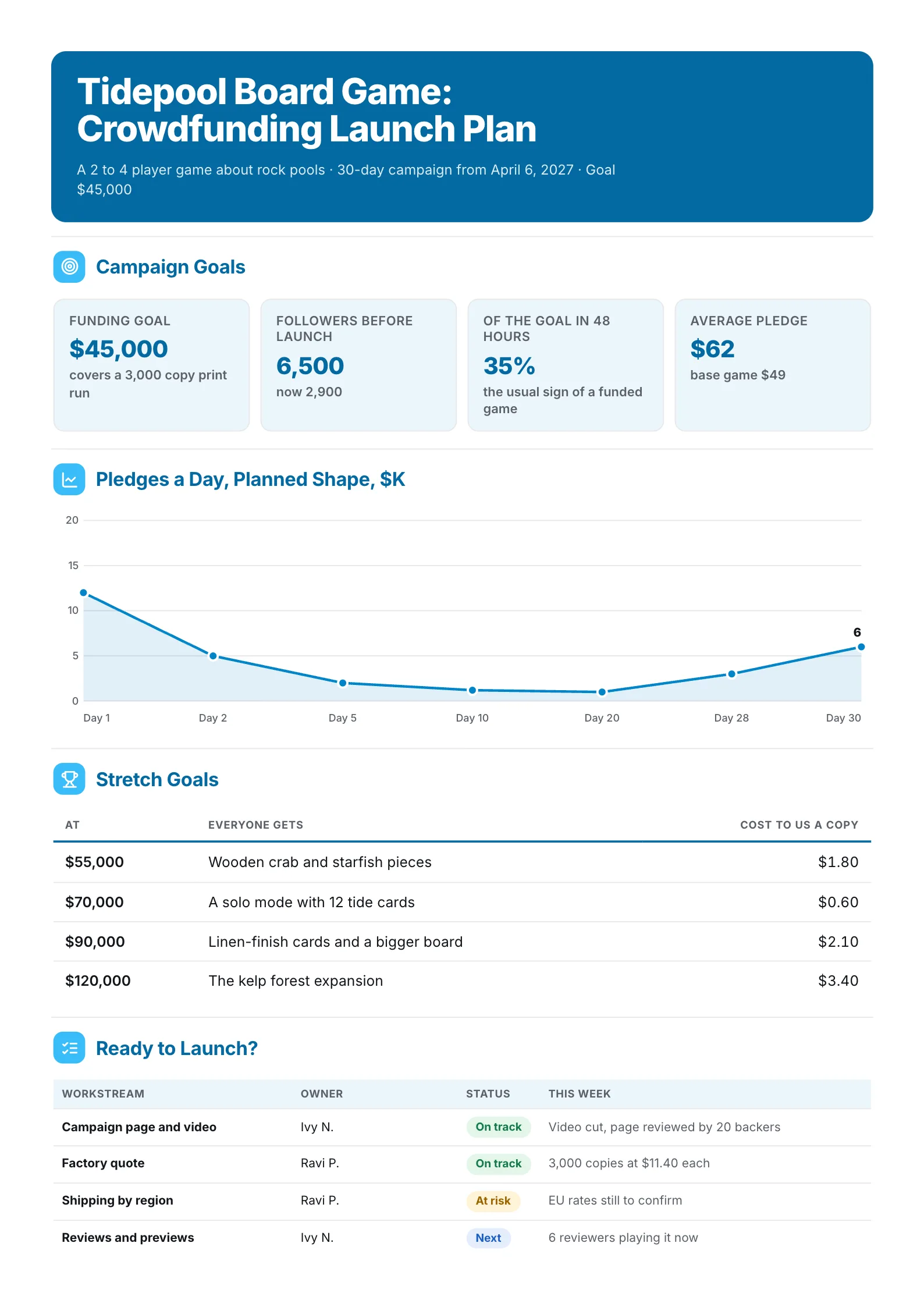 Product Launch Plan: Crowdfunding CampaignEdit for free(opens in a new tab)
We made every example with MakeOnepagers. Each one opens as a template, and you can change every word and color in it for free.
What is a product launch plan?
A product launch plan is the schedule and checklist for releasing a new product, feature or version. It turns your go to market strategy (who it's for, how it's positioned and priced) into dated tasks with owners.
It answers four questions for you. What are you launching, and when? Who does what, and how will you know it worked? Product teams, marketing, sales, support and engineering all read it, so it has to be short enough for everyone to keep in their head.
What to include in a product launch plan template
- What and when: the product, the launch date and the launch type (quiet release, beta, full launch).
- Goal: one to three measures of success with numbers.
- Audience and message: who it is for and the one line marketing will lead with.
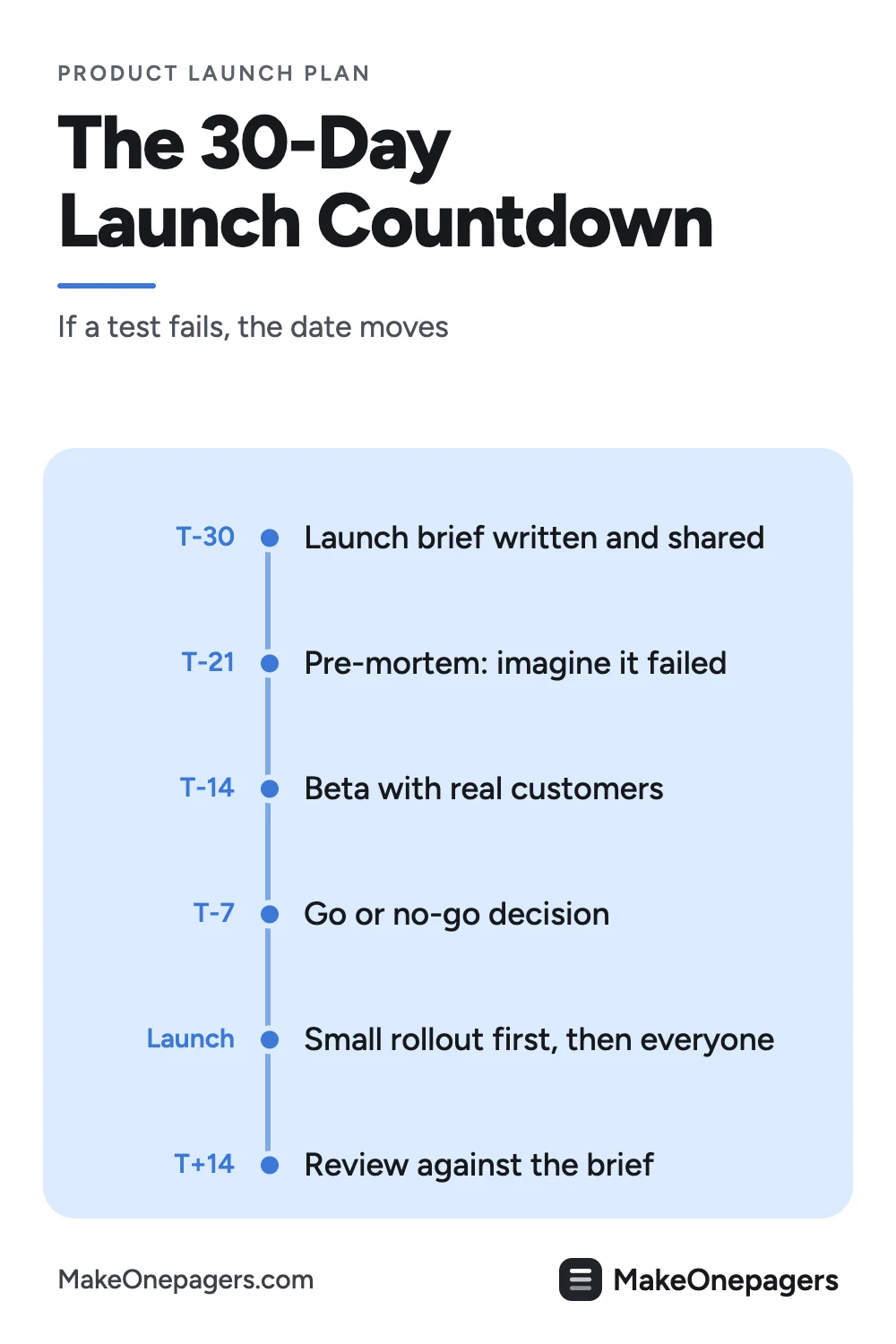
- The countdown: the key steps from T-30 (30 days out) to launch day and the review after.
- Go or no-go test: the checks that must pass a week before launch, or the date moves.
- Who owns what: one owner per team (product, engineering, support, sales, marketing).
- Launch day and rollout: small group first or everyone at once, and who is on call.
- Review: when you will compare results to the goal, and who is in the room.
A launch countdown that works for most teams
| When | What happens |
|---|---|
| T-30 | Launch brief written and shared with every team |
| T-21 | Pre-mortem: imagine it failed and list why |
| T-14 | Beta with a small group of real customers |
| T-7 | Go or no-go decision against the tests |
| Launch | Small rollout first, then everyone |
| T+14 | Review against the brief |
You can shift the dates for a bigger or smaller launch. Just keep the order, with the brief before the beta and the go decision before launch.
A free product launch plan template
Copy this into your own document. Or open the example below and edit it to fit your launch.
| Part | What to write, with an example |
|---|---|
| Title | Team, version, date. Launch Playbook, product team, October |
| Why this plan | 1 line. 3 of 5 launches slipped this year, an average of 11 days |
| Countdown | 6 steps. T-30 brief, T-21 pre-mortem, T-14 beta... |
| Go test | 4 checks. Built and tested on real accounts; support article live |
| Owners | 1 per team, with what they own. Engineering: the rollback |
| Before next launch | 3 to 4 actions anyone can do this week |
6 product launch plan examples
Here are six launch plans you can copy. They cover a software feature, a consumer product on preorder and a big app update. Then come a week of daily releases, a seasonal product with an end date and the message plan behind a drink launch. Each one has a date, an owner per part and a test for success.
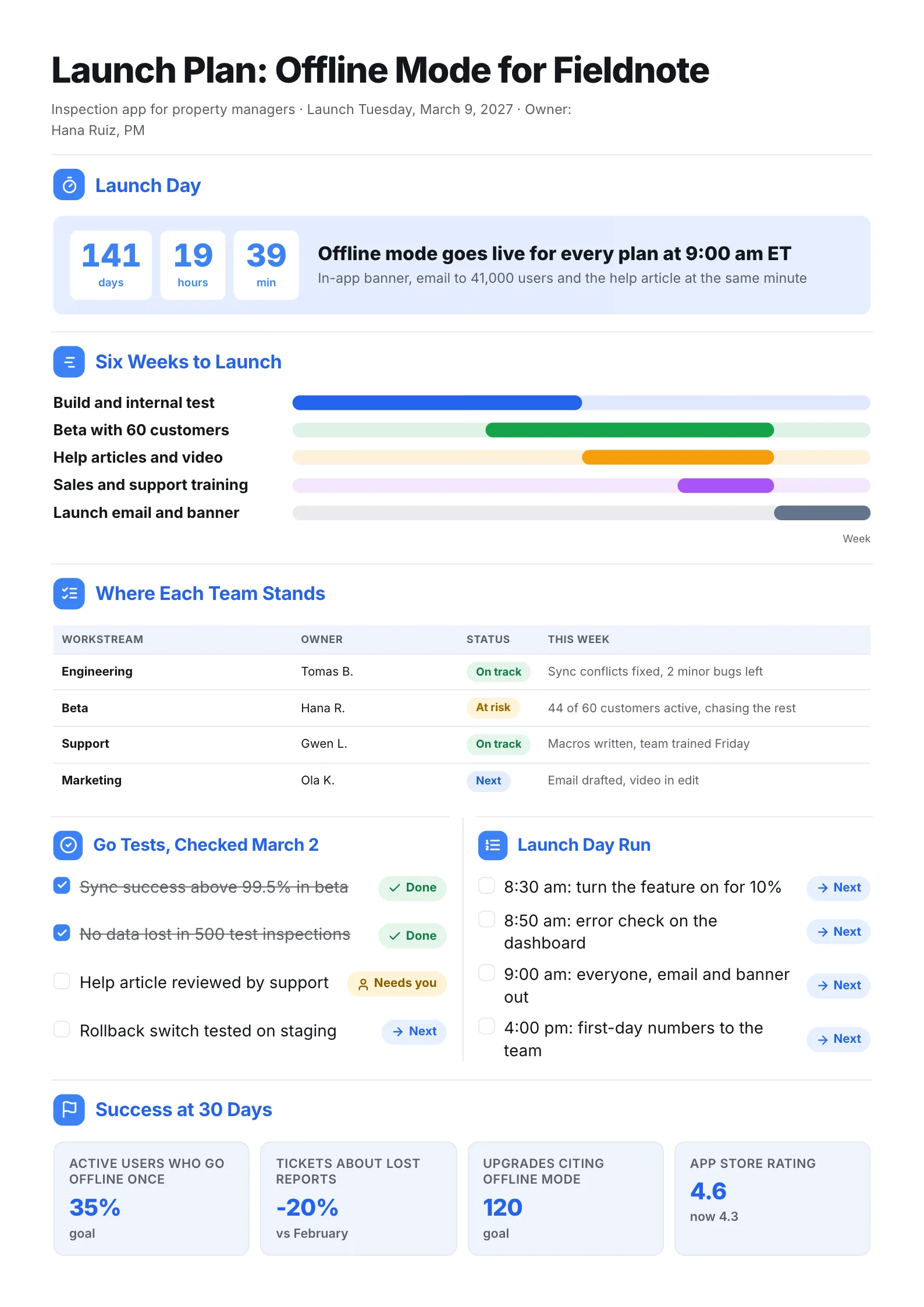
1. Software feature launch plan
 Edit this template
A feature launch timed to the minute, with a status line from every team and the tests it must pass first.
What to copy:
- One minute for everything. The banner, the email to 41,000 users and the help article go out at 9:00 am ET together.
- Go tests with numbers. Sync success above 99.5% in beta, and no data lost in 500 test inspections.
- A day run with times. 8:30 am on for 10%, 8:50 am error check, 9:00 am everyone.
You can edit this software feature launch plan template for free.
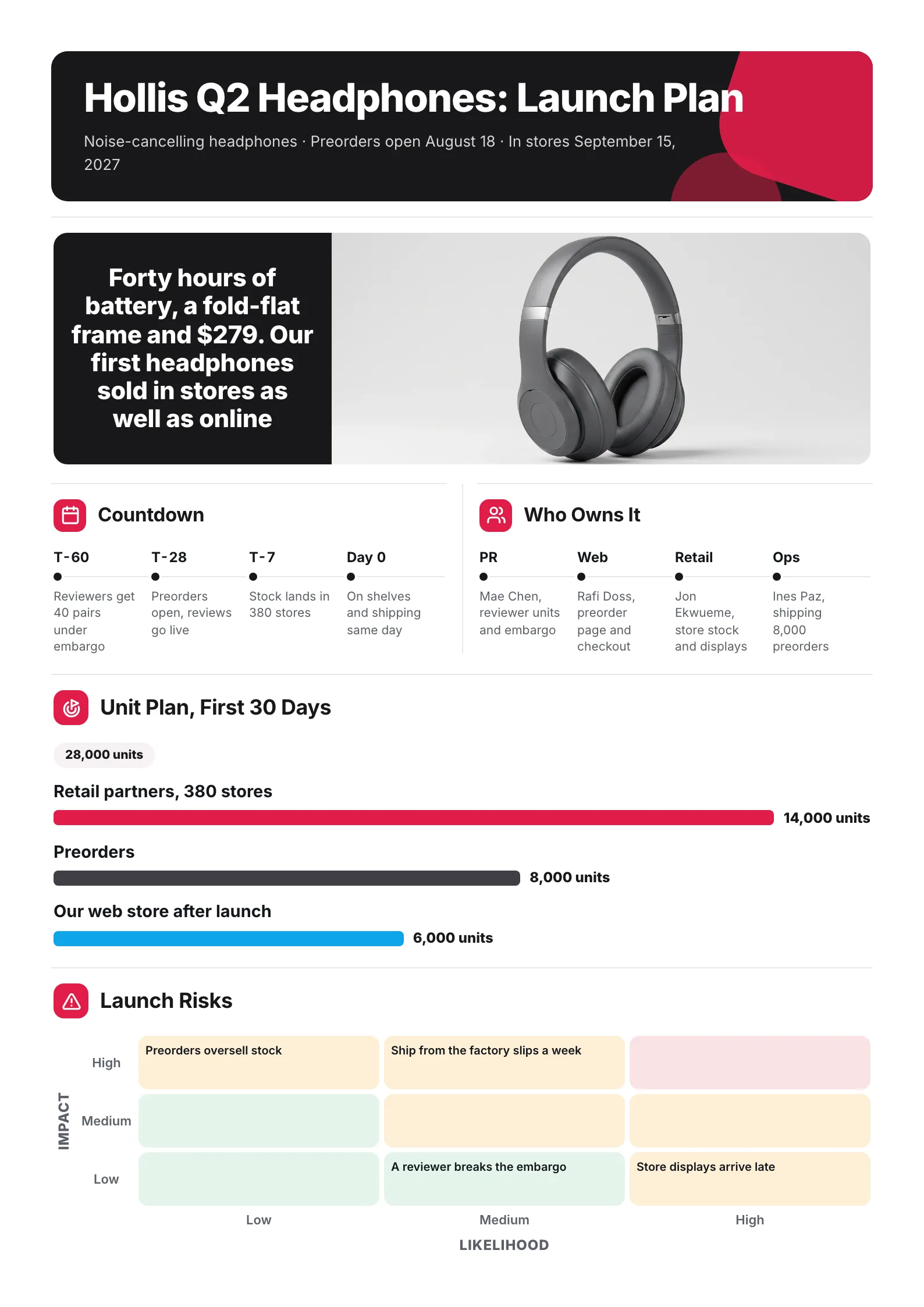
2. Consumer product launch plan
 Edit this template
A product with a preorder window, where each step of the countdown has one named owner.
What to copy:
- The promise under the photo. "Forty hours of battery, a fold-flat frame and $279."
- A name beside each job. Ines Paz owns shipping 8,000 preorders.
- Risks you can act on. "Preorders oversell stock" and "Store displays arrive late."
You can edit this consumer product launch plan template for free.
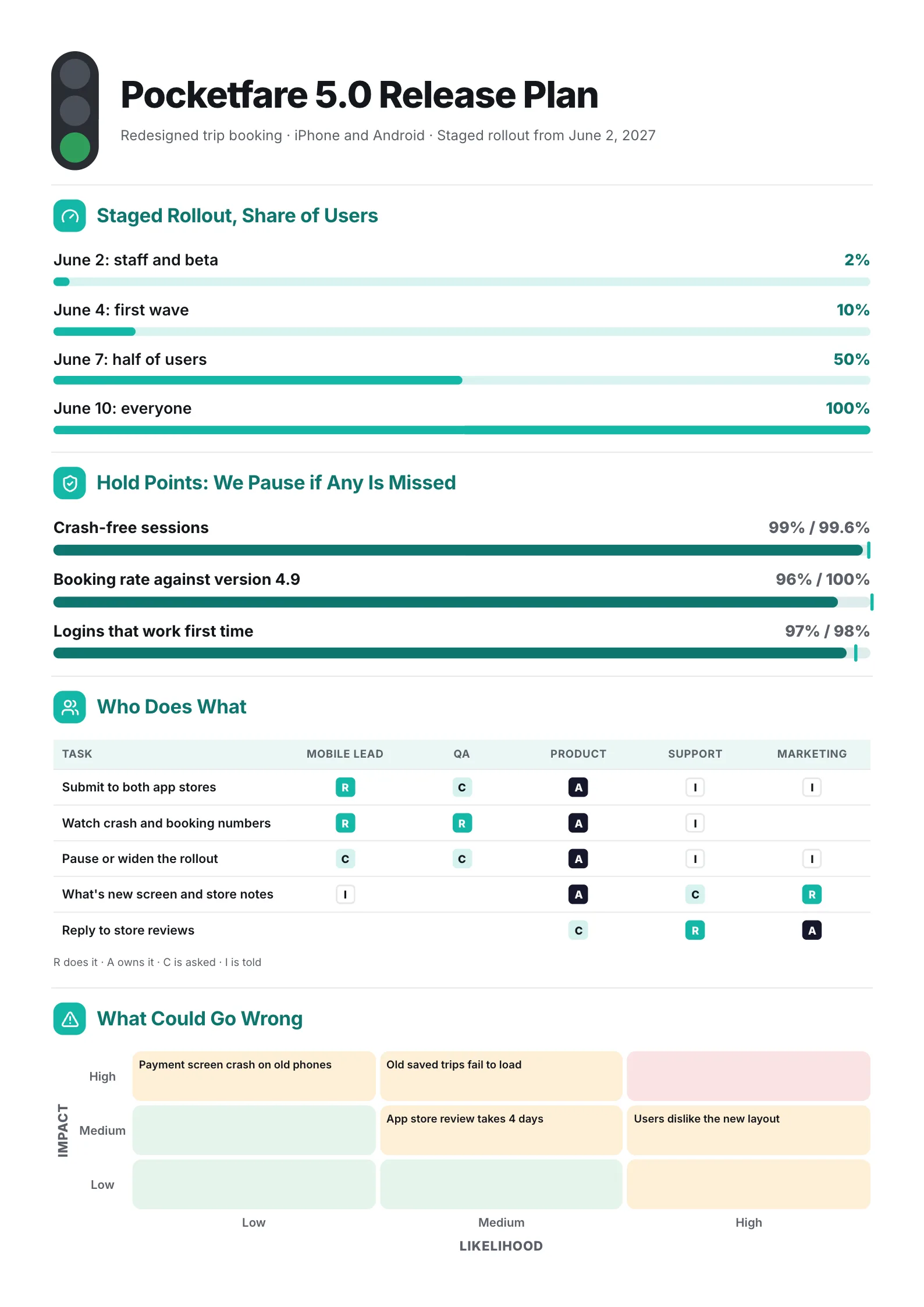
3. App release plan
 Edit this template
A big app update released to more users each step, with the numbers that would stop it.
What to copy:
- The rollout as dates. Staff and beta on June 2, half of users on June 7, everyone on June 10.
- Hold points stated up front. "We pause if any is missed": crash-free sessions, booking rate and first-time logins.
- One person accountable for each step. Product decides whether to pause or widen the rollout.
You can edit this app release plan template for free.
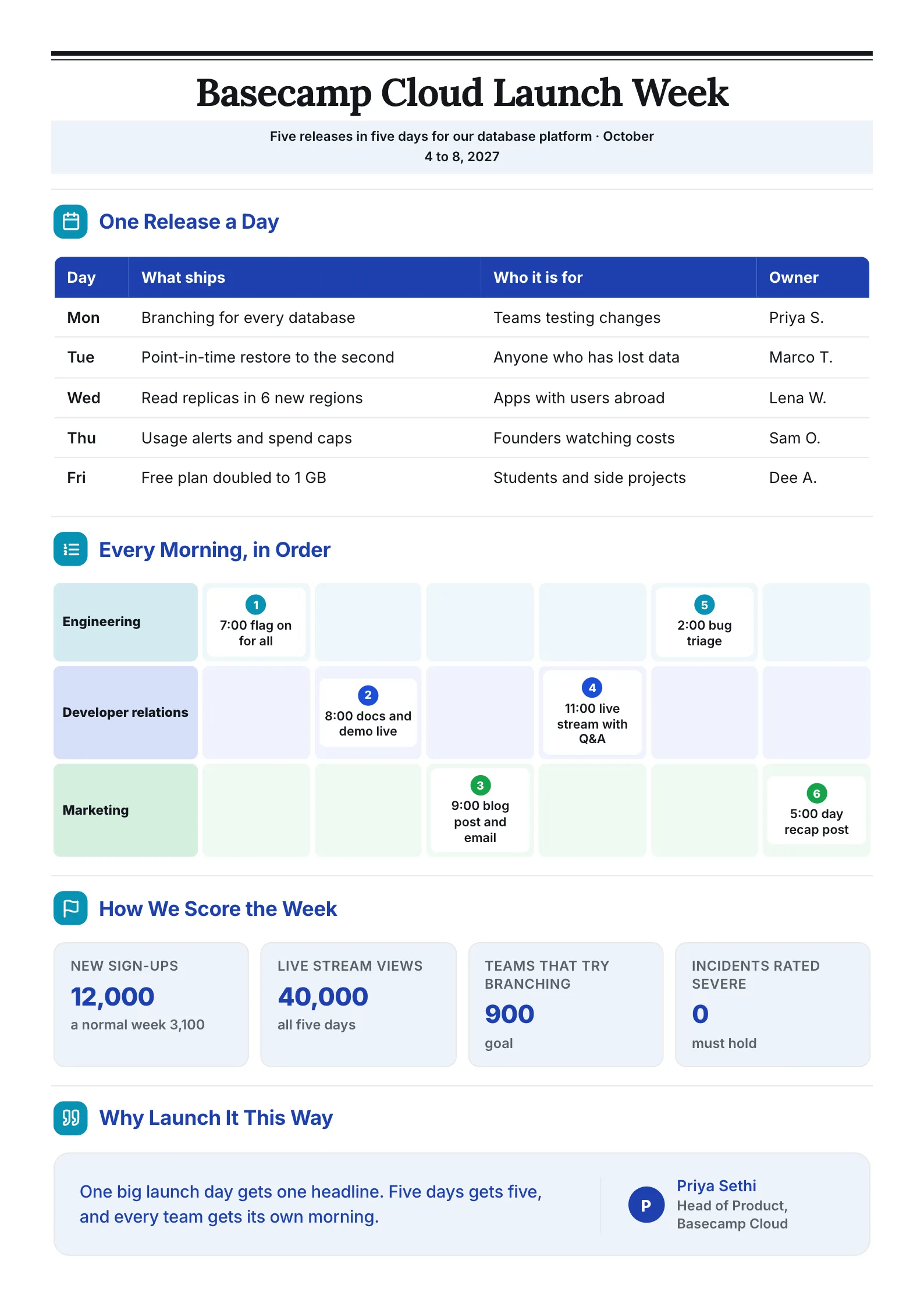
4. Launch week plan
 Edit this template
Five releases in five days, each with its own owner and its own morning.
What to copy:
- A table with a row per day. Monday branching, Tuesday restore to the second, Friday the free plan doubled to 1 GB.
- A goal against a normal week. 12,000 new sign-ups, where a normal week brings 3,100.
- The reason in a line. "One big launch day gets one headline. Five days gets five."
You can edit this launch week plan template for free.
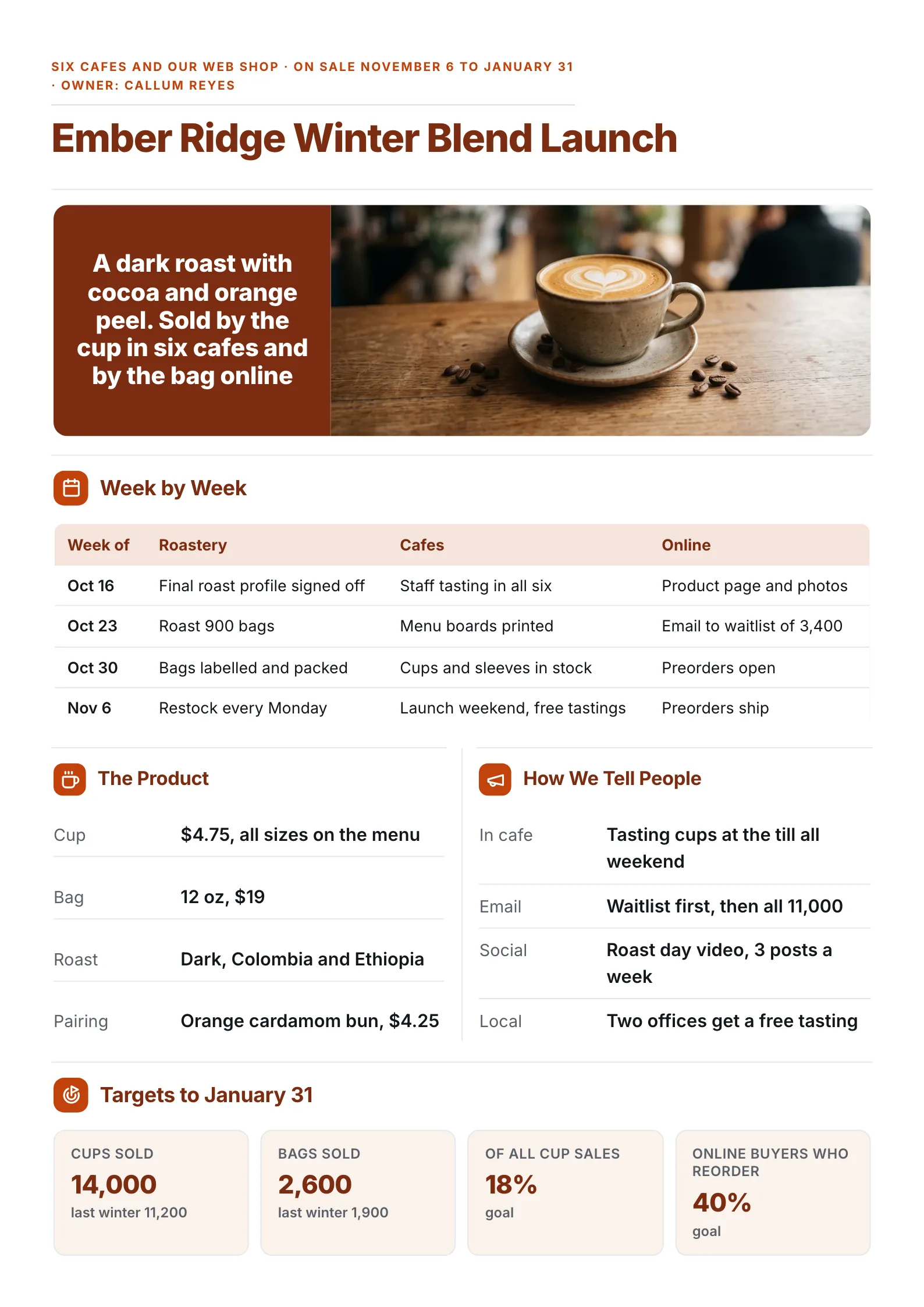
5. Seasonal product launch plan
 Edit this template
A launch with an end date, where every team works to the same four weeks.
What to copy:
- One table, three teams. Roastery, cafes and online each get a column, so no one's week is a surprise.
- The product in four lines. $4.75 a cup, $19 a bag, the roast and the pairing.
- Targets against last year. 14,000 cups against last winter's 11,200 makes the goal easy to judge.
You can edit this seasonal product launch plan template for free.
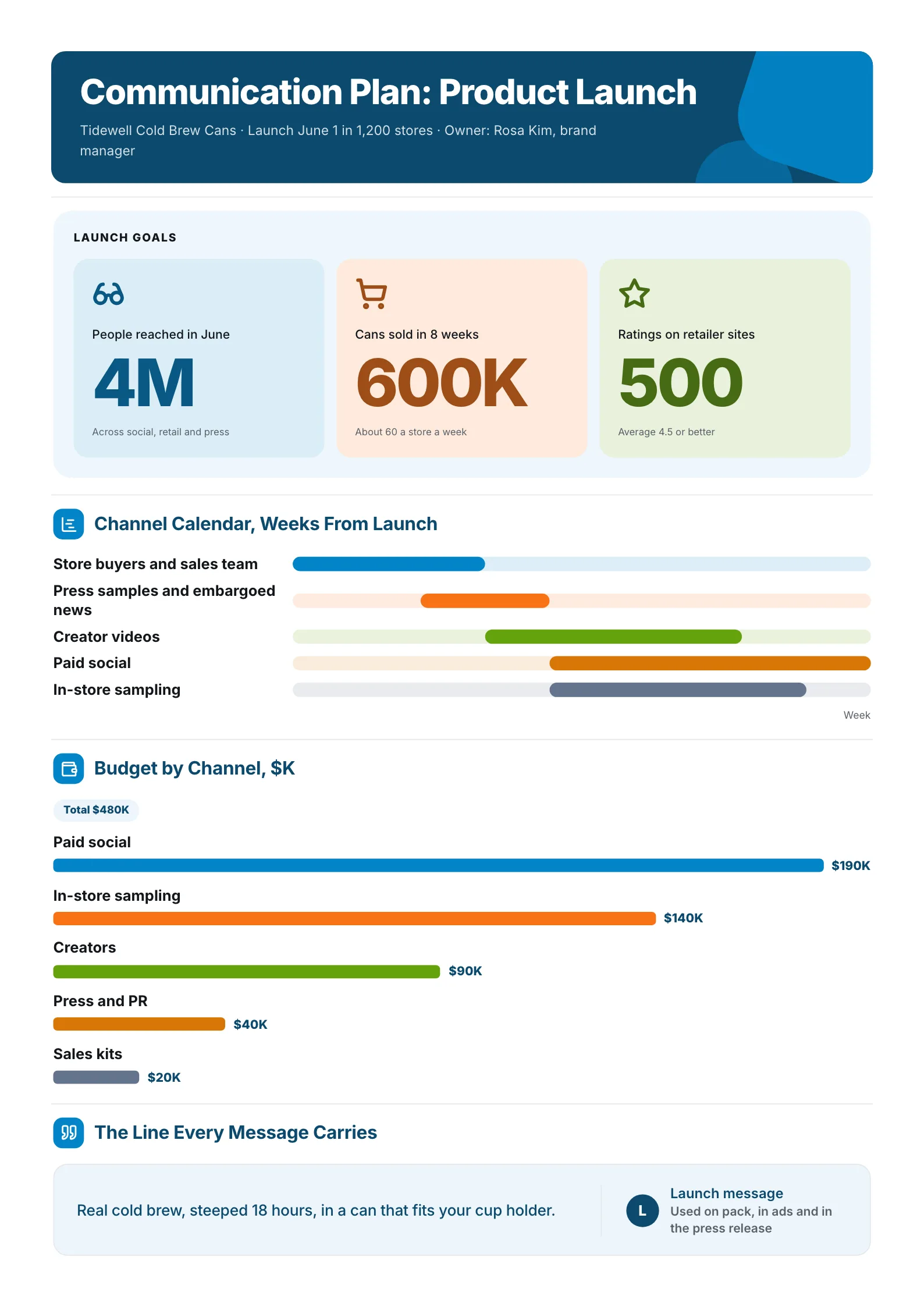
6. Launch communication plan
 Edit this template
The marketing side of a launch. It shows who hears about it, in what order, and what it costs.
What to copy:
- Goals a channel can own. Reach for social and press, cans sold for stores, ratings for retailer sites.
- The calendar in weeks from launch. Store buyers first, press samples under embargo next, paid social last.
- One line every message carries. "Real cold brew, steeped 18 hours, in a can that fits your cup holder." Pack, ads and press release all say it.
You can edit this product launch communication plan template for free.
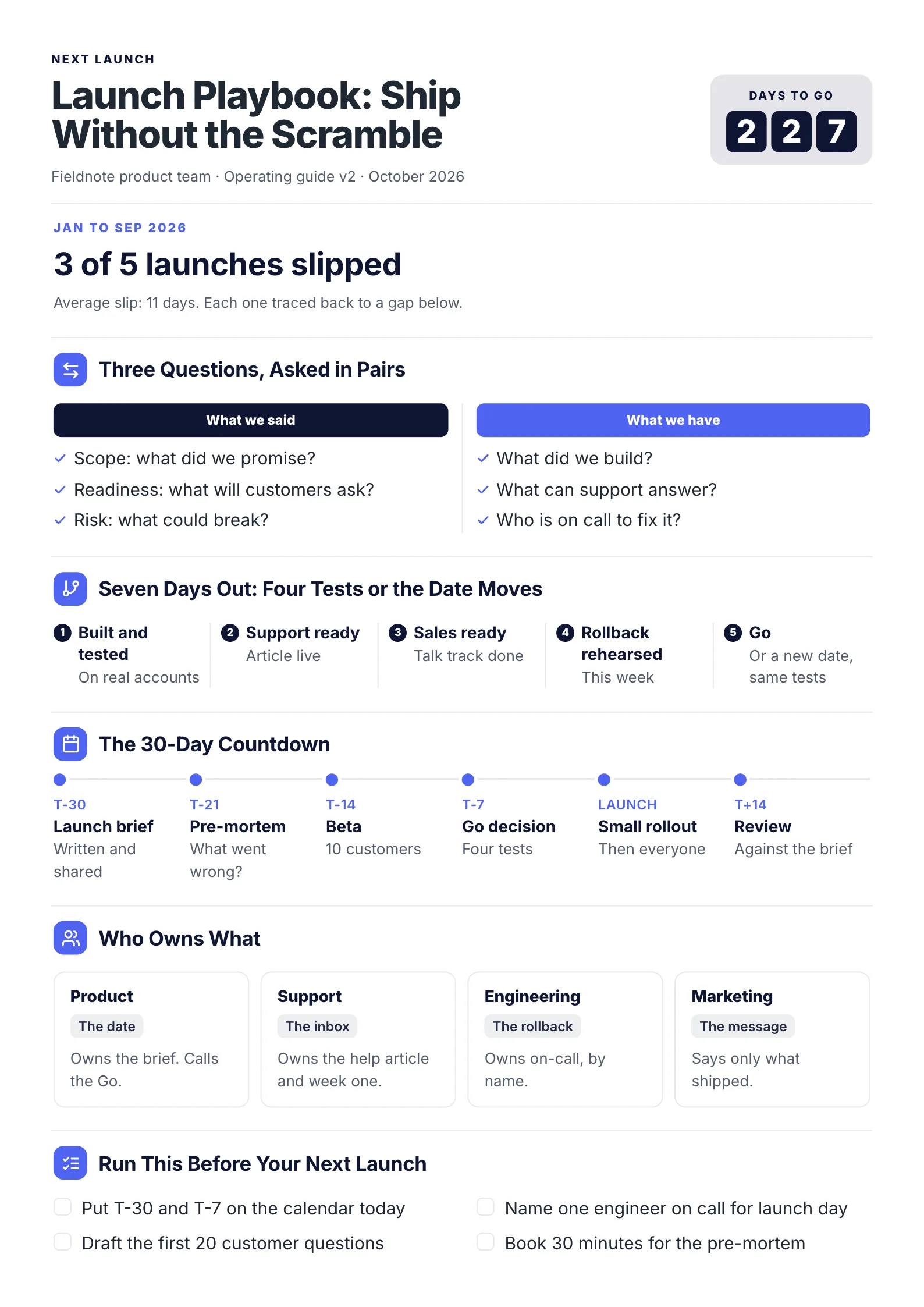
A launch playbook for every launch
 Edit this template
Why launches slipped, the countdown that fixes it and one owner per team.
What to copy:
- The reason for the plan at the top: "3 of 5 launches slipped, average slip 11 days." Everyone knows why the process exists.
- Four tests seven days out: built and tested on real accounts, support article live, sales talk track done, rollback rehearsed. If one fails, the date moves and the tests stay.
- One owner per team, with one word: product owns the date, support owns the inbox, engineering owns the rollback, marketing owns the message.
- A checklist for this week: put T-30 and T-7 on the calendar, draft the first 20 customer questions, name one engineer on call, book 30 minutes for the pre-mortem. A plan that starts with small actions gets used.
You can edit this product launch plan template for free.
A worked example: a feature launch on one page
The company and numbers below are made up. They're here to show you the method.
A meal planning app is launching a shared shopping list. Here's its launch plan in short.
- What and when: shared shopping lists, full launch on Tuesday 9 March, small rollout to 5% of users on 2 March.
- Goal: 20% of active households create a shared list within 30 days; support tickets about lists stay under 50 a week.
- Message: "One list for the whole house. Everyone sees it change."
- Countdown: brief on 6 February, pre-mortem on 15 February, beta with 300 households on 22 February, go decision on 2 March.
- Go test: no open bugs that lose a list item; help article published; app store text approved; rollback tested.
- Owners: product (date and go call), engineering (rollback and on-call), support (help article and the first week of tickets), marketing (email, in-app message and store listing).
- Review: 23 March, against the two goal numbers.
At the pre-mortem the team imagined the launch had failed. The top reason they listed was two people editing the list at once and one change disappearing. That became a go test, and it was fixed in the beta, two weeks before customers would have found it.
How to make a product launch plan in 6 steps
- Write the launch brief first: what, who, why and the goal in numbers.
- Count back from the date: T-30, T-21, T-14, T-7, launch, T+14.
- Write the go test now, while nobody is under date pressure.
- Name one owner per team and what they own.
- Run a pre-mortem: imagine the launch failed and list the reasons. Turn the top three into tasks.
- Book the review before launch day, so it actually happens.
Do you have a long launch checklist or a planning spreadsheet? Drop it into the free AI One-Pager generator. You'll get it back as a designed product launch plan One-Pager.
Product launch plan mistakes
- No go test. Without one, the date wins every argument, and customers find the problems.
- Support hears last. The first week of questions lands on them. Give them the help article and the top 20 questions early.
- Everyone at once. A small rollout first catches problems while they are still small.
- Too many tasks on the plan. Keep the one-page plan to milestones and owners. Detailed tasks live in your project tool.
- Marketing promises more than shipped. The message should describe what is live today, not what is coming.
- No review. If nobody compares results to the goal, the next launch repeats the same mistakes.
Make your product launch plan
Open the free product launch plan template and put in your own launch. Or drop your checklist into the free AI One-Pager generator, and you'll get a finished launch plan One-Pager back.
Frequently asked questions
What should a product launch plan include?
Your plan should say what is launching and when, with the goal in numbers. Add the audience and message, a countdown and a go or no-go test. Then name one owner per team, and add the rollout plan and a review date.
How far in advance should you plan a product launch?
If you're launching a feature or a small product, about 30 days of focused launch work is common. For a large product or a new market, your planning often starts three to six months ahead.
What is the difference between a product launch plan and a go to market strategy?
The go to market strategy decides who you sell to, how you position and price it and which channels you use. Your product launch plan is the dated schedule that carries it out.
What is a go or no-go decision?
It's a meeting a few days before launch. Your team checks the tests you agreed, such as testing, support readiness and a rehearsed rollback. If any fail, the launch date moves.
What should happen after a product launch?
Watch the goal numbers and support tickets daily for the first week. Then hold a review about two weeks later, where you compare your results with the plan and write down what you'll change next time.




