Plan a Launch With a Free Go to Market Strategy Template
A free go to market strategy template with the 8 parts of a GTM plan, 6 examples and a worked plan for a company entering a new market.

A go to market strategy template puts your whole plan for bringing a product to market on one sheet. It says who the product is for and what problem it solves. It shows how you'll position and price it, which channels will reach buyers, and how sales will close them. It also sets when each step happens and how you'll know it worked. Long go-to-market documents get written once and never opened again. A GTM One-Pager gets pinned above desks and checked in every launch meeting. Below you'll find the eight parts of a go to market strategy, a free template to copy and six go to market strategy examples, plus a worked example with real-looking targets and the mistakes that stall launches. Start from a free one pager template.
One‑Pager examples
Real One-Pagers made with MakeOnepagers. Open any one to edit it as your own.
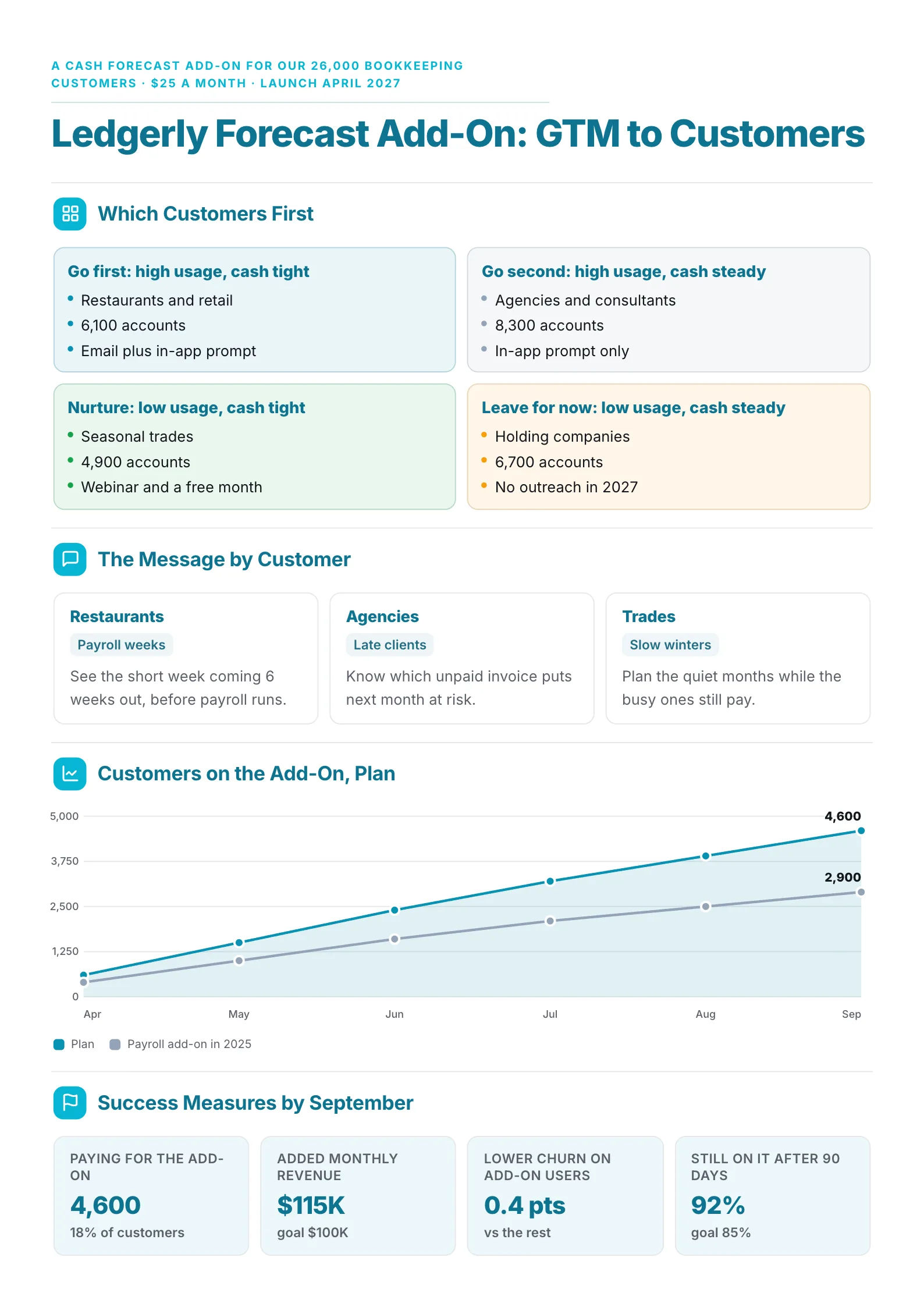 Go-to-Market Strategy: Add-On for CustomersEdit for free(opens in a new tab)
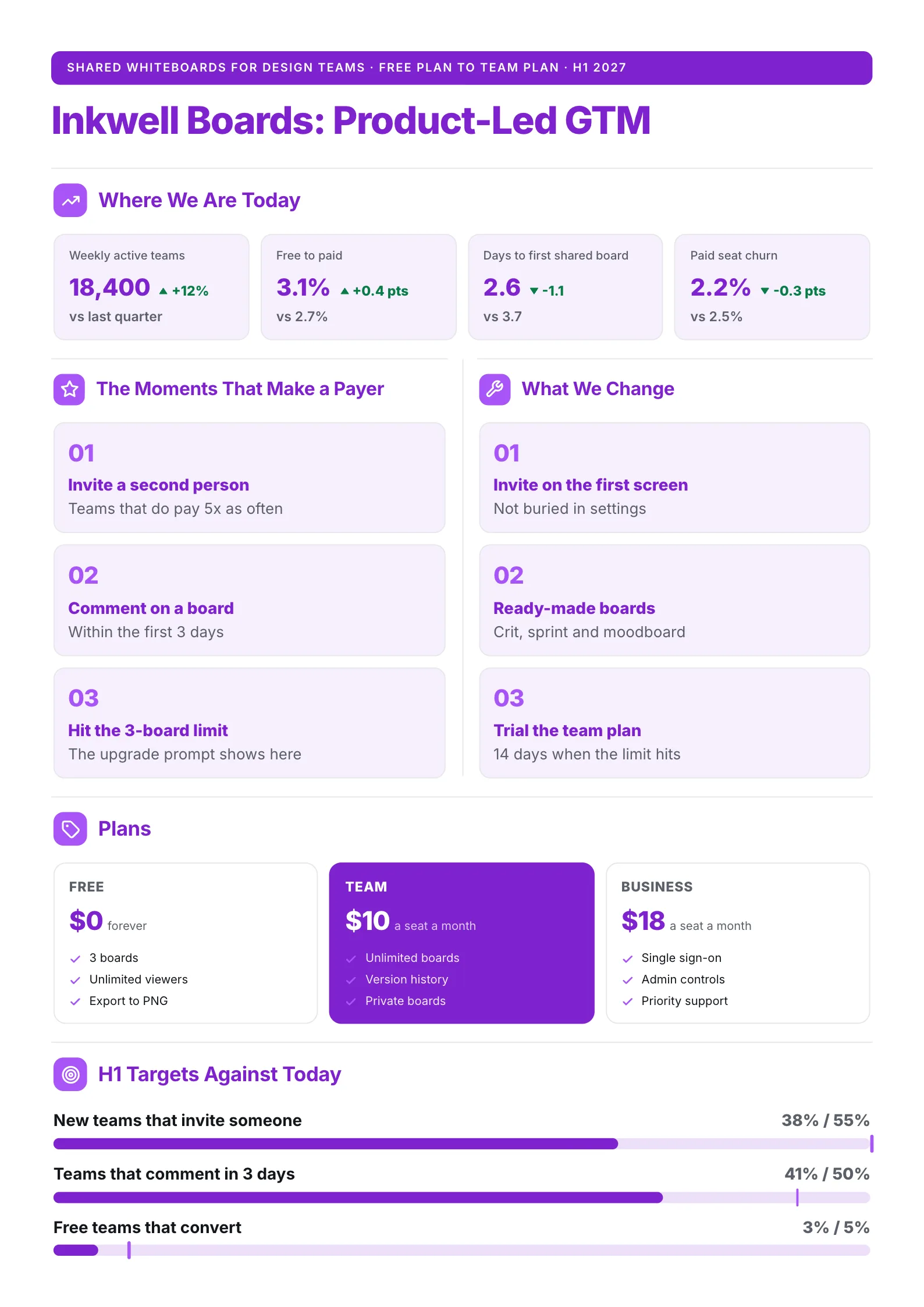 Go-to-Market Strategy: Product-Led GrowthEdit for free(opens in a new tab)
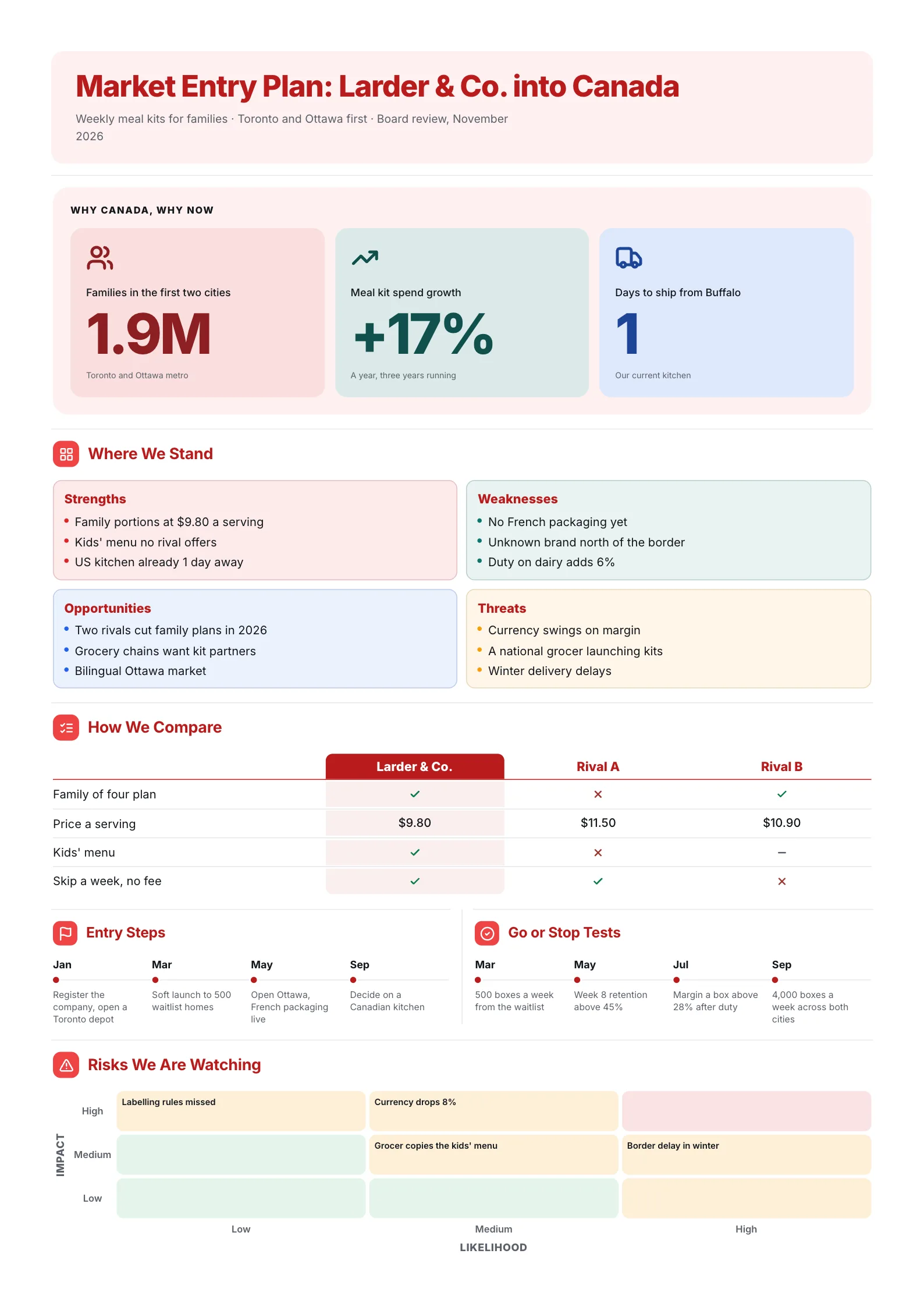 Go-to-Market Strategy: New Country EntryEdit for free(opens in a new tab)
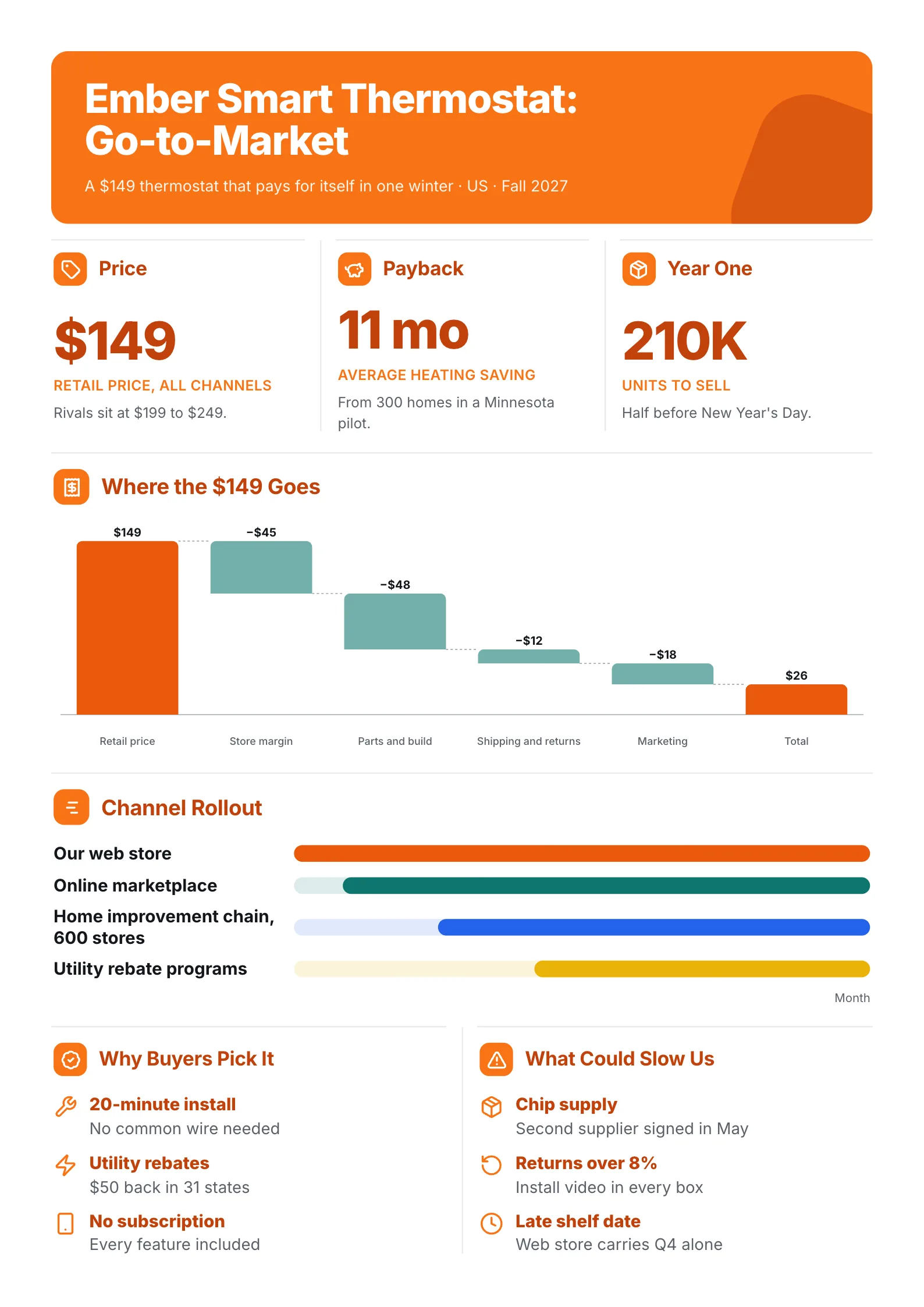 Go-to-Market Strategy: Hardware ProductEdit for free(opens in a new tab)
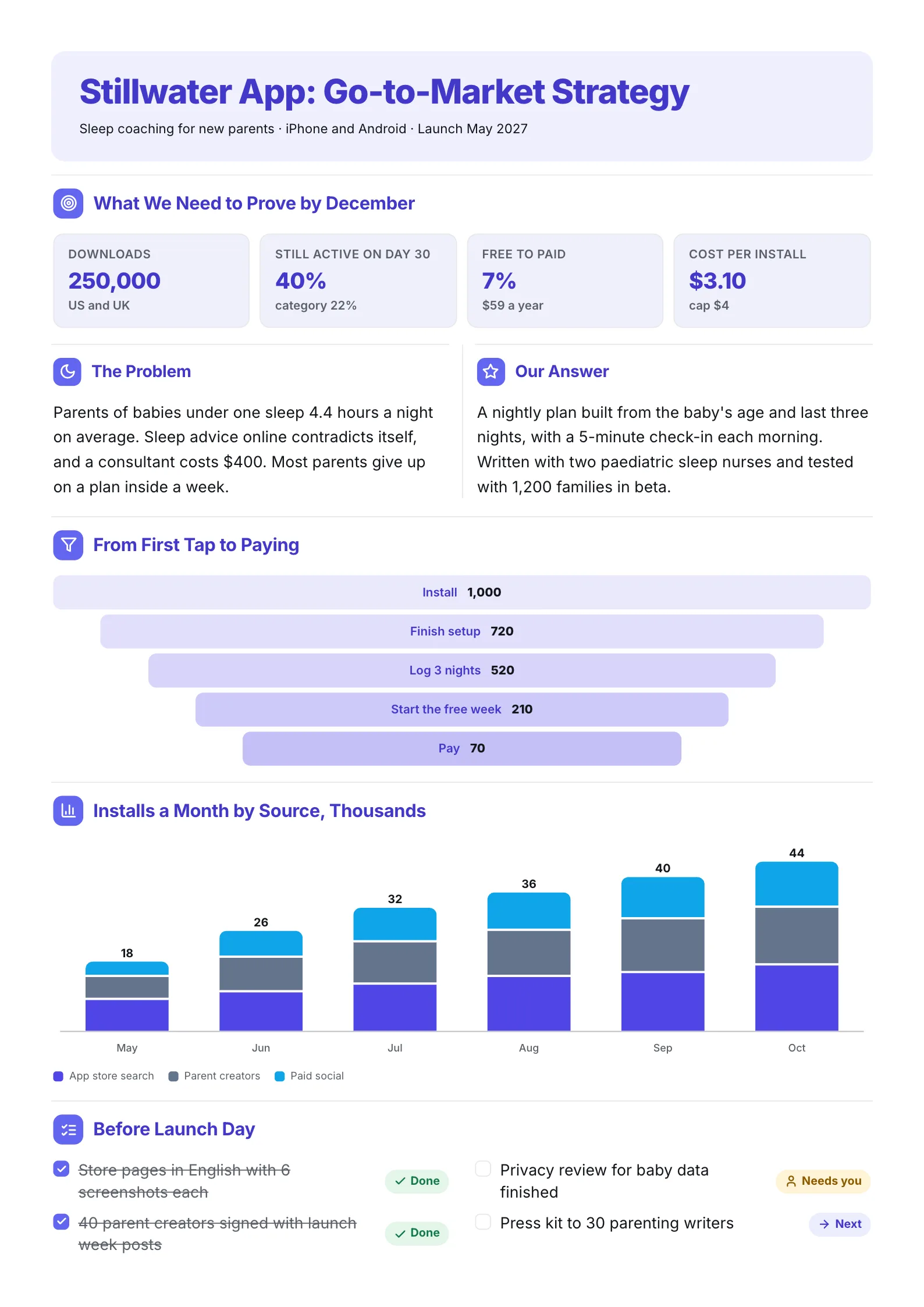 Go-to-Market Strategy: Mobile AppEdit for free(opens in a new tab)
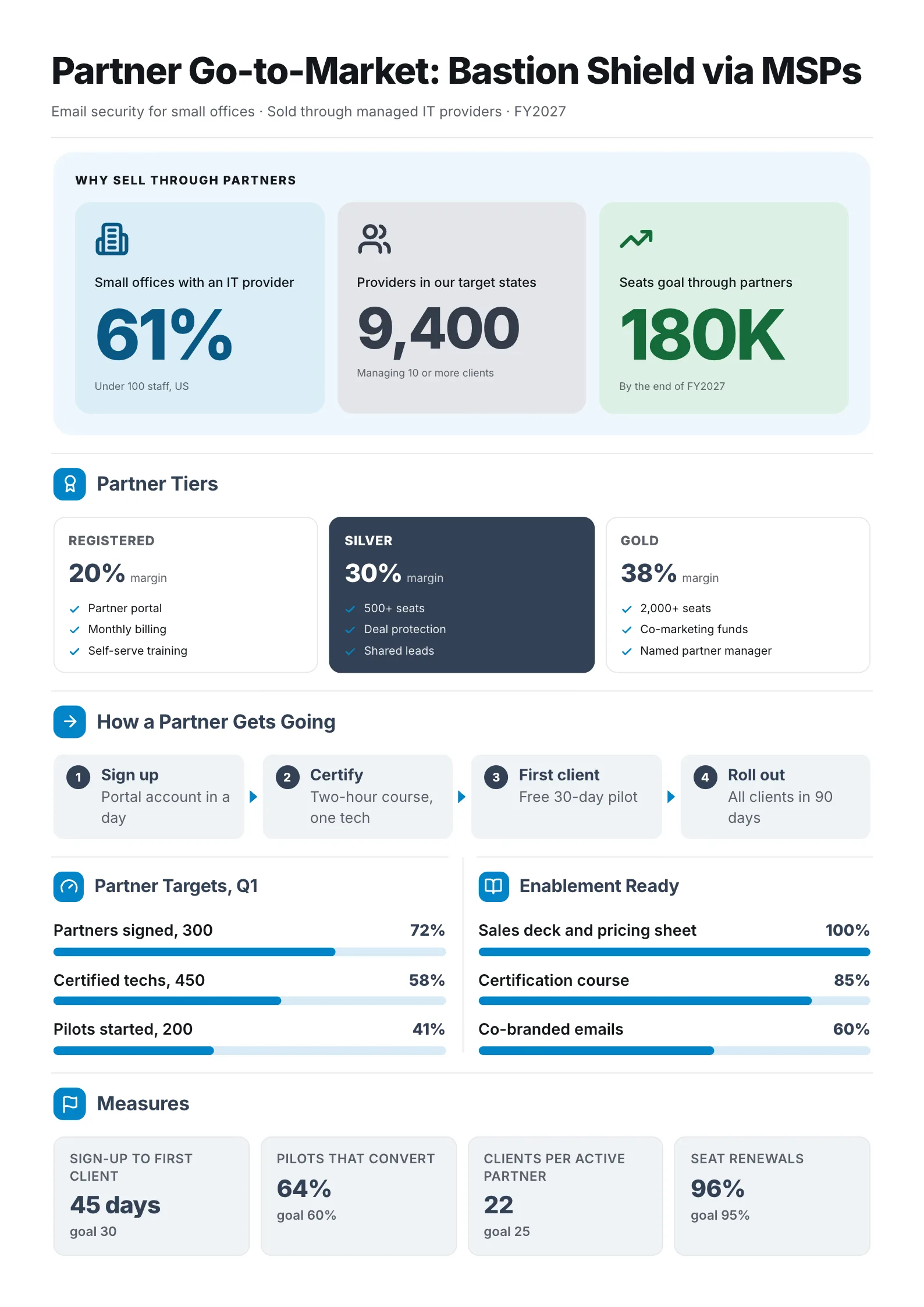 Go-to-Market Strategy: Channel PartnersEdit for free(opens in a new tab)
Every example was made with MakeOnepagers. Each one opens as a template, and you can edit all of it for free.
What is a go to market strategy?
A go to market strategy (GTM strategy) is your plan for launching a product, a new version, or an existing product into a new market. It answers four questions. Who will buy it, and why will they choose it? How will they hear about it? And how will they buy?
It's narrower than a business plan and broader than a marketing campaign. A business plan covers the whole company. A campaign covers one push in one channel. Your GTM strategy covers one product reaching one market, from the decision to launch through the first few months after release.
Go to market strategy or product launch plan?
| Go to market strategy | Product launch plan | |
|---|---|---|
| Question | Who, why, how and at what price? | What happens on which day? |
| Owner | Product marketing and leadership | The launch team |
| Horizon | Months, sometimes a year | Weeks around launch day |
| Changes when | The market or the product changes | A date moves |
Write your strategy first. The launch plan is how your team carries it out, task by task.
The 8 parts of a go to market strategy template
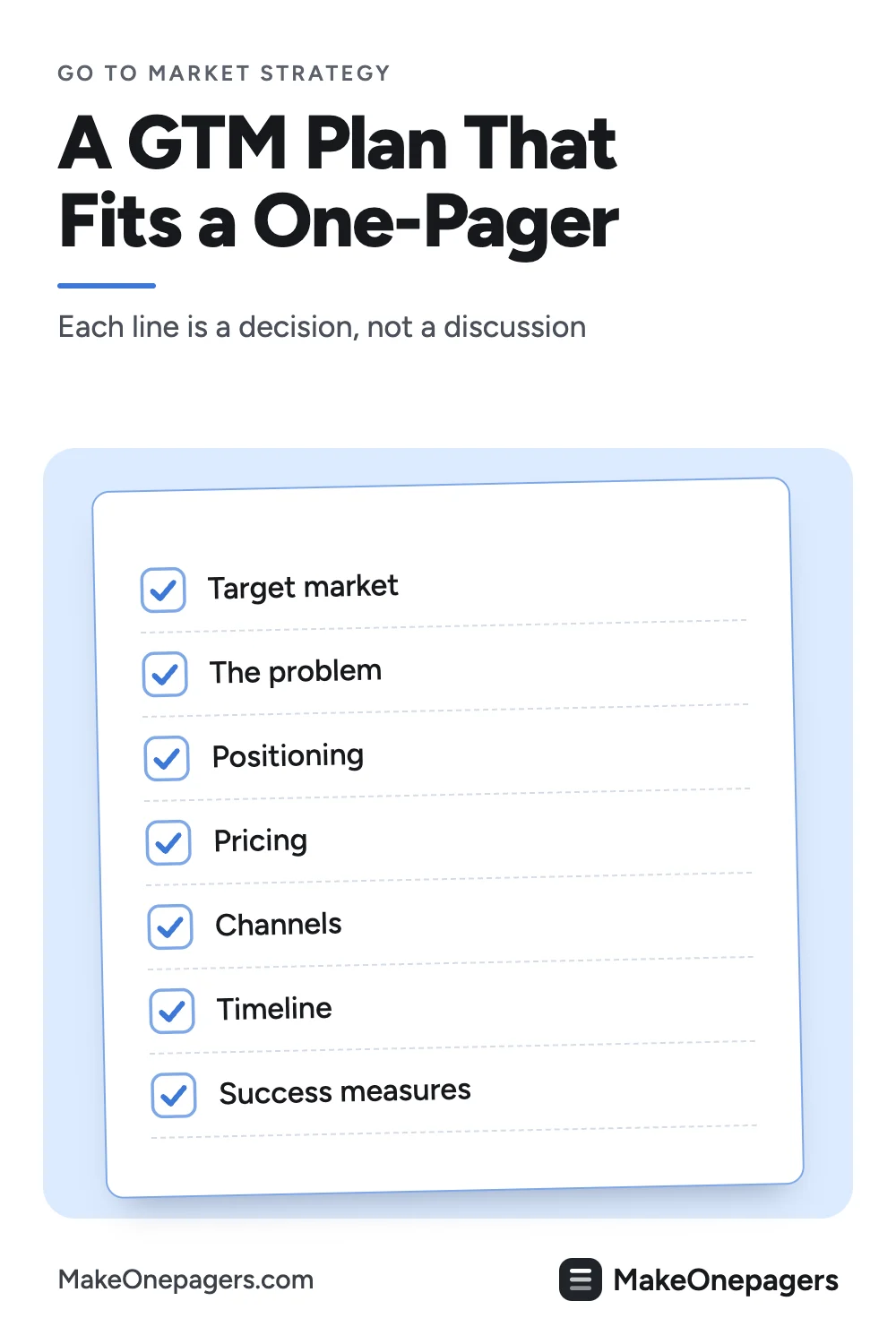
- Target market: the segment, its size and the buyer inside it.
- The problem: what that buyer struggles with today, in their words.
- Positioning: what the product is, who it is for and why it beats the alternative, in one or two sentences.
- Pricing: the model (per seat, per use, flat), the price points and how they compare to rivals.
- Channels: where buyers will find you. Search, partners, events, outbound sales, app stores, retail.
- Sales motion: self-serve, sales-led or partner-led, and what the handoff looks like.
- Timeline: the runway from beta to general release to the push after launch.
- Success measures: three or four numbers with a date, and who owns each.
Add risks and the budget at the bottom if you have room. If you don't, link to them.
A free go to market strategy template
You can copy this into a document. Or open the example below and edit it.
| Part | What to write, with an example |
|---|---|
| Title | Product, version, ship date. Launch Brief: Atlas 3.0, ships April 14 |
| Target market | 1 sentence. Platform teams at mid-size health companies |
| Positioning | 1 to 2 sentences |
| What is new | 3 items, each with one line on why it matters |
| Pricing | Model and price points |
| Channels | 3 to 4, in order of priority |
| Runway | 4 steps by month. Private beta, press embargo, general release, migration push |
| Readiness | Each team as a percent. Engineering 92%, docs and support 74% |
| Success | 3 measures with targets and dates |
6 go to market strategy examples
Six launches with different routes to the buyer: a software release, a SaaS product, a drink brand, a local clinic, an enterprise sale and a two-sided marketplace. Each one names the buyer, the channel and the number that tells you it worked.
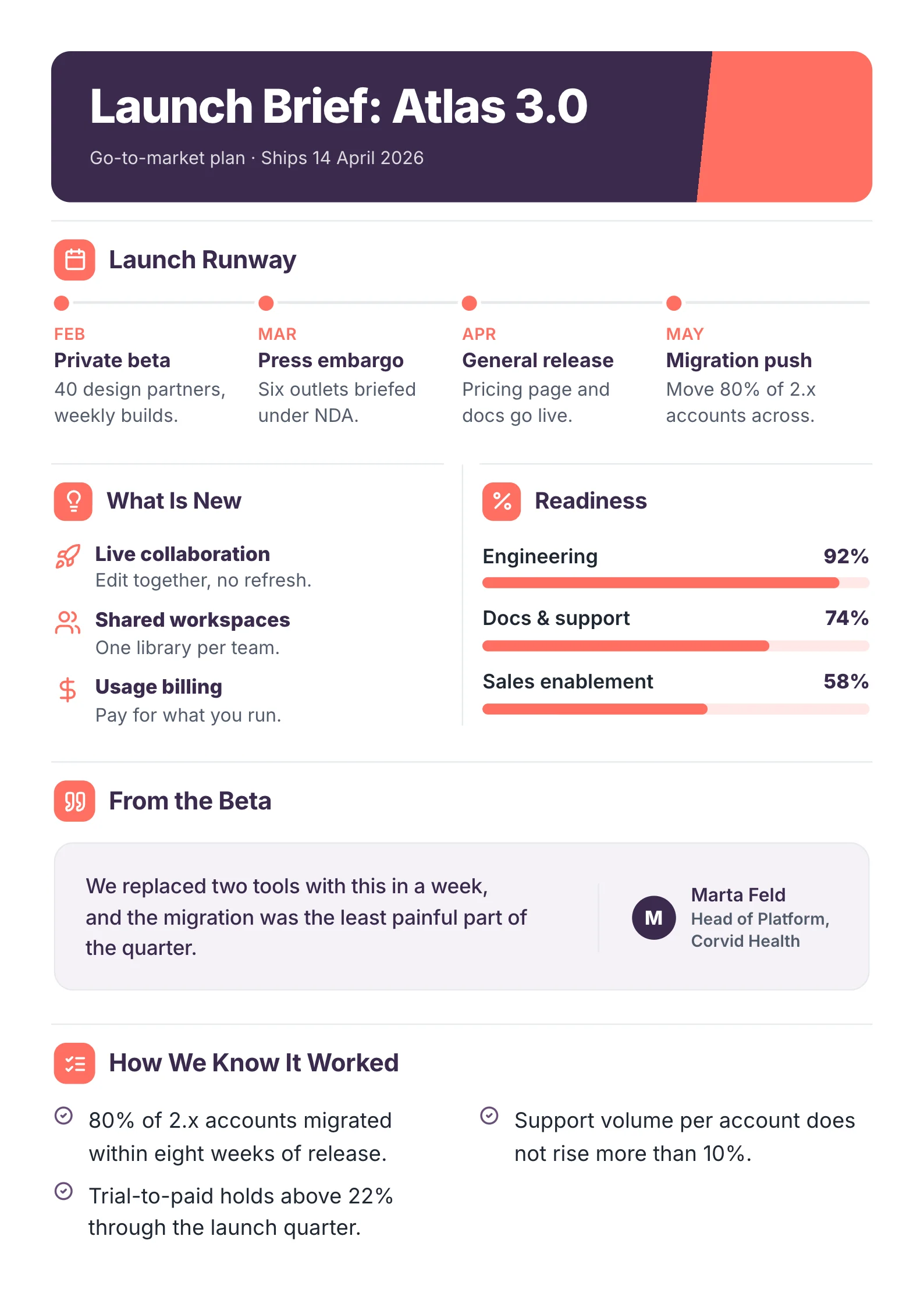
1. Software release launch brief
 Edit this template
The whole launch on one sheet, with readiness and success in numbers.
What to copy:
- The runway as four dated steps: private beta in February, press embargo in March, general release in April, migration push in May. Anyone can see where the team is today.
- Readiness by team, in percent: engineering at 92% and sales enablement at 58% tells leadership exactly where to help, without a status meeting.
- One quote from the beta: it doubles as the first line of launch copy.
- Success written as numbers with a window: 80% of accounts migrated within eight weeks, trial-to-paid above 22%, support volume per account up no more than 10%. After launch, nobody has to argue about whether it went well.
You can edit this product launch brief for free.
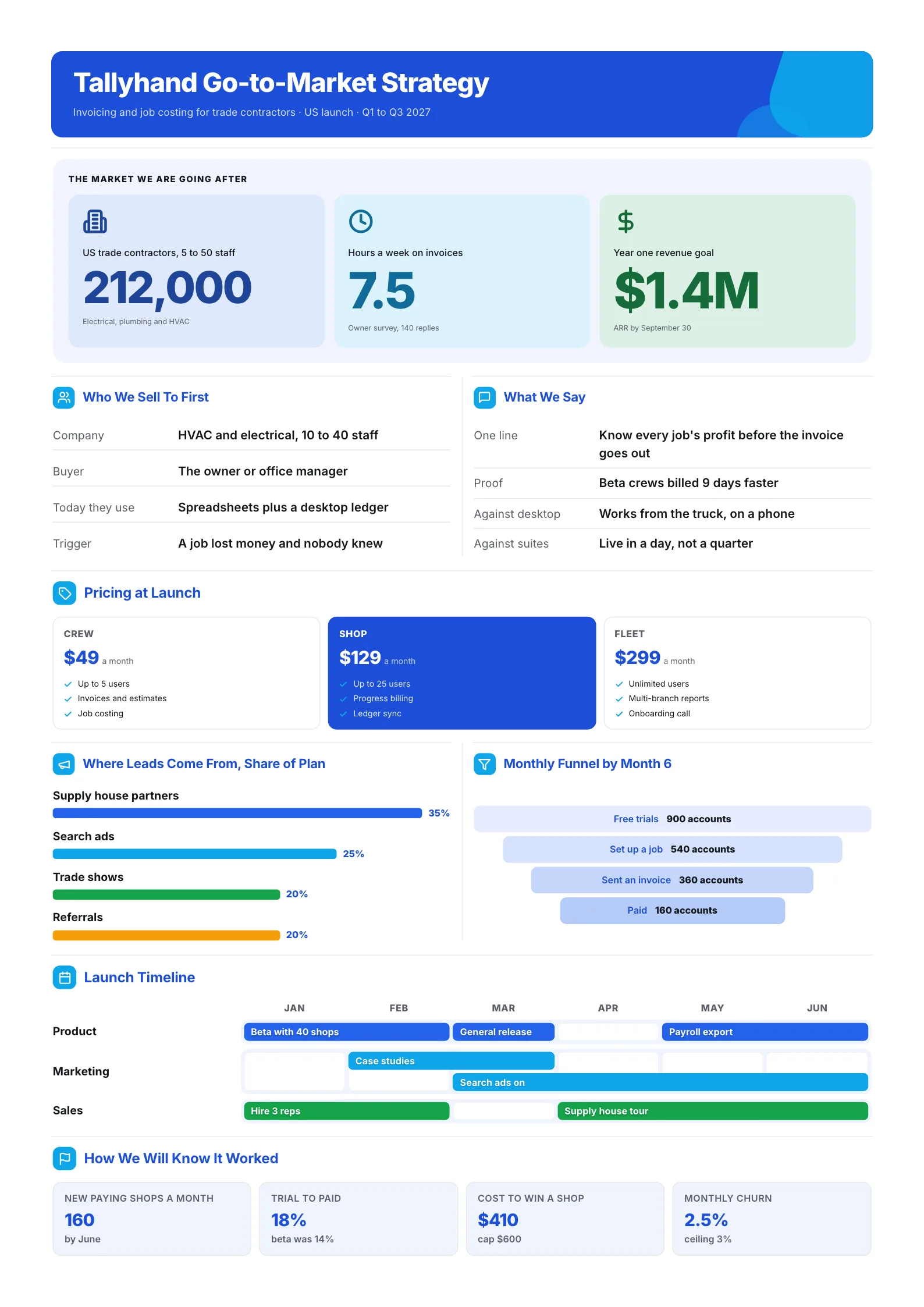
2. SaaS go to market strategy
 Edit this template
A software launch aimed at one kind of buyer first: HVAC and electrical firms with 10 to 40 staff.
What to copy:
- The market as one counted group. 212,000 US trade contractors with 5 to 50 staff.
- The trigger that starts the search. "A job lost money and nobody knew."
- A message against each rival. Against desktop software: "Works from the truck, on a phone."
You can edit this SaaS go to market strategy template for free.
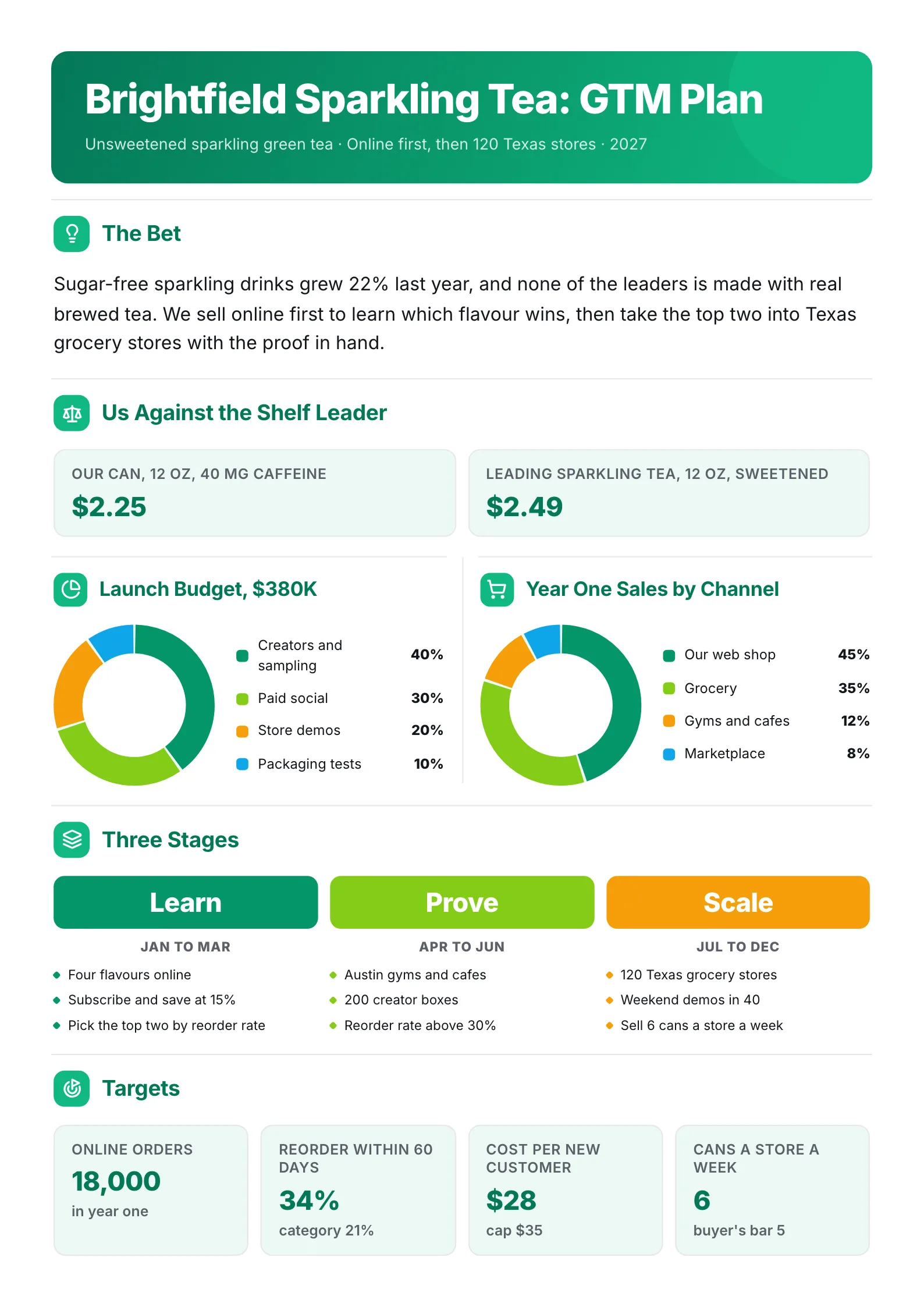
3. Consumer brand go to market plan
 Edit this template
A drink brand learns online first, then takes the proof to grocery buyers.
What to copy:
- The bet in plain words. Sugar-free sparkling drinks grew 22% last year, and none of the leaders is made with real brewed tea.
- Price beside the leader. $2.25 a can against $2.49 for the leading sparkling tea.
- Stages with a test to pass. Learn, prove, scale, with a reorder rate above 30% before the stores.
You can edit this consumer brand go to market plan template for free.
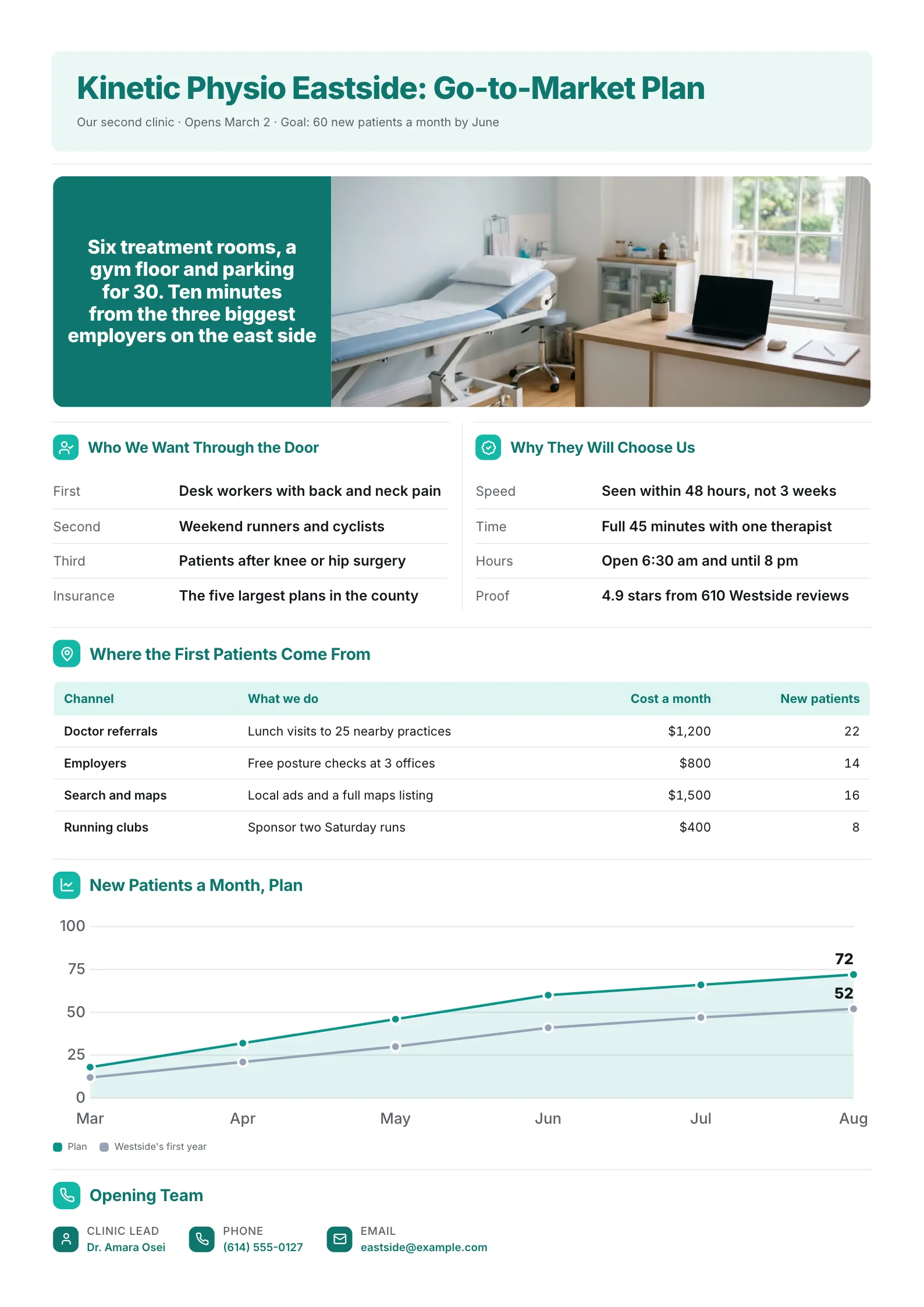
4. Local business go to market plan
 Edit this template
A physio clinic opens its second location and plans where the first patients come from.
What to copy:
- One goal with a date. 60 new patients a month by June.
- Reasons to choose as numbers. Seen within 48 hours, not 3 weeks, and 4.9 stars from 610 reviews.
- Each channel priced against patients. Lunch visits to 25 nearby practices cost $1,200 a month for 22 new patients.
You can edit this local business go to market plan template for free.
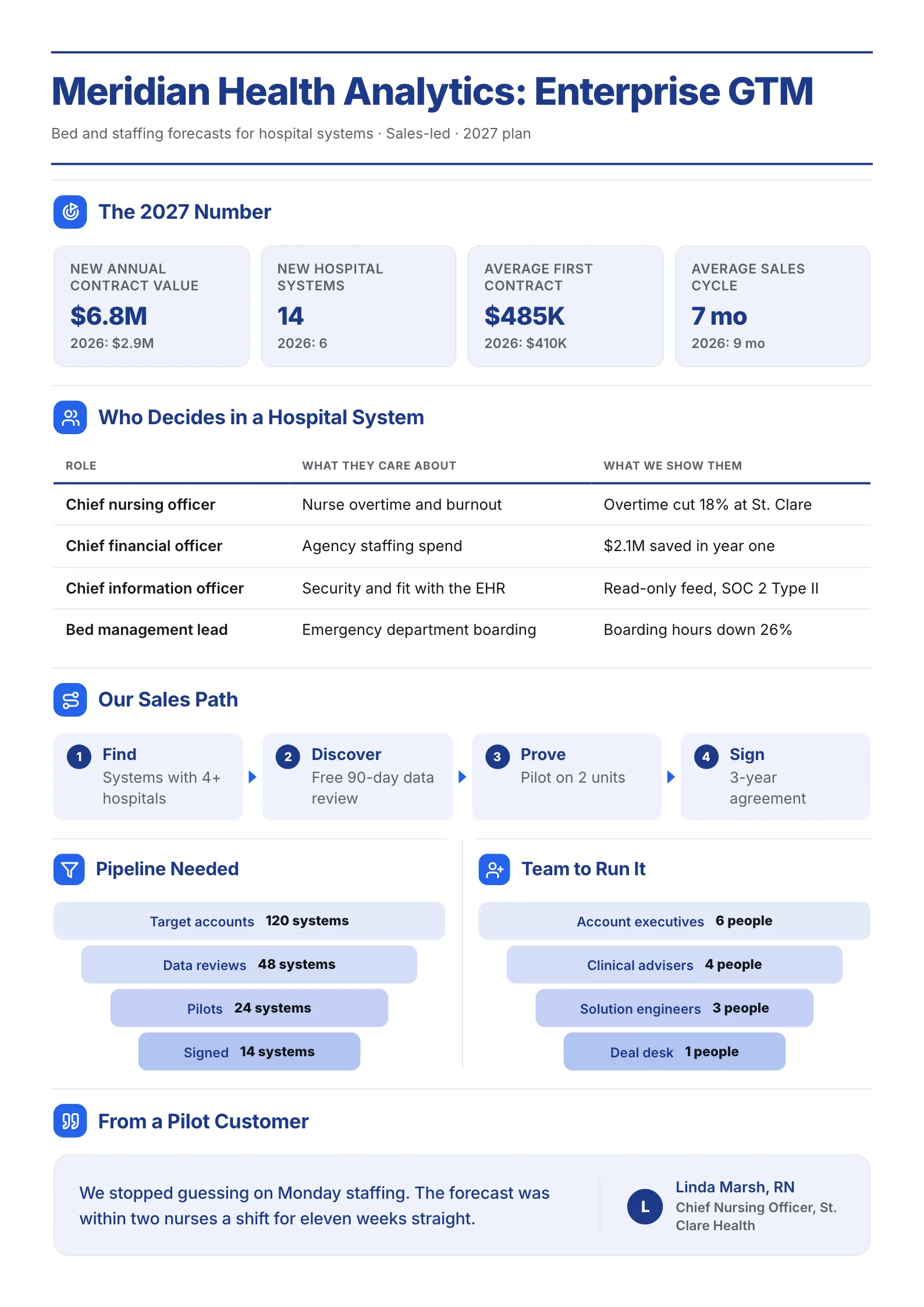
5. Enterprise sales go to market plan
 Edit this template
A sales-led plan for long deals with many people at the table.
What to copy:
- This year's number beside last year's. $6.8M of new contract value, against $2.9M in 2026.
- Proof for each role. The CFO cares about agency staffing spend, so show "$2.1M saved in year one".
- The sales path in four steps. Find, discover with a free 90-day data review, prove with a pilot on 2 units, sign.
You can edit this enterprise sales go to market plan template for free.
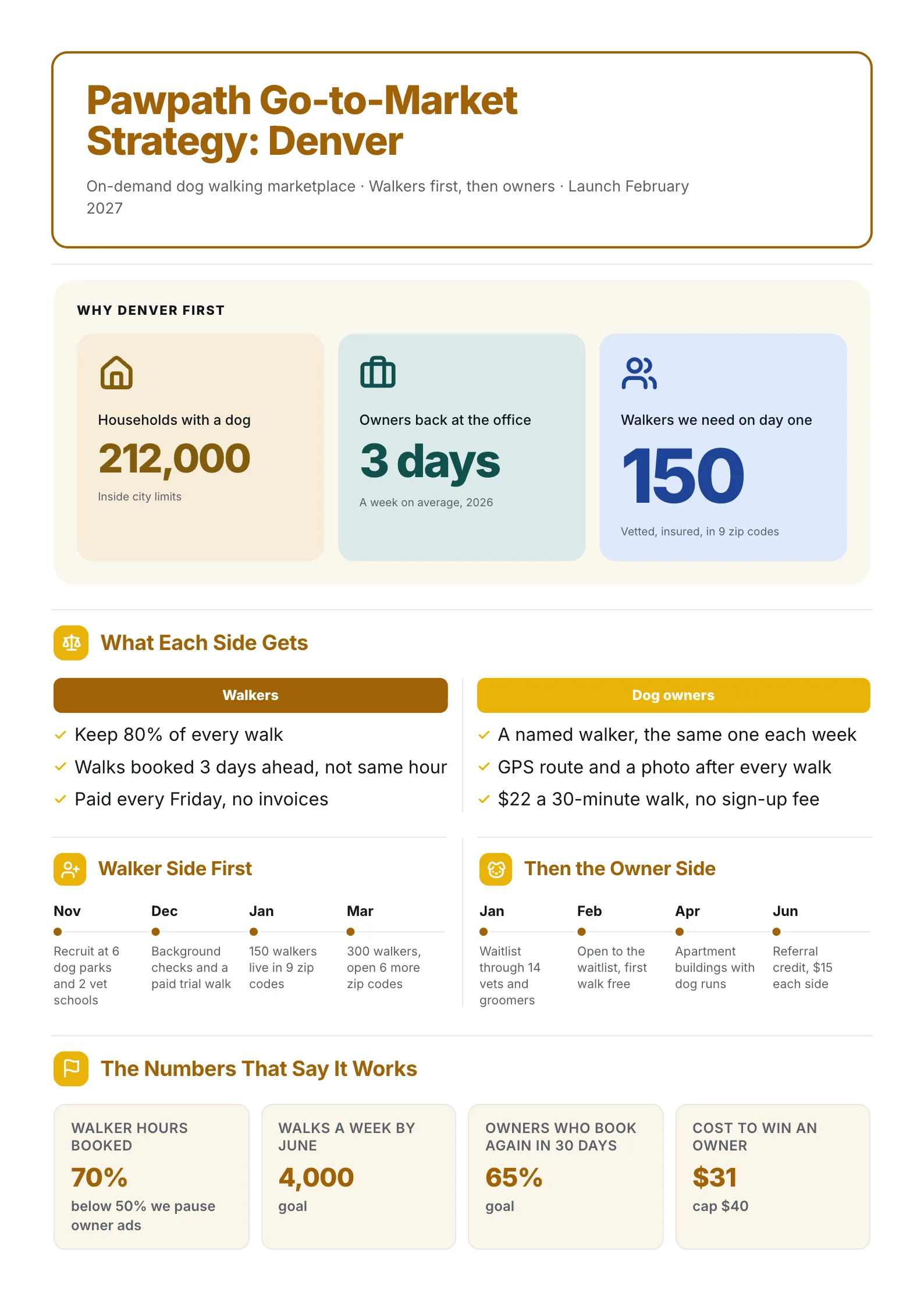
6. Marketplace go to market strategy
 Edit this template
A two-sided marketplace opens one city at a time, walkers first.
What to copy:
- Supply before demand. 150 vetted walkers live in 9 zip codes before owners are let in.
- What each side gets. Walkers keep 80% of every walk. Owners get the same named walker each week.
- A launch offer for each side. The first walk is free, and referrals earn $15 each side.
You can edit this marketplace go to market strategy template for free.
A worked example: a GTM plan for a new market
The company and numbers below are an example, made up to show you the method.
A company that sells inventory software to restaurants decides to enter a new market: independent coffee shops. Here's its GTM strategy in short, as it would read on one sheet.
- Target market: independent coffee shops with one to three locations. The buyer is the owner, who also works the counter.
- Problem: milk and pastry waste. Owners in 9 of 12 interviews said they throw food away every week because they order by feel.
- Positioning: "Order what you will sell tomorrow. Built for coffee shops, set up in an afternoon."
- Pricing: flat $49 a month per location, against $89 for the restaurant version, because coffee shops order fewer items.
- Channels: coffee trade shows, two point-of-sale partners and a referral offer for current restaurant customers who also run a cafe.
- Sales motion: self-serve signup with a 20-minute setup call.
- Timeline: 10 beta shops in January, general release in March, trade show push in April.
- Success by June 30: 150 paying shops, setup finished within 7 days for 80% of them, and fewer than 5% churned in the first 60 days.
The plan fits on one sheet because each line is a decision. You keep the discussion and the research behind it in an appendix.
How to write a go to market strategy in 6 steps
- Name one segment. If you cannot describe the buyer in one sentence, the segment is too broad.
- Talk to ten of them. Confirm the problem and the words they use for it.
- Write the positioning before the features. What it is, who it is for and why it beats what they use today.
- Choose two or three channels you can do well, not every channel at once.
- Set the runway backwards from the launch date, with a gate before each step.
- Agree the success measures with leadership before launch, and put an owner next to each.
Have a long GTM deck or planning notes? Drop them into the free AI One-Pager generator, and you'll get them back as a designed go to market strategy One-Pager.
Go to market strategy mistakes
- Targeting everyone. "Small and medium businesses" is not a segment. "Coffee shops with one to three locations" is.
- Positioning by feature list. Buyers compare outcomes, not menus.
- Too many channels. Five channels done badly lose to two done well.
- No success measure until after launch. Then any result can be called a win.
- Sales hears about it last. If sales cannot explain the product the week of launch, the launch is not ready.
- Never revisited. Check the plan against real numbers 30 and 90 days after launch and change what is not working.
Make your go to market strategy
Open the free product launch brief and put in your own launch. Or drop your notes into the free AI One-Pager generator, and you'll get a finished GTM One-Pager back.
Frequently asked questions
What should a go to market strategy include?
Your plan needs the target market, the problem, positioning, pricing, channels, the sales motion, a timeline and success measures with owners. Add risks and budget if you have room.
How long should a go to market strategy be?
Your decisions should fit on one sheet. Research, market sizing and detailed budgets can sit in an appendix for anyone who wants them.
Who writes the go to market strategy?
It's usually product marketing, with input from product, sales and leadership. Your leadership approves the target market, pricing and success measures.
What is the difference between a go to market strategy and a marketing plan?
A GTM strategy covers one product reaching one market, including pricing and sales. A marketing plan covers all of your company's marketing for a period, usually a year.
When should you write a go to market strategy?
Write it before the build is finished, usually three to six months before launch, so your pricing, channels and sales training are ready on the day.




