Fact Sheet Ideas: 5 Kinds, Each Copied From a Real One
Fact sheet ideas for a fund, a hotel, a venue, a public vote and a company, each taken from a real fact sheet we read, with what to put first.

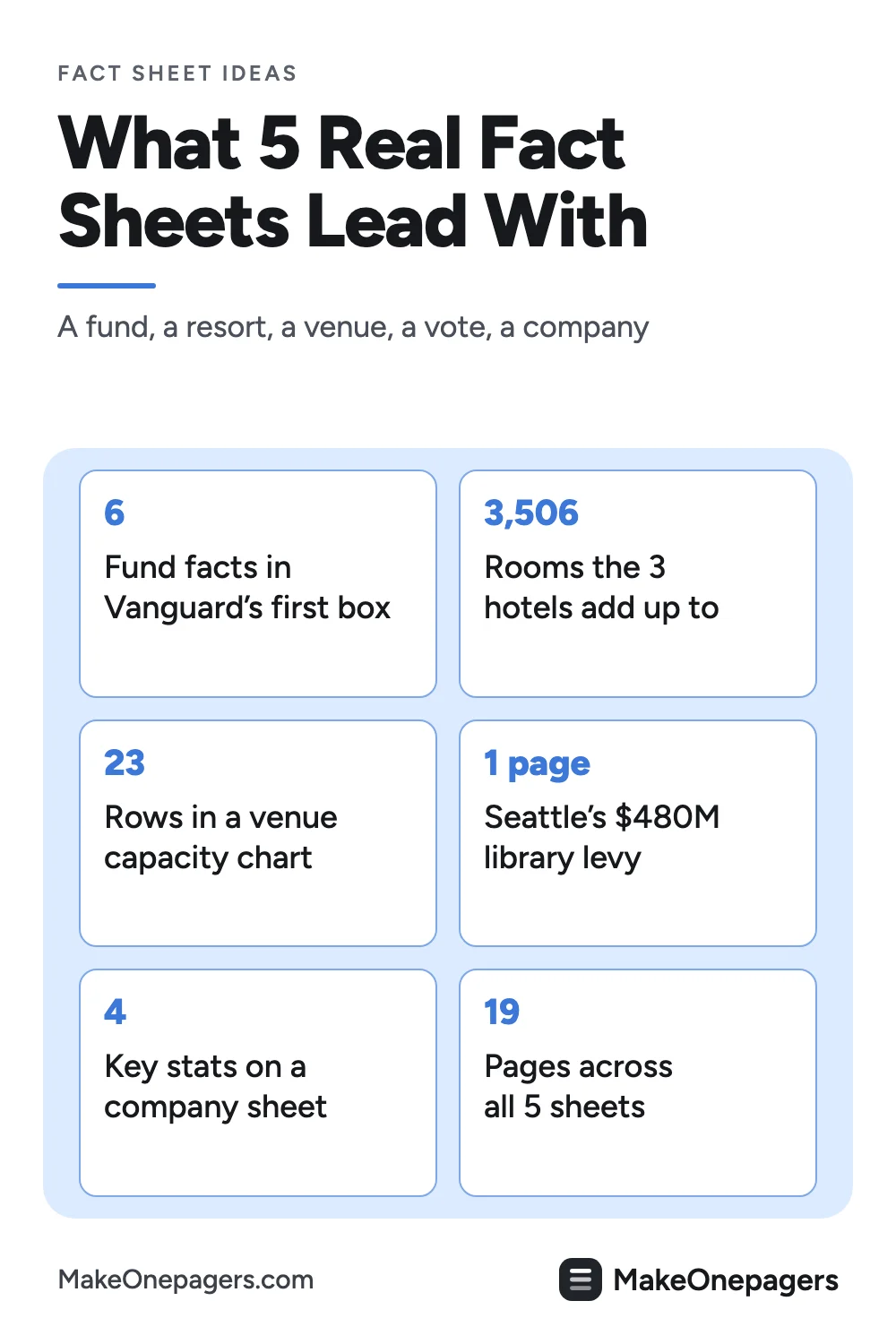
Your reader decides which fact sheet ideas will work. An investor wants the fund's cost. An event planner wants room sizes. A voter wants to know what a measure costs them. So we read 5 real fact sheets, 19 pages in all, from a fund, a resort, a convention center, a library vote and a company. The shortest is Seattle's library levy sheet, at 1 page and 274 words. The longest runs 6 pages. Start from a free one pager template.
One‑Pager examples
Real One-Pagers made with MakeOnepagers. Open any one to edit it as your own.
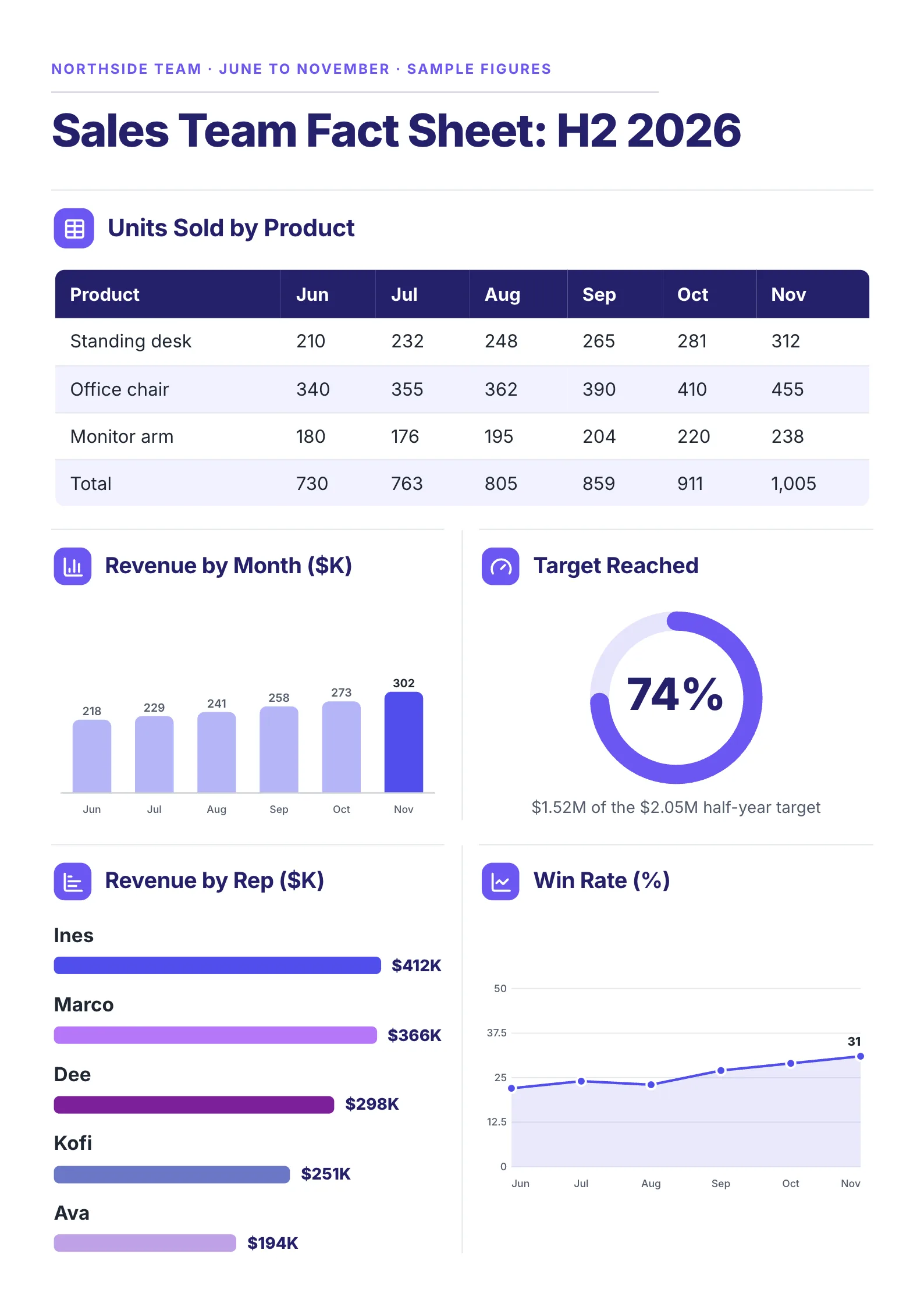 Sales Team Fact SheetEdit for free(opens in a new tab)
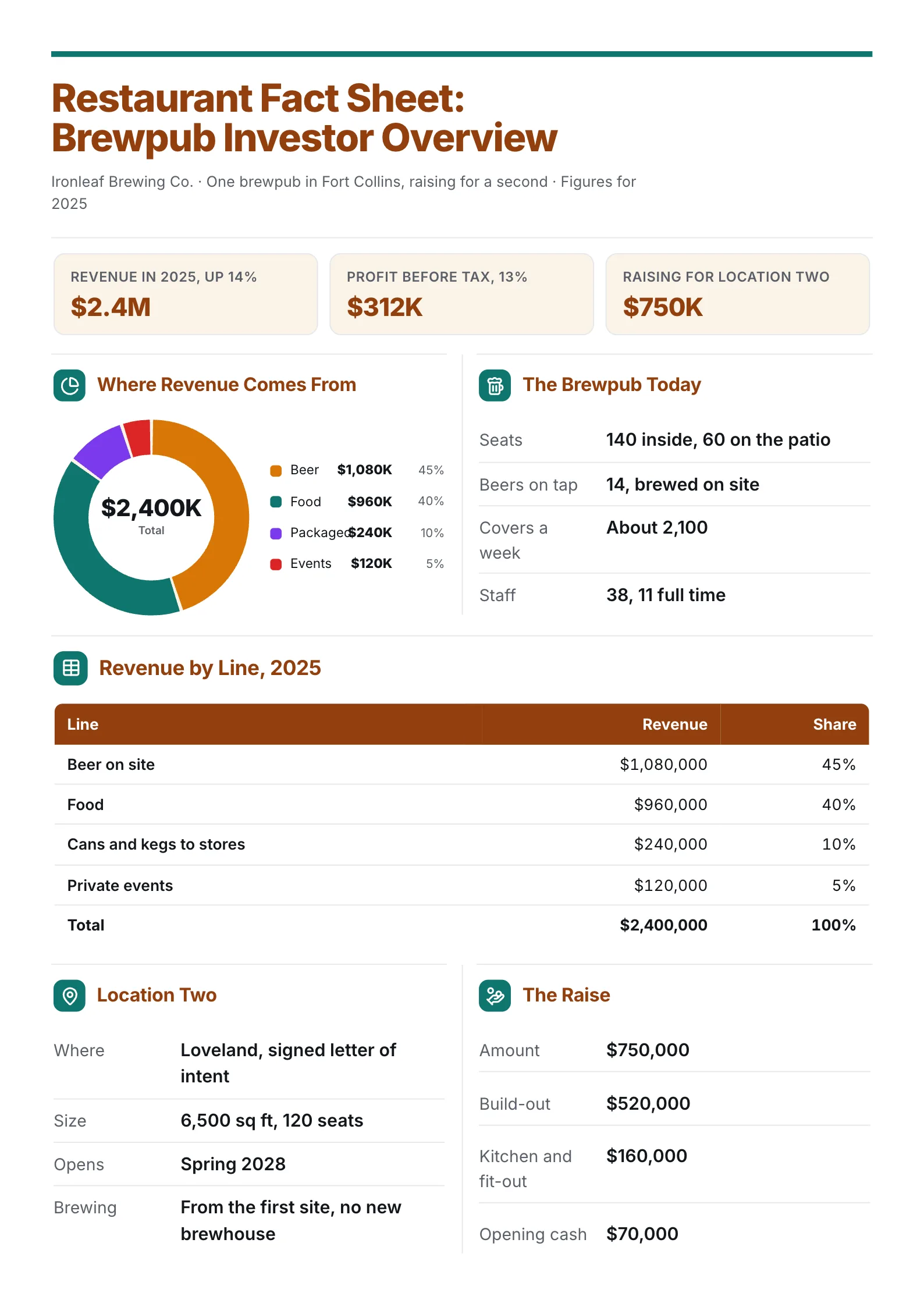 Restaurant Fact Sheet: Brewpub Investor OverviewEdit for free(opens in a new tab)
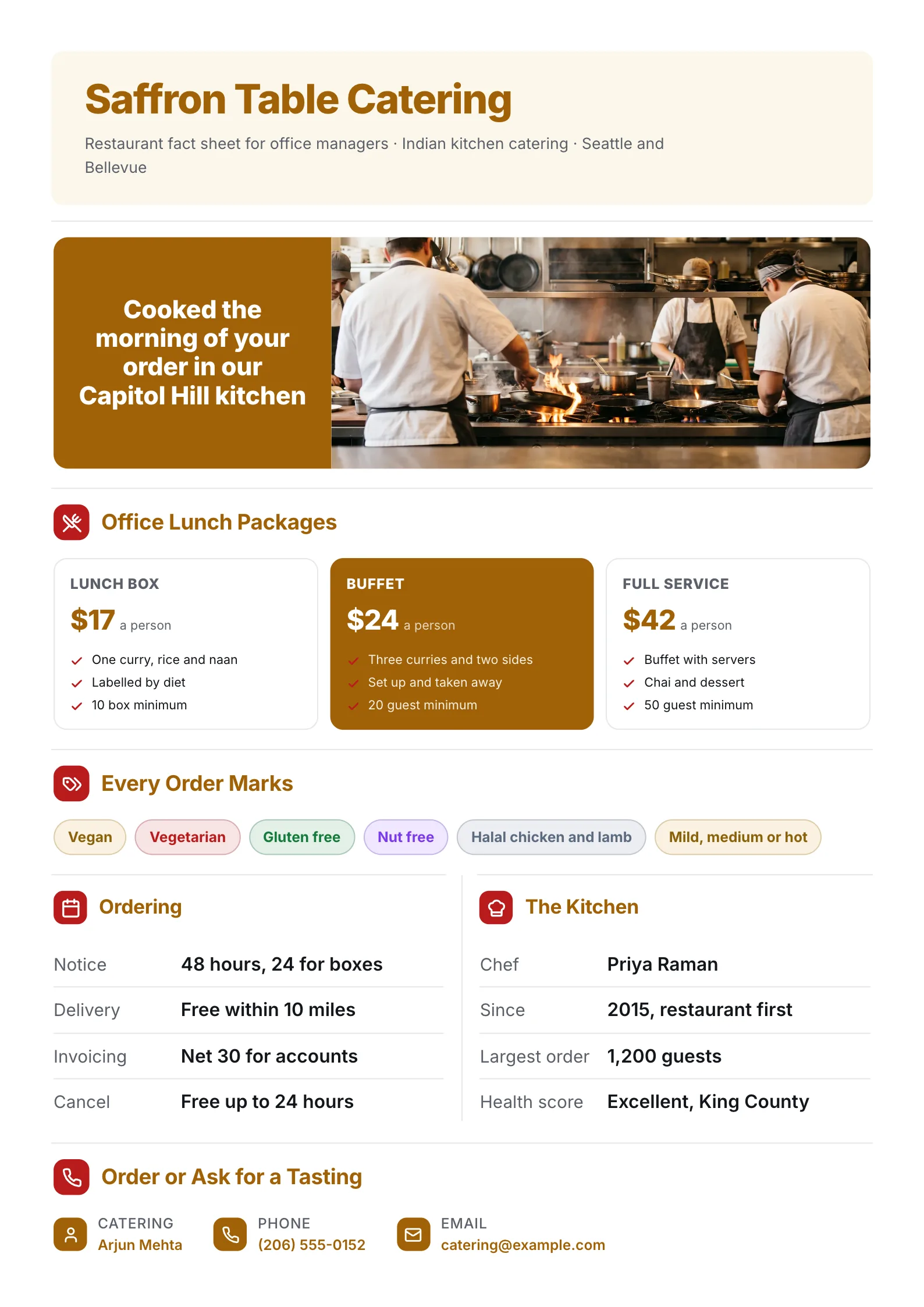 Restaurant Fact Sheet: Office CateringEdit for free(opens in a new tab)
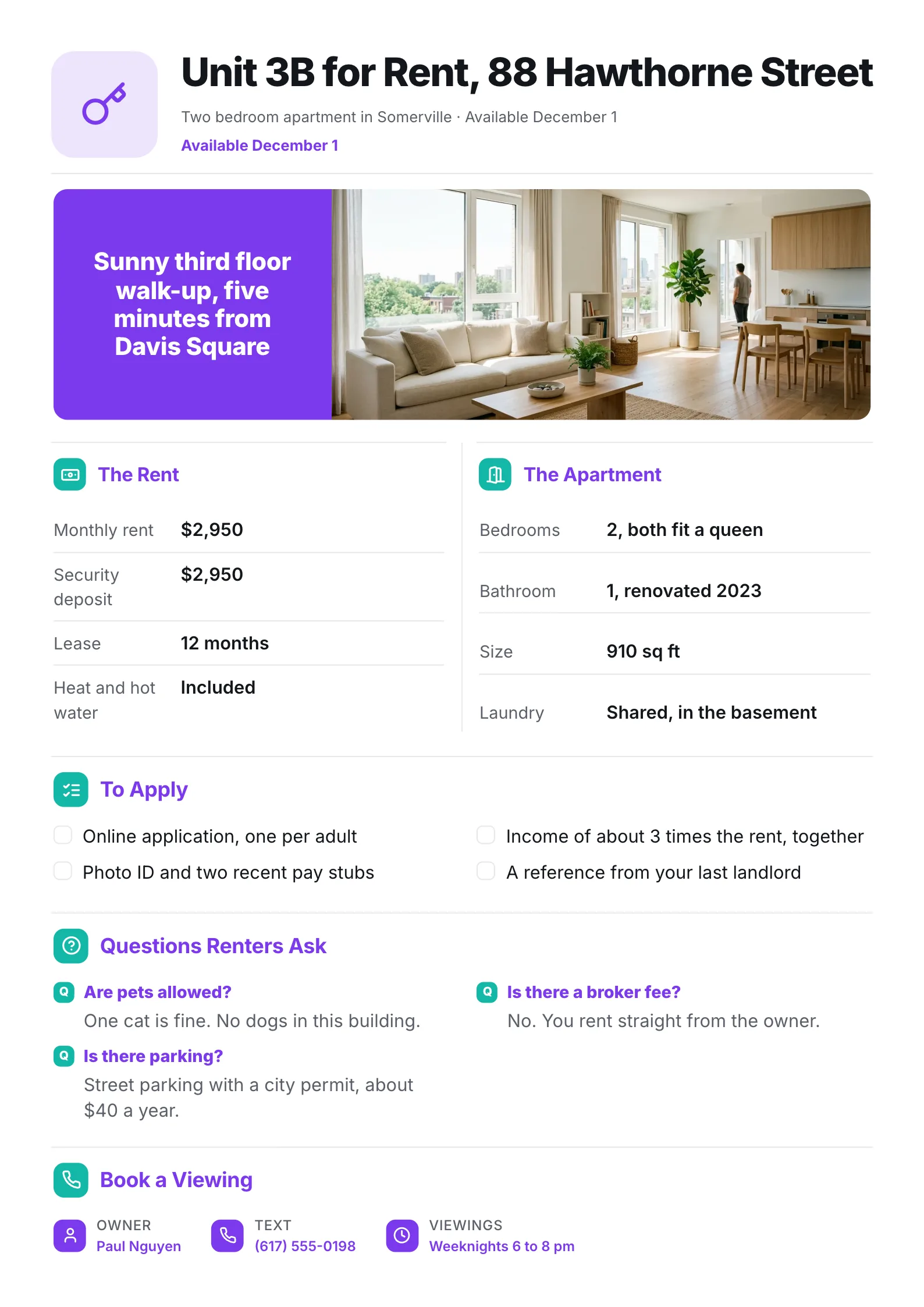 Property Fact Sheet: Apartment for RentEdit for free(opens in a new tab)
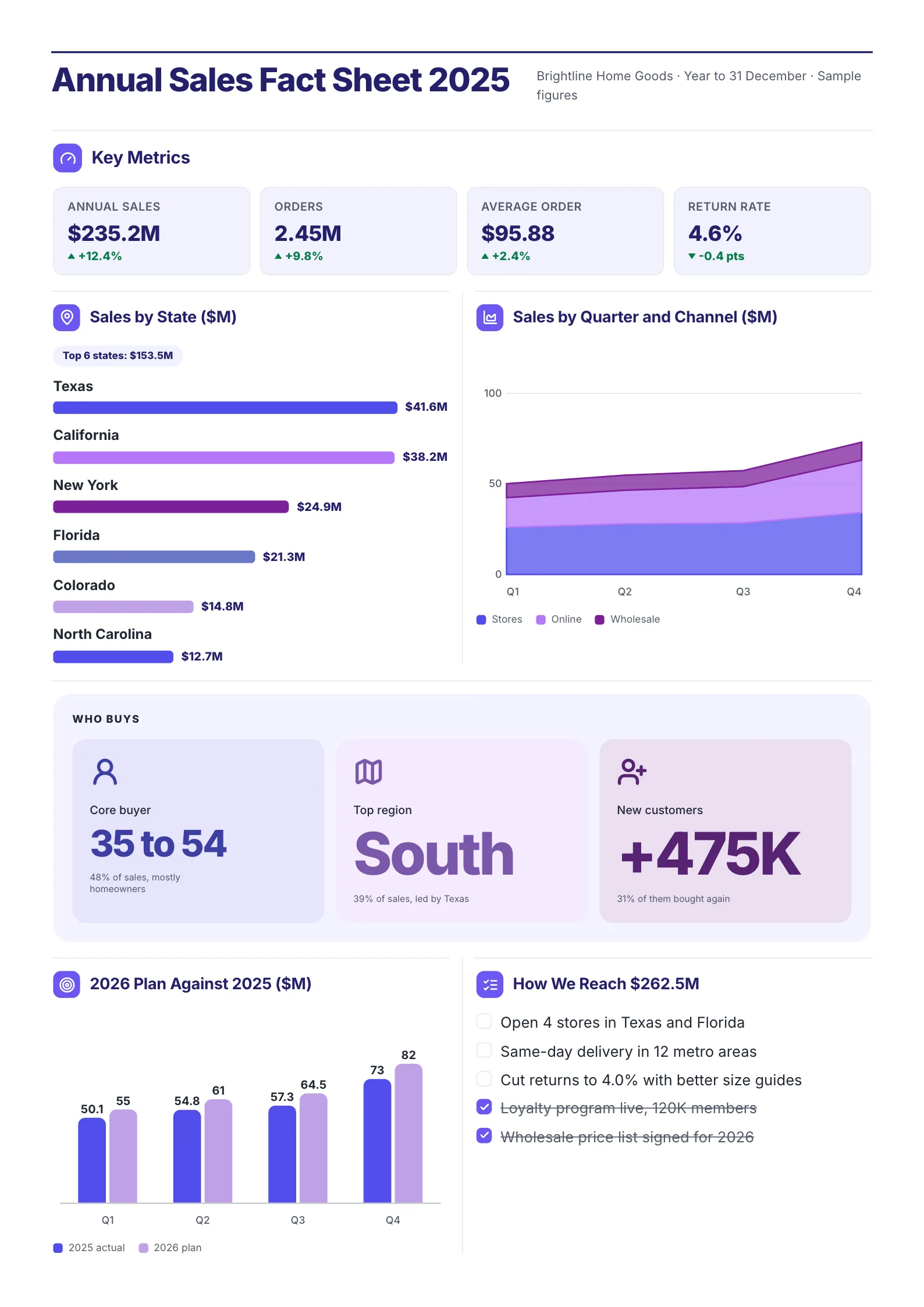 Annual Sales Fact SheetEdit for free(opens in a new tab)
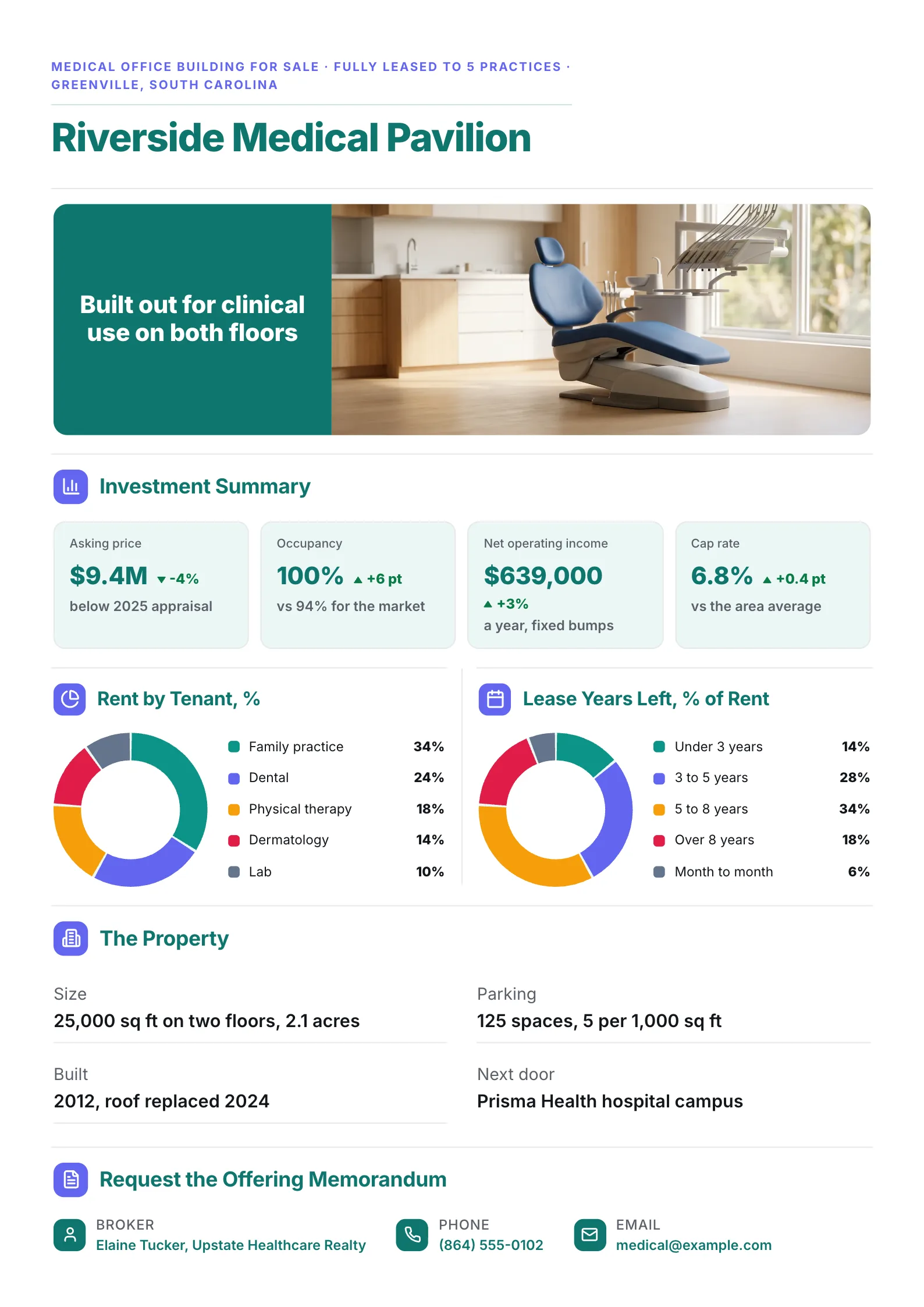 Property Fact Sheet: Medical Office BuildingEdit for free(opens in a new tab)
Below is each idea, what the real sheet puts first, and what you can copy. Every idea also comes with a matching One-Pager sample from MakeOnepagers for you to open and edit. The samples use made-up names and numbers, so replace them with yours.
| Fact sheet idea | The real one we read | Pages | What it leads with |
|---|---|---|---|
| A fund fact sheet | Vanguard 500 Index Fund, September 30, 2026 | 4 | A box of 6 fund facts |
| A hotel fact sheet | Resorts World Las Vegas | 6 | An overview, then Fast Facts |
| A venue fact sheet | Greater Columbus Convention Center | 6 | Square feet and room counts |
| A public vote fact sheet | Seattle's 2026 Library Levy | 1 | The total and the years |
| A company fact sheet | FORTÉ, April 22, 2025 | 2 | Founding date, headquarters, ownership |
Choose your idea in four steps
Before you pick a layout, answer four questions on scrap paper. They take five minutes and they decide most of the sheet.
Who picks it up? Write down one reader: an investor, a planner, a voter, a reporter or a buyer. If you have two, make two sheets.
What do they check first? For an investor that's cost. For a planner it's room sizes. For a voter it's the cost to their home. Put that number in your first line.
What will they compare you with? Vanguard shows the index beside every return. Give your reader the comparison they'd look up anyway.
What do they do next? Call, book, vote or invest. Make the next step the last thing on your sheet, with a name and a number.
Then match your answers to one of the five ideas below and copy its order.
Idea 1: A fund fact sheet that shows the cost up front
Vanguard's sheet for its 500 Index Fund opens with a box called "Fund facts." It holds six items: total net assets of $685,965 million, an expense ratio of 0.04%, the ticker VFIAX, a turnover rate of 2.4%, the inception date 11/13/00 and the fund number. The box sits right under the fund's name, before any words about the fund.
Then every return on the sheet sits next to the S&P 500, the index the fund tracks. Over ten years, the fund returned 15.29% a year and the index 15.33%. The gap shows in one glance, without any math, for you and for your reader. The sheet also names its three portfolio managers and gives page 4 the heading "Plain talk about risk."
Here's what to copy for your own fund or portfolio sheet.
Start with a facts box. Put your assets, cost, ticker and start date in it.
Add a benchmark row under every return row. Your reader will compare anyway, so do it for them.
Name your managers with dates. Say who runs it, and since when.
Write the warning in plain words. Vanguard prints that past results are "not a guarantee of future results."
 Edit this template
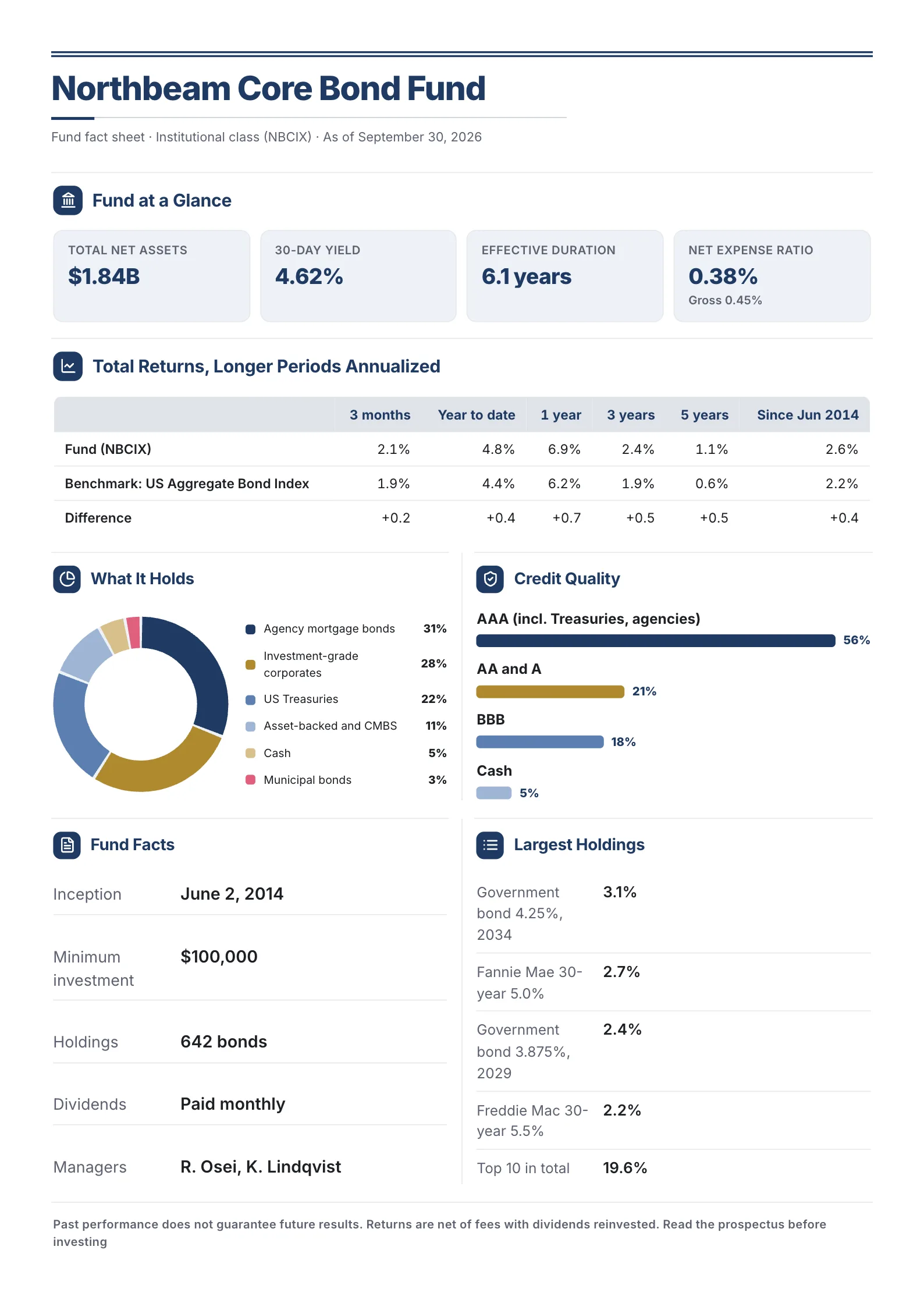
This fund fact sheet follows that order for a made-up bond fund. Four figures lead: $1.84B in assets, a 4.62% 30-day yield, a 6.1-year duration and a 0.38% net expense ratio. Its returns table adds a third row, Difference, so a reader sees +0.7 over one year without subtracting. It closes with 642 bonds held, a $100,000 minimum and the line "Past performance does not guarantee future results."
Idea 2: A hotel fact sheet where every room count agrees
The Resorts World Las Vegas fact sheet runs 6 pages. It covers the casino, three hotels, more than 40 places to eat, a 5,000-capacity theater and 250,000 square feet of meeting space. Its Fast Facts list opens with the day it opened, June 24, 2021.
Read it closely and you'll find a slip. The overview says the resort has "3,500 guest rooms and suites." The meetings section calls it "the 3,500-room resort." But Fast Facts says "3,506 luxury guest rooms and suites." The three hotels' own counts are 1,774, 1,496 and 236, and those add up to 3,506. A planner booking a big group would notice, so add up your own counts before you print.
Here's what to copy for your hotel, inn or rental.
Use one room count everywhere. Add up your room types, then search your sheet for every mention of the total.
Put a Fast Facts list near the top. Give your opening year, rooms, meeting space and the one thing guests can't get elsewhere.
Give a real way to reach a person. This sheet ends with addresses and four social channels, and its text gives no phone number. Print yours.
 Edit this template
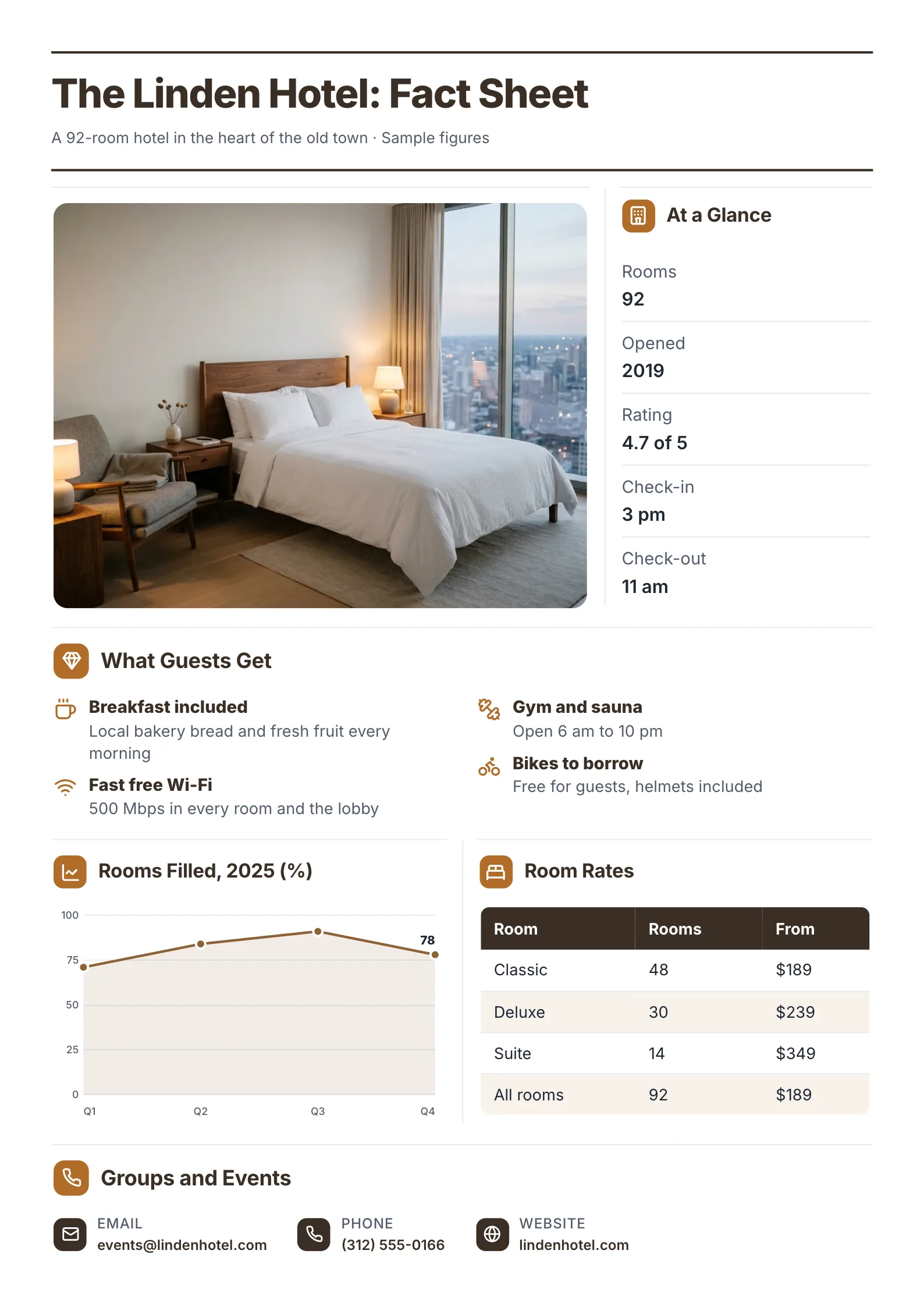
This hotel fact sheet gets the sum right on a single page. The Linden Hotel has 92 rooms: 48 Classic, 30 Deluxe and 14 Suites, priced from $189, $239 and $349. It gives check-in at 3 pm and check-out at 11 am. Its last box holds a groups and events email plus a phone line, so a planner knows who to call.
Idea 3: A venue fact sheet built around a capacity chart
The Greater Columbus Convention Center sheet puts its size in the first line: 1.8 million square feet, 373,000 square feet of exhibit space in one piece, and 10,000 square feet outdoors. The second line counts rooms: 3 ballrooms and 75 meeting rooms, 9 of them with windows.
The heart of it is a capacity chart with 23 rows of rooms and 8 columns. For each space it gives square feet, size and ceiling height. Then it says how many people fit in theater rows, at classroom tables or at round tables, and how many 10x10 booths fit. Exhibit Hall B, for example, holds 7,200 people theater style or 630 booths. The meeting room table adds up too: 5, 2, 26, 22, 11 and 9 rooms make the 75 on page one.
Here's what to copy for your venue, hall or event space.
Put your size in the first line. It's how a planner rules you in or out.
Give each room its own row and each setup its own column. Show seated, standing and theater at the least.
Add a whole-venue row. Then your planner doesn't have to add it up.
Finish with the practical facts. List your parking, the hotels nearby and how to load in.
 Edit this template
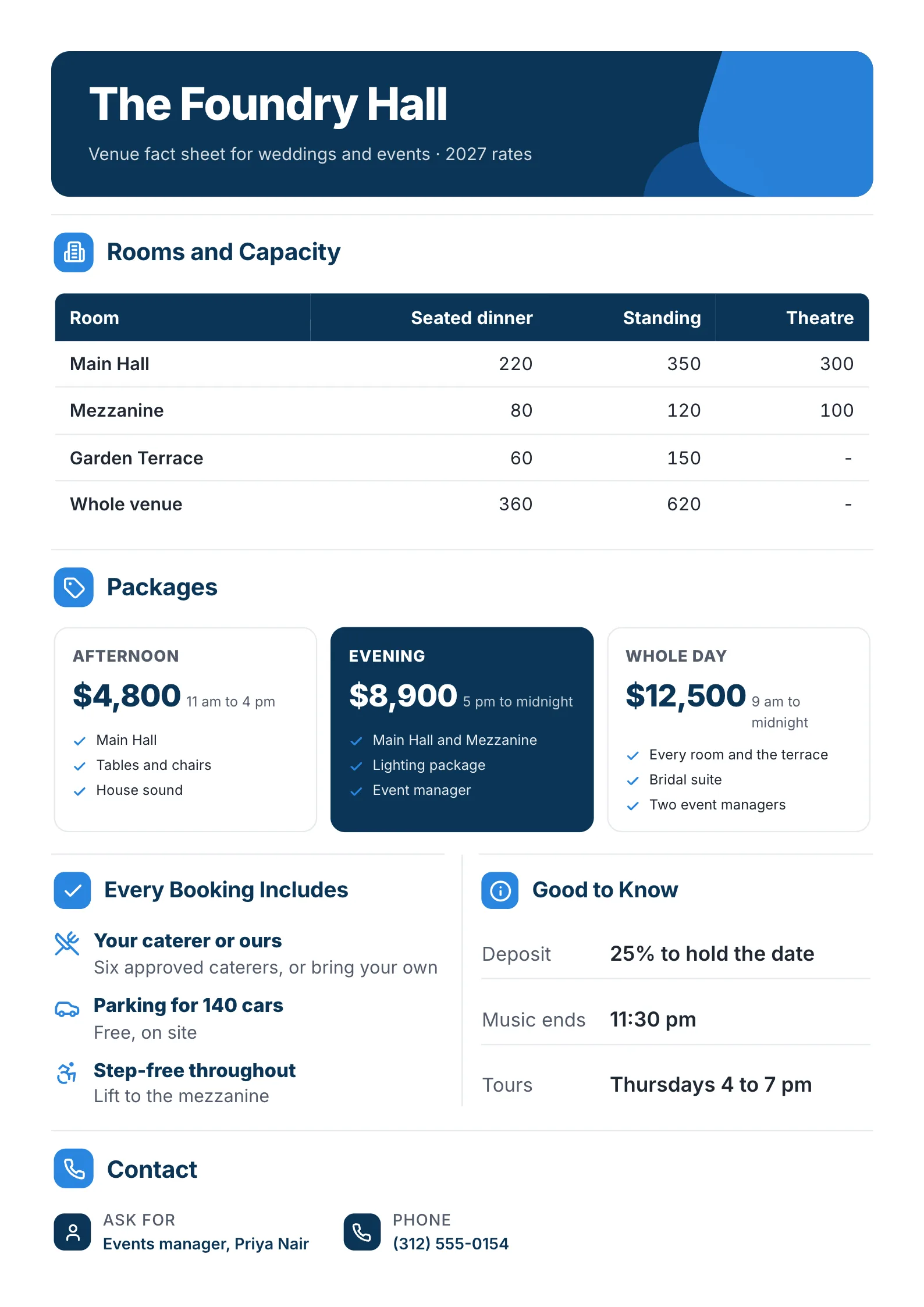
This event venue fact sheet shrinks the chart to three rooms for a made-up hall. The Main Hall, Mezzanine and Garden Terrace seat 220, 80 and 60, and the whole-venue row says 360 seated, 620 standing and 480 theater style. Each total matches its column. Do the same check on yours. Then come three packages at $4,800, $8,900 and $12,500, a 25% deposit to hold the date, and parking for 140 cars.
Idea 4: A public vote fact sheet a voter reads in a minute
Seattle's 2026 Library Levy sheet is the shortest we read, 274 words on 1 page. Its first sentence gives the total and the term: "a $480 million investment" over "seven years (2027-2033)." The next one names the ballot, August 4, 2026.
Then it asks the voter's own question as a heading: "What will this proposal cost Seattle taxpayers?" The answer is $0.23 per $1,000 of assessed home value, which the city budget office puts at about $193 a year for a median home. After that come five funding lines: $229.1 million for hours and access, $69.4 million for collections, $134.1 million for building maintenance, $38.2 million for technology and $9 million for administration. Those add up to $479.8 million, which rounds to the $480 million in the first line. The sheet ends with a phone number and a web address.
Here's what to copy for your bond, levy or town meeting.
Give the total, the term and the vote date in your first two sentences.
Ask the cost question in the voter's words, then answer it for a typical home.
Show where the money goes, with lines that add up to your headline.
End with one phone number and one link.
 Edit this template
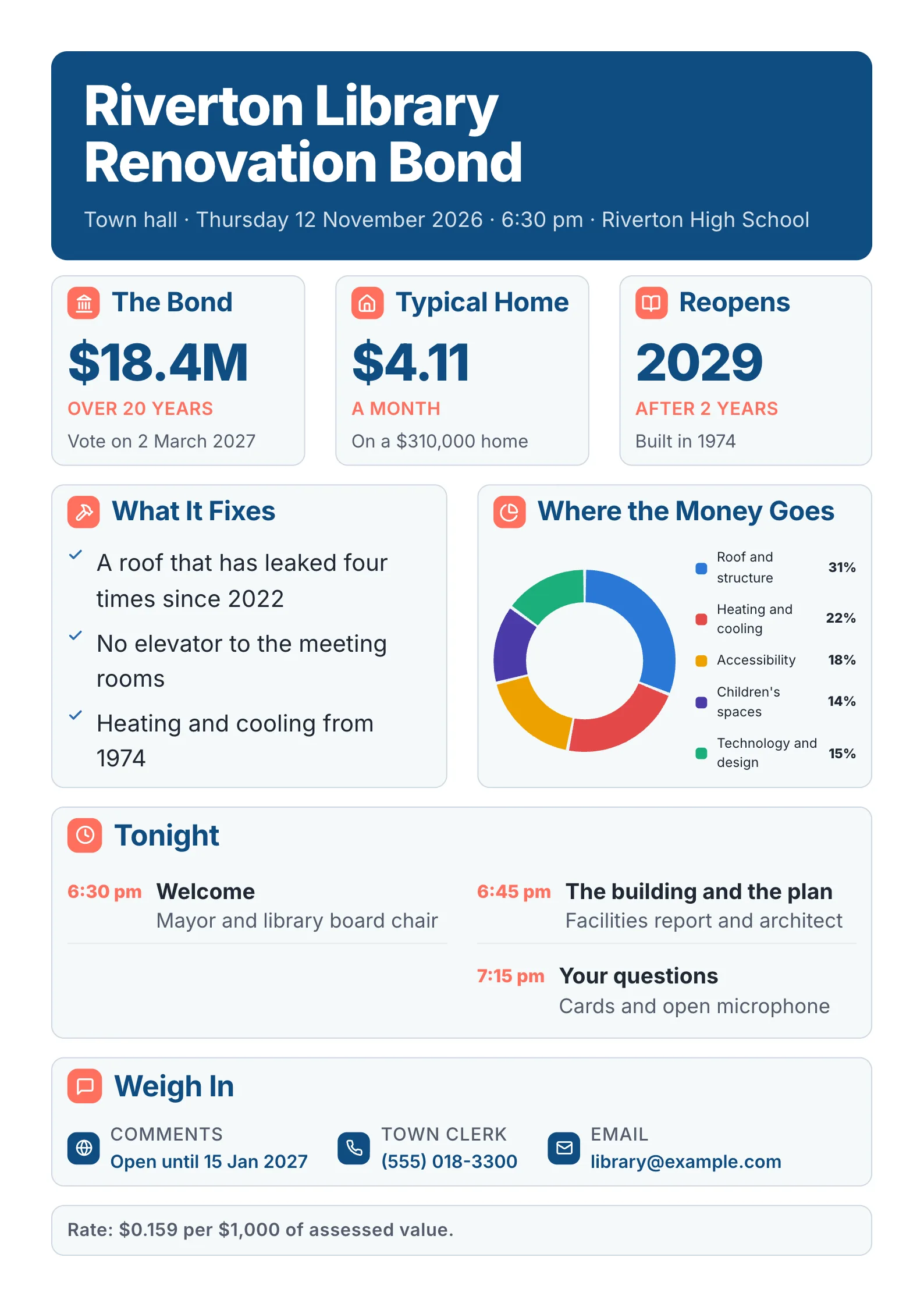
This town hall fact sheet does the same for a made-up library bond. It leads with $18.4M over 20 years and a vote on March 2, 2027. The cost box says $4.11 a month for a $310,000 home, and the footnote gives the rate behind it, $0.159 per $1,000 of assessed value. You can check it yourself. 310 times $0.159 is $49.29 a year, or $4.11 a month. Three repairs are listed too, starting with a roof that has leaked four times since 2022, and comments stay open until Jan 15, 2027.
Idea 5: A company fact sheet a reporter can quote
FORTÉ, an audiovisual company that used to be AVI Systems, keeps its fact sheet to 2 pages and dates it April 22, 2025. The overview gives the founding date, April 1, 1974, then "Years in Business: 51," the headquarters in Eden Prairie, Minnesota, and its ownership, "100% employee-owned (ESOP)."
Next come four key statistics: 1,300 employees, $576 million in 2024 bookings, 4,000 "unique engagements" a year and 42 U.S. locations. A timeline lists 11 dated milestones from 1974 to 2025, including the 2025 name change. The sheet closes with 8 leaders by title and a media contact with a phone number and email. A reporter writing on deadline can lift any line and trust its date. Give yours the same chance.
Here's what to copy for your business or startup.
Print the date on your sheet, so every "this year" number has a year.
Pick four numbers. Try people, money, customers and places.
Add a short timeline for the name changes and moves people ask you about.
Name your press contact, and give their direct line and email.
 Edit this template
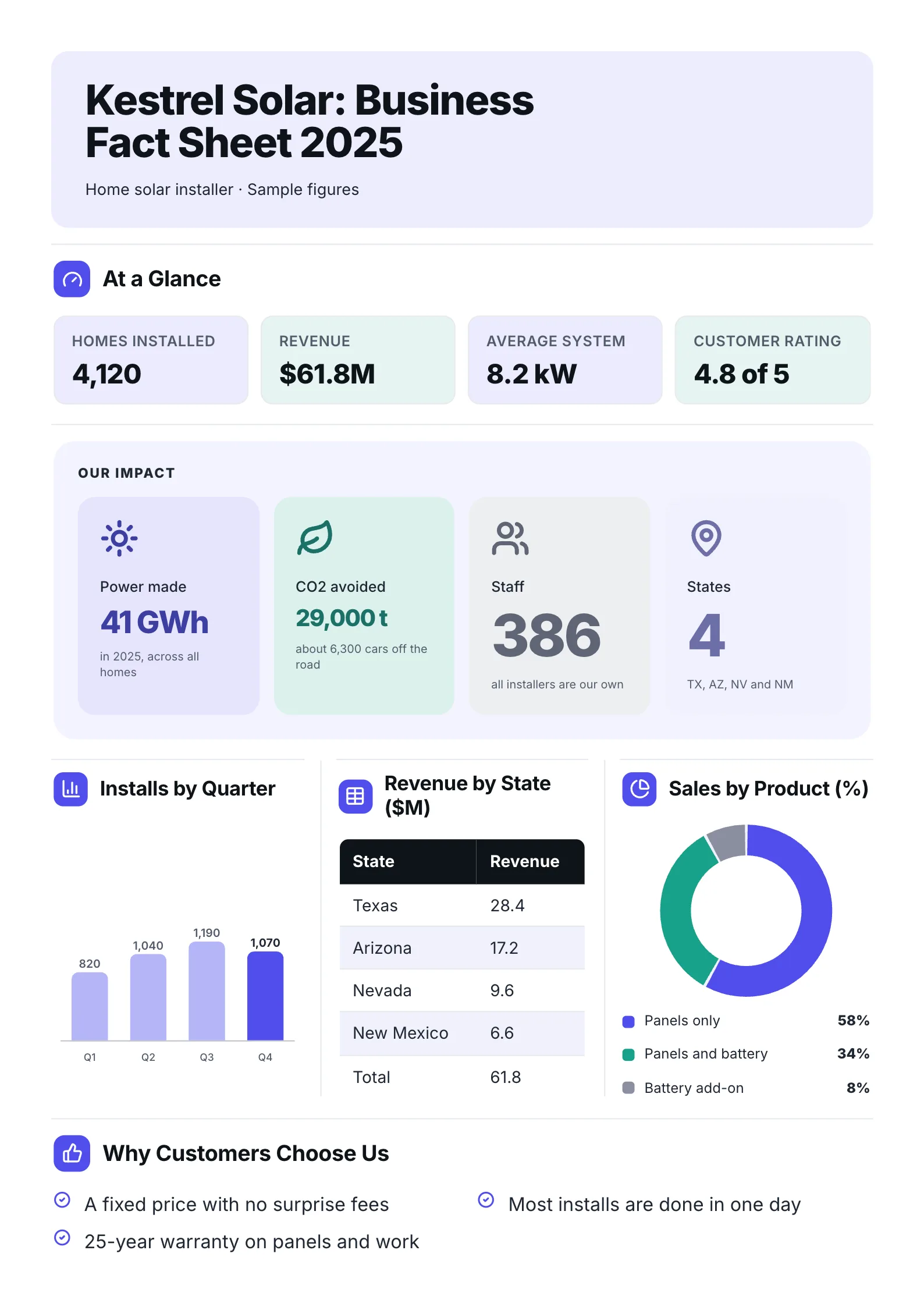
This business fact sheet for Kestrel Solar, a made-up installer, opens the same way with four figures: 4,120 homes installed, $61.8M in revenue, an 8.2 kW average system and a 4.8 of 5 rating. Its revenue table splits that $61.8M across four states, $28.4M, $17.2M, $9.6M and $6.6M, and the four add back to the total. It ends with three reasons customers choose the company, such as a 25-year warranty on panels and work.
More fact sheet ideas to try
Plenty of other readers want a fact sheet too. Here are five more ideas, each with the facts to put at the top:
A sales fact sheet for your board or a lender. Lead with annual sales, orders and average order, then show your plan for next year.
A sales team fact sheet for a half-year review. Show units by product, revenue against target and win rate by month.
A property fact sheet for a buyer or tenant. Open with the price or rent and the size, then add what it costs to run and when they can visit.
A restaurant fact sheet for a catering client. Give your menus with prices, your minimum order and how much notice you need.
An investor fact sheet for a local business raising money. Say what the money buys and what investors get back, in numbers.
You'll find samples of these in the gallery below this post.
What the five real sheets teach about any fact sheet
Line the five up and four habits stand out. Use them on any fact sheet you make.
Put the reader's first question in the first line. Vanguard opens with assets and cost. Columbus leads with size. Seattle leads with the total and the term.
Make your numbers add up. Columbus's room table matches its 75 meeting rooms, and Seattle's five lines round to its $480 million. The Resorts World sheet gives two room counts.
Date it. Vanguard prints "September 30, 2026" and FORTÉ prints "April 22, 2025." The Columbus sheet marks its hotel figures "As of 2022." Resorts World prints no issue date, so a reader can't tell how current its facts are.
Match the length to the job. A vote fits on 1 page. A resort with over 40 places to eat needs 6.
For the writing itself, see how to write a fact sheet, and for the order of the parts, our fact sheet format guide. To see one topic written at three lengths, read our fact sheet examples.
Make your fact sheet
Pick the MakeOnepagers sample closest to your idea, then swap in your own facts. For a quicker first draft, drop your figures into the free AI One-Pager generator and edit what it builds. Then add up every total one last time and print it.
Frequently asked questions
What are good topics for a fact sheet?
Anything a reader checks before a decision. A fund, a hotel, a venue, a ballot measure and a company are five common ones. Start from your reader's first question, such as cost, size or dates.
What should go first on a fact sheet?
The numbers your reader checks before anything else. Vanguard's fund sheet starts with six facts, including the 0.04% expense ratio. Columbus starts with 1.8 million square feet.
Can a fact sheet be one page?
Yes. Seattle's library levy sheet covers a $480 million measure on one page in 274 words. A bigger subject, like a resort with 3,506 rooms, may need more.
How do I check a fact sheet before printing it?
Add up every total and compare it with each place the number appears. Then check that the sheet carries a date and a phone number or email.
Should a fact sheet have a date?
Yes. Without one, readers can't tell if a number is current. Print the date the facts are good for, as Vanguard and FORTÉ do.




