Competitive Analysis vs SWOT: What 4 Annual Reports Show
Competitive analysis vs SWOT, shown in 4 real annual reports: 24 named rivals in one section, the threats in another, and how to use both on one sheet.

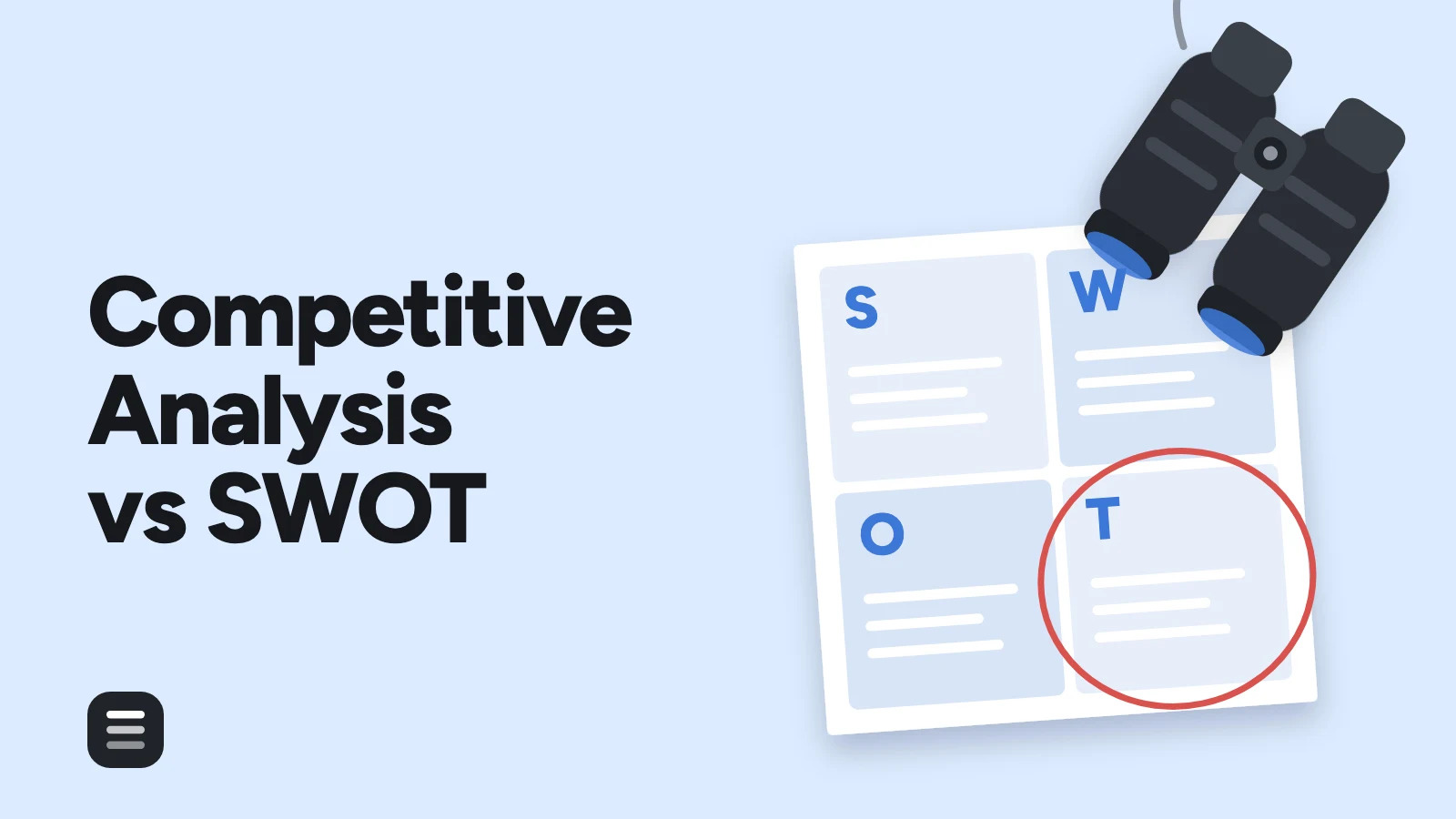
A competitive analysis looks outward, at the rivals your buyers compare you with. It names them, lists the factors buyers weigh and scores everyone on the same points. A SWOT looks at you, and sorts what helps and hurts your business into strengths, weaknesses, opportunities and threats. You need the first one to fill two boxes of the second. Start from a free one pager template.
One‑Pager examples
Real One-Pagers made with MakeOnepagers. Open any one to edit it as your own.
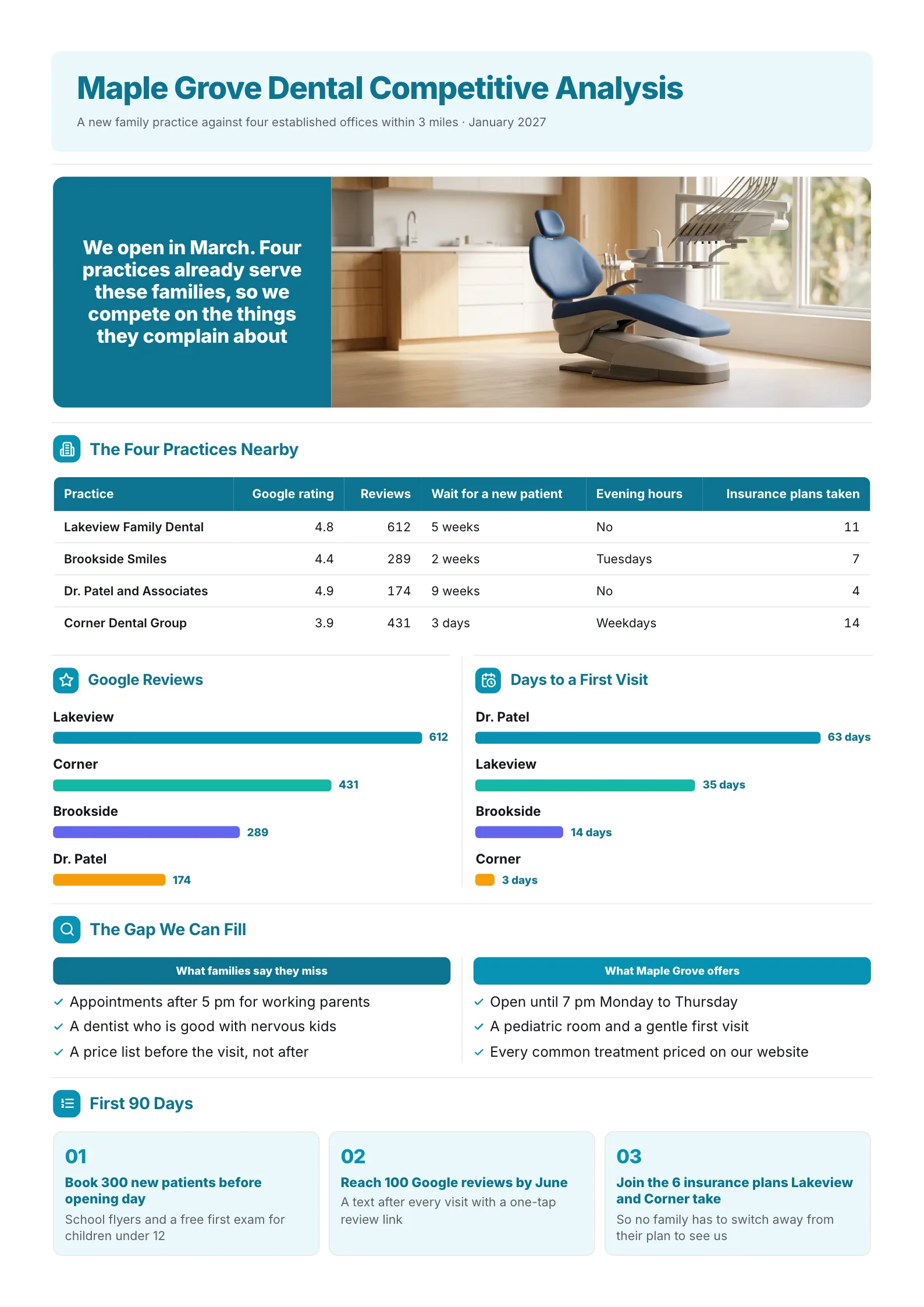 Competitive Analysis: Dental PracticeEdit for free(opens in a new tab)
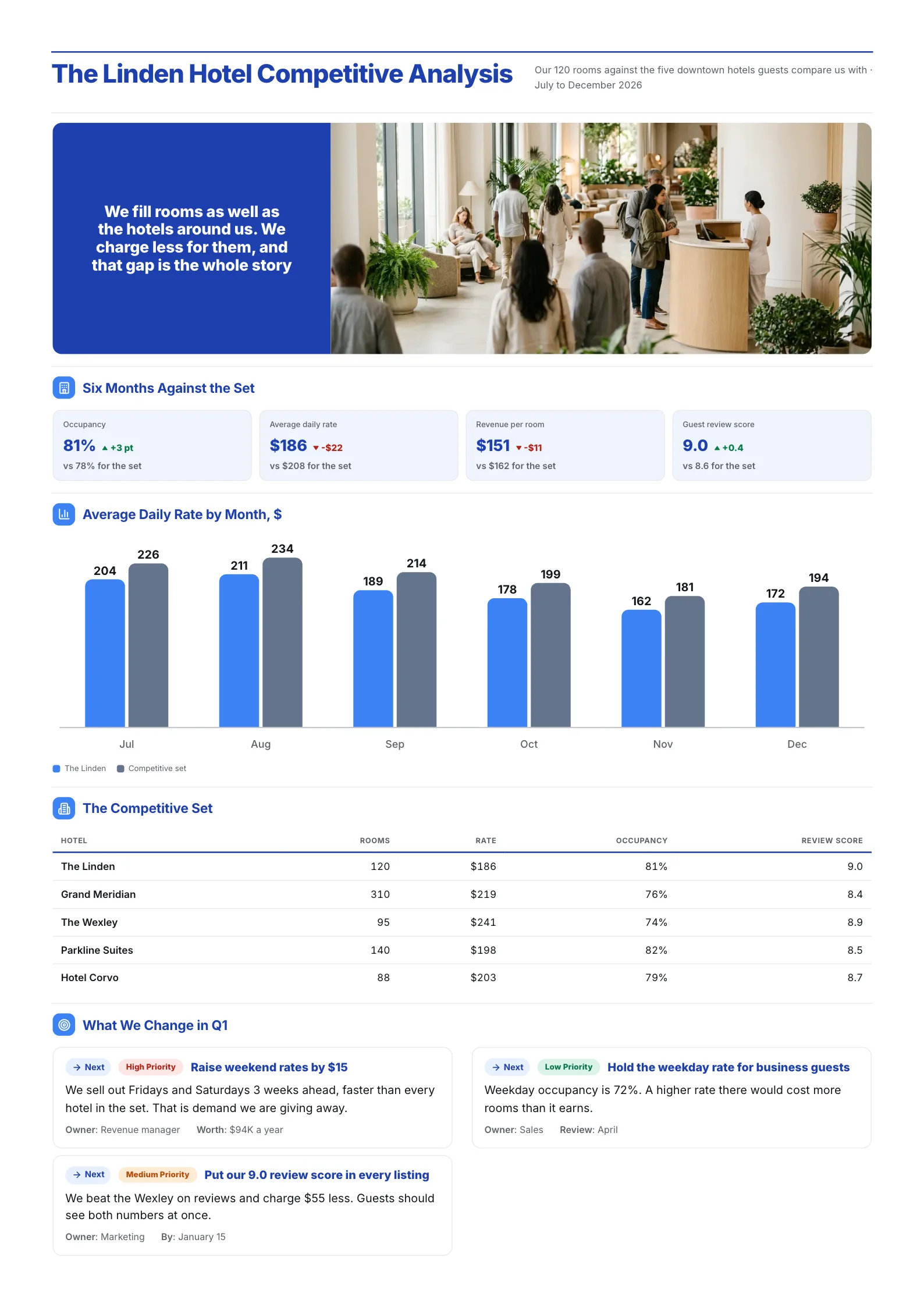 Competitive Analysis: HotelEdit for free(opens in a new tab)
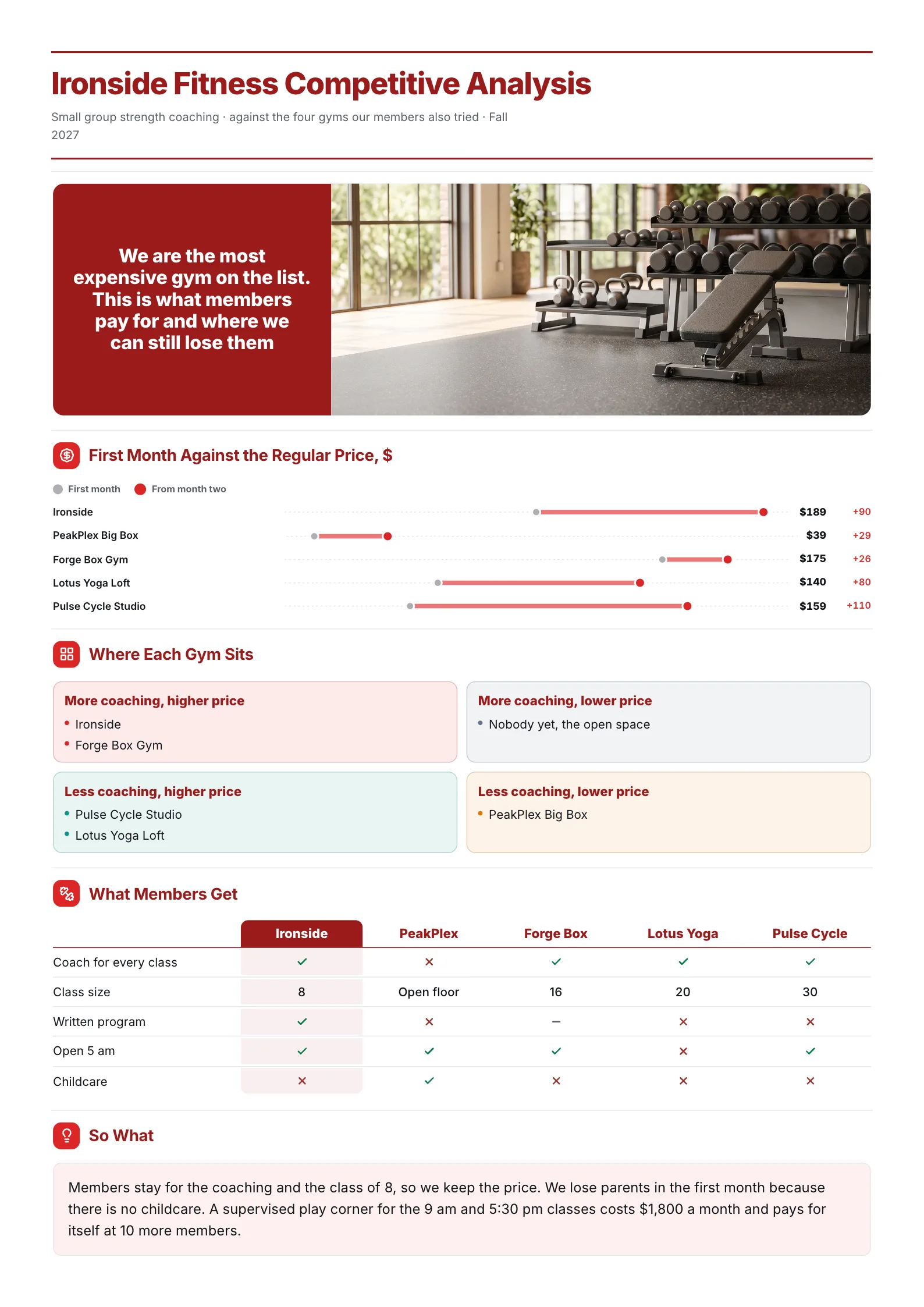 Competitive Analysis: GymEdit for free(opens in a new tab)
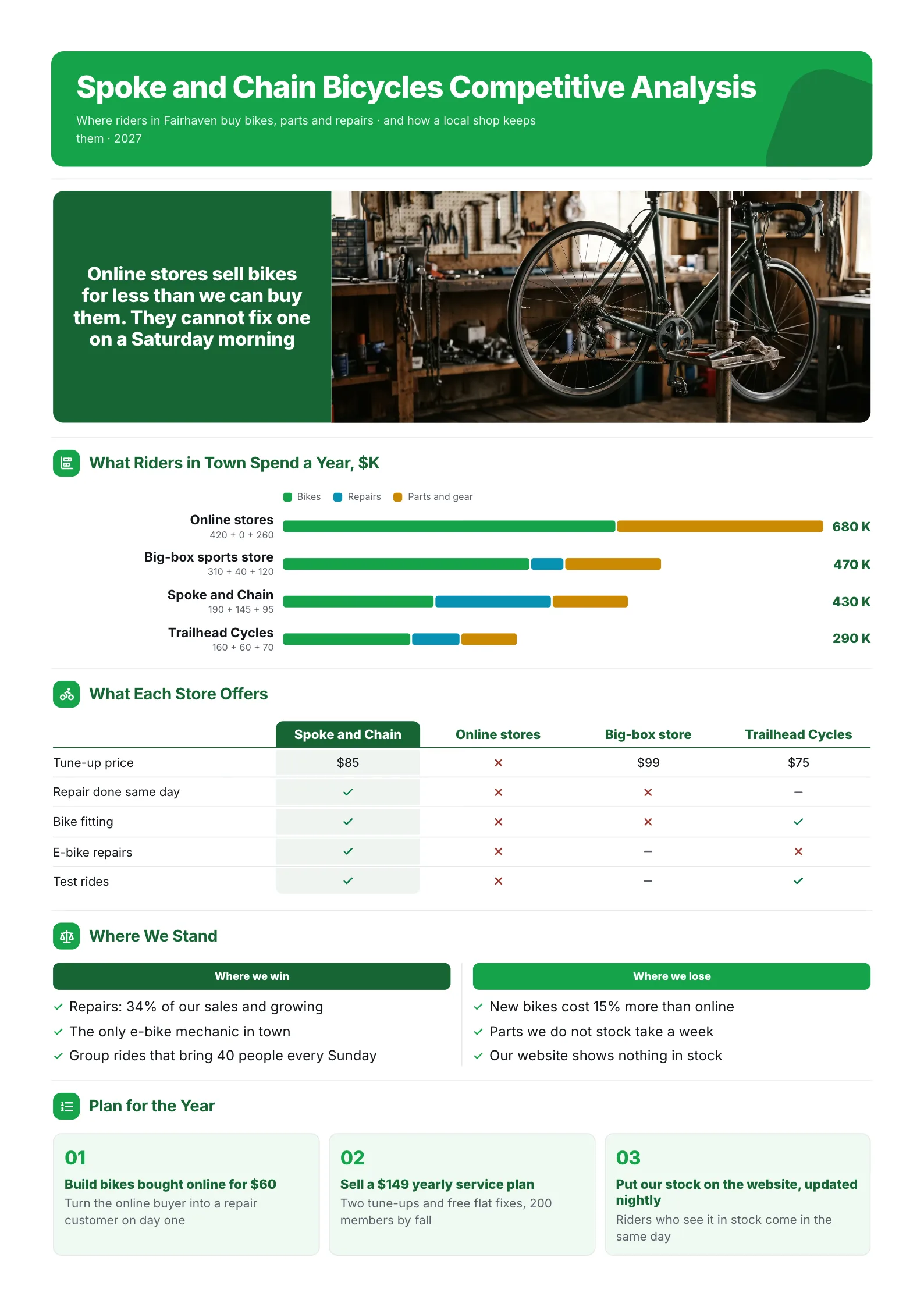 Competitive Analysis: Bike ShopEdit for free(opens in a new tab)
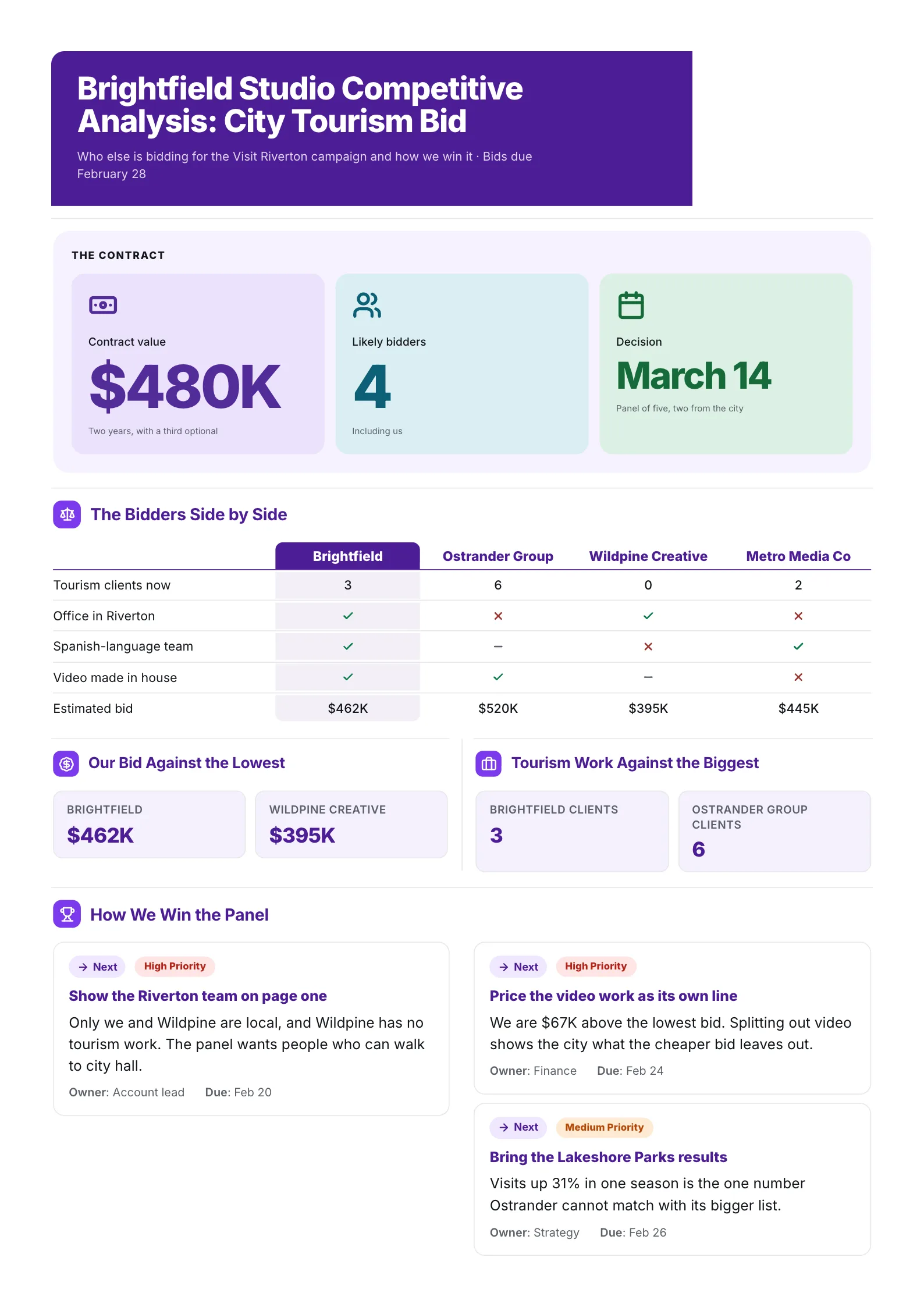 Competitive Analysis: Agency BidEdit for free(opens in a new tab)
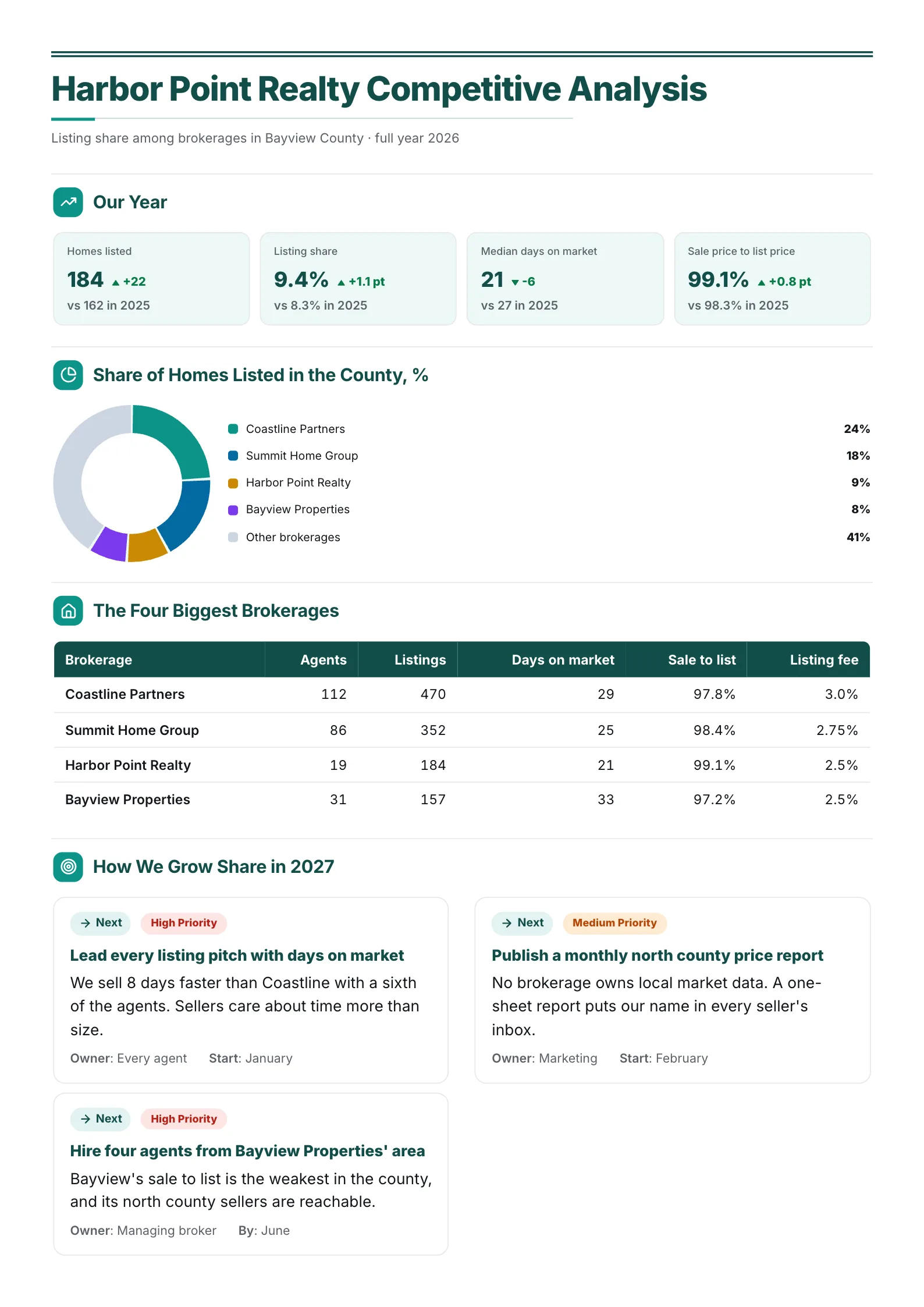 Competitive Analysis: Real Estate BrokerageEdit for free(opens in a new tab)
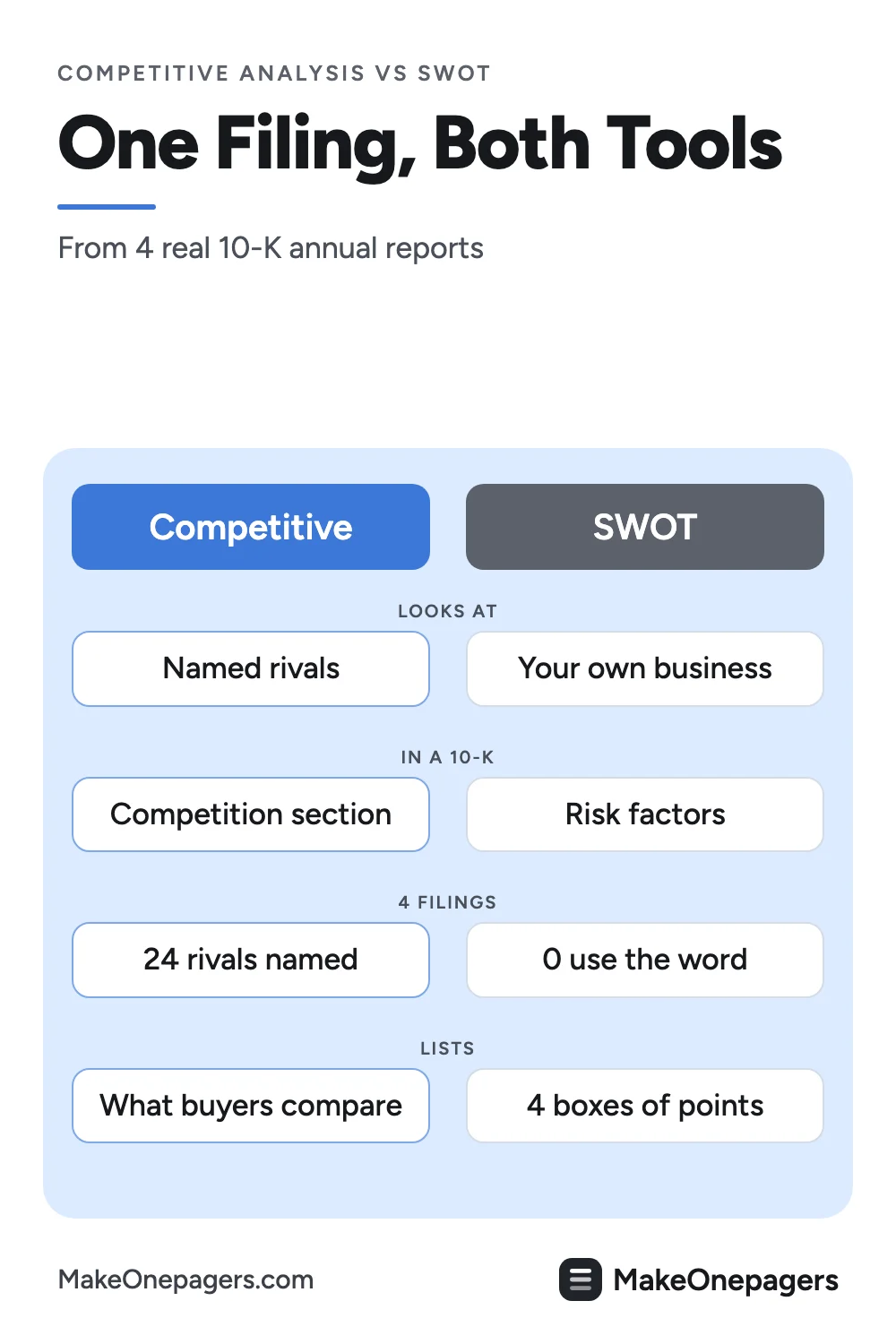
You can watch both at work in any US public company's annual report, the Form 10-K. We read four of them, from YETI, Crocs, Celsius and Freshpet, and their competition sections name 24 rivals between them. Every one of the four then lists competition again as a risk, and not one of them uses the word SWOT.
| Competitive analysis | SWOT analysis | |
|---|---|---|
| The question | Who do buyers compare us with, and on what? | What helps us and what hurts us? |
| Who's in it | Named rivals, side by side | Mostly you |
| What you list | Buying factors, prices, features, scores | Four boxes of short points |
| Where facts come from | Rivals' prices, reviews, lost deals, shares | Your own numbers, plus the outside world |
| What it produces | Where you win and lose, rival by rival | Moves that use strengths and cover weak spots |
| In a 10-K | The "Competition" part of Item 1 | Spread across Item 1 and the "Risk Factors" in Item 1A |
Why every 10-K holds both
The SEC's rules for the annual report make a company write about competition in two separate places. Item 101 of Regulation S-K covers the business itself, including "trends in market demand and competitive conditions," and that's where the competition section lives.
Item 105 asks for something else. It wants "the material factors that make an investment in the registrant or offering speculative or risky," with each one under "a subcaption that adequately describes the risk." In practice, that's a long list of threats and weak spots, written one heading at a time.
So the same company describes its rivals twice, for two different jobs. The first time, it explains the market to you. The second time, it warns you what could go wrong. That split is a good picture of the difference between a competitive analysis and a SWOT.
What the four competition sections hold
All four filings cover the year 2025 and were filed in February or March 2026. We read each competition section, and each risk factor about competition, on November 5, 2026.
| Company | Rivals named | What buyers compare | Strength claim |
|---|---|---|---|
| YETI | 7, from Igloo and Coleman to Owala and HydroJug | 6 factors, from product quality to brand image | Yes |
| Crocs | 7, including NIKE, adidas and Birkenstock | 8 factors, including design, comfort and price | Yes |
| Celsius | 10, from Monster and Red Bull to Molson Coors | None in this section | No |
| Freshpet | 0, four kinds of rival instead | 12 factors, from product quality to nutritional claims | Yes |
Source: MakeOnepagers read of 4 annual reports on Form 10-K, November 5, 2026. Each company name links to the filing.
Three habits in these sections are worth copying into your own competitive analysis.
- Names. YETI splits its rivals by product. In coolers, it names Igloo and Coleman, plus newer brands like Stanley and SharkNinja that "emerged after the popularity of YETI products." In drinkware, it names HydroFlask, Stanley, Owala and HydroJug.
- Factors. Crocs lists eight things buyers weigh: "brand awareness, product functionality, design, comfort, quality, price, customer service, and marketing and distribution." Those are the rows of a comparison table.
- Rivals outside your shelf. Crocs adds that its own stores and websites "also compete with some of our wholesale partners." Celsius says its drinks compete with "all categories of non-alcoholic liquid refreshments."
Where the SWOT boxes sit in the same filings
None of the four filings has a SWOT. Read them with the four boxes in mind, though, and three of the boxes fill up quickly.
Strengths. YETI believes it has competed well "on the basis of our brand, superior design capabilities and product development, our DTC capabilities," and the reach of its retail partners. Freshpet lists 12 factors and then says, "We believe that we compete effectively with respect to each of these factors."
Weaknesses. Crocs names eight things that bigger rivals have more of, from "greater financial resources" to "greater marketing resources." Freshpet says that "Many of our principal competitors have substantially larger financial, marketing, and other resources than we do." A weakness like this only makes sense next to a rival, which is why the competitive analysis has to come first.
Threats. All four companies put competition in their risk factors. Crocs gives it a four-word heading, "We face significant competition," and warns that "Some of our competitors are offering products that are substantially similar, in design and materials, to our products." Celsius adds that rivals are "increasingly using advanced analytics and AI" for pricing and marketing.
Opportunities. This is the box the competition sections leave empty. None of the four uses the word "opportunity," and the risk factors exist to list what could go wrong. Your own plan has to say where the openings are, and your competitive analysis is the best place to find them.
The same rivals, written down twice
The clearest sign that one tool feeds the other is the way the same facts show up twice.
Celsius names 10 companies in its competition section, and its risk factor names the same 10 in the same order. The second time, they're described as companies "that are much larger, some of which have significantly greater financial resources." It's the same list doing a new job, first as a map of the market and then as a threat.
YETI repeats itself the same way with its factors. Its competition section lists six, and its risk factor repeats all six, from product quality to price. It also uses the phrase "low barriers to entry" in both places. Since that's a condition outside the company, it would go in the Threats box of a SWOT.
You can borrow this move for your own business. Build your comparison table first, then read it row by row with two questions in mind. Where does a rival beat you? Write that down as a weakness, or as a threat if the gap is growing. Where does every rival fall short? That one goes in Opportunities.
What a 10-K leaves out, and your version needs
A 10-K is written for investors, so it stops short of the parts that make a competitive analysis useful to you. None of the four sections scores the company against a named rival, factor by factor. None gives a price, a rating or a market share for a rival in its competition section.
Your version can go further, because nobody outside your team will read it. Score yourself and each rival from 1 to 5 on every factor, and use real data where it exists, like prices, review ratings, wait times and lost deals. Add the date you checked each number, since prices and ratings change. Then your SWOT can quote those scores instead of guessing at them.
Which one should you make first?
If you have to choose, start with the competitive analysis. Here's the order we'd follow, and why.
- It gives you facts. A comparison table holds prices, features, ratings and lost deals. A SWOT built without them tends to go vague in its outside boxes.
- It fills two SWOT boxes. Gaps that no rival covers go in Opportunities, and rival moves you expect go in Threats.
- It keeps the SWOT short. You only carry over the points that change a decision, and the rest stays in the table.
If you only have an hour, a SWOT is faster, because your team can write one from what it already knows. Mark every outside point you couldn't back up with a rival's name or a number, and check those points first.
Five competitive analyses, and the SWOT box each one feeds
These samples from MakeOnepagers are all competitive analyses, with invented businesses and numbers. Each one shows a different SWOT box growing out of a comparison with rivals.
A software team's lost deals, the pure competitive analysis
 Edit this template
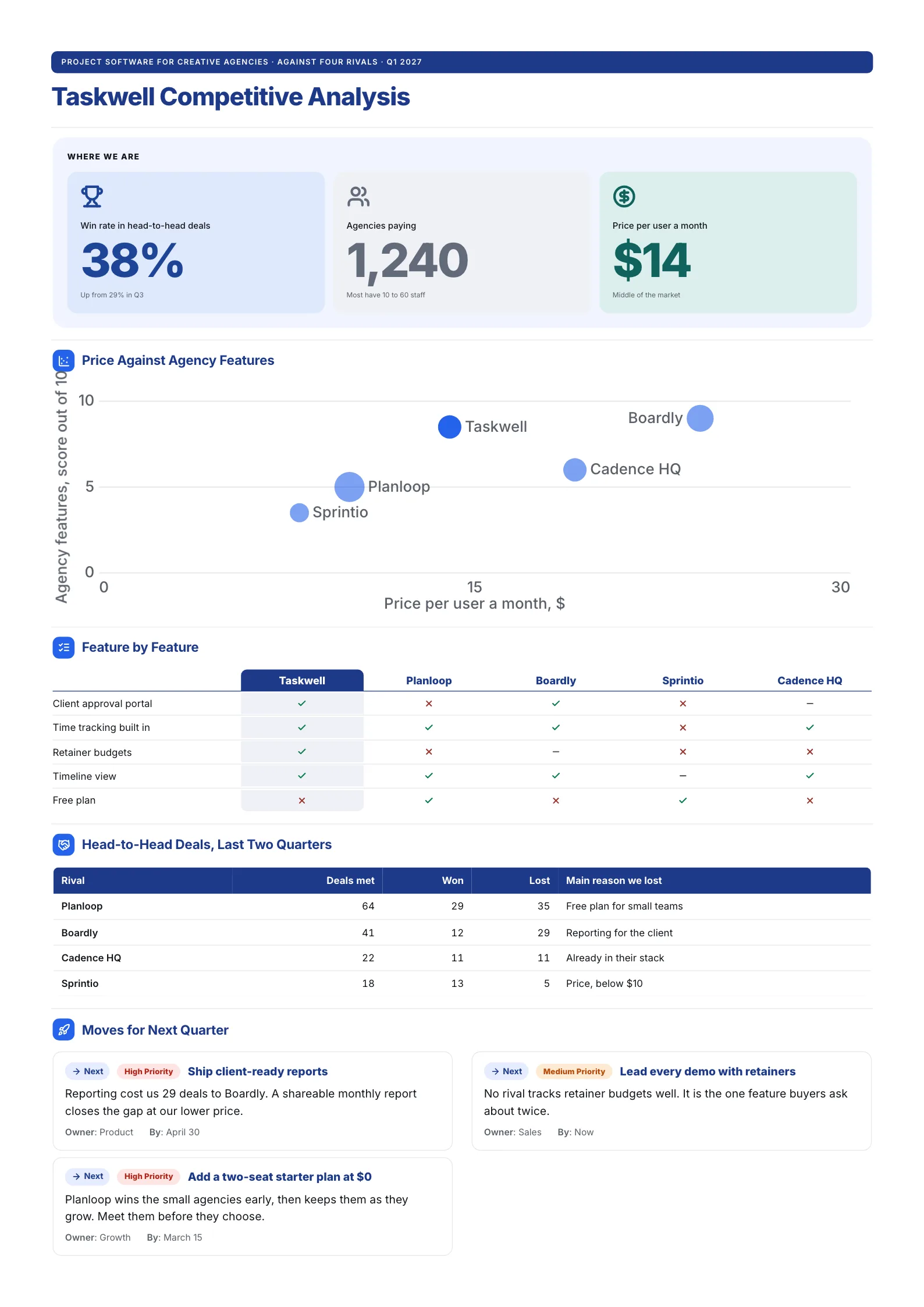
This SaaS competitive analysis never mentions strengths or weaknesses, because it's busy counting deals. Taskwell won 65 of 145 head-to-head deals over two quarters, a 45% win rate. Against Planloop it met 64 deals and lost 35, with a free plan for small teams as the main reason, and against Boardly it lost 29 of 41 over client reporting. That table is raw material for a SWOT, and "Reporting cost us 29 deals to Boardly" could go straight into Weaknesses.
A cafe whose wins and losses are measured against the street
 Edit this template
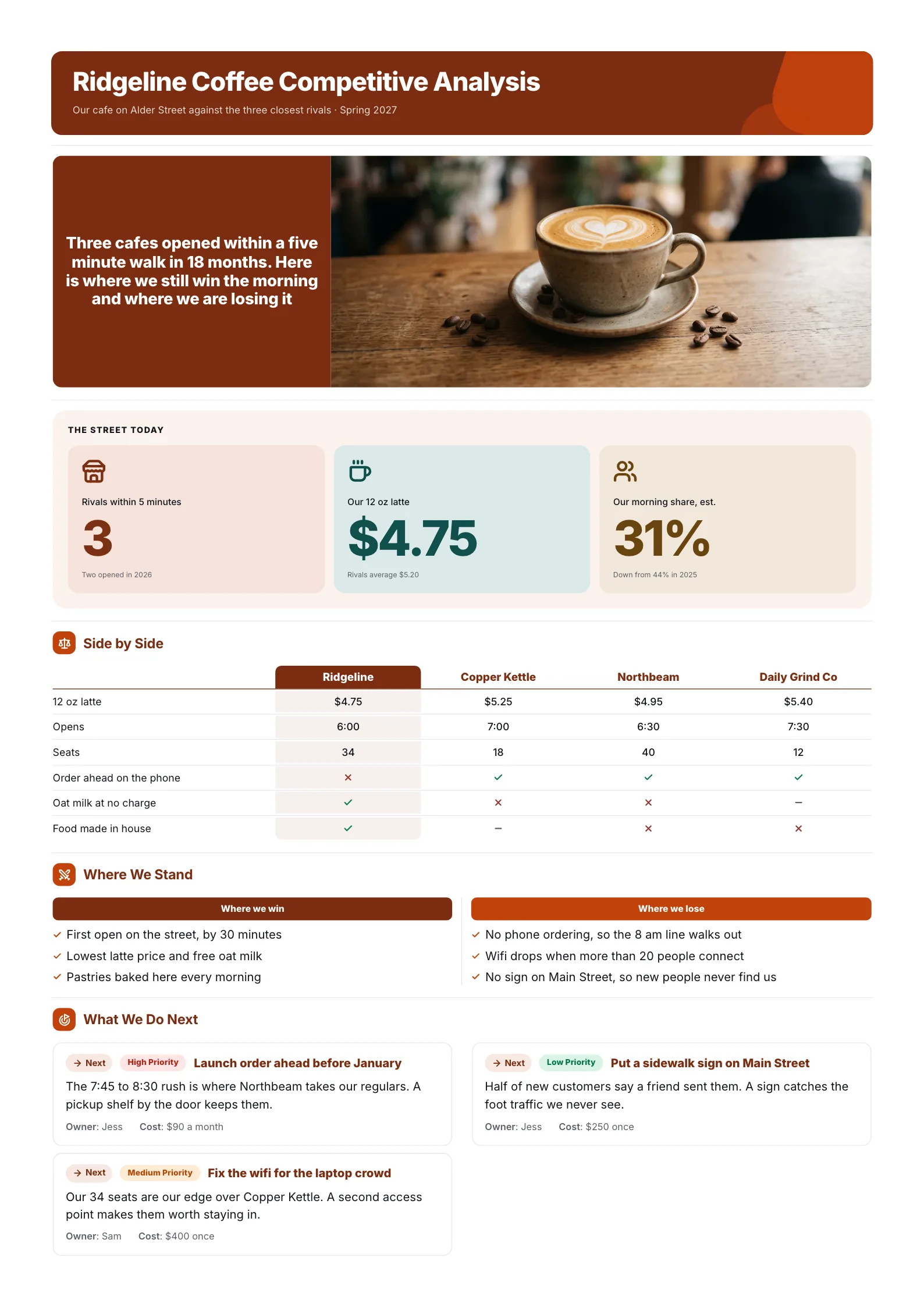
In this one, the comparison turns into Strengths and Weaknesses. This coffee shop competitive analysis says Ridgeline wins by opening first on the street, 30 minutes ahead of the others. It loses because it has no phone ordering, so the 8 am line walks out. Each point counts only because of the rivals in the table, and Ridgeline's estimated morning share has fallen from 44% to 31%.
A taqueria that asks why diners go elsewhere
 Edit this template
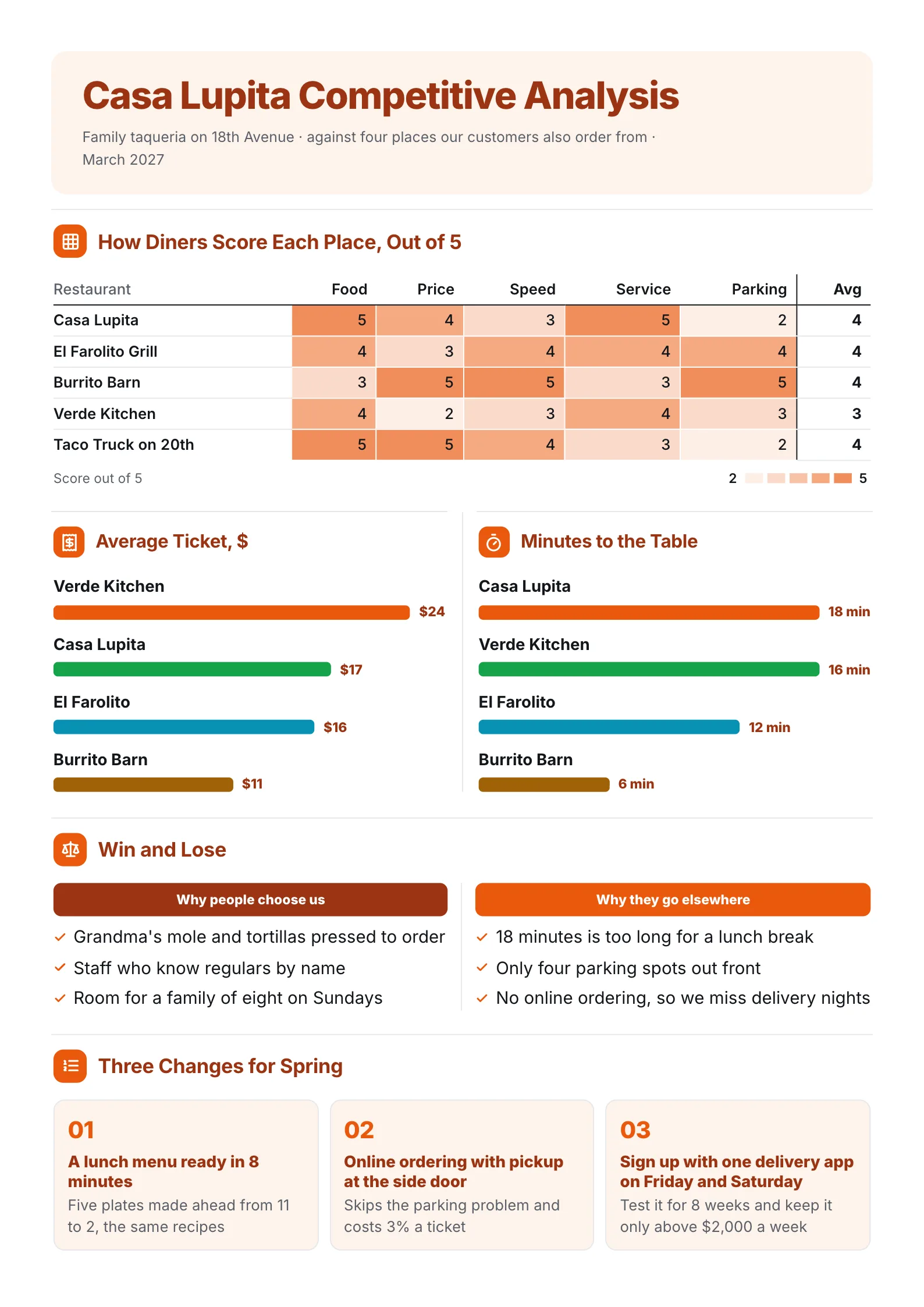
This restaurant competitive analysis writes its weaknesses in the customer's own words, like "18 minutes is too long for a lunch break" and "Only four parking spots out front." Each one comes with a fix, such as a lunch menu ready in 8 minutes. When you can phrase a weakness the way a lost customer would say it, you can be fairly sure it's real.
A budgeting app that lists the gaps it can own
 Edit this template
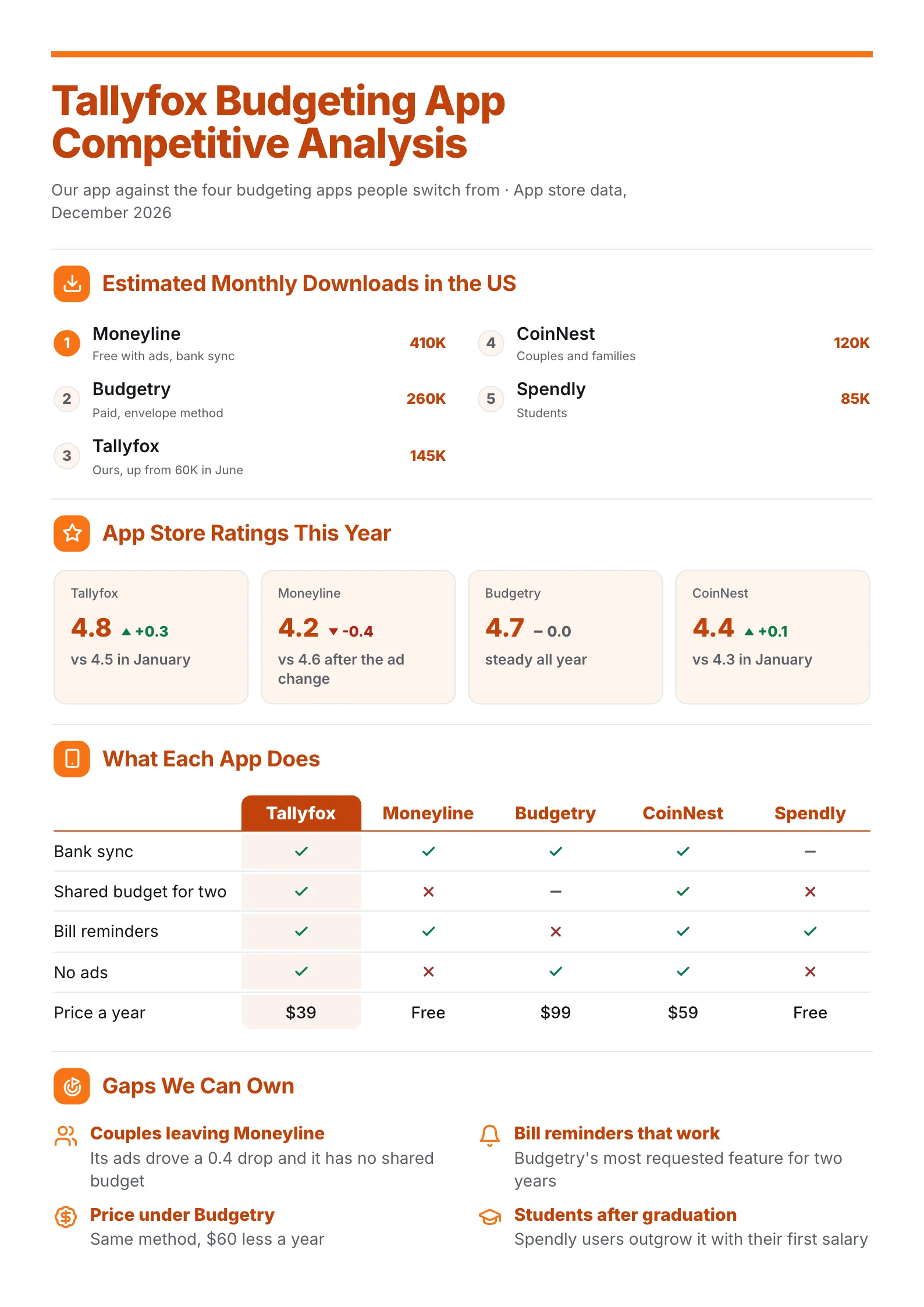
Here is the Opportunities box, built out of rivals' weak spots. This mobile app competitive analysis ends on a list called "Gaps We Can Own." Couples are leaving Moneyline, whose rating dropped 0.4 after an ad change and which has no shared budget. Bill reminders have been Budgetry's most requested feature for two years. Every gap on the list names the rival that left it open.
A snack brand that plans for its rivals' answer
 Edit this template
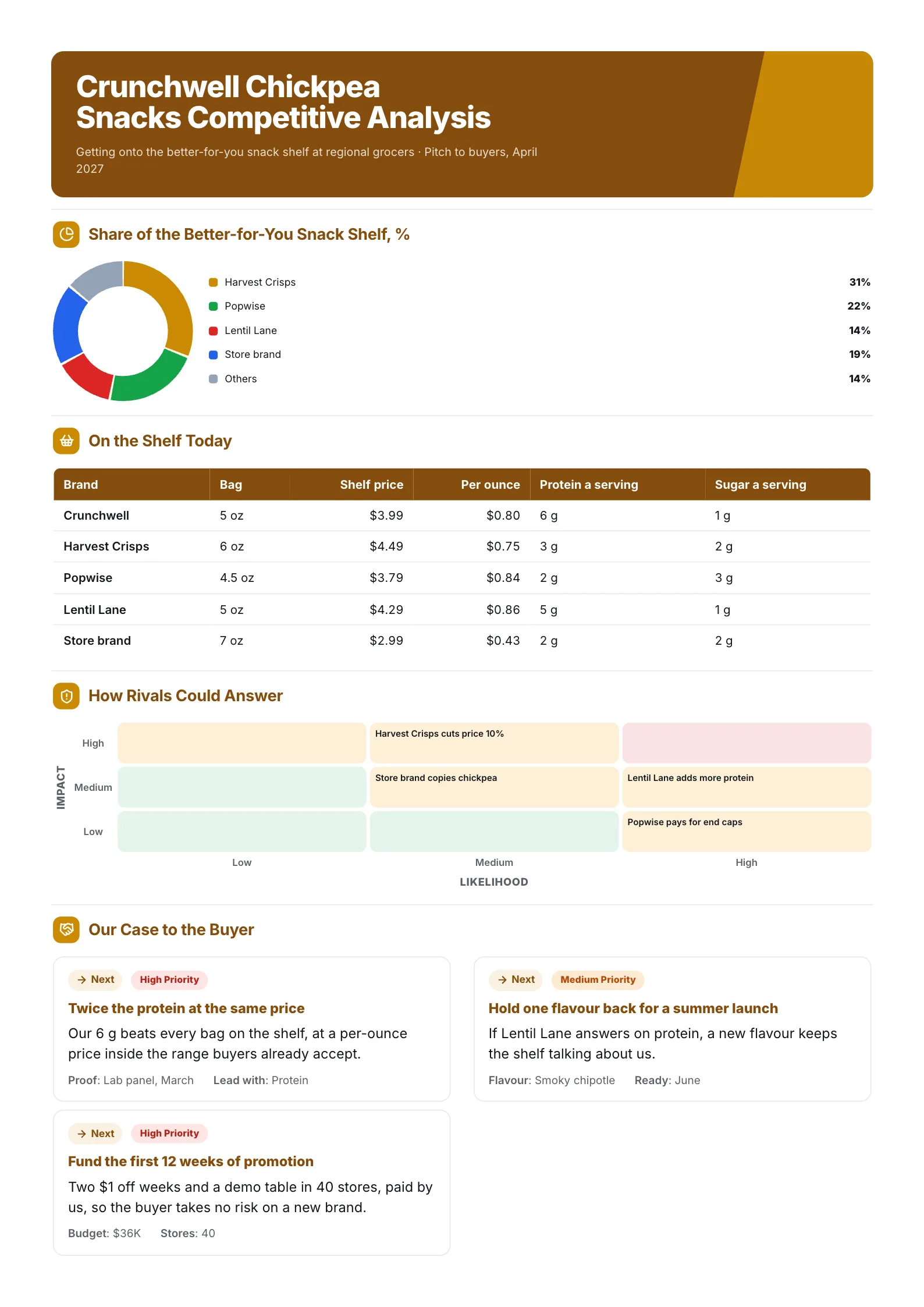
This snack brand competitive analysis fills the Threats box before anything happens. Under "How Rivals Could Answer," it lists four moves, such as Harvest Crisps cutting its price 10% and Lentil Lane adding more protein. Then it plans for one of them. If Lentil Lane answers on protein, Crunchwell has a smoky chipotle flavor ready to launch in June.
Put both on one sheet
You don't need two separate documents. Open a MakeOnepagers competitive analysis that's close to your kind of business and fill in the comparison table first. Then use the bottom of the sheet for four short lists, one for each SWOT box, and tie every outside point to a rival from the table.
When you're ready to build the table, follow our steps for how to write a competitive analysis. To gather what goes in your table, start with these competitive analysis questions, and to see finished four-box grids, browse our SWOT analysis examples. If you'd rather start from your notes, paste them into our free AI One-Pager generator and edit the layout it builds.
Frequently asked questions
Does a SWOT analysis include competitors?
Only in its outside boxes. Rivals show up as threats, and the gaps they leave show up as opportunities. The names, prices and scores behind those points belong in a competitive analysis.
Do public companies publish a SWOT analysis?
Not in their annual reports. None of the four 10-Ks we read uses the word SWOT. They do publish the pieces, though, since the competition sections name rivals and factors and the risk factors read like a list of threats.
Is a competitor SWOT the same as a competitive analysis?
No. A competitor SWOT applies the four boxes to a single rival, while a competitive analysis compares several rivals and you on the same factors. You can run a competitor SWOT on your biggest rival and add it to your analysis.
Can a weakness also be a threat?
Yes, when the cause sits outside your company and it's getting worse. Freshpet treats its rivals' bigger budgets as a fact of the market, and its risk factor warns that price gaps "may result in market share erosion." The gap is a weakness today, and the lost share it could cause is the threat.
How long should each one be?
A one-page competitive analysis usually covers three to five rivals and five to eight factors. A SWOT works best with three to five points in each box, and any point that doesn't change a decision can come out.




