Competitive Analysis Questions: 3 Rounds From 2 Guides
Competitive analysis questions from the SBA's 6 checks and a CMU startup deck's 17, sorted into three rounds you can answer in an afternoon.

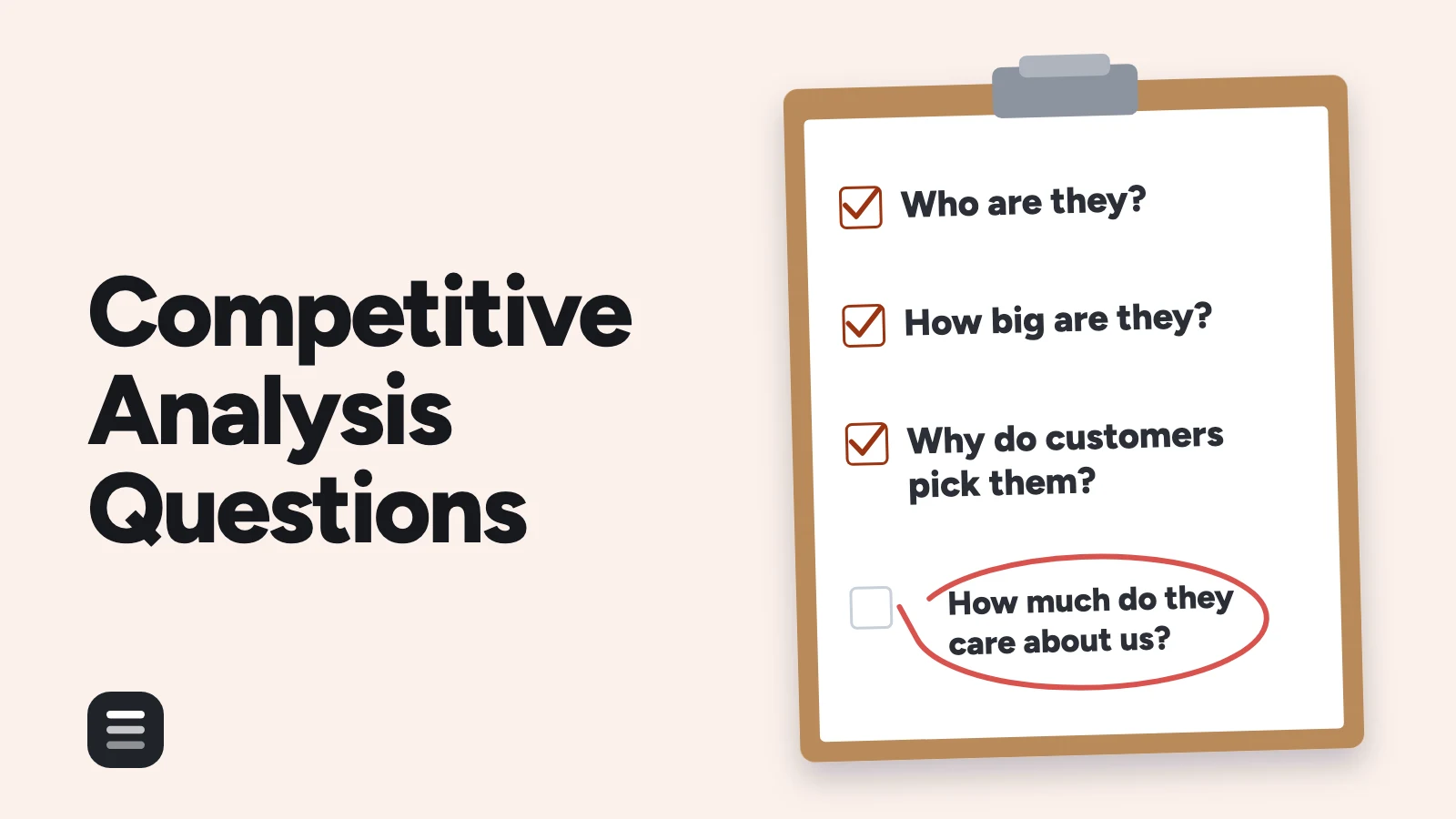
Competitive analysis questions decide what ends up in your table. "Who are our competitors?" gets you a list of names. "Why did our last three lost customers pick someone else?" gets you the one thing a rival does that your customer cares about. Start from a free one pager template.
One‑Pager examples
Real One-Pagers made with MakeOnepagers. Open any one to edit it as your own.
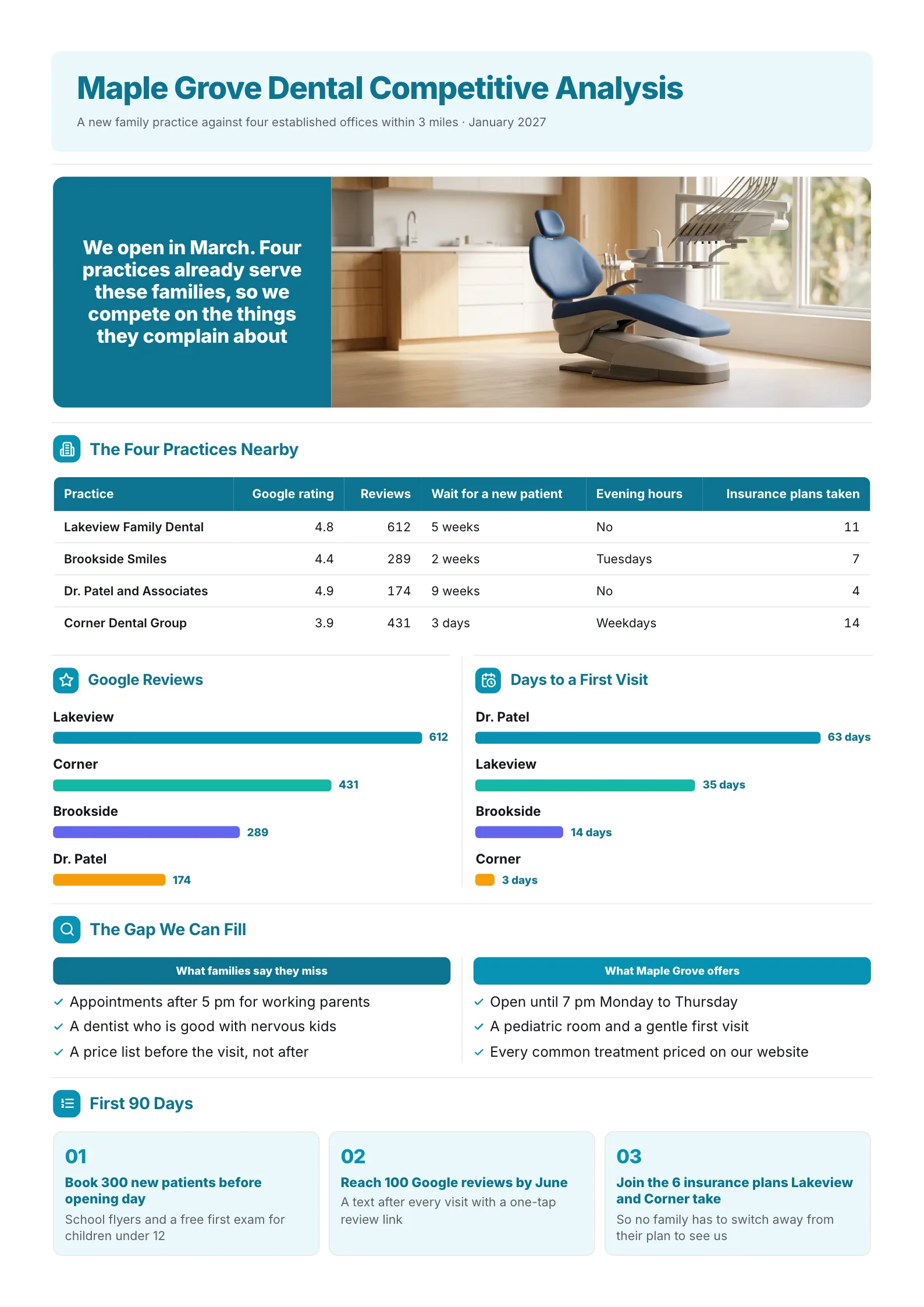 Competitive Analysis: Dental PracticeEdit for free(opens in a new tab)
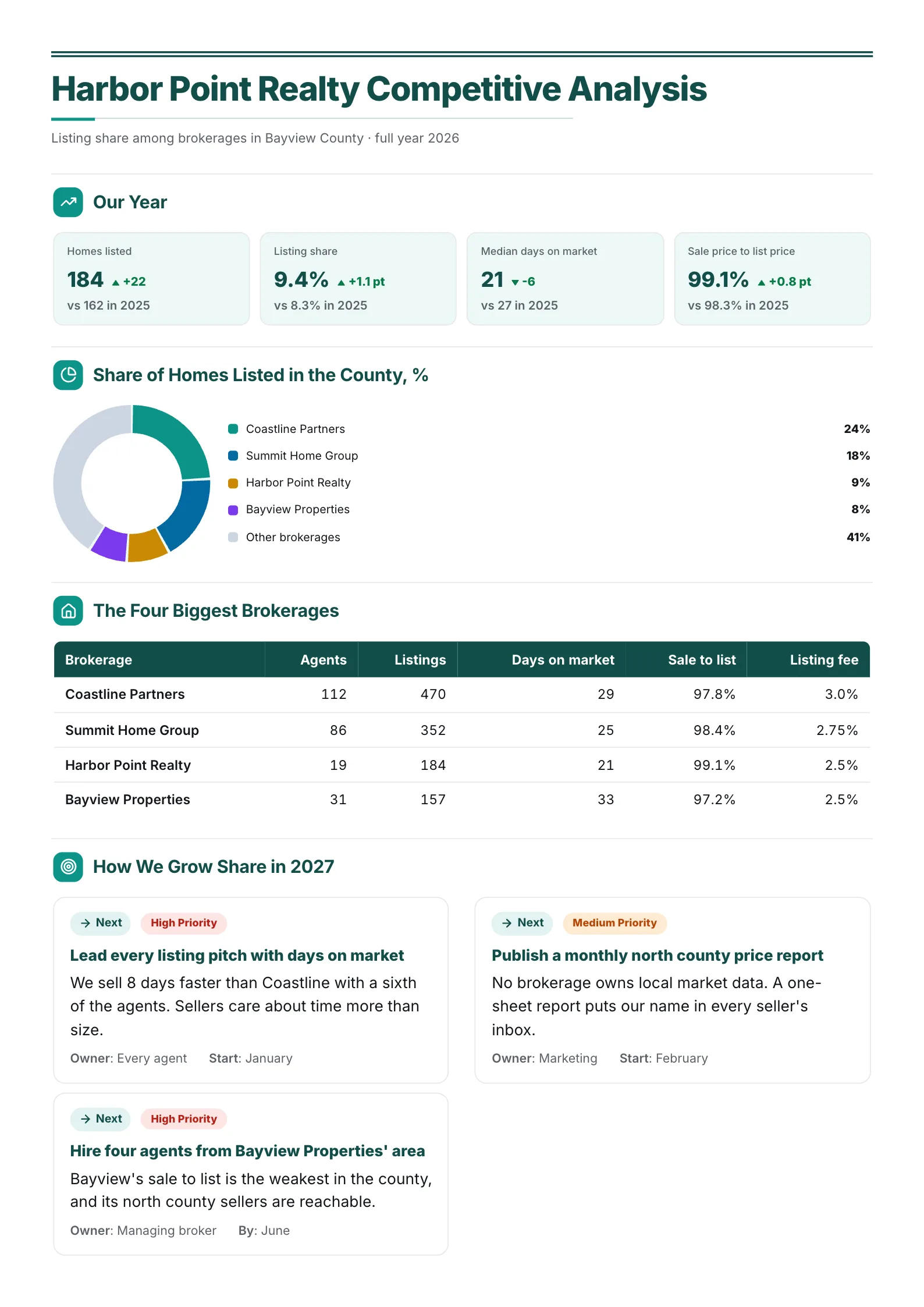 Competitive Analysis: Real Estate BrokerageEdit for free(opens in a new tab)
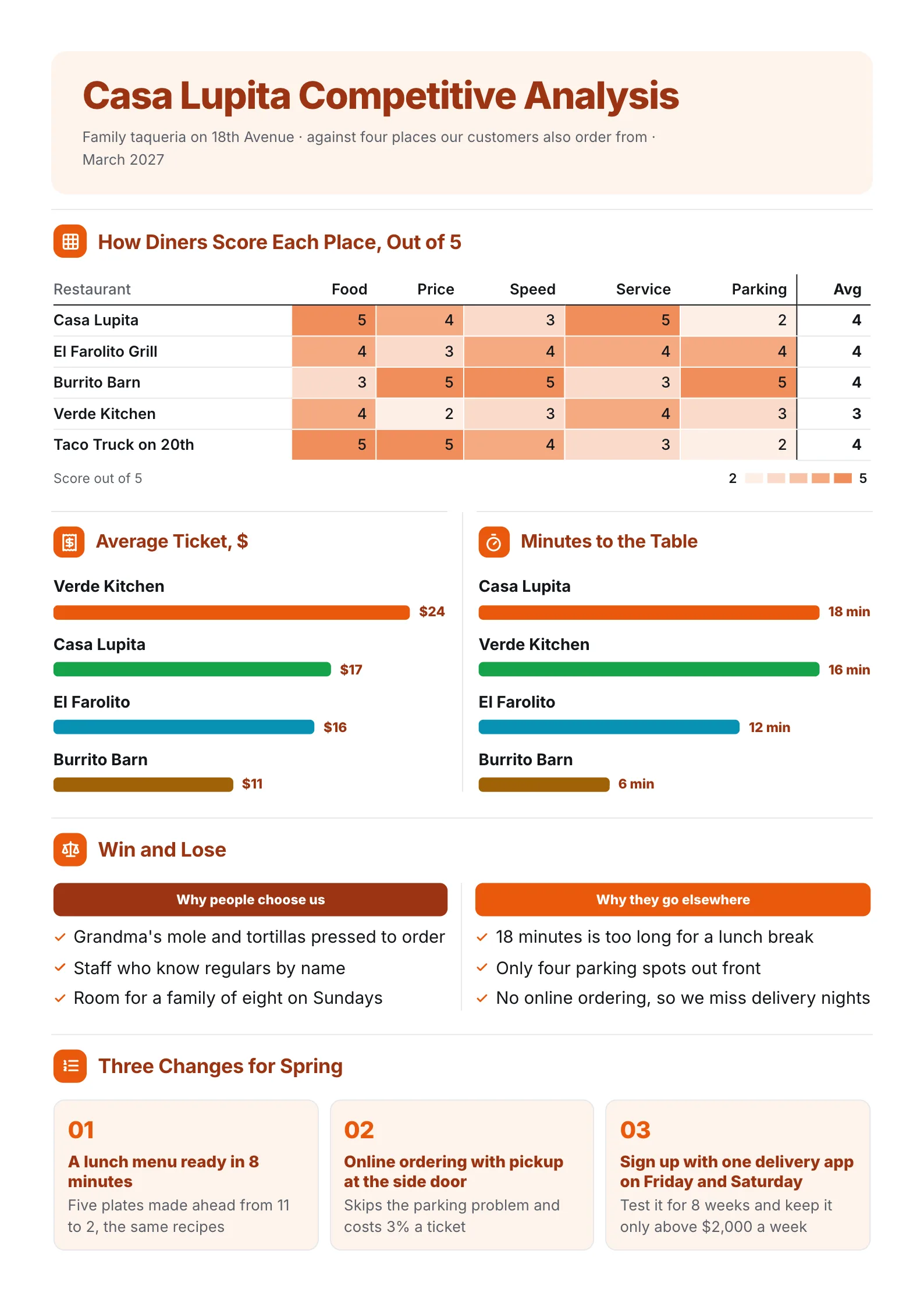 Competitive Analysis: RestaurantEdit for free(opens in a new tab)
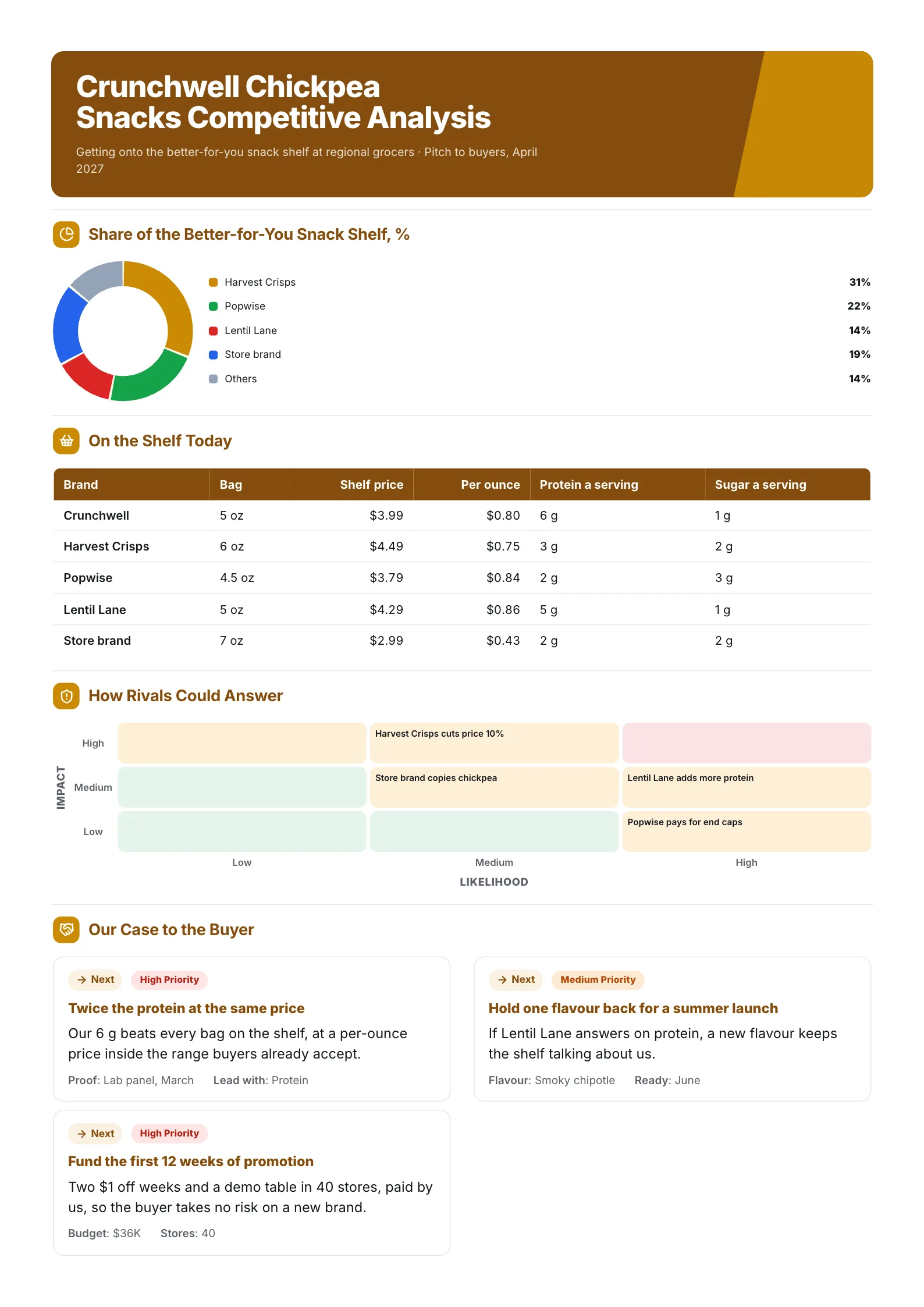 Competitive Analysis: Snack Product LaunchEdit for free(opens in a new tab)
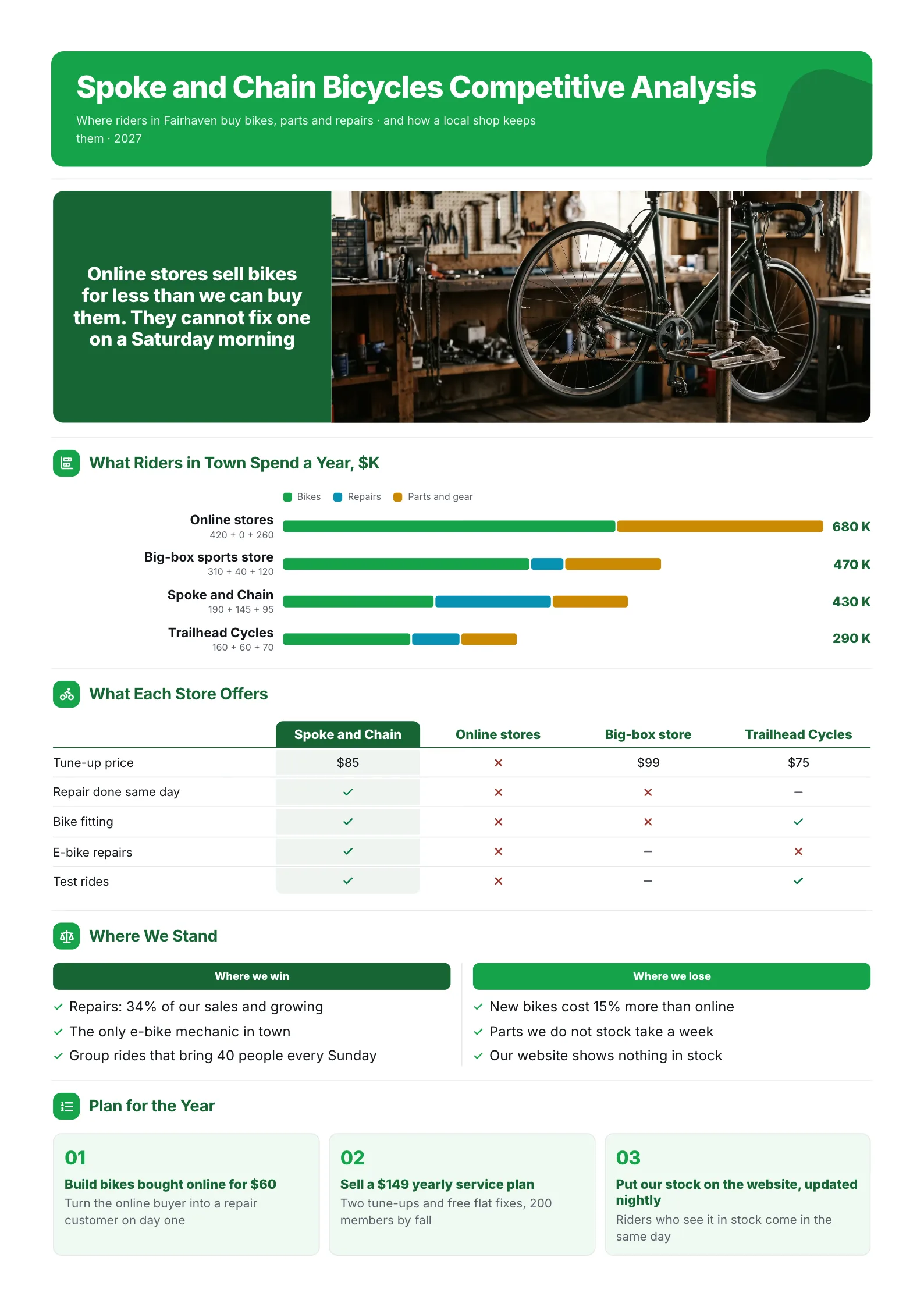 Competitive Analysis: Bike ShopEdit for free(opens in a new tab)
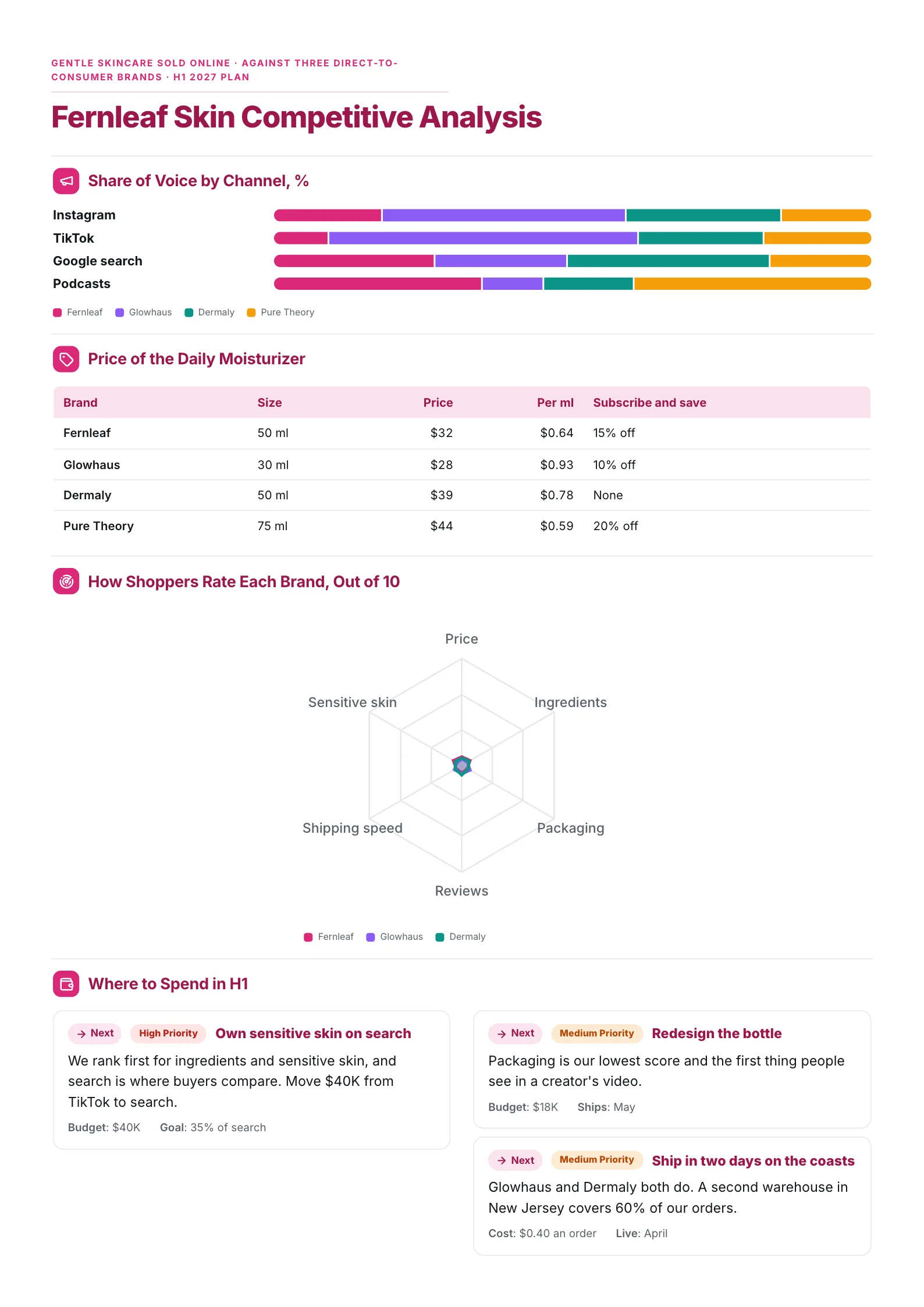 Competitive Analysis: Skincare BrandEdit for free(opens in a new tab)
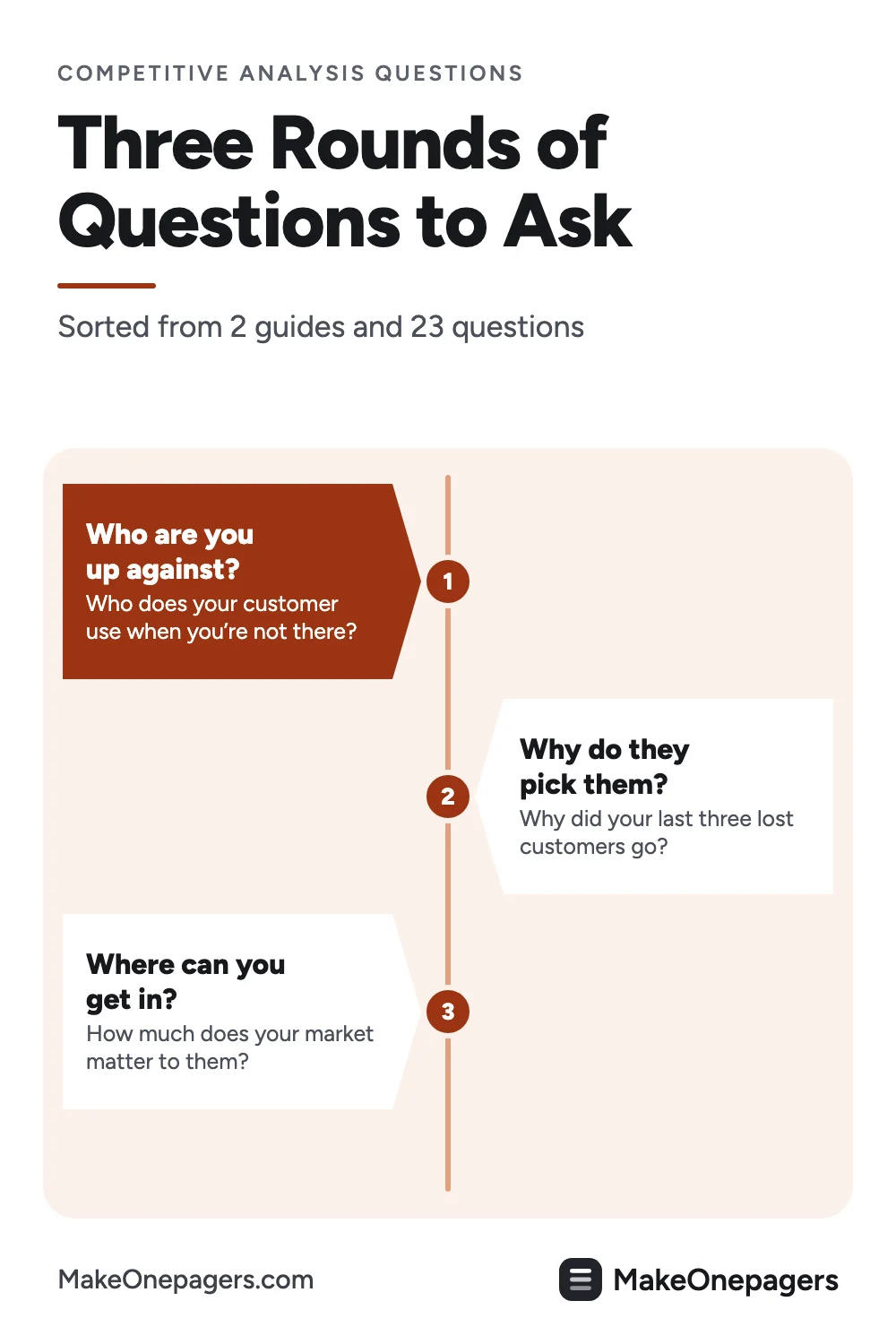
We read two public sources that tell you what to ask. The U.S. Small Business Administration lists 6 things to assess about the competition. A Competitive Analysis deck from Carnegie Mellon's Swartz Center for Entrepreneurship, 30 slides by Kit Needham, adds 17 questions about each rival company, plus an "Other" line. We sorted them into three rounds for one afternoon.
The 23 questions, counted
Here's what each source asks you to find out. We turned the SBA's checklist into questions so you can compare the two side by side.
| What you're asking about | SBA | CMU deck |
|---|---|---|
| Who the rival is (where, how old, how big, who runs it, who owns it) | 0 | 5 |
| Money (sales, funding) | 1 (market share) | 2 |
| What they sell, to whom, and who supplies them | 0 | 3 |
| How they sell (pricing, marketing, sales literature, distribution) | 0 | 4 |
| Strengths and weaknesses | 1 | 2 |
| Whether they're growing or shrinking | 0 | 1 |
| Your window to enter, and the barriers | 2 | 0 |
| Indirect or secondary rivals | 1 | 0 |
| How much your market matters to them | 1 | 0 |
| Total | 6 | 17 |
Source: our count of the SBA's "Use competitive analysis to find a market advantage" section and the CMU deck's "Competitive Company Analysis" slide, read October 30, 2026. CMU's 18th line, "Other," is left out of the count.
The lists barely overlap. CMU profiles each rival, and the SBA looks for your way in. You need both, in the right order.
Round 1: Who are you really up against?
The CMU deck opens with a definition worth taping above your desk. "Any way the customer is solving the problem now is competition." That includes the rival down the street, and it also includes a spreadsheet, a cousin who does it for free, or doing nothing at all.
The deck splits this into direct rivals, which sell something similar, and indirect ones, which solve the same problem for the same people in a different way. The SBA says the same thing in its own words, asking you to name the "indirect or secondary competitors who may impact your success."
Start your list with these questions:
- Who does your customer use today when you're not there?
- Which of them sell what you sell, and which solve the problem another way?
- What product lines does each one sell, and to which customers?
- Where is each one located, and how long has it been in business?
- How many people work there, and what are its annual sales?
- How is it funded, and how much has it raised?
- Who supplies it, and could a supply problem slow it down?
- Who runs it, and is it owned by a larger company?
- Is it expanding or cutting back?
Keep your answers short. A number with a date beats a paragraph, because you can check it again next quarter.
 Edit this template
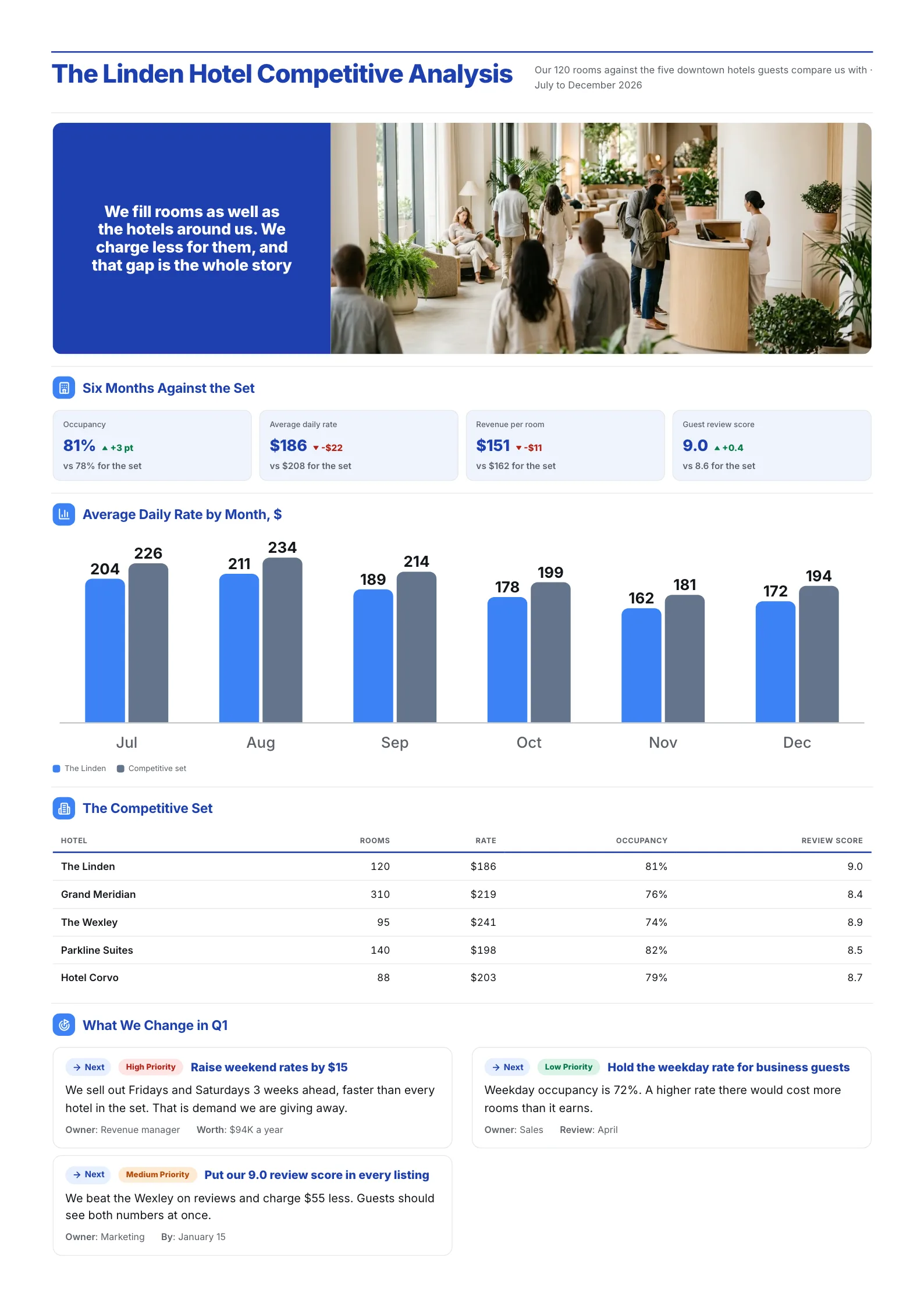
Sample names and figures. Six Months Against the Set answers how the hotel compares on the four numbers guests and owners watch.
Round 2: Why does a customer pick them?
This is the round most of your questions should live in, and neither list puts it first. The CMU deck gives it its own slide, asking "What makes a customer choose one solution over another?" It names three reasons: price, service and quality. Then it adds a rule that saves a lot of wishful planning. "At most, you can only compete on 2 out of the 3."
So for each rival, ask these:
- What does it charge, and how is the price built?
- Is it known for service, like speed, a personal touch or convenience?
- Is it known for quality, like something that lasts longer or looks better?
- Which two of the three does it win on, and which one does it give up?
- What do its customers complain about?
- Where does it market, and what do its ads and brochures promise?
- How does it sell and deliver, through a store, a website, a sales team or resellers?
- What is it best at, and where is it weakest?
The deck then lists 20 features you can compare in a grid, from price and warranties to ease of use, safety and endorsements. You won't need all 20. Pick the four or five your customer mentions when they explain a choice, and score every rival on those.
 Edit this template
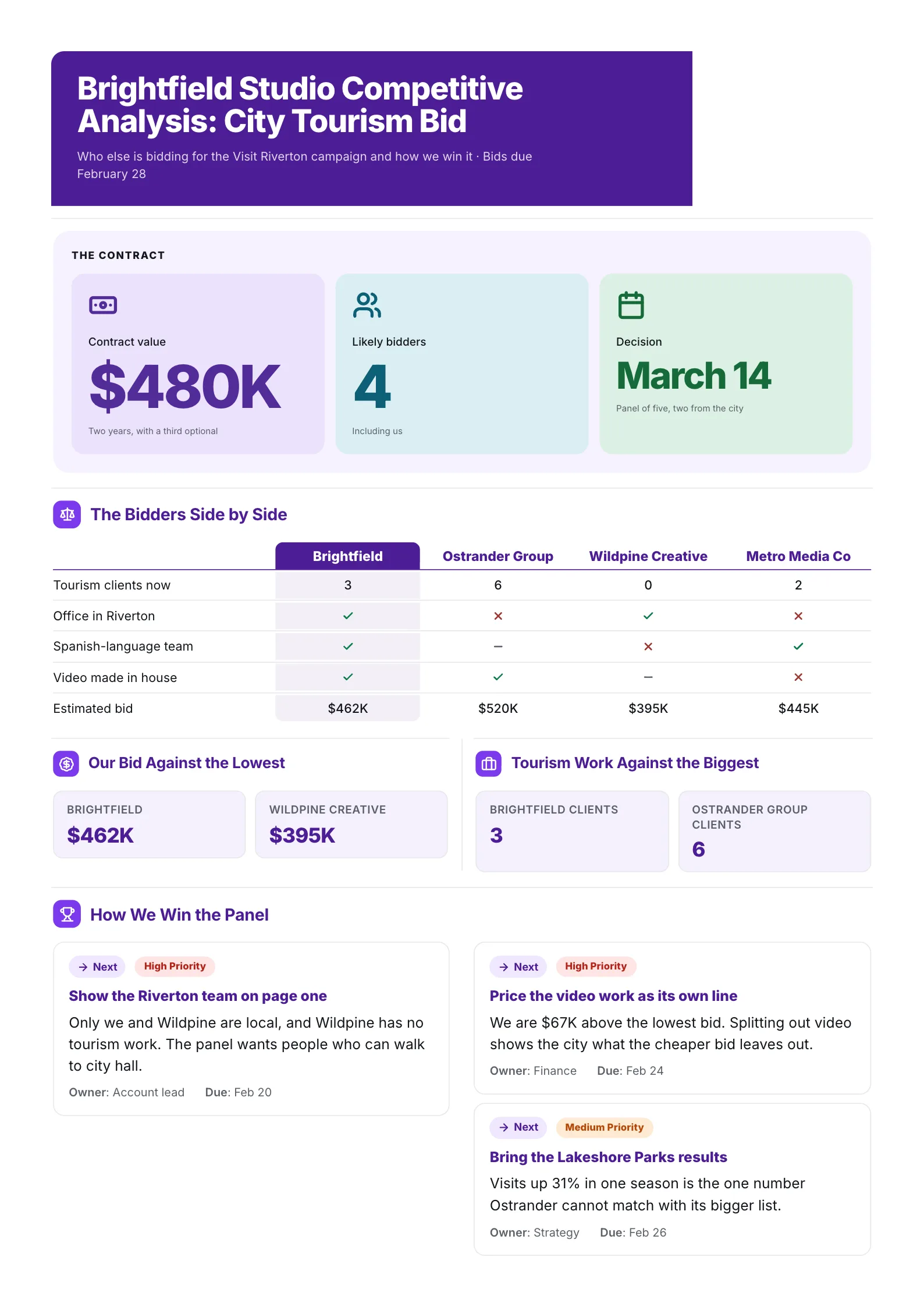
Sample names and figures. The Bidders Side by Side compares each bidder on tourism clients, a local office, a Spanish-language team and in-house video.
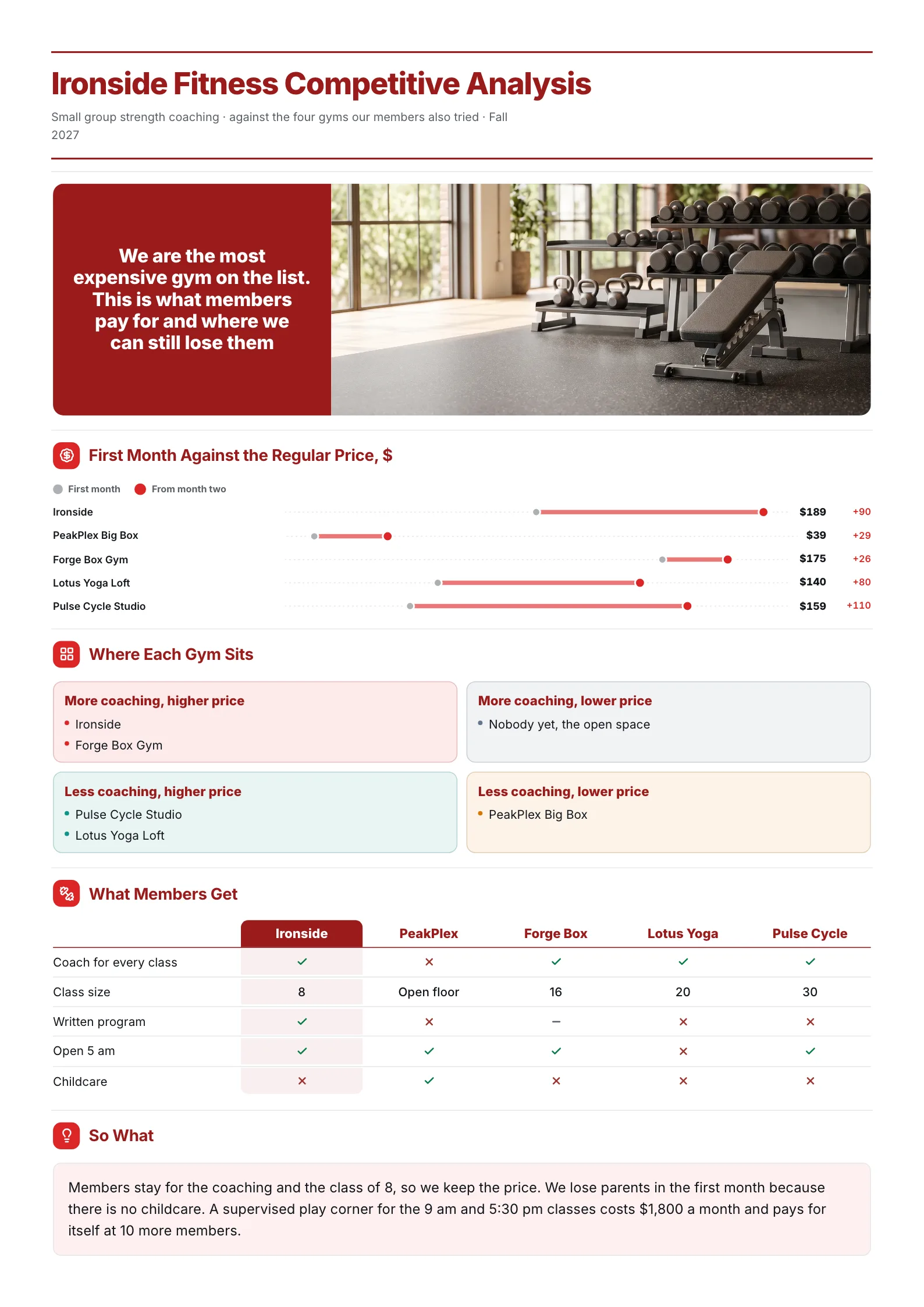
The gym sample below shows the price question answered honestly. It starts by admitting it's the most expensive gym on the list, then says what members pay for and where they leave.
 Edit this template
Sample names and figures. Where Each Gym Sits plots coaching against price and leaves one corner open: more coaching for less money.
Round 3: Where can you get in?
Now the SBA's questions take over. Its checklist is short, and three of its six points are about your own way in: the window, the barriers and how much your market matters to each rival. Ask yourself:
- What share of the market does each rival hold?
- Is there a window of opportunity for you to enter now?
- What barriers could slow you down, like contracts, licenses or switching costs?
- How important is your target market to each competitor?
- Which indirect rivals, like a spreadsheet or doing nothing, could still win the sale?
That fourth question is the one we'd circle. It's the only one of the 23 that asks how much a rival cares about your market. A big company that treats your niche as a side project may not fight for it. A small one that lives on it will.
The SBA also says to sort your competition "by product line or service and market segment." One rival can threaten one line and ignore another, so score them per line.
 Edit this template
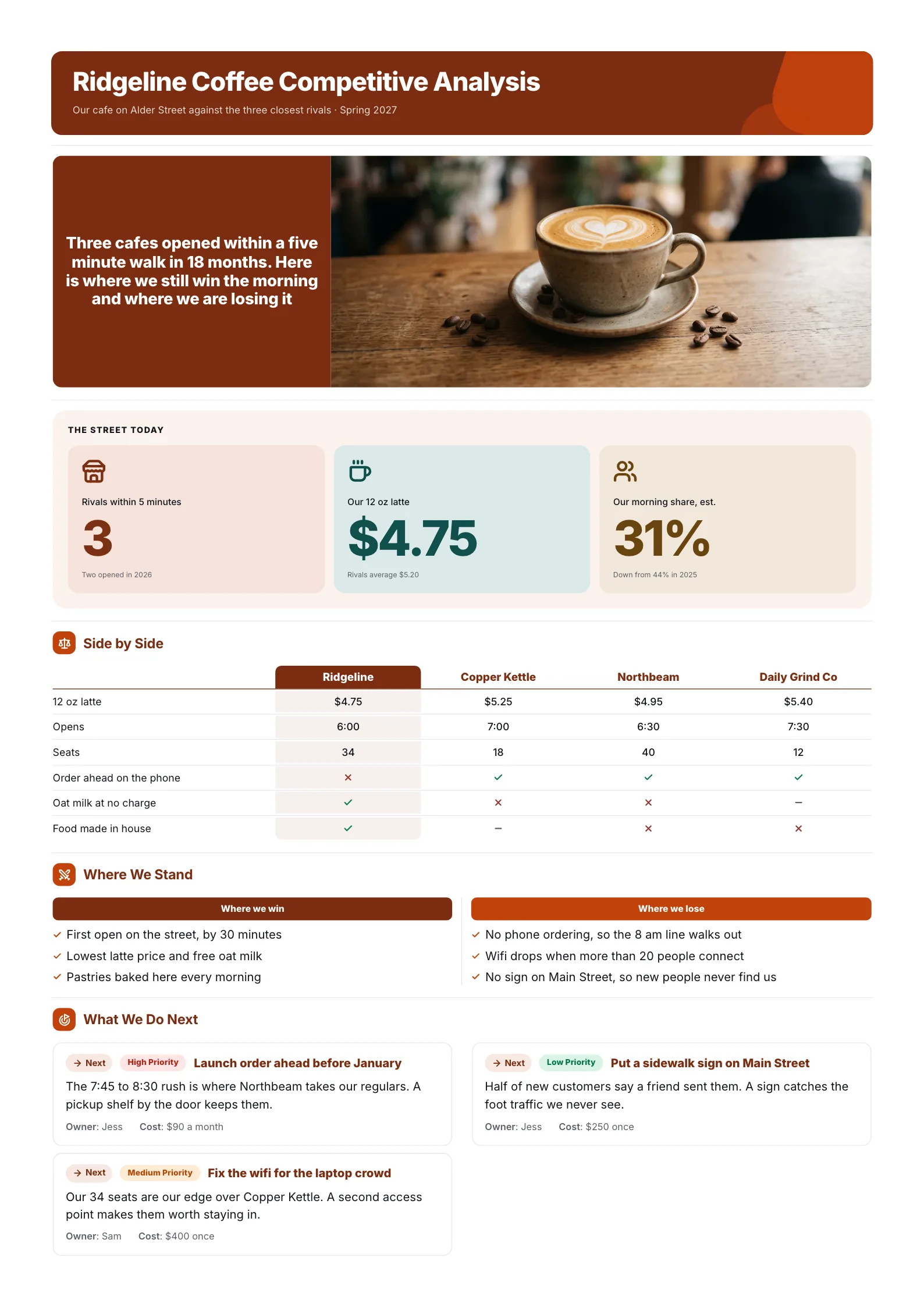
Sample names and figures. The Street Today puts the cafe's falling morning share beside the three new rivals that took it.
Where to find the answers
The CMU deck lists 7 places to look, and most cost nothing:
- Customer discovery interviews
- Your competitors' advertising
- Their sales brochures
- Newspapers and magazines
- Their websites, or comparison websites
- Online sites that rate products and services
- Your own business and professional network
The SBA adds federal data for the market side, such as the Census Business Builder and the Bureau of Labor Statistics. Use those for market size and the rivals' list for everything else.
The CMU deck also suggests you study competitors that have closed. A rival that shut down tells you what the market wouldn't pay for.
 Edit this template
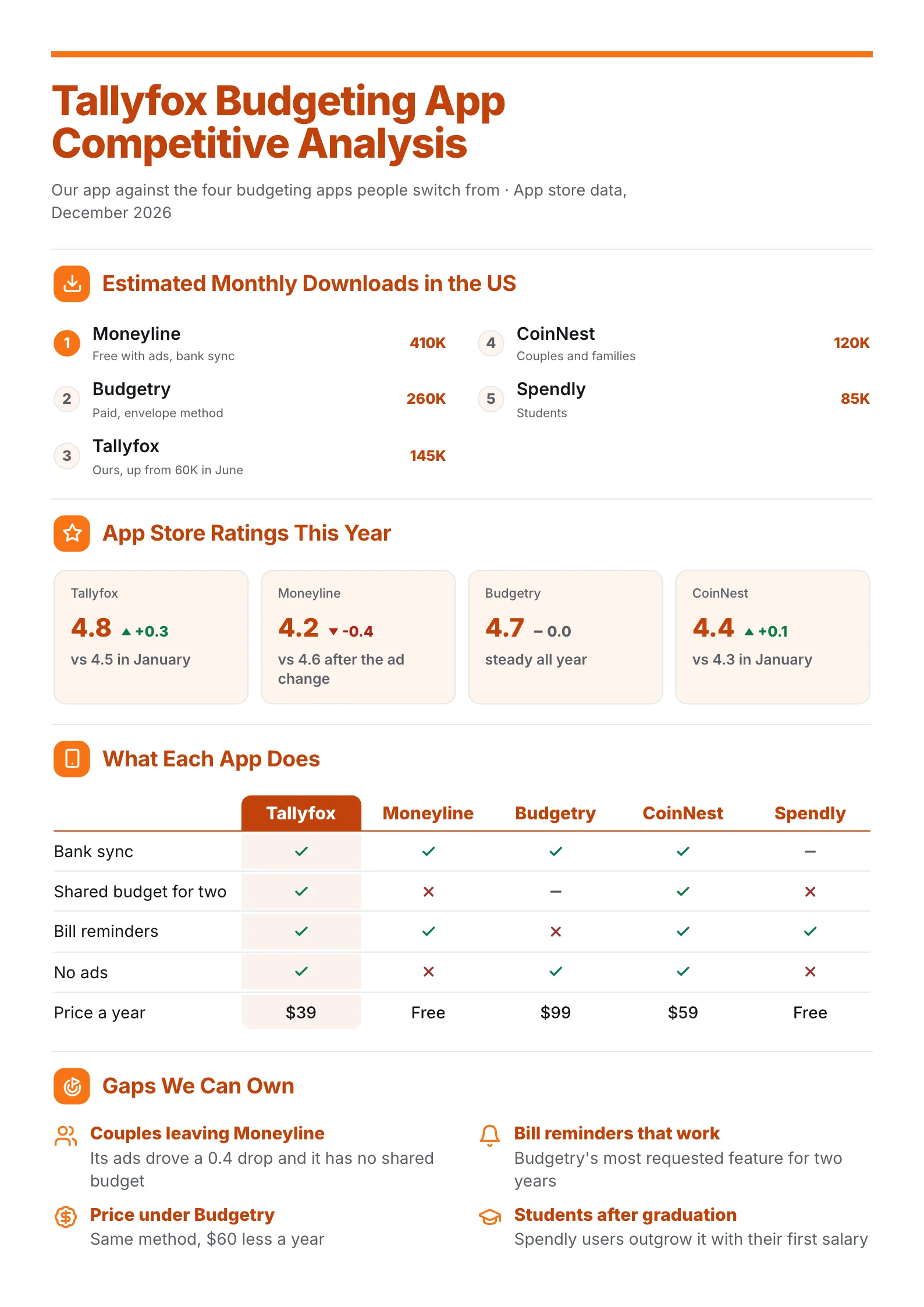
Sample names and figures. App Store Ratings This Year turns a free public source into a rating and its change this year for four of the five apps.
Turn your answers into a page someone will read
The CMU deck makes a point about what you show at the end. Your research matrix will be messy, it says, and the matrix you show investors should be a summary of the strongest competitors with the most important features. Its slide headed "Finally" puts it in four words: "Benefits sell, features tell."
So when your questions are answered, keep only what changes a decision. Lay it out like this:
- Your rivals at a glance: three to five names, each with one number, like share, price or rating.
- A side-by-side grid: four or five features your customer cares about, with a check or a score.
- Where you win and where you lose: one honest line each.
- What you'll do about it: two or three moves, each with an owner and a date.
Our competitive analysis template post shows that layout filled in for six kinds of business. A battlecard is the better fit for a single rival whose claims your sales team has to answer on calls.
Ask the fourth question first
Before you profile anyone, write one line for each rival that answers how much your market matters to it. That single SBA question tells you which rivals will fight and which will let you in. Then fill in the rest of the questions and lay your answers out on a MakeOnepagers competitive analysis design, so the grid and the moves sit on one page.
The two sources we read
| Source | Publisher | What we took |
|---|---|---|
| Market research and competitive analysis | U.S. Small Business Administration | 6 characteristics to assess, sorting rivals by product line and segment, free federal data sources |
| Competitive Analysis (30-slide PDF, Kit Needham) | Swartz Center for Entrepreneurship, Carnegie Mellon University | 17 company questions plus "Other", 3 competitive factors and the 2-of-3 rule, 20 features, 7 sources, study closed competitors |
Both read in full on October 30, 2026.
Frequently asked questions
What are the 5 key questions of a competitive analysis?
Who are your rivals, direct and indirect? Why do customers choose them? Which two of price, service and quality does each one win on? How much does your market matter to them? Where is your opening? Those five cover both of the lists we read.
How many competitors should you analyze?
Three to five is enough for most small businesses. The CMU deck says the version for investors should show only your strongest competitors. List every rival in your notes, then keep the ones your customers actually compare you with.
What questions should you ask a competitor's customers?
Ask why they chose that company, what almost made them choose someone else, and what they'd change. Their complaints are the most useful answers you'll get. The CMU deck lists customer interviews first among its 7 sources.
How often should you redo a competitive analysis?
Revisit it at least once a year, and any time a new rival opens or an old one changes its price. Answers built on numbers with dates make the update quick, because you only check what moved.




