Cash Flow vs Profit: 4 Audited Years Where the Two Split
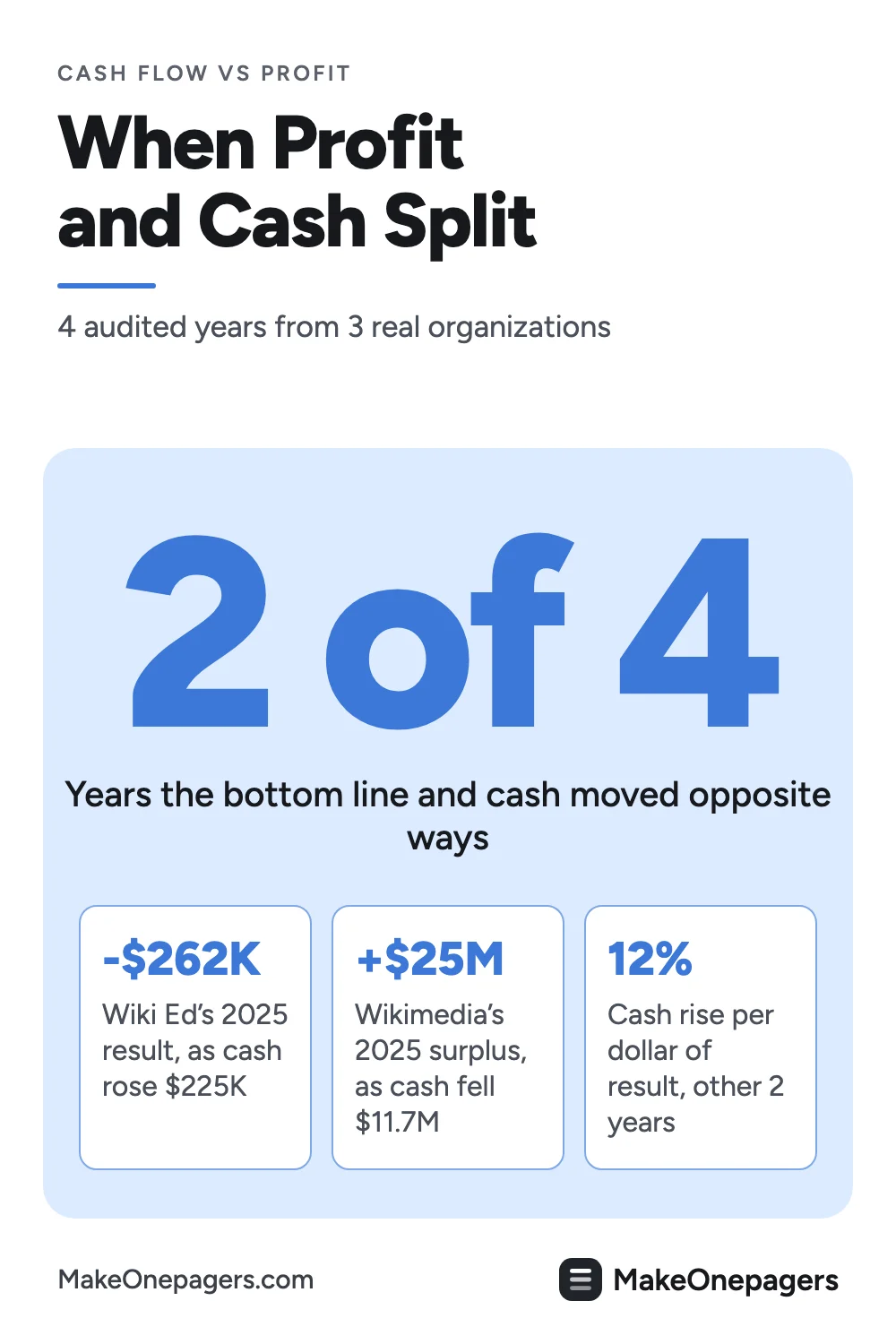
Cash flow vs profit, shown on 4 real audited years. In 2 of them the bottom line and the bank balance moved opposite ways. Here's the line that did it.

Cash flow vs profit comes down to timing. Profit is what you earned minus what you spent in a period, counted when you send the bill or get it. Cash flow is the money that actually moved through your bank account. We read 4 audited years from three organizations, and in 2 of them the bottom line and the cash balance went opposite ways. One lost $261,541 and still ended with $224,870 more cash. Start from a free one pager template.
One‑Pager examples
Real One-Pagers made with MakeOnepagers. Open any one to edit it as your own.
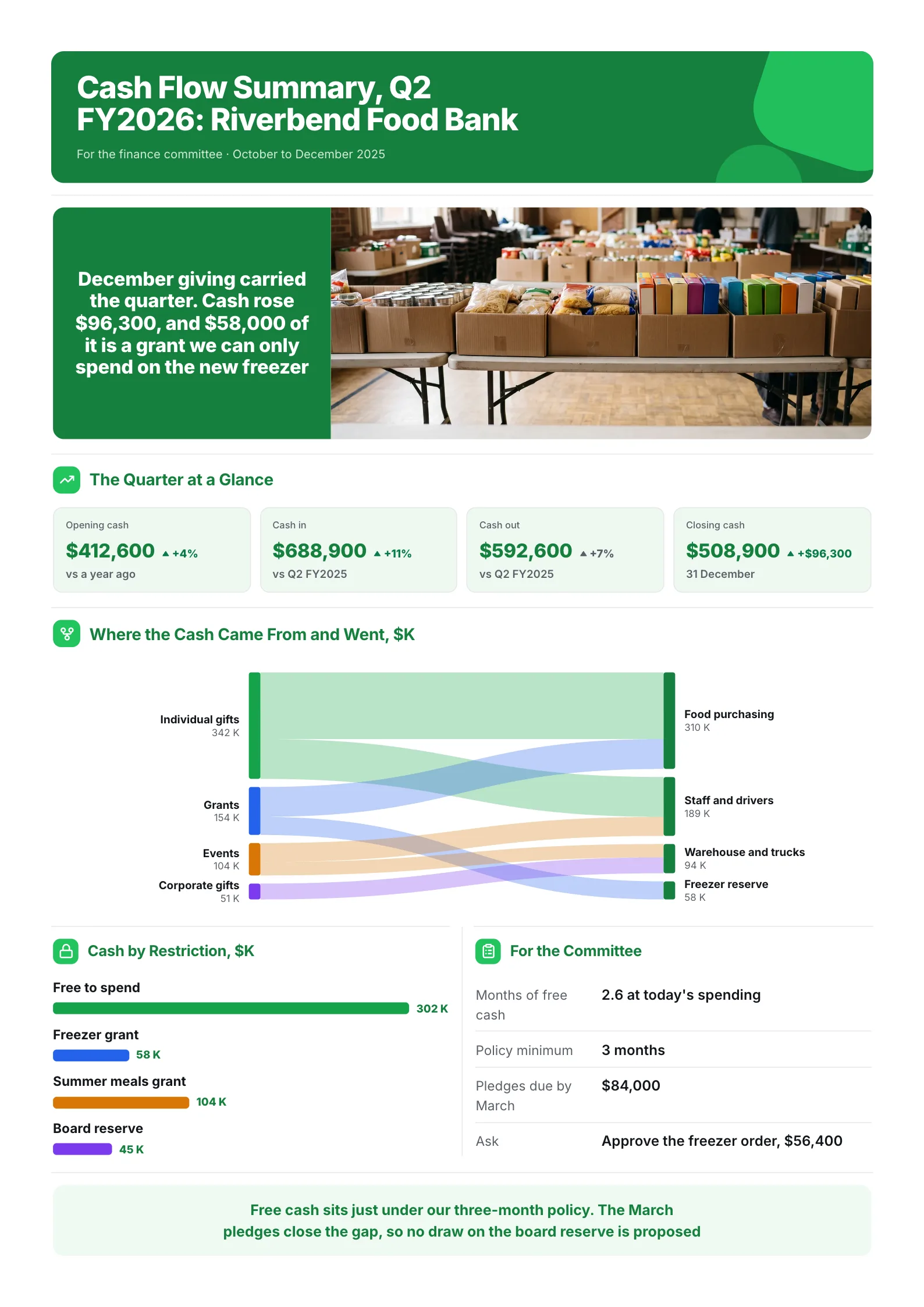 Cash Flow Summary: Food Bank QuarterEdit for free(opens in a new tab)
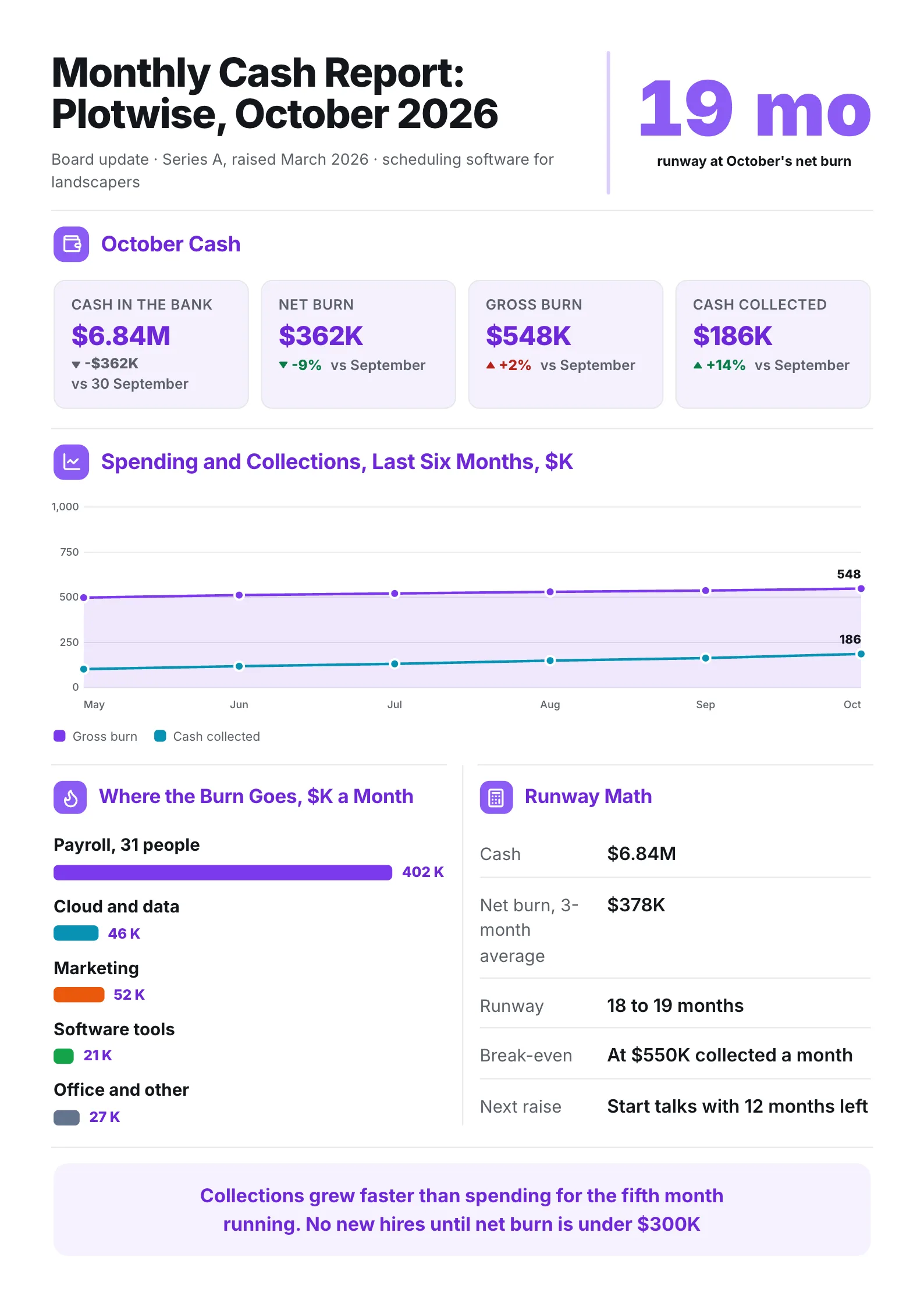 Cash Flow Summary: Startup Burn and RunwayEdit for free(opens in a new tab)
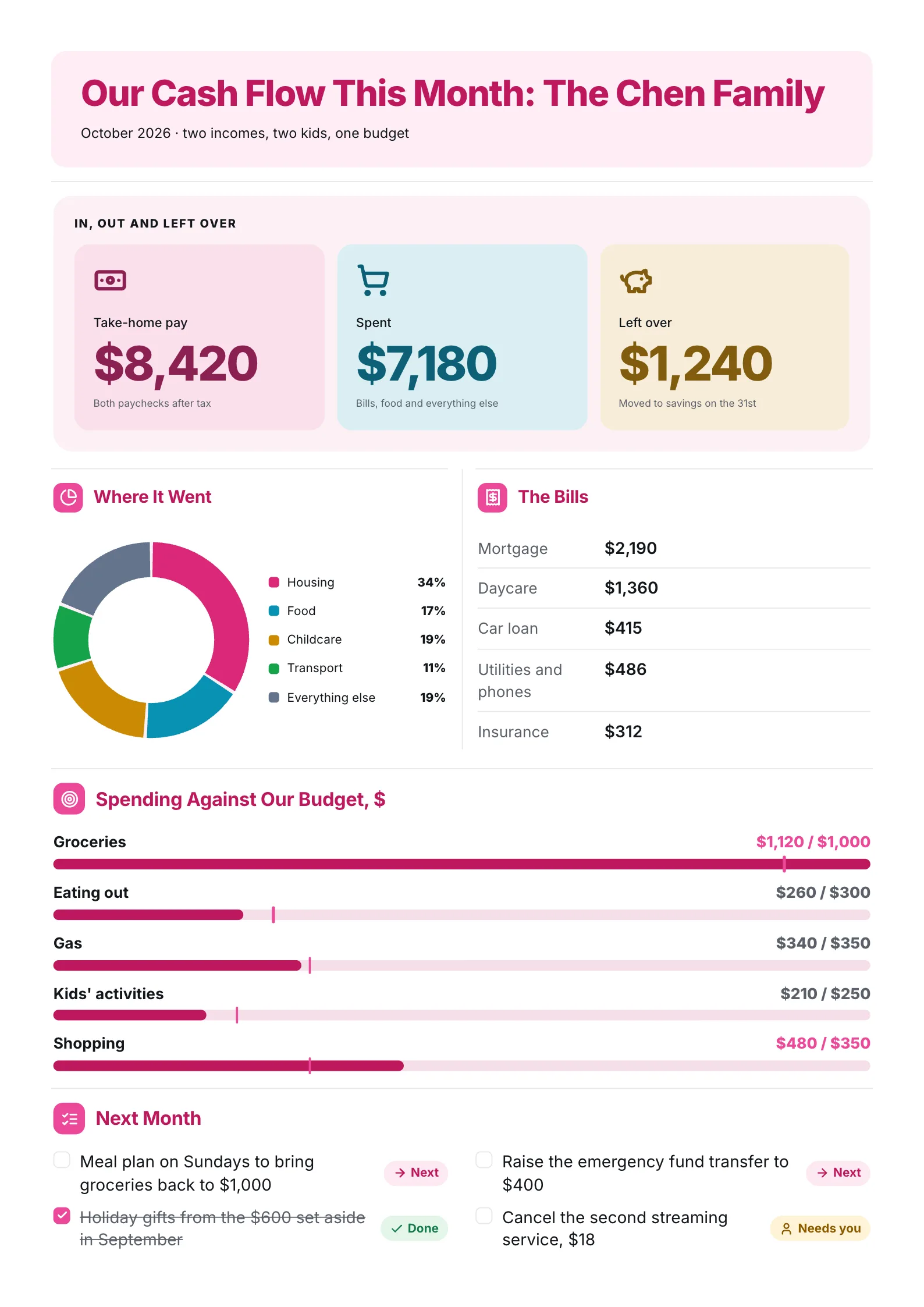 Cash Flow Summary: Household MonthEdit for free(opens in a new tab)
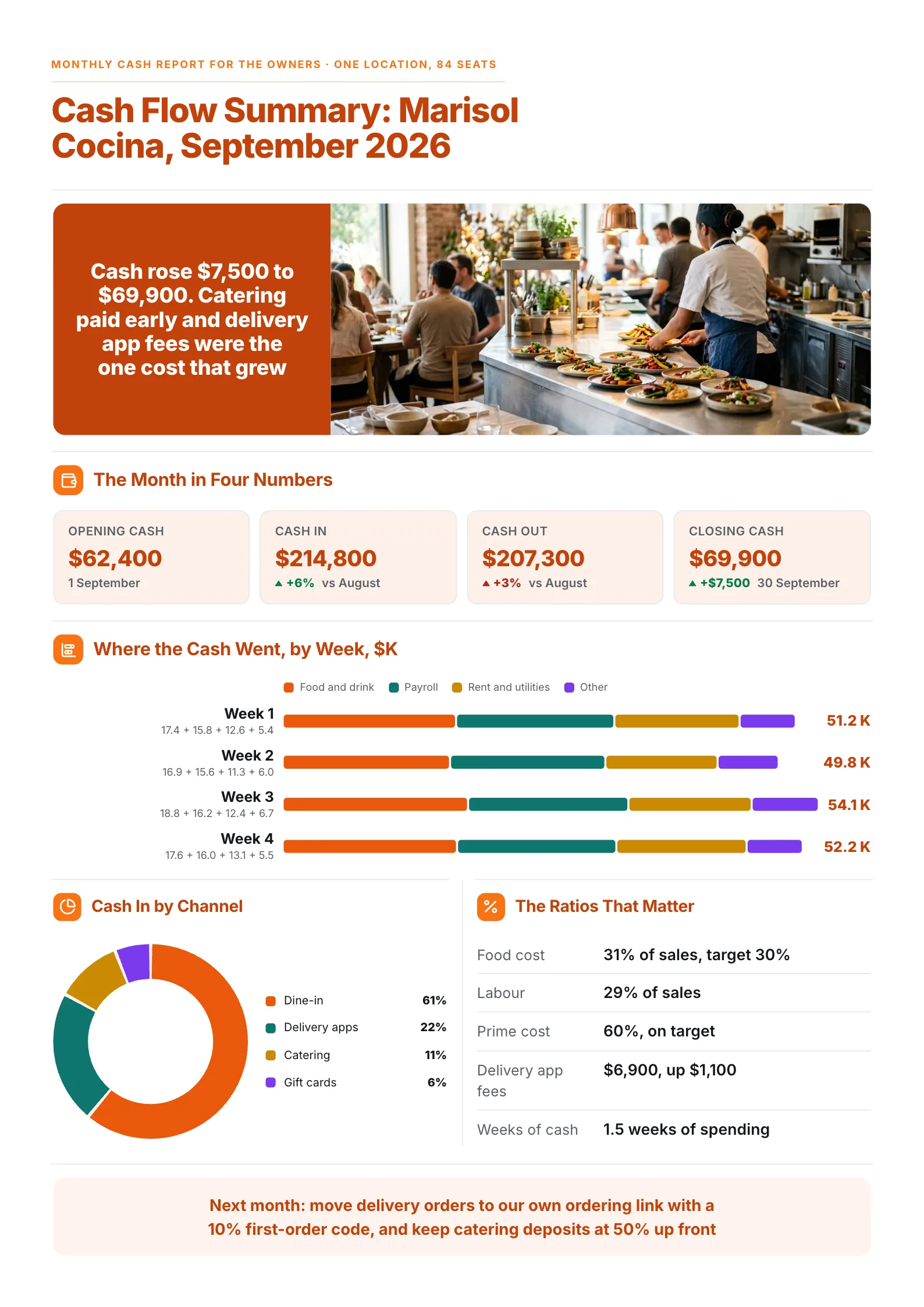 Cash Flow Summary: Restaurant MonthEdit for free(opens in a new tab)
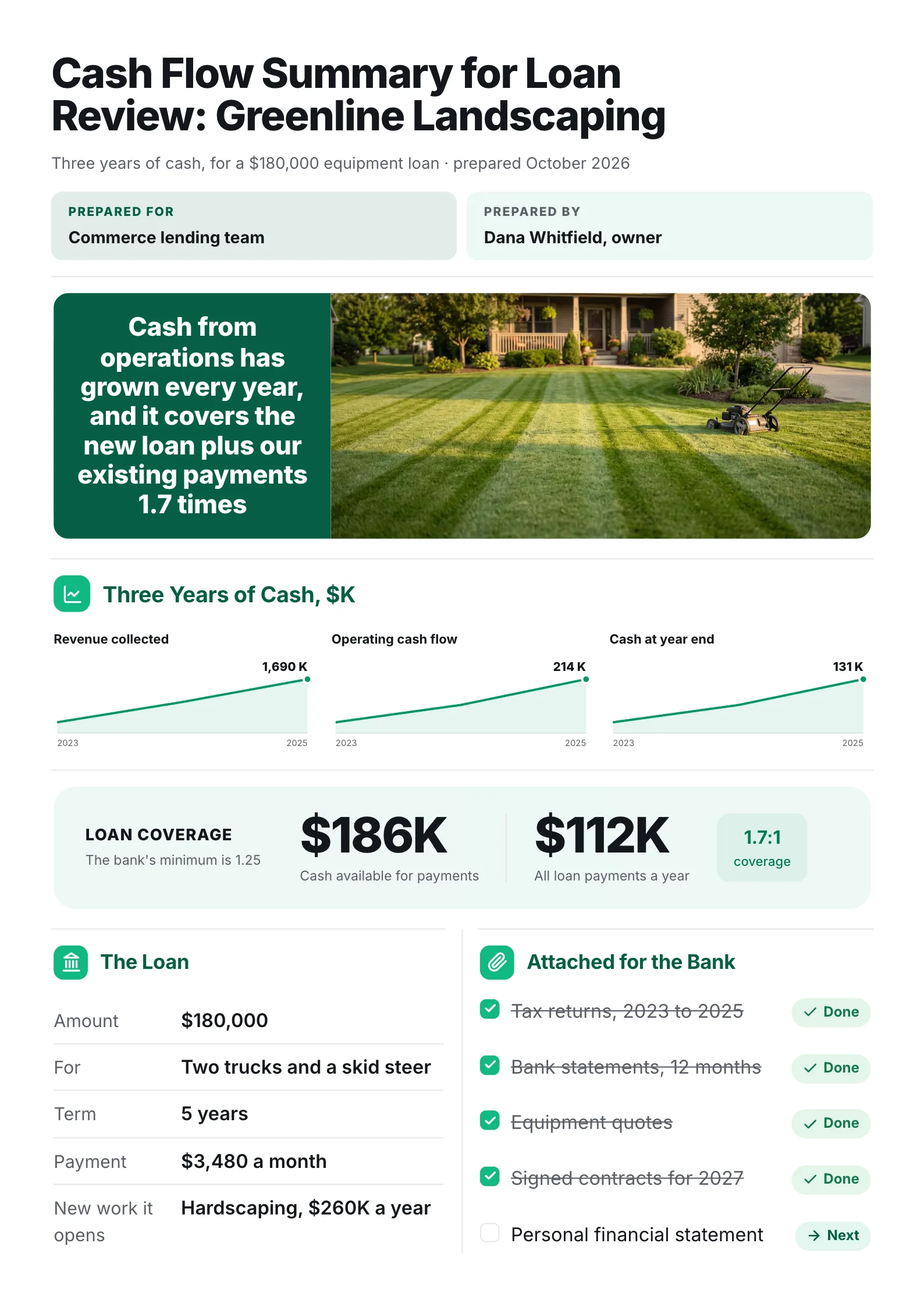 Cash Flow Summary: Loan ApplicationEdit for free(opens in a new tab)
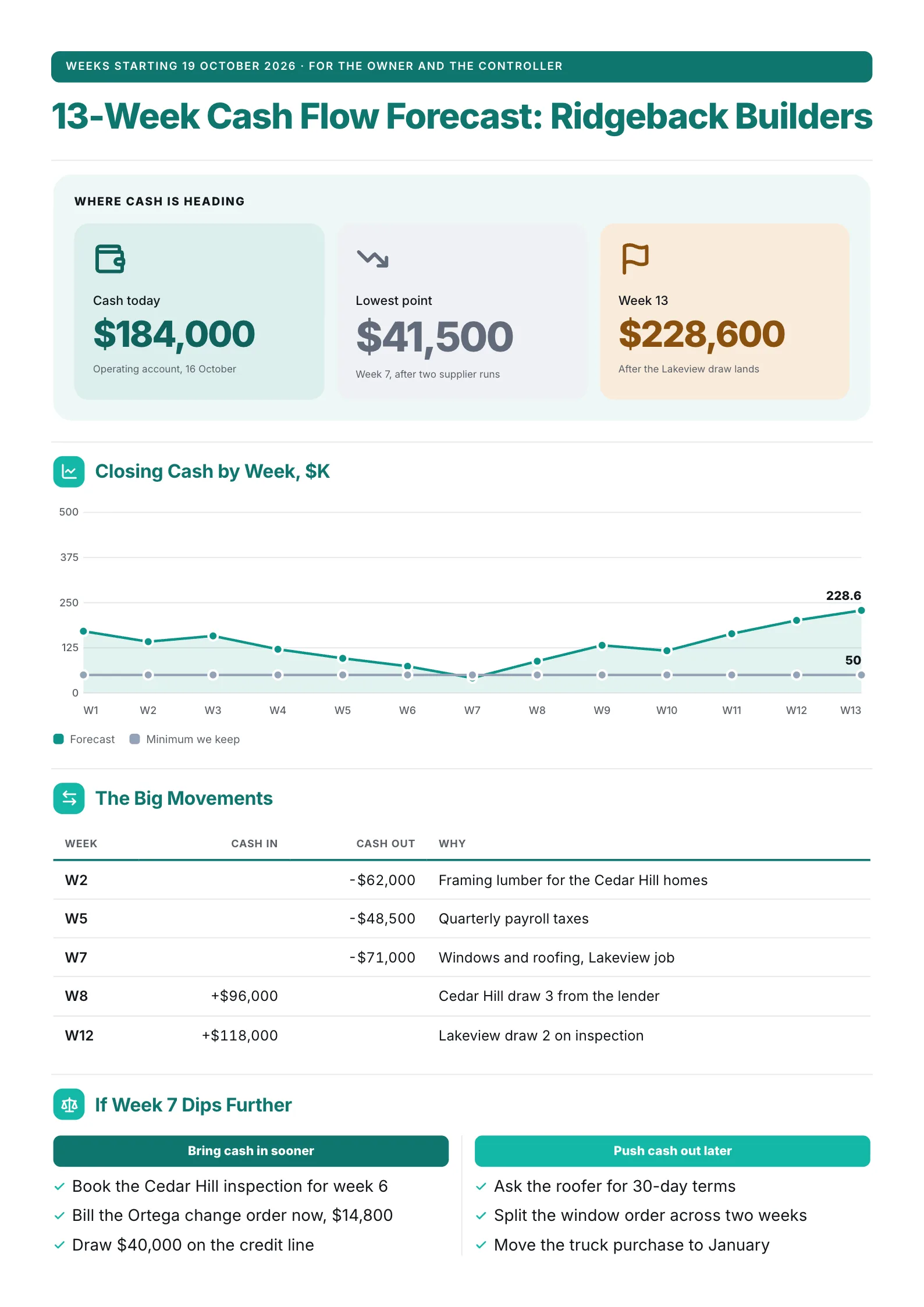 Cash Flow Summary: 13-Week ForecastEdit for free(opens in a new tab)
You don't need to be an accountant to read the gap, and you can do it on your own books in an hour. A few lines on the statement of cash flows explain almost all of it. Below are the four years, the lines that split them, and what to watch on your own books.
Four real years, side by side
Nonprofits and public utilities don't use the word profit. A nonprofit's bottom line is its "change in net assets," and a city-owned utility's is its "change in net position." They do the same job net income does for your business. So you can compare them straight across.
| Organization and year | Bottom line | Change in cash | Same direction? |
|---|---|---|---|
| Wiki Education, year to June 2024 | +$1,166,441 | +$141,989 | Yes, cash was 12% of it |
| Wiki Education, year to June 2025 | -$261,541 | +$224,870 | No |
| Wikimedia Foundation, year to June 2025 | +$24,994,640 | -$11,741,647 | No |
| Greenville Water, 2025 | +$53,866,187 | +$6,630,808 | Yes, cash was 12% of it |
Two years split outright. In the other two, the bank balance grew by about 12 cents for every dollar of bottom line. All three sets of statements come with an independent auditor's report. Each cash flow statement shows exactly where the difference went.
The 4 lines that split profit from cash
1. Money people promised but hadn't paid yet
The Wiki Education Foundation shows this better than any textbook. In its year to June 2024, its net assets grew $1,166,441, mostly from grants and pledges. But its contributions receivable, money promised and not yet paid, rose by $1,064,990. So only $141,989 of new cash showed up.
The next year flipped. Wiki Education spent $2,452,972 against $2,191,431 of revenue, a loss of $261,541. Then part of the money promised the year before arrived, and receivables fell by $504,990. Cash went up $224,870 in a year with a loss.
A business sees the same thing with unpaid invoices. You count the sale when you bill it. You can only spend it when the customer pays. The FDIC and SBA's Money Smart guide on managing cash flow puts it simply: "Cash is stored as inventory, available cash, and accounts receivable." Cash sitting in receivables can't pay rent.
2. Gains on paper
The Wikimedia Foundation grew its net assets by $24,994,640 in the year to June 2025. Part of that came from investments rising in value, with $9,246,817 of unrealized gains on its statement of activities. A gain on paper raises the bottom line, but no cash arrives until you sell. On the cash flow statement, Wikimedia takes $7,593,582 of investment gains back out.
3. Big purchases that don't hit profit all at once
The same Wikimedia statement shows where the rest of the cash went. It bought $102,093,566 of investments and sold $79,705,682, a net $22,387,884 moved out of cash and into its portfolio. It also bought $5,888,019 of property and equipment. Neither purchase counts as an expense that year, so profit barely notices. The cash balance fell $11,741,647, from $84,273,700 to $72,532,053.
Your version of this is a new truck, an oven or a press. You pay for it today. Your profit shows only a slice of the cost each year, through depreciation.
4. Costs that never leave the bank
Depreciation runs the other way. It's a real expense on paper, with no cash paid. Greenville Water in South Carolina had $30,388,110 of operating income in 2025, after $16,476,534 of depreciation and amortization. Add that back, along with smaller changes, and its operating activities brought in $43,694,503 of cash. That's $13,306,393 more cash than income. You'll see the same effect on your own books in any year you carry a lot of equipment.
So why did Greenville's cash rise only $6,630,808? It spent $66,145,457 building and buying capital assets. And $16,085,752 of capital assets were contributed or donated, which lifts the bottom line with no cash at all. Its receivables also rose $1,000,476, money it counted as revenue in 2025 and hadn't collected yet.
What this looks like in a small business
The Money Smart guide has a coffee shop owner, Babak, who "often seems to be short on cash." In March he put in $1,500 of his own money and took a $2,500 short-term loan. That's $4,000 of cash in, and none of it is profit. It also lists "owner's draws" and "debt payments" as ways cash flows out. Your profit statement shows neither the draw nor the loan principal.
Here are the moves that most often split the two numbers for you:
- Cash up, profit flat: you take a loan, put in your own money or collect old invoices.
- Cash down, profit flat: you buy equipment, repay loan principal, take an owner draw or stock up on inventory.
- Profit up, cash flat: you bill a big job on 30-day terms, or book a gain on something you still hold.
- Profit down, cash flat: you record depreciation on equipment you already paid for.
Five One-Pagers that show both numbers
These samples from MakeOnepagers each put profit and cash, or the bills and the bank, side by side on a single One-Pager.
A manufacturer whose cash beat its profit
 Edit this template
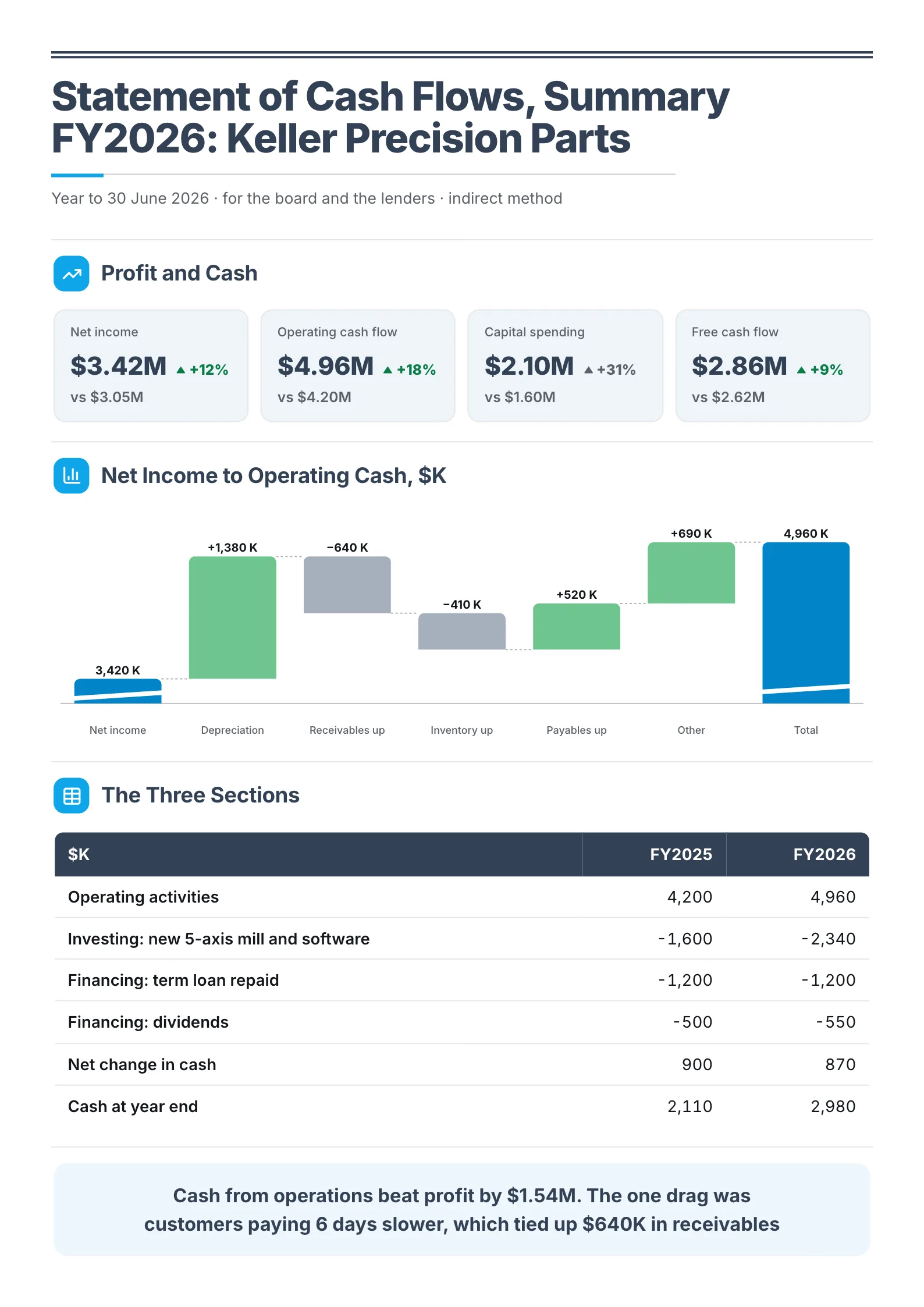
This statement of cash flows summary starts from $3.42M of net income and walks to $4.96M of operating cash. Its note says "Cash from operations beat profit by $1.54M," and names the drag: customers paying 6 days slower, which tied up $640K in receivables. That's Wiki Education's lesson in a factory.
A dental practice waiting on insurance
 Edit this template
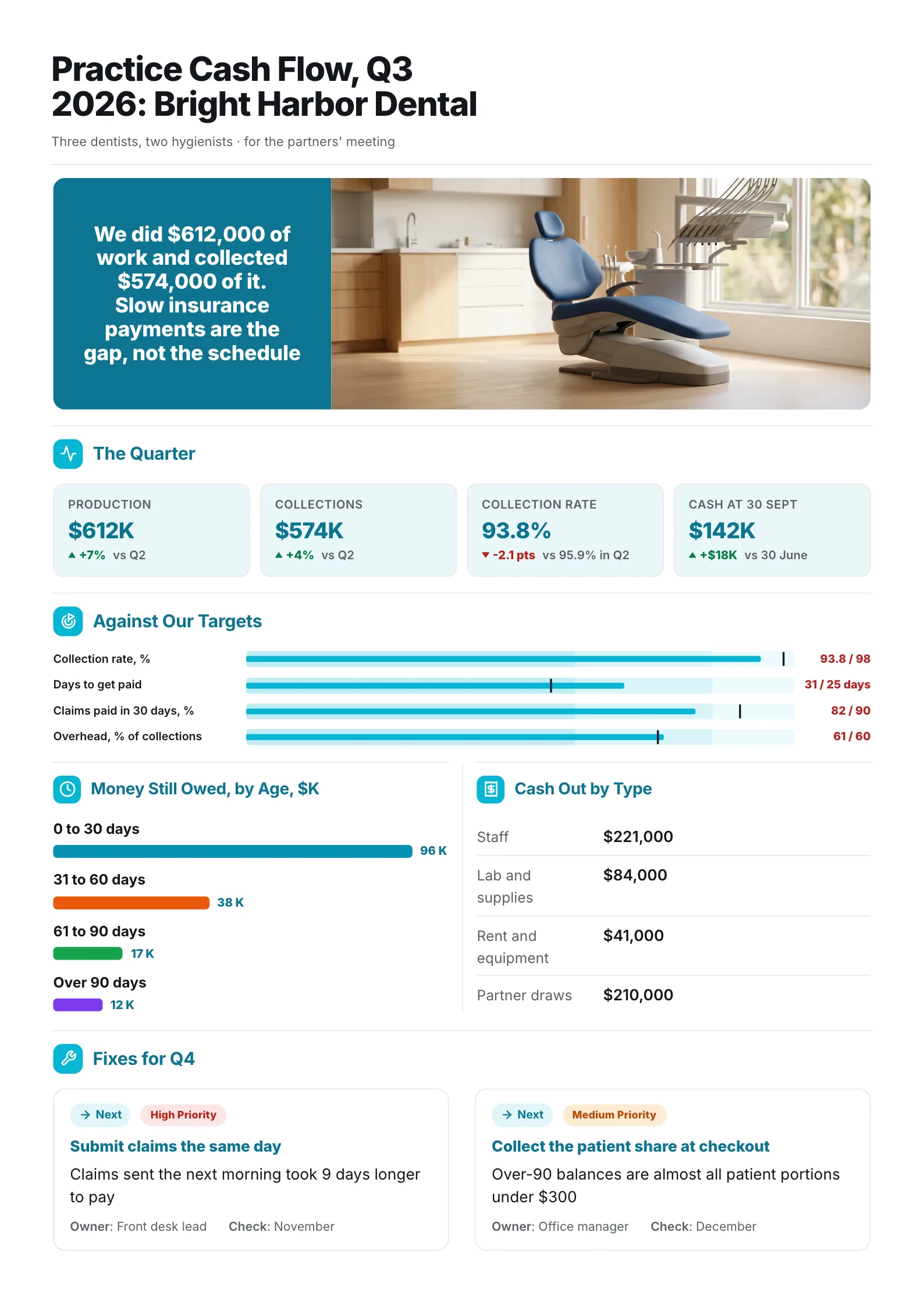
This medical practice cash flow summary opens with the gap in one line. The practice did $612,000 of work and collected $574,000 of it. Days to get paid ran 31 against a 25-day target. The note blames slow insurance payments for the gap.
A print shop that made cash and still lost some
 Edit this template
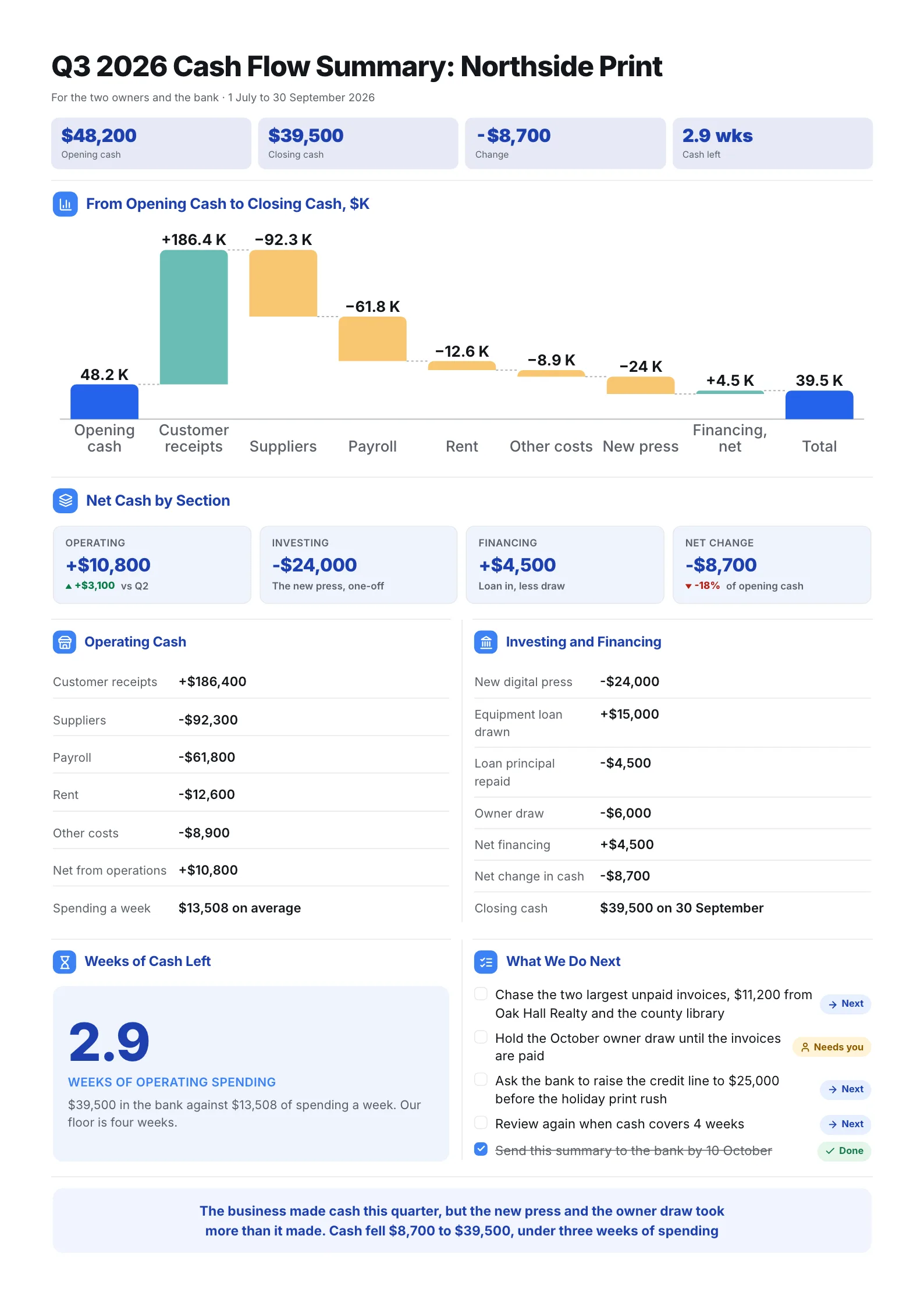
This quarterly cash flow summary shows $10,800 from operations. Then a $24,000 press, $4,500 of loan principal and a $6,000 owner draw take out $34,500, and a $15,000 equipment loan puts some back, so cash falls $8,700. None of those three costs hits the quarter's profit in full. It ends with 2.9 weeks of cash against a four-week floor.
A rental building with a loan to pay down
 Edit this template
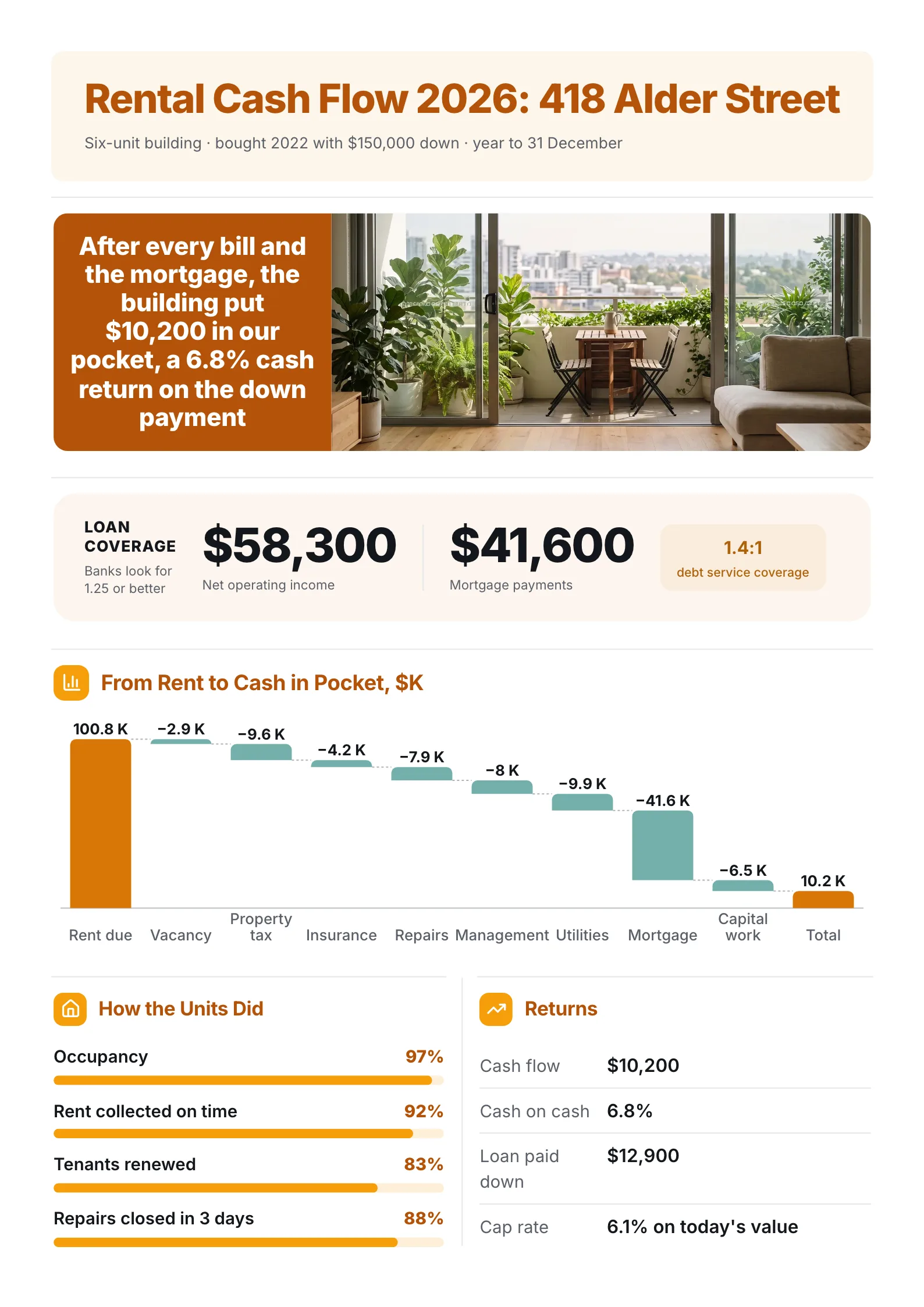
This rental property cash flow puts $10,200 in the owners' pocket after every bill and the mortgage. It also shows $12,900 of loan paid down. That principal left the bank, yet it builds equity and isn't an expense. That's why a rental's profit and its cash rarely match.
An online store that buys before it sells
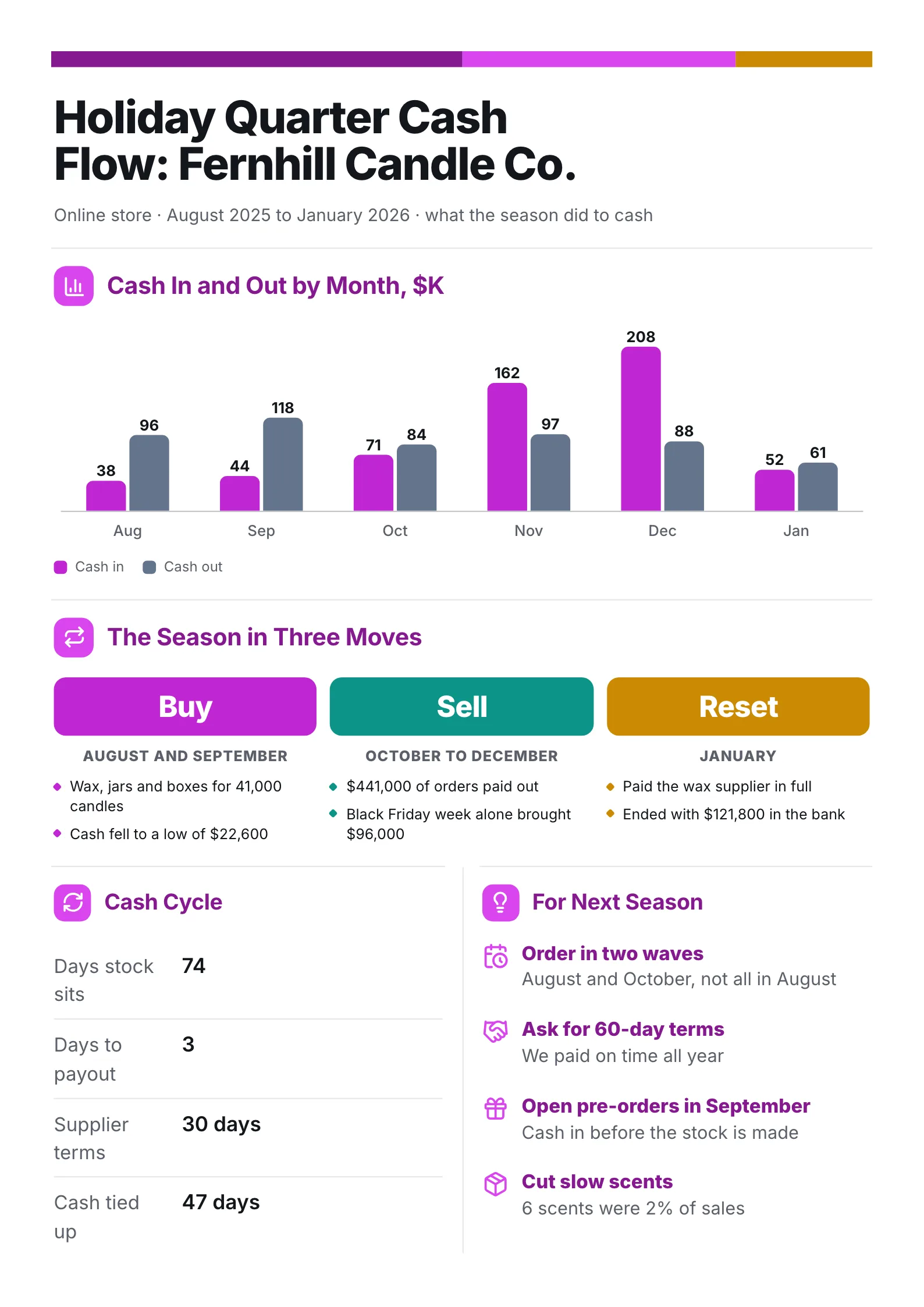 Edit this template
This ecommerce seasonal cash flow buys wax, jars and boxes for 41,000 candles in August and September. Cash falls to a low of $22,600 before $441,000 of orders pay out from October to December. Stock you've paid for is cash you can't spend yet.
How to check your own gap
- Pull your profit and loss statement and your bank balance for the same month.
- Write the change in each, side by side.
- Look up the change in what customers owe you and in your inventory.
- List any loan, owner money in or out, and equipment you bought.
- Add back depreciation. What's left over should be small.
For a format that lays all of this out, see our guide to the cash flow summary format. For six real companies' statements, read cash flow examples. And to build the other half, start from our profit and loss template.
Show both numbers on a One-Pager
Start with a MakeOnepagers cash flow layout and put your profit and your change in cash at the top, with the lines that split them underneath. If your numbers live in a spreadsheet, paste them into the free AI One-Pager generator. You'll get a draft with both figures laid out, ready for you to check line by line.
Frequently asked questions
Is cash flow the same as net income?
No. Net income counts sales and costs when they're earned or owed. Cash flow counts money when it moves. Wiki Education's net assets fell $261,541 in a year its cash rose $224,870.
Why is my cash lower than my profit?
Usually customers owe you money, you bought stock or equipment, you paid down a loan, or you took a draw. Each one uses cash without lowering profit.
Why is my cash higher than my profit?
Depreciation is the common reason, since it's an expense with no payment. Collecting old invoices, borrowing and putting in your own money also raise cash without raising profit.
Does depreciation affect cash flow?
Not directly. You paid the cash when you bought the asset. Greenville Water added $16,476,534 of depreciation and amortization back to its operating income to get its operating cash.
What does a nonprofit call profit?
A nonprofit reports a "change in net assets." A government-owned utility reports a "change in net position." Both work like a business's net income.




