Cash Flow Summary Format: What 6 Published Statements Keep
A cash flow summary format taken from 6 audited statements: opening cash, three sections, closing cash, and why 2 cities fit theirs in 5 and 8 lines.

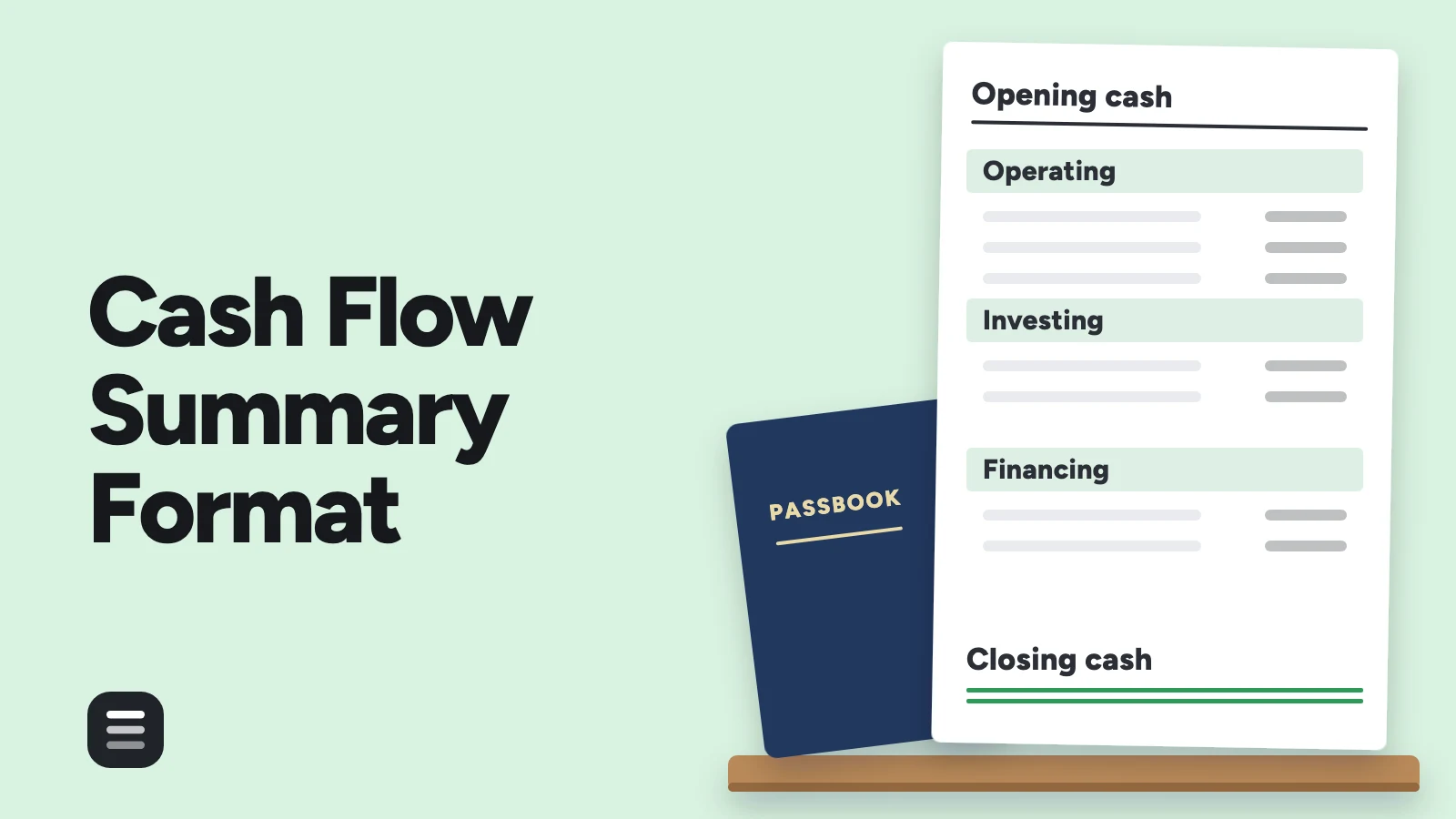
A good cash flow summary format starts with opening cash, moves through operating, investing and financing, and lands on closing cash. You can fit that on one page because the skeleton is short. Most of the length in a formal statement comes from one choice, and you don't have to make it the long way. Start from a free one pager template.
One‑Pager examples
Real One-Pagers made with MakeOnepagers. Open any one to edit it as your own.
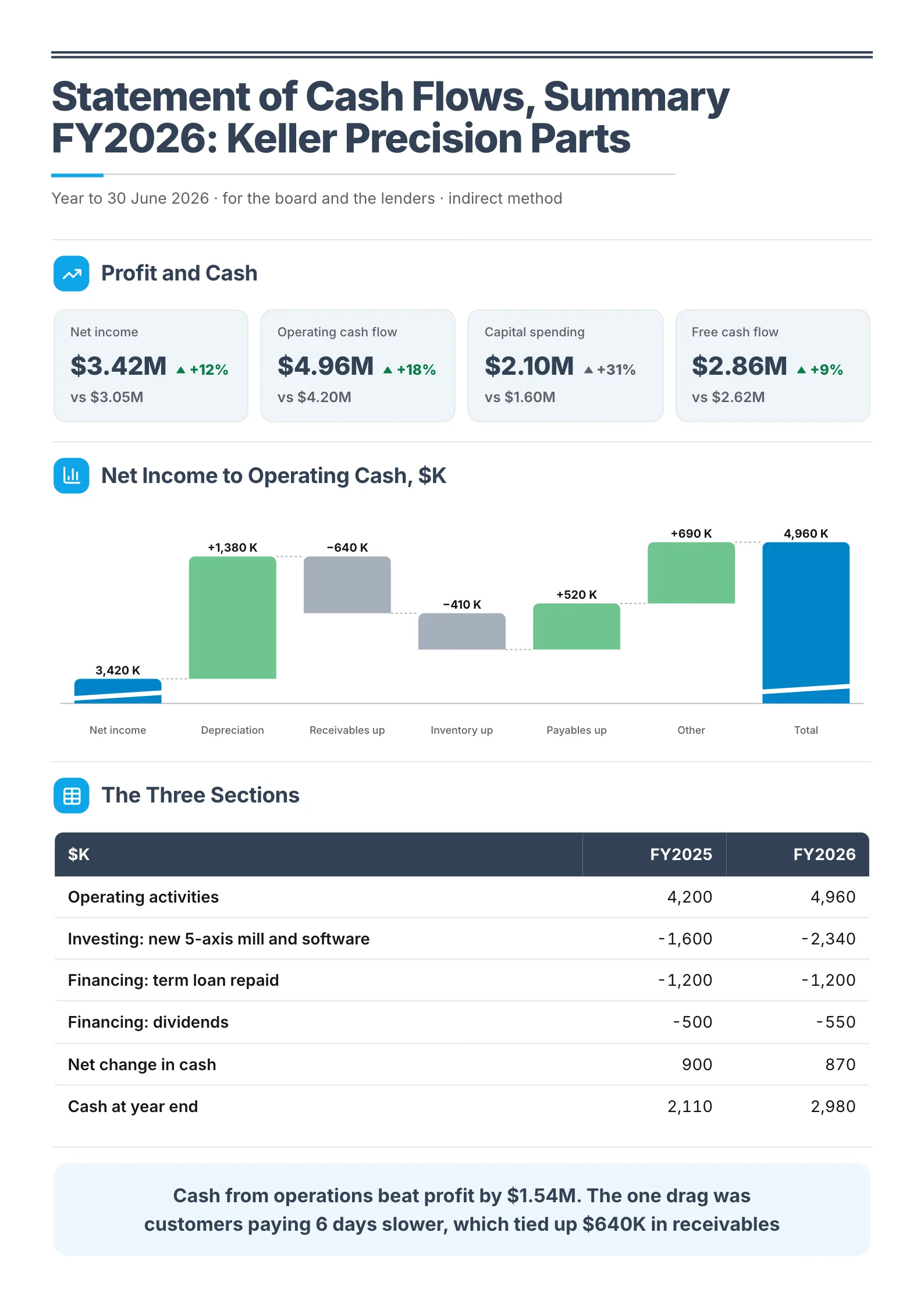 Cash Flow Summary: Manufacturer Year, Indirect MethodEdit for free(opens in a new tab)
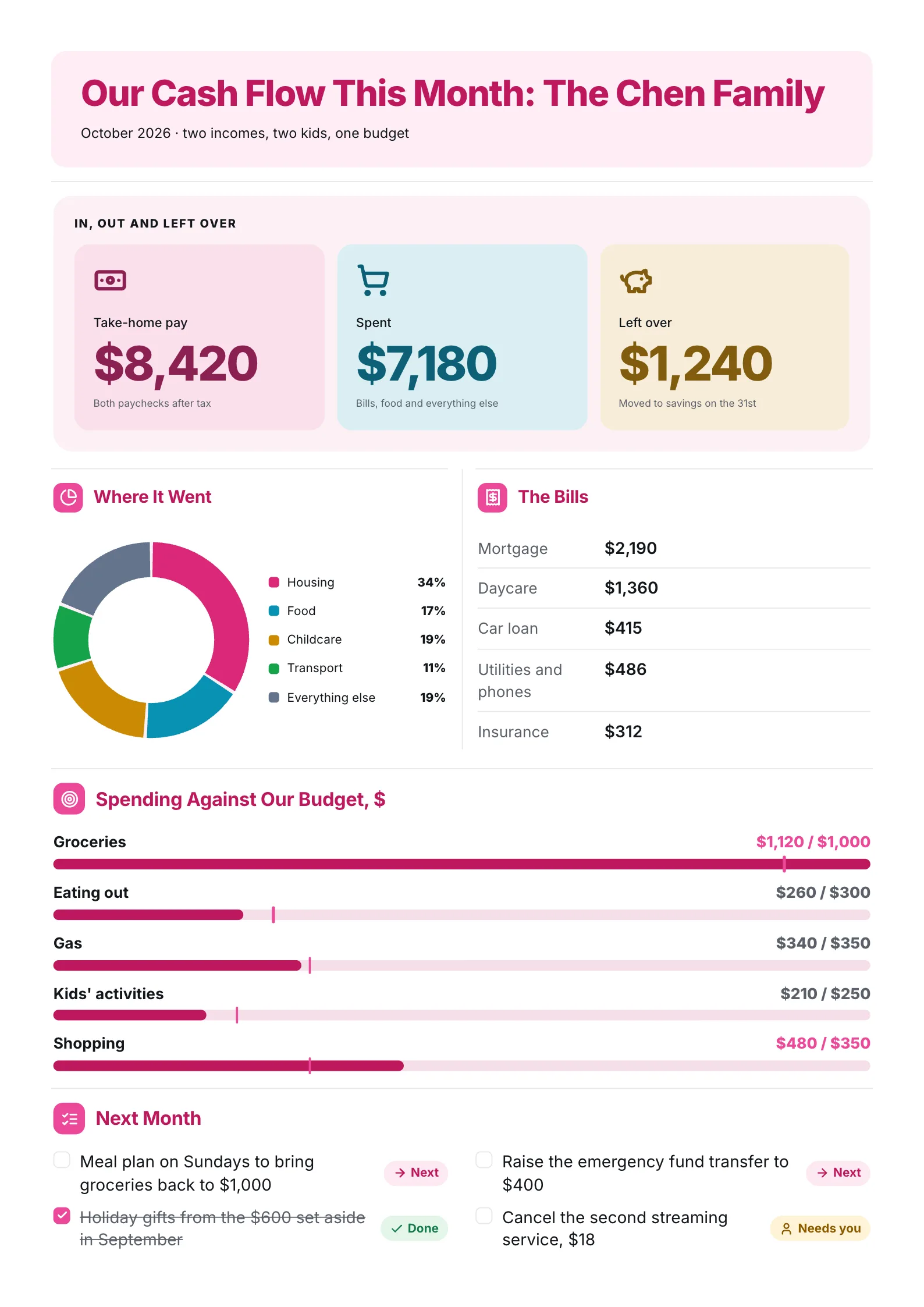 Cash Flow Summary: Household MonthEdit for free(opens in a new tab)
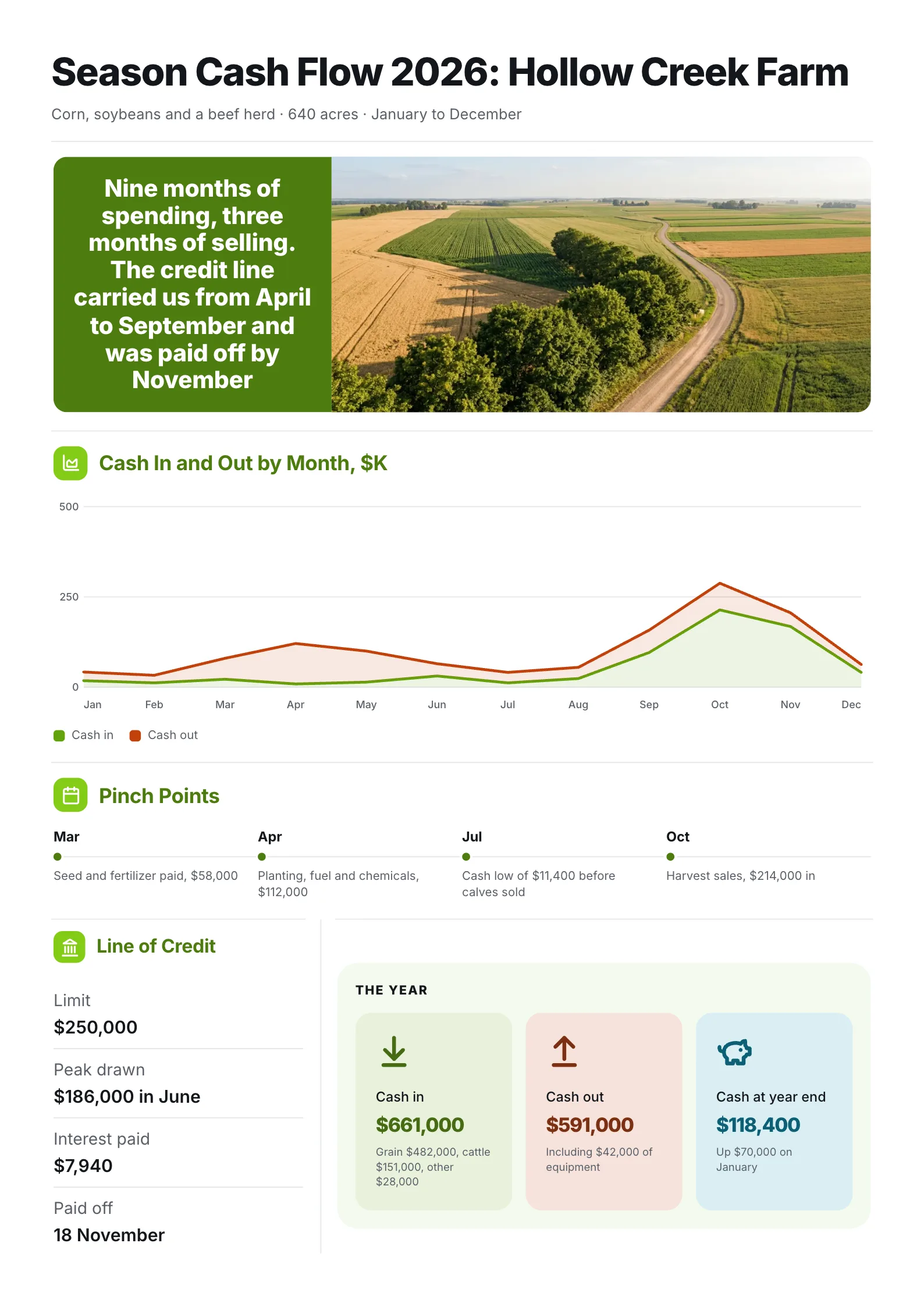 Cash Flow Summary: Farm SeasonEdit for free(opens in a new tab)
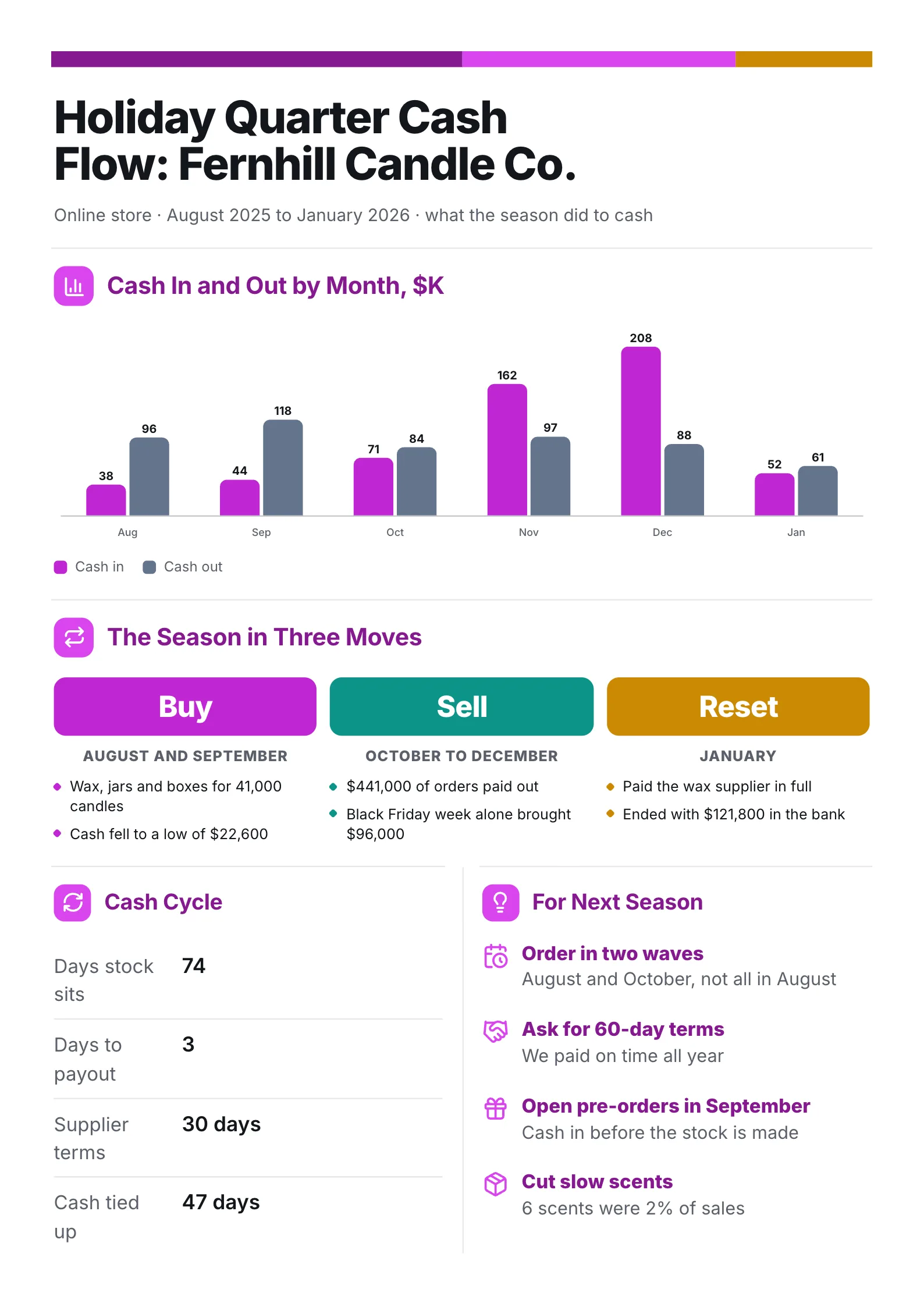 Cash Flow Summary: Online Store Holiday SeasonEdit for free(opens in a new tab)
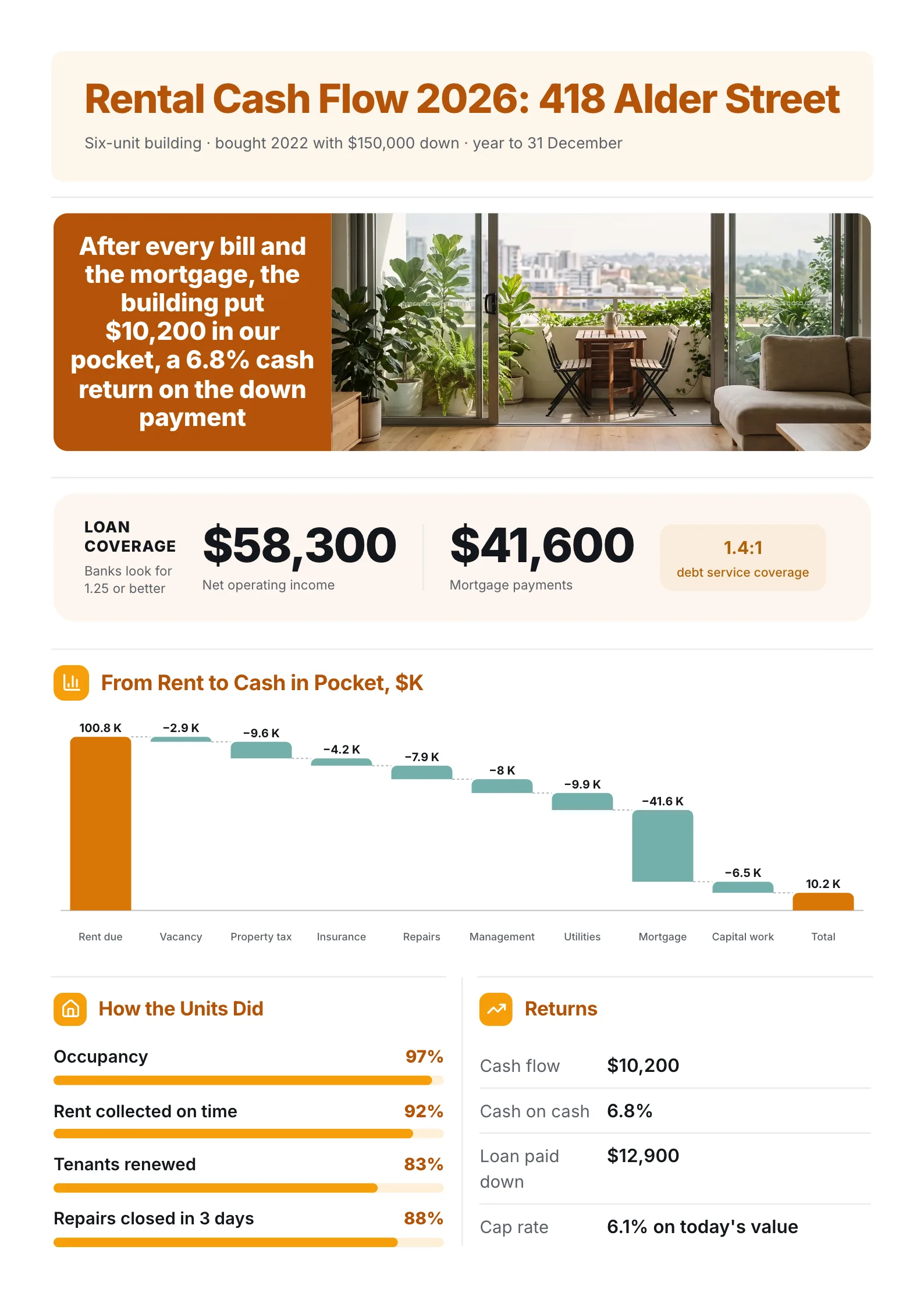 Cash Flow Summary: Rental Property YearEdit for free(opens in a new tab)
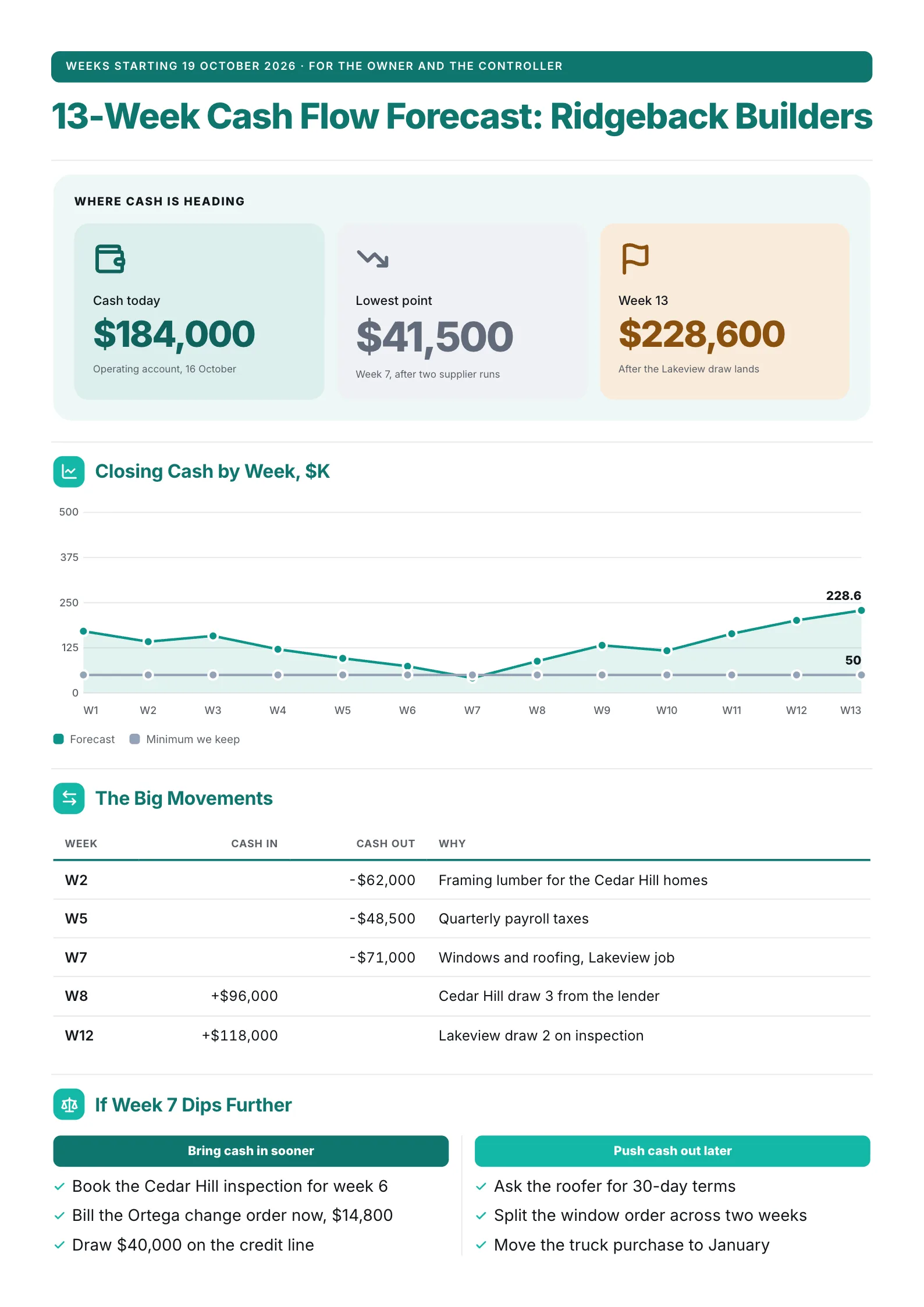 Cash Flow Summary: 13-Week ForecastEdit for free(opens in a new tab)
To find which parts you can't drop, we read 6 audited statements, four from nonprofits and two from small cities. Then we looked at how your reader might get a shorter version.
What the six statements have in common
| Organization | Period | Method | Detail lines | Net change in cash |
|---|---|---|---|---|
| City of Norris, Tennessee, water fund | FY2024 | Direct | 5 | -$25,620 |
| City of Ball Ground, Georgia, utilities | FY2024 | Direct | 8 | -$179,115 |
| Jacobs & Cushman San Diego Food Bank | FY2025 | Indirect | 19 | +$2,404,417 |
| San Francisco AIDS Foundation | FY2024 | Indirect | 20 | +$673,000 |
| Los Angeles Regional Food Bank | 2024 | Indirect | 21 | -$13,127,322 |
| Prevent Cancer Foundation | 2025 | Indirect | 21 | -$13,709 |
Detail lines are the ones we counted above each subtotal, leaving out notes underneath. San Francisco reports in thousands, so its figure is rounded.
You'll see day-to-day cash first in all six, then investing and financing, with the two cities calling theirs "capital and related financing". All six net those sections and walk from beginning cash to ending cash. The four nonprofits also print a prior year beside the current one, and the two cities don't on this main statement.
Why the two cities are so much shorter
The difference is the method, and your choice of method sets the length of your summary. The direct method lists cash as it moved: money from customers, payments to staff, payments to suppliers. The indirect method starts from the change in net assets and adjusts it back to cash, which takes a line for every non-cash item and every balance that changed.
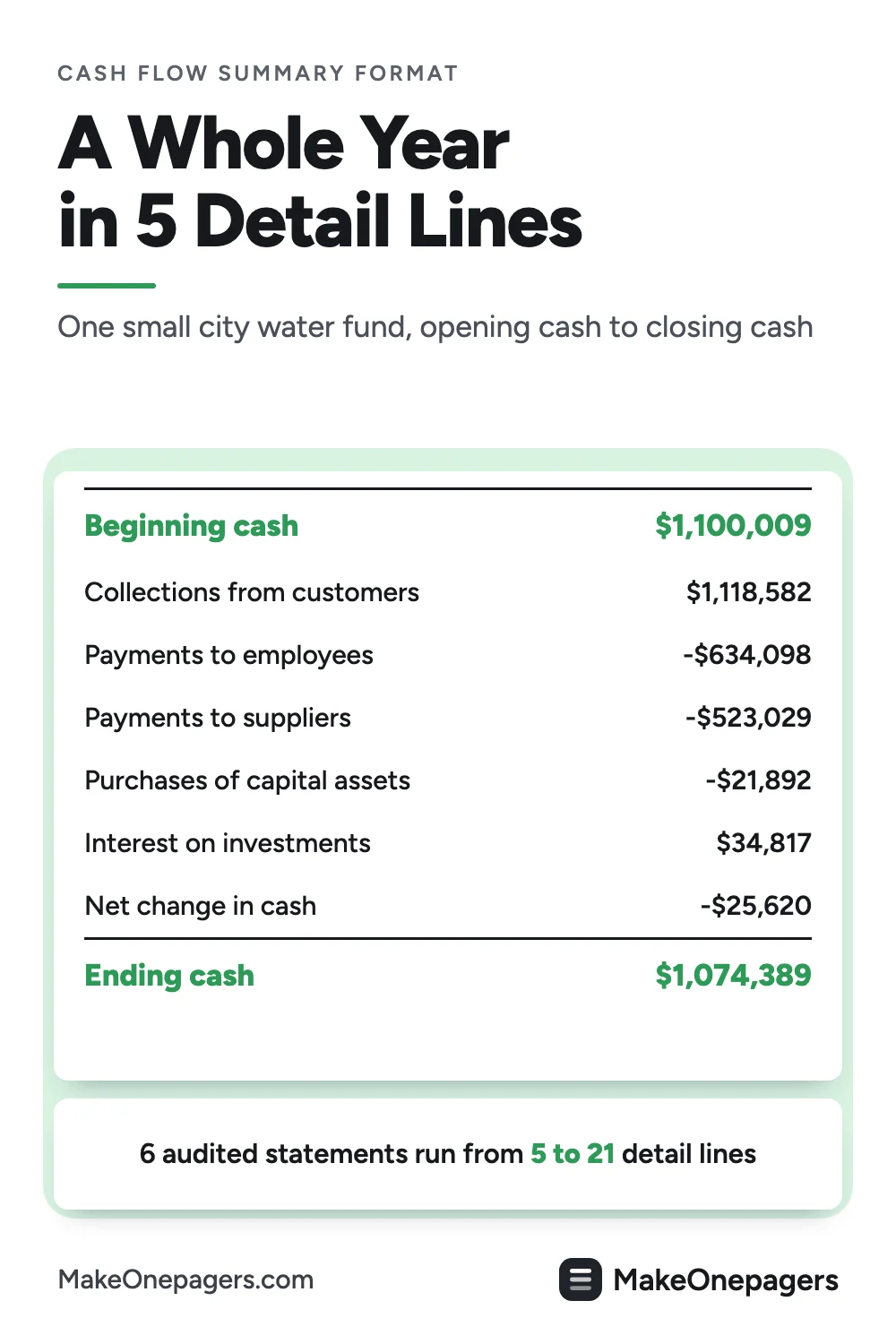
Norris shows how little the direct method needs. Here is its whole water fund statement, with the capital and interest subtotals left out.
| Line | Amount |
|---|---|
| Collections from customers | $1,118,582 |
| Payments to or on behalf of employees | -$634,098 |
| Payments to suppliers | -$523,029 |
| Operating | -$38,545 |
| Purchases of capital assets | -$21,892 |
| Interest on investments and cash deposits | $34,817 |
| Net change in cash | -$25,620 |
| Beginning cash | $1,100,009 |
| Ending cash | $1,074,389 |
Norris ended $25,620 lighter. You can read that in about ten seconds, and your owner or board can too. The Norris statement does still print 11 adjusting lines underneath, so the detail hasn't gone away. It has only moved out of your reader's path, and you can keep your longer version on file for your accountant.
For a very small business, the Australian government's guide trims it further: opening balance, cash incoming, total incoming, cash outgoing, total outgoing, monthly balance, closing balance. You lose the three sections, which is fine until you buy equipment or take out a loan. At that point your summary needs them back, because a press or a truck can drain a month that otherwise looks healthy.
The one sentence no statement writes for you
None of these statements tells you why cash moved, and three of them could fool you if you only looked at the surplus.
- Los Angeles gained $8,960,663 in net assets while its cash fell $13,127,322. It spent $14,510,369 on property and equipment and $8,299,068 on vehicles and equipment for partners.
- San Francisco lost $5,725,000 in net assets and still added $673,000 in cash. Selling investments brought in $19,867,000 against $12,396,000 of purchases.
- Prevent Cancer gained $1,200,711 in net assets, yet $1,152,847 of that was investment gains and trust value changes, so operations produced only $124,847.
So add one plain sentence at the top of your summary, in the style of "Cash fell because we paid for the new building." That line saves your reader from comparing sections.
One format, five readers
You can keep that skeleton and change what sits around it, as these samples from MakeOnepagers do. Every business in them is made up.
Owners and a bank, for one quarter
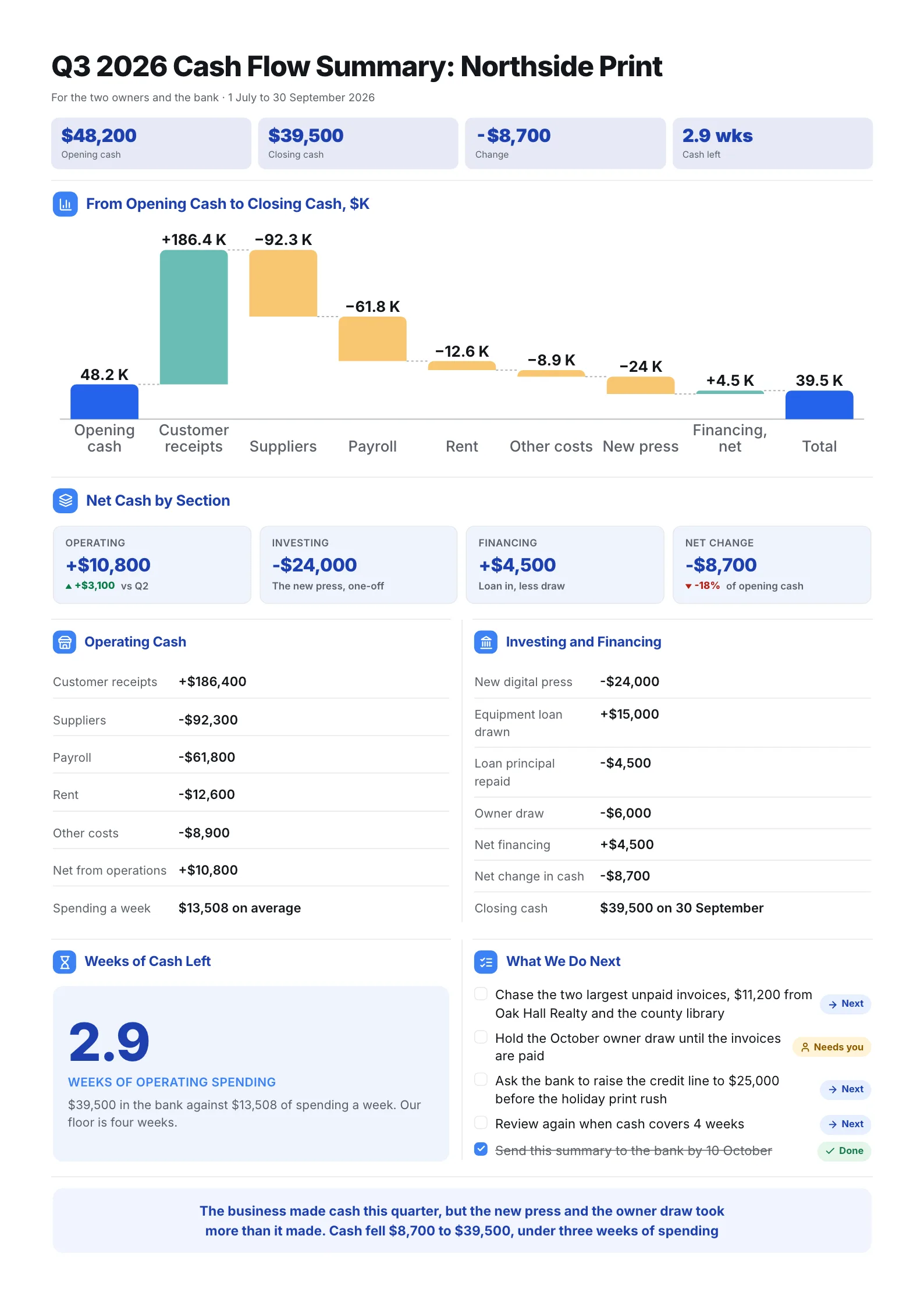
Northside Print walks from $48,200 to $39,500 in a waterfall, then nets each section. Operations made $10,800, the new press took $24,000 and financing added $4,500.
 Edit this template
Its "weeks of cash left" stat turns the closing balance into 2.9 weeks of spending.
A finance committee, with restricted money
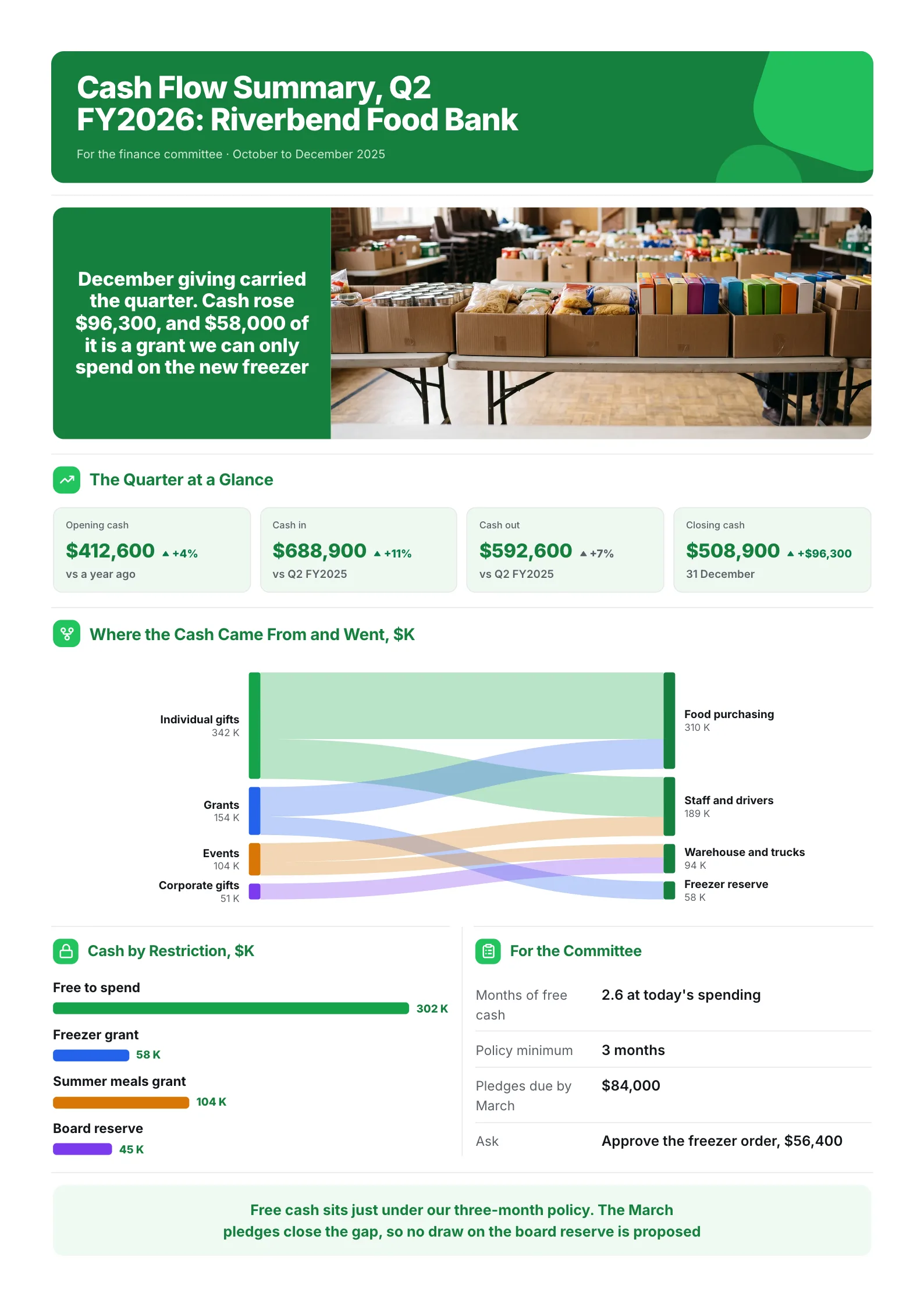
When you run a nonprofit, part of your cash is off limits. Riverbend Food Bank closed at $508,900, and only $302,000 of that is free to spend.
 Edit this template
The restriction bars stop a committee from reading the closing balance as money it can use.
A lender, across three years
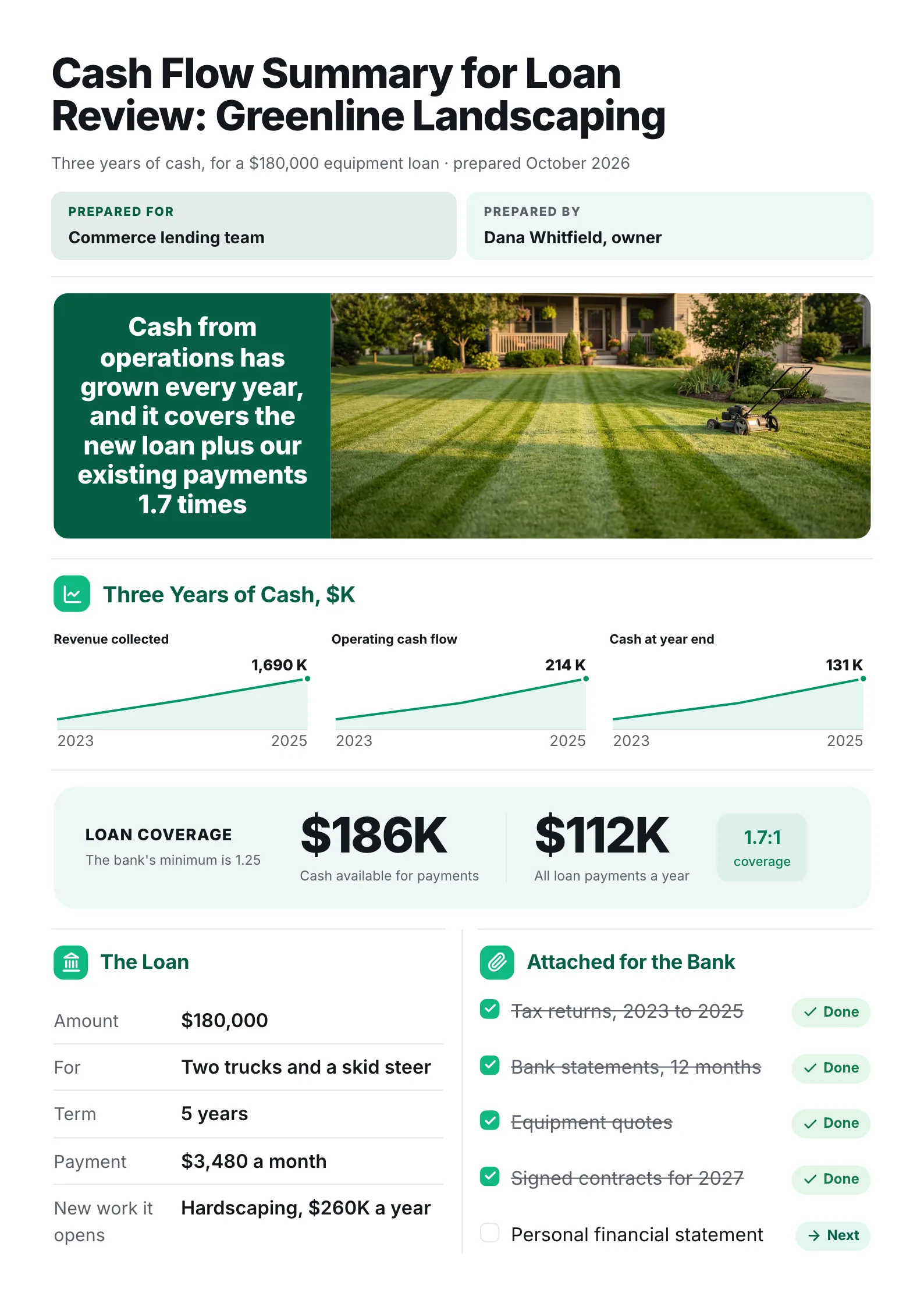
The SBA asks an established business for cash flow statements covering the last three to five years in a traditional business plan. This summary shows three years for a loan request, with coverage beside it: $186K available against $112K of yearly payments.
 Edit this template
Its checklist shows the personal financial statement still open, so the bank knows what's coming.
Owners, every month
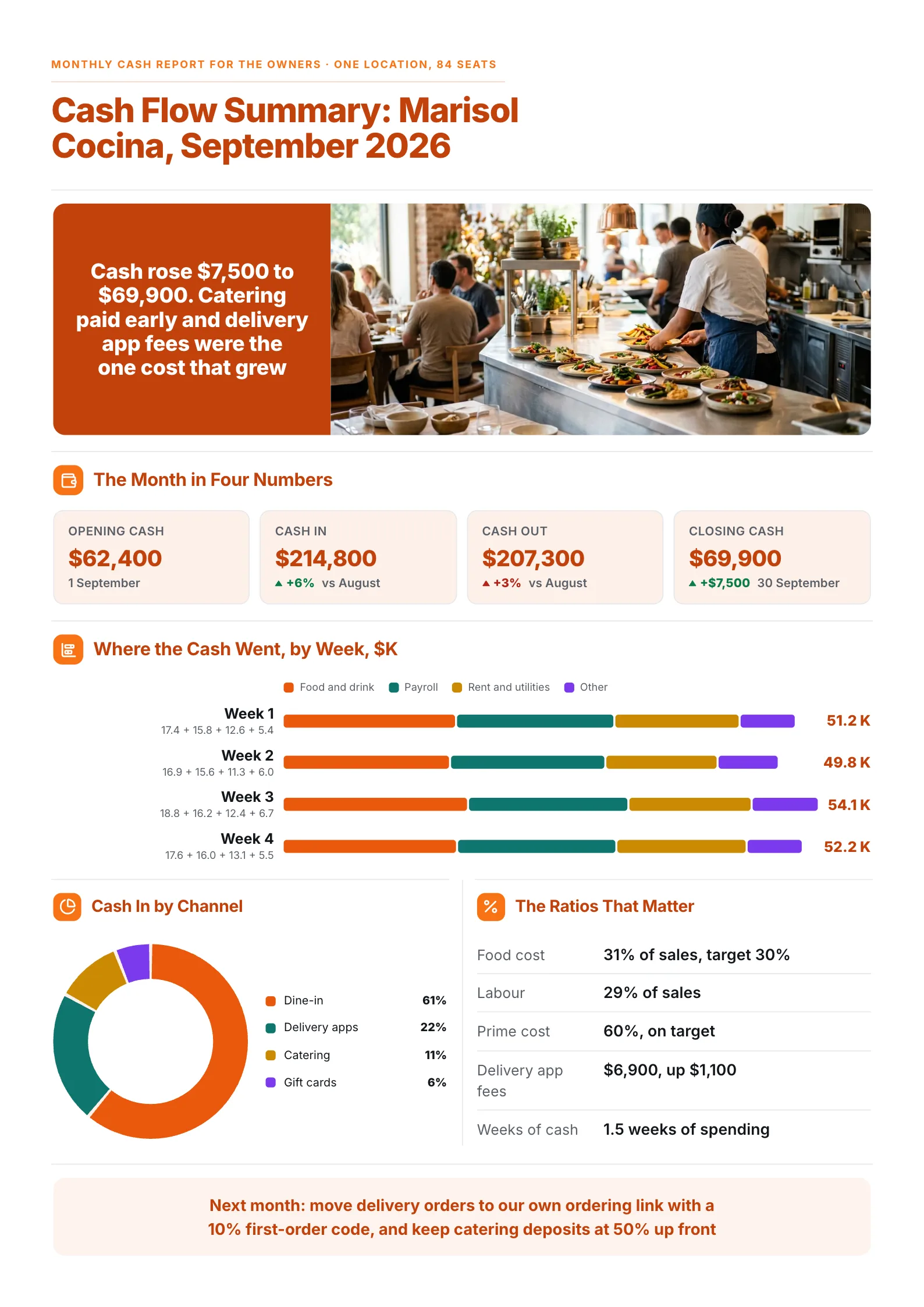
When your cash moves as fast as a restaurant's, a quarterly view comes too late. Marisol Cocina shows opening and closing cash, spending by week and cash in by channel on one sheet.
 Edit this template
The summary line names delivery app fees as the one cost that grew, at $6,900.
Partners who want the gap explained
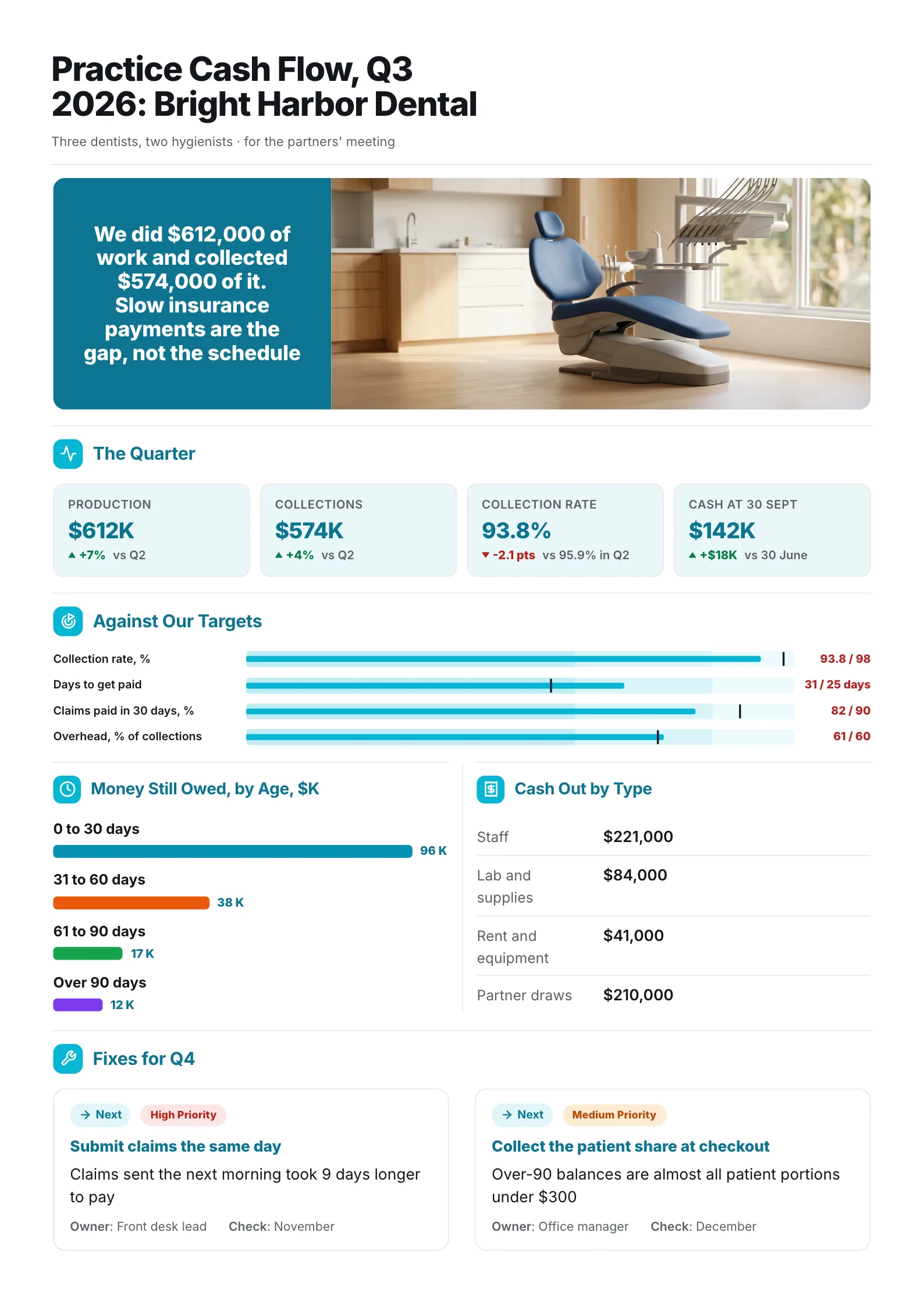
If insurers pay you, the work you did and the cash you collected can differ a lot. Bright Harbor Dental did $612K of work and collected $574K, so its summary leads with that gap.
 Edit this template
Money owed is split by age, with $12K past 90 days.
A format you can copy today
- Title and period: who it's for and the exact dates.
- Why cash moved: one sentence.
- Opening cash.
- Operating: cash in by source, then cash out by type.
- Investing: equipment, property and investments.
- Financing: loans in and out, plus owner draws.
- Net change and closing cash: check it against the bank statement.
- One decision: what happens next because of this number.
For filled-in versions, see our cash flow summary template and these cash flow examples from public companies.
Frequently asked questions
Which cash flow method should a small business use?
Use the direct method for anything an owner or a bank officer will read quickly, since it follows the bank account. Your accountant may still prepare an indirect statement for formal reports. Both methods land on the same operating cash, as the Norris and Ball Ground reconciliations show.
Is a cash flow summary the same as a cash flow statement?
A statement is the formal document, often audited, with every line and its notes. A summary is your shorter version of it for one reader. Keep the section totals identical so that anyone comparing the two gets matching figures.
What period should a cash flow summary cover?
Match how quickly your cash can get into trouble. A restaurant may need monthly, a small service business quarterly, and a loan request several years. The six statements here all cover a full year because they're annual filings.
Should a cash flow summary include a prior period?
It helps, and all four nonprofits above print one. One comparison column lets your reader see whether a $25,000 drop is new or a habit, and you can add it without much extra room.




