BlogGuide
Cash Flow Summary Template: Free, With 5 Examples
A free one-page cash flow summary template, the 7 parts it needs, a worked quarter with real arithmetic and the mistakes that hide a cash crunch.

By MakeOnepagers Team
Updated · 11 min read

A cash flow summary template turns a month or a quarter of bank activity into one page that answers the only question an owner, a board or a lender really asks about cash: how much do we have, why did it change, and how long will it last? Profit can look healthy while the bank balance falls, because profit counts sales when they are made and cash counts them when the money arrives. A short cash flow summary closes that gap. Below are the seven parts it needs, a free cash flow summary template you can copy, a worked example with the arithmetic shown, five cash flow summary examples and the mistakes that hide a cash crunch until it is too late.
One‑Pager examples
Real One-Pagers made with MakeOnepagers. Open any one to edit it as your own.
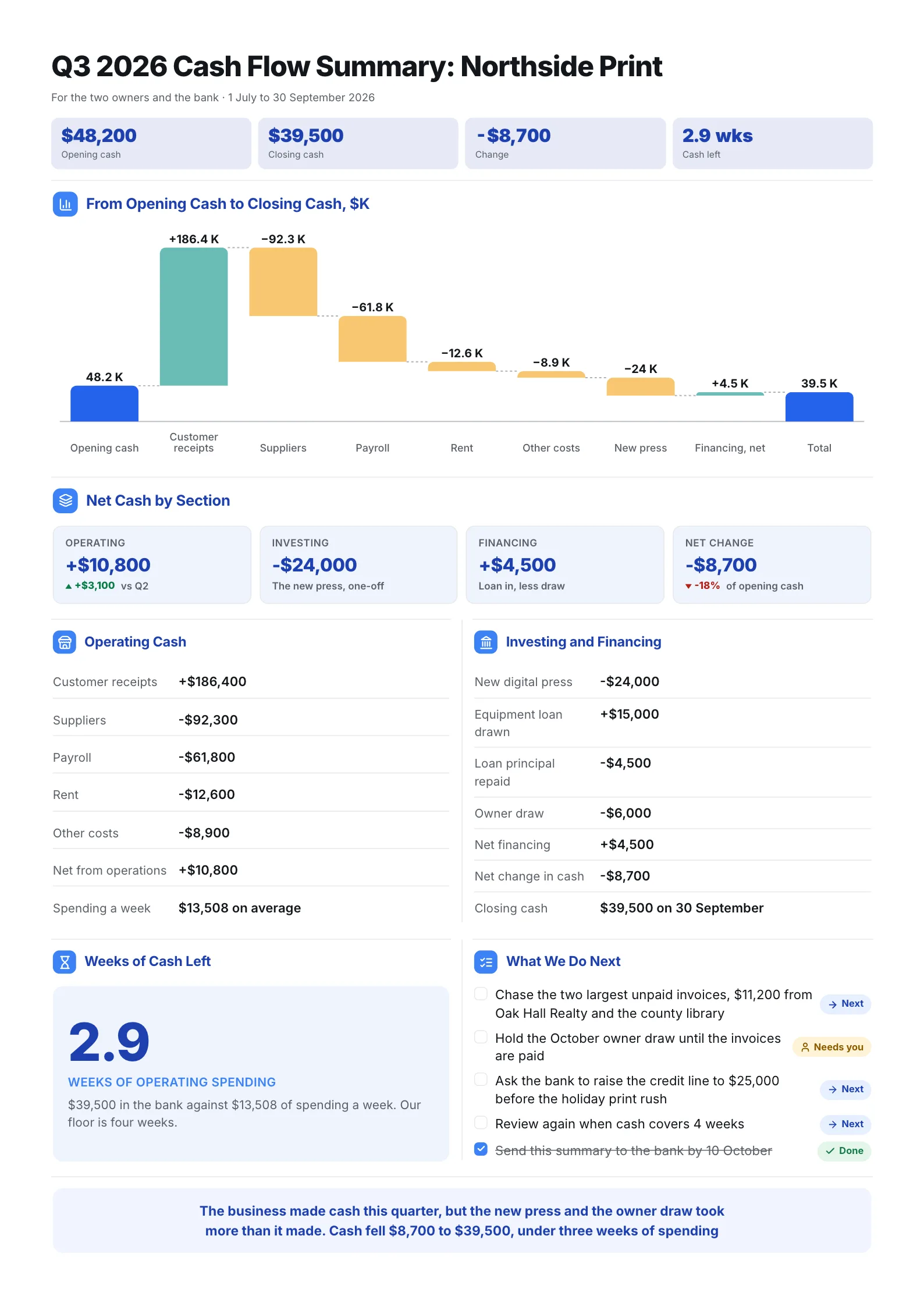 Cash Flow Summary: Print Shop QuarterEdit for free(opens in a new tab)
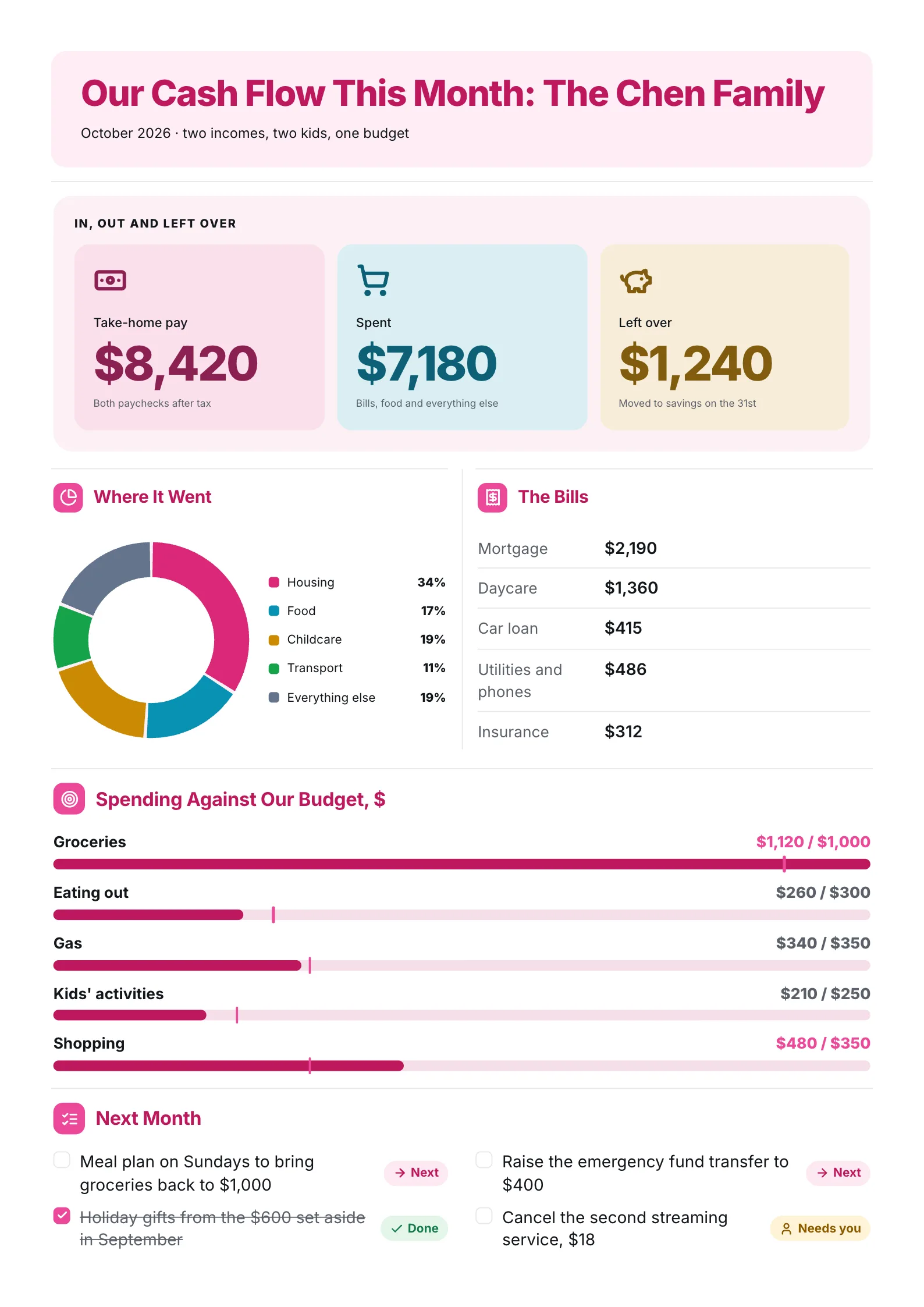 Cash Flow Summary: Household MonthEdit for free(opens in a new tab)
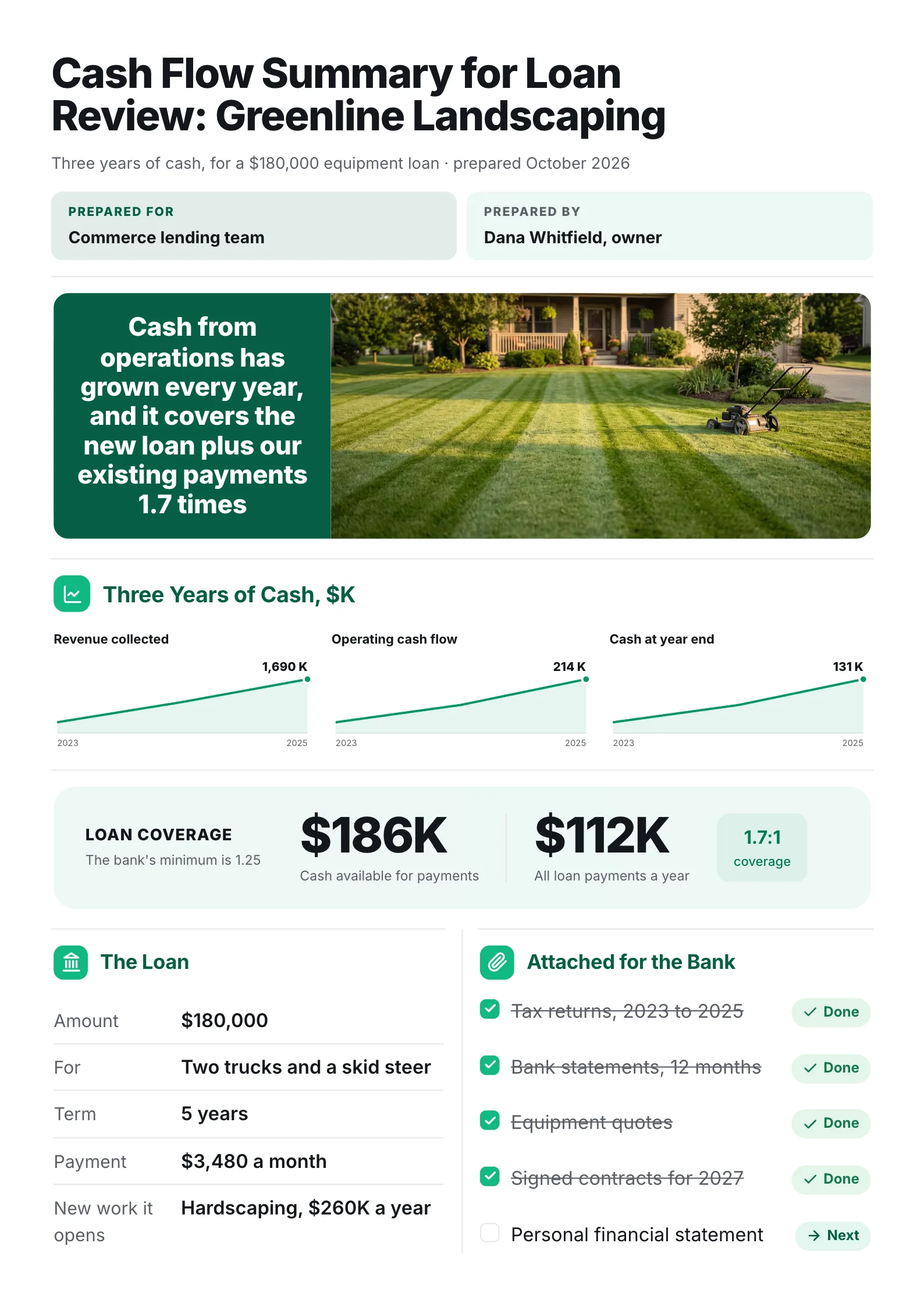 Cash Flow Summary: Loan ApplicationEdit for free(opens in a new tab)
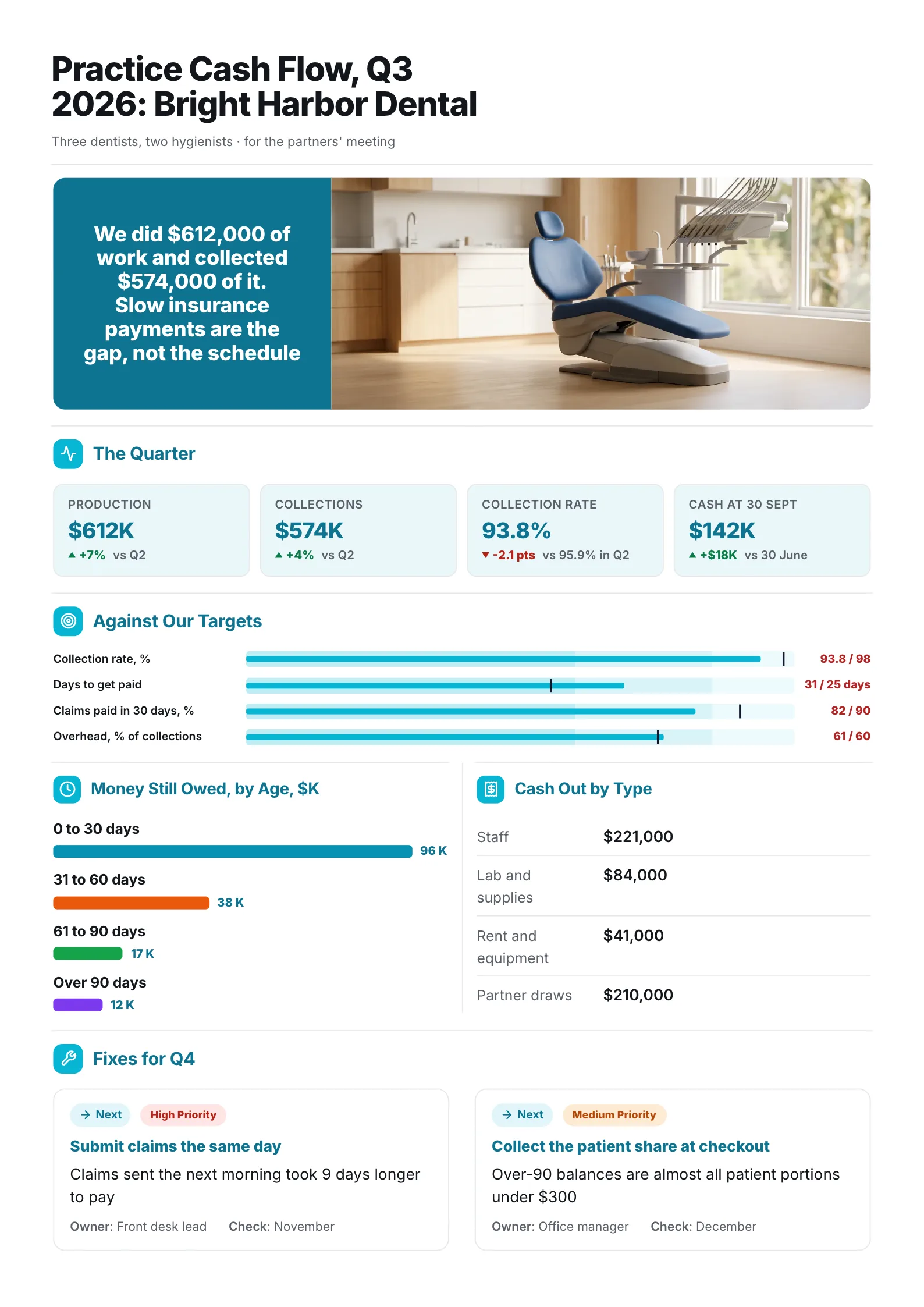 Cash Flow Summary: Dental Practice QuarterEdit for free(opens in a new tab)
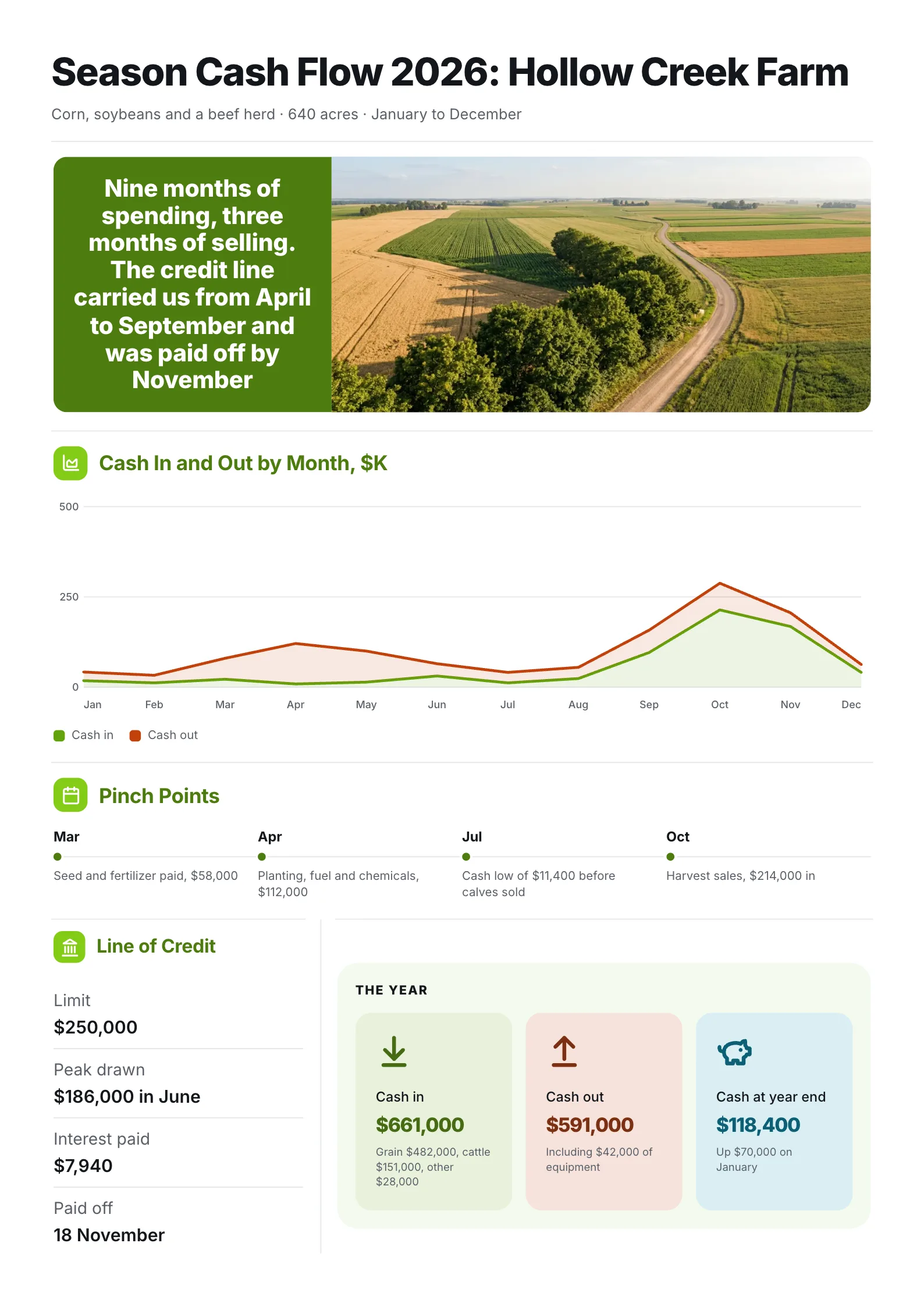 Cash Flow Summary: Farm SeasonEdit for free(opens in a new tab)
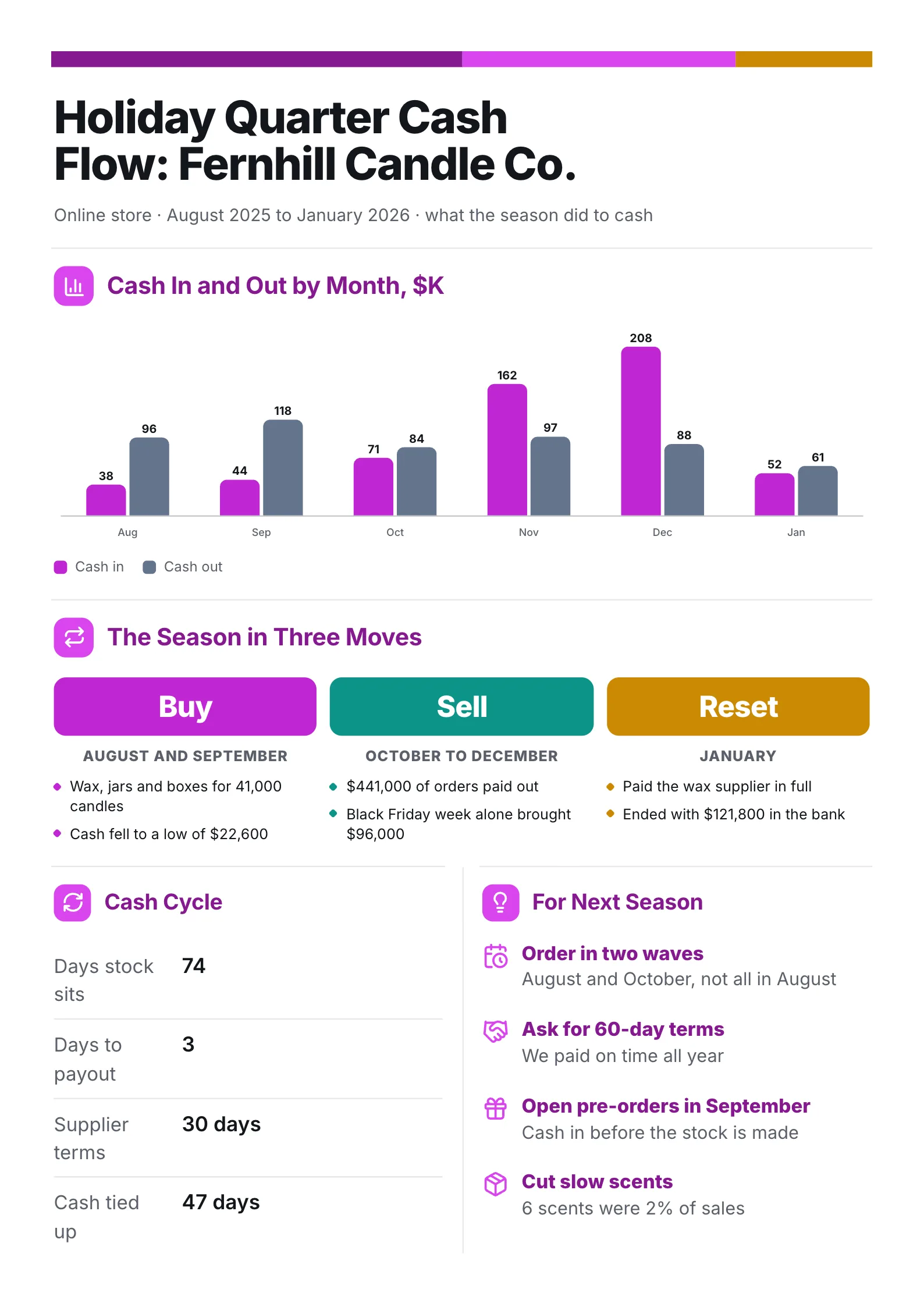 Cash Flow Summary: Online Store Holiday SeasonEdit for free(opens in a new tab)
Every example below was made with MakeOnepagers. Each one opens as a template you can edit for free: every word, chart and color.
What is a cash flow summary?
A cash flow summary is the short version of a cash flow statement. The full statement lists every line in three sections. The summary keeps the totals, the few lines that moved the most and one sentence on why. It is written for people who need to act on cash but will not read a ledger: a business owner, a finance committee, a partner, a bank.
It usually follows the same three sections as a formal statement of cash flows:
- Operating cash flow: cash from running the business. Money in from customers, money out to suppliers, staff, rent and tax.
- Investing cash flow: cash spent on, or received from, long-lived things. Equipment, vehicles, software you capitalise, a building.
- Financing cash flow: cash from or to lenders and owners. A loan drawn, loan principal repaid, money the owner put in or took out.
Add the three together and you get the net change in cash for the period. Add that to the opening balance and you get the closing balance, which should match the bank.
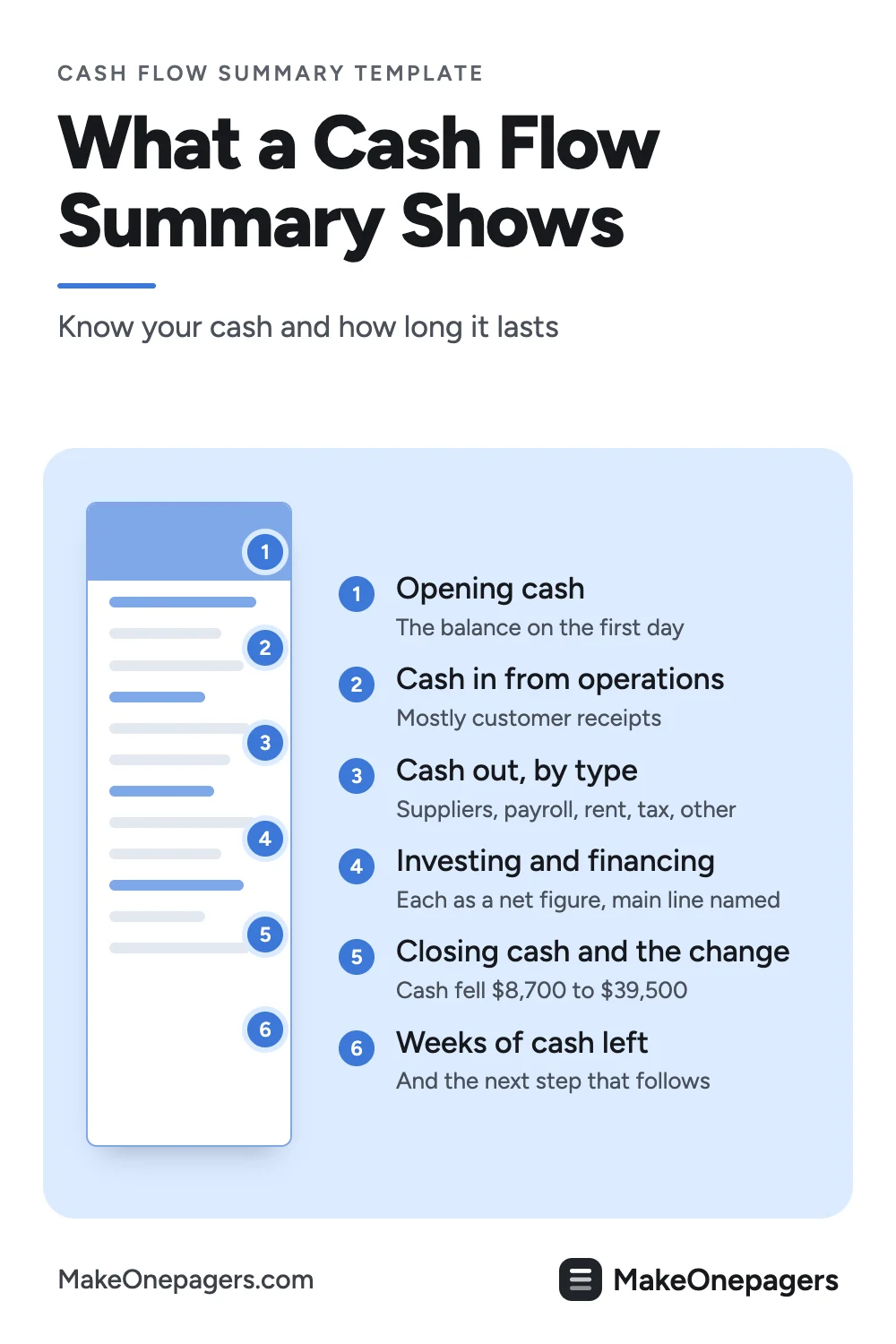
The 7 parts of a cash flow summary
- The period and who it is for. "Q3 2026 cash flow summary, for the owners."
- Opening cash. The balance on the first day of the period.
- Cash in from operations. Mostly customer receipts. Show the total and, if it helps, the two or three biggest sources.
- Cash out from operations, grouped into four to six types: suppliers, payroll, rent, tax, everything else.
- Investing and financing, each as a net figure with its main line named. "New press, minus $24,000."
- Closing cash and the change, in one sentence. "Cash fell $8,700 to $39,500."
- Weeks of cash left and what happens next. The closing balance divided by the average weekly spending, and the one or two actions that follow from it.
Part seven is the one most summaries leave out, and it is the one readers remember. A closing balance means little on its own. "2.9 weeks of spending in the bank" means something to everyone in the room.
A free cash flow summary template
Copy this into a document, or open one of the examples further down and edit it.
| Part | What to write, with an example |
|---|---|
| Title | Period and business. Q3 2026 Cash Flow Summary, Northside Print |
| For | The two owners and the bank |
| Opening cash | $48,200 on 1 July |
| Cash in, operations | Customer receipts $186,400 |
| Cash out, operations | Suppliers, payroll, rent, other, each with its total |
| Net from operations | Plus $10,800 |
| Investing | New press, minus $24,000 |
| Financing | Loan drawn, principal repaid, owner draw: plus $4,500 net |
| Closing cash | $39,500 on 30 September, down $8,700 |
| Weeks of cash | 2.9 weeks of operating spending |
| Next step | The action that follows, with an owner and a date |
A worked example: one quarter at a print shop
The figures below are an example, made up for this guide so the arithmetic is easy to follow. Swap in your own.
Northside Print starts the quarter with $48,200 in the bank.
Operating cash flow
| Line | Q3 |
|---|---|
| Customer receipts | +$186,400 |
| Suppliers (paper, ink, parts) | -$92,300 |
| Payroll | -$61,800 |
| Rent | -$12,600 |
| Other operating costs | -$8,900 |
| Net from operations | +$10,800 |
Cash out from operations totals $175,600, so operations add $186,400 minus $175,600, which is $10,800.
Investing cash flow: a new digital press, -$24,000.
Financing cash flow: a $15,000 equipment loan drawn, $4,500 of loan principal repaid and a $6,000 owner draw, so +$4,500 net.
Net change in cash: $10,800 minus $24,000 plus $4,500 is -$8,700.
Closing cash: $48,200 minus $8,700 is $39,500.
Weeks of cash left: operating spending was $175,600 over 13 weeks, about $13,508 a week. $39,500 divided by $13,508 is 2.9 weeks.
The summary sentence writes itself: "The business made cash this quarter, but the new press and the owner draw took more than it made. Cash fell $8,700 to $39,500, under three weeks of spending." The next step follows from it: chase the two largest unpaid customer invoices, and hold the next owner draw until cash covers four weeks again.
That is the whole job of a cash flow summary. Nobody had to read 400 bank lines to reach that decision.
5 cash flow summary examples
Five cash flow summaries for five different readers: restaurant owners, a builder's controller, a food bank's finance committee, a startup board and a manufacturer's lenders. Each one ends on the cash that is left and what it means.
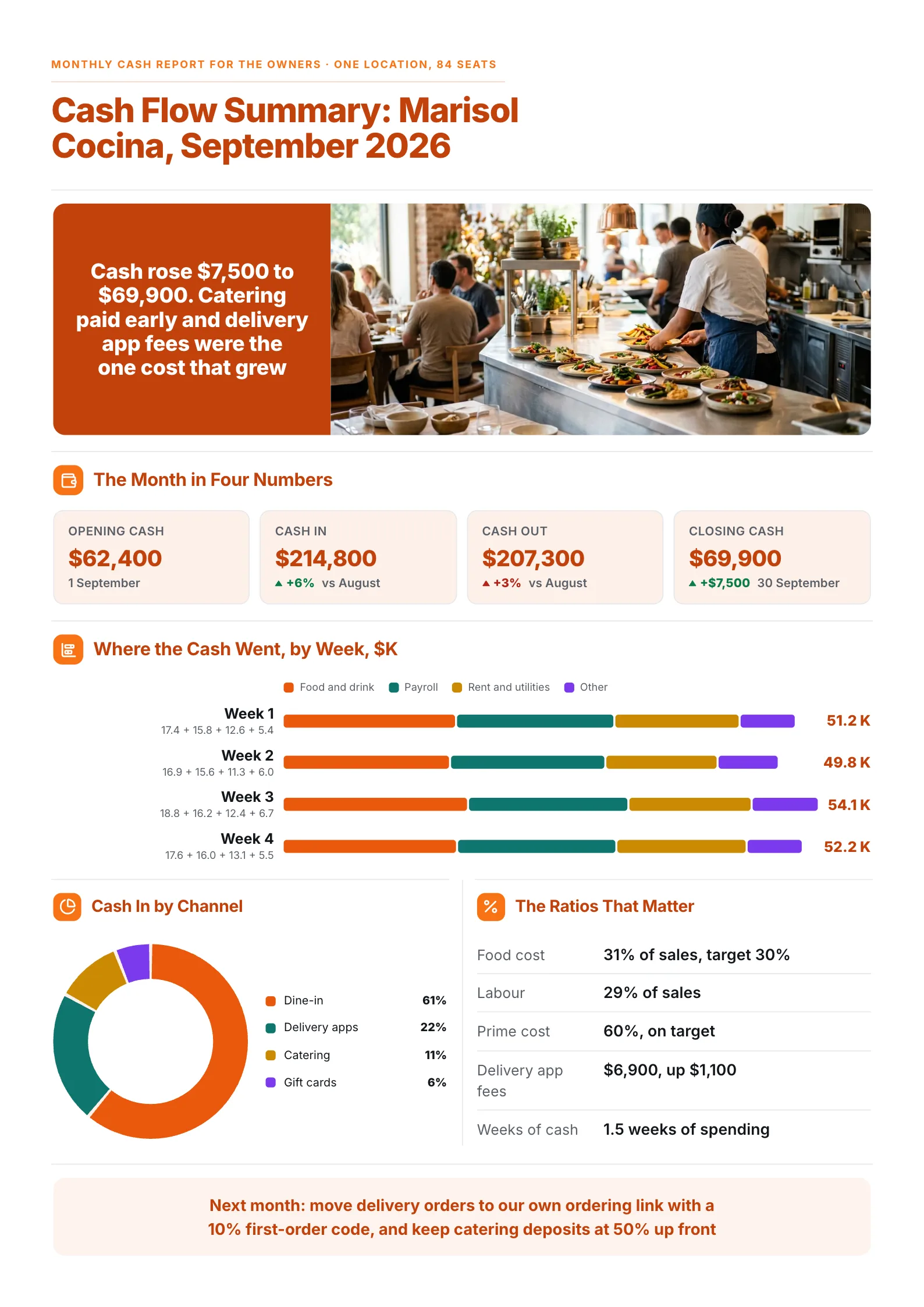
1. Restaurant cash flow summary
 Edit this template
A one-location restaurant's month, with the costs that decide its margin read out under the cash.
What to copy:
- The month in four numbers. Opening cash, cash in, cash out and closing cash, each beside last month.
- Cash in by channel. Dine-in, delivery apps, catering and gift cards, so the owners see where sales come from.
- The one cost that grew, named. Delivery app fees of $6,900, up $1,100.
Edit for free: restaurant monthly cash flow summary template.
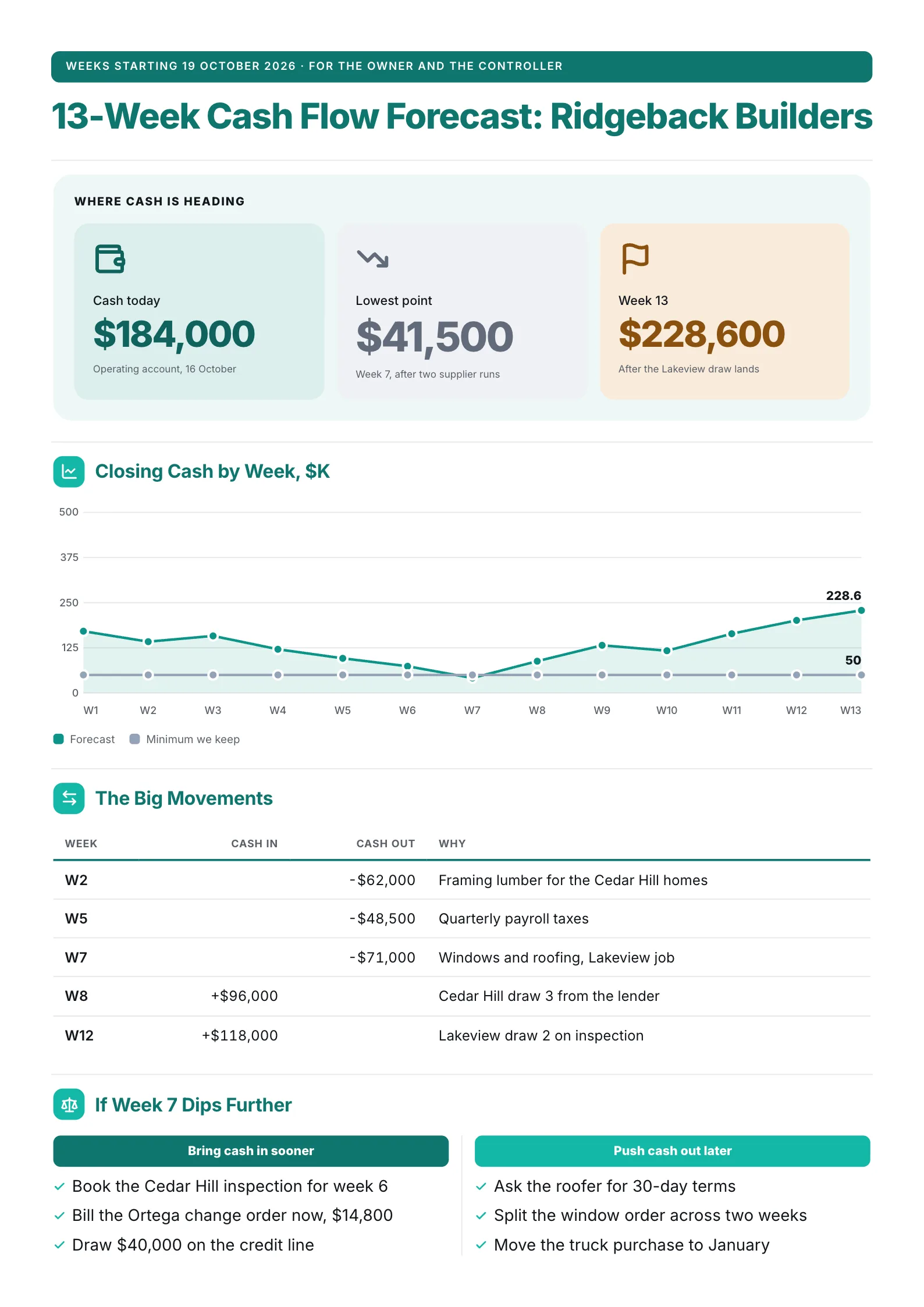
2. 13-week cash flow forecast
 Edit this template
A builder looks forward, not back: closing cash for each of the next 13 weeks against the minimum it keeps.
What to copy:
- The lowest point, marked. $41,500 in week 7, after two supplier runs.
- Only the big movements listed. Framing lumber in week 2, quarterly payroll taxes in week 5, a lender draw of $96,000 in week 8.
- A plan if the low gets lower. Book the Cedar Hill inspection for week 6 and bill the $14,800 change order now.
Edit for free: 13-week cash flow forecast template.
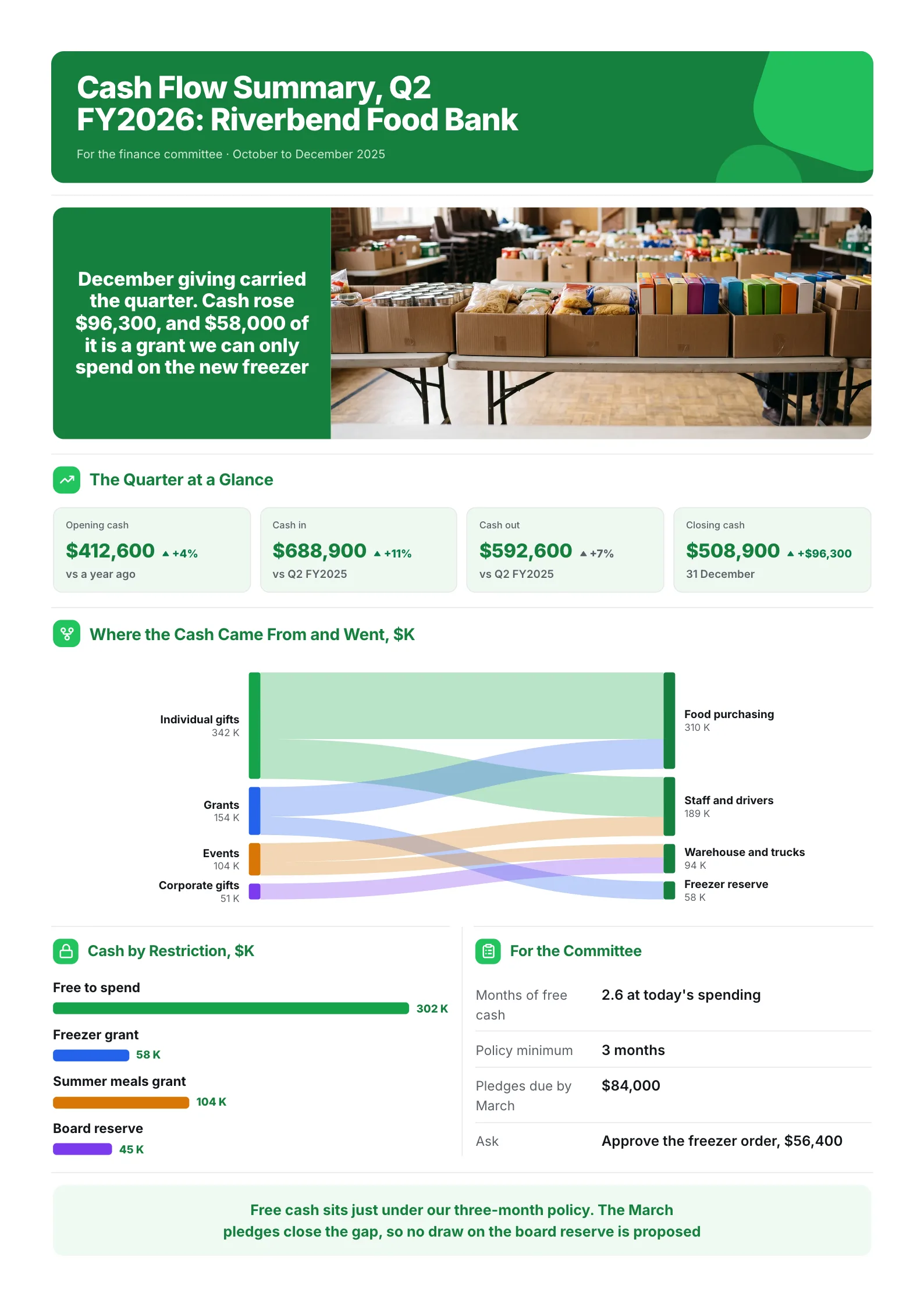
3. Nonprofit cash flow summary
 Edit this template
A food bank's quarter, with the cash it can spend kept apart from the cash a grant has already claimed.
What to copy:
- The caveat in the headline. "Cash rose $96,300, and $58,000 of it is a grant we can only spend on the new freezer."
- Each figure against a year ago. Cash in $688,900, up 11% on the same quarter last year.
- Cash by restriction. Free to spend, the freezer grant and the summer meals grant, each on its own line.
Edit for free: nonprofit cash flow summary template.
4. Startup burn and runway cash flow summary
 Edit this template
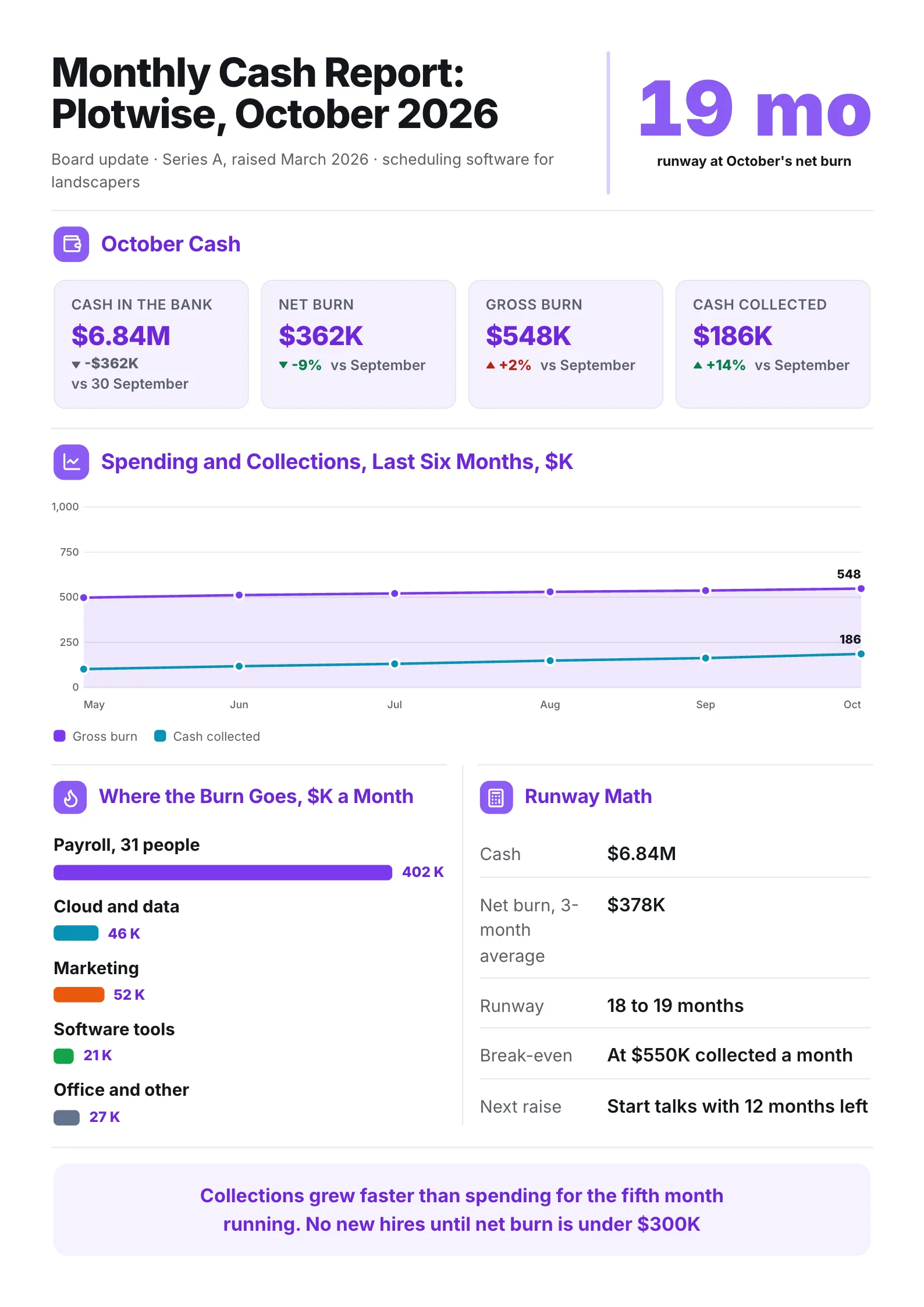
A startup's monthly cash report turns the bank balance into months of runway.
What to copy:
- Gross and net burn side by side. $548K spent, $186K collected, $362K net.
- Runway on a three-month average. $6.84M against $378K a month is 18 to 19 months.
- A rule tied to the number. "No new hires until net burn is under $300K."
Edit for free: startup burn and runway report template.
5. Statement of cash flows summary
 Edit this template
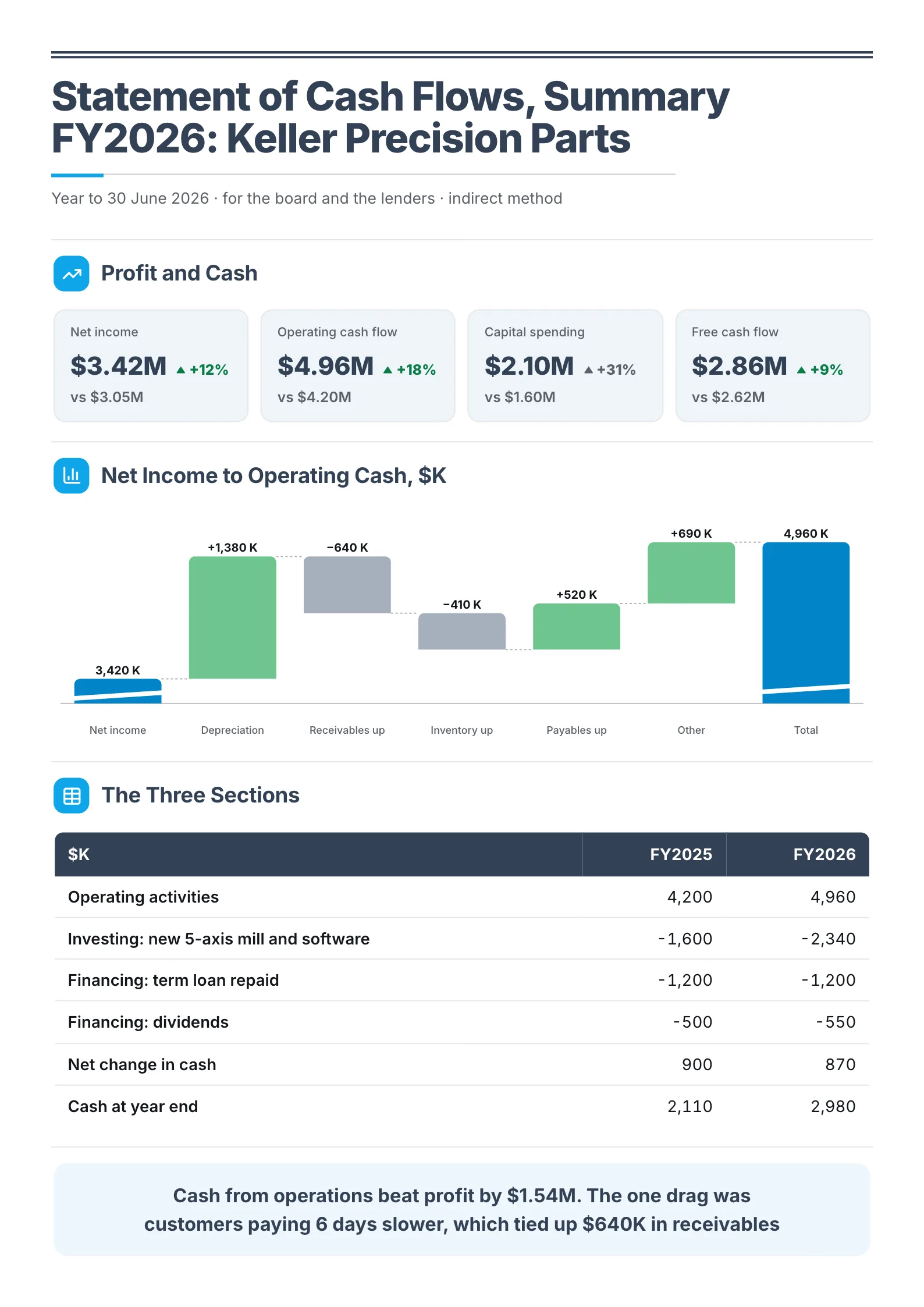
A manufacturer's year for the board and its lenders, bridging profit to cash.
What to copy:
- A bridge from profit to cash. Net income, then depreciation, receivables, inventory and payables, ending at operating cash.
- Free cash flow as its own figure. $2.86M, up 9%.
- The one drag, explained. "Customers paying 6 days slower tied up $640K in receivables."
Edit for free: statement of cash flows summary template.
Cash flow summary vs cash flow statement vs cash flow forecast
These three get mixed up, and searches for one often turn up the others.
| Cash flow statement | Cash flow summary | Cash flow forecast | |
|---|---|---|---|
| Looks at | The past period | The past period | The weeks or months ahead |
| Detail | Every line, in a set format | Totals and the lines that matter | Expected cash in and out by week or month |
| Written for | Accountants, auditors, lenders | Owners, boards, managers | Whoever decides spending |
| Ends with | Closing cash | Closing cash, weeks left, next step | The lowest point and when it comes |
The best habit is to pair them: a one-page summary of the quarter that just ended, with a short forecast of the next 13 weeks on the back.
Direct or indirect method?
A formal statement of cash flows can show operating cash in two ways. The direct method lists cash received from customers and cash paid out by type, as in the example above. The indirect method starts from net profit and adjusts for the items that are not cash, such as depreciation and changes in what customers owe you.
For a summary that people outside finance will read, the direct method is almost always clearer. "Customers paid us $186,400" needs no explanation. "Profit plus depreciation minus the increase in receivables" does. If your accountant prepares the indirect version, you can still write the summary in direct terms from the bank feed.
How to write a cash flow summary in 6 steps
- Pull the opening and closing balances from the bank, and check the difference is the net change you are about to explain.
- Sort every movement into operating, investing and financing. Most accounting tools do this for you.
- Group operating cash out into four to six types. Anything smaller goes into "other".
- Write the change in one sentence, with the biggest reason in it.
- Work out weeks of cash left from average weekly operating spending.
- Finish with the action: what you will chase, delay, cut or borrow, who does it and by when.
If you already have the period's bank export or a long finance report as a PDF, the free AI One-Pager generator reads a PDF, Word or PowerPoint file and gives it back as a designed One-Pager, with the figures pulled from your file. Check every total against the bank before you share it.
Cash flow summary mistakes
- Profit presented as cash. A profitable quarter with a falling balance needs explaining, not hiding. Show both and say why they differ.
- No opening balance. Without it, the reader cannot check that the movements add up to the closing figure.
- Twenty lines of operating costs. Group them. The detail belongs in the ledger.
- Investing hidden inside operations. A one-off equipment purchase makes operations look weak when they were fine.
- No weeks-of-cash figure. A balance without a rate of spending answers nothing.
- No next step. If the summary does not lead to a decision, it will not be read twice.
Make your cash flow summary
Open the free cash flow summary template and put in your own months, or drop your bank export or finance report into the free AI One-Pager generator and get a finished summary back.
Frequently asked questions
What should a cash flow summary include?
The period, the opening cash, cash in and out from operations, net investing and financing cash flow, the closing cash and how it changed, the number of weeks of spending the closing cash covers, and the next step.
How often should I write a cash flow summary?
Monthly for most small businesses, and weekly when cash covers fewer than eight weeks of spending. A quarterly summary suits a board or a lender that meets every three months.
What is the difference between cash flow and profit?
Profit counts income when it is earned and costs when they are incurred. Cash flow counts money when it actually moves. A business can be profitable while its customers still owe it money, and run short of cash in the meantime.
Is there a cash flow summary template in Excel?
Most spreadsheet tools include a cash flow template for the detailed numbers. Use it to build the figures, then present them on a one-page summary for the people who decide.