Cash Flow Examples: 6 Real Statements and What They Teach You
Cash flow examples from 6 real 2025 company statements filed with the SEC: 5 made more cash than profit, yet 4 still ended the year with less cash.

The cash flow examples below are real: six 2025 statements that companies you know filed with the SEC, from a steakhouse chain to a homebuilder. Each one tells you where the cash came from and where it went, in three sections. Operating cash comes from selling things and paying your bills. Investing cash goes into long-lived things like stores and machines. Financing cash moves to and from your lenders and owners. Start from a free one pager template.
One‑Pager examples
Real One-Pagers made with MakeOnepagers. Open any one to edit it as your own.
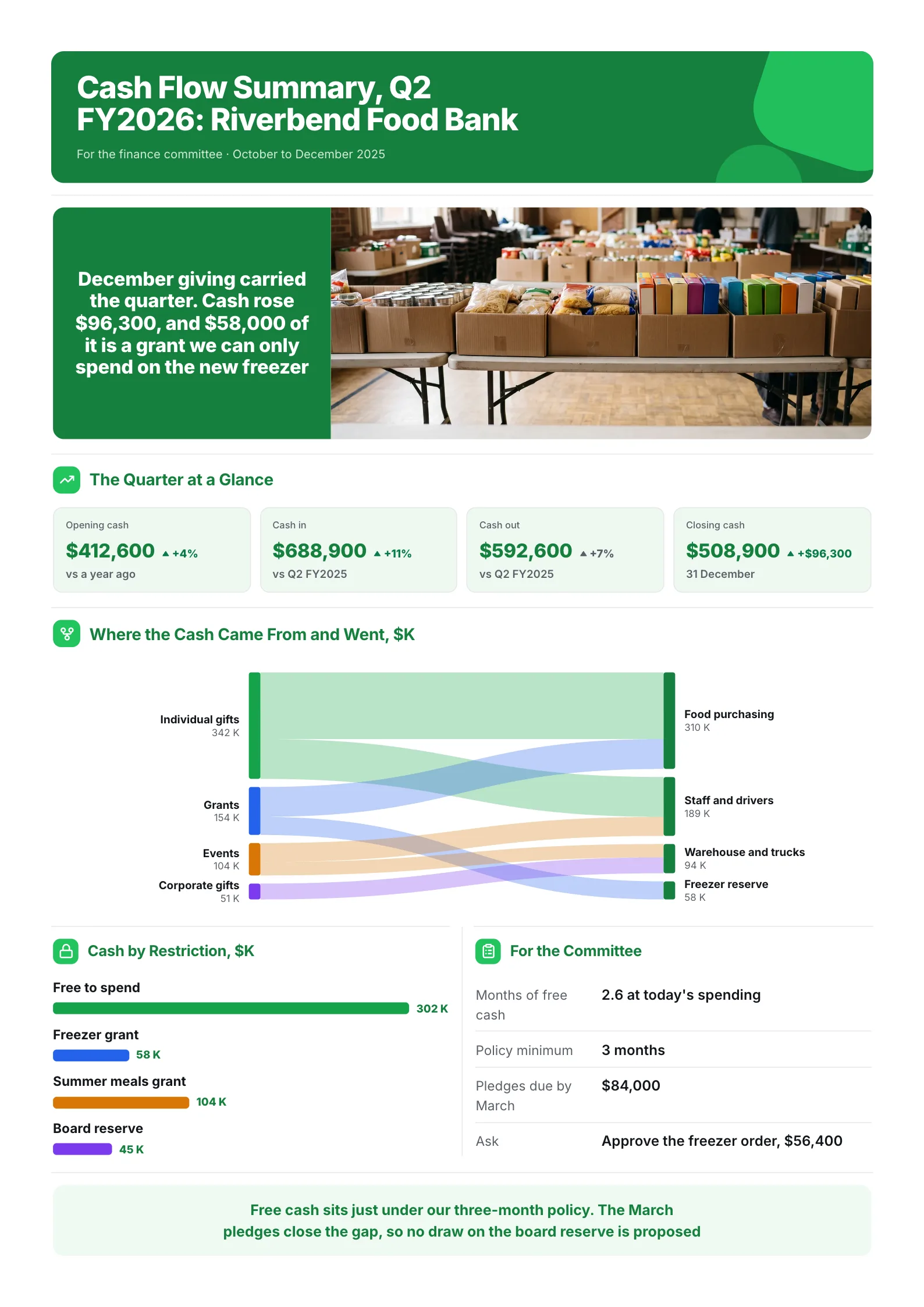 Cash Flow Summary: Food Bank QuarterEdit for free(opens in a new tab)
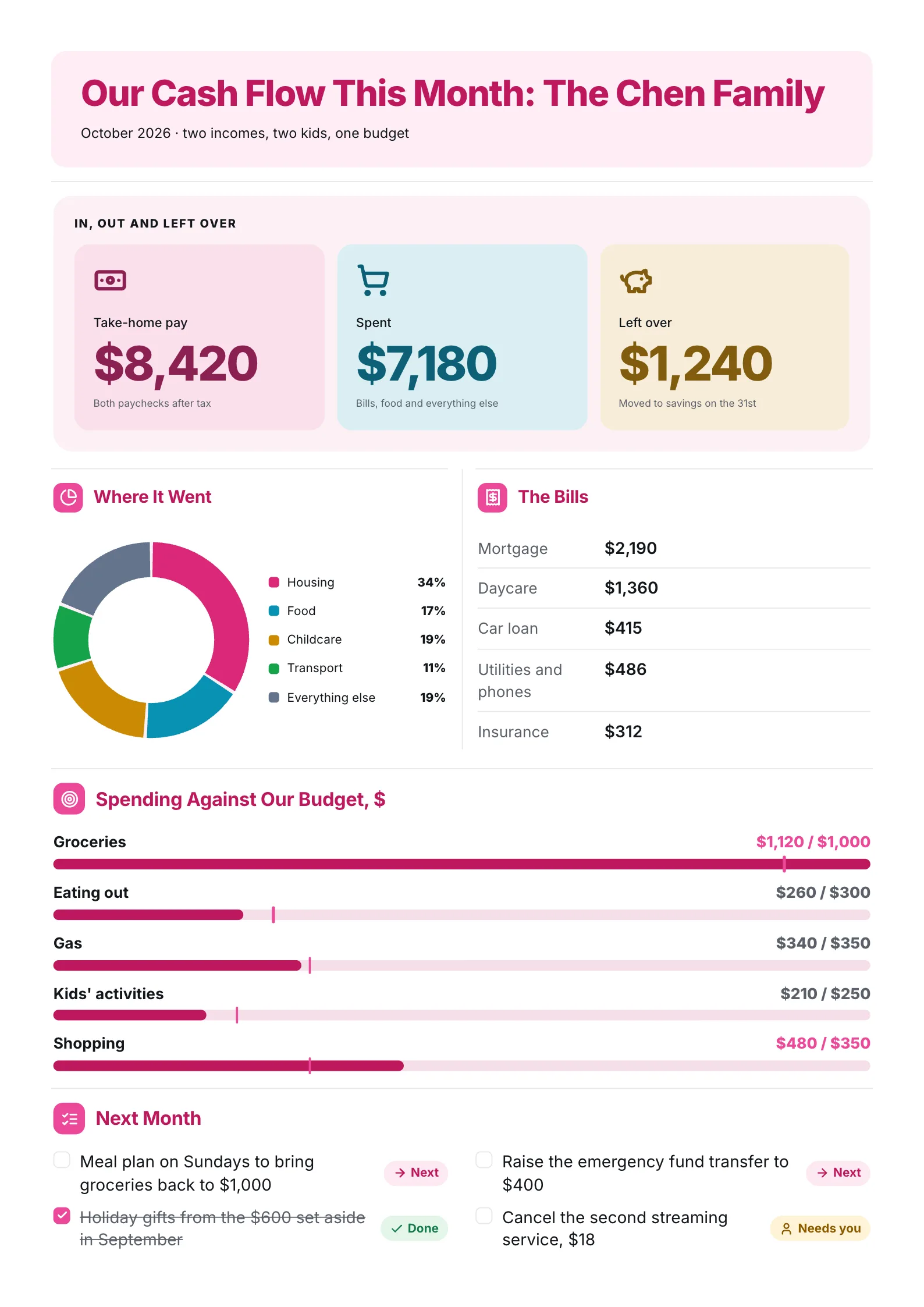 Cash Flow Summary: Household MonthEdit for free(opens in a new tab)
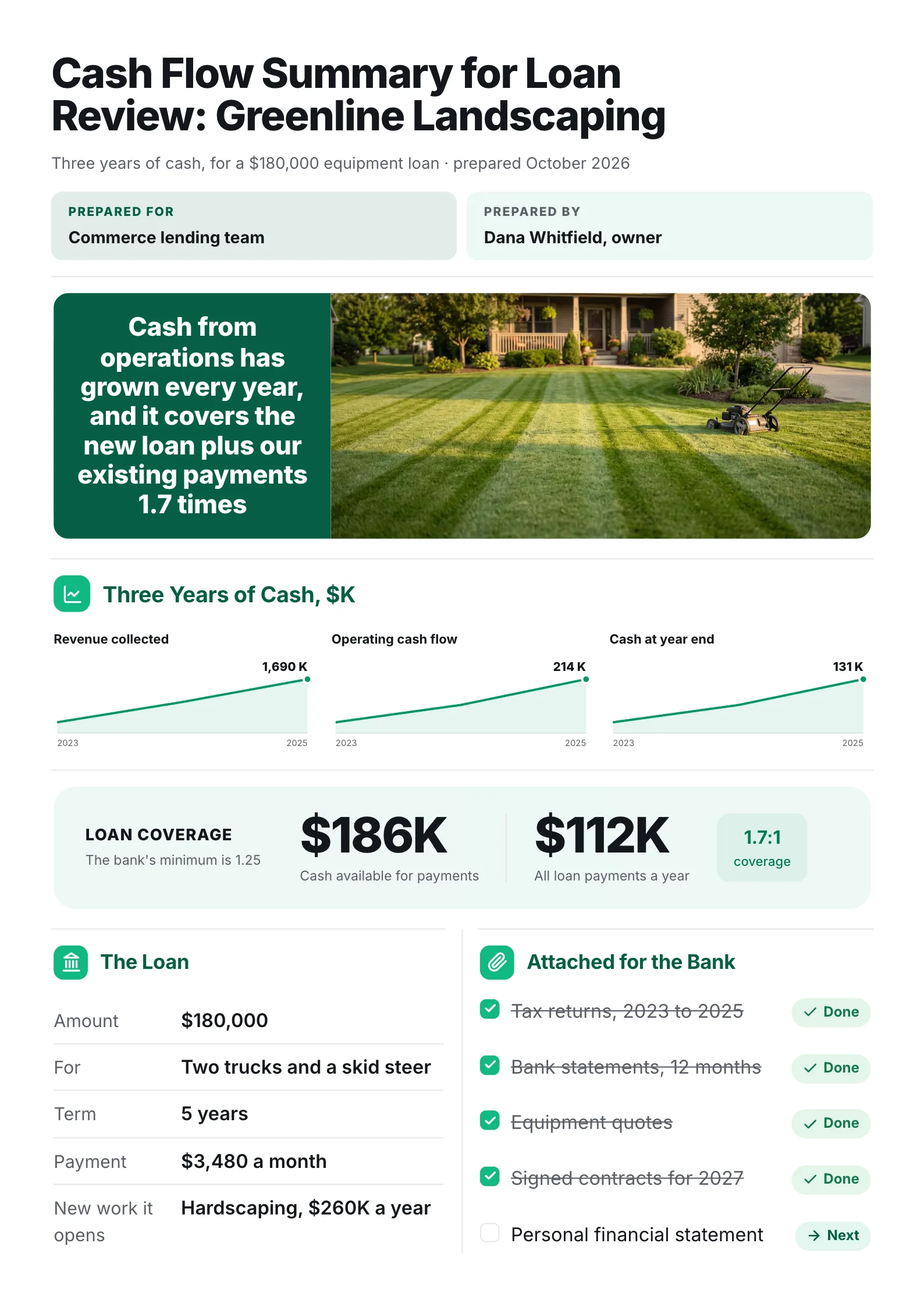 Cash Flow Summary: Loan ApplicationEdit for free(opens in a new tab)
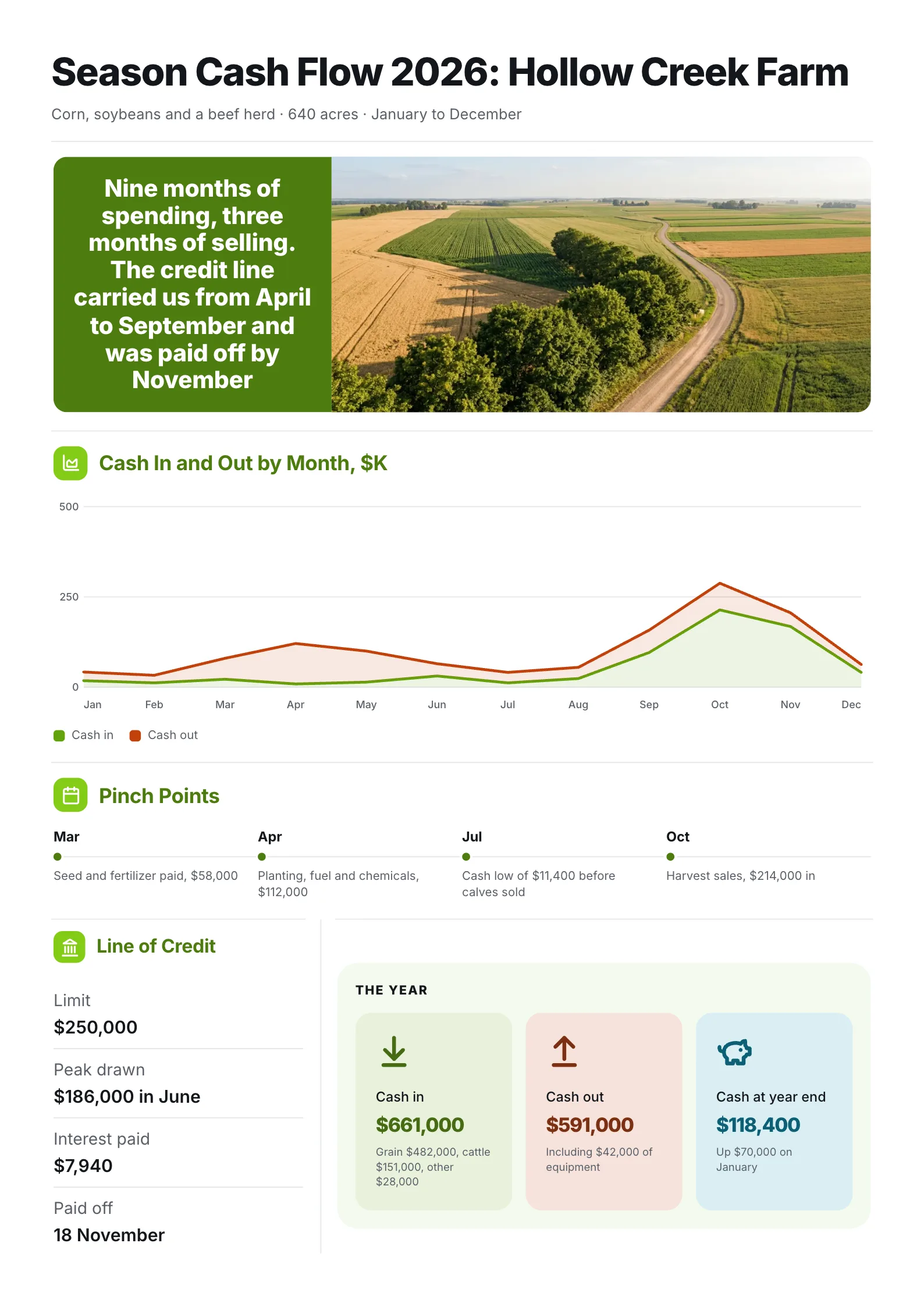 Cash Flow Summary: Farm SeasonEdit for free(opens in a new tab)
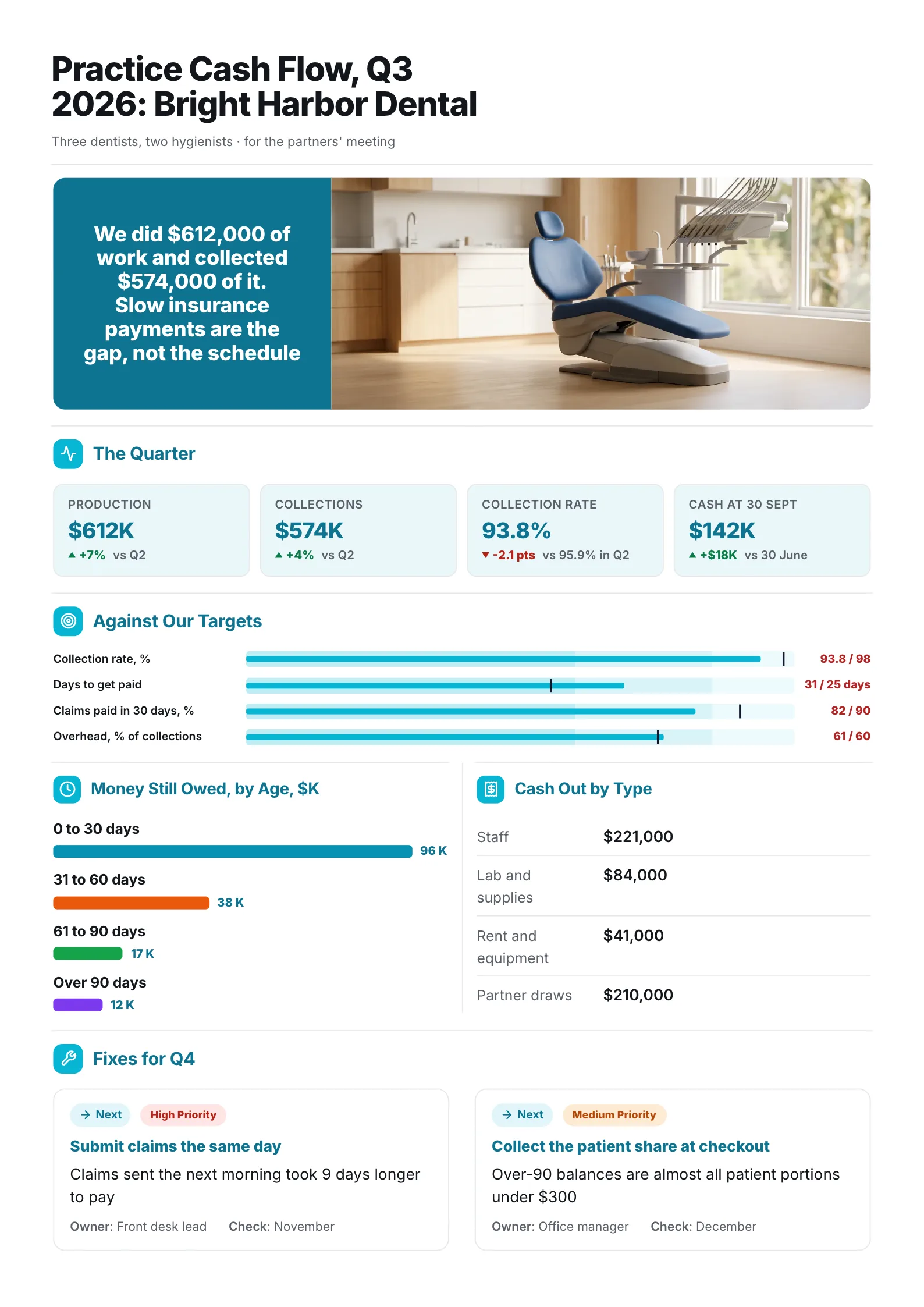 Cash Flow Summary: Dental Practice QuarterEdit for free(opens in a new tab)
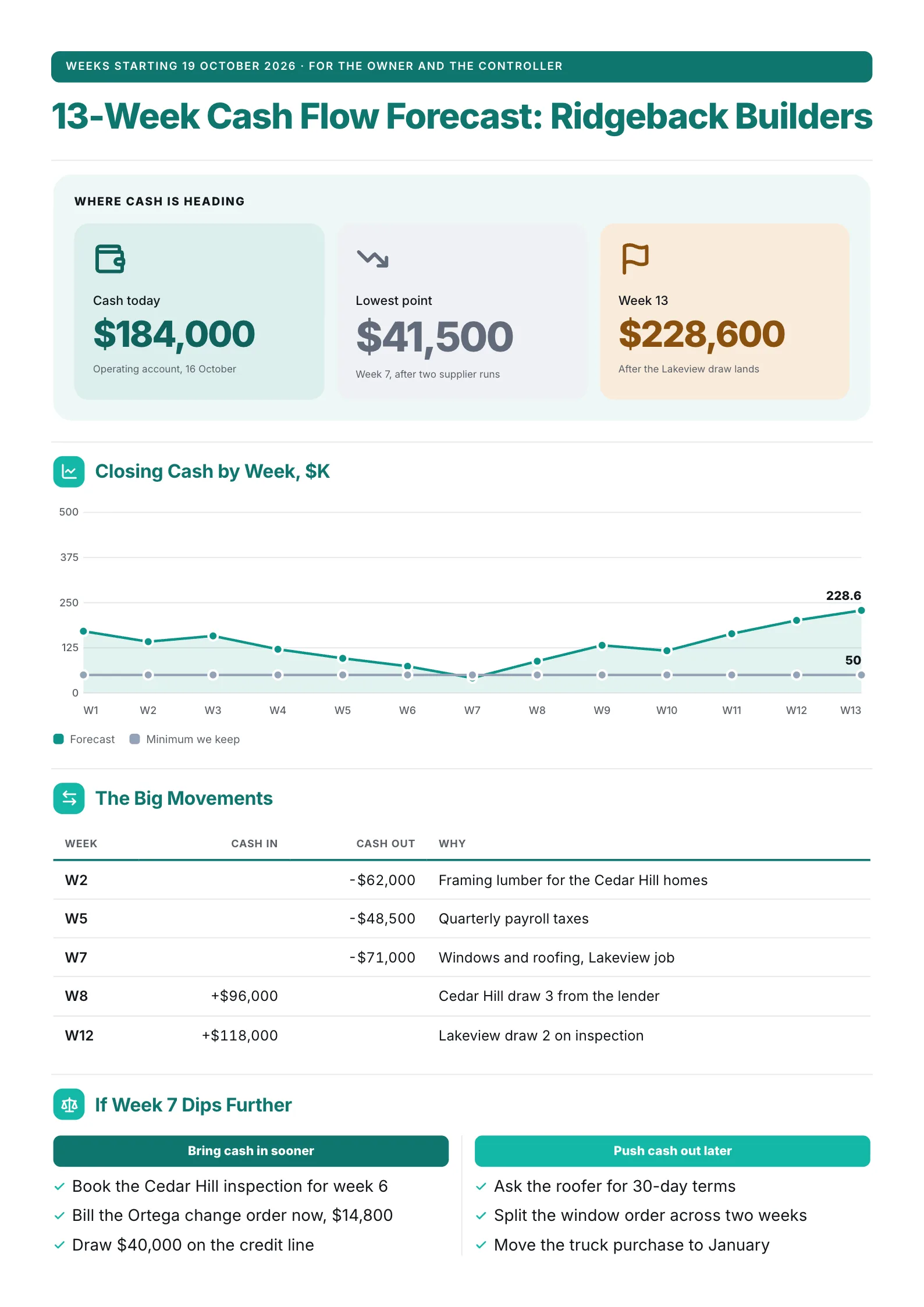 Cash Flow Summary: 13-Week ForecastEdit for free(opens in a new tab)
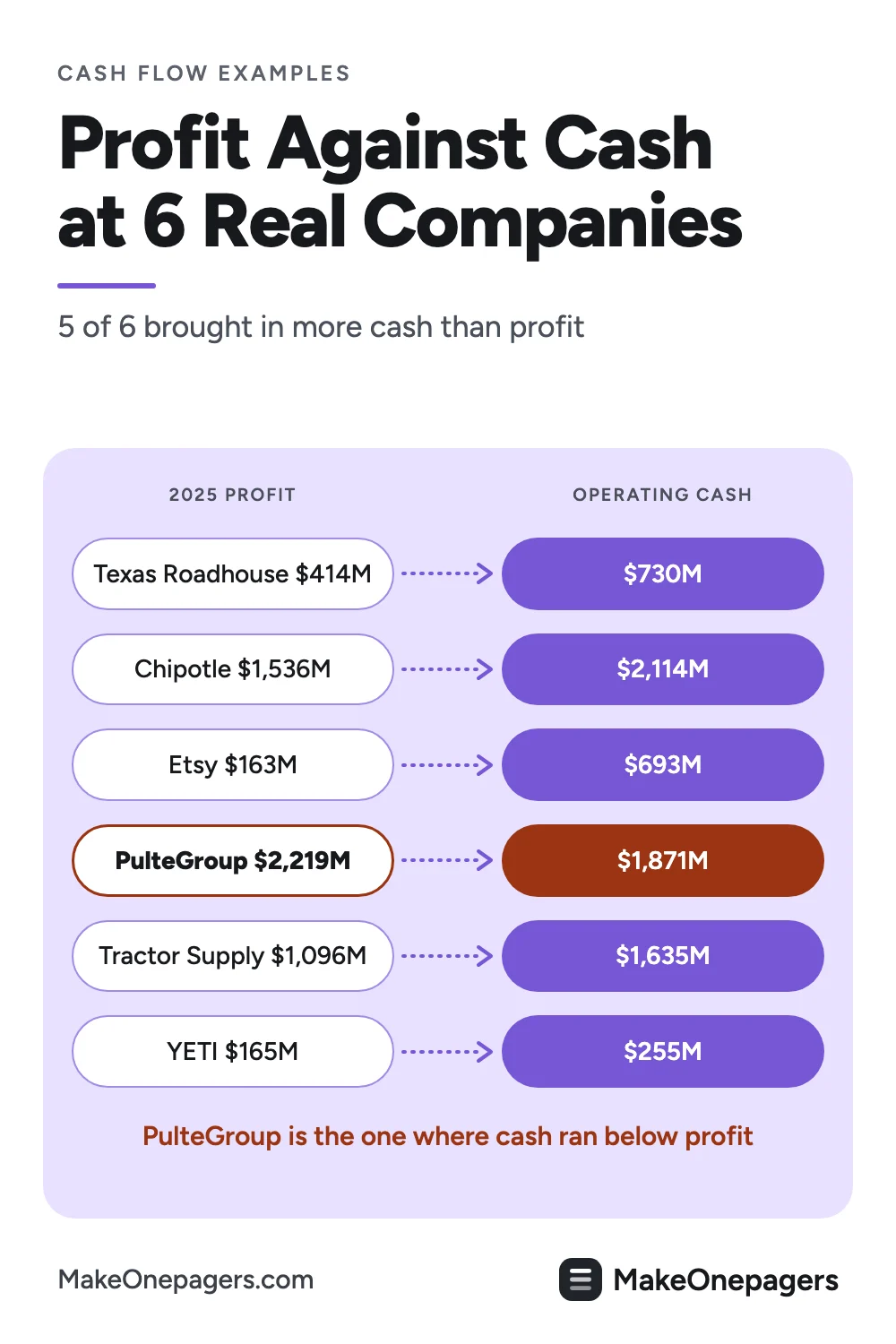
Five of the six brought in more cash from operations than they booked as profit. Four of them still ended the year with less cash in the bank. Once you see why, you'll read your own numbers differently, and you'll know which lines your one-page summary needs.
Six companies' 2025 cash in one table
All figures are in millions of dollars for each company's 2025 fiscal year, read from the numbers each one tagged in its annual report.
| Company | Profit | Operating | Investing | Financing | Capital spending | Paid to shareholders | Change in cash |
|---|---|---|---|---|---|---|---|
| Texas Roadhouse | $414.3 | $730.1 | -$482.8 | -$357.8 | $388.0 | $330.7 | down $110.5 |
| Chipotle | $1,535.8 | $2,113.9 | -$35.1 | -$2,470.9 | $666.3 | $2,425.5 | down $392.5 |
| Etsy | $163.0 | $693.4 | $32.1 | -$169.9 | $15.4 | $776.9 | up $593.2 |
| PulteGroup | $2,218.7 | $1,871.2 | -$80.4 | -$1,435.7 | $122.7 | $1,376.7 | up $355.1 |
| Tractor Supply | $1,096.1 | $1,635.3 | -$778.6 | -$914.1 | $894.8 | $849.0 | down $57.4 |
| YETI | $165.4 | $254.7 | -$101.8 | -$321.4 | $42.7 | $297.8 | down $170.5 |
Source: each company's 2025 Form 10-K on SEC EDGAR, read October 30, 2026. "Paid to shareholders" adds share buybacks and dividends. Every filing is linked at the end.
Pick any row and you get the company's year in one line: what it earned, what the business brought in, what it spent and what it handed back. Your own cash flow works the same way, just with fewer zeros. Keep the table open as you read the five lessons below.
Example 1: profit and cash are two different numbers
Etsy earned $163.0 million in profit in 2025 and brought in $693.4 million in operating cash. That's more than four times its profit. A big part of the gap is costs that reduce profit without spending any cash, like depreciation and the value of shares paid to staff.
PulteGroup shows the opposite. It earned $2,218.7 million but brought in only $1,871.2 million from operations. A homebuilder pays for land and half-built houses before it gets paid, and its homes in inventory grew by $213.4 million during the year. That cash is sitting in houses, not in the bank. Pulte gets that cash back when the homes close, so its gap is timing.
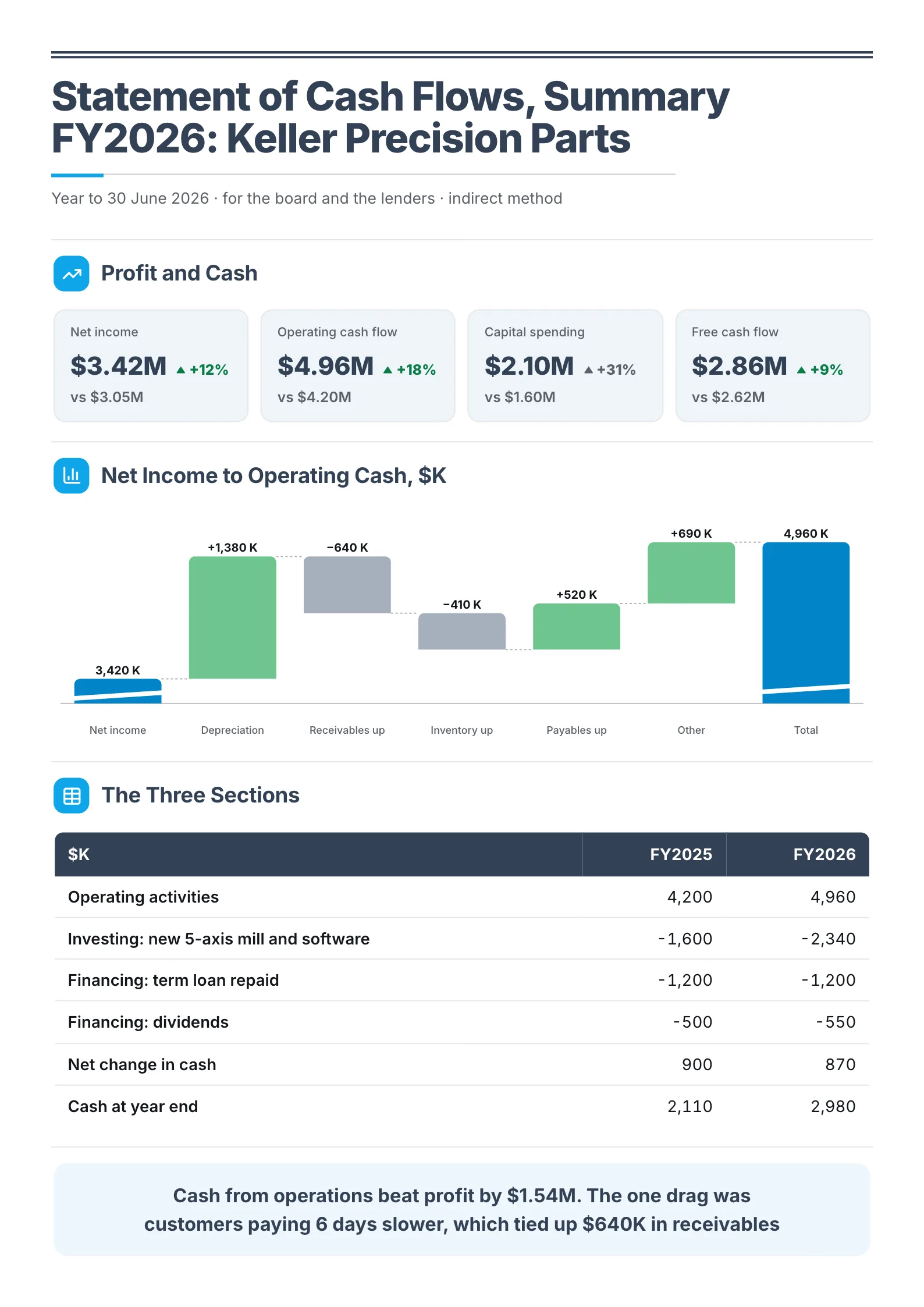
Your business has the same gap, usually from customers who owe you and stock on your shelf. When your customers pay slower, your profit stays the same and your cash drops. The indirect method shows you each piece. It starts with your profit, then adds back or subtracts every difference, so your reader sees exactly where the cash went.
 Edit this template
Sample names and figures. The bridge shows why cash beat profit by $1.54M, and what held it back: $640K tied up in slower customer payments and $410K more sitting in stock.
Example 2: a growing business spends its operating cash
Tractor Supply brought in $1,635.3 million from operations and put $894.8 million of it back into the business. That's 55% of its operating cash, spent on stores, distribution centers and equipment. Texas Roadhouse spent 53%, $388.0 million of $730.1 million, mostly on new restaurants.
Neither number is a problem. They're the cost of growing. But they explain why a profitable company can feel short of cash, and you'll feel the same thing the quarter you buy a truck, a press or a second location.
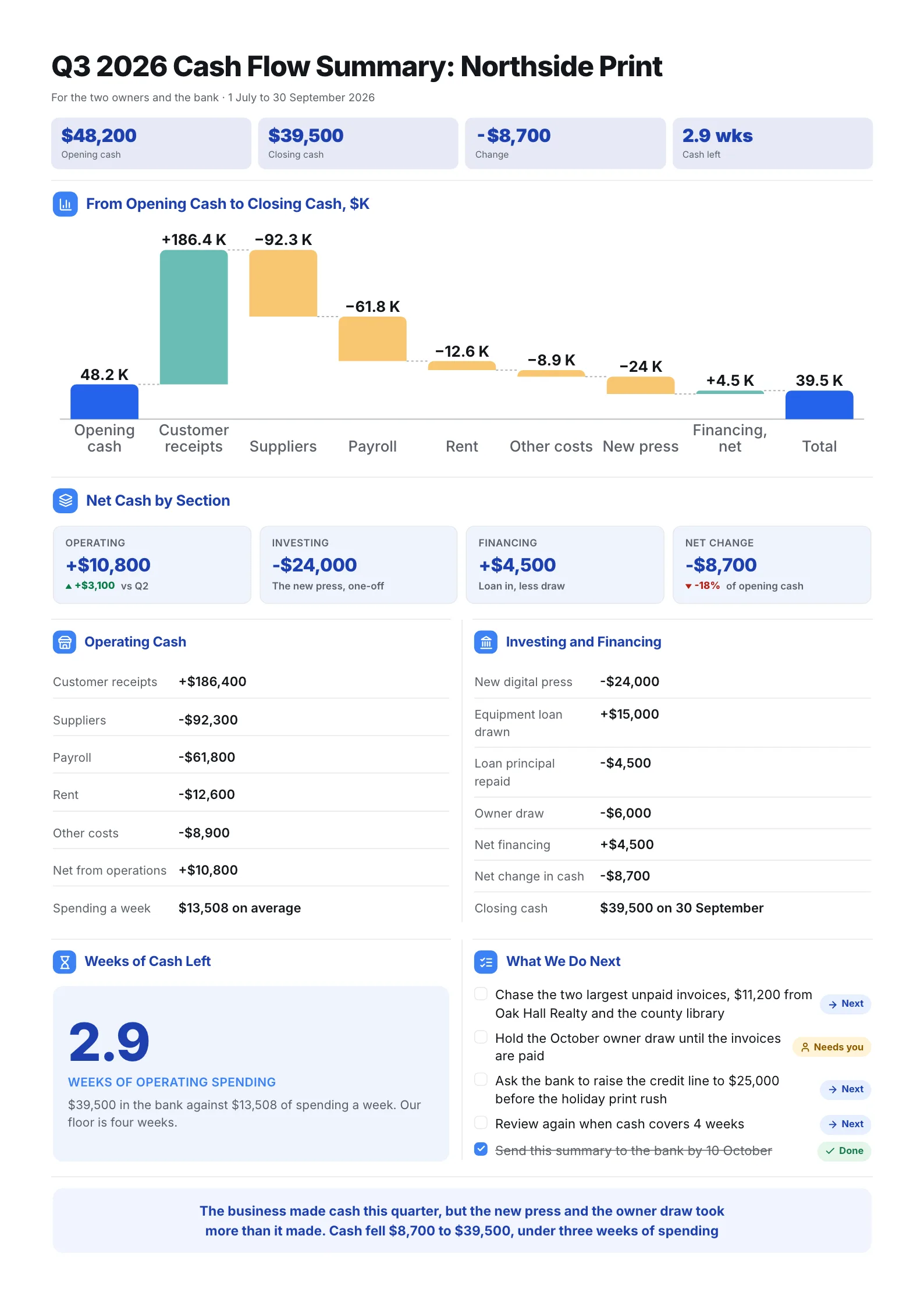
On your own summary, that spending sits in the investing section. Give it its own line so your partner or your banker doesn't mistake an equipment purchase for a bad quarter. A loan that paid for part of it goes in the financing section right below, so your reader sees both halves of the deal.
 Edit this template
Sample names and figures. Operations made $10,800, the new press took $24,000, and the loan and owner draw netted to $4,500.
Example 3: owners take cash out, too
Chipotle's operating cash was $2,113.9 million in 2025. It spent $2,425.5 million buying back its own shares. That's more than all the cash its restaurants brought in, and its cash fell $392.5 million for the year.
YETI did something similar on a smaller scale. It bought back $297.8 million of stock against $254.7 million of operating cash, and ended the year $170.5 million lower.
Etsy looks like it breaks this rule. It paid out $776.9 million against $693.4 million of operating cash, and its cash still rose $593.2 million. The financing section explains it: Etsy raised $700 million that year by selling convertible notes. When your balance rises in a year you took a lot out, check whether a loan did the lifting.
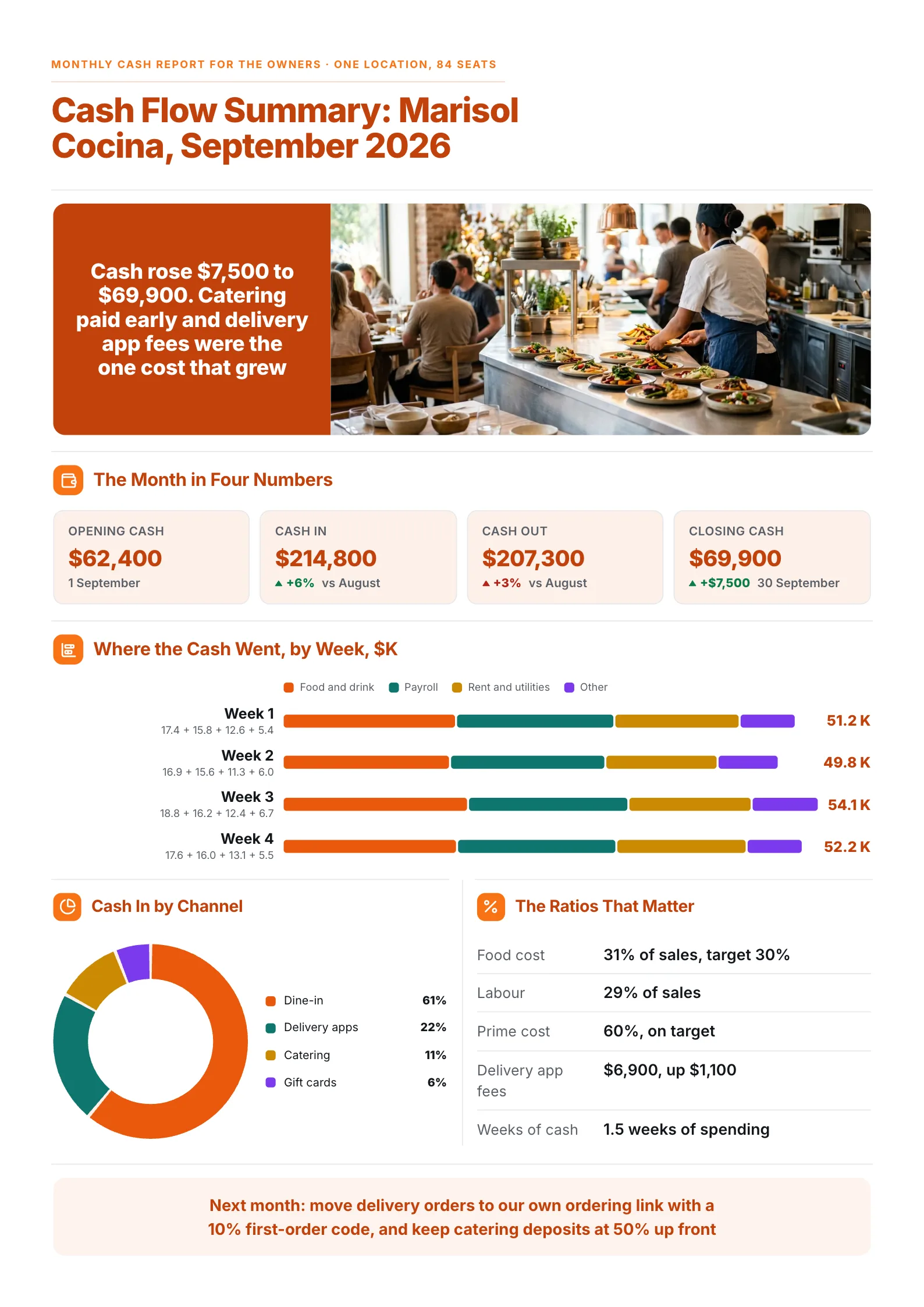
In your business, the financing section holds your owner's draw and your loan payments. Take out more than operations bring in and your balance falls, however good your year was. A monthly summary shows you that drift before your bank balance does, and you can trim next month's draw instead of finding out in a shortfall.
 Edit this template
Sample names and figures. Cash rose $7,500, and the summary still flags 1.5 weeks of spending as the number to watch.
Example 4: seasonal businesses swing all year
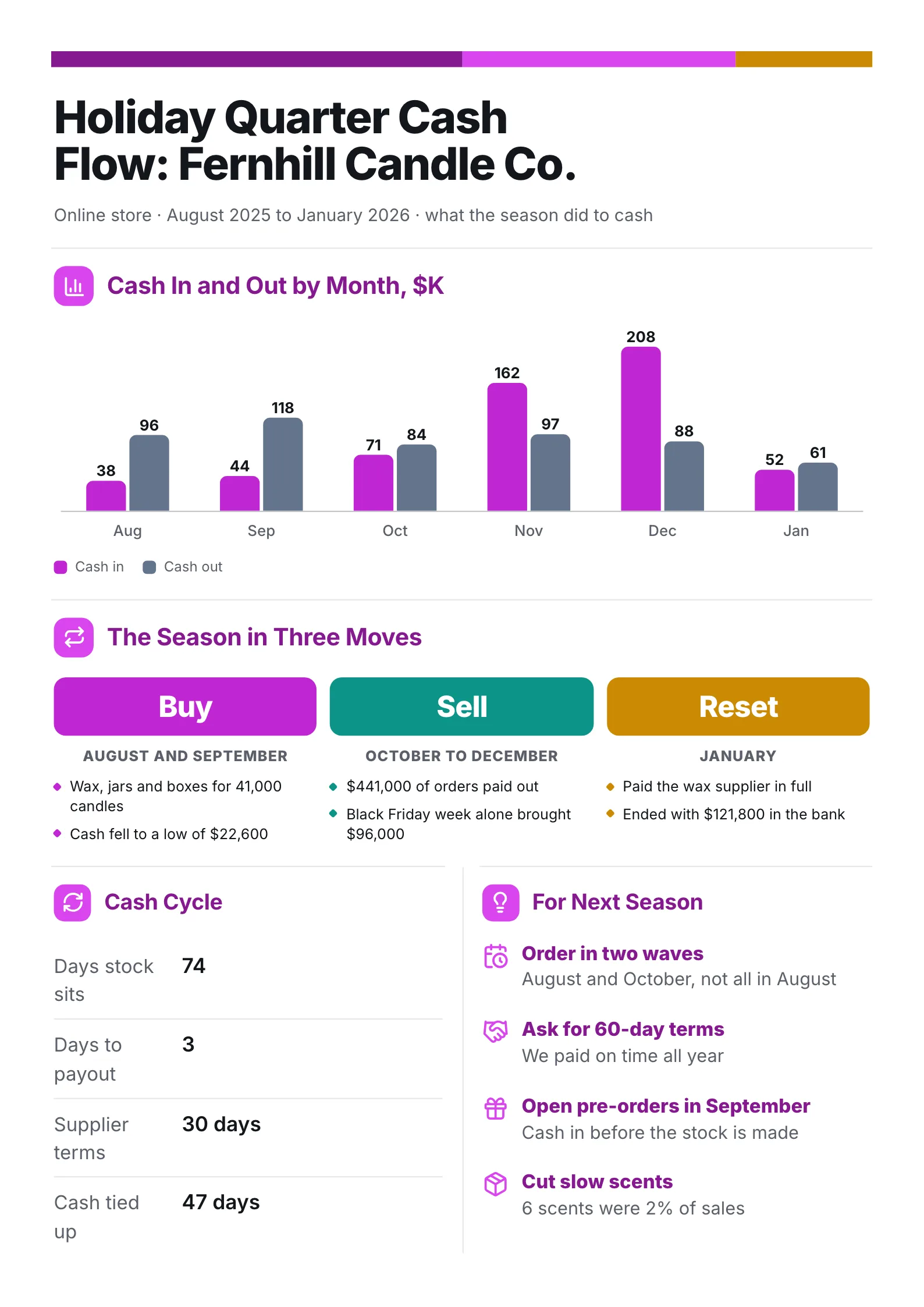
A yearly statement like YETI's can't show you the swing inside the year. A business that sells coolers, candles or gifts buys its stock months before the busy season. Your cash drops first and comes back later, and a yearly view hides the low point you have to survive.
The useful number for you is how long your cash sits tied up. Add the days your stock sits to the days it takes to get paid, then subtract the days your suppliers give you. The candle store below waits 74 days on stock and 3 days for payouts, and gets 30 days from suppliers. That leaves its cash tied up for 47 days.
 Edit this template
Sample names and figures. The plan for next season is to order in two waves and ask for 60-day supplier terms.
Example 5: a business that burns cash on purpose
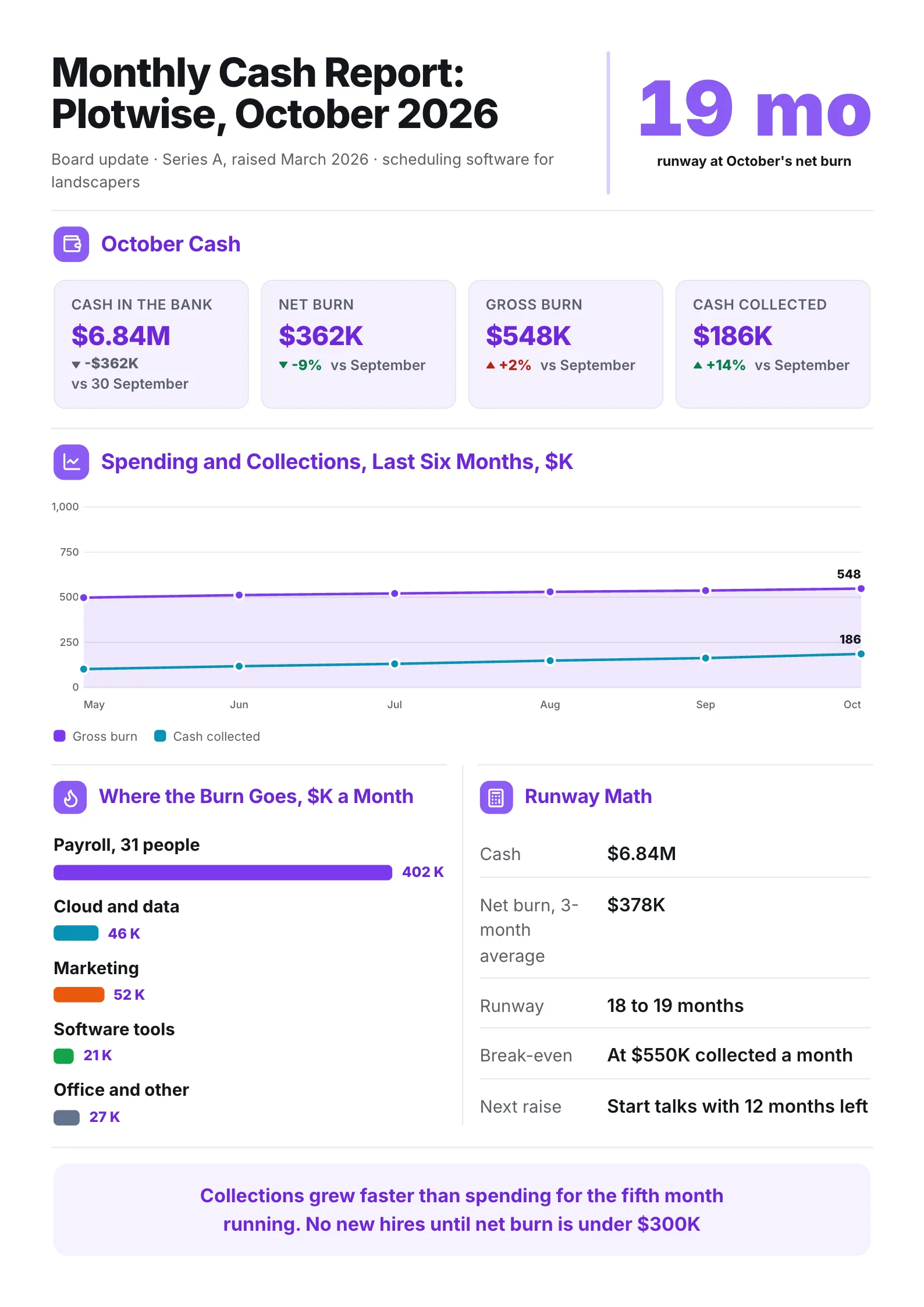
None of the six public companies lost cash from operations in 2025. If you run a young startup, you probably do, and your cash flow summary looks different. The headline number is net burn, the cash going out each month minus the cash coming in. Divide the bank balance by it and you get runway, the months left before the money runs out.
The startup below has $6.84M in the bank and a net burn of $362K in October. That gives it about 19 months at October's pace, and 18 to 19 months at its three-month average. Your investors will check both, so show the average beside the latest month instead of picking the kinder one.
 Edit this template
Sample names and figures. Runway is cash divided by net burn, so every hire shows up in the months left.
How to read any cash flow statement in a minute
You can run the same four checks on a public company's statement or on your own, and each takes a few seconds.
- Is operating cash above profit? Five of our six were. If yours is below profit, look at your stock and the money customers owe you.
- How much of operating cash goes back into the business? It was 2% at Etsy and 55% at Tractor Supply.
- Where did the rest go? Look for loan payments, owner draws, buybacks and dividends in the financing section.
- Did the balance go up or down, and why? Your one sentence that answers this is the most useful line on your page.
For a blank one-page layout and a worked quarter, see our cash flow summary template post. To set cash beside profit, our profit and loss template post shows the income side.
The six filings we read
| Company | What it sells | Fiscal year ended | Filing |
|---|---|---|---|
| Texas Roadhouse | Steakhouse restaurants | December 30, 2025 | Form 10-K, filed February 27, 2026 |
| Chipotle Mexican Grill | Fast-casual restaurants | December 31, 2025 | Form 10-K, filed February 4, 2026 |
| Etsy | Online marketplace | December 31, 2025 | Form 10-K, filed February 19, 2026 |
| PulteGroup | Homebuilding | December 31, 2025 | Form 10-K, filed February 4, 2026 |
| Tractor Supply | Rural lifestyle stores | December 27, 2025 | Form 10-K, filed February 19, 2026 |
| YETI | Coolers and drinkware | January 3, 2026 | Form 10-K, filed February 27, 2026 |
We read each company's tagged financial data through the SEC's EDGAR system on October 30, 2026. Texas Roadhouse's profit is its consolidated net income, including the share that belongs to minority partners.
Start with your cash sentence
Before you build your own summary, write the sentence that explains your change in cash, the way each company's year fits in one line. "Cash fell $8,700 because the new press cost more than the quarter made" tells your reader everything that matters. Then lay out the numbers behind it in a MakeOnepagers cash flow design, with operating, investing and financing already in their own sections.
Frequently asked questions
What are the three types of cash flow?
Operating, investing and financing. Operating covers money from customers and money paid for supplies, staff and rent. Investing covers buying and selling long-lived things like equipment. Financing covers loans, owner money in and out, and dividends.
What is a good example of positive cash flow?
Texas Roadhouse brought in $730.1 million from operations in 2025, about 1.8 times its profit. Positive operating cash means the day-to-day business pays for itself. The total can still fall, as it did there, when spending on new restaurants and shareholders is larger.
Can a profitable business run out of cash?
Yes. Profit can sit in stock and unpaid invoices. PulteGroup's operating cash ran $347.5M below its profit because cash went into land and homes, though it had plenty left. A small business with slow-paying customers has no such cushion, and that's why your summary should show the weeks of cash you have left.
Is a cash flow statement the same as a cash flow summary?
A statement is the formal version with every line in three sections. A summary keeps your totals and the few lines that moved, on one page, for you, your board or your bank.




